PART2:Three Families Returned Milo for Loving Too Much—Then a Widowed Woman Walked Into the Shelter and Said, “So Do I”
PART2
The first meeting lasted a long time.
Longer than most.
We used the small shelter garden where prospective adopters could spend time with dogs away from the noise of the kennel rows.
Milo came outside on leash.
He did not pull.
Did not race toward Elizabeth.
He walked beside me until we reached the bench.
Then stopped.
Elizabeth was already sitting.
Hands folded in her lap.
She did not call him.
That helped.
She waited.
Milo looked at me.
Then at her.
Then back toward the shelter door.
I unclipped the leash.
He stood there for perhaps twenty seconds.
Elizabeth spoke quietly.
“Hello, Milo.”
His ears moved.
That was all.
Then he walked toward her.
Slowly.
One step.
Another.
He sniffed her shoe.
Her coat.
Her hand.
Elizabeth kept her fingers loose.
No grabbing.
No patting the top of his head.
No excited baby voice.
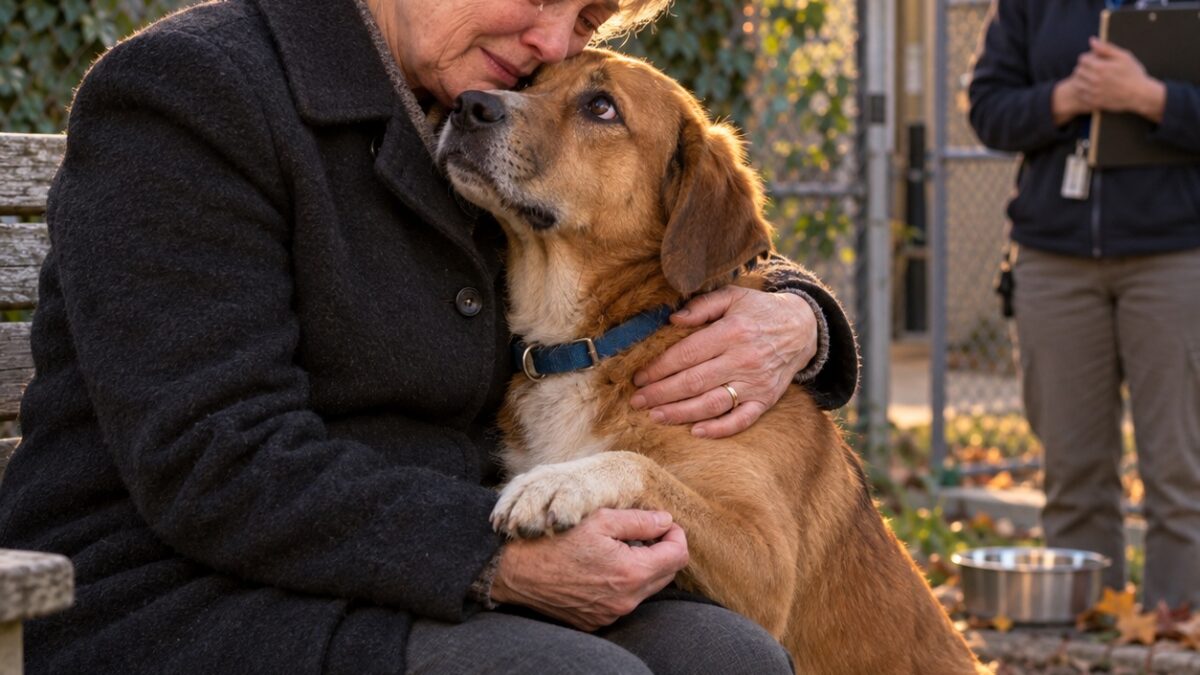
After a minute, Milo placed his front paws against the edge of the bench.
Then climbed beside her.
Immediately.
As if the decision had already been made somewhere inside him.
Elizabeth laughed.
A tiny laugh.
Surprised.
“Oh.”
Milo sat pressed against her thigh.
His head slightly raised.
Eyes on her face.
Watching.
Checking.
I knew that look.
He was making sure she had not disappeared.
Elizabeth touched the side of his neck.
Slowly.
Milo exhaled.
His body softened.
That was what struck me.
At the shelter, Milo was almost always alert.
If someone moved toward a door, his body changed.
If footsteps disappeared down the hallway, he watched.
If a kennel gate closed, he became restless.
But beside Elizabeth, something settled.
His breathing slowed.
His ears dropped naturally.
Not sadness.
Peace.
I stood a few steps away.
Elizabeth looked over.
“Is he always like this?”
“No.”
I believed she deserved the truth.
“He’s normally more anxious.”
“He struggles when people leave.”
“That’s why he’s been returned.”
Elizabeth stroked the top of his head.
Milo leaned farther into her.
“He can’t stand being alone?”
“No.”
She nodded.
Not worried.
Almost thoughtful.
Then she said:
“Neither can I.”
I remember the exact way she said it.
Not as a joke.
Not sentimental.
Simply a fact.
She looked down at Milo.
“My husband died two years ago.”
Milo’s eyes stayed on her.
“The house used to have sounds.”
“His shoes.”
“His coughing.”
“The cabinet in the kitchen that he never closed properly.”
“His newspaper.”
She smiled briefly.
“He had this awful habit of tapping his fingers against the table when he read.”
She looked toward the shelter fence.
“I hated it.”
“Then he died.”
“And I would have given anything to hear that tapping again.”
I said nothing.
She continued.
“Now I hear my own breathing.”
“The clock.”
“The heating system.”
“You know what it’s like when a room is full of silence and nothing you do can fill it?”
I did know.
More than she knew.
I lived alone too.
There were nights after shelter shifts when I returned to my apartment and left the television on in another room simply because a human voice, even one I was not listening to, made the place feel less empty.
I could have told her.
But the moment belonged to Elizabeth and Milo.
So I stayed quiet.
Milo lifted one paw.
Placed it on Elizabeth’s knee.
Then left it there.
No pawing.
No demand.
Just contact.
Elizabeth looked down.
Her lips pressed together.
For a second, I thought she might cry.
Instead, she covered Milo’s paw with her hand.
“I’m here.”
she whispered.
I do not know whether Milo understood the words.
But he did not move his paw.
Neither did she.
Elizabeth returned the next morning at ten.
Exactly.
She had called at 9:42.
“I don’t want to bother you.”
“You’re not bothering me.”
“Would it be all right if I saw Milo again?”
“Yes.”
“How soon?”
I smiled.
“Whenever you want.”
“I’m already in the parking lot.”
That made me laugh.
She came inside carrying a paperback book.
“Do dogs mind reading?”
“Depends on the dog.”
“What about Milo?”
“He mostly minds abandonment.”
Elizabeth nodded as if I had given her practical medical information.
“Then I suppose reading is manageable.”
We went to the garden.
Milo saw her through the glass door.
His body changed instantly.
He stood.
Tail moving.
Not wildly.
But unmistakably.
Elizabeth crouched.
Milo went straight to her.
No twenty-second inspection this time.
He pressed his head against her chest.
She wrapped one arm around him.
Not tightly.
Enough.
Then she sat on the bench.
Opened her book.
Started reading aloud.
I returned to work.
Twenty minutes later, I looked through my office window.
Elizabeth was still reading.
Milo lay at her feet.
Eyes closed.
Not watching the door.
That mattered.
She came back the next day.
And the next.
For two weeks, Elizabeth visited every day.
Sometimes she read.
Sometimes they walked slowly around the shelter grounds.
Milo did not need long walks.
He needed a person at the other end of the leash.
That distinction mattered.
He walked beside Elizabeth with his head angled slightly upward.
Checking.
Always checking.
At first, every few steps.
Then less.
As though repetition was teaching him something.
She is still here.
Still here.
Still here.
One afternoon, I saw Elizabeth stop near the garden fence.
She crouched in front of Milo.
Took his face between both hands.
Said something I could not hear through the window.
Milo’s tail started moving.
Not the cautious little movement I knew.
A full sweep.
Again.
Again.
Again.
His whole body joined.
Elizabeth laughed.
Then pressed her forehead against his.
I looked away.
Not because I was uncomfortable.
Because shelter work teaches you to recognize moments that are not yours to invade.
During those two weeks, I spoke with Elizabeth about Milo’s history.
All three returns.
I did not hide anything.
“He may cry when you close a door.”
“That’s okay.”
“He may want to sleep near you.”
“That’s okay.”
“He may follow you into the kitchen.”
“Good.”
“He may follow you to the bathroom door.”
She laughed.
“I’ve been married.”
“I’m familiar with people asking questions through bathroom doors.”
I laughed too.
Then:
“Elizabeth.”
“Yes?”
“You will need to help him feel safe when you eventually leave the house.”
“I know.”
“He can learn.”
“But it has to be gradual.”
“I know.”
“He shouldn’t become frightened every time you go buy groceries.”
“No.”
She became serious.
“I don’t want to make his fear worse because I like being needed.”
That answer stopped me.
Many adopters say:
“I’m home all the time.”
Which sounds ideal until life changes.
Elizabeth understood something more subtle.
Milo’s closeness suited her.
But loving him also meant helping him develop enough security to survive ordinary separation.
Not rejecting his need.
Not feeding the fear either.
“That’s exactly right.”
I said.
She nodded.
“We’ll learn.”
We.
That word.
Not:
I’ll train him.
Not:
He’ll adjust.
We.
Milo’s third family had once told us:
“We tried everything.”
They had kept him six weeks.
They were good people.
I want that clear.
Not cruel.
Not heartless.
They worked long hours.
Their life simply required a dog who could spend several hours alone without distress.
Milo could not.
They brought him back reluctantly.
The woman cried.
Her husband said:
“We love him.”
“But he needs something we can’t give.”
At the time, those words sounded like failure.
Later, I understood they were honesty.
A home is not right simply because people are kind.
Compatibility matters.
Needs matter.
Sometimes love is admitting you cannot provide what another living creature requires.
The problem was not that Milo had been returned by monsters.
The problem was that each return taught him that closeness eventually ended in loss.
Elizabeth was different because what Milo needed did not frighten her.
It met a need she already carried.
That did not automatically guarantee success.
But it gave them a foundation the previous homes lacked.
On the tenth day, Elizabeth arrived fifteen minutes late.
Milo was already in the garden.
I had brought him out because he had started waiting near the door around ten.
At 10:05, he watched the gate.
At 10:10, he began pacing.
My stomach tightened.
I thought:
This is the test.
At 10:14, Elizabeth hurried through the gate.
Coat open.
Hair windblown.
“I’m sorry.”
Milo ran.
Actually ran.
Straight to her.
Elizabeth dropped to her knees.
He pressed himself against her.
She held him.
“I know.”
“I’m late.”
“I know.”
“I came back.”
Milo’s entire body moved with his tail.
I stood nearby.
That phrase stayed with me.
I came back.
Perhaps that was what Milo had needed more than anything.
Not a person who never left a room.
A person whose leaving did not predict permanent loss.
Those are different forms of safety.
Over time, Elizabeth could teach him the second.
But first, he needed enough evidence to believe in it.
The adoption day arrived on a Friday afternoon.
The shelter was quiet.
One of those rare hours when phones were not ringing and nobody was unloading bags of food or arguing about paperwork.
I had Milo’s adoption packet ready.
Medical records.
Feeding information.
Contact numbers.
Notes about separation anxiety.
Recommended routine.
Elizabeth sat across from my desk.
Milo sat beside her chair.
Of course.
His shoulder touched her ankle.
I went through every page.
Not quickly.
I wanted her to understand the commitment.
She initialed.
Signed.
Asked questions.
Good questions.
Then I reached the final page.
I placed the pen down.
Looked at her.
“You know something?”
“What?”
“A lot of people brought Milo back saying he loved too much.”
Elizabeth glanced at him.
He looked up immediately.
“They said he couldn’t be alone.”
“He needed too much attention.”
“He was too attached.”
Elizabeth smiled.
This time the smile reached her eyes.
“And that’s supposed to be a problem?”
I laughed.
“No.”
“Not anymore.”
She signed.
Milo was officially hers.
Or perhaps, more accurately, they were officially each other’s.
I expected Milo to walk out.
Instead, Elizabeth crouched.
He placed his front paws against her.
She lifted him.
Milo settled into her arms as though that arrangement had been negotiated long ago.
His head rested on her shoulder.
One paw over the front of her coat.
I followed them to the lobby.
The automatic door opened.
Cold air entered.
Elizabeth stepped through.
Milo looked over her shoulder toward me.
For one second, the old shelter worker pain hit.
Every adoption has it.
You spend days.
Weeks.
Months.
You learn an animal.
Feed them.
Clean after them.
Watch for changes.
Fall in love despite yourself.
Then the good outcome requires saying goodbye.
I felt pressure in my chest.
But it changed almost immediately.
Lightness.
Because Milo was not being carried away from safety.
He was being carried toward it.
The door closed.
I stood inside looking through glass.
Elizabeth reached her car.
Opened passenger door.
Placed Milo gently inside.
Before closing it, she leaned in.
Said something.
Milo’s tail moved.
Then the car left.
For the first time, I watched Milo disappear through the shelter gate without wondering when he would come back.
I thought about him constantly that weekend.
Shelter workers pretend we do not.
We absolutely do.
Saturday morning:
I wonder if he slept.
Saturday afternoon:
I wonder if he ate.
Saturday night:
I wonder if she left him alone yet.
Sunday:
Maybe I should call.
I did not.
People need space to begin.
Monday:
Still did not call.
Tuesday morning, my phone rang.
Elizabeth.
My stomach tightened before answering.
That is what three returns do.
Even when you trust the adopter.
“Hello?”
“Margot.”
Her voice sounded strange.
I immediately prepared myself.
“What happened?”
She laughed.
“Oh.”
“No.”
“Nothing happened.”
Then:
“I thought you might want to know he sleeps in my bed.”
I sat back.
“Already?”
“He decided.”
“Of course he did.”
“I bought him a bed.”
“Very nice bed.”
“Expensive.”
“Where is it?”
“In the corner.”
“Unused.”
I laughed.
Elizabeth continued.
“He wakes before me.”
“And the first thing he does is put his head on my pillow.”
“Sometimes directly on my face.”
“That sounds like Milo.”
“He follows me downstairs.”
“He sits outside the bathroom.”
“He lies against my feet while I read.”
Her voice softened.
“The house isn’t quiet anymore.”
I stopped laughing.
“Not because he makes a lot of noise.”
“He doesn’t.”
“It’s his breathing.”
“His paws.”
“The sound of him shifting on the floor.”
“Sometimes his collar touches the bowl.”
She paused.
“It fills things.”
I knew exactly what she meant.
She continued:
“I had forgotten what it felt like to need somebody.”
Then:
“And I had forgotten what it felt like when somebody needed me.”
There was silence between us.
Not empty silence.
The kind filled with understanding.
I closed my eyes.
Imagined Elizabeth in her chair.
Milo near her feet.
A house that had held one person’s breathing now holding two.
“Sounds like he’s home.”
I said.
Elizabeth’s voice broke slightly.
“Yes.”
“He is.”
I still worried about one thing.
Separation.
A week later, I called.
“How’s he doing when you leave?”
“We’re working on it.”
“How?”
“Very small.”
She explained.
First, she walked to the mailbox.
Milo waited inside.
She returned.
Then two minutes.
Five.
A short walk without him.
Then a quick grocery trip.
At first Milo waited near the door.
Sometimes whined.
But Elizabeth came back.
Every time.
She did not punish the anxiety.
Did not make dramatic reunions either.
She simply returned.
Again.
Again.
Again.
Evidence.
That word stayed with me.
Milo needed evidence that absence could end in reunion.
His first three homes had accidentally taught him the opposite.
Elizabeth was teaching him a new pattern.
Slowly.
“I don’t need him to love being alone.”
she told me.
“I just want him to know alone does not mean abandoned.”
That may be one of the kindest sentences I have ever heard from an adopter.
Weeks became months.
Shelter life moved.
New dogs arrived.
Others left.
One old shepherd finally found a home after 143 days.
A litter of puppies created complete chaos.
A terrier learned to escape three different kennel latches and became a local criminal legend.
Milo became one of the stories I carried.
Not forgotten.
Just safely elsewhere.
Every once in a while, Elizabeth sent a photograph.
Milo lying on her feet while she read.
Milo beside her chair.
Milo on the porch.
Milo asleep with his head on one of her shoes.
In every photograph, some part of his body touched something connected to Elizabeth.
Her foot.
Chair.
Blanket.
Hand.
And Elizabeth looked different too.
It is dangerous to claim we can diagnose happiness from photographs.
I know that.
But I could see change.
Shoulders relaxed.
Eyes brighter.
Smile less careful.
They looked like two living beings who had stopped apologizing for wanting company.
Several months after the adoption, Elizabeth walked into the shelter again.
I was at my desk.
I heard the lobby door.
Then nails hitting tile.
Fast.
A dog came around the corner.
Milo.
He saw me.
Ran.
I crouched automatically.
“Milo!”
He reached me.
Tail moving.
Body pressing against my knees.
I hugged him.
He looked healthy.
Coat better.
Eyes bright.
Confident.
I could have cried.
Then something happened that mattered even more.
After perhaps twenty seconds, Milo pulled away.
Turned.
Ran back to Elizabeth.
No hesitation.
He sat at her feet.
Looked up at her.
Elizabeth smiled.
There it was.
Safety.
Belonging.
Love.
Not desperation.
He could greet me.
Remember me.
Enjoy me.
Then return to his person because he knew exactly where home was.
Elizabeth laughed.
“He still can’t stay alone.”
“Neither can I.”
I laughed too.
“How bad is it?”
“Better.”
“He can handle errands.”
“Short periods.”
“But if I’m home?”
She looked at Milo.
“He wants to be with me.”
Milo leaned against her leg.
“And that is perfectly fine with me.”
I nodded.
“Seems fair.”
They stayed almost an hour.
Elizabeth talked with staff members who remembered him.
Everyone wanted to see Milo.
This time, attention did not make him anxious.
Why would it?
He had an anchor.
If a person approached, he greeted them.
Then checked Elizabeth.
She was there.
He did not need every person to become permanent.
That was new.
Perhaps that is what secure attachment looks like.
Not needing everybody to stay.
Knowing one person will.
I asked Elizabeth:
“Do you ever regret choosing the dog everyone said was too attached?”
She looked genuinely confused by the question.
“No.”
Then she thought.
“I think the phrase was wrong.”
“What phrase?”
“Too attached.”
She looked down.
“Milo doesn’t love too much.”
“He was afraid of losing people.”
“That isn’t the same thing.”
I felt something tighten in my throat.
She was right.
We had all used the shelter shorthand because behavior needed a label.
Separation anxiety.
Clingy.
Attached.
But labels sometimes flatten a story.
Milo was not demanding because he believed he deserved endless attention.
He was frightened because closeness had ended repeatedly.
Elizabeth did not resent that fear.
She understood it.
Her own great fear was the opposite version of the same thing.
The person beside her husband’s chair was gone.
The room remained.
The silence remained.
She knew what absence could do to a living thing.
Milo did too.
They recognized each other there.
A year after Milo left, Elizabeth still sends photographs.
Not constantly.
Thank goodness.
I have enough shelter photos to fill a server farm.
But occasionally.
One arrived in spring.
Elizabeth in a chair on her porch.
Book open.
Milo stretched across her feet.
Sunset behind them.
Another:
Milo asleep on the bed.
Head occupying most of Elizabeth’s pillow.
She captioned it:
Still refuses to understand personal space.
I replied:
Return policy expired.
She sent:
Wouldn’t return him if you paid me.
The last photograph is my favorite.
Elizabeth asleep in her armchair.
Her hand hanging over one side.
Milo sits on the floor beneath it.
Eyes closed.
His head rests directly beneath her hand.
Not gripping.
Not begging.
Simply there.
Her fingers touch his fur.
Both asleep.
Both peaceful.
I printed it.
Keep it in my desk drawer.
Sometimes shelter work becomes heavy.
Very heavy.
People see adoption photos.
They do not always see surrender forms.
Medical neglect.
Fear.
The dog who has waited months.
The kennel that becomes empty because an animal died instead of being adopted.
The family crying because they have no money for treatment.
The volunteer who takes a difficult case home and comes back with scratches and tears.
You accumulate stories.
Some stay.
On difficult days, I open my drawer.
Look at Elizabeth and Milo.
That photograph does not erase everything hard about the work.
It reminds me why the hard work is worth surviving.
Sometimes the job is not changing an animal.
Sometimes it is finding the environment where the animal no longer has to be treated as wrong.
Milo had been called too much.
Too needy.
Too attached.
Too anxious.
Too dependent.
Those descriptions were not completely false.
He did struggle with separation.
He did seek constant closeness.
He did need more reassurance than many dogs.
What changed was not Milo becoming an entirely different dog.
What changed was the meaning of his needs inside the right home.
That distinction matters.
A trait can become unbearable in one environment and deeply compatible in another.
Milo did not become “less” so Elizabeth could love him.
Elizabeth did not demand that his deepest instinct disappear.
She helped him feel safer without shaming him for wanting connection.
And he did something similar for her.
He did not cure grief.
I would never say that.
Grief is not an illness a dog fixes.
Elizabeth still missed her husband.
She still carried years they had shared.
But Milo changed the texture of her days.
The house contained footsteps again.
Breathing.
Routine.
Warmth beside a chair.
Another being waiting for morning.
That is not a cure.
It is companionship.
Sometimes companionship is enough to make silence livable.
I thought about my own apartment more after meeting Elizabeth.
I had almost told her that first day.
About coming home late.
Setting my keys down.
Hearing absolutely nothing.
Sometimes talking aloud simply because my own voice made the rooms feel occupied.
I never told her.
Did not need to.
But Milo and Elizabeth changed something in me too.
I stopped treating the desire for company as weakness.
We live in a culture that praises independence constantly.
Be self-sufficient.
Do not need anyone.
Do not be clingy.
Do not ask too much.
Give people space.
All useful sometimes.
But taken too far, we start acting as though needing closeness is some embarrassing character defect.
Animals do not pretend that.
Milo certainly did not.
He wanted someone.
He wanted proximity.
He wanted reassurance.
He wanted a body near his own.
Elizabeth wanted presence.
A reason to speak inside her own house.
A creature who noticed when she entered a room.
Neither need was shameful.
They simply needed to meet somewhere healthy.
They did.
I also became more careful when talking with adopters.
Now, when someone says:
“I want a dog who is affectionate,”
I ask:
“What does affectionate mean to you?”
Cuddling at night?
Following you around?
Being happy to greet you but comfortable alone?
Sitting on your lap?
Wanting constant contact?
Those are different dogs.
And different people.
We used to say:
“He’s very attached.”
Now I explain.
“He may become anxious when separated.”
“He will likely want to stay near you.”
“He needs a home prepared to work patiently on independence without rejecting closeness.”
That is more accurate.
Words matter.
“Too much” is lazy.
Too much for whom?
For what household?
For what schedule?
For what expectation?
Milo was too much for three families.
He was exactly enough for Elizabeth.
Both statements can be true.
Sometimes people hear the story and make the first three families villains.
I stop them.
No.
They returned him.
That hurt him.
But we do not know that keeping him would have been kinder.
A dog living with people who resent his needs can be lonelier than a dog in a shelter still waiting for the right match.
The mistake would have been pretending compatibility where none existed.
Elizabeth’s home worked because she did not see Milo’s need for closeness as an inconvenience she had to tolerate until he became different.
She saw companionship as part of what she was choosing.
That gave them somewhere to begin.
At the shelter, there are dogs with opposite needs.
Dogs who do not want hands constantly on them.
Dogs who need space.
Dogs who sleep across the room.
Dogs who love people but not laps.
Those dogs are not cold.
Milo was not defective for wanting contact.
Difference is not moral.
Compatibility is practical.
The right home is not the home that transforms every trait into something socially convenient.
It is the home where the animal can become safer and healthier without losing the right to be itself.
Elizabeth understood that instinctively.
One afternoon she called me again.
This was months after the adoption.
“Milo did something.”
My mind went immediately to disaster.
Shelter reflex.
“What?”
“I left him for forty minutes.”
“Okay.”
“He slept.”
I smiled.
“Really?”
“I checked the little camera when I came home.”
“He was on the couch.”
“He looked at the door once.”
“Then went back to sleep.”
She sounded proud enough to announce a graduation.
“That’s huge.”
“I know.”
Then she became quiet.
“Margot?”
“Yes?”
“I’m proud of him.”
“You should be.”
“But a tiny part of me felt…”
She struggled.
“Sad.”
I understood before she finished.
“Because he didn’t need you every second.”
“Yes.”
We both laughed softly.
Then I said:
“That’s love too.”
“What?”
“Helping someone become secure enough not to need proof every minute.”
Elizabeth was quiet.
Then:
“You’re right.”
“He still slept against my legs that night.”
“There you go.”
“Balance.”
She laughed.
That call reminded me that their match was not simply two lonely beings clinging indefinitely.
They were changing together.
Milo was learning:
Elizabeth can leave and return.
Elizabeth was learning:
Being loved does not require being indispensable every second.
That is healthier than dependency.
Their shared loneliness brought them together.
Trust gave the relationship room to grow beyond it.
That is why their story stayed with me.
It was not merely:
Lonely widow adopts clingy dog.
It was:
Two creatures with compatible wounds found each other, then slowly learned safety did not have to mean fear of separation.
That is much more beautiful.
And much less simple.
I still remember Milo’s third return.
The family brought his bed.
Food.
Favorite toy.
The woman cried while signing paperwork.
Milo stood at the shelter door watching their car.
For several minutes after they left, he would not turn around.
I remember thinking:
How many times can a dog watch a car leave before he stops believing in the next one?
Then Elizabeth arrived.
The day she adopted him, I watched her car leave.
This time I thought:
Please let this be the last time he leaves this building with everything he owns.
A year later, it is.
He has not returned.
Not as a surrendered dog.
Only as a visitor.
That difference gives me more satisfaction than anything else in the story.
When he visits, he still remembers me.
That feels good.
But he does not cling to me.
That feels even better.
The first time he ran back to Elizabeth after greeting me, I felt a tiny sting.
Then immediate happiness.
Shelter workers sometimes joke that successful adoption means being forgotten.
Not literally.
But if a dog no longer needs the shelter to feel safe, we did our job.
Milo could love me and leave with her.
No panic.
No confusion.
That is success.
Elizabeth says her house sounds different now.
Not loud.
Milo is not especially noisy.
His contribution is subtle.
Nails on the floor.
A sigh.
Collar tags.
Water bowl.
The soft jump onto a couch.
Breathing beside the bed.
Occasional scratch at a door.
It reminded me how much life is made of sounds we barely notice until they disappear.
Her husband’s tapping fingers.
Gone.
Now Milo’s paws.
Not replacement.
Never replacement.
A new sound beside an old silence.
That is what grief allows when we are lucky.
Not substitution.
Addition.
I once asked Elizabeth whether she worried loving another living creature so deeply would expose her to loss again.
She thought for a while.
“Of course.”
“Milo won’t live forever.”
“No.”
“Neither will I.”
Then she shrugged.
“But silence already hurt me.”
“I don’t think avoiding love would make loss less possible.”
“It would only make the time before loss emptier.”
I wrote that down after she left.
Not because I planned to quote her.
Because I needed to remember it.
Working at a shelter means loving animals you will eventually lose.
Through adoption.
Age.
Illness.
Sometimes circumstances.
You could protect yourself by staying detached.
Some workers try.
I have never met one who succeeds completely.
Elizabeth’s answer helped.
Love does not guarantee duration.
It makes duration matter.
Milo sleeps in her bed.
Still.
He still likes her chair.
Still follows her through the house more than the average dog.
Still prefers to know where she is.
None of that has disappeared.
But panic has softened.
He can rest when she goes to the market.
He can wait.
He has evidence now.
She returns.
The world does not end every time a door closes.
Imagine what that must feel like after three returns.
I cannot know.
But I can see the result.
His body changed.
Not his need for love.
His fear around it.
That may be the most precise way I can say it.
One year after adoption, Elizabeth sent a photo on the anniversary.
No caption at first.
Just the image.
She was sleeping in the chair.
Milo beneath her hand.
Same favorite photograph.
Then a second message:
One year.
Then:
He still follows me everywhere.
Then:
Thank God.
I laughed at my desk.
A volunteer asked what was funny.
I showed her.
She smiled.
“Is that the dog who got returned three times?”
“Yes.”
“For being clingy?”
“Yes.”
She looked at the photograph.
“Doesn’t look like a problem.”
“No.”
“Not there.”
That is why I keep the photo.
When someone asks why I still do this work, I can explain.
There are statistics.
Adoption rates.
Medical outcomes.
Community value.
Those matter.
But sometimes explanation is easier with one image.
Woman asleep.
Dog asleep.
Hand touching fur.
No shelter bars.
No return form.
No complaint.
No “too much.”
Just peace.
I show it and say:
“Sometimes the work is finding the right person.”
The person who looks at a trait everybody else called a defect and says:
“That is something I know how to live with.”
Maybe even:
“That is something I need.”
I do not want people to misunderstand that idea.
Not every difficult behavior becomes magically perfect because somebody “loves enough.”
Milo needed patient work.
Routine.
Gradual separation practice.
Honest expectations.
Elizabeth understood that.
Love was not the whole treatment.
But love made the work acceptable.
She did not approach training with the goal:
Make him stop needing me.
Her goal was:
Help him feel safe even when I am briefly gone.
That difference is enormous.
One rejects the need.
The other supports the dog while expanding what he can tolerate.
Milo felt the difference.
I am convinced of that.
The shelter garden still has the same bench.
Paint peeling.
One leg slightly uneven.
I sit there sometimes on lunch breaks.
I can still picture their first meeting.
Elizabeth’s hands.
Milo beside her.
One paw on her knee.
“I’m here.”
Simple.
Almost every important promise begins that way.
Not:
I will never leave a room.
Not:
Nothing bad will ever happen.
Just:
I am here now.
And when I do leave, I will do my best to return.
That is perhaps the most any of us can honestly promise.
I have thought about why Milo chose her so quickly.
Maybe scent.
Voice.
Stillness.
Maybe dogs understand things we do not.
Maybe he simply liked her.
I resist turning it into fate.
Stories become cleaner when we say:
They were meant for each other.
Real life is better than that.
Elizabeth chose to return every day.
Milo chose to approach.
She learned his needs.
He learned her routine.
They built something.
Choice repeated often enough can look like destiny from outside.
I prefer choice.
It gives them both credit.
The first visit lasted a long time.
The second longer.
By the end of two weeks, nobody at the shelter was surprised to find Elizabeth in the garden reading aloud.
One staff member joked:
“Has she moved in?”
I said:
“Not yet.”
Milo would lie at her feet while she read.
He did not care what the book was.
Mystery.
History.
Novel.
The words were less important than the voice continuing.
For a dog afraid of absence, perhaps a steady human voice is a kind of architecture.
A sound that says the room is still occupied.
A sound you can rest inside.
Elizabeth had said her home was filled only with her breathing.
Milo’s shelter world had been filled with doors.
Together, they created sound without demand.
I loved watching that.
I remember one rainy day.
Garden unusable.
We put them in a small visitation room.
Two chairs.
A rug.
Window.
Milo hated that room with other adopters because the door was visible.
People inevitably left through it.
That day, Elizabeth sat on the floor instead of the chair.
Milo curled beside her.
Someone opened the door.
He looked.
Then looked back at Elizabeth.
Did not stand.
That was small.
Also huge.
He was beginning to understand one opening door did not automatically mean loss.
She stayed.
That was the beginning of everything.
I once told Elizabeth:
“You know, you don’t have to come every day before adopting him.”
She looked at me.
“I know.”
“Then why?”
She shrugged.
“He waits.”
“So?”
“So I said I’d come back tomorrow.”
That was it.
No philosophy.
She made a promise.
Then returned.
Again.
Again.
That was exactly the language Milo understood.
The third family had also loved him.
The first may have too.
The second probably did.
I no longer think love alone determines success.
There are people we love who are wrong for our lives.
Animals too.
What matters is whether the life you can actually provide matches the needs in front of you.
Elizabeth was retired.
Home often.
Wanted company.
Willing to build independence slowly.
Milo wanted closeness.
Needed predictability.
Needed someone not irritated by following.
They matched.
That is less romantic than fate.
More useful.
Elizabeth also did something essential.
She never laughed at his fear.
People sometimes do without meaning harm.
“Oh, look at you.”
“Such a baby.”
“You can’t survive five minutes without me?”
Said affectionately.
But anxiety is not a joke to the nervous system experiencing it.
Elizabeth did not shame him.
When he followed:
“Come on.”
When he waited outside a door:
“I’m right here.”
When she practiced leaving:
“I’ll be back.”
Then she was.
No drama.
Safety becomes believable through repetition.
Months later, Milo no longer panicked every time she moved toward the front door.
He still watched.
He still preferred to go.
But watching is not panic.
Preference is not pathology.
That distinction matters.
We do not need to transform every dependent behavior into total indifference to declare success.
Milo did not need to become a dog who loved eight hours alone.
He needed enough resilience to live safely inside Elizabeth’s real life.
He got there.
Elizabeth changed too.
She started taking walks because Milo needed them.
Then realized she liked them.
She returned to the same park she and her husband once visited.
At first, that hurt.
Then became manageable.
She told me:
“I talk to Milo.”
“Out loud?”
“All the time.”
“What do you tell him?”
“Everything.”
I smiled.
“Does he offer useful advice?”
“Terrible.”
“Very judgmental.”
“That sounds right.”
She laughed.
That laugh was different from the one on adoption day.
Easier.
I do not claim Milo healed her grief.
But he gave grief somewhere to move.
A reason to get up.
Walk.
Feed.
Open curtains.
Go outside.
Come home.
Routine can carry a person while the heart learns how to carry itself again.
Dogs are very good at routine.
There were still lonely days.
She told me that too.
Anniversary.
Her husband’s birthday.
Certain songs.
Milo did not erase those.
Sometimes Elizabeth sat and cried.
Milo sat with her.
That was enough.
You do not have to solve another person’s sadness to be valuable.
Presence has its own worth.
Milo had always understood that.
Perhaps humans had misunderstood him.
His attachment was not a burden to Elizabeth because she did not expect him to entertain her or cure her.
She simply wanted another living being in the room.
Milo wanted the same.
There is something almost embarrassingly simple about that.
And beautiful.
I still get adoption applications from people saying:
“We want a dog who loves us more than anything.”
I am more careful now.
Love can look like Milo.
Following.
Watching.
Waiting.
Needing reassurance.
Are you prepared for that?
Some say yes.
Some pause.
The pause is useful.
Better honesty before adoption than regret after.
Milo taught us that too.
If his first three returns had never happened, perhaps he would not have become so anxious.
Maybe.
We cannot know.
But once the pattern existed, the answer was not blaming him for having learned it.
Behavior has history.
Animals do not invent fear to inconvenience us.
Something makes the nervous system believe a response is necessary.
We can punish the response.
Or change the evidence.
Elizabeth changed the evidence.
Door closes.
She returns.
Morning comes.
She is there.
Night comes.
She is there.
The house is quiet.
But not empty.
Again.
Again.
Again.
Milo’s body learned.
That was the work.
One year is not forever.
I know.
Life changes.
Health changes.
Loss eventually comes.
But one year of safety matters.
A thousand ordinary mornings matter.
A hundred evenings with a book matter.
Forty grocery trips where Elizabeth returns matter.
All of that becomes Milo’s life.
Not just the returns.
That is what rescue can do at its best.
It cannot delete history.
It can give history competition.
Milo’s file still exists in our archive.
Three return forms.
Adoption notes.
Medical records.
Elizabeth’s application.
If someone read only the first three forms, they might think:
Problem dog.
Separation anxiety.
Excessive attachment.
Difficult placement.
Then one final line:
Adopted — Elizabeth.
Sometimes I want to write beneath it:
Still home.
I do not.
Records should stay records.
But in my head, I add it.
Still home.
A volunteer once asked:
“What if Elizabeth had never walked in?”
I did not like the question.
Because there are shelter animals for whom the right person has not walked in yet.
Maybe tomorrow.
Maybe months.
Maybe never.
That is the hard part.
Milo’s story is beautiful because timing finally worked.
But I do not tell it as proof every animal gets a perfect ending.
I tell it because it reminds me why matching matters.
Why patience matters.
Why labels matter.
Why one person’s “too much” can be another person’s “exactly right.”
Not always.
Sometimes.
And sometimes is enough reason to keep trying.
My name is Margot.
I work in a shelter where every kennel contains an animal someone has already interpreted.
Too loud.
Too old.
Too nervous.
Too strong.
Too shy.
Too attached.
Part of my job is learning which descriptions are useful and which are merely evidence of a mismatch.
Milo taught me one of the most important distinctions.
He was not wrong for wanting closeness.
He needed someone whose life could hold that closeness without resentment.
Elizabeth was not wrong for hating the silence in her house.
She needed presence that did not ask her to pretend grief had ended.
They met.
That is all.
And somehow it was enough to reorganize two lives.
One year later, Milo still follows Elizabeth.
He still sleeps near her.
Still places his head where her hand can reach him.
Still waits if she leaves a room.
But now waiting has a different meaning.
He knows she returns.
Elizabeth still misses her husband.
Still has quiet moments.
But quiet no longer means absolutely alone.
Milo breathes nearby.
Paws cross the floor.
A collar taps a bowl.
A body settles beside her chair.
Two forms of loneliness met and became companionship.
Not perfect.
Not magical.
Real.
The last photo remains in my desk.
Elizabeth asleep.
Hand hanging.
Milo beneath it.
Head resting under her fingers.
Sometimes, after a hard surrender, I open that drawer.
Look.
Remember the day somebody returned Milo and said:
“He loves too much.”
Then remember Elizabeth sitting on the garden bench.
Milo’s paw on her knee.
Her hand covering it.
Neither of them asking the other to become less.
That is why the photograph matters.
It does not say:
Love fixes everything.
It says something smaller.
Sometimes love simply needs somewhere it fits.
Milo had spent three homes being told, in one way or another, that the space he needed in somebody’s life was too large.
Then he met a woman living inside a house with too much empty space.
People call that coincidence.
Maybe.
I call it a match.
The kind shelter workers spend entire careers hoping to witness often enough to continue.
If Milo could understand the phrase “too attached,” I think I would apologize to him for using it.
I would tell him:
You were frightened.
You wanted certainty.
You wanted someone close.
Those are not crimes.
Then I would tell Elizabeth the same thing.
You were lonely.
You wanted another heartbeat in the house.
You wanted to matter to someone again.
Also not a crime.
And then I would leave them alone.
Because they already know.
The world is full of people who have been told their way of loving is inconvenient.
Too emotional.
Too loyal.
Too present.
Too needy.
Too affectionate.
Sometimes those words reveal something we genuinely need to work on.
Milo did need help learning that temporary separation was safe.
But sometimes the deeper problem is not that we feel too much.
It is that we keep offering what we have to people who do not know what to do with it.
That does not make us worthless.
It means the match is wrong.
Milo’s first three homes taught him that his need was a problem.
Elizabeth’s home taught him his need could be understood, supported, and made safer without being rejected.
That difference saved him.
And his presence gave Elizabeth something her silent house could not.
Not a replacement husband.
Not an escape from grief.
Company.
Warmth.
A reason to hear footsteps again.
When Elizabeth returned to the shelter months later and Milo ran to me, I loved him enough to notice what happened next.
He turned around.
Went back to her.
Sat at her feet.
Looked up.
Home.
That is still my favorite part.
Not the adoption papers.
Not the phone call.
Not even the photograph.
The turn.
Milo could come back to where he had once been safe.
Then choose to leave again because something safer was waiting.
There is an entire life inside that movement.
He no longer belonged to the shelter.
He belonged beside Elizabeth.
And Elizabeth, who had once said she could hear only her own breathing in a silent house, now had a dog whose greatest supposed flaw was refusing to let her be alone.
Sometimes the thing everyone calls “too much” does not need to disappear.
Sometimes it simply needs the right home.
Milo found his.
So did Elizabeth.
And one year later, neither of them has learned to enjoy being alone very much.
Thankfully, neither of them has to.

