PART2:Three Academy Boys Kicked My Cane and Filmed Me on the Ground—They Had No Idea Who Was Sitting on That Bench
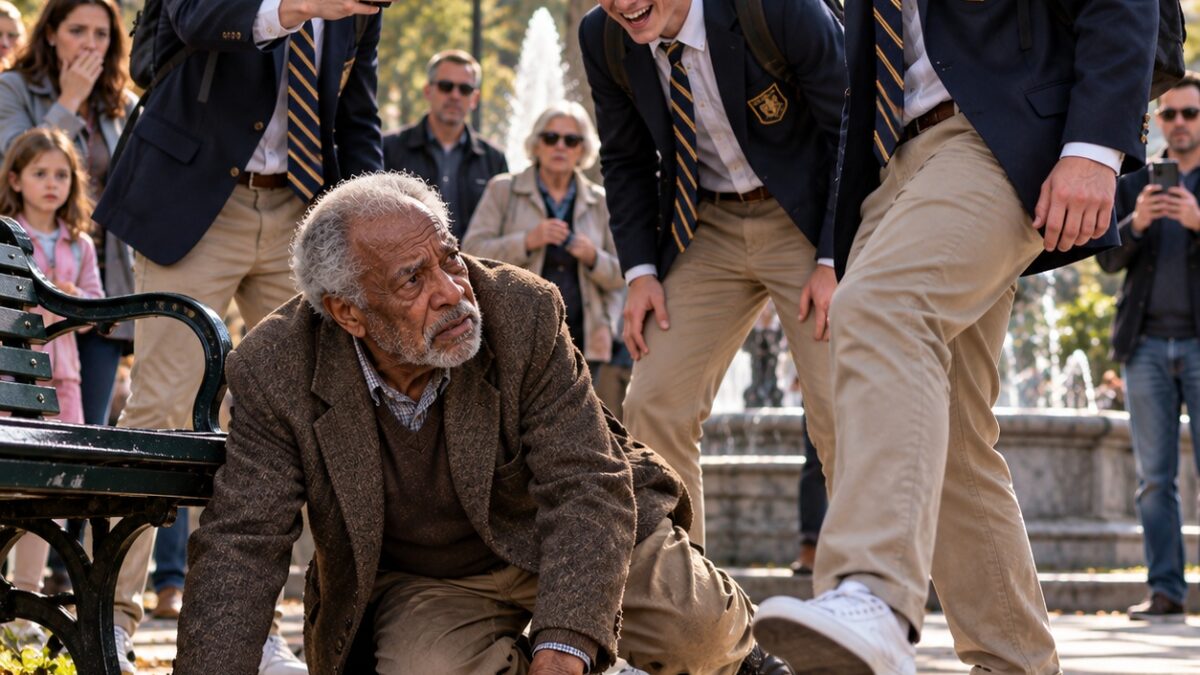
PART2
I looked at his shoe resting on my cane.
Then at his face.
He could not have been more than seventeen.
Maybe sixteen.
Strong kid.
The kind of shoulders coaches notice.
The kind of confidence adults often praise until it grows teeth.
I said:
“Move your foot.”
He blinked.
My voice was quiet.
That surprised him.
He had expected weakness or anger.
Maybe both.
“What?”
“You heard me.”
His friends made exaggerated noises.
“Ooh.”
“Grandpa’s mad.”
The boy filming stepped closer.
“Say it again.”
I looked toward his phone.
Then back at the tall boy.
“Move your foot.”
He did.
Not because he respected me.
Because he wanted the scene to continue.
I picked up my cane.
Brushed dust from the handle.
Set it beside me.
Then returned my attention to the pigeons.
That infuriated them.
One boy hunched his shoulders and began shuffling around the bench, imitating the way I walked.
Slow steps.
Bent back.
His friends howled.
“Careful,” another said.
“Don’t break a hip.”
A jogger slowed.
He looked at me.
Looked at them.
For half a second, his stride nearly stopped.
Then he kept moving.
A middle-aged man in a windbreaker sat thirty feet away.
He stared down at his phone.
His thumb moved.
The screen remained dark.
That detail stayed with me.
I remember thinking:
He wants to look busy so badly he is scrolling nothing.
People talk about cruelty as though the cruel person is the whole story.
He rarely is.
Cruelty gets room from silence.
The boys were loud.
But the adults around them were building the stage.
Every person who turned away gave them another inch.
I had seen that before.
Different places.
Different uniforms.
Same mechanism.
When I was young, crowds could become vicious inside an arena.
A fighter stumbled.
Ten thousand strangers smelled weakness.
They shouted for blood.
That never surprised me.
People bought tickets for violence.
This did.
A sunny public park.
Children nearby.
Three boys humiliating an old man for entertainment.
No ticket required.
And still people watched.
One of the boys swung his sneaker through the pile of pigeon feed.
Seeds flew across the path.
The birds scattered.
He laughed.
“Oops.”
I watched the crumbs roll into cracks in the concrete.
For years, Thursday afternoons had been one of the smallest rituals in my life.
Coffee.
Bench.
Pigeons.
Nothing anyone would call important.
That was why it mattered.
Peace often lives inside things too ordinary to defend until someone destroys them.
The boy looked at me.
“What?”
I said nothing.
“Come on.”
Nothing.
“Are you deaf?”
Nothing.
His smile changed.
The audience was not getting enough.
So he stepped behind the bench.
I heard his hands close around the metal backrest.
That sound was small.
Fabric against painted steel.
But my body recognized intent before my mind finished naming it.
He jerked the bench sideways.
Hard.
The metal legs scraped concrete with a long, ugly scream.
My left foot slipped across the scattered seeds.
The hip failed.
My cane was not under me.
I dropped.
One knee hit first.
Then my hand.
Pain flashed upward.
A bright electric line from my palm through my shoulder.
The coffee cup tipped.
The lid came off.
Coffee spread across the pavement.
Brown against gray.
The park gasped.
This time, more than one person.
Still nobody moved.
The phone came closer.
I could hear the boy breathing behind it.
“Stand up, champ.”
Champ.
For one impossible second, the word opened a door.
I was not in Briar Glen anymore.
I was twenty-seven beneath arena lights.
My trainer slapping my shoulder.
“Get up, champ.”
I was thirty-one in the ninth round with blood running into my mouth while someone across from me believed he had finally hurt me.
“Stay on him, champ.”
I was thirty-five after my forty-seventh professional win, referee lifting my wrist while flashbulbs turned the ring white.
Champ.
I had heard that word from trainers.
Reporters.
Children at the gym.
Men I respected.
Men who had tried to break my ribs.
Now a boy who had not been alive when I retired was using it while filming me on one knee.
The irony would have been funny if it had not hurt so much.
I planted my palm against the bench.
Closed my hand around the cane.
And stood.
Slowly.
No rush.
That was another lesson boxing teaches.
Panic burns oxygen.
I straightened.
My knee hurt.
My palm had been scraped.
My trousers were dusty.
Coffee dripped from the edge of the bench.
I brushed one sleeve.
Then the other.
The boys watched.
Their laughter had softened slightly.
Maybe because I had not given them the broken old man they wanted.
I looked at the academy crest on their hoodies.
Navy thread.
Gold lettering.
St. Bartholomew Academy.
I read it twice.
Then looked directly at the tall boy.
“Do your parents know where you are?”
The laughter exploded again.
“Did he just ask about our parents?”
“He’s gonna tell Mommy.”
“Go ahead.”
The boy with the phone leaned close.
“Call the school too.”
I held his eyes.
“That’s a good idea.”
His smile flickered.
Only slightly.
Then came back.
“Do it.”
So I reached inside my coat.
All three stiffened.
Interesting.
Cruelty likes feeling brave until the person being mocked makes an unexpected movement.
The tall boy stepped backward.
“What are you doing?”
I pulled out my wallet.
Old leather.
Corners soft from years in the same pocket.
One boy laughed with visible relief.
“Oh, he’s gonna pay us.”
I ignored him.
Inside the wallet was a photograph I had carried longer than those boys had been alive.
Black-and-white edges faded to yellow.
Me beneath arena lights.
Much younger.
Heavy shoulders.
Gloves raised.
A championship belt around my waist.
A referee holding my wrist.
The photograph was not there because I enjoyed looking at myself young.
Quite the opposite.
I rarely opened that section of the wallet.
The picture had been given to me after my last title defense.
For years I kept it because children at the gym liked seeing it.
Later, I kept it because throwing it away felt disrespectful to a life I no longer inhabited.
I opened the wallet.
Did not hold it toward the boys.
Just looked at it once.
A woman near the fountain saw first.
She narrowed her eyes.
Then took two steps closer.
I heard her inhale.
“Oh my God.”
The boys turned.
She pointed.
“That’s Iron Hayes.”
The name moved through the small crowd strangely.
Not loud.
Almost like a question.
A jogger stopped.
“What?”
The woman stared at me.
“That’s Harold Hayes.”
The man in the windbreaker finally looked up from his dead phone.
“No way.”
The boy recording looked at my photograph.
Then at my face.
Then back.
Recognition is a physical thing.
You can watch it rearrange someone.
He began typing with his thumb.
Fast.
I did not need to ask what he searched.
Harold Hayes boxer.
Probably.
Iron Hayes.
There was plenty.
Forty-seven professional fights.
Forty-seven wins.
Never knocked down.
Hall of Fame induction.
Photographs.
Old newspaper scans.
Southside Boxing Gym.
Youth programs.
The plaque downtown.
All the things I had stopped thinking about when I sat on Thursdays feeding pigeons.
The boy’s face lost color.
His friend leaned over the screen.
“No way.”
The tall one said:
“So what?”
Too quickly.
“He boxed.”
Another search result appeared.
The phone moved between them.
One of the boys whispered:
“Forty-seven and zero.”
The man in the windbreaker stood.
“My father trained under him.”
His voice shook slightly.
“At Southside.”
He walked closer.
I recognized nothing about him.
Why would I?
Thousands had passed through the gym.
He looked at me with tears gathering in his eyes.
“My dad was Eddie March.”
The name hit.
Not strongly.
Then memory found it.
Thin kid.
Quick left hand.
Anger bigger than his body.
Came to the gym after getting suspended from school.
I looked at the man.
“Eddie had a good jab.”
He laughed once.
A broken sound.
“He talked about you until he died.”
The park became silent.
Completely now.
The boys stood in the middle of it.
One still held his phone.
Still recording.
I looked at the lens.
“You filmed it.”
He swallowed.
I said:
“Good.”
That frightened him more than any threat could have.
I did not hit them.
That seems obvious to me.
Apparently it was not obvious to everyone else.
For days afterward, strangers online wrote versions of what they wished I had done.
He should’ve dropped all three.
Imagine bullying an undefeated champion.
One left hook would’ve taught them.
No.
That would have been the easiest possible ending.
And the worst.
I had spent half my life teaching boys not to confuse violence with strength.
What would it say if, at the first opportunity to satisfy an audience, I punched teenagers?
Could I have?
Probably.
Not like forty years earlier.
Age is real.
But enough.
A fist does not forget everything.
That was precisely why I kept mine at my sides.
The hardest part of knowing how to hurt someone is understanding when not to.
The tall boy finally said:
“We were just joking.”
That sentence.
I have heard it from grown men too.
After cruelty becomes expensive:
Just joking.
I looked at my coffee spreading across the pavement.
At the seed scattered.
At the scrape on my palm.
Then at him.
“Which part?”
He blinked.
“What?”
“Which part was the joke?”
No answer.
“Kicking the cane?”
Silence.
“Moving the bench?”
Silence.
“Filming me on the ground?”
His face reddened.
One friend stared at his shoes.
The other stopped recording at last.
I looked toward the adults around us.
“That’s what I thought.”
Then I sat.
Not because my point was complete.
Because my knee hurt like hell.
The woman from the fountain came forward.
“Are you okay?”
I almost laughed.
Where had that question been five minutes earlier?
Still, I knew shame when I saw it.
She had a little girl holding her hand.
The child was watching everything.
I said:
“I’m all right.”
The woman looked close to tears.
“I’m sorry.”
I nodded.
The man in the windbreaker walked over.
“I should’ve said something.”
“Yes.”
He flinched.
I did not soften the answer.
Sometimes apology should be allowed to feel uncomfortable.
The jogger came back too.
He had circled the path.
He stood behind the boys.
“I saw the whole thing.”
Now.
I thought.
Now everyone saw.
Recognition had transformed courage.
That bothered me more than I wanted to admit.
If I had been Harold Hayes, retired champion, only after the photograph appeared, what had I been ten minutes earlier?
Just an old man?
Was that category worth less?
That became the part of the story reporters rarely understood.
The reveal made people cheer.
It made me sad.
Because I should not have needed a championship record to deserve protection.
The boys left.
Not running.
That would have been too dramatic.
They backed away slowly while people stared.
The tall one muttered:
“Come on.”
The phone boy kept looking at the screen.
My face from forty years earlier.
My face now.
Maybe trying to make them belong to the same person.
They walked toward the academy.
No one stopped them.
Neither did I.
The woman offered to call the police.
I said no.
Another man offered.
No.
I wanted to finish my coffee.
Then looked at the brown puddle.
Apparently not.
The little girl beside the fountain approached.
Her mother tried to stop her.
The girl slipped free.
Maybe six.
She picked up the empty paper cup.
Walked to the trash can.
Threw it away.
Then came back.
“I’m sorry they spilled it.”
I looked at her.
“Thank you.”
She nodded solemnly.
Children sometimes understand dignity faster than adults.
The mother cried then.
Quietly.
I pretended not to notice.
When I got home, my knee had swollen.
Not badly.
Enough.
I iced it.
Washed the scrape on my hand.
Put the cane beside my chair.
Then my phone began vibrating.
Once.
Twice.
Then continuously.
I turned it face down.
Five minutes later, someone knocked.
My neighbor.
“You okay?”
“Yes.”
“You’re online.”
“I don’t know what that means.”
He held up his phone.
There I was.
On one knee.
Three boys around me.
Caption:
ST. BARTHOLOMEW KIDS HARASS ELDERLY MAN IN BRIAR GLEN PARK.
Another video appeared.
Different angle.
Clearer.
Apparently someone near the walking path had recorded the entire thing.
Not the boys’ edited version.
The full event.
Cane kicked.
Bench jerked.
Fall.
Phone shoved toward my face.
Then recognition.
“That’s Iron Hayes.”
I watched once.
Never again.
Seeing yourself humiliated is different from remembering it.
Memory protects you.
It frames events from inside your own body.
Video gives you no mercy.
I saw what strangers had seen.
A thin old Black man struggling to stand.
For one second, I did not recognize myself.
Not because I had forgotten aging.
Because somewhere inside, we remain connected to earlier versions of ourselves.
I still sometimes dreamed with young legs.
Moved fast in sleep.
Woke before dawn and needed a second to remember that those knees no longer belonged to me.
The man in the video looked fragile.
That word hurt.
I paused on the moment before I stood.
Then shut the phone off.
The next morning, reporters were outside Southside Boxing Gym.
The gym still operated.
I had stepped away from daily management years earlier, but my name remained on the old brick wall.
A simple message appeared on its social page:
RESPECT IS NON-NEGOTIABLE.
Nothing else.
That was enough.
St. Bartholomew Academy issued a statement before lunch.
We are aware of a deeply concerning incident involving students off campus.
Then:
An investigation is underway.
The phrase “deeply concerning” appeared everywhere that week.
Schools love language capable of sounding serious before anyone has decided what seriousness requires.
By afternoon, investigators had the videos.
Names.
Times.
Witnesses.
The student conduct code.
Harassment prohibited on and off campus when conduct reflected on the school.
Scholarships temporarily suspended pending review.
One of the boys was a varsity wide receiver.
College scouts had been following him.
Recruitment emails changed.
Nobody officially revoked his future overnight.
But people asked questions.
Another boy’s father sat on a local development board.
His name appeared in opinion columns.
People questioned privilege.
Influence.
Accountability.
That part made me uncomfortable.
A child’s wrongdoing should not automatically become permission to destroy a parent.
But parents do shape children.
And powerful families often spend years insulating consequences.
The public conversation grew larger than me.
That was unavoidable once the video spread.
The academy called.
Headmaster.
Polite.
Deeply apologetic.
He asked whether I would attend a private meeting with the boys and their parents.
I said no.
He seemed surprised.
“Mr. Hayes, they need to hear from you.”
“No.”
“May I ask why?”
“They already heard me.”
Silence.
“We believe restorative dialogue could be valuable.”
“Maybe.”
“Then—”
“But I’m not required to perform forgiveness for them.”
He stopped.
I continued.
“They have teachers.”
“Counselors.”
“Parents.”
“A conduct board.”
“Use them.”
I was not angry.
Just tired.
There is a strange burden placed on people after public harm.
You are hurt.
Then you become responsible for educating everyone who hurt you.
No.
I had done enough teaching.
Forty years in a boxing gym.
Thousands of young men.
I did not owe these three a private masterclass because they picked the wrong old man.
What I did agree to was simple.
My attorney sent formal notice preserving my rights related to harassment and minor assault.
I did not press criminal charges.
That decision upset people.
Some said the boys needed records.
Police.
Court.
Hard consequences.
Maybe.
But I wanted consequences connected to correction.
Not destruction for public entertainment.
They were teenagers.
Old enough to know better.
Young enough that “better” might still become possible.
I wanted the school to do its job.
Their parents too.
And I wanted the boys to live long enough with memory that someday the park made them ashamed for the right reasons, not merely frightened because they got caught.
The disciplinary hearing happened behind closed doors.
I did not attend.
I received the outcome in writing.
Mandatory community service.
Conduct and diversity training.
Formal suspension-related academic consequences under the school process.
Public apology at an assembly.
Scholarship reviews.
Athletic consequences evaluated separately.
The school also revised its anti-bullying language.
Expanded it beyond campus.
Added a parent accountability component.
The code that had existed as words in orientation packets suddenly had teeth because three boys forced adults to ask whether values mattered only inside school gates.
That part satisfied me.
Policy matters.
People laugh at policy until they need it.
A rule written after pain cannot erase what happened.
But it may stop repetition.
That is one way suffering becomes less wasted.
The public apology was recorded.
Someone sent me the video.
I almost deleted it.
Then watched.
The boys stood on an auditorium stage.
No academy hoodies.
Dress shirts.
Ties.
Rows of students in front of them.
Teachers along the walls.
The tall boy spoke first.
His voice shook.
“I humiliated Mr. Harold Hayes in Briar Glen Park.”
He paused.
“I kicked his cane.”
Another pause.
“I helped create a situation where he fell.”
He did not say “if anyone was offended.”
Good.
He did not call it a joke.
Better.
The boy who had filmed me spoke next.
“I recorded because I thought embarrassing someone would be funny.”
His eyes stayed on the page.
“When I found out who Mr. Hayes was, I became afraid.”
He swallowed.
“But what I did was wrong before I knew who he was.”
I stopped the video.
Sat back.
That sentence mattered.
I replayed it.
What I did was wrong before I knew who he was.
There.
That was the lesson.
Not that they bullied a champion.
That they bullied a man.
The third boy spoke about bystanders.
About wanting approval from friends.
About laughing because everyone else laughed.
I watched all of it.
Did I trust every word?
No.
Teenagers can read apologies.
Adults write statements.
Schools coach language.
Real change takes time.
But I heard something beginning.
That was enough.
The phone boy’s original recording never became what he intended.
That felt like a particular kind of justice.
He had lifted the phone to capture weakness.
Instead, it preserved his own cruelty.
Evidence has no loyalty to the person holding the camera.
That is one thing young people learn too late.
You may believe you are controlling the story because you are filming.
But the lens records both directions.
His laughter.
His comments.
His face when the search results appeared.
The moment confidence collapsed.
All of it.
Millions saw.
I did not celebrate that.
Public shame is powerful.
Dangerously powerful.
I worried about those boys.
Not because they had not earned consequences.
Because the internet does not understand proportion.
A teenager can do something awful.
The world can then try to freeze him permanently at seventeen.
I did not want that either.
If I believed people could never grow beyond their worst day, my entire boxing gym would have been pointless.
Half the boys who came through Southside arrived because someone had already decided they were trouble.
Angry kids.
Suspended kids.
Kids whose fathers were gone.
Kids who fought at school.
Kids who had stolen.
Kids one mistake away from becoming the label adults used for them.
My job had been to tell them:
You are responsible for what you did.
And you are not required to remain the person who did it.
Both truths.
Always both.
When I opened Southside Boxing Gym, people thought I wanted to train champions.
I did.
Sometimes.
But championships were never the point.
Discipline was.
The first rule was simple:
No fighting outside the gym.
Teenagers hated that.
“Coach, what if somebody starts something?”
“Walk away.”
“What if they hit me?”
“Protect yourself.”
“Then?”
“Leave.”
“What if people think I’m scared?”
“Let them.”
They hated that answer most.
Young men often think reputation is oxygen.
They believe they will die if strangers think they are weak.
My job was teaching them that you can survive another person’s misunderstanding.
Sometimes that is strength.
One boy once asked:
“What’s the point of learning to fight if we can’t use it?”
I told him:
“So you stop needing to.”
He rolled his eyes.
Years later, he became a firefighter.
Sent me a Christmas card every year.
That was success.
Not knockouts.
I had knocked men out.
Plenty.
The little boy in the park would eventually ask me that.
Yes.
I knew exactly what it felt like when another man’s body stopped answering him.
There is nothing poetic about it up close.
The crowd loves it.
The fighter often does not.
You see eyes trying to focus.
Chest rising.
Gloves moving without purpose.
Referee counting.
Victory is complicated when another human being is lying because of your hands.
That was why I never romanticized violence for the kids.
Boxing taught me control more than aggression.
It taught me what damage costs.
The plaque downtown became part of the news coverage.
Reporters stood beside it.
HAROLD “IRON” HAYES
Some inscription about undefeated record and youth mentorship.
I had walked past that plaque hundreds of times.
Rarely looked.
Recognition belongs mostly to other people.
The life it refers to belongs to you.
There is a difference.
For days, strangers came to the gym.
Left flowers.
Notes.
One note said:
My grandfather watched every fight.
Another:
You taught my father to stay out of jail.
Another:
I’m sorry nobody helped you sooner.
That last one sat with me.
I folded it.
Put it in my coat pocket.
Not because I wanted pity.
Because that stranger had understood the part that hurt.
Not the cane.
Not the fall.
The silence.
For a while, I stopped going to the park.
Not deliberately.
Thursday came.
I stayed home.
The next Thursday, rain.
Easy excuse.
Third Thursday, clear skies.
I made coffee in my own kitchen.
Sat near the window.
Watched four o’clock arrive.
Did not leave.
That angered me.
Three teenagers had taken a place I loved and changed the way my body felt when I imagined it.
I hated giving them that much influence.
But fear does not always look like fear.
Sometimes it looks like:
I don’t feel like going today.
I knew that trick.
I had seen fighters use it.
After a bad sparring session:
“My shoulder’s tight.”
“Need rest.”
Sometimes true.
Sometimes the mind protecting itself.
I sat with the coffee.
Looked at my cane.
Then laughed.
“Harold.”
I spoke aloud.
“You’re being ridiculous.”
Still did not go.
Healing rarely obeys insult.
The following week, the headmaster called again.
Not asking for meetings.
He simply told me the boys had begun community service.
Parks department.
Trash collection.
Trail maintenance.
Public areas.
That made sense.
Not theatrical.
Work.
I said:
“Good.”
He hesitated.
“Mr. Hayes?”
“Yes?”
“One of them asked if he could write to you.”
“No.”
Silence.
Then:
“Not yet.”
I surprised myself.
Maybe later.
I did not want an apology while the boy was still terrified.
Fear writes excellent letters.
Character writes different ones.
I wanted time.
At Southside, the younger fighters were furious.
Some had seen the video.
One sixteen-year-old named Malik hit the heavy bag so hard his trainer stopped him.
When I walked in, Malik pulled off his gloves.
“Coach.”
I had not coached him directly.
Everyone still called me that.
“You should’ve hit them.”
“No.”
“They put hands on you.”
“Yes.”
“They dropped you.”
“I slipped.”
“They still—”
“Malik.”
He stopped.
I walked toward the bag.
“Why are you angry?”
“Because they disrespected you.”
“Why?”
“You’re you.”
Wrong answer.
I waited.
Malik frowned.
Then understood.
“Oh.”
“Would you be this angry if they did it to some old man you didn’t know?”
He looked away.
“That’s the question.”
He said:
“It’d still be wrong.”
“Would you care this much?”
Silence.
“Probably not.”
“Then work on that.”
He stared at the floor.
I tapped the bag.
“Respect is easy when someone has earned fame.”
I pointed toward the door.
“Practice it on people who never will.”
He nodded.
That conversation may have mattered more to me than the school policy.
Because fame had become a trap in the story.
People wanted justice because I was Iron Hayes.
I wanted justice because old men should not be pushed for content.
The academy invited me to speak months later.
I declined again.
Not forever.
Just then.
I did not want to become their moral exhibit.
The Man We Bullied Teaches Us Kindness.
No.
Let teachers teach.
Let parents parent.
Let consequences teach.
I had a life.
I returned to Southside more often instead.
Sat near the ring.
Watched younger coaches work.
The sound helped.
Jump ropes hitting canvas.
Gloves against mitts.
Bell.
Breathing.
No music sounds like a boxing gym.
People think boxing is loud.
Mostly it is rhythm.
One afternoon, a boy at the gym fell during footwork drills.
The others laughed.
Reflex.
Not cruel.
Just teenage instinct.
The coach stopped everything.
“Pick him up.”
Two boys did.
The fallen boy laughed too.
Practice resumed.
Simple.
No lecture.
That moment stayed with me.
A healthy group does not mean nobody laughs.
It means humiliation does not become entertainment.
Someone falls.
You pick him up.
Then maybe you laugh together.
That is different from standing over someone with a phone.
Three weeks after the incident, I woke on Thursday knowing I was going back.
No dramatic decision.
I simply put on my coat.
Bought coffee.
Walked toward Briar Glen.
My knee was better.
The scrape on my palm had healed.
The cane clicked against sidewalk.
Each block felt slightly heavier than it should.
When I reached the park entrance, I stopped.
The green bench was visible through the trees.
Same place.
Same fountain.
Same trimmed hedges.
I could have turned around.
Nobody would know.
Then I saw pigeons near the path.
Hungry little opportunists.
I smiled.
Kept walking.
The bench had been moved back into place.
That bothered me.
I do not know why.
Maybe I expected a scar.
Something showing that a bad thing had happened.
Instead it looked normal.
That is how places are.
They do not carry memory for us.
We carry it into them.
I sat.
Set my coffee safely beside me.
Took crumbs from the paper bag.
The first pigeon approached.
Then three more.
The fountain hummed.
A child laughed near the swings.
And slowly, my body understood the park was not attacking me.
Just a park.
That was enough.
Ten minutes later, a boy approached.
Not one of the three.
Much younger.
Maybe ten.
He stopped several feet away.
Hands in jacket pockets.
“Sir?”
“Yes?”
“Are you really Iron Hayes?”
I almost sighed.
Apparently quiet Thursdays were gone for a while.
“Yes.”
His eyes widened.
“Really undefeated?”
“Yes.”
“Forty-seven?”
“Yes.”
He took another step.
“Did you knock people out?”
I looked at him.
Children ask violence questions directly.
Adults dress them up.
“Sometimes.”
He grinned.
“Was it awesome?”
I considered.
The breeze lifted the edge of my coat.
Across the lawn, I noticed three bright community-service vests.
Trash grabbers.
Black bags.
The boys.
All three.
Working along the pathway.
Their heads were down.
No academy hoodies.
No phones.
No laughter.
For a second, time folded.
I saw the tall boy’s shoe on my cane.
The phone in my face.
My knee on concrete.
Then I looked at the little boy standing in front of me.
“Sometimes,” I said, “winning means not swinging.”
His smile faded into concentration.
He was trying to understand.
Good.
Some lessons should take time.
He nodded eventually.
“Okay.”
Then he ran back toward a woman near the fountain.
Probably his mother.
I watched him go.
Across the lawn, one of the teenagers lifted his head.
The boy who had filmed me.
Our eyes met.
He froze.
I could see fear from fifty yards away.
Maybe shame.
Probably both.
He looked as though he expected me to call someone.
Point.
Demand.
I did none of that.
I nodded once.
Barely.
Not forgiveness.
Not absolution.
Acknowledgment.
I see you.
You see me.
Now do the work.
His chin dropped.
He returned to collecting trash.
The tall boy was pulling weeds from around a path marker.
The third carried a heavy bag toward a parks truck.
Their laughter was gone.
But I did not enjoy that.
I did not need them miserable forever.
I needed them changed.
Those are different desires.
The phone boy wrote eventually.
Months later.
One page.
Handwritten.
No school letterhead.
No parent signature.
I knew immediately that the tone was different.
He began:
Mr. Hayes, I’ve rewritten this six times because everything I wrote sounded like I was trying to make you tell me I’m not a bad person.
Good start.
He wrote about the video.
How he wanted likes.
How he had spent years believing being funny meant someone else had to become the joke.
He wrote:
When I recognized you, I was ashamed because I thought I had picked the wrong person. Later I realized that was still the wrong lesson.
Then:
You were the right person to respect before I knew anything about you.
I sat with that line.
There it was again.
The real lesson finding its way through.
He did not ask me to forgive him.
Did not ask for a meeting.
At the bottom:
I’m sorry. I hope I become someone who would have stepped in instead of someone who recorded.
I folded the letter.
Placed it beside the anonymous note from the gym.
I never replied.
Not then.
Sometimes an apology’s value is in saying what must be said without demanding something back.
Years later, perhaps I would.
But the letter did not need my signature to be true.
The tall boy’s football recruitment changed.
That became public.
Some schools paused.
One withdrew interest.
Others waited.
People argued whether that was fair.
I refused interviews about it.
I was not the athletic director.
Not the coach.
Not the admissions office.
Actions have consequences.
Institutions decide according to their standards.
What I did not want was the boy’s entire life destroyed for one afternoon if he truly changed.
A scholarship is opportunity.
It is not immunity.
A lost scholarship is painful.
It is not the end of existence.
Maybe he would learn that too.
One door closing does not prove there are no others.
I had told boys at Southside the same thing after suspensions and arrests.
You are not entitled to the future you imagined if your actions damaged it.
But you are still responsible for building another.
Hard truth.
Necessary.
The boy whose father served on the development board created another public storm.
People attacked the father.
Asked whether privilege had protected his son before.
Some questions were legitimate.
Some were opportunistic.
I learned the father made a public statement.
No excuses.
No “boys will be boys.”
He said:
“My son humiliated a member of our community, and the fact that my family has influence makes his behavior more concerning, not less.”
Good.
He stepped away from one board decision involving the academy to avoid conflict.
That was responsibility.
Not punishment.
I respected it.
Parents cannot control every action their children take.
They can control whether they become shields after wrongdoing.
The academy changed its parent agreements.
People laughed at that too.
“Another policy.”
Maybe.
But policy tells families what the institution will tolerate.
It included off-campus harassment.
Digital humiliation.
Bystander responsibility.
Parents acknowledged that serious misconduct beyond school grounds could affect student standing.
Would paper make teenagers kind?
No.
But culture is built partly from what adults name clearly.
Ambiguity often protects the cruel.
The boys had lived inside an environment where teasing could be dismissed as confidence.
Now the line was clearer.
Good.
The park became normal again.
Mostly.
For months, strangers recognized me.
Some asked for photographs.
Some told stories about watching fights with fathers or grandfathers.
A few cried.
One old woman punched my arm and said:
“You cost me twenty dollars in 1982.”
I laughed.
“Who’d you bet on?”
“The other guy.”
“That was your mistake.”
She agreed.
Those moments were pleasant.
But eventually the attention faded.
The internet found another outrage.
Another video.
Another villain.
Another hero.
That is how it works.
I was grateful.
I wanted my Thursdays back.
The pigeons never cared.
That was comforting.
Champion.
Victim.
Viral story.
Old man.
None of it mattered.
I had crumbs.
That was the relationship.
Simple.
One Thursday, the man in the windbreaker returned.
The one who had pretended to scroll.
He stood near the bench awkwardly.
“Mr. Hayes?”
“Harold.”
He sat at the far end after I nodded.
For several minutes he said nothing.
Then:
“I keep thinking about that day.”
“So do I.”
“I saw the first shove.”
I looked toward the fountain.
“I know.”
“My body just…”
He stopped.
“I froze.”
I said nothing.
“I told myself they were kids.”
“Then I told myself maybe you knew them.”
“Then I thought if I stepped in, it could become something.”
“Then you fell.”
His voice broke.
“I’m sorry.”
This apology affected me differently.
Maybe because he had no institutional pressure.
No school.
No parents.
No internet demanding it.
Just a grown man carrying shame.
I said:
“What will you do next time?”
He looked at me.
“Step in.”
I nodded.
“That’s enough.”
He exhaled.
Not relieved exactly.
Maybe oriented.
We sat together until my coffee was gone.
Then he left.
He returned sometimes after that.
Never became a close friend.
Just a man who said hello.
That was enough too.
The mother with the little girl wrote to Southside.
Her daughter had asked why adults did not help.
The mother did not know what to say.
That question hurt.
Children see hypocrisy with painful clarity.
Adults teach:
Help people.
Speak up.
Do not bully.
Then a real moment arrives.
Risk enters.
Adults calculate.
Children watch.
The woman wrote that she had begun talking with her daughter about fear honestly.
Not:
I didn’t see.
Not:
Someone else was handling it.
She told her:
“I was scared to get involved, and I wish I had been braver.”
That may have taught the girl more than pretending perfection would.
Children do not need flawless adults.
They need adults willing to correct themselves.
The little girl eventually came to Southside with her mother.
Not for boxing.
For a community event.
She recognized me.
“You got new coffee?”
I laughed.
“Yes.”
“Did those boys say sorry?”
“Some did.”
“Are you mad?”
“Sometimes.”
She thought.
“Are you going to punch them?”
“No.”
“Good.”
“Why good?”
She shrugged.
“You’re old.”
I laughed so hard my hip hurt.
Children.
No diplomacy.
Her mother looked horrified.
I told her not to apologize.
The girl was correct.
Age became part of the conversation after the video.
Opinion columns asked when gray hair became a target.
Television panels debated respect for elders.
Most discussions were too broad for me.
Young people are not uniquely cruel.
Old people are not automatically wise.
I had met foolish men at seventy and extraordinary boys at fourteen.
Respect should not depend on age either.
But there was something about how those boys saw slowness.
They interpreted it as inferiority.
That bothered me.
A slow step can mean weakness.
Or surgery.
Or arthritis.
Or ninety years of living.
You do not know.
The human body changes.
Dignity should not.
I remembered my own youth.
I had been arrogant.
Not like them exactly.
But enough.
When I began winning, people treated me differently.
I liked it.
Of course I did.
Walk into a restaurant.
Heads turn.
Free meals.
Women smiled.
Men wanted handshakes.
I once snapped at an older cutman because he was moving too slowly wrapping my hands.
My trainer hit me in the back of the head.
Not hard.
Enough.
“That man wrapped champions before your mother knew your father.”
I never forgot.
I apologized.
The cutman accepted.
Did that one moment make me good?
No.
It corrected a direction.
Young people need correction.
Sometimes sharp correction.
That is why I did not want the three boys destroyed.
I wanted them redirected.
There is a difference between consequences and annihilation.
The public did not always agree.
One radio host said community service was too soft.
Another wanted expulsion.
Some wanted criminal prosecution.
Some said the boys were being “canceled.”
People love extremes because nuance is bad television.
I stopped listening.
The academy had acted.
The parents had acted.
The boys had faced public shame, school discipline, athletic consequences, community service, mandatory training, and formal apologies.
That was not nothing.
Would every consequence last forever?
Hopefully not.
Punishment without a path back becomes revenge.
I had spent my whole post-fighting life believing people need a path back.
I was not going to abandon that because the wrong had happened to me.
One of my old gym boys called.
He was a grandfather now.
That alone felt offensive.
“Coach.”
“Yes?”
“You okay?”
“Yes.”
“Want me to handle those kids?”
I laughed.
“You are sixty-three years old.”
“I still got hands.”
“You have cholesterol.”
He laughed for a full minute.
Then became serious.
“You taught me not to fight outside.”
“Correct.”
“Still annoying.”
“Good.”
He said his grandson had seen the video.
They talked about it.
That became another ripple I had not expected.
Families discussing respect.
Bystanders.
Filming.
What counts as strength.
Maybe that was the best consequence of all.
Not policy.
Conversation.
The phrase Respect is non-negotiable stayed on the gym page.
Eventually it appeared on a wall inside the building.
I protested.
The current manager said:
“You don’t run daily operations anymore.”
“Apparently retirement means nobody listens.”
“Correct.”
They painted it anyway.
Young fighters touched the wall before entering the ring.
That was too dramatic for my taste.
But if the phrase helped one kid think before humiliating someone, fine.
I returned to coaching occasionally.
Nothing full time.
A little mitt work.
Mostly talking.
Old coaches eventually become talk.
There are worse fates.
One afternoon, Malik asked:
“Coach, did being undefeated make you feel invincible?”
“No.”
“Never?”
“Sometimes after fights.”
“What changed?”
“Morning.”
He laughed.
I explained.
You can win at night.
Crowd chanting.
Belt around your waist.
Then wake up with swollen hands.
Bruised ribs.
Bills.
Laundry.
Human again.
Sports create temporary mythology.
Life removes it by breakfast.
That is healthy.
The three boys had learned a version of the same lesson.
One afternoon, they owned the park because their friends were laughing.
By evening, the video owned them.
Power is often temporary.
Character follows you home.
The photo in my wallet remained.
I considered removing it.
The reveal had given it too much symbolic weight.
But it had been there before them.
It belonged to me before it belonged to the story.
So I kept it.
Sometimes little kids asked to see.
Sometimes I showed them.
Sometimes not.
I never used it as proof again.
I did not want to become the old man who needed to establish former importance before speaking.
My present age deserved its own dignity.
That was something I had to learn too.
One afternoon, a teenage boy offered me his seat on a bus.
I almost refused out of pride.
Then remembered everything.
Sat.
Said:
“Thank you.”
Age requires accepting kindness without treating it as insult.
Another hard lesson.
Respect can look like assistance.
Not pity.
You decide partly by how it is offered.
The boy returned to his phone.
No camera pointed at me.
No joke.
Just kindness.
I smiled all the way home.
Months after the incident, St. Bartholomew sent me a copy of its revised code.
Probably administrative courtesy.
I read it.
Every page.
Old habits.
Sections on harassment.
Digital conduct.
Off-campus accountability.
Bystander expectations.
Parent acknowledgment.
I wrote one note back:
Policies matter only when inconvenience does not weaken them.
The headmaster called to ask permission to quote it.
I said:
“No.”
He laughed.
I was serious.
Not every sentence needs to become branding.
The varsity boy eventually returned to football.
I heard through local news.
Different recruiting landscape.
Smaller schools.
He had lost opportunities.
But he played.
I was glad.
Really.
A teenager losing everything would not heal my knee.
Growth requires somewhere to go.
Maybe football gave him that.
Maybe not.
His life stopped being my business after accountability.
That is another form of letting go.
The boy who filmed joined a community media project.
That detail reached me through his letter much later.
He had become interested in documentary work.
Apparently one teacher told him:
“If you are going to point a camera at people, learn responsibility.”
Good teacher.
He began filming service projects.
Oral histories.
Veterans.
Older residents.
I laughed when I heard.
Life has a sense of irony subtler than revenge.
A camera used for humiliation becoming a tool for listening.
That is a satisfying correction.
I hope he kept going.
The third boy—the quieter one—was harder to track because his family avoided publicity.
Probably wise.
I heard only that he completed service requirements and stayed at the academy.
Not every life needs a public transformation.
Sometimes the healthiest thing is to change privately.
I wish him well.
Years of boxing had taught me that victory is rarely one clean moment.
People remember the raised hand.
Not the rounds.
Not the swelling.
Not training before sunrise.
Not loneliness.
The park story became the same.
People remembered:
Recognition.
That’s Iron Hayes.
The boys’ faces.
Consequences.
But my hardest moments happened afterward.
Staying home on Thursdays.
Watching the video alone.
Realizing recognition had made people care more.
Wondering whether age had made me invisible.
Those were the rounds nobody saw.
Going back to the bench was the real victory.
Sitting where I had fallen.
Feeding pigeons.
Drinking coffee.
Refusing to let humiliation permanently redraw my map.
That felt more like championship work than anything under arena lights.
The little boy who asked whether I knocked people out returned several times.
His name was Noah.
I eventually learned.
His mother apologized for him “bothering” me.
He did not bother me.
He asked questions.
Kids do.
One Thursday:
“How do you win if you don’t swing?”
I smiled.
He had been thinking.
“Depends on the fight.”
“That’s not an answer.”
“Good.”
He frowned.
I said:
“Sometimes someone wants you angry because anger makes you stupid.”
He nodded.
“Sometimes walking away means they don’t control you.”
“Sometimes telling the truth is enough.”
“What about if they hit you?”
“Protect yourself.”
“Then hit them back?”
“Maybe.”
His eyes widened.
I laughed.
“Life doesn’t fit on posters, Noah.”
He seemed disappointed.
Good.
Complexity begins in disappointment.
His mother later enrolled him in beginner boxing.
Not because of me, she insisted.
Definitely because of me.
Southside.
He was terrible at first.
Most people are.
Could not keep his hands up.
Tripped over his own feet.
Loved every second.
I watched once from the corner.
His coach said:
“Balance first.”
That phrase reached me.
Balance first.
Before power.
Before speed.
Before winning.
Maybe that applied to more than boxing.
I never became close with the three teenagers.
That matters for fidelity to reality.
No magical mentor relationship.
No cinematic scene where I trained them.
No Thanksgiving dinner.
No adoption into the gym.
They had consequences.
They apologized.
They worked.
Then our lives separated.
That was appropriate.
Forgiveness does not require friendship.
Growth does not require access to the person you hurt.
Sometimes the respectful thing is to leave them alone.
The tall boy once saw me in a grocery store almost a year later.
He froze near produce.
I was comparing tomatoes.
He approached slowly.
“Mr. Hayes?”
“Yes?”
He was taller somehow.
Or maybe stood differently.
“Can I say something?”
I nodded.
“I’m sorry.”
No speech.
No explanation.
Just that.
I looked at him.
“I know.”
He swallowed.
“I think about it all the time.”
“That will fade.”
He looked surprised.
“I don’t want it to.”
“You should.”
“What?”
“You should remember the lesson.”
I picked up a tomato.
“Not spend your whole life trapped inside the shame.”
His eyes filled.
I continued.
“You did something cruel.”
“Yes, sir.”
“Don’t build an identity around being the kid who did something cruel.”
“What do I do?”
“Become a man who wouldn’t.”
He nodded.
We stood there in produce while an older woman squeezed avocados beside us.
Life is rarely cinematic when the important conversations arrive.
He said:
“Thank you.”
I nodded.
Then:
“Those tomatoes are terrible.”
He laughed.
So did I.
That was the last meaningful conversation we had.
It was enough.
For years, people called me Iron Hayes because I could not be knocked down.
That was never literally true in life.
Everyone gets knocked down eventually.
Age did it.
Grief did it.
Loss did it.
A stupid shove beside a park bench did it.
The title had always been boxing mythology.
My real strength was never staying upright every second.
It was learning what to do after the ground arrived.
Stand if you can.
Rest if you need.
Accept a hand sometimes.
Do not confuse falling with becoming less.
That lesson took longer than forty-seven fights.
When people asked:
“Was that the first time anyone ever put Iron Hayes on a knee?”
I would smile.
“No.”
Life had done it plenty.
They wanted the sports answer.
I gave them the human one.
The plaque downtown eventually needed polishing.
The city contacted Southside.
Asked whether I wanted to attend a little rededication.
“No.”
They did it anyway.
Sent a photograph.
The brass looked bright.
My name.
Record.
Gym.
Community service.
I stared.
Then put the photo in a drawer.
A plaque is lovely.
But the boys at the park taught me again that reputation cannot walk beside you everywhere.
There will always be people who do not know.
Good.
That means character still has to function without applause.
My Thursday ritual continues.
Coffee.
Bench.
Pigeons.
Some weeks someone recognizes me.
Most do not.
That is how I prefer it.
A gray-haired man walking slowly with a cane.
No title.
No photograph.
No belt.
If somebody holds a door, I say thank you.
If a child asks a question, I answer if I feel like it.
If teenagers pass laughing, I do not assume anything.
That is important too.
Three boys should not make me suspicious of every young person.
Doing that would make me guilty of the same lazy thinking they brought to the bench.
Age does not define character.
Neither does youth.
Watch behavior.
The man in the windbreaker eventually told me his father, Eddie, had died years earlier.
We talked about the old gym.
Eddie never became a professional boxer.
He worked construction.
Raised three children.
Stayed sober for thirty-one years.
That mattered more than any fight record.
The man said:
“My dad always said you saved him.”
I shook my head.
“He saved himself.”
“You helped.”
“Maybe.”
“He said you made him mop the gym for two weeks after he got into a street fight.”
That sounded like me.
“He hated you.”
“Good.”
“Then he understood.”
Better.
That is coaching.
Immediate popularity is often a bad sign.
I thought about those three teenagers when he told me Eddie’s story.
Maybe community service felt humiliating.
Good.
Maybe training felt tedious.
Good.
Maybe the public apology made them sweat.
Good.
Discomfort is not abuse.
Sometimes discomfort is the space where accountability works.
The goal is not to make a person feel worthless.
It is to make harmful behavior expensive enough that reflection has time to catch up.
That is how I understood discipline.
Always.
I never forgot the adults who stayed silent.
But I stopped resenting them.
Mostly.
The mother.
Jogger.
Windbreaker man.
Others.
Fear is human.
Crowds create uncertainty.
People worry about escalation.
Maybe the boys were armed.
Maybe intervention would provoke them.
Not every bystander must become a hero.
But there are ways to help.
Call security.
Speak from distance.
Gather others.
Record evidence.
Ask the victim if they are okay before discovering he is famous.
That last part matters.
You do not need to throw yourself into danger to refuse invisibility.
Sometimes simply saying:
“Leave him alone.”
is enough to break the social permission cruelty depends on.
I hope people learned that.
The clearest evidence came months later.
I was in the park.
Different teenagers.
Not from St. Bartholomew.
Two boys were teasing a homeless man near the fountain.
Before I could stand, three adults intervened.
A woman said:
“Enough.”
A jogger stopped beside her.
Another man called park security.
The boys left.
Maybe they would have done that anyway.
Maybe the video changed Briar Glen.
I cannot know.
But I sat there feeling something loosen in my chest.
Communities learn too.
Sometimes publicly.
Painfully.
The homeless man sat on a low wall.
The woman brought him water.
Nobody asked whether he had once been a champion.
Nobody searched his name.
Nobody needed proof.
That was the lesson I had wanted.
I fed the pigeons.
Smiled.
Kept my mouth shut.
Some victories do not need to know they are victories.
Years ago, crowds chanted my name because I hurt men legally inside ropes.
Now the moment I am proudest of involved keeping my hands open.
That surprised me.
At twenty-five, I would not have understood.
At thirty-five, maybe.
At my age now, it feels obvious.
Strength changes shape.
Young strength can explode.
Older strength often contains.
Waits.
Chooses.
Young Harold wanted people to know he could knock them down.
Old Harold knows the more important question is whether he needs to.
Most days:
No.
That does not mean passivity.
I did not excuse the boys.
I preserved legal options.
Allowed the academy investigation.
Supported policy changes.
Accepted public accountability.
Refused to minimize what happened.
Mercy without consequence can become permission.
Consequence without mercy can become vengeance.
Balance.
Again.
Always balance.
If they had seriously injured me, perhaps my decision about criminal charges would have been different.
If they had continued.
If they had threatened others.
Context matters.
People online wanted universal rules.
Life gives cases.
I made the decision that felt right for mine.
My attorney protected my rights.
The school acted.
The parents acted.
The boys worked.
That was enough for me.
One reporter asked:
“Did being undefeated help you stay calm?”
I laughed.
“No.”
“What did?”
“Age.”
He waited.
I continued.
“When you’ve spent enough years being angry, you learn most anger is expensive.”
He wrote that down.
I wish reporters would stop writing everything down.
Then again, perhaps that is their job.
Anger had powered part of my boxing career.
Useful fuel.
Dangerous engine.
I learned to convert it.
Training.
Discipline.
Timing.
You cannot enter a ring emotionally wild against a good fighter.
He will use it.
Same in life.
The boys wanted emotion.
A viral clip.
Old man screaming.
Maybe swinging his cane.
Instead, they got evidence.
Silence.
Then consequence.
That was partly discipline.
Partly exhaustion.
Let us not turn everything into philosophy.
Sometimes old men are simply too tired for nonsense.
The cane survived.
Scratch on the handle.
I kept using it.
People told me to replace it after the video.
Why?
“It’s damaged.”
Cosmetically.
Still works.
I was not going to let one teenager retire a perfectly good cane.
That would have been absurd.
The green bench was eventually repainted.
Parks department.
Fresh green.
For one week, caution tape.
I had to sit elsewhere.
Annoyed me more than the incident.
Routine is sacred.
When the tape came down, I returned.
No visible scrape from the day it had been dragged.
Again, the place healed faster than memory.
That is fine.
Noah grew.
He stopped asking whether I knocked people out.
Started asking about footwork.
Better questions.
Once he asked:
“Were you scared before fights?”
“Always.”
He stared.
“Really?”
“Yes.”
“But you were undefeated.”
“Fear does not care about records.”
That applies everywhere.
The adults in the park had been afraid too.
Difference is what you do next.
Noah nodded.
Then forgot because his coach yelled at him to move.
Good.
Lessons should sometimes enter indirectly.
At Southside, the wall still says:
RESPECT IS NON-NEGOTIABLE.
Below it, someone eventually painted smaller words:
ESPECIALLY WHEN NO ONE IMPORTANT IS WATCHING.
I asked who added that.
Nobody admitted it.
I suspect Malik.
Good addition.
The three boys finished their community service.
Bright vests eventually disappeared from the park.
Life moved.
One Thursday I realized I had not thought about them for several weeks.
That was when I knew the story was releasing me.
Not forgiveness.
Not forgetting.
Release.
An event becomes history when it stops interrupting ordinary mornings.
The phone boy’s letter remains in a drawer at the gym.
I sometimes use the idea in conversations with young fighters.
Not his name.
Never.
The sentence:
I thought I picked the wrong person. Then I realized that was still the wrong lesson.
That is powerful because most people begin there.
We hear someone insulted.
Then discover:
He is a veteran.
She is a judge.
He is a champion.
She owns the company.
Suddenly everyone says:
They messed with the wrong person.
Maybe.
But beneath that is a dangerous implication.
Would there have been a right person?
A poor man?
An unknown woman?
An old man with no plaque?
A child whose parents have no influence?
No.
There is no correct powerless target.
That is the lesson I want attached to my story.
Not:
Do not bully old men because one may be Iron Hayes.
Do not bully old men.
Period.
Better:
Do not humiliate people for sport.
Period.
The internet loves secret-power stories.
They satisfy something in us.
Cruel person misjudges quiet victim.
Victim revealed as powerful.
Tables turn.
I understand.
There is pleasure in seeing arrogance collapse.
I felt some.
I will not pretend otherwise.
When the boys’ faces changed, part of me enjoyed it.
Human.
But I am glad the story did not end there.
Because the reveal is not the moral.
Recognition merely opened the door to consequence.
The real work came after.
Apology.
Service.
Policy.
Reflection.
Return.
My career record remains 47–0.
People sometimes call that perfection.
It was not.
Some wins were ugly.
Some judges could have gone either way.
I made mistakes in every fight.
Perfection is a statistic made cleaner by distance.
Life is the same.
That day at the park, I was not perfectly calm.
I wanted to hurt them for a moment.
When my knee hit concrete, anger flashed so strongly I could taste it.
I pictured the tall boy’s body opening beneath a left hook.
Not proud.
True.
Training does not erase instinct.
Character is not the absence of ugly thoughts.
It is what you choose to do with them.
I kept my hands down.
That choice became the part I respect.
Sometimes winning means not swinging.
The little boy nodded when I told him.
I doubt he understood then.
Maybe he does now.
Maybe someday someone will insult him.
Challenge him.
Humiliate him.
He will feel heat rise.
Hands tighten.
Maybe he will remember an old man on a bench.
Maybe not.
Lessons travel strangely.
We plant them.
Rarely see where they land.
My father used to tell me:
“A man’s hands tell the truth.”
He worked with tools.
His hands were scarred.
I spent decades making mine into weapons.
Then decades teaching others to control theirs.
Now these hands shake sometimes when I am tired.
That does not embarrass me.
Strength is not one shape forever.
A hand can punch.
Wrap a child’s gloves.
Hold a cane.
Scatter crumbs.
Lift itself from pavement.
All are uses.
The day the boys shoved me, I felt old in a way I had avoided.
Not because of the fall.
Because of how they looked at me.
As if age had erased all chapters before it.
I think that is part of why humiliation hurt.
Age already asks you to surrender pieces of identity.
Speed.
Balance.
Certain kinds of independence.
Then strangers sometimes participate by treating you as though what remains is lesser.
It is not.
A person is not a machine whose value drops with performance.
We are accumulation.
The slow old man contains the fighter.
The frightened child contains the future adult.
The cruel teenager may contain the man who later regrets him.
Time stacks people.
It does not simply replace them.
That understanding softened me toward the boys.
Not excused.
Softened.
I saw seventeen.
Not final form.
I remembered myself at seventeen.
Different mistakes.
Same certainty.
There should be consequences for cruelty.
There should also be room for becoming someone else.
Both.
Always both.
The park stayed expensive-looking.
Trimmed hedges.
Fresh mulch.
Luxury SUVs.
Saint Bartholomew beyond the trees.
Nothing outward changed much.
But I noticed parents watching differently.
Teachers from the academy occasionally walked through with students during service projects.
Signs appeared about respectful public conduct.
Maybe temporary.
Maybe lasting.
The bench remained.
That mattered to me.
Public space belongs to everyone.
Old.
Young.
Rich.
Poor.
Known.
Unknown.
No one should have to prove a record to sit peacefully.
One afternoon, I watched a St. Bartholomew student help an elderly woman lift a walker from her car.
Navy hoodie.
Gold crest.
No camera.
He did not know I was watching.
That made me smile.
Maybe he was always kind.
Maybe the school had changed.
Maybe nothing connected.
Not everything needs to be part of my story.
Still, I enjoyed seeing it.
The headmaster eventually invited me again.
Years later.
This time, not to speak about bullying.
They wanted me at a youth leadership event.
I accepted.
One condition.
“No video of the park incident.”
He agreed.
I spoke about boxing.
Discipline.
Fear.
Failure.
At the end, a student asked:
“What makes somebody strong?”
I almost gave the polished answer.
Then thought.
“Knowing you can hurt someone and still choosing what the moment actually requires.”
A teacher wrote that down.
I sighed.
Everyone writes everything down.
Afterward, I walked past the athletic field.
Football practice.
Young men sprinting.
One coach shouted.
Bodies moving.
For a second I wondered whether one of the three boys had once run that field.
Probably.
I did not ask.
Let the past have boundaries.
The strongest fan letters came from older people.
People who had been mocked for walking slowly.
Using oxygen.
Hearing aids.
Wheelchairs.
Canes.
One woman wrote:
When they kicked your cane, I cried because my grandson hides mine when his friends visit.
That letter broke my heart more than the fall.
I replied.
One of the few.
I wrote:
Your cane is nothing to be ashamed of. It is a tool that lets you keep moving. Anyone embarrassed by it has growing to do.
She wrote back months later.
Her grandson apologized.
I do not know if my note caused that.
Maybe.
The possibility made the entire ugly afternoon feel slightly less useless.
Another letter came from a teenager.
He admitted he had filmed homeless people for jokes.
Deleted the videos after seeing mine.
I wanted to believe him.
I did.
Maybe because hope is a discipline too.
The boys never returned to bother me.
Obviously.
The community service period ended.
The attention ended.
Years passed.
I aged further.
That is the conclusion stories often forget.
The hero does not freeze at the satisfying ending.
My knee got worse.
Eventually I used the cane every day.
Some mornings, a walker felt smarter.
I used it.
No shame.
Iron Hayes with a walker.
Imagine that.
Still me.
The first time I brought it to the park, I laughed.
Somewhere, seventeen-year-old boys would have had material.
Good for them.
I fed the pigeons anyway.
Noah saw the walker.
“You okay?”
“Yes.”
“Looks serious.”
“It has a basket.”
He considered.
“That is pretty good.”
Exactly.
We put my coffee in the basket.
Adaptation.
Championship behavior.
People sometimes offered sympathy.
I preferred practicality.
“Need help up?”
Better than:
“Poor thing.”
Age teaches you that independence is not doing everything alone.
It is having meaningful control over how help enters.
The boys took control from me when they moved the bench.
Kind strangers later gave it back by asking.
That difference is dignity.
Ask.
Do not assume.
Small rule.
Large effect.
My final thoughts about the incident are not angry.
Mostly.
There are days I remember the sound of laughter when my knee hit concrete.
Anger returns.
I let it.
Emotion does not have to be permanent to be valid.
Then it passes.
I think about the apology.
The phone boy’s letter.
The tall kid in the grocery store.
The adults who promised themselves to intervene next time.
The revised school policy.
The little girl carrying my spilled cup to the trash.
The homeless man later defended by strangers.
The community service vests.
Noah asking questions.
All of it belongs to the same story.
Pain and repair.
If people want a satisfying ending, they often want the cruel boys ruined.
Expelled.
Scholarships gone forever.
Careers destroyed.
Parents humiliated.
Maybe prison.
I understand the appetite.
We want pain balanced visibly.
But I spent too many years coaching young men to believe destruction is the only form of consequence.
The ending that satisfies me is harder.
The boys were held accountable.
They lost things.
They stood before their school and named what they did.
They worked.
They were forced to live inside the embarrassment they had tried to give me.
The school changed policy.
Parents faced questions.
The community learned.
And then the boys were allowed to grow.
That is justice I can respect.
Not soft.
Not endless.
Useful.
Three weeks after the incident, when I looked across that lawn and saw them in bright service vests, I could have felt triumph.
Instead, I felt steady.
That word.
Steady.
The park felt steady.
I did too.
The tall boy lifted a bag.
The boy who filmed me picked trash from around a bench.
The third worked along the pathway.
They did not laugh.
They did not look at me.
They worked.
And I fed pigeons.
That was the balance I wanted restored.
They had tried to turn a public place into a stage for cruelty.
Now they were helping maintain it.
I had been pushed from my bench.
Now I sat there by choice.
Nobody had to lose the rest of his life for that moment to matter.
The little boy asked:
“Were you really undefeated?”
“Yes.”
“Did you knock people out?”
“Sometimes.”
Then I told him:
“Sometimes winning means not swinging.”
That line traveled farther than any punch I threw.
I am glad.
Because forty-seven victories made me famous once.
One restrained hand taught people more.
Maybe that is vanity too.
Old men still have egos.
But I hope not.
I hope the lesson stands without my name.
If you take anything from what happened to me in Briar Glen, do not take this:
Be careful who you bully because the old man might be famous.
Take this instead:
He should not have to be.
I should not have needed a championship photograph.
A Hall of Fame record.
A plaque.
A boxing gym.
Forty-seven wins.
The cane should have been enough.
The gray hair should have been enough.
The simple fact that I was another human being trying to drink coffee in peace should have been enough.
That is the truth beneath the satisfying reveal.
Before anyone recognized Iron Hayes, Harold Hayes already mattered.
So did the homeless man by the fountain.
So does the janitor.
The waiter.
The frightened kid.
The woman nobody knows.
The old man whose past will never appear in a search result.
Respect given only after status is discovered is not respect.
It is calculation.
I wanted those boys to learn the difference.
I think at least some of them did.
My name is Harold Hayes.
Long ago, crowds called me Iron.
I fought forty-seven professional fights.
Won forty-seven.
Never got knocked down inside a ring.
But eventually age put a cane in my hand.
One Thursday afternoon, three teenagers from an expensive academy saw the cane before they saw me.
They kicked it.
Mocked my walk.
Scattered my pigeon feed.
Moved the bench.
Made me fall.
Filmed me on one knee.
And one boy leaned into the phone and told me:
“Stand up, champ.”
So I did.
Slowly.
Painfully.
Without swinging.
Then the park learned who I had been.
The boys learned too.
Their laughter died.
Their phones showed them headlines.
Photographs.
Forty-seven and zero.
Southside Boxing Gym.
Iron Hayes.
And for a few minutes, everybody thought that was the reversal.
It was not.
The reversal came later.
When a boy who filmed cruelty stood before his school and admitted it had been wrong before he knew my name.
When adults who had looked away promised themselves to speak next time.
When school policies became more than orientation language.
When three boys spent weeks in bright vests cleaning public spaces instead of using one as a stage.
When I returned to the same bench.
When a ten-year-old asked whether champions knock people out, and I finally understood what I wanted him to remember.
Sometimes.
But sometimes winning means not swinging.
The last time I saw all three boys together, they were finishing community service near the far path.
Sun low.
Same kind of afternoon as before.
Gold light through the oaks.
The fountain humming.
One of them lifted a heavy trash bag into the parks truck.
Another collected bottles from under shrubs.
The third was scraping old stickers from a sign.
Hard, boring work.
Perfect.
They noticed me.
All three.
For a second, nobody moved.
Then the tall boy nodded.
The other two followed.
Small.
Respectful.
No performance.
I nodded back.
Then turned toward the pigeons.
No speech.
No applause.
No camera that I could see.
That is why I trusted the moment.
Some apologies are words.
Some are changed behavior when nobody benefits from performing it.
I scattered another handful of crumbs.
The birds came closer.
My coffee sat safely beside me.
My cane leaned against the bench.
And the sun dropped behind St. Bartholomew Academy while three young men finished cleaning the park where three foolish boys had once believed cruelty made them powerful.
I watched them work.
Not with anger.
Not with satisfaction at their humiliation.
With hope.
Because I had spent most of my life around young men.
I knew something the internet often forgets.
A boy can be cruel.
A boy can be ashamed.
A boy can face consequences.
And, if the adults around him have enough courage to demand better without convincing him he is permanently worthless, that boy may still become a decent man.
That is the ending I wanted.
Not because they deserved escape.
Because all of us need the possibility of becoming better than our worst moment.
I rested both hands on the top of my cane.
Years earlier, those hands had been wrapped in tape.
Then gloves.
Then raised beneath arena lights.
Reporters once wrote that Iron Hayes had hands made of steel.
Nonsense.
They were hands.
Bone.
Tendon.
Skin.
They bruised.
They healed.
They aged.
Now one hand had a faint scar from the day I hit the pavement.
I rubbed it with my thumb.
Small mark.
Almost gone.
The boys disappeared down the path with the parks crew.
The little boy near the fountain waved at me.
I waved back.
Then the park returned to its expensive, careful quiet.
But it did not feel like the same quiet.
The first quiet had been cowardice.
People watching and saying nothing.
This quiet felt earned.
A place settling after correction.
I picked up my coffee.
Took a sip.
Cold.
Terrible.
I drank it anyway.
Because Thursday was mine again.
The bench was mine again.
Not legally.
Not exclusively.
In the way ordinary places belong to us when we feel safe enough to exist there without proving who we once were.
That was the championship.
Not the photograph.
Not the belt.
Not the headlines.
Returning.
Sitting.
Remaining soft enough not to hate.
Strong enough not to disappear.
And wise enough, finally, to understand that the greatest victory of my life was not forty-seven men failing to knock me down.
It was getting knocked down years later, in front of everyone, and discovering I no longer needed a fist to stand back up.

