PART2:They Tried to Throw a Frail Old Woman Out of My Wedding—Then She Revealed Who Really Owned My Bride’s Family Company
PART2
A security guard had already started toward her when I crossed the entrance.
Margaret stood perfectly still.
That image has never left me.
People later saw photographs and talked about how calm she looked.
They were wrong.
Her hands were shaking.
Thin fingers wrapped around the handles of that worn purse.
Her shoulders were slightly rounded.
She looked tired.
Old.
Human.
Not frightened in the theatrical way people recognize easily.
No tears.
No pleading.
But if you know what humiliation does to a body, you could see it.
The way she held herself smaller.
The way her chin stayed level because letting it fall would have felt like surrender.
The security guard reached out.
I stepped between them.
“She’s my guest.”
Everything stopped.
Not metaphorically.
I mean the entrance actually seemed to stop breathing.
The bridesmaid’s smile disappeared.
The guard lowered his hand.
My bride turned toward me from several feet away.
“Daniel.”
There was a warning inside my name.
Not concern.
Not curiosity.
Warning.
I ignored it.
The old woman looked up at me.
Her eyes were clearer than the rest of her appearance suggested.
Observant.
Steady.
Almost painfully alert.
“Ma’am,” I said, “would you like to come inside?”
She studied me.
“Am I causing a problem?”
The question hurt.
Not because of what she asked.
Because people had made her believe she might be the problem.
“No.”
I offered my arm.
“You were invited.”
That was technically an assumption.
But I knew the guest list had several names attached to development partners and foundations I had never personally met.
And even if she had walked through the wrong door by accident, there were humane ways to solve that.
You do not humiliate an elderly person in front of a crowd.
You do not laugh.
You do not summon security before asking her name.
You do not decide somebody’s worth from a coat.
My bride came closer and pulled gently at my sleeve.
“This is embarrassing.”
I turned.
For one second, I thought I had misheard her.
“What?”
She kept her voice low.
Her smile remained fixed for the crowd.
“Everyone is watching.”
I looked around.
She was right.
Everyone was watching.
That was exactly the problem.
“Then they can watch me help her.”
Her eyes sharpened.
“Daniel.”
I knew that tone.
We had been together long enough for me to recognize the difference between disagreement and command.
This was command.
I had heard her father use the same voice in meetings.
Soft.
Controlled.
Assuming compliance.
I turned back to Margaret.
“Would you like water?”
“I’m fine.”
“A seat?”
“Yes.”
My bride’s mother stepped forward.
“Daniel, please.”
I looked at her.
She had spent years treating me politely.
Inviting me to dinners.
Introducing me as “our brilliant architect.”
Telling people how proud the family was of me.
Now I saw another version of her.
The version that appeared when respect became inconvenient.
“She can sit inside,” I said.
“This is a private event.”
“She said she was invited.”
“People say things.”
Margaret’s face did not change.
That hurt too.
She had probably heard versions of that sentence before.
My bride’s father arrived then.
He moved through the crowd with the controlled calm of a man who had spent his entire adult life entering situations certain that his authority would simplify them.
His tuxedo fit perfectly.
His cufflinks flashed when he adjusted his jacket.
He smiled at Margaret.
Then at me.
“What seems to be happening?”
His wife answered before I could.
“This woman wandered in.”
Margaret spoke.
“I did not wander.”
Quiet.
Clear.
The father’s smile tightened.
“Of course.”
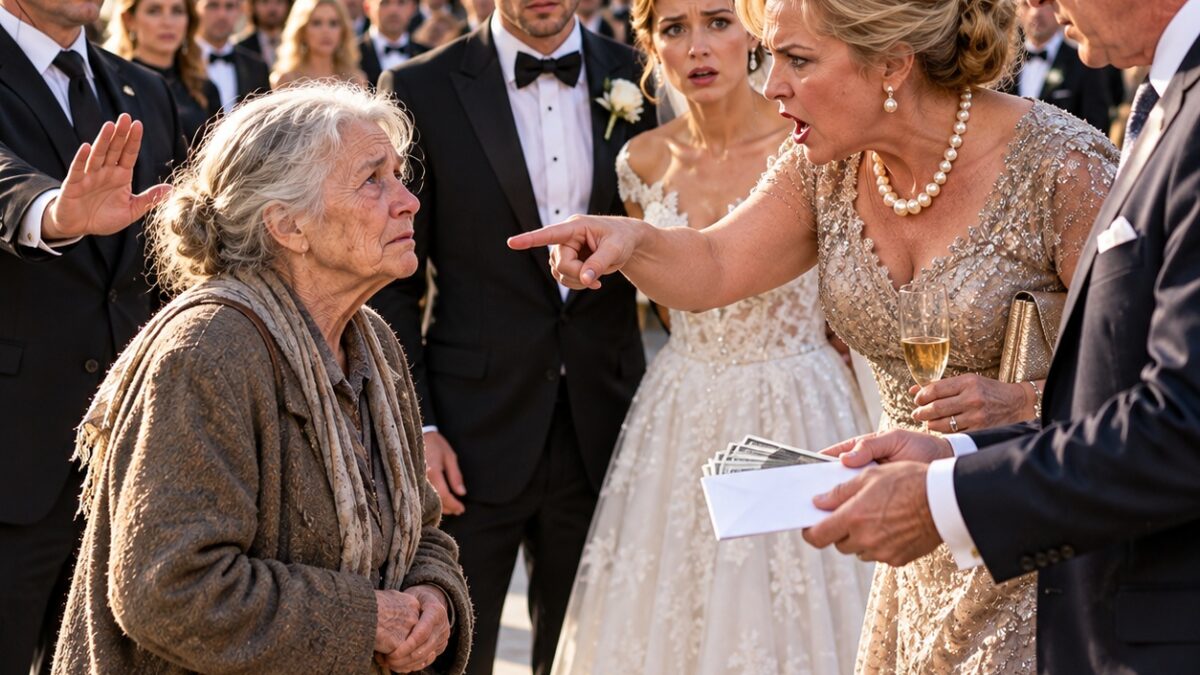
Then he reached inside his jacket.
At first I thought he was retrieving a phone.
Instead, he pulled out a white envelope.
I knew immediately what it was.
Cash.
He extended it toward Margaret between two fingers.
The gesture was so polished it took a second to understand how cruel it was.
“Perhaps you’d be more comfortable somewhere more appropriate.”
The crowd became silent again.
Margaret looked at the envelope.
Not greedily.
Not hopefully.
She simply looked.
Then looked up at him.
I felt my shoulders tighten.
“Sir.”
He did not take his eyes off her.
“She doesn’t need charity.”
That brought the first real reaction from the guests.
A murmur.
A few heads turning.
My father-in-law finally looked at me.
The smile vanished.
“Daniel.”
One word.
A boundary.
I held his gaze.
“You don’t know who she is.”
“Neither do you.”
“Exactly.”
He stepped closer.
Lowered his voice.
“You work for my company.”
There it was.
Not shouted.
Worse.
Measured.
Public.
A reminder that every invitation I had received into their world had conditions.
My salary.
My title.
My office.
My projects.
My future.
All of it could suddenly be placed on the table because I refused to let him insult an elderly stranger.
I heard my mother behind me inhale.
My father said nothing.
That nearly destroyed me.
Because I knew what they were hearing.
For years, they had celebrated my career.
Every promotion.
Every article.
Every building.
They had watched me climb from the narrow brick house where I grew up into rooms our family had never occupied.
And now the man whose daughter I had just married was reminding everyone that he still believed the ladder belonged to him.
I wish I could tell you I felt fearless.
I did not.
I felt sick.
My mortgage.
My career.
Projects I had spent years building.
People who worked under me.
Professional reputation.
Marriage.
All of it moved through my mind at once.
Then Margaret’s hand trembled against her purse again.
And the decision became strangely easy.
I looked at my father-in-law.
“I know exactly who I work for.”
His eyebrows rose.
“My profession.”
I paused.
“And my conscience.”
My mother started crying.
Quietly.
I saw it from the corner of my eye.
My father looked down.
The old woman looked at me differently.
Not grateful exactly.
Evaluating.
That would matter later.
The father pushed the envelope slightly closer.
Margaret did not take it.
“I was invited,” she said.
He blinked.
“By whom?”
She turned toward me.
I did not know the answer.
But I knew mine.
“Come with me.”
I offered my arm.
She rested her fingers lightly against it.
The crowd parted.
Not graciously.
Reluctantly.
I felt eyes on my back.
The bride’s mother said something behind us.
My bride said my name again.
I kept walking.
Past flower arrangements that cost more than some families’ monthly rent.
Past crystal centerpieces.
Past donors.
Past board members.
Past people who had laughed three minutes earlier.
I could have seated Margaret at an empty table in the corner.
Instead, I took her to my parents.
Family.
My mother stood immediately.
“Come sit with us.”
No question about clothing.
No demand for credentials.
No whispered speculation.
Just:
Come sit.
My father pulled out a chair.
Margaret lowered herself slowly.
“Thank you.”
My mother touched her hand.
“You’re welcome.”
The contrast almost broke me.
There are people who need to know your résumé before they decide whether you deserve kindness.
And there are people who see an old woman standing alone and make space.
I had spent years trying to rise from one world into the other.
That afternoon, for the first time, I wondered whether I had misunderstood which world was higher.
Dinner started.
Or tried to.
The room had changed.
Conversations came back in fragments.
People spoke too brightly.
Silverware touched porcelain.
The band resumed.
My bride sat at the sweetheart table.
She smiled for photographs.
But every time her eyes found me, the smile vanished for half a second.
I knew we would have a conversation later.
I did not know how brutal it would be.
At that moment, I did not care.
I sat beside Margaret.
She ate slowly.
Barely.
My mother kept asking whether she wanted more water.
Finally Margaret smiled.
“Your mother is going to drown me before dessert.”
My mother laughed.
Good.
The tension broke for one second.
Then Margaret began asking me questions.
Not wedding questions.
Business questions.
“Your firm’s waterfront permit is delayed.”
I looked at her.
“Yes.”
“Why?”
“Environmental review.”
“Only?”
I hesitated.
“There are also easement issues.”
She nodded.
“What about Maple Street?”
I stopped eating.
Maple Street was confidential.
Pending acquisition.
Executive-level discussion.
Not public.
“What about it?”
“The western parcels.”
My father-in-law, seated across the room, had stopped eating.
I noticed.
Margaret noticed me noticing.
She took a sip of water.
“The zoning variance won’t survive if they consolidate those lots under the current plan.”
My pulse changed.
“How do you know that?”
She smiled faintly.
“Do you disagree?”
“No.”
“Why?”
I glanced toward the head table.
My father-in-law’s fork hung motionless.
The bride’s mother leaned toward him.
My bride watched.
I turned back.
“The drainage plan creates a conflict with the new parking footprint.”
Margaret nodded.
“And?”
“Historic façade restrictions.”
Again, the small nod.
“And?”
I stared.
“There’s a utility easement nobody has resolved.”
She smiled.
“Good.”
My mother whispered:
“Are we still at a wedding?”
Margaret laughed.
I did too.
But my father-in-law did not.
He stood.
Slowly.
Walked toward our table.
No smile now.
Not even a fake one.
He stopped behind the chair across from Margaret.
“How do you know about Maple Street?”
She folded her napkin once.
Placed it beside her plate.
“Coffee first.”
He stared.
The server arrived at almost the same moment, pouring into delicate white cups.
Steam curled upward.
Nobody around us spoke.
I could feel other tables paying attention.
Margaret opened her purse.
That worn, scuffed purse everyone had judged.
She removed a folded sheet.
Crisp.
Uncreased.
Official.
My father-in-law’s eyes dropped to it.
Margaret unfolded the document.
Turned it around.
“Do you recognize this?”
He looked.
I saw his face change before I saw the page.
His jaw loosened.
Color left his cheeks.
His hand touched the back of the chair.
“What is this?”
Margaret raised one eyebrow.
“You signed it.”
He looked again.
Then I leaned closer.
Land expansion agreement.
A recent one.
I recognized the project.
His signature appeared near the bottom.
Bold.
Confident.
Underneath it:
Veil Infrastructure Holdings.
The name meant something to me.
But only vaguely.
A silent capital partner used on several large projects.
Private.
Almost no public profile.
Our firm had worked with Veil for twelve years.
I had never met anyone from the company.
Neither had most executives.
Its representatives were lawyers.
Fund managers.
Signatures.
No publicity.
My father-in-law looked from the page to Margaret.
“How did you get this?”
She removed her glasses.
“I believe we’ve been partners for twelve years.”
Nobody moved.
Not my parents.
Not me.
Not the father.
The words traveled outward.
People at the neighboring table heard.
Then the next.
Margaret began standing.
I instinctively reached to help.
She accepted my arm.
She smoothed the front of her faded wool coat.
The same coat the bridesmaid had looked at with disgust.
The same coat my bride’s mother had wanted removed from the photographs.
“My name,” she said, “is Margaret Vale.”
Somewhere near the bar, somebody inhaled sharply.
An older man whispered:
“No.”
Phones appeared.
People searched.
Margaret Vale.
Forbes.
Veil Infrastructure.
Regional development holdings.
Investment chains.
Estimated net worth reaching into billions.
But almost no photographs.
By design.
She had spent decades behind holding companies.
No interviews.
No social media.
No society pages.
Ownership without theater.
My father-in-law looked physically ill.
I had never seen money leave a room so quickly without a dollar moving.
Margaret’s identity changed nothing about what had happened.
That was the painful part.
She had been the same woman outside.
Same mind.
Same history.
Same dignity.
But suddenly the people who had laughed wanted to stand straighter.
A board member rushed over.
A politician whispered to his wife.
The bridesmaid who had stopped Margaret at the entrance disappeared.
My bride’s mother approached first.
Of course.
“What a surprise.”
Her smile was huge now.
Painfully warm.
Margaret looked at her.
No expression.
My father-in-law stepped forward.
“Ms. Vale, if we had known—”
Margaret interrupted.
“That is precisely the problem.”
The room went still.
He swallowed.
“This was a misunderstanding.”
She looked toward the entrance.
Toward the security guard.
Toward the white envelope still sitting on the table.
“No.”
One word.
Not angry.
Worse.
Certain.
“You understood exactly who you believed I was.”
Nobody moved.
“You simply believed that person deserved less.”
My bride’s mother opened her mouth.
Closed it.
Margaret picked up the white envelope.
For one terrible second, I thought she would open it.
Instead, she slid it across the table.
Back toward him.
“Keep it.”
He did not touch it.
She looked around the room.
At the guests who had laughed.
The guests who had stared.
The guests who suddenly looked ashamed.
Then her eyes came back to me.
“You were the only one who treated me like a person.”
My throat tightened.
“That shouldn’t make me special.”
“No.”
Something softened in her face.
“It shouldn’t.”
She turned toward my parents.
“Neither should they.”
My mother started crying again.
Margaret squeezed her hand.
Then she said something that changed every life in that room.
“For some time, I’ve been reviewing succession.”
My father-in-law’s face changed again.
Not fear.
Calculation.
My bride stepped closer.
Her eyes fixed on Margaret.
Margaret continued.
“I have no children.”
The room listened harder.
“No direct heirs.”
Phones were recording now.
Nobody pretended otherwise.
“I have built companies, partnerships, land positions, and foundations.”
She paused.
“I have spent most of my life watching people mistake inheritance for character.”
Her eyes found mine.
“I have not decided what happens next.”
That was important.
She did not announce:
Daniel gets everything.
That would have turned kindness into a lottery ticket.
She was too wise for that.
But then:
“If character is part of legacy…”
She looked at me.
“…I believe I may finally know where to begin looking.”
My bride’s face changed.
That is one of the most painful memories from my wedding.
Not her mother’s cruelty.
Not her father’s threat.
My bride’s face.
For the first time since Margaret arrived, she looked at me without embarrassment.
Without frustration.
Without anger.
She looked at me as though I had become valuable.
Not emotionally.
Financially.
Possibly enormously valuable.
The shift lasted less than a second.
Maybe nobody else saw it.
I did.
And once you see something like that in the person you married, you cannot unsee it.
Margaret saw it too.
Her eyes moved from my bride to me.
She said nothing.
She did not have to.
Dinner ended badly.
There is no elegant way to restart a wedding reception after the poorest-looking guest in the room reveals she has controlling interests connected to the bride’s family empire.
People tried.
The band played.
The photographer attempted group shots.
Dessert appeared.
Nobody tasted much.
My father-in-law disappeared with two board members.
My bride’s mother made rounds attempting damage control disguised as hospitality.
Guests who had never spoken to Margaret suddenly wanted introductions.
She declined nearly all of them.
One senator attempted:
“Margaret, we may have crossed paths—”
“No.”
He retreated.
I sat beside my parents.
My father finally spoke.
“You okay?”
No.
“Yes.”
He gave me the look fathers give sons who have forgotten that their fathers know them.
My mother took my hand.
“That was cruel.”
She meant all of it.
Not only what had happened to Margaret.
The public reminder that I worked for the family.
My bride’s reaction.
Years of subtle class distinctions suddenly made explicit.
I nodded.
“I know.”
She looked toward the head table.
“Whatever happens next, don’t lose yourself trying to keep something that only loves you when you’re useful.”
That sentence hurt more than I can explain.
Because mothers sometimes say aloud the thing you have been trying not to know.
I wish I could give you a dramatic scene about my marriage that night.
A screaming confrontation.
A wedding ring thrown across marble.
I will not.
The source of this story does not support that.
And some wounds are private even when they begin in public.
What I can tell you is that something fundamental had been exposed.
Not created.
Exposed.
Margaret taught me that distinction later.
Power did not make my bride’s family become who they were.
It revealed what had already been there.
By midnight, Margaret had left.
No motorcade.
No dramatic security detail.
A quiet sedan arrived.
Before she got in, I followed her outside.
“Ms. Vale.”
She turned.
“Margaret.”
“Thank you.”
“For what?”
I almost laughed.
“For destroying my reception?”
“I did no such thing.”
She looked back toward the club.
“They did that themselves.”
I nodded.
Then:
“I didn’t know who you were.”
“I know.”
“I want you to know I would have—”
She raised one hand.
“Don’t.”
I stopped.
“You’re about to ruin the only thing you did right.”
I stared.
“What?”
“You did not help me because I was Margaret Vale.”
“No.”
“Then do not make your kindness retroactively about my identity.”
That landed hard.
She stepped closer.
“You saw an old woman being humiliated.”
“Yes.”
“And you decided it was wrong before you knew whether I could ever do anything for you.”
“Yes.”
“That is enough.”
My throat tightened.
She looked toward my parents through the glass.
“They raised you well.”
“They did.”
“Then remember where your wealth started.”
I frowned.
“I’m not wealthy.”
Margaret smiled.
“That is not what I said.”
Then she got into the car.
For the next three weeks, my life became something I barely recognized.
Veil Infrastructure initiated a restructuring review of every shared holding connected to my father-in-law’s firm.
Auditors arrived.
Not dramatic men in dark coats.
Accountants.
Lawyers.
Compliance specialists.
People with laptops and document requests.
Far more terrifying to executives who had spent years without serious challenge.
My father-in-law complained the review was punitive.
Margaret answered through counsel:
“Review is not punishment.”
That sentence spread through the company.
It became a kind of warning.
If clean books frighten you, the books are the problem.
The special board meeting happened less than a month after the wedding.
I was not invited.
I should not have been.
I worked for the company, but I was not a voting director.
Margaret’s controlling interests gave her enormous influence across the shared holdings.
She did not use it to install me.
That mattered.
She used it to force review.
Hours passed.
Then I received an email.
Short.
Strategic leadership realignment effective immediately.
My father-in-law had been removed as CEO.
Not dragged from the building.
Not publicly screamed at.
A vote.
Governance.
The same machinery of power he had spent years assuming belonged to him had finally operated without his consent.
People expected me to celebrate.
I did not.
He had hired me.
Taught me things.
Given me opportunities.
Also humiliated me.
Threatened my career.
Treated vulnerable people as lesser.
Humans are inconvenient that way.
They rarely fit perfectly into villain boxes.
His removal still hurt people close to me.
That did not make it wrong.
Then the emails surfaced.
That changed everything.
Internal messages.
“Undesirable tenant profiles.”
“Protecting premium-property demographics.”
“Steering applicants.”
Coded language.
Sometimes not coded enough.
I read excerpts and felt sick.
The company I had spent years helping build had been making decisions beneath my feet that I had not seen.
Maybe I had not wanted to see.
That question haunted me.
How much can you benefit from a structure before you become responsible for asking what supports it?
The compliance investigation expanded.
Several contracts paused.
Expansion permits froze.
Local press started digging.
The wedding story leaked soon after.
A guest had taken photographs.
One showed Margaret at the entrance.
Faded coat.
Security guard nearby.
My bride’s mother in front of her.
Another captured my father-in-law holding the white envelope.
That image went everywhere.
People debated class prejudice.
Elitism.
Corporate culture.
The internet wanted instant punishment.
Margaret refused interviews.
No angry statement.
No victory lap.
Instead, she announced the Veil Foundation for Ethical Development and Housing Equity.
That was her answer.
Not humiliation.
Structure.
Board policies rewritten.
Anti-discrimination clauses strengthened.
Tenant-review procedures independently audited.
Community representation added to certain planning reviews.
Compliance reporting made direct to board committees rather than filtered through executives.
Reform.
Boring.
Powerful.
I expected my career to be over.
My father-in-law had been removed.
My relationship to the family made me radioactive.
Some colleagues assumed Margaret would simply give me his job.
Others resented me before anything happened.
One man congratulated me in the elevator.
“For what?”
“You know.”
“No.”
He smiled.
“Come on, Daniel.”
I stared at him.
“If you think defending an elderly woman was a job interview, you learned the wrong lesson.”
He stopped smiling.
Good.
Margaret called me two days later.
“Board would like to interview you.”
“For what?”
“A leadership role.”
My stomach dropped.
“I don’t want charity.”
She laughed.
Actually laughed.
“Oh, Daniel.”
“What?”
“You think I removed one entitled man so I could install another because I like him?”
That shut me up.
“You’ll interview.”
She continued.
“Independent directors.”
“Yes.”
“You’ll submit a restructuring proposal.”
“Yes.”
“They’ll examine your project history.”
“Yes.”
“Management complaints.”
“Yes.”
“Financial performance.”
“Yes.”
“Community outcomes.”
“Yes.”
“And if they decide you’re not ready, you won’t get the job.”
I exhaled.
“Good.”
“That’s why I called.”
The process lasted weeks.
Brutal weeks.
Questions about decisions I had made years earlier.
Projects over budget.
A permit delay I had mishandled.
A junior architect who left my team after conflict.
Every weak point examined.
One interviewer asked:
“Why should we trust your ethics when you worked inside this company for years?”
I hated the question.
Because it was fair.
“I don’t know that you should.”
He looked surprised.
I continued.
“You should verify them.”
Silence.
“Judge my record.”
I swallowed.
“And where my record is incomplete, build controls around me too.”
That answer changed the room.
I had learned from Margaret.
Good systems do not depend on finding saints.
Eventually, I was offered a leadership position.
Not ownership.
Not Margaret’s fortune.
Not immediate succession to anything.
Responsibility.
I accepted.
The first morning I entered my new office, I closed the door.
Sat.
Then cried.
Not because I had “won.”
Because I could still hear my father-in-law on the country-club steps.
You work for my company.
Now I understood the trap inside that sentence.
No company should belong psychologically to one person.
Not his.
Not mine.
Institutions are held temporarily.
Stewarded.
Then passed.
I opened the first board packet.
Started working.
Margaret visited rarely.
When she did, nobody mistook her for anyone anymore.
That irritated her.
“People are exhausting.”
I smiled.
“You preferred being thrown out?”
“No.”
She paused.
“But at least I learned something.”
Her health began showing age more clearly.
Nothing dramatic was invented.
She simply became thinner.
Used a cane sometimes.
Hands trembled more.
Mind stayed razor sharp.
A year after the wedding, we stood together at the opening of an affordable housing development on the east side of town.
Brick buildings.
Wide sidewalks.
A playground.
Young trees that would take years to become shade.
Families moving boxes.
Children running.
No red carpet.
No country club.
No champagne towers.
A small plaque near the entrance read:
FUNDED BY THE VEIL FOUNDATION
Margaret’s name was not on it.
She had insisted.
“People need housing, not my biography.”
I smiled.
“That sounds familiar.”
“What?”
“Nothing.”
She leaned over the blueprints in my hands.
Corrected one note.
At her age.
At a ribbon opening.
Still correcting drawings.
“You enjoy this too much,” I told her.
“I enjoy being right.”
“There it is.”
We watched a little girl run across the courtyard toward the playground.
Her mother called after her.
Laughter echoed between the buildings.
Margaret’s expression changed.
Softer.
“Power reveals people,” she said.
I looked at her.
“So does poverty.”
I waited.
She continued.
“People think poverty creates character.”
“No?”
“It reveals it too.”
She looked toward the buildings.
“Some people become generous when they have nothing.”
Then toward the city skyline.
“Some people become cruel when they have everything.”
I thought about the country club.
The white envelope.
The laughter.
My bride’s mother whispering:
We don’t want people like that in the photos.
The irony became almost unbearable.
Those photographs survived.
Not the perfect ones they wanted.
The ugly ones.
Margaret near security.
The envelope.
The room staring.
A family with enormous wealth caught measuring a human being by a coat.
Money had not protected their reputation.
Character had destroyed it.
I looked at Margaret.
“What did you see in me that day?”
She smiled.
“I didn’t see anything magical.”
“Comforting.”
“You saw somebody being treated badly.”
“Yes.”
“And you decided your comfort was less important than stopping it.”
She tapped my blueprint.
“People overcomplicate character.”
I thought about that.
Then asked the question that had bothered me for a year.
“Were you really looking for an heir?”
She became quiet.
“Yes.”
“Am I?”
She looked at me.
Long enough to make me uncomfortable.
“Do you want to be?”
I thought about the company.
Her wealth.
Holdings.
Influence.
All the things people at the wedding would have killed to inherit.
Then I thought about my parents pulling out a chair before they knew her name.
“No.”
Margaret smiled.
“Good.”
I blinked.
“Good?”
“People who want inheritance too badly are usually the least interesting candidates for trust.”
I laughed.
“So what happens?”
“We keep working.”
That was her answer.
No dramatic will.
No promise.
No fortune dropped into my lap.
Trust.
Earned daily.
That was more valuable.
The bride’s family name eventually disappeared from company letterhead after the restructuring.
Not erased from history.
They had built real things.
Their role belonged in the record.
But the company no longer functioned as a family possession disguised as an institution.
That distinction mattered.
New governance.
Independent directors.
Transparent reviews.
Clear ethics structures.
My father-in-law’s removal did not magically cleanse everything.
Reform is not baptism.
It is maintenance.
We made mistakes.
Had disagreements.
Approvals failed.
Developers complained.
Some affordable-housing proposals were financially impossible.
Some activists thought we were not going far enough.
Some investors thought we had gone too far.
Welcome to leadership.
No one hands you moral purity with the office keys.
You balance.
You listen.
You document.
And when you are wrong, you correct before somebody has to humiliate you into recognizing it.
That became my rule.
The wedding photograph remained in my desk.
Not the formal one.
The leaked photograph of Margaret outside.
I kept it because it reminded me how quickly successful people can become blind.
Sometimes young executives would enter my office nervous.
New hires.
Assistants.
Contractors.
I watched myself carefully around them.
Not because I was naturally better than my father-in-law.
Because I had seen what happens when people stop checking.
Power creates conveniences.
People laugh before you finish jokes.
Doors open.
Mistakes disappear.
Your schedule becomes everyone else’s emergency.
Eventually you begin believing the world naturally moves that way.
It does not.
People are moving it for you.
And if nobody can tell you no, you become dangerous without noticing.
I made sure people could tell me no.
Sometimes they did enthusiastically.
A young project manager once said:
“Daniel, that plan is terrible.”
The room froze.
I asked:
“Why?”
He explained.
He was right.
I changed it.
Afterward he apologized for his wording.
I said:
“Keep the honesty. Improve the diplomacy.”
He laughed.
That culture mattered more to me than any title.
Because the old company had been full of people who knew better and stayed quiet.
The country-club guests had done the same.
Silence can be expensive.
The leaked emails proved it.
Somebody had read those messages when they were written.
Nobody stopped them.
Somebody had seen applicants being steered.
Nobody escalated.
People adapt to wrongdoing gradually.
One compromise.
Then another.
By the time the wine reaches somebody’s coat, everyone is surprised.
They should not be.
The wine is usually the visible end of a much older pattern.
Margaret understood that.
That was why her response targeted governance instead of individuals only.
My father-in-law lost the CEO position.
Necessary.
But if we replaced him and left every structure intact, another version of him would eventually emerge.
Reform had to outlive anger.
The bride’s mother never publicly apologized to Margaret.
Not that I know of.
She made attempts at private reconciliation.
Margaret declined most.
“She does not want forgiveness,” Margaret told me once.
“What does she want?”
“Relief from discomfort.”
I thought.
“Difference?”
“Enormous.”
True apology accepts that the injured person may never make you feel better.
It asks for nothing.
Many apologies are really negotiations.
I said sorry. Now please stop making me feel like someone who did this.
Margaret had no interest.
The bridesmaid sent a handwritten note.
Margaret showed me.
Short.
No excuses.
I saw your coat and decided who you were. I am ashamed. You owed me nothing, and I treated you as if you owed me an explanation. I am sorry.
Margaret folded it.
“That one learned.”
“How do you know?”
“She apologized for what she did, not for how it looked.”
I remembered that.
Public relations teaches people to say:
We regret that anyone was offended.
Character says:
I did this. It was wrong.
Simple.
Rare.
One year became two.
The housing-equity foundation expanded.
Not only affordable apartments.
Small-business financing.
Ethical development research.
Tenant legal aid.
Projects that would never make glamorous gala videos.
Margaret loved those most.
“No chandeliers,” she said.
“Your standards are falling.”
“They’re improving.”
Miguel—no, wrong story, I sometimes thought about other stories of people standing silent in rooms. In ours, the witnesses were donors and board members. Different names, same human weakness.
That thought followed me.
How many rooms had I occupied where someone became invisible?
How many times had I stayed silent because I did not understand the whole situation?
The wedding made me uncomfortable with my own history too.
It is easy to condemn cruelty you stopped.
Harder to examine what you ignored before.
I remembered a construction meeting years earlier.
An older janitor interrupted because water was leaking near a service corridor.
An executive waved him away.
I had said nothing.
The leak damaged finished flooring later.
Everybody joked the janitor had been right.
Nobody apologized to him.
I had forgotten until Margaret.
Why?
Because I had not been the victim.
That is how privilege works in ordinary ways.
Other people’s humiliations do not stay in your memory as long.
I found him.
Retired by then.
Called.
The conversation was awkward.
He barely remembered me.
I apologized anyway.
Not because I expected forgiveness.
Because accountability should not depend on being remembered.
He laughed.
“Son, I was right about that leak.”
“Yes, sir.”
“That’s what matters.”
Maybe.
To him.
I still needed to say it.
Margaret became a mentor in the way severe weather becomes a teacher.
Not gentle.
Useful.
She questioned everything.
“Why are you building that?”
“Market demand.”
“Whose demand?”
“Residents.”
“Which residents?”
I hated her.
Then improved the proposal.
She never let ethical development become a slogan.
Affordable does not mean low quality.
Equity does not mean ignoring math.
Community input does not mean everyone gets veto power.
Profit is not immoral.
Exploitation is.
Luxury housing is not automatically evil.
Displacement is not automatically inevitable.
Nuance.
Work.
No easy slogans.
The foundation’s best projects came from refusing false choices.
On the east side development, we included modest units without designing them to look like punishment.
Wide sidewalks.
Light.
Trees.
Play space.
Transit access.
Not charity architecture.
Dignity architecture.
Margaret inspected the first finished apartment.
Opened cabinets.
Checked window locks.
Ran water.
I laughed.
“You’re worth billions.”
“And faucets still leak.”
Fair.
One tenant recognized her from the wedding story.
“Ms. Vale?”
Margaret visibly regretted becoming recognizable.
The woman hugged her.
Margaret froze.
Then slowly hugged back.
“Thank you,” the woman said.
Margaret looked uncomfortable.
“For what?”
“For building somewhere my kids can live.”
That silenced her.
On the drive home, she looked out the window.
“You okay?”
“No.”
I smiled.
“Reasonable.”
She glared.
I had used her own line.
Good.
There was one part of the story fans always wanted more of.
My bride.
They wanted punishment.
They wanted me to stand at the wedding, remove my ring, and leave her family humiliated.
Real life is not required to satisfy an audience that way.
And the source does not support me inventing that ending.
What I can tell you is simpler and more painful.
That day changed the way I saw love.
Because when Margaret revealed wealth, I watched warmth replace embarrassment on faces all around the ballroom.
Including people closest to me.
That is a hard thing to survive emotionally.
Once you learn someone respects power more quickly than goodness, the knowledge does not disappear.
What followed privately belonged to us.
Not the internet.
Not the company.
Not the board.
And it is not necessary to manufacture a dramatic divorce to understand the lesson.
The wedding itself had already exposed what needed exposing.
That was enough.
Fans often want villains punished in the most personal way possible.
But I learned from Margaret that the most satisfying consequence is not always emotional destruction.
Sometimes it is losing the ability to keep harming people.
My father-in-law lost control of the company.
Discriminatory practices came under investigation.
Contracts paused.
His name stopped functioning as automatic authority.
The organization changed.
Families who would once have been screened through coded prejudice received fairer process.
Developments were evaluated differently.
Those consequences reached farther than one ruined wedding ever could.
That satisfied me.
Not immediately.
I was human.
There were nights I imagined speeches.
Perfect sentences.
Things I wished I had said when he held the envelope.
Things I wished I had said when he told me I worked for him.
Then eventually those fantasies became boring.
Because the actual answer was stronger.
He told me:
You work for my company.
Years later, I stood inside that company after its governance had been rebuilt and understood:
No.
I worked for the responsibility.
Titles come and go.
Family names come and go.
Buildings outlive signatures.
The people affected by decisions remain.
That is who leadership owes.
The company eventually adopted a policy requiring community-impact review on major developments.
The first time the board approved it, I thought about the old emails.
“Undesirable tenant profiles.”
Words typed casually because writers believed nobody important would ever object.
Now the people previously categorized in emails had representation in the process.
Not total control.
Representation.
Voice.
That mattered.
Margaret attended the vote through video.
Afterward, she called.
“You looked nervous.”
“I was.”
“Good.”
“You say that every time.”
“Because confident people frighten me.”
“You’re very confident.”
“That’s why I frighten myself.”
I laughed.
She did not.
Maybe she was serious.
Age made her physically smaller.
Her cane became permanent.
Hands shook noticeably.
She hated help.
I learned how to offer it without making her feel managed.
“Stairs.”
“I can see.”
“I know.”
“Then stop narrating architecture to an investor.”
“Yes, ma’am.”
At a board dinner, a young executive tried to carry her purse.
She nearly took his head off.
I intervened.
“He’s trying to help.”
“I did not ask.”
The executive fled.
I leaned toward her.
“You traumatized him.”
“Then he’ll remember consent.”
Fair.
Underneath the sharpness, though, I saw time.
The woman who had walked alone around the country-club perimeter was slowing.
That became painful.
Because trust creates another kind of fear.
Loss.
She had no children.
No direct heirs.
Her succession planning continued.
People speculated constantly.
News articles.
Financial analysts.
Who gets Veil?
Will Daniel inherit?
Will the foundation control it?
I refused to answer questions I genuinely could not answer.
Margaret refused even more aggressively.
“Everybody wants to know where my money goes.”
She stirred tea.
“Nobody asks where I go.”
That sentence hit me.
“What do you mean?”
She shrugged.
“People discuss estates while people are still alive.”
I understood.
From then on, I asked fewer succession questions.
More human ones.
How are you sleeping?
What are you reading?
Do you want to go outside?
What do you miss?
She missed her sister.
Dead years earlier.
She missed train travel before everything required security lines.
She missed being anonymous.
She missed good peaches.
She complained modern peaches tasted “educated but useless.”
I have no idea what that meant.
She refused to explain.
Those conversations mattered more than inheritance.
Maybe that was another test.
Maybe not.
I stopped caring.
Trust changed me.
Years later, at an industry conference, a panel moderator introduced me as “Margaret Vale’s likely successor.”
I corrected him publicly.
“No.”
He blinked.
“You’re not?”
“I am Daniel.”
People laughed nervously.
I continued.
“Margaret’s succession is hers to decide. My work should stand without speculation about what I may inherit.”
That clip circulated.
Margaret called.
“You finally learned.”
“What?”
“Never let somebody else’s wealth become your biography.”
I wrote that down.
Power attracts people.
Proximity to power attracts others.
When I was only the scholarship architect marrying into an old-money family, some people viewed me as lucky.
After Margaret’s announcement, they viewed me as potentially strategic.
Same person.
Different imagined access.
That is exhausting.
It also teaches you to value the people whose behavior does not change.
My parents.
They remained unimpressed.
When I received the leadership role after formal vetting, I called my mother.
“You proud?”
“Did you eat lunch?”
“Mom.”
“Answer.”
“No.”
“Then I’m not proud until you eat.”
I laughed.
Normal love.
No valuation model.
No inheritance angle.
My father asked:
“Are you treating people right?”
“I’m trying.”
“Good.”
Then:
“Don’t become impressed with your own office.”
That was the entire celebration.
Perfect.
Margaret loved them.
She occasionally visited their house.
The first time, my mother panicked about furniture.
Margaret arrived carrying a grocery-store pie.
Not expensive.
My mother stared.
“You brought store pie?”
“I don’t bake.”
“You’re a billionaire.”
“And?”
My mother shook her head.
They became friends.
That gave me joy I did not expect.
Two women from completely different worlds discovering that neither had patience for nonsense.
My father mostly listened.
Smart man.
One evening, Margaret looked around the narrow brick house where I grew up.
Family photographs.
Old couch.
Small kitchen.
She said:
“This is where you learned.”
“What?”
“To make space.”
I looked at my mother.
She was setting another plate on the table even though nobody needed more food.
“Yes.”
Margaret nodded.
“That’s what money can’t buy.”
That may have been the closest she came to explaining why she trusted me.
Not because I was brilliant.
Not because I stood up to wealthy people.
Because when an old woman looked out of place, my instinct was:
Make space.
That came from home.
The development firm eventually had another gala.
Years later.
Smaller.
Different venue.
I almost skipped it.
Then went.
I watched the entrance carefully.
Not because I expected Margaret.
Because I remembered.
Servers moved among guests.
I paid attention to how executives spoke to them.
That became an informal habit.
You can learn much about someone from how they treat people carrying trays.
One board member snapped his fingers at a server.
I pulled him aside.
“Don’t.”
He looked confused.
“Don’t what?”
“Do that.”
“It’s nothing.”
“Then it should be easy to stop.”
He never did it again around me.
Maybe elsewhere.
Culture is repetition.
You cannot announce values once.
You practice them until disrespect feels abnormal.
At the original wedding, cruelty felt normal enough that a room stayed silent.
I wanted the opposite.
A room where someone acting like that becomes the strange one.
That is cultural change.
Margaret’s foundation funded ethics training too, though she hated the phrase.
“People know right from wrong.”
“Then why training?”
“They ignore it.”
“So training?”
“Accountability.”
She insisted training without consequences was theater.
Correct again.
We tied conduct to promotion.
Vendor selection.
Leadership review.
People complained that standards were subjective.
Some are.
That does not mean abandon standards.
Use documentation.
Multiple reviewers.
Appeals.
Transparency.
Build fair process.
Again, systems.
The investigation into the old emails eventually produced formal compliance findings.
Some people left.
Some remained under new controls.
We did not conduct a purge for spectacle.
Important.
Correct wrongdoing.
Protect people.
Preserve legitimate expertise where possible.
Institutions need memory too.
The father-in-law’s removal was sufficient to satisfy internet revenge fantasies.
I cared more about whether the next applicant was treated fairly.
That is the difference between punishment and reform.
One looks backward.
One prevents repetition.
You need both sometimes.
But never confuse them.
A year after the east-side opening, I returned without Margaret.
I wanted to see how it functioned when nobody knew anyone important was coming.
Parking lot full.
Children on the playground.
One broken sprinkler.
A resident complained about trash pickup.
Excellent.
Real life.
No staged photographs.
I walked the sidewalks.
The buildings were not monuments to us.
They were housing.
That was the goal.
A little boy rode a scooter directly into my shin.
Nearly killed me.
His mother apologized.
I laughed.
Margaret would have called it community engagement.
The plaque had weathered slightly.
Funded by the Veil Foundation.
No Margaret Vale.
No Daniel.
Good.
I sat on a bench.
Thought about the country-club envelope.
The money offered to an old woman because people believed poverty made her removable.
Now her money had helped create homes where families were treated with dignity.
That was satisfying.
Not because the bride’s family had lost.
Because someone else gained.
That distinction matters.
Revenge subtracts.
Justice can sometimes build.
When people tell the story now, they often stop at:
She was secretly a billionaire.
I hate that.
The reveal makes good drama.
But the reveal is not the moral.
Margaret did not become worthy when people learned her net worth.
She was worthy when her shoes were scuffed.
She was worthy when her coat was faded.
She was worthy before the Forbes search.
Before the holding-company contract.
Before the controlling shares.
The cruelty happened before anyone knew she could punish them.
That is precisely why it mattered.
If your kindness activates only after wealth is revealed, it is not kindness.
It is risk management.
My parents had the best reaction of anyone that day.
They knew nothing.
My mother saw an elderly woman.
She pulled out a chair.
My father made space.
No calculation.
No cameras needed.
That remains the purest moment in the story.
Not the reveal.
The chair.
I tell young leaders that.
They look disappointed.
They want strategy.
I give them furniture.
Pull out the chair.
Make space before you know the résumé.
That is leadership at its smallest.
And sometimes the smallest choices are the only honest ones because you make them before reward appears.
Margaret once asked whether I regretted helping her.
I laughed.
“What kind of question is that?”
“A useful one.”
“No.”
“Even with everything that happened?”
I understood.
The wedding damage.
Career uncertainty.
Public scrutiny.
Private consequences.
“No.”
“Why?”
“Because if I walked past you to keep everybody happy, I would have had to live with the man who did that.”
She smiled.
“There he is.”
“Who?”
“The person I trusted.”
I looked away.
Compliments from Margaret were dangerous.
They made you emotional before you realized what happened.
Her trust was never loud.
She did not tell me:
You’re like a son.
She did not need to.
She asked me to review structures.
Invited me into meetings.
Criticized my proposals.
Trusted me with information.
Real trust is often administrative.
Keys.
Documents.
Calls returned at midnight.
Showing someone the unfinished version.
I learned that.
Succession remained unresolved publicly.
That was okay.
The fans of the story may want a final line where Margaret leaves me billions.
I will not invent it.
That would cheapen everything.
Because then the moral becomes:
Kindness paid off financially.
No.
I did not help Margaret because I expected reward.
If she left every dollar to a hospital, the action outside that country club would still be right.
That is the point.
My reward was not inheritance.
It was trust.
A career I earned under independent review.
A chance to build differently.
A mentor.
And the knowledge that when the moment came, I did not betray the people who raised me just to preserve access to people with more money.
That is enough.
More than enough.
The last image I want you to have is not the bride’s father losing his job.
Not auditors walking through headquarters.
Not leaked emails.
Not the bride’s mother staring at the white envelope she once offered like an insult.
Those were consequences.
Necessary.
Satisfying, perhaps.
But not the ending.
The ending came one year after the wedding.
East-side courtyard.
Afternoon light.
Children laughing.
A woman carrying groceries into a building she could afford.
A man helping his father up a wide accessible sidewalk.
Workers finishing landscaping.
Margaret beside me.
Thinner.
Cane resting against one arm.
Still sharp enough to criticize my blueprints.
No country-club music.
No security guard.
No cameras.
Just work continuing.
She watched the children.
“Do you remember what they said about me?”
I knew.
Probably scouting for handouts.
We don’t want people like that in the photos.
Somewhere more appropriate.
“Yes.”
Margaret nodded toward the housing development.
“Funny.”
“What?”
“Turns out I was looking for somewhere appropriate.”
I laughed.
She smiled.
Then her face became serious.
“Daniel.”
“Yes?”
“Never let what happened to me become a story about hidden wealth.”
I looked at her.
“Why?”
“Because then everyone learns the wrong lesson.”
She tapped her cane once against the pavement.
“They’ll say, ‘Be careful. The poor-looking woman may be rich.’”
She shook her head.
“That is cowardice dressed as wisdom.”
I knew exactly what she meant.
“What should they learn?”
Her eyes moved toward the children.
“Treat the poor-looking woman well even if she has nothing.”
Simple.
Devastating.
“Because?”
Margaret looked at me like the question was unnecessary.
“Because she is someone.”
The playground erupted in laughter.
A little girl came running toward us chasing a ball.
It rolled to Margaret’s cane.
Margaret stopped it with her shoe.
The girl looked up.
“Can I have it?”
Margaret pretended to think.
“Are you on the board?”
The girl stared.
I laughed.
Margaret nudged the ball back.
The girl ran away without knowing she had just ordered a billionaire around.
Perfect.
Margaret watched her go.
“That,” she said, “is a person with proper priorities.”
We stood there a little longer.
Then I offered my arm.
She looked at it.
“Stairs?”
“Uneven pavement.”
“I can walk.”
“I know.”
She took my arm anyway.
We moved slowly through the courtyard.
Years earlier, I had offered that same arm at the country-club entrance.
Then it had been an act of defiance.
Now it was simply affection.
That was the transformation I valued.
She no longer needed me to prove she belonged anywhere.
She never had.
I no longer needed wealthy people to prove I belonged either.
That had taken me longer.
At the far end of the courtyard, we passed the small foundation plaque.
Margaret did not look at it.
I did.
Just once.
Then kept walking.
Because names on plaques are not the deepest legacy.
People living with dignity are.
The family that tried to remove her from my wedding had once controlled rooms through money, name, and inherited influence.
A year later, their name no longer controlled the company letterhead.
Auditors had examined the books.
Discriminatory practices had been exposed.
Leadership had changed.
Board rules had changed.
Housing policy had changed.
My father-in-law had learned the brutal truth that power is not permanent simply because everyone has been too afraid to challenge it.
And Margaret?
She did not become louder.
She did not buy the country club.
She did not demand an apology on television.
She did not destroy people for entertainment.
She built.
Homes.
Controls.
Opportunity.
Trust.
That was why her victory felt complete.
She did not become what had hurt her.
Neither did I.
Sometimes fans want the villain screaming while security drags them away.
I understand.
Humiliation creates an appetite for humiliation in return.
But there is something far more satisfying than watching cruel people suffer for five minutes.
Watching them lose the power to keep hurting people.
Watching the system change.
Watching doors stay open for the people they once shut out.
Watching affordable homes rise where exclusion used to make money.
Watching an old woman in a faded coat become known not because she demanded recognition, but because her choices made other people harder to erase.
That was our ending.
Not revenge.
Correction.
Not inheritance.
Trust.
Not a perfect wedding photograph.
A truthful one.
If you ever saw the leaked image, Margaret looked small beside the country-club columns.
Her old coat faded against all that polished white stone.
People assumed the building made her insignificant.
I know better now.
Buildings only look powerful because people agree they are.
Titles only matter because systems support them.
Family names last until records change.
Money can disappear.
Companies can restructure.
Boards can vote.
But the moment somebody sees another human being being made small and decides to stand beside them—
that is harder to take away.
My father-in-law once reminded me in front of an entire room:
“You work for my company.”
He meant it as a leash.
Years later, I finally understood the answer I wish I had been wise enough to give him then.
No.
I worked for the thing my parents taught me before I had a title.
Before the scholarship.
Before the firm.
Before the wedding.
Before Margaret Vale ever entered my life.
Dignity.
And dignity does not care what somebody’s coat costs.
It does not wait for Forbes.
It does not ask who controls the voting shares.
It does not check whether kindness will be rewarded.
It simply asks whether a human being is being treated like one.
That afternoon, outside the country club, almost everyone failed that test.
My parents did not.
I did not.
And Margaret remembered.
Not because she needed rescuing.
Because powerful people spend their lives surrounded by people who become kind the second they discover power.
What she had almost never seen was kindness arriving first.
That was why she trusted me.
That was why she trusted my parents.
And that is why, one year later, as she leaned lightly on my arm beneath a sky full of children’s laughter, I finally stopped thinking about everything I might inherit from Margaret Vale.
I had already inherited the only thing she had truly chosen to give me.
Her trust.
We kept walking.
Behind us, children played in a courtyard built to last.
Ahead of us, there was more work.
And for the first time since the country-club doors opened on my wedding day, that was exactly where I wanted to be.

