PART2:They Found King Unconscious in the Garbage—Then the Vet Told Me He Might Not Survive the Night
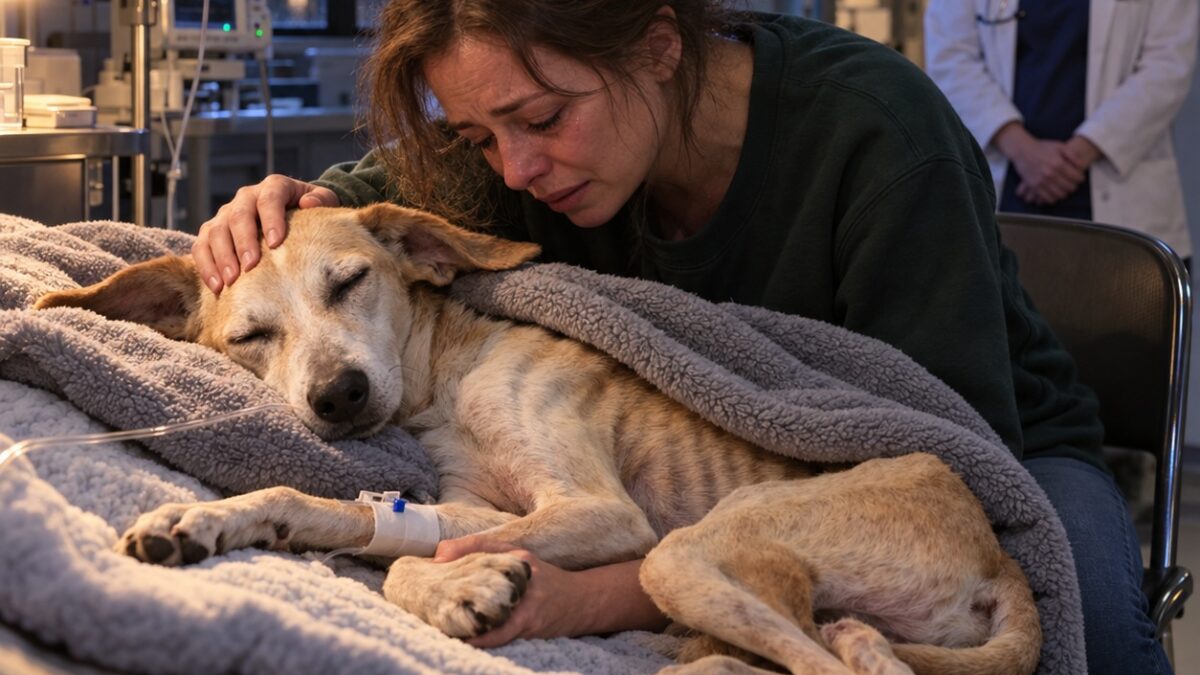
PART2
I had sat beside dying animals before.
There is a particular silence around a body that is losing its fight.
Not peaceful silence.
Waiting silence.
You listen too carefully.
You count breaths without admitting you are counting.
You watch the chest.
Rise.
Fall.
Pause.
Rise again.
Every pause feels longer than the one before it.
That first night with King, I learned the exact rhythm of his breathing.
I learned which tiny movement meant he was trying to get comfortable.
I learned the shape of his face when medication finally let some tension leave it.
I learned how helpless a person can feel while sitting only inches away from someone they desperately want to save.
The veterinarian had not said King was definitely going to die.
But nobody spoke to me about recovery plans.
Nobody talked about weeks.
Nobody said rehabilitation.
They talked about keeping him comfortable.
Keeping him stable.
Seeing what his body did.
Those phrases sound clinical until you are sitting beside the animal they refer to.
Then they mean:
We do not know whether morning belongs to him.
I brought food when I was told he could try it.
At first, he barely reacted.
I placed a little near him.
He smelled it.
Turned his head slightly.
That was all.
“It’s okay.”
I said.
“You don’t have to.”
I removed it.
An hour later, I tried again.
Nothing.
I remember thinking how strange it was that I already cared so much about whether a dog I had met only hours earlier swallowed one bite of food.
But crisis changes the scale of importance.
A bite becomes a victory.
An open eye becomes news.
A deeper breath feels like hope.
I talked to him.
I had no idea whether it helped.
Still did it.
“King.”
The name was new.
We had started calling him that because he needed something that belonged to him besides a medical chart.
“King.”
His ear moved slightly.
Or maybe I imagined it.
“You’re safe.”
That was another promise I was not entirely certain how to define.
Safe from what?
His body was still in danger.
His health was still critical.
But nobody was going to throw him away again.
That part I could control.
“You’re not in the garbage anymore.”
I whispered.
King’s eyes opened for perhaps a second.
Then closed.
I put my hand beside his face.
Did not force him to accept touch.
He could move away if he wanted.
He did not.
So I stayed.
The next morning, he was alive.
That sentence sounds so small.
It did not feel small.
I walked into the clinic and saw his chest rise.
I almost cried from relief.
The veterinary team remained cautious.
No celebration.
No promise.
“He made it through the night.”
someone said.
Made it through.
Not recovered.
Not safe.
Made it through.
I sat beside him.
“Good morning.”
His eyes opened.
This time, they stayed open longer.
Not much.
Maybe two seconds.
But he looked in my direction.
I smiled.
“You have no idea how unreasonable everybody thinks you are.”
His eyes closed again.
I laughed softly.
“You keep doing that.”
I began returning every day.
That became my routine.
Work around King.
Money around King.
Plans around King.
I brought food.
Asked questions.
Sat near him.
The savings I had put aside for my own life began turning into treatment for a dog whose life I still could not be certain would last another week.
I did not consider myself heroic.
Mostly, I was scared.
There is nothing heroic about looking at a bill and thinking:
I hope I am not paying for something that will end tomorrow.
Then immediately hating yourself for thinking it.
But fear does not cancel love.
Neither does practicality.
I knew money was finite.
I knew treatment was expensive.
I knew King’s condition was serious enough that even organizations dedicated to animals had said they could not take him.
Still, when the choice arrived—
continue helping,
or stop—
I kept saying yes.
Not because I knew the ending.
Because King had already experienced enough decisions where somebody else decided he was not worth the difficulty.
I did not want my decision to be another one.
On the second day, he ate.
Not much.
A few bites.
I watched as though I were witnessing something impossible.
His mouth moved slowly.
He stopped.
Rested.
Took another bite.
“That’s it.”
I whispered.
“Take your time.”
The veterinarian saw my face.
“Don’t read too much into one meal.”
“I know.”
I did not know.
Or I knew intellectually.
Emotionally, those few bites were everything.
Food meant appetite.
Appetite meant the body still had some conversation with the future.
King had wanted something.
I clung to that.
The third day, he lifted his head when I came in.
Barely.
An inch.
Maybe two.
But this time I knew I was not imagining it.
“King?”
His eyes found me.
I stopped walking.
The room seemed to narrow until there was nothing except that dog and the fact that he recognized the sound of my voice.
“Hey.”
His head lowered again.
I sat beside him.
My hands shook.
It embarrassed me.
A dog had lifted his head.
That was all.
But when you have been preparing yourself to say goodbye to someone you barely had time to know, any sign that they are trying to remain feels enormous.
By the fourth day, one of the clinic staff said:
“He seems a little more stable.”
I hated how much hope those words created.
Stable is not healed.
Stable is not safe.
Stable only means the emergency has stopped getting worse for a moment.
But for King, a moment mattered.
I started imagining impossible things.
Bringing him somewhere outside.
Watching him eat a full meal.
Seeing him look interested in something.
I did not let myself imagine walking.
Not yet.
His legs remained badly deformed.
Even survival would not erase that.
I told myself:
Do not ask for everything.
Ask for today.
That became my rule.
Today, breathe.
Today, eat.
Today, stay.
Tomorrow could make its own argument when it arrived.
The veterinary team continued medication.
Continued monitoring.
King continued surprising us by still being there.
Days accumulated.
Five.
Six.
Seven.
I started realizing I knew the sound of the clinic doors.
Which technician walked quickly.
Who spoke softly to King.
Which blanket he seemed to settle best under.
That was how much time I spent there.
King, meanwhile, was beginning to exist as something other than a nearly motionless body.
His eyes followed people.
He became aware of food before it touched his mouth.
Sometimes he watched me.
I started seeing an expression that felt less absent.
Curiosity, perhaps.
Or maybe simple awareness.
Whatever it was, I wanted more.
One afternoon, I brought food and sat beside him.
I placed it down.
King smelled it.
Then looked at me.
For the first time, his eyes held mine.
Three seconds.
Maybe four.
There are moments when nothing physically dramatic happens but your entire understanding of a situation changes.
That was one.
King was in there.
Not metaphorically.
Not sentimentally.
A living mind was looking back.
He had been so sick that, at first, his personality had almost disappeared beneath the medical crisis.
Now something was emerging.
A dog who noticed.
A dog who chose where to look.
A dog who might have preferences.
A dog who might still want a life.
I smiled.
“Hi.”
King blinked.
Then began eating.
I turned my face away because I did not want anyone to see me cry.
Some people think rescue begins when an animal is taken out of danger.
I used to think that too.
King changed the definition for me.
Removing him from the garbage was only the first movement.
The rescue continued every time medication arrived.
Every time somebody cleaned him.
Every time his food was prepared.
Every time I came back through the clinic door.
Every time one of us chose not to let his condition become a reason to stop caring.
Rescue was repetition.
Not one dramatic moment.
That was the first thing King taught me.
I kept thinking about where he had been found.
Garbage.
The word bothered me more every day.
Not because rubbish itself is uniquely terrible.
Because of what it represents.
Things people are finished with.
Things considered broken.
Things that take up space without giving anything back.
You discard them.
King had been lying among that idea.
His legs could not carry him normally.
His health had collapsed.
Someone, apparently, had reached a point where his inability to move made him easier to leave than to help.
I could not prove exactly how he got there.
I refused to invent a villain simply to make my anger easier.
But whatever the circumstances, King had been found in a place where unwanted things go.
Now every time I looked at him eating, breathing, watching me, I thought:
You were never garbage.
I wanted him to have enough life left for that fact to become undeniable.
A week passed.
Then more.
The veterinarian stopped speaking only in hours.
That change was so subtle I almost missed it.
At first:
“We’ll see how tonight goes.”
Then:
“Let’s reassess tomorrow.”
Later:
“We need to think about his nutritional plan.”
A plan.
Plans belong to futures.
I noticed.
Did not mention it.
I was afraid saying hope aloud would scare it away.
That is irrational.
I know.
But when you almost lose something before you even have it, you become superstitious.
King’s appetite improved.
His body began accepting nourishment instead of merely tolerating it.
His eyes looked clearer.
His breathing stronger.
He still could not stand.
His legs remained a serious problem.
But I was no longer sitting beside him to make sure he did not die alone.
I was sitting beside him wondering what life might look like if he did not die.
That was a completely different kind of fear.
Because now I wanted things.
I wanted him home.
Wanted him comfortable.
Wanted him interested in the world.
Wanted to know what would make his tail move.
Wanted to hear what kind of sound he made when excited.
Hope creates new vulnerabilities.
When you expect death, you protect yourself through preparation.
When you begin expecting life, suddenly there are hundreds of things to lose.
I accepted the risk.
Two weeks after King had arrived at the clinic with almost no expectation of survival, the veterinarian told me he could leave.
I thought I misunderstood.
“What?”
“He’s stable enough to continue care at home.”
“Home?”
“Yes.”
The word hit me harder than I expected.
“Are you sure?”
She smiled.
“You have spent two weeks asking us to save him.”
“I know.”
“Now you’re arguing because he’s well enough to leave?”
“I’m not arguing.”
“You look like you’re arguing.”
I looked toward King.
He was awake.
Watching us.
His legs were still deformed.
His body still needed care.
Nothing about him looked suddenly perfect.
But he was alive.
Strong enough to leave.
Strong enough to have a next place.
“Where is he supposed to go?”
she asked.
“With me.”
The answer came before she finished.
No phone calls.
No shelters.
No searching.
“With me.”
She nodded.
“I figured.”
I looked at King.
“You hear that?”
His head shifted slightly.
“You’re coming home.”
I carried him out of the clinic.
There is symmetry in that image that still breaks me.
I had carried him in not knowing whether he would ever leave alive.
Now I was carrying him out.
Same body.
Still fragile.
Still limited.
But warmer.
Stronger.
Present.
The sunlight outside felt almost disrespectfully ordinary.
Cars moved.
People walked.
Somebody laughed in the distance.
The world had continued for two weeks while mine had narrowed to one dog’s breathing.
King blinked at the brightness.
I held him carefully.
“Take a look.”
His eyes moved.
New place.
New air.
New sounds.
“You made it outside.”
That sentence almost destroyed me.
I put him into the vehicle.
His head rested against the blanket.
I drove slowly.
No emergency this time.
No desperate glances every two seconds to make sure he was still alive.
I still checked.
Of course I checked.
But now I was driving toward something instead of away from disaster.
Home.
I prepared a place for him before discharge.
Soft bedding.
Easy access to food and water.
A quiet area where he could see what was happening.
I had other dogs.
That worried me.
Not because they were aggressive.
Because King was vulnerable.
Introductions needed to be careful.
The first time one of my dogs entered the room, King’s eyes changed immediately.
He watched.
The other dog stopped.
Sniffed from a safe distance.
King lifted his head.
Something woke in him.
Interest.
Not fear.
Interest.
I almost laughed.
“Really?”
After everything King had survived, the first thing that seemed to truly capture his attention was another dog walking past.
The other dog moved away.
King’s eyes followed.
That became important later.
At the time, I simply thought:
Good.
Let the world contain something besides medication.
Home care was work.
I do not romanticize it.
Feeding.
Cleaning.
Monitoring.
Medication.
Making sure King rested properly.
Watching for any sign that his condition was worsening.
The first nights, I barely slept.
Every sound made me sit up.
If the room became too quiet, I checked his breathing.
King would sometimes open his eyes and look at me as if I were the one with a medical problem.
Maybe I was.
Fear can become a habit.
For two weeks, I had lived with the possibility that he would stop breathing.
My body did not immediately understand that the emergency had changed.
So I checked.
Again.
Again.
Again.
He kept breathing.
That repetition healed me too.
Nourishing meals became one of the biggest parts of his recovery.
King had been so depleted that feeding him felt like rebuilding something molecule by molecule.
Every meal mattered.
I watched his body slowly fill out.
Not dramatically.
A little less sharp here.
A little more energy there.
He began noticing me before food reached him.
Then anticipating.
One day, I entered carrying his meal and his eyes lit up in a way I had never seen.
I laughed.
“Oh, so now we have opinions.”
His head lifted.
“Apparently death is less interesting than dinner.”
That felt like progress.
A dog who had been barely conscious now cared whether food was arriving quickly enough.
Wonderful.
Be demanding.
Be inconvenient.
Want things.
I wanted King to become troublesome.
A dying animal is easy in the worst possible way.
It asks almost nothing because it has almost nothing left to ask with.
Life is noisy.
Hungry.
Impatient.
I wanted noise.
The other dogs became King’s television.
He watched them constantly.
One played with a toy.
King watched.
Another crossed the room.
King watched.
They went toward the yard.
King watched.
At first I thought he was simply curious.
Then one afternoon, something changed.
King shifted his body forward.
I was nearby.
He placed his front legs beneath himself.
Tried to push.
Nothing.
His legs could not support him properly.
He collapsed back onto the bedding.
I moved closer.
“Easy.”
King looked at the other dogs.
They were playing.
Then he tried again.
My heart stopped.
Not because I thought he would injure himself.
Because I suddenly understood.
He wanted to join them.
King, who had been found unconscious among garbage.
King, whom the clinic had not expected to survive.
King, whom multiple shelters could not take because his condition was too severe.
King wanted to play.
I put one hand over my mouth.
He tried to stand again.
His body lifted partially.
His front legs bent wrong beneath the weight.
He came down.
The other dogs kept playing.
They had no idea they were witnessing one of the most painful and beautiful moments I had ever seen.
King looked toward them.
Then at his own legs.
Then tried again.
“King.”
My voice broke.
He ignored me.
Another attempt.
His chest rose.
For one second, hope.
Then gravity pulled him down.
I knelt beside him.
“Stop.”
Not angry.
Begging.
“You’re going to hurt yourself.”
He looked at me.
And I swear the expression on his face was not surrender.
It was frustration.
That nearly destroyed me.
Because frustration requires desire.
King wanted something badly enough to be upset that his body would not let him reach it.
Two weeks earlier, I had begged his body merely to stay alive.
Now he wanted to chase other dogs.
I put my forehead against his head.
“You want to go, don’t you?”
King watched the others.
That was his answer.
That night, I cried.
Not at the clinic.
Not when the shelters refused.
Not when the veterinarian warned he might die.
I had been too busy then.
Too frightened.
Too focused on the next decision.
But after watching King try to stand, I sat alone and finally let everything arrive.
I thought about the garbage.
The man lifting him.
The clinic.
The calls.
No.
No.
No.
Too critical.
Too sick.
Too much.
Then King’s body refusing to stop.
And now this.
A dog finally wanting life strongly enough to be angry that his legs could not carry him into it.
I cried because surviving had given him another kind of suffering.
He could see life now.
He just could not reach it.
That felt cruel.
For a few minutes, I hated the fact that he had improved enough to know what he was missing.
Then I hated myself for thinking that.
I went back to him.
King was asleep.
The other dogs nearby.
I sat on the floor.
“You didn’t fight this hard just to watch.”
I whispered.
“I don’t know how yet.”
“But we’re going to figure something out.”
His breathing remained steady.
There was another promise.
This one I did not know how to keep yet.
But I intended to try.
I started with bandages.
Support around the front legs.
Careful positioning.
Anything that might help his limbs bear more weight.
It did help.
A little.
That little mattered.
King could shift differently.
Lift himself somewhat more effectively.
But not enough.
He still could not move the way he wanted.
He would see another dog pass.
Try.
Struggle.
Stop.
His body was not going to become normal because I wanted it badly enough.
That realization hurt.
Hope can become cruel when it demands a body transform into something it cannot be.
I had to change the question.
Not:
How do I make King walk like the other dogs?
But:
How do I help King get where he wants to go?
Those are not the same question.
One tries to fix the dog.
The other tries to fix the barrier.
That changed everything.
I began looking at mobility devices.
Wheelchairs.
At first, the idea made my chest tighten.
I wish I could tell you I immediately saw freedom.
I did not.
I saw disability.
I saw permanence.
I saw an object that made it impossible to pretend King’s legs might somehow become typical if we just waited long enough.
Then I looked at King watching the other dogs.
He did not care about my emotional symbolism.
He wanted to move.
That made the decision simple.
I bought him a wheelchair.
When it arrived, I unpacked it slowly.
Metal frame.
Wheels.
Straps.
Supports.
Practical.
Unsentimental.
King watched from his bed.
I set it down.
One of the other dogs sniffed it.
Walked away.
I laughed.
“Apparently nobody else is impressed.”
King looked interested.
Maybe because I was.
Maybe because it smelled new.
I began adjusting it.
His body needed proper support.
Nothing could rub against the wrong place.
Nothing too tight.
Nothing unstable.
I read instructions repeatedly.
Checked measurements.
Adjusted again.
This was not a dramatic miracle device.
It was equipment.
And equipment only works if it fits.
Finally, I brought King closer.
“Okay.”
I said.
“This is going to feel strange.”
He looked at me.
“Trust me.”
I regretted the phrase immediately.
King had known me only a short time.
Why should he trust me?
Then I realized he already had in small ways.
He allowed me to feed him.
Touch him.
Care for him.
Adjust his body.
Maybe trust does not arrive as one big decision.
Maybe it grows out of a hundred moments where nothing bad happens.
I supported him.
Placed him carefully into the wheelchair.
Secured everything.
King froze.
His expression changed completely.
“What is this?”
I laughed nervously.
“That is a fair question.”
He shifted.
One wheel moved.
King startled.
Stopped.
Looked behind himself.
Another shift.
The chair moved again.
The other dogs noticed.
One approached.
King’s ears lifted.
He leaned forward.
The wheels rolled.
One foot.
Maybe less.
I held my breath.
“King.”
He moved again.
Another little roll.
His head rose.
His eyes locked onto the other dog.
The other dog moved away.
King followed.
The wheelchair rolled across the floor.
Slowly.
Awkwardly.
But it moved.
And King moved with it.
I started crying before I could stop myself.
“Go.”
My voice cracked.
“Go, King.”
He did.
Not fast.
Not gracefully.
Not like a dog whose legs worked normally.
But for the first time since I had known him, King crossed the room because he wanted to.
Not because somebody carried him.
Not because somebody repositioned him.
Not because a veterinarian moved his body for treatment.
King decided where to go.
And then he went there.
The other dogs had stopped playing.
They were watching him now.
King rolled toward them.
One stepped forward.
Sniffed the wheel.
King sniffed back.
Then the dog turned and moved several feet away.
King followed.
He overshot slightly on the turn.
The wheel bumped something.
I instinctively stepped forward.
Then stopped.
King corrected.
Moved again.
He reached the other dog.
There was no music.
No audience.
No applause.
Just wheels making a soft sound against the floor.
And a dog who had once been found nearly unconscious in garbage finally participating in his own life.
I sank onto the floor.
Covered my face.
I cried harder than I had when the veterinarian said he might die.
Because death had been abstract fear.
This was life.
Messy.
Imperfect.
Supported by wheels.
But undeniably life.
King looked at me for a second.
Then turned away.
Another dog had moved.
Apparently my emotional collapse was less interesting than companionship.
Perfect.
That was exactly how it should be.
Learning the wheelchair took time.
The first day was not a magical transformation.
King had to understand how his body worked inside it.
How to turn.
How far the wheels extended.
How to stop.
How to navigate around furniture.
Sometimes he became tangled.
Sometimes frustrated.
Sometimes tired quickly.
I learned too.
Where straps needed adjusting.
When he needed rest.
Which surfaces worked better.
How to help without taking over.
The temptation to do everything for an animal with a disability is strong.
You want to make life easy.
But easy can become another kind of confinement if you never allow choice.
King needed assistance.
He did not need every decision made for him.
So I learned to wait.
If he could solve something safely, I let him.
If he needed help, I helped.
The line changed constantly.
That was care.
King’s world became larger.
Before the chair, his life had been defined by where I placed him.
Bed.
Food.
Blanket.
Nearby dogs.
He could shift.
Try.
But distance belonged to other bodies.
With the wheelchair, distance started belonging to him.
He could follow.
Investigate.
Choose another room.
Move toward company.
Move away.
Stop somewhere sunny.
That was the first thing he did one afternoon.
There was a patch of sunlight across the floor.
King saw it.
Rolled toward it.
Stopped directly in the warmth.
Then rested.
I laughed quietly.
Of all the possibilities the chair had given him, King used freedom to choose a nap.
That was beautiful.
Not because it was inspiring.
Because it was ordinary.
Freedom should include the right to do nothing impressive.
King had spent enough time being remarkable simply by surviving.
He deserved boring pleasures.
Sun.
Food.
Company.
Rest.
I began noticing how differently people reacted to him once they saw the wheelchair.
Some smiled.
Some looked sad.
Some immediately said:
“Poor thing.”
I understood the instinct.
King’s body was visibly different.
His history was painful.
But “poor King” started bothering me.
Not because pity is evil.
Because it was incomplete.
King had already been reduced once to what he could not do.
Could not walk properly.
Could not care for himself easily.
Could not survive without help.
Those were real limitations.
But there was more.
King was curious.
King was food-motivated.
King wanted company.
King wanted to follow the other dogs.
King could become stubborn when I tried to stop him from moving before his wheelchair was fully adjusted.
King had opinions.
That mattered.
Disability should not erase personality.
Survival should not turn someone into a permanent object of sadness.
I wanted people to look at King and eventually see King.
Not the garbage.
Not the legs.
Not the chair.
Him.
The veterinarian saw him in the wheelchair later.
She watched him move.
A smile appeared slowly.
“He wants to go.”
she said.
“Yes.”
“He really wants to go.”
“He has been trying since he got home.”
She crouched.
King moved toward her.
Not perfectly.
But confidently enough.
She touched his shoulder.
Then looked at me.
“You know, we can support a body.”
“We can treat illness.”
“We can improve comfort.”
“But we can’t manufacture interest in life.”
I looked at King.
He had already turned his attention toward another dog.
“No.”
I said.
“That part was his.”
That became important to me.
I had not saved King through the force of my love.
The veterinary team had not saved him by medication alone.
The wheelchair had not saved him.
All of those things gave him opportunities.
King did the living.
His body responded.
His eyes opened.
He ate.
He became curious.
He tried to stand.
He wanted to play.
We supported what was already reaching toward life.
That distinction keeps rescue honest.
There were still difficult days.
I do not want to turn the story into a perfect upward line.
Some mornings King had less energy.
Some days movement was harder.
There were adjustments to care.
Times when equipment needed attention.
Moments when I worried too much.
Times when caring for him and the other dogs felt exhausting.
Love does not cancel fatigue.
Commitment does not make money infinite.
I had days where I looked at everything required and thought:
I am tired.
That did not mean:
I wish King were gone.
Caregivers need to be allowed that distinction.
You can love someone deeply and still be tired.
You can choose them and still wish the work were easier.
The important thing is what happens after the feeling.
I rested when I could.
Asked for help when available.
Then got up.
King still needed breakfast.
Life is practical that way.
The savings I spent never returned.
I mention that because rescue stories often hide cost behind emotion.
Money mattered.
It was real.
Treatment costs were real.
Food.
Equipment.
Continued care.
I made those choices knowingly.
I was fortunate enough to make them.
Would I tell every person to empty savings impulsively?
No.
That would be irresponsible.
But I would tell them something King taught me.
Do not measure whether kindness was worth it only by whether the ending becomes perfect.
During the first clinic days, somebody asked me:
“What if you spend all this and he dies anyway?”
The question hurt.
Not because it was cruel.
Because it exposed a terrible assumption.
That care is valuable only if it purchases survival.
If King had died on day four, would feeding him have been pointless?
Would pain medication have been wasted?
Would speaking gently to him have been a mistake?
Would making sure he was not alone have mattered less?
No.
Absolutely not.
We were lucky enough to get more time.
But dignity is not a prize reserved for animals who recover.
King deserved kindness before anybody knew the outcome.
That became one of the deepest things his story gave me.
I thought often about the man who found him.
Without him, none of this existed.
No clinic.
No wheelchair.
No home.
No other dogs.
No future.
Just garbage.
The man did not have specialized training.
He did not know what King needed.
He did not have a medical plan.
He noticed.
Then acted.
That was enough to begin everything.
Months later, I contacted him.
“I wanted to tell you King made it.”
Silence.
Then:
“He made it?”
“Yes.”
“Really?”
“Really.”
I sent him a photograph.
King awake.
Looking stronger.
Later, another picture of him in the wheelchair.
The man called again.
“That’s the dog?”
“Yes.”
He laughed once.
Then his voice changed.
“I thought he was dying when I picked him up.”
“So did we.”
“I thought maybe I was too late.”
“You weren’t.”
Another silence.
“I’m glad I stayed.”
That sentence got me.
Because that was the thread running through King’s entire story.
The man stayed until I arrived.
I stayed at the clinic.
The veterinary team kept treating him.
King stayed alive.
Sometimes rescue is nothing more glamorous than one living being refusing to leave before the next one arrives.
King settled into the house.
Not as a medical project.
As a dog.
That transition took time.
At first, everything revolved around his condition.
What time is medication?
How much did he eat?
Is he comfortable?
How is his breathing?
Are the legs supported?
Is the equipment correct?
Eventually, new questions appeared.
Where did King hide that piece of food?
Why is he staring at the kitchen?
Which dog stole his resting spot?
Why does King suddenly believe my meal belongs to him?
Those questions were a gift.
They meant crisis was no longer the only subject.
King liked company.
That became obvious.
He did not always need active play.
Sometimes he simply wanted to be in the same room as the other dogs.
He would move closer.
Settle.
Watch.
If one shifted positions, King noticed.
If they went somewhere interesting, he wanted to follow.
The wheelchair gave him the option.
I began hearing the wheels from another room.
A soft rolling sound.
Sometimes a little bump.
Then King appeared.
That sound became part of home.
At first, the wheelchair was something I noticed because it represented his disability.
Later, I noticed the sound because it meant King was coming.
That changed everything.
One day I was in the kitchen.
I heard the wheels.
Roll.
Pause.
Roll.
Then King appeared around the doorway.
I smiled without thinking.
“Hey.”
That was when I realized the equipment had stopped being tragedy in my mind.
It was simply how King arrived.
The other dogs adapted faster than people did.
They sniffed the chair.
Investigated the wheels.
Then accepted it.
Dogs are often brutally practical.
Can King play?
Sometimes.
Can he follow?
Yes.
Is he in the way?
Occasionally.
Does he have food?
Important.
That seemed to be the extent of their philosophical analysis.
I loved them for it.
King did not need everybody staring at his legs.
He needed companions.
The other dogs gave him that.
One afternoon, one of them was playing nearby.
King moved toward him.
The other dog changed direction quickly.
King followed.
Not fast.
But determined.
The wheel turned awkwardly.
King corrected.
Then continued.
I stood several feet away.
No help.
He did not need it.
A few weeks earlier, I would have rushed forward.
Now I had learned.
Support does not mean preventing every struggle.
Sometimes support means staying close enough while somebody figures out what their own body and tools can do.
King reached the other dog.
They interacted briefly.
Then both settled.
Nothing extraordinary.
I remember it anyway.
Because ordinary life was the thing I had once been afraid King would never get.
The garbage remained in my mind longer than it remained in his story.
That is probably natural.
I had seen the contrast.
Found almost unconscious.
Now moving through a home.
But I started realizing something.
If I kept telling King’s story only through the garbage, I would do another version of what had already been done to him.
Reduce him to his worst condition.
He was more.
So much more.
I started introducing him differently.
“This is King.”
That was it.
If somebody asked about the wheelchair, I explained.
If they wanted the full story and there was a reason, I told it.
But I stopped leading with suffering.
King had earned the right to meet somebody without his pain entering the room first.
That changed how I thought about rescue stories generally.
We love dramatic beginnings.
Abandoned.
Starved.
Injured.
Thrown away.
Those details make people care.
They matter.
But if we stop there, the animal becomes a symbol of what was done to them.
Recovery should make room for personality.
Who are they after safety?
What do they enjoy?
What annoys them?
What do they choose?
King was not “the garbage dog.”
He was King.
A dog with deformed legs.
A wheelchair.
A strong interest in food.
A need to be near other dogs.
A stubborn desire to move.
A life.
I still remembered the moment he first tried to stand more vividly than almost anything else.
Sometimes I saw it when I closed my eyes.
His front legs under him.
The effort.
The collapse.
Then another attempt.
The other dogs playing only a few feet away.
It had been heartbreaking because he could see exactly what he wanted.
But now I understood that moment differently.
It was the first time King demanded more than survival.
That was the turning point.
The clinic had helped his body remain alive.
Food gave strength.
Rest gave recovery.
But desire transformed the question.
He wanted in.
That desire led us to the wheelchair.
Maybe heartbreak and hope can exist in the same movement.
King taught me that.
The wheelchair did not make every day easy.
There were surfaces that were harder.
Turns that required thought.
Times he needed assistance.
But it made possibility larger.
That was enough.
I stopped thinking:
He cannot walk normally.
Started thinking:
Where does King want to go?
If the answer was reachable, we figured out how.
That mindset changed the entire house.
King’s body did not need to fit the environment perfectly.
The environment could adapt too.
Rugs.
Space.
Positioning.
Equipment.
Timing.
Care.
These were not concessions to tragedy.
They were design decisions for a family member.
That is what accommodations are.
Not pity.
Architecture for belonging.
One day, someone watched King in the wheelchair and said:
“It’s so sad.”
I understood why.
I also felt something resist inside me.
“What part?”
They looked surprised.
“His legs.”
“Yes.”
“They don’t work normally.”
“But look at him.”
King was moving toward the other dogs.
Tail alert.
Eyes engaged.
“He doesn’t look sad right now.”
The person watched.
Then smiled.
“No.”
I nodded.
“That’s the part people miss.”
King’s body had limitations.
That did not mean his entire life was a sad thing.
A disabled body is not automatically a tragic life.
King had suffered.
Absolutely.
Being found critically ill in garbage was tragic.
Having no care was tragic.
Being unable to reach something he desperately wanted without support was painful.
The wheelchair?
The wheelchair was not tragedy.
It was access.
I needed time to understand that.
King understood much faster.
The first time we used the chair, I had looked at the metal frame and thought of everything he had lost.
King looked toward the other dogs.
That difference embarrasses me now.
He was already focused on what the device gave him.
Movement.
I was grieving the version of him I imagined should have existed.
A dog on four straight legs.
Running.
Jumping.
Why?
That dog had never been promised to me.
King was the dog in front of me.
His body was his.
My job was not to mourn him into somebody else.
My job was to help this King live well.
That became enough.
His appetite became a running joke.
A dog once too weak to care about food eventually acted as if every delayed meal were a human-rights violation.
I would prepare food.
King watched.
“Two minutes.”
He remained focused.
“You survived the impossible, but apparently waiting for dinner is where you draw the line.”
The other dogs joined the staring.
“Great.”
I said.
“A union.”
Those moments mattered.
Not because they were profound.
Because they were not.
A life full of profundity is exhausting.
King deserved jokes.
Impatience.
Routine.
Normal irritation.
I wanted days where nobody thought about mortality before breakfast.
We began having them.
The clinic follow-ups became ordinary too.
At first, every visit felt like a potential disaster.
Later:
Check.
Adjust.
Continue.
Routine.
I came to love that word.
Routine means you expect a next appointment.
Routine means the calendar extends.
Routine means nobody is asking whether tonight is the last night.
King had moved from an emergency to a patient.
Then from a patient to a dog who happened to need medical care.
That progression was as important as any physical improvement.
One of the veterinary staff members who had seen him on the first day watched King during a later visit.
She crouched.
He moved toward her.
She touched his chest.
Then looked at me.
“I really didn’t think we’d see this.”
“Neither did I.”
“He looks happy.”
I looked at King.
He was attempting to investigate something he had no business investigating.
“I think he’s nosy.”
She laughed.
“That too.”
Happy.
Nosy.
Hungry.
Stubborn.
Every ordinary adjective replaced a medical one.
Critical.
Unstable.
Poor prognosis.
That was healing too.
I never discovered exactly how King ended up in the garbage.
I stopped trying to create a complete history.
People wanted one.
They would ask:
“Who did that?”
“Why?”
“How long was he there?”
I had no answers.
At first, uncertainty frustrated me.
Then I realized King did not need his past solved before his present could improve.
There is a human obsession with explanation.
We believe if we understand why someone was hurt, the pain becomes organized.
Sometimes it does not.
Sometimes there is only:
This happened.
Now what?
King’s life became my answer to the second question.
Now what?
Feed him.
Treat him.
Let him rest.
Help him move.
Give him company.
Keep him.
Simple.
Not easy.
Simple.
There were moments when I wondered whether King understood he had been abandoned.
Maybe that is a human word too.
He understood absence.
Pain.
Hunger.
Inability.
Then presence.
Food.
Touch.
Other dogs.
Movement.
He did not need a philosophical analysis.
He needed patterns.
This place gives food.
This person returns.
These dogs remain.
This chair helps me reach them.
Patterns become safety.
I could give him that.
At night, after the other dogs settled, King would rest comfortably.
Sometimes I sat near him.
No dramatic speeches anymore.
In the clinic, I had talked constantly because silence frightened me.
At home, silence became different.
There was breathing everywhere.
King.
The others.
The small sounds of a living house.
I could sit without needing to say:
Stay.
Because he was staying.
I thought often about my first promise.
“If this is all the time you have left, you won’t spend it alone.”
At the time, I believed that promise might last hours.
Maybe days.
Instead, it became something much larger.
The meaning changed.
You won’t be alone at the clinic.
You won’t be alone while recovering.
You won’t be alone learning the wheelchair.
You won’t be alone in a house where other dogs move around you.
You won’t be alone when your body makes things harder.
You belong here.
The promise outlived the crisis.
I liked that.
King did not become grateful in the sentimental way people sometimes imagine rescue animals should.
He did not spend every moment gazing at me with understanding.
Good.
He was a dog.
He cared about food.
Rest.
Company.
Movement.
Sometimes me.
Sometimes another dog was more interesting.
That was healthy.
An animal should not owe lifelong emotional worship because a human did what should have been done.
King owed me nothing.
I chose him.
His job was to live.
That became especially clear when he started getting impatient with me.
If I took too long preparing the wheelchair, he shifted.
Wanted to move.
I would say:
“Wait.”
He had no interest in waiting.
The first time that happened, I laughed until my eyes filled.
There was a time when I had begged him simply to open his eyes.
Now he was annoyed by my lack of efficiency.
That is progress.
The other dogs helped keep me honest.
They did not treat King like a miracle.
If King had something they wanted, they noticed.
If he occupied space, they moved around him.
If he followed, fine.
If he did not, also fine.
They normalized him.
Humans often make disability emotionally enormous.
Dogs made it logistical.
Wheel there.
Body here.
Smell.
Okay.
Next.
I learned from them.
One afternoon, all of them settled in the same room.
King without the chair for rest.
The others nearby.
Sunlight across the floor.
I looked at the scene and suddenly remembered the garbage pile.
The contrast was so violent I had to sit down.
King had once been surrounded by things nobody wanted.
Now he was surrounded by bodies choosing to stay near him.
Maybe that is the image that hurts me most.
Not because King knew the symbolism.
He probably did not.
I did.
I thought:
Look at you now.
No trash.
No strange open sky.
No waiting for a rescuer.
No body failing in silence.
Just home.
The word home became more important to me through King.
A home is not automatically the place where pain disappears.
King still had difficult legs.
Needed help.
Still had health needs.
Home did not cure him.
Home was the place where none of those things threatened his belonging.
That is different.
He did not have to recover fully to stay.
Did not have to walk normally.
Did not have to become inexpensive.
Did not have to become easy.
He stayed because he was King.
That is what home should mean.
Sometimes people say:
“You gave him a second chance.”
Maybe.
But that phrase makes it sound as though King failed the first one.
He did not.
He was failed.
The difference matters.
The second chance was not King’s chance to prove he deserved life.
It was our chance to treat his life as if it had always deserved care.
That wording feels more accurate.
I also stopped calling the wheelchair “giving him his legs back.”
It did not.
His legs were still his legs.
Different.
Deformed.
Limited.
The chair gave support.
King gave movement.
That distinction honors him.
Technology did not replace his agency.
It expanded it.
His direction.
His curiosity.
His desire to join.
Those were already there.
I remember watching him approach the other dogs once, months into this new routine.
He moved more smoothly than the first day.
Not perfectly.
But confidently.
One dog turned.
King adjusted direction.
Followed.
I stood against the wall.
No fear.
No tears.
Just watched.
That might have been the moment I finally understood we had reached the ending I wanted.
Not cure.
Normalcy.
King participating without every movement becoming a medical event.
His life no longer required me to narrate every inch.
He could simply go.
That is what I wanted from the beginning without knowing the words.
Not:
Make him normal.
Not:
Erase his past.
Not:
Give me a miracle story.
Just:
Let him have enough life that someday I can stop being afraid every time he moves.
We got there.
Not perfectly.
Enough.
There are still things King cannot do.
That sentence no longer hurts the way it used to.
All bodies have limits.
His are visible.
Mine will be eventually too.
The question is not whether limitation exists.
It is whether limitation is allowed to define worth.
King answered that without saying anything.
He had immense worth lying nearly unconscious.
He had worth before eating.
Before improving.
Before moving.
Before the wheelchair.
Before he could give anyone the emotional satisfaction of a recovery story.
That is why staying at the clinic mattered so much.
If I had loved him only after he began to improve, I would have made survival the entrance fee for compassion.
It should not be.
I think back to those shelters that could not accept him.
The word refused sounds harsh.
The reality was more complicated.
Resources are real.
Capacity matters.
A rescue that takes an animal it cannot adequately support can cause more suffering.
Their no was not a declaration that King had no value.
It was an admission of limitation.
I understand that now more than I did while desperately making calls.
At the time, every no felt personal because King was lying there.
Now I see systems.
Money.
Staff.
Space.
Medical complexity.
The answer is not shame.
The answer is more capacity.
More foster homes.
More medical support.
More people willing to learn adaptive care.
King was fortunate.
He found one path.
Many animals still need one.
I think about them often.
But I do not let that guilt steal King’s life.
Rescue workers can become consumed by the ones they cannot save.
Then even the ones who survive become reminders of failure.
I refuse that.
King gets to be joy too.
Not a symbol of every abandoned dog.
King.
Just King.
His wheelchair eventually showed small marks from use.
Scratches.
Normal wear.
I liked that more than when it was new.
A pristine mobility device means it has not taken somebody anywhere.
King’s became used.
That meant distance.
Even if the distances were only rooms, yard spaces, paths through daily life.
Used meant lived.
There were days he preferred resting.
I learned not to push.
Early in rescue, improvement can become an obsession.
You want one more step.
One more minute.
One more milestone.
But King did not need to perform progress for me.
If he was tired, he rested.
No disappointment.
That was another way I had to change.
Care should not turn into pressure just because it comes from love.
One afternoon, I placed the wheelchair nearby.
King stayed resting.
I waited.
He looked at it.
Then put his head down.
“Not today?”
Nothing.
“Fair.”
The other dogs settled too.
We stayed inside.
The world survived.
The next day King was eager again.
Healing includes the right to have slower days.
That should be obvious.
People forget it.
King became part of my financial life too.
Food budget.
Care.
Equipment.
Appointments.
Not glamorous.
Family is expensive.
Humans know this.
Animals too.
What changed was that the expenses stopped feeling like money spent on “a rescue case.”
They became King’s expenses.
This distinction may sound tiny.
It is huge.
Temporary charity asks:
How long can I afford this?
Family asks:
How do we make this work?
That was the shift.
I still made responsible choices.
Still thought about sustainability.
Love should not require destroying every other part of your life.
But King had a place in the calculation now.
He was not an optional line item competing with my willingness to care.
He belonged.
The man who found him asked once:
“Does he know he’s safe?”
I thought for a long time.
“I don’t know what he knows.”
Then:
“But he sleeps deeply.”
That felt like the best evidence.
King could sleep.
Not unconscious.
Not collapsed from illness.
Sleep.
Voluntary vulnerability.
Rest.
Sometimes safety is not a feeling you can observe directly.
You see what a body stops doing.
Stops bracing.
Stops watching every second.
Stops conserving every bit of energy for survival.
King’s sleep looked different.
Loose.
Peaceful.
I treasured that.
The difference between unconsciousness and sleep became emotionally enormous to me.
Both look still from across a room.
But one is absence.
The other is trust.
The first day, King had been barely moving because his body was failing.
Now he could lie still because nothing required movement.
That is freedom too.
Sometimes I watched his chest rise and fall while he slept.
Old habit.
I had spent too many days counting breaths.
Eventually, I would catch myself.
“Stop.”
He is sleeping.
Let him.
I had to recover from the emergency even after King did.
Caregivers carry echoes.
Every silence sounds suspicious.
Every slower meal becomes fear.
Over time, ordinary evidence accumulated.
King woke.
Ate.
Moved.
Rested.
Woke again.
My nervous system learned.
We were both recovering.
I do not know whether the person who left King would recognize him now.
Probably physically.
His legs remain distinctive.
But the dog himself?
I wonder.
Would they recognize alert eyes?
The desire to move?
The way he positions himself near other dogs?
Would they understand how much life was still inside the body they apparently thought could no longer get around?
I do not know.
I try not to spend much time imagining them.
Anger can become another form of attachment to the past.
King deserves my attention more.
If I could place one scene in front of anyone tempted to discard an animal because care became difficult, I would choose King’s first attempt to stand.
Not the wheelchair.
Not the successful outcome.
That moment.
His body failing beneath him.
His eyes on the dogs playing.
Trying again.
Because that was the truth they would have been throwing away.
Desire.
Personality.
A future that needed help to become reachable.
You cannot always provide every level of care.
That is real.
But abandoning a dependent animal is not the same as responsibly seeking help.
King’s body made him vulnerable.
That should have increased the obligation around him, not erased it.
The bandages we tried before the wheelchair are another detail I remember.
I wanted them to be enough.
Simple solution.
Wrap.
Support.
Stand.
But they were not.
That was frustrating.
Then useful.
Sometimes the first solution does not work.
You do not blame the person whose body needs something different.
You change the plan.
King needed more support.
So we gave more.
No moral drama required.
That seems obvious when talking about a dog.
Humans struggle with it more.
We often expect people to adapt to environments rather than environments to adapt to people.
King’s chair taught me practical compassion.
What does he need to participate?
Not:
What should he be able to do by now?
Those questions produce very different lives.
One day, King moved farther than usual.
Not a huge distance.
But enough that I noticed afterward.
I had been busy.
Did not watch every second.
Then I looked up and realized he was across the room beside the others.
I had missed the journey.
At first I felt guilty.
Then I smiled.
That was success.
King’s movement no longer required an audience.
He could get somewhere without the moment becoming a milestone.
Ordinary.
Again.
I keep returning to that word.
Ordinary is what rescue is trying to create.
Not endless inspiration.
A life where nothing terrible happens often enough that boredom becomes possible.
King got bored.
Wonderful.
Bored King became creative.
He watched.
Investigated.
Wanted attention.
I remember thinking:
You have officially become difficult enough to be healthy.
I loved it.
There is something else I want to say about people calling him a fighter.
King did fight.
His body survived severe illness.
He kept trying.
But sometimes calling survivors “fighters” creates a hidden cruelty.
What about the ones who die?
Did they not fight enough?
No.
Bodies have limits.
Luck exists.
Medicine has limits.
King survived because many things aligned.
His strength was part of it.
Not the only part.
I refuse to make his survival a judgment against animals who could not do the same.
King was fortunate.
We were fortunate.
Gratitude, not superiority.
The veterinary team deserved that gratitude too.
They treated a dog they did not expect to survive.
Medicine when hope is low still matters.
That is professionalism at its best.
You do not withdraw care merely because the odds are poor if comfort and treatment remain appropriate.
You do the work.
Maybe the body surprises you.
King did.
I returned to the clinic once simply to thank them.
King came too.
In his chair.
Staff gathered.
Not ceremonially.
Just people coming out because they remembered him.
One person covered her mouth.
Another said:
“No way.”
I laughed.
“Yes way.”
King looked around.
Probably hoping someone had food.
A technician who had monitored him during the worst days crouched.
Touched him gently.
“I remember you not moving.”
King leaned forward.
Sniffed her.
Then turned toward another sound.
She started crying.
I understood.
The contrast was almost violent.
Unconscious.
Now curious.
Sometimes medical workers need to see the endings.
They carry the bad ones too.
King gave them one good ending.
I did not stay long.
I did not want his life to become a reunion tour.
We thanked them.
King investigated.
Then we went home.
Home.
Still my favorite word in this story.
He has a place there.
Not because I am extraordinary.
Because I decided not to make his physical needs a temporary exception.
He belongs.
That is different from being hosted.
Guests worry about overstaying.
Family does not have to earn every meal by being easy.
King is family.
Sometimes I think about the first chair beside his clinic bed.
Me sitting there.
King barely responsive.
I remember the promise.
“If this is all the time you have left, you won’t spend it alone.”
If I could return to that version of myself, I would not tell them the future.
I would not spoil the surprise.
I would simply put a hand on their shoulder and say:
Keep the chair there.
Because everything begins with staying.
Staying long enough for one bite.
Staying long enough for eyes to open.
Staying long enough for the veterinarian to say “improving.”
Staying through discharge.
Staying through the first failed attempt to stand.
Staying while bandages prove insufficient.
Staying long enough to order a wheelchair.
Staying while King learns the wheels.
Staying until the sound of them becomes ordinary.
Staying until he is no longer “the dog in the garbage.”
Just King.
That is the part of rescue social media rarely captures well.
The hours between dramatic photographs.
The repetition.
Cleaning.
Waiting.
Bills.
Worry.
Trying again.
The boring parts are where trust lives.
King did not become safe because I said:
“You’re safe.”
He became safe because I was there tomorrow.
And the next day.
And after that.
Words became true through repetition.
He learned other patterns too.
Food arrives.
Water remains.
Other dogs remain.
The wheelchair returns when needed.
Rest is allowed.
Nobody leaves him in rubbish because his legs require help.
Those patterns created the life.
Sometimes I wonder whether King remembers the man who first lifted him.
Maybe.
Scent memory can be strong.
Maybe not.
But King’s future exists because a stranger refused to assume a nearly motionless body had nothing left.
That is enough.
Not all kindness needs to be remembered by the recipient to matter.
King has never thanked him.
King has never thanked me.
Good.
Gratitude is not rent.
Care is not a loan.
We do not help vulnerable beings so they can spend the rest of their lives making us feel noble.
King can be ungrateful.
He can be demanding.
He can want another meal.
He can ignore me because another dog is more interesting.
All of that means his life belongs to him again.
That is the goal.
One evening, he fell asleep after moving around with the others.
Wheelchair off.
Body comfortable.
His head rested on the bedding.
One of the dogs lay nearby.
I sat across the room.
For a while, nobody moved.
I thought about the garbage.
Then deliberately let the thought go.
King was not there anymore.
I did not need to keep dragging him back in my mind.
He was here.
That mattered more.
There is a strange temptation after rescue to preserve the suffering because the suffering explains why the love feels so big.
But if you truly care about the animal, eventually you have to let the worst day become history.
Not forgotten.
History.
King deserves a present larger than my memory of finding him broken.
So I focus on now.
Now, King wants to participate.
Now, he has other dogs.
Now, he has nourishing meals.
Now, he has rest.
Now, when his front legs cannot carry him, wheels help.
Now, there is somebody who notices when he needs something.
Now, he has a home.
Those facts are enough.
I sometimes hear people say:
“I could never care for a disabled dog.”
I understand the fear.
It can be work.
Resources matter.
Not everyone is the right home.
But I wish people could see King before deciding disability equals misery.
See him moving toward the others.
See the interest.
The impatience.
The normal dog underneath the equipment.
Maybe they would understand that support changes possibilities.
Not every case is the same.
King’s story is only King’s.
But his life is not lesser because assistance is visible.
If anything, King taught me how artificial our definition of independence can be.
He depends on me.
I depended on veterinarians.
The veterinarian depended on medicine, equipment, staff.
The wheelchair exists because engineers and manufacturers created it.
The man who found King depended on a rescue phone number being answered.
Nobody did this alone.
Yet somehow we look at a dog using wheels and call him dependent as though the rest of us are self-created.
We are all carried in different ways.
King’s are simply easier to see.
That realization made me more patient.
With him.
With myself.
Maybe with everyone.
One morning, King was particularly eager.
The other dogs were active.
He watched.
I prepared his chair.
Before I finished securing the last support, he tried to move.
“King.”
He pushed again.
“Wait.”
He gave me the unmistakable look of someone who believed I was personally delaying his important schedule.
I laughed.
“You nearly died.”
No reaction.
“You were unconscious in garbage.”
Nothing.
“You could show some patience.”
King looked toward the other dogs.
I finished.
“Fine.”
I released him.
He went immediately.
That was the day I understood he did not think of himself as a tragedy.
Why should I?
The past had become my burden more than his.
King was busy.
Living.
I followed his example.
I stopped imagining what would have happened if the man had not found him.
That alternate ending served no one.
The man found him.
That is the timeline we received.
I became grateful instead of haunted.
Not always.
But more often.
People still ask me:
“How did he survive?”
I say:
“I don’t know.”
Medication.
Care.
Food.
His body.
Luck.
No single answer.
Then they ask:
“When did you know he was going to make it?”
I think of several moments.
The first bite.
The head lift.
The eye contact.
The discharge.
But honestly?
I never had one cinematic moment of certainty.
Life accumulated.
One day King was the dog who might die.
Then, somehow, I looked around and realized he was the dog whose wheelchair needed adjusting because he was impatient to play.
That was how survival happened.
Gradually enough that certainty arrived after the fact.
That may be why the story feels so emotional to me.
There was no lightning-bolt miracle.
Only persistence.
The kind of persistence we overlook because it is repetitive.
A body accepting food.
A rescuer returning.
A veterinarian monitoring.
A dog trying to stand.
Bandages.
Then wheels.
Life built piece by piece.
That is more believable than magic.
And, to me, more beautiful.
King’s scars are not the center of his appearance anymore.
I notice his eyes first.
The way he watches the other dogs.
His posture when food is coming.
The anticipation.
The signs of a dog who expects to be included.
Expectation is powerful.
At the garbage pile, I do not know what he expected.
Maybe nothing.
Now he expects meals.
Care.
Company.
Movement.
That is what home does.
It changes what you believe tomorrow contains.
King has tomorrow now.
Not guaranteed forever.
Nobody does.
But expected.
That difference is enormous.
He can fall asleep because breakfast is likely.
He can rest because movement can happen later.
He can stop trying to survive every second because the environment is not constantly threatening survival.
That is what safety gives a nervous system.
Time.
I wish I could explain that to whoever left him.
Not to punish them.
To make them understand what was hidden inside the body they apparently could not manage.
They saw limitation.
There was still desire.
They saw a dog who could not get around.
There was still a dog who wanted to join.
They saw burden.
There was still King.
But that conversation will probably never happen.
So I put the energy elsewhere.
Into King.
Where it belongs.
The wheelchair gets cleaned.
Adjusted.
Maintained.
Food gets bought.
Appointments happen.
The other dogs continue living around him.
Life goes on.
That phrase once sounded dismissive to me.
Now it sounds beautiful.
Life goes on.
King’s especially.
There are no dramatic crowds around him.
No applause every time he moves.
Good.
He does not need an audience.
He needs floors he can navigate.
People who understand his equipment.
Dogs who include him.
A place to rest.
That is enough.
Sometimes he gets tired and I carry him.
That does not make the wheelchair a failure.
Support changes with the day.
That is another lesson.
An accommodation can work and still not solve everything.
A good life can include assistance layered on assistance.
Nothing shameful there.
King certainly is not ashamed.
He relaxes when carried.
Why fight a ride?
Smart dog.
The first time I carried him, he was almost unconscious.
Now when I carry him, there is usually an entirely different feeling.
Weight.
Awareness.
Maybe mild impatience.
That contrast still catches me.
The same arms.
Same dog.
Different life.
I remember once holding him after he had tired himself out.
His head rested against me.
His body was stronger now.
Not the frightening lightness from the garbage day.
I thought:
There you are.
That was the feeling.
Not:
I saved you.
There you are.
As though King had spent weeks emerging from behind illness until his full presence finally occupied his body.
I liked him.
Not just loved.
Liked.
His determination.
His impatience.
His desire to be wherever something was happening.
Those are the things you only learn after crisis stops shouting.
One of my favorite moments came when King ignored me.
That sounds strange.
I called him.
He was focused on the other dogs.
No response.
I called again.
Nothing.
I laughed.
There had been a time when I would have done anything for him to respond to my voice.
Now he was healthy enough to decide something else mattered more.
Excellent.
Agency.
Even disobedience can be a privilege.
King’s life is not inspirational every day.
Some days it is mostly feeding and cleaning.
Some days nothing remarkable happens.
I protect those days.
They are proof.
A life cannot remain an emergency indefinitely.
If it does, nobody survives emotionally.
King moved beyond emergency.
That is perhaps the greatest success.
The chair beside his clinic bed is long gone.
But sometimes I can still feel it beneath me.
The hard seat.
My hand near his face.
My fear.
The whispered promise.
I remember thinking:
If he dies, at least someone will be here.
I did not understand how deeply that promise would shape me.
Because King did not die.
So I had to keep being the person who was there.
That required more than one night.
It required building a life.
I am grateful.
Not because it was easy.
Because King gave me a chance to practice a kind of love that does not demand certainty before committing.
We usually want guarantees.
If I spend this money, will he survive?
If I adopt him, will his health stabilize?
Will the wheelchair work?
Will this be worth it?
Life rarely answers beforehand.
You choose.
Then discover.
King taught me to choose the next kind thing.
That was enough.
If he had died, I hope I would still believe that.
He did not.
So now I get the bonus.
The wheels.
The food demands.
The other dogs.
The sight of King heading toward something he wants.
Every ordinary movement feels like interest paid on a promise I made without expecting repayment.
Sometimes, late in the day, King settles while the others rest.
The house becomes quiet.
I look at him.
There are moments I can almost see the two versions at once.
King in garbage.
King at home.
One nearly motionless.
One waiting for me to put on his wheels because he has somewhere to go.
The distance between those images contains every person who refused to give up.
Including King.
Especially King.
I do not know what force inside him kept responding.
Biology.
Instinct.
Comfort.
Maybe simply the absence of active suffering once treatment began.
I do not romanticize it.
A dog does not need a heroic spirit to deserve survival.
But King clearly retained something that wanted more.
When he showed us, we followed.
That is what I would tell anyone reading this.
Look for the desire.
Not only the disability.
Not only the wound.
Not only the diagnosis.
What does the animal still want?
Food?
Touch?
Space?
Companionship?
Movement?
Sun?
King wanted to join the others.
That single desire gave us a direction.
Wheelchair.
Problem.
Solution.
Not perfect.
Enough.
King’s story does not end with him standing on four straight legs.
It ends more truthfully.
His front legs still cannot support him the way he needs.
His body remains different.
He still requires help.
And he is alive.
Interested.
Included.
Loved.
Those truths belong together.
Do not remove one to make the story prettier.
The wheelchair is part of the happy ending.
Not evidence that the happy ending failed.
I wish I had understood that from the first moment I saw it.
King did.
He had no interest in symbolism.
Only mobility.
Wise.
I have started thinking of rescue as translation.
An animal says something with behavior.
Our job is to understand.
King’s first message was almost impossible to hear because his body was so weak.
I am still alive.
Then:
I can eat.
Then:
I notice you.
Then:
I want to stand.
Then:
I want to go over there.
Each message required a different response.
Clinic.
Food.
Presence.
Support.
Wheels.
If we had answered the first message and ignored the rest, King would have survived without truly living.
The goal kept changing.
Care had to change with it.
That is why the moment he tried to stand remains the climax for me.
Not the garbage.
Not the prognosis.
That attempt.
Because that was when King asked for a future.
His body could not deliver it alone.
He tried anyway.
I have never forgotten the sight.
I think of his front legs folding.
The other dogs playing.
King trying again.
And if I allow myself, I still cry.
Not because he was pathetic.
Because he was not.
Because there was so much life inside him and so little physical ability to express it.
The wheelchair became our answer:
We see that life.
Come join it.
He did.
That first day in the chair, when the wheels began moving, King did not look at me as though I had performed a miracle.
He looked toward the other dogs.
I love him for that.
He did not make the rescue about me.
He made it about where he wanted to go.
Exactly right.
My role was not to become the center of King’s world.
It was to make his world larger.
The clinic.
Home.
Other dogs.
Movement.
Choice.
That is a better definition of rescue than being adored by the animal you helped.
King remains with me.
That is the simple ending.
He stays in the home of the person who promised to care for him.
He has other dogs for company.
He has nourishment.
Rest.
Continued care.
And a wheelchair that helps him move through the life he fought hard enough to reach.
No sudden cure.
No magical reversal.
No hidden twist.
Just a life made possible because somebody saw a nearly unconscious dog in the garbage and refused to treat him like the things surrounding him.
Tonight, if I hear the wheels from another room, I know what it means.
King has decided something is happening without him.
Maybe another dog moved.
Maybe food.
Maybe curiosity.
The sound approaches.
Soft roll.
Pause.
Roll.
Then King appears.
Sometimes I still remember that first day.
The man carrying him.
The body almost motionless.
The question:
“Is he going to make it?”
My answer:
“I don’t know.”
I am glad I did not know.
Because if somebody had shown me this version of King, I might have thought they were trying to comfort me with fantasy.
Yet here he is.
Not walking the way other dogs do.
Not physically perfect.
Not free from every problem.
Here.
That word remains the miracle.
Here.
When King gets tired, he rests.
When he is hungry, he lets us know.
When the other dogs move, he watches.
When he wants to follow, the wheelchair helps.
No one asks him to apologize for needing it.
No one asks whether his care is inconvenient before deciding whether he belongs.
He belongs first.
The logistics come after.
That is family.
I often think about the cruelty of the place where he was found.
Garbage is where humans place objects after deciding there is nothing left to save.
King’s entire life became an argument against that decision.
His value did not begin when he improved.
It did not begin when he ate.
Did not begin when he left the clinic.
Did not begin when he tried to stand.
Did not begin when the wheelchair let him move.
His value was already there when he lay unconscious.
The tragedy is that someone failed to see it.
The blessing is that someone else did.
A stranger saw breathing where somebody else apparently saw burden.
He picked King up.
That action made every later moment possible.
Sometimes saving a life begins without confidence.
You do not need to know the whole solution.
You only need to refuse to walk past the first problem.
The next person may know more.
The clinic knew medicine.
I could offer time and resources.
The wheelchair could offer mobility.
The other dogs offered companionship.
King brought the will to participate.
Everyone carried one part.
That is why he is here.
The story would sound cleaner if I said one person saved King.
That would be false.
A chain of people did.
And King met us at every step with whatever strength he had left.
That is the truth.
There is one image I wish I could erase.
King in garbage.
I cannot.
Maybe I should not.
But there is another image I place beside it.
King moving toward the other dogs for the first time in the wheelchair.
Whenever the first image becomes too painful, I bring up the second.
Not to pretend the suffering was necessary.
It was not.
Nothing about abandonment was necessary.
King did not need to suffer in order for his later life to be meaningful.
That is a dangerous story humans tell.
Pain does not become good because something beautiful follows.
The pain remains wrong.
The beauty simply proves wrong was not allowed to have the last word.
That is different.
King’s life now does not justify what happened to him.
It contradicts it.
Whoever left him treated his limitations as the end of his usefulness.
King’s life says usefulness was never the measure.
Whoever saw a body that could not move normally and decided it no longer belonged somewhere was wrong.
King belongs.
Not because he overcame disability.
Because disability never canceled belonging in the first place.
I understand that now.
Sometimes I still tell him:
“You’re a lot of work.”
King does not care.
“Expensive too.”
Nothing.
“You know that?”
He watches me.
Then perhaps looks toward food.
I laugh.
“Good talk.”
I like that he has no gratitude performance.
Again, his life is his.
One of the other dogs occasionally settles close enough to King that their bodies touch.
No drama.
They sleep.
I watch.
There is something about companionship without pity that makes me emotional.
The other dog does not know King is inspirational.
Does not know his history.
Does not know he was found in garbage.
King is warm.
Familiar.
Part of the group.
That is enough.
I wish humans were always so simple.
As King became stronger, I also became less afraid of leaving the room.
In the early days at home, I watched him constantly.
If I walked away, I listened.
Now I can do ordinary things.
Trust him to rest.
Come back.
That may sound like my progress, not his.
It is both.
Care relationships change two nervous systems.
The cared-for learns:
Help is reliable.
The caregiver learns:
Every second is not an emergency.
We met somewhere in the middle.
There are still vet visits.
Still responsibilities.
Still planning.
That does not make the rescue incomplete.
This is the rescue.
Ongoing.
A life is not a completed project.
You do not reach the last appointment and receive a certificate saying:
Finished.
You continue.
That is what King and I do.
I have wondered whether the title “King” is too grand for him.
Then I watch him command the household with one look toward the food area.
Maybe it fits.
He does not have a throne.
He has wheels.
Better.
People often picture strength standing upright.
King changed that image for me.
Strength can be lying down and eating one bite.
Strength can be surviving a night nobody expected you to survive.
Strength can be trying to stand when your legs cannot give you what you ask.
Strength can be accepting wheels.
Strength can be resting when tired.
Strength is not always vertical.
I wish more people understood that.
The first veterinarian’s warning still echoes sometimes.
“He may not survive.”
She was not wrong.
At that moment, he might not have.
A prognosis is not betrayal.
It is information.
What we did with the information mattered.
We prepared for the possibility of death without abandoning the possibility of life.
That balance is one of the hardest parts of care.
Hope without denial.
Love without guarantee.
King lived inside that tension until his body gave us a clearer answer.
Two weeks.
That is the line I return to.
Two weeks from barely expected to survive to leaving the hospital.
Not healed.
Not fixed.
But leaving.
A future does not need to be perfect to count.
It only needs another day.
Then another.
King accumulated them.
I have no idea how long his life will be.
None of us know that for anyone.
I do know the quality of the days we have now is something I once did not dare imagine.
He is fed.
Comfortable.
Included.
Able to get around with help.
He has company.
He has a person who is staying.
That is enough for me to call this life good.
Sometimes I sit near him while the other dogs play.
King eventually moves toward them.
Maybe joins for a while.
Maybe simply watches.
There is no sadness in watching if watching is what he chooses.
That took me time too.
I used to assume participation must look like everyone else.
Now I ask King.
Not literally.
His behavior answers.
He is content sometimes just being near.
That is valid.
He does not need to win a race.
He does not need to prove the wheelchair worked by becoming endlessly active.
The chair gives options.
That is its success.
Choice.
Again and again, King’s story returns to choice.
The man chose to stop.
I chose to stay.
The clinic chose to keep treating.
King’s body chose, in whatever biological way bodies do, to keep going.
We chose equipment.
King chooses where to move.
A life becomes possible through choices accumulating.
The garbage pile represented the opposite.
No choice.
Left.
Unable to move.
Waiting for something outside himself.
Now King has more say.
I treasure that.
If somebody asked me today what the hardest moment was, they might expect the prognosis.
It was terrible.
The refusals hurt.
The clinic nights were frightening.
But the hardest moment for me remains King trying to stand.
Because by then I loved him enough to understand what he wanted.
And I could see his body denying it.
That was unbearable.
He tried once.
Fell.
Tried again.
The other dogs only feet away.
I wanted to give him my legs.
That is what love feels like sometimes.
An impossible desire to transfer your working parts into somebody you care about.
You cannot.
So you do the next available thing.
Bandages.
Not enough.
Wheelchair.
Better.
Love became engineering.
That is one of my favorite ways to think about it.
Sometimes care is tenderness.
Sometimes it is measuring straps.
Both matter.
King does not know how many people cried over him.
Good.
Let him be free of our emotions.
He has his own.
Maybe simpler.
Hunger.
Comfort.
Interest.
Frustration.
Enjoyment.
Attachment.
Whatever they are, they belong to him.
He should not have to carry ours too.
I keep telling the story because there may be another King somewhere.
Not necessarily in garbage.
Maybe in a shelter.
Maybe in a home where someone is overwhelmed by disability.
Maybe somebody sees an animal who cannot move normally and assumes quality of life is impossible.
It is not my place to make medical decisions for strangers.
Every case is different.
But King offers one question worth asking before you decide.
What does this animal still want?
If there is desire, can support help reach it?
Sometimes yes.
For King, yes.
That yes changed everything.
He wanted to be with the other dogs.
We found a way.
That is the heart of his story.
Not that he survived because he was special.
Not that a wheelchair magically solved life.
That somebody listened closely enough to see what survival alone could not give him.
Access.
I used to think saving an animal meant pulling them away from death.
King taught me that can be only half the job.
Afterward, you have to ask:
What are we saving them for?
For King, the answer was not grand.
Meals.
Rest.
Other dogs.
Movement.
Home.
That was enough.
More than enough.
Tonight, King is resting.
The wheelchair is nearby.
The other dogs are in the room.
Nobody is cheering.
Nobody is taking photographs.
No veterinarian is counting breaths.
No stranger is asking whether he is alive.
He is.
That fact no longer needs constant verification.
That may be the greatest gift of all.
Alive has become ordinary.
I can look away.
Do another task.
Come back.
King is still here.
There was a time when I could not imagine that kind of confidence.
Sometimes, before helping him into the chair, I put a hand on his head.
“Ready?”
King looks toward whatever has caught his interest.
That is his answer.
I secure the supports.
Check everything.
Then let go.
King moves.
The wheels turn.
He heads toward life.
Again.
Again.
Again.
And every time, some part of me remembers the man standing beside the garbage asking:
“Is he going to make it?”
If I could answer him now, I would say:
“Yes.”
But not in the way either of us would have imagined.
King did not “make it” by becoming physically normal.
He made it home.
He made it into a family.
He made it to the other dogs he wanted to play with.
He made it from being carried because he could barely move to moving because wheels gave his desire somewhere to go.
He made it far enough that survival stopped being the most interesting thing about him.
That is what making it means to me now.
King was found where people put things they believe have no more use.
He lives now in a place where usefulness is irrelevant.
That is the distance that matters most.
Not measured in feet.
Measured in belonging.
I do not know whether King understands that nobody is going to throw him away again.
I cannot enter his mind.
But I know what his body does.
He sleeps.
He eats.
He watches.
He moves toward company.
He rests.
He tries.
He trusts enough to be difficult.
Those are good signs.
I will take them.
The promise I made in the clinic was:
You will not be alone.
I thought it was a promise about dying.
It became a promise about living.
That is the part I never expected.
If King had died that first night, I would still be grateful someone found him.
He would still have deserved the chair beside his bed.
He would still have deserved medicine.
Food.
A hand.
A voice.
But he lived.
So the promise got longer.
And every day it gets renewed in ordinary ways.
Breakfast.
Equipment.
Rest.
Another meal.
Another evening.
Nothing dramatic.
Love usually becomes maintenance after the dramatic part is over.
King deserves maintenance.
When people ask why I spent savings on a dog I had only just met, I still struggle to answer.
Maybe because the question assumes love must wait for history.
Sometimes it does not.
Sometimes responsibility arrives before attachment and attachment grows because you stayed responsible.
I did not know King.
Then I fed him.
Sat beside him.
Worried.
Returned.
Learned his eyes.
Learned what he wanted.
At some point, “a dog I had just met” became absurd.
He was King.
That was enough.
I think love often starts that way.
Not lightning.
Repetition.
You keep showing up until one day the thought of not showing up feels impossible.
King has made my home different.
More complicated.
More expensive.
More scheduled.
Also fuller.
The other dogs have company.
I have another life to consider.
A wheelchair occupies space.
Food disappears faster.
There are more things to clean.
I would not return the house to its simpler version.
Simplicity is overrated when it is empty.
There is a line between sacrifice and resentment that caregivers have to watch.
I am aware of it.
I take care of myself because King needs a sustainable person, not a martyr.
That is another thing rescue stories should say more often.
Staying does not mean destroying yourself.
It means building something both lives can continue inside.
We adjust.
That is love too.
King’s care became part of routine rather than an emergency precisely because I learned to make it sustainable.
That is why he can stay.
Promises need structure.
Emotion alone burns out.
King deserves more than emotion.
He deserves a system that works tomorrow too.
The wheelchair was part of that system.
Nutrition.
Veterinary guidance.
Other dogs.
Home layout.
Time.
Resources.
All together.
No single heroic act.
That feels important.
The man who found him did not save King alone.
Neither did I.
Neither did the veterinarian.
Neither did the wheelchair.
King’s life is a bridge made from many pieces.
Remove one and maybe the path changes.
That makes me humble.
I still feel anger sometimes.
Especially if I imagine him lying there before the stranger arrived.
How long?
No answer.
Was he frightened?
No answer.
Was he hungry?
Almost certainly.
Did anyone pass before the man stopped?
I do not know.
I stop myself.
Those questions do not help King today.
Anger has its place.
Then action needs the space back.
King is good at living in today.
Dogs usually are.
If breakfast happened, breakfast happened.
Next question.
If a wheel bumps, adjust and continue.
If another dog moves, maybe follow.
No long moral investigation.
There is wisdom there.
He does not spend his evenings staring into the distance thinking about the garbage.
At least, nothing suggests he does.
I am the one who carries the story.
So I have a responsibility to carry it without trapping him inside it.
That is why the ending matters.
The ending is not:
King was abandoned.
The ending is:
King belongs.
Not:
King cannot walk normally.
King can move with support.
Not:
King was too critical for shelters.
King has a home built around his actual needs.
Not:
King almost died.
King is alive enough that death is no longer the first thing I think when I look at him.
That is the ending.
And still, every once in a while, I return emotionally to the clinic chair.
I think of my hand beside his head.
The words:
“If this is all the time you have left…”
I never finished that sentence in the same way after he survived.
Now, if I say it in my mind, it becomes:
If this is all the time we have—
then let it be his.
Not mine.
Not a rescue organization’s.
Not a story’s.
His.
Let King spend it wanting things.
Moving toward them.
Resting when he wants.
Being with other dogs.
Being difficult.
Being ordinary.
Being loved without owing anyone a transformation.
That is enough.
King’s wheelchair sits ready.
When he wants to move, I help him into it.
The first day, my hands shook.
Now the routine is familiar.
Check.
Support.
Adjust.
Secure.
King waits.
Usually impatiently.
Then I release him.
He goes.
Every time he moves away from me under his own intention, I feel something.
Pride maybe.
Gratitude.
Not possession.
The opposite.
Freedom.
I helped create conditions where King does not have to stay exactly where I put him.
That is what care should do.
Increase autonomy where possible.
Not make the cared-for permanently dependent on your control.
Even a dog in a wheelchair taught me that.
One afternoon, King moved past me without looking.
Straight toward the other dogs.
I smiled.
“Okay.”
No acknowledgment.
“Nice seeing you too.”
Nothing.
He continued.
I laughed.
The dog I once begged to look at me now had better things to do.
Perfect.
Absolutely perfect.
If this story makes you cry, I hope it is not only because King was found in garbage.
I hope part of it is because he wanted to play.
That is the detail that still breaks me.
A dog can survive terrible things.
Sometimes the deepest heartbreak comes afterward, when safety returns and desire wakes up before the body is ready.
King’s legs could not hold him.
Still, he tried.
Again.
Again.
Again.
He looked toward the others as if he could not understand why wanting something was not enough to make his body obey.
There are few things more painful than seeing somebody finally want life and discovering they need help to reach it.
But that is also where the story turned.
Because wanting was something we could work with.
King did not have to crawl forever.
He did not have to watch forever.
He did not have to become physically typical.
He needed another way.
We found one.
That is why I cry differently now when I remember that first failed attempt to stand.
Back then, I saw what King could not do.
Now I see the moment he told me what he wanted.
Those are different memories.
One is despair.
The other is instruction.
I want to go there.
That was King’s message.
The wheelchair became our answer.
Then let’s go.
That is the relationship now.
King shows us where life is.
We help close the distance.
Sometimes the distance is a few feet.
Sometimes it is between surviving and participating.
Either way, we move.
The man who found King gave him the first lift away from the garbage.
I gave him another kind of lift later.
The wheelchair gave another.
Maybe that is what his life has been since that day.
Hands and tools helping him reach the next place until the next place becomes home.
There is no shame in that.
Every one of us arrives somewhere because somebody helped.
King does not know he is a symbol.
I hope he never becomes one in my own mind either.
Symbols are flat.
King is complicated.
Hungry.
Determined.
Sometimes tired.
Sometimes social.
Sometimes not.
A whole dog.
That is what rescue was supposed to preserve.
Not just heartbeat.
Wholeness.
At the clinic, I asked whether he would live.
Later, I asked whether he could stand.
Then whether he could move.
Now I ask much better questions.
Is he comfortable?
Interested?
Eating?
Resting?
Choosing?
Connected?
Those questions make more sense.
Life is not a test of how closely your body matches a standard.
King proved that to me.
There are people who will look at him and see tragedy first forever.
I cannot control that.
I can only tell them:
Watch longer.
Watch what his eyes follow.
Watch him anticipate food.
Watch him move toward company.
Watch the way the other dogs treat him.
Watch long enough for the chair to disappear into the background.
Then tell me the whole life is sad.
Most people cannot.
Because it isn’t.
There is sadness in the story.
Not in every day.
Important distinction.
King is not spending the rest of his life mourning the body he does not have.
He is using the body he has.
With help.
That is living.
I have thought about why the name King feels right now.
Maybe because when I first met him, he had been stripped of almost everything we associate with dignity.
Mobility.
Health.
Safety.
A home.
Control.
Calling him King was almost defiant.
A reminder that circumstances do not determine worth.
At first, I chose the name.
Eventually, he filled it.
Not through power.
Presence.
He occupies his life now.
That is dignity.
If you had told me on the first night that one day I would complain because King was impatient to get into his wheelchair and chase after the others, I would have cried from disbelief.
I almost do now.
We spend so much of life fearing future problems.
Sometimes future problems are proof you got the future.
King’s impatience is one of those problems.
I am grateful for it.
I still keep emergency numbers.
Still monitor.
Still care.
Being grateful does not mean becoming careless.
King’s condition is real.
The responsibility is real.
Love is not denial.
It is attention without reducing the person—or animal—to the risk.
I learned that balance slowly.
I no longer watch every breath.
That alone feels like freedom.
For both of us.
Sometimes King rests in the evening while the other dogs settle.
I sit nearby.
I do not talk much.
We have moved beyond the stage where I need to fill silence with reassurance.
Silence in the clinic felt like death waiting.
Silence at home feels like peace.
Same absence of sound.
Completely different meaning.
Context changes everything.
King’s legs are still deformed.
I am glad the story says that plainly.
Because somewhere, someone may be caring for an animal whose body will never look “fixed.”
They deserve to know a happy ending can include continuing disability.
Not every rescue ends with running.
Some end with wheels.
That is not less beautiful.
Sometimes it is more honest.
King’s wheelchair is not a failure of rehabilitation.
It is a success of adaptation.
I wish I could put that sentence on every wall where someone feels ashamed of needing help.
He came so far.
Not from garbage to perfection.
From garbage to belonging.
That is a better journey.
If I had to summarize everything King taught me in one thought, it would be this:
Never confuse difficulty with lack of value.
King was difficult to place.
Difficult to treat.
Difficult to move.
Expensive.
Time-consuming.
Medically complicated.
None of those words meant worthless.
We often collapse them.
We should not.
Easy is not the same as valuable.
Independent is not the same as worthy.
Healthy is not the same as lovable.
King made those distinctions impossible for me to ignore.
I think about the shelters again sometimes.
What if one had said yes?
King might have gone elsewhere.
Maybe he would still have survived.
Maybe he would have received excellent care.
I will never know.
I do not treat their no as destiny.
It simply became the circumstance that left me standing beside him.
Then I made a choice.
Stay.
That is all.
People often want to know if I “knew” King was special.
No.
I knew he was suffering.
That was enough reason.
You do not need evidence that an animal will become extraordinary before helping.
The ordinary deserve help too.
King happened to become extraordinary to me because I learned him.
That is how love works.
Maybe every creature becomes extraordinary when known closely enough.
The first man knew King for minutes.
Still stayed.
I knew him for hours.
Stayed.
Then days.
Stayed.
Then weeks.
Stayed.
Eventually time itself stopped being the question.
There was no “how long?”
King lived here.
That was the answer.
I stopped thinking:
I am fostering this critical dog.
I started thinking:
King needs his meal.
Subtle.
Huge.
Language tells you when belonging has happened.
The day the wheelchair arrived was another shift.
Before:
What can King not do?
After:
Where does King want to go?
I carry that question into everything now.
Not only animals.
When somebody has a limitation, ask what outcome matters to them.
Then build toward it.
Maybe the expected method is not sacred.
King wanted movement.
Walking normally was only one possible route.
Wheels were another.
We had been trapped by the method.
He cared about the destination.
Smart dog.
That is what breaks me about the first attempt to stand.
King did not care about standing as an achievement.
He wanted to reach his friends.
We were the ones who initially focused on legs.
He focused on belonging.
Once I understood, the solution became clearer.
The other dogs were his motivation.
Not a therapy protocol.
Not a milestone chart.
Companionship.
Connection.
That is powerful medicine too.
Not a replacement for veterinary care.
An addition.
King needed both.
Body and reason.
Care and desire.
I think humans sometimes survive the same way.
Medicine keeps the body.
Connection reminds it why.
King showed me that without trying.
One evening, I watched all the dogs settle.
King had moved near them.
No play.
Just proximity.
That may have been what he wanted all along.
Not running.
Belonging.
The wheelchair made that possible too.
Mobility is often about access to relationship, not distance.
That is a beautiful thing.
I still remember how quiet King was in the garbage.
Barely moving.
Now silence means something else because I know what his engaged self looks like.
I can see when he is resting versus disappearing.
That knowledge comes from relationship.
The first rescuer had no history.
He still noticed life.
That impresses me.
He could have mistaken stillness for death.
Instead, he checked.
Always check.
That may be the simplest lesson.
Do not assume the still thing is finished.
Not without looking.
King had so much life hidden beneath stillness.
There is an entire future sometimes inside one shallow breath.
King’s story began because somebody noticed it.
I have wondered whether I should save the first photograph of King.
I have it.
The critical condition.
The body that barely moved.
I rarely look.
I do not need visual proof anymore.
King is proof.
The image has value for records.
But emotionally, I prefer later pictures.
Not because I want to erase the past.
Because I know it.
I do not need to revisit pain to validate how far he came.
The photograph I would choose now shows King among the others.
Wheelchair.
Eyes alert.
Not looking at the camera.
Looking at life.
That is him.
One day, King moved out of frame while somebody tried to take a picture.
We laughed.
Perfect.
Let the rescue dog ruin the rescue photo because he has somewhere more interesting to be.
That is success.
King does not owe us photogenic gratitude.
He owes himself a life.
I will keep helping him have it.
The first night, I said:
“If you only have a little time left…”
I could not finish without crying.
Today I would finish differently.
“If you only have a little time left, we’ll make it yours.”
But maybe he has a lot.
Maybe not.
No one knows.
The point is unchanged.
His.
He is not here to teach me.
But he did.
He is not here to inspire strangers.
But perhaps he will.
He is here because he survived and because somebody made room afterward.
That is enough reason to exist.
Tonight, King is not in the wheelchair.
He is resting.
The chair is within reach for later.
Other dogs nearby.
The house has the usual sounds.
Breathing.
Movement.
A bowl shifting.
Nothing dramatic.
I think of the garbage sometimes on nights like this.
Then I look away from the memory.
At King.
Here.
That is where attention belongs.
The world once placed him among discarded things.
Our home does not.
And maybe that is the entire difference between abandonment and rescue.
Abandonment says:
Your needs have become too difficult, so you no longer belong with me.
Rescue says:
Your needs are difficult. Let’s figure out what comes next.
King’s legs did not change because the second sentence was kinder.
His life did.
The clinic did not promise survival.
The shelters did not have room.
The bandages were not enough.
The wheelchair did not turn him into another dog.
And still, step after step, answer after answer, we found enough.
Enough medicine.
Enough food.
Enough rest.
Enough money.
Enough support.
Enough wheels.
Enough love.
Not perfect.
Enough.
Sometimes enough is what saves a life.
King’s journey does not end with him proving everybody wrong.
I do not like that framing either.
The shelters were not enemies.
The veterinarian was not wrong to warn me.
His prognosis truly was poor.
King did not triumph over doubters.
He survived uncertainty.
Different.
More humble.
More real.
The miracle, if you want to call it one, is not that experts were wrong.
It is that poor odds still contain lives.
You care appropriately even when certainty is unavailable.
Sometimes the unlikely outcome arrives.
When it does, be grateful.
That is King.
I am grateful every time the wheels roll.
Every time he eats.
Every time he moves toward the others.
Every time he rests so deeply I no longer panic.
Every ordinary day.
Especially those.
If I ever become impatient with care, I remember that first question.
“Is he going to make it?”
Then I look at him.
Yes.
Today, yes.
That is all any of us truly get.
Today.
King has today.
He has a home.
Other dogs.
Food.
Rest.
Care.
A wheelchair.
A person who stayed.
And the right to use all of those things without apologizing.
That is a complete life in ways I once did not understand.
Someone found him unconscious in garbage.
That is how the story begins.
But I refuse to let it be the sentence that defines him.
The sentence that defines King came later.
It happened on the floor of my home.
Other dogs were playing.
King’s front legs could not hold him.
He tried to stand anyway.
Fell.
Looked at them.
Tried again.
That was King.
Not helpless.
Not broken.
Not finished.
Wanting.
And once I understood what he wanted, everything after became a question of helping him reach it.
First bandages.
Then wheels.
Then movement.
Then belonging.
Today, when King sees the other dogs move, he does not always have to stay behind.
That may sound small to someone who has never had movement taken away.
It is not small.
It is freedom measured in feet.
Freedom measured in wheels turning.
Freedom measured in choosing where your body goes next.
The chair does not erase what happened.
Neither does home.
Neither does love.
Nothing will make the garbage pile unhappen.
Nothing will give King different legs.
That is okay.
Healing is not rewriting history.
It is building enough future that history stops occupying every room.
King’s future is doing exactly that.
There are more memories now.
Clinic discharge.
First full meal at home.
Watching the other dogs.
Trying to stand.
My tears.
Bandages.
The box with the wheelchair.
First roll.
First awkward turn.
First successful follow.
Sunlight.
Food impatience.
Quiet evenings.
Every one of those memories stands beside the garbage.
The worst day is becoming outnumbered.
That is what I wanted.
Eventually, I hope King’s life contains so many ordinary days that if someone asks me his story, I have to consciously reach backward to remember the beginning.
Maybe we are already getting there.
Some mornings I look at him and think about breakfast before I think about rescue.
That feels healthy.
King is not an emergency anymore.
He is family.
There is no better ending I could give him.
And when the wheels start moving from the other room because King has once again decided everybody is doing something important without him, I no longer hear disability.
I hear life approaching.
Roll.
Pause.
Roll.
Then King appears.
Eyes awake.
Body supported.
Determined to be included.
The dog who once lay unconscious among discarded things now refuses to miss anything.
I think that is why I still get emotional.
Not because I saved him.
Because I got to witness the moment survival became hunger for life.
And then I got to help that hunger move.
King did not need four perfect legs.
He needed someone to stop.
Someone to carry him.
Someone to stay.
Someone to pay for another day.
Someone to keep feeding him after hope became frightening.
Someone willing to admit that bandages were not enough.
Someone willing to see a wheelchair not as defeat, but as a door.
He needed other dogs who did not care what his legs looked like.
He needed a home that did not ask him to become easier before letting him belong.
He got those things.
Finally.
So if you ask me what King’s greatest victory was, I will not say surviving the clinic.
Although that was enormous.
I will not say the wheelchair.
Although it changed his world.
I will say this:
King wanted to join.
After everything.
After weakness.
After abandonment.
After lying nearly unconscious among rubbish.
After his body had given him every reason to withdraw from the world.
He looked at other dogs playing and wanted in.
Something inside him still believed life was worth approaching.
That was the part no medical chart could measure.
That was the part that made me cry.
That was the part I refused to leave stranded on the floor.
Today, King can approach.
Slowly.
Differently.
With wheels.
But he gets there.
And when he reaches the others, nobody asks how.
Nobody cares whether his route looked normal.
He is there.
That is what matters.
Maybe that is what all of us are asking for in one form or another.
Not to be measured only by the way we move.
Not to be abandoned because help becomes complicated.
Not to be called a burden because our body cannot do what somebody expected.
Just enough support to reach the life we can still see.
King could see his.
Across a room.
Other dogs playing.
He tried to stand.
Failed.
Tried again.
And I finally understood.
He was not asking me to fix him.
He was asking me not to leave him behind.
I didn’t.
I won’t.
And now, whenever those wheels begin to turn and King heads toward the life he nearly never got to have, I remember the promise I whispered when everyone thought he might die.
You will not be alone.
King survived long enough for me to keep it.
And that, more than anything else, is why the dog somebody left among the garbage now has a home where he will never again have to wonder whether being difficult to carry means he is no longer worth carrying at all.

