PART2:They Found Armando Collapsed With a Rope Buried in His Neck—Three Days Later He Wagged His Tail, Then His Body Began Failing Again
PART2
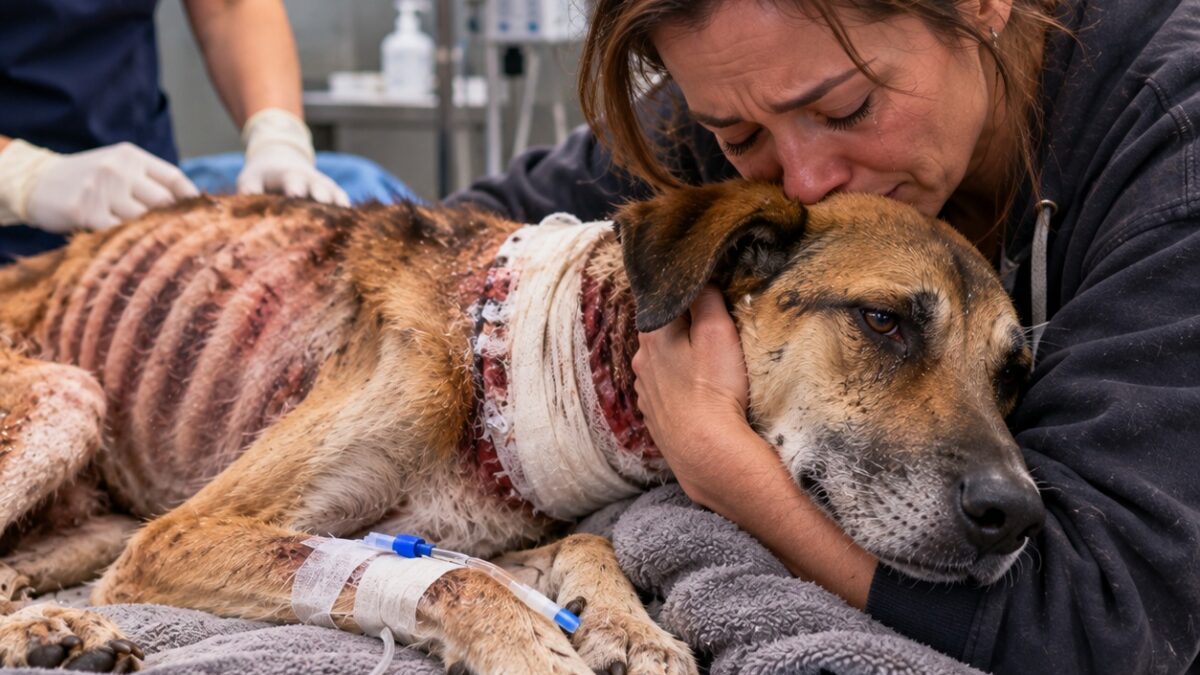
I sat beside him with blood still staining the blanket beneath his body and felt something inside me collapse.
Three days.
That was all it had taken.
Three days for me to go from wondering whether Armando would survive the night to imagining him walking out of the clinic.
Three days for one tiny tail wag to become a promise in my mind.
I had made the mistake people make when they desperately need hope.
I had turned one good moment into a future.
Now that future was disappearing in front of me.
The veterinary team moved quickly.
New medication.
Fluids.
Blood work.
Another transfusion.
Voices around him became short and clinical.
Numbers.
Dosages.
Questions.
I understood almost none of it emotionally.
My mind stayed fixed on Armando’s eyes.
He was awake.
That somehow made it worse.
He could see me.
He could see everybody moving around him.
But his body had no strength.
I leaned close.
“I’m here.”
His eyes shifted toward my face.
That was the only answer he had.
The veterinarian told me his organs had been through too much.
Months of neglect.
Severe malnutrition.
Dehydration.
Anemia.
Infection.
The wound around his neck.
His body had not simply become sick in one day.
It had been slowly depleted.
Starved.
Drained.
Forced to survive on less and less until survival itself had become expensive.
The first transfusions had bought time.
The wound treatment had reduced one immediate threat.
But Armando was not a dog recovering from one injury.
He was a body trying to rebuild every system at once.
And now something was failing again.
I had worked around rescue long enough to know what that could mean.
An animal can look better before crashing.
A little food.
A little energy.
A brighter eye.
Then suddenly the body reveals how much damage was hiding underneath.
I did not want to hear that truth.
I wanted the tail wag.
I wanted the swelling going down.
I wanted the three better days.
I wanted improvement to mean safety.
It did not.
Not yet.
I stayed in the clinic as long as they allowed me.
I sat beside Armando.
Sometimes I talked.
Sometimes I could not.
There are moments when every comforting sentence sounds insulting.
You will be okay.
How could I know?
You are strong.
Why should strength be his responsibility?
Keep fighting.
What if he was tired?
I stopped saying those things.
Instead:
“I’m here.”
That remained true.
“I’m not leaving.”
True.
“You’re not alone.”
True.
Those were the only promises I trusted.
The smell of the clinic became part of my memory.
Disinfectant.
Medication.
Warm blankets.
Food.
Metal.
The faint sterile scent that clings to veterinary hospitals.
I would arrive carrying something Armando might eat.
Then sit.
Sometimes he swallowed.
Sometimes he did not.
I learned how much hope can fit inside a teaspoon.
A little food kept down.
A little water.
A stronger breath.
His eyes staying open.
The veterinary team watched numbers.
I watched Armando.
Both mattered.
That afternoon, after the bloody diarrhea began, he seemed worse.
I remember his head resting sideways.
His ears still.
One paw stretched slightly forward.
I put my fingers near it.
Armando did not move.
I wanted him to touch me.
Just once.
Anything.
But I refused to move his paw myself.
If contact happened, I wanted it to be his choice.
So I waited.
Minutes.
Maybe longer.
Then one toe shifted.
Barely.
His paw touched the side of my hand.
I froze.
It may have been accidental.
Muscle movement.
Position.
I did not care.
I left my hand there.
“Okay.”
I whispered.
“I’m staying.”
That night I went home only because the clinic insisted.
I stood in my doorway and realized I could not remember what I had eaten that day.
Maybe nothing.
I opened the refrigerator.
Closed it.
Sat on the floor.
And cried.
Not quiet tears.
The kind that makes your chest hurt.
I thought about the rope.
How long had it been there?
Months, we believed.
Long enough to become embedded in his skin.
Long enough for a wound to open.
Long enough for infection and maggots.
Long enough for his muscles to waste away.
A dog does not understand why a rope becomes pain.
He only understands that moving hurts.
That the thing around his neck does not stop hurting.
That food does not come enough.
That water is not enough.
That his body becomes weaker.
Day after day.
How many days had Armando waited for somebody to notice?
How many times had he tried to stand before his muscles stopped cooperating?
How many nights had he lain awake with that rope cutting into him?
I did not know.
I would never know.
That uncertainty made the images worse.
I put my hands over my face.
“Please.”
I said aloud to an empty room.
I did not even know who I was asking.
“Please let him get one good thing.”
Not a miracle.
Not years.
One good thing.
One day without pain.
One meal without fear.
One morning in sunlight.
Something.
Anything beyond the clinic.
The next morning, I arrived early.
Armando was alive.
Again, that sentence became enormous.
He was still weak.
The bloody diarrhea had not completely resolved.
His body remained fragile.
But he was alive.
The veterinarian said:
“He’s holding.”
Holding.
Another tiny word that carried an entire world.
“Is that good?”
“It’s better than the alternative.”
She was too tired to soften anything.
I appreciated that.
“What do we do?”
“Continue.”
So we continued.
More transfusion support.
Medication adjustments.
Nutritional care.
Wound management.
Monitoring.
Time.
Time became the hardest treatment.
There was no machine that could produce it instantly.
No medication called tomorrow.
We simply had to reach it.
Then reach the next one.
Armando’s wound was cleaned repeatedly.
I watched once.
Not because I wanted to.
Because I needed to understand what his body was carrying.
The rope had damaged tissue around his neck deeply.
The maggots were gone, but the wound remained raw.
The veterinary team worked gently.
Armando sometimes flinched.
That was painful to watch.
But the flinch also meant something.
He had enough awareness to respond.
Enough sensation.
Enough life.
I hated that I could turn pain into evidence of hope.
Rescue makes you grateful for things you would never wish on anyone.
The swelling in his face continued to reduce.
His eyes became more visible.
There was a softness to them I had not noticed the first day because everything else had been so urgent.
He would follow me when I moved across the room.
Not his head.
Just his eyes.
Left.
Right.
Back again.
I started making unnecessary trips across the treatment area just to see if he would follow.
One technician caught me.
“You know he’s watching you.”
“I know.”
“You don’t have to test it every thirty seconds.”
“I’m not testing.”
She raised an eyebrow.
I smiled for the first time in what felt like days.
“Okay.”
“Maybe I’m testing.”
His tail did not wag again immediately.
That scared me.
I had made the first wag too important.
Now its absence felt like bad news.
The veterinarian finally told me:
“Stop measuring him by the tail.”
I looked at her.
“He’s exhausted.”
“He can be improving without performing happiness for you.”
That stung.
Because she was right.
Armando did not owe me signs.
He did not have to reassure me.
He was the patient.
I was the frightened one.
From then on, I tried to stop demanding emotional proof from his body.
If he rested, let him rest.
If he looked at me, good.
If not, still good.
His job was not to comfort the rescuer.
His job was to survive if his body could.
Slowly, the numbers improved.
Not all at once.
Some moved in the right direction.
Others lagged.
The veterinarian remained cautious.
But I started hearing phrases I had not heard before.
“More stable.”
“Responding.”
“Keeping food down.”
“Stronger today.”
Each phrase felt dangerous.
I accepted them anyway.
Hope was going to hurt if we lost him.
But refusing hope would not protect Armando.
It would only make me emotionally absent while he was still here.
So I let myself believe in the next day.
Not the next year.
The next day.
That was enough.
One afternoon, I walked in carrying food.
Armando’s head lifted.
Not much.
But clearly.
I stopped.
“Hi.”
His tail moved.
Once.
Then twice.
There it was again.
I did not cry this time.
I smiled.
Walked over.
Knelt.
“You don’t have to prove anything.”
Armando’s tail stopped.
Perfect.
I laughed softly.
“Exactly.”
His eyes remained on me.
I placed food near him.
He ate.
Slowly.
But he ate.
I began imagining home again.
Carefully.
A bed.
A quiet room.
Sunlight.
Other sounds besides clinic equipment.
But then I looked at his legs.
That was the next reality.
Even if his organs stabilized.
Even if his wound healed.
Even if the anemia improved.
Armando could barely stand.
His muscles had wasted away severely.
For months, chained and undernourished, his body had not been able to move normally.
The strength simply was not there.
I asked the veterinarian:
“What happens if he survives but can’t walk?”
She looked at me.
“We find out what his body can recover.”
“And if it doesn’t?”
“Then we adapt.”
The answer was simple.
I was not ready for how much comfort it gave me.
Not:
Then he has no life.
Not:
Then all this was pointless.
Adapt.
That word became another promise.
After days of intensive care, Armando was finally well enough to leave the clinic.
I did not celebrate until he was physically in my arms.
Too much had happened.
I had learned not to trust a good sentence until the next breath followed it.
The veterinarian went through instructions.
Food.
Medication.
Wound care.
Monitoring.
Movement.
Rehabilitation.
Daily massages.
Gentle exercises.
No expecting quick progress.
His muscles were profoundly weak.
Recovery would take time.
“How much time?”
“I can’t tell you.”
Weeks?
Months?
She would not promise.
Good.
I had learned to respect uncertainty.
Then she asked:
“Where will he stay?”
“With me.”
I answered immediately.
At that point, there was no other answer.
Armando had entered my life as a dog I intended to help through an emergency.
Somewhere between the first transfusion and the second crash, that temporary idea disappeared.
I did not know whether he would ever walk normally.
I did not know what long-term care would require.
I knew he was coming home.
I carried him out of the clinic.
He was still light.
But not frighteningly weightless anymore.
There was more substance beneath my arms.
More warmth.
More awareness.
When we reached the outside air, Armando lifted his nose.
That destroyed me.
It was such a tiny thing.
He smelled the world.
Not medication.
Not disinfectant.
Air.
Wind.
Something outside.
His eyes narrowed slightly in the daylight.
I stopped walking.
“Take your time.”
The clinic door closed behind us.
Armando’s nose moved again.
I thought of the night at home when I had begged for one good thing.
One moment beyond the clinic.
There it was.
Air.
Sun.
A dog smelling the world.
I almost missed it because I had been waiting for something bigger.
The drive home was quiet.
I kept one hand near him whenever traffic stopped.
Armando rested on a blanket.
Once, his eyes opened and looked toward me.
“You’re okay.”
I said.
Then corrected myself.
“You’re with me.”
Better.
“Whatever happens, you’re with me.”
His eyes closed.
I had made a soft bed near a window.
That decision became more important than I expected.
The window caught sunlight during part of the day.
Armando could see movement outside.
Trees.
Sky.
Passing shadows.
Inside, he could see me moving around.
I wanted his world to feel open without requiring his body to go far.
I lowered him onto the bedding.
He sighed.
A deep sound.
Not pain.
Exhaustion.
Maybe relief.
I sat beside him.
“This is home.”
The words felt huge.
Then I realized something.
I had no idea whether Armando had ever had a home before.
Maybe he had.
Maybe not.
I touched the blanket.
“This is yours.”
That was easier.
A bed.
A window.
A person.
Start there.
The first night, I barely slept.
Of course.
Every sound from Armando had me moving.
If he shifted, I checked.
If he was too quiet, I checked.
At one point around two in the morning, I woke and found him watching me from his bed.
I had fallen asleep nearby.
“Sorry.”
I whispered.
“I’m learning.”
His tail moved once against the blanket.
That tiny sound in the dark felt like forgiveness.
Morning came.
Armando was still there.
No clinic staff.
No machines.
No emergency.
Just us.
I prepared his food.
Carried it to him.
He ate.
Then rested.
That should have felt simple.
Instead, I kept thinking:
He is eating breakfast in a home.
Not dying in a clinic.
Not collapsed inside a business.
Not chained.
Breakfast.
The ordinary things were what made me cry now.
Rehabilitation started immediately.
Not dramatic rehabilitation.
No cinematic montage.
Hands.
Massage.
Slow movement.
Supporting his limbs.
Encouraging muscles that had forgotten what work felt like.
Armando’s body had been deprived of movement for so long that even small exercises exhausted him.
The veterinarian showed me what to do.
Gentle massage.
Range-of-motion work.
Support.
Patience.
Lots of patience.
The first session at home lasted only a short time.
Armando was exhausted afterward.
I felt like I had failed.
Then reminded myself:
He had done more than yesterday.
That was enough.
Each morning I massaged his legs.
Slowly.
Carefully.
I learned where the muscles felt tight.
Where he tolerated touch.
Where he became uncomfortable.
Some days, Armando seemed engaged.
Other days, almost nothing.
Those were the hardest.
I would do the same exercises.
Give the same food.
Carry him outside.
Massage.
Wait.
And see no visible improvement.
Not one.
I would stare at his legs and think:
Are we getting anywhere?
Then I would hate myself for making his recovery about my need for progress.
Armando was not a project.
His body was not required to produce visible improvement on my schedule.
So I kept going.
I carried him outside every day when the weather allowed.
At first, only for short periods.
I would hold him carefully.
Take him to a comfortable place.
Lay him where the sunlight could warm his coat.
The first time, his eyes closed almost immediately.
Not from weakness.
From pleasure.
I knew the difference by then.
His face softened.
His breathing deepened.
The sunlight touched his fur.
I sat beside him.
For perhaps fifteen minutes, nothing happened.
Nothing needed to.
Armando was warm.
Safe.
Outside.
That was enough.
He began loving those moments.
I could see it.
When I carried him toward the door, his head lifted.
When sunlight reached him, he relaxed.
Sometimes he turned his face toward the warmth.
I imagined what months chained had meant.
Limited movement.
Pain around his neck.
Hunger.
Weakness.
Maybe sun had been there then too.
But pleasure requires enough safety to notice it.
Now he noticed.
That mattered.
I started talking to him outside.
Not about his past.
I stopped doing that.
At first, I had said things like:
“You’ll never go through that again.”
“You’re safe now.”
“You didn’t deserve it.”
All true enough.
But I realized I was constantly dragging his worst history into his best moments.
So I changed.
I talked about ordinary things.
Birds.
Food.
Weather.
My day.
A neighbor’s ridiculous noise.
Anything.
Armando did not need every conversation to be about what had happened to him.
Neither did I.
His wound slowly improved.
The neck looked less frightening.
New tissue formed.
The infection came under control.
The memory of the rope remained in the scar.
I could not look at that area without feeling anger.
For a while.
Then something changed.
The scar became part of Armando rather than evidence I examined every time.
I still hated what caused it.
But Armando himself was no longer the wound.
That was important.
His anemia improved too.
Slowly.
Bloodwork that once made the veterinarian grim became less alarming.
I learned to love boring test results.
Boring is wonderful after critical.
I wanted appointments where nobody said:
“We need another transfusion.”
I wanted:
“Continue what you’re doing.”
That sentence became music.
The problem that would not disappear was mobility.
Armando still could barely stand.
His muscles were painfully weak.
When he tried, his legs trembled.
Sometimes they folded.
The first time he attempted to push himself up at home, I was beside him.
He gathered his legs.
Lifted his chest.
His body rose slightly.
Then collapsed.
I immediately supported him.
“Easy.”
Armando looked at me.
No fear.
Only tiredness.
He tried again.
That frightened me.
Not because effort was bad.
Because he did not seem to understand how weak he still was.
I put my hand beneath his chest.
“Wait.”
He stopped.
His eyes moved toward the window.
Outside, sunlight.
That became our goal.
Not walking across a room.
Not running.
Standing long enough to feel his own body under him.
Then maybe one step.
One.
That was all.
The rehabilitation was so slow that some days I wondered whether I imagined improvement.
One morning, he held himself upright for two seconds longer.
Was that real?
Another day, his paw pressed more firmly into my hand during an exercise.
Was that progress?
I started questioning everything.
The veterinarian told me:
“Stop expecting recovery to announce itself.”
I looked at her.
“What does that mean?”
“It means you may not notice until you compare weeks instead of days.”
That helped.
I stopped looking for miracles each morning.
I looked backward every few weeks.
And there it was.
Armando’s head stayed up longer.
His appetite stronger.
His eyes brighter.
Tail more active.
Body less wasted.
He could move his legs slightly more.
Progress had been happening quietly while I was busy grieving its speed.
One morning, I entered the room with his food.
Armando’s tail started wagging before I spoke.
Not one movement.
Several.
I stopped.
He looked directly at me.
There was recognition.
Expectation.
Maybe happiness.
My throat tightened.
“Hi.”
Tail.
More.
“You know what this is?”
I held up the bowl.
Armando watched it.
“Of course.”
I laughed.
“Not me.”
“Breakfast.”
He had priorities now.
That made me happier than if he had worshiped me.
That was when I realized Armando had begun expecting good things.
Expectation is one of the most heartbreaking parts of recovery.
A neglected animal does not always expect food.
Or touch.
Or comfort.
They react to what arrives.
Armando was beginning to anticipate.
Meal.
Sun.
My voice.
The door.
That meant his mind was building a future.
Even if only five minutes ahead.
A future nonetheless.
He also began following me with his eyes.
Constantly.
If I walked across the room, his head might not move much.
His eyes did.
When I left, he watched the doorway.
When I returned, tail.
At first, I felt flattered.
Then sad.
Was he afraid I would disappear?
Maybe.
Again, I did not know.
So I made sure leaving became ordinary.
Kitchen.
Back.
Bathroom.
Back.
Outside briefly.
Back.
No dramatic reunion.
I wanted him to learn that people could leave a room without leaving his life.
That lesson mattered as much as his physical exercises.
One afternoon, I had to go out longer.
I hated it.
I arranged everything.
Checked his bed.
Water.
Comfort.
Someone nearby.
Still, walking out felt like betrayal.
When I returned, Armando was by the window.
Not standing.
Of course.
Lying there.
His eyes found me.
Tail started moving.
I knelt.
“I came back.”
The words slipped out.
Armando’s tail hit the bedding.
Again.
Again.
I realized I needed that reassurance as much as he did.
I had spent weeks terrified of losing him.
Every time I left, some part of me expected to return to an ending.
We both needed repetition.
Leave.
Return.
Still here.
The sunlight became his favorite part of the day.
I could tell.
Even when progress elsewhere felt impossible, the sun gave him something immediate.
Warmth.
No effort required.
No painful exercise.
No needles.
No treatment.
He could simply receive it.
That became important to me.
So much of Armando’s life with us was about fixing, healing, strengthening.
But nobody should have to spend every waking hour being repaired.
Sometimes he needed to be a dog in sunlight.
Nothing more.
So we had days when I carried him outside and did not ask him to work.
No standing attempt.
No exercise for those minutes.
Just sun.
I sat beside him.
He slept.
Those may have been the most important sessions of all.
There was one afternoon I will never forget.
I carried Armando outside.
The day was warm.
Not hot.
Soft breeze.
I laid him down.
He closed his eyes.
Then something moved nearby.
A leaf.
Maybe a small bird.
Armando’s eyes opened.
His head lifted.
He watched.
For a long time.
Then his tail moved.
I smiled.
There it was.
Interest.
A living creature noticing another living thing simply because the world was worth noticing.
That moment hurt more than I expected.
For months before rescue, Armando’s body had probably been organized around survival.
Pain.
Hunger.
Thirst.
Weakness.
Now he had enough room inside himself to notice a leaf.
That is recovery too.
Not on a lab report.
Still real.
People sometimes asked:
“Is he walking yet?”
I learned to dislike the question.
Not because they meant harm.
Because it made walking sound like the exam he had to pass.
“No.”
I would say.
“Not yet.”
Then eventually I stopped adding “yet.”
Maybe he would.
Maybe not.
His worth did not depend on it.
Armando could barely stand.
That remained true.
But he could enjoy food.
Sun.
Touch.
Company.
He could wag his tail.
Recognize me.
Follow me with his eyes.
Those were life too.
I refused to make legs the only measurement.
Still, I wanted him to stand.
Of course I did.
Not because I needed a triumphant ending.
Because standing could give him more comfort.
More independence.
More choice.
So we kept working.
Massage.
Exercises.
Support.
Rest.
Again.
Again.
Again.
One day, weeks into home care, Armando tried.
I was beside him.
His legs were positioned.
I supported his body lightly.
He pushed.
His front half rose.
His hind legs trembled.
I almost lifted more.
Stopped.
Let him do what he could.
Armando held.
One second.
Two.
Three.
My heart hammered.
“Good.”
I whispered.
Four.
Then his legs gave way.
I caught him.
Lowered him gently.
He breathed hard.
I pressed my forehead to his.
“That was four.”
I had not meant to count.
Apparently I did anyway.
Armando looked exhausted.
But his tail moved.
Once.
I laughed and cried at the same time.
“Four seconds.”
To anyone else, nothing.
To us, an entire lifetime.
The next day he managed less.
That was recovery.
I had to learn not to mourn every backward step.
Bodies are not machines.
Especially bodies recovering from prolonged suffering.
Some days stronger.
Some days tired.
Some days the best thing is rest.
I learned.
Slowly.
Probably slower than Armando did.
The veterinarian kept reminding me:
“He survived the critical phase.”
“That doesn’t mean his body suddenly forgot what happened.”
I nodded.
Months of damage.
Weeks cannot erase it.
Time had injured him.
Time would have to help heal him too.
I sometimes thought about the rope.
I hated it.
More than any other detail.
Because a rope is supposed to restrain, not become part of skin.
For it to become embedded, nobody corrected the problem soon enough.
That fact carried its own horror.
I imagined Armando growing thinner while the rope stayed exactly where it was.
His neck changing around it.
The wound worsening.
I stopped myself when those images became too vivid.
I had no proof of every detail I imagined.
The evidence was already enough.
He had suffered.
Now he was not.
Focus there.
Armando never showed fear of me touching his neck once healing progressed.
That surprised me.
I expected him to flinch forever.
Sometimes he did early on.
Later, less.
Eventually, I could stroke the fur near the scar gently.
He would relax.
That trust humbled me.
An animal can endure pain caused around a part of the body and still allow another person to touch that place with kindness.
I did not interpret it as forgiveness.
There was nothing for him to forgive me for.
I saw it as new evidence replacing old.
A hand near the neck does not always mean pain.
Touch can be gentle.
The body learns.
Slowly.
Armando’s face changed as his health improved.
Not literally into another dog.
But suffering had an expression.
Sunken.
Distant.
Exhausted.
As nutrition returned, his eyes looked more open.
His cheeks less hollow.
His head held higher.
People who had seen him at the clinic were shocked when they saw later photographs.
“Is that really him?”
“Yes.”
The question made me emotional every time.
Because yes.
Same dog.
The life had been inside him all along.
We had simply met him when illness covered almost everything.
I became protective of his story.
People liked saying:
“He fought.”
True, perhaps.
But I did not want Armando’s survival used to suggest animals who die simply did not fight hard enough.
Bodies fail.
Even loved bodies.
Armando survived because of many things.
Treatment.
Transfusions.
Nutrition.
Monitoring.
Care.
Timing.
Luck.
Whatever resilience his body still held.
No single heroic explanation.
I was grateful.
Not smug.
There were animals in that clinic who did not get Armando’s ending.
I knew that.
Their lives mattered too.
That knowledge made me even more determined not to turn his survival into some moral victory.
He got another chance.
That was grace.
Not proof he deserved life more than anyone else.
At home, his personality kept appearing.
He liked certain foods more than others.
He clearly preferred the window bed.
He enjoyed sunlight.
He liked being near me.
He became more alert when other animals or people moved.
He disliked certain exercises.
Very clearly.
I would position his leg.
Armando would give me a look.
“I know.”
Another look.
“Yes, I know you hate this.”
Tail still.
“Five more.”
If a dog could roll his eyes, Armando came close.
I loved that.
Frustration meant he had enough strength to object.
The first time he refused food because he wanted something better, I almost celebrated.
He smelled the bowl.
Looked at me.
Looked away.
“Oh, no.”
I said.
“You do not get to become picky.”
Armando ignored me.
I changed nothing.
Eventually he ate.
Good.
I was not going to create a tyrant merely because he survived.
Normal life includes boundaries.
He deserved those too.
People sometimes think kindness means giving a rescued animal anything they want forever.
No.
Kindness includes stability.
Routine.
Safe expectations.
Armando needed to know the world had structure.
Meals.
Rest.
Care.
Exercise.
Sun.
Sleep.
Predictability helped him.
It helped me too.
One evening, I was sitting nearby when Armando shifted.
He attempted to lift himself.
I moved instinctively.
Then paused.
He repositioned one front leg.
Then another.
Pushed.
His body rose farther than before.
He was not fully standing independently.
But higher.
Stronger.
I held my breath.
Armando stayed there.
Five seconds.
Six.
Seven.
Then leaned toward me.
I supported him.
His tail began moving.
I cried.
Again.
Apparently I had become a person who cried over seconds.
There are worse things.
I called the veterinarian.
“He stood longer.”
“How long?”
“Seven seconds.”
Silence.
Then laughter.
“You counted.”
“Yes.”
“I told you not to.”
“I ignored you.”
“Clearly.”
Then her voice softened.
“That’s good.”
Only three words.
I carried them all day.
Weeks accumulated.
Then months.
Armando did not suddenly rise and run.
I want that very clear.
His recovery remained slow.
Some damage had been severe.
The muscle loss was profound.
But the dog who once could not move began participating in his own body again.
Small efforts.
Shifts.
Lifts.
Supported standing.
More awareness.
More strength.
That was enough to keep going.
One of the deepest changes was how he looked at me.
At first, his eyes seemed to ask nothing.
He was too depleted.
Then they tracked me.
Then expected me.
Eventually, when I entered, his face changed.
His tail moved.
Sometimes his head lifted before I said his name.
I became part of his routine.
That touched me more than I can explain.
Not because I needed to be special.
Because Armando had learned that one person’s approach could predict something good.
Food.
Touch.
Sunlight.
Care.
Presence.
After whatever his body had endured, that was a victory.
One morning, I walked past without immediately stopping.
Armando’s tail thumped.
I kept going because my hands were full.
Another thump.
Then another.
I turned.
“You impatient?”
More wagging.
I laughed.
“I’ll be right back.”
I returned.
Of course.
I always returned.
The phrase always returned became central to us.
I could not undo months of neglect.
Could not erase the rope.
Could not give him back blood he had already lost.
Could not make his muscles rebuild overnight.
But I could become predictable.
That was within my control.
Same person.
Same care.
Same return.
Safety often starts there.
Not grand gestures.
Reliability.
Armando’s bed by the window became worn.
I replaced the blanket.
He did not appreciate the change.
He sniffed the new one.
Looked at me.
“Too clean?”
He kept looking.
I placed one of the old pieces on top.
He settled.
“Compromise.”
I smiled.
He closed his eyes.
That little preference delighted me.
A dog found almost dead now had opinions about bedding.
I wanted a hundred more complaints like that.
I began thinking seriously about the future.
Not because the veterinarian promised long years.
Nobody did.
But because life with Armando had already stopped feeling temporary.
He was no longer “the dog from the clinic.”
He was Armando.
His food lived in my house.
His bed had a permanent place.
His schedule changed mine.
My days included his exercises.
His sun time.
His medication.
His needs.
Somewhere along the way, I had crossed from rescuing him to living with him.
The difference is subtle.
Then suddenly enormous.
I remember looking at him one afternoon by the window.
Sun on his coat.
Eyes half closed.
Scar at his neck still visible.
Legs resting.
And thinking:
You are staying.
The decision felt almost embarrassingly obvious.
There was no dramatic paperwork moment in my heart.
No debate.
No list.
Just certainty.
After everything Armando had endured, I could not imagine handing him to another person and asking him to start learning safety from zero again.
He had finally learned my footsteps.
My voice.
My hands.
My return.
I was not going to make those things temporary.
I told him before I told anyone else.
I sat beside his bed.
“Armando.”
His eyes opened.
“I should probably explain something.”
Tail moved once.
“You’re not going anywhere.”
He watched me.
“This is it.”
“Me.”
“This window.”
“This bed.”
“Your food.”
“My terrible schedule.”
“All of it.”
His tail began moving.
I laughed.
“You have no idea what I’m saying.”
Probably true.
But then he pushed his head against my hand.
I took that as agreement.
From that day, I stopped referring to myself as his rescuer in my own mind.
I was his person.
That word carried more responsibility.
Rescuers enter.
Act.
Stabilize.
People stay.
I was staying.
That did not mean the fear disappeared.
Sometimes I woke at night and checked his breathing.
Old habit.
Sometimes a bad day sent me back emotionally to the clinic.
One loose stool.
Less appetite.
Extra fatigue.
Immediately my mind returned to blood.
Transfusions.
The veterinarian saying:
“We are losing him again.”
Trauma does not only belong to the animal.
Caregivers carry echoes too.
I had to learn not every quiet day was a crisis.
Armando taught me by continuing to wake up.
Again.
Again.
Again.
Eventually, ordinary evidence became stronger than fear.
The worst memory remained the relapse.
The blood.
The limp body.
That moment after the tail wag when I believed we were safe.
For a long time, I felt guilty about having been happy the day before.
As though hope had invited punishment.
That is irrational.
Still, grief and fear create strange superstitions.
I had to tell myself:
His tail wag did not cause the crash.
My hope did not hurt him.
Joy is not a contract with disaster.
Eventually, I let myself celebrate good days again.
Armando deserved someone who could enjoy him now, not only fear losing him later.
That became a deliberate practice.
If he ate well, I let myself be happy.
If he enjoyed sun, I enjoyed it too.
If he wagged, I smiled.
I stopped immediately adding:
But what if tomorrow—
Tomorrow would come anyway.
Fear did not protect us.
Presence did.
Armando’s body slowly gained more strength.
Still not enough for effortless standing.
But enough that massages felt different under my hands.
There was muscle where once there had been almost nothing.
Tiny change.
Huge meaning.
I remember pressing gently along one leg and thinking:
There you are.
Not because muscle equals worth.
Because it meant nourishment was becoming tissue.
Food becoming strength.
Care becoming something physical.
The body rebuilding itself.
That process felt almost sacred.
Every meal contained a little of that.
Protein.
Calories.
Water.
Medicine.
Then time.
His body did the rest.
I could supply materials.
Armando had to turn them into himself.
He did.
Slowly.
There were moments when I wanted speed.
I am not proud of that.
I wanted the dramatic before-and-after.
I wanted one morning where he simply stood.
Walked.
Crossed the room.
No support.
No struggle.
That was my fantasy.
Armando did not owe it to me.
Once I accepted that, his actual progress became easier to see.
A stronger head lift.
More stable posture.
Longer supported stand.
More energetic tail wag.
Moving a leg voluntarily.
Those were real.
Not consolation prizes.
Real.
I stopped comparing him to healthy dogs.
That helped.
Comparison can turn improvement into failure.
Armando was not racing another dog.
He was living inside his own body.
The question was:
Is today comfortable?
Is he engaged?
Is he nourished?
Can he enjoy something?
Can he participate?
Those questions had better answers.
Some visitors were emotional when they saw him.
They knew the story.
They would look at his neck scar.
His weak legs.
Then say:
“Poor Armando.”
I understood.
But eventually I started saying:
“Look at his tail.”
They would.
Wag.
“Look at his eyes.”
Alert.
“Look at him watching the door because he knows I’m about to take him outside.”
Perspective changes when you look at the whole dog.
Armando remained medically vulnerable compared with other animals.
That was true.
But vulnerability is not the same as misery.
I learned that distinction through him.
His body needed more.
More care.
More support.
More attention.
That did not make the life itself sad.
Many of his days were peaceful.
Some joyful.
Some boring.
Boring became one of my favorite outcomes.
A boring day for Armando looked like this:
Wake.
Food.
Rest.
Massage.
A little exercise.
Window.
Sun.
Nap.
Me moving around.
Tail wag when I came close.
Another meal.
Quiet evening.
Nothing dramatic.
No emergency.
No transfusion.
No blood.
No maggots.
No rope.
That is a beautiful day.
People underestimate peace because it photographs poorly.
Armando taught me to value it.
The sun remained his favorite.
If I could give him only one luxury beyond medical care, it would have been sunlight.
He changed in it.
His face softened.
Body relaxed.
Sometimes he fell asleep so deeply that I would sit nearby and watch.
Not worried.
Just grateful.
The dog who had once been unable to escape a rope now lay under an open sky with nothing around his neck.
That image made me emotional every time.
No restraint.
No embedded cord.
No pain pulling at skin.
Just fur warming.
Breathing.
Freedom sometimes looks like doing absolutely nothing in the sun.
One afternoon, I touched the scar on his neck very gently.
Armando opened his eyes.
I stopped.
“Sorry.”
He pushed his head slightly into my hand.
I froze.
Then stroked him.
Slowly.
He closed his eyes again.
That moment may have meant nothing complicated to him.
To me, it meant everything.
The place where pain had lived could now tolerate tenderness.
Not erase.
Tolerate.
That was enough.
The man who found Armando eventually asked to see him.
I was nervous.
Would Armando remember?
No idea.
The man arrived quietly.
When he saw Armando by the window, he stopped.
His eyes filled immediately.
“That’s him?”
“Yes.”
He covered his mouth.
“I thought…”
I knew.
He had thought Armando would die.
He crouched.
Did not approach too fast.
Armando looked at him.
The man held out his hand.
Armando sniffed.
Then his tail moved.
The man cried.
Not dramatically.
Just silent tears.
“I carried you out of there.”
he whispered.
Armando looked toward me.
Then back at him.
I sat nearby.
For a few minutes, nobody needed to say anything.
The man told me more about the day he found him.
Not more about Armando’s previous life.
He did not know that either.
He described the stillness.
How he almost believed the dog was already dead.
How he saw one breath.
How afraid he had been to touch him because the neck wound was so severe.
How light Armando felt.
I understood that part.
Too well.
Then he said:
“I kept thinking I should have found him sooner.”
I looked at him.
“You found him when you found him.”
“But what if I had walked past?”
“You didn’t.”
He lowered his head.
Armando’s tail moved again.
I said:
“That’s the part that matters.”
Rescue can torture people with alternate histories.
What if sooner?
What if later?
What if I missed him?
But the actual story was enough.
The man saw Armando.
Stopped.
Called.
Stayed.
Armando lived.
We did not need to punish ourselves with the version where he did not.
The man left with tears in his eyes.
Armando returned to his window.
That felt appropriate.
People enter his story.
Help.
Love.
Then life continues.
Not every meaningful person has to remain forever.
I remained.
That was my role.
There were still days when Armando’s progress seemed invisible.
That never fully disappeared.
I would massage.
Exercise.
Feed.
Carry.
Wait.
Then wonder:
Are we stuck?
The veterinarian reminded me:
“Stability can be progress too.”
I resisted that at first.
Then understood.
For a dog who had repeatedly fallen toward death, simply staying medically stable was an achievement.
Not every week needs a new milestone.
Sometimes maintaining comfort is the victory.
Armando taught me that improvement has different shapes.
Sometimes upward.
Sometimes sideways.
Sometimes simply not falling backward.
That applies to more than dogs.
I carry that with me now.
I also learned that healing does not have to produce independence to be meaningful.
Armando still needed me.
For food preparation.
Carrying.
Exercises.
Comfort.
Movement.
Many things.
Some people would look at that and see dependence.
I saw relationship.
There is a difference between being trapped by dependence and being supported through it.
Armando did not choose the body he had.
But he could still have dignity within care.
That became important to me.
I never wanted him to feel like a burden.
Of course, I cannot know exactly what a dog feels about these concepts.
But I could control my behavior.
No sighing angrily while lifting him.
No treating his care like punishment.
No making affection conditional on progress.
If I was tired, I dealt with my tiredness honestly.
Rest.
Ask for help.
Organize better.
Armando did not need to carry my exhaustion emotionally.
He had carried enough.
There were days I was exhausted.
That is true.
Caring for a medically fragile animal can drain you.
Physical care.
Worry.
Money.
Scheduling.
Cleaning.
Monitoring.
I will not lie and say love made all of it easy.
Love made it meaningful.
Different.
Meaning does not erase fatigue.
It gives fatigue a reason.
Still, caregivers need rest.
I learned that too.
Staying forever requires sustainability.
Armando needed a person who could continue.
Not burn out proving devotion.
So I built routines.
Accepted help.
Protected time.
That made our home stronger.
Armando’s tail became one of my favorite sounds.
It would hit the bedding.
Soft.
Thump.
Thump.
If I approached with food, faster.
If I knelt beside him, sometimes slower.
The first wag at the clinic had felt like a miracle.
Later wags became normal.
I loved that transformation.
A miracle becoming routine.
That is what recovery should do.
Take something once extraordinary and make it expected.
One day I almost walked past without noticing.
Armando’s tail was wagging.
I had seen it so many times by then.
I stopped.
The realization struck me.
I had become accustomed to happiness.
His happiness.
The thing I once cried over was now part of the room.
I knelt.
Touched his head.
“Sorry.”
He looked at me.
“I forgot how impossible this used to feel.”
Armando did not care.
Probably better.
Living things should not be required to remain miracles forever.
Eventually they deserve normalcy.
The scar remained.
His weak legs remained.
The history remained.
But those things no longer dominated the room.
Armando did.
That was healing.
I decided definitively that he would stay for the rest of his life long before I said it publicly.
There was no adoption-day spectacle.
No big announcement necessary.
The decision lived in ordinary choices.
Buying more food.
Rearranging a space.
Planning future care.
Looking at my schedule months ahead and automatically including him.
That is when family happens.
When the future contains someone without debate.
Armando was in mine.
I remember telling the veterinarian.
“He’s staying with me.”
She smiled.
“I assumed.”
“Was it that obvious?”
“You slept beside him in the clinic.”
“I was worried.”
“You spent your savings.”
“That was medical care.”
“You call us about seven-second standing records.”
I sighed.
“Fine.”
She laughed.
Then her voice softened.
“He knows you.”
I looked at Armando.
He was watching me.
“Yeah.”
“I think he does.”
That sentence made me cry later.
He knows you.
Not as the person who found him.
I did not.
Not as the person who hurt him.
Not as a temporary foster.
He knew my voice.
My hands.
My movement through the room.
The sound of me returning.
That was an extraordinary privilege.
Trust from a vulnerable animal is never something I want to take casually.
I thought back to the rope again.
How many hands had been near his neck before mine?
Were any gentle?
I do not know.
I stopped needing to know.
Armando knew mine now.
That was where responsibility began.
One morning, while I was doing exercises, Armando surprised me.
He pushed harder than usual.
His body lifted.
I supported lightly.
Then less.
For one brief moment, he seemed to bear more of himself.
His legs trembled.
He stayed.
I whispered:
“Good.”
No excitement.
No pressure.
He stayed.
Then lowered.
I exhaled.
Armando looked at me.
Tail.
I smiled.
“We’re getting there.”
Then corrected myself.
“We’re getting somewhere.”
That was better.
I no longer needed “there” to mean normal walking.
Somewhere comfortable.
Somewhere stronger.
Somewhere with more choice.
That was enough.
The veterinarian agreed.
“He may always need significant help.”
“I know.”
“His muscles were severely weakened.”
“I know.”
“Recovery may plateau.”
“I know.”
She studied me.
“You actually sound like you know now.”
I smiled.
“Armando is a very patient teacher.”
The truth was, Armando had changed my definition of success.
At the beginning:
Survive.
Then:
Stabilize.
Then:
Eat.
Then:
Come home.
Then:
Enjoy something.
Then:
Gain strength.
Then:
Stand.
Each time we reached one goal, another appeared.
Eventually I realized there would always be another.
That was life.
The goal was not reaching a final state called healed.
The goal was living well along the way.
Armando was doing that.
His life by the window became peaceful.
He watched me move.
Watched outside.
Slept.
Sunbathed.
Ate.
Did his exercises.
He did not need a dramatic adventure.
He had already had enough drama forced on him.
Peace was the reward.
There is a tendency in rescue stories to give the animal a grand future.
Therapy dog.
Ambassador.
Inspiration.
I wanted none of that for Armando unless it served him.
He did not owe the world productivity because people saved him.
He could simply live.
That was enough.
No job.
No public role.
No obligation to transform suffering into service.
He had spent too long being denied basic care.
His future could be selfish.
Food.
Sun.
Sleep.
Affection.
I loved that for him.
Sometimes I called him my sun dog.
Not publicly.
Just at home.
Because he loved those warm patches.
If sunlight moved across the floor, I would adjust his position when he wanted.
He would close his eyes.
I would think:
This is what I begged for.
Not walking.
Not miracles.
One good thing.
Sunlight was one.
He got many.
The first night at the clinic, I had asked for one.
Now he had a bed.
A window.
Food.
Medical care.
Massage.
My voice.
My hands.
Sun.
A permanent home.
He had more than the frightened version of me had dared to ask.
That made gratitude feel almost painful.
I do not believe suffering happens for a reason.
Armando did not need the rope in order to learn love.
He did not need starvation to appreciate food.
He did not need maggots to make sunlight meaningful.
Those things were simply terrible.
The beauty that followed does not justify them.
I say that strongly because people sometimes romanticize rescue.
“They went through all that so they could find you.”
No.
I would have preferred Armando never suffer.
I would gladly erase my role in his story if it meant he had always been safe.
The fact that something good followed something terrible does not make the terrible necessary.
It only means cruelty did not get the final word.
That is enough.
Armando’s final word is not pain.
It is belonging.
That matters.
I still have difficult memories.
The hundreds of maggots being removed.
The transfusions.
The blood on the morning of the relapse.
The helplessness.
Those images remain.
But now they sit beside other ones.
Tail wagging.
Face in sunlight.
Eyes following me.
Food disappearing.
Seven seconds standing.
His head leaning into my hand.
The memories are becoming crowded.
That is good.
I want the worst ones outnumbered.
Perhaps healing is partly that.
Not erasing traumatic memories.
Giving them competition.
More mornings.
More meals.
More safe touches.
More returns.
More sunlight.
Eventually, the past is still there, but it is no longer the only evidence.
Armando’s body learned that.
So did I.
The scar on his neck will always be part of him.
I do not hide it.
But I do not stare at it every time either.
Sometimes a scar is just where the fur grows differently.
Armando is allowed that normalcy.
He is not a museum of what happened.
I do not know how long he will live.
That remains true.
After such severe health problems, certainty would be dishonest.
But I no longer measure our relationship in anticipated loss.
That would be another way of letting the past steal his present.
Today, Armando is here.
That is enough.
He still has days when he cannot do as much.
We adapt.
If exercises need shortening, shorten them.
If he needs more rest, rest.
If he wants the sun, sun.
The lesson is simple now.
Care for the dog in front of you.
Not the dog you hoped he would become.
Not the dog he might have been before suffering.
Armando.
Today.
One afternoon, I carried him outside.
His body felt heavier than it had the first day.
In the best way.
Healthy weight returning.
Strength.
I remembered lifting him from the floor when he was almost nothing in my arms.
The contrast stopped me.
I held him a little closer.
Armando looked at me.
“What?”
I laughed.
“You’re heavy.”
Tail.
“That’s a compliment.”
I set him in the sun.
His eyes closed.
I sat beside him.
And I cried quietly.
Not sad.
Not exactly.
Sometimes love has nowhere else to go.
I thought about the man who found him.
The veterinarian.
The technicians.
The blood donors whose transfusions gave Armando what his own body no longer had enough of.
So many lives intersected to keep one dog alive.
Rescue is never solitary.
Even when one person becomes the permanent home.
Armando belongs to himself.
But his survival was built by a community of moments.
That humbles me.
Two blood transfusions.
Maybe more support during the relapse.
Medication.
Care.
Nutrition.
Massage.
Exercise.
Time.
There was no single miracle.
There was work.
I prefer that truth.
Miracles can make people feel helpless.
Work reminds us there are things we can do.
Stop.
Call.
Carry.
Treat.
Feed.
Stay.
Sometimes those actions are enough to create something that feels miraculous afterward.
Armando did not become strong because I believed hard enough.
He improved because veterinary medicine and care gave his body an opportunity.
Love kept me showing up for the work.
That is where love mattered.
Not as magic.
As endurance.
His tail continues to wag when I approach.
That remains one of my favorite things.
Not because I need his gratitude.
Because the first time I saw it, I thought we had won.
Then almost lost him.
Now every wag contains both memories.
Hope.
Fear.
Then survival.
Over time, the fear has faded.
The wag is just a wag more often.
Again, normalcy.
Beautiful.
I sometimes wonder whether Armando would recognize the business where he was found.
I have no desire to take him back.
He does not need a pilgrimage.
The past has nothing there for him.
His home is here.
The window.
The sun.
The bed.
Me.
We do not need to revisit the place where his body collapsed to prove he survived it.
He is proof.
There is one thing I wish people understood about animals found in conditions like Armando’s.
They are not only suffering physically.
Their world has become small.
Pain shrinks attention.
Hunger shrinks attention.
Weakness shrinks attention.
Everything becomes immediate survival.
Recovery expands the world again.
Food is not only calories.
It eventually becomes pleasure.
Sun is not only warmth.
It becomes comfort.
A person is not only someone touching a wound.
They become companionship.
Movement is not only effort.
It becomes choice.
I watched Armando’s world widen.
That may have been the most beautiful part.
At first, his world was one body lying on the floor.
Then clinic.
Then my face.
Food.
Bed.
Window.
Sun.
Rooms.
Routine.
Future.
That expansion is what I mean when I say he came back to life.
Not merely heartbeat.
Awareness.
Interest.
Expectation.
Belonging.
If I had lost him during that relapse, I would have been devastated.
There is no point pretending otherwise.
But I would also have been grateful that his final days contained care.
I believe that sincerely.
It took time to understand.
A rescue is not worthless if the animal dies.
Compassion is not a transaction where survival is repayment.
Armando happened to live.
Thank God.
But the promise was valid before we knew.
That matters to me.
Maybe that is why I was able to commit to him for life later.
The commitment had already started when the future was uncertain.
I had chosen presence before outcome.
Everything after was an extension.
The phrase for the rest of his life sounds enormous.
It did not feel enormous when I decided.
It felt obvious.
For the rest of his life, Armando would have someone.
If he improved more, someone.
If he never walked independently, someone.
If he became harder to care for, someone.
If he had good days, someone.
Bad days, someone.
Sun.
Night.
Appointments.
Meals.
Someone.
That was the one thing I could guarantee.
Not health.
Presence.
I sometimes whisper that to him.
“You’ve got me.”
Armando usually responds by looking toward food.
Again, priorities.
I like it that way.
There is no dramatic ceremony marking when an abandoned animal stops being abandoned.
No bell.
No certificate.
One day, you realize the word no longer describes their present.
Armando was abandoned.
Past tense.
Armando is cared for.
Present.
That grammatical change contains everything.
He still needs help standing.
He still needs daily care.
We still work with his body.
Those facts do not make the present incomplete.
They are the present.
And the present is good.
One day, I was massaging his legs.
Armando relaxed.
His eyes nearly closed.
I remembered how rigid and depleted he had been at the clinic.
I thought:
Your body finally believes hands can help.
Maybe that is projection.
Still, his body relaxed.
That was enough evidence for me.
We talk about trust as something mental.
Often it is physical first.
Muscles unclench.
Breathing slows.
Sleep deepens.
A head lowers near someone.
A tail moves.
Armando’s body showed trust before any story I could tell about it.
I treasured that.
The first deep sleep I saw at home made me nervous.
He was so still.
I touched him.
He woke immediately.
I apologized.
“Sorry.”
He looked annoyed.
I laughed.
“Good.”
“Be annoyed.”
The next time, I let him sleep.
That was my recovery.
Trusting stillness again.
Because stillness had once meant danger.
Collapsed.
Barely moving.
Now stillness could mean rest.
The same image with a completely different meaning.
That is how far we had come.
I have thought about the title people might give Armando’s story.
Dog found with rope embedded in neck.
Dog covered in maggots survives.
Rescued dog beats the odds.
All true.
But the title I carry privately is simpler.
Armando Got to Rest.
That is what I wanted most.
Not endless fighting.
Rest.
A life where he did not need to fight every second.
Survival stories sometimes glorify struggle so much that we forget the goal is to stop struggling eventually.
Armando deserved ease.
We built as much as we could.
There are days he lies in the sun and does absolutely nothing.
Those may be my favorite.
No bravery.
No progress.
No milestones.
Just warmth.
He does not know anyone might call him inspiring.
Perfect.
He has no job but being alive.
If he wants to wag, wag.
Sleep, sleep.
Eat, eat.
Watch me, watch.
That is enough.
I keep remembering the morning of the relapse.
The blood.
The helplessness.
The thought:
Maybe yesterday’s wag was goodbye.
I was wrong.
It was not goodbye.
It was the first line of a much longer conversation.
Armando kept answering.
With food.
With eyes.
With another wag.
With a small movement.
With seven seconds standing.
With relaxation in the sun.
With trust.
Each answer said:
Still here.
And every day I answered back:
So am I.
Maybe that is the real story.
Not one dog fighting alone.
Two beings learning the rhythm of staying.
Armando stayed alive.
I stayed beside him.
The veterinary team stayed committed.
Then home became the place where staying no longer required effort.
It became normal.
I think about the word normal differently now.
Normal is not four strong legs.
Perfect bloodwork.
No scars.
Normal is the routine a life builds around its reality.
Armando’s normal includes support.
Massage.
Care.
A weak body that has become stronger than it was.
A scarred neck.
A window bed.
Sun.
Me.
That is normal enough.
When strangers see him now, they sometimes look sad before they look closely.
I understand.
Then Armando wags.
Or watches me with those alert eyes.
Or becomes interested in food.
And their expression changes.
That is when I want to say:
“Stay long enough to see the whole dog.”
Because suffering is visually loud.
Personality can be quieter.
You have to stay.
The man who found him stayed.
The clinic stayed.
I stayed.
That is why we got to see who Armando was beneath the suffering.
Maybe that is another definition of rescue.
Staying long enough for the animal to become more than the emergency.
Armando became more than his emergency.
Much more.
He became the dog who loves sunlight.
The dog who follows me with his eyes.
The dog whose tail announces breakfast.
The dog who tolerates massages but clearly has opinions.
The dog who sleeps deeply by the window.
The dog who almost died.
Yes.
But “almost died” is not a personality.
Armando is.
I wish I could tell the earlier version of him what comes next.
The dog lying collapsed.
The dog with the rope cutting into his neck.
The dog too weak to move.
I would not say:
You become strong.
Because strength is not the point.
I would say:
Someone sees you.
They stop.
More people come.
The pain gets treated.
The rope comes off.
The wound gets cleaned.
Blood comes back into your body through people trying to save you.
You get food.
You get sun.
You get a bed.
And when you are still too weak to stand, nobody decides that means you have failed.
They help you anyway.
Then you stay.
That is what I would tell him.
You stay.
Maybe he would not understand a word.
That is fine.
The life itself became the message.
I have no interest in making Armando famous for suffering.
His suffering is not entertainment.
But I tell his story because I know what people assume when they see an animal who cannot stand.
Too far gone.
Too difficult.
Too expensive.
Too broken.
Sometimes those conclusions may be medically appropriate.
Sometimes quality of life truly cannot be restored.
Veterinarians help us make those hard decisions.
But Armando reminds me not to make them based only on appearance or inconvenience.
Let professionals assess.
Give care where appropriate.
Look at the whole animal.
Ask what comfort is possible.
Ask what life remains.
Sometimes the answer surprises you.
Armando surprised us.
Repeatedly.
He surprised the veterinary team by surviving.
Surprised me by eating.
By wagging.
By surviving the relapse.
By coming home.
By slowly gaining strength.
By becoming interested in the world.
None of those things were guaranteed.
I treat them as gifts, not proof.
The rest of his life belongs to him now.
I mean that seriously.
I will care for it.
Protect it.
But it belongs to Armando.
He does not owe the rescue world a perfect ending.
If his progress stops here, enough.
If he gets stronger, wonderful.
If one day he takes more steps, I will celebrate quietly.
If not, I will carry him outside.
He will still get the sun.
That is the promise.
I think that is what unconditional care actually means.
Not pretending there are no limitations.
Not refusing reality.
Knowing reality and saying:
You still belong.
Armando belongs.
Tonight he is near the window.
The room is quiet.
His breathing is slow.
The scar around his neck is visible if the light hits it the right way.
I can see the place where pain once lived.
I can also see his tail resting beside him.
His eyes open when I move.
He watches me cross the room.
I kneel.
Tail.
One gentle movement.
Then another.
“Hey.”
I stroke his head.
His eyes soften.
Outside, sunlight is fading.
Tomorrow, if the weather is good, I will carry him outside again.
We will sit.
He will feel warmth on his fur.
Maybe he will sleep.
Maybe he will watch something move.
Maybe we will do exercises afterward.
Maybe it will be a strong day.
Maybe not.
Either way, I will be there.
There was a time when Armando’s entire future was measured in hours.
Now I think about tomorrow casually.
That might be the greatest miracle in the story.
Not a cure.
Not a dramatic recovery.
The ability to assume morning.
Breakfast tomorrow.
Sun tomorrow.
Massage tomorrow.
Me tomorrow.
That is what safety does.
It gives you permission to expect another day.
Armando can expect another day now.
Not because any of us control time.
Because his life is no longer organized around abandonment.
If tomorrow comes, somebody will be there.
That is enough.
I still sometimes see that first image.
Collapsed.
Unable to move.
Rope buried in his neck.
Body wasting away.
Then I look at him now.
The contrast hurts.
I do not think it will ever stop hurting completely.
But the pain has changed.
It no longer feels like helplessness.
It feels like gratitude carrying grief beside it.
Grief for what he endured.
Gratitude that it ended.
Both fit.
Armando’s past does not disappear because he is safe.
Safety gives the past a boundary.
That happened then.
This is now.
I think every rescued animal deserves that boundary.
Not denial.
A line.
The rope was then.
The wound was then.
The maggots were then.
The transfusions were then.
The relapse was then.
The blood was then.
Now:
Food.
Window.
Sun.
Care.
Home.
I know which side of the line I want him living on.
So I do not spend every day retelling the horror around him.
He gets ordinary conversation.
Ordinary affection.
Ordinary rest.
The extraordinary story belongs to us humans who need meaning.
Armando needs comfort.
One evening, while I was sitting nearby, his tail started wagging before I even looked at him.
I turned.
Nothing obvious had happened.
No food.
No door opening.
No visitor.
He was simply looking at me.
I moved closer.
Tail wagged more.
My throat tightened.
I remembered the first wag at the clinic.
The hope.
The crash.
The terror.
Then this.
No crisis after it.
No bloody bedding the next morning.
Just a wag.
Safe enough to be ordinary.
I put my hand on his head.
“You have no idea what that does to me.”
Armando closed his eyes.
Probably exhausted by my emotions.
Fair.
He does not need to know.
I know.
That is enough.
If I had to tell his story in one final scene, I would not choose the clinic.
Not the rope removal.
Not even the moment he nearly died again.
I would choose the window.
Armando on a soft bed.
Sun warming his fur.
His body still weak.
His legs still needing care.
His neck scarred.
Nothing magically erased.
He hears my footsteps.
Opens his eyes.
His tail begins to move.
That is the whole story.
A body that once had no reason to expect kindness now recognizes the sound of it approaching.
That is what breaks me.
Every time.
The first man found Armando hidden away and almost gone.
Now Armando does not need to hide.
He lies where light can find him.
That feels like an ending worth keeping.
I do not know who left him suffering.
I do not know every detail of the months before his rescue.
I do not need to invent them.
The evidence was written on his body.
That was enough.
My responsibility is the part I can verify.
He was found.
He was carried.
He was treated.
He nearly died.
He improved.
He crashed.
He was treated again.
He survived.
He came home.
He struggled to stand.
We worked.
We waited.
He found comfort.
He learned sunlight.
He learned my footsteps.
And I decided he would never have to wonder again whether somebody would stay.
Those facts are enough to make me cry without adding anything.
Perhaps the saddest thing is not what Armando suffered.
Perhaps it is how little he seemed to expect afterward.
A bed made him settle.
Food made his eyes brighten.
Sunlight made him peaceful.
My return made his tail move.
Such small things.
Things so many dogs receive without thinking.
For Armando, they became entire events.
That is what neglect steals.
Not only health.
It steals the assumption that comfort is normal.
We gave that assumption back slowly.
Meal by meal.
Day by day.
I want him to become spoiled by safety.
I mean that.
I want food to be boring.
Sunlight expected.
My return unremarkable.
A clean neck ordinary.
A bed simply where he sleeps.
If one day Armando stops wagging every single time I enter because he is too comfortable to bother, I will probably laugh.
That will be progress too.
Trust can eventually look like indifference.
Why get excited?
Of course she came back.
That is the kind of confidence I want for him.
Maybe we will get there.
Maybe we already have, in pieces.
There is no greater revenge against abandonment than expectation restored.
Not punishment.
Expectation.
The dog expects care now.
Whoever failed him no longer defines what he thinks tomorrow will contain.
That is enough victory.
I made Armando a promise when I did not know if he had hours.
I thought the promise was simple.
You will not die alone.
He survived.
So the promise grew.
You will not heal alone.
You will not struggle alone.
You will not learn your body again alone.
You will not sit in the sun alone unless you choose to.
You will not grow old wondering whether your weakness makes you disposable.
You will not be chained again.
You will not be thrown away because your care is difficult.
You have me.
For however long the rest of your life is.
That is where the story ends.
Not with a dog miraculously running.
Not with every wound erased.
Not with a perfect body.
It ends with something more important.
Certainty.
Armando has a person.
He has a home.
He has a soft bed beside a window.
He has nourishing food.
He has daily care.
He has the sun.
And when his body is too tired to move, someone carries him without making him feel that needing to be carried is a reason to be left behind.
I once begged for one good thing.
Just one.
Armando gave me many.
The first tail wag.
The first meal.
The day the bloody diarrhea stopped frightening us every hour.
The moment the veterinarian finally said he was stable enough to leave.
The first sunlight.
The first stronger attempt to stand.
The seven seconds.
The first time he pushed his head into my hand.
The first morning his tail wagged before I even reached his bed.
All of them.
I remember.
But if you ask me which one matters most, it is this:
Armando no longer has to survive alone.
That is larger than any milestone.
His legs may never become what they could have been in another life.
His neck will always carry a scar.
His body remembers months of suffering in ways I cannot fully see.
I cannot give him back those months.
I can only make sure they are not the template for everything that follows.
And they are not.
Tomorrow is not rope.
Tomorrow is breakfast.
Tomorrow is massage.
Tomorrow is window light.
Tomorrow is my hands lifting him gently.
Tomorrow is the same voice.
Tomorrow is home.
That is what follows now.
Sometimes I imagine the man who first found him standing at the doorway of that business.
One decision.
Walk past.
Or stop.
He stopped.
That decision eventually became this room.
This bed.
This life.
We rarely know how large an act of kindness will become while we are doing it.
Maybe we should act anyway.
Armando’s life is made of people who acted before certainty.
The man called before knowing whether Armando could be saved.
The veterinarians treated him before knowing if he would survive.
I paid for care before knowing if there would be a tomorrow.
We continued after the relapse.
We rehabilitated before knowing how much mobility would return.
I promised forever before knowing what forever would require.
Certainty came later.
Love came first.
Not sentimental love.
Working love.
Cleaning.
Feeding.
Lifting.
Waiting.
Calling.
Paying.
Returning.
Doing exercises when progress is invisible.
Sitting through fear.
Watching a body sleep and resisting the urge to wake it.
Moving a bed into the sunlight.
This is what love looked like with Armando.
I trust that version more than speeches.
He trusts it too, I think.
Not because he knows the word love.
Because he knows the pattern.
I come.
I touch gently.
Food arrives.
Pain is treated.
Sun comes through the window.
I leave.
I return.
Again.
Again.
Again.
A pattern becomes a life.
Armando’s life now has that pattern.
And for the rest of it, however long we are given, I will protect it.
The dog found collapsed and almost lifeless now opens his eyes when he hears me.
The dog who could not move now works his weak body a little each day.
The dog whose neck was being eaten by a wound now leans into gentle hands.
The dog whose blood was disappearing faster than his body could replace it now eats nourishing meals in a home.
The dog who nearly died twice now sleeps in the sun.
If that does not sound miraculous, perhaps we have become too demanding about miracles.
I do not need Armando to run.
I do not need him to become a before-and-after photograph designed to make strangers cheer.
I need him comfortable.
Interested.
Fed.
Warm.
Loved.
I need his life to belong to him.
Those needs are being met.
That is enough.
Tonight, I sit beside the window.
Armando is asleep.
The light has faded.
His tail is still.
His breathing deep.
I no longer count every breath.
That may be my own greatest recovery.
I trust the next one will come.
Then another.
I know someday there will be a final one.
That is true for every creature we love.
But I refuse to live beside Armando as if every day is a rehearsal for losing him.
He has already lost too much time.
I will not help fear steal more.
So tomorrow, when he wakes, I will feed him.
Massage his legs.
Carry him outside.
Let sunlight touch his fur.
Talk about something stupid.
Probably food.
Maybe the weather.
If he tries to stand, I will support him.
If he is tired, I will let him rest.
If he wags, I will smile.
If he does not, I will still stay.
That is the whole promise.
Armando was found because one man looked closely enough to notice that a body everyone else might have mistaken for finished was still breathing.
The rest of us followed that breath.
Into the clinic.
Through transfusions.
Through the worst night.
Through the relapse.
Through blood.
Through fear.
Through slow rehabilitation.
Through days when progress seemed invisible.
All the way to a bed beside a window where Armando now knows the feeling of sunlight.
That is how far one breath carried him.
And when people ask me why I decided he would stay with me forever, I think about the morning I found him weak again after that first hopeful wag.
I remember touching his face.
Remembering how his eyes found mine even when the rest of his body could not move.
There was no accusation in those eyes.
No demand.
Just exhaustion.
And trust beginning before I had earned enough of it.
I could not explain to him why people had failed him.
I could not explain why his neck had hurt for so long.
Why his body had been allowed to waste away.
Why he had ended up collapsed and hidden.
But I could answer one question with the rest of my actions.
What happens to me now?
This.
You come home.
You eat.
You rest.
You heal as much as your body can.
You get carried when you cannot stand.
You feel the sun.
You learn that footsteps approaching do not always bring pain.
You learn that a hand near your neck can be gentle.
You learn that someone can leave the room and come back.
You learn that weakness is not a reason to be discarded.
And when your body has a bad day, nobody decides they are finished with you.
That is what happens now.
Armando shifts in his sleep.
His eyes open.
He sees me.
Tail.
One soft thump.
Then another.
I smile.
“There you are.”
His eyes close again.
He knows.
Or maybe he simply recognizes the sound.
Either way, he rests.
And I remain beside him.
Because once, when I thought he might have only hours left, I promised he would not spend them alone.
Armando turned those hours into days.
The days into weeks.
The weeks into a life.
So I turned my promise into the only ending he should ever have had.
A home.
A person.
And the certainty that no matter how weak his legs become, no matter how much help his body needs, he will never again be left somewhere to suffer as though needing to be carried meant he was no longer worth carrying.
Not while I am here.
And I am here.

