PART2:They Found a Puppy Alive Beside the Road While Maggots Ate His Wounds—Then He Leaned Into the First Hand That Touched Him
PART2
The first night was not peaceful.
It was quieter than the roadside, certainly.
Warm.
Dry.
Controlled.
But Elijah’s body was fighting on too many fronts.
Infection.
Tissue damage.
Pain.
Dehydration.
Malnutrition.
Trauma.
Veterinary staff checked him repeatedly.
His temperature fluctuated.
The feeding tube delivered what his body needed because he had no interest in food.
His wounds had to be monitored for further necrosis.
The wound vacuum did its work quietly beside him.
Machines do not care whether the patient is a puppy.
They hum.
Pulse.
Measure.
Wait.
People do the worrying.
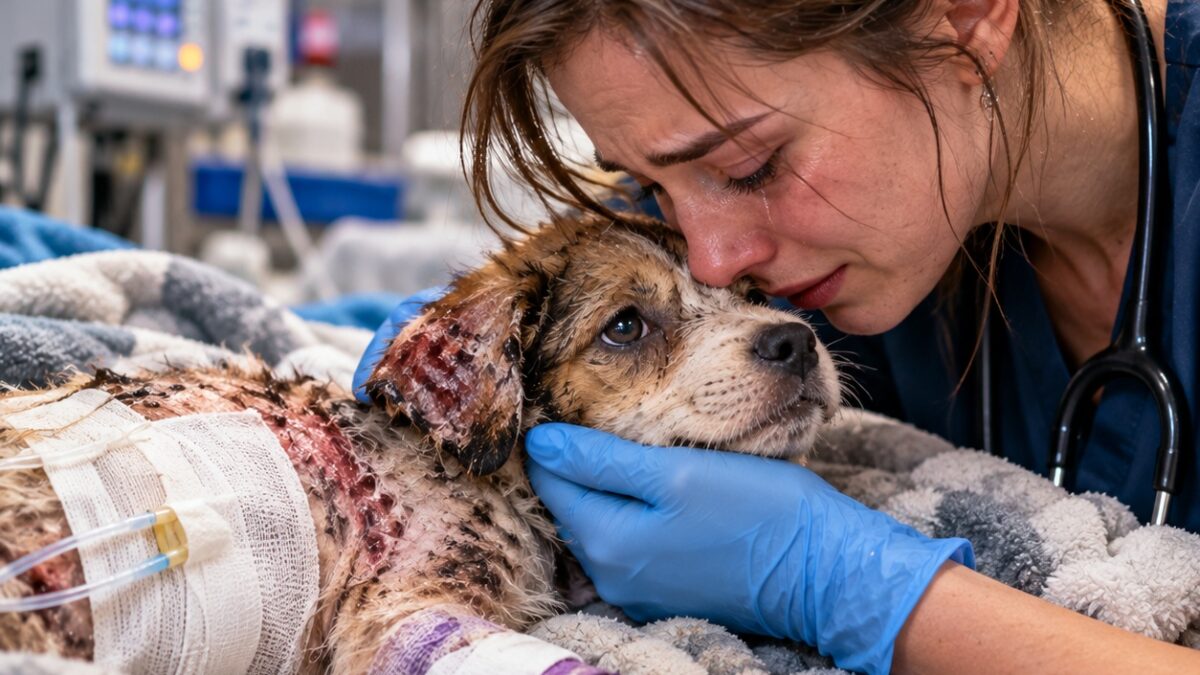
One nurse sat beside Elijah during part of the night.
She was supposed to be completing charts.
Instead, every few minutes she looked into the kennel.
His eyes were closed.
Then open.
Then closed again.
At one point she reached inside.
Not to perform a procedure.
Just touch.
Two fingers against the side of his face where there was uninjured skin.
Elijah’s eyes opened.
The nurse expected withdrawal.
Pain can teach animals that hands mean the next bad thing.
But Elijah moved toward her.
Barely.
A fraction.
His cheek pressed into her palm.
The nurse stopped breathing.
“Hey.”
Elijah remained there.
She stroked once.
Then again.
He did not move away.
Her eyes filled.
“You still want us.”
The puppy could not understand the sentence.
Maybe the tone.
Maybe touch.
That moment traveled through the hospital staff before morning.
Not because it proved he would live.
It did not.
Because it revealed something about him.
Elijah had survived enough cruelty to make fear reasonable.
Still, affection had not disappeared from him.
The rescue team had been told he was reportedly used as a bait dog.
Nobody could prove exactly what had happened.
The pattern of puncture wounds was consistent with repeated bites.
His body suggested more than one attack.
But no one knew how many.
No one knew where.
No one knew who was responsible.
And because Elijah could not tell them, people had to resist the temptation to fill every blank with certainty.
The facts were terrible enough.
A puppy had sustained multiple wounds.
Nobody treated them.
He ended up beside a road.
Flies found him before rescuers did.
That was enough.
The next morning, Elijah looked worse.
Not dramatically.
But the veterinarian noticed changes in one wound.
Then another.
Skin that had appeared borderline viable the previous day was darkening.
Blood supply had failed.
More tissue was dying.
The rescuer stood beside the examination area.
“What does that mean?”
The veterinarian did not soften it too much.
“He may need another debridement.”
“Another surgery?”
“Yes.”
“He just had one.”
“I know.”
“He’s this weak.”
“I know.”
“Can he handle it?”
Silence.
That was the question.
The veterinarian looked at Elijah.
“We have to weigh the risk of anesthesia against the risk of leaving dead tissue.”
Which was worse?
No clean answer.
Medicine often lives there.
Not between good and bad.
Between two dangers.
The rescuer looked at the puppy.
Bandages.
Tube.
One damaged ear.
Eyes too tired for a puppy.
“Do what gives him the best chance.”
The second procedure happened before anyone had emotionally recovered from the first.
More dead tissue removed.
More wounds cleaned.
More dressing.
More time under anesthesia than anyone wanted.
When Elijah woke, he looked offended by existence.
That made one technician smile.
“Good.”
The rescuer frowned.
“What?”
“He’s annoyed.”
“Why is that good?”
“Because yesterday he didn’t have energy to be annoyed.”
Small measurements.
That became the entire story of Elijah’s recovery.
Not dramatic victories.
Tiny signs.
Eyes tracking movement.
A head held up for two seconds longer.
A shift in position.
A sigh when someone scratched under his chin.
A tail movement so small two people argued whether it counted.
The nurse who had been there the first night insisted it did.
“It moved.”
The technician laughed.
“Wishful thinking.”
“His tail moved.”
“Half an inch.”
“Movement.”
Elijah slept through the debate.
Days passed.
His wounds required constant attention.
Dressings changed.
Vacuum checked.
Tube checked.
Pain managed.
Infection monitored.
Every procedure risked hurting a puppy whose body had already learned too much about pain.
So staff began announcing themselves.
Not because Elijah understood every word.
Because predictability matters.
“Hi, baby.”
“Touching your shoulder.”
“Turning you.”
“Almost done.”
“Good boy.”
Again.
Again.
Again.
The tone became familiar.
Hands became less frightening.
One afternoon, a technician opened the kennel to clean around the feeding tube.
Elijah lifted his head.
Then pushed his nose toward her wrist.
She stopped.
“What?”
A tiny lick.
Almost dry.
She laughed.
“No.”
Another.
“You’re flirting now?”
Elijah closed his eyes.
The staff began discovering personality in fragments.
He liked being scratched near the good ear.
He disliked cold cleaning solution.
Understandable.
He tolerated one veterinarian more than another.
Nobody knew why.
He hated the sound of metal bowls dropping.
That became something they avoided when possible.
He seemed calmer when people sat lower.
A tall figure standing directly over him made his body stiffen.
So they changed posture.
Small adaptations.
The kind animals teach humans when humans pay attention.
Still, recovery refused to become easy.
One morning, Elijah’s temperature climbed.
Everyone tensed.
Possible infection flare.
Tests.
Medication adjustment.
Hours of monitoring.
By evening it began coming down.
No celebration.
Not yet.
The next day, one wound looked wetter than before.
Another culture.
Another wait.
The rescuer began dreading phone calls.
If the hospital number appeared, her stomach dropped.
Sometimes the update was good.
Sometimes neutral.
Once:
“We’re concerned about one area.”
That sentence ruined an entire afternoon.
She drove to the hospital.
Sat beside Elijah.
He slept.
She did not touch him at first.
She was afraid of waking him.
Then his eyes opened.
She whispered:
“Hi.”
His head turned.
Toward her.
That was enough to make her cry.
“You know me?”
Of course, nobody knew exactly what Elijah understood.
But he remembered patterns.
Voice.
Scent.
Presence.
The woman had been there the day he left the road.
She kept returning.
That is one of the strongest languages animals understand.
Return.
The rescuer pressed her fingers gently against the uninjured side of his face.
Elijah leaned.
Again.
Always that leaning.
As if he had made a decision about human beings no one had earned yet.
The woman whispered:
“You don’t have to trust everybody.”
Elijah closed his eyes.
“Just us for now.”
The feeding tube remained.
Every day people hoped he might show interest in food.
Every day he did not.
A bowl placed nearby.
Sniff.
Nothing.
Soft food.
No.
Tiny pieces offered by hand.
No.
The veterinarian was not shocked.
His body had been through too much.
But emotionally, the lack of eating became one more symbol of how far he had to go.
Puppies should be hungry.
Annoyingly hungry.
They should hear a bag crinkle and assume every sound means food.
Elijah watched bowls arrive with almost no reaction.
One evening, a nurse warmed a small amount of food.
She placed it near him.
Elijah sniffed.
Looked away.
She sighed.
“Okay.”
She sat with him anyway.
Five minutes.
Ten.
Then Elijah shifted.
His nose moved back.
The nurse froze.
Do not pressure.
Do not make excitement into stress.
Elijah sniffed.
One lick.
She covered her mouth.
Another.
Then he stopped.
The nurse whispered:
“I’m not telling anybody yet.”
Of course she told everybody thirty seconds later.
The veterinarian came.
Nobody crowded the kennel.
They watched from a distance like people observing wildlife.
Elijah licked again.
Then took the smallest bite imaginable.
The rescue worker received a message.
HE ATE.
She stared.
Called immediately.
“How much?”
“Not enough to call a meal.”
“Did he eat?”
“Yes.”
She sat down.
Cried.
The first voluntary bite became more important than any expensive piece of equipment in the room.
Not because the tube was bad.
The tube had kept him alive.
But eating meant Elijah’s body was doing something for itself again.
The next meal was disappointing.
Almost nothing.
The next slightly better.
Then worse.
Recovery did not care about narrative.
Humans want a staircase.
Real healing is scribbles.
Up.
Down.
Sideways.
Pause.
Back.
Forward again.
Elijah remained tube-fed while staff slowly offered food.
Eventually, one morning, he ate enough that everyone in the room went quiet.
Not a lick.
Not a taste.
A meal.
Small for a healthy dog.
Huge for him.
The technician set the bowl down.
Elijah sniffed.
Then ate.
Slowly.
He paused once.
Looked around.
Returned.
The nurse who had felt his first lean toward her started crying before he finished.
Another technician laughed.
“Do not make him think eating is emotional.”
“It is emotional.”
“It’s breakfast.”
“It is the greatest breakfast in history.”
Elijah ignored them.
Good.
His meal belonged to him.
The feeding tube did not come out immediately.
Nobody rushed milestones for symbolism.
They needed consistency.
Tolerance.
Enough intake.
Weight.
Medical stability.
But after that meal, the possibility of removing it became real.
That mattered.
The next major moment came outside.
Not far.
Not a walk around the block.
Just fresh air.
A small protected area near the hospital.
Elijah had spent so long lying down that standing itself looked enormous.
A technician carried him out.
Set him gently on grass.
His legs trembled.
The rescuer knelt nearby.
No pressure.
Elijah looked at the ground.
Then around.
Sunlight.
Wind.
A tree moving.
Birds far away.
His body stiffened for one moment when something dark flew overhead.
Nobody knew whether he remembered.
The rescuer stayed quiet.
Elijah’s front paws adjusted.
One back leg shook.
Then straightened.
He stood.
Badly.
Crooked.
Scarred.
One ear no longer whole.
But standing.
The rescuer covered her mouth.
Elijah looked at her.
Then took one step.
Slow.
Another.
His body wobbled.
A technician kept hands close without grabbing.
Three steps.
Pause.
Elijah sat.
Everyone laughed softly.
Not because it was funny.
Because joy sometimes escapes sounding like laughter when crying has been happening too often.
The puppy who had been unable to lift his head beside the road had just walked outside.
No music.
No audience.
No dramatic speech.
Three uneven steps across grass.
Enough.
The rescuer sat beside him.
Elijah leaned against her knee.
“You did that.”
His eyes closed.
“You don’t know why we’re all crying, do you?”
Probably not.
Good.
He had survived enough human emotion.
From there, progress began becoming visible to people who had not followed every day.
The wounds started closing.
Not all at once.
Edges pulled inward.
Granulation tissue filled deeper areas.
Bandages became smaller.
The wound vacuum was eventually no longer needed.
That day felt enormous.
One machine removed.
Less equipment between Elijah and being a dog.
Later, the feeding tube came out.
The nurse touched the place where it had been.
“You’re free.”
Elijah tried to chew the tape.
“That is not what I meant.”
He had started doing things like that.
Chewing.
Sniffing.
Investigating.
The first toy arrived before anyone knew whether he would care.
Soft.
Small.
A stuffed animal almost his size.
They placed it near him.
Elijah stared.
Then looked at the nurse.
Then back.
His mouth opened.
He touched it.
Released.
Touched again.
Then grabbed it.
Weakly at first.
The nurse gasped.
“Look.”
Within a minute, Elijah had one paw over the toy.
Possessive.
The room erupted in restrained celebration.
Somebody took a photograph.
That image became one of the rescue team’s favorites.
Not because Elijah looked completely healed.
He did not.
Scars visible.
Ear altered.
Fur shaved in patches.
Body still too thin.
But there was a toy between his paws.
Play is a luxury.
An animal in survival mode does not spend energy pretending to kill stuffed animals.
Play means the immediate world feels safe enough to waste energy.
That is beautiful.
Elijah discovered squeakers.
Terrible day for hospital peace.
He pressed.
Squeak.
Head tilt.
Pressed again.
Squeak.
The entire staff laughed.
Within ten minutes, everyone regretted teaching him.
“Make it stop.”
“You gave it to him.”
“I made a mistake.”
Elijah squeaked again.
For the first time, he became annoying.
It was wonderful.
The wounds kept healing.
He gained weight.
His coat began growing back around shaved areas.
The missing portion of his ear remained.
It always would.
One side slightly different.
A permanent mark.
People online sometimes wrote:
Poor baby.
The rescue team understood.
But eventually they wanted a different reaction.
Not poor Elijah.
Elijah.
Alive.
Stubborn.
Toy thief.
Squeaker terrorist.
Food enthusiast.
Champion blanket rearranger.
A dog is not only what happened to him.
That became important as adoption discussions began.
Elijah would need a home.
A permanent one.
That sentence should have been simple.
It was not.
Severe abuse cases attract attention.
People fall in love with recovery stories.
Applications arrive from people moved by photographs.
Some are wonderful.
Some want the idea of rescuing more than the daily dog.
The rescue team needed someone who would love Elijah after the story became old.
When scars stopped seeming heroic.
When he had accidents.
When he barked.
When veterinary appointments cost money.
When fear appeared unexpectedly.
When he needed patience.
When he behaved like an ordinary dog rather than a symbol of survival.
The screening began.
No rush.
Elijah remained in care long enough to learn more about himself.
He liked soft beds.
Very much.
At first, he slept curled tightly.
Body protected.
Head tucked.
Over time, he stretched.
One leg.
Then two.
Eventually belly partly exposed.
Trust visible in sleep.
The rescuer took photographs but did not share all of them.
Some things did not need an audience.
One afternoon, Elijah rolled onto his back while she sat beside him.
She froze.
His stomach was still marked by healing skin.
He looked at her.
She touched gently.
Elijah’s eyes closed.
The woman remembered the roadside.
Maggots.
Dead tissue.
The smell.
The impossibility of imagining this.
A puppy asking for a belly rub.
She whispered:
“You have no idea.”
Elijah’s leg twitched.
“Fine.”
She scratched.
The hospital began seeing less of him as he transitioned toward foster care.
That was good.
Still painful.
The nurse who had first felt him lean into her cried the day he left.
“I’m happy.”
Nobody believed her.
“I am.”
She hugged Elijah.
He licked her chin.
“Traitor.”
The foster home gave him something the hospital could not.
Ordinary routine.
Doors opening.
Kitchen sounds.
Television.
Laundry.
Shoes by the entrance.
A backyard.
Beds that belonged to people.
Food appearing at predictable times.
Elijah explored everything.
Slow at first.
One room.
Then another.
He startled at loud noises.
Metal clanging remained difficult.
If another dog barked suddenly from nearby, Elijah sometimes froze.
His foster family did not force interaction.
No “He needs to get over it.”
No throwing him into uncomfortable situations for dramatic progress.
Distance.
Choice.
Time.
He met calm dogs gradually.
One at a time.
The first dog he trusted was older.
Gentle.
Completely uninterested in Elijah’s history.
They sniffed.
Walked apart.
Sniffed again.
Eventually lay several feet from each other.
No fight.
No attack.
No puncture.
The next day, Elijah moved closer.
That progress made the foster mother cry in the kitchen where Elijah could not see.
After reportedly being used around violence between dogs, simply lying near another animal without fear was enormous.
But nobody turned it into a deadline.
If Elijah had preferred to live as the only dog forever, that would also have been okay.
Healing does not require becoming comfortable with every reminder of trauma.
It requires having enough choice that fear no longer owns everything.
Elijah’s appetite became excellent.
Almost suspiciously excellent.
He learned the sound of food packaging.
The dog who once required a feeding tube now appeared whenever anything edible opened.
Sometimes not edible.
Paper bag?
Elijah.
Refrigerator?
Elijah.
Human opening medicine cabinet?
Possibly snacks.
Elijah.
The foster mother sent a message:
We may have overcorrected the appetite problem.
The rescuer laughed.
Good.
Elijah stole a sandwich once.
Bad behavior.
Wonderful milestone.
The foster mother found him beneath a table with evidence.
“What did you do?”
Elijah looked innocent.
Very poorly.
She took the remaining sandwich.
He looked betrayed.
A rescued animal does not need permission to become mischievous.
That is part of recovery too.
Weeks passed.
His wounds became scars.
Fur hid some.
Not all.
The ear would always tell part of the story.
One side had a missing section.
At first, people noticed immediately.
“What happened?”
The foster family learned to answer simply.
“He had a rough beginning.”
Not details every time.
Elijah did not need strangers imagining his pain while petting him.
Sometimes a dog deserves to meet someone without being introduced by tragedy.
A family applied.
Then another.
One looked perfect on paper.
Large house.
Yard.
Experience.
But during conversations, they talked mostly about Elijah’s story.
How inspirational he was.
How many followers had seen his photographs.
The rescue team hesitated.
Not because those people were bad.
Because they were falling in love with survivor Elijah.
The dog would need people who also loved annoying-adolescent Elijah.
So they waited.
Another family came.
No dramatic reaction to his scars.
They sat on the floor.
Let Elijah approach.
He sniffed one person’s shoe.
Then retreated.
They did not follow.
Good.
Five minutes later, he returned.
One person offered a hand.
Elijah sniffed.
No grabbing.
No squealing.
Eventually, he leaned.
That lean.
Always.
The rescuer watched.
Her throat tightened.
The same puppy who had leaned into a nurse’s palm when his body was barely holding together was now leaning into someone who might become home.
The family asked practical questions.
Diet.
Follow-up veterinary care.
Triggers.
Other animals.
What kind of routine helped.
What should they avoid?
What did Elijah enjoy?
Not:
How famous is he?
Not:
Can we post his story?
Not:
Will he always look like this?
They asked:
“What makes him happy?”
That mattered.
The answer was surprisingly ordinary.
Food.
Soft blankets.
A certain kind of toy.
Quiet affection.
Sniffing outside.
People who did not rush him.
The adoption team continued screening.
Home visit.
References.
Plans.
Nothing guaranteed until everything was ready.
The rescuer tried not to attach too early.
She failed.
She imagined Elijah on their couch.
In their yard.
Sleeping near someone’s feet.
Then forced herself back.
One step.
Always one step.
The family returned for another meeting.
Elijah recognized them.
Tail movement.
Not huge.
Enough.
They sat.
He brought a toy.
Dropped it near one person.
Everyone stopped.
The rescuer smiled.
That was almost an application approval written by Elijah himself.
The paperwork moved forward.
The night before adoption, the foster mother sat with Elijah on the floor.
He was stronger now.
Heavier.
His coat softer.
Ear healed.
Scars stable.
She touched the top of his head.
“Tomorrow.”
Elijah chewed a toy.
“You have no idea what tomorrow means.”
Squeak.
“Correct.”
She laughed.
Then cried.
Elijah looked up.
Humans.
Always emotional.
The foster mother wiped her face.
“I’m supposed to be good at this.”
Foster care means loving enough to let go.
People say that often.
It does not make it painless.
Elijah crawled partly into her lap.
Not because he understood departure.
Because she was there.
She held him.
“I hope you forget me a little.”
That sounds cruel.
It was not.
She hoped his new family became so thoroughly home that foster care turned into an old smell somewhere in memory.
She hoped the hospital disappeared even further.
The roadside farther still.
Some experiences deserve to become distant.
Adoption morning arrived.
The rescuer who had helped bring Elijah in returned too.
So did one hospital nurse.
Nobody wanted to make it overwhelming.
Just a few people.
Elijah walked into the room wearing a collar.
No bandages.
No feeding tube.
No vacuum.
No carrier.
On his own legs.
The rescuer saw him and stopped.
For one second, her mind placed the roadside image over the dog in front of her.
Same eyes.
Different world.
“Elijah.”
His head turned.
He ran.
Not perfectly graceful.
Still a young dog.
But ran.
Toward her.
She dropped to her knees.
He crashed into her.
The woman laughed through tears.
“You remember.”
Of course.
Voice.
Scent.
Return.
Elijah licked her face.
She held him.
Not too tight.
“You got heavy.”
Good problem.
He pulled away to investigate somebody else.
Also good.
The new family arrived.
Elijah saw them.
Tail.
He walked over.
No hesitation large enough to stop him.
One person crouched.
Elijah leaned against their knee.
The rescuer looked away because tears had become ridiculous.
The adoption papers were signed.
That simple.
A name.
Date.
Commitment.
Human paperwork attempting to record something much bigger:
This dog will leave with us.
This dog will sleep in our house.
We will feed him.
Take him to the veterinarian.
Learn his fears.
Learn his joys.
Keep coming back.
Home is mostly a pattern.
Elijah was about to receive one.
Before they left, the rescuer knelt.
“Hey.”
Elijah came.
She held his face gently.
The missing part of his ear made him look slightly uneven.
Perfectly Elijah.
“You don’t have to be brave anymore.”
He blinked.
“You’ve done enough.”
He licked her thumb.
“No more surviving for an audience.”
Her voice broke.
“You can just be a dog.”
Elijah looked toward his new family.
Then back.
The rescuer smiled.
“Go.”
He did.
That was the hardest beautiful thing.
Elijah climbed into the car.
Not alone.
Someone sat beside him.
The door closed.
The vehicle pulled away.
Nobody applauded.
The rescuer stood in the parking lot crying.
The nurse beside her cried too.
“You okay?”
“No.”
“Same.”
They laughed.
Then returned to work.
There were other animals.
There always are.
The first update arrived that evening.
A photograph.
Elijah asleep on a blanket.
The rescuer zoomed in.
His body was curled.
But not tightly.
Head resting against someone’s leg.
Caption:
He ate dinner, explored everything and finally crashed.
The rescuer replied:
Perfect.
Another update the next morning.
Elijah in a backyard.
Nose down.
Tail up.
No road.
No hospital.
No kennel.
Grass.
A week later:
Elijah carrying a toy twice the size of his head.
Two weeks:
Elijah asleep upside down.
One month:
Elijah at a veterinary follow-up looking offended.
Normal.
His family did not hide his history.
They simply refused to let it become the only subject.
Visitors were told to let him approach.
Children were supervised.
Other dogs introduced carefully.
No one grabbed his damaged ear.
No one used rough play that frightened him.
Simple respect.
Elijah continued learning.
He discovered couches.
He had apparently never received the memo that some people prefer dogs not to own furniture.
His family tried.
Failed.
One photograph showed Elijah occupying the center cushion while two humans sat at opposite ends.
Caption:
We have lost control of the house.
The rescuer smiled.
Excellent.
Elijah also learned doors.
At first, when someone left, he sometimes followed urgently.
The family noticed.
Separation.
Not severe.
But enough.
So they practiced.
Short departures.
Return.
Predictable.
No dramatic goodbye.
Return.
Again.
Again.
Elijah learned:
People leave.
People come back.
That lesson may have been one of the most important.
Animals abandoned once cannot be told the next goodbye is temporary.
They have to experience return.
Pattern again.
The family became a pattern.
Morning.
Food.
Walk.
Home.
Nap.
Evening.
Bed.
Repeat.
Safety can be boring.
That is its beauty.
Months later, Elijah’s family sent a video from a park.
Elijah ran across grass toward the camera.
Ear bouncing unevenly.
Mouth open.
Tongue out.
The rescuer watched it several times.
At no point did she think:
Poor dog.
That was new.
She thought:
Look at him.
Just that.
The story of Elijah remained online.
The original photographs were difficult.
People commented:
How could anyone do this?
No answer.
Did they catch whoever hurt him?
No certainty.
Was he really a bait dog?
Reportedly.
His injuries suggested severe abuse, but investigators did not have a complete history.
The rescue team stayed careful.
You do not need to exaggerate cruelty to make compassion legitimate.
What was known was enough.
Elijah had been harmed.
Elijah had been neglected.
Elijah had been left without treatment.
Elijah survived because people acted.
That was enough truth.
Some followers wanted revenge.
Graphic wishes against whoever hurt him.
The rescue discouraged it.
Violence did not heal Elijah.
Care did.
Justice matters.
Accountability matters.
But making another body suffer would not restore his ear.
Would not erase punctures.
Would not return the days of pain.
Elijah’s life became the answer.
Not revenge.
Life.
He grew.
Puppy proportions changed.
Chest broader.
Legs stronger.
The scarred little body became the body of a young dog.
Some scars stretched.
Others faded beneath fur.
The ear remained.
People meeting him for the first time sometimes asked whether he had been born that way.
The family would say:
“No.”
Then decide whether the rest needed telling.
Sometimes it did.
Sometimes:
“He had a difficult start, but he’s fine now.”
Fine.
What a beautiful word.
Not extraordinary.
Fine.
One year after rescue, the family marked the day quietly.
No party for Elijah’s trauma.
Just a new toy.
Special dinner.
Photograph.
The rescuer received a message.
One year home.
She stared.
Home.
Not one year rescued.
Not one year survived.
Home.
She opened the original intake photographs.
Had not looked in months.
Elijah beside the road.
Eyes barely open.
Wounds.
Maggots.
She closed them quickly.
Not denial.
Perspective.
Then opened the new photo.
Elijah in a bed.
One paw over a toy.
Healthy weight.
Missing ear section visible.
Eyes bright.
The rescuer whispered:
“That’s enough.”
Years passed.
Elijah became less news and more dog.
That was exactly what everyone hoped.
The hospital staff changed.
Some nurses left.
New technicians arrived who never knew him.
The first nurse kept his photograph inside her locker.
Not the sick one.
Toy between paws.
A coworker once asked:
“Who’s that?”
She smiled.
“Elijah.”
“What happened to his ear?”
“Long story.”
“Is he okay?”
“Yes.”
That was the only part that needed telling.
The rescuer continued responding to difficult cases.
Every severe wound brought back pieces.
Smell.
Bandages.
The waiting.
Sometimes she remembered Elijah when another animal leaned into her hand.
Not because every story ended the same.
They did not.
Some died despite everything.
That truth mattered.
Elijah’s survival never became proof that enough love guarantees recovery.
Love is not medicine.
Medicine is not certainty.
Rescue is not omnipotence.
Sometimes people do every right thing and still lose an animal.
The rescuer knew.
She had held those too.
Elijah’s story gave hope without promising outcomes.
He survived.
That meant survival was possible.
Not owed.
Possible.
One evening, a volunteer asked why Elijah mattered so much when the rescue had saved hundreds of animals.
The rescuer thought.
“He trusted before he had evidence.”
“What?”
“When we touched him.”
She remembered.
The first nurse’s hand.
That lean.
“He had every reason to be afraid of people.”
“Maybe he was too weak to move.”
“Maybe.”
The rescuer smiled.
“But he kept doing it even when stronger.”
Lean.
Lap.
Touch.
Elijah had not become fearless.
He became selective.
That was healthier.
Trust does not mean forgetting harm.
It means learning who is safe.
His family became safe.
That was the achievement.
At home, Elijah developed a habit of resting his head against someone’s leg whenever he wanted affection.
Not climbing.
Not demanding.
Just pressure.
A lean.
The family joked:
“He chooses his person.”
Sometimes guest.
Sometimes owner.
Always deliberate.
One holiday, the rescuer visited.
Years had passed.
Elijah recognized her.
Not instantly.
That was okay.
He sniffed.
Paused.
Then tail.
The rescuer laughed.
“There you are.”
Elijah came closer.
Leaned.
Of course.
She crouched slowly.
He was no longer tiny.
No longer fragile.
She ran one hand along his shoulder.
Scars beneath fur.
Ear.
Warm body.
“You did good.”
Elijah looked toward his family.
Then returned his head to her hand.
The rescuer looked around the home.
Photos.
Dog bed.
Bowls.
Toys.
One destroyed cushion.
Evidence of ordinary life.
His family said:
“He’s spoiled.”
“Good.”
“He expects dinner five minutes early.”
“Better.”
“He steals socks.”
“Excellent.”
They laughed.
Then somebody said:
“He’s ours.”
The rescuer’s eyes filled.
Not ownership in the harsh sense.
Belonging.
He belonged somewhere.
Someone knew whether he had eaten.
Someone noticed if his gait changed.
Someone knew which veterinarian he used.
Someone worried when he slept too long.
Someone complained about hair on furniture.
Someone bought his food.
Someone said:
“Elijah, leave that.”
Someone said:
“Goodnight.”
Every day.
That was home.
When it was time to leave, the rescuer knelt again.
Elijah sniffed her jacket.
She whispered:
“I’m glad you don’t need me.”
His tail moved.
That might sound sad.
It was not.
The greatest success in rescue is often becoming unnecessary.
At first, Elijah needed people to remove larvae from his wounds.
Then clean tissue.
Then feed him through a tube.
Then help him stand.
Then foster him.
Then reassure him.
Eventually:
Nothing extraordinary.
A meal.
A walk.
A couch.
Love.
He did not need saving every day.
He needed living.
That distinction mattered.
Later, the rescuer received one last photograph she saved permanently.
Elijah asleep beside a child in his family.
The child’s hand rested close to his damaged ear.
Not touching.
Just near.
Elijah slept deeply.
Eyes closed.
Body stretched.
No tension.
On the roadside, a vulnerable body had attracted danger.
At home, vulnerability became safe.
That was the transformation.
Not scars disappearing.
Not ear becoming whole.
Not memory erased.
Safety.
People sometimes asked whether Elijah’s missing ear made the rescuers sad.
The answer changed over time.
At first:
Yes.
Because it represented what could not be saved.
Later:
No.
It was simply his ear.
Part of him.
Dogs do not stand in mirrors mourning symmetry.
Humans do that for them.
Elijah used the ear he had.
He heard the refrigerator.
His name.
A leash being lifted.
A food bag.
His family returning home.
Enough.
The scarred body worked.
The heart trusted.
The dog lived.
That became more important than restoration.
There was no moment when Elijah woke and forgot.
No magical reset.
There were days he startled.
Moments he froze.
Situations his family avoided because they were unnecessary.
Healing did not demand proving he could tolerate everything.
If a certain type of rough dog made him uncomfortable, they crossed the street.
If metal banging frightened him, they reduced it.
If strangers reached too quickly, they said:
“Give him a second.”
Respect.
Not weakness.
His family learned his language.
Elijah learned theirs.
That is relationship.
One afternoon, thunder rolled.
Elijah startled.
Ran toward the hall.
Stopped.
Looked back.
A family member sat on the floor.
No chasing.
No forcing.
Just:
“I’m here.”
Elijah waited.
Then returned.
Leaned.
Thunder continued.
Nothing attacked him.
Eventually he slept.
That is how nervous systems relearn the world.
Not explanations.
Experiences.
Enough safe thunder.
Enough safe hands.
Enough safe dogs.
Enough safe nights.
Until danger stops being expected everywhere.
The rescuer once said the hardest thing about Elijah’s story was not what people imagined.
Not the maggots.
Not even the missing ear.
It was how young he was.
A puppy should not have enough history to need recovery.
He should have been at the beginning.
And yet that also became hope.
He had so much life ahead after the worst part ended.
First real meal.
First toy.
First secure sleep.
First home.
Then hundreds of meals.
Thousands of toys squeaked.
Years of sleep.
The terrible beginning became a smaller percentage of his life with every safe day added.
That is something time can do when safety follows trauma.
It cannot erase.
It can outnumber.
One bad week.
Then one good month.
One good year.
Five.
Enough mornings that the road becomes old history.
Enough dinners that hunger becomes expectation instead of fear.
Enough returns that goodbye loses its threat.
Enough touch that a hand becomes comfort.
That was Elijah’s real recovery.
Not only skin closing.
Life expanding around the scars.
The puppy who had once been photographed because his suffering was shocking eventually became difficult to photograph because he would not sit still.
The family complained.
“He moves too much.”
The rescuer loved that problem.
“Use video.”
“He steals the phone.”
“Even better.”
Movement.
Noise.
Trouble.
Everything the roadside Elijah had lacked.
Somebody once commented beneath a new picture:
He doesn’t even look like the same dog.
The rescuer disagreed.
He did.
Look closely.
Same eyes.
The difference was not identity.
It was what surrounded him.
Before:
Road.
Wounds.
Flies.
No protection.
After:
Home.
Food.
People.
Safety.
Same Elijah.
Different world.
That is why rescue stories should be careful about saying an animal became “unrecognizable.”
Sometimes the animal was always there.
Suffering simply covered everything else.
Remove enough pain and personality appears.
Elijah had always contained the dog who loved toys.
Nobody could see him while he was trying not to die.
He had always contained appetite.
He needed a stomach able to use it.
He had always contained affection.
He showed that almost immediately.
Lean.
He had always contained mischief.
It required energy.
Recovery did not invent him.
It uncovered him.
That realization changed how the rescue team spoke about severe cases.
Not:
We gave him a new life.
Maybe:
We helped him reach the life that was still possible.
The distinction honors the animal.
Elijah did the living.
People made room.
As he aged, his family adjusted care around old injuries.
Scar tissue.
Sensitive areas.
Regular examinations.
No assumptions.
Some wounds echo physically long after healing.
That was part of the commitment.
Adoption is not the last page where responsibility ends.
It is where rescue changes hands.
The family carried it.
Quietly.
No public applause.
Appointments.
Bills.
Medication when needed.
Comfort.
Normal years.
That is where the happy ending actually happens.
Not paperwork.
Tuesday night.
Wednesday morning.
Again.
Again.
Again.
When Elijah eventually became a senior dog, gray appeared around his muzzle.
The rescuer saw a photograph and stared.
Gray.
The puppy found beside the road had lived long enough to become old.
Few outcomes are more satisfying.
He moved slower.
Still loved food.
Still leaned.
The missing ear had long ago stopped being remarkable.
The family knew every scar.
Children who grew up around him saw them as normal.
One child once asked:
“Was Elijah born with one ear funny?”
A parent said:
“No. He got hurt when he was little.”
“Did it grow back?”
“No.”
The child considered.
“He’s still cute.”
Correct.
The conversation ended.
Adults could learn from that.
No tragedy speech required.
Elijah’s body did not need apology.
In his final years, he preferred warm places.
Sunny floor patches.
Blankets.
Someone’s feet.
He had once lain beside a road because there was nowhere else.
Now he had options and consistently chose the most inconvenient one.
Usually where someone needed to walk.
Perfect.
The rescuer received fewer updates because life became busy.
That was okay.
No news meant ordinary.
Then one day, years after adoption, a message arrived.
Not an emergency.
Just:
Thought you’d like this.
Photo.
Elijah asleep.
Gray face.
Head resting against the family member who had first crouched and let him approach during the adoption meeting.
The same lean.
The rescuer sat down.
Everything collapsed into that posture.
Road.
Hospital.
Palm.
Foster home.
Adoption.
Years.
Lean.
Elijah had never stopped asking the world one quiet question:
Will you stay?
The answer changed.
At first, nobody.
Then rescuers.
Veterinary staff.
Foster mother.
Family.
Finally:
Yes.
Again and again until he no longer needed to ask consciously.
The rescuer saved the photograph beside the first healthy picture.
Not the road.
She rarely kept the road image visible anymore.
Elijah’s suffering mattered.
But his life deserved more space.
If someone asked her today what she remembered most about finding him, she could describe the wounds.
Of course.
The larvae.
The smell.
The damaged ear.
The way his head would not lift.
But that was not what came first anymore.
She remembered the weight of him.
How light.
Then the first lean.
A puppy almost consumed by injury still moving toward touch.
That was Elijah.
Not weakness.
Not saintly forgiveness.
A social animal reaching for connection because somewhere inside him, despite everything, the possibility of safety remained.
Humans did not deserve that trust automatically.
They earned it afterward.
One hand.
One dressing.
One meal.
One return at a time.
There were no guarantees when Elijah entered the hospital.
Nobody could honestly say:
He will survive.
Nobody could honestly say:
One day he will run.
One day he will play.
One day someone will adopt him.
That is not how medicine works.
That is not how rescue works.
There was only:
He is alive now.
Treat what is in front of us.
Four hours removing maggots.
Surgery.
Bandages.
Tube.
Vacuum.
Another surgery.
Wound care.
Food.
Steps.
Toy.
Home.
The ending existed because people kept doing the next thing before they knew the final thing.
That is the lesson Elijah’s story leaves behind.
Not that love cures everything.
It does not.
Not that every abused animal instantly trusts.
They do not.
Not that survival proves strength.
Animals who die are not weaker.
The lesson is simpler.
When suffering is in front of you, do not wait for a guaranteed ending before deciding whether care is worth giving.
Elijah had no guaranteed ending.
He got care anyway.
And because medicine, timing, persistence, his own body and extraordinary amounts of ordinary work aligned—
he lived.
He lived long enough for the feeding tube to come out.
Long enough for the wound vacuum to disappear.
Long enough for bandages to shrink.
Long enough to stand outside.
Long enough to eat.
Long enough to discover squeakers.
Long enough to become annoying about food.
Long enough for his foster mother to cry when he left.
Long enough for a family to say:
We want him.
Long enough for scars to become old.
Long enough for gray fur.
Long enough for the worst days of his life to become outnumbered by good ones.
That is what the people who cared for Elijah wanted.
Not for the scars to vanish.
Not for strangers to forget what happened.
For the suffering to stop being the majority of his story.
Eventually, it did.
A puppy was found beside a road with thousands of maggots feeding inside his wounds.
That will always be true.
But so is this:
He woke in warmth.
He leaned into a hand.
He survived surgery.
Then another.
He ate.
He stood.
He walked.
He played.
He healed.
He trusted.
He went home.
And for the rest of his life, when Elijah leaned his scarred little body against someone he loved, there was finally someone on the other side who stayed.

