PART2:They Called Me “The Help” at My Own Wedding on a 600-Acre Estate—The County Deed Was in My Jacket
PART2
The morning of the wedding began before sunrise.
That was normal for me.
My bride had spent months telling me I was not allowed to work on our wedding day.
I had promised.
Mostly.
At five-thirty, I was already walking the lower vineyard.
Not because I expected trouble.
Because walking the property was how I thought.
Mist still rested between the rows.
The vines were heavy with late-summer fruit.
The restored barn stood dark against the sky.
Beyond it, staff were beginning to arrive.
Delivery vans.
Florists.
Rental crews.
Catering.
By seven, the estate would stop feeling like a farm and start behaving like a machine built for a wedding.
I knew every moving part.
That was the problem.
Once you build something yourself, it becomes difficult to walk past a crooked fence and say:
Someone else will handle it.
My bride knew that.
She had teased me the night before.
“If I see you holding a wrench tomorrow, I’m leaving.”
“Before or after the vows?”
“Before.”
“Fair.”
She knew the real me.
Not the brochure version.
She had seen me in work jeans at six in the morning.
Seen me crawl under a pump housing.
Seen me come inside with mud across one shoulder because a utility vehicle had buried itself near the creek.
Her immediate family knew too.
They had spent time on the estate.
Her father had eaten breakfast with me in the maintenance shed.
Her mother had watched me repair a sprayer.
They understood that the man who owned the place did not stand on balconies giving orders through an estate manager.
The larger guest list did not.
Many knew my name.
Few knew my face.
That had never bothered me.
I had never wanted to become the kind of owner whose photograph mattered more than the people doing the work.
The estate employed good people.
Venue coordinators.
Grounds crews.
Vineyard staff.
Housekeeping.
Kitchen teams.
Mechanics.
Servers.
Security.
The property worked because of them.
I happened to own the deed.
That did not make me more human than anyone holding a tray.
Unfortunately, some of our guests seemed to believe the opposite.
I just did not know it yet.
At seven-fifteen, my venue director found me near the barn.
“You’re not supposed to be working.”
“I’m walking.”
“You have a wrench.”
I looked at my hand.
“Coincidence.”
She gave me the same expression my bride used.
Then her radio crackled.
She listened.
Her face changed.
“Irrigation issue near ceremony row.”
“How bad?”
“Pressure drop.”
I was already moving.
“Marcus.”
“What?”
“You’re getting married today.”
“And we need the lower beds alive tomorrow.”
“We have staff.”
“I know.”
That was not lack of trust.
It was instinct.
The irrigation system had been one of my earliest major rebuilds.
I knew exactly where the old line met the newer zone.
If pressure dropped near the ceremony area, I could usually find it faster than anyone.
The valve had partially seized.
Easy repair.
Except the access panel sat near the flower-draped arch where several hundred chairs were already arranged.
I fixed it before breakfast.
Or thought I did.
Then around noon, pressure dropped again.
The ceremony was scheduled for four-thirty.
By three, guests were arriving.
I was dressed except for the formal jacket I would wear during the vows.
Simple tailored jacket.
White shirt.
Dark trousers.
Boots instead of formal shoes because gravel and dress shoes are a ridiculous combination.
My bride had approved.
She liked that I looked like myself.
At three-twenty, a grounds employee radioed.
“Marcus, we’re losing pressure at the arch again.”
I looked toward the main house.
My bride was upstairs.
Guests arriving.
Photographers setting up.
Thirty minutes before I was supposed to disappear and reappear as the groom.
I could have said:
Handle it.
I nearly did.
Then another message came.
“If that line goes completely, it may flood the ceremony path.”
That was enough.
I grabbed my work gloves.
The nearest tractor had the tools I needed.
I drove.
Five minutes.
That was all it should have been.
Drive down.
Shut valve.
Adjust fitting.
Return tractor.
Change jacket.
Get married.
Life enjoys plans like that.
The reception tent sat beside the ceremony lawn.
White canvas.
Open sides.
Crystal chandeliers suspended from a temporary structure strong enough to make engineers nervous.
Tables already set.
Champagne being served to early arrivals.
Some guests wandered outside before the ceremony.
Others sat under the tent because Georgia heat makes elegance negotiable.
I drove slowly.
Very slowly.
The tractor did not roar.
It hummed.
Still, people heard.
Heads turned.
The flower arch stood directly beyond a gravel service lane.
I had to pass behind part of the seating area to reach the irrigation control.
That was when I heard laughter.
At first, I assumed somebody had made a joke unrelated to me.
Then a woman in pearls turned so quickly she spilled champagne.
“Is the landscaping crew really driving through the aisle right now?”
A man answered:
“Apparently.”
Another voice:
“Somebody tell him the help entrance is around back.”
Laughter.
Not everyone.
Enough.
The tractor rolled forward.
I could see faces.
Expensive suits.
Dresses.
Sunglasses.
Phones.
People who had been drinking since early afternoon.
I remember thinking:
They think I’m staff.
That did not offend me.
Why would it?
My father had been staff everywhere he went.
I had been labor most of my life.
The insult was not being mistaken for a worker.
The insult was how quickly they decided a worker deserved contempt.
That distinction became important later.
At the time, I kept driving.
I stopped near the panel.
Shut off the engine.
The sudden quiet made the laughter clearer.
Someone said:
“Unbelievable.”
Another:
“Where is the planner?”
I climbed down.
Dusty boots.
Clean shirt.
Tailored jacket over one arm.
Work gloves.
I could feel people looking.
I ignored them.
My bride was sitting near the front with her mother while the photographer finished some pre-ceremony details.
She saw me.
Her expression changed instantly.
Not embarrassment.
Anger.
She knew why I was there.
She also knew what they were saying.
I gave her a tiny shake of my head.
Not yet.
Do not start.
She knew me well enough to understand.
Her jaw tightened.
She stayed seated.
I walked toward the irrigation panel.
A tall groomsman stepped directly into my path.
I knew who he was.
Friend of the family.
Regional attorney.
The kind of man who seemed perfectly pleasant during formal introductions.
He had already had several glasses of champagne.
“Buddy.”
His smile had an audience built into it.
“Can you not park that thing where people are taking photos?”
I looked toward the tractor.
It was nowhere near the primary photo line.
“I’ll only be a moment.”
He glanced at my boots.
Then my gloves.
“Great.”
He gestured vaguely toward the service road.
“Maybe take the scenic route next time.”
A couple of men behind him laughed.
One said:
“They’ll hire anybody these days.”
Another:
“Maybe he’s part of the rustic experience.”
More laughter.
I looked at the groomsman.
“I need to reach the irrigation panel.”
“During a wedding?”
“Before the wedding.”
He looked toward the seated guests.
“Do you at least have permission to be up here?”
That question almost made me smile.
Almost.
“Yes.”
“From who?”
“The owner.”
The men laughed.
Of course they did.
They heard the answer as:
Some boss told me to do this.
Not:
I made the decision.
That was fine.
I moved left.
The groomsman moved with me.
That changed things.
Mockery is one thing.
Blocking a man from doing his job is another.
I stopped.
“I’ll be done in a moment.”
My voice stayed calm.
No apology.
No threat.
That bothered him.
You could see it.
He wanted irritation.
Wanted the worker to become rude enough that he could justify his own behavior.
People often provoke downward, then punish the reaction upward.
I gave him nothing.
He stepped aside.
Barely.
I passed.
Behind me, a woman said:
“Is that diesel?”
She fanned the air near her face.
The tractor had not produced visible exhaust anywhere near her.
Someone answered:
“You can smell poverty.”
Laughter.
That one hurt.
Not because it described me.
Because I remembered my father.
His garage.
The shirts my mother washed twice because motor oil clung to them.
The old pickup.
The years when dinner out meant a drive-through burger shared in the truck.
Smell poverty.
I could almost hear Dad.
Machines don’t care who owns them. Neither should your manners.
I kept walking.
The irrigation panel was partially hidden behind decorative greenery.
I opened it.
Pressure gauge low.
The fitting I had tightened earlier had shifted.
Ground beneath it damp.
I knelt.
Pulled a small tool from my jacket.
Behind me, the performance grew.
“Make sure he doesn’t scratch the marble.”
That voice carried across the front rows.
“Those steps probably cost more than his truck.”
Louder laughter.
The estate did have marble steps near the main house.
Not where I was standing.
Accuracy was not the point.
Another phone rose.
Red recording light.
Then another.
A photographer lowered her professional camera.
She looked uncomfortable.
She could photograph the moment and become part of it.
Or look away and become part of it differently.
She chose neither for several seconds.
Just stood.
A server near the tent froze with a tray.
Her hands trembled slightly.
I noticed because I notice hands.
Dad again.
Always hands.
The venue coordinator stood near the entrance.
She had gone pale.
Her radio remained near her mouth.
She knew who I was.
More importantly, she knew these guests were abusing someone they believed was staff.
Our contracts had general conduct language.
Nothing strong enough to stop a ceremony instantly.
I could see her calculating.
If she stepped in and said:
That is the owner,
the moment would end.
But then what would anyone have learned?
Do not insult the worker because he might own the land?
Wrong lesson.
Still, I did not want the staff absorbing this.
That became my conflict.
I could tolerate being mocked.
I was not sure I should allow employees to watch mockery become entertainment.
I tightened the fitting.
Pressure rose.
Good.
I wiped my hands on a cloth.
Stood.
Then the groomsman returned.
He had noticed the growing audience.
People like him sometimes become more themselves when a room rewards them.
He folded his arms.
“Finished?”
“Almost.”
“Good.”
He looked at my jacket.
“Someone should tell management the dress code applies to employees too.”
A man near him laughed.
Another guest said:
“Maybe that is the formal tractor jacket.”
More laughter.
The bride stood.
My bride.
The woman I was about to marry.
Her mother caught her wrist gently.
Not restraining.
Asking.
Wait?
My bride looked at me.
I gave the smallest nod.
Wait.
I was not enjoying the humiliation.
That matters.
I was not setting a trap.
Not staging a reveal.
I simply wanted to see where people stopped themselves.
That is a painful thing to learn.
Most did not.
The laughter spread because laughter gives permission.
At first, maybe eight people.
Then fifteen.
People who had not heard the original remark joined because everyone else seemed amused.
A man near the bar lifted his glass.
“To the landscaping team!”
Someone clinked his glass.
I remember the server with the tray looking down.
Her face had changed.
Not amusement.
Shame.
For me?
For herself?
For the guests?
Maybe all three.
One older woman frowned at the men.
“Enough.”
She said it quietly.
Too quietly to stop anything.
Still.
I heard.
That mattered.
One person.
A beginning.
The groomsman looked at me again.
“Do you understand this is a private event?”
“Yes.”
“You keep saying yes like that.”
“Like what?”
He blinked.
Maybe he had not expected a question.
“Like you’re…”
He stopped.
“Like I’m what?”
The men behind him were listening.
He laughed.
“Never mind.”
I could have let it end there.
Then someone in the second row called:
“Who exactly do you work for?”
Sharper voice.
Older man.
Amused.
The question traveled.
Heads turned.
Finally.
The question they all believed would place me properly inside the hierarchy.
I looked toward him.
“I work for the owner.”
The relief under the tent was immediate.
More laughter.
There it was.
Simple.
Employee.
Owner somewhere else.
World restored.
A man near the bar called:
“Great.”
“Call him.”
Another:
“Yes.”
“Let’s clear this up.”
The groomsman smiled.
“Good idea.”
I looked toward my bride.
Her eyes were wet now.
Not because she was ashamed of me.
Because she understood exactly what the moment represented.
She knew the story of the property.
The auction.
The years.
She knew how many nights I had slept four hours because frost threatened the vines.
She knew I had borrowed against almost everything I owned.
She knew I had rebuilt the barn after everyone told me demolition would be cheaper.
She knew I had driven tractors long before I drove a polished black sedan.
And she was watching people invited to celebrate our marriage treat the work that built our life as something beneath them.
That hurt her.
I could see it.
It hurt me more than their laughter.
I took off my gloves.
One finger at a time.
Folded them.
Placed them in my left hand.
Then reached inside my jacket.
The groomsman smiled.
“What?”
“Got his number?”
I did not answer.
I carried a leather folder that day because the venue director had needed final county occupancy paperwork for a newly restored section of the barn that morning.
Inside it were several property documents.
One was a certified deed copy.
Embossed county seal.
Not something I ordinarily carried to weddings.
Life enjoys irony.
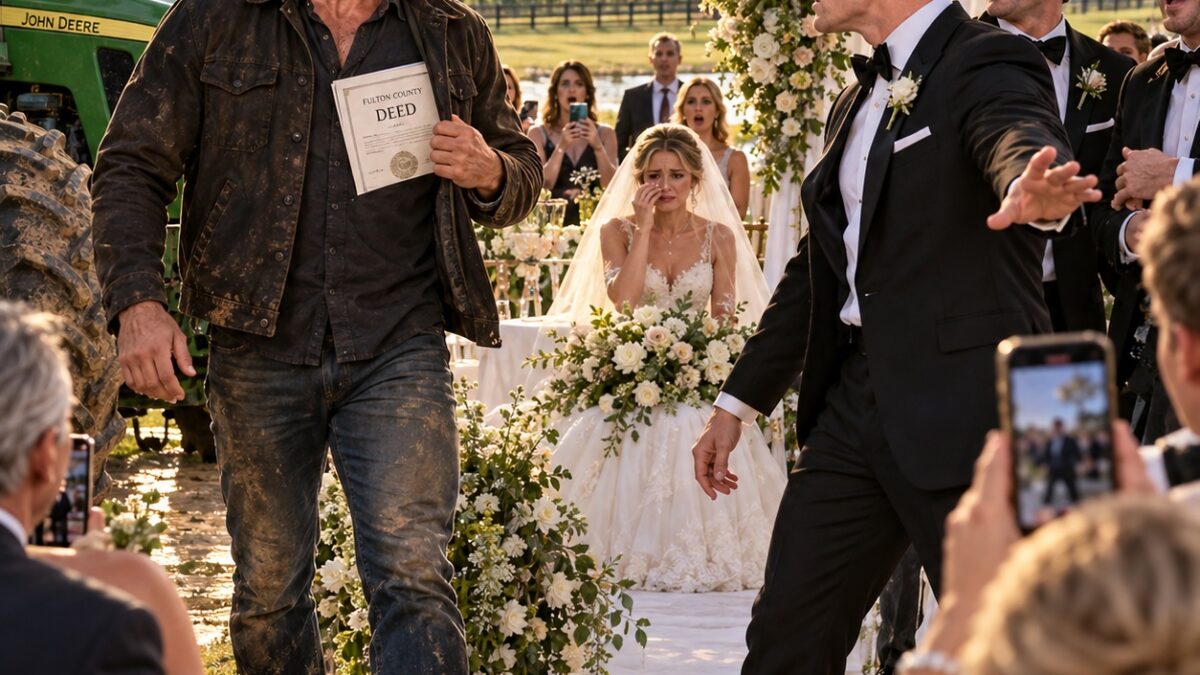
I removed it.
The laughter thinned.
Paper makes people nervous when they do not know what it says.
I walked toward the groomsman.
Held the deed out.
He looked confused.
“What’s this?”
“Read it.”
He took it.
His smile remained for the first line.
Then weakened.
I watched his eyes move.
Property description.
Acreage.
County recording.
Owner.
Marcus Hill.
He looked up.
I said:
“I’m Marcus Hill.”
No edge.
No anger.
“I purchased this estate in 2016.”
Silence moved outward.
Not instantly.
First the men nearest us.
Then the rows behind.
Then tables under the tent.
The county seal caught the afternoon light.
The groomsman looked back down.
Maybe hoping the name would change.
It did not.
I continued:
“I own the vineyard.”
“The barn.”
“The ceremony lawn.”
“The tractor.”
I glanced toward it.
“And the marble steps you were worried about.”
Someone inhaled.
A woman covered her mouth.
I said:
“I also personally approved this wedding.”
My bride stepped forward then.
White dress brushing gravel.
No hurry.
She crossed the distance.
Took my hand.
No speech.
No introduction.
That gesture answered the final question nobody had yet asked.
The groom.
Not landscaper.
Not maintenance worker.
Not hired help.
The dusty man they had been mocking was the man standing beneath the arch in less than thirty minutes.
The man the bride loved.
The man whose property surrounded them in every direction.
The venue coordinator finally found her voice.
“Yes, sir.”
Two words.
Quiet.
Professional.
Enough.
The groomsman’s face changed in patches.
Red.
Then gray.
He handed the deed back as if it had become hot.
“We didn’t know.”
Someone behind him muttered the same thing.
“We didn’t know.”
A woman:
“I’m so sorry.”
Another:
“We were just joking.”
I looked at the groomsman.
“I know you didn’t know.”
He swallowed.
That was all.
I did not say:
That’s the problem.
I did not have to.
Everybody heard it anyway.
The hardest part came next.
People expect satisfaction.
Maybe revenge.
Maybe the moment where the owner orders security to throw everyone out.
I did not.
Partly because it was my wedding.
Partly because my bride deserved a ceremony not entirely consumed by other people’s ugliness.
And partly because humiliating them back would not restore anything.
Still, something had changed.
The guests knew it.
Staff knew it.
I knew it.
An apology does not rewind laughter.
The groomsman stepped toward me.
“Marcus.”
First time he used my name.
Interesting how quickly names appear when status does.
“I truly didn’t mean—”
I raised one hand.
Not aggressively.
“Not now.”
He stopped.
My bride squeezed my fingers.
I looked at the venue coordinator.
“Is pressure stable?”
She blinked.
Then understood.
“Yes.”
“Good.”
I turned toward the irrigation panel.
Closed it.
Then walked toward the tractor.
The groomsman stared.
“You’re still…”
“Moving it.”
I climbed up.
Started the engine.
Nobody laughed this time.
That silence felt worse than the earlier noise in some ways.
Not because I wanted applause.
Because they had learned the wrong immediate reflex.
Before:
tractor equals low status.
After:
tractor belongs to owner, so respect.
I drove the machine toward the barn.
Slowly.
I thought about that.
A lot.
My bride met me near the service entrance.
She had left the guests with her mother.
The moment I stepped down, she hit my chest with both hands.
Not hard.
Angry.
“You told me not to move.”
“I know.”
“I wanted to destroy them.”
“I know.”
“You stood there.”
“I know.”
Her eyes filled.
“Marcus.”
I took her wrists gently.
“Hey.”
“They laughed at you.”
“Yes.”
“At your work.”
“Yes.”
“At this place.”
“Yes.”
She turned toward the vineyard.
“This place exists because of you.”
“Because of a lot of people.”
“You know what I mean.”
I did.
She cried then.
That nearly made me.
Not the jokes.
Not the phone cameras.
Her pain.
“I’m sorry.”
I said.
She stared.
“For what?”
“For making you sit through it.”
“You didn’t make them say those things.”
“No.”
“But I asked you to wait.”
She breathed.
Then:
“Why?”
I looked toward the staff entrance.
A server passed.
The same woman whose tray had trembled.
She looked at me.
Looked away quickly.
“Because if you stood up and said, ‘That’s Marcus, he owns the place,’ they would have stopped.”
“Yes.”
“And what would they have learned?”
My bride went quiet.
“That the owner deserves respect.”
I nodded.
She understood.
“And the worker doesn’t.”
“Exactly.”
She closed her eyes.
“That is so much worse.”
“Yes.”
We stood quietly.
Then she asked:
“Are we still getting married?”
I laughed despite everything.
“I hope so.”
She hit my chest again.
“Idiot.”
“Fair.”
She wiped her eyes.
“Go change.”
“Yes, ma’am.”
“Marcus.”
“What?”
“If one of them says another word to staff…”
“I know.”
“No.”
Her voice hardened.
“I mean it.”
“So do I.”
That became the beginning of what happened later.
I changed jackets.
Washed my hands.
Scrubbed dust from beneath my nails.
Not because dirty hands embarrassed me.
Because wedding photographs last forever, and my bride had threatened my life if I appeared with hydraulic grease on my cuffs.
When I looked in the mirror, I saw my father for one second.
Not literally.
Something around the eyes.
He had died before the estate became what it was.
Before my wedding.
He had seen the land early.
Walked the broken barns with me.
He thought buying it was insane.
“You know how much roof that is?”
“Yes.”
“You know vines are not engines?”
“Yes.”
“You know bankers will eat you alive?”
“Yes.”
He had smiled.
“Then you’re doing it.”
“Yes.”
He helped during the first year.
Fixed tractors.
Rebuilt a pump.
Complained constantly.
He would have hated those guests laughing at work.
Not because they laughed at his son.
Because they laughed at the very idea that a man who worked with his hands could belong under a chandelier.
Dad had no patience for class theater.
I touched the edge of the sink.
“Machines don’t care who owns them.”
I said it aloud.
Then:
“Neither should your manners.”
I put on my jacket.
Went to marry the woman waiting beneath the arch.
The ceremony began twenty-two minutes late.
No one complained.
The same people who had laughed now stood when I walked forward.
That was awkward.
I noticed faces avoiding mine.
The groomsman stood in position.
He looked sick.
I did not remove him.
Again, people may disagree.
Maybe I should have.
But my bride and I spoke for five minutes before the ceremony.
She asked whether I wanted him gone.
I asked her.
“He matters to my family.”
She said.
“Or he did before today.”
“Do you want him there?”
Long pause.
“For the ceremony.”
“Then he stays.”
Consequences could wait.
Our vows would not become his trial.
When my bride appeared, everything else disappeared for a while.
That is the part of the wedding story that matters most to me.
Not the deed.
Not the reveal.
Her.
Walking through the arch.
The vineyard behind her.
Sunlight catching the veil.
Eyes still slightly red.
She reached me.
Whispered:
“You okay?”
I whispered:
“Ask me after.”
She almost laughed.
The officiant looked confused.
Good.
Something normal.
We said our vows.
I meant mine.
She meant hers.
People cried.
Including some of the people who had mocked me.
Human beings are complicated enough to behave terribly at three-forty and sincerely cry at four-fifty.
I learned not to flatten them either.
The reception began afterward.
Music.
Food.
Speeches.
A tension nobody could pretend away.
People approached me one at a time.
Apologies.
Different quality.
One man:
“Sorry, man.”
Then immediately:
“We honestly thought you were maintenance.”
I said:
“Maintenance staff deserve respect too.”
He flushed.
“Right.”
Another:
“We were caught up in the joke.”
“That happens.”
He looked relieved.
I added:
“That doesn’t make it harmless.”
Relief disappeared.
Good.
The woman who had complained about diesel came over.
“I’m embarrassed.”
I believed her.
She said:
“I don’t normally act like that.”
I looked at her.
“Maybe.”
That was all.
The groomsman waited the longest.
He approached after dinner.
No drink.
Good decision.
“Marcus.”
“Yes?”
“I owe you an apology.”
“Yes.”
He swallowed.
“I was an ass.”
Direct.
Better.
“I saw the tractor.”
“The boots.”
“I assumed.”
Then:
“And when other people laughed, I enjoyed it.”
That was honest.
I said nothing.
“I made it worse.”
“Yes.”
“I’m sorry.”
I looked at him.
He seemed genuinely shaken.
Not just because I owned the land.
Because there were videos.
Because he had heard himself.
Maybe both.
Human motives do not need to be pure before remorse begins.
“I appreciate the apology.”
He exhaled.
Then I said:
“But I want you to understand something.”
He nodded.
“If I had been exactly who you thought I was…”
His face tightened.
“A grounds worker.”
“A tractor operator.”
“An employee.”
“You still would’ve been wrong.”
“Yes.”
“Do you believe that?”
He took a second.
“Yes.”
I hoped he did.
Time would tell.
The reception continued.
I danced.
Ate very little.
My wife laughed more as the night progressed.
By eleven, the humiliation had become one terrible chapter inside a much larger day.
That mattered.
Cruel people do not deserve to own the entire memory.
Still, staff were shaken.
I saw it.
Especially the servers.
The photographer.
The coordinator.
They had watched guests openly ridicule someone they believed was one of them.
Then those same guests apologize only after discovering ownership.
What message did that leave?
That question bothered me more than anything.
So once the last dance ended and guests began leaving, I asked my venue director and wedding planner to meet me inside the main house.
My wife came too.
No honeymoon departure yet.
No dramatic exit.
Just work.
Again.
She did not complain this time.
We sat in a small office.
Shoes off.
My tie loosened.
Her dress still on.
The venue director had already collected incident reports.
Several staff members had video.
Three clear angles.
The comments.
Laughter.
Groomsman blocking my path.
The question about permission.
The reveal.
Everything.
I watched one clip.
Only one.
Seeing yourself mocked on video is different from remembering it.
The camera captures the social physics.
People joining.
People looking away.
Staff freezing.
I hated it.
My wife reached for my hand.
The venue director said:
“I should’ve stepped in.”
I looked at her.
“You were waiting for me.”
“Yes.”
“I sign your paycheck.”
“Yes.”
“That is exactly the problem.”
Her eyes filled.
“I was afraid of ruining your wedding.”
“I know.”
“And I was afraid you wanted to handle it.”
“I did.”
“That does not mean our staff should ever be left in that position again.”
She nodded.
We began writing changes before midnight.
Not final legal language.
Principles.
Zero tolerance for harassment of staff.
Clear conduct terms in event contracts.
Venue authority to pause service or ceremony activity if abuse becomes serious.
No guest’s social status overriding staff safety.
Mandatory acknowledgment by event hosts.
Escalation protocols.
Documentation.
The wedding planner looked at me.
“Tonight?”
“Yes.”
My wife laughed.
“He owns six hundred acres and still doesn’t understand days off.”
Fair.
But I could not sleep knowing the next event might reproduce what we had just seen.
The video left the guest list by Sunday night.
Of course it did.
Someone posted.
Then another angle appeared.
The caption changed.
At first:
Wedding guest roasts tractor guy.
Then after the reveal:
Guests mock estate owner at his own wedding.
That framing bothered me.
Again.
People cared because I was owner.
The video went viral enough locally that names became identifiable.
The groomsman’s employer received copies Monday morning.
Regional law firm.
Well known.
By Tuesday afternoon, the firm released a statement condemning the remarks and announcing an internal review into conduct inconsistent with professional standards.
I did not call them.
Neither did my wife.
No pressure from me.
The video existed.
Public behavior has public consequences.
By the end of the week, his professional biography disappeared from the firm website.
I did not know whether he had been fired, suspended, or placed on leave.
I did not ask.
That was between him and his employer.
People online celebrated.
I did not.
Losing a career is serious.
So is humiliating people publicly.
Consequences should belong to institutions with standards, not mobs with appetite.
Two other guests who had loudly joined the mockery stepped down from nonprofit boards after donors began asking questions.
Again, not my demand.
The organizations made their decisions.
That part of the story became much larger than the wedding.
I disliked it.
But I understood.
People who sit on nonprofit boards often represent values publicly.
Video makes private assumptions visible.
Reporters called.
A lot.
I declined.
Television wanted the tractor.
Of course.
“Can we film you driving it?”
No.
“Can we recreate the moment?”
Absolutely not.
“Would you sit under the wedding arch?”
No.
My humiliation was not a tourist attraction.
I gave one written line.
Dignity isn’t seasonal. It applies to everyone on this property.
My wife read it.
“Seasonal?”
“It’s a venue.”
“Sounds like a produce advertisement.”
“You write something.”
She tried.
Mine stayed.
Marriage requires accepting occasional superior wording.
The contract changes became more important than the video.
Our lawyers drafted a zero-tolerance harassment clause.
Not only for staff.
Vendors too.
Photographers.
Musicians.
Drivers.
Temporary workers.
Guests.
Anyone on the property.
Event hosts received conduct expectations during booking.
Repeated or severe abuse could result in service suspension.
In extreme cases, an event could be paused.
That clause made people nervous.
Good.
A bride’s father once asked:
“You mean you could stop my daughter’s ceremony because someone says something rude?”
“No.”
I answered.
“Not because somebody is rude.”
“Because someone is being abused and the event host refuses to stop it.”
He frowned.
“That seems extreme.”
I said:
“What happened at my wedding seemed extreme too.”
He signed.
We trained staff.
Not corporate theater.
Practical.
What do you say?
Who do you call?
Who has authority?
If a guest insults you once?
Document if serious.
If it continues?
Supervisor.
If a supervisor ignores it?
Venue director.
If the venue director is involved?
Direct owner-level escalation or independent event operations contact.
Staff were given permission to step away from abusive guests without automatically losing tips or being disciplined.
Servers said that mattered more than posters.
Of course.
Policy should change the dangerous moment, not decorate break rooms.
The photographer from my wedding sent me the photos months later.
Beautiful.
The kind couples spend years framing.
One image stopped me.
Not ceremony.
Before.
I stood beside the tractor with gloves in one hand.
My bride in the distance.
Guests blurred behind.
You could not hear the laughter.
Could not see the deed.
Without context, it looked peaceful.
I stared at it.
Then another.
My wife holding my hand after the reveal.
Her face furious.
Mine calm.
Too calm.
She looked at the photograph over my shoulder.
“You were hurt.”
I said:
“I was.”
“You didn’t look it.”
“Dad taught me not to give people every reaction they ask for.”
She touched my arm.
“That doesn’t mean you didn’t get to have one.”
Marriage lesson.
A good one.
I had been proud of my composure.
Maybe too proud.
Strength can become another costume if you never take it off.
That night, months later, I finally told her how much the comment about smelling poverty had hurt.
Not because I had been poor.
Because Dad had.
Because that man had turned work, oil, diesel, and scarcity into something dirty.
My wife listened.
No solution.
Good.
Some pain needs a witness more than a fix.
I thought about my father constantly after the wedding.
He had spent his entire life being underestimated.
Mechanic.
Southern accent.
Work shirts.
Customers occasionally asked to speak to “the actual technician” before realizing he owned the garage.
He never enjoyed revealing it.
He would simply point to the sign.
His name.
Then get back to work.
Once, when I was thirteen, a man snapped his fingers at Dad.
“Hey, grease monkey.”
Dad walked over.
“What can I do for you?”
The man wanted a tire checked.
Dad did it.
Afterward I asked:
“Why didn’t you tell him you own the shop?”
Dad looked confused.
“Would the tire be less flat?”
I never forgot that.
Work did not become dignified because the worker owned the building.
Work was dignified because a human being was doing it.
That was the moral under everything.
Six months later, another wedding took place beneath the same white arch.
Different family.
Different guests.
Late summer.
The vines heavy.
Sun warm but softer.
I walked the property before anyone arrived.
Of course.
My wife had stopped trying to prevent it.
Mostly.
I adjusted a sprinkler head near the lower field.
Checked gravel.
Inspected one loose section of fencing.
The tractor sat near the barn.
Polished black sedan beside it.
Someone later photographed both.
Two machines.
Same hands.
I liked that.
Early guests arrived.
A woman passed me near the drive.
“Good afternoon.”
No hesitation.
No scan of my clothes.
Just greeting.
“Welcome.”
Another couple asked:
“Is this the way to the ceremony lawn?”
I pointed.
“Through the arch.”
“Thank you.”
Nothing dramatic.
That was the point.
Staff moved differently too.
Shoulders squared.
Radios clipped securely.
Not aggressive.
Confident.
They knew the venue would protect them.
That changes posture.
People who work without fear move differently.
I noticed.
My venue director noticed too.
She stood beside me before the ceremony.
“Six months.”
“Yes.”
“Feels longer.”
“Yes.”
She looked toward the staff.
“No incidents today.”
“Good.”
Then:
“Do you ever wish the video hadn’t gone public?”
I thought.
“Yes.”
She looked surprised.
“Really?”
“I wish none of it had happened.”
“The reforms?”
“Could have happened without humiliation if I had been smarter earlier.”
She shook her head.
“You didn’t know.”
“That’s what leaders always say after discovering a blind spot.”
She smiled.
“You’re impossible.”
Probably.
The ceremony began on time.
No irrigation failure.
Small miracle.
I stood far from the arch.
Not owner.
Not groom.
Just watching operations.
A server laughed with another near the tent.
Light.
Relaxed.
The sound reached me.
Laughter.
For a second, my body returned to my wedding.
Pearls.
Champagne.
Diesel joke.
Help entrance.
Then I listened closer.
Different laughter.
No target.
No cruelty.
Just people enjoying work.
My wife came up beside me.
“You okay?”
“Yes.”
She followed my gaze.
“Listening?”
“Yes.”
“Sounds different.”
Exactly.
The groomsman from my wedding wrote me a letter four months after the incident.
Not email.
Letter.
I had not heard from him since his apology.
I opened it alone.
He wrote that the law firm investigation had been humiliating.
That word caught me.
Humiliating.
He had lost responsibilities.
His professional reputation had taken damage.
Some friends stopped calling.
He wrote:
For several weeks, I was angry at you even though you had done nothing to me.
Honest.
He continued:
I told myself the consequences were excessive because I needed the story to make me the victim.
Better.
Then:
Eventually I watched the video without sound. What bothered me was my body language. I was enjoying having someone beneath me.
I stopped reading there.
Not because I was angry.
Because he had finally named it.
The behavior was not really about a tractor.
It was about hierarchy.
He enjoyed believing I had less power.
Then used the audience to enjoy it more.
He wrote that he had begun volunteering through a worker legal-aid program connected to employment disputes.
I did not know whether that lasted.
I hope so.
His final paragraph said:
I am not asking you to forgive me or repair my career. I only wanted you to know that when you told me I would still have been wrong if you were exactly who I thought you were, I did not understand. I do now.
I folded the letter.
Put it away.
I never replied.
Some apologies are complete without requiring labor from the person who received the harm.
My wife asked if I forgave him.
“I don’t know.”
“That sounds unlike you.”
“I’m not angry every day.”
“That isn’t the same.”
“No.”
She waited.
I said:
“I don’t need anything from him.”
She nodded.
Maybe that was enough.
Forgiveness is often discussed like a courtroom verdict.
Granted.
Denied.
I think sometimes it is simply the moment another person stops occupying emotional space rent-free.
He was leaving.
That was fine.
The two nonprofit board members who stepped down also disappeared from my orbit.
One sent a short apology.
The other did not.
Life continued.
Not everybody transforms.
Not every consequence produces wisdom.
That is not ours to control.
You build standards.
People decide whether to grow.
The estate’s bookings increased after the media coverage.
That made me uncomfortable.
People called it:
“the dignity venue.”
I hated that.
Marketing suggested using the story.
“No.”
“Marcus, this is positive brand—”
“No.”
“Couples are mentioning it.”
“Good for them.”
“Could we create—”
“No.”
My wedding was not campaign material.
The conduct policy remained publicly available.
That was enough.
If people chose us because workers were protected, good.
I did not need my face on a brochure beside a tractor.
One social-media company offered money to recreate the reveal.
They wanted actors.
A fake arrogant guest.
The deed.
My line.
I told them no.
They asked:
“Why?”
“Because humiliation is not entertainment just because the target wins later.”
That ended the call.
Maybe I should have put that on a poster too.
My wife said no.
She was right.
Too many slogans already.
The estate employees became more willing to report things.
That was useful.
Also inconvenient.
Real culture change is inconvenient.
One bartender reported a wealthy host repeatedly making sexual comments to a server.
We intervened.
Host was furious.
Threatened lawsuit.
Threatened bad reviews.
We paused bar service to his table until behavior stopped.
He later apologized.
Another event involved a mother of the bride screaming at a florist.
Venue manager stepped in.
Not because florist was our employee.
Clause covered vendors.
The mother said:
“I’m paying eighty thousand dollars.”
The manager replied:
“That does not purchase the right to abuse people.”
I heard about it later.
Perfect.
No owner needed.
That was the moment I knew the policy worked.
If every enforcement required Marcus Hill walking in with a deed, we had not changed anything.
Authority had to move into the system.
One night, a dishwasher told me:
“People talk nicer now.”
I asked:
“Guests?”
“Managers too.”
That humbled me.
I had focused so much on guest conduct that I had not considered what employees learned from watching leadership tolerate cruelty.
If guests could humiliate staff, managers might too.
Standards travel downward from what leaders allow.
That was another lesson.
We added manager reviews.
Staff feedback.
Anonymous reporting.
Nothing revolutionary.
Just friction against arrogance.
The restored oak barn became my favorite part of the property.
It had been nearly collapsed when I bought the estate.
Roof gone in sections.
Foundation compromised.
Everyone told me:
Tear it down.
Build something new that looks old.
I refused.
Not because old is automatically better.
Because the beams were sound enough to save.
We took it apart carefully.
Numbered timbers.
Repaired.
Rebuilt.
New strength around old structure.
That became a metaphor people used about the estate after the wedding.
I tried not to.
Metaphors become exhausting when you own a venue.
Still, I understood.
Repair is harder than replacement.
Sometimes worthwhile.
My marriage also needed repair after the wedding.
Not because she blamed me.
Because I had chosen patience in a moment that hurt her.
She understood why.
Still hurt.
For weeks, she would say:
“I can still hear them.”
Me too.
She admitted she felt guilty for not standing sooner.
I reminded her I had asked her not to.
“That doesn’t mean it felt right.”
No.
We learned something together.
You can respect your partner’s choice and still suffer while watching it.
The wedding was ours.
So was the wound.
We did not let it become the center.
That took intention.
We traveled.
Worked.
Argued about normal things.
She kept leaving coffee mugs in places where coffee mugs did not belong.
I kept answering work calls during dinner.
Marriage.
Much healthier problems.
On our first anniversary, she gave me a small framed copy of the county deed.
I stared.
“You’re kidding.”
She smiled.
“Turn it over.”
On the back, she had written:
You never needed this to belong here.
That got me.
Completely.
I sat down.
She laughed because I hate crying.
Then cried too.
The deed had been useful once.
But the deeper truth was hers.
Ownership proved legal authority.
It did not prove human worth.
I hung the frame in my private office.
Back side facing me.
Nobody else sees the message.
That is the part that matters.
My father would have liked her.
He met her before he died, briefly.
He told me afterward:
“She doesn’t care about your land.”
I said:
“I know.”
He said:
“Good.”
Then:
“She does care when you’re being stupid.”
Also good.
Dad’s romantic standards were practical.
I sometimes wondered how the wedding would have unfolded if I had simply arrived in the black sedan.
Formal shoes.
Perfect tuxedo.
No tractor.
No irrigation problem.
Guests would have seen groom.
Owner maybe.
Equal.
The prejudice might have remained hidden.
Would that have been better?
Emotionally, yes.
I would rather not know certain things sometimes.
But hidden contempt still exists.
It appears eventually.
A valet.
A server.
A mechanic.
Someone else.
At least this time the target happened to possess enough structural power to force the room to look at itself.
That is uncomfortable to admit.
People listen differently when the mocked person owns the land.
That should bother us.
The goal afterward was to create a place where the next target would not need power.
That became the real work.
One afternoon, months later, I was repairing a utility cart near the maintenance building.
Suit jacket nowhere in sight.
Oil on my forearm.
A newly hired employee walked over.
“Mr. Hill?”
“Marcus.”
“Sorry.”
“No need.”
She looked nervous.
“You really fix these?”
“Yes.”
“Why?”
“Because they break.”
She laughed.
Then:
“I saw the wedding video.”
I groaned.
“Everyone does.”
“My dad’s a landscaper.”
I looked at her.
She said:
“When those people were laughing…”
She stopped.
“I know that laugh.”
That sentence changed the moment.
Not everybody watched the video and saw a rich owner humbling arrogant guests.
Some saw their fathers.
Mothers.
Themselves.
Workers who had been spoken to like furniture.
That gave me more responsibility.
“What did your dad think?”
“He said you should’ve charged them double.”
I laughed.
Smart man.
The phrase “the help entrance” stayed with me longest.
Not because there is anything wrong with a staff entrance.
We have one.
Necessary for operations.
Deliveries.
Kitchen flow.
Safety.
The ugliness came from the way it was used.
Around back.
Out of sight.
Belong somewhere people celebrating wealth do not have to see you.
Architecture can become hierarchy quickly.
After the wedding, we reviewed service-space design during renovations.
Not to eliminate staff corridors.
That would be impractical.
But break rooms improved.
Natural light.
Better lockers.
Entrances safer and more dignified.
Small.
Practical.
One employee said:
“Are we getting windows because somebody insulted you?”
I laughed.
“No.”
“You’re getting windows because I realized I would never accept a windowless office for myself.”
That was another blind spot.
Leadership often accepts conditions for workers it would reject personally.
Not always malicious.
Often unseen.
Once seen, fix them.
The estate remained profitable.
That matters.
Policies protecting dignity did not destroy luxury hospitality.
Events still booked.
Guests still drank champagne.
Photographers still wanted perfect light.
People still paid absurd amounts for flowers.
The world continued.
Respect was not bad for business.
If anything, staff retention improved.
Service improved.
Guests felt the difference.
People perform better when they are not bracing for abuse.
Revolutionary concept.
A year after the wedding, one magazine finally persuaded me to answer written questions.
No video.
No tractor photographs.
They asked:
“What did you feel when guests learned who you were?”
I wrote:
Disappointed that ownership changed the way they saw me.
They asked:
“What would you want people to learn?”
I wrote:
If the story only teaches you to be polite because the worker might secretly own the building, it teaches nothing.
That quote circulated more than the deed reveal.
Good.
That was the one I wanted.
They asked why I declined to identify every guest who mocked me.
I answered:
Accountability belongs to actions and relevant institutions. Public humiliation is not my business model.
My wife said that sounded arrogant.
Maybe.
I revised:
I didn’t want to turn one bad afternoon into permanent entertainment.
Better.
She edits me.
Another reason the marriage works.
The groomsman eventually returned to the estate.
Not for a wedding.
Two years later.
He emailed first.
Asked permission.
I almost declined.
Then agreed.
He arrived alone.
No suit.
No champagne.
We walked the vineyard.
Awkward.
At the tractor barn, he stopped.
“That one?”
He pointed at the same tractor.
“Yes.”
He laughed quietly.
“Of course you kept it.”
“It works.”
He nodded.
Then:
“I still think about that day.”
“So do I.”
“I lost the firm position.”
There it was.
I had never known exactly.
“I’m sorry.”
He looked surprised.
“You are?”
“Losing a career hurts.”
“I caused it.”
“Your behavior contributed.”
He appreciated the distinction.
“I work somewhere smaller now.”
“Better?”
He thought.
“In some ways.”
Then he told me he had continued volunteer work with employee legal aid.
Not because he wanted me to praise him.
At least I did not think so.
He said:
“I thought class prejudice was something obvious.”
“Country clubs refusing people.”
“Executives saying terrible things.”
“I didn’t realize it could just be a joke you enjoy because the other person can’t answer.”
I looked at him.
“That’s usually how it survives.”
He nodded.
We stood beside the tractor.
Then he asked:
“Do you hate me?”
“No.”
Immediate.
He looked relieved and ashamed at once.
“I hated what you did.”
“Fair.”
“Different.”
We shook hands when he left.
No friendship.
No dramatic redemption.
Just two men with a clearer understanding than they had before.
That satisfied me more than seeing him ruined would have.
My wife asked:
“Why let him back?”
“Because he asked.”
“That’s not an answer.”
“Because change should have somewhere to go.”
She thought.
“Your father?”
“Probably.”
She smiled.
Dad again.
Always.
The tractor became something of a joke among staff.
Whenever I arrived at an event site in it, someone would say:
“Careful, sir. Help entrance is around back.”
The first time, I froze.
Then realized everyone was laughing with me.
Not at me.
I laughed too.
That took time.
Humor can return to wounded language.
When it does, you know memory is losing some control.
Still, I never allowed that joke around temporary staff who did not know the story.
Context matters.
A private reclaiming can become someone else’s insult quickly.
Our wedding video is different from the viral video.
The wedding filmmaker had captured the ceremony beautifully.
He deliberately excluded the confrontation.
When he delivered the final cut, he said:
“I didn’t know if you wanted it.”
I said:
“No.”
Good choice.
Our marriage record begins with vows, not mockery.
The internet can keep the other version.
We keep ours.
In our wedding album, there is one photograph of the tractor.
My wife insisted.
It sits behind the portrait of us under the arch.
No guests visible.
Just the machine near the barn.
Dust on tires.
Late afternoon light.
The same tractor that supposedly did not belong in photographs became one of my favorite photographs.
Not because of revenge.
Because it represented the life behind the wedding.
Work.
Practicality.
Land.
Everything polished ceremonies try to hide.
A vineyard is agricultural before it is romantic.
People forget.
Wine begins in dirt.
So do most beautiful things.
Six months after the incident, when that second wedding began beneath the same arch, I stood at the edge of the vineyard and watched staff.
My wife joined me.
The bride walked toward the groom.
Guests stood.
Music.
The same structure.
Different people.
No cruelty.
No drama.
No viral moment.
I realized I felt relieved.
Not bored.
Relieved.
Normalcy can become luxurious after public humiliation.
The ceremony ended.
Guests applauded.
Staff began resetting.
A man in an expensive tuxedo stepped aside to let two servers pass carrying trays.
“After you.”
Tiny thing.
Maybe he was always polite.
Maybe contract training had nothing to do with it.
Doesn’t matter.
I liked the world better for those three seconds.
The estate still receives difficult guests.
Of course.
Money does not cure people.
Weddings intensify personalities.
Stress.
Alcohol.
Family history.
Status.
Everything comes into the tent.
Our job is not to produce morally perfect guests.
Impossible.
Our job is to make sure imperfection does not become permission to abuse people.
That is what policy does.
A boundary.
Not virtue.
Useful distinction.
We have paused events twice under the new clause.
Once for harassment of a bartender.
Once when a guest repeatedly used racial slurs toward a driver.
Both times hosts were furious at first.
Both times behavior stopped.
Both events resumed.
No newspapers.
No viral clips.
That is success.
A system that corrects before catastrophe.
I wish we had built it sooner.
Leadership regrets are often obvious in hindsight.
That does not make them less useful.
I still work on irrigation.
My wife has accepted defeat.
Last spring, a valve failed during an anniversary party.
I changed into work clothes and fixed it.
A guest walked by.
“Are you maintenance?”
I looked up.
“Yes.”
Technically true.
He nodded.
“Thanks for keeping the place beautiful.”
Then kept walking.
I smiled for five minutes.
No reveal needed.
That may have been my favorite interaction on the property.
He thought I was maintenance.
Treated me like a human being.
Passed the test he did not know existed.
No secret owner lesson.
Just manners.
Dad would have approved.
My father’s garage is gone now.
Property redeveloped.
I kept the old metal sign.
It hangs in the maintenance barn.
Nothing fancy.
His last name in faded paint.
Sometimes new employees ask why.
I tell them.
Mechanic.
Cinder blocks.
Oil.
Engines.
The beginning.
Not six hundred acres.
Not luxury weddings.
That garage.
Because people love origin stories once the ending is successful.
They call humble beginnings inspiring.
When you are living inside the humble part, nobody calls it that.
It is just hard.
Remember that when you meet people still there.
One of the estate mechanics once apologized for getting grease on a guest-path stone.
I said:
“Clean it.”
He nodded.
Then I said:
“But never apologize for the work.”
He looked confused.
I explained.
Grease stain?
Fix it.
Grease on hands because you are repairing a machine?
Nothing to be ashamed of.
Standards and dignity can coexist.
That became another management principle.
We do not protect staff from accountability.
We protect them from dehumanization.
Different.
The groomsman had asked:
“Do you at least have permission to be up here?”
That sentence became funny to me eventually.
Permission.
On my own property.
But ownership itself is just a legal permission structure.
I still cannot do anything I want.
County codes.
Alcohol regulations.
Labor law.
Environmental rules.
Neighbors.
Contracts.
Authority has boundaries.
That is good.
People who believe ownership makes them absolute become exactly like the guests who believe money makes them superior.
Different costume.
Same mistake.
I remind myself of that.
The county deed remains in my office.
Not carried in my jacket anymore.
One reveal was enough.
If somebody mistakes me for staff now, I rarely correct them unless necessary.
Why?
Because I like seeing what happens.
Not as a trap.
As information.
Most people are kind.
That deserves saying.
The viral video created an impression of humanity worse than my actual experience.
Thousands of guests have crossed our property.
Most thank servers.
Hold doors.
Speak respectfully.
The cruel afternoon was memorable because it violated the ordinary.
Do not let one terrible group convince you everyone is like them.
That would be another form of lazy judgment.
Sometimes a guest discovers I am owner after talking with me casually.
“You own this place?”
“Yes.”
“I thought you were grounds crew.”
“I do some grounds work.”
Then we laugh.
No shame.
That is how it should feel.
Work identity and ownership do not cancel each other.
I am both.
The problem was never being mistaken for help.
The problem was believing help deserves contempt.
My wife and I eventually had children.
I think differently about the story now because of them.
When my son was small, he wanted to ride the tractor constantly.
Of course.
I would sit him beside me.
Slow laps around safe fields.
One day he asked:
“Is this the famous tractor?”
My wife had told him too much.
I sighed.
“Yes.”
“Why is it famous?”
“People were silly.”
“What did they do?”
I looked at his little face.
How much do you teach a child about class?
Enough.
“They thought someone’s job made him less important.”
He frowned.
“But you own it.”
Wrong lesson arriving naturally.
I corrected immediately.
“That doesn’t matter.”
“What?”
“If I didn’t own it, they still should’ve been nice.”
He thought.
Then:
“Okay.”
Simple.
Children can understand what adults complicate.
My daughter once saw an employee emptying trash after an event.
She walked over.
“Thank you.”
The employee looked surprised.
I had not prompted her.
I looked at my wife.
She smiled.
Maybe the lesson entered the family too.
Good.
But I do not want my children becoming performatively polite either.
Respect should be normal enough not to require parental applause.
So I said nothing.
Later, my wife whispered:
“You looked proud.”
“I was.”
“Good.”
The estate’s branding eventually changed.
We reduced “heritage luxury.”
That phrase had always annoyed me.
Heritage of what?
I bought the place bankrupt.
There were older structures and agricultural history, yes.
But implying generations of wealthy ownership was marketing fantasy.
We began telling the real story.
Restoration.
Recovery.
Working land.
A venue built out of a failed property.
Guests liked it more.
Authenticity is easier than pretending your grandfather owned silver mines.
The brochure now includes an image of vineyard staff.
Names.
Actual work.
No staged pristine white shirts.
Hands.
Vines.
Machinery.
Not because labor is aesthetic.
Because a vineyard should not hide the fact that human effort makes beauty possible.
The first version of the brochure said:
Where timeless elegance meets Southern heritage.
I changed it.
My wife still laughs.
“What does it say now?”
Working land. Beautiful celebrations.
Less glamorous.
More true.
Bookings remain fine.
Local news revisited us one year after the incident.
I declined an interview again.
They covered the conduct policy.
Spoke with staff.
Good.
A server said:
“I know management will back us if someone crosses a line.”
That quote mattered more than mine.
Another worker said:
“We don’t feel like props.”
That one hurt.
Had they before?
Some had.
Leadership hears truth late.
The goal is learning without becoming defensive.
I am still working on that.
A reporter asked the venue director whether she regretted not intervening earlier at my wedding.
She said:
“Yes.”
Then:
“I was looking to the owner for permission when I should have been looking at the behavior.”
Perfect.
That sentence should be in every management course.
Authority can paralyze judgment when people wait upward.
We trained around that.
If conduct clearly violates standards, you do not need the owner’s personal permission to protect someone.
That became explicit.
I thought about the bride—my wife—sitting under that arch while people laughed.
She carried her own version.
Guests were from both our circles, but some were connected more to hers.
She felt responsible.
I kept telling her she was not.
Feelings ignore logic.
She later told me:
“I worried you thought they reflected me.”
“No.”
“You sure?”
“Yes.”
“Why?”
“Because you were the one person under that tent who looked ready to commit a felony on my behalf.”
She laughed.
True.
Her loyalty had never been in question.
We removed a few guests from our future social life.
Not formal.
No announcements.
Relationships changed.
People reveal themselves.
You adjust access.
That is normal.
Forgiveness does not require dinner invitations.
One couple apologized sincerely and remained friends.
Another treated the whole thing as “overblown internet outrage.”
We stopped seeing them.
Not revenge.
Compatibility.
Values matter in friendship too.
The man who said:
“That probably cost more than his truck,”
sent me an expensive bottle of whiskey.
No note beyond:
My apologies.
I sent it back.
Not dramatically.
I do not drink whiskey often.
And apologies are not upgraded by price.
I wrote:
Thank you for the apology. No gift necessary.
He never contacted me again.
Fine.
The woman who said:
“Is that diesel?”
wrote my wife a long message.
She was mortified.
Apparently her grandfather had actually been a farm worker.
That detail made her behavior more complicated, not less.
Sometimes people climb socially and become harsh toward reminders of where they came from.
Status insecurity can produce cruelty.
Understanding motive does not excuse it.
But it helps explain why fragile power withholds dignity so quickly.
People who feel secure rarely need to push strangers downward.
I learned that.
My father had no interest in performing status.
When he finally made decent money, he still drove the same truck.
I asked why.
“It starts.”
End of conversation.
I inherited that.
My black sedan exists because sometimes business requires it.
The tractor exists because land requires it.
Neither tells you who I am.
Vehicles are tools.
People turn them into class markers because humans cannot resist ranking.
At sunset six months after the wedding, the tractor rested beside the barn.
The black sedan parked nearby.
Light reflected off one.
Dust softened the other.
I stood looking.
The venue photographer from that day walked past.
She stopped.
“Can I photograph this?”
“What?”
“The two vehicles.”
“Why?”
She smiled.
“Because it says something.”
I almost refused because I hate symbols.
Then:
“Fine.”
She took one photograph.
No people.
It later hung in the venue office.
Not public marketing.
Staff liked it.
Two machines.
Same hands behind both.
I could live with that.
Years after the incident, a young employee asked me:
“Did you know they were recording?”
“Yes.”
“Weren’t you scared?”
“Of what?”
“Looking weak.”
That question surprised me.
I thought.
“No.”
Then corrected.
“Maybe.”
Because I had been aware of cameras.
Of being mocked.
Of how calmness might look.
But age had taught me something.
There are worse things than strangers believing you are weak.
One is proving strength by becoming cruel.
The hardest part of public humiliation is resisting the urge to reclaim dominance immediately.
I could have thrown them off the property.
Could have shouted.
Could have listed my assets.
Could have made them feel small.
Instead I showed a deed because they demanded authority.
Then stopped.
That choice mattered to me.
Not because calmness is always morally superior.
Sometimes anger is appropriate.
But I did not want their behavior deciding mine.
I was angry later.
Very.
I went into the barn the morning after our wedding and kicked an empty feed bucket across the floor.
My wife saw.
“Feeling dignified?”
“No.”
She laughed.
Then I laughed.
Then I cried.
Again.
Strength in public.
Emotion in private.
Not necessarily healthy.
I am getting better.
The viral clip still resurfaces.
Algorithms have long memories.
Every few months:
ARROGANT WEDDING GUESTS MOCK LANDSCAPER—INSTANT REGRET.
I hate that title.
Sometimes:
They Didn’t Know He Owned Everything.
Closer.
Still shallow.
The comments are predictable.
“Never judge a book by its cover.”
“Treat everyone with respect.”
Some want me to have canceled the wedding.
Others want me to sue guests.
One person insists the tractor model shown did not exist in 2016, as if that disproves the universe.
Internet.
I rarely read.
My wife sometimes does and regrets it.
What I wish people understood is more specific than:
Never judge appearances.
We judge appearances constantly.
Human brains do that.
The question is what behavior follows the judgment.
You may assume someone is staff.
Fine.
Then treat staff well.
You may assume someone has less money.
Fine.
Then treat people with less money well.
You may believe somebody is lost.
Ask if they need directions without contempt.
The danger is not first impression alone.
It is translating imagined status into permission.
That is what happened.
The groomsman did not know I owned the estate.
He knew I was a human being.
That should have been sufficient.
Everything else was bonus information.
My father’s phrase remains the best summary.
Machines don’t care who owns them.
Neither should your manners.
I had it painted inside the maintenance barn eventually.
Small letters.
Not for guests.
For us.
Employees asked whether it was mine.
“No.”
“My dad.”
Better.
The estate has hosted hundreds more weddings.
Most beautiful.
Some chaotic.
Rain.
Power outage.
A groom fainted once.
A bride’s dog escaped into the vineyard.
A grandmother caught the bouquet and nearly injured three bridesmaids.
No event became as famous as mine.
Thank God.
Weddings should not become famous for humiliation.
They should become private family stories.
That is enough.
Sometimes I see new staff glance nervously when wealthy guests arrive.
I understand.
Luxury spaces create hierarchy almost automatically.
We work against it.
Not eliminate.
Roles exist.
Guests pay.
Staff serve.
Owner owns.
Those facts do not have to become rankings of human value.
That is the cultural work.
Never finished.
My wife still wears her wedding ring.
I wear mine.
The ceremony beneath the arch remains one of the happiest moments of my life despite everything before it.
That may sound strange.
Pain and joy can share a day.
Human beings contain both.
I refuse to surrender the wedding to the people who laughed.
They were a scene.
She was the story.
That is important.
On our fifth anniversary, we stood beneath the same arch alone.
No guests.
No chairs.
Just vines.
She asked:
“Would you change anything?”
“Yes.”
“What?”
“I’d fix the irrigation the day before.”
She shoved me.
I laughed.
Then became serious.
“I’d intervene sooner.”
She looked at me.
“Why?”
“For the staff.”
She nodded.
“I think about that too.”
“Would you change anything?”
“Yes.”
“What?”
“I would ignore you and stand up.”
Fair.
We kissed.
Marriage remains a negotiation over old mistakes.
The county deed she framed stays in my office.
Sometimes new executives notice.
“Is that the famous deed?”
I sigh.
“Yes.”
They laugh.
On the back, still hidden:
You never needed this to belong here.
That is the sentence I carry.
Ownership can clarify jurisdiction.
It cannot manufacture belonging.
I belonged on that land before I showed paper.
The employees belonged there too.
The guests belonged because they were invited.
Dignity was not a limited resource requiring us to prove rank.
Everyone could have had it.
They chose, briefly, to make it conditional.
That was the failure.
The six-hundred-acre estate is profitable now.
Healthy.
Debt manageable.
Vines productive.
Barn booked months ahead.
If everything disappeared tomorrow, I would still be Marcus Hill.
That became easier to believe after the wedding.
For a while, I had thought the perfect answer to being underestimated was success.
Build enough.
Own enough.
Then no one can look down on you.
Wrong.
Someone always can.
Clothes.
Accent.
Vehicle.
Age.
Race.
Job.
People who need hierarchy will find a measurement.
The answer is not accumulating so much status that judgment becomes impossible.
The answer is refusing to let another person’s ranking decide your dignity.
Dad had known that without ever using those words.
I learned another thing.
People with fragile power often withhold dignity because dignity feels like equality.
If I treat the tractor driver with full respect, I have admitted something uncomfortable:
My tuxedo does not make me more human.
My law degree does not make me more human.
My nonprofit board seat does not.
My champagne does not.
For secure people, that is obvious.
For insecure people, terrifying.
So they joke.
Rank.
Exclude.
Make the world orderly by deciding who belongs around back.
That wedding exposed that psychology in ugly clarity.
Real authority felt different.
I owned the estate.
I did not need to shout.
The deed existed whether anyone laughed or not.
That is why I stayed calm.
The strongest facts rarely need volume.
County seal.
Recorded title.
Simple.
Likewise, our staff policies became stronger when employees did not need to beg management emotionally.
Rule existed.
Protection existed.
Authority works best when it does not depend on who screams loudest.
One of our servers later told me:
“Before, if a guest was abusive, we’d ask whether they were important.”
I hated hearing that.
“And now?”
“We ask whether the behavior violates policy.”
There.
That was the whole reform.
From:
Who are they?
To:
What happened?
Systems become fairer when identity becomes less determinative.
That is not perfect neutrality.
But it is movement.
The estate hosted a legal association dinner once.
Funny.
Dozens of lawyers.
One speaker referenced professional conduct and the wedding video indirectly.
I almost left.
My wife made me stay.
Afterward, a young attorney approached.
She had worked at the groomsman’s former firm.
She said:
“He changed some people there.”
I raised an eyebrow.
“How?”
“After the review, the firm added staff-conduct rules for client events.”
I had not known.
She continued:
“People started talking about how junior staff and service workers were treated.”
Interesting.
One bad moment had rippled beyond my property.
Not because I planned.
Because institutions protect reputations by changing after exposure.
Motives mixed.
Results still matter.
I hoped those rules lasted after the video became old news.
That is always the test.
The nonprofit boards also changed conduct language.
I heard indirectly.
Good.
Again, no victory lap.
The real proof would be a worker never knowing the policy existed because nobody mistreated him.
Invisible prevention.
Best kind.
I think often about the phone that rose across the aisle.
The recording light.
At the time, I hated it.
Someone turning humiliation into content.
Yet without the videos, consequences might have remained private apologies.
That is complicated.
Cameras can exploit.
Cameras can document.
Same device.
Different use.
The staff videos helped establish what happened.
I never punished anyone for recording.
We instead created guidance:
If safe, document serious incidents.
Do not post employee harm publicly without considering consent.
Preserve evidence.
Again, not perfect.
Better.
The photographer who lowered her camera eventually told me why.
“I didn’t know whether taking a picture would make me part of it.”
I said:
“You were already part of the room.”
She looked sad.
“I know now.”
She later volunteered to photograph staff portraits for the property archive.
Names.
Jobs.
Years of service.
No cost.
A form of repair.
I accepted.
The portraits hang in an employee corridor, not guest lobby.
For us.
One is of the server whose tray trembled.
Her name is Jasmine.
She eventually became banquet supervisor.
In the portrait, she stands straight.
Confident.
No tray.
When I look at it, I remember her hands shaking.
Then I remember her years later stopping a drunk guest from berating a dishwasher.
“Sir, you need to step away.”
No hesitation.
Culture became behavior.
That is the real payoff.
Jasmine once asked:
“Did you know we were scared that day?”
“Yes.”
“Why didn’t you tell us who you were sooner?”
That question came from another angle.
I answered:
“I should have.”
She looked surprised.
“I wanted them to reveal themselves.”
“But you made us sit inside it.”
“Yes.”
“I’m sorry.”
That apology mattered.
Leadership requires admitting when a principled choice imposed costs on people with less agency.
I had been thinking philosophically.
They were working.
There is a difference.
Jasmine accepted.
Then said:
“Next time, just fire them.”
We laughed.
No next time.
Hopefully.
The venue director also gained authority after the wedding.
Before, her contract required owner approval for major event interruption.
We changed that.
She could act.
One day she told me:
“Giving people authority also gives you surprises.”
“Yes.”
“You sure you like that?”
“No.”
“But I like the alternative less.”
Good leadership is not control over every decision.
It is building people capable of making decisions you do not personally witness.
I learned that through humiliation too.
The phrase “heritage luxury” disappeared entirely by our third year after the wedding.
Good riddance.
Our real heritage was work.
Mechanic father.
Failed estate.
Auction.
Debt.
Restoration.
Employees.
Vines.
That story was enough.
People increasingly booked us because the property felt authentic.
Funny.
Truth can be marketable too.
I try not to let marketing ruin it.
Sometimes old guests return for anniversaries.
One couple told me:
“We were at your wedding.”
I smiled.
“Which side?”
They laughed nervously.
“Quiet side.”
Interesting phrase.
There had been a quiet side.
People who did not mock.
Also did not intervene.
I did not challenge them.
Years had passed.
They looked at the tractor.
One said:
“We still talk about it.”
I nodded.
“So do we.”
Then we moved on.
Not every unfinished moral conversation needs completion.
My father’s garage sign eventually rusted further.
I considered restoring it.
Then stopped.
Not everything old needs to look new.
The faded paint was honest.
Like calluses.
Like repaired beams.
Like memory.
The estate itself is restored, not erased.
You can see old timber beside new supports if you look.
I like that.
Repair should not always hide the break.
Sometimes visible repair tells the truer story.
My wedding had a visible break too.
We do not hide it.
We also do not let it define us.
Both.
If you ask my wife about the day, she says her favorite moment was not the reveal.
It was when I came back in a clean jacket and whispered:
“Still want to marry me?”
She answered:
“Unfortunately.”
That woman.
I love her.
She says the reason is simple:
“Everything else was noise.”
She may be right.
The estate at sunset remains beautiful.
Amber over vines.
Barn shadow.
White fence.
Tractor near maintenance.
Black sedan near the house.
People often photograph that light.
They call it timeless.
Nothing is timeless.
Fence rots.
Vines die.
Engines fail.
Buildings need roofs.
Marriages need work.
Policies need enforcement.
Dignity itself has to be practiced repeatedly because human beings keep inventing hierarchies.
That may be the real lesson of land.
Nothing stays beautiful because you declared it beautiful once.
You maintain it.
Same with culture.
Six months after my wedding, the new ceremony ended.
Guests moved toward the reception tent.
Staff reset chairs.
I walked toward the irrigation panel.
Habit.
My wife caught me.
“Don’t.”
“What?”
“You checked it twenty minutes ago.”
“I know.”
“Walk away.”
I sighed.
She took my hand.
Pulled me toward the barn.
We passed the tractor.
She said:
“You know, you could hire someone.”
“I have people.”
“That’s not what I meant.”
I smiled.
“I know.”
We stopped near the hill.
Looked back at the white arch.
Laughter rose from the tent.
Clean laughter.
No target.
Music started.
The vineyard glowed.
My wife leaned against me.
“This is better.”
“Yes.”
Not because every guest now knew I was owner.
Most did not.
Not because staff feared the contract.
Because the expectation had changed.
Respect was now the default we defended publicly.
That made the place feel different even when it looked the same.
I thought about the groomsman.
The law firm.
The video.
The deed.
Dad.
I thought about all the people who had been mocked in places where no hidden ownership reveal arrived.
No county seal.
No powerful connection.
No satisfying twist.
Just humiliation.
Those people matter most when telling this story.
Because the viral version says:
They mocked the wrong man.
I reject that.
There was no right man.
No right worker.
No right target.
That is why I changed the estate rules.
Not to protect owners disguised as laborers.
To protect laborers.
Full stop.
If someone comes onto my property wearing muddy boots, treat them with dignity.
If they carry trays, dignity.
If they park cars, dignity.
If they own six hundred acres, dignity.
If they own nothing, dignity.
The answer does not change.
That is the standard.
Simple standards are often hardest because they remove excuses.
Years after my wedding, an elderly groundskeeper retired.
Thirty-one years working agricultural properties.
He had joined us after I bought the estate.
Helped rebuild vines.
I spoke at his retirement dinner.
He laughed at me.
“You barely knew grapes when you hired me.”
“True.”
“You killed twelve rows.”
“Eleven.”
“Twelve.”
Probably twelve.
He taught me soil.
Pruning.
Timing.
At the dinner, I said:
“This estate belongs legally to me.”
“But parts of what it became belong to people like him.”
He shook his head.
“Don’t get sentimental.”
Too late.
Afterward, he handed me an old pair of pruning shears.
“Keep working.”
Dad would have loved him.
That is what ownership means to me now.
Not superiority.
Custodianship.
Temporary.
I will not own the land forever.
Someone else eventually will.
My job is to leave it healthier.
Same with institutions.
Same with culture.
We inherit.
Change.
Pass on.
The guests at my wedding gave me an ugly lesson.
I tried to leave a better rule behind.
That is enough.
The deed still names Marcus Hill.
The county seal still shines under light.
But one day that name will change.
The lesson should not.
I occasionally speak to young entrepreneurs.
They want to hear about buying the estate.
Debt.
Auction.
Growth.
They ask:
“How did you prove the guests wrong?”
I say:
“I showed them a piece of paper.”
They laugh.
Then:
“But that’s not the part worth copying.”
“What is?”
“Build a place where the piece of paper would not have mattered.”
They usually stop writing.
Good.
Think.
I explain:
If someone needs to discover you are powerful before behaving decently, you have not won.
You have only revealed their calculation.
The real victory is cultural.
Would they treat the groundskeeper well when no owner watches?
Would they protect a server when the abusive guest is wealthy?
Would a manager pause a ceremony because a bartender is being harassed?
If yes, you built something.
If no, your deed is just expensive paper.
That is what I believe.
My father never saw the final policy.
Obviously.
But sometimes I imagine reading it to him.
He would complain it was too long.
“Why does respect need nine pages?”
“Lawyers.”
He would roll his eyes.
Then say:
“Put my sentence at the top.”
Maybe I should.
Machines don’t care who owns them. Neither should your manners.
Simple.
Better than legal language.
Lawyers would hate it.
That makes me like it more.
At our tenth anniversary, my wife and I walked the lower vineyard.
Older.
A little slower.
The estate had matured.
So had we.
She asked:
“Do you still carry the deed?”
“No.”
“Good.”
“You?”
“What would I do with it?”
“Remind people who you married.”
She laughed.
Then:
“I knew before they did.”
“Yes.”
“You know what hurt most?”
“What?”
“That they thought I might be embarrassed by you.”
I stopped.
She had never said that.
“Were you?”
She stared.
“Marcus.”
“Just checking.”
She shoved me.
Then became serious.
“I was proud of you before the paper.”
That sentence sat beside the framed message in my mind.
You never needed the deed to belong.
I squeezed her hand.
We kept walking.
Near the barn, a young employee drove past on the tractor.
He waved.
I waved.
My wife said:
“You going to tell him that thing was at our wedding?”
“He knows.”
“Everyone knows.”
“Unfortunately.”
The employee called:
“Help entrance is around back!”
Then drove faster.
I shouted:
“You’re fired!”
He laughed because he knew he was not.
My wife nearly fell over laughing.
There are forms of healing no policy can create.
That was one.
I would never tell someone humiliation is a gift.
It is not.
That wedding could have passed without cruelty.
The estate could still have changed policy eventually.
I wish the staff had not been shaken.
I wish my wife had not cried.
I wish my father’s poverty had not been turned into a joke inside my head by a stranger who never knew him.
Harm does not become good because we build afterward.
We build because harm happened.
Different.
Important.
But I am proud of what came next.
No retaliatory spectacle.
No permanent blacklist ordered by me.
No mass firing of venue staff.
No humiliating the groomsman during the vows.
We documented.
Changed contracts.
Gave staff authority.
Let employers and boards make their own decisions based on public conduct.
Then moved forward.
That feels proportional.
Useful.
Adult.
Revenge is easy to imagine because it closes a story cleanly.
Repair is messier.
Better.
The groomsman’s employer removed his biography.
Two guests left nonprofit boards.
Those were real consequences.
The internet had its week.
Then attention moved.
The estate kept working.
That is how consequence should feel eventually.
Specific.
Finite.
Followed by life.
I do not know what everyone who laughed became.
I hope some changed.
I know at least one did.
Maybe more.
Maybe some simply learned to hide contempt better.
We cannot control hearts.
Only standards.
The venue does not require internal virtue.
It requires behavior.
That is enough for policy.
Human growth is separate work.
The most important transformation happened among staff.
The server whose tray trembled became a supervisor.
The venue director learned to act without waiting for owner approval.
Managers learned that protecting an event cannot mean sacrificing a worker.
Workers learned the contract included them as people, not just labor.
Those changes outlasted the viral clip.
That is the ending I care about.
One evening, years later, I saw a wealthy guest arguing with a young parking attendant.
Nothing severe.
The guest was irritated because his car had taken too long.
His voice rose.
Before I could move, another guest stepped in.
“Sir, he’s helping you.”
Simple.
The angry man stopped.
Looked embarrassed.
Lowered his voice.
The attendant continued.
No manager.
No owner.
No policy invoked.
A bystander used ordinary decency.
I walked away smiling.
Culture lives partly in what strangers believe the room will tolerate.
Maybe our estate had taught something without needing a crisis.
That felt good.
The wedding arch has been replaced since then.
Wood ages.
The original one began to weather too badly.
We saved a section.
My wife wanted it.
It sits in storage.
One day maybe our children will use it.
Maybe not.
Objects do not need destiny.
The new arch looks similar.
Guests probably assume it is original.
Heritage luxury again.
I laugh.
The tractor is still working.
Barely.
The mechanic says I should replace it.
I refuse.
Dad’s disease.
“If it starts…”
“Yes, Marcus.”
“It starts.”
“For now.”
I rebuild.
He complains.
Tradition.
The black sedan has been replaced twice.
Nobody gets sentimental about sedans.
Interesting.
The tractor earned history because people laughed at it.
Maybe ridicule creates attachment.
Or maybe machines that work beside you become more personal than machines designed to carry you comfortably.
I do not know.
Sometimes during a ceremony, I hear a tractor in a distant field.
Low engine hum.
Guests turn.
No one laughs.
Farm.
Vineyard.
Working land.
Of course a tractor exists.
I like that normality.
We stopped hiding agricultural operations completely during events.
Obviously safety and aesthetics matter.
But I did not want the estate pretending farming was embarrassing.
Weddings happen on land maintained by workers.
Guests can see some reality.
Beauty does not become less beautiful because someone repaired irrigation before it.
If anything, more.
Our brochure even says:
This is an active working estate. Agricultural activity may occur during your stay.
My wife says that is the least romantic wedding copy ever written.
I love it.
Couples still book.
Turns out honesty survives.
There is a final moment I return to.
Not the reveal.
Before it.
I am kneeling near the irrigation panel.
Guests laughing behind me.
My bride watching.
A server holding a trembling tray.
The county deed still inside my jacket.
At that exact second, I had two identities available in their minds.
The one they assigned:
worker.
And the one the paper would reveal:
owner.
What bothers me still is that those identities should never have changed the amount of dignity I received.
They did.
That is the entire story compressed into one painful fact.
When I stood and wiped dust from my hands, the groomsman asked:
“Do you at least have permission to be up here?”
Yes.
I did.
But what if I had not owned anything?
What if I was a grounds worker told by a supervisor to fix that valve?
What if I made twelve dollars an hour?
What if my truck barely started?
What if my boots were not polished?
What if my jacket came from a thrift store?
Would their laughter become acceptable?
No.
That answer does not need a deed.
My name is Marcus Hill.
I bought six hundred acres of bankrupt Georgia land in 2016.
I rebuilt it with debt, patience, employees who knew more than I did, and habits learned from a mechanic who believed work deserved respect before status entered the room.
Years later, on the day I married the woman I loved, an irrigation problem put me behind the wheel of a tractor thirty minutes before the ceremony.
I drove toward the white arch.
Guests laughed.
Called me help.
Complained about diesel.
Joked that the marble steps cost more than my truck.
A groomsman blocked me and asked whether I had permission to stand on my own land.
I could have told them immediately.
I did not.
I fixed the valve.
Listened.
Watched.
Then someone asked:
“Who exactly do you work for?”
I answered:
“The owner.”
They laughed again.
So I took off my gloves.
Reached into my jacket.
Opened the leather folder.
And handed them the deed.
The county seal caught the light.
My name sat where their assumptions had been.
Silence followed.
My bride walked toward me.
Took my hand.
And nobody laughed again.
That was satisfying for maybe thirty seconds.
Then the deeper disappointment arrived.
They respected me now.
Why?
Same boots.
Same hands.
Same man.
Only one new fact.
Ownership.
That was when I understood the reveal could not be the ending.
If it was, the guests would simply learn to check who owns the tractor before mocking the driver.
That is not dignity.
That is caution.
I wanted something better.
So after our vows, after the music, after the last guest left, we started changing the estate.
Contracts.
Authority.
Staff protections.
Conduct standards.
Clear consequences.
Not because the owner had been insulted.
Because no person working on that property should need to reveal power before receiving respect.
The video traveled farther than I wanted.
The groomsman’s law firm reviewed him.
His biography disappeared.
Two guests stepped away from nonprofit boards when donors asked questions.
Their consequences belonged to the institutions whose values they represented.
I did not celebrate.
I also did not interfere.
Accountability does not require cruelty to be real.
Then public attention moved on.
Good.
We had work.
Six months later, another wedding took place beneath the same Georgia sky.
The vines were heavy with fruit.
The tractor sat near the barn.
The black sedan beside it.
Staff moved confidently.
Guests greeted workers.
No one knew they were proving anything.
Perfect.
The ceremony started on time.
People laughed.
But the laughter had no victim.
The bride walked beneath the arch.
Music rose.
Servers moved through the tent without flinching.
The venue director carried authority she had not possessed six months earlier.
And nobody needed a county deed to remind them how to behave.
That was the moment I knew the estate had changed.
Not because every heart had become pure.
Not because prejudice had vanished.
Because dignity no longer depended on the identity of the person being targeted.
The rule existed before the reveal.
That was progress.
At sunset, my wife found me beside the barn.
The tractor had dust across its tires.
The black sedan reflected amber light.
She stood beside me.
“Thinking?”
“Unfortunately.”
She smiled.
“About them?”
I looked toward the reception tent.
Music.
Warm lights.
Workers and guests moving through the same space.
“No.”
And I realized I meant it.
The cruel guests from our wedding were no longer the first people in my mind when I looked at the property.
That felt like another kind of victory.
They had become history.
The land remained.
The marriage remained.
The work remained.
The people remained.
I put one hand against the tractor hood.
Warm from the day.
My father would have understood that feeling.
Metal.
Work.
Something useful.
My wife slipped her hand into mine.
Same gesture she had made after the deed reveal.
This time no audience.
Better.
I spent much of my younger life believing success would eventually make me impossible to underestimate.
Six hundred acres proved that theory wrong.
A thriving business proved it wrong.
A wedding full of wealthy guests proved it spectacularly wrong.
People can underestimate anything if they are committed enough to appearances.
So I stopped trying to become impossible to misjudge.
That is exhausting.
Instead I built a life where another person’s mistake about me does not become my definition.
That is quieter.
More durable.
The day those guests mocked me, they thought the tractor told them the whole story.
It told them almost nothing.
The black sedan would have told them almost nothing too.
Objects are terrible biographies.
So are clothes.
Jobs.
Accents.
Hands.
You can look at calluses and see poverty.
Or skill.
You can look at boots and see labor.
Or ownership.
You can look at a server and see background.
Or a woman raising children, earning a degree, caring for a parent, building a future, surviving things you will never know.
The uncertainty should make us gentler.
Not more suspicious.
We know so little about one another.
Dignity is the safest assumption.
I still check irrigation before major weddings.
My wife still complains.
Staff still laugh.
The tractor still runs.
The county deed stays in my office.
Most guests never meet me.
Good.
The estate should not depend on the owner’s presence to behave well.
That is the standard I built after learning, painfully, why it mattered.
And every now and then, somebody mistakes me for a grounds worker.
I like those moments now.
Not because I am testing them.
Because most people simply smile.
“Morning.”
“Beautiful place.”
“Do you know where the ceremony lawn is?”
I point.
They say:
“Thank you.”
Then continue.
No revelation.
No shame.
No lesson.
Just ordinary human respect moving between two strangers who do not know each other’s résumés.
That is what I wanted all along.
That is what my father meant.
Machines do not care who owns them.
Neither should your manners.
The guests at my wedding eventually learned I owned the estate.
But the better lesson took longer.
I did not deserve dignity because my name was printed on the deed.
I deserved it before I opened the folder.
So did every employee standing beneath that tent.
So did the server whose tray trembled.
The photographer who did not know whether to keep shooting.
The grounds crews.
The bartenders.
The people parking cars behind the barn.
The person washing crystal after midnight.
The people everybody needs while pretending not to see them.
That is the piece I hope survived longer than the viral clip.
Because power can reveal itself with a county seal.
Character reveals itself before the seal appears.
And if your respect arrives only after you discover who owns the land, what you are offering was never respect.
It was fear of consequence.
I wanted my estate to run on something better.
Six months later, standing beside the tractor while laughter floated cleanly from another wedding tent, I knew we had at least begun.
The property looked exactly the same.
White fences.
Oak barn.
Vines.
Gravel.
Georgia sky.
But the people working there stood differently.
And sometimes the most satisfying ending is not watching the people who mocked you lose everything.
It is watching the place where they tried to make someone small become a place where nobody has to prove they are powerful before being treated like they belong.

