PART2:The Sheriff Mocked Me for Unlocking a Row of Motorcycles—Twenty Minutes Later, 2,000 Riders Called Me “Chief”
PART2
Dad used to say silence had two forms.
One came from fear.
The other came from knowing you did not owe every fool an argument.
I was trying very hard to choose the second.
Sheriff Ror had been sheriff long enough that most people in town knew his style.
He was not the kind of man who entered a room quietly.
He liked the badge visible.
Liked being recognized.
Liked the pause that came after he spoke.
Out-of-town bikers knew his reputation too.
Traffic stops.
Questions.
Warnings.
He called them “gangs on wheels.”
Usually with a smile.
People laughed because disagreeing with a sheriff in a small town feels different from disagreeing with some stranger at a gas station.
Dad never liked him.
He never said much about it around me.
Just once.
We had driven through town when I was younger and passed one of Ror’s cruisers sitting behind two motorcycles.
Dad looked at the lights in the mirror.
Then said:
“A man should never need to make somebody smaller just to feel his own size.”
I did not understand it completely then.
I did now.
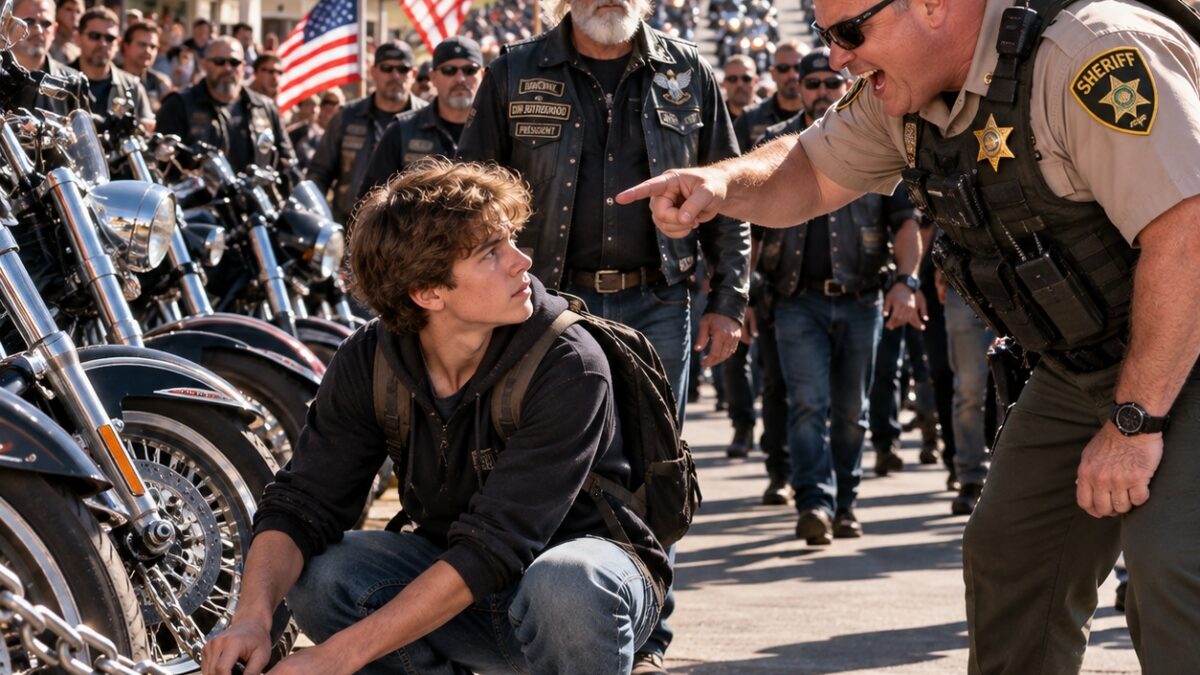
Sheriff Ror stepped closer.
The sun flashed off the badge on his chest.
His hand rested loosely near his belt.
Not threatening exactly.
But visible.
Everything about him communicated the same thing.
I have authority.
Everything about me communicated the opposite.
Worn sneakers.
Diner shirt.
Backpack.
Sixteen.
No title.
No badge.
No adult standing beside me.
“Where’d you get the key?” he asked.
“Mr. Lawson.”
“You think you’re in charge of something?”
“No, sir.”
“Then step away.”
I stood slowly.
The loose section of chain rested near my feet.
“I was told to finish.”
“I’ll handle it.”
His voice was not loud.
It did not need to be.
The small crowd near Rusty’s entrance had become larger.
People knew when something interesting was happening.
A sheriff.
A teenager.
Motorcycles.
That was enough.
Someone took out a phone.
I could feel people watching.
That familiar hot pressure behind the face.
Humiliation.
I hated it.
Not because the sheriff was stopping me.
Because he was enjoying it.
There is a difference.
He looked at the crowd after each joke.
He wanted reaction.
I was part of a performance I had never agreed to join.
“Mr. Lawson said the riders are coming,” I said.
Ror snorted.
“Riders.”
He stretched the word out.
“That so?”
“Yes, sir.”
“Since when does Rusty start taking orders from kids?”
An uneasy laugh came from somewhere behind him.
I did not answer.
I bent down again.
The sheriff moved between me and the next motorcycle.
“I said step away.”
I stopped.
Straightened.
Looked at him.
Not disrespectfully.
Not defiantly.
Just looked.
For one second, I thought about my father’s gloves inside the backpack.
Dad had worn them during rides across twelve states.
Charity runs.
Funeral escorts.
Storm recovery.
Once, after a tornado, the Iron Brotherhood rode supplies into a town where trucks could barely get through because roads were blocked.
I remembered being nine years old and asking why he kept leaving on weekends when he could stay home.
He sat on the garage floor beside me.
“Because if you can help and you don’t, you’ve made a choice too.”
That was Dad.
Service before image.
I could almost hear him.
You don’t need to win this moment.
So I lowered my eyes.
“Yes, sir.”
Sheriff Ror smiled.
He thought I had surrendered.
Then the ground moved.
Not dramatically at first.
A vibration.
Tiny.
Almost nothing.
The kind you feel in your soles before your ears understand.
A glass inside the diner rattled.
Someone turned toward the highway.
Then another.
A fork scraped across a plate behind the window.
Sheriff Ror heard it too.
He looked past me.
“Hear that?”
The vibration deepened.
A low sound rolled across the hills.
Not thunder.
Engines.
A lot of them.
Conversation around us faded.
The sheriff’s smile returned.
“Looks like your friends are coming.”
He turned toward the crowd.
“Here comes the circus.”
Nobody laughed this time.
The sound kept growing.
One engine becomes noise.
Ten engines become presence.
Hundreds of engines become weather.
The rumble rolled through the valley.
Pressed against the diner windows.
Settled in my ribs.
I knew motorcycles.
I had grown up around rides.
I knew the difference between people showing off and people moving together.
This was formation.
Controlled.
Even.
Disciplined.
My hands began shaking.
Not from fear.
Recognition.
I reached into my backpack.
Sheriff Ror watched.
I pulled out the folded T-shirt.
Unwrapped it.
Dad’s gloves appeared in my hands.
For two years, they had lived mostly in darkness.
My room.
My backpack.
A drawer beside my bed.
I slid the first one onto my hand.
The leather felt stiff.
Then familiar.
Second glove.
I tightened each finger.
The sheriff’s expression changed.
Just slightly.
Maybe because I had stopped looking like a kid being embarrassed.
Maybe because something in the way I put those gloves on told him there was information he did not have.
The motorcycles came over the ridge.
First a few.
Then dozens.
Then more.
Chrome flashed in the afternoon sun.
American flags snapped above them.
Leather vests.
Patches.
Purple Hearts.
Military-unit numbers.
Fire departments.
Chapters from states I had only ever seen on maps.
They stretched down Main Street farther than I could see.
Harleys.
Cruisers.
Touring bikes.
Two by two.
No weaving.
No unnecessary revving.
Nobody racing.
The engines rolled together with the kind of rhythm Dad used to call “organized thunder.”
People poured out of businesses.
Store owners.
Diner customers.
Mechanics from across the road.
Phones raised.
Cars pulled over.
The sheriff stared.
His earlier joke about the circus suddenly sounded very small.
The first wave turned into Rusty’s lot.
Then another.
Then another.
They filled every planned space with precision.
Kickstands dropped.
One after another.
Engines shut off.
Thunder became ticking metal.
Cooling pipes.
Small mechanical sounds.
Hundreds of riders sat still.
Then removed helmets.
A silence fell that did not feel empty.
It felt occupied.
Sheriff Ror looked toward his department SUV.
One vehicle.
A sea of motorcycles around it.
But no one threatened him.
That is important.
Nobody moved toward him.
Nobody shouted.
Nobody challenged the badge.
They simply existed with enough discipline that his performance had nowhere to go.
A lead motorcycle rolled forward.
Stopped.
The rider removed his helmet.
Dark hair streaked gray.
Steady face.
Broad shoulders.
I knew him immediately.
Daniel Reyes.
National president of the Iron Brotherhood Riders.
Dad’s oldest friend in the club.
I had not seen Daniel since the funeral.
At the funeral, he barely spoke.
He had held me for a long time.
Then whispered:
“Your dad made us promise something.”
I had forgotten that sentence.
Or maybe grief had buried it.
Daniel swung off the motorcycle.
Sheriff Ror straightened.
Instinct.
Badge.
Authority.
He stepped half a foot forward.
Daniel walked past him.
Did not look at him.
Not dismissively.
He simply had another destination.
Me.
The crowd opened.
Daniel came closer.
His eyes dropped to Dad’s gloves on my hands.
Something moved in his face.
Pain.
Pride.
Memory.
He stopped several feet away.
For a moment, neither of us spoke.
I could hear hot engines ticking.
I remembered listening to the Mustang—no, not my story; that was another life. I remembered Dad’s motorcycle cooling in our driveway when I was a kid.
That ticking had once meant:
He is home.
Now two thousand engines were cooling around me.
Daniel removed his own gloves.
Slowly.
Held them in both hands.
Then extended them toward me.
His voice carried without shouting.
“We’ve been waiting for you, Chief.”
The word hit me harder than anything Sheriff Ror had said.
Chief.
I shook my head slightly.
Almost automatically.
“No.”
Daniel’s eyes held mine.
“Yes.”
Behind him, people shifted.
Whispers.
Confusion.
Sheriff Ror blinked.
I looked down at Dad’s gloves.
Then back at Daniel.
“My dad was Chief.”
Daniel came one step closer.
“Your father was Marcus Carter.”
His voice softened.
“He was my brother.”
My throat tightened.
Daniel continued.
“Two years ago, before that last ride, your dad made me promise something.”
I could barely breathe.
“He said when his boy turned sixteen, we were going to ride together.”
My eyes burned.
“Not in mourning.”
Pause.
“In honor.”
The world blurred around the edges.
I remembered my father’s last morning.
He had stood in the kitchen drinking coffee.
Riding vest over his arm.
I was fourteen.
Too old to hug him automatically.
Too young to understand I would regret that.
He had tapped my shoulder.
“Next big ride, you’re coming.”
I had laughed.
“Mom—Grandma will kill you.”
“She can catch me first.”
He grinned.
I did not know that was goodbye.
Daniel’s voice brought me back.
“Your father did not ask us to hand you authority.”
He turned so the riders and townspeople could hear.
“He asked us to recognize legacy.”
Then he looked at me again.
“He said leadership is not about who makes the most noise.”
Several people glanced toward Sheriff Ror.
Daniel did not.
“It’s about service.”
He gestured toward the steel chains on the pavement.
“These were security chains.”
He looked around the lot.
“But today they mean something else.”
My chest hurt.
“Your father spent his life unlocking doors for people.”
Veterans who needed medical ramps.
Families who had lost homes.
Widows who needed someone at a funeral.
Communities after storms.
Daniel pointed toward the chain I had been working on when the sheriff stopped me.
“Today, his son unlocked the chains.”
He faced me.
“We rode every mile here for this moment.”
I looked past him.
Riders filled the parking lot.
Beyond it.
Main Street.
An ocean of faces.
Dad had known some of them.
Helped some.
Ridden beside some.
Two years after his death, they had come.
For me.
No.
Not only for me.
For what he had left unfinished.
Daniel turned toward the riders.
He did not give a command.
He did not need to.
Helmets began coming off.
One after another.
Hundreds.
Then more.
Weathered faces.
Young faces.
Women.
Old men.
Veterans.
Firefighters.
People who had ridden hundreds of miles.
Eventually, nearly two thousand faces were visible.
Then right hands rose.
Not fists.
Not salutes to a ruler.
A gesture of respect.
And one word moved across the lot.
“Chief.”
Deep.
Unified.
“Chief.”
My vision disappeared behind tears.
I hated crying in front of people.
Dad had cried openly.
He used to tell me only insecure men fear tears.
Still, sixteen-year-old boys are built partly from insecurity.
I tried to hold it.
Failed.
The first tear moved down my face.
Then another.
Daniel stepped closer.
Put one hand on my shoulder.
“You don’t have to be him.”
That sentence saved me.
I looked at him.
“What?”
“You don’t have to become Marcus.”
His hand squeezed.
“You only have to become Jaylen.”
I lowered my head.
For two years, everyone had spoken about Dad like he was a mountain.
Founder.
Chief.
Leader.
Legend.
They meant well.
But legends cast long shadows.
I had spent two years wondering how I was supposed to grow inside his.
Daniel seemed to understand.
“Your father didn’t want a copy.”
He smiled through wet eyes.
“He already liked you.”
I laughed once.
Broken.
Small.
Daniel looked at Dad’s gloves.
“He’d be proud you kept those.”
I whispered:
“I take them everywhere.”
“I know.”
That startled me.
“How?”
“Your grandmother told me.”
Of course.
Grandma.
The woman who pretended not to know half of what I did while knowing everything.
I looked toward the diner.
There she was.
Standing near the doorway.
One hand pressed against her mouth.
Crying.
I had not seen her arrive.
Maybe Mr. Lawson had called.
Maybe she had known the entire plan.
Later I discovered she had.
She had helped Daniel pick the date.
Helped preserve the promise.
Had watched me carry Dad’s gloves for two years without telling me why the Brotherhood kept calling every birthday.
I wanted to be angry with her.
Could not.
She looked older than she had that morning.
Or maybe seeing her cry made me notice her age.
Dad had been her son.
I had not been the only one waiting.
Behind Daniel, Sheriff Ror remained motionless.
The badge on his chest had not changed.
But its meaning had.
Twenty minutes earlier, it had controlled the parking lot.
Now it was one symbol among thousands.
And authority based only on being the loudest person in the space had lost its advantage.
He cleared his throat.
Nobody reacted.
He adjusted his hat.
“Well…”
His voice was thinner.
“Nobody told me all that.”
Daniel looked toward him for the first time.
No hostility.
That mattered.
Dad would have hated a mob.
Daniel simply looked.
“I didn’t know,” Ror said.
Daniel answered quietly.
“Respect doesn’t require knowing somebody’s title.”
The sheriff’s face changed.
“It just requires giving it.”
No cheering.
No applause.
That made the words heavier.
A few townsmen who had laughed earlier stared at the pavement.
One rubbed the back of his neck.
Another slid his phone into his pocket.
Nobody stepped forward to rescue Ror from embarrassment.
But nobody attacked him either.
He had to stand inside the moment.
Sometimes that is consequence enough.
Daniel turned back to me.
“Ready?”
“For what?”
He smiled.
“The ride.”
My stomach dropped.
“I don’t have a bike.”
“Your father planned ahead.”
Of course he did.
Daniel pointed toward a motorcycle being rolled forward.
Black.
Chrome.
Not Dad’s original bike.
That had been badly damaged in the crash.
This one had been built using parts and design elements from one of the models Dad loved.
Across the tank was the Iron Brotherhood insignia.
Below it:
MARCUS “CHIEF” CARTER MEMORIAL RIDE
I could not move.
Daniel said:
“You’ll ride at the front with me.”
“No.”
“Yes.”
“I can’t lead two thousand people.”
“You’re not.”
I stared.
“You’re honoring your father.”
That was different.
Still terrifying.
“I’ve ridden, but—”
“I know what you can do.”
“How?”
Again that small smile.
“Your grandmother talks.”
I looked toward Grandma.
She gave me a look that clearly said she had no regrets.
I laughed through tears.
Then something pulled my attention back.
The chain.
One thick steel length still lay twisted near Sheriff Ror’s boots.
Everyone was beginning to prepare for the ride.
Helmets.
Gloves.
Engines soon.
The sheriff stood apart.
For one second, anger returned.
I could have ignored him.
Maybe that would have been fair.
He had mocked me.
Used me for a joke.
Made the crowd laugh.
I had every reason to enjoy his humiliation.
Then Dad’s voice returned.
Not literally.
Memory.
A man should never need to make somebody smaller just to feel his own size.
If I turned the sheriff into the new target, what had I learned?
Nothing.
I walked toward him.
Daniel watched but did not stop me.
The sheriff saw me coming.
His posture stiffened.
He probably expected something.
A speech.
An insult.
A public victory line.
I stopped several feet away.
“Sir.”
He looked at me.
Up close, he seemed older.
Not weaker.
Human.
“My dad used to tell me respect goes both ways.”
The sheriff swallowed.
The crowd was quiet enough that some people heard.
I did not say it loudly.
Did not need to.
After a moment, Ror nodded.
“I reckon he was right.”
His eyes moved toward the chain.
So did mine.
I bent down.
Picked up one end.
Heavy.
The sheriff hesitated.
Then bent and took the other.
Together, we carried it out of the way.
That was all.
No apology speech.
No cheering.
No miracle transformation.
Just a sheriff and a kid carrying a chain.
But I felt something change.
In him?
Maybe.
In me?
Definitely.
I had spent two years carrying my father’s absence like a chain.
Different kind.
Invisible.
Still heavy.
That afternoon, for the first time, I understood carrying something does not always mean being trapped by it.
Sometimes you carry it somewhere better.
We set the chain beside the diner wall.
Ror straightened.
He looked at Dad’s gloves.
Then at me.
“Those his?”
“Yes, sir.”
He nodded.
“Good gloves.”
I almost smiled.
“They are.”
The first engines started.
One.
Then another.
Thunder rebuilt itself around us.
Not chaos.
Purpose.
Daniel motioned toward the front motorcycle.
I walked over.
My hands suddenly felt too big inside Dad’s gloves.
Or too small.
I swung onto the seat.
The machine shifted beneath my weight.
Familiar but not familiar.
Daniel sat on his motorcycle beside me.
“You nervous?”
“Yes.”
“Good.”
“What?”
“Means you understand responsibility.”
That sounded like Dad.
I told him.
Daniel smiled.
“Where do you think I learned it?”
We pulled out of Rusty’s lot two by two.
I rode at the front beside Daniel.
I did not rev the engine for attention.
Did not wave like I was famous.
I was barely remembering how to breathe.
Main Street had filled.
People stood along sidewalks.
Store owners.
Families.
Veterans.
Children sitting on shoulders.
Some of the same people who had watched Sheriff Ror make jokes twenty minutes earlier.
Their faces were different now.
Not afraid.
Not impressed by spectacle.
Respectful.
Mr. Lawson stood outside the diner wiping his eyes with the back of one hand.
Grandma stood beside him.
When I passed, she touched two fingers to her lips and raised them toward me.
Dad’s old goodbye gesture.
I almost lost it again.
Daniel noticed.
“Eyes forward, Chief.”
I laughed.
“Yes, sir.”
A veteran along the sidewalk removed his cap.
Held it over his heart.
Then another.
American flags moved above us.
The afternoon sun struck chrome until it looked like fire.
Two thousand engines rolled through a town that had once treated bikers as trouble before they even parked.
But nobody behaved badly.
No wheelies.
No shouting.
No engines intentionally screaming beside children.
Order.
That was the Brotherhood.
Dad had been obsessive about that.
“If you say you stand for service, ride like people are watching.”
Apparently people had remembered.
The route took us out past town.
Toward the open highway.
The same kind of road where Dad died.
My chest tightened when we reached it.
Daniel slowed slightly beside me.
“You okay?”
I nodded.
Lie.
He knew.
We rode anyway.
Wind pressed against my jacket.
Dad’s gloves held the grips.
For the first time in two years, I understood why he had loved riding.
Not speed.
Not noise.
Space.
There is something about an open road that tells your body the world is larger than whatever hurt you.
The landscape moved.
Fields.
Fences.
Hills.
Sky.
For two years, Dad’s death had felt like the edge of everything.
That afternoon, the road continued beyond it.
The memorial destination was a veterans’ cemetery outside the county.
When we arrived, engines shut down.
Again that enormous silence.
Daniel led me toward a marker.
Not Dad’s grave.
He was buried closer to home.
This marker belonged to the veteran whose memorial ride Dad had been leading when he died.
I had never visited.
That fact made me ashamed.
Daniel seemed to sense it.
“Your dad didn’t die because of this man.”
I looked at him.
“The driver crossed the line.”
I knew.
Still.
Grief does not care about logic.
Daniel knelt.
Placed a small Iron Brotherhood pin at the marker.
Then said:
“Your dad wanted this ride finished.”
My throat closed.
“This is what today is?”
“Part of it.”
Two years.
The ride Dad never completed.
Now thousands of riders had returned to finish it.
With me.
I knelt beside Daniel.
Touched the grass.
Dad’s gloves against the ground.
I whispered:
“We made it.”
Wind moved through trees.
No sign.
No voice.
Nothing supernatural.
I did not need it.
The riders behind us were evidence enough.
We made it.
At the ceremony, Daniel spoke about the fallen veteran.
Not my father first.
That mattered.
Dad would have wanted the purpose remembered before him.
They raised money for the veteran’s family.
Presented a scholarship check.
Announced home repairs for another wounded service member.
Service.
Again.
The Brotherhood did not exist to create dramatic entrances for teenage boys.
The dramatic entrance had meaning only because of what these people did on ordinary days nobody filmed.
I began understanding the word legacy differently.
Legacy was not people calling me Chief.
It was an obligation.
Dad’s name opened doors.
What would I do once they opened?
That thought scared me more than the ride.
Later, away from the crowd, I asked Daniel:
“Do they really expect me to lead someday?”
“No.”
The answer came immediately.
I blinked.
“No?”
“You’re sixteen.”
I felt ridiculous.
Daniel laughed.
“You finish school.”
“Okay.”
“You help your grandmother.”
“Okay.”
“You become whoever you’re supposed to become.”
I looked toward the riders.
“What about Chief?”
Daniel’s expression softened.
“That was respect.”
“So I’m not—”
“You’re Marcus Carter’s son.”
Then:
“And Jaylen Carter.”
He put emphasis on my name.
“If one day people follow you, make sure it’s because you gave them a reason.”
That was Dad too.
I asked Daniel what promise my father had actually made him swear to.
Daniel sat on a bench.
I joined him.
“He knew you were fascinated by the club.”
“I was fourteen.”
“He knew.”
“He never let me ride with the big groups.”
“He was protecting you.”
“I know.”
Daniel looked toward the cemetery.
“The week before the accident, he told me he worried you thought leadership meant being him.”
I swallowed.
“He said that?”
“He said you watched him too closely.”
I looked down at the gloves.
“He told me, ‘When Jaylen turns sixteen, bring the brothers together. Not to crown him. To show him he has family.’”
Family.
That was what the ride was.
Not succession.
Not a throne.
Family.
My eyes burned again.
Daniel continued.
“He was scared you’d feel alone after he was gone.”
My breath caught.
“Did he know he was going to die?”
“No.”
He answered firmly.
“No, Jaylen.”
Then softer:
“Your dad worried because good fathers worry.”
I nodded.
“He made me promise if anything ever happened, we wouldn’t disappear.”
I looked at the sea of motorcycles.
Two thousand.
“You didn’t.”
“No.”
That might have been the moment that mattered more than the parking lot.
For two years, I had thought Dad’s club belonged to the part of life that vanished with him.
I saw riders sometimes.
Messages arrived for Grandma.
Cards.
Donations.
But grief had made me keep distance.
Too painful.
Every vest looked like Dad.
Every engine sounded wrong because his was missing.
That afternoon, I understood the Brotherhood had not disappeared.
I had.
They had waited until I was ready to see them again.
The ride returned through town before sunset.
This time I did not feel like an impostor at the front.
Still nervous.
But different.
People lined Main Street again.
The sheriff’s SUV was parked near Rusty’s.
Sheriff Ror stood beside it.
No hat this time.
When I approached, he stepped forward.
I slowed.
He raised one hand.
Not a command.
A simple wave.
I returned it.
Then rode on.
Nothing more.
I appreciated that.
Real change is rarely one giant apology.
Sometimes it begins with a person behaving differently once.
Then again.
Weeks later, Ror came into Rusty’s.
I was clearing a table.
He ordered coffee.
Sat at the counter.
I expected nothing.
When I passed, he said:
“Jaylen.”
I stopped.
“Yes, sir?”
He looked uncomfortable.
Good.
Apologies should cost something.
“I was out of line.”
I waited.
He continued.
“Didn’t know you.”
I almost repeated Daniel’s line.
Respect should not require a title.
But this was his apology, not my opportunity for a speech.
So I said:
“Thank you.”
He nodded.
Then:
“Your dad and I didn’t always see eye to eye.”
“I know.”
“He did good work.”
“I know.”
Another nod.
That was it.
No friendship montage.
No sudden transformation.
But after that, Sheriff Ror’s traffic stops involving riders became noticeably more professional.
People noticed.
He still enforced laws.
Good.
Dad never wanted special treatment.
He wanted equal treatment.
There is a difference.
If someone sped, ticket them.
If somebody rode drunk, arrest them.
But do not decide they are criminals because they wear leather.
Do not decide a sixteen-year-old is a thief because he is unlocking a motorcycle.
That was the lesson.
Not:
Respect powerful people.
Exactly the opposite.
Respect people before you learn they have powerful connections.
The town changed slowly too.
The video from Rusty’s spread.
Of course it did.
Phones had captured the arrival.
Daniel’s speech.
The salute.
Clips went everywhere.
People shared the moment where two thousand riders called me Chief.
That part embarrassed me.
At school, kids I barely knew started asking questions.
“Are you like a biker king now?”
“No.”
“Do you own two thousand motorcycles?”
“Obviously.”
Sarcasm helped.
Some teachers treated me differently.
I disliked that most.
I was the same kid who had walked into school the week before.
Dad had been the same man before people knew what the Iron Brotherhood did.
Titles change perception too quickly.
I began seeing that everywhere.
A janitor people ignored.
A quiet girl nobody invited anywhere.
The kid working nights at his uncle’s store.
We build entire stories about people from scraps.
Sheriff Ror had done it to me publicly.
I had done it to others silently.
That realization hurt.
It also changed me.
One afternoon at Rusty’s, a man came in wearing filthy work clothes.
Mud.
Oil.
A couple customers wrinkled their noses.
He ordered coffee.
I brought it.
Started talking.
Turned out he spent the previous week repairing power lines after a storm two counties over.
Worked sixteen-hour shifts.
Dirty because he had come directly home.
I thought about the sheriff.
Appearances.
Again.
Dad used to say character shows up when nobody knows who you are.
That became the standard I tried to use.
Not always successfully.
I was sixteen.
Still stupid in many creative ways.
But trying.
Daniel kept the Brotherhood present without overwhelming me.
He called once every week or two.
Asked about school first.
Always.
“How are grades?”
“Why does every adult ask that?”
“Because teenagers hate it.”
Then he asked Grandma.
Then work.
Only then riding.
He never treated me like an instant leader.
That protected me from the worst part of the viral attention.
People wanted symbolism.
The son inherits the father’s club.
Beautiful story.
Not true.
Leadership cannot be inherited like a motorcycle.
Dad had earned trust over decades.
I had inherited his gloves.
That was all.
Everything else would have to be mine.
The Brotherhood invited me to volunteer.
Not command.
Perfect.
First project was rebuilding a wheelchair ramp for a Marine who had lost mobility.
I arrived expecting motorcycles and speeches.
Instead:
Tape measures.
Circular saws.
Concrete.
Sweat.
Daniel handed me a broom.
“A broom?”
“You’re sixteen.”
“I helped build ramps with Dad.”
“Great.”
He pointed at sawdust.
“Build this pile into the trash can.”
I hated him.
Also understood.
Legacy begins with sweeping.
By the end of the day, I had done more.
Cut lumber.
Held posts.
Checked level.
The Marine’s wife cried when he rolled onto the finished ramp.
No cameras.
No giant crowd.
That moment taught me more about Dad than the two-thousand-rider salute.
This was what Chief meant.
Not being first in a procession.
Making somebody else’s life easier.
Dad’s gloves became work gloves sometimes.
At first, I was afraid to damage them.
Then Daniel said:
“Your father wore those.”
“I know.”
“You think he’d want them in a museum?”
I looked at the scarred leather.
No.
Dad used everything.
Tools were supposed to work.
So I wore them.
Carefully.
They got another scratch.
I almost panicked.
Then smiled.
Something about that felt right.
Not preserving Dad untouched.
Continuing.
Grandma noticed.
She took my hand one evening.
Looked at the gloves.
“New mark.”
“Sorry.”
“Why?”
“They were Dad’s.”
“They still are.”
She looked at me.
“And they’re yours.”
That was grief again.
The strange mathematics of inheritance.
Something can belong to the dead and the living at the same time.
Years would pass before I fully understood that.
At sixteen, I just cried in the kitchen and pretended allergies caused it.
Grandma pretended to believe me.
The first anniversary after the memorial ride felt different.
Dad had already been gone two years before the ride.
But somehow that ride reopened grief, then rearranged it.
We visited his grave.
Just Grandma and me.
No motorcycles.
No Brotherhood.
I brought the gloves.
Sat.
Told him about school.
Rusty’s.
The ramp.
Sheriff Ror’s apology.
I felt ridiculous talking to stone.
Kept talking.
“Everyone called me Chief.”
Wind moved grass.
“I don’t think I’m ready for that.”
Nothing.
“Daniel said I don’t have to be you.”
That sentence still mattered.
I placed one glove on the marker for a minute.
Then picked it back up.
“I’m going to keep these.”
That was the closest I came to a promise.
I would keep the gloves.
Keep the lessons.
Not try to become him.
There is a difference between honoring someone and disappearing inside their memory.
I had spent two years close to disappearing.
The ride pulled me back.
School ended.
I kept working at Rusty’s.
Mr. Lawson never admitted how much he had known that afternoon.
I cornered him once.
“You knew?”
“Knew what?”
“The ride.”
“I know people eat lunch here.”
“Mr. Lawson.”
He wiped the counter.
“Your grandmother can be persuasive.”
“You let the sheriff humiliate me.”
His hands stopped.
That was the first time I had said it directly.
He looked at me.
“I didn’t hear the first part.”
I believed him.
“The second I did, Daniel was already coming over the ridge.”
I nodded.
Then he said:
“I’m sorry.”
That mattered.
People often avoid apologies because they think admitting they missed something makes them responsible for everything.
It does not.
Mr. Lawson had not created Sheriff Ror’s behavior.
But he could regret not stepping outside sooner.
I appreciated honesty more than excuses.
The men who laughed were harder.
Some avoided me afterward.
One came in a week later.
Left twenty dollars tip on a four-dollar breakfast.
Too much.
I followed him.
“You forgot this.”
“No.”
“Yes.”
He looked uncomfortable.
“Keep it.”
“Why?”
He opened his mouth.
Closed it.
I understood.
“No.”
I put the money into his hand.
“You don’t owe me money.”
He looked at the pavement.
“I shouldn’t have laughed.”
“No.”
“I’m sorry.”
“Okay.”
That was better than twenty dollars.
Accountability should not become payment when the real thing needed is changed behavior.
I saw him later defend an out-of-town rider when somebody called him a gang member.
Maybe something stuck.
Maybe that was enough.
Sheriff Ror became part of the town differently after that too.
Still sheriff.
Still loud sometimes.
People do not become new humans overnight.
But he stopped using bikers as an easy joke.
At a town council meeting, somebody complained that the annual Iron Brotherhood ride brought “undesirables.”
Ror spoke.
I heard about it later.
“They follow traffic law better than half this town.”
That made me laugh.
Then he apparently added:
“Judge conduct, not leather.”
Daniel called me immediately.
“Your sheriff is stealing my material.”
“Send him an invoice.”
We laughed.
That was how healing looked.
Not everyone becoming friends.
People correcting course.
The Iron Brotherhood created an annual Marcus Carter Service Day.
I begged them not to.
Daniel ignored me.
Naturally.
But it was not a parade.
Service projects.
Roof repairs.
Veteran transportation.
Food deliveries.
Storm cleanup.
I loved that.
Dad’s name attached to work.
Not mythology.
The first year, we repaired three homes.
One belonged to a Vietnam veteran named Harold who had lived alone since his wife died.
His porch steps were rotten.
Roof flashing leaking.
He kept apologizing.
“I could’ve done this ten years ago.”
Daniel answered:
“Ten years ago is busy.”
Harold laughed.
Then cried when two hundred riders showed up with lumber.
I watched.
Dad would have loved it.
At lunch, Daniel handed me a sandwich.
“You understand now?”
“Chief?”
“Legacy.”
I looked around.
People sweating.
Laughing.
Working.
“Yes.”
Legacy was not a position.
It was a habit other people continued after you were gone.
That changed everything.
I stopped worrying whether I could “live up” to Dad.
I could not become his history.
I could contribute to what he started.
Smaller task.
More honest.
By the time I graduated high school, I knew I wanted to study engineering.
Not because Dad had.
He was not an engineer.
Because I liked fixing physical problems.
Ramps.
Structures.
Machines.
I applied to college.
The Iron Brotherhood offered to pay everything.
I refused.
Daniel got angry.
Grandma got angrier.
Eventually we compromised.
They funded one scholarship in Dad’s name.
I accepted because Daniel said:
“Pride becomes selfish when it prevents people from honoring someone they loved.”
I hated when he sounded wise.
The scholarship required service hours.
That was my addition.
Money should keep moving.
College took me away from town.
That was hard.
The first time I drove past Rusty’s with boxes in my car, I saw the parking lot.
The place where the chain had been.
Where the sheriff laughed.
Where two thousand riders called me Chief.
It looked ordinary.
A few cars.
A delivery truck.
Nothing sacred.
Places rarely know what they contain for us.
I stopped.
Went inside.
Mr. Lawson gave me coffee even though I did not drink much coffee.
“You nervous?”
“No.”
“You’re a terrible liar.”
“Yes.”
He smiled.
“Your dad would be proud.”
People said that all the time.
Usually it comforted me.
That day I asked:
“What if I screw up?”
Mr. Lawson wiped the counter.
“Then he’d still be your dad.”
Simple.
Needed.
I left town.
At college, almost nobody knew the story.
That was wonderful.
I became Jaylen.
Not Chief’s son.
Not the kid from the biker video.
Just another student struggling with calculus and living on bad cafeteria food.
I did not tell people about the Brotherhood until someone noticed the gloves.
I had them on my desk.
My roommate asked:
“Those vintage?”
“My dad’s.”
“Cool.”
That was it.
No legend.
I loved that.
It gave me space to become someone outside grief.
Still, every summer I returned.
Rusty’s.
Grandma.
Service Day.
The ride.
Sheriff Ror eventually retired.
At his retirement reception, he invited me.
I almost did not go.
Then remembered the chain.
We had carried it together.
I went.
He looked older.
Gray.
Less rigid.
He found me after the speeches.
“College treating you all right?”
“Mostly.”
He nodded.
Then said:
“I’ve thought about that day.”
“Me too.”
“I was a damn fool.”
I smiled.
“That was more direct than your first apology.”
“Retirement.”
He grinned.
“Less paperwork.”
Then his face became serious.
“I used to think respect came with the badge.”
I waited.
“It doesn’t.”
“No, sir.”
He looked at me.
“You still calling me sir?”
“You’re older than me.”
He laughed.
Then hugged me.
Awkward.
Unexpected.
I hugged him back.
Not because the humiliation had vanished.
Because it no longer owned either of us.
People can become more than the worst thing you watched them do.
Not everyone chooses to.
Ror did.
That matters.
Daniel stayed national president for several more years.
Then stepped down.
No drama.
No throne.
New leadership elected.
That was another lesson.
Organizations become dangerous when one person believes legacy means ownership.
Dad founded the Brotherhood.
Daniel led it.
Then someone else.
The mission continued.
That was healthy.
At Daniel’s final national gathering, he called me onto a stage.
I was twenty-three by then.
I hated stages as much as ever.
He held a familiar object.
Dad’s old chapter patch.
He gave it to me.
“I’ve kept this since the accident.”
My hands shook.
“Why now?”
“Because now you won’t confuse it with a crown.”
He knew me too well.
I took it.
Framed it later.
Dad’s gloves remained unframed.
Still used.
That distinction pleased me.
Some memories belong behind glass.
Some belong on your hands.
I finished school.
Became a civil engineer.
Worked on bridges and transportation projects.
The first time I supervised a team older than me, I almost laughed at the irony.
Authority.
Again.
I remembered Sheriff Ror.
Badge against backpack.
I made a rule for myself.
Never embarrass someone publicly when correction can happen privately.
Not always possible.
Sometimes safety requires immediate intervention.
But humiliation should never become management.
I failed occasionally.
Of course.
I once snapped at a junior engineer in front of contractors.
Saw his face.
Immediately remembered the parking lot.
Afterward, I apologized.
Publicly.
Because the mistake had been public.
That cost pride.
Good.
Leadership should cost pride occasionally.
Dad would have approved.
The Iron Brotherhood kept calling me Chief sometimes.
Mostly older riders.
I stopped correcting them.
Not because I believed I was Dad’s replacement.
Because I learned the word meant different things from different people.
From them, it meant:
Family.
History.
Trust.
Not rank.
I eventually became involved in the Brotherhood’s national service committee.
Not president.
Never wanted it.
I liked projects.
Disaster recovery.
Accessible housing.
Veteran transportation.
Work with clear outcomes.
A ramp either functions or it does not.
A roof leaks or it does not.
Human leadership is messier.
Still, Daniel would tease:
“You’re leading anyway.”
“I’m organizing.”
“That’s leadership.”
“Stop.”
He laughed.
Grandma lived long enough to see most of it.
She kept Dad’s photograph on the mantle.
One from before I was born.
Leather vest.
Huge smile.
The older I got, the younger he looked in the picture.
That is one of the strangest parts of losing a parent young.
You keep aging.
They do not.
Eventually you approach the age they were when they died.
Then pass moments they never reached.
I once told Grandma that frightened me.
She said:
“Then live enough for both of you.”
No pressure.
Thanks, Grandma.
But I understood.
Not literally.
I did not owe Dad a second life.
I owed my own life attention.
That was all.
When Grandma died, years later, the Brotherhood showed up again.
Not two thousand.
Enough.
Daniel sat beside me.
No speeches about legacy.
He handed me coffee.
We watched riders escort her funeral procession.
At the cemetery, I wore Dad’s gloves.
Afterward, I went back to the small white house.
Porch still sagging slightly on one side.
Wind chimes.
The house quieter than it had ever been.
I sat on the steps.
For a moment, I was sixteen again.
Backpack.
Rusty’s.
Sheriff.
Then I realized something.
I was not alone.
Cars lined the street.
Friends.
Riders.
Coworkers.
Family.
Dad’s fear had never come true.
He had worried I would be left alone if something happened.
I had not been.
Because he had spent years building relationships based on service.
That was his real inheritance.
Not the club.
People.
That is what lasts.
Years after the Rusty’s incident, a young rider asked me whether the story had happened exactly like the videos said.
“Mostly.”
“Two thousand riders?”
“About that.”
“He really called you Chief?”
“Yes.”
“What did that feel like?”
I thought.
“Too heavy.”
He looked disappointed.
He wanted something cinematic.
I continued.
“Then lighter.”
“What do you mean?”
“The first time, I thought the word meant I had to become my father.”
“And later?”
“I learned it meant I didn’t have to forget him.”
That was the truth.
Memory can be carried without becoming an assignment.
The gloves had taught me.
The ride had taught me.
Even Sheriff Ror had taught me, unintentionally.
He taught me what authority looks like when it needs an audience.
Dad taught me what authority looks like when it does not.
Daniel taught me recognition without entitlement.
Grandma taught me endurance.
Rusty’s taught me humility.
Two thousand engines taught me that quiet people can have enormous communities behind them even when nobody else sees them.
That last lesson stayed with me most.
You never know who someone is connected to.
But more importantly:
They should not need powerful connections before you treat them with dignity.
That distinction became almost an obsession for me.
People tell the story and say:
“The sheriff learned Jaylen was important.”
No.
That is the shallow version.
I was important before the motorcycles arrived.
Every kid is.
Every waitress.
Every mechanic.
Every person crouched beside a tire.
My father’s reputation should not have been the reason I deserved respect.
Daniel understood that.
“Respect doesn’t require knowing someone’s title.”
Exactly.
If the lesson is:
Be careful whom you mock because they might secretly be powerful,
then we learned nothing.
The lesson is:
Do not mock people.
That is enough.
The last time I visited Rusty’s before Mr. Lawson sold the diner, we stood in the parking lot.
He had repaved it.
No cracks.
No visible spot where the chains had once rested.
I told him I was sad.
He looked confused.
“About asphalt?”
“The old marks are gone.”
He laughed.
“Jaylen, we sell burgers.”
“I know.”
Then he pointed toward Main Street.
“You remember without the cracks.”
He was right.
Places do not need scars for memory to remain.
I had spent years thinking objects preserved people.
Gloves.
Patches.
Parking lots.
Dad’s motorcycle parts.
They help.
But memory eventually moves inside.
The gloves could disappear tomorrow.
Dad would still exist in how I treated people.
That is the strongest preservation.
Behavior.
I took one final walk around the lot.
Near where Sheriff Ror had stood, I could almost see him.
Hat.
Badge.
Smirk.
Near the motorcycles, sixteen-year-old me.
Worn shoes.
Backpack.
Trying not to cry.
Then thunder over the ridge.
I smiled.
Mr. Lawson came beside me.
“What?”
“Nothing.”
“Liar.”
“I was just thinking.”
“Dangerous.”
We stood quietly.
I asked:
“Do you still have the old chain?”
He looked surprised.
Then walked into the storage shed.
Came back carrying a rusted length.
Same chain.
Or at least part of it.
Heavy.
I touched the steel.
Memory hit instantly.
My teenage hands.
Sheriff Ror at the other end.
Together.
I laughed.
“You kept this?”
“Thought somebody might want it.”
I considered taking it.
Then shook my head.
“No.”
“You sure?”
“Yes.”
He looked at the chain.
“What should I do with it?”
“Use it.”
“For what?”
“I don’t know.”
He laughed.
A year later, he sent me a photo.
The old chain had become part of a hanging sign outside the diner under new ownership.
Nothing dramatic.
Just hardware.
I liked that.
A chain does not have to remain a symbol forever.
Sometimes healing means an object becomes ordinary again.
I still participate in the annual memorial ride.
Not always at the front.
Most years I prefer the middle.
You can see more from there.
New riders.
Old riders.
Veterans.
Families.
People whose names I do not know.
Dad’s patch appears on some vests.
The organization has changed.
It should.
Anything alive changes.
On the twentieth anniversary of the Brotherhood, Daniel stood beside me while engines gathered.
He was gray now.
Completely.
“Remember Rusty’s?”
“Unfortunately.”
“You looked terrified.”
“I was.”
“You hid it.”
“No, everyone was distracted by two thousand motorcycles.”
He laughed.
Then looked serious.
“Marcus would be proud.”
I no longer flinched when people said that.
“I hope so.”
Daniel nudged my shoulder.
“You know what he’d be proudest of?”
“What?”
“You never became him.”
I looked at Daniel.
He smiled.
“You became you.”
That was the thing I had needed to hear at sixteen.
Maybe he had told me then.
Maybe understanding takes years.
Engines started.
I pulled Dad’s gloves on.
The leather had been repaired twice.
Still usable.
More scars now.
Some his.
Some mine.
That seemed right.
I rode.
Not because I was trying to preserve the day Sheriff Ror underestimated me.
Not because I needed people chanting Chief.
Because I loved the road.
The service.
The people.
Because something Dad began had become part of my life without becoming all of it.
That is legacy done correctly.
It gives you roots.
Not chains.
I think about that word often.
Chains.
The story began with literal chains around motorcycle tires.
Sheriff Ror thought I was a kid playing with something that did not belong to me.
Daniel turned them into a symbol of doors Dad had opened.
Then Ror and I carried one away together.
For years, people online wrote captions about “breaking chains.”
They made it dramatic.
Maybe too dramatic.
But the older I get, the more I appreciate the metaphor.
Grief can chain you to the last day.
Reputation can chain a child to a parent.
Authority can chain people to roles.
Humiliation can chain two people to one bad moment.
But chains can be moved.
Sometimes together.
That may be why the quietest part of that day remains my favorite.
Not two thousand hands rising.
Not Daniel calling me Chief.
Not Sheriff Ror realizing who my father was.
The chain.
Me lifting one end.
Ror taking the other.
No audience reaction.
No victory.
Two people correcting the physical mess in front of them.
That act contained the future.
He could change.
I could forgive without pretending the humiliation had not happened.
We could move the chain without becoming friends.
Grace does not require amnesia.
That is another lesson Dad never had time to teach me directly.
Life did.
Today, when somebody recognizes me from the old video, they usually ask:
“Was that really you?”
“Yes.”
“What happened to the sheriff?”
“He retired.”
“Did he get fired?”
“No.”
“Did the riders threaten him?”
“No.”
“Did he apologize?”
“Yes.”
They sometimes look disappointed.
People want punishment.
The internet loves a clean villain.
Real life gave me something better.
Correction.
A man was wrong.
Publicly.
Then he had the chance to become less wrong.
He took it.
That is more useful than destruction.
If Sheriff Ror had lost everything, maybe the story would feel more satisfying to strangers.
But the town would have learned less.
Instead, people watched authority apologize.
That matters.
The sheriff learned respect should come before status.
I learned not to use my father’s legacy as a weapon.
The town learned quiet people may carry stories nobody sees.
The Brotherhood finished a ride left incomplete.
And I learned that my father had built enough love into the world that even after he died, thousands of people still knew how to find his son.
That is the part that still breaks me.
Not the salute.
The promise.
“We won’t disappear.”
They did not.
My father did not leave me a fortune.
He did not leave me a business empire.
He left a small house with a sagging porch.
A pair of leather gloves.
A name people respected.
And a community built by years of showing up.
That was more than enough.
Sometimes I still take the gloves out even when I am not riding.
I sit.
Hold them.
The smell of engine oil is mostly gone now.
Leather changes.
Time takes everything eventually.
But I remember.
Dad’s hands.
His laugh.
The last morning.
The promise I never knew he made.
And the afternoon the pavement shook.
I remember Sheriff Ror laughing.
Then not laughing.
Daniel walking past him.
“We’ve been waiting for you, Chief.”
I remember thinking the entire world had just learned who I was.
I was wrong.
That day was the beginning of learning it myself.
I was not Marcus Carter.
I did not need to be.
I was Jaylen.
His son.
My own man.
A person who could carry the gloves without becoming trapped inside them.
A person who could inherit service without inheriting a title.
A person who could be humiliated and still choose grace.
That is who came out of Rusty’s parking lot that day.
Not a biker king.
Not a secret leader.
Just a sixteen-year-old who finally understood that quiet strength is still strength even before anybody hears the engines coming.
And if I could return to that parking lot now, before the first motorcycle appeared, I would kneel beside that kid in dusty sneakers and tell him one thing.
Do not raise your voice just because somebody else raises theirs.
You know why you are there.
You know who gave you the key.
You know what your father taught you.
Keep working.
Let the truth arrive at its own speed.
Sometimes truth comes as paperwork.
Sometimes as a witness.
Sometimes as an apology.
And sometimes, if your father spent his life loving people well enough, truth comes over a ridge on two thousand motorcycles.
The pavement starts to shake.
The laughter stops.
But by then, the important thing is not that everyone else finally sees your worth.
It is that you never surrendered it while they were laughing.

