PART2:The Groom’s Family Thought I Was the Help at My Daughter’s Wedding—Then Nine Rolls-Royces Pulled Up for Me
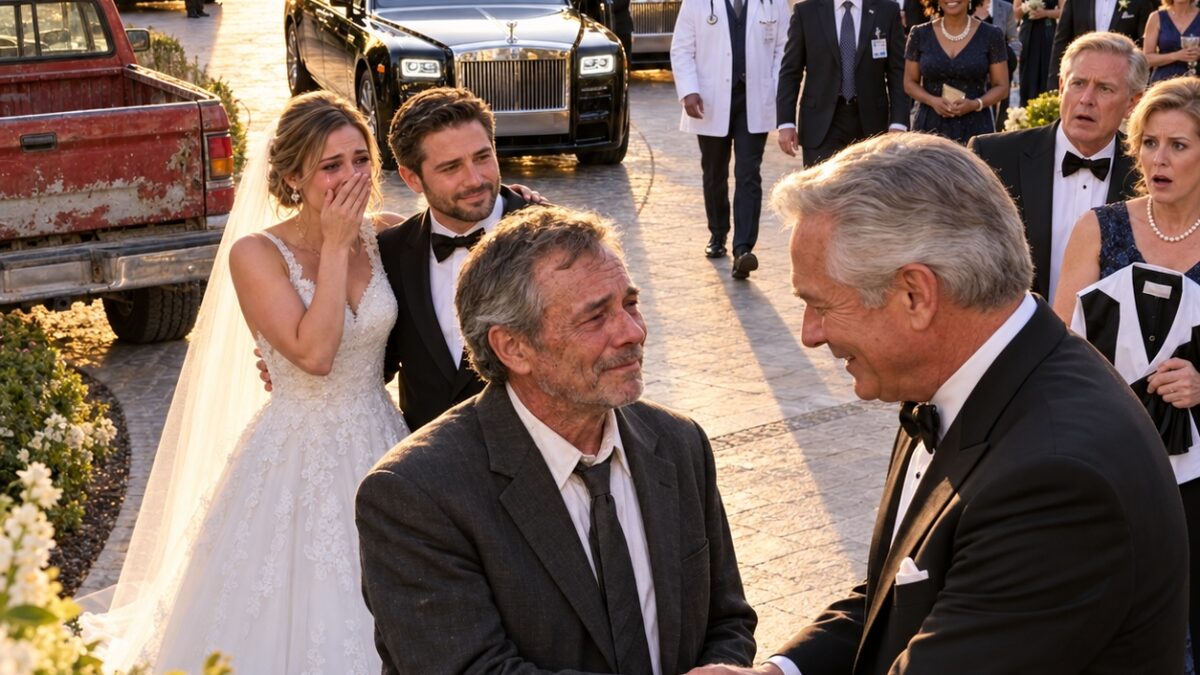
PART2
The rehearsal dinner was held at the same estate where the ceremony would take place the following afternoon.
Old stone building.
Marble staircase.
Gold chandeliers.
Enough crystal hanging from the ceiling to make a hardware store nervous.
The invitation called the dinner “intimate.”
There were nearly eighty people.
That is how wealthy families use language.
Everything becomes understated except the price.
I parked my truck near the end of the circular drive.
Nine or ten European cars were already there.
Mercedes.
Bentleys.
A Porsche.
Two Range Rovers.
My Ford looked like it had accidentally wandered in looking for a parts store.
I turned off the engine.
It ticked as it cooled.
For a second, I looked at the steering wheel.
Anna should have been beside me.
She had been gone six years by then.
Ovarian cancer.
Fourteen months from diagnosis to funeral.
The silver cufflinks I wore that night had been hers.
Not technically.
She bought them for me when the shop was barely surviving.
We could not afford a gift box, so she wrapped them in newspaper.
“Why cufflinks?” I asked.
“Because someday you’ll need to remember you own something that isn’t covered in grease.”
Then she smiled.
“And so you remember who you are.”
I wore them at her funeral.
And now at Claire’s wedding.
They were dull with age.
I could have polished them.
I did not.
I liked the years showing.
Inside the ballroom, Daniel’s mother, Eleanor Beaumont, stood near the champagne table.
Elegant woman.
Perfect posture.
Silver-blonde hair.
Pearls.
She had the ability to make a sentence sound polite while removing the kindness from every word.
I had met her several times before.
She had never been openly rude.
Until that weekend.
I had barely entered when I heard her voice behind me.
Low.
Sharp.
Meant for a woman beside her.
“I didn’t realize we were inviting the help.”
A small laugh.
Then another.
I knew she meant me before I turned.
The woman beside her pretended to study her champagne.
Eleanor saw that I had heard.
For a fraction of a second, embarrassment crossed her face.
Then it vanished.
She smiled.
“Thomas.”
“Eleanor.”
“So glad you made it.”
“I wouldn’t miss my daughter’s wedding.”
“Of course.”
Her eyes moved down my suit.
It was clean.
Navy.
Tailored years ago.
Still fit, mostly.
My shoulders were narrower than when Anna had bought it.
My hands were the problem.
No suit hides forty years of mechanics.
Knuckles thick.
Small scars.
Nails clean, but never elegant.
Eleanor’s gaze landed there.
Then returned to my face.
“Dinner should be lovely.”
“I’m sure.”
She walked away.
I did not confront her.
That will disappoint people who think dignity must be immediate and loud.
But I had learned something in forty years of business.
You do not answer every insult simply because somebody throws it at you.
Sometimes answering gives a foolish person more importance than the insult deserved.
Besides, the weekend belonged to Claire.
Not me.
I went inside.
My place card was near the back.
Beside the swinging kitchen doors.
I noticed immediately.
Of course I did.
At the head of the room sat Daniel’s parents.
Aunts.
Uncles.
Major donors.
Old family friends.
Claire sat near Daniel.
I sat close enough to the kitchen that every time a server came through the doors, warm air carrying garlic and butter hit the back of my neck.
I pulled out the chair.
Sat.
Said nothing.
A man across from me introduced himself as Peter Beaumont.
Daniel’s uncle.
Investment banking.
He asked:
“So, Thomas, what line are you in?”
“Automotive.”
He nodded.
“Dealership?”
“Service.”
His interest dropped.
“Ah.”
That one syllable said more than a speech.
A woman beside him asked whether I still worked.
“Every day.”
“Good for you.”
That phrase.
Good for you.
As if I had learned to dress myself.
I smiled.
Then the first course arrived.
Halfway through the salad, a young caterer touched my shoulder.
“Sir?”
I looked up.
“We’re fully staffed tonight, but if you check with the event manager, I’m sure they can find you a uniform.”
The table went silent.
The poor kid was maybe twenty.
He looked genuinely confused.
I said gently:
“I’m a guest.”
His face went crimson.
“Oh my God. I’m so sorry.”
“It’s fine.”
“I thought—”
“I know what you thought.”
He apologized again.
I saved him.
“Really. You’re fine.”
He escaped toward the kitchen.
Peter Beaumont pretended to inspect his wine.
The woman beside him suddenly became fascinated with her napkin.
Nobody said:
That was awful.
Nobody said:
Thomas is the bride’s father.
They simply waited for the awkwardness to pass.
That bothered me more than the mistake.
Later, I stood near the ballroom entrance.
Eleanor approached.
Thin smile.
“Thomas.”
“Yes?”
“Have you found the valet?”
I looked toward my Ford outside.
“No.”
She nodded sympathetically.
“These venues can be confusing.”
I met her eyes.
“I parked just fine.”
She blinked.
There was a pause.
Then:
“Oh.”
“Anything else?”
“No.”
She moved away.
Claire had seen it.
I knew because when I looked across the room, her jaw was tight.
She had Anna’s face when angry.
Exactly.
Same little muscle near the cheek.
The same eyes that somehow became brighter instead of darker.
I gave her a small shake of my head.
Not tonight.
She understood.
Did not like it.
Near the bar, Peter Beaumont was holding court with two relatives.
They thought I was far enough away.
“Claire’s a lovely girl.”
“She is.”
Peter glanced toward me.
“Well, at least love is blind.”
Laughter.
A few seconds.
Nothing more.
Claire heard that too.
She stood beside Daniel.
Her bouquet from rehearsal flowers in one hand.
The stem shook.
She looked at Daniel.
He leaned close.
I could not hear everything.
Only enough.
“Don’t start anything today.”
Then:
“Just ignore it.”
Claire stared at him.
That worried me.
Because disrespect toward me was one thing.
Watching the man she was about to marry ask her to swallow disrespect was another.
I waited.
Daniel touched her arm.
She pulled away slightly.
Then smiled for a guest.
Wedding weekends require acting.
Everyone becomes a performer.
After dessert, I went outside.
Needed air.
The ballroom had become too warm.
Too many conversations where people discussed “legacy” as if the word belonged exclusively to money.
The night was cool.
Clean.
My truck sat where I had left it.
I leaned against the hood.
Took out my phone.
Made one call.
“Ray?”
“Thomas.”
“You still have tomorrow afternoon clear?”
“Everything’s ready.”
“Nine?”
“Nine.”
“Good.”
“You sure?”
I looked toward the ballroom.
“Yeah.”
“Claire know?”
“No.”
Ray laughed softly.
“She’s going to kill you.”
“Probably.”
“Your usual truck?”
“Of course.”
“Of course.”
I ended the call.
The side door opened.
Claire.
She stepped out still holding herself together.
Barely.
“Dad.”
I smiled.
“Hey, baby.”
“Why?”
“What?”
“Why do you let them treat you like this?”
The question hit me harder than Eleanor’s words.
Claire’s eyes were wet.
“They talk about you like you don’t belong here.”
“I’m here.”
“That’s not what I mean.”
“I know.”
“They act like you’re less.”
I looked toward the dark lawn.
Then back at her.
She was thirty-two.
Successful.
Educated.
Strong.
And for one second she looked twelve again.
The kid who once cried after girls at school laughed because my hands were dirty when I picked her up.
“Baby.”
She shook her head.
“No. It’s not right.”
“No.”
I took her hand.
“It isn’t.”
“Then say something.”
I thought about Anna.
What she would tell me.
Probably something sharper than what I chose.
Instead I said:
“A man doesn’t prove his worth by arguing with fools.”
Claire wiped at one eye.
“That sounds like something Grandpa would say.”
“He probably did.”
“I hate this.”
“I know.”
“Daniel keeps telling me to ignore it.”
That made me pause.
“Do you want to marry him?”
She looked at me immediately.
“Yes.”
No hesitation.
“Does he respect you?”
“Yes.”
“Does he make you feel small?”
“No.”
“Then tell him this matters.”
“I did.”
“And?”
“He said he’d handle it.”
“Good.”
“But—”
“Claire.”
She stopped.
“Tomorrow is about you.”
Her mouth tightened.
“Dad.”
“Let me handle the rest.”
“What does that mean?”
“Exactly what I said.”
She searched my face.
I gave her nothing.
She knew me well enough to know that meant something.
“Are you planning something?”
“No crimes.”
“That is not reassuring.”
I kissed her forehead.
“Go inside.”
She held my hand for another second.
Then:
“Mom would be furious.”
“Your mother was furious about most things involving bad manners.”
That made Claire laugh through tears.
Good.
“Go.”
She did.
I stayed outside a little longer.
Then went back in.
What nobody in that ballroom knew was that the repair shop had stopped being the full story nearly twenty years earlier.
The shop did well.
Better than expected.
By my late thirties, we had six bays.
Then twelve.
Fleet maintenance contracts.
Municipal vehicles.
Delivery companies.
Local businesses.
I reinvested almost everything.
Not because I was brilliant.
Because I understood machines and hated debt.
Then one corporate client asked whether I knew anyone who could provide reliable executive transportation.
Their existing service was terrible.
Cars late.
Drivers sloppy.
Maintenance neglected.
I said:
“I can.”
I owned no luxury cars.
That problem took about six months to solve.
I bought one used black sedan.
Hired a retired police officer named Ray Davis to drive.
We were embarrassingly small.
One car.
One driver.
One major client.
But we were never late.
Never.
The car was spotless.
Maintenance perfect.
Ray wore a suit.
Remembered names.
Opened doors.
Did not talk unless passengers wanted conversation.
One car became three.
Then six.
Then regional contracts.
Airport transportation.
Corporate travel.
Hospital executive service.
Eventually luxury weddings.
Diplomatic visitors.
Charity galas.
Then we acquired higher-end vehicles.
Bentleys.
Mercedes-Maybachs.
Rolls-Royces.
I kept the business under a separate company name.
Hale Meridian Transport.
Most people never connected it to Hale Auto Service.
I liked it that way.
Then something happened that changed what the transportation company meant to me.
A pediatric oncologist named Dr. Serena Walsh became a client.
She traveled frequently between hospitals.
One night, Ray drove her home.
She mentioned a family whose child needed treatment two states away.
Insurance covered the treatment.
Not transportation.
The parents had no reliable car.
I told Ray:
“Take them.”
He said:
“What do I charge?”
“Nothing.”
One ride.
Then another.
The hospital started calling occasionally.
Children needing transport.
Parents without cars.
Specialists far away.
We created a program.
No press release.
No name at first.
Just internal notes:
Medical charity transport — no invoice.
Eventually the regional children’s foundation heard.
They wanted to help.
I said:
“Send us the families.”
That was enough.
Years later, we were moving hundreds of patients and family members.
Free.
Then came students.
A scholarship organization called because one recipient had been accepted to a university but could not afford the travel for an admissions visit.
“Can you help?”
“Yes.”
A driver picked her up.
Then more.
We funded some scholarships too.
Quietly.
Anna had insisted on that.
She remembered the way we struggled with Claire’s tuition.
“Give somebody choices,” she told me.
Same promise I had whispered beside a crib.
So we did.
I never bought myself a Rolls-Royce.
Why would I?
The Ford ran.
My employees joked that the owner arrived in the cheapest vehicle on the property.
Ray once said:
“You know the paint has become several different reds.”
“It’s character.”
“It’s oxidation.”
“Same thing.”
The wealthy families at my daughter’s wedding saw the truck.
They saw the old suit.
They saw my hands.
They did not see twenty-three luxury vehicles sitting at two depots.
Or the contracts.
Or the foundation work.
Or the drivers who had transported children at three in the morning without billing anybody.
They did not know because I never told them.
I had never needed strangers to know.
The next day was not supposed to change that.
Originally, the nine Rolls-Royces had one purpose.
Claire.
She had once joked, when she was fifteen, that if she ever married, she wanted to arrive “like an old movie star.”
I remembered.
Anna remembered too.
Years before she died, she had said:
“Promise me you’ll make her entrance ridiculous.”
So I had.
Nine cars were unnecessary.
That was why Anna would have loved it.
Wedding morning began at seven.
I went to the shop first.
Yes.
On my daughter’s wedding day.
Routine calms me.
Two technicians were already there.
They stared.
“Boss.”
“What?”
“You’re in a suit.”
“Sharp observation.”
One of them looked at my cufflinks.
“Those Anna’s?”
“She bought them.”
He nodded.
Nobody said more.
The men who had known her understood.
Ray arrived at nine.
Checked the schedule.
All nine Rolls-Royces detailed.
Drivers assigned.
Timing precise.
VIP passengers coordinated.
That last part had changed the night before.
When I called Ray, I had decided to invite a few people connected to the charity programs.
Not to embarrass Eleanor.
That distinction mattered to me.
I wanted Claire to see the life her mother and I had built from those early years of sacrifice.
Maybe I also wanted certain people to understand that dirty hands were not the same as empty ones.
I am human.
Dignity and pride sometimes share a fence.
Dr. Walsh agreed to come.
So did Evelyn Price, director of the regional children’s foundation.
Former mayor Anthony Bell.
Two hospital board members.
Marcus Trent, CEO of a logistics company that had been my first major fleet customer.
A university scholarship director.
Others.
People who knew me not because of parties.
Because of work.
At eleven, Ray said:
“Thomas, this is going to make an entrance.”
“I know.”
“You could still go with three.”
“Nine.”
He grinned.
“Anna?”
“Anna.”
“Then nine.”
By four that afternoon, the estate ballroom looked completely different.
Ceremony seating.
White flowers.
Programs.
Sunlight through tall windows.
The string quartet warming up.
Guests arriving.
Daniel stood near the altar.
Nervous.
Good.
A groom should look a little nervous.
I had spoken with him that morning.
Privately.
Not about his family’s money.
Not about what they said to me.
About Claire.
“You told her to ignore them.”
He looked ashamed.
“I know.”
“Why?”
“I didn’t want a fight.”
“I understand.”
“That wasn’t fair to her.”
“No.”
He swallowed.
“I talked to my mother.”
“And?”
“It wasn’t pleasant.”
“Good.”
He almost smiled.
“I told her if she insults Claire’s family again, we leave.”
That mattered.
“What did she say?”
“That I was being dramatic.”
“Of course.”
“But I meant it.”
I looked at him for a long time.
Then held out my hand.
He shook it.
“Take care of her.”
“I will.”
“No.”
I tightened my grip slightly.
“Love her enough to be uncomfortable when necessary.”
Daniel nodded.
“I understand.”
Good.
That was all I needed.
I was outside with Claire when the first engine arrived.
She had been getting ready in the bridal suite.
White dress.
Simple.
Elegant.
She looked so much like Anna that I had to look away for a moment.
She noticed.
“Dad.”
“I’m okay.”
“No, you’re not.”
“No.”
She hugged me.
Careful not to crush flowers.
“Mom should be here.”
“Yes.”
We stood like that.
Then the sound came.
Low.
Controlled.
A twelve-cylinder engine approaching slowly.
Claire pulled back.
“What did you do?”
“Nothing.”
“Dad.”
The first black Rolls-Royce appeared around the circular drive.
Long hood.
Polished body.
Stopped at the curb.
Claire stared.
Then the second.
Her mouth opened.
Third.
“Dad.”
Fourth.
“You didn’t.”
Fifth.
“Oh my God.”
Sixth.
She started laughing.
Seven.
Then crying.
Eight.
Then nine.
Perfect formation.
Black.
Identical enough to look ceremonial.
The valets froze.
One genuinely took off his sunglasses as though better vision might change what he was seeing.
Claire punched my arm.
“Nine?”
“Your mother said ridiculous.”
“You remembered?”
“Of course.”
She covered her mouth.
Then:
“Is this why you were being weird?”
“Partly.”
“Partly?”
The chauffeurs stepped out.
Uniforms.
Caps.
Gloves.
Ray led them.
Then the passenger doors opened.
That was when the ballroom noticed.
Through the tall glass windows, guests began turning.
Phones lifted.
The quartet slowed.
One violinist actually stopped playing.
Eleanor stood near the front.
Peter Beaumont beside her.
They expected maybe celebrities.
That was how their world processed luxury.
But the people stepping out were familiar for different reasons.
Dr. Serena Walsh.
Evelyn Price.
Former Mayor Bell.
Marcus Trent.
Hospital trustees.
Business leaders.
Foundation directors.
People whose names appeared in charity reports and business journals.
They did not enter looking for the Beaumont family.
They walked straight toward me.
Marcus reached me first.
“Thomas.”
He hugged me.
Not a performative handshake.
A hug.
“You really went with nine.”
“Anna’s instructions.”
He smiled.
“She would approve.”
Evelyn came next.
“You look handsome.”
“I look expensive.”
“Barely.”
Claire laughed.
Evelyn hugged her.
“I’ve wanted to meet you for years.”
Claire looked confused.
Then Dr. Walsh took my hand.
“Fleet is ready?”
Ray said:
“Exactly as requested.”
His voice carried into the ballroom.
People heard.
Then Evelyn said something that carried even farther.
“We wouldn’t have missed this after everything you’ve done for our scholarship families.”
Dr. Walsh added:
“And our patient transport program.”
The room changed.
There is no other way to describe it.
People leaned closer.
Whispers spread.
Questions.
Connections forming.
Hale Meridian.
The transport fleet.
The children’s program.
My name.
The old mechanic.
The faded truck.
Understanding moved through the ballroom like wind through grass.
I watched Peter Beaumont’s face.
His careful social confidence disappeared.
Eleanor looked at me.
Then at the nine cars.
Then at the people greeting me.
For the first time all weekend, she had nothing ready to say.
Claire stared.
“You never told me the program got this big.”
“I told you we helped with rides.”
“Dad.”
“What?”
“You said ‘some rides.’”
“Technically accurate.”
Evelyn laughed.
“Your father’s definition of ‘some’ is approximately four hundred families a year.”
Claire turned.
“Four hundred?”
“Sometimes more.”
She hit my arm again.
“Stop hitting the mechanic.”
“You are unbelievable.”
“Genetics.”
She was crying again.
But different tears.
Not because of the Rolls-Royces.
I knew my daughter.
She was looking at the people.
At what Anna and I had built.
At years she had only seen from one angle.
Growing up, she knew I worked.
She knew about the transport company.
But she had built her own career and moved away.
I had never sent reports.
Never said:
Look what your father accomplished.
That kind of announcement always felt wrong.
Maybe too wrong.
There is humility.
Then there is hiding things from people who would be proud.
I had probably crossed that line.
We walked inside.
The ballroom went quiet.
Not complete silence.
More like conversation being lowered by invisible hands.
People who had avoided me the night before suddenly came closer.
Funny how quickly human geography changes when perceived status changes.
Peter Beaumont approached.
“Thomas.”
“Peter.”
He cleared his throat.
“I had no idea.”
“I know.”
“You’ve built quite an enterprise.”
“We have good people.”
“I’d be interested in talking sometime.”
“About?”
“Potential investment opportunities.”
Of course.
Twenty-four hours earlier:
Love is blind.
Now:
Investment opportunities.
I did not embarrass him.
Tempting.
Instead:
“I’m mostly interested in investing in people.”
He blinked.
“Of course.”
“And transportation.”
“Yes.”
He stood awkwardly for a second.
Then moved away.
That was enough.
Eleanor came later.
Not immediately.
She needed time.
When she finally approached, Daniel was nearby.
Claire too.
Good.
No hidden conversation.
“Thomas.”
“Eleanor.”
She looked toward the drive.
“Those vehicles are yours?”
“The company’s.”
“I had no idea.”
I nodded.
That phrase was getting popular.
“I seem to have misunderstood your… circumstances.”
My circumstances.
I almost laughed.
Instead:
“You misunderstood me.”
She stopped.
Claire looked at me.
Daniel looked at his mother.
Eleanor’s face tightened.
Then softened.
“Perhaps I did.”
Not apology.
Not yet.
I waited.
Silence is useful.
Finally:
“My comment yesterday was inappropriate.”
Claire’s eyebrows rose.
Eleanor continued.
“And the seating arrangement should have been handled differently.”
“The server mistake wasn’t yours.”
“No.”
She looked at my hands.
Then my face.
“But some assumptions were.”
There.
Closer.
I nodded.
“Thank you.”
She seemed surprised that I did not punish her.
What would be the point?
If a person finally sees something clearly, making them crawl afterward mostly serves ego.
I had received what mattered.
Acknowledgment.
More importantly, Claire had heard it.
The ceremony was delayed twelve minutes because everybody was talking about the cars.
I apologized to the officiant.
He said:
“I’ve delayed weddings for worse reasons.”
Ray opened the first Rolls-Royce door.
I helped Claire in.
Then walked around and sat beside her.
The interior smelled like leather and wood.
Perfect.
Almost too perfect.
Claire looked at me.
“Dad.”
“Yes?”
“Why do you still drive that terrible truck?”
“Because it still runs.”
She laughed.
Then wiped tears.
“Mom really planned this?”
“She planted the idea.”
“Of course she did.”
The car moved fifty yards.
Ridiculous, I know.
But ceremony is made of ridiculous distances taken seriously.
At the entrance, Ray opened the door.
I stepped out.
Then offered my hand.
Claire took it.
Photographers clicked.
But the car had already become background.
That pleased me.
It was never supposed to be the point.
We stood before the ballroom doors.
Claire took a breath.
Her hands trembled slightly.
“Ready?”
She nodded.
Then:
“Dad?”
“What?”
“I’m sorry.”
“For what?”
“I should have defended you harder last night.”
“No.”
“They were awful.”
“Some were.”
“I let Daniel talk me into staying quiet.”
“You talked to him.”
“Yes.”
“He listened?”
“Yes.”
“Then you did what you needed.”
She swallowed.
“I still hate it.”
I looked at her.
“Remember who you are.”
She smiled faintly.
“Mom’s cufflink line?”
“Adapted.”
I leaned closer.
“Not what you have.”
“Not what they think.”
“Who you are.”
Her shoulders settled.
She took one long breath.
Then the doors opened.
Everyone stood.
Nobody instructed them.
That is what I remember.
The quartet began again.
Soft.
Not dramatic.
I could hear my shoes against the floor.
Claire’s hand around my arm.
Faces on both sides.
People who had laughed.
People who had stayed silent.
People who now looked embarrassed.
People who had always been kind.
People who had never known enough to have an opinion.
All standing.
I did not look at Eleanor.
Or Peter.
I looked at Daniel.
He was crying.
Good sign.
When we reached him, I took Claire’s hand from my arm.
Placed it into his.
Then said quietly:
“You know what I told you.”
Daniel nodded.
“Yes, sir.”
Claire whispered:
“Both of you stop being dramatic.”
Anna again.
I sat.
The ceremony began.
By the time vows were spoken, the room felt different.
People will tell you that was because they had learned I had money.
Maybe partly.
That is the uncomfortable truth.
Some people respect wealth faster than character.
I am not naïve.
But the nine Rolls-Royces did something else.
They forced people to confront how little they had known when they judged.
That mattered more.
The cars were expensive.
But what silenced the room was not simply price.
It was the people stepping out.
Doctors.
Foundation directors.
Scholarship leaders.
People telling the story behind the fleet.
That was the part Eleanor could not reduce to net worth.
I had not bought nine fancy cars to show up richer than her family.
I already owned the fleet.
The important question was what I had done with it.
During the reception, guests kept approaching.
Some congratulated Claire.
Some wanted business cards.
Some wanted to talk about philanthropy.
A few apologized.
That surprised me.
One woman said:
“I’m ashamed I laughed yesterday.”
I knew exactly which laugh.
“Thank you for saying that.”
“I shouldn’t have.”
“No.”
She waited as if expecting more.
There was no more.
Apologies do not always require speeches.
Another man said:
“I assumed you were part of the venue staff.”
“I know.”
“That was arrogant.”
“Yes.”
Again, he waited.
I smiled slightly.
“You’re allowed to become less arrogant.”
He laughed.
Fair.
The young caterer who had offered me a uniform found me near the kitchen.
He looked terrified.
“Sir.”
“Thomas.”
“Mr. Hale, I—”
“You already apologized.”
“I know, but now I know who you are.”
That sentence bothered me.
I said:
“Stop there.”
He froze.
“You didn’t owe me a better apology because you found out I own expensive cars.”
His face reddened.
“The mistake was assuming a man in an old suit standing near a kitchen door must be staff.”
“Yes, sir.”
“That would still be the mistake if I were broke.”
He nodded.
“I understand.”
“Good.”
Then I handed him twenty dollars.
He refused.
“It’s a tip.”
“I can’t take that after—”
“Take it before I become offended.”
He laughed.
Took it.
We were fine.
Peter Beaumont’s apology was less graceful.
He cornered me near the bar.
“Thomas.”
“Peter.”
“About the comment yesterday.”
“Yes?”
“Just wedding humor.”
“No.”
He smiled weakly.
“Fair.”
I waited.
“I shouldn’t have said it.”
“No.”
“I suppose I misjudged.”
“Yes.”
He looked irritated that I was not making the apology easier.
That was not my responsibility.
Then:
“I hope there are no hard feelings.”
“I don’t know you well enough for hard feelings.”
That actually made him laugh.
Good.
Maybe we had found the correct level of relationship.
Eleanor’s real apology came later.
After dinner.
No audience.
That mattered.
She found me near the patio.
The light was fading.
Music inside.
Claire dancing with Daniel.
Eleanor stood beside me.
“Anna would have been proud.”
I turned.
Claire must have told her about Anna.
“Yes.”
“She sounds remarkable.”
“She was.”
Pause.
Then Eleanor said:
“I was cruel.”
Direct.
No excuse.
I looked at her.
She continued.
“I saw your truck.”
“Your suit.”
“Your hands.”
“And I decided who you were.”
“Yes.”
“I have spent a great deal of my life surrounded by people who display everything.”
“I assumed anyone who didn’t simply had nothing.”
That was probably the truest thing she said all weekend.
“I’m sorry.”
I believed her.
Not because the apology erased anything.
Because she finally named the actual problem.
“Thank you.”
She nodded.
Then:
“Why didn’t you tell us?”
“Tell you what?”
“About the company.”
“The foundation work.”
“Your investments.”
I looked toward Claire.
“Why would I?”
She had no immediate answer.
I continued.
“You were not interviewing me for a loan.”
That made her smile despite herself.
“No.”
“Then my balance sheet wasn’t relevant.”
She looked down.
“I suppose that is the point.”
“Part of it.”
“What is the rest?”
“Respect people before you know what they can do for you.”
She absorbed that.
Then:
“That may take me some practice.”
“Most useful things do.”
Daniel found me later.
He looked exhausted.
Groom exhaustion.
There should be a medical term.
“Mr. Hale.”
“Thomas.”
He stood beside me.
“I should have defended you more last night.”
“That conversation belongs between you and Claire.”
“I know.”
“But I want you to know I’m sorry.”
I looked at him.
“Your job isn’t to defend me.”
“No?”
“No.”
“I can defend myself.”
He waited.
“Your job is to make sure your wife never has to choose between keeping peace and keeping her dignity.”
That landed.
He nodded.
“I understand.”
“You will mess that up sometimes.”
“I probably will.”
“Then apologize faster than your mother.”
He laughed.
“Deal.”
I shook his hand.
I liked him.
Still do.
Good people sometimes come from families with bad habits.
They are allowed to learn.
Then came the father-daughter dance.
Claire chose one of Anna’s favorite songs.
That almost ended me.
We stepped onto the floor.
Claire whispered:
“You okay?”
“No.”
“Good.”
“Why good?”
“Because I was going to be angry if you didn’t cry.”
“Manipulative.”
“Genetics.”
We moved slowly.
I am not a good dancer.
Forty years under cars does nothing for rhythm.
Claire rested her head against my shoulder.
“Dad.”
“Yeah?”
“Thank you.”
“For the cars?”
“No.”
“For everything before the cars.”
That was the sentence.
I nearly lost it completely.
She continued.
“The school.”
“College.”
“Mom.”
“The shop.”
“All the nights.”
“You think I didn’t notice because I was a kid.”
“I noticed.”
I looked at her.
“Baby, none of that was a debt.”
“I know.”
“I didn’t do it so you’d thank me.”
“I know.”
“Good.”
She squeezed my hand.
Then:
“The cars were pretty cool though.”
I laughed.
“Your mother’s fault.”
“Everything fun was.”
True.
After the dance, Evelyn Price from the children’s foundation sat beside me.
“You should let us put your name on the transport program.”
“No.”
“Thomas.”
“No.”
“You know this humility thing can become vanity too.”
I looked at her.
“That sounds suspiciously wise.”
“I’ve known you twenty years.”
She was right.
There are ways hiding can become control.
If nobody knows who built something, nobody can thank you.
Or challenge you.
Or carry it forward.
Anna had told me something similar.
Eventually, a year after the wedding, we renamed the program:
Hale Family Mobility Fund.
Not Thomas Hale.
Family.
Anna belonged there.
Claire too.
The drivers.
Everyone.
I could live with that.
The Rolls-Royces became a local story.
Someone posted the video.
Nine cars arriving.
Executives greeting me.
The groom’s relatives looking stunned.
People online invented details.
Of course.
Some claimed I was a secret billionaire.
Not true.
Some said I owned “half the city.”
Ridiculous.
One post claimed Eleanor had been escorted out of the wedding.
Absolutely false.
Another said I bought the entire venue afterward.
No.
I laughed at most of it.
Claire did not.
“People are making Mom’s story stupid.”
“She would enjoy that.”
“She would.”
Daniel sent me one video with dramatic music and the caption:
THEY THOUGHT HE WAS POOR.
I replied:
I WAS poor. That’s the point.
He sent a laughing emoji.
Because that part matters.
There is nothing shameful about being poor.
If the lesson becomes:
Do not mistreat the mechanic because he might secretly be wealthy,
then everybody learned the wrong thing.
You should not mistreat the mechanic if he owns one rusty wrench and owes money on his boots.
You should not mistake a man for staff and then value him more after seeing his bank statement.
The Rolls-Royces exposed prejudice.
They did not create my worth.
My worth did not increase when the ninth car arrived.
It had not decreased when I parked the red Ford.
That is the real lesson.
My father never became wealthy.
Worked maintenance at a textile mill.
Died owing money.
He was one of the finest men I knew.
If he had attended Claire’s wedding, he would have arrived in work shoes.
Maybe a jacket borrowed from church.
Eleanor might have looked down on him too.
He would have deserved the same respect I received after the fleet appeared.
That thought keeps the story honest.
The wedding ended after midnight.
Guests left in waves.
Some climbed into hired luxury cars.
Some drove themselves.
The nine Rolls-Royces completed their actual assignments.
Family transport.
Hotel runs.
Airport transfers for older relatives.
Nothing theatrical after the entrance.
Ray saved one car for Claire and Daniel.
Another for me.
I refused.
“Where’s my truck?”
He groaned.
“Thomas.”
“It’s parked right there.”
“You cannot leave your daughter’s wedding in that thing.”
“Watch me.”
Claire overheard.
“You are not driving yourself.”
“Why?”
“You’ve had champagne.”
“One glass.”
“Still.”
Ray smiled.
“I have the keys.”
Traitor.
Apparently Claire had taken them earlier.
So I rode in a Rolls-Royce.
The Ford stayed overnight.
I complained the entire way.
The driver ignored me professionally.
Next morning, I returned for the truck.
Eleanor was outside the hotel.
She saw me walking toward it.
“Still runs?”
I looked at her.
She smiled.
I smiled back.
“Still runs.”
That was the first conversation between us that felt normal.
Over the next year, Claire and Daniel built their own life.
Different city.
Apartment first.
Then house.
Daniel became better at disagreeing with his mother.
Important marital skill.
Eleanor changed too.
Not overnight.
People rarely do.
But she started asking more questions before assuming.
Once she visited the original repair shop.
I do not know what she expected.
Probably some nostalgic little garage.
The business had expanded.
Thirty-four employees.
Modern bays.
Training center.
But the old two-bay building still stood inside the larger property.
We kept it.
She touched the faded hand-painted sign.
“This is where you started?”
“Yes.”
“And Claire slept here?”
I showed her the old office.
Crib long gone.
But the room remained.
Eleanor stood quietly.
Then:
“I understand more now.”
I said:
“You did not need to understand this room to respect me.”
She nodded.
“I know.”
Progress.
She became involved with the children’s foundation.
That surprised me.
Not as a donor only.
Volunteering.
Actually showing up.
Hospital transport planning.
Scholarship interviews.
One afternoon, Evelyn called.
“You corrupted Eleanor Beaumont.”
“How?”
“She moved chairs.”
“What?”
“With her own hands.”
“Call the newspaper.”
Evelyn laughed.
People can change.
That does not erase where they started.
It makes where they go matter.
Peter Beaumont never changed much.
That is fine.
Not everybody needs a redemption arc.
He still talks investments.
I still avoid him at holidays.
Mutual peace.
The young caterer eventually came to work for us.
Funny story.
His name was Jacob.
Two years after the wedding, he applied for a dispatch position at Hale Meridian.
I recognized him immediately.
He looked horrified.
“You remember me.”
“Uniform guy.”
He covered his face.
“Oh God.”
I hired him anyway.
Not because of the wedding.
Because his references were excellent and he understood logistics.
He later became operations manager.
One day he said:
“Are you ever going to stop telling new employees I thought you were catering staff?”
“No.”
“That is workplace harassment.”
“Document it.”
He laughed.
Good man.
The nine Rolls-Royces stayed in the fleet for years.
Eventually sold and replaced.
Machines age.
Paint chips.
Technology changes.
Luxury does not stop depreciation.
My Ford outlasted three of them.
I took obscene satisfaction in that.
At 312,000 miles, the transmission finally gave me trouble again.
Ray said:
“Let it die.”
“No.”
“Thomas.”
“I can rebuild it.”
“You own a transportation company.”
“Exactly.”
“You have access to hundreds of vehicles.”
“Not my truck.”
Claire intervened.
“Dad, Mom would want you to let it go.”
“That is manipulative.”
“She would.”
She was right.
Mostly.
I rebuilt it anyway.
Then gave it to a training program for young mechanics.
That was how I finally let go.
Not junkyard.
Classroom.
Good ending.
My new vehicle?
Another Ford pickup.
Used.
Claire nearly disowned me.
The cufflinks stayed.
I wore them to Jacob’s wedding years later.
To Claire’s first charity gala.
To my first granddaughter’s baptism.
Silver.
Still slightly dull.
I never polished them.
Anna’s newspaper-wrapped gift survived longer than almost everything we owned in those early years.
Those cufflinks mean more to me than every Rolls-Royce combined.
Because value and price are not synonyms.
Rich people should know that better than anyone.
Many do.
Some need reminding.
After the wedding, reporters occasionally wanted the “secret millionaire mechanic” story.
I hated the phrase.
Secret millionaire.
As if wealth had been the reveal.
The better story was:
A mechanic built something.
He kept being a mechanic.
That is less clickable.
More accurate.
I still went to the shop.
Still inspected engines.
Still talked with apprentices.
Still cleaned my own tools when necessary.
Money changed what I could choose.
It did not make the work beneath me.
That would have betrayed everything that built it.
One apprentice once asked:
“Why do you still know how to fix cars if you own the company?”
I stared at him.
“How do you think I got the company?”
He looked embarrassed.
Then I laughed.
“Come here.”
I taught him how to diagnose a vacuum leak.
Legacy.
Not plaques.
Skills passed forward.
The transport company grew because of that culture too.
Never ask an employee to do work you treat as beneath you.
Drivers matter.
Dispatchers matter.
Detailers matter.
Mechanics matter.
Executives matter.
Different responsibility.
Same human dignity.
That principle became written into our training after the wedding.
Not because Eleanor insulted me.
Because the young caterer showed me how quickly hierarchy confuses people.
Uniforms become identities.
We wanted employees trained to see individuals first.
One day Claire asked whether I had intentionally invited the hospital executives to humiliate the Beaumonts.
I answered honestly.
“Partly.”
She stared.
“Dad.”
“I said partly.”
“You always act like you’re above revenge.”
“I’m not above anything. I just try not to live there.”
“So you wanted them embarrassed.”
“I wanted them corrected.”
“That sounds like revenge in a suit.”
“Probably.”
She laughed.
Then:
“I’m glad you did.”
I shook my head.
“The cars were for you.”
“I know.”
“The guests were for context.”
“Context.”
“Yes.”
“That is the most Dad word possible.”
Would I do it differently now?
Maybe.
I might have spoken earlier.
Not to defend my net worth.
To protect Claire.
When she saw me absorb insult after insult, my silence put weight on her.
I did not understand that until later.
I thought I was shielding her wedding.
She felt I was allowing disrespect.
Those are not the same experience.
Dignity can be quiet.
But silence should not force somebody who loves you to watch harm without response.
That is one thing I learned.
Daniel learned something too.
Peace is not the absence of conflict.
Sometimes refusing conflict simply moves the cost onto the person being insulted.
He told me that years later.
“I thought I was keeping everyone calm.”
“You were.”
“At Claire’s expense.”
“Sometimes.”
He nodded.
“I don’t do that anymore.”
Good.
Their marriage lasted.
Still going.
That makes me happier than every business result.
Eleanor and I became surprisingly comfortable with each other.
Not close friends.
Family.
There is a difference.
At Thanksgiving, she brings expensive wine.
I bring pie from a diner she claims is “aggressively average.”
We argue.
Once she asked:
“Do you still think I’m a snob?”
“Yes.”
She laughed.
“Do you think I’ve improved?”
“Significantly.”
“I’ll take that.”
She earned the answer.
When my first granddaughter was born, Eleanor and I stood outside the hospital nursery.
She looked at the baby.
Then at me.
“Thomas?”
“Yes?”
“I sometimes think about what I said at the wedding.”
“The help?”
“Yes.”
“You should stop.”
“Why?”
“Because guilt is only useful if it changes behavior.”
She looked at me.
“Has mine?”
“Yes.”
“Then?”
“Enjoy your granddaughter.”
She cried.
I pretended not to notice.
Family dignity goes both directions.
The scholarship program expanded.
Evelyn convinced me to formalize it.
Not only rides.
Tuition support.
Trade-school grants.
Campus travel.
Emergency transportation.
We named one scholarship after Anna.
Claire cried when she saw it.
ANNA HALE CHOICE SCHOLARSHIP
Because that had been the promise.
Choices.
The first recipient studied mechanical engineering.
Anna would have laughed.
Of course.
The hospital transport program also expanded.
One Rolls-Royce once carried a ten-year-old girl to treatment because every standard sedan was unavailable.
She thought she was a princess.
Her mother sent a photograph.
The child wore a knit cap.
Thin from chemotherapy.
Holding a juice box in the back of a car worth more than their house.
People saw the picture and said:
“How generous.”
I saw a vehicle doing its job.
Transport.
That is all wealth should be when it is useful.
A tool.
Not a throne.
My biggest fear about the wedding story going public was that people would learn the wrong lesson.
So when I was eventually asked to speak at a local business school, I told the students:
“If you are only respectful to the man in the old suit because he might secretly own the Rolls-Royce outside, you have learned nothing.”
The room got quiet.
I continued.
“The mechanic sweeping the floor deserves respect if he never owns anything.”
“The waiter deserves respect if he never becomes your boss.”
“The valet deserves respect if he never turns out to be a billionaire.”
“Character is not a lottery ticket you buy because maybe the person you dismiss will become powerful later.”
That clip went online.
More popular than the wedding cars.
I preferred that.
Because I had spent years being the actual help.
I swept floors.
I cleaned bathrooms.
I crawled underneath vehicles dripping transmission fluid.
I delivered cars.
I washed tools.
Those jobs were never humiliating.
The humiliation at the wedding came from people using “the help” as an insult.
That distinction matters.
There is dignity in service.
There is shame in treating service as evidence of lesser humanity.
I sometimes imagine Anna at the rehearsal dinner.
Eleanor whispers:
“I didn’t realize we were inviting the help.”
Anna turns.
Smiles.
Then verbally destroys her in six sentences.
Probably.
Anna had less patience than I did.
Maybe the universe was protecting Eleanor.
Claire keeps a photograph from the wedding on her desk.
Not the Rolls-Royces.
Not the ballroom.
One of us outside before the procession.
Me in the old suit.
Her in her dress.
My forehead against hers.
Nothing expensive visible.
When I asked why that one, she said:
“Because this was before everybody knew.”
I understood.
Before they knew money.
Before they knew titles.
Before they knew fleets.
She already knew me.
That is family.
I keep a different photograph.
Anna holding baby Claire inside the shop office.
The crib behind them.
An impact wrench visible through the open door.
Anna looks exhausted.
Happy.
I look ridiculous.
Twenty-nine years old.
Grease on my face.
No money.
No fleet.
No hospital program.
No scholarship.
No clue what was coming.
That man was not less successful because his bank account was smaller.
He had a wife he loved.
A child asleep nearby.
Work that mattered.
A promise he intended to keep.
There are many definitions of wealth.
Most are not financial statements.
When people ask whether the Beaumont family respected me after the cars arrived, I say:
“Yes.”
Then sometimes they ask:
“Did that feel good?”
Complicated.
It felt good to see Claire’s pride.
It felt good to see Anna’s work recognized indirectly.
It felt good to see years of quiet generosity become visible.
But respect that arrives only after status is revealed is not the highest kind.
The best respect I received that weekend came from people who treated me well before they knew.
The bartender.
One of the chauffeurs.
The hotel janitor I spoke with near midnight.
A bridesmaid who complimented my cufflinks without asking what they cost.
Claire.
Always Claire.
Those people passed the test nobody knew was happening.
The wedding did not end with the Beaumonts ruined.
Good.
I never wanted that.
Daniel and Claire married.
Eleanor learned.
Peter mostly did not.
People apologized.
Life continued.
That is more realistic than revenge.
No empire collapsed.
No one lost a mansion.
The world simply became slightly less comfortable for a few people who had made assumptions.
Sometimes that is enough.
There was one funny aftermath.
At the next Beaumont charity gala, I attended with Eleanor and Daniel.
Valet came running toward my new used pickup.
He recognized me.
“Mr. Hale.”
“Thomas.”
“I’ll take care of it.”
Eleanor whispered:
“He knows who you are.”
I said:
“Tragic.”
Inside, Peter introduced me to someone as:
“Thomas Hale, transportation entrepreneur and philanthropist.”
I corrected him.
“Mechanic.”
The man laughed.
Peter did not.
I enjoyed that.
Small revenge.
I am not a saint.
The old repair shop became a training academy eventually.
Young technicians.
Scholarships.
Veterans retraining after service.
Formerly incarcerated workers needing second chances.
We added classrooms.
Diagnostics labs.
EV systems.
One wall displays the original hand-painted sign.
Another displays Anna’s photograph.
No photograph of the Rolls-Royces.
Intentional.
Businesses should remember their engines, not their ornaments.
A student once pointed at my cufflinks.
“Those expensive?”
“No.”
“They look old.”
“They are.”
“Why wear them?”
“So I remember who I am.”
He looked confused.
That was okay.
Some lessons take decades.
Ray retired at sixty-eight.
We threw a party.
He had driven the first sedan.
Then the first Rolls.
Then Claire on her wedding day.
I gave him a restored 1968 Mustang.
He cried.
Then said:
“You should’ve given me your Ford.”
“No chance.”
True friendship.
Evelyn retired from the foundation later.
At her farewell dinner, she mentioned the wedding.
“Thomas taught a ballroom full of rich people a lesson.”
I corrected her.
“Nine cars taught it.”
“No.”
She shook her head.
“The cars only made them quiet long enough to hear it.”
That was better.
I wrote it down later.
The ballroom itself closed for renovation a few years after Claire’s wedding.
Someone sent me photos.
Chandeliers removed.
Floors covered.
Kitchen doors gone.
The table where I sat no longer existed.
Good.
Places should not become shrines to embarrassment.
It was a room.
The lesson traveled.
That was enough.
Claire once asked whether I regretted not bringing Anna’s photograph to the wedding.
“I did.”
She looked surprised.
“Where?”
“Inside my jacket.”
I showed her the small copy years later.
Anna sitting in the shop office.
The photograph had been in my inside pocket through the ceremony.
Claire held it.
Cried.
“Why didn’t you tell me?”
“You had enough happening.”
“She was there.”
“Yes.”
That was the only presence I cared about.
Not nine Rolls.
Not CEOs.
Anna.
The cufflinks eventually went to Daniel.
That surprised Claire.
“Why Daniel?”
“Your mother gave them to me when I was building a family.”
“He’s building one now.”
Daniel tried refusing.
I insisted.
At first granddaughter’s first birthday, he wore them.
Silver dull.
Same scratches.
I told him the story.
Anna wrapping them in newspaper.
Her sentence.
Remember who you are.
He looked at me.
“I’ll take care of them.”
“I know.”
That felt like inheritance.
Not money.
Meaning.
I retained one thing from the wedding for myself.
The key to the old Ford.
The truck went to the training academy.
The key stays in my desk.
A reminder of how easy it is for people to look at an object and invent the man attached to it.
Faded truck.
Poor.
Rolls-Royce.
Powerful.
Neither is complete.
Objects are terrible biographies.
There were years when my Ford really was all I could afford.
Years when Anna and I counted groceries.
Years when private-school tuition arrived and I stared at the amount wondering what could wait.
Years when one large shop repair nearly broke us.
If Eleanor had met me then, I would have been poorer.
Would that have made her insult more acceptable?
Of course not.
That is why I resist the “secretly rich father” version.
I was wealthy at the wedding.
But dignity was mine long before money.
If I could return to the rehearsal dinner, I might do one thing differently.
When Eleanor whispered:
“I didn’t realize we were inviting the help,”
I might turn.
Look directly at her.
And say:
“There is nothing wrong with being the help.”
Then walk away.
Not to announce my company.
Not to defend status.
To defend every person she had reduced with that phrase.
Maybe that would have been the better answer.
I did not think of it then.
Age keeps editing old conversations.
But I do not regret staying calm.
My daughter’s wedding remained her wedding.
The revelation did not become a screaming match.
No one was thrown out.
No one made a drunken speech.
Daniel and Claire exchanged vows.
The families eventually became family.
That mattered more than one perfect comeback.
Money is useful.
I will never pretend otherwise.
It paid Claire’s tuition.
Paid Anna’s treatment bills not covered by insurance.
Paid employees.
Bought vehicles.
Moved sick children.
Sent students to campuses.
Built scholarships.
Money matters.
What money cannot do is tell you what kind of person owns it.
That is where the Beaumonts failed.
They had confused visible wealth with invisible character.
Many people do.
The wedding simply made the distinction impossible to ignore.
I remember the exact moment the room understood.
Not the first Rolls.
By the third, people were curious.
By the ninth, impressed.
But the understanding came when Evelyn said:
“We wouldn’t have missed this after everything you’ve done for our scholarship families.”
Then Dr. Walsh mentioned patient transport.
That was when the expensive cars stopped being a flex.
They became evidence of a choice.
I had resources.
I had used some for other people.
That altered the meaning.
Character is what gives wealth direction.
Without it, money is just storage.
Years later, when Claire’s daughter was old enough to ask about the wedding photograph, she pointed at the Rolls-Royce.
“Grandpa, is that your car?”
“One of the company’s.”
“Are you rich?”
Children.
Direct.
I thought.
“I have enough.”
“What does that mean?”
“It means I can help people I love and sometimes people I don’t know.”
She nodded.
Then:
“Can I have a pony?”
I walked into that one.
“No.”
“Then you’re not rich.”
Fair.
My granddaughter eventually visited the shop.
She saw technicians.
Grease.
Tools.
Asked:
“Did you really start here?”
“Yes.”
“Was Grandma Claire’s crib really in that office?”
“Yes.”
“Why?”
“Because I worked too much.”
She considered.
“Was that bad?”
Sometimes children ask better questions than adults.
“Sometimes.”
“Did Mom hate it?”
“I don’t think so.”
“Did you?”
“No.”
“But I wish I had gone home earlier more often.”
Success creates its own regrets.
That matters too.
Sacrifice can become a word people use to romanticize absence.
I worked because I had to.
Then sometimes because I did not know how to stop.
Anna kept me human.
Claire did too.
I am proud of what I built.
I also know businesses do not hug you back.
Balance took me decades.
I tell young entrepreneurs that.
They prefer the Rolls-Royce story.
They want the reveal.
The growth.
The fleet.
They do not want the part where you miss dinner.
Where a child sleeps in the office.
Where your wife asks if you are coming home.
Where profit becomes easier to count than time.
But that is part of the story.
Wealth built slowly contains both sacrifice and cost.
Character means knowing the difference.
At the rehearsal dinner, Eleanor saw an old suit.
She did not see Anna buying it with me years earlier.
Peter saw a faded truck.
He did not see every school tuition payment I made instead of replacing it.
The caterer saw rough hands.
He did not see the engines those hands had repaired so families could get to work.
Guests saw dull cufflinks.
They did not see newspaper wrapping.
People judge surfaces because stories take time.
The mistake is not that we notice surfaces.
Everyone does.
The mistake is believing the surface gives us permission to stop being curious.
That is the lesson I carried away.
Not:
Never underestimate the quiet rich man.
That is too shallow.
Never reduce somebody to what your world taught you to value.
The person near the kitchen door may be staff.
Treat him well.
He may be the father of the bride.
Treat him well.
He may own nine Rolls-Royces.
Treat him well.
He may own nothing.
Treat him well.
The answer should not change.
My name is Thomas Hale.
I started as a mechanic at nineteen.
I swept floors before anyone trusted me with an engine.
I opened a two-bay shop with debt I could barely sleep through.
My daughter had a crib in the back office.
My wife wrapped silver cufflinks in newspaper because a gift box cost more than we wanted to spend.
We paid private-school tuition one repaired transmission at a time.
I drove the same faded pickup long after I could afford almost anything else.
The business grew.
Then another grew beside it.
One black sedan became three.
Three became a fleet.
Corporate contracts created money.
Anna and I decided some of that money should create choices for people who did not have enough.
So cars started carrying children to treatment.
Students to campuses.
Families to hospitals.
Nobody needed to know our names.
The work was enough.
Then Claire married into a family that saw my old suit before they saw my life.
They seated me near the kitchen.
Mistook me for staff.
Asked whether I had found the valet.
Joked that love was blind.
And I stayed quiet longer than my daughter wanted because I believed her wedding mattered more than my pride.
Then the next afternoon, nine Rolls-Royces arrived.
Not rented for revenge.
Part of the company I had built.
Part of a promise Anna made me keep.
Behind their doors came people whose lives and organizations had crossed mine through work, charity, trust, and years of kept promises.
That was what changed the room.
Not the chrome.
Not the price.
History.
The history nobody had bothered to ask about.
For several minutes, the people who had judged me were embarrassed.
Then the wedding continued.
That part is important.
Life did not freeze at the reveal.
Claire still had to walk down the aisle.
Daniel still had to become the husband he promised to be.
Eleanor still had to decide whether embarrassment would become bitterness or growth.
Peter still had to live with being Peter.
I still had to wake up the next day and go back to work.
A dramatic moment can expose people.
What they do afterward tells you more.
Eleanor apologized.
Then changed.
Daniel learned that avoiding conflict can become its own form of failure.
Claire learned that her father had been hiding more good than she knew.
I learned silence can protect dignity but can also make the people who love you carry anger on your behalf.
We all learned something.
That made the day worth more than humiliation.
The nine Rolls-Royces eventually became just cars again.
Some sold.
Some replaced.
Metal.
Engines.
Leather.
Depreciation.
The silver cufflinks lasted.
The repaired relationships lasted.
The scholarship program lasted.
The patient rides lasted.
My daughter’s marriage lasted.
Those are the assets I count now.
Sometimes people still send me the wedding video.
Nine black cars.
Guests turning.
Executives walking down the aisle.
Peter looking like somebody had swallowed his portfolio.
Eleanor speechless.
Then me.
Old suit.
Old cufflinks.
Same expression I had the night before.
That is my favorite part.
The cars changed.
The room changed.
People’s behavior changed.
I did not.
That was the point Anna had tried to teach me when she wrapped those cufflinks in newspaper.
Remember who you are.
Before success.
During it.
After people discover it.
Especially after.
Because contempt can distort a man.
So can admiration.
One tells you that you are less than you are.
The other tempts you to believe you are more.
Character means surviving both.
On Claire’s tenth anniversary, Daniel rented the same estate for a family dinner.
Small gathering.
No ballroom full of strangers.
No Rolls-Royce procession.
I drove my used Ford.
Of course.
Eleanor saw me arrive.
Shook her head.
“You do this deliberately.”
“What?”
“The truck.”
“It runs.”
She laughed.
Then opened the passenger door for me with exaggerated ceremony.
“Mr. Hale.”
“Mrs. Beaumont.”
We had come a long way.
Inside, Claire had placed Anna’s photograph beside the anniversary cake.
The cufflinks were on Daniel’s sleeves.
My granddaughter was arguing with a cousin.
Normal family noise.
I stood near the kitchen doors for a moment.
Same place I had been seated ten years earlier.
A server passed.
“Excuse me, sir.”
I moved aside.
He smiled.
“Thank you.”
That was it.
No mistaken identity.
No humiliation.
But even if he had mistaken me for staff, I knew now exactly what I would say.
“I’m a guest.”
And if somebody had whispered:
“I didn’t realize we were inviting the help,”
I would answer:
“You should be grateful for everyone who helps.”
Because I am.
I owe my life to people who helped.
Anna.
Mechanics.
Drivers.
Teachers.
Doctors.
Employees.
Customers.
People whose names never appeared on plaques.
People whose clothes never impressed a ballroom.
People who showed up.
Fixed things.
Carried things.
Drove people.
Taught children.
Held hands.
Worked late.
Kept promises.
That is wealth too.
Maybe the truest kind.
The last thing Anna ever said to me about business was not dramatic.
She was sick.
We were home.
I was sitting beside the bed with financial papers because I had forgotten how to sit still without doing something.
She looked at me.
“Thomas.”
“Yes?”
“You have enough.”
I thought she meant money.
“I know.”
“No.”
She touched my hand.
“You have enough.”
It took me years to understand the difference.
She was telling me to stop measuring.
Stop proving.
Stop building as though the next accomplishment would make the life complete.
The life was already there.
Claire.
Her.
People.
Work.
Enough.
That lesson returned at the wedding.
The Beaumonts thought I had less.
Then discovered I had more money than they assumed.
But Anna would have told me both judgments missed the point.
Enough was never the fleet.
Enough was knowing who I was before anyone else decided.
So when I remember that ballroom now, I do not begin with the insult.
I begin with Claire.
White dress.
Her fingers around my hand.
I remember the nine Rolls-Royces only as background.
I remember Ray smiling.
Evelyn hugging my daughter.
Dr. Walsh thanking me.
Eleanor apologizing.
Daniel promising to do better.
I remember the silver glint of Anna’s cufflinks beneath the chandelier.
Then I remember walking.
Slowly.
Steadily.
Down an aisle that had seemed impossibly wide the night before.
Not because everyone suddenly knew I had money.
Because my daughter knew exactly whose arm she was holding.
And she always had.
That is enough.
It has always been enough.
People can measure a man by the truck he drives.
The suit he wears.
The shine of his shoes.
The softness of his hands.
They can measure his accounts.
His fleet.
His property.
His name on a company.
All of those measurements tell you something.
None tells you the whole man.
The whole man is found in what he keeps doing when nobody is impressed.
The sixteen-hour shift.
The tuition payment.
The free ride to the hospital.
The scholarship check with no name attached.
The promise to a dying wife.
The steady hand offered to a daughter at the beginning of her own life.
That is the part no Rolls-Royce can display.
And that is why, when nine of them finally pulled up to that wedding and an entire room suddenly looked at me differently, I felt no taller than I had the night before.
I was still Thomas Hale.
Mechanic.
Husband.
Widower.
Father.
A man wearing old silver cufflinks his wife once wrapped in newspaper.
The cars did not make me worthy of their respect.
They simply made the people who had withheld it realize how badly they had misjudged the man who had deserved it all along.

