PART2:The CEO Ordered Security to Throw My Grandfather Out of His Own Anniversary Gala—Then I Opened the Ivory Envelope
PART2
Richard Halston did not raise his voice.
He did not need to.
That was part of what made the moment so ugly.
People with real institutional power rarely have to shout.
They can humiliate someone with a smile and let everyone else do the work through silence.
Two security guards stepped forward.
Professional.
Polite.
Embarrassed.
You could see it in the way they approached.
They did not want confrontation.
They had been given an instruction.
Richard gave them a small nod.
Then looked toward Grandpa.
“We can’t have people wandering in from the street tonight.”
A few people laughed.
Not because it was funny.
Because Richard had laughed first.
That is one of the things wealth teaches people badly.
They start confusing the laughter around them with agreement.
I saw a woman near the press table lower her glass.
A board director shifted.
Someone else looked down at his phone.
Nobody said:
Richard, stop.
Nobody asked:
Who is this man?
Nobody wondered whether the older gentleman in the carefully pressed suit might have been invited.
Silence protected the person everyone already knew.
Grandpa’s hands remained folded in front of him.
I could feel anger moving through me.
Fast.
Hot.
I stepped forward before the guards reached him.
“He belongs here.”
Richard looked at me.
I wore a navy dress.
No jewelry beyond small earrings.
No visible badge of rank.
He gave a short laugh.
“That’s adorable.”
I still remember that word more clearly than the security order.
Adorable.
As if I were a child defending a confused relative.
As if my grandfather’s dignity were sentimental rather than factual.
As if our presence required his generosity.
Richard looked at Grandpa again.
Then at me.
“We do thorough guest screening.”
He turned slightly toward nearby cameras.
“Every year, success attracts a few gate crashers.”
Uneasy chuckles.
Less this time.
“Which charity are you representing, sir?”
Grandpa finally answered.
“I’m not representing a charity.”
Richard smiled.
“Ah.”
He let the sound stretch.
“Then perhaps you’re confused about the event.”
“I’m not.”
Two words.
Calm.
Nothing more.
The guards stopped a few feet away.
Waiting.
I moved closer to Grandpa.
“He was invited.”
Richard’s eyebrows lifted.
“Invited?”
He looked around as though inviting the room into the joke.
“And who exactly extended that invitation?”
I could have answered immediately.
The board secretary.
Corporate counsel.
The office that had spent the last month confirming the succession documentation.
But something stopped me.
Maybe Grandpa.
Maybe the way he stood.
Maybe the fact that Richard had spent twenty-five years telling a story in which only his voice mattered.
I wanted the truth to arrive in its own form.
Not mine.
Grandpa looked at the security guards.
Then gave them a tiny, apologetic smile.
“I’ll leave if I’m not wanted.”
My heart broke.
Not because he sounded weak.
Because he sounded gracious.
There is nothing more exposing to cruelty than the dignity of the person being mistreated.
One guard shifted uncomfortably.
I moved between them.
“No.”
Grandpa looked at me.
I shook my head.
“No.”
Richard stepped closer.
“This isn’t a community center.”
His voice was lower now.
But the room was silent enough for everyone nearby to hear.
“We have standards tonight.”
The words hit harder than the first insult.
Standards.
The kind of word prejudice borrows when it wants to sound administrative.
I heard a champagne glass tremble against a table.
A fork struck porcelain.
Somebody whispered:
“Is this necessary?”
No one said it loudly enough.
That mattered.
I reached into my purse.
The ivory envelope was exactly where I had placed it.
Grandpa noticed.
His eyes met mine.
He did not smile.
Did not nod.
But I knew.
We had discussed whether the documents would be necessary.
I had hoped they would not.
I had imagined a quiet conversation with the board chair after the gala.
Maybe an introduction during dessert.
Perhaps an announcement later about correcting the company history.
I never imagined I would have to use them to prove my grandfather was allowed to stand in a room his capital had helped create.
Richard saw the envelope.
His expression shifted from amusement to irritation.
“If there’s proof,” he said, louder now, “let’s see it.”
Then he turned toward the photographers.
“Let’s document this.”
That was his mistake.
Not because cameras created the truth.
Because cameras made it harder for anyone to later pretend this moment had been private or misunderstood.
“We take security seriously at Halston Technologies.”
A photographer hesitated.
Then raised his camera.
Flash.
White light crossed Grandpa’s face.
I wanted to slap the camera down.
Grandpa did not move.
Richard squared his shoulders.
Fully performing now.
“This company was built from nothing.”
His voice carried beautifully.
He was very good at public speaking.
“From grit. From vision.”
He looked around.
“I know every person who belongs in this room.”
Grandpa lifted his eyes.
Met Richard’s.
“Yes.”
Soft.
Almost gentle.
“You do.”
Richard’s smile flickered.
Only a second.
Then returned.
Tighter.
I stepped beside Grandpa.
“Are you certain about that?”
Richard looked at me.
The room had changed.
No phones now.
No whispering.
Everyone was watching.
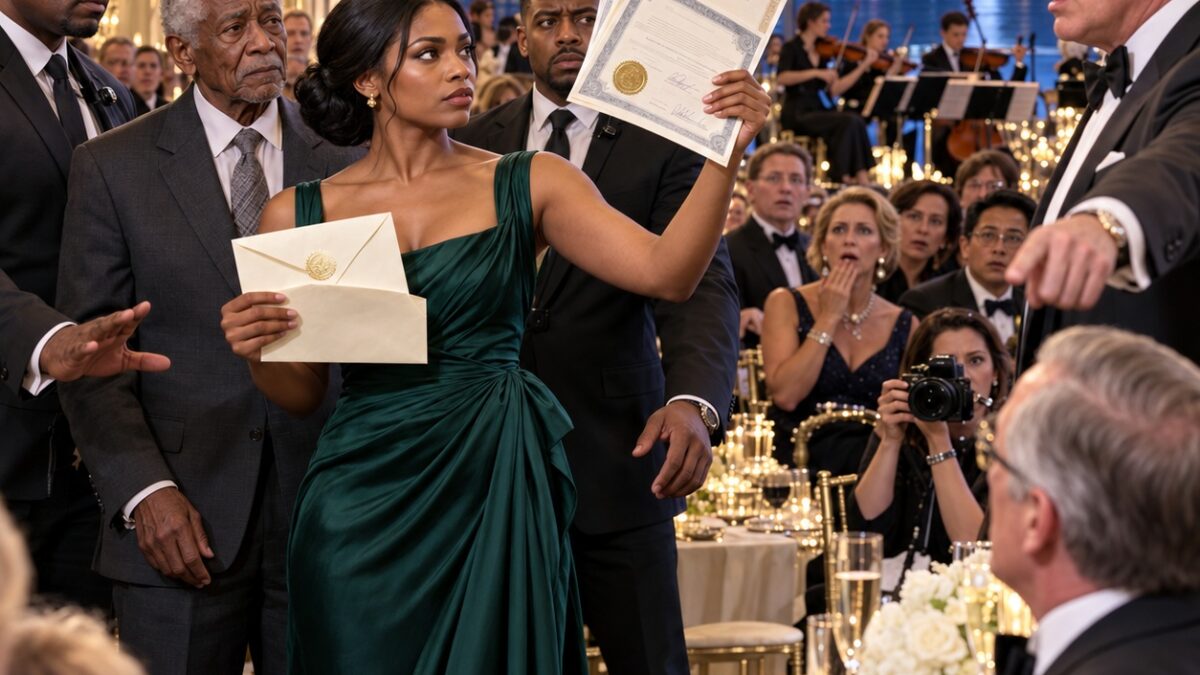
I lifted the ivory envelope.
Broke the seal.
The tearing sound seemed impossibly loud.
I took out the documents.
Majority shareholder transfer.
Legal succession certification.
Historical investment agreement.
Board authorization.
Stamped filings.
The work had taken weeks to assemble cleanly.
Corporate lawyers had reviewed every page.
I handed them to Richard.
He accepted them automatically.
Still smiling.
He looked at the first page.
Then the second.
The smile stopped.
His eyes moved faster.
Back to the first.
Then down.
I watched the color leave his face slowly.
Not dramatically.
A little around the mouth.
Then the cheeks.
His thumb stopped near the signature block.
I spoke.
“My grandfather funded Halston Technologies in 1999 when your primary investors withdrew.”
Nobody moved.
“His stake was diluted during restructuring.”
Richard looked up.
I continued.
“It was never legally voided.”
A board director stood.
Another leaned forward.
I held Richard’s gaze.
“I am Elijah Carter’s legal heir.”
I felt Grandpa beside me.
Steady.
“As of last quarter, under the succession documents filed and certified by the company, I am the largest voting shareholder of Halston Technologies.”
No applause.
Thank God.
I did not want applause.
This was not revenge theater.
This was correction.
Richard stared at me.
Then Grandpa.
Then the documents.
The nearest security guard took one step backward.
Then another.
No one told him.
He understood.
The second guard followed.
One of the board members approached.
Gray hair.
Meticulous.
A man I knew from governance calls.
He held out his hand for the papers.
Richard gave them reluctantly.
The director read.
First page.
Second.
His jaw tightened.
“It’s legitimate.”
The words were quiet.
Clear.
And that was when the ballroom finally understood the size of what had happened.
Not because I had suddenly become important.
I had been important before anyone knew.
Grandpa had been important before Richard recognized him.
The only thing that changed was visibility.
People who had laughed looked away.
A woman became intensely interested in her champagne.
One venture capitalist studied the ceiling.
The photographer lowered his camera.
Richard cleared his throat.
“There must be some misunderstanding.”
Nobody answered.
“We can sort this out privately.”
He tried to laugh.
The laugh died immediately.
An hour earlier, silence had protected him.
Now silence judged him.
That difference is something I never forgot.
The board chair—Faye Morrison—walked toward the security team.
“He stays.”
Simple.
The guards nodded.
Grandpa remained exactly where he had stood.
No triumphant smile.
No sarcastic remark.
No:
Do you know who I am now?
Nothing.
I think that unsettled Richard more than anger would have.
Grandpa did not need Richard’s humiliation to restore his dignity.
It had never left.
The board requested an immediate closed session.
Dessert had not even been served.
The gala was still technically happening.
Music stopped.
Guests gathered in low conversations.
Financial reporters began typing messages.
Phones lit up across the room.
The night had changed.
Faye approached me.
“Maya.”
Her voice was controlled.
“We need you in the conference room.”
I looked at Grandpa.
He shook his head slightly.
“You go.”
“You’re coming.”
“No.”
“Grandpa.”
“I did my part in 1999.”
He looked toward Richard.
“Now you do yours.”
That sentence scared me.
Because people love the moment power changes hands.
They rarely talk about what responsibility feels like once it does.
I followed the board upstairs.
The conference room overlooked the river.
City lights beyond the glass.
Jackets came off.
Ties loosened.
The atmosphere changed from gala to crisis in minutes.
Richard sat at the head of the table.
Habit.
No one challenged the seat.
No one looked to him for direction either.
Documents moved around.
Historical investment agreements.
Capitalization records.
Restructuring amendments.
Board authorizations.
Corporate filings.
The company’s general counsel was pale.
He read a section twice.
Then said:
“There appears to have been suppression of minority-investor attribution during restructuring.”
A director stared.
“Suppression?”
Counsel chose his next words carefully.
“The founder narrative in subsequent public materials is incomplete.”
“Incomplete?”
“Potentially misleading.”
Richard leaned forward.
“This is absurd.”
Faye looked at him.
“Is Elijah Carter’s investment real?”
“Yes, but—”
“Was his stake legally extinguished?”
Silence.
“Richard?”
“Not in those exact terms.”
A director laughed once.
Not humor.
Disbelief.
“That is not an answer.”
Richard began talking about dilution.
Restructuring.
Capital risk.
Operational control.
Every point had some truth inside it.
That is what makes institutional erasure complicated.
Nobody had forged a document saying Elijah Carter never existed.
They had simply allowed his role to shrink in language.
One filing.
Then another.
One anniversary article.
Another.
Richard became “the founder.”
Then “the visionary founder.”
Then “the man who built Halston Technologies from nothing.”
At some point omission turned into mythology.
My grandfather became a footnote.
Then even the footnote disappeared.
General counsel said:
“We need outside review.”
Faye nodded.
“Independent.”
Richard objected.
“Over twenty-five-year-old attribution?”
“No.”
I spoke for the first time since entering.
“Over current governance.”
Everyone looked at me.
I hated that.
I continued.
“If history was selectively rewritten because it served management, the question isn’t only what happened in 1999.”
I looked at the board.
“It’s what that tells us about the company’s controls now.”
Silence.
Faye nodded.
Exactly.
That was the real issue.
Not Grandpa’s pride.
Not my anger.
Governance.
If leadership could erase inconvenient contributions from corporate history, what else had been interpreted narrowly when power benefited?
By midnight, an outside law firm had been contacted.
An independent audit authorized.
Historical capitalization review.
Governance review.
Disclosure review.
Richard remained in the room, but his authority had changed.
Not legally gone yet.
Emotionally?
Yes.
When we returned to the ballroom, most guests had left.
Grandpa sat near a window.
Two cups of coffee in front of him.
He slid one toward me.
“You eat?”
I stared at him.
“Grandpa.”
“What?”
“The entire company might be entering a governance crisis.”
“And you skipped dinner.”
That was him.
I sat.
My hands started shaking.
Only then.
Adrenaline is strange.
It waits until danger feels over.
Grandpa watched.
“You all right?”
“No.”
He nodded.
“Reasonable.”
I looked at him.
“How are you not angry?”
“I am.”
He said it simply.
That surprised me.
“You don’t look angry.”
“I’m seventy-six, Maya. I’ve had time to practice not making every emotion everybody else’s problem.”
I almost laughed.
Then tears came instead.
“I’m sorry.”
“For what?”
“For making you stand there.”
“You didn’t.”
“I knew what those documents said.”
“That man made his own choice.”
I looked at his hands.
Worn.
Veins visible.
The same hands that had once signed the investment that kept the company alive.
“Why didn’t you fight this years ago?”
He looked toward the dark river.
“I fought for value.”
“What does that mean?”
“I invested.”
“I know.”
“I got returns.”
“But they erased you.”
He was quiet.
Then:
“I thought being paid was enough.”
That hurt.
“Was it?”
“For a while.”
He looked at me.
“Then I watched a company teach young employees that Richard Halston built it alone.”
His mouth tightened.
“That bothered me.”
“Why didn’t you say something?”
“Pride.”
I blinked.
He smiled faintly.
“Mine.”
That was not what I expected.
“I told myself recognition did not matter.”
“Maybe it shouldn’t.”
“It shouldn’t matter enough to control you.”
He lifted the coffee.
“But truth matters.”
That was Grandpa.
He did not need a statue.
He did not need his face on a wall.
He needed the record to stop lying.
Within forty-eight hours, Richard Halston was placed on administrative leave pending investigation.
The company released a carefully restrained public statement.
Historical oversight.
Early capitalization disclosures.
Independent review.
Governance commitment.
Corporate language is fascinating.
Companies can describe an earthquake as “a material development.”
Financial media picked up the story before markets opened.
I barely slept.
I expected panic.
Instead, investors reacted more calmly than I feared.
Why?
Because the board moved quickly.
Independent audit.
Transparent review.
No attempt to pretend the gala incident had not happened.
Governance reform can signal stability when denial would signal risk.
That became another lesson.
The worst thing a company can do after losing trust is act like acknowledging the problem creates the problem.
The problem already exists.
Acknowledgment simply turns on the light.
Grandpa refused interviews.
Every network called.
Business channels.
Newspapers.
Podcasts.
I asked him once:
“Are you sure?”
“Yes.”
“People want to hear your story.”
“I told you my story.”
“That’s not the same.”
“Exactly.”
He went home.
Made soup.
Read the paper.
Infuriatingly normal.
I handled the shareholder calls.
That was my job now.
Some people congratulated me.
I hated that.
There was nothing to congratulate.
A man had publicly humiliated my grandfather because he thought Grandpa did not belong.
A company had spent years simplifying its origin until truth disappeared.
My voting position did not make that fun.
Responsibility is heavier when it arrives inside injury.
Weeks passed.
The audit findings came in stages.
Historical investor credit had been diluted publicly as well as financially.
Internal narratives disproportionately elevated Richard.
Some fiduciary interpretations had been aggressively narrow.
Certain disclosures were not necessarily fabricated, but they had been framed in ways that obscured the role of early minority investors.
Legal language can make erasure sound sterile.
It is not.
I read the findings at my kitchen table.
Grandpa sat across from me.
He read them too.
Finally:
“Hmm.”
That was all.
“Hmm?”
“What do you want?”
“I don’t know. Maybe anger?”
“I told you. I’m angry.”
“You say it like you’re discussing the weather.”
He looked over his glasses.
“Would you prefer fireworks?”
I laughed.
He went back to reading.
Richard resigned before the board could vote formally on his future.
His statement emphasized twenty-five years of dedication.
Transition.
Company stability.
He did not apologize to Grandpa.
Not publicly.
Maybe not privately either.
Grandpa never told me.
I stopped asking.
Soon afterward, the SEC confirmed a formal inquiry into historical disclosure issues.
People online celebrated like a villain had finally been defeated.
I did not.
Regulatory inquiries are not entertainment when employees, retirees, and shareholders depend on the company remaining healthy.
My priority was governance.
Accuracy.
Stability.
The board amended corporate bylaws.
Permanent recognition of founding investors in official company history.
Stronger protections for minority stakeholders.
Enhanced disclosure review.
Independent governance oversight.
Dry language.
Seismic meaning.
One reporter asked whether I would become CEO.
“No.”
She looked surprised.
“You’re the largest voting shareholder.”
“That’s ownership influence.”
Pause.
“Not operating qualification.”
“But you could—”
“Leadership isn’t ownership.”
That line became a headline.
I did not mean it as one.
I meant it literally.
I understood finance.
Governance.
Succession.
I did not have twenty-five years running Halston Technologies.
Installing myself as chief executive because I had voting power would have repeated the exact sickness we were trying to correct.
An interim executive was appointed.
Experienced.
Boring.
Wonderful.
I preferred boring leadership more with every passing week.
The first major initiative I personally proposed was the Elijah Carter Fellowship.
Grandpa hated the name.
Of course.
“No.”
“Yes.”
“No.”
“You funded a company when traditional investors walked.”
“So?”
“So we’re creating capital access for underrepresented founders who cannot reach the same networks.”
“Call it something else.”
“Why?”
He sighed.
“Maya.”
“Grandpa.”
He looked at me for a long time.
Then:
“Fine.”
That was victory.
Not Richard resigning.
Getting Elijah Carter to allow his own name on something.
The fellowship was designed carefully.
Not charity branding.
Real capital-development support.
Mentorship.
Governance education.
Connections to early-stage investors.
Founders who had viable businesses but lacked access to the rooms where financing decisions were made.
I wanted the program to address what Grandpa’s own history revealed.
Capital is not distributed only according to merit.
Access matters.
Networks matter.
Recognition matters.
And when people outside traditional networks contribute, institutions have a habit of forgetting them once success becomes clean enough for mythology.
We wanted less forgetting.
At the next quarterly meeting, I announced the fellowship.
Grandpa sat in the front row.
Hands folded.
No applause from him.
Naturally.
Afterward, a young founder approached.
Black woman.
Early thirties.
Medical-technology startup.
She shook his hand.
“My father told me people like us never get into rooms like this.”
Grandpa looked at her.
“Then build another door.”
That became the line everyone remembered.
He hated that too.
“Why do people keep writing down things I say?”
“Because you say annoying things that sound good later.”
He smiled.
Months passed.
Headlines moved on.
They always do.
Richard’s name appeared in legal columns occasionally.
Then less.
The company kept operating.
Employees kept coming to work.
Products still needed shipping.
Customers still needed support.
Markets do not stop because a founder loses a myth.
That normal continuation mattered.
Accountability should improve an institution.
Not merely satisfy the audience.
One morning, I received an invitation to a modest auditorium inside Halston Technologies’ original downtown building.
No chandeliers.
No champagne.
Old carpet.
Fresh paint.
Grandpa came with me.
We walked through the entrance.
Employees gathered quietly.
Handshakes.
No press line.
Near the lobby wall hung a new plaque.
FOUNDING INVESTORS
Names.
Dates.
Grandpa’s name.
Elijah Carter — 1999
He stood in front of it.
Longer than I expected.
I stayed beside him.
Not in front.
That mattered.
The board chair spoke briefly.
Accuracy.
Stewardship.
Correcting the record.
No dramatic apology.
No theatrical redemption.
Just acknowledgement.
Grandpa stared at his name.
Finally:
“Looks smaller than I imagined.”
I laughed.
“What did you imagine?”
“Nothing.”
He smiled.
“That’s the point.”
I looked at him.
“You’re impossible.”
“Yes.”
Employees came over.
Some older people remembered him vaguely.
One former finance manager had worked at the company in 1999.
He shook Grandpa’s hand with both of his.
“You kept us paid.”
Grandpa’s face changed.
That one reached him.
“I had two kids then.”
The man continued.
“My wife had just gone back to school.”
Grandpa looked away.
Not because he was uncomfortable.
Because his eyes had filled.
There it was.
The recognition he actually cared about.
Not founder.
Not investor.
Not plaque.
People.
Payroll.
Families.
Impact.
That evening, we went to a diner.
Not a luxury restaurant.
Grandpa ordered meatloaf.
I asked him whether the plaque made him feel better.
“No.”
I frowned.
“Really?”
“It corrected something.”
“That’s not better?”
“It’s different.”
He cut his food carefully.
“Dignity isn’t something they returned to me, Maya.”
I stopped.
“They corrected the record.”
He looked at me.
“I never stopped being who I was.”
That sentence changed the whole story for me.
For months, I had described what happened as restoration.
Restoring Grandpa’s credit.
Restoring his place.
Restoring dignity.
But he was right.
Dignity had never been Richard’s to take.
He had humiliated Grandpa publicly.
Yes.
The company had erased important history.
Yes.
But Grandpa’s worth had not depended on whether a ballroom recognized it.
The institutional record needed restoration.
Grandpa did not.
That became the deepest lesson.
People use the phrase:
Give someone dignity.
You cannot.
You can respect it.
Protect it.
Stop violating it.
But dignity is not a gift from powerful people.
That is why Grandpa stood so calmly while Richard tried to shrink him.
He did not need to win the room to know his value.
I did.
At least then.
I needed Richard to understand.
Needed everyone who laughed to regret it.
Needed the documents to shock them.
Grandpa wanted truth.
Different motive.
Over time, I moved closer to his.
The company commissioned a complete historical review.
Not only Grandpa.
Other early employees.
Engineers.
Administrative staff.
Small investors.
People whose work had disappeared beneath a founder-centered narrative.
That was uncomfortable.
Some people complained:
“Every company simplifies its origin story.”
True.
Simplification becomes dangerous when it consistently turns many people’s contributions into one man’s greatness.
Founding myths shape culture.
If employees are taught that one genius created everything, they begin tolerating concentrated power because concentrated power feels natural.
Accurate history became a governance issue.
Not just a plaque issue.
We changed onboarding materials.
Corporate archives.
Public timelines.
Richard remained part of the story.
He should.
He built enormous parts of the company.
Accuracy does not require replacing one erasure with another.
I insisted on that.
Some shareholders wanted his name removed from everything.
“No.”
“Why?”
“Because he was there.”
“So was Elijah.”
“Exactly.”
Full history.
Not revenge history.
Grandpa approved.
That was the standard.
The independent audit also uncovered other minority investors whose early roles had been understated.
Some estates.
Some retired founders.
We contacted them.
Corrected attribution.
In a few cases, financial rights had long since ended legitimately.
In others, documentation required deeper review.
We did the work.
One family wrote me a letter.
Their father had died believing the company had forgotten him.
That one hurt.
No correction can fully repair recognition that arrives after death.
We still corrected it.
Late truth is not useless.
Just more expensive emotionally.
I began thinking about the people in the ballroom.
The ones who had watched.
This part of the source story asked the right question:
What did everyone else not do?
That stayed with me.
Richard’s cruelty was obvious.
The silence around him made it possible.
A senator watched.
Board members watched.
Investors.
Executives.
Press.
People with enough power to ask one sentence:
Who is he?
Nobody did before I stepped forward.
Why?
Because social rooms have gravity.
Richard had status.
Grandpa did not appear to.
People calculate risk without admitting it.
If they challenge Richard and he is right, they look foolish.
If they stay quiet and Grandpa is wrong, nothing happens to them.
Silence becomes self-protection.
That is how humiliation becomes communal.
Not because everyone agrees.
Because nobody wants to pay the social price of disagreement.
I became obsessed with that.
At board retreats, I asked:
“How easy is it to disagree with the most powerful person in the room?”
People gave polished answers.
I wanted evidence.
Anonymous director surveys.
Escalation channels.
Protected dissent.
Independent committee access.
Not because every objection is wise.
Because a company that cannot tolerate challenge becomes stupid.
Richard’s founder mythology had grown partly because too few people benefited from correcting him.
That is a structural failure.
We worked on it.
The first board meeting after reforms was exhausting.
Wonderful.
Directors disagreed openly.
An acquisition proposal received hard questions.
Management had to return with better data.
The meeting ran an hour late.
I smiled.
Someone asked why.
“Nothing.”
Inside, I thought:
Good.
No worship.
Grandpa never joined the board.
People asked.
He declined every time.
“I already invested once.”
That was his joke.
But privately he told me:
“My name being back on the wall does not mean I should start taking up chairs.”
Again.
Annoying wisdom.
Recognition can become another form of ego if you are not careful.
He wanted truth corrected.
Then space.
The fellowship became his preferred way to contribute.
He met recipients twice a year.
Never lectured long.
Asked questions.
“How much runway?”
“What happens if your largest customer leaves?”
“Who can tell you no?”
That last one surprised founders.
They expected fundraising advice.
Grandpa cared about governance.
“Who can tell you no?”
If answer:
No one,
he worried.
A founder who hears only yes eventually becomes Richard.
Not necessarily cruel.
But isolated.
My relationship with Grandpa changed too.
The succession process had made me his largest voting heir.
That phrase sounded enormous publicly.
Privately, I was still the granddaughter he called when his printer stopped working.
He would text:
Machine refusing cooperation.
I would drive over.
Press the correct button.
“Investor problem solved.”
He would glare.
We needed that normal relationship.
Power distorts families too if you let it.
I did not want every conversation to become corporate.
Sometimes we talked about tomatoes.
Sometimes my mother—his daughter.
Sometimes the company.
One afternoon I asked:
“Did you ever resent me inheriting the voting position?”
He stared.
“Why would I?”
“You built the original stake.”
“I invested.”
“You took the risk.”
“Yes.”
“And now I vote it.”
“That’s what succession is.”
“It doesn’t feel fair.”
He smiled.
“Maya, inheritance is never fair.”
I frowned.
“What does that mean?”
“You did not earn being my granddaughter.”
I waited.
“You also did not earn losing your grandmother young.”
He looked out the window.
“Life hands people assets and losses they did not earn.”
Then:
“Character is what you do after.”
That stayed.
I had not earned the voting power.
I was responsible for using it well.
Different.
Entitlement says:
I deserve this.
Stewardship says:
I have this. What does it require?
Grandpa was teaching me stewardship.
Richard had eventually confused ownership, authorship, and leadership into one identity.
That was the cautionary version.
The SEC inquiry took time.
Longer than media attention.
That is normal.
I will not invent dramatic charges the source does not contain.
The formal inquiry examined prior disclosures.
Corporate counsel cooperated.
Historical files were produced.
Our responsibility was transparency.
Not predicting regulators.
I resisted board members who wanted public statements every week.
“Let the process work.”
That became my phrase.
People hate it.
Because process is slow.
But accountable institutions should not decide guilt through headlines.
We had already learned the danger of narrative overpowering records.
Do not repeat it in reverse.
Richard deserved accurate process too.
That was harder to say publicly.
Some people thought it meant defending him.
It did not.
Fairness is not loyalty to the accused.
It is loyalty to standards even when anger would prefer shortcuts.
Grandpa approved.
Of course.
“You don’t build better rules by breaking them against somebody you dislike.”
More annoying wisdom.
The stock stabilized.
Governance improvements reassured long-term holders.
Employees gradually stopped treating every executive change as a crisis.
The interim CEO became permanent after a board process.
Qualified.
Experienced.
Not family.
Not me.
Another good outcome.
One business channel called it “the Carter takeover that wasn’t.”
I liked that headline.
Because we never wanted a takeover.
We wanted correction.
Richard had been wrong to assume belonging was something he personally granted.
I had no desire to replace him as gatekeeper.
Years passed.
The ballroom incident became a case study in some governance courses.
That embarrassed me.
Professors asked permission to use clips.
I agreed if they focused on governance, not the dramatic “secret shareholder” twist.
Some did.
Students wrote papers about founder mythology.
Minority investors.
Stakeholder attribution.
Board independence.
One professor invited me to speak.
I brought Grandpa.
Naturally, students preferred him.
One asked:
“What did you feel when Mr. Halston ordered security to remove you?”
Grandpa thought.
“Hungry.”
The room laughed.
I covered my face.
The student tried again.
“Emotionally.”
“I knew the truth.”
“That made you calm?”
“No.”
He looked at me.
“Maya was ready to set the ballroom on fire with her eyes.”
More laughter.
Then Grandpa became serious.
“I was embarrassed.”
The room quieted.
“People think dignity means you don’t feel humiliation.”
He shook his head.
“You feel it.”
He paused.
“You just decide humiliation does not get to tell you who you are.”
I looked at him.
I had never heard him explain it that way.
The student asked:
“Why didn’t you tell everyone immediately who you were?”
Grandpa smiled.
“Would you have believed me?”
That silenced them.
Exactly.
If an older Black man being removed by security shouted:
I saved this company,
what would the room have done?
Maybe laughed harder.
Maybe assumed confusion.
The documents mattered because power respects documents it has already agreed to respect.
That reality is not always fair.
But understanding it lets you choose strategy.
Grandpa was never passive.
His silence was strategic restraint.
That distinction became clearer to me over time.
He had learned something through decades in finance.
Do not waste truth where the room has decided only status counts.
Change what the room must count.
The envelope did that.
Not magic.
Paper.
Records.
Corporate authority.
Then they had to listen.
I wish dignity alone were always enough to stop humiliation.
It is not.
Sometimes you need evidence.
Allies.
Voting rights.
Law.
Institutions.
That is why reform matters.
We cannot tell vulnerable people:
Just be dignified.
Dignity does not stop security guards.
Structures do.
The goal is institutions where dignity is respected before someone produces a majority-shareholder certificate.
That became my standard.
Employee conduct policies changed.
Security escalation rules changed.
Executive event protocols changed.
Not because we wanted bureaucracy everywhere.
Because no CEO should casually turn private security into a tool for social humiliation.
The guards had done nothing malicious.
They had paused.
Waited.
Stepped back when authority changed.
But the system had placed them inside Richard’s ego.
That was unfair to them too.
We trained differently.
Clear verification before removal where safety was not at risk.
Event lists accessible.
Independent escalation.
Basic process.
Again:
Boring rules preventing dramatic abuse.
I loved boring rules.
Grandpa teased me.
“You’re becoming an administrator.”
“Take it back.”
He laughed.
The Elijah Carter Fellowship grew.
First five founders.
Then twelve.
Then partnerships with outside investors.
Not everyone succeeded.
Important.
We did not pretend access guarantees outcomes.
Some businesses failed.
Some pivoted.
Some raised capital.
One became a major supplier.
Another founder closed after eighteen months and later wrote me:
“Failure hurt less because I knew I actually got a fair shot.”
That mattered.
Grandpa attended every cohort introduction while his health allowed.
He refused front-row reserved seating eventually.
Sat in the middle.
Founders always found him anyway.
His name had become known.
Irony.
The man who spent decades without public recognition could no longer attend a company event quietly.
He complained constantly.
Secretly enjoyed some of it.
I know.
Granddaughters know these things.
One night after a fellowship dinner, we passed the old plaque.
He stopped.
Touched his name.
“Still there.”
“Were you expecting theft?”
“You never know.”
I laughed.
Then he said:
“I’m glad they put everyone else up too.”
That was what mattered.
The plaque had expanded.
Not just Elijah.
Other founding investors.
Early engineers.
Corporate legal structure had categories.
The history exhibit had people.
Names.
Roles.
Dates.
No single-genius mythology.
Richard’s name remained at the top among founders.
Correctly.
I once asked Grandpa whether that bothered him.
“No.”
“Why not?”
“He founded it.”
“But the old story—”
“Was incomplete.”
He looked at me.
“Do not correct a lie by creating another.”
There it was again.
Accuracy.
Not revenge.
Richard had vision.
Drive.
Operational courage.
He built Halston Technologies.
He did not build it alone.
Both truths fit.
Mature history can hold more than one person.
My anger had wanted replacement.
Grandpa wanted expansion.
He was wiser.
I became more like him slowly.
Not enough.
But more.
Richard never contacted me directly after resignation.
At least not for years.
Then a letter arrived.
Physical.
No email.
I almost did not open it.
Grandpa was sitting at my kitchen table.
“Open it.”
“You don’t even know what it is.”
“I know the return address.”
Of course he had looked.
I opened.
Richard’s handwriting.
Not long.
He did not beg forgiveness.
Did not rewrite history.
He acknowledged that the gala incident had been wrong.
He said years of being treated as the company’s singular creator had distorted his judgment about who he thought belonged.
He apologized to Grandpa.
And to me.
I read it twice.
Handed it over.
Grandpa read.
Then folded it.
“What do you think?”
“He took his time.”
I laughed.
“Grandpa.”
“He apologized.”
“Yes.”
“Good.”
“That’s all?”
“What would you like me to do? Ring a bell?”
“Do you forgive him?”
Grandpa looked at the letter.
“Forgiveness is not a press release.”
I waited.
Then he said:
“I’m not carrying him around.”
That was his answer.
I understood.
Forgiveness did not mean inviting Richard back.
Did not mean minimizing harm.
It meant Richard no longer occupied emotional space Grandpa needed for other things.
I wrote a short reply.
Thank you for acknowledging it.
Nothing more.
No public reconciliation.
No redemption campaign.
Not everything needs an audience.
That felt appropriate.
Grandpa grew older.
Obviously.
Time became more visible.
Steps slower.
Hands less steady.
Still sharp mentally.
Still impossible.
I began accompanying him to medical appointments.
Roles changed.
The man who once corrected my taxes now asked me to read prescription labels.
That was hard.
Power means nothing against aging.
Voting shares.
Money.
Plaques.
None of it buys back time.
We talked more about family.
Less about Halston.
One afternoon I asked what he was proudest of.
I expected:
The 1999 investment.
The fellowship.
Me.
Hopefully.
He said:
“Your mother.”
I smiled.
“My mom?”
“She raised you.”
“You helped.”
“Your mother did the hard part.”
He looked at me.
“Then maybe you.”
“Maybe?”
“Don’t get arrogant.”
I laughed so hard I cried.
That is how I remember him most now.
Not under chandeliers.
Not beside security guards.
At a kitchen table.
Teasing me.
The corporate story continued without needing us at the center.
That was healthy.
Governance tightened.
Reporting improved.
New executives.
New products.
Employees who joined years later knew the full founding history from day one.
Not because Grandpa needed constant gratitude.
Because accurate institutions should know their own beginnings.
The fellowship became permanent.
The plaque gathered dust like every plaque eventually does.
Life moved.
That is success.
Dignity restored to the record became ordinary.
It no longer required an event.
That was what I wanted.
The ballroom, though, remained in my memory.
Sometimes unwillingly.
A chandelier reflection.
A quartet.
A camera flash could bring it back.
Richard saying:
“This isn’t a community center.”
“We have standards tonight.”
I used to replay what I should have said.
Sharp answers.
Perfect humiliations.
Years later, I stopped.
Because the best answer had already happened.
Documents.
No shouting.
No insult.
Truth.
Richard created theater.
We brought record.
The record lasted longer.
I think about the people who laughed too.
Some later apologized.
One board director called Grandpa personally.
Another sent a letter.
The woman whose glass trembled approached me months later.
“I should’ve said something.”
I appreciated that.
She looked genuinely ashamed.
I told her:
“Say something next time.”
That was more useful than absolution.
Because there will always be a next room.
Different Richard.
Different Elijah.
Different social risk.
Character is not revealed only by what the powerful person does.
It is revealed by what witnesses tolerate.
That became one of the fellowship’s leadership sessions.
Not founder branding.
Bystander responsibility.
Institutional courage.
How do you speak when the person making the joke signs your compensation package?
How do you challenge someone when their status is real?
Those are harder questions than:
Would you defend an old man?
Everyone believes they would in theory.
Rooms are different.
Career risk.
Social pressure.
Uncertainty.
That is why systems must help courage.
Independent channels.
Board access.
Policies.
Culture where respectful dissent is rewarded.
You cannot build ethics entirely on hoping individuals become heroes in public.
Design matters.
Grandpa would smile whenever I said design.
“Listen to you.”
“What?”
“Sounding like somebody who reads bylaws for fun.”
“I hate you.”
“No, you don’t.”
Correct.
Years after the gala, the hotel contacted Halston Technologies about another charity event.
Same ballroom.
Faye asked whether I wanted to attend.
I said no.
Then changed my mind.
Not because I needed closure.
I distrust that word.
Life rarely closes neatly.
I wanted to see whether the room still had power over me.
I went.
Different event.
Different company hosting.
Same chandeliers.
Same river.
Another quartet.
I stood near the place where Grandpa had been.
Nothing happened.
No cinematic emotion.
No ghosts.
Just a ballroom.
That was freeing.
Trauma gives rooms more power than architecture deserves.
Eventually, if you are fortunate, a room becomes a room again.
I ordered sparkling water.
Listened to music.
Left early.
Perfect.
The story people tell ends when I open the ivory envelope.
That is where viral stories like to end.
Power reversal.
Secret heir.
CEO exposed.
But the real story began there.
Power is easy to enjoy for five minutes.
Stewardship takes years.
The envelope did not make me wise.
It made me responsible.
The board did not become good automatically because Richard left.
We built controls.
The fellowship did not fix inequality.
It opened some doors.
Grandpa’s name on a plaque did not heal every year of erasure.
It corrected the record.
Small, real things.
That is how change works most of the time.
Not total.
Not perfect.
Worth doing.
If you ask me now what I felt when Richard said:
“Security, remove him,”
the answer is still anger.
Immediate.
Protective.
Almost physical.
But underneath anger was something else.
Fear.
What if the documents were challenged?
What if the room still chose him?
What if Grandpa was hurt by the spectacle more deeply than he showed?
I had the voting rights.
I still felt powerless for a moment.
That taught me empathy.
People without an ivory envelope experience that moment every day.
A landlord.
A manager.
A hospital administrator.
A police officer.
A banker.
A board.
Someone says:
You do not belong.
And the person being targeted may know the statement is wrong.
Knowing is not always enough.
Power has mechanisms.
That is why legal protections and institutional accountability matter.
Do not romanticize dignity as a substitute for power reform.
Grandpa’s dignity survived.
The company still needed reform.
Both.
That is the complete lesson.
I became less interested in dramatic reversals and more interested in preventing the first humiliation.
That is why our event policies changed.
Why founder histories changed.
Why minority-investor protections strengthened.
Why fellowship founders received governance education, not only checks.
Because the goal is not:
Someday the underestimated person will secretly become powerful and embarrass you.
The goal is:
Do not humiliate people who appear powerless.
Simple.
Hard.
Necessary.
Grandpa said that better.
Near the end of one interview—one of the few he agreed to—a reporter asked:
“What should Richard Halston have done differently?”
Grandpa thought for a moment.
“Asked my name.”
The reporter waited.
“That’s it?”
“He asked what I was.”
Pause.
“Counsel? Investor? Charity?”
Grandpa smiled.
“He never really asked who I was.”
That sentence stayed with me.
How often do we ask what someone is before who?
Profession.
Status.
Usefulness.
Category.
Then decide respect.
Grandpa wanted the order reversed.
Name first.
Person first.
Everything else later.
When he died—years after the gala, not as part of the original source’s ending, so I won’t turn this rewrite into an invented death scene—the lesson remained with me.
I’m careful even saying that because stories like this often add tragedy to intensify emotion.
It is unnecessary.
His legacy is powerful while he is still sitting in that front row, hands folded, watching younger founders enter rooms that once would have excluded them.
That is where I prefer to leave him.
Alive in the source.
Quiet.
Recognized.
Not changed by recognition.
The company’s old narrative said one man built an empire from nothing.
Our corrected history says something less cinematic and more honest.
Richard Halston had vision.
Employees worked.
Investors took risks.
Elijah Carter supplied capital when others withdrew.
Boards made decisions.
Markets changed.
Many people built Halston Technologies.
That is how most real institutions are built.
Together.
The myth of the lone genius is attractive because it gives audiences one face.
It is also dangerous.
One face becomes one authority.
One authority becomes difficult to question.
Full history distributes credit.
Distributed credit encourages distributed accountability.
That is good governance.
Sometimes history itself is a control system.
If people know success required many contributors, they are less likely to worship one leader.
That may be the lasting reform I value most.
Not the SEC inquiry.
Not Richard’s resignation.
Culture.
Employees now hear:
No one person built this.
That sentence creates room.
For challenge.
For gratitude.
For accuracy.
Grandpa’s name became part of that.
Not above Richard’s.
Beside many others.
Exactly where he wanted it.
The ivory envelope sits in my desk today.
Empty.
I kept it.
I know that sounds sentimental.
The original documents are stored properly.
Digital copies.
Corporate records.
Legal archive.
The envelope itself has no official value.
Just paper.
Cream-colored.
Slight crease where my thumb pressed while Richard humiliated Grandpa.
Sometimes I open the drawer and see it.
I remember the tearing sound.
The room going silent.
Grandpa’s steady face.
Then I close the drawer.
I do not need to relive it constantly.
Symbols should serve memory.
Not imprison it.
One day I may throw it away.
Not yet.
There is one final thing I want people to understand.
When Richard Halston ordered security to remove my grandfather, the wrongness of what he did did not begin only after we proved Grandpa had been an investor.
It did not become wrong because I was the largest voting shareholder.
It was wrong before the envelope opened.
That is the point people keep missing.
If Grandpa had owned zero shares, Richard’s public humiliation still would have revealed something ugly.
A quiet older man standing peacefully in a ballroom deserved basic respect.
A young woman saying he was invited deserved a question before mockery.
Security should not have become entertainment.
Dignity should not require equity.
The paperwork changed the power.
It did not create the humanity.
That was already there.
So when people tell me:
“Richard picked the wrong man to humiliate,”
I correct them.
He picked a man to humiliate.
That was already the mistake.
Everything after merely made the consequences visible.
Grandpa did not need to be secretly important.
No one does.
We should not need impressive hidden identities to justify kindness.
That is a childish moral.
Be nice because the waiter might own the restaurant.
Be polite because the janitor might be the CEO’s father.
No.
Be decent because the waiter is a person.
The janitor is a person.
The older man in a modest suit is a person.
That is enough.
The irony is that Richard spent twenty-five years building a company around technology, scale, and intelligence, then failed at the oldest human calculation in the room.
He measured worth by appearance.
Grandpa measured people by conduct.
One of those systems failed that night.
The other did not.
Months after the gala, I stood beside Grandpa beneath that new plaque.
Employees moved through the hall.
No cameras.
No quartet.
No champagne.
Just an ordinary workday.
He looked at his name.
Then at me.
“You ready to go?”
“That’s it?”
“What?”
“Twenty-five years of erasure and you get a plaque.”
He shrugged.
“They spelled it right.”
I laughed.
He started walking toward the door.
I followed.
That is the ending I love.
Not Richard’s face when I opened the envelope.
Not security stepping back.
Not headlines.
My grandfather leaving the building with no need to stand beneath his own name longer than necessary.
Because recognition had finally caught up with truth.
And truth, once recorded correctly, did not need him to keep proving it.
He had known who he was all along.
Eventually, the company did too.

