PART2:The CEO Fired Me in Front of the Entire Executive Team—Then the Board Chair Told Him I Owned 51% of the Company
PART2
No one moved.
That is what I remember most.
Not his words.
Not even security.
The stillness.
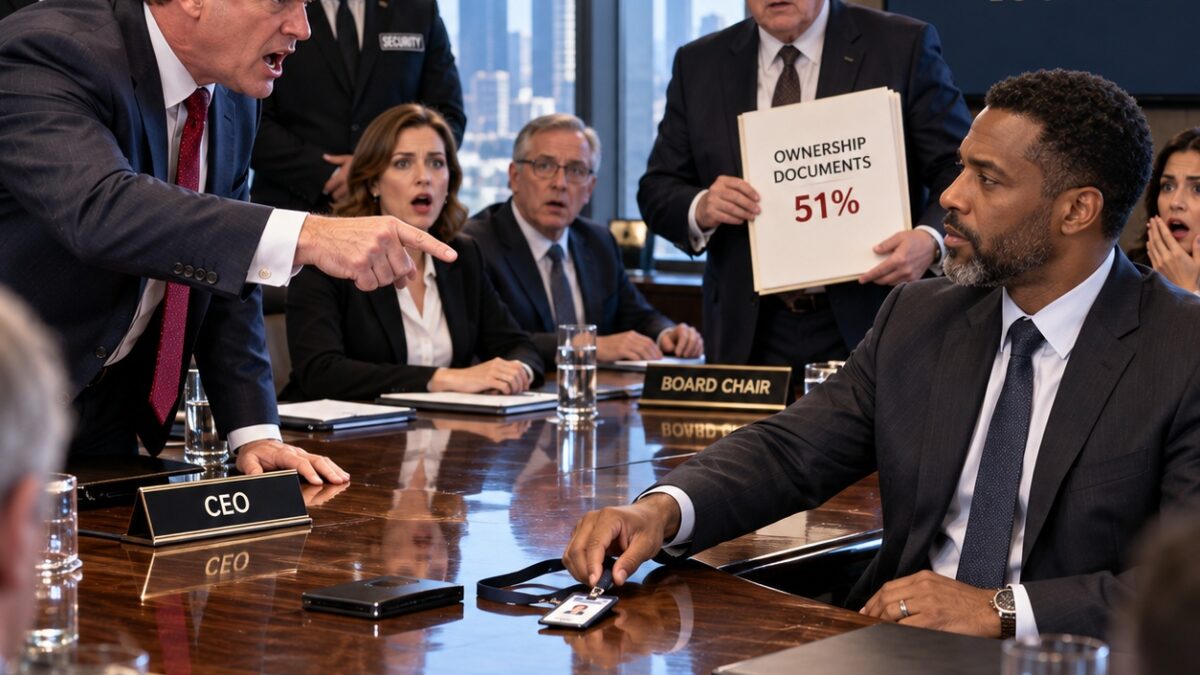
Our HR director folded her hands together and stared at her wedding ring.
The CFO adjusted his glasses and reread a page he had already read twice.
A junior analyst held his pen so tightly his knuckles had gone white.
They were not agreeing with the CEO.
They were afraid of becoming next.
That distinction mattered.
The CEO walked toward the head of the table.
He straightened his cuff links.
Expensive ones.
Silver.
Small gesture.
He did things like that whenever he wanted to look relaxed.
“Effective immediately.”
I reached for the lanyard around my neck.
No rush.
No protest.
I unclipped the badge.
Placed it on the conference table.
Slid it forward about an inch.
The plastic clicked against polished wood.
The CEO looked satisfied.
He had built the scene exactly the way he wanted.
One executive publicly removed.
Security at the door.
Nobody speaking.
Message delivered.
My phone lit beside my notebook.
BOARD CHAIR
I looked at it.
Silenced the call.
Across the table, someone’s elbow caught a paper cup.
Coffee spilled.
A thin brown line moved toward a stack of quarterly reports.
Nobody reached for napkins.
The CEO repeated:
“Effective immediately.”
I stood.
Picked up my briefcase.
Then looked at him.
“Before I leave…”
He gave a short, irritated laugh.
“What?”
“You may want to check your email.”
He stared at me.
“Check my email?”
“Yes.”
“I think we’re finished here.”
I set the briefcase back on the table.
Unlatched it.
Removed a slim gray folder.
No dramatic stack of documents.
No giant binder.
Just the documents that mattered.
I placed the folder in front of him.
He barely looked at it.
Then the conference-room door opened.
The security officers turned.
I expected another HR representative.
Maybe corporate counsel.
Instead, the board chair walked in.
Still wearing his coat.
His face unreadable.
Everything in the room changed.
The CFO started to stand, then stopped halfway.
The CEO frowned.
“We’re in the middle of—”
“We need to clarify something.”
The board chair did not raise his voice.
He looked at me.
Then at the CEO.
“Before any termination proceeds.”
The word proceeds hung there.
The CEO’s jaw tightened.
Confusion.
Not fear yet.
He was still operating under the assumption that this was a procedural inconvenience.
The board chair put both palms on the table.
“Mr. Reed is the company’s majority stakeholder following the equity transfer filed last month.”
Nobody breathed.
The CEO looked at me.
Then at the gray folder.
Then back at the board chair.
“What?”
The board chair opened the folder.
Legal letterhead.
Filing confirmations.
Executed signatures.
Corporate documents.
The final transfer.
Fifty-one percent controlling interest.
The CEO picked up the page.
I watched the color leave his face slowly.
He turned to the second page.
Then back to the first as though the number might have changed.
51%.
It did not.
His fingers trembled.
Only slightly.
Enough.
I sat back down.
Not dramatically.
Just took my chair again.
The same chair from which I had been fired less than three minutes earlier.
I folded my hands over the closed notebook.
Then said:
“I believe this meeting is out of order.”
One of the security officers quietly stepped backward.
The other looked at him.
For the first time, neither seemed certain who they were supposed to escort.
The CEO swallowed.
“This must be procedural.”
His voice had changed.
Still trying for confidence.
Not finding much.
“Temporary transfer until the estate finishes probate.”
“It is binding.”
The board chair cut him off.
No anger.
No triumph.
Fact.
The CEO looked toward the CFO.
“Tell him.”
The CFO cleared his throat.
“The transfer cleared compliance two weeks ago.”
That word landed beautifully.
Compliance.
My department.
The department the CEO had just accused of being a weak link.
The HR director finally lifted her head.
The junior analyst exhaled so loudly I heard it from halfway down the table.
At the door, security exchanged one more look.
Then both stepped into the hallway and closed the door behind them.
Nobody had instructed them.
They simply understood the theater was over.
I wish I could tell you I had planned the entire moment.
That I walked into the meeting knowing he would fire me.
That I had timed the board chair’s entrance.
That the gray folder was some carefully engineered trap.
None of that is true.
The ownership transfer was real.
The filing had been completed.
The board chair and corporate counsel knew.
The CEO did not because the board had decided to handle the formal announcement after final estate and corporate documentation had cleared.
I had agreed.
I did not want a public rollout.
I did not want employees suddenly acting differently around me.
I especially did not want the CEO believing I was interfering with day-to-day operations before the ownership structure was formally presented.
So I kept working.
Same office.
Same schedule.
Same parking space beside the loading docks.
Same title.
Compliance director.
The board chair had called because he learned security had been summoned to the quarterly meeting.
Corporate counsel had received notice of the termination action only minutes earlier.
That triggered the call.
The timing was not revenge.
It was governance catching up with ego.
That distinction matters.
The CEO created the humiliation himself.
No one forced him to call security.
No one forced him to turn a compliance disagreement into public theater.
He wanted an example.
He became one.
The board chair took the empty seat near the far end.
“Everyone stays.”
The CEO looked at him.
“I’m the chief executive.”
The board chair nodded.
“For the moment.”
A heavier silence.
I almost closed my eyes.
Not because I felt sorry for the CEO.
Because I knew exactly what that sentence did to a room.
Three minutes earlier, everyone was terrified of him.
Now they were watching his authority become conditional.
Fear shifts quickly.
That is dangerous.
People who were afraid of a powerful person five minutes earlier can become cruel the instant they smell weakness.
I did not want that.
So I stood.
Not abruptly.
No fist on the table.
“As majority shareholder, I’m calling for an immediate executive review.”
The CEO opened his mouth.
I continued.
“Effective today.”
His face tightened.
“You can’t simply—”
The board chair interrupted.
“He can request it.”
The CFO said nothing.
HR said nothing.
I looked around the table.
“Everyone in this room will preserve documents.”
Now people were listening to me differently.
I hated that.
Ownership had changed nothing about my competence in the last five minutes.
Yet suddenly every word carried more weight.
That taught me something immediately.
People often confuse position with truth.
I wanted to be careful not to start believing them.
“Emails.”
“Exit files.”
“Termination records.”
“Complaint logs.”
“Executive directives.”
“Nothing deleted.”
“Nothing revised.”
“Nothing ‘cleaned up.’”
The CEO stared.
“This is ridiculous.”
“No.”
I looked at him.
“This is review.”
“You’re retaliating because I fired you.”
“Your attempted termination is one event.”
“Then what exactly are you reviewing?”
I glanced at HR.
She lowered her eyes again.
That answered more than she intended.
“Leadership conduct.”
The CEO laughed.
Short.
Disbelieving.
“You’ve owned shares for what, three weeks, and now you think you run the company?”
I shook my head.
“No.”
“You own fifty-one percent.”
“Yes.”
“That means control.”
“Ownership is not the same thing as operational competence.”
He stared.
That answer surprised him.
Probably everyone.
I continued.
“That’s why there’s a board.”
“That’s why we have executive roles.”
“And that’s why we review before we make decisions that affect hundreds of employees.”
I paused.
“Something you should have considered before calling security.”
The room went quiet again.
That was the closest I came to humiliating him.
I regretted it almost immediately.
Not because it was untrue.
Because I could feel the room enjoying it.
Power invites performance.
I had no interest in becoming him with better paperwork.
The emergency board session began that afternoon.
Six hours.
I missed my daughter’s normal pickup.
That bothered me more than anything else that day.
I called the aftercare office at 5:40.
“Hi, this is Marcus Reed.”
The woman at the desk knew me.
“Everything okay?”
“Work emergency.”
“We can keep her until seven.”
“I’ll be there.”
Then I called my daughter.
She answered through the school office phone.
“Dad?”
“Hey.”
“You late?”
“Yeah.”
“How late?”
“Maybe forty minutes.”
“Are you okay?”
Children know.
Not details.
Tone.
“I’m fine.”
“Did someone break a truck?”
I laughed.
“No.”
“Computer?”
“No.”
“What happened?”
“Grown-ups made work complicated.”
“That sounds normal.”
Ten years old.
Already accurate.
“I’ll explain later.”
“Can we get pizza?”
“Yes.”
“Then okay.”
That was how my life worked.
Control of a logistics company did not matter if I forgot dinner.
The board session moved fast.
Corporate counsel joined.
Outside counsel dialed in.
The CEO remained for the initial portion, represented by his employment attorney once he made the call.
He denied wrongdoing.
Of course.
He characterized the attempted termination as:
“Necessary performance management.”
He said my department caused unacceptable delays.
I provided the compliance record.
The filings had been delayed because legally required verification remained incomplete.
Pushing them earlier would have increased regulatory exposure.
The CFO confirmed it.
Not enthusiastically.
But he confirmed it.
That alone did not justify removing a CEO.
Executives make bad calls.
Managers fight.
People misjudge.
The bigger issue emerged when HR opened historical termination reports.
At first, it looked like ordinary restructuring.
New leadership.
Cost cutting.
Position eliminations.
Then we sorted the numbers.
Department.
Performance history.
Tenure.
Demographic data.
Reason codes.
Something appeared.
Not proof yet.
Pattern.
High-performing minority managers had been disproportionately removed under subjective labels.
Culture fit.
Directional misalignment.
Leadership tone.
Strategic compatibility.
Words that sound corporate enough to avoid saying anything measurable.
I asked HR:
“Were all these terminations reviewed?”
She hesitated.
The board chair noticed.
“So that’s a no?”
“Some were.”
“How were they selected?”
“The CEO had discretion during restructuring.”
“Were there objections?”
Another hesitation.
“Yes.”
“Where?”
She looked toward the CEO.
Then toward the table.
“Some were documented.”
“Some?”
“Some were verbal.”
“Why?”
Her hands tightened.
I had watched those hands at the quarterly meeting.
Wedding ring.
Fingers folding and unfolding.
Now I understood.
She had been afraid long before I was fired.
“Did you raise concerns?”
“Yes.”
“With whom?”
“Executive leadership.”
“Meaning him?”
She nodded.
The CEO leaned forward.
“This is being distorted.”
The board chair raised a hand.
“Let her answer.”
That phrase mattered.
Let her answer.
I began to realize how rarely people had been allowed to finish sentences around our new CEO.
We reopened exit interviews.
Former managers had described:
Pressure.
Public humiliation.
Threats.
Comments about “fresh blood.”
Comments about “old culture.”
Several remarks that were not explicitly discriminatory but looked worse beside the termination data.
One manager had filed a complaint.
Archived.
No investigation.
Another raised concerns about selective treatment.
Reclassified as:
interpersonal conflict.
A third complained about aggressive comments made during an executive meeting.
HR softened the language before the report reached the board.
“Why?”
The board chair asked.
The HR director looked sick.
“He told us the original wording was inflammatory.”
“Who?”
She looked toward the CEO.
Nobody needed the answer spoken.
The review widened.
That is what happens when people finally open the drawers everyone has agreed not to open.
I wish organizations did this sooner.
Problems rarely stay small because no one notices.
They stay small because people notice separately.
One person sees a termination.
Another sees a complaint disappear.
Another sees a pattern.
Another hears a comment.
Nobody compares.
Then a room changes.
Files come together.
And suddenly what felt isolated becomes institutional.
At 8:10 that night, the board recessed.
Not finished.
Recessed.
The CEO was placed under preliminary executive review.
He was not yet suspended.
Not yet fired.
That was important.
I had the votes to push harder.
I did not.
Corporate governance should not become revenge because the majority shareholder is angry.
If I had used the same impulsive process he had used against me, what exactly would I have proved?
We retained external counsel.
Independent.
Not company counsel.
I insisted.
The board agreed.
Evidence preservation notice issued before midnight.
All termination records.
HR records.
Executive email.
Compensation decisions.
Restructuring instructions.
Everything.
I left at 8:35.
My daughter was with my sister by then.
Pizza waiting.
She opened the door.
Looked at my tie.
“You look terrible.”
“Thank you.”
“Did you get fired?”
I froze.
My sister gave her a look.
“What?”
My daughter shrugged.
“Auntie said work was weird.”
I took off my coat.
“Someone tried.”
Her eyes widened.
“Can they do that?”
“Usually.”
“But not today?”
“Not exactly.”
She sat at the kitchen table.
I sat across from her.
My sister brought pizza.
My daughter watched me.
“What happened?”
I had no idea how to explain controlling equity to a ten-year-old.
So I tried.
“You remember my godfather?”
She nodded.
“The man who gave me the giant stuffed bear when I was six.”
“Yes.”
“He owned part of the company.”
“All of it?”
“Most.”
“He left some to me.”
She took a bite.
“How much?”
“Enough that I now own more than half.”
She stopped chewing.
Then:
“So you’re the boss?”
“No.”
She frowned.
“Dad.”
“I own the company.”
“That sounds like boss.”
“Not exactly.”
“Can you fire the guy who fired you?”
I looked toward my sister.
She was trying not to laugh.
“Yes.”
My daughter smiled.
“So do it.”
“No.”
“Why?”
“Because we have to find out what actually happened first.”
“He fired you.”
“Yes.”
“That happened.”
“Other things.”
She thought.
Then:
“That is very boring.”
“Most responsible things are.”
She returned to pizza.
Ten-year-olds are not impressed by corporate governance.
Useful.
External counsel began interviews the next morning.
By noon, more complaints surfaced.
People talk when they believe speaking is finally safe.
That is both encouraging and depressing.
Encouraging because truth can emerge quickly.
Depressing because it means fear had been doing real work.
One senior manager told investigators:
“I thought the board knew.”
The board did not.
Another said:
“Everybody knew what he was like.”
No.
Everybody knew a different piece.
That is not the same as institutional knowledge.
A company cannot act on whispers.
But it also cannot create an environment where people believe formal channels are useless.
That was our failure.
Not only his.
Ours.
I owned that.
Literally now.
But morally too.
I had been compliance director.
I asked myself whether I should have seen more.
Maybe.
Compliance had focused heavily on regulatory risk.
Transportation law.
Reporting.
Licensing.
Safety.
Contract obligations.
HR behavior lived elsewhere.
Convenient separation.
Organizations love compartments until misconduct crosses them.
Then everyone says:
“I assumed someone else handled that.”
I had said versions of that myself.
I stopped.
The CEO sent a company-wide email that afternoon.
Without board authorization.
He described himself as the victim of:
“Internal political maneuvering.”
He referenced “legacy insiders.”
He implied the equity transfer had been concealed to undermine private equity leadership.
The board chair called me.
“He’s making this worse.”
“Yes.”
“What do you want to do?”
“Preserve the email.”
“Marcus.”
“What?”
“You have control.”
“I know.”
“You can suspend him.”
“Do we have independent counsel’s recommendation?”
“Not yet.”
“Then wait.”
He exhaled.
“You’re annoyingly cautious.”
“My godfather said the same thing.”
Silence.
Then the board chair laughed.
First laugh I had heard from him in days.
“Fine.”
We waited.
Twenty-four more hours.
That decision mattered later.
External counsel finished preliminary interviews.
Enough evidence existed to support immediate administrative leave pending full investigation.
Not because I wanted it.
Because outside lawyers concluded the risk of interference was significant.
Forty-eight hours after trying to fire me, the CEO received his own notice.
No conference room.
No security theater.
Private meeting.
Counsel present.
HR present.
Written terms.
Administrative leave.
System access restricted.
Records preserved.
He left through the same lobby everyone else used.
That difference mattered to me.
Accountability should not require humiliation.
The investigation took the rest of the week.
I continued working.
Same compliance office.
People kept stopping by.
That made productivity nearly impossible.
Some congratulated me.
I hated that.
One analyst whispered:
“That was incredible.”
“What?”
“The meeting.”
“No.”
“It was.”
“A man tried to fire me and found out the paperwork was wrong.”
“That’s pretty incredible.”
“Go work.”
People laughed more around me now.
Another change.
Some were afraid of me.
That was worse.
The cafeteria line became awkward.
People let me go ahead.
I refused.
“Marcus, you can—”
“No.”
I waited behind warehouse supervisors and dispatch staff exactly as before.
One employee said:
“You own the company now.”
“Yes.”
“You don’t have to wait.”
“That would make the line move slower for everyone else.”
He looked at me.
Then:
“Fair.”
Small decisions.
But I became obsessed with them.
Power announces itself through tiny permissions.
Parking spots.
Who waits.
Who interrupts.
Who people laugh at.
Who gets the benefit of doubt.
I had just watched one executive destroy himself because he treated privilege like proof of competence.
I did not want to become a softer version.
Friday afternoon, external counsel presented preliminary conclusions.
Patterns were serious enough that the board called a formal special session.
Termination disparities.
Suppressed complaints.
Executive pressure on HR.
Misrepresentation of compliance risk.
Leadership misconduct.
Potential breach of fiduciary responsibility.
Not every allegation was proven.
That is important.
Investigations are not rumor machines.
Several complaints could not be corroborated.
Some restructuring decisions were legitimate.
Some layoffs were unavoidable.
But enough remained.
More than enough.
The board delayed final action until the following Tuesday to complete interviews and allow the CEO’s attorney to respond.
I agreed.
He deserved process.
Even though he had denied it to me.
Especially because he had denied it to me.
If principles only apply to people you like, they are preferences.
My daughter spent the weekend with me.
Saturday morning, I made pancakes.
Burned the first batch.
Normal.
She sat at the counter doing math homework.
“Are you rich now?”
I looked up.
“What?”
“Because you own a company.”
“I owned shares before.”
“Not that much.”
“Apparently you’ve been researching.”
“Auntie.”
Of course.
I put a pancake on her plate.
“Company ownership does not mean there’s a swimming pool of cash somewhere.”
“That sounds disappointing.”
“It is.”
“Can we get a dog?”
“No.”
“Then what’s the point of owning a company?”
Excellent question.
I laughed.
She did not.
“Seriously.”
“Responsibility.”
She frowned.
“That is even more boring than money.”
“Usually.”
Then she said:
“Are you going to be CEO?”
“No.”
“Why?”
“Because I’m not the best person for the job.”
She looked genuinely confused.
“But you can choose yourself.”
“Yes.”
“And you won’t?”
“No.”
“Adults make no sense.”
Sometimes adults make too much sense.
Ownership tempts people to assume leadership.
They are not the same skill.
I knew compliance.
Risk.
Systems.
Documentation.
I understood Halbrook culturally because I had known it for years.
But day-to-day logistics leadership across every function?
Operations?
Sales?
Fleet?
Warehousing?
Labor?
Customer expansion?
There were people inside the company better suited.
I knew one of them.
The senior operations director.
Steady.
Respected.
Unflashy.
Twenty-two years inside the business.
When a winter storm shut down highways, he slept in the dispatch center.
When drivers had family emergencies, he knew their names.
When a contract failed, he explained why before assigning blame.
People followed him because he did not perform leadership.
He practiced it.
I knew exactly whom I would recommend if asked.
Tuesday’s board meeting lasted three hours.
The CEO’s attorney presented his response.
He argued that aggressive restructuring had been authorized.
True.
He argued some personnel outcomes reflected departmental realities.
Also true.
He argued subjective terms like “culture fit” were common in executive evaluation.
True again.
Then outside counsel presented the cumulative findings.
That was where his defense failed.
One event can be explained.
A repeated pattern is harder.
One HR complaint can be poorly handled.
Several being softened after executive intervention becomes something else.
One termination can involve personality.
A cluster involving high-performing minority leaders under vague labels demands scrutiny.
And the attempt to fire the compliance director after he refused premature filings?
That now existed beside everything else.
By then, my ownership transfer was almost irrelevant to the misconduct analysis.
That pleased me.
The case should not be:
CEO fired the wrong powerful man.
That is a childish lesson.
The problem was how he treated people he believed had less power.
If I had owned zero shares, the public firing still would have been wrong.
If I had never been the founder’s godson, the regulatory concern still would have mattered.
If no board chair had walked through that door, the CEO’s behavior should still have been reviewed.
Power should not determine whether someone deserves fairness.
That was the entire point.
The vote was unanimous.
Termination for cause.
No severance under the morality clause.
The same clause he had praised during earlier restructuring discussions as a necessary protection for ownership.
There was irony.
I did not mention it.
The board chair looked at me before calling the vote.
I nodded.
Not because he needed my permission.
Because he wanted to know whether I accepted the independent findings.
I did.
The CEO was informed privately.
No cameras.
No security officers standing behind him for effect.
He was given time to collect personal property under normal supervision.
That was intentional.
I refused to recreate the scene he had built for me.
Some board members thought I was being too gentle.
I disagreed.
Consequences were the termination.
The public release.
Loss of severance.
Reputational damage caused by documented misconduct.
Cruelty would add nothing.
The press release was short.
Leadership misconduct.
Breach of fiduciary responsibility.
Independent investigation.
Governance changes.
Measured.
No dramatic reference to:
CEO accidentally fires majority owner.
Reporters discovered that anyway.
Of course.
Someone inside the company leaked enough details.
Headlines appeared.
EXECUTIVE FIRES MAN WHO OWNS COMPANY.
BOARDROOM REVERSAL AT CHICAGO LOGISTICS FIRM.
MAJORITY OWNER REVEALED DURING TERMINATION MEETING.
I hated all of them.
My daughter loved them.
She saved screenshots.
“Dad, this one says ‘ultimate corporate plot twist.’”
“Delete it.”
“No.”
“Please.”
“No.”
Parenting remained unaffected by equity.
Good.
The board asked me to serve as interim CEO.
I said no.
Immediately.
The chair frowned.
“At least ninety days.”
“No.”
“You’re already running half these reviews.”
“That does not make me CEO.”
“You have employee confidence.”
“Today.”
“Marcus—”
I held up a hand.
“The company does not need another person taking a role because power makes it available.”
He went quiet.
I continued.
“We have a senior operations director who knows the business better than any of us.”
“You’re proposing him?”
“Yes.”
“Will private equity accept it?”
“That’s what boards are for.”
A faint smile.
“Majority shareholder talking.”
“No.”
“Compliance director.”
I recommended the operations director.
He accepted interim appointment reluctantly.
Another good sign.
People desperate for titles make me nervous.
He took the job.
First thing he did was meet with warehouse teams before executive leadership.
Second thing:
He asked HR to publish the complaint-escalation process.
Third:
He asked me whether the compliance filings that started everything had cleared.
“Yes.”
“Can we submit?”
“Yes.”
“Then submit.”
No ego.
Problem solved.
We created an independent ethics oversight committee.
External membership.
Annual reporting to the board.
Termination protocols were rewritten.
Not to make termination impossible.
Companies sometimes need to remove people.
But high-level dismissals now required documented review layers.
Performance basis.
HR signoff.
Legal review where appropriate.
No CEO could summon security for theatrical effect unless actual safety concerns existed.
That clause was mine.
Mandatory executive bias audits became annual.
Not because audits magically eliminate prejudice.
They make patterns harder to hide.
Complaint records were centralized.
No individual executive could soften language before escalation without preserving the original.
That came directly from what happened.
You do not fix culture with slogans.
You change pathways.
Who sees information.
Who can stop action.
What gets preserved.
Where discretion has friction.
Boring.
Structural.
Useful.
I stayed in compliance.
That confused everyone.
“Why?”
Because I liked the work.
Because ownership did not replace competence.
Because I wanted my daughter to see that a title did not have to become a personality.
I kept my modest office overlooking the loading docks.
Same desk.
Same framed photo of my daughter missing her two front teeth.
Same coffee mug.
The only change was security.
They kept trying to call me “Mr. Reed” more formally.
I stopped that.
One guard saw me entering the building after the boardroom incident and stood straighter.
“Good morning, sir.”
“You called me Marcus last month.”
His face reddened.
“Sorry.”
“Don’t be.”
“Okay.”
“Marcus.”
He smiled.
“Morning, Marcus.”
Better.
The parking situation became ridiculous.
Someone suggested a reserved ownership space beside the entrance.
“No.”
“Most owners—”
“I park near the loading docks.”
“It’s farther.”
“That’s why I park there.”
The first car in the lot.
Easy exit at six.
Routine.
I refused to let ownership rearrange everything merely because it could.
There is danger in letting small conveniences accumulate.
One reserved space.
One special door.
One assistant screening ordinary employees.
One separate dining room.
Soon you stop hearing the building the way everyone else does.
My godfather understood that.
He ate lunch in the warehouse twice a week until the year he died.
He said:
“If you only hear the company through vice presidents, eventually everyone lies politely.”
He was right.
I thought about him constantly during those weeks.
Especially the equity transfer.
People assumed it was emotional.
Founder leaves company to godson.
Nice story.
Not exactly.
He had called me into his office months before his death.
No health crisis.
No dramatic music.
He closed the door.
“Sit.”
I sat.
He handed me coffee.
Then:
“I’m changing the ownership structure.”
“Why?”
“I’m old.”
“You’re sixty-seven.”
“Ancient.”
“You’re impossible.”
“Listen.”
He explained.
Private equity already held a significant position.
He wanted long-term controlling interest anchored with someone who understood the culture and would not liquidate the company for short-term gain.
“Why me?”
He looked insulted.
“Because I’ve known you since you were six.”
“That is a terrible corporate reason.”
“Because you don’t want it.”
I stared.
“What?”
“Power.”
“You don’t want it.”
“I do not want your company.”
“Exactly.”
“That makes no sense.”
“It makes all the sense.”
He leaned back.
“You like systems.”
“You hate attention.”
“You read contracts.”
“You go home to your kid.”
“You don’t need people to clap when you walk into a room.”
He paused.
“That makes you safer than half the people who would love this job.”
I shook my head.
“Ownership isn’t a job.”
He smiled.
“Good.”
Then he became serious.
“You don’t run it alone.”
“You protect it.”
That was the instruction.
Not:
Become CEO.
Not:
Win every argument.
Protect it.
The transfer documents moved slowly.
Lawyers.
Estate planning.
Corporate approvals.
Then he died before we publicly announced anything.
The filing finished afterward.
That was why the CEO did not know.
Not a trap.
Timing.
Life.
The CEO later claimed in interviews that the ownership structure had been hidden deliberately.
It had not.
The board corrected the record once.
Then stopped responding.
You cannot argue forever with somebody’s preferred version of events.
Documents existed.
Enough.
I felt no need to publicly destroy him after he was gone.
That surprised some employees.
One asked:
“You don’t hate him?”
I thought.
“No.”
“After what he did?”
“I don’t trust him.”
“That’s different.”
“Very.”
Hate is expensive.
It requires attention.
I had a daughter.
A company.
A compliance backlog.
I had better places to spend attention.
The first company town hall after the changes took place about a month later.
Full auditorium.
Warehouse teams.
Drivers.
Office staff.
Dispatchers.
Managers.
People expected a speech from me.
I did not want one.
The interim CEO spoke first.
Explained governance changes.
No self-congratulation.
HR explained reporting channels.
Outside ethics chair introduced herself.
Then the interim CEO called my name.
I walked to the microphone.
No introduction necessary.
Everyone knew the story by then.
Too well.
I looked at the crowd.
I had prepared three pages.
I left them folded in my pocket.
Then said:
“Leadership isn’t volume.”
Silence.
“It’s responsibility.”
That was all.
I stepped away.
For a second, nobody reacted.
Then applause.
Not explosive.
Steady.
I preferred that.
I did not want a victory rally.
I wanted people to believe the building was safe enough to ask questions again.
That would take longer than applause.
Weeks passed.
The glass conference room felt different.
Same table.
Same chairs.
Same skyline reflection.
But people interrupted more.
Not rudely.
Honestly.
The CFO disagreed openly during one meeting.
I smiled.
He looked confused.
“What?”
“Nothing.”
“Why are you smiling?”
“Keep going.”
He did.
HR challenged an operations decision.
The interim CEO asked her to explain.
Nobody punished her afterward.
A junior analyst once said:
“I think that assumption is wrong.”
Then visibly braced.
The room waited.
The interim CEO asked:
“Why?”
The analyst explained.
He was right.
We changed the forecast.
Tiny moment.
Huge.
Fear leaves organizations slowly.
It does not disappear because one bully loses a title.
People need repeated evidence that speaking will not cost them their jobs.
That takes months.
Years sometimes.
Culture is accumulated memory.
You replace bad memory with better memory one meeting at a time.
I kept leaving at six.
That became almost symbolic to people.
It should not have been.
One Friday, the board chair asked:
“Dinner?”
“Can’t.”
“Why?”
“School pickup.”
“You own fifty-one percent.”
“My daughter owns one hundred percent of my Friday night.”
He laughed.
I did not.
I left.
At the school, I waited in the pickup line.
Sunlight across the windshield.
Minivans.
SUVs.
Parents checking phones.
No reporters.
No executives.
My daughter climbed in.
Backpack hit the passenger door.
“Hey.”
“Hey.”
“How was school?”
“Fine.”
“That means bad or boring.”
“Boring.”
“Homework?”
“Math.”
“Dinner?”
“Tacos.”
She buckled.
Then:
“Did you fire anybody today?”
I stared.
“No.”
“Good.”
“Why?”
“You said leadership is responsibility.”
I looked at her.
“Who told you that?”
“You were on the company video.”
Of course.
“Did you watch the whole town hall?”
“No.”
“Just your part.”
“It was short.”
She smiled.
“So tacos?”
“Tacos.”
I started the car.
That image appeared in one article later.
Some reporter had apparently photographed me at the school from a distance.
I hated that.
But the caption made me pause.
Majority owner returns to school pickup after corporate shakeup.
People thought it was symbolic.
For me it was Friday.
That may have been why it mattered.
My daughter asked about my godfather often after the ownership story became public.
“Why didn’t he leave it to his children?”
He had none.
“That’s sad.”
“He had people.”
“Not the same.”
She was right.
Then:
“Did he love you like a son?”
I did not answer immediately.
“Yes.”
“Did you love him like a dad?”
Complicated.
My own father had been present in my childhood.
My godfather was different.
Mentor.
Uncle.
Boss.
I said:
“I loved him like himself.”
She thought.
“That’s a weird answer.”
“It’s the correct one.”
People do not need to fit replacement roles to matter.
That became another lesson.
The ownership brought real responsibility.
Financial risk.
Board tension.
Private equity negotiations.
Capital decisions.
I suddenly received information I had never wanted.
Debt ratios.
Acquisition proposals.
Warehouse expansion.
Fuel hedging.
Insurance.
Labor costs.
Some nights, after my daughter slept, I sat at the kitchen table reading board packets.
I missed being only compliance director.
Power is romantic from a distance.
Up close, it is mostly documents that arrive late and decisions where every option costs somebody something.
I began to understand why my godfather looked tired at family dinners.
He had carried more than he explained.
Not heroic.
Heavy.
Private equity initially pushed for a more aggressive restructuring.
I resisted some.
Accepted others.
That is important.
The previous CEO was not wrong that Halbrook needed change.
Revenue pressure existed.
Some departments were bloated.
Legacy habits had become inefficiencies.
The mistake would have been swinging the pendulum completely backward because his leadership was bad.
Bad people can identify real problems.
Good governance separates diagnosis from method.
We eliminated some positions.
Painful.
But with transparent criteria.
Documented severance.
Review.
No humiliation.
We invested in fleet software.
Closed one underperforming facility.
Expanded another.
Growth stabilized.
The company did not become a charity because Marcus Reed owned fifty-one percent.
It remained a business.
Responsibility includes keeping it alive.
The ethics committee uncovered other problems unrelated to the former CEO.
Smaller.
Expense irregularities.
A vendor conflict.
A manager who had been bypassing procurement rules for years.
That was useful.
Once people believe a reform is only about one villain, they stop looking after the villain leaves.
Systems regress.
We kept looking.
Not because everyone was corrupt.
Because control systems should not depend on character.
Good people need guardrails too.
I received invitations.
Business dinners.
Panels.
Leadership conferences.
A podcast wanted me to discuss:
“Silent Power.”
I declined.
The title alone irritated me.
Another wanted:
“How to Stay Calm When You Secretly Own the Company.”
I laughed.
Declined.
My daughter said I should do it.
“Why?”
“You’d go viral.”
“I do not want to go viral.”
“That is why you’re bad at the internet.”
Correct.
I did one interview eventually.
Trade publication.
Focused on governance.
Not the reveal.
The reporter asked:
“What did you think when the CEO told you to pack your desk?”
I said:
“That he had made a decision without enough information.”
She waited.
“That’s it?”
“Pretty much.”
“Were you angry?”
“Yes.”
“Humiliated?”
“Yes.”
“Did you know you could reverse it?”
“I knew the board would need to intervene.”
“Why didn’t you tell him immediately that you owned the company?”
I thought.
“Because if someone only treats you fairly after learning you have power, you learn something important.”
She wrote that down.
I regretted giving her a quotable line.
But it was true.
That was the deepest lesson from the boardroom.
Not:
Be careful who you fire because he might own the company.
That is shallow.
The CEO should not have treated a compliance director that way even if I owned zero shares.
He should not have treated the marketing director that way.
Or the junior analyst.
Or a warehouse worker.
Or anyone whose title could not hurt him.
Dignity should not be conditional on hidden leverage.
The fifty-one percent made the reversal satisfying.
The misconduct made the consequences necessary.
Those are different things.
I remembered his words:
This isn’t a daycare.
For months afterward, whenever someone raised a legitimate caution, I listened especially carefully.
Not automatically agreed.
Listened.
One of the easiest ways to destroy an organization is to equate caution with weakness.
Compliance exists partly to say:
Wait.
Verify.
Check.
That can frustrate revenue teams.
Operations.
Executives.
It should.
Friction is sometimes the system working.
Eight days felt expensive.
A regulatory violation could have been much more expensive.
The HR director changed after the investigation.
She had carried guilt.
One afternoon, she came to my office.
Closed the door.
“I should have done more.”
I looked up.
“About what?”
“Everything.”
“That is not specific enough to fix.”
She sat.
“I softened complaints.”
“Yes.”
“He pressured you.”
“Yes.”
“But I did it.”
“Yes.”
She looked almost disappointed I was not comforting her.
“I was afraid.”
“I know.”
“That doesn’t excuse it.”
“No.”
Silence.
Then I said:
“What are you doing differently?”
She had an answer.
Original complaints preserved.
Escalation matrix.
External ethics channel.
No executive editing without audit trail.
“That matters more than feeling guilty.”
She nodded.
“I’m sorry.”
“I know.”
She became one of the strongest advocates for the new system.
People can fail and still become part of the repair.
If you allow it.
The CFO struggled differently.
He had known the equity transfer cleared.
He had not told the CEO.
Appropriate at the time.
Confidential.
But he also admitted he had seen signs of management misconduct and rationalized them as aggressive restructuring.
“I told myself the numbers were improving.”
I asked:
“Were they?”
“Some.”
“Enough?”
“No.”
He looked tired.
“I thought the board wanted results.”
“We did.”
“Then—”
“Results do not erase method.”
He nodded.
Finance people appreciate equations.
So I gave him one.
Short-term gain minus long-term liability is not always gain.
He started attending ethics meetings voluntarily.
I took that as progress.
The junior analyst from the boardroom became one of my favorite employees to watch.
Not because he knew that.
He had dropped the pen.
Knuckles white.
A year later, he presented a risk model to the board.
Halfway through, a director challenged an assumption.
The analyst did not fold.
He said:
“I disagree.”
Then explained.
Clear.
Calm.
Evidence.
After the meeting, I caught him in the hallway.
“Good presentation.”
He looked surprised.
“Thanks.”
“Especially the disagreement.”
He smiled.
“A year ago I would’ve just changed the slide.”
“I know.”
“How?”
“You almost broke a pen in the boardroom.”
He laughed.
“I thought I was next.”
That sentence hurt.
“I’m sorry.”
“You didn’t fire anyone.”
“No.”
“But I was part of leadership.”
He looked at me.
“That’s not all on you.”
Maybe.
But ownership had taught me something.
You inherit more than assets.
You inherit institutional memory.
Some of it happened before you had control.
It still becomes yours to address.
The former CEO disappeared from my daily life.
News cycle moved on.
He contested some aspects of the termination.
Lawyers handled it.
Eventually resolved.
I did not follow his career.
No need.
One employee once sent me an article about him interviewing for another executive role.
I deleted it.
The employee asked:
“Don’t you care?”
“No.”
“What if he does it again?”
“Then that company has a board.”
I had done my part.
Accountability should not become surveillance.
My daughter eventually stopped caring about the story.
Healthy.
At eleven, she had more important problems.
Friends.
School.
A science fair.
She built a bridge model.
Terrible structural design.
I told her.
She said:
“Dad, it’s made of popsicle sticks.”
“Gravity remains real.”
She rolled her eyes.
Then strengthened the supports.
Won third place.
Corporate ownership could not save me from being an annoying father.
Excellent.
One night she asked:
“Would you ever sell the company?”
I was surprised.
“Why?”
“Because you said owning it is stressful.”
“Maybe someday.”
“Would Godfather be mad?”
There it was.
Legacy pressure.
I had felt it too.
“I don’t know.”
“You’re allowed?”
“Yes.”
“Then why do you look worried?”
Ten-year-olds are dangerous.
I thought.
“Because people sometimes confuse protecting someone’s legacy with freezing it.”
She waited.
“The company has to change.”
“Even if he started it?”
“Yes.”
“Then maybe he’d understand.”
Maybe.
I wanted Halbrook to survive, not become a museum to a dead founder.
That distinction guided later decisions.
We modernized.
New software.
Cleaner compliance reporting.
Better driver safety analytics.
Training.
Some old employees complained.
“Founder never would’ve done this.”
I sometimes answered:
“He also used fax machines.”
Tradition is not strategy.
Honor the values.
Update the tools.
Three years after the boardroom incident, I still was not CEO.
The interim operations director had become permanent CEO after a full search.
Best candidate.
The board voted.
I supported him.
He once asked:
“Do you ever regret not taking this chair?”
We were in the same glass conference room.
I looked toward the head of the table.
“No.”
“Never?”
“Sometimes I regret meetings existing.”
He laughed.
Then:
“You could remove me.”
“Why would I?”
“I’m reminding you of the power dynamic.”
“Please don’t.”
“Why?”
“Because if I start enjoying that sentence, we have a problem.”
He nodded.
Good leader.
The glass conference room itself became less symbolic over time.
For months, everyone remembered the firing.
Then ordinary meetings happened.
Budgets.
Safety.
Contracts.
Weather disruptions.
A coffee machine broke.
People complained.
That was healthy.
Places should not remain shrines to conflict.
Eventually, a new employee sat in my old chair without knowing what happened there.
I noticed.
Smiled.
Said nothing.
Institutional healing looks like people forgetting which chair used to frighten everyone.
At the fifth anniversary of the founder’s death, we held a small gathering.
No giant memorial.
He would have hated that.
Employees who knew him told stories.
Warehouse mistakes.
Arguments.
Acts of kindness he pretended were business decisions.
I spoke briefly.
No ownership talk.
I told the story of my first summer job.
Loading trailers.
Heat.
Complaining.
His answer:
“You wanted work. I didn’t hear you ask for air-conditioning.”
People laughed.
Then I said:
“He taught me that work gives you responsibility before it gives you status.”
That was the lesson I kept.
Not the shares.
The responsibility.
Afterward, the board chair found me.
“You know he planned the transfer for almost a year.”
“I know.”
“He asked me whether you would fight it.”
“What did you say?”
“That you would.”
Correct.
“He said that was why he trusted you.”
I looked away.
I still missed him.
Grief changes when someone leaves you an enormous responsibility.
Sometimes you want the person back just so you can complain properly.
I would have told him:
You could have left me a watch.
A cabin.
Nothing.
Instead:
Company.
He would have laughed.
Probably said:
“Should’ve read before signing.”
Fair.
The former CEO’s greatest mistake was not failing to know who owned the company.
People love that part because it makes the story satisfying.
His real mistake was believing the people in the room without visible power did not matter.
He looked at the compliance director and saw an obstacle.
He looked at HR and saw a function to control.
He looked at minority managers and saw replaceable “fit” issues.
He looked at analysts and saw silence.
He looked at security and saw props.
He mistook fear for agreement.
That is what ended him.
The ownership reveal only accelerated the reckoning.
If I had never inherited a single share, his leadership pattern would still have been wrong.
Maybe it would have lasted longer.
That is the uncomfortable part.
Bad systems often survive until someone with enough leverage is affected.
Our responsibility afterward was to build a system where the next employee would not need fifty-one percent ownership to be heard.
That became my standard.
We measured that.
Complaint response times.
Appeals.
Exit data.
Promotion patterns.
Pay equity.
Termination review.
Not because numbers capture everything.
Because what you do not measure becomes easy to narrate.
And powerful people are very good at narratives.
Data creates friction.
A manager says:
“No pattern.”
The data says:
Look again.
An executive says:
“Everyone understands.”
Survey says:
No.
A board says:
“We would have heard.”
Complaint audit says:
You did.
Then someone softened it.
Measurement is not justice.
It is visibility.
You still need courage to act.
Years later, an employee challenged me directly at a town hall.
Not politely.
He believed a warehouse closure was unfair.
He stood in front of hundreds of people.
Said:
“You’re talking about efficiency, but people are losing jobs.”
True.
I answered.
He challenged again.
The room tensed.
Old memory.
People expected me to shut him down.
Instead I said:
“You’re right to be angry.”
He looked surprised.
“We still have to close the facility.”
Then I explained why.
Volumes.
Lease.
Route overlap.
Transfer offers.
Severance.
No magic answer.
He remained angry.
That was allowed.
Afterward, the CEO said:
“You handled that well.”
“I let him talk.”
“Exactly.”
Low bar.
But organizations remember whether leaders punish discomfort.
That employee later accepted a transfer.
Not because I won the argument.
Because disagreement did not end his career.
That mattered.
My daughter became a teenager.
Then older.
The pickup line disappeared.
She began taking the bus.
Then driving.
Parenthood changes faster than companies.
One evening she came home late.
I was furious.
She said:
“Leadership isn’t volume.”
I stared.
She smiled.
“Responsibility.”
I had created a monster.
“Give me the car keys.”
“That is abuse of authority.”
“Keys.”
She surrendered them.
Corporate philosophy has limits.
When she eventually understood the full story, she asked:
“Were you scared?”
“In the boardroom?”
“Yes.”
I thought.
“Embarrassed more than scared.”
“Why?”
“Because everyone was watching.”
“You knew you owned the company.”
“Yes.”
“So why care?”
That question was more insightful than she knew.
Because money does not protect dignity.
Because public rejection still hurts.
Because authority can make you feel twelve years old even when you know it is wrong.
Because being powerful on paper does not make humiliation painless.
I said:
“Knowing the truth doesn’t stop feelings.”
She nodded.
Then:
“You didn’t look embarrassed in the video.”
“There’s video?”
She smiled.
Apparently some internal security footage had circulated in legal discovery and later training.
I groaned.
“Delete whatever you have.”
“No.”
Parenting remained consistent.
We eventually used the boardroom incident in executive training.
Anonymous at first.
Then not, because everyone knew.
Scenario:
Compliance leader raises regulatory concern.
CEO responds publicly.
Security summoned.
Termination initiated without review.
Participants asked:
Where did governance fail?
Most focused on ownership.
Wrong.
The answer was process.
No proper termination review.
No HR safeguard.
No counsel check.
No respect for compliance independence.
Security used performatively.
The fact that the employee happened to be majority owner made the failure visible.
It did not create the failure.
That training became mandatory.
I attended once.
Never again.
It is strange watching strangers analyze your worst meeting on slides.
One participant said:
“The employee should have disclosed his ownership.”
I raised my hand.
The facilitator nearly panicked.
I asked:
“Why?”
The participant said:
“Conflict.”
“Ownership was already disclosed to the board and counsel.”
“But not the CEO.”
“The board controlled announcement timing.”
He thought.
I continued.
“Would the termination process have been acceptable if the employee had owned zero percent?”
“No.”
“Then ownership is not the root problem.”
He nodded.
Good.
That was why we taught it.
The phrase:
Authority had not raised its voice. It had simply changed hands.
A reporter wrote something like that later.
People repeated it.
I never liked it.
Because authority did not actually change hands in that moment.
My ownership existed before the meeting.
The paperwork had already cleared.
Nothing changed except who knew.
That is a subtler lesson.
Reality can exist before the room recognizes it.
The CEO believed he held total authority because no one contradicted him.
Then information arrived.
Same company.
Same shares.
Same documents.
Different understanding.
Power often depends on perception more than we admit.
That should make leaders humble.
I still use the same leather notebook style.
People think it is sentimental.
It is just a good notebook.
My daughter bought me a monogrammed one once.
M.R.
I told her that was too fancy.
She said:
“You own a logistics company.”
I said:
“I also lose pens.”
Fair.
The badge from the firing meeting ended up in my desk drawer.
HR gave it back.
I kept it.
Not framed.
No plaque.
Sometimes I find it while looking for something else.
Plastic.
Photo.
Name.
Compliance Director.
That is still the title I am proudest of.
Not majority shareholder.
Compliance means somebody has to care whether the system does what it says.
That idea became the center of everything.
At the next major restructuring, five years later, we eliminated roles.
Real ones.
Necessary.
I insisted executives explain decisions personally.
No mass email.
No security unless needed.
Career support.
Severance.
Appeal process for factual errors.
One board member complained:
“Too much hand-holding.”
I looked at him.
“People are losing jobs.”
“That’s business.”
“Yes.”
“And business is done by people.”
He stopped complaining.
I was not trying to make layoffs painless.
Impossible.
I wanted them not to be degrading.
There is a difference.
The old CEO had said:
“This isn’t a daycare.”
Correct.
Adults deserve more respect, not less.
That phrase became almost a joke inside Halbrook.
Whenever someone proposed unnecessary humiliation, somebody would say:
“We’re not a daycare.”
Then someone else:
“Exactly. So treat adults like adults.”
Culture can reclaim language too.
Private equity eventually sold part of its position.
New investors came.
I remained controlling shareholder.
Not forever.
Eventually ownership will change.
Everything does.
I built succession rules.
Independent board seats.
Voting protections.
No single majority owner able to override certain ethics decisions without review.
Someone asked:
“Why limit yourself?”
Because I am not immortal.
And because systems designed around one good person fail the moment that person is replaced by someone less good.
My godfather trusted me.
I appreciated it.
I also believed the next generation deserved more than:
Hope Marcus stays reasonable.
Guardrails should survive character.
That may have been the most important thing I learned from the CEO who tried to fire me.
My daughter grew old enough to understand what 51% meant financially.
Her first reaction:
“Why do we still live here?”
I looked around our house.
“What’s wrong with here?”
“Nothing.”
“Then?”
“We could have a bigger house.”
“Do you want a bigger room?”
“Yes.”
“No.”
She stared.
“You are terrible at being rich.”
Maybe.
She still got college savings.
Security.
Opportunities.
But I refused to turn wealth into a performance.
Not because money is bad.
Because I had watched a man perform power until he confused performance with reality.
I wanted distance from that habit.
My godfather once said:
“Money lets you avoid inconvenience.”
Then:
“That can make you stupid.”
I understand now.
If nobody tells you no.
If every room adjusts around you.
If people laugh when you laugh.
If security appears when you text.
If HR softens complaints.
Eventually your preferences feel like facts.
That is how the CEO reached the point where he could publicly fire someone without checking basic corporate governance.
Not one giant act of arrogance.
Hundreds of small confirmations.
That is why I value inconvenience now.
Waiting in line.
Being challenged.
Reading dissent.
Sitting in ordinary offices.
Not sainthood.
Calibration.
The board chair retired later.
At his retirement dinner, he brought up that day.
“I thought Marcus was going to punch him.”
I laughed.
“I have never punched anyone in a conference room.”
“Yet.”
My daughter was there.
She said:
“He would document the punch first.”
Everyone laughed.
Accurate.
The chair gave me the original duplicate of the equity-transfer confirmation he had carried into the room.
I looked at it.
“Why do I want this?”
“History.”
“I have copies.”
“This one was there.”
That made it different.
I took it.
It now sits in the same drawer as the old badge.
Two pieces of paper.
One said employee.
One said owner.
Both were true at the same time.
People struggle with that.
We like one identity per person.
Boss.
Employee.
Father.
Shareholder.
Compliance officer.
But real life stacks roles.
Good judgment requires knowing which role should speak when.
In the boardroom that day, I was all of them.
The hardest part was deciding which one not to become.
I chose not to become executioner.
I am proud of that.
If I had fired the CEO myself at that table, people would have cheered.
It would have made a better viral clip.
He fires me.
I reveal ownership.
I fire him back.
Perfect symmetry.
Also terrible governance.
The investigation would look retaliatory.
Employees would learn the same lesson under a different name:
Whoever has more power wins.
I wanted a different lesson.
Process matters most when you have enough power to ignore it.
So we reviewed.
Investigated.
Allowed response.
Voted.
Then removed him.
Slower.
Boring.
Defensible.
That is leadership too.
I have been asked whether the former CEO ever apologized.
No.
Not to me.
I do not need it.
I suspect he believes some version of events where private equity hired him to make hard choices and legacy leadership undermined him.
People build stories that let them live with themselves.
Maybe part of his story is true.
He was hired to restructure.
The company did need change.
That still does not excuse the misconduct.
Multiple truths can coexist.
I can understand how someone arrived at a decision without approving it.
That is useful in compliance.
And life.
The most meaningful apology came from someone else.
The marketing director whose coffee cup trembled.
Months later, she stopped me near the elevators.
“Marcus.”
“Yeah?”
“I’m sorry.”
“For what?”
“I watched.”
I knew immediately.
“You didn’t do anything.”
“Exactly.”
She looked ashamed.
“When he fired you.”
“I kept my head down.”
“You had a family.”
“So did you.”
“Yes.”
“But I still hate that I said nothing.”
I thought.
“What would you have said?”
She almost laughed.
“I don’t know.”
“Then stop rehearsing bravery backward.”
She looked at me.
“Do it forward.”
That became something I told myself too.
Regret is useful only if it changes the next moment.
A year later, she challenged an executive publicly over a marketing claim that could have misled customers.
Not my department.
I heard about it.
She won the argument.
No retaliation.
That was forward.
The HR director went on to lead a company-wide ethics initiative.
The CFO tightened executive reporting.
The junior analyst became a manager.
The interim operations director became one of the best CEOs Halbrook ever had.
None of them became heroes because one man was fired.
They simply behaved differently after seeing what fear had cost.
That is how organizations improve.
Not through perfect people.
Through corrected behavior made repeatable.
My daughter once asked:
“Was Godfather rich?”
“Yes.”
“Was he powerful?”
“Yes.”
“Was he nice?”
“Sometimes.”
She laughed.
“What does that mean?”
“He could be difficult.”
“But good?”
“Mostly.”
I did not want to turn him into a saint either.
He made mistakes.
Held grudges.
Worked too much.
Sometimes confused loyalty with agreement.
But he learned.
He trusted people.
He built something durable.
And, at the end, he tried to place responsibility where he believed it would be handled carefully.
That was enough.
I still think about his sentence:
“You don’t run it alone. You protect it.”
At first, I thought protection meant defending the company from bad actors.
Now I think it means defending it from concentration.
From ego.
From fear.
From silence.
From ownership itself becoming unquestionable.
Including mine.
Especially mine.
When I eventually step away, I hope the company does not depend on somebody discovering a secret 51% ownership document to stop a bad executive.
That would mean we failed.
The system should stop bad behavior earlier.
At HR.
At compliance.
At the board.
At the first complaint.
At the first data pattern.
Before security is standing at a conference-room door.
That became the legacy I wanted.
Not the dramatic reversal.
The prevention of needing another one.
The boardroom story will probably outlive all the quiet improvements.
That is how storytelling works.
People remember the reveal.
The CEO says:
“You’re done.”
I say:
“Check your email.”
Board chair enters.
51%.
Face loses color.
Security leaves.
Perfect.
But I remember different details.
The HR director’s hands around her wedding ring.
The junior analyst’s white knuckles.
The spilled coffee nobody cleaned.
The way security looked at each other when authority became unclear.
Those details told me what kind of company we had become.
A place where people were watching power instead of doing their jobs.
That scared me more than being fired.
The company feels different now.
Not perfect.
Never perfect.
But lighter.
Questions asked.
Bad news surfaces faster.
Managers argue.
People complain.
Sometimes loudly.
Good.
Silence is efficient until it hides risk.
I prefer a little noise.
Real noise.
Not a CEO performing authority.
Employees using voice.
I still arrive early.
Not always first anymore.
A warehouse supervisor beats me some mornings.
I accuse him of showing off.
He says:
“You’re getting old.”
Rude.
I still leave around six whenever possible.
My daughter does not need aftercare anymore.
Now she sometimes does not come home until after me.
Life reverses.
I still drive the same route.
Still see the loading docks from my office.
Still read compliance filings.
Still close my leather notebook carefully before difficult conversations.
Habit.
There are people who think ownership should have changed me more.
Maybe they are right.
But I watched what happened when a man let authority become identity.
I had no interest in repeating it.
Ownership did not make me smarter.
It made my mistakes more expensive.
That is how I think about it.
More control means greater need for restraint.
Not greater permission.
If you ask what I felt when the board chair said:
“Mr. Reed is the majority stakeholder,”
the answer is not triumph.
Relief first.
Then embarrassment.
Then responsibility.
Because the entire room changed how it looked at me.
Immediately.
And I knew I was the same man I had been thirty seconds earlier.
Same compliance director.
Same father.
Same unfinished reports.
Same coffee going cold.
That is a dangerous thing to witness.
How quickly human respect can attach itself to perceived power.
It made me suspicious of praise from then on.
If you respect me only after learning what I own, I learn more about you than you learn about me.
That is why I never tell this story as revenge.
The revenge version is easier.
A powerful CEO humiliates a quiet employee.
Quiet employee secretly owns company.
Tables turn.
Bad boss destroyed.
Crowd cheers.
Clean.
Satisfying.
Wrong lesson.
The better lesson is less dramatic.
Do not humiliate people because you believe they cannot answer back.
Do not mistake silence for weakness.
Do not mistake fear for loyalty.
Do not treat compliance as obstruction because the answer is inconvenient.
Do not let titles perform the work that judgment should do.
And if power suddenly lands in your hands, do not use it to recreate the cruelty you just survived.
That last part may be the hardest.
The CEO told me:
“You’re done. Pack your desk.”
For a few seconds, he believed those words were reality because nobody in the room contradicted him.
Then a document entered the conversation.
Reality widened.
But documents alone did not save the company.
People did.
The board chair intervened.
The CFO finally spoke.
HR told the truth.
Employees participated in the investigation.
External counsel separated evidence from emotion.
The board voted.
The new CEO rebuilt trust.
People changed behavior.
That is the whole story.
Not one powerful owner.
A system remembering how to function.
The last time I sat in that exact boardroom chair, years after the incident, no one mentioned what had happened.
Quarterly meeting.
Normal.
The current CEO was presenting route margins.
Someone disagreed.
Someone else interrupted.
Coffee cups everywhere.
At one point a junior manager said:
“I think leadership’s assumption is wrong.”
Nobody froze.
Nobody lowered their eyes.
The CEO asked:
“Show me.”
The manager did.
We changed the plan.
I looked through the glass wall toward the Chicago skyline.
And for one second, I remembered two security officers standing at the door.
My badge on the table.
The smirk.
The silence.
Then I looked around the room.
Nobody was afraid.
At least not of speaking.
That was when I finally felt like the company had recovered.
Not the day the CEO was fired.
Not the day I became publicly known as majority owner.
That day.
A junior manager disagreed.
And nothing terrible happened.
After the meeting, I left at six.
My daughter—older by then—called while I was walking to the car.
“What are you doing?”
“Leaving work.”
“Can you pick up dinner?”
“Sure.”
“Tacos?”
“Again?”
“They’re efficient.”
I laughed.
“Fine.”
I reached my car.
Same side lot.
Same loading-dock view.
No reserved owner space.
No driver waiting.
Just me.
Before I hung up, she said:
“Dad?”
“Yeah?”
“You sound happy.”
I looked back at the glass building.
“I am.”
“Good.”
Then she hung up without asking why.
That was enough.
My name is Marcus Reed.
I was a compliance director before I was publicly known as a controlling shareholder.
I remained one afterward.
A new CEO once stood over me in a conference room and called me a weak link because I refused to rush regulatory filings.
He had security waiting.
He turned a disagreement into theater.
He told me to surrender my badge.
So I did.
Then I asked him to check his email.
The board chair entered.
A gray folder opened.
Fifty-one percent.
And a room full of frightened people watched power reveal how fragile it had always been.
But the most important thing I did that day was not reveal ownership.
It was what I refused to do next.
I did not fire him back.
I called for review.
We documented.
We investigated.
We gave him process.
And when the evidence supported termination, the board removed him for cause.
Then we changed the systems that had allowed fear to become management.
That is the part I want remembered.
Because if the only lesson is:
Be careful who you humiliate—they might secretly own the company,
then we have learned almost nothing.
The compliance director with no shares deserves dignity.
The warehouse worker deserves dignity.
The analyst deserves dignity.
The HR coordinator deserves dignity.
The security officer deserves dignity.
Power should never be the entry fee for basic respect.
And leadership should never be confused with the ability to make everyone else quiet.
The loudest voice in that conference room once believed silence proved he controlled the company.
He was wrong.
Silence only proved people were afraid.
Real leadership came later.
It looked less impressive.
A review.
A vote.
A rewritten process.
A manager asking one more question.
An analyst disagreeing without fear.
A father leaving work in time to pick up dinner for his daughter.
No security.
No smirk.
No audience.
That is what responsibility looks like after the room stops watching.
And that, more than the fifty-one percent, was the ownership my godfather had trusted me to carry.

