PART2:The Border Collie Thrown From a Moving Car Spent Four Days Limping Back Toward the People Who Abandoned Him
PART2
I took him home that night because he needed somewhere quiet.
The shelter situation was complicated, and after what his body had endured, I wanted him away from barking kennels if possible.
My house sat about four miles south of where he had been found.
I prepared a crate in a spare bedroom.
Blanket.
Water.
Low light.
Everything simple.
The veterinarian had given clear instructions.
Keep him confined.
Keep weight off the broken leg.
Monitor the dressings.
Bring him back if anything changed.
The dog watched me while I arranged everything.
He did not show much interest in food.
I expected that.
Pain.
Medication.
Stress.
I crouched outside the crate.
“You’re safe here.”
The words felt necessary even if he could not understand them.
He looked toward the bedroom window.
Then at the door.
Then back at me.
I remember thinking:
He doesn’t know what safe means yet.
I checked the crate latch twice.
Checked the window.
Closed the bedroom door.
Then went to sleep on the couch because I wanted to be close enough to hear him.
I woke before sunrise.
The house was silent.
Too silent.
I went straight to the spare room.
Opened the door.
The crate was empty.
For several seconds, my brain refused to accept what I was seeing.
Blanket pushed aside.
Water spilled.
Crate door bent enough that he had forced his way through.
I turned.
The window screen bowed outward.
Near the lower corner was a torn opening large enough for a narrow dog to squeeze through.
I stared.
“No.”
I ran outside.
Backyard.
Side yard.
Street.
Nothing.
I called.
Not a name.
He did not have one.
“Hey!”
“Buddy!”
“Come here!”
Nothing.
I checked under porches.
Behind sheds.
Along fences.
The entire time I kept seeing that broken leg.
He was not supposed to put weight on it.
He was barely supposed to move.
And somehow during the night, this dog had forced himself through a crate, pushed through a screen, dropped from a window, and disappeared.
I called the clinic.
Then the rescue.
Then neighbors.
I walked the surrounding streets until my shirt was soaked with sweat.
No sign.
I drove slowly.
Windows down.
Stopped every few hundred yards.
Nothing.
By late morning, fear had become guilt.
I had brought him home.
I had been responsible.
The veterinarian had said confinement.
I had checked everything.
Still, he was gone.
I kept replaying the room.
Crate latch.
Window.
Screen.
Had I missed something?
Had he panicked?
Had the medication confused him?
Was he hiding somewhere close?
A healthy border collie could cover four miles easily.
He was not healthy.
His tibia was broken.
His shoulder was raw.
The wound beneath his jaw had fresh sutures.
One ear had just been operated on.
Every movement should have hurt.
That was the only thing that gave me hope.
He could not have gone far.
I believed that for one day.
Then two.
Then three.
By the fourth morning, I was beginning to fear that he had crawled somewhere we would never find him.
July heat.
No reliable water.
Fresh wounds.
A broken bone.
I thought about infection.
Dehydration.
Cars.
Coyotes.
Every possibility was worse than the one before it.
I had rescue flyers ready.
People had been searching.
No confirmed sightings.
Then my phone rang.
The same man who had found him the first time.
His voice came fast.
“I think I found your dog.”
I was already grabbing keys.
“Where?”
“Same highway.”
My hand stopped on the door.
“What?”
“He’s walking beside the road.”
“Which direction?”
A pause.
“North.”
The vehicle that had thrown him out had gone north.
I felt cold despite the July heat.
“Don’t lose him.”
“I won’t.”
“I’m coming.”
By the time I arrived, the witness had parked well off the shoulder.
He stood near the edge of the road.
The dog was maybe twenty yards ahead.
Walking.
If you could call it walking.
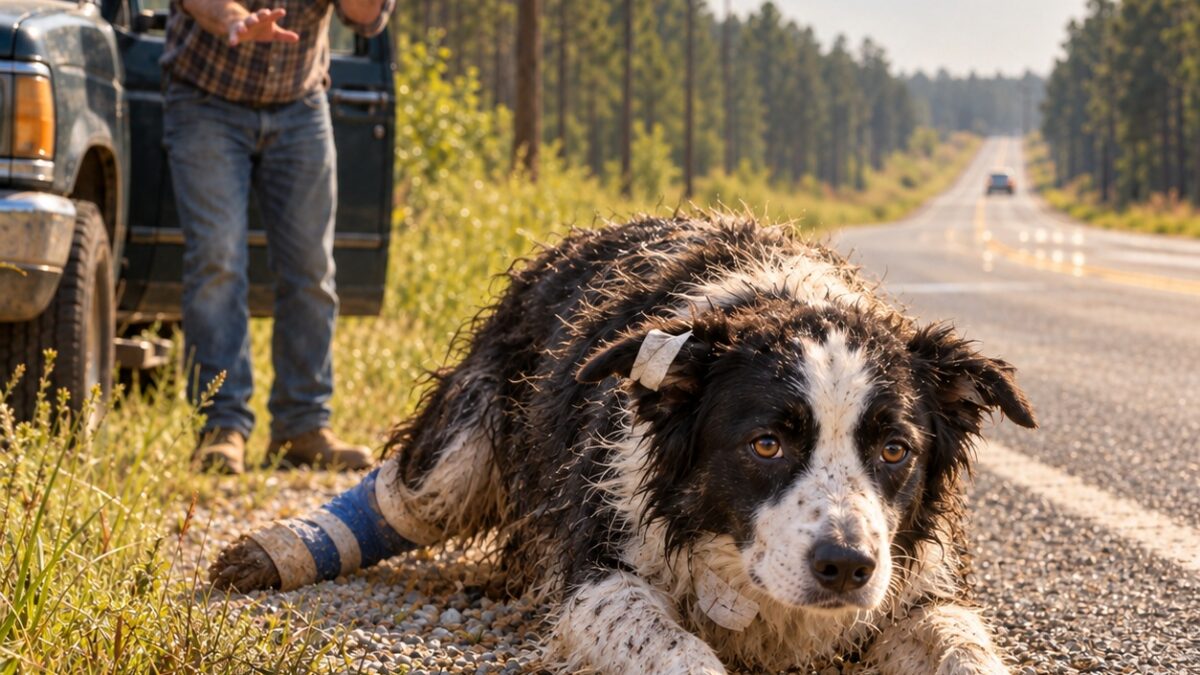
His damaged hind leg barely touched the ground.
Each step was an uneven three-beat struggle.
Front.
Front.
One rear leg carrying nearly everything.
The broken leg hanging uselessly.
His veterinary dressing was gone.
The wounds on his shoulder had reopened.
Blood and dust had dried into the fur.
His paws were raw from the pavement.
He looked thinner than he had four days earlier.
And he was still moving north.
I stopped the car.
For a moment, I could not get out.
I just watched.
Four miles.
At least four miles from my house back to this highway.
And then farther.
On a broken leg.
In July.
With fresh stitches.
No food I knew of.
Not enough water.
Moving in one direction.
The witness looked at me.
“That’s him, right?”
I nodded.
His torn ear made identification easy.
So did the sutures under his jaw.
There was no doubt.
I got out.
The dog heard the door.
He turned.
For one second, he froze.
Then his eyes went past me.
Toward the road.
Toward the north.
I crouched.
“Hey.”
He did not come.
I moved slowly.
“Easy.”
His body trembled.
He tried to take another step.
His damaged leg buckled.
He nearly fell.
That was when I stopped being afraid he would run from me.
He had almost nothing left with which to run.
I reached him.
My hands moved under his chest.
He stiffened.
Then sagged.
He was lighter.
Noticeably.
I could feel ribs.
His paws were warm and raw.
When I lifted him, his head turned toward the highway.
Even in my arms, he looked north.
The witness opened my vehicle.
We placed him inside.
He tried to sit up.
Could not.
I kept one hand against his chest.
“You’re done.”
He did not understand.
“You don’t have to keep going.”
His eyes stayed on the windshield.
The veterinarian’s face changed the second she saw him.
“What happened?”
“He escaped.”
“For four days?”
“Yes.”
She looked at the leg.
Then at me.
“He walked on this?”
“Yes.”
“How far?”
“At least four miles to get back to the highway.”
I swallowed.
“And then north.”
She stopped.
“North?”
I told her about the vehicle.
The direction.
The witness seeing him on the same route.
The veterinarian became very quiet.
She examined him.
The broken tibia had shifted.
The first plan—a splint and strict rest—was no longer enough.
His walking had displaced the fracture.
The open abrasions were infected.
Some sutures under the jaw had pulled.
His paw pads were worn raw.
He was dehydrated.
Underweight compared with four days earlier.
The veterinarian shook her head.
“I honestly don’t know how he covered that distance.”
Neither did I.
Four miles may not sound like much for a border collie.
For a healthy dog, it is not.
For him, every yard had been an act of force.
One broken tibia.
Fresh surgery.
Open skin.
Summer pavement.
No person walking beside him.
No water bowl.
No shade guaranteed.
And still he moved.
The veterinarian looked through the treatment-room window.
He was lying on the table now.
Exhausted.
Eyes still open.
Then she said something I have never forgotten.
“He can’t make sense of being abandoned.”
I looked at her.
She continued quietly.
“All he has is the direction they disappeared.”
That sentence changed how I saw everything.
The escape.
The broken screen.
The four days.
The highway.
I had assumed he was frightened by my house.
Trying to flee confinement.
Maybe that was part of it.
But now the path made terrible sense.
He was not moving randomly.
He had returned to the last place his old life still made sense.
The highway.
Then he followed the only information he had.
They went that way.
So he went that way too.
We scheduled surgery.
Pins would be needed to stabilize the fracture.
The veterinarian warned me the recovery would be harder now.
Longer.
There was also infection to treat.
Wounds to clean.
Paw pads to protect.
I signed everything.
This time there was no discussion about where he would go afterward.
“He comes home with me.”
I said.
The veterinarian looked up.
“Again?”
“Yes.”
I understood the question.
“He’ll need real confinement.”
“I know.”
“No window access.”
“I know.”
“More secure crate.”
“I know.”
She watched me.
I added:
“And I’m not leaving him to figure out alone why nobody came back.”
That was the moment he stopped being a rescue case in my mind.
He was becoming family.
He still did not have a name.
But he had somewhere to belong.
The operation went well.
The surgeon secured the fracture.
His ear survived, though it would never look exactly as it had before the highway.
His shoulder wounds were cleaned repeatedly.
Infection treated.
Paws bandaged.
When I brought him home the second time, I changed everything.
No unused bedroom.
No closed door.
I set up his recovery space where he could see me.
If I was in the kitchen, he could hear me.
If I sat in the living room, he could see my chair.
At night, I slept close.
I wanted him to learn something his old life had failed to teach him.
A person can leave a room and come back.
A door can close without becoming abandonment.
A car can drive away and return.
He did not need to follow every disappearing thing.
At first, he watched constantly.
If I stood, his eyes opened.
If I picked up keys, his head lifted.
If a car passed outside, his ears moved.
But he could not chase anything now.
Surgery had made movement impossible enough that, in a strange way, his body forced his mind to stop.
That was not peace.
Not yet.
It was only stillness.
So I gave the stillness a routine.
Breakfast.
Medication.
Wound care.
Rest.
Short supported bathroom breaks.
Dinner.
Sleep.
Same voice.
Same hands.
Same house.
Again.
Again.
Again.
I started calling him Compass because of the highway.
Not as a joke.
Not really.
For four days, injured beyond anything I would have believed possible, he had followed one direction.
North.
The direction his people had disappeared.
His whole world had been reduced to a bearing.
I told a friend:
“He needs a name.”
She asked:
“What about something normal?”
I looked at him.
Crooked repaired ear.
Bandaged leg.
Pale line under his chin beginning to heal.
A dog who had broken out of a house and walked back toward a moving vehicle that had thrown him onto asphalt.
“Compass.”
I said.
The name stayed.
The first few weeks were difficult.
Compass did not trust rest.
That sounds strange.
But some dogs understand pain more easily than safety.
Pain gives clear information.
Do not put weight there.
Do not move that way.
Safety requires prediction.
Will you still be here tomorrow?
Will food still come?
Will the door open?
Will the person who touches me gently become the person who disappears?
Compass watched.
I gave him no speeches.
Just repetition.
The veterinarian had prescribed medication at specific times.
I never missed one.
Wounds cleaned every day.
I did it slowly.
The shoulder abrasion was ugly.
Pink tissue.
Dark scabs.
Small bits of damaged skin.
The first time I cleaned it after he came home, he flinched.
I stopped.
Waited.
“Sorry.”
He looked at me.
Then lowered his head.
I continued.
His ear bothered him too.
The original shape could not be restored fully.
It healed unevenly.
One side of his face would always tell part of the story.
I hated that at first.
Not because it made him less beautiful.
Because every mark reminded me someone had done this.
Eventually, the scars stopped looking like damage and started looking like Compass.
That took time.
His leg healed more slowly.
Pins held the fracture.
Strict rest.
Follow-up imaging.
Then carefully controlled movement.
The veterinarian told me:
“He may always have an uneven gait.”
“How bad?”
“We won’t know until he’s farther along.”
“Will he hurt?”
“Not necessarily.”
“But the leg may never move exactly like the other one.”
I looked at Compass.
He was watching a truck pass the clinic window.
His head turned until it disappeared.
I said:
“He doesn’t need to be perfect.”
The veterinarian smiled.
“No.”
“He needs to be comfortable.”
That became the goal.
Not undoing the highway.
Not making his body look untouched.
Comfortable.
Safe.
Alive.
The first time I had to leave him alone for a short appointment, I hated it.
I stood by the front door holding my keys.
Compass lay in his recovery space.
The moment the keys moved, he raised his head.
There it was.
The road inside him.
Movement means leaving.
Leaving means gone.
I crouched.
“I’ll be back.”
I knew the words were useless.
He had once belonged to people who probably used ordinary reassuring voices too.
Words were not evidence.
So I left.
Ten minutes.
That was all.
I drove around the block.
Sat in my car for five minutes like an idiot.
Then returned.
Compass was exactly where I left him.
Eyes open.
Watching the door.
I stepped inside.
His tail moved once.
Not much.
I sat nearby.
No dramatic greeting.
No apology.
I wanted the lesson to be boring.
Person leaves.
Person comes back.
Nothing terrible happens.
The next time, fifteen minutes.
Then twenty.
Eventually a grocery run.
Every return became a tiny contradiction to the highway.
Not every car disappears forever.
Not every person who steps outside is abandoning you.
That learning took months.
Compass never became a dog who ignored roads.
I learned that early.
When his leg was strong enough for short leash walks, he walked carefully.
Uneven rhythm.
Tap.
Tap.
Soft hesitation.
Tap.
The repaired leg gave his footsteps a gentle off-beat sound on hard surfaces.
At first, I heard it constantly.
Every uneven step made me think:
Highway.
Fracture.
Pins.
But Compass did not appear embarrassed by it.
Dogs are often kinder to their changed bodies than humans are.
He simply walked.
So I learned to hear the gait as his.
Not wrong.
His.
Cars were different.
A passing vehicle could pull his attention instantly.
Not every one.
But enough.
He would stop.
Watch.
Not bark.
Not lunge.
Just follow it with his eyes.
If the vehicle disappeared around a bend, Compass might remain still for another second or two.
Then continue.
I never knew what he remembered.
It is tempting to create a human sentence.
Is that them?
Maybe.
Maybe not.
I stopped pretending certainty.
All I knew was that roads mattered to him.
And I respected that.
His paw pads healed.
The shoulder grew new fur.
Not exactly the same color.
A lighter patch remained where the worst abrasion had been.
The scar beneath his jaw faded to a pale line.
His ear stayed visibly altered.
His hind leg grew stronger.
Month by month, his body became less medical.
Bandages disappeared.
Appointments became less frequent.
Medication changed.
Eventually, the pins had done their job.
But the uneven gait stayed.
The veterinarian had been right.
On hard floors, I could identify Compass without seeing him.
Tap.
Tap.
Pause.
Tap.
Sometimes I would hear him coming down the hallway and smile before he entered the room.
The sound that once broke my heart became one of the sounds that made my house feel occupied.
He chose the front window.
I did not teach him that.
There was a wide patch of floor beside it where morning light came in.
Compass began lying there.
Face toward the road.
At first, I worried.
Was he unhappy?
Waiting?
Planning another escape?
I checked windows obsessively.
Screens.
Locks.
Doors.
The first escape had taught me humility.
This time there would be no four-day search.
But Compass never tried again.
He simply watched.
Cars came.
Cars went.
He did not jump up.
Did not whine.
Did not pace.
He lay still.
Eyes moving.
Sometimes ears.
That was all.
There was something in his stillness that resembled waiting.
Even after the frantic part had faded.
Even after the highway became months behind us.
I once sat beside him.
A pickup passed.
Compass followed it with his eyes.
“Not them.”
I said.
Then immediately regretted assigning him a thought I could not know.
So I corrected myself.
“You’re here.”
That I knew.
He looked at me.
Then lowered his head.
People who heard the story often asked:
“Why would he go after them?”
Usually with anger.
“They threw him out.”
“They hurt him.”
“Why would he still want them?”
That question misunderstands dogs.
Maybe humans too.
Attachment does not shut off because somebody proves unworthy of it.
Compass did not know the moral facts we knew.
He did not understand betrayal in legal language.
He had a before.
Car.
People.
Smells.
Routine.
Then asphalt.
Pain.
Ditch.
Strangers.
Clinic.
Another stranger’s house.
His old world disappeared north.
So he followed north.
That is not stupidity.
It is attachment looking for an explanation.
The veterinarian had said:
“He can’t make sense of being abandoned.”
Exactly.
Humans sometimes spend years doing the same thing.
Going back mentally.
Following the direction someone left.
Trying to find the moment where the story still makes sense.
Compass just did it literally.
On a broken leg.
That was why I never punished him for escaping.
How could I?
The escape injured him badly.
It created more surgery.
More cost.
More pain.
I still could not be angry.
He had not disobeyed me.
He had acted on the strongest information his world contained.
They went that way.
He followed.
My job was to give him better information.
You live here now.
Food comes here.
Rest happens here.
Hands help here.
Doors open here.
People return here.
One day at a time.
The first time Compass slept through a car passing outside, I almost missed it.
I was reading at the kitchen table.
A vehicle went by.
Usually, his ears would lift.
That time, nothing.
He slept.
I looked at the window.
Then at him.
His chest moved slowly.
Deep.
Peaceful.
For some ridiculous reason, my eyes filled.
I did not wake him.
That would have defeated the point.
I sat there thinking:
Maybe that is what healing looks like.
Not forgetting the road.
Being tired enough of watching it to sleep.
He began playing later.
Not quickly.
At first, toys meant nothing.
I offered a ball.
He looked at it.
I rolled it.
Nothing.
I tried a rope.
Nothing.
Food puzzle.
That got interest.
Border collie.
Of course.
His brain still wanted something to solve.
I hid treats in simple places.
Under a towel.
Inside a puzzle toy.
Behind a cup.
His eyes became sharper.
His body more animated.
That was the first time I saw him engaged with something that had nothing to do with leaving.
No door.
No road.
No disappearing car.
Just:
Where did the treat go?
A small problem.
A solvable problem.
I loved watching it.
As his leg improved, I added short walks.
The first block took forever.
Partly because he moved cautiously.
Partly because Compass inspected everything.
Pine needles.
Grass.
Mailboxes.
Drainage grates.
He especially disliked loose gravel.
I understood why.
The witness had followed blood drops across loose stones.
Perhaps the texture hurt his paws.
Perhaps I was projecting again.
Either way, I let Compass choose pavement or grass whenever possible.
We were not training for distance.
We were practicing having somewhere to go that was not north.
That thought stayed with me.
For four days, his entire direction had been determined by people who left him.
Now he could choose directions for other reasons.
Shade.
Smell.
A squirrel.
A path.
Home.
Compass was becoming a compass again, but not one fixed to the old bearing.
He had more than one direction now.
That felt important.
Someone once suggested renaming him.
“Maybe Compass reminds you too much of what happened.”
I looked at the dog.
“No.”
The name did not mean abandonment to me.
It meant determination.
Yes, he followed the wrong people.
But he also survived an impossible journey.
And eventually, his sense of direction changed.
The name grew with him.
That happens.
The man who originally found him visited once.
I invited him.
He had asked about Compass several times through the rescue.
When he came to the house, Compass watched him.
No obvious recognition at first.
The man crouched.
“Hey, buddy.”
Compass approached.
Slowly.
Sniffed him.
Then leaned slightly into his hand.
The man’s eyes filled.
“That’s him.”
“Yes.”
“He looks good.”
“He is.”
He touched the repaired ear carefully.
“I thought he was dead when he hit the road.”
His voice broke.
“I thought I watched somebody kill him.”
I sat beside him.
“You stopped.”
“I almost didn’t.”
That surprised me.
He looked ashamed.
“It happened so fast.”
“I thought maybe it was trash.”
“Then something in me said go back.”
He looked at Compass.
“I keep thinking what if I hadn’t.”
I knew that kind of question.
“What if” has no bottom.
I said:
“You did.”
He nodded.
Compass rested near his feet.
That was enough.
I never learned who had been in the vehicle.
That is important.
The story has no arrest I can honestly give you.
No dramatic confession.
No courtroom.
No explanation.
I do not know who pushed Compass out.
I do not know why.
I do not know whether it was somebody he had lived with for years or days.
I do not know whether they ever looked back.
The witness saw a dog thrown from a moving vehicle.
The vehicle did not stop.
Those are the facts.
I will not invent motive to make the story cleaner.
What happened was bad enough without imagination.
Sometimes not knowing made me furious.
Especially when cleaning his wounds.
During rehabilitation.
Watching him limp.
Seeing the crooked ear.
Someone had made a decision that lasted perhaps seconds.
Open window.
Push.
Drive.
Compass carried that decision in his body long afterward.
That is the unfair arithmetic of harm.
The person causing it may spend seconds.
The injured one spends months learning how to walk differently.
I could not change that.
So I focused on the part I could influence.
What would the months become?
Only aftermath?
Or life?
Compass answered by living.
He became affectionate gradually.
Not clingy.
Not at first.
He liked being near me but not always touched.
I respected that.
Sometimes he lay beside my chair.
Sometimes across the room.
At night, he chose a bed near the front window for months.
Then one evening, I woke around two and heard his uneven steps.
Tap.
Tap.
Pause.
Tap.
He came into my bedroom.
Stopped.
Looked at me.
I lifted one side of the blanket.
“You coming up?”
He could not jump well.
I had a low bench beside the bed by then.
He used it.
Slowly.
Turned.
Lay near my feet.
That was the first night.
Afterward, not every night.
His choice.
I liked that.
Trust is better when it has options.
One morning, I woke and Compass was watching me.
His repaired ear tilted slightly differently from the other.
That crookedness made his expression look permanently curious.
I smiled.
“Morning.”
Tail against mattress.
Tap.
Tap.
A different uneven rhythm.
No urgency.
No road.
Breakfast.
That was all.
Ordinary life had reached him.
The rescue organization received interest in his story after people heard what happened.
We were careful.
I did not want Compass turned into spectacle.
I had seen enough rescue stories where the suffering becomes the animal’s permanent identity.
Thrown from car.
Broken leg.
Highway dog.
Yes.
Those things happened.
But Compass also liked cheese too much.
Stole socks.
Ignored expensive toys.
Preferred cardboard.
Got suspicious when rain started.
Had an obsession with one particular patch of sunlight.
Those details mattered more to me as time passed.
Trauma is something that happened to him.
It is not all he is.
His favorite place remained the window.
Today, he still lies there.
Face toward the road.
Passing cars do not make him leap up.
He rarely shows much excitement.
He watches.
Quietly.
Sometimes I stand behind him.
Look over the same road.
A sedan.
Truck.
Motorcycle.
Delivery van.
They pass.
Compass’s eyes follow some.
Ignore others.
I once told someone:
“I don’t think he searches for those people the way he once did.”
That is true.
At least, I do not believe he does.
The desperate part is gone.
The part that pushed through a crate and screen.
The part that walked miles on a displaced fracture.
That is gone.
But some part of him may always keep an eye on the road.
I have stopped needing that to disappear.
Healing does not always mean returning to the version of yourself from before the injury.
Compass cannot do that physically.
His gait proves it.
His ear proves it.
The pale patch on his shoulder.
The faint scar under his jaw.
All permanent.
Why would I demand his mind become unmarked when his body did not?
Instead, I ask a different question.
Can he live comfortably with what remains?
Yes.
Can he sleep?
Yes.
Play?
Yes.
Walk?
Yes.
Trust?
More than before.
Can he watch a road without following every car?
Yes.
That is enough.
More than enough.
There was one day when we drove past the stretch of highway where he had been found.
Not intentionally.
A detour.
I recognized the drainage channel before I realized where we were.
My stomach tightened.
Compass sat in the back seat.
Window cracked.
I looked at him in the mirror.
His head lifted.
He watched outside.
I considered turning around.
Then thought:
No.
The road is not sacred.
It is a road.
We continued.
Compass watched.
No panic.
No whining.
No attempt to climb forward.
We passed the place.
Then the next mile.
Then another.
At an intersection, I turned west.
Compass lowered his head.
That was all.
I pulled over several miles later.
Not because he needed it.
Because I did.
I sat in the car with both hands on the wheel.
Compass moved forward enough to put his head between the seats.
I touched his muzzle.
“We went a different direction.”
He licked my wrist.
Probably because it tasted like salt.
Still counted.
For months, I had thought his story was about loyalty.
A dog thrown away still trying to go back.
People love that interpretation.
Dogs are loyal beyond reason.
Maybe.
But the word loyalty can hide something darker.
Compass was not making a noble moral decision on the highway.
He was confused.
Hurt.
Attached.
Searching.
The people who left represented the only familiar direction in a suddenly broken world.
Calling it loyalty alone makes the suffering sound beautiful.
It was not beautiful.
It was heartbreaking.
The beautiful part came later.
When he learned loyalty did not have to mean chasing someone who hurt him.
It could mean resting beside someone who stayed.
I learned something from that too.
Humans romanticize persistence.
Keep going.
Never quit.
Fight for what you love.
Compass nearly destroyed his leg following that instinct.
Sometimes survival means stopping.
Sometimes the brave direction is not after.
It is away.
Home.
Rest.
Recovery.
That is one reason I like his name now.
A compass does not tell you where you should go.
It tells you where you are facing.
You still have to choose.
Compass eventually got choices again.
The veterinarian who treated him saw him months later.
She watched him cross the clinic floor.
Tap.
Tap.
Pause.
Tap.
She smiled.
“That’s better than I expected.”
“So he’s okay?”
“He’s more than okay.”
She crouched.
Compass approached.
She examined the leg.
The ear.
Scar.
Then scratched his chest.
“Still stubborn?”
“Very.”
“Good.”
I asked if the uneven gait would ever disappear completely.
She shook her head.
“Probably not.”
I looked at him.
He was investigating a cabinet.
“That’s fine.”
And it was.
Not resignation.
Acceptance.
There is a difference.
The scar beneath his chin became hard to see unless you knew where to look.
I knew.
My fingers found it sometimes when rubbing his neck.
A thin raised line.
The shoulder patch stayed lighter.
His ear carried more obvious history.
People occasionally asked:
“What happened to his ear?”
I decided how much to say based on the person.
Sometimes:
“Old injury.”
Sometimes the whole story.
Compass did not care.
He would stand there while strangers discussed the worst day of his life as though he were not present.
Eventually I stopped doing that around him as much.
Again, he could not understand the words exactly.
But I wanted his identity in my home to be larger than the highway.
I started introducing him simply.
“This is Compass.”
Not:
This is the dog who was thrown from a car.
He had earned the right to meet people without a tragedy attached to his name.
The original witness once asked whether Compass had forgiven the people in the vehicle.
I did not know how to answer.
Forgiveness is a human framework.
Compass did not file moral judgments.
He remembered patterns.
Safety.
Threat.
Absence.
Return.
Maybe that is cleaner.
He did not need to forgive.
He needed to stop searching.
Over time, he did.
Mostly.
That mostly matters.
I refuse to pretend every trace vanished.
When a car slows near the house, Compass sometimes raises his head faster.
If a door slams outside, he may watch.
At the window, he still has that quiet focus.
There are moments I see the old highway dog.
Then he hears me in the kitchen.
Or smells dinner.
Or notices the sun moved to his favorite floorboard.
And he turns away.
That ability to turn away may be the entire story.
Once, the road held his whole future.
Now it is only something outside the window.
On particularly hot July afternoons, I think about those four days.
The pavement.
Raw paws.
Broken tibia.
Infection.
Every step.
I still cannot understand how he did it.
The veterinarian could not either.
Maybe adrenaline.
Maybe instinct.
Maybe attachment.
Probably all of it.
What matters is not turning the endurance into something I expect from him now.
He proved enough.
He does not need to be strong every day because he survived something terrible once.
Sometimes survivors deserve to be lazy.
Compass is excellent at it.
He sleeps upside down now.
That took months.
Belly exposed.
Legs relaxed.
The first time I saw it, I stood in the doorway.
Dogs do not make philosophical statements through sleeping positions.
I know.
Still, a body that once moved injured along a highway was now completely vulnerable on my rug.
That meant something to me.
I took no photograph.
I simply watched for a few seconds.
Then let him sleep.
One evening a thunderstorm rolled through.
Power flickered.
Compass became restless.
Not terrified.
Restless.
I sat on the floor.
He came close.
Leaned against me.
I thought about the ditch.
How alone he had been.
Then I stopped.
That was my memory, not necessarily his in that moment.
I rubbed his chest.
Storm passed.
No symbolism required.
Sometimes comfort is enough.
My house changed around him.
Rug runners on slick floors because of his uneven leg.
Small ramp.
Bed near window.
Water bowl in more than one room.
The furniture arrangement changed slightly so he had clear paths.
None of that felt like sacrifice.
It felt like living with someone whose body had needs.
People do that for one another constantly.
Dogs deserve it too.
I became protective of his leg without becoming fearful of it.
That took time.
At first, every stumble made me panic.
Now I watch.
Does he recover?
Yes.
Good.
If not, help.
That is healthier for both of us.
Compass does not need me turning every awkward step into an emergency.
His body belongs to him.
Not my anxiety.
I think the hardest thing about rescue is accepting that safety afterward does not erase what came before.
We want a clean transformation.
Before:
abandoned.
After:
happy.
But living creatures carry continuity.
Compass came home with the highway.
For a while, the highway lived in every window.
Every car.
Every door.
Then slowly, other things accumulated.
My voice.
Food bowls.
Walks.
Vet visits that ended with coming home.
Naps.
Rain.
Sun.
Puzzle toys.
Morning routines.
The highway became one memory among many.
That is perhaps the best healing can do.
Not erase.
Outnumber.
I like that word.
Outnumber.
One terrible road.
Hundreds of safe mornings.
One disappearing vehicle.
Hundreds of returns.
Four days alone.
Years beside somebody.
Eventually, safety has more evidence.
That is what I wanted for him.
Today, if I leave for groceries, Compass may watch from the window.
When I return, he is often still there.
But he no longer looks like an animal preparing to chase.
His tail moves.
I open the door.
He comes over at his uneven pace.
Tap.
Tap.
Pause.
Tap.
I touch his repaired ear.
“Hey, buddy.”
That is the reunion.
No desperation.
No collapse.
Ordinary.
The most beautiful kind.
Sometimes I wonder what would have happened if the witness had kept driving.
I do not stay with that thought long.
He did not.
He stopped.
Walked back nearly two hundred yards.
Followed blood.
Made a call.
Four days later, he stopped again.
That man saved Compass twice.
Not because he had special training.
Because he noticed.
Then acted.
Rescue often begins there.
Not with expertise.
Attention.
The veterinarian saved him too.
Twice.
First by stabilizing the fracture and treating the wounds.
Then by repairing the damage his four-day journey caused.
She never judged him for walking.
Neither did I.
A dog does not understand orthopedic instructions.
He understood loss.
And eventually, I stopped calling myself only his foster.
The paperwork came later.
The decision came earlier.
When I picked him up from the highway the second time, lighter and infected and still looking north, something settled inside me.
He had already spent four days trying to return to people who had disappeared.
I was not going to make him spend another day wondering whether he had somewhere else to go.
Compass became mine.
More accurately, I became his person.
I do not know whether he ever consciously understood that shift.
Maybe dogs do not need declarations.
They understand repetition.
The same hand.
Same room.
Same food.
Same bed.
Same return.
One day the temporary becomes normal.
One day the guest stops waiting to be sent away.
One day the road outside becomes scenery.
That is enough.
There are still evenings when Compass lies near the front window and watches headlights move between trees.
I sit behind him sometimes.
Not too close.
We watch together.
One car.
Another.
A truck.
Each appears.
Passes.
Disappears.
Compass stays.
That is the part I notice.
Not that he watches.
That he stays.
Years ago, or rather in July 2023, staying was not something he knew how to do.
The only direction he trusted was the direction somebody else had gone.
Now he can let the entire world drive past.
He has somewhere to remain.
That is the difference.
I will never know what he expected to find at the end of that highway.
Maybe a familiar car.
A familiar smell.
A person.
Maybe nothing that specific.
Maybe movement itself felt better than confusion.
What I know is what he found instead.
Another rescue.
Surgery.
A crooked ear.
A permanently uneven step.
A lighter patch of fur.
A name.
A window.
A home.
And me.
I sometimes hesitate to include myself because rescue stories can become too centered on the human.
Compass did the surviving.
He walked.
He endured.
His body healed.
But I was there for the part after.
That matters too.
Not heroically.
Daily.
Food.
Medicine.
Driving.
Cleaning wounds.
Coming home.
Safety is often repetitive labor.
I am proud of that work.
Not because it makes me his savior.
Because it made me reliable.
Reliability was what he needed.
If I could tell Compass one thing he fully understood, it would not be:
You were abandoned.
Or:
You survived.
It would be:
You do not have to follow them anymore.
There is nothing you need to prove on that road.
There is no car you need to catch.
No explanation waiting four miles ahead.
You can rest.
Maybe his body already knows.
The evidence is in the window.
Cars pass.
Compass watches.
Then, eventually, he closes his eyes.
That is enough for me.
People sometimes look at him and notice the limp first.
I notice it too.
Hard not to.
But now it is simply his rhythm.
Tap.
Tap.
Pause.
Tap.
The sound of Compass moving through the house he nearly never had.
The damaged ear hears my refrigerator.
The scarred jaw holds a stolen sock.
The lighter shoulder patch warms in the afternoon sun.
The paw pads that once bled on July pavement now rest on a rug.
Scars are not beautiful because suffering is beautiful.
Suffering is not beautiful.
What is beautiful is that the injured body gets ordinary things afterward.
That is different.
Compass has no interest in inspiring anybody.
Good.
He wants breakfast.
He wants the best patch of sunlight.
He wants me to open the door.
He wants whatever I am eating.
Those are excellent ambitions.
I hope they remain the largest problems in his life.
When people ask me why I named him Compass, I tell them the simple version.
“He walked back toward the direction they went.”
That usually makes people emotional.
Then I add:
“But the name means something different now.”
“What?”
“He knows where home is.”
That is the version I prefer.
I sometimes picture him during those four days.
I try not to.
There is no value in torturing myself with details I did not witness.
But one image returns.
Compass reaching the highway.
Perhaps smelling hot asphalt.
Recognizing the road.
Stopping.
Then choosing north.
That choice nearly cost him the use of his leg.
At the time, it was the only direction he understood.
Today he has another.
When we walk, eventually I say:
“Home.”
Compass turns with me.
No resistance.
No look north.
We walk back together.
Tap.
Tap.
Pause.
Tap.
That is his compass now.
Not the disappearing car.
Me.
The house.
The window.
The bed.
The life behind us.
I cannot rewrite July 2023.
I cannot make the vehicle stop.
Cannot put him safely inside it.
Cannot prevent his body from hitting asphalt.
Cannot stop him escaping my house that first night.
Cannot take those four days off his leg.
I used to wish I could.
Now I spend less time bargaining with the past.
Because Compass does not live there every minute.
Why should I?
The veterinarian once said:
“He can’t make sense of being abandoned. All he has is the direction they disappeared.”
For a long time, that sentence was the saddest thing I knew about him.
Now I hear the second half differently.
That was all he had then.
A direction.
Today he has more.
He has routines.
People.
Rooms.
Smells.
A name.
A bed.
Familiar hands.
The sound of my key at the front door.
The knowledge that a vehicle can leave and return.
The knowledge that he can stay behind and still belong.
That is a lot of evidence.
Enough to build a life.
Tonight, Compass is beside the front window.
Of course he is.
The glass reflects the room behind him.
My lamp.
The couch.
His bed.
Me.
Outside, a vehicle passes.
His eyes follow it.
The taillights disappear through the pines.
Compass waits perhaps two seconds.
Then lowers his head onto his paws.
Does not stand.
Does not follow.
Does not search.
Just breathes.
I sit behind him and listen to the quiet uneven click of his nails when he shifts position.
His body still carries the highway.
Maybe some part of his mind always will.
But the highway does not carry him anymore.
That is the difference.
Someone once pushed him from a moving car and disappeared north.
Compass nearly destroyed himself trying to follow.
Now cars disappear every day.
He lets them.
Because eventually, after all those miles, all that pain, all that waiting, he found something stronger than the direction they left.
He found a place worth staying.

