PART2:She Waited Outside Her Owner’s Locked Gate for a Week—Then Gave Birth to 10 Puppies in the First Safe Place She Had Left
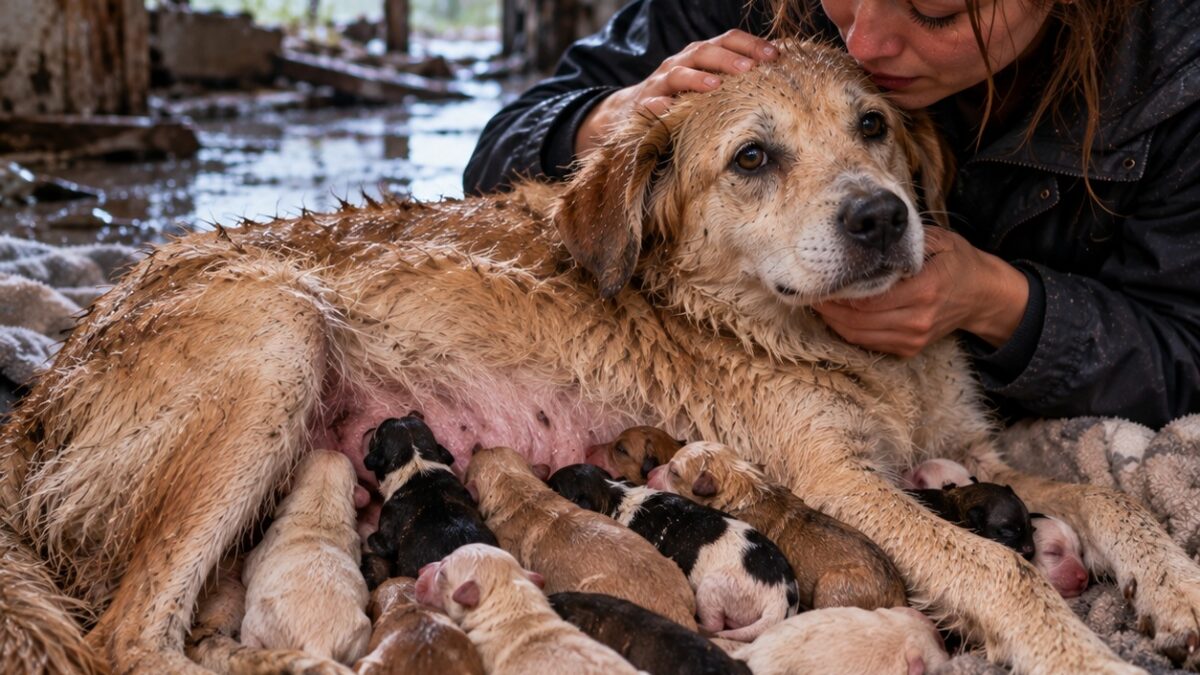
PART2
There are rescue moments when trust has to develop slowly.
This was not one of them.
I would have loved to sit in that room for an hour and let her choose us.
Labor does not care about ideal behavioral protocols.
Neither does cold rain.
She needed a veterinarian.
Immediately.
So we approached carefully.
One person at her head.
One near the rear.
Blanket ready.
No sudden movements.
“Easy, mama.”
I kept saying it.
“Easy.”
She tensed when my hand touched her shoulder.
But she did not snap.
Did not fight.
She looked at me.
Then, impossibly, let us lift her.
That trust hurt.
Not because she knew us.
She didn’t.
But she had spent a week being denied by the person she did know, and now complete strangers were carrying her out of the only shelter she had left.
Sometimes animals surrender because they are afraid.
Sometimes because they are exhausted.
Sometimes because somewhere in the nervous system, they recognize the difference between hands pushing away and hands supporting weight.
I do not know which it was.
I only know she let us help.
Her belly was enormous when we lifted her.
Not unhealthy-looking in the way a tumor is enormous.
Full.
Heavy.
Alive.
Puppies.
You could feel the significance of every movement.
We supported her carefully.
No pressure against the abdomen.
No unnecessary jostling.
Outside, rain hammered the roof.
The sound intensified as we reached the doorway.
For a second, she resisted.
The open world.
Rain.
Vehicle.
Unknown.
I stroked the side of her neck.
“We’re going somewhere dry.”
She could not understand.
We went anyway.
The drive to the veterinarian felt longer than it was.
Every few minutes, I turned.
She lay on blankets in the back.
Breathing heavily.
Not active labor yet.
But close.
Very close.
Her eyes remained open.
Watching.
Once, she shifted and groaned softly.
My heart stopped.
“Is she contracting?”
The rescuer beside her watched.
“Maybe.”
We called the clinic.
“We’re coming with a pregnant female.”
“How far along?”
“Due any time.”
“How many puppies?”
“Unknown.”
“Any discharge?”
“Not that we can see.”
“Any active straining?”
“Not yet.”
“Bring her straight in.”
Traffic suddenly became offensive.
Every red light.
Every slow truck.
Every driver unaware that ten lives might already be preparing to arrive behind us.
I kept telling myself:
She survived a week outside.
Just get her there.
At the clinic, we moved fast.
No waiting room.
Straight to examination.
The veterinarian checked her temperature.
Heart rate.
Hydration.
Abdomen.
General condition.
Then imaging to assess the pregnancy.
Puppies.
Many.
More than I expected.
“Ten?”
The veterinarian counted carefully.
“Looks like ten.”
I stared at the screen.
Ten.
Ten little skeletons.
Ten spines.
Ten heads.
Ten hearts depending on the dog lying beside us.
That number changed the scale of everything.
She was not simply pregnant.
She was carrying an entire litter large enough to exhaust even a healthy, well-fed mother.
And she had spent a week outside.
The veterinarian said she was close.
Very close.
There was no reason to send her anywhere else.
We prepared a clean area.
Blankets.
Towels.
Warmth.
Supplies.
Everything needed if labor progressed normally.
And everything we hoped not to need if it did not.
Because labor can become emergency quickly.
A puppy too large.
Poor position.
Maternal exhaustion.
Failure to progress.
Bleeding.
Retained puppy.
Ten opportunities for something to go wrong.
That reality hung in the room even though nobody said it dramatically.
The mother dog settled onto fresh bedding.
At first, she looked confused by it.
Soft.
Dry.
Warm.
She sniffed once.
Turned.
Lowered herself.
Then looked toward the door.
That broke me.
I wondered if she was still thinking about the gate.
Dogs do not narrate abandonment, but they do remember places.
Maybe part of her still expected someone familiar to appear.
No one did.
Instead, we stayed.
For the next hours, she became restless.
Shift.
Stand.
Turn.
Lie down.
Pant.
Get up.
Circle.
Lie again.
Classic pre-labor behavior.
Her body knew exactly what it was preparing to do even if her circumstances had been chaos.
Nature can be terrifyingly determined.
Outside, rain continued.
Inside, we dried more blankets.
Checked supplies.
Watched the clock.
I sat several feet away.
No need to crowd.
She kept looking at us.
Not panicked.
Alert.
Sometimes I offered water.
She drank.
Sometimes she rested.
Then another contraction seemed to pass through her.
Her abdomen tightened.
Her face changed.
Then relaxed.
Closer.
One of the technicians asked:
“Do we have a name?”
We didn’t.
The neighbors had not given us one we could confirm.
I hesitated.
Names matter emotionally more to humans than dogs at first, but they also shift something in rescue.
A patient becomes an individual.
A case becomes someone.
I called her Rosie.
It fit the softness around her eyes.
“Rosie.”
Her ears moved.
Maybe coincidence.
Still.
“Okay, Rosie.”
I smiled.
“We’re here.”
Four hours after we arrived, labor truly began.
Rosie stood.
Turned.
Lay down again.
Straining.
The room became instantly focused.
No panic.
No unnecessary talking.
We watched the timing.
The intensity.
Her breathing.
She worked.
And worked.
Then the first puppy appeared.
There are few things in rescue more emotional than a newborn puppy taking a first breath.
Especially when you know where that first breath almost happened.
Wet abandoned floor.
Rain.
No towels.
No heat.
No one watching for complications.
Instead, the first puppy arrived on clean bedding beneath trained eyes.
Rosie turned immediately.
Instinct took over.
She licked.
Cleaned.
Nudged.
The tiny body moved.
A sound.
Alive.
I exhaled.
Only then realized I had been holding my breath.
“One.”
Someone said it quietly.
Nine more.
The first puppy found warmth near Rosie.
We helped as needed but tried not to interfere more than necessary.
A good mother often knows what to do.
Rosie did.
That moved me.
She had been denied a safe place.
Still, she knew how to make one with her own body.
The second puppy came.
Healthy.
Movement.
Breathing.
Rosie cleaned.
We dried where needed.
Warmth.
Check.
Another.
Time changed.
Labor has its own rhythm.
Waiting between contractions.
Then sudden intensity.
Then another life.
The room alternated between concentration and brief relief.
Puppy three.
Healthy.
Puppy four.
Healthy.
Each time, I thought:
Please keep going.
Please keep having enough strength.
Because ten puppies is a tremendous labor burden.
Rosie had not eaten and rested under ideal conditions for the week before.
Her body was using whatever reserves remained.
Puppy five.
Halfway.
Rosie looked exhausted.
Her tongue hung slightly as she panted.
I offered water.
She drank.
We gave her a chance to rest.
The puppies already born pressed against her belly.
Tiny.
Blind.
Rooting.
Searching for milk.
They had no concept of what their mother had gone through to get them here.
Good.
Newborns should not inherit adult tragedy.
Their first world was warmth.
That was enough.
Then puppy six.
Seven.
The pile beside Rosie grew.
Small bodies moving.
Tiny cries.
Dark noses.
Closed eyes.
Warm towels replacing wet ones.
The technician counted repeatedly because when multiple newborns shift together, numbers blur.
“Seven.”
“Seven.”
Okay.
Three more.
Rosie’s labor stretched toward two hours.
The body works hard in that time.
Contraction after contraction.
Cleaning newborns between.
Letting them nurse.
Changing position carefully because tiny puppies now surrounded her.
Motherhood arrived all at once.
No preparation class.
No nursery.
No gentle final week.
One hour she had been a pregnant abandoned dog in an empty building.
Now seven living puppies pressed against her.
And she still had more to deliver.
Puppy eight came.
Then a pause.
Long enough that everyone watched the clock a little more closely.
Rosie rested.
No immediate strong contractions.
The veterinarian monitored.
We waited.
Not every pause is an emergency.
But with known puppies remaining, you pay attention.
I looked at the little cluster.
Eight.
All healthy so far.
The thought came against my will:
Please do not let the last two be the ones we lose.
Fear is cruel like that.
It starts bargaining before anything bad has happened.
Rosie lifted her head.
Looked at us.
Then back at the puppies.
I moved closer.
Not touching her belly.
Just stroked her neck.
“You’re doing so good.”
She closed her eyes briefly.
Then another contraction came.
Her body tightened.
She strained.
Again.
Again.
Puppy nine.
Alive.
Healthy.
I laughed from relief.
“One more.”
The veterinarian nodded.
“One more.”
The final puppy took effort.
Rosie was tired.
That was obvious.
Her breathing heavier.
Movements slower.
We watched carefully.
If labor stopped progressing, intervention would be necessary.
But she kept going.
Strain.
Rest.
Strain.
I found myself whispering:
“Come on, mama.”
Every person in the room probably was.
Not loudly.
Encouragement meant more to us than her.
Still.
“Come on.”
Then the tenth puppy arrived.
Ten.
All healthy.
For a moment, nobody spoke.
Then someone said:
“Ten.”
I looked at Rosie.
She was cleaning the final newborn.
Around her, nine others moved against her body.
Ten tiny lives.
All alive.
All breathing.
All delivered.
The room changed.
The fear did not disappear.
Newborn care still carried risk.
Rosie still had to recover.
Milk production would matter.
But the labor itself was over.
She had done it.
I cried.
Of course.
Someone laughed at me.
Fair.
I had been holding emotion in my throat for two hours.
Now it came out.
I crouched near Rosie.
She looked exhausted beyond words.
Eyes half closed.
Body stretched carefully around the litter.
Ten puppies pressed close.
I stroked her head.
“Look what you did.”
She did not care about my dramatic speech.
She was tired.
Good.
She deserved to be.
We counted again.
Because nobody trusted the first count.
One.
Two.
Three.
Four.
Five.
Six.
Seven.
Eight.
Nine.
Ten.
All moving.
All responsive.
All warm enough under care.
All healthy on initial assessment.
That was almost impossible to believe.
A few hours earlier, they had been inside their mother while she lay on a wet floor in a deserted house.
Now they were dry.
Warm.
Beside her.
Watched.
That contrast was so sharp it hurt.
Rosie’s maternal behavior was strong.
She cleaned.
Adjusted.
Let them root.
But then we noticed another concern.
Milk.
Not enough.
At least not initially.
Ten puppies.
Ten tiny mouths.
One mother already depleted.
Of course.
The body cannot produce abundance from nothing.
Rosie’s system had spent a week under stress.
Food insecurity.
Exposure.
Pregnancy.
Labor.
Now ten newborns demanded nutrition immediately.
We were not disappointed in her.
We were worried for her.
And them.
The first days after birth became another kind of emergency.
Less dramatic than labor.
More exhausting.
Newborn puppies cannot simply “wait” for feeding problems to solve themselves.
They lose strength quickly.
Temperature regulation is poor.
Nutrition must be monitored.
Rosie’s milk supply needed support.
Her own nutrition became critical.
She had to eat enough not only for herself but for ten growing puppies.
That is an extraordinary metabolic demand.
So caregivers stayed close.
Very close.
Weight checks.
Observation.
Are they nursing?
Are they warm?
Is anyone being pushed away?
Is one puppy weaker?
Is Rosie eating?
Drinking?
Resting?
Any abnormal discharge?
Fever?
Pain?
Signs of mastitis?
The checklist seemed endless.
Good.
Endless checklists save lives.
Supplemental feeding support was provided as needed while Rosie’s milk supply improved.
That was hard emotionally.
People assume mother dog plus healthy puppies equals finished rescue.
No.
Birth is the beginning.
Especially a litter of ten.
The puppies spent most of the first days doing three things.
Nurse.
Sleep.
Crawl.
That was their entire universe.
And every one of those actions mattered.
A puppy too weak to root is trouble.
A puppy isolated from warmth is trouble.
A puppy consistently losing access to nipples is trouble.
So we watched.
Rosie watched too.
Sometimes more anxiously than we wanted.
She was protective.
Not aggressive.
Alert.
If a puppy squeaked, her head came up.
If we handled one, she followed the movement with her eyes.
We respected that.
She had lost control over almost everything in the week before.
Now these puppies were hers.
We did not need to make her feel they were being taken.
Every handling was calm.
Return quickly.
Let her see.
Trust.
Her appetite became one of our biggest priorities.
High-quality food.
Frequent meals.
Water always available.
Her body needed fuel.
The milk supply gradually responded.
That was one of the most satisfying changes.
More milk.
Stronger nursing.
Puppies settling more easily after feeding.
Rosie able to relax.
The entire room felt calmer when babies were full.
There is a sound newborn puppies make when they are hungry.
Persistent.
Searching.
Restless.
Then there is the silence of full puppies.
Warm.
Sleeping in a pile.
That silence became our favorite sound.
The first week was difficult.
More difficult than the rescue itself in some ways.
The rescue had urgency.
Adrenaline.
Move her.
Drive.
Vet.
Labor.
The first week had repetition.
Night checks.
Feeding support.
Cleaning.
Laundry.
Monitoring.
Making sure Rosie’s body recovered from delivering ten puppies while simultaneously becoming the food source for all of them.
No applause.
No dramatic reveal.
Just work.
Rosie was tired.
She deserved to be.
Sometimes she would lie while the puppies nursed and close her eyes instantly.
Not fully sleeping at first.
One ear still tuned to them.
One puppy climbed over another.
Another squeaked.
Rosie opened one eye.
Then closed it.
Motherhood is exhaustion with vigilance attached.
We made her bedding as comfortable as possible.
Warm.
Dry.
Clean.
That last word mattered.
Dry.
Every time I changed the blankets, I remembered the abandoned house.
Wet floor.
Rain.
Rosie curled against damp concrete.
Now if a blanket became wet or dirty, it disappeared immediately.
Fresh one.
Again.
Again.
Again.
I never got tired of that.
The ability to replace wet bedding felt like wealth.
The puppies had no idea what rain was.
That fact made me emotional.
Their first sensory world was warmth.
Milk.
Mother.
Human hands helping quietly.
No locked gate.
No cold wet floor.
No searching.
That was the greatest gift we could give them.
Not making them brave.
Making bravery unnecessary.
Rosie gradually relaxed around caregivers.
At first, every approach caught her attention.
Then she learned the rhythm.
Food person.
Blanket person.
Puppy check.
Water.
Touch.
People came in and nothing terrible happened.
Predictability again.
Dogs build trust through repetition.
Rosie had spent a week at a gate learning one awful pattern:
Wait.
Nothing.
Now she learned:
Need.
Response.
Completely different life.
When we brought food, she ate.
When she needed fresh bedding, it appeared.
When the puppies needed support, hands came.
No one chased her away.
That consistency changed her posture.
Her eyes.
The way she rested.
I noticed one afternoon that Rosie had stretched out fully.
Not curled protectively.
Not pressed into a corner.
Her side exposed.
Puppies lined against her belly.
Head resting flat.
Eyes closed.
Really sleeping.
That image stays with me.
For one week outside, sleep may have been interrupted by cold, people, traffic, rain, hunger, uncertainty.
Now she could sleep while somebody else kept watch.
Correct order.
The puppies changed faster than seemed possible.
Newborns look almost unfinished.
Closed eyes.
Folded ears.
Tiny bodies designed around warmth and milk.
Then days pass.
Weight.
Strength.
Movement.
One begins crawling farther.
Another pushes over littermates.
Tiny personalities start leaking through biology.
We numbered or otherwise tracked them carefully for health monitoring.
With ten nearly identical moving bodies, memory is not enough.
Weights were recorded.
Changes noted.
Who gained.
Who needed extra attention.
Every puppy mattered individually.
Not simply:
the litter.
That is important.
Large litters can hide weak individuals if nobody pays attention.
We paid attention.
Rosie’s milk improved.
That reduced supplemental stress.
Her own nutrition continued.
She needed to regain what pregnancy, abandonment, and nursing had taken.
Again:
care for the mother, not only the puppies.
People are easily distracted by newborn animals.
Cute.
Tiny.
Photogenic.
The mother becomes background.
I refused that.
Rosie was the reason they were alive.
Rosie had waited outside a gate.
Rosie had found the abandoned house.
Rosie had endured labor.
Rosie fed ten bodies.
She was not packaging.
She was our patient too.
Sometimes I sat near her after the puppies were asleep.
No handling.
No task.
Just company.
She would look at me.
I offered my hand.
Eventually, she began resting her chin near it.
Not always touching.
Close.
That felt like trust.
I wondered about her old owner.
Of course.
How could I not?
Neighbors said she had been chased away.
Pregnant.
Near delivery.
A week outside.
I felt anger strong enough to taste.
But anger could easily become the center.
I did not want that.
Rosie did not need us spending all our time imagining punishment.
She needed calories.
Milk support.
Rest.
The puppies needed warmth.
Focus on who is in front of you.
Accountability belongs elsewhere.
Care belongs here.
That rule saved my energy.
There was also something painful about the fact that she had waited.
Why not leave?
Why stay near the gate for a week?
We cannot know.
Dogs often remain attached to places where they have lived.
Home is scent.
Routine.
Familiarity.
The gate represented the only life she understood.
Even rejection may not erase learned belonging immediately.
Maybe every day she thought the pattern would reset.
Maybe the person would open.
Maybe food would appear.
Maybe she simply did not know another place.
That possibility destroys me.
Then when rain became too much, she finally moved.
Not toward a rescuer.
Toward an empty house.
She solved the problem herself.
Shelter.
Not good shelter.
But walls.
Roof.
A corner.
A place to give birth if no one came.
That maternal instinct deserves respect.
Rosie was already trying to save her litter before we knew her.
Imagine the alternative.
Labor starts there.
Ten puppies on wet flooring.
Mother exhausted.
Low milk.
Rain.
No heat support.
No monitoring.
Even healthy puppies could have chilled.
One complicated delivery could have become fatal.
The timing of rescue mattered enormously.
Hours.
Not weeks.
Hours.
That awareness haunted everyone.
We did not say:
Just in time,
too often because it sounds cinematic.
But it was.
Four hours after arriving, first puppy.
That is not much margin.
If the message had come a day later, the story might be different.
I try not to live in alternate endings.
Still, sometimes they show you why action matters.
By the end of the first week, the family looked different.
Rosie’s exhaustion remained.
But she had rhythm.
The puppies were gaining.
Milk had improved.
We had moved from:
Will everyone get through tonight?
to:
Let’s see how much they weigh tomorrow.
That shift is enormous.
Emergency becomes development.
Then the eyes began to open.
One puppy first.
Tiny slit.
Then more.
People become absurd around puppy eye-opening.
“Look!”
“Yes.”
“Look!”
“I’m looking.”
It feels like the world literally entering them.
Until then, warmth and smell had been everything.
Now light.
Shapes.
Movement.
Mother’s face eventually.
Hands.
The small safe room around them.
Their world expanded.
And unlike their mother’s recent world, the expansion was safe.
That mattered deeply to me.
Rosie had learned the outside through rejection.
Her puppies learned it through curiosity.
That is what breaking a cycle looks like in animal rescue.
Not a speech.
Different first experiences.
They began moving more.
Crawling became wobbly walking.
Walking became bumping into each other.
They climbed over Rosie.
Chewed on ears.
Bit tails.
Fell.
Got up.
Discovered that littermates are excellent furniture.
The room became chaos.
Beautiful chaos.
Rosie sometimes looked exhausted by them.
Understandably.
Ten puppies are a lot of children.
One would crawl across her head.
Another would tug fur.
Three would attempt to nurse simultaneously from the same area.
She would stand, reposition, lie down again.
Patience.
Then occasionally:
Enough.
She would move slightly away.
We respected that.
Mothers need breaks too.
Caregivers created safe spaces where Rosie could rest near the litter without being climbed on every second.
That was important.
Motherhood should not mean total loss of bodily autonomy, even for dogs.
Rosie could step away briefly.
Stretch.
Eat.
Drink.
Rest.
The puppies remained warm and supervised.
Balance.
When Rosie returned to them voluntarily, I smiled every time.
No locked gate now.
She could move away.
She could come back.
Choice.
That is the difference between confinement and care.
The puppies began playing.
At first, it barely looked like play.
One paw.
A mouth opening.
A tiny wobble.
Then suddenly wrestling.
Rolling.
Bouncing badly.
Puppies are terrible athletes and excellent comedians.
The recovery room changed from maternity ward into nursery.
Noise increased.
Mess increased.
Laundry increased beyond reason.
Joy increased too.
Ten personalities began appearing.
One bold.
One sleepy.
One always under the pile.
One apparently convinced every human finger was edible.
Another following Rosie constantly.
We did not need to invent dramatic names or destinies.
They were becoming themselves.
That was enough.
Rosie watched them.
Sometimes resting.
Sometimes correcting gently.
Sometimes simply lying while chaos happened around her.
There is an expression mother dogs get when puppies become mobile.
A mixture of tolerance and existential regret.
I loved it.
Because it meant we had reached a normal problem.
Her children were annoying.
Wonderful.
The first week had been:
Are they alive?
Later:
Please stop chewing the bedding.
That is progress.
Rosie gained strength too.
Her body had been stretched by pregnancy and labor.
Milk production demanded huge energy.
But with consistent feeding and support, she began recovering.
Her posture improved.
Her eyes looked brighter.
She moved more comfortably.
The mother emerged from beneath the emergency just as the puppies emerged from newborn helplessness.
I began wondering who Rosie might be outside motherhood.
That question matters in rescue.
Dogs with litters become known entirely as “Mama.”
But she is also an individual.
What does she like?
How does she play?
Does she enjoy walks?
Other dogs?
People?
Quiet?
What happens when ten puppies no longer follow her?
Those answers would come later.
For now, she was Rosie and mother.
Both.
She became more affectionate with caregivers.
Not excessively.
Gentle.
Grateful is a word people use, though I hesitate because dogs do not owe gratitude.
She sought contact.
Maybe because contact had become safe.
A hand on her head.
Scratch behind an ear.
A quiet voice.
These were now part of her environment.
No chasing.
No closed gate.
The gate remained the image I could not forget.
Sometimes while Rosie ate, I imagined her sitting outside waiting.
Then I stopped myself.
The old place did not deserve to occupy every good moment.
Trauma can dominate the rescued animal’s story even after the animal moves on.
Humans do that.
We keep looking backward.
Rosie was looking at food.
Puppies.
People.
The present.
Follow the dog.
One afternoon, the rain started again.
Heavy.
The sound against the roof made me freeze.
Same kind of rain.
I looked at Rosie.
She lifted her head briefly.
Then lowered it.
The puppies slept.
Dry.
Warm.
Nothing changed.
Rain had become weather.
Not emergency.
I cried at that.
People laughed.
I did not care.
There is something powerful about transforming a trigger into background noise.
The first rain:
abandoned house.
Wet floor.
Birth imminent.
Later rain:
blankets.
Food.
People.
Puppies sleeping.
Same sound.
Different world.
The puppies did not even wake.
Good.
Let rain be boring.
Their eyes fully opened over time.
Then hearing sharpened.
Tiny heads turned toward sounds.
Human voices.
Rosie moving.
Bowls.
Doors.
Their small universe became more complex.
We introduced everything carefully.
No overwhelming stimulation.
Safe handling.
Clean environment.
Age-appropriate experiences.
Every good early exposure can shape future confidence.
They deserved that advantage.
Rosie had not received it.
We could not fix her puppyhood.
We could give hers a better one.
That is another form of repair.
The litter eventually began eating beyond nursing as development progressed.
Again, more work.
Ten puppies eating means ten puppies producing mess.
Nobody puts that part in sentimental rescue videos.
Laundry.
Cleaning.
More cleaning.
Then cleaning what you just cleaned.
Still, every mess meant digestive systems functioning and bodies growing.
Perspective helps.
Rosie’s role gradually changed.
Still mother.
But no longer sole food source.
Relief.
Her body could reclaim resources.
Milk demand slowly became less absolute.
The puppies became more independent.
That transition mattered for her health.
I watched her sleep longer.
Deeply.
Not waking at every squeak.
She trusted the environment.
Trusted us.
Trusted that not every problem belonged only to her.
That is what support does.
It distributes responsibility.
For a week outside the gate, Rosie had carried everything.
Her body.
Pregnancy.
Food search.
Shelter.
Weather.
Risk.
No one sharing.
After rescue, humans took pieces.
Medical care.
Food.
Shelter.
Puppy monitoring.
Supplemental feeding.
Cleaning.
Rosie could focus on being mother instead of emergency manager.
Correct order.
People often say animals are resilient.
True.
But resilience should not become an excuse for what we make them survive.
Rosie’s ability to endure a locked gate does not make the gate acceptable.
Her ability to find a deserted house does not make abandonment less cruel.
Her successful delivery does not mean she would have been fine without rescue.
Do not romanticize survival.
Prevent the suffering when possible.
Support it when it has already happened.
Rosie survived because she was capable.
The litter thrived because capable humans joined her.
Both truths.
The puppies became increasingly playful.
One would climb out of the bed area and immediately forget why.
Another learned to bark and seemed shocked by its own voice.
Someone always wanted the same toy another puppy had, even with five identical toys nearby.
Normal.
Normal.
Normal.
That word felt like celebration.
Rosie occasionally joined small interactions.
A nose.
Gentle correction.
Maybe a playful movement.
Those moments reminded us she was not only exhausted.
There was more energy returning.
A mother recovering.
Her body no longer looked stretched with impending birth.
She moved differently.
Lighter.
Ten puppies now outside instead of inside.
That physical change must have been enormous.
But feeding them meant another burden of energy.
Hence the constant nutrition support.
We did not stop caring about her because labor ended.
The veterinary team continued monitoring.
Postpartum health matters.
Any signs of fever, abnormal discharge, pain, weakness.
We stayed alert.
The fact that she had delivered all ten healthy did not remove maternal risk.
Good rescue avoids victory laps until the patient is truly stable.
Even then, remain humble.
Rosie continued doing well.
The puppies continued doing well.
That sentence became increasingly comfortable to say.
At first, every “doing well” had a qualifier.
So far.
Today.
Right now.
Eventually we could breathe.
The litter slept in piles.
If you have never seen ten puppies asleep together, it is difficult to describe how unnecessary personal space becomes.
Head on stomach.
Paw across face.
One beneath three others.
Rosie nearby.
A mound of warmth.
I would stand and stare.
Then remember the empty house.
Stop.
Look at now.
Warm.
A friend asked:
“Which one is your favorite?”
I refused.
Then immediately had favorites.
We all do.
But the point was each would eventually need an appropriate home.
Rosie too.
That future began approaching as they grew.
And with it, another emotional challenge.
They were safe.
But not yet home.
There is a difference.
People sometimes hear rescue stories and assume once the dog enters care, everything is solved.
Care is the bridge.
Permanent loving homes are the destination when adoption is appropriate.
Rosie and ten puppies represented eleven placements.
Eleven families or compatible arrangements.
Eleven sets of screening.
Eleven futures.
That is a lot.
So even while enjoying the playful stage, we knew the work ahead.
The source of their story ends honestly there.
They still needed loving homes.
I respect that.
No invented adopter arriving with a red bow.
No claim that all ten went to perfect families within a week.
Real rescue often ends publicly before adoption does.
The animals remain in care while people continue working.
That is not failure.
That is process.
For now, Rosie and her puppies had somewhere to stay together.
That was already more than they had hours before birth.
Safe.
Warm.
Supported.
Enough for this chapter.
Still, I imagined what homes might look like.
Not specific.
Just standards.
People who understand puppies chew.
People who vaccinate.
People who spay or neuter at the appropriate time.
People who do not abandon when inconvenience arrives.
People who see an adult mother dog as just as valuable as the babies.
That last one matters.
Puppies attract attention easily.
Rosie deserved equal interest.
Maybe more.
She had already proven what kind of dog she was.
Gentle.
Patient.
Able to trust.
A survivor.
I worried she might be overlooked because people wanted puppies.
That happens.
Mother dogs can watch their litters leave while they wait.
I hated imagining that.
But again, do not write sadness before it occurs.
Rosie had rescuers.
She would not be pushed out a gate.
Her waiting now would happen somewhere safe.
That difference is everything.
If it took time, it took time.
A safe foster or rescue setting is not abandonment.
Waiting with food, shelter, and care is different from waiting outside a locked gate.
Same verb.
Different reality.
The puppies grew fast.
Every week, their movements looked more coordinated.
Bodies filled out.
Eyes brighter.
More confident.
Their bed became less a nest and more a launch pad for chaos.
Rosie sometimes escaped to the side and watched.
I understood.
Ten toddlers.
Anyone would.
She began taking longer breaks from nursing.
Healthy.
Normal.
The puppies learned to eat more independently.
That gave her body relief.
I loved watching Rosie choose rest.
Choice again.
At first after rescue, every decision had been made for survival.
Now she could decide:
Lie here.
Move there.
Take a break.
Accept petting.
Walk away.
These are small freedoms.
They matter.
One afternoon she lay several feet from the litter while all ten puppies wrestled.
She watched them.
Then looked at me.
Her expression seemed almost tiredly amused.
I laughed.
“Your kids.”
She sighed.
I swear.
Maybe projection.
Still funny.
I thought about her waiting outside the gate.
Was she already this close to labor then?
The neighbors said she had been there a week.
That means her body was changing rapidly while she waited.
Every day heavier.
More uncomfortable.
Maybe nesting instinct increasing.
Maybe trying to find privacy.
And still returning.
That is hard to think about.
Eventually instinct overruled attachment.
She found the abandoned house.
That decision may have saved the litter long enough for us to find her.
Shelter from some of the rain, even imperfect.
Privacy.
A place to stop moving.
Rosie saved time for us.
We used it.
The rescue team arrived before birth.
The veterinarian received her.
Four hours.
That is such a short bridge between danger and safety.
Four hours.
Had the first puppy arrived in the abandoned house, Rosie likely would have done everything she could.
Cleaned.
Nursed.
Protected.
But environment matters.
A good mother cannot create heat she does not have.
Cannot sterilize wet concrete.
Cannot call a veterinarian if a puppy is stuck.
Maternal love is not a substitute for resources.
That is why rescue matters.
Rosie did her part.
We gave her infrastructure.
Together, ten puppies lived.
“All healthy.”
Those words remained incredible.
Ten.
All.
Healthy.
No loss in delivery.
Given the circumstances before rescue, that felt enormous.
I never wanted to treat it as guaranteed.
It wasn’t.
We were lucky.
Rosie was capable.
Medical support was there.
All three mattered.
Then milk supply became the next challenge.
Again:
victory immediately followed by responsibility.
Rescue does not allow long celebration.
Fine.
We celebrated while making bottles.
Human beings can multitask.
The caregivers helping her feed ten puppies became almost part of the litter’s extended parenting team.
Rosie did not know job titles.
She knew hands.
Warmth.
Food.
Support.
Enough.
I watched one caregiver hold a puppy while Rosie rested.
Tiny body.
Eyes closed.
The puppy’s mouth searching reflexively.
Then returned near mom.
It struck me:
This animal’s entire experience of humans began with support.
What a gift.
Rosie’s recent experience had been expulsion.
Her puppies’ first human experiences were careful hands.
Cycles can change fast when environment changes.
That gave me hope beyond this one family.
Not naive hope.
Practical.
Intervention matters because experience changes behavior and future.
One generation can begin somewhere different.
The puppies learned that hands lift gently.
Food comes.
Beds are warm.
People clean.
No need to learn the locked gate.
Good.
Rosie learned too, later than she should have.
That is still worthwhile.
Adult dogs can learn safety.
It may take repetition.
She had repetition.
I wonder what she thought the first time someone opened a gate or door for her after rescue.
Did she hesitate?
Maybe.
Maybe not.
Again, I refuse to invent scenes we did not observe.
But emotionally, the symbolism remains powerful.
A closed gate had defined abandonment.
Now doors opened around her because people wanted her inside.
That contrast belongs to the truth of her situation even if we do not need a cinematic moment.
Inside.
That word matters.
Rosie had been outside.
Then hiding.
Now inside care.
The puppies were born inside safety.
Simple geography.
Huge moral difference.
As the weeks passed, the litter became harder to photograph.
Ten puppies rarely agree on direction.
One looking at camera.
Two biting each other.
Three walking away.
One asleep.
One somehow behind Rosie.
Chaos.
I liked that.
Health is chaotic.
Sickness is often still.
Give me chaos.
Rosie tolerated photo attempts with patient resignation.
Again, a mother.
The caregivers joked about needing more arms.
Ten puppies produce logistical humor.
Feed.
Clean.
Count.
Count again.
Where is number seven?
Under the blanket.
Good.
Someone chewing a pad.
Stop.
Someone climbing.
Good.
Someone not eating.
Check.
Never-ending.
But unlike emergency labor, this work was joyful.
Busy because life was expanding.
Not collapsing.
That distinction changes fatigue.
You can be exhausted and happy.
The caregivers were.
Rosie certainly was.
Her milk supply improving was one of those invisible victories outsiders may not appreciate.
Milk meant the puppies could nurse effectively.
Settle.
Grow.
It meant Rosie’s body was responding to better nutrition and postpartum support.
It meant one major worry reduced.
We celebrated quietly.
Rosie ate enormous amounts compared with a normal adult because nursing ten demands it.
No guilt.
No rationing emotionally.
Her body needed fuel.
We provided.
Every bowl felt like paying a debt she was never responsible for.
Food at the gate had been uncertain.
Now bowls arrived.
Again.
Again.
Again.
Predictability.
Always.
I remember catching myself saying:
“She knows food is coming now.”
Can we know that cognitively?
Not exactly.
But behavior showed reduced urgency over time.
Less scanning.
More relaxed eating.
Resting after.
Evidence enough.
Her body language around sleep changed too.
At first, alert.
Later, deeper.
Puppies climbing did not always wake her.
Only mothers understand that level of fatigue.
The first time she moved away from the litter and slept completely alone for a short period, I smiled.
It meant she trusted us to watch them.
Maybe.
Or simply needed a break.
Both are healthy.
Rosie had spent a week responsible for unborn puppies without help.
Now she could rest while humans shared the load.
That is the opposite of abandonment.
Shared load.
Rescue is often exactly that.
We cannot erase what happened.
We can make sure the animal is no longer carrying it alone.
The puppies’ eyes opening represented another transition.
Soon they could see Rosie.
See the people.
See the bed.
The walls.
Their first visual world was safe.
I keep returning to that because it matters so much.
Development builds on environment.
They began from warmth instead of rejection.
One little puppy stared at me with newly opened eyes as if offended by existence.
I laughed.
Rosie looked over.
Everything normal.
Normality is underrated in rescue narratives.
People want extreme suffering and extreme transformation.
But the happy part is usually ordinary.
Puppies playing.
Mother eating.
Laundry.
Sleep.
A clean bed.
That is the real ending.
One rainy afternoon, I sat with the family and listened to the storm.
Rosie remained relaxed.
The puppies tumbled.
I realized nobody was talking about the old owner.
That felt good.
For the first time, the cruelty was not present in the room even as memory.
Life had become louder.
That is what we want.
The person who abandoned Rosie should not remain the most important person in her story.
Rosie is.
Then the puppies.
Then the people who helped.
Cruelty is context.
Not protagonist.
I stopped asking for updates about the owner unless necessary for formal process.
There was nothing useful in letting anger occupy space that could go toward placement planning.
Rosie did not need revenge content.
She needed a good home.
Ten puppies needed homes.
Focus.
People online, when they heard, were furious.
Understandably.
“Who abandons a pregnant dog?”
“Why would anyone chase her away?”
“Did the owner get punished?”
Those questions came fast.
I understood every one.
But I also saw comments asking:
“Can I adopt?”
That is where anger becomes useful.
Not impulse adoption.
Careful.
Screened.
Prepared.
But willingness to help.
Turn outrage into responsibility.
That is better.
We had to remind everyone:
Puppies are not ready immediately.
They need time with mother.
Development.
Medical care.
Appropriate age.
Vaccination schedules.
Assessment.
Rosie also needed recovery.
No rushing because the story was emotional.
Again:
patient care over emotional urgency.
Same lesson as every rescue.
Puppies should not be separated from mother too early simply because people are excited.
Rosie had already lost enough control.
Let her raise them.
Let them learn from her.
Time.
Potential adopters had to understand that ten cute newborns would become ten individual dogs with adult needs.
Training.
Exercise.
Veterinary care.
Commitment.
The locked gate could never happen again.
That became my unspoken standard.
If inconvenience makes you abandon, do not start.
Rosie’s future home would need to understand something else.
She had been through instability.
Maybe she would attach quickly.
Maybe slowly.
Maybe have behaviors tied to abandonment.
Maybe not.
Do not assume trauma.
Do not ignore history.
Observe the actual dog.
Respond to her.
That is responsible adoption.
I hoped someone would choose Rosie for Rosie.
Not because of sympathy only.
Not because she was famous for giving birth to ten.
Because they liked her.
Her gentleness.
Her temperament.
The way she rested.
Whatever personality emerged after motherhood.
That is what she deserved.
Mother dogs often give everything to litters and then become invisible when puppies draw attention.
I wanted the opposite.
Rosie should eventually have a chapter where nobody called her Mama first.
Just Rosie.
Dog.
Individual.
Loved.
The source does not tell us that chapter yet.
So I will not fake it.
Hope can remain honest.
For now, she had shelter.
Care.
Her puppies.
That was the truth.
The litter grew strong enough that their movements became more coordinated.
Then play became rougher.
Tiny growls.
Pounces.
Chasing within limited space.
They learned bite inhibition from littermates.
Social cues.
Normal developmental work.
Rosie occasionally intervened.
Mother as teacher now, not merely food source.
Beautiful.
One puppy tugged her ear too hard.
Rosie turned.
Gave a gentle correction.
Puppy stopped.
Lesson.
No human required.
Dogs raise dogs in ways we cannot replace.
Another reason preserving litter time matters.
The puppies learned boundaries inside safety.
That is ideal.
Not fear-based.
Social.
Rosie’s confidence around humans seemed to improve with the consistency.
She no longer watched every movement.
At least not the same way.
People entered.
She remained settled.
Trust had become partly environmental.
This place is safe.
These people are predictable.
That is a huge achievement for an abandoned dog.
I sat beside her one day and touched her shoulder.
She leaned.
No hesitation.
I whispered:
“You waited too long for a door.”
Maybe she did not need me dragging the past in.
I stopped.
Instead:
“Good girl.”
Better.
Dogs live now.
Honor that.
The first home had taught her:
access can disappear.
Rescue needed to teach:
care can remain.
Only time proves that.
We gave time.
The family’s safe world remained relatively small at first.
Bed.
Room.
Caregivers.
As puppies grew, that world expanded appropriately.
The phrase “small, safe world” is beautiful to me.
Animals do not need enormous freedom immediately.
They need manageable safety.
A bed can be a universe when you are newborn.
A room can be enough.
A foster home can be the bridge to everything else.
Rosie’s abandoned house had been large and empty.
The rescue space smaller but full of care.
Square footage does not equal safety.
The puppies learned human scent from people who helped.
That early social contact matters.
Gentle handling.
Positive association.
Not overwhelming.
The goal was confident future dogs.
Again, care is building forward.
Rosie’s litter of ten represented ten futures we were helping shape before we knew any adopters.
That responsibility felt enormous.
Good.
It should.
Every puppy eventually leaves the cute helpless stage.
People need to remember.
The dog who fits in two hands becomes a body with teeth, energy, needs.
Commitment must grow too.
The old owner had failed the mother at the most vulnerable stage.
We were determined to screen for people who understood long-term responsibility.
No adoption is risk-free.
You do your best.
Education.
Screening.
Support.
Then trust.
Rescue cannot control forever.
It can prepare.
That preparation was still ahead.
For now, the puppies played.
Good.
Let childhood be childhood.
I liked watching Rosie observe them.
She seemed calmer every week.
Maybe relieved as they became less fragile.
Again, projection possible.
But mothers often change as pups gain independence.
Her body certainly benefited.
We continued supporting her nutrition.
Pregnancy can deplete.
Lactation even more.
A mother dog’s recovery deserves active planning.
She should not leave rescue thinner because everyone focused on puppies.
That is unacceptable.
Rosie had entered hungry enough for concern after a week outside.
We wanted her eventually stronger than before.
Not merely surviving motherhood.
Rebuilding.
Caregivers monitored her weight.
Energy.
Skin.
Coat.
General condition.
Meals adjusted.
She was not an endless resource.
Her body mattered independently.
One day, someone brought her a special soft bed separate from the puppy nest.
Rosie sniffed.
Stepped in.
Curled.
Within minutes, three puppies climbed in after her.
We laughed.
No personal space.
Motherhood.
Eventually we created a spot they could not access easily when she needed rest.
She used it.
Good.
Boundaries.
Rosie learned she could move away and still return.
Puppies learned mother can leave briefly and come back.
Healthy attachment in tiny animal terms.
Again, opposite of abandonment.
Leaving is not always forever.
That lesson may matter for Rosie too, though we cannot know exactly.
The locked gate had taught permanence in the worst direction.
Rescue taught temporary separation inside continuity.
Subtle.
Powerful.
When people ask me what hurt most, I do not say the rain.
I say the week.
One week.
Because one bad night can be panic.
A week means repetition.
She returned.
Waited.
Gate stayed shut.
Day after day.
That prolonged uncertainty is what I cannot forgive emotionally.
Pregnancy would have made every day harder.
More pressure.
Less comfort.
Greater hunger.
Then rain.
Finally the abandoned house.
Rosie adapted because she had no choice.
I wish she had never needed that resilience.
The highest point of the story will always be puppy ten.
Not because ten is magical.
Because it meant Rosie had reached the end of labor with every puppy alive.
After everything before.
Ten breaths.
Ten bodies.
Mother breathing too.
That room full of life felt like an answer to the locked gate.
Not revenge.
Answer.
You tried to push one dog out.
She arrived somewhere that made space for eleven.
That is satisfying enough.
Space.
Food.
Warmth.
Hands.
The things denied became abundant.
There is poetic symmetry whether we seek it or not.
The gate had said:
No room.
Rescue said:
We’ll make room.
Ten puppies included.
That is the moral I prefer.
As they grew, the litter took more room literally.
Pens expanded.
Bedding multiplied.
Toys appeared.
Noise.
The rescue team kept adjusting.
Make room.
Again.
Love often looks like rearranging practical space.
Move furniture.
Add blankets.
Create separate feeding areas.
Schedule.
Clean.
Not poetry.
Still love.
Rosie deserved people willing to rearrange.
She got them.
At several weeks old, the puppies became confident enough to explore everything placed near them.
New toy?
Attack.
Blanket fold?
Climb.
Human shoelace?
Treasure.
Rosie watched.
Sometimes joined.
Sometimes wisely ignored.
The dog who had hidden from weather now lived among exploration.
That contrast made me happy.
One puppy wandered farther than the others and looked temporarily lost.
Rosie raised her head.
The puppy turned.
Found her.
Returned.
Tiny moment.
Mother as home base.
That is what Rosie should have had too once.
We could not give her puppyhood back.
But we could let her provide it safely.
I think that gave her something too, though again we must avoid humanizing too far.
Behaviorally, stable maternal care happened.
That is enough.
The puppies began recognizing caregivers.
Approaching.
Tails starting to move.
Human-social development.
We tried to ensure people meant good things.
Food.
Gentle touch.
Play.
Clean bedding.
The opposite of being chased away.
If any of those puppies one day stands outside a closed gate, the system will have failed them.
That thought strengthened every adoption discussion.
No casual placements.
No “cute puppy for the kids” without adult responsibility.
No gifts without consent.
No disposable lives.
Rosie’s story should make future gates open, not merely make people sad about the old one.
The mother and puppies still needing loving homes gave readers something unresolved.
That is okay.
Not every satisfying story has to end with adoption photos.
Sometimes the satisfying part is that death and exposure were interrupted.
The rest remains work.
I like honest hope more than fabricated closure.
They are safe now.
People are helping.
They are growing.
Homes are still needed.
That is strong.
One evening, I watched the litter asleep while Rosie ate.
All ten piled together.
She finished.
Drank.
Then walked toward them.
Paused.
Looked at the bed already full.
Decided to lie beside it instead.
Smart.
I sat nearby.
Rain lightly touched the windows.
Not heavy.
Enough to hear.
Rosie closed her eyes.
The puppies did not wake.
I realized this was probably the first time I had seen the entire family completely at rest at once.
No nursing.
No crying.
No labor.
No checking.
Just rest.
I stayed quiet.
That felt like the ending of something.
Not the story.
The emergency.
Emergency had lasted from the gate through the first difficult week.
Now development had taken over.
That transition deserves recognition.
Rosie no longer needed us to save the pregnancy.
We needed to support the family.
Different work.
Better work.
I thought about the phrase:
“She no longer had to wait outside a locked gate or search for a dry place to lie down.”
That is enough.
Two freedoms.
Inside.
Dry.
Simple.
Massive.
We take shelter for granted until watching an animal negotiate rain.
A roof is not sentimental.
It is survival.
A dry bed prevents chilling.
Protects skin.
Allows sleep.
Supports nursing.
Infrastructure again.
Love becomes material.
Rosie’s shelter was no longer abandoned.
It was occupied by care.
That distinction matters more than ownership.
The deserted house had walls but no caregiver.
The rescue space had both.
Home requires relationship, not only roof.
The future adopters would need to understand that too.
A house is not a home simply because dog is inside.
Home is continuity.
Food.
Medical care.
Attention.
Patience.
No gate closing permanently when life becomes inconvenient.
Rosie’s previous experience makes that standard obvious.
It should be obvious for every dog.
The little ones eventually became old enough that individual adoption planning could begin.
Again, source does not specify final placements.
So we stay at the threshold.
Eleven animals.
Waiting safely.
Very different from Rosie’s first wait.
I want to emphasize that.
Rosie waited twice in her story.
First wait:
outside a gate.
Hungry.
Pregnant.
Unwanted.
No assurance.
Second wait:
in rescue.
Fed.
Dry.
With puppies.
People actively seeking good homes.
Same word.
Nothing else the same.
Waiting is not always abandonment.
Safe waiting can be care.
That is a nuanced happy ending.
Not final.
But humane.
The puppies did not know they were waiting.
They played.
Good.
Let the humans handle applications.
Again:
correct order.
Rosie’s body continued recovering.
Good.
Let time work.
If fans want the moment that should make them cheer, I would choose the tenth puppy breathing.
If they want the moment that should make them cry, I would choose Rosie lying on a wet floor before rescue.
If they want the moment that should satisfy them, I would choose the entire family sleeping warm while rain falls outside.
Because satisfaction is not punishment.
It is reversal of condition.
Wet to dry.
Outside to inside.
Alone to supported.
Rejected to cared for.
Pregnant and unsafe to mother of ten healthy puppies.
That is enough reversal for any heart.
The old owner no longer controls whether Rosie gets through a door.
That is the consequence that matters inside her daily life.
Her puppies begin in a world where doors open.
That is the inheritance that matters.
I do not know whether Rosie will someday sleep on a couch in a permanent home.
I hope so.
I do not know whether the ten puppies will grow into ten adored family dogs.
I hope so.
We work toward it.
Hope should be paired with process.
Applications.
Screening.
Medical care.
Placement.
Follow-up.
That part remains.
But I know this:
None of them had to be born in the abandoned house.
That future was interrupted.
Real.
Permanent.
You cannot undo a week of rejection.
You can stop week two.
That is what rescue did.
You cannot erase rain that already fell.
You can provide dry blankets now.
You cannot force a former owner to become kind retroactively.
You can put the dog with people who are kind today.
That philosophy keeps me sane.
Rescue cannot rewrite.
It can redirect.
Rosie’s path was redirected hours before labor.
Ten lives followed.
That is the scale of one intervention.
One dog rescued.
Eleven animals affected immediately.
Maybe future families too.
Impact multiplies.
Spaying after weaning and appropriate medical recovery would become part of responsible future care, though the source does not detail that stage and I will not invent it as completed.
Again, truth.
We can understand best practices without pretending they occurred already.
For now, motherhood.
Recovery.
Growth.
Home search.
Enough.
Rosie sometimes looked almost proud beside the litter.
That is human interpretation.
I know.
Still.
She carried herself differently.
Maybe simply less burdened.
Maybe healthier.
Maybe safer.
Whatever the reason, I liked it.
The puppies filled the bed.
Rosie filled the room in a way she had not in the abandoned house.
There, she tried to disappear into a corner.
Here, she belonged.
Body language reflects environment.
She took up space.
Good.
Taking up space is something abandoned animals relearn.
They stop making themselves small.
Stretch.
Move.
Approach.
Occupy beds.
That is emotional recovery you can see physically.
Rosie was beginning.
One morning, she slept with her legs stretched out while the puppies played around her.
No defensive curl.
I smiled.
Space claimed.
Her puppies had never learned to make themselves small.
Even better.
They sprawled everywhere.
A generation born entitled to warmth.
I say that lovingly.
Sometimes entitlement is healthy.
A puppy should expect food.
A dog should expect shelter.
A pet should expect not to be abandoned.
Basic expectations are not luxury.
They are welfare.
Rosie’s old life had violated them.
Her puppies’ new life began restoring the standard.
The story also reminds me how dangerous pregnancy can be in neglected dogs.
People romanticize litters.
Cute puppies.
But pregnancy taxes the mother.
Labor can kill.
Lactation demands enormous resources.
Ten puppies are not a hobby.
They are responsibility multiplied.
Rosie’s case shows why breeding without lifelong responsibility is cruel.
If you bring puppies into the world, you owe the mother too.
Especially the mother.
Chasing her away while pregnant was not simply rejecting one adult dog.
It endangered every puppy she carried.
That is why the rescue timing mattered so much.
The neighbors who noticed mattered.
Observation matters.
Someone spoke.
Someone contacted help.
That action moved the entire family from wet abandoned floor to veterinary care.
Again:
rescue begins with noticing.
Not every neighbor can personally take in a pregnant dog.
That is fine.
Call someone.
Report.
Connect.
Do not assume somebody else will.
The first message can be lifesaving.
Rosie proves it.
The veterinary team mattered.
Without them, a rescue vehicle would only have changed location.
Care requires expertise.
Labor monitoring.
Newborn assessment.
Maternal health.
Feeding support.
All of it.
Give professionals credit.
The caregivers who stayed after birth mattered just as much.
Because ten healthy puppies can become ten struggling puppies if milk fails and no one notices.
Follow-through.
Always.
Rosie’s improved milk supply was a triumph of follow-through.
The body responded when fed and supported.
Then her puppies could rely more on her.
Beautiful biology meeting human assistance.
The first week being difficult is honest.
No magical instant fix.
Rescue stories should show difficulty.
It respects the work.
The second week bringing small changes is honest too.
Eyes opening.
Movement.
Play.
Healing often announces itself through development rather than dramatic medical events.
The puppies did not need to know how close they came to being born in rain.
We can remember for them.
Let them be silly.
That is perhaps the most loving use of memory.
Humans carry the danger so animals can carry toys.
I love that idea.
Rosie carries less too.
Eventually, maybe she only carries affection and habits.
No one needs to remind her she was abandoned every day.
Her behavior can move on even if our narrative remembers.
I stopped calling her “the pregnant rescue” after birth.
Then “the mama dog” became temporary.
Rosie.
Use her name.
Identity beyond circumstance.
The puppies would need names too.
Individual identities.
Not numbers forever.
That comes with care.
Names say:
I expect to refer to you tomorrow.
That is why they matter emotionally.
The old owner had closed a gate.
The rescue named Rosie.
One action says leave.
The other says stay long enough to be known.
Strong contrast.
When I imagine the final day before adoption eventually happens, I know it will be emotional.
Rosie watching puppies leave one by one.
Or perhaps foster transitions.
Again, I will not fabricate.
But rescue workers know goodbye is part of success.
Still ahead.
For now, together.
That togetherness matters.
No rush.
They had already been rushed by circumstance.
Let development happen.
The phrase “loving homes” is easy to write.
Harder to guarantee.
We do our best.
Loving means more than wanting a puppy.
It means showing up when dog becomes adult.
When medical bills appear.
When furniture gets chewed.
When schedules change.
When pregnancy does not happen because responsible care prevents unwanted litters.
When old age arrives.
The opposite of Rosie’s first home.
Rosie is the standard reminder.
Do not take an animal if your commitment has conditions the animal cannot understand.
A dog hears the gate only after it closes.
Do not close it.
That lesson is painful but useful.
I still think about the person who chased her away.
Not often.
When I do, I return to a question:
What would it have cost to ask for help instead?
A phone call.
A surrender.
An admission:
I cannot handle this.
That would have been better.
Pride or indifference should never force an animal into a wet abandoned building.
If you cannot care, transfer responsibly.
There is dignity in asking for help.
Cruelty in refusing until the animal pays.
Rosie paid.
Then rescue stopped the bill.
Her puppies did not have to pay.
That is perhaps the strongest part.
By the time they were toddling and playing, the original danger felt far away.
Good.
Distance from danger is success.
One puppy fell asleep with its head over Rosie’s paw.
She did not move.
I took a picture.
Not because it was cute.
It was.
Because it captured the whole point.
Mother and child.
Warm.
Still.
No rain.
No gate.
No urgency.
That is what intervention buys.
Quiet.
People think rescue is dramatic.
Often the goal is to make life undramatic.
No emergency.
No crisis.
No viral suffering.
Just sleep.
That photo is my favorite.
If I had shown it to the woman I was in the abandoned house, carrying Rosie toward the vehicle, I would have cried.
I was already crying.
Still.
It would have given me a destination.
This.
Warmth.
Ten healthy puppies.
Rest.
We reached it.
Rosie had one week of rejection.
Then one night of rescue.
Then hours of labor.
Then a difficult first week.
Then growth.
The timeline feels symbolic.
Pain does not always disappear quickly.
But it can stop accumulating.
That is the first victory.
The gate stopped adding harm once she left it.
The rain stopped adding cold once she entered care.
Then healing could begin.
You cannot heal while injury is still ongoing.
Remove from danger first.
Obvious.
Essential.
Rosie’s story follows that principle perfectly.
Danger removed.
Medical support.
Birth.
Postpartum support.
Development.
Placement preparation.
A chain.
Break any link and outcomes could change.
That is why rescue is teamwork.
No lone hero.
Neighbor.
Rescuer.
Driver.
Veterinarian.
Technicians.
Foster or shelter caregivers.
Potential adopters.
Everyone.
Rosie’s litter needed a village before they were old enough to know what a village was.
They got one.
I hope people remember that when donating or volunteering.
Your job may be laundry.
It still belongs in the chain.
Newborn puppies need clean bedding.
Your job may be transport.
Rosie needed a car.
Your job may be answering messages.
Someone had to receive the report.
Small roles.
Large outcomes.
Rosie’s entire family existed safely because multiple small tasks connected.
That is beautiful.
One morning, one of the puppies barked at a towel.
I laughed so hard I scared Rosie.
She looked at me.
I apologized.
Life had become absurd in the best way.
Compare:
Heavy rain.
Wet floor.
Labor imminent.
Now:
puppy angry at towel.
That is the satisfying ending readers deserve.
Normal nonsense.
The puppies opened their eyes.
Then apparently used them to find trouble.
Excellent.
Rosie sometimes seemed happier when they slept.
Also excellent.
Motherhood honesty.
Her caregivers continued helping even as things became easier.
That matters.
Support should not disappear the moment crisis looks less dramatic.
Rosie still had nutritional demands.
The puppies still needed care.
Consistency to the end.
This is where many rescue stories fail publicly.
People donate in emergency, then attention moves.
But care costs continue.
Food for eleven.
Vaccinations.
Deworming.
Medical checks.
Housing.
Cleaning.
Placement.
Emergency creates visibility.
Recovery creates bills.
Remember that.
Rosie’s story was lucky to have people continuing.
The puppies became strong because people stayed after the headline.
That is real love.
Eventually their warm bed could barely contain them.
Bodies bigger.
Legs stronger.
Movement everywhere.
The same bed that once held ten tiny newborns now overflowed.
Time visible.
Rosie lay nearby.
Her job slowly shifting.
Maybe relieved.
I looked at the bed and imagined the wet abandoned floor again.
Then deliberately replaced the image.
No.
This bed.
Now.
We are allowed to choose which image becomes the final one.
Memory should serve care, not torture caregivers.
Keep enough of the old to remember why the work matters.
Then look at the new.
The new image:
Ten puppies asleep.
Rosie beside them.
Dry blankets.
Someone filling her water.
Rain somewhere outside maybe.
No one afraid.
That is the story now.
When people ask whether she knew she was rescued, I say I do not know.
Dogs do not understand legal transfer.
But she knew conditions changed.
No gate.
No rain on her body.
Food.
Hands.
Warmth.
Puppies safe.
That is enough.
Animals do not need to understand rescue as a concept to benefit from it.
Thank God.
Rosie’s trust remained remarkable.
She allowed strangers to help during one of the most vulnerable times of her life.
Pregnancy and labor.
That should be respected.
No unnecessary handling.
No crowding.
We tried.
She gave us access to save her family.
That feels like a partnership even if she could not agree in words.
Her body did the labor.
Do not forget.
Humans supported.
Rosie delivered.
Ten.
That is extraordinary.
The first puppy arrived four hours after intake.
I keep repeating it because timing still shocks me.
Four hours.
Imagine missing by five.
Six.
A day.
Rescue windows can be narrow.
Act when you know.
The two hours of labor felt endless.
Then later, short.
Memory compresses.
At the time every pause mattered.
Especially before ten.
I can still feel it.
Nine puppies.
Known one remaining.
Rosie tired.
Wait.
Contraction.
Then ten.
Relief.
If the room had erupted cheering, it might have frightened her.
So celebration stayed human and quiet.
Tears.
Smiles.
Whispered:
“Ten.”
That word carried everything.
I touched Rosie’s head.
She looked at me.
Exhausted.
Then turned to her newborn.
Exactly right.
Mother first.
Our emotions could wait.
She did not ask for praise.
She needed water.
We gave water.
Practical love again.
After labor, there was no dramatic curtain closing.
Only postpartum care.
That is the honest continuation.
Her milk being low initially could have frightened people into assuming she was failing as mother.
No.
Her body was depleted.
She needed support.
Do not moralize physiology.
Help.
That is a principle worth carrying beyond animals.
The milk improved when she received what her body needed.
Good.
No shame.
All ten puppies nursed.
Slept.
Grew.
That is beautiful.
The first week difficult.
Then eyes.
Then play.
Development.
A staircase out of crisis.
Rosie did not have to find another shelter.
That sentence alone makes me happy.
No more searching.
Search is exhausting when you are vulnerable.
A place to stay means energy can go toward healing and parenting.
Shelter is medicine too.
She finally had enough stability for time to work in her favor.
The puppies needed loving homes.
Rosie too.
That is where we leave them honestly.
Not forgotten.
Not abandoned.
In process.
There is dignity in a story that does not pretend every problem is solved.
It trusts readers to understand that safety now matters even before permanence later.
Rosie’s final scene should not be someone closing a gate behind her.
Not yet.
The final scene is an open room.
She is inside.
Her puppies are around her.
People are helping.
Future homes are being sought.
The door is not locked against her.
That is enough.
I imagine the gate from her first home sometimes.
Metal.
Still.
Closed.
Then I imagine the rescue door.
Opening.
Hands.
Blankets.
Car.
Clinic.
Warm room.
Birth.
One door closed.
Another opened.
Stories can change on hinges.
Rosie waited a week for the wrong one.
Then strangers opened the right one.
That is what I want fans to carry.
Not hatred.
Relief.
The dog is inside now.
Her puppies begin life there too.
Inside.
The first owner’s rejection did not become the puppies’ inheritance.
That is justice at its most practical.
If any of those ten grow into dogs who trust people easily, that trust will be built partly on the fact that their first human environment was safe.
That is a gift Rosie did not receive.
She gave it to them anyway with our help.
Beautiful.
The cycle changed.
Not magically.
By location.
Food.
Medical care.
Human behavior.
Concrete things.
Cycles are broken through concrete things.
Rosie’s puppies opened their eyes into a world that answered cries with care.
I cannot think of a more satisfying reversal.
No one threw them out.
No one left them in rain.
No one asked their mother to handle ten newborns alone.
That is enough victory.
The mother who waited outside now had people waiting on her.
That line stays with me.
Waiting on her.
Food.
Water.
Blankets.
Medical attention.
Puppy support.
She became someone people checked.
Someone whose comfort mattered.
Someone worth planning around.
She always had been.
Now the environment reflected it.
Value does not begin when rescuers arrive.
Recognition does.
Important difference.
Rosie was worth protecting outside the gate.
The owner failed.
Rescuers simply acted on worth that already existed.
The puppies were worth safe birth before their eyes opened.
No achievement needed.
Life is enough.
That ethic keeps rescue simple at the deepest level.
Do they suffer?
Help.
Can we improve welfare?
Do it.
No need for heroic narratives.
Rosie’s story became heroic anyway because humans love narrative.
Fine.
Just keep the dog at the center.
She waited.
She hid.
She was found.
She trusted.
She gave birth.
She fed.
She recovered.
She watched puppies grow.
That is her arc.
The rescuers?
Supporting characters.
As we should be.
I return mentally to the wet room one last time.
Rain outside.
Rosie’s belly heavy.
No bed.
No bowl.
No one.
That was where the story could have gone dark.
Instead, footsteps entered.
Our footsteps.
She looked up.
Afraid.
And let us come closer.
Everything after depended partly on that moment.
Trust at the edge of labor.
Remarkable.
We carried her out.
A few hours later, she carried ten lives into the world.
That symmetry is almost too perfect.
Still true.
We helped her weight.
She delivered theirs.
Then we helped all eleven.
That is rescue.
Months from now—whatever exact placements eventually occur—the locked gate will be farther behind.
I hope one day it becomes irrelevant to her daily behavior.
I hope.
But hope can remain hope.
No need to fake certainty.
For now, Rosie sleeps somewhere dry.
That sentence is factual.
The puppies sleep warm.
Factual.
They have people helping them grow.
Factual.
They need homes.
Factual.
That is enough truth for a beautiful ending.
I think readers often confuse satisfaction with completion.
A story can satisfy before every future detail is known if the direction has changed decisively.
Rosie’s direction changed.
That is the key.
Before rescue:
outward from home.
Into rain.
Toward abandonment.
After rescue:
toward medical care.
Birth.
Warmth.
Growth.
Homes being sought.
Trajectory reversed.
That is a satisfying ending.
The puppies’ first week was difficult.
But the second contained opened eyes.
That is almost poetic.
Darkness first.
Then sight.
No need to embellish.
Reality already gave the metaphor.
They opened their eyes in safety.
Rosie had finally closed hers in safety too.
Two generations healing differently.
One learns the world gently from the beginning.
The other relearns it after rejection.
Both matter.
If Rosie ever becomes frightened by a gate again, whoever adopts her should be patient.
If she never does, wonderful.
Do not assume scars.
Do not deny possibilities.
Observe.
Love the actual dog.
If puppies become mischievous, train.
Do not punish for being young.
Remember their mother.
Commitment.
The whole family deserves a future without disposable love.
That is our goal.
I think about Rosie’s owner bringing or keeping her outside? No.
I stop.
Again:
The cruelty does not get the last paragraphs.
Rosie does.
So let me tell you what I see now.
A warm bed.
Rosie stretched along one side.
Ten puppies around her.
Some nursing.
Some sleeping.
One crawling in the wrong direction.
A caregiver reaches down.
Moves the puppy gently back.
Rosie watches.
Does not panic.
She knows these hands.
A bowl of food nearby.
Water.
Dry floor.
Clean blanket.
Outside, maybe rain.
It does not matter.
Inside, nobody is getting wet.
Rosie lowers her head.
Her eyes close.
Puppies continue moving against her.
Someone adjusts a blanket.
No gate.
No waiting.
No empty house.
No question about where she belongs tonight.
That is the image I choose.
The first image taught us what abandonment looks like.
The last teaches what care looks like.
Abandonment:
a pregnant dog outside a familiar gate for seven days.
Care:
eleven bodies counted before sleep.
Abandonment:
find shelter yourself.
Care:
someone changes the wet blanket before you ask.
Abandonment:
birth alone if no one comes.
Care:
a team watches puppy ten breathe.
Abandonment:
your hunger is your problem.
Care:
your milk supply is our problem too.
Abandonment:
closed gate.
Care:
open hands.
Rosie moved from one language to the other.
Her puppies were born speaking only the second.
That may be the most beautiful thing in the entire story.
My name is Claire.
I was one of the people lucky enough to meet Rosie after the week she spent waiting for someone who had already chosen not to let her in.
I wish we had found her on day one.
We did not.
I wish she never knew rejection.
She did.
Rescue cannot edit those facts.
It can only decide what happens next.
What happened next was this:
We found her before labor.
We carried her out of the wet abandoned house.
She went to the vet.
Four hours later, puppy one arrived.
Then two.
Then three.
All the way to ten.
Nearly two hours.
Ten healthy puppies.
A living mother.
Then the harder quieter work.
Milk.
Food.
Warmth.
Sleep.
Monitoring.
Support.
The first difficult week.
Then the eyes.
Then movement.
Then play.
Then the realization that the family had moved out of emergency.
Not out of need.
They still needed loving homes.
But need inside safety is different from need inside abandonment.
They had a bridge now.
People were carrying them across.
Rosie no longer stood alone at a gate.
Her puppies no longer depended on luck.
They had care.
That is the ending.
If you want revenge, the story does not give it.
I will not invent it.
If you want justice, look at the bed.
Eleven lives warm.
That is justice in the form available to us.
If you want a perfect adoption scene, it has not happened yet in the source.
I will not pretend.
But there is already something deeply satisfying about knowing no puppy took its first breath on wet abandoned flooring.
That outcome is permanent.
Nothing can undo it.
They were born safe.
Rosie was there.
People were there.
All ten healthy.
That matters forever.
Maybe one day each puppy will sleep in a different home.
Maybe Rosie will finally have a door that opens every time she approaches.
I hope so.
Deeply.
For now, hope is enough because care is real.
Rosie’s puppies do not know they need homes.
They know milk.
Warmth.
Play.
Mother.
Hands.
That is exactly what they should know at this age.
Let the adults worry about forever.
The babies can grow.
Rosie does not need to understand applications, foster arrangements, or adoption timelines.
She only needs to wake and discover that food is still there.
Her puppies are still there.
The people are still there.
Today.
Then tomorrow.
Repetition.
Trust.
The same process that heals every abandoned animal.
Not one dramatic promise.
A thousand kept small ones.
We did not tell Rosie:
We will never leave you.
Dogs do not need speeches.
We stayed overnight.
Then next morning.
Then the next.
That was the speech.
We did not tell the puppies:
You are safe.
We kept them warm.
That was the speech.
We did not tell Rosie:
You are wanted.
We made room for eleven.
That was the speech.
Actions translate better.
I hope one day someone adopts Rosie and continues speaking that language.
Meals.
Vet care.
A bed.
Patience.
A door opening.
Every day.
That is love.
And I hope every puppy finds the same.
Not because they are cute now.
Because they will still matter when they are grown.
Rosie’s first owner apparently saw pregnancy and inconvenience.
Rescue saw responsibility.
Future adopters must see lifetime.
That is the progression we want.
Lifetime.
A word dogs cannot understand, but humans can.
We owe them its meaning.
The puppies will not stay small.
Good.
Let them grow.
Let them become too large for the first bed.
Let them scatter toys.
Let them bark.
Let them need training.
Let them become adults.
That is success.
Rosie will not always be nursing.
Good.
Let her body become hers again.
Let her rest.
Let her learn who she is after motherhood.
Let someone choose her then.
Not because she produced ten puppies.
Because she is Rosie.
That future is what I want most.
Until then, there is the warm bed.
The litter.
The caregivers.
Enough.
The day we found Rosie, she was preparing to bring ten lives into a world that had just pushed her out.
That is the part that hurts the most.
The world corrected itself in time.
Not everywhere.
Not completely.
Enough for this family.
Ten puppies entered a different world than the one their mother had been experiencing four hours earlier.
That is remarkable.
Four hours.
A car ride.
A veterinary team.
Warm blankets.
That was the distance between their first breath being uncertain and supervised.
Rescue can change an entire generation in an afternoon.
Rosie’s story proves it.
The gate stayed closed.
But the story did not.
Another door opened.
She walked through afraid.
Then lay down.
Then gave birth.
Then fed.
Then healed.
Then watched ten puppies open their eyes.
And when those eyes opened, the first world they saw was not the one that rejected their mother.
It was the one that made room for her.
That is where I will leave them.
Together.
Warm.
Safe.
Still waiting for forever.
But no longer waiting alone.

