PART2:She Poured Wine Down My Shirt in Front of 200 Guests—Then I Told Her Whose Signature Her Company Needed to Survive
PART2
The first mistake could have been explained away.
People make assumptions.
Busy event.
Similar suit.
No badge.
Fine.
Then came the woman with the silver fox stole.
She raised two fingers toward me.
Not a wave.
A summons.
I walked closer because I wanted to see what she would do.
She peeled the stole from her shoulders.
Held it toward me without looking into my face.
“Be careful with this.”
Then, as if she were helping me understand the stakes:
“It’s worth more than your salary.”
She never asked whether I worked there.
She never waited for an answer.
I took the fur because letting it fall would have punished the coat, not the person.
Placed it over the back of her chair.
Walked away.
She did not notice.
That was worse than an insult.
An insult acknowledges your existence.
She had interacted with me the way people interact with furniture.
Twenty minutes later, a junior vice president approached while talking to two executives.
His hand landed firmly on my shoulder.
“Staff areas through the kitchen, buddy.”
He tried to redirect me physically.
I looked at his hand.
Then at him.
Removed his fingers from my shoulder with two of mine.
Slowly.
No violence.
No scene.
He barely registered what happened.
Already back in conversation.
I remember thinking:
Three.
Not incidents.
Data points.
By then, I was no longer deciding whether Catherine had made an embarrassing mistake.
I was studying a culture.
Cultures reveal themselves through small permissions.
Who gets touched without consent.
Who gets interrupted.
Who receives eye contact.
Who is expected to step aside.
Who must explain why they belong.
And who moves through the room without ever having to prove anything.
Then Richard Hargrave walked past.
CEO.
Founder.
The man whose name sat on the building, the brochures, the evening’s speeches, and approximately half the gala signage.
He was surrounded by associates.
Champagne in hand.
He glanced toward me once.
Not long enough to register a face.
Then murmured:
“At least the help is dressed better this year.”
Low laughter followed him.
He never knew I heard.
Or perhaps he did and did not care.
That was the moment the deal changed for me.
Not ended.
Not yet.
But changed.
A billion-dollar partnership requires financial confidence.
Operational confidence.
Legal confidence.
It also requires cultural confidence.
Infrastructure agreements last years.
Sometimes decades.
Projects go wrong.
Budgets tighten.
Deadlines slip.
Regulators intervene.
Communities protest.
Weather changes.
You learn who your partner is when pressure arrives.
And I had just watched the CEO casually mock someone he thought could not affect him.
That mattered.
I stood near the grand window.
Chicago stretched behind the glass.
Forty floors of light.
Traffic moving far below.
The river dark and beautiful between buildings.
I could have left.
That would have been the easiest move.
Walk out.
Call my legal team.
Withdraw the next morning.
Nobody in the ballroom would ever know why.
But something stopped me.
Not revenge.
Curiosity.
How far does a culture go when nobody interrupts it?
The answer arrived in silver.
Catherine found me near the window.
She did not walk over privately.
She raised her voice before reaching me.
“You.”
Conversation nearby slowed.
She had chosen an audience.
“I told you about the ice over an hour ago.”
I turned.
For the first time all evening, I held her gaze directly.
“I’m not on your staff.”
Her laugh came immediately.
Professional.
Sharp.
Designed to recruit the room.
She looked at the guests nearest us.
“Oh, really?”
Then back at me.
“Then who exactly are you?”
I drew breath.
She did not let me answer.
That detail matters.
She was not curious.
She had no interest in discovering who I was.
The question was another instrument of humiliation.
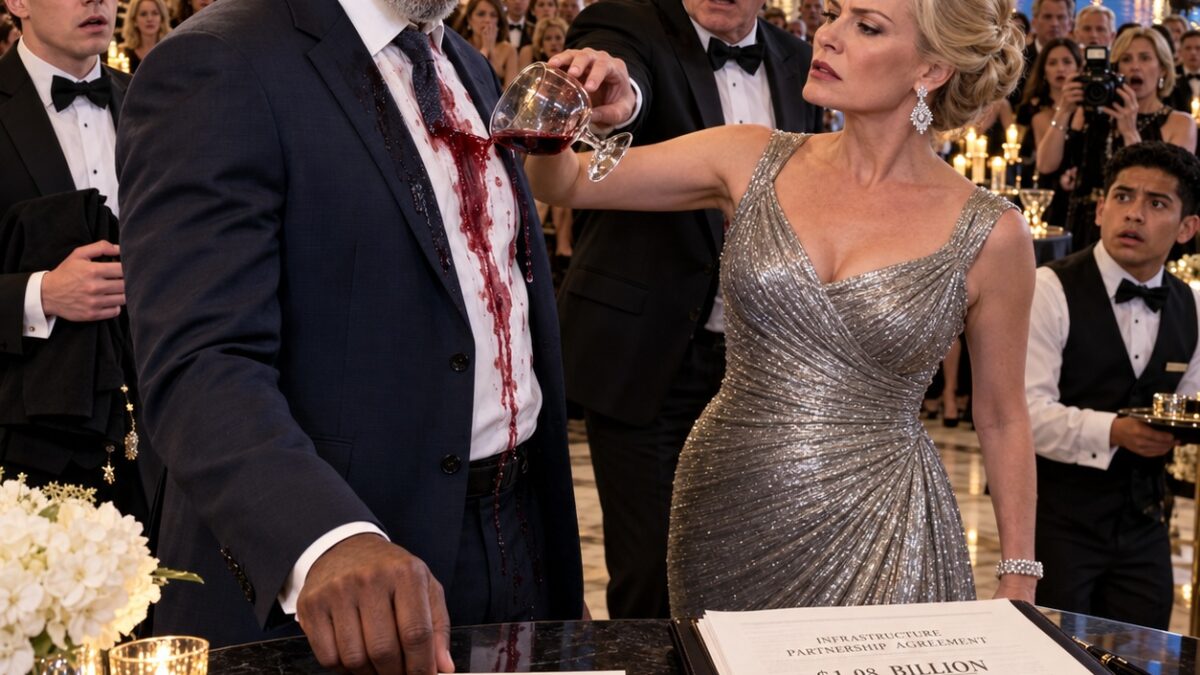
She reached toward the table.
Took a glass of Bordeaux.
Stepped closer.
“Let me make this clear.”
Her voice dropped.
Soft enough to sound personal.
Loud enough that everyone within twenty feet heard.
“You don’t belong in this room.”
Then she tilted the glass.
Slowly.
Deliberately.
Red wine hit my chest.
Cold first.
Then warm against skin.
It spread across my white shirt.
Down the front.
Collar.
Buttons.
Belt.
Drops struck the marble.
Nobody moved.
That is what I remember most.
Not Catherine’s face.
Not the wine.
Not even the smell.
The silence.
Two hundred guests.
Not all staring directly at us, but enough.
People with political power.
Financial power.
Corporate power.
Journalists whose profession supposedly involved observing injustice.
Executives who liked talking about leadership.
Nobody stepped forward.
No one said:
Stop.
No one took the glass.
No one asked if I was all right.
No one challenged her.
The same room that had spent the evening celebrating charity had become completely unable to practice the smallest form of decency once the social risk belonged to them.
I looked down at my shirt.
The stain looked almost theatrical.
Dark red spreading across white.
I remember wondering absurdly whether the hotel dry cleaner could get it out.
Then I looked back at Catherine.
She expected anger.
Maybe shouting.
Maybe the scene she could later describe as proof that she had been right to remove me.
I gave her nothing.
My hands stayed open.
My breathing stayed even.
Not because I felt calm.
I was furious.
Humiliation is physical.
Heat behind the face.
Pressure in the chest.
A primitive urge to restore balance immediately.
Years earlier, I might have.
Age teaches you one useful question:
What outcome do I actually want?
I did not want to win an argument with Catherine.
I wanted to understand whether Hargrave-Lister deserved my capital.
I had my answer.
So I reached inside my jacket.
Slowly.
The room became even quieter.
Perhaps someone thought I was reaching for something threatening.
I was not.
I took out a business card.
White.
Simple.
No metallic embossing.
No slogan.
Just:
Dr. Leonard Maitland
Founder & Chairman
Maitland Global Infrastructure
I placed it on the white tablecloth beside Catherine.
Face up.
Smooth.
Then I spoke.
“My name is Dr. Leonard Maitland.”
Catherine’s expression changed.
Not fully.
Not yet.
People often need a second for identity to connect with information.
“I am the founder and sole owner of Maitland Global Infrastructure.”
That did it.
The name moved through the room.
Not loudly.
A ripple.
Heads turned toward Richard Hargrave.
Catherine’s face began losing color.
I continued.
“I am the signature on the partnership your company cannot survive without.”
A champagne glass clicked against a silver tray fifteen feet away.
Richard had set it down.
He was already moving toward us.
Catherine stepped backward.
Her heel caught.
Her hand found the edge of the table.
For the first time that evening, she looked at me as if I were a person.
That should not have required a billion dollars.
Richard came forward quickly.
“Dr. Maitland—”
I raised one hand.
Open palm.
He stopped.
“Please,” he said. “Let me assure you—”
I shook my head once.
He fell silent.
The ballroom had rearranged itself.
That is the only way I can describe it.
The same people who had watched a minute earlier suddenly looked horrified.
Not all at Catherine.
Some at themselves.
The junior executive who had touched my shoulder had moved near the wall.
Eyes down.
The woman with the fur was gone.
Several guests began whispering that Catherine’s behavior was unacceptable.
Now.
After learning who I was.
That distinction mattered more than their outrage.
I looked at Catherine one last time.
She appeared ready to speak.
Apologize maybe.
Explain.
Blame alcohol.
Stress.
A misunderstanding.
I did not wait.
“I think we’re done here.”
I buttoned my wine-stained jacket.
One button.
Turned.
Walked toward the exit.
My shoes sounded loud against marble.
Nobody blocked me.
Miguel stood near the service entrance.
Our eyes met.
He looked ashamed.
I gave him a small nod.
Then left.
The ride back to my hotel took eleven minutes.
I remember every one.
Chicago lights outside.
Wine drying against my shirt.
Phone vibrating.
Richard.
Board chair.
General counsel.
Richard again.
I ignored everything.
I did not call my attorneys that night.
Not immediately.
First, I removed the shirt.
Laid it across a chair.
Stood in front of the hotel sink.
Washed red wine from my skin.
And stared at myself in the mirror.
People later described my composure as impressive.
That is because they did not see that room.
My hands shook once I was alone.
I sat on the bed.
Closed my eyes.
Heard Catherine again.
You don’t belong in this room.
I had heard versions of that sentence my whole life.
Not always spoken.
Sometimes in the pause at a private club.
Sometimes in a bank officer’s surprise when I signed the ownership documents.
Sometimes when someone assumed I was my own driver.
Sometimes when a junior employee explained my own industry to me before discovering who I was.
Underestimation becomes predictable.
You build armor.
But armor is not numbness.
I was hurt.
Not because Catherine failed to recognize money.
Because two hundred people had watched her strip a stranger of dignity and calculated that silence was safer.
That was bigger than one woman.
Around midnight, I called my general counsel.
“Withdraw.”
No greeting.
She knew about the incident already.
Someone had called.
“Entire deal?”
“Entire deal.”
“Do you want a cure period?”
“No.”
“Renegotiation?”
“No.”
“Leonard, we’re at signature stage.”
“I know.”
“Hargrave will ask for a meeting.”
“No.”
Pause.
“Reason?”
“Fundamental misalignment in institutional values.”
My counsel became quiet.
She knew me well enough to understand that if I had chosen those words, the decision was final.
“Three paragraphs?”
“Two if you can.”
She laughed softly.
“Three.”
The withdrawal letter arrived at Hargrave-Lister’s legal department forty-seven hours after the gala.
Three paragraphs.
Formal termination of all negotiations.
Effective immediately.
No cure.
No second meeting.
No reopening the economics.
No public accusation.
One stated reason:
Fundamental misalignment in institutional values.
Richard called me twelve times.
Then his board chair called.
I answered her.
“Leonard.”
She sounded tired.
“I’m not calling to ask you to come back.”
“Good.”
“I’m calling to apologize.”
“You didn’t pour the wine.”
“No.”
She paused.
“I watched.”
That answer mattered.
Most people apologized for Catherine.
Very few apologized for themselves.
“I should have stopped it.”
“Yes.”
No softening.
No:
It’s okay.
Because it was not.
She accepted that.
“We’re opening an internal review.”
“You should.”
“I know that doesn’t change your decision.”
“It doesn’t.”
Another pause.
“I’m sorry.”
“I believe you.”
We ended there.
That was one of the better conversations that week.
Hargrave-Lister’s stock dropped fourteen percent before noon the day our withdrawal became public.
I did not enjoy that.
People always assume you enjoy seeing a company punished after something like this.
A stock decline hurts more than CEOs.
Employees.
Retirement accounts.
Suppliers.
Families.
My decision was not intended to destroy Hargrave-Lister.
It was intended to refuse a partnership.
The consequences belonged to the company’s own fragility.
If one unsigned agreement could expose the balance sheet that badly, then my capital had been functioning as a rescue raft, not a partnership.
The board held an emergency session.
Catherine was placed on administrative leave before it ended.
Two weeks later, she was terminated.
The announcement came through a press release.
Richard issued a public statement calling the incident deeply unacceptable and inconsistent with company values.
I read it once.
Then put it away.
Values are easiest to print after they become expensive.
I cared more about what they would change when cameras stopped watching.
Three executives who had witnessed the incident were placed under internal review.
Two eventually resigned before their reviews concluded.
That interested me.
Not because resignation equals guilt.
Because the board had finally recognized silence as part of the cultural failure.
You cannot build a workplace where senior people are rewarded for knowing when to look away.
Then Miguel’s video surfaced.
I had not known he recorded anything.
Apparently, after Catherine handed me the glass near the bar, he became uncomfortable enough to use his phone discreetly.
He captured fragments.
Her ice instruction.
The junior VP’s hand on my shoulder.
Part of Richard’s comment.
Then the wine.
And the silence.
Especially the silence.
The clip went online.
Eleven million views within six hours.
My phone became unusable.
Reporters.
Networks.
Civil-rights organizations.
Business media.
Friends I had not heard from in years.
People wanted an interview.
I declined them all.
My communications team hated me.
“You need to shape the narrative.”
“The video is the narrative.”
“If you don’t speak, other people will.”
“They already are.”
“That’s the problem.”
“No.”
I looked at her.
“The problem happened in the ballroom.”
I had no interest in becoming a television character inside my own humiliation.
There is a market for public pain.
Outrage panels.
Slow-motion replay.
Experts explaining facial expressions.
I did not want to feed it.
A federal civil-rights inquiry opened within the week.
I cooperated where necessary.
Did not speculate publicly.
Did not demand anyone be arrested.
Did not sue Catherine personally.
People found that confusing.
“Why not sue?”
Because money was not what I wanted from her.
A lawsuit might have produced damages.
It might also have tied us together for years.
Depositions.
Headlines.
Appeals.
I had already learned what I needed to know.
Hargrave-Lister had consequences through markets, governance, regulators, and its own board.
I did not need to turn my remaining years into a courtroom relationship with Catherine Aldridge.
Instead, I redirected the capital.
All of it.
The $1.08 billion infrastructure allocation did not disappear.
It moved.
For years, my firm had evaluated a coalition of minority-led development groups working across Chicago’s South Side.
Affordable housing.
Small-business space.
Transit-adjacent development.
Community health infrastructure.
Projects consistently described as “promising but complicated” by the same capital markets that found billion-dollar rescue packages for large developers remarkably uncomplicated.
We accelerated diligence.
Reworked the structure.
Spread risk across multiple projects.
Built stronger oversight.
Then committed the capital.
When Maitland Global Infrastructure released the announcement, the statement was four sentences.
The final sentence said the capital would support a minority-led South Side development coalition.
That generated another media cycle.
People called it revenge.
It was not.
I had already been studying those projects.
Catherine did not invent worthy places for capital.
She simply made one destination unacceptable.
Six months later, I stood on a patch of South Side Chicago soil wearing another navy suit.
No tie.
This time, nobody mistook me for staff.
I almost wished someone had.
Groundbreaking ceremonies are unbearably formal.
The site would become several things.
Affordable housing.
A small-business incubator.
A community health center.
Public gathering space.
My foundation’s name was nowhere on the exterior plans.
That was deliberate.
A reporter noticed.
“Why not put your name on the building?”
“Because people need a health center more than they need my name.”
He smiled.
Thought I was being humble.
I was not.
I was being practical.
Naming rights are branding.
Sometimes useful.
Not necessary here.
Miguel Herrera attended the groundbreaking.
That surprised me.
He stood near the back.
Suit slightly too large.
Same alert eyes.
I walked over.
He looked nervous.
“Dr. Maitland.”
“Leonard.”
“I’m sorry.”
“For what?”
“The gala.”
“You poured the wine?”
“No.”
“Then what?”
He looked down.
“I saw the first thing.”
“The glass?”
“Yes.”
“And I didn’t say anything.”
I remembered his face.
Young.
Hourly worker.
Surrounded by senior executives.
“You were twenty-two.”
“Twenty-three.”
“My mistake.”
He almost smiled.
“I still should’ve said something.”
“Maybe.”
He looked surprised.
People expect forgiveness to erase complexity.
I continued.
“But the room had senators and CEOs in it. I’m not putting the whole moral burden on the youngest server.”
His eyes filled.
“You recorded.”
He nodded.
“That mattered.”
“I should’ve done more.”
“You did what you could when you were ready.”
That was enough.
Through our foundation, Miguel had received a full scholarship to study urban planning.
I had not chosen him personally.
The scholarship committee did.
He had already been applying.
His essay, I later learned, was about how built environments reflect who society imagines belongs.
Of course it was.
I asked:
“What are you studying first?”
“Land use.”
“Dangerous.”
He laughed.
The photographer caught us talking.
That image circulated more than I wanted.
People called it poetic justice.
I thought it was simpler.
One young man witnessed something ugly.
Then decided to build something better.
That was useful.
Hargrave-Lister survived.
Barely.
And differently.
The company had too many assets and too much expertise to vanish overnight.
That was good.
Thousands of innocent employees did not deserve collapse because senior leadership had tolerated arrogance.
But survival came with change.
Board structure tightened.
Independent review expanded.
Client-relations training was rebuilt.
Executive conduct became a governance issue, not an HR footnote.
Richard remained CEO for a period, but his authority narrowed.
The board no longer treated his instinct as synonymous with company judgment.
The financial press called it a humiliation.
Governance people called it overdue.
I preferred the second.
A company should not be built around one person’s immunity from correction.
That is not leadership.
That is structural risk.
The inquiry into the gala exposed more than overt discrimination.
It exposed hierarchy.
Employees reported that Catherine had long ranked people by perceived usefulness.
Clients first.
Senior executives second.
Everybody else somewhere below.
Assistants.
Servers.
Junior staff.
Contractors.
People were expected to absorb disrespect if challenging it might inconvenience someone important.
That pattern had become normal.
Normal is one of the most dangerous words in organizational culture.
Once bad behavior becomes normal, people stop seeing individual incidents.
They call them personality.
“That’s just Catherine.”
“That’s how Richard is.”
“They’re intense.”
“They expect excellence.”
Maybe.
Or maybe people have spent years renaming cruelty so employment feels easier.
The board commissioned culture interviews.
Anonymous.
Protected.
That mattered.
Stories emerged.
No single scandal larger than the gala.
That was not the point.
Culture is rarely one explosion.
It is accumulation.
Who is allowed to interrupt?
Whose time matters?
Who gets credited?
Whose discomfort is treated as the cost of doing business?
Those patterns predict the big moment.
The wine did not come from nowhere.
It was simply the first time Catherine’s habits collided with someone whose economic leverage could not be ignored.
That bothered me.
Because it meant the lesson could easily become the wrong one.
Be careful whom you disrespect. They might be a billionaire.
No.
I rejected that every time someone repeated it.
Catherine’s behavior would have been wrong if I had been a bartender.
If I had been a driver.
If I had been unemployed.
If I had been lost.
If I had walked into the wrong ballroom accidentally.
Pouring wine down someone’s shirt to prove they do not belong is wrong before you learn their net worth.
My business card changed consequences.
It did not change morality.
That distinction became the center of every conversation I was willing to have.
I eventually agreed to one private leadership forum.
No press.
Executives from several companies.
They wanted me to discuss “reputation risk.”
I told them they had already missed the point.
One man asked:
“Wasn’t reputation the biggest consequence?”
“No.”
“Stock fell fourteen percent.”
“Also not the biggest.”
“What was?”
I looked around.
“Two hundred people watched.”
Silence.
“The risk is not that a video goes viral.”
I continued.
“The risk is that your organization has trained two hundred people to believe watching is safer than intervening.”
That quieted the room.
You can hire crisis communications after a video.
You cannot quickly repair a culture where everyone has learned courage is career-limiting.
That takes years.
I told them:
“If your values appear only after the incident becomes expensive, they are not values. They are damage control.”
No one enjoyed that.
Good.
Richard eventually wrote to me.
Months later.
Not an apology exactly.
A request for conversation.
I accepted.
Private room.
No lawyers initially.
He looked older.
Pressure does that.
He did not wear the effortless confidence I remembered from the gala.
“Leonard.”
“Richard.”
He started with:
“I failed you.”
I stopped him.
“You didn’t know me.”
“That’s not an excuse.”
“No.”
He looked down.
“I failed the room.”
Better.
I waited.
He said he had spent years assuming Catherine’s abrasiveness was part of what made her effective.
He admitted laughing at comments he should have corrected.
Rewarding results while ignoring how she achieved them.
Normalizing hierarchy because he believed clients expected exclusivity.
I listened.
Then asked:
“Why did you think I was staff?”
He became uncomfortable.
“Your clothing—”
“Was a navy suit.”
He stopped.
“Yes.”
“My race?”
Long silence.
“Yes.”
That honesty mattered more than a polished diversity statement.
I asked:
“And when you thought I was staff, why did that make the joke acceptable?”
He closed his eyes.
That was the harder question.
Not:
Why did you mistake me?
Why did the mistaken identity lower the amount of respect you believed I deserved?
He did not have a good answer.
Eventually:
“It shouldn’t have.”
“No.”
“I know that now.”
“I hope so.”
He asked whether there was any path to reopening the deal.
I said no.
Not angrily.
Not punitively.
No.
Our capital was committed elsewhere.
Even if it had not been, trust had changed.
Business relationships are not marriages.
You do not owe endless reconciliation.
Sometimes consequences mean a door stays closed.
Richard accepted that.
We shook hands.
I left.
I never became his friend.
I did not need to.
Accountability does not require intimacy.
The South Side projects moved forward.
Slowly.
Real development is less beautiful than renderings.
Permits.
Community meetings.
Environmental review.
Contractor disputes.
Budget adjustments.
Rain.
Supply shortages.
Residents asking legitimate questions.
The first affordable-housing phase opened behind schedule.
I considered that a success.
Anything that complex arriving only slightly late is practically military precision.
The health center opened six months after that.
I attended before the ribbon ceremony.
No cameras.
Walked through patient rooms.
Spoke to nurses.
Checked the waiting area.
A woman from the neighborhood asked me whether the center was “really staying.”
I asked what she meant.
“Things come here for photos.”
Then:
“Then they leave.”
That sentence bothered me.
“This stays.”
“How you know?”
“Because the operating funding is already committed for ten years.”
She looked at me.
“Now that sounds real.”
Exactly.
Promises are easy.
Structure matters.
Capital can make dignity material.
Not solve everything.
But build somewhere people are used to hearing no.
The small-business incubator became my favorite part.
Young founders.
Barbershop expansion.
Food company.
Logistics startup.
Childcare cooperative.
Contractor training.
Some businesses failed.
Others grew.
A man named Reggie opened a fabrication shop and hired fifteen people within three years.
He once asked why we invested there.
I told him:
“Because the numbers worked.”
He laughed.
“No inspirational answer?”
“You want me to lie?”
He grinned.
Then I added:
“And because capital has ignored good numbers in neighborhoods like this for too long.”
That was the complete answer.
Values and returns do not always oppose each other.
Sometimes markets are simply biased about where they expect competence.
I knew something about that.
Miguel finished his first semester.
Then second.
He sent me his grades because he thought scholarship sponsors wanted proof.
I told him the foundation already received transcripts.
He kept sending them.
Eventually, he interned with one of the planning teams.
Not because I ordered it.
He applied.
Earned it.
That distinction mattered.
He had already experienced a room where people saw service before person.
I would not use power to turn him into another symbol.
He needed a career.
Not a role in my redemption story.
Years passed.
The famous video stayed online.
Of course.
Every few months, someone rediscovered it.
New captions.
New edits.
Some inaccurate.
One version claimed Catherine was arrested on the spot.
False.
Another said I bought Hargrave-Lister the next day.
False.
Another said I was secretly worth fifty billion dollars.
Very false.
Internet stories improve facts the way storms improve roofs.
They do not.
The truth was strong enough.
I was a businessman evaluating a $1.08 billion partnership.
I arrived anonymously.
Senior people repeatedly mistook me for staff.
Catherine publicly humiliated me.
I revealed my identity.
I withdrew the deal.
The company faced financial and cultural consequences.
The capital went elsewhere.
That is enough.
No handcuffs required.
No revenge acquisition.
No dramatic destruction.
One of the oddest outcomes was that people began recognizing me more often.
Airports.
Restaurants.
Conferences.
Someone would stare.
Then:
“Are you the wine guy?”
A terrible title.
I would smile.
“Unfortunately.”
Sometimes they asked for photographs.
I usually declined.
I did not want my worst public night to become my primary public identity.
That is another form of dehumanization.
Victims can become symbols just as quickly as powerful people become legends.
I was still Leonard.
Father.
Grandfather.
Investor.
Engineer by training.
Man who hated overcooked fish.
Person who forgot passwords.
A viral clip should not swallow a life.
I protected that.
My family did too.
My daughter refused to discuss the gala after three weeks.
“Enough.”
She told me.
“People have poured things on you before.”
“Coffee, maybe.”
“You survived.”
She had my mother’s bluntness.
I needed it.
Family returns you to proportion.
The world can turn one event into a monument.
Family reminds you garbage still needs taking out.
Hargrave-Lister gradually rebuilt.
Different leadership mix.
Different governance.
Richard eventually stepped away from daily control.
Not immediately.
Not as a theatrical punishment.
The board became less founder-centric.
Client relations changed.
Several executives from outside the old culture joined.
The company began requiring senior leaders to spend time with frontline employees without formal entourages.
People mocked that as symbolic.
Maybe.
Symbols can help if they support structure.
Not if they replace it.
What mattered more were reporting protections.
Independent review.
Promotion metrics that did not reward revenue while ignoring conduct.
Clear sanctions.
Those changes impressed me.
Quietly.
I never reopened negotiations.
But I could acknowledge improvement.
Accountability should allow institutions to become better than their failure.
Otherwise why demand reform?
If the answer is:
Nothing you do matters after you fail,
then organizations learn to hide mistakes, not correct them.
Hargrave-Lister did serious work after the gala.
That did not erase the gala.
Both can be true.
Catherine disappeared from public view.
People asked me what I thought happened to her.
I did not know.
I did not search.
Her termination was consequence.
Anything afterward belonged to her.
I hoped she changed.
That surprised people.
“Why?”
Because if she remained exactly the same, everyone around her would continue paying for it.
Growth is more useful than permanent ruin.
I did not need her suffering.
I needed the behavior to stop.
Those are not the same.
Maybe she found another job.
Maybe nobody trusted her.
Maybe she apologized privately to people she had treated badly for years.
Maybe not.
I refuse to invent.
The story does not need her destruction to make my dignity real.
That would give her too much power.
Miguel once asked me whether I forgave her.
We were walking through the incubator.
I thought.
“I don’t organize my day around her.”
He laughed.
“That’s not an answer.”
“It’s the answer I have.”
Forgiveness is often described dramatically.
A feeling.
A release.
For me, it was simpler.
Catherine stopped occupying mental rent.
I no longer replayed the wine.
No longer imagined better responses.
No longer needed her to understand me.
That was freedom.
I still remembered.
Memory is not resentment.
Six months after the gala, a reporter caught me outside the South Side groundbreaking.
I had refused scheduled interviews.
He had waited near the exit.
“Dr. Maitland!”
I stopped.
One question.
“Why did you stay so calm that night?”
I almost kept walking.
Then answered because the question was sincere.
“I’ve been underestimated my entire life.”
He waited.
“At some point, you stop being surprised.”
I looked back toward the construction site.
“You just make sure it matters.”
That quote followed me everywhere.
People interpreted it as revenge.
I meant responsibility.
If someone underestimates you, you have choices.
Prove them wrong loudly.
Destroy them if you can.
Carry anger.
Or use what you learned to make a decision that reflects your values.
I withdrew because I saw a culture inconsistent with my company’s standards.
I redirected capital because I saw better opportunities.
The fact that those decisions also became consequences for Hargrave-Lister did not make them revenge.
A boundary can hurt the person who crossed it.
That does not make the boundary cruel.
I learned that distinction late.
It saved me from many bad decisions.
People often believe restraint means weakness.
It can.
Sometimes people stay quiet because they are afraid.
Sometimes because they have no options.
But sometimes restraint is control.
I knew that night exactly what I could do.
I could expose myself immediately after the first insult.
I could demand Catherine’s job.
I could threaten the deal.
I could embarrass Richard publicly.
Instead, I watched.
Some people later criticized me.
“You allowed it to continue.”
I understand that argument.
Could I have stopped the second insult?
Yes.
Would the wine have happened if I had revealed myself sooner?
Probably not.
But that is precisely what disturbed me.
Their behavior would have changed only because of who I was.
I wanted to know how they treated the person they believed had no leverage.
Now I knew.
Would I make the same choice again?
I do not know.
That answer matters.
Humiliation is not a laboratory experiment.
I was not morally obligated to endure it for information.
No one is.
I chose to stay.
That does not mean someone else should.
When I teach leadership now, I tell people:
Do not romanticize endurance.
Leave dangerous rooms.
Report abuse.
Protect yourself.
My decision belonged to my circumstances.
I had money.
Legal resources.
Age.
Experience.
A strong sense of personal safety.
Miguel did not.
His silence should be judged differently from Richard’s.
Power changes responsibility.
That is another lesson the viral version often misses.
Two hundred people were silent.
They did not all hold equal power.
The young server.
Different.
The senator.
Different.
Board directors.
Different.
Senior executives.
Different.
Ethics should account for capability.
The person with the safest position to intervene carries more responsibility than the person who may lose rent money by challenging a VIP.
That is why I did not blame Miguel the way I blamed Richard’s executives.
He recorded what happened at personal risk.
That mattered.
A board member had far more ability to say:
Catherine, stop.
They did not.
That mattered too.
At one corporate seminar, I put three names on a screen.
Catherine.
Miguel.
Richard.
Asked executives:
“Who failed?”
Most said Catherine.
Some Richard.
Few Miguel.
Then I asked:
“Who had the most power before the wine?”
Richard.
“Who had the least?”
Miguel.
“Then why do organizations focus ethics training on frontline workers?”
That made them uncomfortable.
Exactly.
Culture is largely modeled downward.
If the CEO laughs, the junior VP laughs.
If the senior vice president humiliates staff, others learn humiliation is safe.
If the board ignores it, the behavior becomes infrastructure.
Changing culture requires changing incentives near the top.
Posters near elevators will not do it.
Neither will annual online training with stock photographs of diverse coworkers smiling at laptops.
Governance.
Promotion.
Accountability.
Who gets rewarded?
Who gets protected?
Who can challenge whom?
Those questions matter.
My own company underwent review after the gala too.
That surprised my executives.
“Why us?”
“Because if I can see their failure, I should look for ours.”
We commissioned anonymous employee feedback.
Painful.
We learned things.
Not wine-pouring things.
Still.
Middle managers who dismissed contractors.
Senior staff who expected assistants to answer after midnight.
Certain offices where promotion networks were too closed.
I could have said:
We are better than Hargrave-Lister.
Maybe we were.
That is a dangerous sentence.
Better is not the same as finished.
We changed policies.
Adjusted compensation.
Expanded reporting.
I apologized to one assistant personally after learning my own schedule expectations had created unnecessary pressure through layers of staff.
I had never told anyone to answer email at midnight.
Someone beneath me had interpreted my quick responses as expectation.
That is how culture works.
Leaders communicate even when they think they are merely behaving.
Richard’s laughter had taught his people something.
So had mine.
That humbled me.
The South Side coalition eventually became profitable.
That delighted reporters less than the original announcement.
Good news is less viral.
Affordable units stayed occupied.
Small businesses paid rent.
The health center hit utilization targets.
The investment produced stable returns.
No miracle.
Sound structure.
My board was pleased.
One director joked:
“Catherine accidentally improved our portfolio.”
I stopped him.
“No.”
He looked at me.
“She gets no credit.”
He understood immediately.
I do not like the habit of crediting harmful people for what victims build afterward.
Catherine did not create the South Side opportunity.
She did not create my discipline.
She did not create Miguel’s scholarship.
Those were choices made in response to harm.
They belong to the people who made them.
Pain can influence an outcome without deserving gratitude.
Important distinction.
Years later, I returned to the Chamberlain Hotel for an unrelated conference.
I did not realize the event was in the same ballroom until I walked through the doors.
The chandeliers looked smaller.
Funny how memory enlarges rooms.
The marble was unchanged.
I found the spot near the grand window.
Nothing marked it.
No stain.
Of course.
Professional cleaners had removed the wine within hours.
The physical evidence was gone.
I stood there.
Waited for anger.
Nothing.
Just recognition.
A room.
That was all.
Then a banquet employee approached.
“Sir, can I help you find your table?”
I looked at him.
Young man.
Polite.
Professional.
I smiled.
“Yes.”
He showed me.
That simple interaction moved me more than I expected.
Same room.
Different assumption.
Respect before status.
Maybe because times changed.
Maybe because the hotel trained better.
Maybe because this employee was simply decent.
You do not need a philosophical explanation for every act of kindness.
Sometimes people are just kind.
I sat.
Listened to the conference.
Left.
No drama.
I liked that ending better than if the ballroom had somehow apologized.
Buildings do not owe us apologies.
People do.
Systems owe correction.
Then life continues.
My granddaughter once found the old wine-stained shirt.
I had kept it without intending to.
Back of a closet.
Dry-cleaned but faint discoloration remained near one seam.
She held it up.
“What happened?”
She was eleven.
I had never told her the full story.
Her mother had kept the details vague.
“Someone spilled wine.”
She looked suspicious.
“On purpose?”
Children detect adult evasions professionally.
“Yes.”
“Why?”
I sat.
How do you explain prejudice without teaching a child the world is hopeless?
“Because sometimes people decide who you are before they know you.”
She frowned.
“That’s stupid.”
“Yes.”
“What did you do?”
“I left.”
“Did they say sorry?”
“Some did.”
She thought.
Then:
“Did you get a new shirt?”
I laughed.
Children restore proportion.
“Yes.”
“Then why keep this ugly one?”
Excellent question.
I looked at it.
“Maybe I don’t need to.”
We donated it to textile recycling.
I expected some emotional moment.
Nothing.
Shirt in a bag.
Gone.
Memory remained.
That is when I knew I had fully moved on.
Symbols are useful until they become unnecessary.
The business card, however, I still carry.
Not the same one.
Obviously.
A new card.
Same simple design.
Sometimes I think about that little rectangle on the white tablecloth.
All night, people had looked at me and seen what they expected.
One card changed their perception.
That should bother us.
It bothers me still.
Not because business cards are powerful.
Because dignity should not need credentials.
A name should have been enough.
Actually, not even that.
Presence should have been enough.
Humanity should have been enough.
That is the final lesson I return to.
People love telling the story as:
They thought he was a waiter, but he was a billionaire.
I hate that version.
It implies waiters deserve less respect.
The correction becomes:
He was secretly important.
No.
I was important before they knew my bank account.
Miguel was important while carrying a tray.
The coat-check worker was important.
The bartender.
The junior assistants.
Everyone.
If I had truly been staff, Catherine pouring wine on me would have been more horrifying, not less, because I might have lacked the freedom to walk away without risking my livelihood.
That is the test of character.
How do you treat people who cannot affect you?
Richard failed.
Catherine failed.
Several executives failed.
Some learned.
Some did not.
The company changed.
Capital moved.
Life continued.
At the groundbreaking, months after the gala, that reporter asked why I stayed calm.
My answer became famous.
But there is a second answer I never gave him.
I stayed calm because I already knew who I was.
Catherine’s mistake was believing the room could define me.
It could embarrass me.
It could hurt me.
It could make me angry.
It could not assign my worth.
That part belonged to me.
By the time I understood that in life, I had already spent decades being underestimated.
Maybe that is the only gift repetition gave me.
Practice.
Not immunity.
Practice.
The night she poured wine on me, I was not calm because I was secretly powerful.
I was calm because I had learned that reaction and consequence are not the same thing.
I did not need to react loudly for consequences to exist.
Two days later, my signature disappeared from their future.
Six months later, that capital was pouring concrete somewhere else.
Years later, people who had never been invited into rooms like the Chamberlain were opening businesses in buildings financed by the deal Hargrave-Lister thought it owned.
That is what made it matter.
Not Catherine losing her job.
Not Richard apologizing.
Not the stock drop.
Not eleven million views.
Those were consequences.
The meaning came afterward.
The health center.
The apartments.
Miguel in school.
Founders receiving capital.
A company forced to confront what it had normalized.
My own company forced to inspect itself.
That is what I mean when I say:
Make it matter.
Do not simply make it hurt.
Those are different ambitions.
One produces revenge.
The other can produce structure.
I prefer structure.
When people ask what I would say to Catherine today, the answer is almost nothing.
I hope she learned.
That is all.
When people ask what I would say to the two hundred guests, I have more.
Next time, do not wait for the business card.
Do not wait for someone powerful to become offended.
Do not calculate whether the person being humiliated has enough status to make defending them safe.
Speak when the cost is still small.
One sentence.
“That’s enough.”
Sometimes that is all a room needs.
The night Catherine poured the wine, no one gave the room that sentence.
So the room taught her silence meant permission.
Until the business card changed the economics.
I want better rooms than that.
Rooms where the least powerful person receives the same basic dignity as the person financing the building.
That is the standard.
Not because it sounds noble.
Because institutions that rank humanity by status eventually make catastrophic decisions.
They become blind.
And blind organizations are expensive.
Hargrave-Lister learned that with fourteen percent of its share price and a billion-dollar deal.
I learned it years earlier without needing a spreadsheet.
My father taught me.
Arrive before they know you matter.
Watch how people behave.
He was right.
But if he were alive now, I would add something.
Once you know who people are, do not become like them just because you have the leverage.
That was the test after the gala.
I could have tried to destroy Hargrave-Lister.
I did not.
I walked away.
Invested elsewhere.
Let institutions do what institutions were supposed to do.
Board.
Regulators.
Markets.
Internal review.
No personal lawsuit.
No takeover.
No public revenge tour.
Boundaries.
Consequences.
Then movement.
That is how I protected my dignity after the room tried to strip it away.
Not by forcing everyone to kneel.
By refusing to let their behavior choose who I became.
Today, the South Side projects are no longer “the place Leonard redirected the Hargrave money.”
They are simply buildings.
Homes.
Businesses.
Medical appointments.
Jobs.
That is success.
When a project stops being symbolic and starts being ordinary life, it has done its work.
The Chamberlain gala has also become smaller in my memory.
Not gone.
Smaller.
One room.
One night.
One glass of wine.
The world did not end.
Mine did not begin.
I was Leonard before it happened.
I remained Leonard afterward.
Catherine thought she was deciding whether I belonged in her ballroom.
She was wrong about the scale of the decision.
The real question that night was whether Hargrave-Lister belonged in my portfolio.
By the time the wine reached my belt, I had my answer.
No.
And after everything that followed—the stock drop, the inquiry, the resignations, the viral video, the new projects—that remains the simplest truth of the entire story.
They thought they were judging me.
I was judging them.
And they failed.

