PART2:Rex Found a Missing Boy in the Mountains and Shielded Him With His Own Body—Then He Came Home With No Mission Left to Save Him
PART2
The first week was brutal.
There is no better word.
Rex struggled to stand.
His hind legs would shake beneath him until one paw slid or his hip lost balance.
Then he would fall sideways.
Every single time, he immediately tried to get up.
That was the part that hurt most.
Not the fall.
The urgency afterward.
As though weakness itself were unacceptable.
As though lying on the floor for more than three seconds meant failure.
The first time it happened in my kitchen, I moved toward him.
“Easy.”
Rex pushed with his front legs.
His rear half lagged.
He slipped.
Tried again.
“Rex.”
Another attempt.
I knelt.
Put one arm beneath his chest and another around his body.
He stiffened.
That old working instinct.
I do it myself.
“Let me.”
His eyes met mine.
And I swear I saw embarrassment.
I know people tell us not to assign human emotions to dogs too easily.
Fair.
But I knew Rex.
I had watched him exhausted.
Frustrated.
Alert.
Proud.
Uncertain.
This was different.
He looked at me like he was asking something I did not know how to answer.
Do I still matter if I can’t do what I used to do?
I helped him stand.
Held him until his legs stabilized.
Then released slowly.
He stayed up.
For perhaps ten seconds.
Then sat.
I touched his neck.
“You don’t have to prove anything.”
He looked away.
I realized I was saying it to myself too.
I started talking to him.
Not commands.
Ordinary conversation.
It felt ridiculous at first.
Rex understood working language.
Short.
Clear.
Purposeful.
Now I sat beside him and told him about grocery shopping.
Traffic.
A book.
The weather.
A stupid call from someone in the unit.
Sometimes I read aloud.
Not because I thought Rex cared about novels.
Because my voice had always meant direction.
I wanted him to learn it could mean presence too.
At first, he watched me like I had become incompetent.
I would sit on the floor with a paperback.
Read three pages.
Look down.
Rex staring.
“What?”
He blinked.
“Yes, this is apparently what retirement looks like.”
No response.
“You could at least pretend to appreciate the literature.”
His ears moved.
That counted.
The hardest thing to explain to a working dog is that usefulness and worth are not the same thing.
I had no language for that.
Maybe because I had never believed it myself.
For eight years, my life had also been built around calls.
Searches.
Schedules.
Training.
Need.
Somebody missing.
Somebody waiting.
Somewhere dangerous.
We went.
That structure gave me identity.
Rex had lost his in one rescue.
And sitting beside him, I began to wonder how much of mine had always depended on being needed too.
Three times a week, I took him to veterinary rehabilitation.
The center had equipment Rex initially distrusted.
An underwater treadmill.
Exercise platforms.
Support harnesses.
Massage tables.
Warm water.
Soft voices.
Everything about it confused him.
During service, touch usually meant equipment.
Check.
Preparation.
Injury.
Get back up.
Continue.
At rehabilitation, people touched him with no demand attached.
Massage.
Stretching.
Support.
Rest.
The first time they put him on the underwater treadmill, Rex looked at me with pure accusation.
“I know.”
I stood beside the tank.
“This wasn’t my idea.”
The therapist laughed.
“He doesn’t believe you.”
“He shouldn’t.”
Water rose.
Warm.
Rex stiffened.
His legs made uncertain movements beneath the surface.
The therapist guided him.
“Easy.”
He resisted.
Not violently.
He simply did not understand the point.
Work had always produced an outcome he could recognize.
Find.
Track.
Protect.
Reach.
This was different.
The goal was:
Stand without pain.
Move without falling.
Trust your own body again.
Those are not dramatic goals.
They are also enormous.
The therapist said:
“We’re not trying to make him what he was.”
That sentence stayed with me.
“What are we trying to make him?”
“Comfortable in the body he has now.”
I looked through the glass at Rex.
His legs moved slowly through warm water.
Comfortable in the body he has now.
I had spent my entire career measuring success by capability.
More endurance.
More precision.
Faster response.
Better performance.
Now success was a dog walking six careful minutes in warm water.
I had to relearn everything.
My commander called during the second week.
“You coming back Monday?”
I looked across the room.
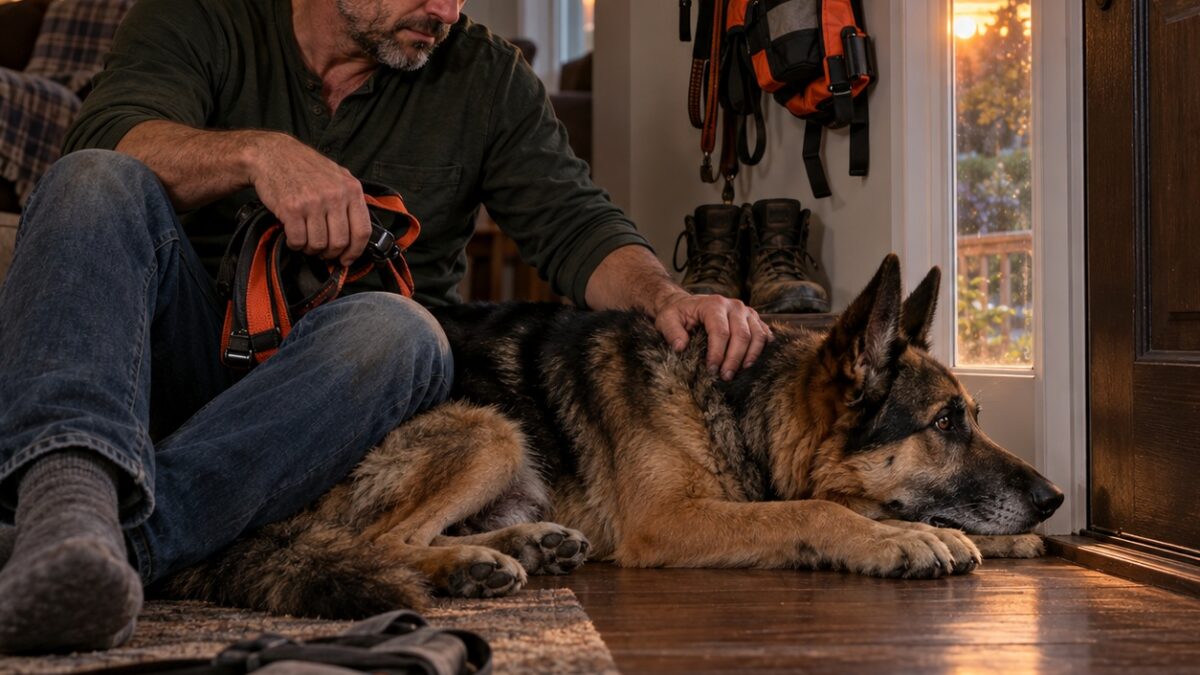
Rex lay beside the door.
“No.”
Pause.
“How long?”
“I don’t know.”
“We need you.”
I almost said yes automatically.
The unit needs you.
That sentence had controlled more of my life than I realized.
Birthdays.
Weekends.
Sleep.
Relationships.
Plans.
Everything could be postponed because the unit needed me.
Then Rex shifted.
Tried to stand.
His hind legs trembled.
He lowered himself again.
“I’m taking leave.”
“Marcus.”
“I’ve never taken real leave.”
“That doesn’t mean this is the time.”
“It is exactly the time.”
Silence.
Then:
“He’s a dog.”
The sentence was not cruel.
My commander was not cruel.
He was thinking operationally.
The unit.
Staffing.
Coverage.
I had thought the same way for years.
I looked at Rex.
“No.”
I said.
“He’s my partner.”
The line went quiet.
Then:
“Call me when you know.”
“I will.”
I ended the call.
For perhaps the first time in my career, I chose something over service.
I expected guilt.
There was some.
But underneath it, relief.
Rex had chosen duty every time I asked.
Now I could choose him once without apology.
The days became repetitive.
Rehabilitation.
Medication.
Short walks.
Falls.
Support.
Rest.
Talking.
Reading.
Trying again.
Progress was painfully slow.
One morning, he stood for fifteen seconds longer than the week before.
I wrote it down.
Another day, he walked from the bedroom to the kitchen without falling.
I called the therapist.
“Good.”
she said.
“That’s good.”
“That’s it?”
“What do you want?”
“Confetti.”
She laughed.
“Marcus, if you celebrate every three extra steps like a championship, you’re going to exhaust both of you.”
She was right.
I had turned recovery into a mission.
Metrics.
Targets.
Improvement.
Rex did not need another job disguised as healing.
So I stopped counting everything.
Mostly.
I still noticed.
Of course I noticed.
But I tried not to make every movement carry meaning.
Some days he was stronger.
Some days worse.
Some mornings he seemed almost eager to move.
Other mornings, he stayed down longer.
I learned recovery was not a straight trail.
Rex had always taught me to read terrain.
Now the terrain was him.
There were nights when I sat beside him and wondered if I had failed him.
Not on the mountain.
After.
Before.
All eight years.
Had I seen him as a partner?
Yes.
But had I also treated him like equipment?
Sometimes.
I remembered dark rooms where Rex entered first.
Searches where I sent him into spaces I would not enter until he cleared them.
Cold nights in the truck when he lay at my feet, ears up even while I slept.
He protected me because that was his training.
Because that was our bond.
Because that was what we asked of him.
How often had I asked what it cost?
That question became difficult once he could no longer work.
A tool that breaks gets replaced.
A partner who breaks gets carried.
Which had he truly been to me?
I hated the answer when I thought too honestly.
Both.
I loved him.
Deeply.
And I had still benefited from his willingness to give everything.
The mountain made that impossible to ignore.
Rex had used his body to protect Elias.
Exactly as he had been trained.
Exactly as we had praised him for doing.
The child lived.
Rex came home changed.
Everyone called him a hero.
Then the world moved on.
Hero is a beautiful word.
It does not help a dog stand up.
One Tuesday morning, about ten, something happened.
I was in the kitchen with coffee.
Rex lay near the window.
Head on floor.
Sunlight across his coat.
I had stopped watching him every second.
That itself was progress.
Then I heard nails on the floor.
I turned.
Rex had lifted his head.
He was looking toward the back door.
I waited.
Slowly, he shifted his front paws underneath him.
Pushed.
His hind legs trembled.
He paused.
Then stood.
Not elegantly.
Not smoothly.
But stood.
I put the coffee down.
Did not move toward him.
Rex took one step.
Then another.
Toward the door.
Stopped.
Turned.
Looked at me.
“What?”
He looked back toward the door.
Then at me again.
“You want outside?”
His tail moved.
Once.
Tiny.
I froze.
For weeks, his tail had barely done anything beyond reflexive movement.
This was different.
It moved again.
Small.
Uncertain.
But there.
I laughed.
Then covered my mouth because the sound almost became a sob.
“All right.”
I opened the door.
Rex stepped outside.
Sunlight.
Clear air.
Grass.
He walked three careful steps.
Stopped.
Lifted his head.
Wind moved through his coat.
He looked toward the horizon.
Not toward the truck.
Not toward me for instruction.
Just outward.
I sat on the porch steps.
I knew immediately what I was seeing.
Rex was coming back.
Not to work.
Not to service.
To life.
His life.
That distinction hit me so hard I had to look away.
For years I had defined Rex through what he could do.
Track.
Find.
Protect.
Now he stood in grass doing nothing useful.
And I had never been prouder of him.
I thought about every dark room he entered before me.
Every trail.
Every dangerous place.
Every time he positioned himself between me and uncertainty.
Every night in the truck when I woke and saw him at my feet.
Ready.
Always ready.
I thought about how much of his life had been readiness.
When had he ever been allowed simply to exist?
“Forgive me.”
I whispered.
Rex turned.
He heard the sound.
Walked toward me.
Slowly.
More confidently than the week before.
Reached the porch.
Sat near my feet.
Then placed his head on my knees.
Exactly as he used to do after difficult nights.
When I had come back exhausted.
When he somehow knew I did not need noise.
I rested one hand on his head.
His breathing was deep.
Steady.
“You saved that boy.”
I said.
“You saved him.”
My voice broke.
“And you saved me more times than I ever counted.”
Rex closed his eyes.
“Now it’s my turn.”
I sat there with him until my coffee was cold.
The weeks after that were not suddenly easy.
One tail wag did not cure him.
One trip into the yard did not restore his strength.
But something changed.
Rex stopped looking at the front door quite so often.
He still rested there sometimes.
Habit.
Comfort.
Maybe waiting.
I stopped assigning every position a tragedy.
That was important.
When you know an animal has suffered, you can start interpreting every behavior through suffering.
Sometimes Rex lay near the door because the floor was cool.
Sometimes he watched the window because birds moved outside.
Sometimes a dog is simply a dog.
I had to let him become one again.
The rehabilitation continued three times a week.
Warm treadmill.
Massage.
Balance.
Strength.
Rex resisted less.
One therapist held a ball in front of him during an exercise.
He stared at it.
Then at her.
The expression clearly said:
You cannot be serious.
I laughed.
She tossed it gently.
Rex watched it roll.
Did nothing.
“Working dog.”
I said.
“He doesn’t fetch.”
“Retired working dog.”
she corrected.
“Maybe he can learn.”
Eventually, he did.
Not enthusiastically.
Rex treated recreational ball play like an assignment created by incompetent management.
But one day he nudged it.
Then followed.
Then picked it up.
I applauded once.
He dropped it.
Walked away.
Fair.
His falls became less frequent.
He still stumbled.
His hind legs would never have the power they once had.
The veterinarian was honest.
“He won’t run mountain searches again.”
“I know.”
“He may always have weakness.”
“I know.”
“There will be days he does less.”
“I know.”
“Marcus.”
“What?”
“You keep saying you know.”
“I’m trying to make sure you actually accept it.”
That irritated me because it was accurate.
Acceptance is harder than knowledge.
I knew Rex would not return to service.
Part of me still looked for signs that maybe everyone was wrong.
A stronger step.
Better balance.
A good day.
Maybe.
Maybe.
Maybe.
Then I remembered the yard.
Wind in his coat.
Tail moving.
Rex did not need to climb another mountain to justify his survival.
He had already done enough.
More than enough.
I called Elias’s family one evening.
I do not know exactly why that night.
Perhaps I needed to hear the child was all right.
Perhaps I wanted to connect Rex’s old mission to the life he had now.
A woman answered.
“Hello?”
“My name is Marcus Reed.”
Silence.
Then a sharp intake of breath.
“You’re Rex’s handler.”
That was how she knew me.
Not Marcus.
Not officer.
The man whose dog saved my son.
“Yes.”
“Oh my God.”
Her voice trembled.
“We think about you every day.”
“We think about Rex every day.”
I looked across the room.
Rex lay beside the couch.
Head on paws.
His eyes lifted when he heard his name.
“How’s Elias?”
“He’s doing well.”
She began crying softly.
“I’m sorry.”
“No.”
“It’s okay.”
“He asks about Rex every week.”
My throat tightened.
“He does?”
“Every week.”
“He asks if the dog is okay.”
“If he can walk.”
“If he’s still hurt.”
I looked at Rex.
“He’s recovering.”
“Slowly.”
“But he’s okay.”
“Could Elias meet him?”
I was quiet.
The question scared me in a way I had not expected.
Would seeing Elias pull Rex back toward work?
Would it overwhelm him?
Was I protecting Rex or myself?
I looked at his eyes.
They were different now.
Not empty.
Not waiting.
Calm.
“Yes.”
I said.
“I think he’d like that.”
We met on a Sunday in a park.
Neutral place.
Open.
Quiet.
I arrived early.
Of course.
Old habits.
Rex sat beside me.
The mother came first.
Then Elias.
Seven years old.
Smaller than I remembered because on the mountain he had existed in my mind as an emergency, not a child.
He saw Rex.
Stopped.
Then ran.
My instinct was to intervene.
“Easy.”
But Rex had already lifted his head.
Tail moving.
Elias reached him.
Dropped to his knees.
Wrapped both arms around Rex’s neck.
Rex stood completely still.
Allowed it.
Then leaned slightly into the boy.
That tiny movement nearly destroyed me.
Elias buried his face in Rex’s coat.
“Thank you.”
Two words.
Rex did not know what they meant.
Or maybe he understood tone.
The mother stood beside me.
Tears in her eyes.
“He saved my son.”
“Yes.”
“And now you’re saving him.”
I looked at Rex.
Elias still holding him.
“No.”
I said quietly.
“We’re helping each other.”
That was the truth.
Elias asked questions.
A lot of them.
Children do.
“Does Rex remember me?”
“I don’t know.”
“Can he run?”
“Not like before.”
“Does it hurt?”
“Sometimes.”
“Is he sad he can’t work?”
That one stopped me.
I looked at Rex.
He was sniffing the grass.
“I think he was confused at first.”
“Why?”
“Because working was all he knew.”
Elias thought about that.
Then:
“What does he do now?”
I smiled.
“He lives with me.”
“That’s not a job.”
“No.”
“That’s kind of the point.”
Elias seemed dissatisfied with the answer.
Then he threw a small ball.
Rex watched it roll.
Did not move.
Elias laughed.
“He’s bad at fetch.”
“Terrible.”
Rex looked offended.
We stayed almost an hour.
When they left, Elias hugged Rex again.
Then me.
I was not prepared for that.
“Take care of him.”
he said.
“I will.”
He pointed at Rex.
“You too.”
Rex sneezed.
Close enough.
That evening, Rex climbed onto my bed for the first time.
He had slept beside it for weeks.
Sometimes near the door.
Sometimes on his blanket.
I never forced anything.
That night, I lay down.
A few minutes later, the mattress shifted.
Rex climbed carefully.
His rear legs awkward.
I started to help.
Stopped.
He managed.
Turned once.
Lay beside me.
Back against mine.
Then sighed.
Deep.
Long.
Not defeat.
Contentment.
I lay in darkness listening.
For eight years, Rex and I had been partners in motion.
Search.
Train.
Move.
Go.
Now partnership meant sharing a bed.
A quiet room.
A night where nothing was wrong.
I thought about what the word partner really meant.
Not:
The one who performs beside you when you are strong.
The one who stays useful.
The one who succeeds.
A partner is the one who remains when the mission ends.
When the body fails.
When identity collapses.
When one of you falls.
The other stays.
Simple.
Hard.
I had understood only half of partnership before Rex was injured.
He taught me the rest.
The next morning, I opened my eyes.
Rex was watching me.
Amber eyes.
Bright.
Alive.
His tail moved against the bed.
Not timidly.
Confident.
Happy.
“Morning, soldier.”
I said automatically.
Rex stood.
Stretched.
Jumped down.
The landing was clumsy.
One hind paw slipped.
He corrected.
Stayed upright.
Then looked at me.
Barked once.
Short.
Demanding.
I knew that bark.
Move.
We have things to do.
I laughed.
Not a polite laugh.
A real one.
The kind that reaches your chest before you realize it is coming.
“All right.”
I got up.
We went outside.
Morning cold.
Clear.
Rex walked beside me.
Not behind.
Not waiting for command.
Beside.
Slow.
Steady.
He stopped to smell grass.
Watched birds.
Tail moved in the wind.
No harness.
No tactical gear.
No mission.
That was his new service.
Living.
Enjoying.
Being free enough to notice birds.
I had never considered how radical that could be for a dog trained to turn every environment into a task.
I started changing too.
The leave from work kept extending.
My commander eventually stopped asking every week.
I returned gradually.
Not in the same way.
Something had shifted.
For years, the job had been the central beam of my life.
Everything else fitted around it.
Now there was Rex.
Morning medication.
Rehab.
Walks.
Evenings.
A dog who needed me not as a handler but as a person.
That distinction altered me.
When I went back to the unit, people welcomed me.
Some asked:
“How’s the hero?”
I knew they meant Rex.
“Recovering.”
“Coming back?”
“No.”
People reacted differently.
Some nodded.
Some looked disappointed.
A few said:
“Damn.”
As if retirement were defeat.
I stopped explaining.
Rex had already given what he had to give.
The fact that he could no longer run another search did not make the previous eight years smaller.
His gear remained in a closet.
Harness.
Lead.
Old equipment.
The first month, I could not touch it.
Then one afternoon, I took everything out.
Rex watched from the doorway.
I expected some reaction.
Alertness.
Excitement.
Anxiety.
Instead, he sniffed the harness.
Then walked away.
That surprised me.
I stood holding it.
A piece of equipment that had once meant identity.
Rex had already started moving past it.
I was the one still holding on.
I folded everything.
Put it in a storage box.
Not trash.
Not shrine.
History.
Then I closed the closet.
Rex learned ordinary things.
This sounds funny because he had done extraordinary things.
But ordinary life was new.
He learned that the refrigerator opening sometimes meant nothing for him.
That mail carriers were not threats.
That the backyard could be inspected slowly.
That a ball did not require professional interest.
That he could lie on the couch.
Yes, couch.
I had rules for about two weeks.
Then Rex violated them by resting his head in my lap.
Rules weakened.
He learned that people could visit without giving commands.
That children could touch his head.
That a day could have no outcome beyond ending peacefully.
I think that last lesson was the hardest.
For both of us.
Some evenings I read aloud again.
Rex would lie nearby.
Eventually he stopped watching me like I had lost my mind.
His breathing would slow.
Sometimes he slept through entire chapters.
Terrible audience.
Still better than silence.
I realized the reading had become for me as much as him.
My apartment—my house, really—had once been a place where I recovered between shifts.
Now I inhabited it.
There is a difference.
Rex made me notice it.
I cooked more.
Opened windows.
Sat outside.
Bought a chair for the porch.
None of those things sound important.
That is exactly why they were.
A life cannot consist only of moments important enough to report.
Most of it is weather.
Coffee.
A dog sleeping.
Morning light.
I had ignored that for years.
Rex’s rehabilitation entered a new phase.
Fewer assisted sessions.
More home exercises.
Shorter but steadier walks.
The veterinarian said:
“He’s learning how to distribute weight differently.”
I watched him move.
“So this is permanent.”
“Yes.”
The answer still hurt.
Less than before.
I nodded.
“He’ll adapt.”
“He already is.”
She smiled.
“Dogs are better at that than people.”
“Don’t tell him.”
“Why?”
“He already has an ego.”
Rex looked at both of us.
The therapist laughed.
His tail moved.
One afternoon, during a park walk, another working-dog unit passed nearby.
Rex heard a command.
His entire body changed.
Head up.
Ears forward.
Weight shifted.
For one second, I saw the old dog.
Ready.
Then his hind legs trembled slightly.
He looked at me.
I held my breath.
What would he do?
The team continued.
Rex watched.
Then lowered his head.
Went back to sniffing grass.
I nearly cried right there.
Not because he had forgotten.
Because he had remembered and still chosen the life he was living.
Or perhaps I was the one choosing to see it that way.
Either way, we kept walking.
People sometimes asked whether Rex missed work.
I never knew how to answer honestly.
Probably parts of it.
Routine.
Purpose.
Stimulation.
Me beside him.
But dogs do not sit around constructing biographies the way humans do.
Rex lived in the present more easily than I did.
His body told him what was possible today.
He adjusted.
I kept comparing today to yesterday.
That was my problem.
Eventually I stopped asking:
Can he do what he used to do?
And started asking:
What does he enjoy now?
Walk.
Sun.
Grass.
Food.
Ball occasionally.
Bed.
Me.
That list was enough.
Elias and his family stayed in touch.
Not constantly.
I was grateful for that.
Rex did not need to become a permanent symbol of their worst day.
But every few months, his mother called.
“How is he?”
“Good.”
“Walking?”
“Yes.”
“Still improving?”
“In his own way.”
Elias sometimes got on the phone.
“Tell Rex hi.”
“I will.”
“Does he remember me?”
“I think he remembers your hug.”
“Really?”
“I can’t prove it.”
“That’s okay.”
Children tolerate uncertainty better when adults stop pretending.
The second time Elias visited, he did not run.
He approached slowly.
Older by months, maybe more aware of Rex’s injuries.
Rex went to him.
That mattered.
They sat together in the grass.
Elias scratched behind his ears.
No speeches.
No tears.
I preferred it.
The mountain belonged to the past.
Their relationship did not need to remain trapped there.
Rex had saved him once.
Now they could simply sit.
That was enough.
One night, I had a dream about the mountains.
Not unusual.
I woke at three.
Sweating.
Heart pounding.
Before I fully understood where I was, Rex moved beside me.
His body pressed against mine.
He was awake.
Watching.
Old instinct.
Monitor Marcus.
I put my hand on his neck.
“I’m okay.”
His eyes stayed on me.
That was when I realized something.
Rex had retired from service.
He had not retired from being Rex.
Protectiveness did not disappear because paperwork changed.
Bond did not end when missions ended.
He still noticed.
Still responded.
Not because I ordered him.
Because that was part of who he was.
I stopped trying to strip every working instinct away.
Retirement was not erasure.
He could keep parts of himself.
Just without paying for them with his body anymore.
That became important for me too.
I did not have to stop being a handler internally.
I could still value discipline.
Attention.
Service.
I simply had to stop believing those were the only reasons I deserved a life.
Rex and I were both learning retirement before either of us expected it.
His was medical.
Mine became emotional.
Maybe professional too, eventually.
But first emotional.
We were stepping out of identities built entirely around usefulness.
That is harder than it sounds.
At rehab, one therapist asked whether I had considered therapy for myself.
I laughed.
She did not.
“I’m serious.”
“I’m fine.”
“You read books to your dog because you don’t know how to sit with him without a task.”
I stared.
“That was unnecessarily accurate.”
“Occupational hazard.”
I went.
Not because I was broken.
Because somebody finally pointed out the obvious.
I had spent years training Rex to respond to cues.
I had also trained myself.
Radio.
Command.
Need.
Crisis.
Act.
Without those cues, I did not know who Marcus was.
Rex’s injury forced the question.
I did not enjoy answering.
Still worth it.
The therapist asked:
“What do you like?”
“Work.”
“That’s not what I asked.”
“Dogs.”
“Besides Rex.”
I had no answer.
That embarrassed me.
Eventually I found some.
Books.
Hiking, though that word had become complicated.
Coffee outside.
Cooking badly.
Silence when it was chosen instead of imposed.
Rex sat beside me through all of it.
My recovery looked less dramatic than his.
No underwater treadmill.
No trembling legs.
But it was real.
Months later, I returned to the mountains without Rex.
Not to the exact search area.
Not to reenact anything.
Just nearby.
I thought I needed to prove I could.
The air triggered memories immediately.
Cold.
Rock.
Distance.
Search urgency.
I stood beside my vehicle.
Then laughed at myself.
I had driven hours to stand beside a truck and think.
Rex would have been offended by the inefficiency.
I walked a short trail.
No mission.
No radio.
No one missing.
For the first twenty minutes, I kept scanning automatically.
Habit.
Then I noticed trees.
Wind.
A bird.
I understood Rex’s backyard moment more deeply.
Returning to life is not always leaving the old place.
Sometimes it is being in a familiar environment without performing the old role.
I went home that evening.
Rex met me at the door.
Tail.
Head against my hip.
No question about where I had been.
Only that I returned.
The sentence that stayed with me most was still:
Does he matter if he can’t do what he used to do?
Rex never asked it in words.
I asked it for both of us.
The answer took months.
Yes.
Obviously yes.
But “obvious” truths can take a long time to believe when your entire identity is built around performance.
Rex mattered sleeping.
Rex mattered limping.
Rex mattered lying beside the window.
Rex mattered refusing a ball.
Rex mattered because he was alive.
Because he was Rex.
I should have known that before the mountain.
I know it now.
The public version of his story was simpler.
Working dog saves missing child.
Injured hero retires.
Handler adopts him.
Beautiful.
Accurate.
Incomplete.
The real story happened afterward.
On kitchen floors.
At rehabilitation centers.
Beside doors.
During falls.
During quiet mornings.
When nobody was watching.
Hero stories usually end at rescue.
But what happens to the rescuer after the applause stops?
That became the story I cared about.
Rex had done the impossible thing.
Find the boy.
Protect him.
Now I had to help him do the ordinary thing.
Live.
Somehow that required more patience.
He became good at ordinary life.
Very good.
He had a favorite patch of sunlight.
Favorite side of the bed.
Favorite park path.
A strong opinion about delivery trucks.
No enthusiasm for rain.
He could play with a ball for several minutes before becoming bored.
He loved lying near the porch steps.
If I sat with coffee, he would settle close enough that his shoulder touched my boot.
No command.
No need.
Just habit.
That contact became one of my favorite parts of the day.
His body remained imperfect.
Some mornings stiff.
Cold weather worse.
Long walks limited.
I adapted.
Shorter routes.
More breaks.
Rehab exercises.
Ramp for the vehicle.
I hated the ramp initially.
It made his injury visible.
Then I hated myself for hating it.
Rex did not care.
He used it.
Dogs have less pride about equipment than handlers.
Good lesson.
One evening he fell again.
Months after I thought the worst was behind us.
His hind leg slipped.
He went down.
My stomach dropped.
Rex tried to rise.
Stopped.
Looked at me.
Old question returned.
For a second, I saw shame.
Maybe I imagined it.
I knelt.
“Hey.”
He waited.
I supported him.
Slowly.
No panic.
No desperate push.
He let me help.
That was progress too.
Not never falling.
Trusting someone when you do.
I nearly missed that.
The next day, he walked normally for his new normal.
Life continued.
That phrase became important.
New normal.
Not lesser.
New.
People often say that phrase after loss as if it should comfort immediately.
It does not.
At first, new feels like insult.
You want old.
Then time passes.
New accumulates its own memories.
Rex in the backyard.
Elias in the park.
First confident tail wag.
First night on the bed.
First time he stayed lying down when I picked up keys.
Those memories belonged to the new life.
Eventually it stopped feeling temporary.
The unit invited me to a recognition ceremony for Rex.
I almost declined.
Too much.
But I went.
Rex did not.
I decided he did not need a room full of people applauding at him.
They gave me a plaque.
His name.
Date.
Recognition for locating and protecting Elias.
I brought it home.
Placed it on a shelf.
Rex sniffed the box.
Walked away.
Appropriate.
I looked at the plaque.
Then at him sleeping.
The plaque recorded what he did.
His life recorded who he was.
I cared more about the second.
When Elias’s mother later sent a photograph of her son starting school again, I printed it.
Put it near the plaque.
Not because Rex could understand.
Because I could.
Proof.
The boy lived.
Rex’s sacrifice had consequence.
There were days when watching him struggle made me angry at the cost.
The photograph helped.
Not erase anger.
Balance it.
Rex had done something extraordinary.
I wished it had cost less.
Both truths could coexist.
I never told Rex:
It was worth it.
That sentence felt wrong.
I was not entitled to declare his pain worth anything.
I told him:
“You did enough.”
Much better.
Years of service had trained us both to continue until somebody said stop.
The mountain stopped Rex physically.
I had to learn to stop voluntarily.
Rest.
Leave a task unfinished.
Say no.
Take leave.
Go home.
Those lessons sounded embarrassingly basic.
They changed me.
One afternoon my commander called on my day off.
“Need help.”
I looked at Rex asleep beside me.
Old reflex:
Yes.
Instead:
“Can someone else cover?”
Pause.
“Probably.”
“Then let them.”
That felt almost criminal.
Nothing collapsed.
The unit survived.
Imagine.
I started understanding that being necessary can become an addiction.
Rex and I had both lived inside it.
One morning, months after the injury, Rex stood at the back door.
Tail moving.
I opened it.
He walked into the garden.
Same place as the first tail wag.
But this time there was no trembling hesitation.
Slow.
Steady.
He moved across grass.
Stopped under a tree.
Smelled something.
Then lay down in sunlight.
I sat on porch.
No revelation.
No tears.
That was the best part.
The extraordinary moment had become routine.
Rex being alive no longer felt fragile every second.
Safety had become boring.
Boring is underrated.
The biggest change came when I stopped monitoring him constantly.
First weeks, every sound woke me.
Every shift.
Every stumble.
Every breath.
I lived as though disaster were waiting.
Then one afternoon, I realized Rex had been in another room for twenty minutes and I had not checked.
I found him asleep.
I smiled.
Trust is not only the injured learning to trust the caregiver.
The caregiver must trust life again too.
I was getting there.
The park meeting with Elias became something we did occasionally.
Not scheduled ritual.
Just sometimes.
Elias grew.
Rex aged.
The boy learned not to hug too hard.
Rex learned that Elias often carried snacks.
Their relationship improved accordingly.
One day Elias sat beside Rex and asked me:
“Will he ever work again?”
“No.”
“Does he know?”
I thought.
“I think he knows his life is different.”
“Is he sad?”
“Sometimes maybe.”
“Are you?”
“Yes.”
Elias nodded.
Then scratched Rex’s ears.
“I’m glad he found me.”
I looked away.
“So am I.”
Then he said:
“But I’m glad he has you.”
That one I could not answer immediately.
After they left, I sat with Rex.
“You hear that?”
His ears moved.
“The kid thinks I’m useful.”
Tail.
“Don’t encourage him.”
Rex lowered his head.
I laughed.
The phrase he lost everything he knew stayed with me.
It was true.
Work.
Routine.
Capability.
Role.
Maybe even the confidence he had in his own body.
But over time I realized losing everything you know is not the same as losing everything.
There was still me.
There was his body, damaged but alive.
Sunlight.
Grass.
Food.
Sleep.
Touch.
Elias.
A bed.
A future.
We built from those.
Slowly.
Nothing glamorous.
That is what rebuilding usually looks like.
I used to think resilience meant pushing through.
Rex taught me another version.
Resilience can mean accepting help.
Resting.
Learning new movement.
Choosing a smaller life without calling it meaningless.
Letting the body set limits without treating limits as defeat.
That was harder for me than any physical training.
Probably for him too.
The night he first slept on my bed became normal quickly.
Within a month, he had claimed enough space to make me question every generous thought I had ever had.
He slept sideways.
I slept around him.
One night I woke with one paw against my ribs.
“Rex.”
Nothing.
“You have your own half.”
Nothing.
“Technically more than half.”
He sighed.
I gave up.
Partnership.
Apparently.
His paw touching my hand in sleep became common.
Maybe coincidence.
Maybe habit.
I liked it anyway.
It reassured me.
I wondered if it reassured him.
Did not matter.
Two sleeping bodies maintaining contact.
Simple.
That was enough.
The veterinarian eventually reduced rehabilitation frequency.
“Home program now.”
I almost resisted.
Professional support had become safety for me.
“What if he regresses?”
“Then call.”
“What if I do something wrong?”
“You won’t.”
“You sound very sure.”
“I’ve watched you for months.”
Pause.
“Marcus, you need to trust yourself with him.”
That was another lesson.
The professionals had carried us through the worst.
Now home had to be enough.
Rex was ready.
I was slower.
As usual.
At home, exercises became part of routine.
Short.
Gentle.
I stopped turning them into drills.
Sometimes we skipped a day if he was tired.
That once would have felt unacceptable.
Now:
Fine.
A body is not a machine.
Rex had given his like one long enough.
I eventually told my commander I would not return to exactly the same role.
That conversation was difficult.
“You sure?”
“Yes.”
“You’ve got years left.”
“I know.”
“You’re good.”
“I know.”
“So?”
I looked at Rex lying beside my desk.
“So maybe being good at something doesn’t mean I have to give it everything forever.”
My commander stared.
“Who are you?”
I laughed.
“Apparently somebody who took leave.”
We found another arrangement.
Less field exposure.
More training.
Mentoring.
Different.
I stayed connected to service without making it my entire identity.
Rex had taught me adaptation.
I finally used it.
I worked with younger handlers.
That was strange.
They thought I knew everything.
Dangerous assumption.
I told them about Rex.
Not only the mountain.
After.
I said:
“Your dog is not equipment.”
They all nodded because everyone knows that sentence.
Then I added:
“If the job ends tomorrow, do you know who that animal is without the job?”
That made them think.
Good.
“Do you know how to live with him if he cannot work?”
Silence.
“Do you know how to let him be useless?”
One handler frowned.
“No dog’s useless.”
“Exactly.”
“But do you live like you believe that?”
That was the question.
I wished someone had asked me eight years earlier.
Rex became part of some training days.
Not working.
Just present.
Young dogs noticed him.
Handlers admired him.
Somebody would say:
“That’s Rex?”
“Yes.”
“The mountain dog?”
I hated that phrase slightly.
But accepted.
They would kneel.
Rex might accept attention.
Then return to me.
Not because he needed protection.
Because that was home.
One trainee asked:
“Does he miss it?”
“Work?”
“Yeah.”
I looked at Rex.
He was sniffing a trash can.
“Not at this exact moment.”
The trainee laughed.
Then I said:
“He probably misses parts.”
“But he has a life now.”
“Don’t train a dog so hard for service that you forget to give him one.”
I meant it.
The years had made Rex disciplined.
The injury made us both human.
That sounds strange about a dog.
Still true.
Service demanded precision.
Recovery demanded mercy.
I had been better at precision.
Now I was learning mercy.
Toward Rex.
Toward myself.
I stopped calling him soldier as often.
Not deliberately.
It just faded.
Sometimes:
“Old man.”
Sometimes:
“Buddy.”
Sometimes:
“Move, you’re on my side.”
Names change when roles change.
Rex remained Rex.
That was enough.
There was one evening when I understood the entire story differently.
I came home after mentoring a new handler.
Rex met me at door.
Not frantic.
Tail.
One bark.
I sat on floor.
He came over.
Pressed his head beneath my hand.
I thought about the mountain.
Everyone called that rescue.
Rex rescuing Elias.
Correct.
Then I thought about everything after.
Warm-water treadmill.
Falls.
Books.
Backyard.
Elias hugging him.
Bed.
Tail.
My career changing.
My life widening.
Who rescued whom became impossible to separate.
Maybe that was the point.
Partnership had always been mutual.
I had just measured the visible parts.
Rex found people.
Protected me.
Followed commands.
Those were easy to count.
What he gave me emotionally had no report form.
No statistic.
Still real.
He taught me that staying is a form of rescue.
Not dramatic.
No mountain.
No emergency.
Staying when somebody falls.
Staying when recovery is slow.
Staying when the old version never returns.
Staying without making the injured person—or dog—perform gratitude.
Staying long enough for a new life to become believable.
Rex had done that for me for eight years.
I finally understood when it became my turn.
Tonight, as I write this, Rex is on my bed.
Head near my pillow.
Breathing deep.
Outside, crickets.
Window open.
Stars visible between branches.
The backyard is silver under moonlight.
The same yard where his tail moved for the first time after the injury.
Tomorrow morning, he will wake before me.
Probably stare until I open my eyes.
Then bark once.
Demanding.
The old command reversed.
Get up, Marcus.
We have things to do.
The things are small now.
Walk.
Grass.
Birds.
Breakfast.
Maybe park.
Maybe nothing.
That is enough.
My name is Marcus Reed.
For eight years, I was a K9 handler.
Rex was my partner.
He found a missing seven-year-old boy in the mountains.
He protected that child with his body.
He came home injured.
Weak.
Confused.
Without the work that had defined nearly everything he knew.
I thought my job was to restore him.
I was wrong.
My job was not to turn him back into the dog he had been.
It was to help him discover that the dog he was now still deserved a life.
Once I understood that, everything changed.
Rex will never run for hours through the mountains again.
He does not need to.
He can walk through a park.
He can stand in my yard.
He can chase a ball badly.
He can let a seven-year-old boy wrap his arms around him.
He can sleep against my back.
He can bark once in the morning because breakfast is late.
He can spend an afternoon doing absolutely nothing useful.
That last one may be his greatest achievement.
There was a time when Rex looked at me after every fall as if asking:
Do I still matter?
Now, when he slips, he waits.
Lets me help.
Gets up.
Continues.
No shame I can see.
Maybe I finally answered the question clearly enough.
Yes.
You matter standing.
You matter falling.
You matter working.
You matter retired.
You matter because you are here.
I wish every working dog could know that before the body forces the lesson.
I wish every handler could too.
Elias’s mother once told me:
“He saved my son.”
She was right.
Then:
“And you’re saving him.”
Maybe.
But the truth is messier.
Rex saved Elias.
Rex saved me.
I helped Rex.
Elias gave Rex’s sacrifice a face.
The veterinarians helped.
The therapists helped.
Time helped.
Life is rarely one person pulling another entirely out of darkness.
Usually we take turns carrying weight.
That is partnership.
The mountain was the moment everyone remembers.
I remember the backyard.
The first tail wag.
The first time Rex stopped waiting beside the door.
The first night he climbed onto my bed.
The first morning he barked at me like I was late for duty.
Those are the moments that proved he had come back.
Not to service.
To himself.
I used to think service ended when a dog could no longer perform the job.
Now I think service can mean something much quieter.
Choosing to stay.
Choosing to care.
Choosing to walk beside someone at the pace their body allows.
Choosing not to abandon them when their usefulness changes.
Rex taught me that after losing the very thing I thought defined him.
And perhaps that is why I owe him more than gratitude for the mountain.
The mountain showed me what he was willing to sacrifice.
Everything afterward showed me what he was still capable of receiving.
Love.
Rest.
Patience.
A life.
Tomorrow we will go outside.
Slowly.
Rex will walk beside me.
Not behind.
Not ahead.
Beside.
He will stop to smell something unimportant.
I will wait.
He will watch birds.
I will probably watch him.
The old Marcus would have called that wasted time.
I know better now.
There is no wasted time when the creature beside you once almost lost the chance to have any more of it.
Rex shifts in his sleep as I finish writing.
His paw touches my hand.
Even asleep, he keeps contact.
I leave my hand there.
Not because he needs reassurance every second anymore.
Because I like knowing where he is.
Maybe some habits are allowed to stay.
I spent eight years believing my job was to lead Rex into danger and bring him back.
Then one day he went farther than his body could safely carry him because a child needed him.
He came back changed.
And I finally learned the other half of the promise I should have understood from the beginning.
A partner does not only stay beside you when you are strong enough to save somebody else.
A partner stays when you are the one who needs saving.
Rex stayed for Elias.
He stayed for me.
So when he lost the mountains, the missions, the strength in his legs, and nearly everything that had told him who he was, I made the only decision that mattered.
I stayed too.
And in the end, that was the greatest rescue either of us ever made.

