PART2:Phoenix Was Dying Beside a Mountain of Garbage—Six Months Later, His Back Legs Carried Him Into a Life He Had Never Been Allowed to Know
PART2
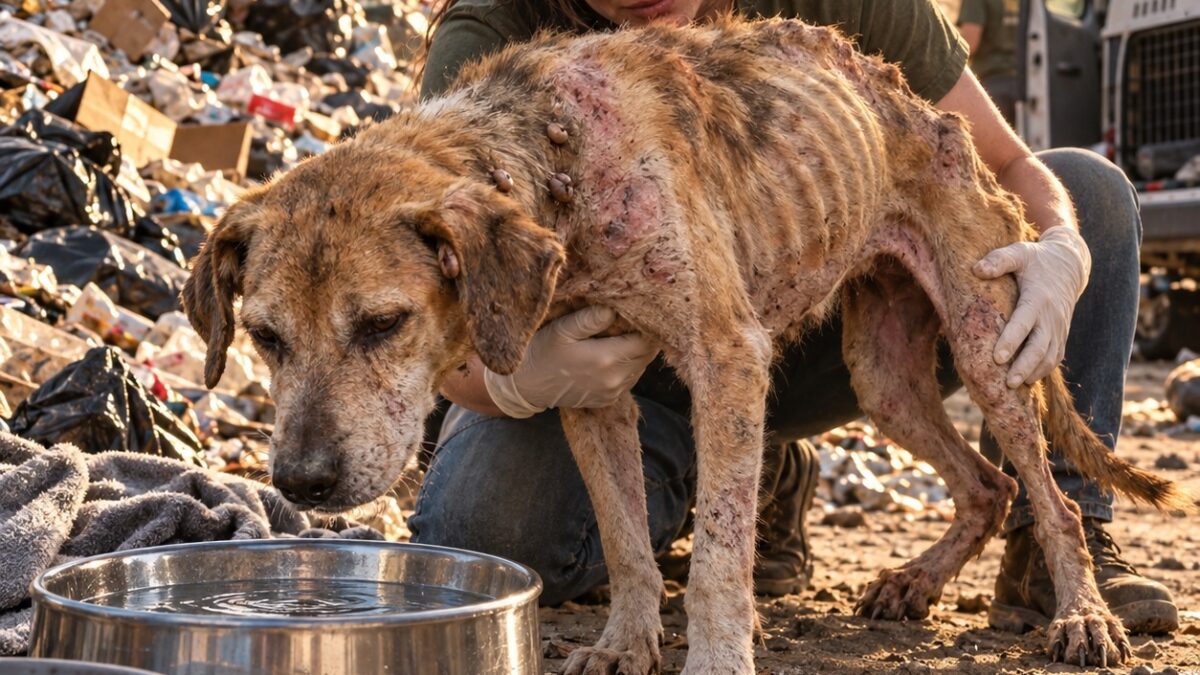
The veterinary clinic was ready when we arrived.
That did not make walking through the door easier.
Phoenix had drunk some water during the first part of the rescue, but by the time we reached the hospital, his body had returned to that heavy stillness.
I carried him inside.
A technician lifted the blanket beneath him while another supported his back legs.
The moment those rear paws touched the examination table, they began trembling again.
The veterinarian placed a hand gently along Phoenix’s side.
Then stopped.
He could feel every rib.
“How long has he been like this?”
“I don’t know.”
That answer becomes unbearable in rescue.
We often know the condition.
Not the timeline.
How long hungry?
How long covered in ticks?
How long in pain?
How many mornings did the dog wake beside garbage and begin searching again because nobody came?
We did not know.
The doctor checked his gums.
Too pale.
Listened to his heart.
Checked temperature.
Hydration.
Reflexes.
Joint response.
Muscle tone.
Then blood.
Phoenix barely reacted when the needle went in.
Another bad sign.
Some animals protest.
He just watched.
The veterinarian returned with the first results and sat down.
“His anemia is severe.”
I looked at Phoenix.
“From the ticks?”
“Likely contributing.”
The doctor continued.
“Malnutrition too.”
His calcium was dangerously low.
His entire body had been functioning without the basic resources needed to maintain normal strength.
Muscles.
Bones.
Nerves.
Energy.
Everything asking for material that was not coming.
The weakness in the hind legs was not one simple problem we could solve with a pill.
He had lost condition.
Strength.
Stability.
Possibly weeks or months of normal movement.
The veterinarian said:
“We need to support him carefully.”
“How carefully?”
“Very.”
Phoenix’s body could not simply receive a giant meal and be expected to recover overnight.
Nutrition after prolonged deprivation has to be managed.
Hydration monitored.
Electrolytes.
Minerals.
Medication.
Skin.
Parasites.
His system had been surviving on almost nothing.
You do not shock a body like that with abundance.
You rebuild.
Slowly.
Piece by piece.
The doctor gave him fluids.
We waited.
Phoenix rested with his head on a towel.
For the first time, surrounded by clean walls and people working only for him, he looked even smaller.
The garbage had made him part of the landscape.
In the clinic, every wound became visible.
A tick near his ear.
Another along his neck.
Raw skin down his side.
Thin legs.
Nails.
The tired eyes.
I sat near his head.
“Phoenix.”
His eyes moved.
“I know.”
I did not know what I meant.
Maybe:
I know you’re tired.
I know this is strange.
I know you have no reason to understand why these people are touching you.
Maybe I was apologizing on behalf of every human who had walked past a dog searching for scraps.
A technician brought a small amount of food.
The veterinarian said:
“Let’s see if he’s interested.”
Interested?
Phoenix lifted his head when the smell reached him.
That answered the question.
But even hunger could not make his body move quickly.
I held the bowl near him.
He sniffed.
Took one bite.
Chewed.
Paused.
Then another.
There was something almost unbearable about watching him eat from a clean bowl.
No plastic bag to tear.
No rotten smell to sort through.
No competition with flies.
No weak legs carrying him from one pile to another.
Food simply existed in front of him.
For him.
Phoenix ate.
Then rested.
Ate again.
When he finished the small portion, he licked the bowl.
Once.
Twice.
Then looked at me.
I wanted to give him everything.
A huge meal.
Another bowl.
Anything he wanted.
The veterinarian stopped me gently.
“Slow.”
I knew.
My heart did not care.
Phoenix had spent enough time hungry.
But healing required us to resist emotional urgency.
That became the pattern of his recovery.
Everything in me wanted fast.
His body demanded patient.
Tick removal took time.
More time than I expected.
There were so many.
Some came away easily.
Others had to be removed slowly to avoid worsening already inflamed skin.
Phoenix lay on a clean pad while the veterinary team worked.
Each time one parasite came off, it felt like one small theft ending.
His blood had already been taken by hunger.
By illness.
By whatever chain of circumstances had left him scavenging.
And these creatures had kept taking too.
I held his front paw.
Not because he needed me specifically.
Because I needed to do something.
His paw was rough.
The nails long.
The leg too thin.
The technician removed another tick.
Placed it away.
Another.
Another.
I stopped counting.
Phoenix occasionally lifted his head.
Then let it fall again.
The doctor said:
“He’s exhausted.”
That word followed him everywhere.
Exhausted.
Not lazy.
Not old.
Not weak by nature.
Used up.
There is a difference.
At around six years old, he should have been in the middle of life.
A strong adult dog.
Maybe running.
Playing.
Pulling on a leash.
Arguing with another dog over a toy.
Instead he looked like an elderly dog whose body had been slowly surrendering.
People later saw his early photographs and guessed ten.
Twelve.
Sometimes older.
I understood why.
Suffering ages the body.
The eyes too.
We began cleaning his skin that day.
Very gently.
The bath was not really a bath at first.
More like careful medical cleaning.
Warm water.
Soft cloth.
Medicated products chosen by the veterinary team.
We could not scrub.
His sores made that impossible.
Phoenix stood for part of it only because two of us supported him.
One person under his chest.
Another stabilizing the rear.
Every few minutes, we let him lie down.
The water darkened.
Dirt.
Blood residue.
Debris.
Evidence of a life without basic care.
I remember one of the technicians saying:
“Easy, boy.”
Phoenix turned his head toward her voice.
His eyes softened slightly.
Maybe I imagined it.
But that was the first time I saw something beyond exhaustion.
A response.
Not yet hope.
Maybe curiosity.
The hands touching him were not hurting him.
The water was warm.
No one rushed.
No one shouted.
When he could no longer stand, we stopped.
Wrapped him.
Dried him.
Put him on clean bedding.
Phoenix lowered himself onto it.
His back legs did not fold gracefully.
He almost collapsed.
We adjusted.
He rested.
That clean bed became one of the first symbols of his new life.
The garbage had been replaced by something soft enough that his bones did not press against the ground.
I watched him breathe.
In.
Out.
Slow.
And thought:
Tonight you do not have to search.
That alone felt enormous.
The first days were medically busy and emotionally quiet.
Phoenix ate.
Drank.
Received medication.
Calcium supplementation.
Treatment for anemia and skin infection.
Nutritional support.
Parasite management.
Everything scheduled.
Everything measured.
His meals became small anchors through the day.
Eventually four meals.
Not thrown scraps.
Not luck.
Meals.
Four times every day, the same promise:
Food is coming.
You do not have to find it.
That changed him.
At first, the bowl appeared and Phoenix ate with the desperate concentration of an animal afraid the food might vanish.
He did not look up.
Did not pause.
Just ate.
We stayed close enough to monitor but not so close that he felt pressured.
After some days, he began slowing.
Not because appetite decreased.
Because urgency did.
He started learning that one meal was not the last meal.
Breakfast would be followed by another.
And another.
And another.
Tomorrow too.
Predictability is medicine.
Maybe not something that comes in a bottle.
Still medicine.
His anemia remained a serious concern.
The veterinarian repeated blood work.
We watched numbers.
Small improvements.
Sometimes almost none.
The calcium level needed careful correction.
His muscles needed nutrients before they could respond properly to exercise.
His hips and back legs had almost no reserve.
Standing remained difficult.
Phoenix would plant his front paws.
Lift his chest.
Then try to bring the rear half underneath him.
Sometimes one leg slipped.
Sometimes both.
He would sit back down.
I learned not to rush in every time.
That was hard.
My instinct was to support.
Help.
Lift.
But rehabilitation required balance between assistance and effort.
If we did everything for him, his muscles had no reason to work.
If we demanded too much, he could fall or exhaust himself.
So we watched.
Encouraged.
Supported only when necessary.
Phoenix did not know he was in physical therapy.
He knew only that these strange humans kept asking him to do difficult things before feeding him.
He had opinions about that.
Good.
Opinions were life.
The therapy balls came later.
Large supportive exercise balls used to help stabilize him while he worked his hips and hind legs.
The first session looked almost absurd.
Phoenix was draped gently over the support, one caregiver holding his front body and another guiding his rear paws into position.
His legs trembled immediately.
I hated watching.
Not because he was being hurt.
Because effort looked so expensive.
A healthy dog shifts weight without thinking.
Phoenix had to concentrate.
Body forward.
Rear paws down.
Hold.
One second.
Two.
Release.
Rest.
Again.
Sometimes he looked at us with an expression that clearly said:
Why?
I would laugh softly.
“Because someday you’re going to annoy us by running.”
He did not believe me.
Some days, I barely did.
Progress came slowly enough to test everybody.
There were no dramatic transformations in the first week.
No morning where Phoenix suddenly stood and walked.
Some days looked almost identical to the day before.
That can be dangerous for morale.
Humans crave visible improvement.
The body does not owe us entertainment.
Healing happens internally before it becomes photogenic.
Blood rebuilding.
Minerals stabilizing.
Skin inflammation decreasing beneath ointment.
Muscle fibers receiving nutrients.
Nervous system adjusting.
We had to trust processes we could not see.
Phoenix had to endure them.
One morning, his skin looked slightly less angry.
We celebrated.
The next, one sore appeared irritated again.
We worried.
Then it calmed.
Progress is not a straight line.
Nobody tells inspiring stories that way.
They should.
Because the uneven days are where commitment proves itself.
Phoenix gained small amounts of weight.
At first, ounces felt important.
Then more.
His face changed.
Slight fullness around the cheeks.
The spine less severe.
Ribs still obvious, but not cutting through every angle.
He stood for a few seconds longer.
Then sat.
We cheered.
Phoenix looked unimpressed.
He liked food better than applause.
Fair.
He also began showing boundaries.
One afternoon, another dog came too close while Phoenix was resting.
The other dog meant no harm.
Just curious.
Phoenix lifted his head.
Gave a tiny warning nip toward the air.
Not a fight.
Not aggression.
A message.
Enough.
I laughed before I could stop myself.
Phoenix looked at me.
“What?”
I said.
“Good.”
Not because we wanted him biting.
Because he had enough energy to say:
I need space.
That mattered.
The dog we found had barely enough strength to stand.
He had tolerated everything because resistance cost energy he did not possess.
Now he could object.
Could communicate.
Could be annoyed.
That was progress too.
Recovery is not always becoming sweeter.
Sometimes it is becoming strong enough to complain.
We learned his personality in fragments.
Phoenix liked food.
Obviously.
He liked quiet.
He tolerated bathing better than expected after the first few sessions.
He preferred being approached from the side rather than directly over his head.
He could become grumpy when another dog crowded his rest.
Reasonable.
He liked certain caregivers more quickly than others.
He enjoyed gentle scratches when his skin allowed them.
And slowly, almost imperceptibly, he began wagging his tail.
The first wag happened when someone approached with food.
I refuse to pretend it was about love.
Food.
Absolutely food.
But eventually the wag began before the bowl appeared.
A caregiver entered.
Tail.
I walked in.
Tail.
Not always.
Enough.
Recognition.
Association.
People now predicted good things.
That is the beginning of trust.
One morning changed everything.
Not medically.
Emotionally.
I arrived early.
Phoenix was on his bedding.
I greeted him.
He lifted his head.
Then something different happened.
He shifted his front paws.
Pushed.
Brought his chest up.
His rear legs moved underneath him awkwardly.
And Phoenix sat.
By himself.
No sling.
No hand under his hips.
No therapy ball.
He sat.
It sounds small.
Most dogs sit hundreds of times without anyone noticing.
Phoenix had been so weak that arranging his own body upright required strength we had not seen him possess.
I froze.
“Wait.”
The technician turned.
Phoenix remained sitting.
Wobbly.
But up.
“Look.”
She looked.
Her face changed.
“Oh my God.”
Phoenix sat there staring at us as though we were idiots.
Then his rear leg slid.
He lowered himself.
The whole moment lasted maybe ten seconds.
I cried for ten minutes.
Phoenix ate breakfast.
Everyone has different priorities.
That sit became the first milestone people could understand instantly.
Before:
Could barely hold himself.
Now:
Sat alone.
We recorded the next time.
Not because we wanted content.
Because we wanted proof for ourselves on the difficult days.
Phoenix can do this.
He did it once.
The body remembers.
Over the next week, sitting became easier.
Then standing.
Still supported sometimes.
But more reliable.
His back legs no longer looked completely detached from the rest of him.
They began participating.
That is the only way I know to describe it.
They had been burdens Phoenix dragged.
Now they were becoming legs again.
The changes in his sleep surprised me.
When we found him, Phoenix slept curled protectively.
Body compact.
Head low.
Nothing exposed.
Later, he began sleeping on his side.
Then one afternoon, I walked into the room and stopped.
Phoenix was on his back.
Belly exposed.
Front paws loose.
Rear legs relaxed outward.
Completely asleep.
I whispered:
“Look at him.”
The caregiver beside me smiled.
“Comfortable.”
Safe.
That was what I saw.
Sleeping on the back is not a medical milestone.
No lab value improved because of it.
No muscle strengthened from the posture.
But emotionally, it felt huge.
A vulnerable body stretched open.
No garbage.
No ticks.
No need to guard food.
No need to conserve every movement.
Someone else worrying about the next meal.
Someone else checking medication.
Phoenix asleep.
That was his job.
Finally.
I took a photograph.
Not for social media initially.
For me.
Whenever recovery felt too slow, I looked at it.
A dog who feels unsafe does not usually sleep like that.
Phoenix was beginning to trust the environment enough to let consciousness go.
That is a kind of healing science cannot fully quantify.
Four meals a day.
Calcium.
Medication.
Physical therapy.
Bathing.
Rest.
Repeat.
The routine became almost boring.
That was wonderful.
Emergency had become schedule.
A schedule means you expect tomorrow.
Phoenix had a tomorrow now.
We planned for it.
His skin continued improving.
Open wounds began closing.
Inflammation reduced.
The tick damage became memory rather than active crisis.
Fur returned slowly in places.
Not perfectly at first.
Patchy.
Uneven.
People sometimes looked at recovery photos and said:
“He looks funny.”
I never liked that.
He looked healing.
There is a difference.
A body repairing itself does not owe anyone beauty.
Phoenix became handsome later.
But he deserved love while raw.
While thin.
While uneven.
While smelling medicinal.
That became important to me.
His age also became easier to believe.
At intake, six sounded impossible.
He looked old.
As his weight improved and eyes brightened, younger features emerged.
The face softened.
Posture changed.
Energy changed.
The dog who had looked more than ten began looking closer to the age he actually was.
It felt like watching time reverse.
Not literally.
His suffering had not disappeared.
But care removed some of what suffering had painted onto him.
He became more alert.
More interested in the room.
At first, Phoenix mostly watched food.
Then people.
Then doors.
Then other dogs.
Curiosity began taking space that exhaustion had occupied.
He noticed sounds.
Raised his head.
Sometimes tried to follow.
Physical therapy sessions became less passive.
Phoenix started helping us help him.
Pushing.
Balancing.
Resisting.
The therapy ball no longer carried most of the work.
His legs did.
That change was subtle until it was not.
One day, the therapist reduced support.
Phoenix stayed up.
Another day, less.
Still up.
Small tremors.
But standing.
I remember one particular session.
Phoenix was positioned carefully, rear paws planted.
The therapist supported his hips lightly.
“Come on.”
She shifted the ball.
Phoenix adjusted.
Right leg.
Left.
Hold.
His muscles trembled.
I watched his face.
Focused.
Not defeated.
The therapist loosened her hand.
Phoenix remained.
One second.
Two.
Three.
Then sat.
She laughed.
I clapped.
Phoenix looked toward his food area.
Again:
Different priorities.
But we knew.
Something had changed.
His body had begun believing in itself.
Swimming came later.
Water therapy offered a way to work the legs with less weight pressing through weak joints and muscles.
The first time, Phoenix was unsure.
Understandably.
He had survived enough without being placed in water by humans.
We used support.
Shallow introduction.
Gentle handling.
A flotation device as needed.
No throwing him into a pool for dramatic transformation.
Slow.
Phoenix’s paws began moving.
Front first.
Then rear.
The movement was not strong.
But water gave the hind legs an opportunity.
Kick.
Extend.
Work.
Without carrying his entire body.
The therapist guided.
Phoenix paddled.
I watched those back legs.
The same legs that had nearly collapsed among garbage.
Moving.
Deliberate.
Alive.
I had to look away because tears made it hard to see.
After swimming, Phoenix slept deeply.
On his back.
Of course.
We joked that therapy made him lazy.
No.
Therapy made rest deserved in a way we could measure.
He ate afterward.
All four meals still important.
Weight continued climbing.
His foster mom entered his story during this phase.
She had been helping with his care and eventually took on more of his daily rehabilitation outside the clinic setting.
I will call her Anna.
Not because her name matters less.
Because Phoenix’s story remained centered on what she gave him rather than public attention.
She was exactly the kind of foster a dog like Phoenix needed.
Patient.
Observant.
Not obsessed with forcing milestones.
She understood that a dog recovering from severe weakness needed structure without pressure.
Phoenix went places with her as his strength allowed.
Not huge adventures.
Life.
Car rides.
Short outings.
Different surfaces.
New smells.
The world beyond garbage and veterinary rooms.
Anna kept food routines precise.
Medication.
Calcium.
Therapy.
Rest.
She learned his moods.
When he had energy.
When he needed space.
When another dog was too close.
Phoenix learned hers too.
The first time he followed her toward the door without assistance, she sent a message.
He thinks he’s coming with me.
I replied:
He is.
She laughed.
Phoenix went.
That was how his world expanded.
Not one huge breakthrough.
Invitation.
He rode in the car differently from the day of rescue.
That first ride, his body had simply given up into sleep.
Now he looked out.
Head lifted.
Sometimes ears moving.
The passing world interested him.
That change broke my heart in a better way.
A dog who expects to survive can afford curiosity.
Anna took him on short walks tailored to what his legs could handle.
At first, every outing remained rehabilitation.
Distance measured.
Rest planned.
Surface considered.
Then one day she realized they had walked simply because Phoenix wanted to sniff something.
Not therapy.
A walk.
That distinction mattered.
Recovery becomes life when not every activity has a medical purpose.
Phoenix was getting there.
He gained strength in his hips.
The back legs still required attention.
Nobody pretended he had become an athlete overnight.
But movement became functional.
Then confident.
He could stand longer.
Move across rooms.
Follow people.
Reposition himself without help.
The things healthy dogs do unconsciously became achievements.
I started noticing how much we take normal movement for granted.
A dog stands up.
No applause.
Phoenix stands up.
Everyone watches.
Maybe that is one gift sick animals give us unwillingly.
They expose how miraculous ordinary bodies are.
His appetite never disappointed.
Four meals.
Phoenix considered this arrangement correct.
The more weight he gained, the more his personality appeared.
He sometimes became impatient if food preparation took too long.
A low sound.
A stare.
One caregiver said:
“Are you complaining?”
Phoenix stared harder.
Good.
The dog who once searched garbage now had expectations.
I loved that.
Entitlement after deprivation can be beautiful when it looks like:
Dinner should be on time.
We remained careful about feeding behavior around other dogs.
Phoenix had known scarcity.
You cannot assume a previously starving dog understands abundance immediately.
Space.
Separate bowls.
No competition.
Respect.
He occasionally signaled when another dog came too close.
We listened.
Boundaries reduce conflict.
Over time, as meals remained predictable, even that tension softened.
Not completely.
And it did not need to.
Phoenix was allowed preferences.
Recovery is not erasing personality to create a perfectly compliant dog.
It is giving the dog enough safety that his personality can exist without constant survival.
There were setbacks.
Of course.
One day he seemed weaker after therapy.
We worried.
The veterinarian adjusted the plan.
Another time, skin irritation flared.
Treatment continued.
A blood value improved more slowly than hoped.
Nobody panicked publicly.
Privately, every delay hurt.
You become greedy for progress once the dog gives you some.
Phoenix sits.
Now you want standing.
Phoenix stands.
Now you want walking.
Phoenix walks.
Now you want running.
Healing teaches patience repeatedly because humans forget it repeatedly.
Phoenix never promised speed.
He promised effort.
That was enough.
One morning, Anna sent a video.
Phoenix waking.
He opened his eyes.
Lifted his head.
Stretched his front legs.
Then pushed himself up.
No trembling collapse.
No assistance.
He stood.
Walked toward her.
Tail wagging.
The video was ordinary.
That is what made it extraordinary.
No one off camera cheering.
No therapist holding him.
No ball.
Phoenix simply woke up and moved because he wanted to greet the person who cared for him.
I watched it again.
And again.
The same back legs that once barely carried him between piles of trash now carried him across a clean floor toward someone he trusted.
That image became the center of the story for me.
Not the suffering.
The movement toward love.
Six months is both short and long.
Short compared with a lifetime.
Long when you are measuring recovery by meals.
Six months after we found Phoenix, we weighed him again.
The number settled.
Twelve pounds gained.
Twelve.
People hear that and think:
Weight.
I heard:
Hundreds of meals.
Calcium absorbed.
Blood rebuilding.
Skin healing.
Muscle returning.
Sleep.
Therapy.
Water.
Hands.
Time.
Twelve pounds was not merely food stored on a body.
It was care made visible.
Phoenix stood beside the scale.
He looked at us.
Tail moving.
I put the intake photograph next to a recent one.
I knew they were the same dog.
Still, my brain resisted.
The first Phoenix looked ancient.
Hollow.
Skin damaged.
Eyes tired.
Back legs barely functioning.
The dog in front of me looked present.
Not perfect.
Alive.
Strong enough to carry himself.
Alert.
Interested.
His face had shape again.
His body had substance.
The years suffering had painted onto him seemed partly erased.
I whispered:
“Look at you.”
Phoenix wagged.
He had no idea what six months meant.
Good.
Dogs do not need anniversaries.
They need good days.
He had one.
We took him outside afterward.
Not for a formal celebration.
Just because the weather was good.
Anna clipped his leash.
Phoenix moved forward.
Steady.
Not fast.
Steady.
He stopped to smell something near a tree.
Took his time.
Then moved again.
The leash remained loose.
I followed a few feet behind.
For a moment, the old image arrived.
Phoenix in garbage.
Searching.
Every step a struggle.
Then present Phoenix stepped onto grass.
Rear legs supporting.
Tail up.
Head moving with scents.
I started crying.
Anna looked back.
“Again?”
“Yes.”
She laughed.
“You cry a lot.”
“I know.”
Phoenix looked at us.
Then continued sniffing.
Perfect.
He had more important things to do than participate in human symbolism.
The name Phoenix had felt almost too hopeful at the beginning.
I worried about that.
What if he did not recover enough?
Would the name become pressure?
We do that sometimes.
Give sick animals names like Hope, Miracle, Lucky, Phoenix because we need to believe the story has a direction.
But animals do not owe us inspiring endings.
Some do not survive.
Some remain disabled.
Some heal differently.
Their lives still matter.
I reminded myself of that constantly.
Phoenix did not need to “rise” dramatically to justify rescue.
If he remained weak but comfortable, we would care.
If his hind legs never became fully functional, we would adapt.
Wheel support.
Mobility assistance.
Whatever.
The goal was not a perfect transformation photograph.
The goal was quality of life.
That is why his progress felt like a gift rather than something we were entitled to.
He gave us more than we dared demand.
Swimming became something he seemed to accept, then enjoy.
At first therapeutic.
Later familiar.
He moved through the water with more strength.
The legs working in a rhythm we once could not imagine.
People who saw clips said:
“He looks happy.”
Maybe.
I am careful about projecting too much.
But his body was loose.
His expression alert.
He returned willingly.
Good enough for me.
Water had become another place where his body worked instead of failed.
His foster life grew richer.
Car rides.
Outings.
Rest in clean spaces.
People around.
No scavenging.
No ticks draining him.
No body covered in untreated open sores.
The contrast remained almost too large.
I had to stop comparing sometimes.
Because Phoenix deserved to be known as the dog he was now.
Not forever as the garbage dog.
Trauma can become another cage when humans refuse to let the recovered animal have a new identity.
So we talked about his present.
Phoenix likes this.
Phoenix did that.
Phoenix stole something.
Phoenix nipped another dog for getting too close.
Phoenix slept on his back like he paid rent.
Phoenix swam.
Phoenix went out with Anna.
Phoenix gained weight.
Present tense.
Life tense.
The sleeping-on-his-back habit continued.
That image always made people smile.
Belly exposed.
Legs open.
Sometimes one front paw bent strangely.
Complete vulnerability.
He had gone from searching garbage with a body fighting to remain upright to sleeping in a clean place while someone else counted meals.
That difference is what rescue should be.
Not heroism.
Transfer of burden.
Before:
Phoenix carried everything.
Hunger.
Movement.
Danger.
Finding food.
Finding somewhere to rest.
After:
Humans carried the schedule.
Meals.
Medicine.
Therapy.
Veterinary decisions.
Phoenix could carry only himself.
Eventually even that became easier.
I often think about the day he first sat up.
Why that moment?
We had bigger milestones later.
Weight gain.
Walking.
Swimming.
But the sit remains special.
Because it was the first clear declaration from his body:
I am still here.
He did not know that.
We did.
A little movement built from minerals, food, sleep, muscle, and will.
Sometimes recovery enters quietly.
No music.
Just a dog sitting.
The tail wag mattered differently.
That said:
Something here feels good.
At the dump, we saw need.
At the clinic, we saw survival.
The wag introduced pleasure.
That is a huge transition.
Life should contain more than absence of suffering.
Animals deserve joy too.
Food can stop hunger.
Medicine can stop infection.
Safety can stop danger.
But play, affection, exploration—those create a life.
Phoenix was moving toward that.
His foster mom became part of that joy.
He recognized her routines.
The sound of movement.
Car.
Leash.
Meal preparation.
Dogs build worlds from patterns.
Anna became one of the patterns that meant good things.
When she approached, Phoenix wagged.
That simple response told me more than any speech could.
We never wanted his medical recovery to become entertainment.
That required discipline.
People love extreme before-and-after stories.
Phoenix had one.
The temptation to compress six months into thirty seconds was strong.
Garbage.
Vet.
Therapy.
Healthy dog.
Music.
Done.
But compression can erase labor.
So whenever I told his story, I emphasized months.
Four meals a day.
Supplements.
Medication.
Physical therapy.
Support.
Swimming.
Caregivers noticing small changes.
Because miracles are often maintenance viewed from far away.
Up close, somebody set alarms.
Somebody cleaned wounds.
Somebody held the therapy ball.
Somebody washed bedding.
Somebody measured food.
Somebody drove to appointments.
Somebody worried.
Again.
Again.
Again.
Phoenix rose because a network refused to stop showing up.
He also rose because his body had incredible resilience.
We should give him that credit.
Nutrition does not automatically create strength if an animal has no capacity to recover.
Phoenix responded.
He ate.
Used what he was given.
Tried.
Worked muscles that had little strength.
Moved.
Repeated.
His body participated in its own rescue.
That matters.
We helped.
Phoenix healed.
The garbage site remained in my memory long after I stopped visiting.
Sometimes driving past piles of discarded things anywhere else brought it back.
The smell.
Heat.
Phoenix moving.
I would think about how invisible suffering can become when surrounded by things people already decided were worthless.
Garbage has a way of making whatever is inside it look disposable too.
Phoenix had been living among what people threw away.
Maybe that is why the image hurt so much.
A living animal forced into a landscape of rejection.
But Phoenix was never garbage.
Never disposable.
Never old simply because neglect made him look old.
Never weak by identity.
His condition was what had been done to his body through deprivation.
Not who he was.
That distinction guided us.
There is cruelty in confusing condition with identity.
A malnourished dog looks weak.
People say:
Weak dog.
A fearful dog hides.
People say:
Bad temperament.
A sick dog smells.
People step away.
Phoenix taught us to ask:
What happens after care?
The answer was:
Everything.
The dog emerged.
Once his skin improved enough for comfortable touch, Phoenix began accepting longer petting.
Not dramatic affection at first.
A hand along the shoulder.
Scratch near the neck where skin had healed.
He leaned slightly.
Then more.
I remember thinking about the ticks that had once occupied those same areas.
Now fingers.
Gentle.
Same body surface.
Completely different experience.
The skin itself was learning a new world.
Physical therapy made his body more coordinated.
At first, he moved like each rear leg belonged to someone else.
Later, the steps synchronized.
Not perfect.
Better.
His hips steadier.
We used supportive exercises.
Weight shifting.
Controlled standing.
Strengthening.
Water work.
Every technique boring in isolation.
Together:
mobility.
That word became precious.
Mobility meant Phoenix could choose where to go.
A dog with failing legs lives partly where the body leaves him.
A stronger Phoenix could move toward shade.
Food.
Person.
Door.
Bed.
Freedom is partly movement.
Rehabilitation returned choice.
That is why I loved watching him walk.
Not because walking made him more worthy.
Because it expanded agency.
One day at foster, another dog moved into Phoenix’s preferred resting space.
Phoenix gave that familiar little warning nip.
Anna laughed.
“Bossy.”
Phoenix settled elsewhere.
I smiled when she told me.
A dog confident enough to have preferred space.
Six months earlier, he had no clean place at all.
Now he had opinions about seating arrangements.
Recovery.
He became more expressive around food too.
Sometimes standing before the scheduled meal.
Watching.
Waiting.
Maybe a soft vocalization.
The fear that food would never come was gradually replaced by the expectation that humans were simply slow.
Wonderful.
I have rescued starving dogs who never completely lose the urgency.
Some always eat quickly.
Some guard.
Some search bins forever.
Phoenix retained traces too.
History does not vanish because circumstances improve.
But behavior softened.
That is enough.
Healing is often not zero scar.
It is scar without domination.
The scars on his skin became less visible as fur returned.
Some remained.
I did not hate them.
Not because suffering should be romanticized.
Because scars are evidence the wound closed.
Open sores were danger.
Scars were past tense.
I prefer past tense.
His eyes changed most.
I know I said that about other dogs.
It remains true.
Eyes do not literally transform color from care.
But expression does.
At the dump, Phoenix looked inward.
Energy conserved.
World reduced.
Months later, he looked out.
At people.
Dogs.
Food.
Environment.
Curiosity returned.
That is youth returning.
Maybe that is why he stopped looking ten years old.
Interest makes faces younger.
A veterinarian once looked at his six-month photos and said:
“You can finally see six.”
That line stayed with me.
Neglect had stolen his apparent age.
Care gave it back.
Not the lost time.
But the dog hidden underneath.
We never knew exactly what Phoenix had experienced before the garbage.
I did not invent a story.
That matters.
Rescue storytelling can become dangerous when we fill gaps with dramatic certainty.
We know what we saw.
Open wounds.
Ticks.
Severe malnutrition.
Anemia.
Low calcium.
Weak hind legs.
Living among garbage.
Searching for food.
We do not need fictional cruelty to make that enough.
The condition speaks.
Our job is truth.
Phoenix deserved that too.
Sometimes people asked:
“Who did this?”
I answered:
“We don’t know the full history.”
That frustrated them.
People want a villain.
A face.
Punishment.
But not knowing does not reduce responsibility to care for the animal in front of you.
Phoenix did not need us to solve his biography before feeding him.
That became another lesson.
Help can begin before explanation.
The first water bowl saved nothing by itself.
The first meal did not cure malnutrition.
The first bath did not heal skin.
The first therapy session did not make him walk.
But every recovery is made of insufficient things repeated until together they become enough.
That is Phoenix’s story.
One insufficient act after another.
Water.
Food.
Medication.
Calcium.
Bath.
Rest.
Therapy.
Meal.
Meal.
Meal.
Meal.
Sleep.
Again.
Then:
sit.
Again.
Stand.
Again.
Walk.
Again.
Swim.
Again.
Live.
The number twelve pounds became almost famous among people following him.
Six months.
Twelve pounds.
Clear.
Measurable.
But I wish there were a scale for other things.
How many grams of fear lost?
How many ounces of trust gained?
How much more future?
No instrument.
We use behavior.
Tail wag.
Back sleep.
Following foster mom.
Moving with interest.
Those were our emotional measurements.
Phoenix gained far more than twelve pounds.
Anna once sent me a photograph of Phoenix asleep in the car after an outing.
I froze.
The angle resembled the rescue-day ride.
Head resting.
Eyes closed.
But everything else was different.
First ride:
collapse.
Now:
content exhaustion.
The body looks similar in a still image.
Context changes meaning.
I thought about how often we misread animals from photographs alone.
You need story.
First sleep:
I have nothing left.
Later sleep:
I had a full day.
What a difference.
His outings became part of recovery because normal experience strengthens more than muscles.
Novel environments.
Smells.
Surfaces.
Safe people.
Confidence.
Phoenix’s world had once been small enough to measure by trash piles.
Now the car could carry him elsewhere.
A park.
A quiet path.
A place to sit with Anna.
Every new location told his nervous system:
The world is bigger.
And some parts are good.
He did not need to become adventurous.
Not every rescue dog turns into an explorer.
But Phoenix engaged.
That made us happy.
He had choice.
That was enough.
At around the six-month mark, I walked beside him without carrying a support sling.
I remember noticing the emptiness of my hands.
At the beginning, my arms were always ready.
Lift.
Catch.
Stabilize.
Now Phoenix walked.
I had nothing to do.
That felt wonderful.
People working in care often celebrate becoming unnecessary.
It means the patient reclaimed something.
Phoenix reclaimed his legs.
Not perfectly.
Enough to carry life.
We stopped applauding every stand eventually.
That was another milestone.
At first:
Phoenix stood!
Then it became normal.
Nobody noticed.
Perfect.
Recovery should eventually become boring.
You do not want every basic movement to remain an event.
You want it to become expected.
Phoenix stands.
Of course.
Phoenix walks.
Of course.
That is success.
His foster mom once joked:
“You know he follows me everywhere now?”
I said:
“Your problem.”
She laughed.
“I remember when he could barely follow anyone.”
Silence.
We both felt it.
Then she said:
“I’ll take the problem.”
Good.
The hardest part of seeing Phoenix healthy was knowing how unnecessary so much of his suffering had been.
Hunger can be treated.
Ticks can be removed.
Skin infections can be addressed.
Weakness can be supported.
Maybe not every case is preventable.
But an animal should not need to reach garbage-dump collapse before help begins.
That anger remained.
I learned to use it carefully.
Anger can start rescue.
It cannot replace care.
Phoenix did not need me furious while measuring his calcium.
He needed precision.
People donated.
Shared.
Encouraged.
That mattered.
Medical care costs money.
Therapy takes resources.
Foster care takes time.
Phoenix’s recovery belonged partly to a community that decided he was worth spending those things on.
Worth.
That word.
He had always been worth them.
We simply arrived late.
I sometimes wondered what he thought of us.
Probably not much in human terms.
Dogs do not construct heroic narratives.
Phoenix likely understood:
Food people.
Medicine people.
Therapy people.
Anna.
Safe bed.
Water.
Car.
Other dog annoying sometimes.
Good.
That is better than being someone’s symbol.
Let him be a dog.
The more active he became, the more we had to adjust his routine.
Exercise increased carefully.
Calories monitored.
Therapy advanced.
Rest remained important.
Muscles grow during recovery, not only activity.
Phoenix liked rest.
Especially on his back.
He had perfected it.
One day he rolled so far while sleeping that he nearly fell off the bed.
Anna caught him.
Phoenix woke offended.
She sent the story.
I laughed until tears came.
Compare that with our first fear:
Will he survive?
Now:
Phoenix is too relaxed and fell off furniture.
Give me that problem forever.
He began exploring more with his nose.
Sniffing everything.
Other dogs’ paths.
Grass.
Bags.
Cars.
A dog’s nose is how the world becomes legible.
Hunger had once forced his nose toward garbage.
Now smell could be information, not desperation.
That difference moved me.
We gave him treats during therapy.
He became suspiciously enthusiastic about rehabilitation.
The therapist said:
“I think he’s manipulating us.”
Good.
Manipulation requires energy.
Phoenix earned it.
He learned that certain exercises predicted rewards.
Stand.
Treat.
Shift weight.
Treat.
Walk.
Treat.
Phoenix became a scientist.
We became predictable machines dispensing food.
This arrangement pleased him.
He still had limits.
We respected them.
Some days shorter sessions.
Sometimes fatigue.
Sometimes skin sensitivity.
Recovery does not mean pushing until collapse.
We wanted strength, not performance.
Phoenix had already spent too much of life forcing his body beyond available resources.
Now effort could stop before suffering.
That is another form of care.
Six months after rescue did not mean story over.
That is important.
There were still checkups.
Management.
Strengthening.
Continued good nutrition.
A foster home.
Life unfolding.
I would never invent a perfect endpoint unsupported by what we knew.
But six months gave us something we had not had at the beginning:
confidence in direction.
Phoenix was no longer spiraling downward.
He was growing.
That is a satisfying ending even before the final chapter is known.
Sometimes the victory is trajectory.
I looked at him one afternoon and realized I no longer feared touching his spine because it no longer felt like a row of sharp edges beneath skin.
There was muscle.
Weight.
Warmth.
I ran my hand along his back.
Phoenix leaned slightly.
Tail.
I remembered the first lift.
How light.
Too light.
I whispered:
“Twelve pounds.”
He ignored me.
Fair.
Numbers are for humans.
He cared about dinner.
His meals remained four a day for a long time.
Routine.
A caregiver joked:
“Phoenix thinks it should be five.”
Probably.
The dog had earned negotiations.
There was a moment when another dog approached during meal preparation.
Months earlier, we would have separated carefully to avoid stress.
Now Phoenix looked.
Gave a small warning.
Then returned attention to his bowl.
Progress.
Not perfect sociability.
Confidence.
Resource security.
Enough.
He became comfortable enough around Anna to sleep while she moved through the room.
At first, dogs recovering from neglect often wake at every movement.
Phoenix eventually did not.
That is trust again.
You can make noise and I remain asleep because I do not expect danger from your footsteps.
This may be one of the most underrated signs of safety.
Anna took him places.
People saw him.
Some knew his story.
Others did not.
The ones who did not simply saw a dog.
That pleased me.
I wanted his healthy life to outgrow his rescue identity.
One stranger once said:
“He looks good for an older dog.”
Anna laughed.
“He’s only about six.”
The stranger looked surprised.
Exactly.
Phoenix had finally become young enough to surprise people.
That felt like winning time back.
His name became more fitting with each month.
Phoenix.
Rise.
Again, I remain cautious about symbolism.
But sometimes a name catches reality.
He had not risen from ashes literally.
He rose from garbage.
From anemia.
From calcium depletion.
From skin wounds.
From legs that could barely support him.
Maybe close enough.
The difference is that mythical phoenixes rise alone through magic.
This one did not.
He rose through care.
I prefer that story.
Magic asks nothing of us.
Care asks everything.
Time.
Money.
Repetition.
Skill.
Patience.
Foster homes.
Veterinary work.
Hands.
Real rescue is less glamorous than myth and more meaningful.
People asked how Phoenix stayed so gentle after everything.
I never liked the implication that harmed animals should automatically become aggressive.
Trauma changes behavior differently.
Phoenix had boundaries.
He could nip when crowded.
Good.
He communicated.
But he remained willing to engage.
That was his temperament.
We respected it.
The little nip became almost a joke among caregivers.
“Phoenix says no.”
We listened.
Teaching people to listen to small signals prevents big ones.
Another rescue lesson.
A dog should not have to escalate to be heard.
When his rear legs strengthened enough, he began choosing different sleeping locations.
Not always the easiest.
Sometimes stretched farther from support.
Sometimes moved just because someone else had the better spot.
He could negotiate space physically now.
Again, mobility equals agency.
I once found him lying halfway across a doorway.
Completely blocking traffic.
I said:
“Excuse me.”
Phoenix looked.
Did not move.
I stepped over him.
The dog who once moved painfully through garbage now had the audacity to make humans move around him.
Beautiful.
Anna laughed when I called him spoiled.
“He’s not spoiled.”
“He is lying in the doorway making everyone step over him.”
“He’s recovering.”
“For six months?”
“Lifetime condition.”
Fair.
There is a tendency to believe rescued animals should remain grateful.
I reject that.
Phoenix did not owe obedience because we fed him.
He did not owe perfect behavior because we paid medical bills.
Care is not a debt contract.
If he became stubborn, annoying, picky, vocal, or demanding, good.
That means he was safe enough to be a full animal.
The first time he refused a food he did not like, I almost applauded.
At the dump, he searched garbage.
Now:
No, thank you.
Choice.
Again.
I think often about calcium.
Such a mundane mineral.
Invisible.
No emotional symbolism.
Yet Phoenix’s dangerously low calcium level helped explain why his body struggled.
Sometimes suffering is biochemical.
Not dramatic.
A body without enough building blocks cannot perform courage into existence.
We needed veterinary science.
Not love alone.
That matters.
Love without medicine would not have fixed his anemia.
Kind words do not replace calcium.
Compassion must become competent care.
Phoenix deserved both.
Likewise, physical therapy was not optional inspiration.
Muscle needs training.
Nerves need repetition.
Joints need controlled movement.
The therapy ball looked strange to some viewers.
Maybe funny.
But every controlled second had purpose.
His eventual steps were built there.
Swimming too.
People saw a cute dog in water.
We saw reduced load, increased range, controlled strengthening.
Recovery has mechanics.
It is okay to admire them.
His foster mom learned the exercises.
Consistency.
Home rehabilitation.
That helped bridge clinic and daily life.
Phoenix’s body did not know weekends.
Care had to continue.
She continued.
That is what good fostering looks like.
Not only cuddles.
Work.
Of course there were cuddles too.
Phoenix eventually accepted those gladly.
Good balance.
At the six-month comparison, someone said:
“He looks like a completely different dog.”
I understood.
But I answered:
“Same dog.”
Because that matters.
The healthy Phoenix was not created by us.
He was the same animal finally receiving what allowed his body to express itself.
Same Phoenix.
Different condition.
Never confuse damaged appearance with damaged worth.
The dog in the trash was already worthy of the clean bed.
The dog with sores was already worthy of affection.
The dog who could not stand was already worthy of a future.
Recovery did not earn those things.
It revealed what should have been recognized earlier.
One day, after a successful therapy session, Phoenix walked toward Anna, then past her.
She laughed.
“He doesn’t even want me.”
He was heading for his food.
Of course.
I said:
“Know your rank.”
Anna replied:
“Below dinner.”
Correct.
Humor became part of the story.
That is another sign emergency has loosened.
At the beginning, nobody joked.
Everything felt too fragile.
Later:
Phoenix complains.
Phoenix steals space.
Phoenix wants food.
Phoenix falls asleep upside down.
Humor means we expect him to be around long enough to laugh.
That expectation itself is healing.
I remember the first night I allowed myself to think:
He might be okay.
Not survive the night.
Not improve slightly.
Okay.
It was after he sat up.
Maybe irrational.
One sit does not determine prognosis.
But emotionally, that movement changed the future.
He had strength we could build on.
Hope became less abstract.
The first time he crossed a room unassisted gave me the same feeling multiplied.
Step.
Step.
Rear legs under him.
No collapse.
Pause.
Step.
Phoenix reached the other side.
Looked back.
Maybe wondering why everyone was emotional.
I whispered:
“You have no idea.”
He did not.
Good.
Let the humans carry the history.
His world moved from survival to preference.
That is the trajectory I want people to remember.
Survival:
Where is food?
Can I stand?
What hurts?
Preference:
Which bed?
Which person?
Is that dog too close?
Should I swim today?
Where are we going in the car?
That is a life opening.
We never stopped monitoring his health.
Improvement can create complacency.
Phoenix’s history meant he needed proper follow-up.
Weight.
Blood.
Calcium.
Musculoskeletal condition.
Skin.
Everything.
Care does not end when photographs improve.
That is another reason I resist simplistic rescue endings.
The after photo should begin responsibility, not close it.
Anna understood.
She never treated Phoenix as a completed project.
She treated him as a dog with ongoing needs.
That made me trust her.
If his story had ended at the clinic, it would be incomplete.
If it ended at the first sit, incomplete.
If it ended at twelve pounds, still incomplete.
But every story needs a place to rest.
For me, it is this:
Phoenix walking beside Anna six months after rescue.
No sling.
No garbage.
No trembling collapse.
Rear legs moving.
Tail lifting.
Body fuller.
The ground beneath him clean.
Someone beside him.
That is where I can leave the reader.
Because the direction is clear.
He is going forward.
I imagine the dog we found seeing that version of himself.
He would not understand.
Animals do not imagine future bodies the way we do.
But maybe that is why rescue matters.
When the suffering animal cannot imagine tomorrow, someone else has to hold the image for him.
The veterinarian.
Foster.
Rescuer.
Donor.
Caregiver.
We hold:
Eat again.
Stand again.
Walk again.
Until the animal can simply live it without needing to know we once doubted.
Phoenix never knew the fear in our conversations.
The blood results that worried us.
The calcium number.
The way people whispered after seeing his skin.
Good.
He had enough burdens.
Let humans worry.
That is one of the gifts of rescue:
redistributing worry.
Before:
dog worries about survival.
After:
people worry about dog.
The dog sleeps on his back.
That is correct order.
His back-sleeping photos became a favorite among supporters.
I understood why.
They were funny.
But more than funny.
A dog who once could not control whether his environment was safe now slept in the most defenseless posture possible.
Trust made visible.
One image showed his rear legs stretched loosely.
Those legs.
I stared at them.
No tremor.
No collapse.
Resting.
It is strange to feel proud of legs while they do nothing.
But rest is a privilege too.
Phoenix had earned it.
The phrase “he looked ten” remained painful because it reminded me how quickly humans read age from deterioration.
After six months, someone guessed five.
I almost hugged them.
Care had returned years to his appearance.
Not real chronological years.
Still.
It felt symbolic.
We celebrated his six-month mark with food.
Of course.
Not cake.
Phoenix did not care about ceremonies.
A good meal.
He ate.
Tail wagging.
Then slept.
Excellent celebration.
I sat nearby and scrolled to the first photographs.
I do not recommend doing that when emotional.
Garbage.
Sores.
Ticks.
Hips.
Eyes.
Then looked up.
Phoenix asleep.
Clean.
Fed.
Twelve pounds heavier.
I whispered:
“We found you.”
Then corrected myself.
“No.”
“Someone noticed you.”
“That’s where it started.”
Rescue rarely begins with the rescuer.
It begins with witness.
Someone sees.
Then refuses to pretend not to.
That is important.
How many days had Phoenix been visible before the message?
I do not know.
How many people thought:
Someone else will help?
I do not know.
I am not interested in blaming strangers without facts.
But I am interested in encouraging action.
If you see an animal in obvious distress, report.
Ask.
Contact a rescue or local authority.
Do not assume suffering is being handled simply because it has become part of the scenery.
Phoenix had become part of garbage scenery.
He should not have.
The day we removed him, the trash remained.
Phoenix did not.
That difference was everything.
I sometimes dream about finding him again.
Same place.
But in the dream, his legs work.
He runs toward the car.
Dreams rewrite helplessness.
I wake sad and grateful.
There is one part of his story I rarely talk about.
The guilt of rescue timing.
You arrive.
You save.
Then later think:
Why not yesterday?
Why not last week?
Why did nobody reach him before anemia became severe?
Before calcium fell dangerously low?
Before sores opened?
It can consume you.
You have to learn:
You cannot rescue an animal before you know he exists.
Once you know, move.
That is all.
Phoenix did not need our guilt.
He needed our schedule.
So we made one.
Four meals.
Medication.
Supplements.
Therapy.
Repeat.
Guilt converted into care.
Best use for it.
The foster mom once told me Phoenix seemed to enjoy watching the world from the car window.
Not hanging his head dangerously outside.
Just watching.
I pictured him.
Movement without effort.
Landscape changing.
No need to search for food.
Someone driving him somewhere because they wanted his company.
That is such a luxurious concept for an animal who once moved only because survival required it.
Now travel could be optional.
Interesting.
Fun.
Phoenix had leisure.
Another miracle built from ordinary life.
He went swimming.
He went places.
He had people beside him.
That sentence from his recovery is my favorite summary.
People beside him.
At the garbage site, he had no visible one.
Then suddenly:
veterinarian beside him.
Technicians.
Rescuers.
Foster mom.
People.
The opposite of abandonment is not merely shelter.
It is companionship.
Someone beside.
His progress encouraged caregivers too.
Rescue work can be emotionally brutal.
Some cases end badly.
Some animals arrive too late.
Phoenix gave the team something.
Evidence that patient work can produce extraordinary change.
His sit made people smile for days.
His walking made them cry.
His weight gain reminded everyone why routine matters.
Phoenix did not owe us inspiration.
Still, he gave it.
I watched younger volunteers learn from him.
They wanted to help him stand immediately.
We taught them to support correctly.
Wanted to feed more.
We explained measured nutrition.
Wanted to bathe vigorously.
We taught wound-safe cleaning.
Phoenix became an education in patience.
No shortcuts.
That lesson will help other dogs.
His recovery rippled outward.
Again, he owed none of this.
But good care creates knowledge.
We carry it forward.
The nickname “old man” sometimes appeared affectionately because of how he first looked.
I stopped people eventually.
“He’s six.”
They laughed.
But I meant it.
Language shapes perception.
Phoenix deserved to be seen as a middle-aged dog with future, not an old dog nearing end.
He had lost enough time.
Give him the years he has.
His body posture became taller.
That sounds strange.
Not height.
Presence.
At the beginning, body collapsed inward.
Later, head higher.
Back more supported.
Eyes outward.
Space occupied.
Phoenix began looking like he belonged in the room.
He always did.
Now he felt it too, maybe.
One morning, another dog tried to take his resting spot.
Phoenix stood.
Actually stood.
Moved forward.
Gave a clear look.
The other dog moved.
Phoenix lay down.
I laughed.
He had become landlord.
Perfect.
The rear legs that once made him helpless now helped him negotiate furniture politics.
Beautiful.
When Anna prepared for an outing, Phoenix began anticipating.
Leash.
Tail.
Movement.
At first, we had carried him into many situations.
Later, he brought himself.
That shift felt profound.
He no longer needed to be transported through life.
He participated.
If he tired, Anna stopped.
No shame.
A dog can be improving and still need support.
Recovery does not require pretending limitation vanished.
We adjusted around him.
That respect helped strength grow without making weakness feel like failure.
Humans could learn from that.
Maybe.
But again, Phoenix did not exist to teach us.
He existed to live.
I keep repeating that because rescue stories easily become moral fables.
Phoenix was not a metaphor first.
He was a dog.
Hungry.
Then fed.
Sick.
Then treated.
Weak.
Then stronger.
That is enough.
The most satisfying fan reactions were not:
“Punish whoever did this.”
They were:
“Look at his tail now.”
“Look at him sitting.”
“He’s walking!”
“He sleeps on his back!”
People had moved with us from outrage to joy.
That is healthy.
Anger can mobilize.
Joy sustains.
If every rescue story ends emotionally at the cruelty, the animal never becomes bigger than what happened.
Phoenix did.
At six months, the intake image became almost historical.
Still painful.
But no longer predictive.
That is what you want from a before photo.
Past.
Not prophecy.
Phoenix’s future remained open.
Maybe more therapy.
More weight adjustment.
More muscle.
More adventures with foster mom.
Maybe eventually a permanent home if and when the right situation came.
The source of his story at that point did not give me a final adoption, and I will not invent one.
He did not need a fabricated ending.
His real recovery was already enough.
He had a clean place.
Consistent care.
People beside him.
A body getting stronger.
A foster mom taking him into life.
That is real.
That satisfies me more than a false bow tied around facts.
Sometimes survival itself is the ending.
Sometimes walking is.
Sometimes twelve pounds is.
Sometimes sleeping on your back because you trust dinner will come tomorrow.
Phoenix had all of those.
The last image I carry from those first six months is not staged.
Anna is ahead.
Phoenix follows.
The path is ordinary.
His gait still carries history if you know what to look for.
But he moves.
One back leg.
Then the other.
Weight transferred.
Body forward.
Tail moving lightly.
No support sling.
No therapy ball.
No garbage.
Just steps.
I stand behind them.
Not close enough to help unless needed.
That distance is the point.
At the beginning, we could not let Phoenix take two steps without fearing he would collapse.
Now I can watch from behind.
He does not need my arms under him.
He has his own legs.
And a person walking beside him.
I think about the name.
Phoenix.
We chose it before evidence.
That feels brave now.
Or foolish.
Hope often looks foolish before proof.
We named the possibility.
Then spent months supporting the body until possibility became visible.
But the name did not save him.
Care did.
He saved parts of himself too.
The name simply gave us language for what we wanted.
Rise.
And he did.
Not with wings.
With shaking legs.
That is better.
He rose the first time he drank clean water.
Rose when he ate food he did not have to find inside trash.
Rose when the first tick came off.
When his skin was cleaned.
When medication entered his body.
When calcium began returning.
When blood improved.
When he accepted the therapy ball.
When he objected to another dog being too close.
When he sat.
When he stood.
When he slept on his back.
When his tail moved.
When he swam.
When he followed Anna.
When the scale showed twelve pounds more life around his bones.
Rising was not one moment.
It was months.
That is why I resist the image of dramatic rescue.
The dramatic part is often only discovery.
The heroic part is Tuesday.
Then Wednesday.
Then Thursday.
Still feeding.
Still cleaning.
Still lifting.
Still driving.
Still believing when the body changes by millimeters.
Phoenix had people who kept returning.
That is why he rose.
When people ask what Phoenix needed most, they expect:
Food.
Medication.
Calcium.
Therapy.
All true.
But beneath everything:
continuity.
Care that did not disappear after the emotional first day.
That is the difference between rescue and momentary pity.
Pity sees wounds.
Commitment returns tomorrow.
Phoenix needed tomorrow.
Many of them.
He got them.
I think about his first night on clean bedding.
We worried whether he would eat again.
Whether anemia would worsen.
Whether his legs could recover.
Phoenix knew none of that.
He slept.
Maybe for the first time in a long while without garbage beneath him.
That night now feels like the beginning of his second life.
Not because the danger was over.
Because responsibility had transferred.
He did not have to solve survival alone anymore.
That is what I wish every neglected animal could experience.
A moment where the burden changes hands.
You can stop now.
We have the food.
We have the medicine.
We have the schedule.
Sleep.
We’ll worry.
Phoenix eventually understood that arrangement very well.
Especially the sleeping part.
On his back.
Completely shameless.
Good boy.
I used to look at him sleeping that way and think:
If only the dog in the garbage could see this.
Then I realized he was the dog in the garbage.
Not a replacement.
Not a new version separate from the old one.
Same Phoenix.
Bodies can travel astonishing distances when given support.
So can trust.
The six-year-old dog who looked more than ten began looking his age.
The dog whose rear legs nearly failed began using them to follow the person he cared about.
The dog who searched trash began waiting for four scheduled meals.
The dog covered in ticks began sleeping clean.
The dog with open sores began growing skin that no longer hurt at every touch.
The dog who had almost nothing left began having preferences.
That is enough transformation for any story.
If people want punishment to complete the narrative, I understand.
Looking at a starving animal creates anger.
But Phoenix’s body never asked for revenge.
It asked for calcium.
Food.
Water.
Medicine.
Rest.
Support.
That is where we put our energy.
The best response to neglect was not making someone else suffer in equal measure.
It was making Phoenix comfortable enough that suffering stopped being his identity.
Justice, when available, belongs to authorities and evidence.
Healing belongs to caregivers.
Do not confuse the jobs.
We chose healing.
I still remember lifting Phoenix from the garbage.
The surprising lightness.
The heat of wounded skin.
His head against my arm.
No struggle.
No energy.
I remember wondering whether he knew we were helping.
Probably not.
It did not matter.
Care does not require immediate gratitude.
Sometimes the animal understands only later.
Sometimes never.
Do it anyway.
Months later, Phoenix walked toward me on his own.
I did not call him.
He saw me.
Tail moved.
He came.
I crouched.
Not because he needed support.
Because I wanted to be near his level.
Phoenix stopped in front of me.
I placed my hand on his chest.
Solid.
More solid.
Warm.
His back legs stayed under him.
No collapse.
I scratched gently.
He leaned.
Just a little.
I whispered:
“You did it.”
That sentence was unfair.
He was still doing it.
Recovery continues.
So I corrected:
“You’re doing it.”
Better.
Phoenix wagged.
Anna called him.
He turned.
Walked toward her.
Those legs again.
I watched.
Step.
Step.
Step.
It became almost rhythmic.
I thought about every therapy session hidden inside the movement.
Every meal.
Every supplement.
All the work invisible now because the result looked natural.
That is what good rehabilitation does.
Eventually the effort disappears inside ability.
Phoenix walks.
Looks simple.
It was not.
He reached Anna.
She put a hand on his back.
They continued.
I stayed behind.
And for once, I did not cry.
I smiled.
Maybe I was finally learning that joy does not always need tears.
Probably temporary.
I cry often.
The path curved.
Phoenix and Anna disappeared around it.
I could hear her voice.
Could not make out the words.
Did not need to.
The dog was not alone.
That was enough.
My name is Claire.
I helped carry Phoenix away from a place where he had been surviving among piles of garbage with open sores, ticks, severe anemia, dangerously low calcium, and rear legs too weak to hold him properly.
At around six years old, he looked more than ten.
His body had been aged by deprivation.
We gave him water.
Then food.
Then more food.
Four times a day.
Medication.
Calcium.
Clean bedding.
Baths gentle enough for wounded skin.
Tick removal.
Veterinary care.
Physical therapy.
Support balls.
Swimming.
Rest.
Time.
A foster mom who took him places and kept showing up.
None of those things were glamorous.
Together, they changed his life.
The first morning he sat up alone, we celebrated like he had won something.
He had.
The right to control his body a little more.
The next changes came slowly.
Energy.
Movement.
Tail wag.
Sleep on his back.
Stronger hips.
Better legs.
More weight.
Twelve pounds in six months.
People saw the after picture and called it unbelievable.
I believed every ounce because I had watched it arrive meal by meal.
Phoenix did not wake one day transformed.
He became stronger in front of us so gradually that sometimes we had to look backward to understand how far he had traveled.
That is true of most healing.
Standing inside it, you notice only today’s work.
Look back six months and suddenly the distance takes your breath.
The garbage had once been his dining room.
Now food appeared in bowls.
The ground had once been whatever surface he could find.
Now he stretched out safely enough to sleep belly-up.
His back legs had once barely carried him toward scraps.
Now they carried him through water, along paths, toward his foster mom, toward people, toward life.
That is the ending I want.
Not perfection.
Movement.
Phoenix’s story at six months was not finished.
Good.
Living stories should not always be finished.
He still had days ahead.
Meals.
Therapy.
Walks.
Swimming.
Rest.
People beside him.
His body still had things to teach us.
His future still had room.
That is not an incomplete ending.
That is hope.
And if anyone looks at the first photograph and thinks the dog was almost gone, I understand.
I thought it too.
But there was something still there.
A body willing to drink.
A stomach willing to eat.
A heart willing to keep beating.
Legs that shook but still tried.
That last part stays with me.
The legs still tried.
Before we gave them calcium.
Before therapy.
Before swimming.
Before muscle returned.
Phoenix tried to move through garbage because survival demanded it.
Months later, those same legs moved because life invited him forward.
That is the difference care made.
Survival says:
Move or you may not eat.
Healing says:
Move because your foster mom is going somewhere and you want to follow.
Survival says:
Search.
Healing says:
Dinner is coming.
Survival says:
Stay alert.
Healing says:
Sleep on your back.
Survival says:
Use whatever strength remains.
Healing says:
We will help you build more.
Phoenix crossed from one language into the other.
Slowly.
Meal by meal.
Step by step.
The name Phoenix became true in the least mythical way possible.
He did not rise in fire.
He rose in routine.
That is better.
Because routine can be repeated for the next dog.
And the next.
No magic required.
Just people deciding that a wounded animal is worth tomorrow’s work.
Six months after we carried him away from the garbage, Phoenix walked beside the woman fostering him.
The sun was soft.
Nothing dramatic happening.
He stopped to smell something.
Tail moved.
Anna waited.
No rush.
Phoenix took another step.
Then another.
I watched the rear legs.
Of course I did.
They held.
He moved forward.
No one clapped.
No camera needed to zoom in.
No miracle announcement.
Just a dog walking through a life that had finally started making room for him.
That was satisfying enough.
More than enough.
Because the best thing that happened to Phoenix was not that people were shocked by how he looked afterward.
It was that Phoenix no longer needed anybody to be shocked by anything.
He had food.
Care.
Strength returning.
A clean place to sleep.
Water to swim through.
Places to go.
A foster mom beside him.
And tomorrow already planned.
For a dog who had once searched through garbage because he could not be certain there would be another meal, having tomorrow planned was its own kind of miracle.
Phoenix kept walking.
And this time, nothing in the world was asking those legs to carry him alone.

