PART2:Our Rescue Drone Found a Dog Stranded on a Flooded Barn Roof—But He Refused to Leave Until We Followed Him Inside
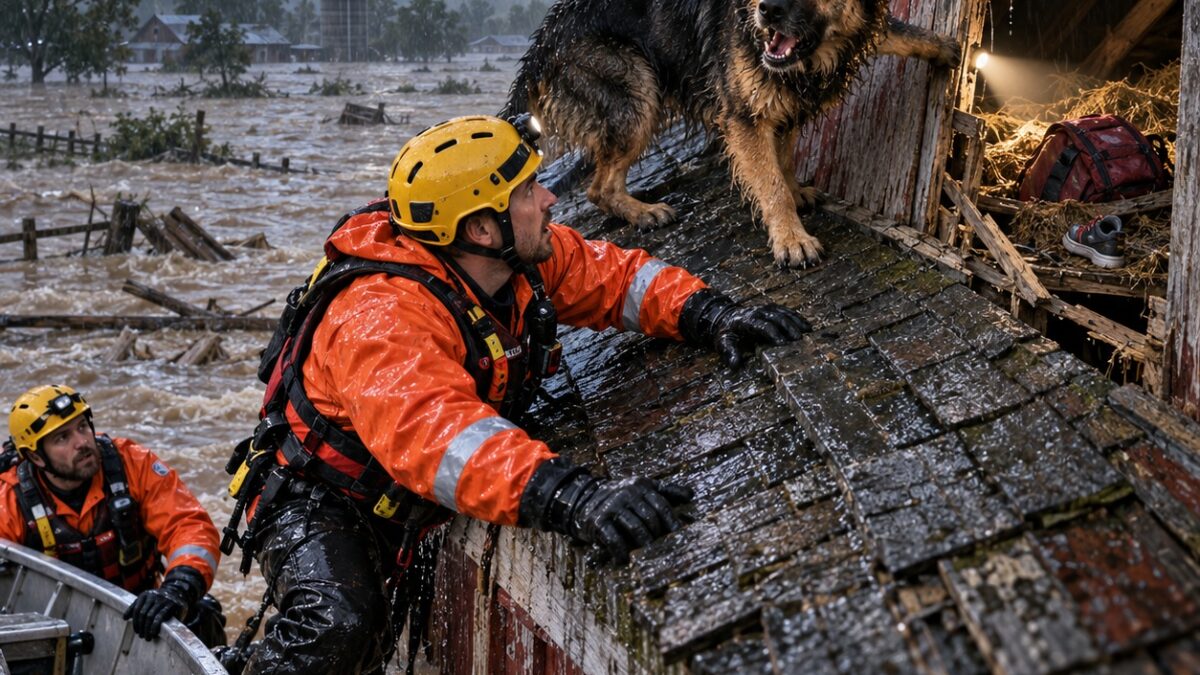
PART2
The stairs inside were narrow, steep, and wet.
Calling them stairs may be generous.
They were old wooden boards nailed into a structure that had already started taking water.
The lower level was flooded.
I could hear it below.
Not see all of it.
Hear it.
That deep rolling sound of current moving through a place never designed to hold a river.
The dog stayed ahead of me.
Later, we learned his name was Max.
At that moment, he was simply the dog from the roof.
My flashlight cut through darkness.
The attic smelled of wet hay, old wood, mud, animal dust, and floodwater.
The air felt thick.
Heavy.
Some hay bales had collapsed.
Others had shifted.
A section of the loft was blocked.
Max walked straight toward the far corner.
No hesitation.
Then stopped beside a large pile of fallen hay.
He looked at me.
I stepped closer.
“What is it?”
Max pawed at the hay.
Once.
Again.
Then growled.
Not aggressively.
Impatiently.
The sound said:
Hurry.
My teammate came up behind me.
“What’s he doing?”
“I think there’s something under this.”
“Animal?”
“I don’t know.”
Max scratched again.
Then looked directly at me.
There are moments in rescue work when you stop consciously reasoning and simply respond to the scene in front of you.
We started moving hay.
Wet hay is heavier than people realize.
Dry hay looks soft.
Light.
Harmless.
Once soaked, compressed, and partially collapsed, it becomes something else.
Dense.
Heavy.
Difficult to lift.
We pulled one section aside.
Then another.
My flashlight shifted across boards.
No movement.
Max would not leave.
He remained beside us.
Nose pointed toward the same spot.
Every few seconds, he stepped closer and sniffed.
Then I heard something.
At first, I thought it was wood shifting.
I stopped.
“Hold on.”
Everyone froze.
Current below.
Rain outside.
Barn creaking.
Then:
“Here…”
A voice.
Weak.
Almost nothing.
Human.
I felt every hair on my arms rise.
“Hello?”
Silence.
Then:
“Here.”
A girl.
“Keep talking!”
We moved faster.
Carefully, but faster.
Hay came away.
One layer.
Another.
Max pressed close.
“Back.”
I tried to keep him out of the way.
He moved only a foot.
Not leaving.
Never leaving.
Then my light hit a hand.
Pale fingers.
Motionless at first.
Then moving.
“There!”
We pulled the remaining hay away.
A girl lay beneath it.
Young.
Very young.
Her body was pinned against the wooden floor where part of the stack had collapsed.
Her face was pale.
Hair wet with sweat and damp air.
Her eyes opened.
Fourteen years old, we later learned.
Emma.
“Hey.”
I knelt.
“My name’s Adam.”
“You’re okay.”
The sentence came automatically.
Rescue workers say it even when nothing is okay yet.
What we usually mean is:
We found you.
You are no longer alone.
Emma stared at me.
Then past me.
“Max?”
The dog pushed forward immediately.
His entire body changed when she said his name.
“Max?”
I repeated.
Emma tried lifting one hand.
Max moved to her.
Pressed his nose beneath her fingers.
Her eyes filled.
“He stayed.”
she whispered.
I looked at him.
“What?”
“He stayed.”
That was the beginning.
The rest came later.
We worked to free Emma.
The collapsed hay had pinned part of her body but had not completely crushed her.
That was luck.
If the weight had fallen differently, the outcome might have been very different.
We removed material slowly so nothing shifted onto her.
Max stayed close enough that I had to keep moving him gently away from our hands.
“Max.”
Emma whispered.
He stopped.
Immediately.
That told me something too.
This was not a stray dog who had wandered onto a farm during the flood.
He knew her.
She knew him.
When we finally freed her enough to assess movement, Emma was frightened but conscious.
“Can you feel this?”
“Yes.”
“Your legs?”
“Yes.”
“Good.”
She tried sitting.
Winced.
“Slow.”
Max moved close again.
Emma put one arm around his neck.
For several seconds, she did not let go.
I could feel the structure trembling beneath us.
We needed to move.
“Emma, we have to get out.”
She nodded.
Then immediately:
“Max comes too.”
“Yes.”
“Promise?”
“Yes.”
She looked at me with an intensity that surprised me.
“You promise?”
“I promise.”
Only then did she let me help her.
Getting down was difficult.
The lower part of the barn was already flooded.
We used the safest remaining path.
My teammates supported Emma.
Max moved with us.
He did not try to go first.
That detail stayed with me.
Animals trapped in disasters often rush toward an exit the second it becomes available.
That is instinct.
Survival.
Max had been on the roof.
He already knew there was a way out.
He had demonstrated that.
Yet now he stayed near Emma.
If we moved her, he moved.
If we stopped, he stopped.
When we reached the opening near the boat, Max stood back.
Emma was transferred first.
Only after she was settled did he come forward.
My teammate reached toward him.
Max stepped into the boat.
Then immediately went to Emma.
Sat beside her.
She put one hand on his wet head.
Only then did he lower his body.
The ride away from the barn was one of those scenes that stays frozen in memory.
Floodwater everywhere.
The old barn shrinking behind us.
Rain still coming.
Emma wrapped in what warmth we could give her.
Max beside her.
His fur soaked.
His body exhausted.
His breathing heavy.
But his head upright.
Watching her.
I sat across from them.
Emma had stopped shaking enough to speak.
“You found him on the roof?”
I asked.
She nodded.
“No.”
Then corrected herself.
“He found you.”
I looked at Max.
“What happened?”
Emma took a breath.
“My family wasn’t there.”
Her voice was weak.
“They were away.”
“I was at the farm.”
“With Max.”
She swallowed.
“When the warning came, I thought the barn would be safer.”
I understood the logic.
High loft.
Old structure.
Maybe higher than parts of the house.
In an emergency, people make decisions with the information they have.
She continued.
“The water came really fast.”
“We went upstairs.”
“Then something fell.”
She looked down.
“The hay.”
Her hands began shaking again.
“It trapped me.”
Max leaned closer.
Emma touched his back.
“I couldn’t move.”
“How long?”
“I don’t know.”
Probably felt like forever.
“What did Max do?”
That was when she looked at him.
Her face changed.
“He could’ve left.”
“What do you mean?”
“He climbed up.”
“Onto the roof?”
“Yes.”
She nodded.
“There was an opening.”
“He got out.”
“I saw him.”
I pictured it.
Flood rising beneath an old barn.
Fourteen-year-old girl trapped under collapsed hay.
Dog finding a route upward.
Survival route.
Escape.
Emma continued.
“I told him to go.”
Her voice cracked.
“I kept telling him.”
“Go, Max.”
“Go.”
“I thought if he could get out, at least he would be okay.”
She began crying.
Quietly at first.
Then harder.
“But he came back.”
I looked at Max.
“He came back down?”
“Yes.”
“He came back to me.”
Emma pressed her face briefly into his wet fur.
“He laid next to me.”
“He put his head here.”
She touched her chest.
“And he stayed.”
I had no answer.
What could I possibly say?
Max had found the roof.
Found escape.
Then chosen to return to the dark.
To the rising water.
To the trapped girl.
Not because he could free her.
He could not move the hay.
Not because he knew a rescue team was coming.
He could not know that.
He returned because Emma could not go with him.
That was enough.
At the staging area, medical personnel took over.
Emma protested when they tried separating Max.
“I need him.”
A responder looked at me.
I looked at Max.
He was exhausted but stable.
“Keep them together if you can.”
That became the pattern.
Emma went to the hospital.
Max went with her as far as circumstances allowed.
Her parents were contacted.
They were already on the way.
Physically, Emma was fortunate.
She needed evaluation.
Monitoring.
Treatment for exposure and the effects of being trapped.
But nothing indicated the catastrophic injuries I had feared when I first saw her beneath that hay.
The psychological part was harder to measure.
She had spent hours in darkness listening to water rise beneath her.
Unable to move.
Unsure whether anyone knew she was there.
That kind of fear does not disappear because a rescue boat reaches shore.
I returned to base after dark.
My clothes were wet.
Boots full of mud.
Hands scratched from wood and hay.
I sat on the locker-room floor after pulling off one boot.
Then stopped.
Could not move for a while.
Around me, people were talking.
Equipment being checked.
Radios.
Reports.
Another mission.
Another family.
Flood response does not give you much time to process the thing you just saw.
But my mind would not leave the barn.
Emma under hay.
Max on the roof.
Max returning.
Max pawing the pile.
That bark.
One bark.
If he had not done it…
I hated finishing that thought.
We had seen a dog.
We were prepared to rescue a dog.
If Max had jumped into the boat immediately, would we have searched the attic?
Maybe.
Maybe not.
The building was unstable.
Flooded.
Our visible rescue target had been the animal on the roof.
Time matters in floods.
Teams move from need to need.
Max had changed the mission.
He had looked at us and somehow communicated:
Not me.
Inside.
That thought made my chest tighten.
Jake came into the locker room.
Saw me sitting there.
“You okay?”
“Yeah.”
He sat on the bench.
For a few seconds, neither of us spoke.
Then he said:
“That dog was weird.”
I looked at him.
“Weird?”
“You know what I mean.”
He shook his head.
“I’ve flown drones over animals for years.”
“I’ve never seen one track it like that.”
“He knew it was something.”
“Maybe.”
“No.”
Jake sounded certain.
“He was using it.”
I laughed tiredly.
“You think the dog understood aerial rescue technology?”
“No.”
Jake smiled.
“But he knew it came from people.”
That was harder to dismiss.
“He followed the drone to the side where we could see him best.”
Jake continued.
“Then when we approached, he disappeared inside.”
“Like he wanted us to follow.”
I looked down at my scratched hands.
“That’s exactly what he did.”
Jake exhaled.
“Damn.”
We sat there quietly.
The next morning, I went to the hospital.
I told myself I was checking on Emma.
That was true.
I also wanted to see Max.
When I reached the room, Emma was sitting up in bed.
Color back in her face.
Parents nearby.
And Max was on the floor beside her.
Of course.
Apparently staff had tried moving him at one point.
Emma had objected.
Strongly.
“Let him stay.”
They did.
The hospital had rules.
Rules also occasionally meet a fourteen-year-old who just survived a flood with a dog that refused to leave her.
Some exceptions become obvious.
Emma smiled when she saw me.
“You came.”
“I said I would.”
Max lifted his head.
His ears moved.
I pulled a chair closer.
“How do you feel?”
“Tired.”
“That makes sense.”
Her mother thanked me.
Her father too.
I did not know how to receive it.
“We followed Max.”
I said.
That was the most accurate version.
Emma looked down.
Max rested his head across her foot.
“I was really scared.”
she said.
Her parents became quiet.
I leaned forward slightly.
“You don’t have to talk about it.”
“I want to.”
So I listened.
“When the hay fell, I couldn’t breathe right at first.”
Emma said.
“It was heavy.”
“I kept trying to move.”
“My legs worked, but I couldn’t get enough leverage.”
“The more I pushed, the more things shifted.”
“So I stopped.”
Her fingers moved through Max’s fur.
“He was barking.”
“I told him to go find someone.”
“Did you think he understood?”
“No.”
She smiled weakly.
“Maybe.”
“He kept going up toward the roof.”
“There was enough space.”
“I knew he could get out.”
“So I told him to leave.”
Her voice grew quieter.
“I thought the water was going to come all the way up.”
I could hear her breathing change.
Her mother reached for her hand.
Emma kept talking.
“I thought if Max stayed, he’d die too.”
“So I yelled at him.”
“I told him he was stupid.”
A tear ran down her cheek.
“I told him to get out.”
Max remained still.
“He went.”
I waited.
“I saw him climb out.”
“I was happy.”
“Really happy.”
“Because I thought at least he was safe.”
Then she swallowed.
“And then he came back.”
Her face folded.
Her mother leaned toward her.
Emma cried into both hands.
“He came back.”
Max stood immediately.
Put his front paws against the side of the hospital bed.
Emma lowered her hands.
He touched his nose to her arm.
She wrapped her arms around his head.
The room went silent.
After a while, Emma whispered:
“He lay beside me.”
“His head was on my chest.”
“I could feel his heart.”
“He was calm.”
“That was the weird thing.”
“I was terrified.”
“Max wasn’t.”
“He just stayed there.”
She touched the center of her chest.
“I could feel him breathing.”
“So I counted his breaths.”
I had to look away.
Emma continued.
“I thought if he was calm, maybe I could be calm.”
“I kept telling myself…”
She paused.
“If Max thinks somebody’s coming, somebody must be coming.”
My eyes burned.
“Did you believe that?”
“Sometimes.”
She looked at him.
“Enough.”
That word stayed with me.
Enough.
She did not need perfect confidence.
She needed enough hope to keep breathing.
Enough calm to stop wasting energy fighting the hay.
Enough companionship not to feel completely alone.
Max could not remove the weight.
Could not stop the water.
Could not call 911.
But he could stay.
Sometimes staying is an action.
People underestimate that.
I looked at Max.
He met my eyes.
The same look from the roof.
Steady.
Not desperate.
I had originally interpreted it as urgency.
That was there.
But now I noticed something else.
Trust.
Not trust that I personally would save him.
Trust that help was possible.
It is dangerous to romanticize what animals think.
I know that.
Max did not understand drones, incident command, boats, weather models, or rescue protocols.
But he understood people.
He understood that something unfamiliar had appeared above the flood.
He understood it was watching him.
He did not hide.
He stayed visible.
Then guided us.
Whatever exact thoughts existed in his mind, his behavior was clear.
He did everything he could with the tools available to a dog.
Emma’s father told me later that Max had been with their family since Emma was seven.
Seven years.
Half of her life.
He slept near her bed.
Waited at the door when she came home from school.
Followed her around the farm.
Emma called him her best friend.
That phrase gets used casually.
In their case, I stopped seeing it as casual.
Best friends do not always have solutions.
Sometimes they simply refuse to leave.
We went back to work.
The flood did not end because one girl had been rescued.
Water remained high.
Families displaced.
Roads closed.
Animals stranded.
Buildings damaged.
The next few days blurred.
But Max became part of the team’s conversations.
Not in an exaggerated way.
Rescue workers can be cynical about inspirational stories.
We see too much reality.
Still, everybody wanted to hear about the dog.
Jake told the drone story repeatedly.
“He stared right at the camera.”
Someone joked:
“Maybe he wanted an interview.”
Jake shook his head.
“No.”
“He wanted us over there.”
Another responder asked me:
“So the girl was under hay the whole time?”
“Yes.”
“And he had been on the roof?”
“Yes.”
“Could’ve left?”
“As far as we can tell.”
“And went back?”
“Yes.”
Silence.
Nobody had a joke after that.
I kept replaying Max’s bark.
One short bark.
That sound changed the rescue.
I wondered what would have happened if I had ignored it.
A dog barking in a disaster is not unusual.
What made me follow him?
Maybe the look.
Maybe his pattern.
Roof.
Opening.
Back.
Bark.
Maybe years of work taught me to trust when something feels inconsistent.
A dog who wants rescue usually comes toward rescue.
Max moved away.
That contradiction mattered.
Follow the contradiction.
It led to Emma.
Floodwater began receding over the following days.
The farm looked different afterward.
Mud.
Debris.
Damaged fencing.
Water lines on walls.
Hay ruined.
The barn had survived enough to remain standing, though badly damaged.
Emma did not return immediately.
Her family had more important things.
Recovery.
Safety.
Rebuilding.
I was glad.
A fourteen-year-old did not need to rush back to the place where she had believed she might die.
A couple of weeks later, Emma sent our team a message.
Not complicated.
Just:
Thank you for following Max.
That sentence stayed on the board at base for a while.
Because she understood something adults sometimes missed.
We rescued Emma.
Yes.
But first, we listened to Max.
That mattered.
Later, after Emma had recovered enough, we organized a small meeting.
No big ceremony.
No television.
No dramatic awards.
Just our team, Emma, her parents, and Max.
The ground was still damp.
Trees overhead.
The farm and surrounding area were still recovering.
Emma sat on the grass.
Max beside her.
Head in her lap.
He looked completely different from the dog on the roof.
Dry.
Relaxed.
Tongue out.
Ears up.
Ordinary.
I loved seeing him ordinary.
Heroes deserve ordinary too.
Emma talked about when Max first came into the family.
“I was seven.”
she said.
“He was already bigger than I wanted.”
Her mother laughed.
“You begged for him.”
“I know.”
Emma smiled.
“He slept outside my room the first night.”
“Then inside.”
Her father added.
“Then on her bed.”
“That was his decision.”
Emma said.
Max looked up.
She scratched his ears.
“He waits for me after school.”
“Every day.”
“If I’m late, he sits by the door.”
Her voice softened.
“He knows when I’m upset.”
“How?”
I asked.
“I don’t know.”
“He just does.”
She looked down at him.
“He’s my best friend.”
Then:
“And I know I’m his best friend too.”
Max lifted his head.
Licked her cheek.
Everyone laughed.
Then, strangely, went quiet.
Because there are things laughter cannot fully carry.
The girl under the hay.
The dog leaving and returning.
The roof.
The drone.
The bark.
All of it sat invisibly inside that simple lick.
One of my teammates handed Emma a small photograph Jake had printed from the drone footage.
Max on the roof.
Tiny against the barn.
Floodwater around everything.
Emma stared at it for a long time.
“That’s when you saw him?”
“Yes.”
Jake said.
She looked at Max.
“What were you doing?”
she asked him.
Max panted.
No answer.
Emma smiled.
“I know.”
She touched his head.
“You were getting help.”
Maybe.
Again, I cannot know.
But I did not correct her.
Her father looked at the photo too.
His face changed.
As a parent, the image must have been brutal.
His daughter invisible inside.
Dog visible above.
An entire family crisis represented by one animal on a roof.
He handed the photo back carefully.
“We owe him everything.”
Emma shook her head.
“No.”
She put her arms around Max.
“He doesn’t want anything.”
Her father smiled sadly.
“Probably food.”
“Definitely food.”
The tension broke.
Everyone laughed.
Max’s tail moved as though he understood that part.
Two months later, much of the farm had been rebuilt.
Not perfectly.
Floods leave marks.
Wood replaced.
Mud cleared.
Some structures repaired.
Some things gone.
Max stayed with Emma.
Of course.
I continued rescue work.
More calls.
More storms.
More animals.
More people.
That is how the job works.
You cannot remain inside one story forever.
But some stories remain inside you.
Max and Emma did.
I started thinking differently about loyalty.
People use that word constantly with dogs.
Loyal.
Faithful.
Devoted.
Sometimes we turn animals into moral symbols because their attachment comforts us.
Max made the word feel heavier.
He did not stay beside Emma when staying was easy.
He had an exit.
That is what matters.
He reached the roof.
He could have remained there.
Could potentially have moved toward safety.
Yet he returned.
I do not know whether a dog frames that as sacrifice.
Probably not.
He knew one simple fact.
Emma was still inside.
For Max, apparently, safety without Emma was incomplete.
That is the story.
I also thought about courage.
Max was not fearless.
We have no reason to believe that.
His heart was beating.
His body was soaked.
The barn shook.
Water roared.
He had reasons to be afraid.
Courage does not require the absence of fear.
Sometimes it is simply deciding fear does not get the final vote.
Max returned anyway.
Emma stayed calm enough because he returned.
Then he climbed out again.
Waited.
Watched for help.
That sequence mattered more than any heroic label.
Jake continued flying drones.
Months later, during another operation, he said over the radio:
“I’ve got a dog.”
Someone immediately replied:
“Is he trying to tell us something?”
We all laughed.
That is what teams do with intense memories.
Turn them partly into jokes.
Not disrespectfully.
To make them carryable.
But we also became more attentive.
Animal behavior became another piece of information.
Not magic.
Not certainty.
Information.
If a dog refuses rescue and repeatedly moves toward a location, look.
If an animal’s behavior does not fit the obvious situation, ask why.
Max taught us that without formal training.
I returned to the farm once after rebuilding had begun.
Not for an emergency.
Emma’s parents invited me.
The barn looked wounded.
Some wood had been replaced.
Lower walls showed damage.
The attic opening remained.
I stood outside.
Max came toward me.
Recognized me, perhaps.
Tail moving.
Emma followed.
“You want to see where I was?”
I hesitated.
“Only if you do.”
She nodded.
We went partway.
Not into anything unsafe.
She pointed.
“That corner.”
The hay was gone.
Floor repaired.
The space looked smaller than I remembered.
That happens with traumatic places.
Memory enlarges them.
Emma stood beside me.
Max at her leg.
“I thought I was going to die there.”
The statement was so direct I did not answer immediately.
“I’m glad you didn’t.”
“Me too.”
She smiled faintly.
Then:
“I wasn’t scared the whole time.”
“What do you mean?”
“When Max came back.”
She looked at him.
“I was still scared.”
“But different.”
“How?”
She thought.
“I knew if I died, I wasn’t alone.”
My chest tightened.
Fourteen years old.
No fourteen-year-old should need that thought.
But there it was.
Then she added:
“And then I decided I probably wasn’t going to die.”
“Because of Max?”
“He was too calm.”
I laughed softly.
“You trusted his judgment?”
“Yes.”
“Dangerous.”
She smiled.
“He’s smarter than me.”
Max sniffed the floor.
I chose not to argue.
Emma told me she had yelled at him multiple times to leave.
“He ignored me.”
“Good thing.”
“Yeah.”
She became quiet.
“I used to think dogs stayed because we feed them.”
I looked at Max.
“And now?”
“I think he stayed because I’m his person.”
There was no need to complicate it.
Maybe she was right.
When we came back outside, Max sat in the grass.
Emma joined him.
The farm still carried flood damage.
But there was sunlight.
Dry ground.
Ordinary sounds.
I remember thinking that disaster scenes eventually become places again.
A barn becomes a barn.
A road becomes a road.
A roof becomes a roof.
That is healing too.
Emma should not have to see every piece of the farm only through what happened.
Max did not.
He smelled grass.
Watched birds.
Accepted food.
Animals are often better at returning to the present.
I carried the story differently after that visit.
Less as a dramatic rescue.
More as a story about presence.
Max could not remove hay.
Could not raise the barn.
Could not stop the flood.
But Emma said she counted his heartbeats.
Think about that.
A trapped fourteen-year-old girl in darkness with water rising beneath her used the heartbeat of a dog as evidence that she could keep going.
That is not a small thing.
Max did not need technical ability to save her before we arrived.
His body beside hers kept fear from becoming total.
Then his behavior guided us to her.
He saved her twice in two completely different ways.
First by staying.
Then by leading.
We usually think of rescue as extraction.
Get someone out.
Sometimes rescue begins earlier.
Keeping a person calm.
Warm.
Connected.
Alive emotionally long enough for physical help to arrive.
Max did that.
I began noticing animals differently in emergencies.
Not anthropomorphizing every movement.
That can be dangerous.
A frightened animal may behave unpredictably.
But I stopped dismissing them as secondary details.
Animals know their people.
Know homes.
Know routines.
Sometimes they know exactly where someone is when we do not.
Max was evidence.
There is another part of the story I rarely mention.
The moment we first moved hay and heard Emma’s voice.
That sound visits me sometimes.
“Here…”
Barely audible.
Imagine if Max had not barked.
No.
I still refuse to live too long inside that alternate timeline.
Because he did bark.
I followed.
We heard her.
That is the real story.
Rescue workers can destroy themselves with what-ifs.
What if the drone battery had died?
What if we approached another side?
What if Max hid?
What if Emma had been unconscious?
What if the barn collapsed?
There is no end.
The actual sequence deserves our attention.
Drone saw Max.
Max stayed visible.
Boat reached barn.
Max led inward.
We followed.
Emma was found.
She lived.
Hold onto reality.
It is enough.
My work has given me many images I wish I could forget.
Max on the roof is not one of them.
That image used to make me sad.
Now it makes me feel something closer to respect.
A dog surrounded by floodwater.
Not safe.
Not comfortable.
But still doing what he could.
He did not have a flare.
A radio.
Words.
He had position.
Eyes.
Movement.
A bark.
He used all of them.
The drone image became famous within our little circle.
Not publicly famous.
Team famous.
Someone printed a copy.
Jake wrote under it:
Listen when the dog says follow.
We kept it at base for a while.
People laughed.
Then usually asked for the story.
We told it.
Every telling ended differently depending on who spoke.
Jake focused on the drone behavior.
My teammate talked about the unstable barn.
I talked about the hay.
But everyone included the bark.
That bark was the hinge.
Emma eventually returned to school.
Her mother told me later that the first heavy rain after the flood was difficult.
That made sense.
Emma became quiet.
Max stayed close.
At night, he slept near her bed.
The same way he had since she was seven.
Some patterns survive disaster unchanged.
That can be comforting.
I did not pretend Max cured her fear.
Dogs cannot erase trauma.
But they can occupy the room while healing happens.
There is value in that.
Emma had professional support from adults around her.
Family.
Time.
Safety.
Max added continuity.
Something from before the flood that remained after it.
For a young person, that can matter enormously.
I visited once during another rainy week.
Emma was reading.
Max asleep nearby.
Rain hit the roof gently.
She noticed me listening.
“It doesn’t bother me as much now.”
“The rain?”
She nodded.
“Sometimes.”
Then:
“When it’s really hard, Max comes upstairs.”
“Does he know?”
“I think so.”
Maybe.
Dogs notice changes.
Breathing.
Movement.
Routine.
However he knew, he stayed.
That was enough.
One day Emma asked me a question I did not expect.
“Was Max scared on the roof?”
“I don’t know.”
“You saw him.”
“Yes.”
“Did he look scared?”
I thought carefully.
“No.”
That was true.
“But that doesn’t mean he wasn’t.”
She nodded.
“I think he was.”
“Why?”
“Because I was.”
I waited.
She continued.
“But I think he went anyway.”
That answer sounded right.
Probably more honest than calling him fearless.
Emma understood courage better at fourteen than many adults.
She said:
“When people tell the story, they say Max was brave.”
“He was.”
“Yeah.”
“But they make it sound like he knew everything would work.”
I looked at her.
“He couldn’t have.”
“Exactly.”
She touched his ear.
“He just stayed.”
That sentence became my favorite summary.
He just stayed.
We make courage complicated.
Max did not.
There was another detail Emma told me later.
While trapped, she had occasionally heard Max moving away.
Each time, she thought:
He finally left.
And she told herself it was good.
He would live.
Then she would hear him returning.
Paws.
Breathing.
Body settling.
Every return felt like a decision.
Not one heroic moment.
Repeated choices.
Go toward escape.
Come back.
Stay.
Maybe look for help.
Come back.
That rhythm lasted until the drone appeared.
When I learned that, the roof scene changed again in my mind.
Max had not simply chosen once.
He had been balancing two needs.
Stay with Emma.
Find help.
The drone gave him a third possibility.
Show himself.
Then lead us.
That was the opening he needed.
Perhaps that is why his stare felt so intense.
He had already tried everything available to a dog.
Then something appeared in the sky.
Buzzing.
Watching.
Human-made.
He followed it.
Maybe he understood only that attention had finally arrived.
Sometimes that is enough.
The next flood season, I thought about Max often.
We reviewed procedures.
Equipment.
Drone batteries.
Boat maintenance.
Nothing sentimental.
But I added one thing mentally.
Look beyond the obvious rescue target.
A person may be where an animal keeps returning.
That lesson came from one dog on one roof.
I do not know how many years Max has left.
He was healthy after the flood.
Still lives with Emma.
Still sleeps near her.
That is the latest simple truth.
And I like that his story does not end in tragedy.
It does not need death to be emotional.
Sometimes survival itself is enough.
Emma survived.
Max survived.
The family rebuilt.
Life continued.
That is a good ending.
Two months after the flood, Emma sent us a photograph.
I still keep a copy.
She and Max sit in front of the rebuilt house.
Sunlight.
Dry ground.
Max’s ears up.
Tongue hanging slightly.
Emma smiling.
Nothing about the photograph tells you she had once been buried beneath wet hay while floodwater rose below her.
Nothing tells you the dog beside her had stood on a roof waiting for a drone.
That is why I love it.
They are allowed to look ordinary.
I keep the photograph on my desk at base.
On rainy nights, I sometimes look at it.
Not because I need inspiration every shift.
Sometimes I just need perspective.
The worst moment is not always the final image.
That is easy to forget in rescue work.
We arrive when people are frightened.
Injured.
Trapped.
Lost.
We see lives at their most chaotic.
Then we leave.
We do not always get the photograph months later.
The rebuilt house.
The girl smiling.
The dog relaxed.
Emma gave us that.
I am grateful.
Tonight, as I tell this story, rain is falling outside.
Gentle.
Regular.
Nothing like the flood.
Still, the sound takes me back.
Water striking barn walls.
Old wood groaning.
My flashlight cutting through hay dust.
Max pawing frantically.
Then:
“Here…”
Emma’s voice.
Weak.
Alive.
That word again.
Alive.
I think about Max’s eyes on the roof.
That was the first thing the drone caught clearly.
A dog looking upward.
Most people seeing that image would assume:
Save him.
That was our assumption too.
We were wrong.
Max was not asking us to choose him first.
He was asking us to understand there was more.
We almost missed the language because it had no words.
Maybe loyalty is partly that.
Finding a way to communicate when the person you love cannot.
Emma could not reach us.
Max could.
So he became the signal.
He did not wave.
He stared.
Moved.
Barked.
Led.
Enough.
There is a moment during every successful rescue when responsibility changes hands.
Before we arrived, Max was responsible for Emma in the only way he could be.
He stayed warm against her.
Kept her from being entirely alone.
Searched for help.
Once we reached them, he gave that responsibility to us.
But even then, he did not leave her.
That is the detail I come back to.
He could finally stop.
He did not.
He stayed until Emma was in the boat.
Then he followed.
Maybe that is not because he thought in terms of responsibility.
Maybe he just loved her.
The simpler explanation is often better.
Love is usually discussed as emotion.
In disasters, it becomes behavior.
Stay.
Return.
Wait.
Follow.
Do not leave until the other person can leave too.
Max’s love looked like that.
People sometimes ask whether I think animals understand sacrifice.
I do not know.
I do not need Max to understand sacrifice as a concept.
His actions are enough.
He had an escape route.
Emma did not.
He returned.
We can call it instinct.
Attachment.
Loyalty.
Bond.
Whatever word makes us comfortable.
The behavior remains.
He stayed beside the person who could not get out.
That is why his story still affects me.
Not because dogs are magically purer than people.
They are animals.
Complex.
Individual.
But sometimes an animal does something so direct that it strips away all our complicated language.
Someone I love cannot leave.
So I will not leave.
That is Max.
Emma once told me:
“I think he knew I needed him.”
Maybe.
Then she smiled.
“Or maybe he just didn’t want to be alone either.”
I liked that answer too.
Loyalty does not have to be noble to matter.
Maybe Max needed Emma just as much.
Maybe returning to her was also returning to his own safe place.
Love can work both directions.
That does not make it smaller.
When we talk about rescue, we often divide roles.
Rescuer.
Victim.
Max blurred them.
He needed rescue from the roof.
He was also rescuing Emma.
Emma’s existence gave him a reason to keep trying.
Max’s presence gave Emma enough calm to keep going.
We arrived and physically removed both.
Who saved whom?
The neat categories disappear.
That happens more often than people think.
The photograph on my desk reminds me of that.
Two survivors.
Not hero and victim.
Friends.
There were moments after the flood when Emma felt guilty.
Her mother told me.
Because Max could have left.
Emma worried he had risked himself because of her.
I spoke to her once.
“You didn’t make him stay.”
“I told him to go.”
“I know.”
“He could’ve died.”
“Yes.”
I did not lie.
She looked down.
“Doesn’t that make it my fault?”
“No.”
“How?”
“Because Max made a choice with the instincts and attachment he had.”
“You did not trap him there.”
“The flood did.”
She was quiet.
Then I added:
“You also kept him calm.”
She looked surprised.
“I didn’t.”
“You talked to him?”
“Yes.”
“You touched him?”
“Yes.”
“You told him to go because you wanted him safe.”
She nodded.
“So you were looking after each other.”
That seemed to help.
I hope it did.
The guilt of survivors can be strange.
Even a child can start carrying responsibility for being loved.
I did not want that for Emma.
Max stayed because their bond mattered.
That bond should comfort her, not become a debt.
I think Max would agree.
If dogs could roll their eyes at human guilt, he probably would.
Months later, Emma told me she no longer thought about what Max “sacrificed.”
She thought about what they did together.
That sounded healthier.
They survived together.
The barn eventually became usable again after repairs.
Emma did not avoid it forever.
I was glad.
Fear should be respected.
Not allowed to annex every place connected to it permanently.
She returned gradually.
Max went too.
Of course.
The first time she climbed toward the attic after rebuilding, her father stayed close.
Max ahead.
Emma said her hands shook.
She stopped.
Breathed.
Max turned around.
Came back down one step.
Waited.
She went up.
That story came from her later.
It did not surprise me.
Max had already taught her how to move through fear once.
She did not need to prove anything by returning.
But she wanted the barn back.
So she took it back slowly.
That is another kind of rescue.
Adam the rescuer, people sometimes call me when telling the story.
I correct them less now.
I did my job.
My team did theirs.
Jake flew the drone.
The boat crew navigated difficult water.
Medical responders cared for Emma.
Many people contributed.
But if you ask where the rescue began, I will not say with our boat.
It began when Max climbed to the roof and refused to disappear.
That is the signal I remember.
Not a flare.
Not waving arms.
Eyes.
A dog’s eyes fixed on a drone.
The look seemed to say:
See me.
Then, once we did:
Follow me.
Maybe that is an interpretation.
Behavior supports enough of it for me.
I have responded to people waving from rooftops.
Families writing HELP on sheets.
Phone lights flashing from windows.
Car horns.
Whistles.
All kinds of signals.
Max had none of those.
He had himself.
He made himself visible.
Then used movement to redirect us.
Simple.
Effective.
When Jake talks about the flight, he always says the same thing.
“The dog never stopped watching.”
Even when the drone moved.
Max tracked it.
That is the detail that convinced Jake this was not random.
Attention.
Mutual attention.
Drone watching dog.
Dog watching drone.
Then people watching the dog.
A chain.
Emma at the end.
Technology gets credit in rescue stories.
Drones are incredible tools.
That day, the drone found Max.
But Max gave the technology meaning.
A camera can show us an image.
It cannot explain the image.
We still have to interpret.
The dog helped us interpret.
That partnership fascinates me.
Human technology.
Animal behavior.
Both necessary.
If the drone had only spotted an empty roof, we might have moved on.
If Max had hidden inside beside Emma the entire time, we might never have seen them in time.
He moved between worlds.
Inside with her.
Outside where help could see him.
That was the genius of what happened, intentional or instinctive.
I cannot know whether Max planned anything.
I do not need to.
Outcome is enough.
He created a bridge between Emma and rescue.
When I tell new team members the story, I avoid making it mystical.
I say:
“Observe.”
“Animal behavior can indicate unseen people.”
“Do not assume visible victim equals only victim.”
“Follow unusual persistence when conditions permit.”
Practical lessons.
Then, after training, sometimes someone asks:
“But do you think he knew?”
I smile.
“I think he knew Emma was inside.”
“And he knew we were outside.”
The rest is interpretation.
That is enough knowledge.
I think about Emma’s line often.
“He put his head on my chest.”
In darkness.
Under hay.
Cold.
Water below.
Dog’s head.
Heartbeat.
She counted.
What a strange survival tool.
A heartbeat.
But human nervous systems respond to rhythm.
Slow breathing.
Steady presence.
Maybe Max’s calm helped regulate hers.
I do not need a scientific lecture to know companionship matters.
She told me.
That is enough.
After the flood, Emma became more attached to Max, according to her parents.
Understandable.
They worried briefly.
Would she panic without him?
Would the trauma turn normal attachment into fear?
Time helped.
Routine helped.
Emma resumed school.
Max stayed Max.
The relationship settled.
That was good.
Healing does not mean pretending the event never happened.
It means the event stops organizing every hour.
They got there gradually.
Max continued waiting for her after school.
That was not trauma.
He had always done it.
Some habits survive because they are love, not fear.
Again, context matters.
I once arrived at the farm just as the school bus dropped Emma off.
Max was at the door before she reached the porch.
Tail going.
Emma laughed.
“Every day.”
“How long has he done that?”
“Forever.”
She knelt.
Max pressed into her.
The flood had not created their bond.
It revealed it under pressure.
That distinction matters.
People love saying disasters show who we really are.
Sometimes that is too dramatic.
But pressure does reveal patterns.
Max’s pattern was:
Emma first.
Emma’s pattern was:
Make Max leave so he survives.
They were both trying to save the other.
That is the part that gets me.
She yelled:
“Go.”
He returned.
He went to roof.
She wanted him safe.
He found help.
Then returned.
Two creatures making different calculations based on the same bond.
There is something painfully beautiful in that.
The rescue did not make Max a better dog.
He was already Max.
It gave us evidence of who he had been every ordinary day before the flood.
Waiting at the door.
Sleeping near Emma.
Following her.
All those small behaviors became the foundation for the extraordinary one.
Heroism rarely appears from nowhere.
It grows from habits.
Attachment.
Routine.
The choice to stay near someone day after day.
Then one day the water rises, and the same habit becomes life-saving.
That changed how I thought about heroism.
We imagine a heroic act as separate from ordinary life.
Maybe it is ordinary love under extraordinary pressure.
Max’s rescue was exactly that.
The same dog who slept near Emma’s bed stayed near her under collapsed hay.
Same behavior.
Different stakes.
Emma told me years later—well, months later in the source period, but it felt like years emotionally—that she no longer called Max a hero every day.
Good.
She called him Max.
Better.
Heroes deserve names.
Not titles.
Two months after the flood, the farm looked alive again.
Fresh repairs.
Dry grass returning.
New boards.
People moving.
Max sleeping where he pleased.
That may have been the most satisfying sight.
Not Max on the roof.
Max asleep.
Unneeded.
Safe.
I stood near him once while Emma’s father worked.
Max did not open his eyes.
“You know I saved you.”
I joked quietly.
No response.
“Very rude.”
One ear moved.
I laughed.
That is how it should be.
He owed me nothing.
Rescue work can create strange dynamics.
People treat rescuers like heroes.
We rarely feel like heroes.
We were available.
Trained.
Equipped.
We did a job.
Max had none of that framework.
He was simply attached to Emma.
Perhaps that is why his part feels purer to outsiders.
But I resist ranking courage.
The boat crew was courageous.
Emma was courageous.
Max was courageous.
Different forms.
No competition.
Emma herself often gets left out when people retell the story.
That bothers me.
She was fourteen.
Trapped.
Scared.
Could not move.
Still she tried to send Max away because she wanted him to live.
Think about that.
A child believing she might die still prioritized her dog’s escape.
That is courage too.
Max returned because of love.
Emma told him to go because of love.
Then we arrived.
The story belongs to both of them.
When I visited the hospital, Emma’s first concern was Max.
When we rescued her, she made me promise he would come too.
Those details tell you who she was.
Not passive.
Not simply waiting.
She endured.
She communicated.
She protected as much as she could.
I want that remembered.
Maybe that is why Max trusted her so deeply.
Relationships are built both ways.
Seven years.
Meals.
School returns.
Bedtime.
Farm days.
Walks.
Whatever their ordinary life contained.
Then flood.
The bond held.
I used to think rescue stories begin on the day of disaster.
Now I think they often begin years earlier.
Every ordinary act building trust.
Every meal.
Every return home.
Every night sleeping nearby.
Those moments create the relationship that later determines behavior under pressure.
Max’s decision in the barn was seven years in the making.
That makes the story less magical.
I like it more.
Love built through repetition.
Then tested once.
Held.
The rain outside tonight is getting lighter.
I can hear drops against the base window.
For a moment, I am back in the boat.
Max visible through gray rain.
Barn roof.
Drone overhead.
I remember thinking:
Poor dog.
That was my first interpretation.
Stranded animal.
Need rescue.
I smile now at how incomplete it was.
Max was in danger.
Yes.
But he was not simply waiting to be saved.
He was working with what he had.
Waiting to make us see someone else.
There is humility in realizing the subject of your rescue operation understood the emergency better than you did.
Max knew where Emma was.
We did not.
Simple.
The dog had information.
We needed to listen.
I sometimes imagine what Max saw when the drone appeared.
A buzzing object.
Unfamiliar.
Maybe frightening.
Maybe just interesting.
Then the boat.
People.
Finally.
Whatever his internal reaction, he did not run away.
That calm is what struck Jake.
Max made himself easy to find.
Then difficult to remove.
That contradiction saved Emma.
When I first held out my hand, expecting him to come, he turned away.
That was the moment I could have misunderstood.
An uncooperative dog.
Fearful.
Confused.
Instead, he looked back.
That look.
Come.
I followed.
Everything after came from accepting that maybe he had a reason.
In rescue work, arrogance can kill.
You cannot assume you are the smartest thing in every scene simply because you arrived with equipment.
The environment contains information.
People contain information.
Animals contain information.
Pay attention.
Max reinforced that lesson permanently.
The barn attic was one of the darkest places I had entered during that flood.
Yet when I think of it now, the darkness is not the first thing.
Max pawing the hay.
That movement.
Insistence.
The certainty.
He knew.
That is what I remember.
And then Emma’s voice.
Weak.
“Here.”
I still hear it sometimes.
Not as a nightmare.
As a reminder.
She was there.
We found her.
Past tense.
Safe now.
That is important.
People who survive disasters can become permanently associated with their worst moment in other people’s minds.
I try not to do that to Emma.
She is not “the girl in the barn.”
She is Emma.
Fourteen then.
Growing.
Going to school.
Living with her family.
Laughing.
Getting annoyed.
Whatever normal teenage life contains.
The flood is one chapter.
Not her identity.
Same with Max.
Not “the flood dog.”
Max.
Best friend.
Door waiter.
Bed sleeper.
Farm dog.
That matters.
The photograph on my desk helps.
No flood visible.
Just them.
It forces me to remember beyond the rescue.
I sometimes wonder what Max dreams about.
Probably nothing dramatic.
Food.
Smells.
Running.
Dogs.
Emma.
Who knows.
I hope the barn is not one of them.
But if it is, I hope the dream ends with dry ground.
There is an ethical temptation to make animal stories emotionally perfect.
Dog understands everything.
Dog knows rescue is coming.
Dog sacrifices consciously.
I do not need that perfection.
The real behavior is enough.
Max could escape.
He returned.
He stayed near Emma.
He went to roof.
He remained visible to drone.
He guided us inside.
He stayed with her until she was safe.
Those facts do not need embellishment.
They are already extraordinary.
And Emma’s testimony explains the emotional center.
“I felt his heart.”
That is enough to make me cry years later.
I think about heartbeat as communication now.
Before words.
Before rescue.
Before signals.
One living body telling another:
You are not alone yet.
Maybe that was all Emma needed for one more hour.
Then another.
Until the drone came.
Max could not promise rescue.
He could promise presence.
That is a distinction I have carried into my own life.
We cannot always solve what somebody is going through.
Sometimes we can stay.
People underestimate staying because it looks passive.
It is not.
Staying can be difficult.
Uncomfortable.
Frightening.
Max stayed in a flooding barn.
Nothing passive about that.
I have used that lesson with people too.
Families waiting at staging areas.
Colleagues after hard calls.
Sometimes there is nothing useful to say.
Sit.
Stay.
That can matter.
Max taught a rescue worker that.
I find that funny.
And humbling.
Emma’s parents once apologized for not being at the farm.
I stopped them.
Life happens.
They were away.
Emma was there.
The flood came.
Guilt likes to invent control where none existed.
What mattered was what came next.
Their daughter survived.
They rebuilt.
They stayed close.
No need to turn survival into a courtroom.
The same goes for Emma’s decision to run to the barn.
Was it the perfect choice?
Maybe not.
It was the choice a fourteen-year-old made during a flood.
Judging it afterward is easy.
She believed higher ground in the barn was safer.
Then the structure shifted.
That is how emergencies work.
No perfect information.
Only decisions.
I never wanted her to feel responsible for the collapse.
Nature and old wood made that choice.
Not her.
Max followed her.
Again, ordinary loyalty.
Until ordinary became extraordinary.
One day, while talking with Emma, she asked:
“What if Max hadn’t come back?”
I hated the question because I knew where it was going.
“I don’t know.”
“Would I have died?”
“I don’t know.”
Honesty.
She thought.
“Would you have found me?”
“I don’t know.”
I wanted to say yes.
Could not.
Then I added:
“But he did come back.”
She nodded.
“That’s what my mom says.”
“Your mom is smart.”
“She’ll like hearing that.”
We smiled.
Stay with reality.
Again.
He came back.
That became useful to Emma too.
When anxiety pulled her into what-ifs, she learned to return to facts.
Max came back.
Drone came.
Rescuers came.
She got out.
Hospital.
Home.
Now.
That sequence became grounding.
I hope she keeps it.
Max himself needed no such exercise.
Dogs are brutally present.
Once dry and fed, he moved on.
Humans could borrow some of that.
Not forget.
Return.
I have often wondered whether Max’s calm beneath the hay was genuine or simply stillness.
Emma experienced it as calm.
That is what matters psychologically.
His body was there.
Breathing.
Steady enough.
Her nervous system read safety.
Whether Max himself was frightened does not reduce that effect.
Sometimes we become someone else’s anchor while scared ourselves.
That is courage too.
I remember being on calls where junior rescuers looked at me and assumed I was calm.
Inside, I was not.
But trained behavior communicates safety.
Maybe Max did something similar instinctively.
Stayed still because Emma was still.
Pressed close.
Whatever the mechanism, it worked.
The dog on the roof taught me more about leadership than some formal training.
Be visible.
Do not panic others.
Keep returning to the person who cannot move.
Use what you have.
Signal clearly.
Do not leave someone behind.
Simple.
I would never put that on a motivational poster.
Max would hate it.
Probably chew the poster.
Good.
Let the lesson stay human.
Max can remain a dog.
At the small reunion, I watched Max lie with his head on Emma’s lap while adults talked about him.
He was bored.
That pleased me.
The hero had no interest in heroism.
He wanted Emma’s hand.
Maybe shade.
Probably snacks.
Perfect.
If we had given him a medal, he would have tried to eat the ribbon.
Another reason ceremonies are for humans.
The real reward was Emma beside him.
Same as before the flood.
That continuity mattered.
He had acted to preserve the relationship.
Then got to return to it.
Best possible outcome.
Not every rescue story gets that.
I know.
That is why I do not take this one lightly.
Some nights at base, after everyone else is asleep, I look at Emma’s photo.
There is something peaceful in knowing Max is probably asleep near her bed at that same moment.
No water.
No attic.
No drone.
Just home.
That is what rescue is for.
Not the dramatic extraction itself.
The ordinary night afterward.
People celebrate the boat.
I celebrate the bed.
The bed means the rescue held.
Max sleeping near Emma means she has a tomorrow.
Farm rebuilt means family has a tomorrow.
Rain becoming ordinary again means fear lost some territory.
Those are the outcomes.
I still work.
Calls continue.
I have seen more floods.
More fires.
Vehicle crashes.
Missing hikers.
Animals stranded.
Each incident different.
Max never became a superstition.
I do not assume every dog is leading me to a hidden child.
That would be foolish.
But I do pause.
Observe.
Ask.
That is his practical legacy in my work.
Jake says the same.
“If the dog looks smarter than you, follow him.”
Not official procedure.
Definitely not in the manual.
Still funny.
The deeper legacy is harder to name.
Maybe this:
Rescue is not always about who has the uniform.
Sometimes the first responder is already there.
No radio.
No training certificate.
Four paws.
Wet fur.
Heart beside a frightened child.
Waiting until the people with equipment finally arrive.
That was Max.
Emma once asked me whether I thought Max saved her.
“Yes.”
I answered.
No hesitation.
She smiled.
“Me too.”
Then she said:
“But you saved both of us.”
I shook my head.
“My team got you out.”
“That’s saving.”
“Okay.”
I smiled.
“We all did something.”
Max looked between us.
The only correct answer.
Shared rescue.
When people ask me what the most heroic thing Max did was, most expect:
He returned to the attic.
Or:
He led rescuers to Emma.
Those are reasonable.
My answer changes.
Sometimes I think the most important thing was lying beside her.
Because that part had no audience.
No drone.
No rescuers.
No reward.
Only Emma.
Darkness.
Water.
Time.
Max stayed when nobody was watching.
Character often lives there.
Again, I resist turning dogs into moral philosophers.
But behavior matters.
He stayed.
That is enough.
The barn’s lower walls still showed a water line for a while.
A physical mark of how high the flood reached.
Emma once touched it.
“Was it really this high?”
Her father nodded.
She looked upward toward the loft.
Max stood beside her.
I could see the calculation in her face.
Distance.
Height.
How close the water had come.
Then she stepped away.
No need to measure more.
Sometimes knowing the margin is enough.
Max did not look.
He found something interesting in the grass.
Good for him.
The family repaired what could be repaired.
Some things were replaced.
Flood recovery is never romantic.
Insurance.
Mud.
Drywall.
Wood.
Lost property.
Labor.
But eventually the farm became theirs again.
That was important.
Disaster should not permanently own property through memory if people can reclaim it.
They did.
Emma helped.
Max followed.
Ordinary.
Two months sounds short.
Recovery continues beyond two months.
The source ends there because stories need boundaries.
Life does not.
I think about that often.
We say:
Two months later, they rebuilt.
That is not the end.
There will be more rain.
More birthdays.
More school years.
Max will age.
Emma will grow up.
The flood becomes a story they tell differently over time.
That is life.
I like leaving them there.
Together.
Not needing another dramatic event.
My own story continues too.
I remain Adam.
Rescuer.
Still tired after long shifts.
Still pulling wet boots off at base.
Still listening to rain.
But something changed in me after Max.
I stopped thinking rescue belonged only to people trained for it.
It belongs to anyone—or any animal—who refuses to leave another living thing alone in danger when they can do something.
Sometimes the thing is huge.
Sometimes it is lying beside someone.
That lesson made me kinder.
I hope.
At least more attentive.
There are rescue calls you remember because they were technically difficult.
Others because they were tragic.
Max and Emma remain because the heart of the story was simple enough to understand without training.
He could leave.
She could not.
He stayed.
Everything else follows from that.
When I speak to schools or community groups about emergency preparedness, people sometimes ask for the Max story.
I tell it carefully.
I do not tell children that pets should stay in dangerous buildings.
Obviously.
If there is a safe exit, people and animals should leave.
Max’s behavior was extraordinary, not a safety plan.
That distinction matters.
Then I tell them the useful part.
Have evacuation plans.
Do not assume higher structures are automatically safe.
Keep emergency contacts.
Listen to alerts.
And if rescue technology spots you, make yourself visible.
Emma laughs when she hears I turned Max into a safety lecture.
“He’d be proud.”
“No.”
I tell her.
“He’d be asleep.”
Probably.
I have never forgotten the first time I saw his face enlarged on the drone screen.
Wet fur.
Ears alert.
Eyes fixed upward.
There was something in that look.
The title says his eyes communicated more than any signal could.
I understand why.
Because signals are designed.
His look was raw.
Attention.
Urgency.
Expectation.
We interpreted it only after seeing what he did next.
That is important.
Eyes alone did not save Emma.
Behavior gave the look meaning.
Follow me.
And we did.
Sometimes I think rescue work is mostly that.
Following clues.
Footprints.
Phone pings.
Broken branches.
Heat signatures.
Sounds.
A dog.
You rarely receive the whole answer immediately.
You assemble it.
Max was the clue standing on the roof.
Emma was the answer hidden underneath.
That sounds poetic.
At the time, it was mud and fear and heavy hay.
Stories become clean afterward.
Reality is not.
My gloves were soaked.
The barn smelled terrible.
My knees hurt.
Emma was frightened.
Max was exhausted.
That messiness matters.
Heroic moments do not feel heroic while happening.
They feel urgent.
The emotional meaning comes later.
Locker room.
Hospital.
Photo.
Rain months later.
That is when your brain catches up.
Mine still is.
I think about the word choice a lot.
Did Max consciously choose to stay?
We cannot know in human terms.
But behaviorally, there were alternatives.
Roof.
Inside.
He moved between them.
Emma saw him leave.
Then return.
That is enough for me to say he stayed when he could have remained out.
I do not need a philosophical theory of canine free will.
The observable fact is powerful enough.
Emma interprets it as love.
I do too.
Maybe that is the simplest word.
Love does not always look like affection.
Sometimes it looks like a wet dog refusing to stay on a roof alone.
I remember the moment he pressed against Mr—no, against Emma in the boat. Careful not to confuse story. Max sat beside Emma in boat, not Mr Whitfield; that’s prior story. In the boat, his body was exhausted but he watched her. That is my clearest post-rescue image.
Not us.
Not shore.
Emma.
His attention stayed there until she was handed to medical staff.
Then, only then, did he seem to let himself sag.
That was when I realized how tired he was.
During the rescue, purpose had hidden exhaustion.
Once she was safe, it appeared.
Animals do that.
Humans too.
You hold together until responsibility transfers.
Then your body collects the bill.
Max slept hard afterward.
He deserved it.
At the hospital, when he lay at Emma’s feet, he barely moved.
Every person entering got one glance.
Then back down.
No need to patrol.
No need to search.
Emma was there.
Mission complete, if you want to use that word.
But he was not a working dog.
Just hers.
That distinction warmed me.
Emma’s parents asked if Max should be checked.
Yes.
He had endured exposure.
Wet conditions.
Stress.
He was evaluated and cared for appropriately.
Nothing in the source suggests lasting injury.
I am grateful for that.
A dramatic story does not need to injure the hero for emotional effect.
Max survived.
Healthy enough to return home.
Good.
The source also does not need a villain.
No neglectful farmer.
No cruel adult.
No conspiracy.
A flood came.
Old structure failed.
Emma was alone.
Max stayed.
Nature provided enough danger.
I have learned not every emotional story needs someone to hate.
Sometimes fear itself is enough.
In some ways, that makes Max’s choice clearer.
He was not protecting Emma from a person.
He was resisting circumstance.
Water does not care.
Old wood does not care.
Cold does not care.
Max did.
That contrast is powerful.
The flood could not love her.
Max could.
That is the emotional center.
When I tell the story now, I sometimes begin at the hospital rather than the roof.
Emma:
“I felt his heart.”
Then I go backward.
Because once you understand that detail, everything else changes.
The roof is no longer just rescue footage.
It becomes the moment Max temporarily left the person whose chest had been beneath his head in order to find someone who could free her.
That is much more moving than “dog stranded on roof.”
He was not stranded there emotionally.
He had a reason.
The drone did not merely locate a victim.
It located a messenger.
Again, maybe too poetic.
Still true functionally.
There is a technical lesson there too.
Drone teams search structures systematically.
Visual anomalies matter.
A dog on a roof can indicate habitation.
Human presence.
Need.
That day reinforced it.
We changed some internal discussions because of the case.
Not formal policy based on one anecdote.
But awareness.
Always useful.
Max had no idea.
He simply went home.
That humility keeps me sane.
Animals do extraordinary things, then return to dinner.
Humans write essays.
Probably why dogs sleep better.
Emma’s favorite line whenever adults praise Max is:
“He’s still afraid of the vacuum.”
I love that.
Heroic flood dog.
Enemy: household vacuum cleaner.
A reminder that courage is situational.
Nobody is fearless everywhere.
Again, human lesson hidden inside dog behavior.
Bravery is not a personality that eliminates fear.
It is something that can coexist with ridiculous fears.
Max can stay in a flood and dislike a vacuum.
Both true.
People too.
Emma once joked that if we had approached the barn carrying a vacuum, Max might have abandoned the whole operation.
I laughed harder than I should have.
Dark humor after trauma can be healthy.
They earned the joke.
That is another sign of recovery.
When the event becomes something you can occasionally laugh around.
Not at the danger.
Around it.
It no longer demands solemnity every time.
The photograph on my desk now has a small crease.
I have picked it up too often.
Emma and Max.
Sun.
Dry ground.
Sometimes I turn it over.
Nothing written on the back.
I should probably write the date.
Maybe I will not.
I know what it is.
One day, the photo will fade.
Max will not live forever.
Neither will any of us.
That is not where I want to end the story.
The point is not eventual loss.
The point is what existed.
A dog and a girl had seven years before the flood.
Then the flood.
Then more life afterward.
Love is not invalidated because time has limits.
If anything, Max made that obvious too.
He did not stay because he could guarantee Emma would survive.
He stayed because she was there.
That is love under uncertainty.
We all live inside that.
As rescuers, we also work under uncertainty.
We do not know whether we will reach someone in time.
We go anyway.
Maybe that is why Max’s behavior hit me so hard.
It mirrored the profession in the simplest possible form.
Someone may be in danger.
Go.
Once found, stay until safe.
Max had no training manual.
But he understood the principle.
I sometimes call him the best rescuer I ever worked with.
My teammates object.
Understandably.
I tell them:
“He found my victim before I did.”
Hard to argue.
Jake says:
“He also had better drone awareness.”
Very funny.
The story became part of our team culture.
New members hear it.
They know Max’s name.
Emma is older now by however much time passes beyond the source, but I won’t invent future facts. Within the two-month frame, she was recovering well.
We preserve it there.
No need to invent college, career, future deaths.
The story is complete.
Complete because the core question is answered.
Did Max stay?
Yes.
Did help come?
Yes.
Was Emma found?
Yes.
Did they go home?
Yes.
That is enough.
This matters because storytellers sometimes cannot resist adding more.
Awards.
News interviews.
Permanent trauma.
A heroic second rescue.
A future service-dog program.
We do not need any of it.
The real ending—Max asleep near Emma’s bed—is stronger.
Because it returns the extraordinary to ordinary life.
That is where rescue belongs.
The image I hold now is nighttime at the farm.
Not one I personally saw.
One Emma described.
Max near her bed.
Sleeping.
No water.
No roof.
No drone.
She can hear him breathe.
Same sound that kept her calm in the attic.
Only now it means nothing is wrong.
That transformation is beautiful.
A heartbeat once used to survive fear becomes simply the sound of home.
I think that is the final gift of the story.
Not that Max proved dogs are loyal.
We already know dogs can form extraordinary bonds.
The gift is seeing how a familiar presence can change the meaning of the same sensation.
Rain.
Before: threat.
Later: weather.
Max’s heartbeat.
Before: lifeline.
Later: bedtime.
Barn.
Before: trap.
Later: farm structure again.
Healing changes meaning.
Not memory.
Meaning.
Emma may always remember the sound of water.
She may always remember darkness.
The source does not tell us otherwise.
We should not invent complete psychological recovery.
What we know is she physically recovered, returned home, and two months later her family was rebuilding with Max still beside her.
That is enough to show life continued.
Max likewise did not become a symbol in his own life.
He remained a dog.
That is perhaps the best outcome.
I still hear rain tonight.
Soft.
The kind you can sleep through.
I look at Emma’s photo.
I imagine, based only on what she told me, Max somewhere on the farm near her bed.
Not because he is guarding against another flood.
Not because duty requires it.
Because that is where he has always slept.
Because he likes being close.
Because she is his person.
And maybe that is why he returned to the attic.
No grand philosophy.
No conscious heroism.
His person was there.
So he went where his person was.
Sometimes the simplest explanation is the one that breaks your heart most.
I am Adam.
I am a rescuer.
I have carried people out of places they thought would become graves.
I have watched strangers risk themselves for family.
I have watched responders enter dangerous water because someone was still waiting.
I have seen bravery wearing uniforms.
That day, I saw it wearing wet fur.
Max could not lift the hay.
Could not tell us Emma’s name.
Could not radio coordinates.
Could not stop the flood.
But he did the one thing available to him.
He refused to abandon the person he loved.
Then, when a drone appeared, he made sure we saw him.
When we arrived, he made sure we followed.
When we found Emma, he stayed.
When we put her in the boat, he waited.
When she went to the hospital, he lay at her feet.
And when everything was finally over, he went home with her.
There was no moment where Max asked:
What do I get for this?
That is not how bonds work.
People sometimes say dogs are loyal because they depend on us.
Maybe dependency is part of attachment.
But on that roof, Max had something Emma did not.
An escape.
For a brief moment, he was the less dependent one.
And he used that advantage not to disappear but to seek help and return.
That is why the story endures.
He had freedom.
He used it to stay connected.
The older I get in rescue work, the more I think love is partly what we do with the freedom to leave.
Anyone can stay when there is no alternative.
Max had one.
He came back.
Again, I am speaking behaviorally, not philosophically.
Still.
The fact remains.
I wonder sometimes whether Emma fully understands how extraordinary that was.
Then I remember her words:
“He’s my best friend, and I know I’m his best friend.”
She understands enough.
Maybe more than we do.
Friendship does not need a technical definition when it has survived a flood.
If I ever leave rescue work, Max will be one of the stories I carry.
Not the bloodiest.
Not the most technically complicated.
Not the largest operation.
But perhaps the clearest.
A drone spotted a dog.
The dog said, in the only ways available to him:
Come here.
We did.
A girl lived.
Sometimes rescue really is that simple.
Pay attention.
Follow.
Stay.
The flood eventually receded.
The barn dried.
Mud was cleared.
The farm rebuilt.
Our equipment dried too.
The boat went back into service.
Drone batteries recharged.
Reports were filed.
Life organized the event into paperwork.
That is what institutions do.
But paperwork cannot hold the moment Max looked at the drone.
Some things remain outside the form.
I wrote in my report that a canine led rescuers to an entrapped juvenile.
Accurate.
Clinical.
Necessary.
Nothing about the look.
Nothing about Emma counting heartbeats.
Nothing about Max returning after reaching the roof.
Reports are for facts.
Stories are where meaning goes.
This is the meaning I kept:
A dog could have run.
He stayed.
A child could not get out.
He stayed.
Help arrived.
He led us.
She lived.
They went home together.
I do not need anything more.
I close the photograph in my hands now.
Rain is almost gone.
Tomorrow, another call may come.
Someone else may need a boat.
A drone.
A pair of hands.
I will go because that is my job.
And somewhere out there on a rebuilt farm, Max will probably wake when Emma moves, lift his head, decide whether anything requires attention, then settle again if it does not.
I hope most days nothing requires attention.
I hope his greatest responsibility now is deciding where to sleep.
He has already done enough.
Emma once told me that before the flood she had never thought about why Max waited for her after school.
“It was just what he did.”
she said.
That is how love often works before disaster.
Invisible because it is reliable.
The door opens.
Dog waits.
Bedtime.
Dog nearby.
Morning.
Dog follows.
Ordinary repetition.
Then one day the world becomes dangerous, and suddenly you understand what all those ordinary repetitions meant.
They meant:
I know where you belong.
It is near me.
When the flood came, Max followed the same rule.
Emma belonged near him.
If she could not leave, neither could the relationship.
That is what he knew.
Maybe this story is not really about rescue.
Maybe it is about the invisible structures built long before rescue is necessary.
Trust.
Routine.
Attachment.
Seven years of Emma and Max.
Then one terrible day tests everything.
The structure holds.
The barn nearly did not.
Their bond did.
That is what I am grateful for.
Not the flood.
Never the flood.
Not the fear.
Not the collapsing hay.
Those were terrible.
I am grateful that when terrible things happened, Emma was not alone.
I am grateful that Max was visible.
I am grateful Jake saw him.
I am grateful the boat reached them.
I am grateful we followed the dog instead of assuming we knew what he needed.
I am grateful the voice beneath the hay was still strong enough to say:
“Here.”
Most of all, I am grateful that months later, the image that replaced the roof was sunlight.
Emma smiling.
Max beside her.
Dry.
Safe.
Together.
That is where I leave them in my mind.
Not on the barn.
Not in the hospital.
Home.
Because rescue should not be defined only by the moment we pull someone from danger.
The true success is that danger eventually stops being where the story lives.
Max’s story now lives beside Emma’s bed.
In the yard.
At the door when she returns.
In ordinary photographs.
The flood is history.
Their friendship is present.
I still hear that single bark.
It was short.
Sharp.
Easy to dismiss if you were not paying attention.
I was paying attention.
Thank God.
Because behind that bark was a girl who had no other way to reach us.
And behind that girl was a dog who had already done the hardest thing.
He had found the way out.
Then chosen to come back.
The drone spotted Max on the roof.
But Max was never the only one waiting to be rescued.
His eyes told us that before we understood it.
His bark confirmed it.
His paws led us the rest of the way.
And beneath collapsed hay, in a dark attic above rising floodwater, we found the reason he had refused to leave.
Emma.
Fourteen years old.
Alive.
Still touching the dog who had stayed long enough for help to find them both.
People call Max loyal.
They are right.
People call him heroic.
They are probably right about that too.
But when I think of him, I use a simpler word.
Friend.
Because a hero may save you once.
A friend stays after the chance to leave appears.
Max had the roof.
He had open air.
He had a possible escape.
Emma had none.
So he went back.
And when the rescue finally came, he did not ask us to save him first.
He showed us where she was.
That is why, whenever rain hits the windows at the base and I catch myself looking at Emma’s photograph, I do not think first about the flood.
I think about Max lying beside her in the dark.
Head on her chest.
His heart beating beneath her hand.
A frightened girl counting that rhythm because it was the only steady thing left in a world filling with water.
One heartbeat.
Then another.
Then another.
Until the sound of a drone appeared overhead.
Until Max climbed onto the roof.
Until he made us see him.
Until he barked.
Until we followed.
Until Emma heard my voice above the hay.
Until I heard hers answer:
“Here.”
And sometimes that is all rescue really is.
Someone staying long enough for someone else to finally hear you.
Max stayed.
We heard.
Emma came home.
And somewhere on that farm tonight, if rain is touching the roof again, Max is still close to her—not because anyone ordered him to guard her, not because he owes her anything, and not because he knows people once called him a hero.
He is there for the same reason he went back into that flooding barn when every instinct could have carried him toward safety.
Emma was there.
And for Max, that was reason enough to stay.

