PART2:Nina Carried a 13-Pound Tumor Beneath Her Starved Body—On Day Eight, We Had to Choose Between Surgery and Losing Her
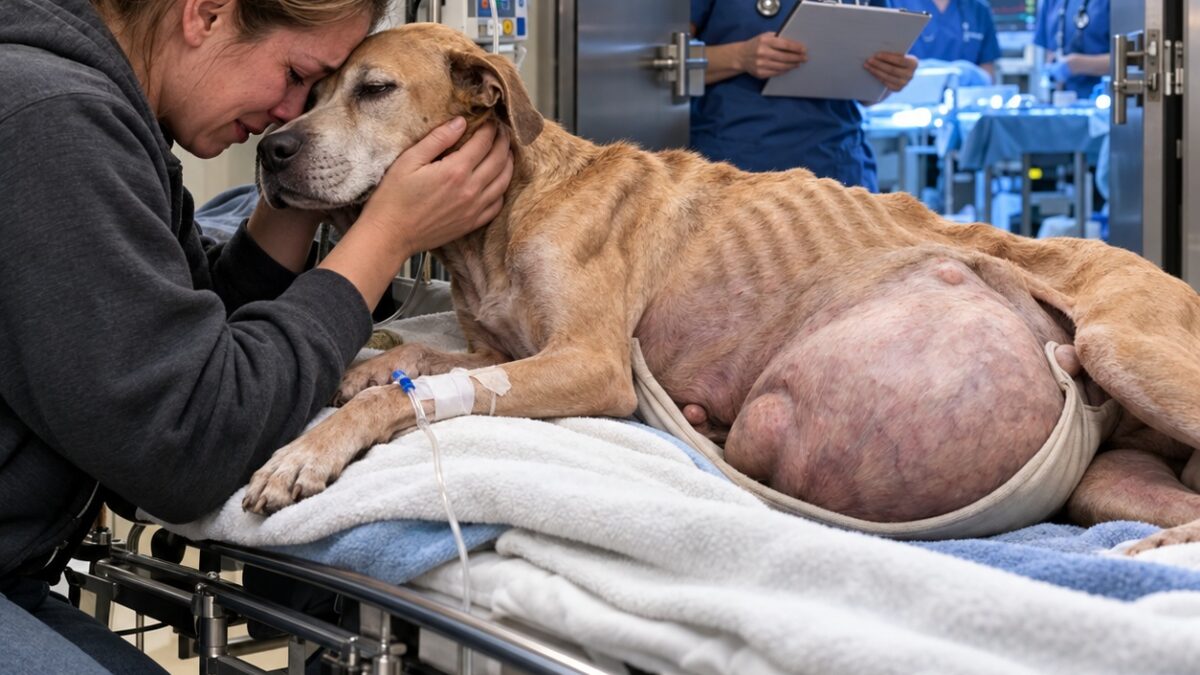
PART2
The first thing we had to accept was that wanting the tumor gone did not mean Nina was ready to lose it.
Emotion wants obvious solutions.
There it was.
A huge mass.
Remove it.
Save the dog.
But medicine does not care about emotional simplicity.
The tumor was thirteen pounds of dangerous weight attached to a body that had already been stripped down by neglect, infection, poor nutrition, and time.
Removing it would mean anesthesia.
Incision.
Blood loss.
Physiological stress.
Pain control.
Recovery.
Everything Nina’s body was least prepared to handle.
One veterinarian explained it in the simplest way possible.
“We have to make her strong enough to survive being helped.”
That sentence stayed with me.
Because it sounded impossible.
How do you strengthen a starving dog in days?
How do you correct infections quickly enough?
How do you balance urgency against preparation when the thing you are waiting to remove may itself become the emergency?
There was no comfortable answer.
Only work.
So we worked.
Nina received treatment for the infections first.
Medication.
Monitoring.
Support.
Her fever had to come down.
Her body needed calories, but nutrition had to be handled with care.
A severely emaciated animal cannot simply be given unlimited food because everybody feels guilty.
The body needs rebuilding, not overwhelming.
Meals became medical events.
Measured.
Observed.
Adjusted.
I watched Nina eat and had the same painful thought every time:
This should have happened long before us.
She should never have needed rescuers to teach her body that food would arrive regularly.
But regret does not contain protein.
So we fed her.
Again.
Again.
Again.
That became the pattern.
Feed.
Treat.
Check.
Wait.
Reassess.
Repeat.
The specialists reviewed her case.
Tests were run.
Blood collected.
Images taken.
The tumors evaluated as much as possible before surgery.
Every result seemed to lead to another question.
Could she tolerate anesthesia?
How much blood loss could she survive?
What was the safest surgical approach?
What else might be happening internally?
Could the large mass be removed cleanly?
What were the smaller tumors?
Was the giant mass malignant?
We did not know yet.
That uncertainty sat over everything.
People imagine that the worst part of rescue is seeing an animal arrive.
Sometimes the waiting is worse.
At arrival, the emergency gives you something to do.
Later, you have time to understand all the ways things might still go wrong.
Nina remained remarkably gentle.
That word appears in almost every description of her because there is no better one.
Gentle.
She was uncomfortable.
She was weak.
She had every reason to avoid us.
And still, sometimes when a caregiver sat near her, Nina would lift her face and nuzzle a hand.
The movement was small because everything she did seemed to cost energy.
She did not leap into laps.
Did not wag wildly.
She simply sought contact.
A forehead into a palm.
A nose beneath fingers.
A quiet request.
Stay close.
I began to understand that Nina was not only tolerating care.
She wanted connection.
That was both beautiful and devastating.
Somebody had failed this dog badly enough that she reached us with a thirteen-pound tumor, infected skin and ribs showing.
Yet people had not been ruined for her.
She still believed a human hand might contain something good.
I am not sure I will ever understand how dogs do that.
Her haunches needed careful attention.
The skin was raw and infected.
Her tail too.
You could not simply rub or wash carelessly.
Everything had to be gentle.
Clean.
Medicated appropriately.
Comfort was not a luxury.
It was part of keeping her stable enough to reach surgery.
We changed bedding.
Kept her clean.
Watched every irritated area.
Not glamorous work.
Necessary work.
A lot of rescue happens through laundry.
People rarely donate because they are inspired by clean towels.
But clean towels matter.
Dry bedding matters.
A dog with damaged skin deserves to lie on something that does not worsen the damage.
So we kept changing them.
The tumor changed how Nina positioned herself.
There was no forgetting it.
Even when she rested, the mass remained.
When she stood, there it was.
When she shifted, it shifted too.
It had become physically attached to every movement.
I often wondered how long she had been compensating.
How many days had passed between the first small swelling and this enormous weight?
How many people saw?
Did anyone understand?
Did anyone care?
We did not know enough to write a complete history, and I refused to invent one.
We knew she came from a cruel situation in North Memphis.
We knew the condition she arrived in.
That was enough.
We did not need imagined details to make the truth more horrifying.
Her body was evidence enough.
The cruelest part of the giant tumor was not simply its size.
It was what it did to our sense of time.
Every morning we bought Nina another day of preparation.
Every morning also meant another day the mass remained attached.
Risk on both sides.
If the tumor ruptured, the situation could become catastrophic.
But if we rushed because we were afraid of rupture, anesthesia could become catastrophic.
The choice was not between danger and safety.
It was between dangers.
That is what made those eight days so frightening.
On the second day, her fever remained concerning.
I remember standing with a veterinarian while Nina rested.
I asked:
“If she were stronger, would you operate now?”
“Yes.”
No hesitation.
That answer hurt.
“So we’re waiting because…”
“Because right now, the surgery might be more than she can survive.”
I looked at Nina.
She was asleep.
The tumor rested against the bedding.
Thirteen pounds.
I tried to imagine carrying thirteen pounds attached to my abdomen while already starving.
Then stopped.
The comparison was useless.
Human imagination cannot replicate another body’s suffering.
You can only witness.
She woke.
Lifted her head.
I crouched.
“Hi, Nina.”
Her eyes found me.
I offered my hand.
She pushed her nose against it.
Again.
I swallowed.
“You really don’t know how worried we are, do you?”
Maybe that was good.
Let us worry.
She had done enough.
We tried to keep the environment calm.
Stress costs energy too.
Nina needed every bit she had.
So voices stayed low.
Movements deliberate.
Care routine predictable.
Food.
Medication.
Cleaning.
Rest.
Examinations.
Nothing could make this situation normal, but routine can give the body something to lean on.
I think animals understand patterns before they understand intentions.
At first, every person entering might mean another examination.
Then she learned some people brought meals.
Some brought fresh bedding.
Some brought medication.
Some simply sat.
The sitting mattered.
Not every interaction had to take something from her.
Sometimes we were just there.
On the third day, somebody said:
“She looks a little brighter.”
We all turned.
That is what happens when everyone is desperate for progress.
A head held slightly higher becomes news.
Eyes slightly clearer.
One more bite.
A little more interest.
We became collectors of tiny signs.
Maybe she repositioned herself with less effort.
Maybe she watched someone longer.
Maybe she ate more confidently.
We held onto everything.
Not because we were naïve.
Because hope needs evidence too.
Her weight gain before surgery was never going to be dramatic.
Eight days cannot undo long-term emaciation.
The goal was not to transform Nina into a healthy dog before operating.
The goal was to move her body from catastrophic weakness toward enough stability.
Enough.
That word became sacred.
Not strong.
Enough.
Not healthy.
Enough.
Not safe.
Safer.
Rescue often lives in those imperfect comparisons.
Blood work was repeated.
Specialists consulted again.
We asked the same questions with new numbers.
What can she tolerate now?
What does another day buy us?
What does another day risk?
I hated every answer that included:
We can’t know for sure.
But medicine rarely gives certainty.
People want doctors to predict.
Sometimes they can only estimate.
That is not failure.
It is reality.
Nina’s case demanded decisions inside uncertainty.
By the fourth day, I had stopped counting how often I checked her breathing while she slept.
That habit begins with fragile animals.
You are talking to someone.
Look over.
Chest moving?
Yes.
Continue.
Five minutes later.
Again.
It becomes unconscious.
Nina slept deeply sometimes.
Her body needed it.
Every time she became very still, my heart reacted before reason.
Then the chest rose.
Relief.
Over and over.
I wondered whether Nina had slept deeply before rescue.
Could she?
Pain.
Tumor.
Infection.
Fever.
Uncertainty.
A body in distress does not rest the same way.
Now she had medication.
Clean bedding.
People monitoring.
Maybe sleep could finally become restorative instead of merely unconsciousness.
That mattered.
We wanted every system to rebuild.
Muscle.
Blood.
Immune response.
Strength.
Sleep participates too.
On the fifth day, her fever was moving in the right direction.
The words were cautious.
Nobody said:
Good.
They said:
Better.
Better became another sacred word.
Better is not healed.
Better is direction.
Nina needed direction.
She ate.
She nuzzled.
She rested.
The mass remained.
You could never fully celebrate because it hung there, enormous, visually reminding us what had not yet been solved.
That is emotionally difficult.
You see improvement and danger in the same frame.
One caregiver stroked Nina’s head and whispered:
“You have no idea how much lighter you’re going to feel.”
I nearly cried.
Because we did not know if she would ever get the chance to feel it.
That was the sentence nobody said aloud.
We talked about after surgery constantly.
Recovery bed.
Pain control.
Nutrition.
Monitoring.
As though planning created certainty.
Maybe it helped.
We needed an after.
So we spoke one into the room.
The sixth day brought another round of consultation.
We were getting closer.
The surgical team reviewed everything.
Potential blood loss became one of the biggest concerns.
A mass that size can have substantial blood supply.
Removal could be difficult.
Bleeding could be significant.
Nina was already anemic and weak.
Every surgical concern seemed connected to another weakness.
That was what starvation had done.
It had stolen her margin for error.
Healthy bodies survive complications partly because they have reserves.
Nina had almost none.
We were trying to manufacture a margin in days.
I remember leaving the hospital that evening and sitting in the car without turning the engine on.
I was angry.
Not at the veterinary team.
Not at the slow timeline.
At the concept of fairness.
Nina had arrived gentle.
Still affectionate.
Still willing to seek people.
And now we were asking whether she was strong enough to survive the care required because help had arrived so late.
That felt cruel beyond language.
I hit the steering wheel once.
Then stopped.
Anger had nowhere useful to go.
I went home.
Slept badly.
Returned early.
Day seven.
The day before surgery.
We knew.
The team had decided.
Tomorrow.
There is a strange relief in having a date, even when the date terrifies you.
At least waiting becomes finite.
I spent extra time beside Nina.
Maybe everyone did.
Nobody said goodbye.
Absolutely not.
We did not make the room feel like goodbye.
But human beings behave differently when afraid.
Longer touches.
More photographs.
More quiet sitting.
People pretending not to think about tomorrow.
Nina seemed unaware of the significance.
Of course.
She ate.
Rested.
Accepted care.
Nuzzled someone’s hand.
That gesture again.
Always that gesture.
I held my palm beneath her chin.
She pressed gently.
I whispered:
“You’ve done your part.”
That was true.
She had eaten.
Responded.
Endured treatments.
Let us clean wounds.
Taken medication.
Survived seven days.
Tomorrow, we would ask something enormous.
And there was nothing else she could consciously do to prepare.
That night, the surgeon spoke with us carefully.
No false confidence.
The risk was significant.
Blood loss.
Anesthesia.
Her body condition.
Complications.
Possibility of death.
The words were clinical.
Necessary.
I hated them.
But I also trusted the people who said them.
False reassurance is not kindness.
We needed to understand.
Nina deserved a team willing to look directly at risk and operate anyway because waiting had become worse.
I barely slept.
Every version of the next day replayed.
Nina waking.
Nina not waking.
Complication.
Success.
Phone ringing.
Silence.
There is no productive way to think yourself through surgical uncertainty.
Your mind tries anyway.
Day eight.
I remember almost everything.
The light.
The smell.
The sound of kennel doors.
The way Nina looked that morning.
She seemed no more dramatic than usual.
That offended me somehow.
How could the world feel ordinary on a day like this?
She did not know.
Maybe that was mercy.
We followed preoperative instructions carefully.
No mistakes.
No emotional rule-breaking.
Everything according to the surgical team.
Nina was examined again.
Vitals.
Final checks.
Blood.
Preparation.
One technician clipped what needed clipping.
Another adjusted equipment.
The surgeon reviewed the plan.
Professional.
Calm.
People who work in medicine learn how to carry fear without handing it to the patient.
I watched them.
Tried to borrow some of that calm.
When it was time, Nina looked toward us.
I crouched beside her.
I did not say:
Don’t die.
That would have been for me.
Instead:
“We’ll be here.”
Simple.
True.
I touched the top of her head.
Nina nudged my wrist weakly.
Of course she did.
Then they took her.
The operating-room doors closed.
And suddenly there was nothing left for us to do.
That was the worst part.
For eight days, everything had been action.
Feed.
Clean.
Call.
Test.
Consult.
Measure.
Monitor.
Prepare.
Now?
Sit.
Wait.
Trust people behind a door.
Time behaves differently outside surgery.
Minutes lengthen.
You check clocks too often.
Nobody talks normally.
Someone drinks coffee and forgets it.
A phone vibrates and every body reacts.
Not Nina.
Wrong message.
Sit again.
I tried to read something.
Could not.
Walked.
Sat.
Walked again.
I thought about the tumor.
Thirteen pounds.
I imagined the surgical team separating it carefully from Nina’s body.
Controlling bleeding.
Watching anesthesia.
Monitoring every number.
I knew enough to frighten myself and not enough to help.
That is a miserable amount of knowledge.
Someone said:
“She’s tough.”
I did not answer.
I have complicated feelings about calling sick animals tough.
They did not choose the test.
But Nina had survived enough to reach the table.
That was fact.
We hoped she had one more survival left in her.
More waiting.
No dramatic music.
No meaningful conversation.
Just waiting.
Then someone came through the door.
I stood so quickly the chair moved behind me.
The first thing I looked at was the person’s face.
Medical people often reveal news before speaking.
I saw relief.
Not celebration.
Relief.
“She made it through.”
I think someone beside me started crying before I did.
I asked:
“She’s alive?”
“Yes.”
“The mass?”
“Removed.”
“All of it?”
“The large mass is out.”
Thirteen pounds.
Gone.
I sat down because my legs suddenly stopped being trustworthy.
Nina survived.
The sentence sounds so clean.
It was not clean emotionally.
It was the collapse of eight days of fear.
People crying.
Laughing.
Asking questions too fast.
Trying to understand postoperative plans while still stuck on:
Alive.
Alive.
Alive.
The massive tumor was no longer hanging from her belly.
For the first time since rescue, Nina’s body existed without that weight attached.
I wanted her awake enough to understand.
Of course she was recovering from anesthesia.
The immediate goal was stability.
Warmth.
Pain control.
Monitoring.
Bleeding.
Vitals.
Everything.
Surgery was over.
Risk was not.
We knew that.
But the largest obstacle had been physically removed.
I saw the mass after surgery.
I wish I could explain what thirteen pounds looks like after you have spent eight days seeing it attached to a severely emaciated dog.
It looked impossible.
Heavy.
Real.
Something Nina had been carrying every time she stood.
Every time she lay down.
Every time she tried to move.
I felt anger again.
Then relief.
Then nausea.
Then gratitude.
Human emotion is messy around medical things.
I looked back toward the recovery area.
Nina.
Without it.
The body looked unfamiliar.
Still far too thin.
Still healing.
But the shape had changed.
A burden that had dominated every photograph was gone.
I whispered:
“You’re lighter.”
This time, she had survived long enough for the sentence to become true.
Her postoperative period required careful monitoring.
No one pretended the story ended when the surgeon closed.
Surgery creates wounds while treating disease.
Nina now had an incision.
Pain.
Anesthesia recovery.
Nutritional needs.
Infections that still needed management.
Weakness.
The raw skin along her haunches and tail.
She still required help.
But the nature of the help had changed.
Before:
Can we get her strong enough to remove the tumor?
After:
Can we help her body recover now that the tumor is gone?
A better question.
Still serious.
Better.
When Nina woke more fully, I was there.
Her eyes opened.
Closed.
Opened again.
She looked disoriented.
Normal.
I spoke softly.
“Hi.”
One ear shifted.
“Nina.”
Her eyes moved toward the voice.
I offered my hand.
For a few seconds, nothing.
Then her nose moved.
Slow.
She touched me.
Barely.
I cried.
Again.
There are no original emotions in rescue.
Only the same ones returning deeper.
“You did it.”
She had no idea.
She had simply gone to sleep and woken lighter.
Maybe dogs are spared some psychological burden by not understanding procedures.
Maybe not.
Pain still communicates.
But Nina did not need the surgical explanation.
She needed warmth.
Medication.
Rest.
Food when appropriate.
People.
We gave those.
The first time she stood after surgery was emotional for a different reason.
Her balance had changed.
Thirteen pounds no longer pulled from the same place.
Think about that.
Her body had compensated around the mass.
Now the weight distribution was different.
Her muscles were still weak.
She needed careful support.
But when she stood, even briefly, you could see what the operation had changed.
The obstacle was gone.
The dog remained.
There was no sudden transformation into a healthy animal.
That is important.
After photographs sometimes make rescue look instantaneous.
Before tumor.
After tumor.
Victory.
But Nina remained severely underweight.
Still healing infection.
Still needed nutrition.
Still had two smaller tumors to understand.
Still waiting on biopsy.
Still medically complicated.
We allowed ourselves relief.
Not complacency.
Then came pathology.
Biopsy results.
Another wait.
Maybe less visually dramatic than surgery.
Emotionally brutal.
We knew the giant tumor could be malignant.
We needed to know what we were dealing with.
The two smaller masses were also tested.
When results came, we listened carefully.
The two smaller tumors were benign.
Relief.
Two.
Benign.
I held onto those words.
Then the large mass.
Soft tissue sarcoma.
Cancer.
There it was.
Victory and reality in the same sentence.
The huge tumor had been removed.
Nina had survived.
But pathology did not turn it into something harmless retroactively.
It was a soft tissue sarcoma.
People wanted a simple reaction.
Good news?
Bad news?
Life refused.
The smaller tumors being benign was good.
Surviving surgery was wonderful.
Removing the thirteen-pound mass was enormous.
Soft tissue sarcoma was serious.
All true.
You do not have to choose one emotion.
We were grateful.
Worried.
Proud.
Sad.
Relieved.
Everything.
We discussed what the pathology meant with the medical team.
I will not invent outcomes beyond what we knew.
There was no magical declaration that Nina was cured forever.
No guarantee.
The diagnosis remained part of her medical story.
Follow-up mattered.
Monitoring mattered.
Her future medical decisions would be guided by professionals.
The honest ending was not:
Cancer gone, everything perfect.
The honest ending was:
The massive tumor had been removed successfully, Nina was alive, and now she had the time and care necessary to keep healing.
That was already extraordinary.
She moved into one of Wright-Way’s medical foster homes.
That transition felt almost as important as leaving surgery.
Hospital care saves lives.
Foster care teaches those lives how to exist outside crisis.
Nina needed somewhere medically appropriate but also warm.
Predictable.
Human.
A place where people would notice whether she ate.
Whether her incision looked different.
Whether fever returned.
Whether skin improved.
Whether she slept comfortably.
Whether she wanted affection.
She got that.
The first night in foster, I worried anyway.
Rescuers are terrible at releasing worry after responsibility changes hands.
“How did she settle?”
“Did she eat?”
“Did she sleep?”
“Any problems?”
Her foster family answered patiently.
She was resting.
She had people watching.
She was not alone.
Good.
I have thought a lot about that phrase.
Medical foster home.
It sounds clinical.
But Nina experienced something simpler.
A home where medical needs did not make her unwanted.
That is profound.
She had arrived with a body requiring enormous care.
Now care was built into the home around her.
Medication did not interrupt belonging.
It was part of belonging.
Her appetite helped.
Nina began gaining weight.
Slowly.
Correctly.
The ribs that had looked so sharp began becoming less severe.
Her body filled out.
Not dramatically overnight.
Day by day.
Meals.
Absorption.
Rest.
Healing.
The same quiet machinery of recovery that saves so many animals.
She no longer had a thirteen-pound tumor consuming the visual center of her body.
Now we could watch Nina herself emerge.
Her posture.
Face.
Coat.
Expressions.
The gentle nature we had already seen.
People.
She liked people.
After everything.
Still.
Her coat became healthier.
At intake, skin problems and overall condition had made her look worn down.
In foster, nutrition and treatment began showing externally.
Fur improved.
Skin settled.
The body was rebuilding itself in places we could see.
I love that stage.
Not because beauty matters more than health.
Because the coat is evidence.
The body finally has enough resources to invest in something beyond emergency survival.
When an emaciated animal starts looking soft again, you understand how expensive survival is.
The starving body spends everything on staying alive.
Luxury systems shut down first.
Coat quality.
Muscle.
Reserves.
The body triages itself.
With regular nutrition, it can start rebuilding beyond the bare minimum.
Nina’s healthier coat meant more than appearance.
It meant resources.
She continued seeking touch.
That never left.
Maybe became stronger.
At the beginning, those nuzzles had stunned us because her trust seemed impossible.
In foster, affection had room to become part of normal life.
A hand reached.
Nina leaned.
Someone sat.
Nina moved closer.
No medical procedure attached.
No test.
No wound cleaning.
Just touch.
That mattered.
Dogs deserve affection that is not connected to being treated.
One evening, her foster caregiver sent an update:
Nina had settled near the family.
Nothing dramatic.
A photograph.
Nina resting.
Someone’s hand beside her.
The dog’s face turned toward it.
I stared for a long time.
Because when she arrived, every human interaction was urgent.
Now affection could be ordinary.
Ordinary becomes sacred after crisis.
She started flourishing.
That word gets used too easily.
For Nina, flourishing did not mean every problem had vanished.
It meant her direction had changed.
She was gaining instead of wasting.
Healing instead of deteriorating.
Resting instead of merely collapsing.
Receiving food instead of living emaciated.
Being monitored instead of overlooked.
Being touched gently instead of existing inside cruelty.
That is flourishing.
The first time I saw her after she had spent a while in foster, I had to adjust my memory.
I still carried intake Nina mentally.
The ribs.
Tumor.
Raw skin.
Fever.
But the dog in front of me had changed.
She recognized people.
Moved with more confidence.
Looked brighter.
Still healing.
Still Nina.
But present.
I crouched.
“Hi, girl.”
She approached.
And that familiar head came toward my hand.
Nuzzle.
I laughed.
“Still doing that?”
Of course.
Some things did not need healing because they had never been broken.
Her gentleness had survived intact.
I think that is the part that moves people most.
Not the tumor.
Not surgery.
Nina’s response to kindness.
A dog who had been placed in a cruel situation reached toward tenderness rather than away.
That should not be romanticized into:
Abuse made her sweet.
No.
Cruelty does not create goodness.
Nina was gentle despite what happened.
That distinction matters.
We do not thank suffering for character.
We thank Nina for remaining Nina.
Her foster family returned that affection.
That was the satisfying answer.
She reached.
Someone reached back.
Again.
Again.
Again.
Trust became reciprocal.
No longer Nina asking for a gentle hand and hoping.
Now she had people whose hands she knew.
That is home-like safety, even in medical foster care.
The story of the tumor followed her publicly.
People could not look at before photographs without focusing on the mass.
Understandable.
Thirteen pounds is shocking.
But I wanted people to look at her face too.
The tumor was something Nina carried.
It was not Nina.
Cancer was part of her medical reality.
It was not her identity.
She was affectionate.
Patient.
Resilient.
A dog who liked contact.
A dog learning comfort.
A dog gaining weight.
A dog flourishing.
More than pathology.
The surgical team deserved enormous credit.
So did the people who stabilized her before surgery.
That eight-day wait was not delay.
It was preparation.
That distinction matters.
People sometimes ask:
Why didn’t they remove it immediately?
Because immediate action can kill a fragile patient.
Those days were treatment.
Every meal before anesthesia mattered.
Every infection addressed mattered.
Every test mattered.
Every consultation mattered.
They were building Nina’s chance.
Waiting can be active medicine.
Day eight became the dramatic point only because days one through seven happened correctly.
That is the lesson behind the operation.
The surgeon’s skill mattered.
So did the boring days.
Probably more than most people realize.
I often replay the decision.
What if we had operated day one?
No one can know.
What if we had waited too long?
Again.
No certainty.
We had the outcome we had because specialists assessed Nina repeatedly and chose the moment they believed gave her the best chance.
That is not a miracle alone.
It is judgment.
Medicine.
Care.
And luck, because every surgery carries some.
Respect all of it.
The mass could have ruptured.
That fear had pushed against us every morning.
After surgery, that particular danger was gone.
I remember realizing that days later.
We no longer had to wake thinking:
Is today the day it ruptures?
One entire category of dread had disappeared.
That felt like putting down a weight ourselves.
Nothing compared with Nina’s thirteen pounds.
Still.
Her body had been balancing around something massive.
Now her rehabilitation involved learning a body without it.
Imagine carrying an enormous burden for long enough that posture adapts, then suddenly it is gone.
Relief can require adjustment.
Nina had healing ahead.
We let her take it.
No one rushed her into proving the surgery worked by acting energetic.
She was allowed to rest.
I loved that.
Animals in rescue are often photographed at their most dramatic moments because people need evidence of improvement.
But a recovering dog should not have to perform.
Nina could sleep.
Eat.
Heal.
That was the assignment.
Her foster home understood.
No pressure.
No timeline designed for an audience.
Medical schedule.
Comfort.
Patience.
Nina flourished partly because nobody demanded that she flourish quickly.
Weight gain brought visible changes.
Her ribs became less prominent.
Muscle returned slowly.
The body looked more proportionate now that the giant mass was absent.
People who had not seen her intake might not have understood the transformation.
We did.
Every small improvement was attached to memory.
The skin along her haunches and tail improved.
Again, not instant.
Infection had damaged those areas.
Treatment needed time.
But healing tissue replaces active injury.
The color changes.
Texture changes.
Fur may begin returning.
Comfort increases.
The dog stops constantly carrying that irritation.
Those are quiet victories.
A coat becoming healthier sounds superficial until you remember what it represents.
Nutrition.
Reduced inflammation.
Stable environment.
Medical treatment.
A body no longer spending every resource fighting multiple crises.
Nina’s coat was her health becoming visible.
I remember running my hand gently along an area that had once looked painfully raw.
Later, it felt different.
Still evidence of healing.
But not the same.
Nina leaned toward the touch.
I had to stop because emotion rose too quickly.
Sometimes touch lets you measure recovery more honestly than photographs.
She began looking less like a patient.
That is always a beautiful transition.
At first, every image says hospital.
Bandages.
Medical bedding.
Concern.
Then eventually:
dog.
A dog lying near people.
A dog looking for affection.
A dog eating.
A dog resting.
The medical story moves slightly into the background.
Exactly where we want it.
One of her foster caregivers described her as affectionate.
I laughed.
“We knew that.”
We did.
From almost the beginning.
The nuzzling.
That tiny act had been a preview of the dog waiting underneath pain.
Now the rest of the world could see it too.
I wondered sometimes how Nina would have behaved if rescued earlier.
Would she have been more playful?
More energetic?
Maybe.
But speculation steals attention from the dog we actually have.
Nina now.
That was enough.
We could not recover the past.
We could protect the present.
The soft tissue sarcoma diagnosis stayed in my mind even during happy updates.
I will not pretend otherwise.
Cancer is a word that changes how humans look at time.
Every good day feels precious.
Maybe too precious.
You start counting.
Then you have to stop.
Nina did not know the pathology terminology.
She knew meals.
Beds.
Hands.
Comfort.
That difference helped me.
Follow veterinary guidance.
Monitor appropriately.
Then let the dog live.
Do not make every minute a cancer minute.
Nina deserved ordinary minutes too.
The two smaller tumors being benign gave us relief.
I remember the specific emotional exhale.
Two fewer things to fear.
It did not erase the sarcoma.
Still mattered.
Medicine often gives partial good news.
Take it.
You are allowed.
I think about how easily her story could have ended before we met her.
That thought can become unbearable.
A massive tumor ruptures.
Infection worsens.
Fever rises.
Emaciation continues.
No strength for surgery.
That was the trajectory.
Rescue interrupted it.
Not with a guaranteed happy ending.
With a chance.
That is often all rescue can promise.
Chance.
Nina used hers.
People sometimes describe rescue as “saving.”
I am careful.
We create conditions.
Veterinary teams treat.
Foster families care.
Animals survive, heal, adapt.
No single person owns the word saved.
Nina’s survival came from many hands.
The rescuer who removed her from danger.
The clinic.
Specialists.
Surgeon.
Technicians.
People feeding her.
People washing bedding.
Wright-Way’s medical foster home.
Everyone.
And Nina herself.
Her body did extraordinary work once given support.
Every incision heals from the inside out through biological processes no rescuer can command.
We can protect.
Feed.
Medicate.
The body does the final labor.
Nina did that.
I remember the first post-surgery update that did not mention the surgery.
That sounds strange.
It was about something ordinary.
She had eaten well.
Rested comfortably.
Wanted affection.
I smiled.
The operation had stopped being the only headline.
Good.
That means life is moving beyond crisis.
Her foster home had people around her.
A family.
Not necessarily a final adoption—we did not know that from her story, and I will not invent it.
But family-like care existed there.
That was real.
People who came back into the room.
People who noticed her.
People who touched gently.
People responsible for tomorrow.
For an animal who arrived needing help with almost everything, that was enormous.
There is a difference between having people nearby and having people responsible for you.
Nina had the second now.
If she did not eat, someone noticed.
If an incision looked different, someone called.
If her skin worsened, action.
If she seemed tired, rest.
That vigilance is love in medical foster form.
The massive tumor had forced Nina’s body to carry more than it could afford.
Her foster family did the opposite.
They carried the logistics so Nina could simply recover.
Food.
Medication.
Appointments.
Clean spaces.
Humans took the complicated parts.
Dog got to be dog.
Correct arrangement.
The word “flourish” became more comfortable with time.
At first, I was afraid to use hopeful language too early.
Rescuers become superstitious.
Do not say she’s doing great.
What if something happens?
Do not celebrate.
Wait for next blood work.
Wait for pathology.
Wait for incision check.
Wait.
Fear tries to protect itself by withholding joy.
Eventually I realized Nina did not need our superstition.
If today was good, call today good.
Tomorrow can be handled tomorrow.
So:
Nina was flourishing.
Today.
Enough.
She gained strength.
She gained healthier coat.
She gained comfort.
She gained people.
Her life expanded.
That deserved celebration without guarantee.
I think that is one lesson Nina gave me unwillingly.
You can love an outcome without demanding permanence.
Animals teach time differently.
They do not ask:
Will this comfort last ten years?
They rest because the bed is soft now.
They lean into the hand because the hand is gentle now.
We should respect that.
I began looking less at the old photographs.
Not because they were too painful.
Because Nina’s present deserved more space.
Before pictures are useful.
They document.
Raise awareness.
Show transformation.
But if we stare only backward, the animal remains trapped in our memory as the worst day.
Nina was no longer that dog.
She was the same dog, yes.
But living a different chapter.
A foster photograph showed her resting near someone’s feet.
I saved that instead.
Nothing visually shocking.
No giant mass.
No surgical drama.
Just Nina.
I liked that more.
She had arrived needing help with almost everything.
That sentence may be the saddest and most hopeful description.
Everything.
Food.
Medical care.
Strength.
Infection.
Surgery.
Skin.
Rest.
Comfort.
But “everything” can change.
Humans built systems around each need.
One at a time.
Eventually some needs stopped being emergencies.
That is recovery.
I wondered how different she felt physically after the mass was gone.
We can only imagine.
Thirteen pounds removed from an emaciated dog is enormous.
Did standing feel strange?
Sleeping?
Turning?
Was there immediate relief beneath surgical soreness?
We do not know.
But mechanically, her body no longer had to carry it.
That fact alone felt like freedom.
The first photograph where I could fully see the natural line of her belly without the mass hit me hard.
There she was.
Not hidden behind disease.
Not visually dominated by tumor.
Nina.
I stared.
“Hi, girl.”
As if seeing her properly for the first time.
One of the dangers of dramatic medical conditions is that people begin describing the animal through the disease.
Tumor dog.
Cancer dog.
Thirteen-pound mass.
Nina deserved better language.
Gentle Nina.
Affectionate Nina.
Nina who nuzzles hands.
Nina who kept trusting.
Nina getting stronger.
The tumor was huge.
Nina was bigger than it in every way that mattered.
Her name itself became enough.
Nina.
Not:
the North Memphis dog.
Not:
the sarcoma case.
Just Nina.
That is always a milestone.
The foster family learned her signals.
Where she liked to rest.
How she asked for touch.
When she had enough.
What foods worked best.
How to keep her comfortable.
These tiny facts are the beginning of belonging.
You stop treating a generic patient and start knowing an individual.
Nina’s nuzzle became recognizable.
Head lowering.
Nose pressing lightly.
Hand.
Stay.
I loved that she could ask.
I loved more that people answered.
If I had to choose one image to represent her story, many people would pick the giant tumor removed after surgery.
I would pick the hand.
Nina’s face against a hand.
Before surgery.
After surgery.
In foster.
Same gesture.
Because the medical transformation is astonishing.
The emotional continuity is what breaks me.
She came believing gentleness was still possible.
We had the responsibility not to prove her wrong.
That is heavy when you think about it.
An animal arrives from cruelty still willing to trust.
You become part of the answer to a question she cannot phrase.
Are humans safe?
Every interaction contributes.
Nina got better answers.
The waiting room on surgery day still returns sometimes.
Not the operation.
The chairs.
Clock.
Coffee.
A phone.
Human helplessness.
I remember thinking:
If she dies, was waiting eight days wrong?
If we had operated earlier, would that have changed anything?
Fear creates retrospective accusations before events even finish.
Then she survived.
Relief silenced them.
But the experience taught me something.
Medical decisions should not be judged only by outcome.
They should be judged by evidence and reasoning available at the time.
The team did the work.
Prepared her.
Chose day eight.
She came through.
Trust the process, not superstition.
I am grateful for the specialists.
They did not let our emotional urgency force unsafe shortcuts.
That discipline helped Nina.
The surgeon too.
People sometimes say:
The rescue saved her.
No.
The surgeon held part of her life in skilled hands.
Give professionals credit.
Rescue works because teams intersect.
The people donating to Wright-Way’s medical care helped too.
Medicine is expensive.
Major surgery especially.
Foster care requires resources.
Community support becomes physical outcomes.
People think their contribution disappears into a fund.
Sometimes it becomes one more bag of food that helps a dog gain enough weight to tolerate anesthesia.
Sometimes it becomes surgery.
Sometimes medication.
Sometimes the clean bedding beneath a healing incision.
Money can become mercy when used competently.
That is why I do not romanticize rescue as pure love.
Love matters.
Logistics save too.
Scheduling.
Transport.
Money.
Medication.
Records.
Specialists.
Foster availability.
All boring.
All essential.
Nina’s life sat at the intersection of emotion and infrastructure.
Someone cared.
Then a system had to function.
It did.
She lived.
As weeks passed, her appearance changed enough that people reacted with disbelief.
“She’s beautiful.”
She had always been.
They meant:
Now I can see beauty because illness is no longer overwhelming my eyes.
I understood.
Still, I wanted to remind everyone:
The dog under the tumor was worthy before she became easier to look at.
Rescue ethics begins there.
Emaciated animals are not less deserving because they are difficult to photograph.
Infected skin is not ugliness.
It is injury.
Tumors are not identity.
They are disease.
Nina taught all of that without trying.
Her healthier coat eventually gave people something easy to celebrate.
Softness.
Shine.
Color returning.
I let them.
Joy should be accessible too.
Not every lesson needs correction.
Sometimes:
Look how good she looks!
is exactly right.
She did look good.
Better.
Alive.
I visited again and noticed the ribs first.
Not because they were visible.
Because they were less visible.
Funny how absence becomes evidence.
Something no longer shouting.
Weight returning.
I ran a hand gently along her side.
More body beneath it.
I smiled.
“You’re getting there.”
Nina leaned.
Nuzzle.
Always.
Her foster family laughed about how affectionate she had become.
I said:
“She warned us.”
“What?”
“She was like this even when she felt terrible.”
That is true.
The affection had not been created by comfort.
Comfort allowed it to expand.
I wonder how much energy kindness itself requires.
When you are sick, reaching for another being costs something.
Nina spent that energy anyway.
Maybe connection was also comfort for her.
Maybe nuzzling reduced fear.
Maybe we were not receiving a gift so much as participating in her coping.
That does not make it less beautiful.
It makes it more honest.
Her medical foster family became part of her healing in ways the clinic could not.
Clinics provide intense expertise.
Homes provide repetition.
Morning.
Afternoon.
Evening.
Night.
The same voices.
The same rooms.
The same hands.
Security is built through sameness.
Nina needed that after chaos.
A dog with medical needs can become defined by appointments.
Foster life restores non-medical time.
Sunlight.
Sleeping near someone.
Eating in a kitchen.
Hearing television.
Normal household sounds.
Those experiences tell the nervous system:
Life is more than treatment.
Nina received that.
There were likely moments of discomfort.
Healing incision.
Medication.
Skin.
Weakness.
Recovery is not painless.
But now discomfort occurred within safety.
That changes everything.
Pain plus abandonment is one experience.
Pain while someone stays is another.
The second still hurts.
But it does not mean the world has disappeared.
Nina had people who stayed.
That is the deepest part of the ending for me.
People often want adoption as the final line.
I understand.
Permanent home.
Name on a tag.
Family.
But a story should not invent what the facts do not give us.
What we know is enough.
Nina moved into Wright-Way’s medical foster home.
She gained strength.
Her coat became healthier.
She flourished.
She had people returning her affection.
That is not an unfinished emotional ending.
That is a dog safely inside care after arriving on the edge of catastrophe.
The future remains open.
Hope is allowed to remain future tense.
I would rather leave Nina truthfully healing than falsely claim a perfect forever home the source never gave.
Truth respects her more.
So the satisfying ending is not:
Everything became perfect.
It is:
She survived the impossible operation.
The thirteen-pound tumor stopped hanging from her body.
She was no longer alone in a cruel situation.
Her infections were treated.
Her food was dependable.
Her skin had time to heal.
Her coat improved.
Her body strengthened.
People knew her name.
People noticed her.
People loved touching her gently because she loved touching back.
That is deeply satisfying.
Sometimes survival is enough to make fans cheer.
Nina earned that cheer.
I remember the eight-day timeline as chapters.
Day one:
Shock.
Day two:
Numbers.
Day three:
Tiny improvement.
Day four:
Fear.
Day five:
Better.
Day six:
Decision approaching.
Day seven:
Tomorrow.
Day eight:
Door closes.
Wait.
Then:
She made it.
You could build an entire lifetime of emotion inside eight days.
We did.
But Nina’s body experienced those days differently.
Food.
Medicine.
Rest.
Hands.
Maybe that simplicity helped.
She did not know there was a countdown.
We carried it for her.
Again:
Correct order.
Humans worry.
Dog heals.
After surgery, the countdown ended.
Time expanded.
No longer:
Can we get her to day eight?
Now:
Let’s see what tomorrow brings.
Better.
I often imagine Nina’s first night in foster after surgery.
Not hospital alarms.
A quieter space.
People nearby.
Her body sore but lighter.
Maybe she shifted.
Maybe she slept.
Maybe someone checked her too often because they were nervous.
Medical fosters do that.
You tell them:
She’s okay.
They check anyway.
Good.
Better too much attention after neglect than too little.
Nina had spent too long without enough.
Now she entered a world of enough and then some.
Food enough.
Hands enough.
Beds enough.
Monitoring enough.
Love enough.
The word “cruel situation” can remain abstract.
Nina’s body made it concrete.
Visible ribs.
Fever.
Infection.
Raw skin.
Tumors.
That is why rescue documentation matters.
It transforms vague cruelty into measurable need.
Then care can become equally concrete.
Temperature falls.
Weight rises.
Wound closes.
Tumor removed.
Coat returns.
Numbers move.
Recovery has evidence too.
The pathology report became one document among many.
Soft tissue sarcoma.
Clinical words.
But Nina did not become a pathology report.
That distinction protected my mind.
We followed medical advice.
Then returned to Nina.
Her eyes.
Her nuzzles.
Her meals.
The living animal.
Cancer can make people treat every interaction as potentially final.
I tried not to.
Nina deserved presence without constant anticipatory grief.
That is difficult.
Important.
One afternoon she rested with her head near someone’s knee.
The person stroked her.
No conversation about sarcoma.
No prognosis.
Just dog and hand.
I thought:
This is what she needs from us emotionally.
Not denial.
Not fear.
Company.
Her rescue had begun with emergency.
Her recovery matured into companionship.
That is the arc.
I once heard someone say:
“It’s amazing she’s still so loving.”
I answered:
“Maybe we should be amazed she was loving in the first place.”
Because by the time she arrived, she had enough evidence to distrust.
Yet there she was.
Nuzzle.
Human hand.
Again.
Dogs are often called forgiving.
I do not know if Nina forgave anyone.
I do not know if she remembered specific harm in human narrative terms.
I know she remained open to connection.
That is enough.
Do not burden animals with our moral vocabulary when behavior already tells a beautiful story.
Nina sought gentleness.
She found people willing to give it.
There.
The thirteen-pound mass became something in photographs and medical memory.
Nina moved beyond it physically.
I loved that.
An object that once defined her silhouette no longer existed on her body.
The eye had to find something else.
Face.
Posture.
Coat.
Nina.
That is symbolic whether I want it to be or not.
Sometimes removal allows identity to become visible.
But again:
She was always Nina.
Even under it.
The smaller benign tumors gave us a rare clean piece of good news.
I remember repeating:
Benign.
Benign.
Two times.
Like a prayer.
The sarcoma prevented uncomplicated celebration.
Still.
Two benign tumors were two fewer threats.
Take the wins that exist.
You do not disrespect remaining difficulty by being grateful for partial relief.
That philosophy carried through recovery.
One good meal.
Win.
One comfortable night.
Win.
Healthier coat.
Win.
More strength.
Win.
Cancer diagnosis still real.
All true.
Humans can hold multiple truths.
We have to.
The foster family eventually knew Nina outside the story.
That is a privilege.
Rescuers often meet the crisis version.
Fosters meet the everyday personality.
Maybe she had preferences.
Habits.
Favorite resting places.
Little routines.
Those are the details that transform an animal from case to family member.
The source tells us the family was there to return her affection.
That alone paints enough.
She reached.
They answered.
I imagine hands becoming familiar.
At first:
One more person.
Later:
My people.
Again, dogs do not use our exact words.
But attachment shows.
Approach.
Relaxation.
Seeking proximity.
The body says enough.
Nina’s body had once been screaming medically.
Eventually it could whisper emotionally.
A lean.
A nuzzle.
A rest.
That is what stability buys.
The most painful question people asked was:
“How did she survive this long?”
I did not know.
Bodies are mysterious.
Some animals reach us far worse than expected and still respond.
Others seem stronger and decline suddenly.
No guarantees.
Nina survived until rescue.
Then surgery.
Then recovery.
Grateful.
No need to explain beyond what medicine supports.
Another question:
“Did the tumor weigh more than she should have been carrying?”
Obviously yes emotionally.
But clinically, the astonishing fact remains thirteen pounds.
I do not need hyperbole.
Thirteen pounds on an emaciated dog is already difficult to comprehend.
Truth is dramatic enough.
That is another rule I learned.
Do not exaggerate rescue.
It insults real suffering.
Nina’s real story needs no added cruelty, no fictional villain, no invented medical miracle.
Everything necessary is already there.
A cruel situation.
Severe emaciation.
Infections.
High fever.
Raw infected skin.
Three tumors.
One thirteen pounds.
Body too weak for surgery.
Risk of rupture.
Eight days of preparation.
Specialists.
Tests.
Weight gain.
Anesthesia risk.
Blood loss risk.
Operation.
Survival.
Soft tissue sarcoma.
Medical foster.
Strength.
Healthy coat.
Affection.
What more drama could anyone ethically need?
None.
The satisfying part is real too.
The operating-room door opened with Nina alive.
Real.
The mass was gone.
Real.
The two smaller tumors were benign.
Real.
Medical foster care.
Real.
Strength returning.
Real.
Flourishing.
Real.
Do not invent beyond a story this strong.
When I think about fan satisfaction, I think people sometimes want the person who hurt the animal punished.
That is understandable.
But the source does not give us that ending.
I will not fabricate it.
Instead, I offer the better thing we actually know:
The cruelty no longer controlled Nina’s daily life.
Whatever happened before had lost physical custody of her.
She was with people who cared.
That is consequence enough for the story we can truthfully tell.
Her former situation does not get her body anymore.
Wright-Way’s caregivers do.
Gentle hands.
Meals.
Medicine.
Foster family.
Time.
That is the transfer.
The biggest reversal is not somebody being arrested.
It is Nina nuzzling a hand in a safe home.
The same dog who arrived with a thirteen-pound cancerous tumor now had people waiting to return affection.
That is the victory.
I think readers sometimes underestimate how radical comfort is after severe neglect.
A clean bed.
Food.
Someone checking fever.
A person noticing weight.
A hand touching gently.
Those things feel small because many of us take them for granted.
For Nina, they were the architecture of survival.
Time itself became care.
At intake, time threatened her.
Every day with the tumor increased risk.
After surgery, time became opportunity.
Another day to heal.
Another meal.
Another ounce.
Another patch of healthier coat.
Another nuzzle.
Same clock.
Different meaning.
That is beautiful.
Before surgery:
Can we keep her alive long enough?
After surgery:
How much better can she feel with time?
I know which question I prefer.
There is one moment I wish I could preserve perfectly.
Not on video.
The instant after we heard:
She made it through.
Everyone’s shoulders changed.
You could see fear leaving bodies.
Not all fear.
Enough.
For eight days, people had carried tension physically.
Then release.
Someone laughed.
Someone cried.
I sat.
Maybe that is why I remember the chair.
My knees gave way into it.
Nina had survived the operation.
The world suddenly had an after.
We had spent eight days imagining “after” as a fragile possibility.
Now we could enter it.
The first hours after surgery were still cautious.
But every stable check pushed us farther from the worst possibility.
Breathing.
Temperature.
Pain management.
Incision.
Awareness.
One parameter at a time.
Recovery often feels like walking backward from a cliff.
Do not celebrate distance too early.
But notice it.
Nina’s nuzzle after waking felt like herself returning.
Maybe that is why it devastated me.
Anesthesia had temporarily muted everything.
Then:
eyes.
Movement.
Nose.
Hand.
Nina.
Still here.
I wanted to tell her everything.
Thirteen pounds gone.
You survived.
People were terrified.
You have no idea.
She did not need the speech.
The hand was enough.
Eventually, she moved into foster and the crisis team could breathe.
Not stop caring.
Breathe.
That distinction is important for rescue workers.
You carry cases home mentally.
A good foster allows some transfer.
Someone else is watching tonight.
Someone else will call if something changes.
Shared burden.
Nina had shared burden everywhere after rescue.
Correcting the years when she carried too much alone.
Her entire story is about weight in one way.
Physical weight she lacked.
Weight she should gain.
The thirteen-pound mass she should not have had.
Emotional weight rescuers carried.
Medical responsibility.
Then the giant weight removed.
Then healthy weight gained.
Different kinds of weight.
Some life needs.
Some life cannot survive.
Care means learning the difference.
Nina needed body weight.
Nutrition.
Muscle.
Reserve.
She needed the tumor’s weight gone.
Simple in words.
Complex in execution.
As she gained healthy weight, the transformation became satisfying visually.
I tried to remember that every pound now represented something welcome.
Different from the mass.
This weight belonged to Nina.
Muscle.
Tissue.
Health.
Not disease hanging from her.
That thought made scale updates emotional.
Coat health did the same.
Healthy fur belongs.
Tumor did not.
Recovery is partly the body reclaiming territory.
The raw skin on the haunches and tail had once made touch difficult.
As healing progressed, those areas no longer visually shouted infection.
The body reclaimed those too.
We watched Nina become physically more comfortable inside herself.
That is a privilege.
People sometimes say:
She became a new dog.
No.
Again.
Same Nina.
The condition changed.
Respect continuity.
A sick body does not make someone less herself.
A healthier body does not create worth.
I imagine Nina in foster one quiet evening.
Maybe lights low.
Family nearby.
Her stomach full.
Medication done.
No appointments tonight.
She walks over.
Presses her face into a hand.
The hand scratches gently.
She stays.
That scene contains everything I need.
No ballroom reveal.
No revenge.
No fictional adoption.
No impossible cure.
Just safety.
After everything, safety is dramatic enough.
The first line of Nina’s story could easily be:
She had a thirteen-pound tumor.
I prefer:
She still reached for a gentle hand.
Because that is who she was beneath the medical facts.
The surgeons removed disease.
The foster family helped restore life.
Both matter.
I want to be careful with the word “happy ending.”
Soft tissue sarcoma is serious.
The source does not tell us the entire long-term outcome.
So I will not pretend.
But happiness can exist inside an unfinished medical future.
A dog feeling better today is real happiness.
A dog being loved today is real.
We do not invalidate those because tomorrow is unknown.
Tomorrow is unknown for every animal.
Every person too.
Nina deserved today.
She had it.
That is the satisfying ending I believe fans can accept honestly.
The operation did not erase mortality.
It gave Nina time without the huge mass.
Time to gain strength.
Time to grow healthier coat.
Time to experience family care.
Time to nuzzle hands because she wanted to, not because she was desperately seeking comfort in a clinic.
Time.
That is enormous.
Before rescue, time had allowed the tumor to become gigantic.
After rescue, time became the thing that helped Nina rebuild.
Same passage.
Different environment.
That may be the most powerful reversal.
When people ask why rescue matters even when an animal has serious disease, Nina answers without words.
Because quality of life matters.
Because comfort matters.
Because one week, one month, one year of being treated with dignity matters.
Because an animal’s value is not calculated only by predicted lifespan.
We help because she is here.
That is enough.
The decision to operate was partly about giving Nina that chance.
She got it.
I sometimes think about day one Nina and medical-foster Nina in the same mental frame.
Day one:
rib cage visible.
Tumor dragging.
Fever.
Raw skin.
Infection.
Exhaustion.
Later:
mass gone.
body strengthening.
coat improving.
people around.
affection returned.
The difference feels enormous.
It was built through very specific acts.
Not wishful thinking.
That is what I want people to see in rescue.
Hope should become procedure.
Love should become treatment.
Concern should become transport.
Anger should become reporting.
Compassion should become foster space.
Otherwise emotion evaporates.
Nina needed converted emotion.
She received it.
When Nina nuzzled us before surgery, she gave us something emotionally.
When we prepared her for surgery, we answered materially.
That exchange feels right.
Not balanced.
We owed her more.
But right.
The family in foster did not ask Nina to be inspirational.
They cared.
That is another reason she could flourish.
Animals recover better when they are allowed to be animals instead of symbols.
Sleep.
Eat.
Seek touch.
Rest.
Repeat.
One of the most beautiful phrases in her story is:
“She finally had the time.”
Time.
Cruel conditions take time away.
Medical foster gave it back.
Not all of it.
Enough to begin feeling better.
She had time for her coat to improve.
Time for weight to come back.
Time for infection to settle.
Time to discover familiar people.
Time to let affection become routine.
All because day eight went the way we desperately hoped.
That surgery day remained the hinge.
Everything after depended on Nina coming through.
She did.
That does not mean she was destined to.
It means the risk was real and the outcome worth celebrating.
Never erase risk after success.
It cheapens the courage of the decision.
The team went in knowing significant blood loss was possible.
Knowing she might not survive.
They operated anyway because not operating had become its own danger.
That is not recklessness.
That is medicine at the edge of available choices.
I respect it deeply.
Nina’s survival belonged partly to that careful willingness.
I also respect the decision not to operate immediately.
People often praise action.
Sometimes restraint is the smarter action.
Those eight days mattered.
Her body needed them.
The surgery succeeded after them.
The timeline itself tells the story.
Prepare.
Then act.
I imagine if Nina could understand, we might say:
We wanted to take it off the first day.
We really did.
But loving you meant waiting until your body had a chance.
That is a mature kind of care.
Not satisfying the rescuer’s need to do something dramatic.
Doing what the patient needs.
Nina taught patience before she ever reached foster.
Her continued affection afterward was almost funny.
People would sit.
Nina would find the hand.
As if saying:
You seem to have forgotten your job.
Pet me.
Good.
The dog with open sores and a giant tumor became a dog with expectations.
That is recovery too.
When illness dominates, the animal rarely gets to be demanding.
Everything happens to them.
Exams.
Medications.
Movement.
Later, preferences return.
Touch here.
Sit there.
Come closer.
That is autonomy.
I love seeing it.
Perhaps the biggest emotional shift was that Nina stopped being someone we feared losing every hour.
She became someone we expected to see tomorrow.
That expectation took time.
I noticed it suddenly.
Planning future appointments without the quiet thought:
If she makes it.
Then planning meals.
Foster updates.
Weeks.
Future tense normalized.
That is hope becoming routine.
The first week after surgery, fear remained close.
Later, the calendar expanded.
That felt luxurious.
I hope Nina experienced something similar in her body.
Not consciously planning months.
Just waking less uncomfortable.
Eating.
Resting.
Finding hands.
Maybe animals live inside improvement more naturally than humans do.
They do not compare every good day to the worst one.
We do.
Maybe that is why we tell the stories.
They live.
We remember.
Nina’s story deserves remembering because it shows what severe neglect can do.
But also because it shows what coordinated care can undo.
Not everything.
Enough.
It also shows that a frightening diagnosis does not erase the value of improvement.
Soft tissue sarcoma is not a sentence that retroactively cancels the successful surgery.
Both matter.
The medical future needs honesty.
The present deserves gratitude.
I learned not to ask:
Is this a happy story or sad story?
It is both.
Most rescue is.
Sad enough that action was necessary.
Happy enough that action mattered.
Nina sits exactly in that space.
Her ribs told us she had gone without enough food.
Her fever told us infection had progressed.
Her raw skin told us the body had been neglected.
The tumor told us time had passed.
Her nuzzle told us none of that was the whole dog.
I return to that contrast constantly.
If I could erase one image, perhaps I would erase the giant mass hanging from her belly.
But then the world might not understand how much she survived.
Still, Nina herself did not need the image.
She needed removal.
The surgeons gave her that.
The mass was medical waste after surgery.
Think about that.
Something that had dominated her life became something discarded.
Nina remained.
That is powerful.
Disease leaves.
Dog stays.
At least that day.
The soft tissue sarcoma diagnosis complicated the celebration, but it did not reverse the surgery.
The burden was gone.
Nina had survived.
That was fact.
Hold onto facts.
I hope people understand why we did not simply say:
Cancer, therefore tragic ending.
No.
Dogs do not read pathology reports.
They feel comfort.
Pain.
Hunger.
Touch.
Energy.
If Nina felt better, that mattered immediately.
Quality of life is not sentimental.
It is medical too.
Her gaining strength tells us care was working in meaningful ways.
Her coat becoming healthier tells us the body was responding.
Her flourishing tells us the environment supported her.
Those are outcomes.
Celebrate them.
The foster family had a privilege we envied.
They got more of Nina’s ordinary self.
Rescuers sometimes joke that fosters get the healed version after we get the emergency.
That is not quite fair.
Medical fosters do enormous work.
But I loved imagining Nina in a home after the hospital.
The shift in atmosphere.
No fluorescent exam room every minute.
A household.
Human life happening around her.
Nina part of it.
That is important social recovery.
There is a psychological difference between being medically cared for and belonging somewhere.
Medical foster can provide both.
Nina needed both.
Her caregivers returned affection rather than only delivering treatment.
That phrase makes me emotional.
Return.
Nina reached.
They returned.
Not one-directional rescue.
Relationship.
When a dog nuzzles a hand, she is making a tiny request.
Come closer.
Stay.
Touch.
Nina’s family answered.
Imagine how powerful that is for an animal who arrived from cruelty.
The world can answer differently.
I wonder whether she ever stopped surprising them with her gentleness.
Probably not.
Some animals remain miraculous in personality long after the medical emergency fades.
But do not make gentleness a requirement for rescue.
This matters too.
If Nina had growled.
Snapped.
Avoided hands.
She would still deserve treatment.
Trauma responses do not reduce worth.
Nina happened to remain affectionate.
Beautiful.
Not necessary.
We rescue the frightened ones too.
The angry ones.
The shut-down ones.
Dignity is not a reward for sweetness.
That is another lesson Nina’s story can carry responsibly.
Her tenderness moved us.
Her medical need obligated us regardless.
I think about the phrase:
She needed help with almost everything.
There is no shame in that for an animal.
Humans often equate dependence with lesser value.
Dogs expose the cruelty of that idea.
Nina was maximally dependent and fully worthy.
Care is not an insult.
Sometimes it is survival.
As she gained independence in small ways, we celebrated.
But her worth did not increase with independence.
Her quality of life did.
Important difference.
The day she no longer carried the mass, she was not more worthy.
She was more comfortable.
The day her coat grew healthier, not more worthy.
Healthier.
Language matters.
Nina never had to earn care by improving.
We gave care first.
Improvement followed where her body could manage.
That is the ethical order.
If she had not improved dramatically, we would still owe comfort.
That is rescue too.
Fortunately, Nina did improve.
And that is where the satisfying warmth lives.
She responded.
Strengthened.
Flourished.
The people who feared losing her on day eight got to see the dog after day eight.
That alone feels like a gift.
Imagine standing outside an operating room believing there is a genuine chance a dog will not wake up.
Then imagine months later seeing her healthier.
That emotional distance is difficult to describe.
You carry the waiting room inside the later joy.
Every good photograph is layered over the memory of the doors closing.
That is why rescuers cry at ordinary updates.
We know what almost did not happen.
Nina did not know how close the story came to ending.
Maybe that is mercy.
She simply continued.
I admire that.
The human mind lives in alternate outcomes.
The dog lives in breakfast.
Perhaps dogs are wiser accidentally.
So we gave Nina breakfast.
And dinner.
And medicine.
And hands.
The future built itself.
I would like to say her story cured my fear around surgical cases.
It did not.
Every fragile animal is different.
If anything, Nina made me respect risk more.
But she also taught me that preparation can create possibility where panic sees only danger.
Those eight days were possibility-building.
I still hear:
“First, we have to help her survive losing it.”
That is the sentence I associate with Nina.
Because sometimes the thing hurting you cannot simply be ripped away.
The body must be prepared for change.
Healing requires sequence.
Stabilize.
Strengthen.
Remove.
Recover.
Rebuild.
A whole life inside five verbs.
Nina did all of them with people around.
That last part matters.
Around.
Not watching from distance.
Participating.
When I first saw her, I wanted to carry everything for her.
By foster, the burden was distributed.
Surgeons carried surgery.
Caregivers carried routine.
Her body carried healing.
No one component enough alone.
Teams save complex cases.
I love rescue teams because no single hero narrative survives close inspection.
Someone drove.
Someone paid.
Someone medicated.
Someone cleaned.
Someone operated.
Someone fostered.
Someone documented.
Someone answered at midnight.
Nina belonged to that web of care until she could simply belong to herself and the people around her.
Her story became less about cruelty over time.
Good.
The cruel situation explains rescue.
It does not deserve permanent narrative control.
The better chapters should eventually become longer.
If I were editing her life like a book, I would let the first chapter hurt.
North Memphis.
Emaciated.
Infected.
Fever.
Tumor.
Then I would spend far more pages on preparation.
Surgery.
Recovery.
Foster.
Affection.
Strength.
That is justice through narrative.
Do not let harm take all the pages.
Nina’s future after the source remains unwritten here.
I will leave it that way.
Honest.
But the direction is no longer darkness.
That is what matters.
She is in care.
She is stronger.
She is loved.
She is not carrying thirteen pounds of tumor.
Those are enormous truths.
There is one phrase people use after rescue:
“Look what love can do.”
I like it, but I would revise.
Look what love plus competent care can do.
Love called specialists.
Love waited eight days.
Love respected anesthesia risk.
Love performed surgery.
Love sent pathology.
Love placed Nina in medical foster.
Love measured meals.
Love watched skin.
Love became organized.
That is powerful.
Emotion alone would have cried beside Nina.
Care acted.
Nina’s nuzzle was emotion.
Our answer had to be infrastructure.
We gave her both.
The rescue community often carries many cases at once.
Nina demanded focus because of severity.
Still, other animals existed.
Other emergencies.
That is why systems matter.
You cannot rely on one person’s limitless emotional capacity.
People burn out.
Teams allow care to continue.
Wright-Way’s medical foster network mattered for exactly that reason.
A safe recovery place existed.
Nina could use it.
Infrastructure saves lives before the animal even arrives because capacity is already there.
That is less dramatic than the surgery story.
Just as important.
I sometimes wonder what the foster family felt the first night they looked at Nina sleeping.
Did they think about the giant tumor photographs?
Probably.
Did they check her too often?
Almost certainly.
Did someone reach down just to confirm she was warm and breathing?
I would have.
Medical foster people are rescuers with household furniture.
They worry professionally from couches.
I love them.
Nina needed that kind of person.
She got it.
Her healthier coat became almost symbolic of the home environment.
Coat does not improve from affection alone.
Nutrition.
Medical care.
Reduced stress.
Time.
Still, the visual softness matched the emotional softness around her.
Beautiful.
The raw skin on her tail and haunches had been evidence of neglect.
Later, the healthier coat became evidence of continuity.
Bodies record environments.
Nina’s body began recording safety.
Her weight gain did too.
The ribs slowly disappeared beneath a more appropriate body.
People celebrated.
Not because thin dogs are ugly.
Because emaciation is suffering.
Healthy weight is comfort and reserve.
Nina deserved reserve.
The ability to miss one meal without crisis.
The ability to heal wounds.
The ability to withstand ordinary stress.
That is what weight can mean medically.
Before surgery, every missing pound reduced margin.
Afterward, every healthy gain increased it.
Again, weight transformed from danger to strength.
I wish we knew every meal that helped her.
We do not need to.
Repetition matters more than one.
Meals are anonymous heroes.
Nina’s fever eventually ceased being the first thing people mentioned.
Another milestone.
At intake:
High fever.
Later:
No one talking about fever.
Because it was no longer the defining concern.
Silence around a symptom can mean healing.
Beautiful absence again.
Same with infection.
At first:
Infected skin.
Later:
Healthier coat.
Language moved.
Body moved.
The two benign smaller tumors also faded into background after pathology.
Good.
Not every medical thing deserves permanent spotlight once understood.
Soft tissue sarcoma remained the serious note.
Appropriate.
But Nina’s life still had foreground.
That balance matters.
The most ethically satisfying ending is not certainty.
It is dignity.
Nina had it now.
Even with an uncertain long-term medical future.
Dignity does not require guarantees.
It requires care now.
She had clean bedding.
Food.
Treatment.
People.
That is dignity in practice.
A dog arriving with a huge tumor might make some people ask whether treatment is worth it.
That question can be appropriate medically depending on prognosis and suffering.
But for Nina, specialists believed surgery was a chance worth taking after stabilization.
They took it.
She survived.
The outcome validated the possibility, though not the risk.
That distinction is important.
Every patient deserves individualized assessment.
Nina was not a slogan for “always operate.”
She was a case where careful preparation made surgery possible.
Respect nuance.
Fans like triumph.
Medicine likes nuance.
Nina gives us both.
The triumph:
She came through.
The nuance:
She still had healing ahead.
Perfect.
Real.
I think of her name sometimes.
Nina.
Simple.
Soft.
No dramatic rescue name.
I like that.
She did not need to be named Miracle or Fighter for the story to be extraordinary.
Nina was enough.
Maybe that is another lesson.
Animals do not need inspirational branding.
They need care.
The day I saw her nuzzle a foster caregiver’s hand, I felt something settle.
The gesture had continuity from intake.
But now everything around it had changed.
Before:
Sick dog seeking comfort in crisis.
Now:
Recovering dog seeking affection in a home.
Same movement.
Different world.
That is rescue.
Change the world around the animal enough that the same dog can live differently.
You do not need to change Nina’s essence.
You change conditions.
Her gentleness handles the rest.
I sometimes wish she could understand how many people were afraid on day eight.
Not so she would feel grateful.
Just so she could know she mattered before she ever got better.
People worried because she was already valuable.
Not because recovery made her valuable afterward.
That is important.
We did not wait to love the healthy version.
We loved the emaciated one with raw skin and a giant tumor.
Then fought to meet the healthier one.
That is rescue at its best.
When people see final photographs, they often say:
She looks so much happier.
Maybe.
What I can say responsibly is:
She looked healthier.
More comfortable.
More alert.
More physically well.
She sought affection.
She gained strength.
Those things usually align with better welfare.
That is enough.
The first photograph hurt.
The later one heals.
Use both.
Remember why intervention matters.
Then spend more time with the healed image.
Hope needs representation too.
I would not want Nina’s story shared only to make people cry.
Tears pass.
I want it to change behavior.
Notice severe neglect.
Support medical rescue.
Understand why stabilization before surgery matters.
Respect foster homes.
Do not treat a huge tumor as the entire dog.
And when an animal still reaches for your hand after suffering, answer gently.
That is enough action.
No CTA needed.
The story itself can carry it.
One evening in foster, Nina rested while someone sat beside her.
I imagine her breathing slowly.
The family not talking about surgery anymore.
Maybe television.
Maybe dinner cooking.
Normal sounds.
That image gives me more peace than the surgical success itself.
Because surgery saved the body from one enormous threat.
Normal life tells us why saving mattered.
So Nina could have evenings.
Evenings where nothing happens.
That is the dream.
Crisis makes nothing happening feel boring.
After crisis, nothing happening feels like wealth.
No rupture.
No fever spike.
No emergency call.
No surgery.
Just Nina.
Resting.
If she asks for affection, a hand appears.
If she needs food, it comes.
If she needs medical care, someone notices.
That is enough structure for happiness to begin.
The word “begin” matters.
Her foster period was not a finished fairy tale.
It was beginning to feel better.
The source says exactly that.
I love its honesty.
Not:
She lived perfectly ever after.
She finally had time, care and comfort to begin feeling better.
That is beautiful.
Because recovery deserves beginnings too.
We spend so much time waiting for endings that we undervalue beginnings.
Nina’s surgery was an ending for the giant tumor.
Her foster home was a beginning for Nina without it.
Both matter.
She was learning her new body.
New routine.
New people.
New comfort.
A new chapter did not need a final page yet.
There is satisfaction in watching a dog move from impossible medical crisis into possibility.
That is where we leave Nina.
Possibility.
Not danger as default.
Possibility.
The day she arrived, her body seemed to contain only problems.
By foster, it contained progress too.
That changes the emotional equation.
Her giant tumor became pathology history.
Her ribs became less sharp.
Her coat became healthier.
Her hands—no, our hands—became familiar.
Her future opened.
I think about the phrase:
First, they had to help her survive losing it.
That remains the heart.
Sometimes relief itself is physically dangerous when the body is fragile.
So care prepares.
It does not merely remove pain.
It builds capacity for healing.
Nina’s eight days were capacity.
We wanted a dramatic rescue.
The best doctors gave us patience.
Thank God.
Day eight succeeded because urgency and patience met at the correct moment.
That is the high point.
Not action alone.
Timing.
When the mass was removed, Nina’s body was finally allowed to direct calories and energy elsewhere.
Toward healing.
Weight.
Coat.
Strength.
That is a physical liberation.
I imagine every meal after surgery becoming more useful because the giant diseased burden was gone.
Not medically exact in every sense, but emotionally intuitive.
Food was rebuilding Nina now.
Not simply keeping her alive beneath an impossible weight.
The foster family saw the results.
Day by day.
Probably more clearly than those of us who visited less often.
When you see an animal daily, progress can be subtle.
Then someone visits after a week.
“Oh.”
That exclamation.
I love it.
The body changed while no one was looking for a reveal.
Nina’s coat improved while people slept.
Wounds healed at night.
Weight accumulated quietly.
Recovery is constantly happening between the moments we photograph.
That humbles storytelling.
We capture points.
Life occurs in the spaces.
Maybe that is why Nina’s story feels so powerful.
The dramatic facts are huge.
Thirteen pounds.
Surgery.
Sarcoma.
But the actual saving happens in the quiet spaces.
Feedings.
Medication.
Clean bedding.
Nuzzling.
Foster.
Time.
People may remember the number thirteen.
I hope they also remember the number eight.
Eight days of preparation.
Because that is where care defeated panic.
And maybe remember zero.
Zero pounds of that giant tumor attached to her after surgery.
That is a satisfying number.
I smiled the first time I thought of it that way.
Thirteen.
Then zero.
Nina still there.
Good math.
Of course, the body still had healing ahead.
But one impossible weight had become absent.
Absence can be victory.
If I could sit beside Nina years later—whatever her future became beyond the documented story—I would not tell her how brave she was.
Dogs do not need our heroic narratives.
I would probably offer a hand.
See if she still nuzzles.
If she does, I would smile.
That would be enough.
Her story changed me because I saw how gentleness can coexist with catastrophic suffering.
People often imagine pain makes beings hard.
Sometimes it does.
Sometimes Nina happens.
Still reaching.
That possibility asks something from us.
Be worthy of the reach.
She leaned into a hand before knowing whether surgery would save her.
We had eight days to prove that hand meant care.
The surgical team proved it.
The foster family kept proving it.
That is the story.
The final emotional climax did not happen only in surgery.
There was a quieter climax later.
Seeing Nina flourish.
Because survival can be accidental in one moment.
Flourishing requires an environment.
The foster home provided that environment.
A dog can survive an operation and still have no life afterward if no one continues care.
Nina had continuation.
That is why the ending satisfies me.
Not merely:
She lived.
She was cared for after living.
Huge difference.
Postoperative animals are vulnerable.
Medical foster is not ceremonial.
People had to manage.
Observe.
Support.
Continue.
Her family did.
Again:
Return.
Return.
Return.
Nina returned affection.
They returned care.
A loop.
Healthy.
Her new coat and strength became evidence that the loop worked.
I think of one imaginary but source-faithful moment—not a new twist, just the truth distilled:
Nina resting in foster.
Someone puts a hand near her.
She lifts her head.
Presses her face into the palm.
The palm does not disappear.
It strokes her.
Then remains.
Nina closes her eyes.
That is what she had been trying to find all along.
Not rescue fame.
Not dramatic surgery.
A hand that stays gentle.
That is where I would leave the camera.
No music needed.
But because stories need words, I will give Nina the ending she actually earned.
Not invented perfection.
Real victory.
Nina came from North Memphis carrying a body that looked as though the world had already asked too much.
Visible ribs.
Infection.
Fever.
Raw skin.
A massive thirteen-pound tumor.
Two more tumors waiting for answers.
She needed surgery urgently.
She was too weak to survive it safely.
That contradiction could have killed her.
So people chose patience.
Not passive patience.
Working patience.
They treated infection.
Consulted specialists.
Ran tests.
Fed her.
Helped her gain strength.
Watched.
Adjusted.
Prepared.
Eight days.
And through those eight days, Nina did something almost unbearable in its tenderness.
She nuzzled their hands.
On day eight, the surgeons took her.
The doors closed.
People waited knowing blood loss could be significant.
Knowing anesthesia could be too much.
Knowing she might not come back.
Then she did.
Nina woke.
The thirteen-pound tumor did not.
It was gone.
The two smaller tumors came back benign.
The giant mass came back as soft tissue sarcoma.
Reality remained complicated.
No fake miracle.
No easy promise.
But Nina was alive.
That mattered more than any perfect story.
She moved into a Wright-Way medical foster home.
She had people watching.
People feeding.
People touching gently.
People noticing every small improvement.
Her body began gaining strength.
Her coat grew healthier.
The emaciated shape softened.
The dog buried beneath disease became easier to see.
And Nina kept doing the thing she had done from the beginning.
She reached for hands.
Only now, every time she did, someone was there to reach back.
That is the satisfying part.
The dog who arrived carrying a thirteen-pound tumor no longer had to carry her recovery alone.
The humans carried the schedule.
The medical decisions.
The meals.
The worry.
Nina could carry herself into better days.
I cannot promise where every road after foster care led.
The source does not tell us, and Nina deserves truth more than a fabricated fairy tale.
But I can tell you exactly where this chapter ends.
It ends with Nina no longer in the cruel situation where rescuers found her.
It ends with the enormous tumor removed.
It ends with the terrifying eighth day behind her.
It ends with her infections being treated.
Her body gaining strength.
Her coat beginning to flourish.
Her medical needs watched by people who cared.
Her affectionate nature answered with affection.
It ends with time.
Something Nina almost did not get.
Time to heal.
Time to eat.
Time to rest.
Time to learn the feel of a familiar hand.
Time for her body to become more than a list of emergencies.
The thirteen-pound tumor had taken up enormous space in Nina’s life.
After surgery, that space became available for something else.
Strength.
Comfort.
People.
That is what filled it.
And maybe that is why I still think about the way she nuzzled us before surgery.
She had no guarantee.
Neither did we.
But she reached anyway.
A small movement.
Face against hand.
Trust surviving inside a broken body.
Eight days later, her body survived too.
Months of healing would still ask things from Nina.
The sarcoma diagnosis would still require responsible medical follow-up.
The past would remain part of the record.
But none of those truths could erase the one I cared about most.
Nina got the chance to feel better.
Not someday.
Already.
A healthier coat.
More strength.
A foster family nearby.
Hands she knew.
For a dog who arrived needing help with almost everything, those ordinary comforts were enormous.
The day I first saw her, the tumor dominated every angle.
By the time she was flourishing in foster, I could look at a photograph and see Nina first.
That is how I knew the story had changed.
Not tumor.
Nina.
Not cruelty.
Nina.
Not cancer.
Nina.
A gentle dog.
A survivor.
A patient.
A companion.
A living animal who still wanted affection after everything.
I hope that is how people remember her.
Not only for what hung from her belly.
For what remained in her heart.
Because the greatest thing the surgeons removed weighed thirteen pounds.
But the greatest thing Nina kept could never have been placed on a scale.
Her willingness to reach toward kindness.
And this time, kindness did not let go.

