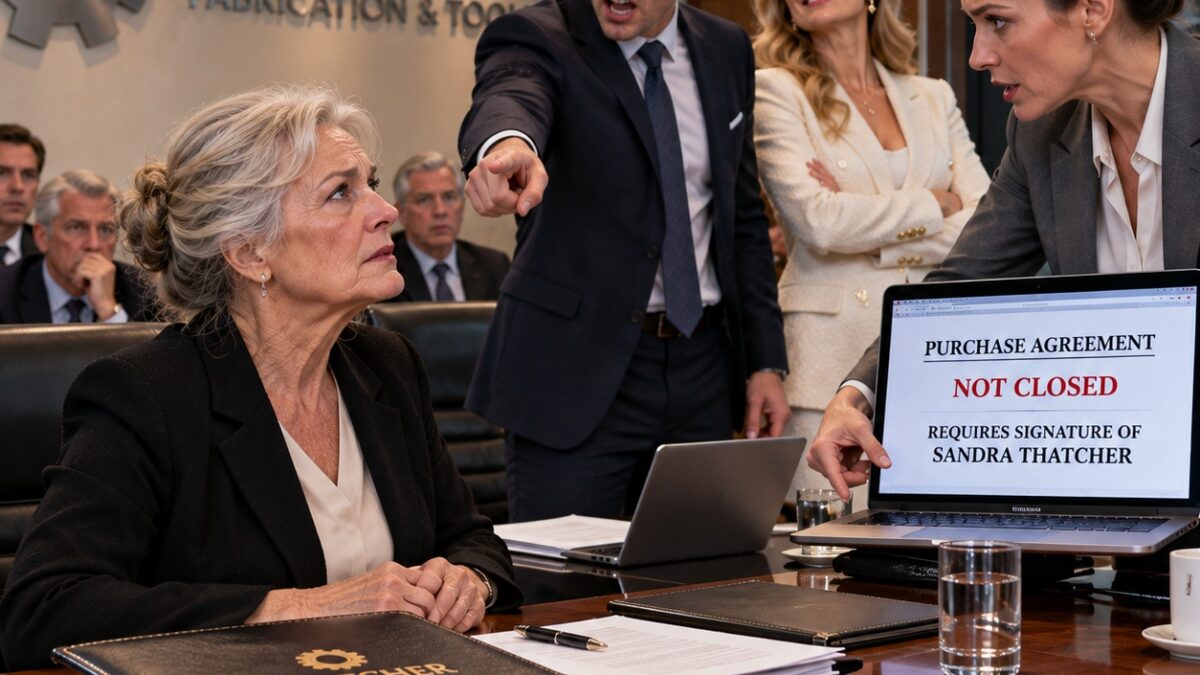
PART2:My son stood at the head of the conference table I had bought in 1994, refused to look at me, and announced in front of eleven people, “The entire five-million-dollar company and the house belong to my wife now, Mom—pack your things and get out.”
PART2
Whitney became chief financial officer in March 2021.
I want to be fair about her.
For years, I was.
She had an accounting degree from Miami University.
She was organized.
Sharp.
In her first eleven weeks, she found roughly ninety thousand dollars in duplicate freight billing.
At the summer cookout, I praised her in front of the entire shop.
She went pink.
Looked at the ground.
For a while, I thought:
Good.
Grant married a capable woman.
Then small things started changing.
Accounting software.
New bank.
Printer paper.
Nothing worth fighting over.
Then in August 2024, my live financial access broke.
“Permissions error.”
Whitney fixed it.
September:
Broke again.
November:
Again.
Three times is not an error.
Three times is policy.
I did not make a scene.
I asked for printed summaries.
Every Monday at nine, Whitney brought a clipped packet.
Variance column highlighted green.
Fourteen months.
Never missed.
Then January 2026:
Tuesday instead of Monday.
February:
Nothing.
When I asked, she smiled.
“You don’t need the live feed, Sandra.”
She pronounced my name almost like I was a vendor.
“You need the summary.”
I said:
“Thank you.”
Then went back to the floor.
That was one of my bad habits.
If production kept moving, I treated discomfort as manageable.
I had spent almost half a century solving problems by making sure the next job ran.
Sometimes that works with steel.
It does not always work with family.
There is another detail you need.
Since 1979, I had almost never signed my full first name.
When Ray and I first started, I sent thirty-one quotes signed:
Sandra Thatcher.
Two buyers called back.
Ray watched me complain.
Then said:
“Try initials.”
That summer, I sent thirty more.
S.R. Thatcher.
Nineteen calls.
That was America in 1979.
Purchasing agents did not want to discuss tool steel with a twenty-one-year-old woman named Sandra.
They were perfectly comfortable discussing it with someone named S.R. Thatcher.
So I kept the initials.
Every invoice.
Every check.
Every equipment note.
Every lease.
Every insurance application.
Every customer Christmas card.
S.R. Thatcher.
Small period after S.
Small period after R.
At first necessity.
Then habit.
Then superstition.
March 14, 2025, I had cataract surgery on my right eye at a surgical center in Dayton.
Thirty-eight miles from home.
Whitney drove me.
She was kind that day.
Travel pillow.
Thermos.
Stayed through recovery.
I remember waking with a plastic shield taped over my eye.
A warming blanket across my chest.
A green folder on my lap.
Hospital pen attached to a chain.
Whitney telling me something needed a signature for the clinic.
I remember signing something.
I never remembered what.
That became very important later.
October 2025.
Quarterly budget review.
Front conference room.
Me.
Grant.
Whitney.
Dale.
Trent Keley standing near the wall.
There was an eighty-four-thousand-dollar line item:
ADVISORY SERVICES.
No vendor.
I had approved plenty of eighty-four-thousand-dollar expenditures.
I had never approved eighty-four thousand dollars going to nobody.
“Who’s the adviser?”
I asked.
Grant looked at Whitney.
Not the packet.
His wife.
That look told me more than his answer would have.
Whitney slowly closed her laptop.
“You’re a signature, Sandra.”
Pause.
“Not a partner.”
Trent laughed through his nose.
Dale wrote something on his legal pad.
Grant said nothing.
That hurt most.
He had a mouth.
He had thirty-nine percent.
He used neither.
I squared my packet.
“All right.”
Then walked onto the floor.
The laser was loud.
Nobody talks near the laser.
I needed that.
Whitney was wrong by exactly one word.
It took ten months, $4.80 in postage and a woman from Fort Wayne to correct it.
But first, I protected the wrong thing.
After Ray died, I promised myself his name would never disappear from that building.
That was my fear.
Not losing money.
Not losing status.
Continuity.
So I tolerated things.
Sloppy choices.
Aggressive expansion.
Whitney’s growing control.
Grant’s silence.
I told myself:
Do not split the family.
Do not accuse your son.
Do not destroy what Ray left.
There is something terrible about suspecting your own child.
If you say:
“My son is stealing my authority,”
that sentence does not vanish.
It sits at Thanksgiving.
Christmas.
Funerals.
Every photograph afterward.
So I did not say it.
For years.
Continuity is not love.
I learned that late.
January 13, 2026.
6:27 a.m.
I had punched in at 6:12.
A stranger was standing in our truck lane with a tape measure.
Canvas jacket too clean.
Work boots without a mark.
He measured lane width.
Photographed the east-wall electrical panel.
Then wrote down the crane capacity.
“Morning.”
I held my coffee.
“Can I help you?”
“Insurance survey.”
He smiled.
“Won’t be long.”
He was lying.
Insurance surveys look at roofs.
Sprinkler heads.
Wiring.
Exit signs.
That man never once looked up.
He looked at the crane rating.
A buyer cares about crane capacity.
A buyer measures truck access.
I called our insurer.
“No survey scheduled.”
That was the first morning I knew somebody was measuring my building for somebody else.
In February, Dale started calling me Mrs. Thatcher.
Dale had been our accountant for thirty-one years.
Had eaten Thanksgiving at my house.
Carried Ray’s casket.
Suddenly:
Mrs. Thatcher.
Distance delivered politely.
Then monthly reconciliations stopped.
No explanation.
I need to confess something about Dale because kindness can create strange debts.
In 2019, I found sixty-one thousand dollars of his personal expenses hidden in company books.
Boat trailer.
Dental crowns.
A Gatlinburg trip coded as a client visit.
I did not fire him.
Did not tell Grant.
Did not call police.
I sat Dale down.
“You repay five hundred dollars a week.”
He cried.
“I’m sorry.”
“Every Friday.”
Two years and four months.
One hundred twenty-two Fridays.
Never missed.
I believed I had been merciful.
What I actually did was create shame.
And shame is a debt people sometimes repay in resentment.
March 9.
6:12.
My office was gone.
Not robbed.
Moved.
Desk.
Chair.
Two file cabinets.
Framed first purchase order from 1979.
All shoved into the old quality-control room.
Nine by eleven.
No window.
Exhaust fan through the wall.
The brass plate on my old door had been removed.
Two screw holes remained.
Grant explained at nine.
“Sales needs the corner.”
“Why?”
“Flow.”
He used the word flow three times.
Temporary.
Strategic.
Flow.
I said:
“Fine.”
Then moved the last six feet of my own chair because Trent was watching.
I would not give him the pleasure of seeing me struggle.
That same week, Trent installed a phone-based timekeeping system.
He taped a sheet above Ray’s old clock:
TIME CLOCK RETIRES APRIL 1ST
He called it:
“Grandma clock.”
I kept punching card number one.
Every morning.
Kachchunk.
April 1 came.
Nobody unplugged it.
Trent’s sign eventually fell behind a recycling bin.
He once walked by and said:
“Museum opens early.”
I answered:
“Somebody has to keep the lights on.”
They took my office.
They did not think to take the clock.
March 20, I asked Grant for our operating agreement.
“I’d like a copy for my files.”
“Whitney has it.”
Whitney said:
“Bank vault.”
Reasonable.
We had stored originals at Delwood Savings since 2011.
I drove down Friday.
Brought a cinnamon roll for the teller.
Then learned the safe-deposit box had been closed in November.
Contents transferred to record storage in Columbus.
“Who closed it?”
Lou Pettit, bank officer, came out personally.
His face was red.
“Whitney Thatcher.”
“How?”
“Power of attorney.”
“I never gave her one.”
Silence.
The closure form bore a power of attorney I had never seen.
I thanked Lou.
Then sat in my truck with the cinnamon roll untouched beside me.
That was the first time in my life a bank made me feel cold.
I called Harold Price.
Seventy-nine.
Retired lawyer.
Kept four filing cabinets in his garage because, according to Harold:
“Clients die slower than lawyers.”
He told me:
“Come Thursday.”
“Bring donuts.”
“Park on the street because the driveway’s ice.”
It took him eleven minutes.
He returned holding a red folder.
RESTATED OPERATING AGREEMENT OF THATCHER FABRICATION & TOOL LLC
June 14, 2011.
Forty-one pages.
Signature page.
There it was.
S.R. Thatcher
Blue ink.
Harold tapped it.
“You have signed that way since I met you in 1988.”
He laughed.
“My secretary once tried to make you spell out the whole name.”
“She was stubborn.”
“You were worse.”
Then he turned to section 9.3.
Read aloud.
Sale of substantially all assets or membership interests required written consent of:
ALL MEMBERS.
Not fifty-one percent.
Not seventy-five.
All.
“There is no back door.”
Harold said.
“Ray insisted.”
I looked at him.
“Why?”
Harold leaned back.
“Ray said if somebody ever wanted the shop badly enough to get clever, you’d be the last person to suspect your own family.”
That hurt.
Then Harold explained another section.
Removing a manager?
Majority.
More than fifty percent.
I had fifty-one.
One more thing.
I had my coat halfway on when Harold stopped me.
“Sandra.”
“What?”
“Signing isn’t closing.”
I looked back.
“Meaning?”
“People say ‘deal done’ when they sign.”
He shook his head.
“A deal is done when money moves.”
“Between signing and closing, conditions have to clear.”
“What kind?”
“Consents.”
“Titles.”
“Representations.”
“Escrow conditions.”
“And somebody checks them?”
“Somebody paid an obscene amount of money checks every one.”
He smiled.
“That’s the only part of a transaction that reliably works.”
I drove home saying one word aloud.
“Safe.”
Like an idiot.
Fifty-one percent.
Unanimous sale consent.
My signature required.
Safe.
Nine weeks later, I learned what they had done instead of asking.
May 28.
9:04 p.m.
Email.
YOU HAVE BEEN GRANTED ACCESS TO PROJECT HAMMERHEAD
I had never heard of Project Hammerhead.
It was a virtual data room.
Hundreds of company documents.
Corporate formation.
Financials.
Customers.
Contracts.
Then:
CORPORATE APPROVALS
Tab 4.11:
CONSENT OF MEMBERS — EXECUTED
I opened it.
Four signatures.
Grant W. Thatcher.
Whitney L. Thatcher.
Dale R. Ostrander.
Then:
Sandra R. Thatcher
Written out in full.
I sat in my recliner for twenty minutes.
Did not move.
Did not cry.
The furnace came on.
Went off.
Came on again.
Whoever forged me had never looked closely at a document I had signed.
Forty-six years.
Never once:
Sandra R. Thatcher.
Always:
S.R. Thatcher.
I opened the next document.
Tab 4.12.
DEED — 4180 QUARRY ROAD
My house.
The house Ray and I had lived in since 1983.
Transferred to:
Thatcher Family Legacy Trust
Grantor:
Sandra R. Thatcher
Dated March 14, 2025.
My cataract surgery day.
I still did not call Grant.
Did not call Whitney.
Did not call a lawyer.
Because the data room taught me something else.
It logged access.
Every click.
Every timestamp.
My opening Tab 4.11 at 9:19 p.m. was now recorded.
If they were watching, they would know I had found it.
I decided I did not care.
Nobody asked.
Later, Kestrel told me nobody on the seller side checked the access report for eleven weeks.
They had been careful forging documents.
Not careful checking the front door.
The next morning, I reached the shop at 5:40.
Flashlight.
Pulled seven documents.
Invoice 0001.
April 9, 1979.
$62.40.
Payroll check image, 1984.
Equipment note, 1991.
Building lease, 2004.
Operating agreement, 2011.
Insurance application, 2023.
Christmas-card proof, 2024.
Seven documents.
Forty-five years.
Every one:
S.R. Thatcher
I drove to the public library because our company copier logged usernames.
Fourteen pages.
Fifteen cents a page.
$2.10.
Cheapest evidence I ever bought.
When I got home, Grant’s truck sat in my driveway.
My son was at my kitchen table.
Coffee made.
Spare key on the table.
“What is Project Hammerhead?”
I asked.
He did not ask how I knew.
That told me everything.
He rubbed his face.
Then spoke for six minutes.
Most of it was about 1998.
The year we lost our biggest valve contract.
Sixty-one percent of revenue gone.
I refinanced my house.
Emptied the savings account Ray and I had started for Grant when he was born.
Nineteen thousand dollars.
Nine payrolls.
Grant was thirteen.
“You spent my college money on forty-one strangers.”
I looked at him.
“They were not strangers.”
“They weren’t your kid either.”
I had known for twenty-eight years he was angry about that.
I had never heard him say it.
He attended Clark State.
Then Wright State at night.
Worked while studying.
Fifteen years on the floor.
Part of him had never stopped being thirteen.
I might have sat down.
Explained.
Apologized.
Told him what 1998 had cost all of us.
Then he stood.
His eyes went to the scar on my left forearm.
He had always looked at that scar when upset.
“Pack your things.”
I stared.
“And get out.”
“This is my kitchen, Grant.”
His face hardened.
“You know what I mean.”
“No.”
I pointed toward the door.
“But you may leave through the one you came in.”
He took the spare key from the table.
For forty-one years, my son had never taken a key out of my house.
That afternoon, Whitney arrived.
Manila envelope.
Soft voice.
The kind people use with someone they have decided is confused.
Inside:
A recorded quitclaim deed.
My house.
Trust.
March 14.
Notarized at 11:15 a.m.
She placed it on my counter.
“You signed it, Sandra.”
“No.”
“You just don’t remember.”
She smiled sadly.
“That isn’t anybody’s fault.”
Cruelty with good manners is still cruelty.
It simply gets better seating.
I opened my phone calendar.
March 14.
Surgical center.
Check-in:
7:00 a.m.
At 11:15, according to the deed, I had supposedly appeared before a notary in Marberry.
At 11:15, I had actually been under anesthesia in Dayton with a plastic shield taped over my eye.
I said none of that.
The first person who explains too much often loses.
So I only said:
“Thank you for the copy.”
Whitney looked disappointed.
June 3.
6:12 a.m.
I reached for card number one.
Empty.
Checked the floor.
Other slots.
Nothing.
Trent stood by the coffee machine.
“Systems digital now.”
He smiled.
“Grandma clock.”
“Good morning.”
I walked to my windowless room.
Ten minutes later, Bonnie entered.
Put card number one on my desk.
Bent corner.
“They put it in the shred bin.”
Nine words.
She had seen it at four the day before.
Taken it because Bonnie knew what belonged in a shred bin.
And what did not.
She did not ask questions.
“I’ll be at my desk.”
That card later proved exactly where I stood on the morning everything broke.
I finally called a lawyer.
Delia Marsh.
Dayton.
Fifty minutes.
$325 an hour.
She was excellent because she told me bad news immediately.
“To unwind a sale in court?”
She said.
“Fourteen to twenty months.”
“Cost?”
“Sixty to ninety thousand.”
“And the sale?”
“Could close in nine weeks.”
Fourteen months versus nine weeks.
Easy arithmetic.
So I asked something else.
“Who actually has to believe me for the deal to stop?”
Delia went quiet.
Keyboard.
Then:
“The buyer.”
I said nothing.
“You don’t necessarily need to win a lawsuit first.”
She continued.
“The buyer has to decide this transaction is too contaminated to close.”
Whitney’s voice came back.
You’re a signature, Sandra, not a partner.
Fine.
Then I would be the one signature that had to be real.
It took four days to write one page.
June 19.
Buyer:
Kestrel Industrial Group.
Fort Wayne, Indiana.
Buyer’s lawyer:
Owen Brandt.
I wrote five facts.
No adjectives.
One:
I owned fifty-one percent and remained manager of record.
Two:
Section 9.3 required written consent of all members.
Three:
I had never consented to any sale.
Four:
Tab 4.11 carried my name written in full.
Five:
Enclosed were seven examples of my actual signature spanning 1979 through 2024.
Then I signed:
S.R. Thatcher
Below:
I have signed this way since 1979. Harold Price, attorney, Springfield, Ohio, may verify.
I asked for nothing.
No money.
No justice.
No sympathy.
People brace against requests.
They have more trouble bracing against facts.
Certified mail:
$4.80.
Then silence.
Eleven days.
Meanwhile, I brought the deed to my friend Ruth Abernathy.
Retired deputy county recorder.
Seventy-one.
Ruth read documents the way other people watch football.
She put on glasses.
Leaned forward.
Made small noises.
“Huh.”
Then went to the county office.
The deed had been submitted three times.
March 21:
Rejected.
No legal description.
April 4:
Rejected.
Defective notary block.
April 22:
Recorded.
“What does defective mean?”
I asked.
“Could be several things.”
Ruth tapped the notary line.
“Recording a deed does not make it true.”
She looked at me.
“It only tells the world somebody is claiming it.”
Then:
“Give me until Thursday.”
June 30.
2:15 p.m.
Indiana area code.
“Mrs. Thatcher?”
“Yes.”
“Adrienne Vogel, vice president of corporate development at Kestrel Industrial Group.”
Gray voice.
Professional.
No warmth.
No hostility.
“Do you have twenty minutes?”
She asked fourteen questions.
Mostly dates.
Last member meeting.
Date financial access changed.
Eye surgery date.
Surgical facility.
Safe-deposit-box closure.
Who had authority.
She did not ask:
Is your son a bad person?
Is Whitney evil?
How do you feel?
It was almost restful.
Then:
“Do you want money from this?”
“No.”
“What do you want?”
I answered without thinking.
“I want the shop to still be here in ten years.”
Typing.
Pause.
Then:
“Say the sentence about your signature again.”
“I never sign my first name.”
“Thank you.”
Another pause.
“Mrs. Thatcher, do not tell anybody at your company we spoke.”
“Not even my son?”
“Especially not your son.”
“If asked directly, you may say we spoke.”
“Do not volunteer it.”
Then Kestrel disappeared for six weeks.
July 11.
Dale drove to my house.
Would not come inside.
We sat on the porch.
Coffee he never drank.
Hands shaking.
“I signed something.”
“What?”
“A verification.”
He swallowed.
“On my letterhead.”
Confirming that the forged signature was mine.
“Why?”
Whitney had brought him a spreadsheet.
Four years.
Sixty-one thousand dollars.
His old theft.
One question:
You want Grant to see this?
Dale looked toward my barn.
“Ray would have hated all of this.”
“True.”
I looked at him.
“Then why are you on my porch instead of calling them?”
No answer.
He left.
I understood fear.
I did not excuse choice.
July 31, Grant and Whitney signed the purchase agreement.
Five million dollars.
Grant booked a back room at the Wagon Wheel.
Nine people.
I was not invited.
Bonnie later told me Trent toasted:
“To the museum.”
“May it rest.”
Grant read a two-page transaction summary Whitney had prepared.
The full purchase agreement was sixty-one pages plus exhibits.
My son read two.
Then celebrated.
Bonnie found another page on a chair afterward.
Header:
CONSOLIDATION — TOOLING LINE
Under it:
(17)
Not dollars.
Jobs.
Seventeen people.
Kestrel’s integration plan was going to remove seventeen positions.
Grant did not know.
Because he had not read past page two.
August 8, fourteen flattened moving boxes appeared on my porch.
Roll of tape.
Note from Whitney:
Movers 8:30 a.m. — W
Then text:
Please be reasonable. Nobody wants a scene. You’re a signature, Sandra, not a partner.
Same line.
She liked it.
I sat on my porch surrounded by cardboard.
Work jacket still smelling of cutting oil.
And I realized:
They had my financial access.
Bank.
Office.
Documents.
They had removed my nameplate.
Prepared movers.
Practiced their laugh.
But they did not have the smell of that jacket.
They did not have Ray’s clock.
And they did not have forty-six years of my handwriting.
I folded every moving box flat.
Stacked them in my barn.
I am not wasteful.
Two days later, a notice appeared on my front door.
EMERGENCY MEETING OF MEMBERS AND KEY PERSONNEL
August 21.
10:00 a.m.
Attendance required.
Signed:
Grant Thatcher, CEO.
He taped a mandatory-meeting notice to the door of a woman who owned fifty-one percent of the company.
Thursday night, I ironed a navy blazer I had bought in 2004.
White blouse.
Flat shoes.
Concrete floor.
I packed:
Fourteen signature copies.
Harold’s operating agreement.
Recorded quitclaim deed.
Surgical discharge summary.
Then one thing that was not paper.
Card number one.
At 9:40 p.m., Ruth called.
“Sandra.”
“Yes?”
“His commission was expired.”
Four words.
Curt Hoy.
The notary whose stamp appeared on my deed.
Commission expired February 9, 2025.
Five weeks before he supposedly notarized my signature.
I slept surprisingly well.
August 21.
6:12 a.m.
I slid card number one into Ray’s clock.
Kachchunk.
6:12.
Pale blue-black ink.
A little dry on the left.
Same as it had been for years.
I folded the card.
Put it inside my blazer against my ribs.
Made coffee.
Read the safety board.
At ten, I entered the conference room.
Eleven people.
Grant at the head.
Whitney to his right.
Folder squared perfectly.
Dale two seats down.
Trent against the wall.
Bonnie with the green minute book.
Hector.
Curtis.
Lou Pettit from Delwood Savings.
Two representatives from Kestrel.
Owen Brandt.
And Adrienne Vogel in a gray suit.
Laptop open.
Yellow folder closed.
That order mattered.
I sat at the foot.
My chair.
Same chair since 1994.
Because I bought the table.
Grant stood.
Thanked everybody.
Talked about:
Next chapter.
Wonderful home.
Culture fit.
Then:
“The entire five million and the house belong to my wife.”
He did not look at me.
“Pack your things and get out.”
Whitney smiled faintly.
Trent laughed.
Dale studied his coffee.
I unfolded my hands.
Then folded them again.
“So you sold the company without my signature.”
The room laughed.
Seven people, maybe.
Two seconds.
Two seconds is longer than it sounds when people are laughing at a sixty-eight-year-old woman.
Grant smiled.
“It’s already done, Mom.”
I did not answer.
I looked down the table.
Then Adrienne Vogel stood.
She did not look at Grant first.
She looked at me.
Then at everyone.
“Actually, Mr. Thatcher.”
Grant’s smile stayed.
“You signed.”
Pause.
“You did not close.”
Grant frowned.
“I’m sorry?”
Adrienne turned slightly.
“For clarity, because you have just made a statement concerning this transaction in front of employees and your bank.”
Lou Pettit straightened.
“On July thirty-first, you executed a purchase agreement.”
She spoke slowly.
“Signing is a promise.”
“Closing is payment.”
“They are different dates for a reason.”
Grant looked toward Whitney.
Adrienne continued.
“Closing was scheduled for 10:30 this morning.”
“That is why our team traveled from Fort Wayne.”
“Your chief financial officer represented to our escrow agent on Tuesday that she would deliver the original consent of members at this table.”
Whitney’s face did not change.
“Condition precedent number six requires an original consent executed by all members.”
Adrienne opened the yellow folder.
“Not most.”
“All.”
“Your own operating agreement, section 9.3.”
Grant laughed.
High.
Wrong.
“Whitney has the consent.”
Adrienne looked at him.
“We have it too.”
Then:
“That is the problem.”
Whitney’s chin lifted.
Adrienne turned her laptop.
Projector changed.
Two images appeared side by side.
Left:
Tab 4.11.
Four signatures.
Grant.
Whitney.
Dale.
Sandra R. Thatcher
Right:
My seven signature samples.
Every one:
S.R. Thatcher.
Owen Brandt spoke.
“We also have a statement from Harold Price, dated June twenty-sixth.”
“He drafted your 2011 agreement.”
“He has known Mrs. Thatcher’s signature since 1988.”
Nobody was breathing normally.
I remained seated.
I said seven words.
“I never sign my first name.”
Whitney exploded.
First time in five years I heard her raise her voice.
“That’s a handwriting opinion!”
She pointed at the screen.
“It isn’t evidence.”
“You have no idea what you’re talking about.”
“Two law firms reviewed—”
Owen interrupted.
“Section 9.3.”
Two words.
Whitney stopped like a machine hitting a limit switch.
Grant turned toward her.
“You told me she signed.”
Whitney looked at him.
“I told you it was handled.”
Handled.
Interesting word.
Adrienne opened the yellow folder wider.
Three more pages.
“Tab 4.12.”
She laid down the quitclaim deed.
“4180 Quarry Road.”
“Transfer from Mrs. Thatcher to the Thatcher Family Legacy Trust.”
“March fourteenth, 2025.”
“Notarized 11:15 a.m. in Marberry.”
Second page.
“My discharge summary.”
Adrienne read.
“Patient check-in: 7:00 a.m.”
“Anesthesia: 9:12 a.m.”
“Discharge to family care: 3:40 p.m.”
She waited.
“At 11:15 a.m., when this deed claims Mrs. Thatcher appeared before a notary thirty-eight miles away, she was unconscious in a surgical center in Dayton.”
Nobody moved.
Third page.
Adrienne slid it forward.
“Ohio Secretary of State notary record.”
“Curt Hoy.”
“Commission expired February ninth, 2025.”
“Five weeks before this deed was notarized.”
Ruth’s four words.
His commission was expired.
I placed both hands flat on the table.
My blazer sleeve pulled back.
The burn scar showed.
Curtis looked at it.
Then looked at Grant.
I had known that man twenty-two years.
I had never seen disappointment settle on a face like that.
Dale shot to his feet.
Knocked over his coffee.
“I never saw her sign anything.”
He spoke toward Adrienne.
“Only verified the name.”
“That letter only says—”
Whitney snapped:
“You verified it in writing, Dale.”
Dale sat back down.
In his spilled coffee.
Eleven seconds of silence.
Bonnie counted.
Adrienne did not gloat.
That made it worse for them.
“Kestrel Industrial Group is terminating the purchase agreement under section 8.2(c), seller misrepresentation.”
Grant stared.
“The closing scheduled for 10:30 is canceled.”
Adrienne closed her laptop halfway.
“The five million dollars remains in escrow in Fort Wayne.”
“It has never left our account.”
Grant’s face drained.
Then Adrienne continued.
“Under the agreement, selling members are responsible for our documented due-diligence costs.”
“Current total: $118,400.”
Grant said:
“That’s the company’s expense.”
Owen answered.
“Page fifty-four.”
“Seller representations were executed individually.”
Adrienne closed the laptop fully.
“Our file will go to counsel this afternoon.”
“A copy will be provided to the Delwood County Prosecutor.”
Then:
“Kestrel does not buy companies from people who forge the majority owner.”
She picked up her bag.
Stopped beside me.
“Mrs. Thatcher.”
Not triumphant.
Respectful.
Then walked out.
The slow door closer took four seconds.
Nobody spoke.
That was when I stood.
First time all morning.
“I hold fifty-one percent.”
My voice was ordinary.
“Under Article Six, I am calling a members meeting for Tuesday at ten.”
“One item.”
“Removal of the manager.”
Grant stared at me.
“It takes a majority.”
I said.
“And I am the majority.”
Then:
“Bonnie, note the time.”
Without looking up:
“10:26.”
I turned toward Grant.
“You may take your things.”
Pause.
“The building stays.”
That was when my son broke.
Loud.
Angry.
Twenty-eight years of resentment poured out.
Nineteen thousand dollars.
College.
Nine payrolls.
“You chose forty-one strangers over your own kid!”
His voice cracked on kid.
I let him finish.
I owed him that much.
No more.
Then I said:
“I chose forty-one people who showed up.”
He stared.
“You were thirteen.”
Pause.
“You have been forty-one for eight months.”
That shut the room down.
I walked out.
Past the old clock.
Past slot number one.
Onto the floor.
Machines running.
People working.
Exactly where a manufacturing company belongs.
The next eleven days were paperwork.
August 26.
Members meeting.
10:00 a.m.
My fifty-one percent removed Grant as manager and chief executive.
He did not attend.
At 10:40, Whitney’s employment as CFO ended.
Lou Pettit revoked her bank access before lunch.
He came in person.
August 27.
Dale resigned as accountant.
Offered to sell his five percent.
I bought it under the formula in Article Seven.
Did not negotiate him down.
He was sixty-three.
I wanted his ownership.
Not his humiliation.
That put me at fifty-six percent.
August 28.
Sheriff’s report opened.
Curt Hoy’s expired commission became part of the file.
Civil proceedings began to void the quitclaim deed on my house.
Hearing scheduled for October.
September 1.
Kestrel’s bill:
Accounting: $46,200.
Legal: $58,900.
Environmental: $13,300.
Total:
$118,400.
Painful.
Necessary.
Then I printed one other page.
Kestrel’s integration plan.
Move tooling line to Muncie, Indiana.
Eliminate seventeen positions.
I pinned it to the breakroom board.
No comment.
No speech.
The shop understood.
Trent gave notice the next day.
Nobody organized a card.
Forty-one people still had jobs.
Twenty-nine still had more than a decade of service.
My son had told me to pack.
I had flattened the boxes.
Stored them in the barn.
First Monday of September, card number one had become too soft to feed through the clock.
Bonnie printed a new one.
Placed it in slot one.
I took a ballpoint.
For the first time in forty-six years, I paused.
Thought about writing:
Sandra Thatcher.
Then I wrote:
S.R. Thatcher
I was not going to let them take that too.
Kachchunk.
6:12.
That afternoon, Grant came to my porch.
No Whitney.
No lawyer.
No expensive truck.
He stood with both hands in his pockets.
“Is there a road back?”
He did not apologize.
I did not expect an apology.
I would not have trusted one yet.
I handed him one page.
He read.
Floor position.
Second shift support.
Salary: $72,000.
No signing authority.
No bank access.
No vendor approvals.
Performance review: September 2028.
His face reddened.
“This is humiliating.”
I looked at him.
“It is written down.”
Pause.
“That is the difference between us.”
He folded the paper.
Put it into his shirt pocket.
We stood looking toward the barn.
Then I said:
“I never signed my first name, Grant.”
He closed his eyes.
“You would have known that if you had ever read anything I sent you.”
He left.
Three weeks passed.
He did not return.
I left the porch light on.
That was not weakness.
A light is just a light.
One evening, Adrienne Vogel emailed me.
Two sentences.
She wrote that in 2011, Kestrel had been a three-person company in Fort Wayne.
Her father died the same week they needed a forty-part run nobody would quote.
One shop in Ohio accepted the job.
Delivered on time.
Thatcher Fabrication & Tool.
Then:
That is not why I stood up in your conference room, but it is why I remembered your name.
I printed the email.
Bonnie said:
“Only old women print emails.”
“Only smart women make paper backups.”
She rolled her eyes.
I pinned that one inside my office.
Not the windowless room.
My old office.
I moved back after Grant was removed.
But something had changed.
I did not put the brass plate back.
Not at first.
For months, the two screw holes stayed.
People asked.
I said:
“I know whose office it is.”
That was enough.
The house deed case took longer.
Law moves differently from machines.
Machines are honest about resistance.
Courts make you wait.
The quitclaim deed was eventually declared invalid.
The forgery evidence was overwhelming.
Surgery timestamps.
Expired notary commission.
Signature history.
No valid authorization.
My house remained mine.
I stood in the kitchen afterward holding the court order.
Same kitchen where Grant told me to pack.
I expected satisfaction.
What I felt instead was tired.
Then grief.
Ray should have been there.
He would have read the first page.
Then the second.
Then looked up and said:
“So we keep the house?”
“Yes.”
“Good.”
Then asked what was for dinner.
I sat at the kitchen table alone and laughed until I cried.
That is marriage after death.
You still know exactly what the other person would say.
The criminal investigation moved slowly.
I will not decorate it.
There were lawyers.
Interviews.
Documents.
Whitney blamed Dale.
Dale blamed Whitney.
Grant claimed he had relied on his wife and advisers.
Some of that was probably true.
But relying on another person does not make you blind.
Grant had celebrated a deal he had not read.
He had packed boxes for his mother before closing.
He had accepted a forged consent because it produced the outcome he wanted.
I did not need prison to teach me anything.
I needed distance.
The company needed clean books.
The employees needed stability.
So that is what I focused on.
We hired an outside forensic accountant.
Every account reviewed.
Every vendor.
Every transfer.
Every access permission.
Every advisory invoice.
The eighty-four-thousand-dollar mystery line?
Transaction consultants.
Sale preparation.
Valuation.
Legal structuring.
The company had paid professionals to help sell itself without telling its majority owner.
That made me laugh once.
Then I wrote the check to clean up the mess.
Humor helps.
We rebuilt controls.
Two signatures above certain amounts.
Board-level review of ownership changes.
Independent storage of governing documents.
No one person—not me, not a child, not a CFO—could move original corporate records without notice to all members.
The clock stayed.
We also kept the app.
I am old, not ridiculous.
Employees could use either during transition.
Most younger workers chose phones.
Bonnie still used paper.
So did Curtis.
Hector used both for six months because he did not trust either one.
I respected that.
Grant eventually accepted the floor offer.
Not three weeks after the porch.
Eleven.
November 24.
6:58 p.m.
Second shift had already started.
I was in my office when Bonnie called.
“Your boy’s here.”
I went to the floor.
Grant stood near the break room wearing an old Thatcher work jacket.
Not management clothes.
Steel-toe boots.
Safety glasses in one hand.
The same kind of jacket he wore when he was twenty-six.
He looked older.
“You still have the position?”
“Yes.”
“Seventy-two?”
“Yes.”
“No bank access?”
“No.”
“No approvals?”
“No.”
He nodded.
“All right.”
“Second shift.”
“I read it.”
Good.
That mattered.
He started the following Monday.
Curtis supervised him.
Not me.
I had learned enough.
The first week, Grant worked material handling.
The former CEO moving sheet stock.
Some people thought I did it to humiliate him.
Wrong.
I did it because he needed to remember a company from the floor up.
He had once known.
Then titles had gotten louder.
He worked.
No complaints to me.
At least none I heard.
By January, he was supporting scheduling again.
Not authorizing.
Not directing executives.
Supporting.
There is dignity in competent work when pride stops interfering.
I saw pieces of my son return.
Not all.
Trust is slower than employment.
One night in March, I came in during second shift.
Grant was at Ray’s old clock.
He looked at it.
Then at me.
“You still punch this every day?”
“Yes.”
“Why?”
I considered.
“Because your father liked it.”
“That’s not a reason.”
“It is to me.”
He smiled faintly.
Then:
“I never knew you signed those Christmas cards.”
I stopped.
“What?”
“All one hundred ten.”
“Yes.”
“Every year?”
“Yes.”
“I thought Bonnie did.”
“No.”
He stared at the card rack.
Then:
“I didn’t know much.”
That was the closest thing to an apology he had offered.
I answered carefully.
“You knew plenty.”
“Just not the things you didn’t bother to ask.”
He nodded.
Fair.
We left it there.
Whitney and Grant separated.
I did not celebrate.
Their marriage was theirs.
I never liked easy stories where one spouse becomes the evil mastermind and the other becomes innocent because the marriage ends.
Whitney forged and manipulated.
Grant accepted what benefited him.
Different responsibility.
Still responsibility.
He eventually told me she had started talking about selling in 2023.
“Your mom won’t live forever.”
He said she had told him.
“You’ll own it eventually.”
The house too.
Company too.
It sounded ugly.
But Grant had nodded along.
That mattered.
He told me:
“I was angry you had fifty-one.”
“Why?”
“Because I did the work.”
I almost laughed.
Then realized he meant it.
“You thought I didn’t?”
“No.”
He rubbed his face.
“I mean after Dad.”
“I ran operations.”
“Customers.”
“Floor.”
“And you…”
“Stayed out of your way.”
“Yes.”
“That was what you asked for.”
“I know.”
He looked ashamed.
“And then I started thinking staying out meant you weren’t really involved.”
There it was.
Absence had been rewritten as irrelevance.
I said:
“I gave you authority to run the company.”
“Not authority to rewrite ownership.”
“I understand that now.”
I looked at him.
“Do you understand why Ray left me control?”
He thought.
“Because he trusted you more.”
“No.”
I shook my head.
“Because he knew I hated conflict enough to let family push too far.”
Grant looked surprised.
“Your father was protecting the company from me.”
“From you?”
“From my tendency to say yes too long.”
That may have been the strangest inheritance Ray left.
He knew my weakness.
Not greed.
Not ambition.
Loyalty.
Loyalty can damage a business when you confuse it with permission.
We built new governance around that lesson.
The 2028 review arrived.
Grant had spent two full years without signing authority.
No missed shifts.
No disciplinary problems.
Positive evaluations from Curtis.
Good scheduling work.
He had proposed three process improvements.
One saved roughly $71,000 annually.
We met.
Not family.
Formal.
Bonnie took minutes.
Grant presented his record.
Then left.
The management committee discussed him.
I did not vote first.
That mattered.
Hector supported limited authority.
Curtis agreed.
Outside accountant recommended staged permissions.
So Grant became operations manager.
Not CEO.
Bank access:
No.
Vendor authority:
Capped.
Capital approvals:
Committee.
He accepted.
No argument.
After the meeting, he caught me near the clock.
“You could have just given me the title back.”
“Yes.”
“Why didn’t you?”
“Because earning it is different from inheriting my guilt.”
He looked at me.
Then nodded.
That sentence ended something.
Maybe for both of us.
Thatcher Fabrication remained independent.
We lost some customers when rumors spread.
Gained others.
People in manufacturing care about continuity.
They care even more about whether you deliver.
We delivered.
Forty-one employees became forty-four.
Then forty-six.
The tuition program stayed.
I increased it.
Not because business was suddenly easy.
Because if 1998 taught me anything, payroll and people come first.
Grant once asked if I regretted using his college account.
I said:
“Yes.”
That surprised him.
“You do?”
“Yes.”
“I regret that we had no better option.”
“I regret the cost fell partly on you.”
“I do not regret making nine payrolls.”
He stayed quiet.
“I needed you to say the first part twenty-eight years ago.”
“I know.”
“I needed you to tell me I mattered too.”
“You did.”
“Then why didn’t you?”
I looked at the scar on my arm.
Because mothers sometimes assume sacrifice is obvious.
It is not.
Children remember outcomes.
Not the private arithmetic behind them.
“I was wrong.”
I said.
Grant cried.
Not dramatically.
One tear.
Then another.
We were standing beside a steel rack.
Forklift warning beeping somewhere behind us.
Not the setting people imagine for family repair.
Better than a conference room.
He said:
“I was wrong too.”
That was the apology I eventually trusted.
No audience.
No consequence arriving that day.
No request attached.
Just wrong.
I believed him.
Whitney never apologized to me.
Not sincerely.
Her legal matters took their course.
I do not discuss all of that.
Partly because some records belong to lawyers.
Mostly because I stopped needing her punishment to prove I had survived.
Her most dangerous sentence had been:
You’re a signature, Sandra, not a partner.
Years later, I almost agreed with half of it.
Yes.
I was a signature.
But a signature is not nothing.
A signature can represent consent.
History.
Authority.
A life of repeated choices.
You can forge ink.
You cannot forge pattern.
That was what Kestrel recognized.
Seven documents across forty-five years.
S.R.
S.R.
S.R.
Again.
Again.
Again.
The forgery failed because the person doing it copied a name, not a life.
That distinction stayed with me.
I had spent decades thinking my work was invisible because manufacturing itself is invisible.
The die goes into a machine.
Machine makes a part.
Part goes inside another thing.
Nobody sees us.
Still matters.
Same with character.
People think character is the big moment.
Standing at the conference table.
Calling the vote.
Stopping a sale.
No.
Character is Tuesday.
Then Wednesday.
Then four thousand mornings at 6:12.
The same signature.
The same rules.
The same payroll.
Showing up when nobody is watching.
That is why the buyer believed me.
Not because I sounded persuasive.
Because forty-six years agreed with me.
Adrienne Vogel and I stayed in touch.
Not friends exactly.
Something quieter.
Once a year, usually December, she sent a card.
Her father had died the week Thatcher Fabrication saved that forty-part job in 2011.
She never forgot the shop name.
She told me once:
“You think you remember people because of big favors.”
“Usually you remember who made one difficult week slightly easier.”
I liked that.
I sent her our Christmas card.
Signed in ink.
S.R. Thatcher
Every year.
The mechanical clock finally failed in 2030.
Stopped at 5:47 one January morning.
Bonnie called me at home as if somebody had died.
“Clock.”
“What?”
“It stopped.”
I drove in.
Of course I did.
Opened the case.
Dust.
Old gears.
Spring tired.
Grant came downstairs.
“Can we fix it?”
I looked at him.
“Probably.”
He smiled.
“Good.”
We found a retired clock repairman in Troy.
Eighty-two.
He took three weeks.
Charged more than Ray originally paid by a factor of about fifty.
Worth it.
When the clock returned, Grant mounted a small brass plate beneath it.
I did not know he had ordered one.
It read:
FIRST HONEST MINUTE OF THE DAY — 6:12 A.M.
IN MEMORY OF RAY THATCHER
I stood there for a long time.
Then asked:
“How much did this plate cost?”
Grant laughed.
“Mom.”
“I’m serious.”
“Let it go.”
“I’ll need an invoice.”
He walked away.
Progress has limits.
My old office eventually changed too.
I put the brass nameplate back.
Not:
SANDRA THATCHER.
Just:
S.R. THATCHER
People entering knew.
If they did not, they could ask.
I stepped back from daily work gradually.
Not the dramatic retirement Ray never got.
Three days a week.
Then two.
Then mornings.
Still punched in at 6:12 when I came.
Even if I planned to leave by ten.
Habits are architecture too.
Grant took more responsibility with oversight.
Eventually, years after the forgery, the company bought back part of his membership interest under a revised structure.
Not punishment.
Risk management.
He kept enough ownership to care.
Not enough to operate without checks.
He agreed.
That mattered.
One Sunday, we sat on my porch.
Same place where he had once called the floor job humiliating.
He looked at the barn.
“Do you think Dad would have fired me?”
“Immediately.”
Grant laughed.
“No hesitation?”
“Your father fired his own brother in 1987 for coming to work drunk twice.”
“Uncle Mike says he quit.”
“Uncle Mike lies.”
Grant laughed harder.
Then:
“Would Dad have let me come back?”
I thought.
“Yes.”
“How do you know?”
“He let Mike come back.”
Grant looked surprised.
“What?”
“Four years later.”
“What did he do?”
“Swept floors for six months.”
Grant covered his face.
“You people had a theme.”
“Yes.”
“Humiliation?”
“Brooms.”
He laughed.
Then became quiet.
“I’m glad you left the porch light on.”
I looked at him.
“I was angry.”
“I know.”
“I didn’t want to come back because I thought you wanted me to crawl.”
“I wanted you to choose.”
“Difference?”
“Crawling is about me.”
“Choosing is about you.”
He nodded.
That was the whole lesson.
I could remove Grant from authority.
Could offer a road back.
Could write terms.
I could not make him walk it.
He did.
Eventually.
The house at 4180 Quarry Road stayed mine.
I never transferred it to Grant again.
Never transferred it to a family trust controlled by anyone else.
I wrote a new estate plan.
Independent trustee.
Clear percentages.
No surprises.
Grant read every page.
So did I.
Then I signed.
S.R. Thatcher.
He laughed when I did.
“What?”
“Nothing.”
“Say it.”
“I was just thinking how stupid we were.”
“You were.”
“Mom.”
“I was stupid differently.”
That satisfied him.
One day, a young employee named Marcy came into my office with financing paperwork.
She was twenty-seven.
Wanted to buy a house.
“Could you look at this?”
“Why me?”
“You read things.”
I laughed.
We went through every page.
Fixed-rate.
Closing costs.
Escrow.
Nothing alarming.
At the end she said:
“My dad told me never sign anything I don’t understand.”
“Your father is smart.”
“He also says warranties are a scam.”
“Your father is not smart about everything.”
She laughed.
I thought about how families pass down rules.
Some save us.
Some trap us.
Ray gave me:
Read.
Show up.
Pay people first.
I gave Grant:
Continuity at any cost.
That one nearly destroyed us.
Then we replaced it.
Continuity with accountability.
Much better.
I am seventy-two now.
Still drive a truck that smells faintly like cutting oil because some smells never leave.
The scar on my forearm looks paler.
Grant still notices when I rub it.
“You’re about to say no.”
“Maybe.”
He smiles.
He does not fear the word the way he once did.
Neither do I.
That may be the most peaceful change.
Our conference table is still there.
The six-hundred-dollar table from the defunct law firm.
Scratched.
One corner repaired.
My chair at the foot.
Grant’s chair at the head during operations meetings.
Same positions.
Different meaning.
Nobody at that table confuses the chair with ownership anymore.
At least not while I am alive.
I once asked Bonnie why she saved card number one from the shred bin.
She looked offended.
“Because it didn’t belong there.”
“That’s it?”
“What else would there be?”
I thought maybe loyalty.
Affection.
Instinct.
Bonnie had a simpler answer.
The card did not belong in the trash.
So she removed it.
There is something beautiful about people whose morality is that direct.
Maybe every crisis needs one Bonnie.
Someone who does the useful thing before asking for the story.
Years later, I framed that old card.
Not bidder-style dramatic.
Just a small frame near the clock.
August 21, 2026.
6:12 a.m.
Pale ink.
It proved where I was.
But that is not why I kept it.
I kept it because Grant and Whitney tried to erase a pattern.
Office.
Access.
Nameplate.
Clock.
Signature.
House.
Ownership.
Boxes.
And one little card said:
Sandra Thatcher was here.
Not in words.
In time.
6:12.
I do not think families understand how dangerous erasure can become.
It usually starts small.
“Mom doesn’t need access.”
“She doesn’t need the live feed.”
“Move her office.”
“Change the clock.”
“She won’t remember.”
“She signed.”
“She’s old.”
“She’ll be reasonable.”
Then one day people are discussing a five-million-dollar company as if its majority owner is furniture.
I had helped them do it.
That is the part I refuse to skip.
Every time Whitney reduced my access and I accepted the printout, I taught her I would tolerate one more inch.
Every time Grant excluded me and I said:
He earned the chair.
I taught him that silence meant consent.
Every time I protected Dale’s secret, I taught myself that preserving relationships was more important than clean governance.
You cannot prevent every betrayal.
But you can stop building systems that require everyone to stay good forever.
That became my late-life business philosophy.
Good contracts.
Multiple eyes.
Real approvals.
No secret forgiveness that turns into leverage.
No unwritten ownership.
No assumption that family reduces the need for documentation.
Family increases it.
People hear that and call it cold.
I disagree.
Clear paper preserves warm relationships.
Ambiguous paper turns dinner into litigation.
Ask me how I know.
The sale to Kestrel never happened.
Years later, another buyer approached.
A serious one.
They wanted seventy percent.
Good valuation.
Good retention commitments.
Grant asked:
“What do you think?”
I read every page.
Then said:
“No.”
He asked:
“Why?”
“Culture.”
He laughed.
“You sound like 2026 me.”
“That is the meanest thing you have ever said.”
But he listened.
We passed.
The company stayed independent.
Maybe someday it will sell.
I am not sentimental about buildings.
Ray was.
I became less so.
The purpose of a company is not immortality.
It is useful work done fairly while it exists.
If a buyer one day protects the people, honors the obligations and pays a sensible price, maybe the name comes down.
I can live with that now.
What I could not live with was fraud dressed as succession.
That is different.
Grant eventually understood.
One evening after a board meeting, he stayed behind.
Everyone else left.
He asked:
“If Whitney had done everything legally, and if I had asked you honestly to sell, would you have?”
I thought for a long time.
“Maybe.”
His face changed.
“Seriously?”
“Yes.”
“Even in 2026?”
“If the seventeen jobs were protected.”
“If the house was not part of it.”
“If people had real severance.”
“If the price was fair.”
“If I understood the future.”
He sat back.
“You might have said yes.”
“Yes.”
Grant stared at the tabletop.
Then whispered:
“We destroyed everything over a yes we were afraid to ask for.”
That may be the saddest sentence in this whole story.
Not because it excuses anything.
Because fear of hearing no often makes people do things that guarantee no forever.
They forged consent instead of seeking it.
They took my house because control felt easier than negotiation.
They treated me as an obstacle before ever letting me answer.
By the time they discovered I might have listened, trust was already ash.
Grant asked:
“Why didn’t you tell me that during the meeting?”
“Because you had not asked.”
Simple.
Painful.
True.
He nodded.
Then stood.
“Good night, Mom.”
“Good night.”
He reached the door.
Stopped.
“6:12 tomorrow?”
“Of course.”
He smiled.
That is where I prefer to leave him.
Not as the man shouting:
Pack your things.
Not as a villain frozen forever in one conference room.
As a grown son who did something terrible, lost authority, accepted consequences, returned to the floor and spent years proving he could be trusted with more than a chair.
I do not believe every betrayal deserves reconciliation.
Some do not.
I do believe reconciliation without evidence is only wishful thinking.
Grant gave me evidence.
Shift after shift.
Year after year.
He read documents.
Asked questions.
Accepted no.
Stopped blaming 1998 for 2026.
That mattered.
My forgiveness came before full trust.
Those are separate things.
Whitney never came back into my life.
Also fine.
Not every door needs reopening.
Dale died at sixty-eight.
Heart.
His obituary mentioned thirty-one years serving local businesses.
It did not mention the sixty-one thousand dollars.
Did not mention the forged verification.
I attended the funeral.
Sat near the back.
His daughter hugged me.
“He always said you saved his life.”
I did not know what to say.
Maybe I did.
Maybe forgiving him privately in 2019 later helped put pressure into Whitney’s hands.
Mercy creates consequences too.
That does not mean mercy is wrong.
It means mercy without structure is risky.
I wished Dale peace.
Then went home.
Ruth still proofreads county rejection logs on Tuesdays.
She is incapable of retirement.
Harold died at eighty-two.
His family gave me the red folder from his garage.
It sits in my office.
Section 9.3 still marked with a yellow tab.
All members.
One page.
One clause.
Ray had insisted on it fifteen years before it saved the company.
Sometimes the dead protect us with paperwork.
Adrienne remains in Fort Wayne.
She became president at Kestrel.
Still remembers our name.
I remember hers.
Not because she rescued me.
She did not.
She read.
That distinction matters.
I gave her facts.
She did her job.
Competence can look like heroism when everybody around you has become careless.
But she never treated me like an old woman needing rescue.
She treated me like the majority owner of a company whose consent was missing.
Exactly what I needed.
Today, if someone asks what saved Thatcher Fabrication, they expect me to say:
My fifty-one percent.
No.
The operating agreement?
Partly.
The buyer?
Partly.
My signature habit?
Yes.
But not alone.
What saved us was a chain.
Ray insisted on unanimous consent.
Harold kept a copy.
The data room accidentally let me in.
I recognized the forgery.
The library copied fourteen pages.
Ruth read the deed.
Delia told me the buyer mattered more than a lawsuit.
Adrienne checked dates.
Bonnie saved a time card.
Owen read section 9.3.
Curtis and Hector stayed still long enough to watch.
No single dramatic act.
Just competent people doing their piece.
That is how most important things are actually saved.
Not by one person.
By a chain that does not break.
The only reason I had a place in that chain was that I finally stopped protecting the people breaking it.
There is the lesson.
At sixty-eight, I learned that keeping peace is not neutral when someone else is using the peace to steal.
Silence becomes participation eventually.
You must know when.
I did not know early enough.
But I knew before the money moved.
Harold had been right.
Signing is not closing.
Everything before closing is theater.
And Grant had built a very convincing theater.
Boxes on my porch.
Office moved.
Financial access gone.
House deed recorded.
Celebration dinner.
Purchase agreement signed.
Emergency meeting.
All designed to make me believe the story was already over.
It wasn’t.
The money had not moved.
My signature had not existed.
The last condition had not cleared.
Sometimes a whole life changes because one person refuses to confuse almost done with done.
That was me.
When Grant announced I should pack my things, I did not need a speech.
I needed the truth to reach the person holding the escrow instructions.
It did.
The five million never moved.
The seventeen jobs never disappeared.
The house stayed mine.
The clock kept punching.
And years later, my son finally learned what Ray had understood from the beginning:
A chair can be handed down.
Authority can be delegated.
Trust can be offered.
But ownership, consent and character are not the same thing.
Those must be earned, read and respected separately.
Every December, I still sign customer cards.
Fewer now.
My hand cramps.
Grant helps stuff envelopes.
He once offered:
“I can sign some.”
I looked at him.
He burst out laughing.
“Right.”
“Absolutely not.”
He hands me the next card.
I write:
S.R. Thatcher
Again.
Again.
Again.
A lifetime reduced to two initials.
But that is not really what the signature means.
It means I was there.
I read it.
I agreed.
It was mine to give.
And after everything that happened, nobody in my family will ever confuse those four things again.

