PART2:My Son-in-Law Said, “Sit Down, Old Woman—What Can You Do?”—Six Months Later, I Bought His Company’s Trucks at the IRS Auction
PART2
My anger lasted approximately two seconds.
Then it went cold.
Cold has always been more useful to me.
I turned and walked into the kitchen.
Two caterers stopped washing dishes.
I stepped on the trash-can pedal.
The silver frame lay faceup in coffee grounds and cranberry sauce.
The glass had cracked diagonally across the face of the seventeen-year-old girl.
I lifted it carefully.
Took a clean dish towel.
Wiped the glass.
The corners.
The back.
Slowly.
The way you clean a scraped knee.
Nobody came to stop me.
Nobody in the dining room was talking anymore either.
I returned holding the frame against my cardigan.
“Claire.”
She looked at me.
“Get your coat.”
Brandon muttered something about drama.
I did not ask him to repeat it.
Claire stood.
Her eyes were wet.
But she did not cry until we were four miles down Route 22.
Snow tapped the windshield.
The heater roared.
Then everything came out at once.
“She said it was a mistake, Mom.”
“I heard her.”
“She told me every picture of her mother burned in a house fire.”
I kept my eyes on the road.
“I found that one in your album at Thanksgiving.”
That made me look over.
“My album?”
“The shoebox in your hall closet.”
Of course.
“I scanned it while you were carving the turkey.”
Claire wiped her face.
“I put it back the next week.”
She looked down at the cracked frame in her lap.
“I thought she’d be happy.”
I drove another half mile.
Then asked:
“Do you know whose handwriting is on the back?”
“No.”
“Mine.”
Claire looked at me.
I knew exactly when that photograph had been taken.
July 1975.
I was nineteen.
My father had died in a railroad accident seven years earlier.
My mother cleaned houses six days a week.
I worked the register at the Blue Plate Diner along Route 22 while taking accounting classes at night.
Dot Puit was the head waitress.
Pink uniform.
Pencil behind her ear.
Big laugh.
Best coconut cream pie in Blair County.
She called everybody “hon.”
Dot had a teenage daughter.
Lorraine.
Skinny.
Fast.
Embarrassed by everything.
Especially her mother.
Lorraine bussed tables during summers.
One slow afternoon, I had a Kodak Instamatic in my purse.
I said:
“Dot, hold still.”
She laughed.
Lorraine grabbed the coffee pot as though it might hide her.
Click.
That was the photograph Claire had restored.
The one Lorraine threw into the trash.
Claire stared at me.
“You knew her?”
“Yes.”
“For how long?”
“When she was a teenager.”
“Why didn’t you ever tell me?”
Because I had promised myself something long before Claire married Brandon.
My own mother had interfered so aggressively in my sister’s marriage that eventually there was no marriage left.
I swore I would never become that mother.
My daughter’s marriage belonged to my daughter.
I would not investigate.
Manipulate.
Warn without being asked.
Or drag old history into new relationships.
So when Claire started dating Brandon Caldwell, I stayed quiet.
Even when Lorraine recognized me.
The first time I saw her as an adult was at Claire and Brandon’s engagement party at Laurel Glenn Country Club in 2021.
Lorraine crossed the terrace in pearls and lemon-yellow silk.
I knew her immediately.
“Lori.”
She stopped.
I smiled.
“Blue Plate.”
Her face changed.
“Your mother made the best coconut cream pie in the county.”
Six bridge friends stood nearby.
Lorraine laughed lightly.
“You must be confusing me with someone.”
Twenty minutes later, she cornered me outside the ladies’ room.
No smile.
“Whatever you think you remember, you don’t.”
I understood.
Somewhere between seventeen-year-old Lorraine Puit pouring coffee at the Blue Plate and Lorraine Caldwell marrying into the county’s best-known heating-oil family, she had created a different past.
Her father had supposedly been an engineer in Pittsburgh.
A house fire had supposedly destroyed every family photograph in 1979.
No diner.
No waitress mother.
No poverty.
No pink uniform.
And I was apparently the one living witness she could not control.
I never said another word.
Not to Claire.
Not to Brandon.
Not to Lorraine’s friends.
For four and a half years, I kept her secret.
And somehow she hated me more for knowing it.
Claire sat silently beside me.
Then whispered:
“So when she saw that picture…”
“She thought I gave it to you.”
“I swear you didn’t.”
“I know.”
“She thought I was trying to expose her.”
“Yes.”
Claire looked at the cracked glass.
“I just thought she might want her mother back.”
That sentence hurt.
Because Dot had been proud of Lorraine.
You could see it in the photograph.
The girl was trying to disappear.
Her mother looked delighted that she existed.
But Lorraine’s history was not the only thing sitting beneath that Christmas dinner.
Brandon had his own reason to resent me.
August 18, 2024.
He sat at my kitchen table with a fourteen-page business plan in a glossy blue folder.
Gordon’s stroke had pushed Brandon into the presidency of Caldwell Fuel and Heating two years earlier.
Sixty-four employees.
Thirty-one hundred household customers.
Nine delivery trucks.
A business his grandfather had founded in 1951.
Brandon wanted two propane trucks and a new depot.
He wanted $250,000 from me.
He called it an investment.
I read all fourteen pages.
Then took out my HP 12C.
Gold and black.
Frank had bought it for me when I passed the CPA exam in 1981.
I had used that calculator across thirty-five tax seasons.
I ran Brandon’s numbers once.
Then again.
Customer receivables averaging ninety-four days.
Equipment loan due every thirty.
Interest over nine percent.
Margins too thin.
Cash conversion ugly.
I closed the folder.
“I’m sorry.”
Brandon leaned back.
“I can’t put money into this.”
His jaw tightened.
“Why?”
“Your customers are paying you in ninety-four days.”
“So?”
“Your new debt expects money every thirty.”
“We’ll grow through it.”
“You might.”
I touched the calculator.
“But right now the cash doesn’t close.”
His chair scraped backward.
“I didn’t come here for a lecture from an old woman.”
First time he called me that.
He bought the equipment anyway.
Borrowed the money.
Then, less than two months later, bought a $540,000 lake house.
I said nothing to Claire.
My rule.
Their marriage.
His company.
His decision.
Looking back, silence can be principled right up until it becomes negligence.
I did not understand that yet.
Kendra posted the Christmas video at 11:48 that night.
Thirty-eight seconds.
Claire’s hopeful face.
Lorraine carrying the photograph into the kitchen.
The trash-can lid.
Brandon’s voice:
Sit down, old woman. What can you do?
Then me standing.
Caption:
When the gift is a mistake 😂
By morning:
41,000 views.
Parents from Claire’s school had seen it.
Teachers.
Students’ families.
People in town.
Claire came to my house December 27 wearing her winter coat indoors.
She sat at the kitchen table.
The repaired-not-yet frame lay between us.
“Kendra says I embarrassed the family.”
I made coffee.
“Did she?”
“She says I’m part of the business now.”
I stopped pouring.
“What?”
Claire rubbed her forehead.
“I’m treasurer.”
My coffee cup touched the saucer too carefully.
“Of Caldwell Fuel?”
“Yes.”
“Since when?”
“July.”
I sat.
“Tell me exactly how that happened.”
Claire looked confused by my tone.
“It’s nothing.”
“Who said?”
“Kendra.”
Of course.
June 29, 2025.
Sunday family dinner.
Pot roast.
Kendra announced that she needed to step down as company treasurer because marketing required her full attention.
Then she smiled at Claire.
“You should take it.”
Claire laughed.
“I’m an art teacher.”
“It’s just a title.”
Lorraine patted my daughter’s hand.
“Claire’s family now.”
That sentence stayed with me.
Because according to Claire, it was the warmest thing Lorraine had said to her in four years.
Two days later, July 1, Claire went to Allegheny Ridge Bank on her lunch break.
Signed a signature card.
Signed a one-page acceptance.
Received a manila folder.
She put it in her desk at home.
Never read beyond the first page.
Between July and September, Brandon brought her eleven checks.
Parts suppliers.
Tire shop.
Pump maintenance.
Total:
$38,420.
Every check arrived completed.
Claire signed where he pointed.
I asked:
“Did anyone show you payroll tax deposits?”
She frowned.
“What tax deposits?”
My stomach tightened.
“When was Kendra’s last day as treasurer?”
“June thirtieth.”
“Exactly?”
“Yes.”
One day before the end of a federal payroll-tax quarter.
People do not hand away financial titles on June 30 by accident.
I asked more.
Claire remembered an October day.
October 16.
School open house.
She had stopped at Caldwell Fuel to bring Brandon lunch.
On his desk:
IRS envelope.
Heavy black print.
FINAL NOTICE
She asked about it.
Kendra was in the doorway.
“Payroll-company clerical problem.”
Brandon folded the letter.
“It’s handled.”
Then:
“Stay in your lane.”
Claire went back to school.
Smiled at parents for three hours.
Forgot the letter.
I did not.
“What was the last check you signed?”
She thought.
“September twenty-sixth.”
“And after the IRS notice?”
“Nothing.”
That made me more worried, not less.
A letter that says FINAL NOTICE is rarely clerical.
I had spent three decades watching business owners convince themselves government notices were clerical right up until levies hit their bank accounts.
January 8, I drove past Caldwell Fuel.
I told myself I needed stamps.
I did.
I also wanted to see the yard.
January in Pennsylvania is heating-oil season.
At nineteen degrees, every delivery truck should be working.
Four were moving.
Five sat cold against the fence.
Christmas wreaths still wired to the grilles, brown and brittle.
Across the road, Dale Kowaltic was filling his pickup.
Twenty-six-year Caldwell driver.
I had done his family’s tax returns years earlier.
He tipped his cap.
“Moren.”
“How’s winter?”
He looked at the yard.
“Weird.”
“Why?”
“Supplier wants cash on delivery.”
“Since when?”
“November.”
That was bad.
“They cut Christmas bonus too.”
“Brandon says slow winter?”
Dale snorted.
“It’s nineteen degrees.”
Exactly.
I drove home.
Five days later, my phone rang at 9:40 p.m.
Claire.
Thin voice.
“Mom.”
I sat up in bed.
“What happened?”
“There’s a letter from the IRS.”
Pause.
“It has my name on it.”
“Your name?”
“And my title.”
Every nerve in my body came awake.
“Bring it here.”
“Right now?”
“Right now.”
“And bring every document Brandon has asked you to sign.”
Twenty-five minutes later, Claire stood at my back door with wet hair and her school lanyard still around her neck.
I made coffee.
Cleared the fruit bowl.
Then took my HP 12C from the drawer.
The IRS envelope was dated January 9, 2026.
Addressed:
CLAIRE CALDWELL
TREASURER
CALDWELL FUEL & HEATING INC.
Revenue Officer:
Gloria Haynes.
The company had failed to pay federal employment taxes for the second, third and fourth quarters of 2025.
Claire was being asked to attend an interview and complete Form 4180.
I knew Form 4180.
I had sat beside business owners through dozens.
Then Claire handed me another page.
“Brandon gave me this Sunday.”
At the top:
STATEMENT OF OFFICER DUTIES
Written in Claire’s voice.
It claimed that since July 1 she had been responsible for federal tax deposits.
That she decided which creditors were paid.
That she controlled company disbursements.
At the bottom:
Claire’s name.
Unsigned.
My hands went cold.
“He gave you this before your IRS letter arrived?”
“Two days before.”
That meant Brandon had likely received his own notice first.
And somebody had decided exactly whose signature they wanted before the government started asking questions.
I turned to the IRS balances.
Second quarter.
Third.
Fourth.
Trust-fund portion.
I added them.
Then again.
$418,640.
Claire stared.
“What does that mean?”
I looked at her.
“This is not paperwork.”
Her eyes widened.
“It is a confession with your name typed underneath.”
She went still.
I explained payroll trust funds.
Employee income tax.
Social Security.
Medicare.
Money withheld from workers.
A company holds it temporarily.
It never owns it.
If the company spends that money instead of sending it to the government, the IRS can pursue individuals who were responsible and willfully failed to pay.
Personally.
Claire whispered:
“All of it?”
“All of the trust-fund portion they assess.”
She looked at the number.
$418,640.
My daughter earned $61,000 teaching middle-school art.
She had $22,000 in savings.
A Subaru with two years of payments left.
That amount could swallow a decade of her life.
Claire lowered her head onto her arms.
“He sleeps next to me, Mom.”
I put my hand on her hair.
“He sleeps next to me.”
That sentence was not about taxes.
It was about betrayal becoming physical.
The person who ate breakfast beside her.
Shared a bed.
Knew which side she slept on.
Had typed a document transferring financial responsibility onto her.
I told her something I had avoided admitting.
“I saw his numbers in 2024.”
She lifted her head.
“What?”
“The company was already vulnerable.”
“Why didn’t you tell me?”
Because of my rule.
Because I had been so determined not to interfere that I had confused silence with respect.
“I told him.”
“You couldn’t have known this.”
“No.”
I squared the papers.
“But I know it now.”
I looked at her.
“And the IRS does not care what your title says if somebody else controlled the money.”
Claire swallowed.
“So what do we do?”
“Three things.”
I held up one finger.
“You sign nothing.”
Second.
“You post nothing.”
Third.
“We read.”
“Everything?”
“Everything they gave you.”
The people who had designed this depended on Claire being embarrassed by financial paperwork.
They had chosen the wrong mother.
At seven the next morning, I called Walter Ames.
Tax attorney in State College.
I had hired Walter as a twenty-three-year-old junior accountant in 1994.
He later went to law school at night.
“Moren Huitt calling before breakfast?”
He said.
“Somebody’s in trouble.”
“My daughter.”
His voice changed instantly.
“Tell me.”
I did.
Eleven minutes.
No interruption.
Then:
“She signs nothing.”
“Agreed.”
“She discusses no taxes with Brandon.”
“Agreed.”
“She gathers anything she is legally entitled to see as treasurer.”
“No snooping.”
“Exactly.”
Then Walter said the sentence I needed Claire to hear.
“Titles do not decide these cases.”
“What does?”
“Access.”
Who could move money?
Who got notices?
Who decided creditors?
Who had online banking?
Who could pay the IRS and chose not to?
When I hung up, Claire was scrolling through email.
She stopped.
“Mom.”
“What?”
“PayBridge.”
Payroll service.
July 1, 2025.
YOUR VIEW-ONLY ACCESS IS READY.
She had never activated it.
Brandon’s deadline for his fake officer statement was Friday.
Claire spent that week sleeping in her childhood bedroom.
Every morning she drove to school and taught color wheels.
Perspective.
Shading.
The ordinary courage of doing your job while your marriage is collapsing is rarely celebrated enough.
Friday evening at 6:15, somebody hammered on my front door.
Brandon.
Navy parka.
Manila folder.
“Where is she?”
Claire came into the hall.
Did not hide behind me.
Stood beside me.
Brandon shoved the folder forward.
“Sign it tonight.”
“No.”
“Or you’re out.”
Claire’s face changed.
“Out of what?”
“The house.”
He smiled.
“The family.”
Everything.
Claire looked at him.
“I’m not signing something I didn’t do.”
“You were treasurer.”
“I signed eleven checks.”
“You had authority.”
“You filled out every check.”
Brandon looked at me.
That same Christmas smile.
“What’s your mother going to do?”
He laughed.
“Balance my checkbook?”
Then his phone spoke.
Lorraine.
Speakerphone.
“Brandon, stop wasting time on a mistake. Get the signature.”
Claire flinched.
Mistake.
Again.
Photo.
Marriage.
Now her.
I saw my daughter fold both arms.
Then say:
“No.”
One syllable.
I had never been prouder.
Brandon’s face darkened.
“You should leave.”
I told him.
He started shouting.
I closed the door gently.
Locked it.
From the steps:
“You’ll both regret this by spring!”
Tuesday, January 20.
6:41 p.m.
Claire finally activated her PayBridge login.
Walter had confirmed it belonged to her as company treasurer.
View-only.
Legal access.
No tricks.
No hacking.
Just a dashboard somebody had created because making Claire look like a real treasurer required paperwork.
We clicked:
REPORTS
Then:
ACCOUNT ACTIVITY
Audit log.
Every setting change.
Every user.
Every timestamp.
We scrolled.
Then stopped.
APRIL 3, 2025 — 11:52 P.M.
USER: B. CALDWELL
TAX SERVICE CHANGED: FULL SERVICE → SELF-FILE
I read it twice.
Claire frowned.
“What does that mean?”
“Before this, PayBridge automatically sent payroll taxes to the IRS.”
“And after?”
“The money stayed in the company account.”
Her face changed.
“So Brandon turned it off?”
“At 11:52 p.m.”
Months before Claire became treasurer.
Next entry.
July 1.
TAX NOTICE CONTACT CHANGED — B. CALDWELL
Then:
VIEW-ONLY USER CREATED — C. CALDWELL
Claire.
At the very bottom:
JANUARY 20, 2026 — 6:41 P.M.
C. CALDWELL — FIRST LOGIN
The log had done something people could not.
It remembered without loyalty.
Without fear.
Without family politics.
Claire covered her mouth.
“They really did it.”
“Yes.”
“They gave me the title so—”
“So your name would be closest when somebody came looking.”
Her eyes filled.
“It was never just a title.”
“No.”
We printed three copies.
Sent the digital report to Walter.
But one thing bothered me.
If warnings had been redirected to Brandon on July 1, who received them before July 1?
The next night we found the answer.
System notice.
June 20, 2025.
No federal tax deposits recorded for the second quarter.
Recipient:
K. CALDWELL
Kendra.
Ten days later:
Kendra resigned.
June 30.
In the manila folder from the bank sat her resignation letter.
Dated exactly ten days after the warning.
I stared at it.
“Kendra didn’t resign.”
Claire looked at me.
“What?”
“She evacuated.”
The woman earning $9,000 a month as marketing director had learned what a treasurer could be blamed for.
She did not solve the tax problem.
She found somebody less protected.
My daughter.
And Lorraine had sat at that Sunday dinner, patted Claire’s hand and said:
Claire’s family now.
The only time she ever welcomed my daughter warmly was the day they needed her signature.
February 2, Claire resigned as treasurer.
Certified mail.
Copy to Walter.
Return receipt signed by Kendra.
Two days later, Kendra posted a photograph of Claire’s empty chair at Sunday dinner.
Caption:
Some people steal from family businesses and then run home to Mommy.
Nine hundred comments by morning.
People called Claire a thief.
Gold digger.
Parasite.
Brandon texted me:
Enjoy your little war, old woman.
Claire sat on my couch shaking.
“We should post the log.”
“No.”
“They’re lying.”
“I know.”
“Mom, people at school are seeing this.”
“I know.”
“Then let them see!”
I shook my head.
“Evidence goes to people who can act on it.”
“But—”
“Once you throw proof onto social media, it becomes an argument.”
Kendra knew how to win arguments.
Filters.
Captions.
Followers.
We were not playing there.
The audit log belonged across a conference table from Gloria Haynes.
Nowhere else.
So that evening, instead of posting, I made pot roast.
Claire threw a pillow at the television.
Then we watched a baking show.
February 10.
IRS interview.
Walter’s conference room.
Claire.
Walter.
Gloria Haynes.
I waited in the lobby.
Two hours and ten minutes.
I read the same article about hydrangeas four times.
When Claire came out, she looked exhausted.
In the car, she told me everything.
Gloria had asked:
Who controlled online banking?
Brandon and Lorraine.
Who decided what bills got paid?
Brandon.
Who received PayBridge warnings?
Kendra, then Brandon.
Who received IRS notices?
Brandon.
Who prepared the eleven checks Claire signed?
Brandon.
Did Claire know payroll taxes were unpaid when she signed them?
No.
Did she sign anything after seeing the October final notice?
No.
Then Gloria said:
“Titles do not answer my questions, Mrs. Caldwell.”
Pause.
“Bank access does.”
Walter had been right.
Gloria did not promise anything.
She closed the file.
Said she would interview others.
Driving home, Claire stared out the window.
“What is Brandon going to say?”
“Whatever helps Brandon.”
“And if he lies?”
I watched dirty snowbanks slide past.
“The log does not.”
March 2, Brandon filed for divorce.
Claire read the filing at my kitchen table.
“Irreconcilable differences.”
She laughed once.
“Well.”
She folded it.
“That’s one thing we agree on.”
That week, I finally took Lorraine’s silver frame to Keller’s Frame Shop.
Ed removed the broken glass.
Under his magnifying lamp, he noticed something I had missed for fifty years.
The photo lab stamp.
July 1975.
And behind Dot’s shoulder, inside the diner pie case, a handwritten card:
COCONUT CREAM — 45¢
I laughed.
Dot would have too.
Ed replaced the glass.
When he handed the frame back, the seventeen-year-old girl was whole again.
White apron.
Coffee pot.
Trying not to be seen.
I could have mailed copies to Lorraine’s bridge friends.
Could have posted it beneath Kendra’s video.
Could have destroyed the invented history Lorraine had spent forty years protecting.
I did not.
That photograph did not belong to me as ammunition.
One day, I decided, it would go back to the girl inside it.
I just did not yet know when.
The IRS acted in March.
First levy:
Caldwell Fuel’s bank accounts.
Then sixty-four employee paychecks bounced.
Tri-County Petroleum stopped deliveries.
April 1:
Caldwell Fuel and Heating closed after seventy-five years.
A sheet of printer paper appeared in the office window:
CLOSED FOR RESTRUCTURING
The lender reclaimed Brandon’s two propane trucks.
The tanks.
Equipment financed through debt.
Exactly the purchases he had wanted my quarter-million dollars to support.
Then proposed trust-fund recovery letters went out.
Brandon.
Lorraine.
Kendra.
$418,640.
Gordon received none.
His stroke had removed him from meaningful control.
For two weeks, Claire checked her mailbox every afternoon.
Nothing.
April 28, Walter called.
“They’re not proposing the penalty against Claire.”
I found her in the school parking lot.
She was sitting inside her Subaru.
When I told her, she put her forehead against the steering wheel.
Cried for ten minutes.
The good kind.
For the first time since Christmas, my daughter could breathe without $418,640 sitting on her chest.
The audit log had done its job.
May 14, the IRS seized what remained of Caldwell Fuel.
Nine green oil trucks.
Two service vans.
Shop equipment.
Bright orange notices appeared on windshields.
Then Dale called me.
“You hear about the auction?”
“I expected one.”
His voice dropped.
“Brandon has a plan.”
“Of course.”
“Trip Whitam from Witcom Propane is supposed to buy the trucks cheap.”
“And?”
“Two weeks later, Brandon wants everybody back under a new name.”
“What name?”
“Keystone Comfort Heating.”
I sat at my kitchen table.
HP 12C in front of me.
Dale continued:
“He says taxes are the old company’s problem.”
Some men learn from fire.
Some complain about smoke while carrying gasoline.
The public auction notice appeared May 28.
June 11.
10:00 a.m.
Caldwell yard.
Public sale.
Anyone could bid.
That night, I called Gail Row.
My former business partner.
“Gail.”
Pause.
“What are you buying?”
She knows me.
“Nine oil trucks.”
Longer pause.
“At your age?”
“Especially at my age.”
We formed a company.
Juniata Home Heating.
Named for the river.
Leased an empty truck garage.
Route 22.
Then I prepared cashier’s checks.
This is where I should probably tell you what Brandon never bothered learning.
The diner was not my career.
It was my beginning.
I earned my accounting degree in 1980.
CPA in 1981.
In 1992, Gail and I opened Huitt & Row above a laundromat.
Payroll.
Payroll tax.
Small-business accounting.
By 2016:
Forty-two employees.
Thousands of clients across four counties.
A regional accounting firm bought us.
My share:
$6.4 million.
Invested carefully afterward.
I did not move.
Did not buy a mansion.
Did not replace my Buick because it still started.
Claire knew.
The Caldwells did not.
Because when Claire began dating Brandon, we agreed my money would not enter her marriage.
No loans.
No gifts large enough to distort anything.
No inheritance conversations.
I wanted my daughter loved as Claire.
Not as the only child of a woman worth millions.
Lorraine never asked.
Brandon never asked.
They saw the ranch.
The Buick.
The old diner story.
Then supplied the rest themselves.
That mistake was theirs.
June 11 arrived clear.
Seventy-one degrees.
Sixty people gathered in the Caldwell gravel yard.
Equipment buyers.
Former employees.
Neighbors.
Reporter.
The green trucks lined the fence.
Orange seizure stickers on each windshield.
I sat in the third row.
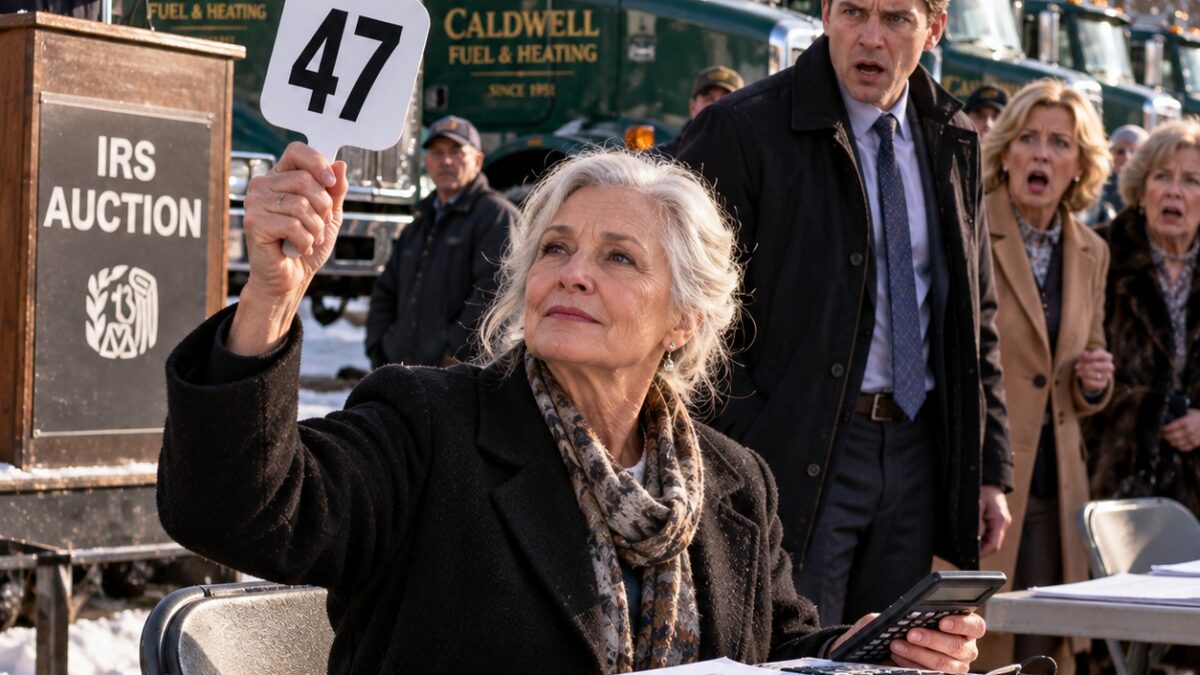
Bidder paddle:
47
HP 12C on my knee.
Claire beside me in sunglasses.
At 9:52, silver Escalade.
Brandon stepped out.
Aviators.
Golf shirt.
Trip Whitam behind him.
Then Kendra.
Already livestreaming.
“Caldwell comeback day!”
Lorraine exited last.
White linen jacket.
Dark glasses.
She stood apart near the office.
Brandon saw me.
Stopped.
Then he did what he always did when frightened.
Found an audience.
He turned toward the former employees.
“Want to know why your paychecks bounced?”
Then pointed at Claire.
“Ask my wife.”
A murmur moved through forty green jackets.
Claire started to stand.
I placed my hand over hers.
“Not yet.”
She sat.
Shaking.
Brandon walked to us.
Looked down.
Same Christmas expression.
“What are you doing here, old woman?”
One golf friend laughed.
“Shopping?”
I checked my calculator battery.
Did not answer.
I had waited twenty-four weeks since Christmas.
Six more minutes would not hurt.
At 10:00, IRS property specialist Ray Dumbrowski switched on his megaphone.
“Lot one.”
2019 International oil-delivery truck.
2,800-gallon tank.
Minimum:
$18,000.
Trip raised his paddle.
“Eighteen.”
I raised 47.
“Twenty from bidder forty-seven.”
Trip glanced at Brandon.
Then bid again.
Twenty-two.
Twenty-four.
Thirty.
Thirty-five.
Forty-one.
Trip lowered his paddle.
“Sold.”
The gavel struck.
“Bidder forty-seven.”
Lot two.
Same.
Lot three.
Faster.
Lot four.
Trip called his bank.
Then leaned toward Brandon.
I heard:
“My letter says one-eighty, man. That’s all they approved.”
$180,000.
I ran the numbers on my calculator.
At the current pace, they would be finished by lot five.
They were.
Lot five.
Six.
Seven.
Eight.
Nine.
Service vans.
Shop equipment.
Total:
$356,500.
Every dollar paid to the IRS against Caldwell Fuel’s liabilities.
I never stood.
Not once.
Somebody behind me was watching Kendra’s livestream.
Comments flew.
WHO IS THE GRANDMA?
BIDDER 47 AGAIN
WAIT WHAT IS HAPPENING
Then Brandon walked toward me.
No smile.
“You did this.”
His voice cracked across the gravel yard.
“You set us up.”
I looked at my paddle.
“I am sitting, Brandon.”
“What?”
“You told me to.”
A few former employees understood first.
Somebody laughed.
I looked up.
“You asked what an old woman could do.”
His face darkened.
“I told you at Christmas.”
“I can read.”
“Read what?”
The yard became quiet.
I set my calculator on my lap.
“April third, 2025.”
His expression changed.
“Eleven fifty-two p.m.”
“What are you talking about?”
“You turned off automatic tax deposits.”
Kendra’s phone lowered a few inches.
“June twentieth.”
I continued.
“The first warning went to Kendra.”
Kendra went white.
“Ten days later, she resigned.”
“I didn’t—”
“July first.”
I looked at Brandon.
“You gave Claire the title.”
Then:
“You changed the tax-notice contact to yourself.”
His mouth opened.
“It was never just a title.”
“You don’t know anything about my business!”
He was shouting now.
“You’re a cashier.”
His face had gone brick red.
“A nobody from a diner.”
I remained seated.
“The mistake was made at 11:52 p.m.”
Pause.
“And it wasn’t my daughter’s.”
Behind him, Dale moved forward.
“Brandon.”
Low voice.
“That tax money came out of our checks.”
Brandon turned.
“Stay out of this.”
That was the moment everything changed.
Not when I bid.
Not when the IRS closed the company.
When forty former employees stopped looking at Claire.
And started looking at Brandon.
The withheld money had come from them.
Their paychecks.
Their Social Security.
Their Medicare.
Their federal withholding.
Not his emergency fund.
Not company cash.
Theirs.
Kendra started crying.
“I only did marketing.”
Nobody answered her.
Ray stepped down from the office stairs.
“Sir, step back or I suspend this sale.”
Brandon kicked gravel.
Trip grabbed his arm.
Then Lorraine walked over.
Removed her sunglasses.
Her eyes were dry.
“You humiliated my son.”
I looked at her.
“In front of the whole town.”
I reached beneath my chair.
Pulled out a flat brown-paper package.
Lorraine watched.
I tore the paper.
Silver frame.
New glass.
Blue Plate Diner.
Dot.
Lorraine at seventeen.
Her body stiffened.
I stood only enough to hand it to her.
“It was never a mistake, Lori.”
She looked at me.
“She was proud of you.”
Lorraine did not take it immediately.
Sixty people watched.
Eventually her hands came up.
She looked at the photograph.
Two seconds.
Maybe three.
Her thumb moved across the glass.
Over Dot’s laughing face.
Pencil behind her ear.
For one moment Lorraine’s expression changed.
The expensive woman disappeared.
Seventeen-year-old Lori Puit stood there instead.
Embarrassed.
Poor.
Loved by her mother.
Her mouth trembled.
Then the door shut again.
She looked up.
“It’s still a mistake.”
She turned.
Walked toward the Escalade.
Frame held against her white jacket.
But she did not throw it away.
That was the only apology Lorraine gave me that day.
I decided it would have to be enough.
Then I stood fully.
My hip protested.
I ignored it.
Turned toward the former Caldwell employees.
Forty green jackets.
Dale in front.
“My name is Moren Huitt.”
A few heads lifted.
“Some of you knew my old accounting firm.”
Dale nodded.
“Huitt & Row.”
“I bought these trucks for a new company.”
Nobody moved.
“Juniata Home Heating.”
Wind rattled the chain-link fence.
“We open Monday morning at seven.”
Then:
“Same jobs.”
Someone looked up.
“Same pay.”
Dale stared.
I continued.
“And anybody whose paycheck bounced in March gets a signing bonus.”
Pause.
“The exact amount of the bounced check.”
For a second, silence.
Then someone clapped.
One person.
Then another.
Within seconds the gravel yard filled with applause.
An older driver named Hank sat on the bumper of lot three and covered his face.
I looked at Dale.
“I need an operations manager.”
He removed his cap.
“Yes, ma’am.”
Behind me, Brandon was shouting while Trip guided him toward the Escalade.
Nobody turned around.
Claire squeezed my hand.
Her eyes were wet.
“You stood up.”
I looked at her.
“What?”
She smiled.
“Only when it was worth it.”
Juniata opened June 15 at seven sharp.
Fifty-eight of Caldwell’s sixty-four employees returned.
The first checks we wrote were signing bonuses.
One for every bounced paycheck.
Exact amounts.
No rounding.
No speeches.
Dale handed them out himself.
By August, 2,700 of Caldwell’s former 3,100 customers had moved to us.
Mostly because their drivers asked them to.
Customers think they are loyal to company names.
Often they are loyal to the person who shows up in freezing weather when the heating tank is almost empty.
The green trucks became blue.
Deep river blue.
White lettering.
JUNIATA HOME HEATING
Every Tuesday, one drove down Ridge Road past the Caldwell house.
By then, a FOR SALE sign stood near the driveway.
Brandon and Lorraine appealed their IRS penalties.
Walter said appeals take time.
The audit log was not going anywhere.
Kendra did not appeal.
Her penalty became final.
Her social-media sponsors disappeared.
Her account went private.
The last I heard, she was selling furniture online.
She texted Claire once:
You could have warned me.
Claire showed me.
“What should I say?”
“Nothing.”
She deleted the message.
Brandon sold the lake house.
The lender and government took most of the proceeds.
Keystone Comfort Heating—the company his friend planned to use for his comeback—was dissolved before delivering a gallon.
Brandon ended up renting a two-bedroom apartment in Altoona.
Someone told me he sold used cars on commission.
I did not celebrate.
A man losing everything does not restore what he tried to take from my daughter.
It simply means consequences finally stopped missing him.
Laurel Glenn suspended Lorraine over unpaid dues.
I heard the bridge club found a new hostess.
Bev informed me their chicken salad improved.
Some victories arrive in very strange forms.
Claire’s divorce moved forward.
She kept her teaching job.
Her Subaru.
Her savings.
And, most importantly:
She owed the IRS zero dollars.
Not one cent.
She rented an apartment above a bakery on Main Street.
Good north light.
Perfect for restoring photographs.
Gordon, her father-in-law, remained in assisted care after his stroke.
Claire visited him monthly.
Nobody asked her to.
She simply loved him.
On one visit, Gordon held her hand for a long time.
Speech was difficult.
Eventually:
“I’m sorry, honey.”
The only Caldwell who ever said it plainly.
Claire cried in the car afterward.
Not because she wanted Brandon back.
Because sometimes one honest sentence arrives after years of people explaining why they do not owe you one.
In August, my answering machine blinked.
Lorraine.
Eleven-second message.
“Moren.”
Pause.
“I was wondering whether you still have the original print.”
I knew exactly which one.
Blue Plate.
The original remained in my shoebox album.
I took it out.
Looked at Dot laughing.
Lorraine holding the coffee pot.
Then mailed it.
Plain envelope.
No note.
No sermon.
No forgiveness speech.
Some things belong to the people inside them.
The photograph belonged to Lorraine.
My time did not.
I never returned the call.
That became my boundary.
Claire decides who she sees.
I decide who sits at my table.
On Saturday mornings, Claire uses the little office at Juniata’s garage to restore old family photographs for employees.
Free.
By the time clock hangs an entire wall.
Fathers beside tractors.
Mothers in diner uniforms.
Children on bicycles.
Wedding photographs.
Military portraits.
One picture shows Dale at eight years old sitting on his father’s oil truck.
Another shows Hank’s mother behind the counter of a bakery.
Nobody is embarrassed by those pictures.
That may be my favorite thing about the company.
We do not ask people to reinvent where they came from before we respect where they are.
Every Sunday, Claire comes to dinner.
Sometimes Dale and his wife come.
Sometimes Bev.
Nobody sits beside the kitchen door unless they specifically want the seat closest to the pie.
My old HP 12C still lives in my kitchen drawer.
The numbers on several keys are nearly worn away.
It survived Brandon.
So did I.
Sometimes Claire teases me.
“You know, Mom, most grandmothers respond to Christmas insults by leaving early.”
“I did leave.”
“You bought an oil company.”
“Six months later.”
“As one does.”
I remind her that I did not buy the company.
I bought assets from the IRS.
She says that distinction only makes the story more disturbing.
Maybe.
But I want one thing understood.
I did not spend $356,500 for revenge.
If revenge were the goal, I could have spent much less.
I bought nine trucks because they could still deliver fuel.
I bought two vans because technicians still needed to reach furnaces.
I bought shop equipment because sixty-four people had spent years earning their living with it.
I started Juniata because thirty-one hundred households still needed heat.
Brandon believed a company belonged to whoever controlled the name.
I had spent decades doing payroll.
I knew better.
A company is the Monday morning when people show up.
The driver who knows which elderly customer needs a knock on the back door because she cannot hear the front bell.
The mechanic who knows truck seven makes a noise only when cold.
The office worker who can recognize every customer from the last four digits of a phone number.
The person who sends payroll taxes instead of spending them.
That is a company.
The Caldwells lost theirs long before the IRS put orange stickers on the windshields.
They lost it when people became objects.
Claire became a signature.
Kendra became marketing.
Employees became withheld taxes.
Customers became receivables.
And I became an old woman who could be told to sit down because nobody at that table had ever asked what I had spent thirty-five years doing.
That is the danger of contempt.
It makes you stop asking questions about the person you underestimate.
If Brandon had asked, he might have learned I understood payroll tax better than he did.
If Lorraine had asked, she might have learned I had guarded her secret for years.
If Kendra had asked, she might have discovered Claire had a mother who knew exactly what Form 4180 meant.
Instead, they saw:
Buick.
Ranch house.
Diner.
Gray hair.
Bad hip.
Old woman.
And filled in the rest.
I do not mind being underestimated.
It is sometimes convenient.
What I mind is cruelty built on the assumption that somebody cannot answer back.
That Christmas night, Brandon asked:
“What can you do?”
For months, I thought the satisfying answer was:
I can buy your trucks.
It was not.
I can read.
That was the answer.
Read the IRS letter.
Read the statement before signing.
Read the bank authorization.
Read the audit log.
Read the timestamp.
Read the resignation date.
Read the payroll settings.
Read the tax notices.
Read the auction notice.
Read every number twice.
Truth did not need me to invent anything.
I simply had to stop looking away.
That was my failure before it became my strength.
I had seen Brandon’s cash-flow problem in 2024.
I stayed silent because I did not want to interfere.
I saw Lorraine’s hostility toward Claire.
Stayed silent.
I knew the woman underneath Lorraine’s fake history.
Stayed silent.
I told myself I was respecting my daughter’s marriage.
Some of that was true.
Some of it was cowardice wearing the clothes of restraint.
There is a difference between invading an adult child’s life and warning her that you see smoke.
I understand that now.
If I could return to that kitchen table in 2024, I would not tell Claire:
Leave your husband.
I would tell her:
I reviewed Brandon’s business plan.
His company has a serious cash-flow problem.
You are an adult.
Do with that information what you choose.
That is not meddling.
That is truth.
Parents do not need to drive the car.
Sometimes we should still mention the bridge is out.
Claire forgave me faster than I forgave myself.
“Mom.”
She said once.
“You didn’t put my name on that paper.”
“No.”
“You didn’t stop the tax deposits.”
“No.”
“You didn’t give me the treasurer title.”
“No.”
“Then stop trying to serve somebody else’s sentence.”
Art teachers occasionally become annoyingly wise.
I listened.
Mostly.
Our Sunday dinners became simpler.
No walnut table built for twenty.
No handwritten cards.
No silver polished for people who hate one another.
My table seats six comfortably.
Eight if nobody minds elbows.
Dale brings beer.
Bev brings gossip.
Claire brings dessert when she remembers.
I make too much food.
Frank’s chair remains empty.
I still talk to him sometimes.
One evening, after Juniata had been operating for almost a year, I sat alone at the table with the HP 12C.
I imagined telling him.
“Your daughter married an idiot.”
Frank would have corrected me.
“Not helpful, Moren.”
“He tried to put $418,640 on her.”
Then Frank would have stopped smiling.
I told him about bidder forty-seven.
The trucks.
The new company.
Claire’s apartment.
The photograph.
I could almost hear him:
“You spent three hundred fifty-six thousand dollars because someone called you old?”
“No.”
I would say.
“I spent it because sixty-four people needed jobs.”
Pause.
“And because he called me old.”
Frank would laugh.
I miss him.
Grief does not disappear because other emergencies get louder.
It waits.
But these days, when I think about Christmas at the Caldwell house, I no longer see Brandon first.
I see Claire.
Silver box under her chair.
Excited.
Thinking she had restored something beautiful.
She had.
Lorraine just was not ready to look.
That photograph became the beginning because it exposed two different kinds of shame.
Lorraine’s shame about where she came from.
Brandon’s shame about where his company was going.
Both chose the same defense.
Humiliate somebody else before somebody could see them clearly.
Lorraine threw the past in the trash.
Brandon tried to put the future into my daughter’s name.
Neither worked.
Claire once asked me whether I thought Lorraine kept the photograph after the auction.
“I know she did.”
“How?”
“She called for the original.”
“Oh.”
Claire became quiet.
“Do you think she looks at it?”
“Maybe.”
“Do you think she misses her mother?”
“Yes.”
No hesitation.
Shame does not erase love.
Sometimes it makes love harder to touch.
Dot Puit had been dead for decades by then.
I wished Lorraine had not spent so many years believing her mother’s apron made her smaller.
My own mother cleaned houses.
My father worked railroad tracks.
I poured coffee.
None of it contaminated the later years.
The blue plate diner did not prevent me becoming a CPA.
My Buick did not erase $6.4 million.
Claire teaching art did not make her stupid about everything.
It made her inexperienced with corporate tax.
People are allowed not to know things.
The crime is when someone who does know uses that gap against them.
That is what Brandon did.
That is what Kendra did.
Lorraine allowed it.
And that is why the sweetest part of this story is not watching them lose the company.
It is watching Claire learn to ask one question before signing anything:
“What does this actually make me responsible for?”
She teaches that to her students now in a different form.
When a child turns in a project copied from the internet, she asks:
“Do you understand what you put your name on?”
She told me once:
“I sound like you.”
“Terrifying.”
“Very.”
Her divorce became final that fall.
No dramatic courtroom confrontation.
Paper.
Signatures.
Property.
Done.
Brandon attempted to argue that some company-related obligations should be shared.
Walter sent records.
The argument went nowhere useful.
Claire walked out of the courthouse carrying one folder.
She called me.
“It’s done.”
“How do you feel?”
She thought.
“Hungry.”
We went for pancakes.
There is something deeply satisfying about ordinary food after legal endings.
No champagne.
No country club.
Pancakes.
She put syrup on everything.
I did not criticize.
Juniata grew carefully.
That word matters.
Carefully.
No lake house.
No aggressive expansion.
No pretending receivables are cash.
Dale and Gail helped build systems.
Every payroll tax deposit automated.
Every notice copied to more than one officer.
No single person could quietly disable tax service without an alert to outside accounting.
We built the company around the weaknesses I had watched destroy others.
Not because systems make people honest.
Because systems should make dishonesty difficult.
The company became profitable.
Slowly.
Good.
I did not need another empire.
I needed a business stable enough that the people inside it could sleep.
Employees called me Mrs. Huitt at first.
I hated it.
“Moren.”
A few complied.
Dale never did.
“Yes, ma’am.”
Hopeless.
One morning, I arrived at the garage and saw a framed photograph on the wall.
The Blue Plate picture.
Not the original.
Claire had made a copy.
Underneath, a tiny brass label:
EVERYBODY COMES FROM SOMEWHERE.
I stared.
“Claire.”
She appeared in the doorway.
“What?”
“You put this here?”
“Dale asked for something for the lobby.”
“Why this?”
She smiled.
“Because I like it.”
I looked at seventeen-year-old Lorraine.
Then Dot.
Then my own nineteen-year-old hand behind the camera.
“Do you think she’d be angry?”
“Probably.”
“Then maybe take it down.”
Claire shook her head.
“It’s not labeled.”
Nobody knew Lorraine’s name.
To anybody walking through the office, it was simply two women in a diner.
Mother.
Daughter.
Working.
Laughing.
Nothing shameful.
I left it.
That photograph did not expose Lorraine.
It honored Dot.
There is a difference.
Over time, people in Bellwood Springs stopped talking about the auction.
Small towns always find new material.
Someone’s divorce.
School-board fight.
Restaurant closing.
Weather.
That is healthy.
I did not want to be bidder forty-seven forever.
I wanted to be Moren.
The woman who occasionally forgot where she put her glasses while wearing them.
Who overcooked pork chops.
Who still could not use the voice function on her phone without swearing.
Drama should not become identity just because strangers enjoyed watching it.
Kendra’s Christmas video eventually disappeared.
Forty-one thousand views became irrelevant.
The IRS records did not disappear.
That was the difference between internet spectacle and evidence.
One evaporates.
The other has timestamps.
I never forgot 11:52 p.m.
April 3, 2025.
Sometimes people ask me why that number mattered so much.
Because intent often hides in time.
A business owner changing payroll-tax settings eight minutes before midnight is not automatically guilty of anything.
But pair that with no deposits.
Then warnings.
Then changing the warning recipient.
Then installing an inexperienced treasurer after the first notice.
Then asking her to sign a retroactive statement.
The pattern tells the story.
Accounting is not glamorous.
Nobody makes movies about reconciling ledgers correctly.
But numbers become very eloquent when someone lies around them.
Brandon mocked my calculator.
The HP 12C never cared.
It gave the same answer whether a man wore a golf shirt or a mechanic’s jacket.
That impartiality is one of the reasons I loved accounting.
People bring pride.
Numbers bring consequences.
One afternoon, years after the auction, a young woman from Juniata’s office came into my room holding a form.
“I know this sounds silly.”
“What?”
“I don’t understand what I’m being asked to sign.”
I put down my coffee.
“That never sounds silly.”
She sat.
We read it.
Together.
Nothing dangerous.
Routine insurance designation.
But when she left, I thought about Claire.
It’s just a title.
That sentence still makes me angry.
There is no such thing as “just” a title when a signature sits underneath.
Treasurer.
Director.
Trustee.
Guarantor.
Cosigner.
Officer.
Executor.
Words create duties.
Sometimes liability.
Read them.
If somebody rushes you, read slower.
If somebody says everybody signs it, ask why.
If someone says family does not need lawyers, that may be exactly when you need one.
I wish Claire had known.
Now she does.
That is enough.
Lorraine and I never became friends.
That would have been sentimental nonsense.
Years later, I saw her once in a pharmacy.
She looked smaller.
No white linen.
No bridge-club posture.
We stood at opposite ends of the same aisle.
She looked at me.
“Moren.”
“Lorraine.”
Pause.
Then:
“Thank you for sending the original.”
“You’re welcome.”
Her mouth moved as though another sentence might come.
It did not.
I started walking.
Then she said:
“My mother really did make the best coconut cream pie.”
I stopped.
Looked back.
“Yes.”
Lorraine’s eyes filled slightly.
“She used lard.”
“I know.”
“She never wrote the recipe down.”
“No.”
Another silence.
Then Lorraine said:
“I should have kept more.”
I knew she did not mean recipes.
I answered:
“Yes.”
That was all.
No apology.
No reconciliation.
But Lori Puit had spoken about her mother without denying her.
Maybe that mattered.
I hope it did.
Then I went home.
My time belongs to me.
That boundary held.
Claire still comes every Sunday.
Her north-light apartment eventually filled with photographs.
She does restoration work for money now too.
Not enough to leave teaching.
Enough that strangers mail her cracked portraits and faded wedding pictures.
She says damaged photographs do not always need to look new.
“They need to look whole enough to remember.”
I like that.
Maybe people are similar.
No need to become who we were before damage.
Just whole enough to keep going.
The first Christmas after the divorce, Claire brought me a silver package.
I stared.
She laughed.
“Open it.”
Inside:
My old Blue Plate photograph.
Another restored print.
But this time she had widened the scan.
In the far left corner, behind the counter, was me.
Nineteen.
Partially caught in the diner mirror.
Camera up to my face.
I had never noticed.
Three women in one image.
Dot laughing.
Lorraine trying to disappear.
Me taking the picture.
Claire had added a tiny card.
THE WOMEN WHO WERE THERE.
I cried.
“Good tears?”
She asked.
“Annoying tears.”
She hugged me.
Then Dale arrived with pie.
Nobody threw anything away.
That is what satisfying endings look like to me now.
Not people suffering.
People learning what deserves to stay.
Frank’s calculator stayed.
Dot’s photograph stayed.
Claire’s savings stayed.
Fifty-eight jobs stayed.
Thousands of customers kept getting heat.
The unpaid taxes stopped being somebody else’s invisible problem.
And Claire’s name stayed off a debt she did not create.
The Caldwells asked what an old woman could do.
The answer was never:
Destroy them.
They did most of that themselves.
My answer was smaller.
I could read the page they expected my daughter not to read.
I could know that June 30 meant something.
I could recognize a final notice.
I could ask who controlled the bank account.
I could call a lawyer at seven in the morning.
I could sit still while louder people lied.
I could wait until evidence reached the person authorized to use it.
I could lift paddle forty-seven when the auctioneer asked for twenty thousand dollars.
Then again.
And again.
And again.
Most importantly, I could finally understand that staying out of my daughter’s marriage did not require staying silent while people pushed her toward a cliff.
I learned late.
But not too late.
That distinction saved her.
If I could return to Lorraine’s Christmas table now, I would still stand when she threw the photograph away.
I would still retrieve it.
Still tell Claire to get her coat.
But when Brandon looked at me with pie on his fork and asked:
“What can you do?”
I would not answer.
Not because I was intimidated.
Because there is no reason to explain yourself to someone committed to underestimating you.
Let them.
Let them mistake your quiet for weakness.
Let them believe a Buick proves poverty.
Let them believe gray hair means ignorance.
Let them laugh at the calculator.
Then go home.
Read.
Document.
Ask questions.
Protect the person who trusts you.
And when the truth finally reaches the room, do not shove it to its feet.
Truth can stand on its own.
That is what mine did.
At 11:52 on a Thursday night, Brandon Caldwell clicked one setting that kept his employees’ tax money inside his company bank account.
Ten weeks later, his sister stepped away from the title closest to the liability.
The next day, they handed that title to my daughter.
Six months later, the IRS asked who actually controlled the money.
The family gave them stories.
The audit log gave them timestamps.
And in the end, the timestamps won.
Today, the nine trucks are blue.
Every Tuesday, one still travels Ridge Road.
Sometimes it passes the old Caldwell colonial.
Someone else owns that house now.
The flagpole remains.
Different flag.
Different family.
No green trucks with Christmas wreaths.
Just a blue Juniata truck moving toward another furnace before somebody’s house gets cold.
Claire occasionally rides with Dale on winter mornings because she loves sketching old Pennsylvania homes.
She says the truck smells like diesel, coffee and peppermint gum.
I tell her it smells like payroll liability.
She rolls her eyes.
Good.
Children should eventually be allowed to roll their eyes at the people who helped save them.
That means crisis is over.
My bidder paddle hangs in the Juniata office.
Forty-seven.
Dale framed it.
I told him that was ridiculous.
He said:
“Yes, ma’am.”
Beside it sits a copy of the original IRS auction notice.
Not because I want employees to remember the Caldwells.
Because I want them to remember the trucks had another life before this one.
Companies do too.
Families do.
People do.
The old woman they told to sit down still sits plenty.
My hip prefers it.
I sit at my kitchen table.
At the Juniata office.
In Claire’s apartment while she restores photographs.
On Sunday evenings beside people I actually want near me.
Sitting was never the insult.
Being told I had no power because I was old was.
They misunderstood power.
Power is not shouting loudest at Christmas.
Not having the largest house on Ridge Road.
Not controlling a family company.
Not being president.
Not even having $6.4 million from selling an accounting firm.
Sometimes power is simply understanding the document in front of you when everybody else is hoping you will be too intimidated to read it.
So if somebody ever hands your child a title and says:
“It doesn’t mean anything.”
Read it.
If somebody hands them a confession and says:
“It’s just paperwork.”
Do not sign it.
If somebody says:
“We’re family, trust me.”
Trust may be appropriate.
Reading is still free.
And if a man looks at you across a Christmas table, laughs and says:
“Sit down, old woman. What can you do?”
You may discover the best answer is to do exactly what he says.
Sit down.
Open every page.
Run the numbers twice.
Wait for the truth to finish its work.
Then, when the auctioneer calls for the next bid—
raise your paddle.

