PART2:My Husband Sprayed Disinfectant in My Face and Locked Me in the Basement—Then I Found the Ledger He Never Expected Me to Read
PART2
At first, I cooperated.
That is the part I am most embarrassed to admit.
People imagine that when abuse becomes obvious, the victim immediately stands up and says, “No.”
Sometimes you do not.
Sometimes the person frightening you is the same person who sat beside your hospital bed twenty years earlier.
The same man who held your hand when your mother died.
The same father who cried at your daughter’s wedding.
The mind does not discard thirty-five years in one afternoon.
So I let Arthur move me into the sunroom.
I let him place plastic sheeting over furniture.
I let him bring sandwiches on paper plates.
I let him tell me not to touch silverware.
He wore latex gloves even while reading the newspaper.
When I walked down the hallway to use the bathroom, he followed behind with disinfectant wipes, scrubbing doorframes and surfaces I had passed.
By the second day my hands were raw.
The skin across my knuckles had cracked from soap.
I sat behind the glass doors of the sunroom and watched Arthur move through the house like a surgeon inside an operating room.
Every morning he brought food.
Every morning I asked:
“Where is Sophie?”
Every morning his answer changed slightly.
“She’s with Julian.”
“She’s overseeing repairs.”
“She’s exhausted.”
“She doesn’t need additional stress.”
Then one afternoon he said:
“Julian is at a private clinic.”
“For what?”
“Exhaustion.”
I looked through the glass at him.
“You know what the laboratory report said.”
His jaw tightened.
“Do not start again.”
Then he adjusted his silk tie.
And I saw it.
A red patch of skin beneath his collar.
Angry.
Inflamed.
I stared.
Arthur noticed.
His fingers immediately pulled the collar higher.
“What?”
“Your neck.”
“Razor irritation.”
“You don’t use a razor there.”
His eyes changed.
Not much.
Arthur had practiced hiding reactions in courtrooms for decades.
But I had been married to him longer than any judge had known him.
I saw fear.
Then contempt covered it.
“You’ve spent too much time reading nonsense online.”
“I’m worried about you.”
“You should worry about yourself.”
He left.
I sat in the wicker chair staring at my hands.
That night I searched whatever medical information I could still access through the sunroom Wi-Fi.
I was careful.
I did not diagnose anybody from pictures.
I had taught literature for thirty years, not medicine.
But one thing became increasingly obvious.
Arthur’s behavior was not consistent with his explanation.
If he believed Julian had brought some dangerous contagion into our home, why did he stand inches from him?
Why did he touch him?
Why did he not isolate Julian?
Why me?
The answer came three days after I found the laboratory sheet.
Julian returned.
I watched from behind the sunroom glass.
He looked terrible.
Thinner.
Eyes hollow.
Shoulders slumped beneath a cashmere sweater.
Arthur met him in the foyer.
No spray.
No order to strip.
No plastic bag.
Arthur placed one gloved hand on Julian’s shoulder.
Not disgust.
Comfort.
They began whispering.
I pressed closer to the glass.
Then heard Julian clearly.
“Is it handled?”
Arthur answered:
“The records are sealed.”
“The firm took care of the lab.”
My heart started hammering.
Then:
“But she knows.”
Julian glanced toward the sunroom.
“What are we going to do with her?”
Arthur did not hesitate.
“She stays where she is.”
“As long as she thinks she’s contaminated, she won’t go to the press.”
“She won’t go to Sophie.”
Julian lowered his voice.
“She isn’t stupid.”
“No.”
Arthur said.
“But she trusts me.”
That sentence destroyed something inside me.
He continued.
“At her age, confusion is believable.”
“I’ll keep her contained.”
“For her own safety.”
They moved away.
I slid down the glass until I was sitting on the floor.
My husband was not protecting me.
He was using fear to imprison me.
Not because I was infectious.
Because I was a witness.
I pressed my raw hands against my knees.
For two days, I had apologized for touching objects in my own house.
I had felt dirty.
Ashamed.
Dangerous.
Arthur had taken whatever secret belonged to him and Julian and poured it onto me until I started believing I carried the stain.
That realization made me nauseated.
Then angry.
Not explosive anger.
Something quieter.
For thirty years, I had taught novels in which women were locked in rooms, declared unstable, spoken over by men who believed authority made their version of reality true.
I had taught my students to ask:
Who controls the story?
I finally asked the question about my own life.
Sophie came home that evening.
Her Volvo pulled into the driveway around seven.
I ran to the glass.
Pressed both palms against it.
“Sophie!”
She looked toward me.
Our eyes met.
For half a second, hope exploded inside my chest.
Then Arthur reached her.
He met her on the porch before she could come near me.
I could not hear everything.
Only fragments.
“Exposure.”
“Confused.”
“Agitated.”
“Doctor recommends distance.”
Sophie looked at the sunroom again.
I waved.
She did not.
The expression on her face was fear.
Fear of me.
Arthur brought her inside through the mudroom.
I stood against the vent near the floor and listened.
“Dad, is Mom getting better?”
“It’s complicated.”
“What happened?”
“The exposure frightened her.”
“Then the isolation made things worse.”
“She’s having some delusional thinking.”
My knees weakened.
“She thinks everyone is sick.”
“She thinks the house is contaminated.”
“I’m arranging professional help if it doesn’t improve.”
Sophie whispered:
“Can I see her?”
“Not yet.”
“It could trigger her.”
Then Arthur said the cruelest thing yet.
“You wouldn’t recognize your mother right now.”
I covered my mouth so they would not hear me sob.
He was erasing me while I was twenty feet away.
He was turning the truth I had discovered into evidence of insanity.
Sophie’s own fear for Julian made the lie easier.
Her husband had suddenly become sick.
Her mother was supposedly exposed.
Her father—the lawyer, the calm one, the authority—was telling her what reality looked like.
Why would she doubt him?
I had not doubted him for thirty-five years.
That understanding made the betrayal worse.
And strangely, it made me less angry at Sophie.
She was being manipulated too.
That night, I heard Arthur cough.
Not a polite clearing of the throat.
A deep, wet cough.
Then again.
I remembered the patch on his neck.
His obsessive disinfecting.
The way he flinched whenever I looked too closely.
Suddenly the plastic sheeting made sense differently.
It was theater.
If the entire house became a stage about my contamination, no one would inspect his.
The next afternoon, I watched Arthur and Julian eat together.
Julian touched the counter.
Arthur did not wipe it.
Julian used a real glass.
Arthur did not throw it away.
They stood shoulder to shoulder talking.
Then Arthur saw me watching.
He walked to the glass and tapped one gloved finger against it.
“Don’t stare.”
I stood.
“Why does Julian get to touch everything?”
“Because Julian is following medical instructions.”
“And I’m not?”
“You went through his private papers.”
“You turned this into hysteria.”
“He brought an infection into our daughter’s marriage.”
Julian, from the kitchen, flinched.
Arthur’s face hardened.
“You don’t know what you’re talking about.”
“I know enough.”
“No.”
“You know one laboratory sheet.”
“And now you’ve created an entire paranoid fantasy around it.”
I stared at him.
“You sprayed disinfectant into my face.”
“For safety.”
“You locked me in a room.”
“For safety.”
“You told Sophie I’m psychotic.”
“For safety.”
“Whose?”
For the first time, he had no immediate answer.
Then:
“Everyone’s.”
He walked away.
I knew then that the phrase for your safety had become the lock on my door.
At two in the morning, I heard the front door.
Soft.
Arthur moving through the foyer.
I crept toward the sunroom window.
His sedan pulled away.
I stared after the taillights.
Where did a sixty-two-year-old attorney go at two in the morning while supposedly protecting his quarantined family?
The house went quiet.
Julian slept upstairs.
Sophie had returned to the condo.
I approached the sunroom door.
Arthur had installed no real prison lock.
The restraint was psychological.
A latch.
Motion alert.
Threats.
I reached for the handle.
Then the latch clicked from the other side.
I jumped.
Arthur stood behind the glass.
He had not gone anywhere.
Or not far.
His car had apparently circled back.
He looked at my hand.
Then my face.
Disappointment.
Almost pity.
“You’re proving my point.”
I stared.
“What?”
“You’re unstable.”
“You cannot maintain boundaries.”
“You waited to see if I’d try leaving.”
“I needed to know whether you could be trusted.”
“This is my house.”
“Our house.”
“You’re sick, Clara.”
“No.”
“I’m frightened.”
“Because my husband is imprisoning me.”
His eyes darkened.
I pointed.
“And your neck is getting worse.”
That did it.
The courtroom mask disappeared for half a second.
Pure rage.
Then calm returned.
He pulled on fresh gloves.
Snap.
Snap.
“The sunroom is no longer appropriate.”
“What does that mean?”
“You’re moving downstairs.”
My body went cold.
“Where?”
“The lower level.”
“The basement?”
“Utility suite.”
“Arthur.”
“You can’t be serious.”
“Sophie is coming tomorrow.”
“I won’t have your behavior disrupting Julian’s recovery.”
“You are burying me.”
“I am protecting the family.”
He opened the door.
Held a flashlight.
“Move.”
I did not.
His voice changed.
“If you refuse, I will call a psychiatric crisis team.”
“I’ve already documented your behavior.”
“The agitation.”
“The attempt to leave.”
“The contamination obsession.”
“All I need to say is that you are a danger to yourself.”
That threat worked.
Not because I believed he was right.
Because Arthur knew systems.
Court orders.
Emergency holds.
Affidavits.
He had spent decades persuading people whose version of events should become official.
I was barefoot.
In a nightgown.
Red-eyed.
Hands cracked.
Locked in a room.
If police arrived and my respected attorney husband calmly explained his unstable wife had suffered a breakdown, whose story would sound organized?
So I walked.
Through my own home.
Arthur three steps behind.
Spraying the air.
We passed the library.
My books.
The framed photograph of Sophie at graduation.
Our wedding portrait.
The kitchen table where Arthur and I had eaten breakfast for three decades.
He ordered me not to touch the banister.
My bare feet struck hardwood I had chosen.
Then carpet.
Then basement stairs.
The humiliation was so intense it became almost detached.
I watched myself descend as if I were reading a terrible novel.
Basement.
Utility room.
Cot.
Card table.
Water.
Protein bars.
Furnace.
Arthur stood at the bottom step.
“The Wi-Fi doesn’t reach well down here.”
“I’ll bring one hot meal a day.”
“If the motion sensor triggers, I call the crisis team.”
Then he shut the door.
Darkness.
Click.
I sat on the cot.
For the first time, I understood the word buried.
The basement was not actually primitive.
We had finished most of it years earlier.
Home theater.
Laundry.
Storage.
But Arthur put me in the utility section near the furnace.
Concrete.
Pipes.
Dampness.
No windows except two narrow panes near the ceiling.
The rain sounded farther away there.
Like weather happening in somebody else’s life.
For hours I did nothing.
Then I started hearing voices through the ductwork.
The study sat almost directly above.
Julian first.
“I can’t keep doing this.”
Cough.
“The fatigue is worse.”
Arthur:
“You can.”
“What if Sophie sees the medication?”
“She sees what we tell her.”
“The Bellevue clinic has you listed with Epstein-Barr.”
“Weight loss.”
“Fatigue.”
“It buys time.”
Then Julian:
“And Clara?”
Arthur laughed.
“She’s in the basement convinced she’s contaminated.”
My hands curled into fists.
“By the time I’m done, she’ll be grateful for silence.”
Then the sentence that changed everything:
“She served her purpose.”
“Domestic stability.”
“Thirty years of respectability.”
“Now the facade has to change.”
I pressed my ear against the metal vent.
Julian said:
“What about the insurance?”
Arthur lowered his voice.
I caught pieces.
“Finalized.”
“Control.”
“Competency.”
“Once the paperwork—”
Then footsteps.
Silence.
I sat back.
Insurance.
Competency.
Arthur was not simply trying to hide illness.
He was building documentation that I was mentally unstable.
Why?
What did declaring me incompetent give him?
Money.
Authority.
Control.
Potential access to assets I still jointly held.
I had spent thirty-five years assuming legal knowledge made Arthur our family’s protector.
Now the same knowledge was being weaponized against me.
On the third night, he came downstairs after midnight.
I woke to a key turning.
I slipped behind the furnace before the door opened.
Arthur entered.
He did not approach my cot.
Instead, he crossed to a locked storage cabinet at the far wall.
The one where we kept old tax records and Christmas ornaments.
He wore no gloves.
He unlocked it from a key on a silver chain.
Inside:
A medical cooler.
Vials.
Syringes.
Documents.
Arthur rolled up his sleeve.
His arm was bruised.
Marked from repeated injections.
He prepared medication with practiced hands.
Then injected himself.
I had to press both hands over my mouth.
When he finished, he leaned against the cabinet.
Breathing hard.
Then whispered:
“Damn you, Julian.”
“You were supposed to be careful.”
“You were supposed to be the one who didn’t get caught.”
I closed my eyes.
Arthur was sick too.
The disease itself was not the moral failure.
Illness is illness.
What horrified me was that he had known.
He had hidden it.
He had shared my bed.
Then, when exposure finally threatened his reputation, he had sprayed me with disinfectant and made me believe I was the contaminant.
That cruelty had nothing to do with medicine.
It was control.
Arthur walked toward my cot.
Looked at the untouched protein bars.
“Eat, Clara.”
He thought I was sleeping.
“I need you functional.”
Then very quietly:
“Just until everything is finalized.”
He went upstairs.
Lock clicked.
I waited ten minutes.
Then crossed to the cabinet.
Arthur was predictable.
Our anniversary.
Sophie’s birthday.
The year we bought the house.
He reused numbers because he believed memory was efficiency.
The cabinet keypad waited.
I entered:
1-9-9-4.
The year we bought Queen Anne.
Click.
The door opened.
Inside were thirty years of my marriage arranged in boxes.
Tax files.
Legal folders.
Medical records.
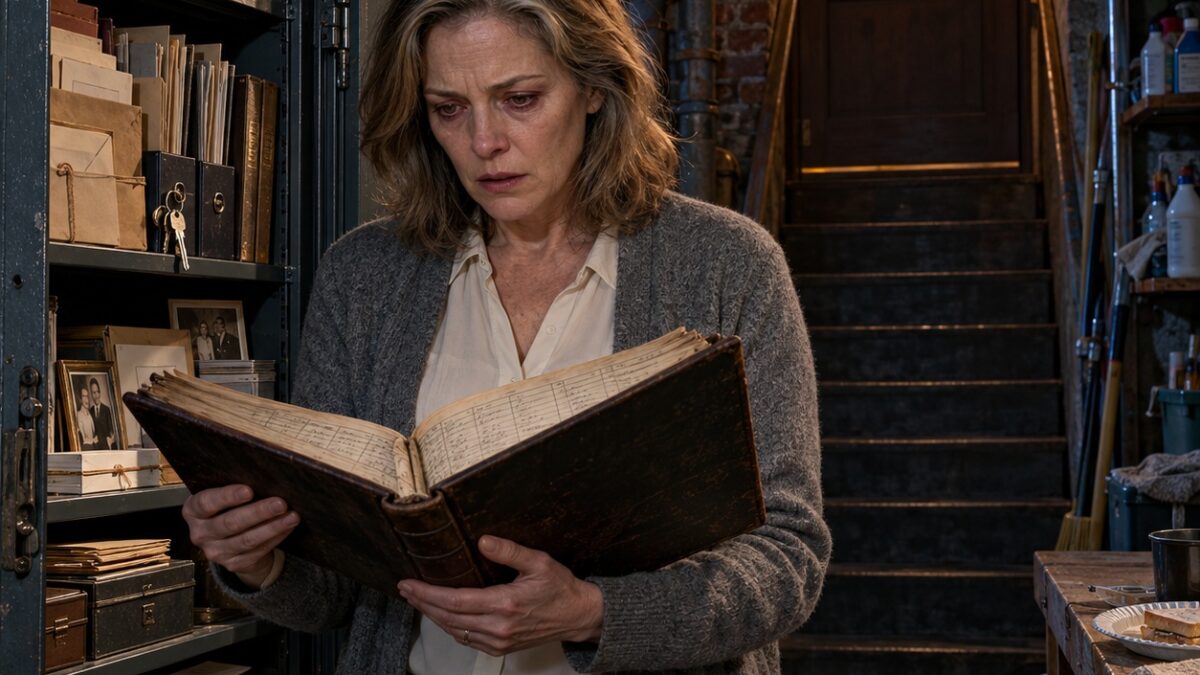
A leather ledger.
I opened it.
Private clinics.
Cash payments.
Offshore accounts.
Insurance policies.
Payments connected to Julian.
Hotel expenses.
Numbers large enough to make my mouth dry.
Then Arthur’s medical records.
Positive tests dating back two years.
Two years.
I sat on the concrete.
For two years, my husband had known he carried a serious transmissible infection.
For two years, he had concealed it from me.
Whatever the exact medical circumstances and actual risk, I had been denied the basic right to know what affected my own health.
Then he accused me of being dangerous because I touched Julian’s briefcase.
I felt sick.
Not dirty.
Betrayed.
There is a difference.
I kept reading.
Insurance paperwork.
$900,000.
Notes about competency.
Asset control.
Legal contingency planning.
The shape emerged.
Arthur feared scandal.
Feared illness becoming public.
Feared losing control over money and reputation.
So he created another story.
Clara is unstable.
Clara is contaminated.
Clara cannot manage herself.
Clara must be isolated.
If he could turn that version into paperwork, he could convert psychological abuse into legal authority.
I held the ledger against my chest.
This was the key.
Not because it magically solved everything.
Because evidence existed outside my memory.
I was not imagining anything.
I needed Sophie.
The basement had no useful Wi-Fi.
No phone.
Arthur had taken mine.
The laundry chute ran between floors.
Too narrow to climb.
Wide enough for sound.
Maybe paper.
I tore a blank edge from an old tax form.
Wrote:
Sophie—look in the basement storage cabinet. Code 1994. Read the ledger. Look at your father’s neck. He isn’t protecting us. He is burying us.
I folded it.
Needed weight.
Found a silver spoon that had fallen through the laundry chute months earlier.
Tied the note around it with thread from a Christmas decoration.
Then waited.
Around midnight, I heard laundry moving upstairs.
Chute door.
I climbed onto the card table.
Threw.
The spoon struck metal.
Clinked upward.
Silence.
I waited.
Nothing.
Maybe it fell back.
Maybe not.
Then the chute door closed.
I sat on the cot.
For the first time since Arthur sprayed me, I had done something he did not control.
A few hours later, the basement door opened.
Light spilled down.
“Mom?”
Sophie.
I stood.
She remained at the top step.
Afraid.
Not entirely of me anymore.
Confused.
“Mom, Dad says you tried to leave.”
“Yes.”
“He says you’re having delusions.”
“No.”
“He says you think the walls are bleeding.”
I almost laughed.
“That’s a new one.”
She stared.
I held up the ledger.
“Do I look like I’m seeing ghosts?”
“Or do I look like someone who found something?”
Her eyes dropped to the leather book.
She recognized it.
“What is that?”
“Your father’s.”
“How did you—”
“Storage cabinet.”
“Code 1994.”
Her face changed.
The note.
She had read it.
I moved closer.
“Sophie, I need you to listen.”
“Your father knew about Julian’s medical situation.”
“He knew before I found the lab sheet.”
“He has his own medical records hidden downstairs.”
“He’s been lying to both of us.”
“He told you I was psychotic because I saw evidence he needed hidden.”
Sophie shook her head.
“No.”
The word came automatically.
Not disagreement.
Pain.
“I know.”
I said.
“I said no too.”
Then footsteps upstairs.
Arthur.
I pushed the ledger toward her.
“Take it.”
“Mom—”
“Take it.”
She grabbed it.
“Close the door.”
She hesitated.
“Do it.”
The door shut.
Lock.
Arthur’s voice followed seconds later.
“Sophie?”
“What are you doing down there?”
“I heard Mom crying.”
A pause.
“She needs rest.”
Arthur’s voice softened into performance.
“The basement is safer.”
“Go back to Julian.”
“He needs you.”
Sophie lied for the first time in her life that I was proud to hear.
“Okay, Dad.”
Her footsteps moved away.
I sat against the basement door.
My daughter had the ledger.
I was still locked in darkness.
But I was no longer alone.
Several hours before dawn, I heard scratching at one of the small basement windows.
At first I thought branch.
Then a face appeared.
Mrs. Gable.
Our housekeeper of fifteen years.
Arthur had fired her six months earlier.
He told me she stole from us.
I had believed him.
I had offered severance privately.
She refused.
Her hurt had confused me.
Now she crouched outside in the rain.
“Mrs. Gable?”
She pushed the window open as far as it would go.
“Clara.”
“What are you doing here?”
“I saw the house.”
“The plastic.”
“I knew.”
“Knew what?”
Her face tightened.
“Arthur didn’t fire me for stealing.”
“I found phones in the tool shed.”
“Burner phones.”
“Messages.”
“Hotels.”
“Private clinics.”
“I confronted him.”
“He fired me the same day.”
The shame nearly knocked me backward.
“I believed him.”
“I know.”
“I’m sorry.”
“I know.”
She held out a plastic-wrapped object.
Small phone.
“I kept one.”
“He thought I threw it away.”
“I kept it charged.”
“Why?”
“I didn’t know.”
“Maybe because I thought someday somebody would need to see.”
I took it.
Rainwater ran down my wrist.
“Why help me after I believed him?”
Mrs. Gable looked through the window.
“Because you treated me like a person for fifteen years.”
“Because he lied to you too.”
“And because nobody should be buried in her own house.”
Then she disappeared back through the hydrangeas.
I sat beneath the window with the phone.
Opened it.
Messages.
Years of them.
Arthur.
Julian.
Clinic names.
Hotel meetings.
Private parties.
Cash.
Medical treatment.
A shared account.
I did not care about judging what consenting adults had done privately.
That was not the point.
The point was that Arthur and Julian had built secret lives while exposing their wives to risks they had never disclosed.
Then, once consequences appeared, they coordinated a cover story.
One message dated six months earlier read:
Results came back. Both in the red. Don’t tell Sophie. Don’t tell Clara. Finalize insurance before symptoms show. If wives know, we lose everything.
I read it twice.
Then three times.
Insurance.
The policy Arthur asked me to sign months earlier.
He had framed it as protecting Sophie.
I had signed because I trusted him.
Another message discussed legal strategy around my supposed instability.
The quarantine was not improvised.
Maybe not every detail.
But the concept existed.
If needed, Clara could be portrayed as confused.
Emotionally unstable.
Unfit.
Arthur had been laying groundwork.
The bleach.
Paper plates.
Psychiatric threats.
Isolation.
All of it could later be described as:
We were managing her crisis.
I nearly vomited.
Then rage replaced nausea.
I began copying messages onto paper.
Dates.
Amounts.
Names.
Clinic addresses.
Insurance references.
For hours.
Teacher handwriting.
Organized.
Methodical.
I had spent my life teaching students to support interpretation with textual evidence.
Now I did the same with my marriage.
Claim.
Evidence.
Pattern.
Truth.
Arthur came down around seven.
I hid the burner phone inside an old Christmas-decoration box.
Sat on the cot.
He brought oatmeal.
Coffee.
“Eat.”
I looked down.
“You look worse.”
he said.
“Talking to yourself again?”
“It’s cold.”
“The rain sounds strange.”
I let my voice tremble.
Played the role he wanted.
His shoulders relaxed.
“You need quiet.”
“How’s Julian?”
“He’s surviving.”
Arthur’s eyes sharpened.
“He understands discretion.”
I looked at the oatmeal.
“Do you?”
“What?”
“Nothing.”
He studied me.
For one terrible second, I thought he knew.
Then he turned.
“Don’t touch the tray after you finish.”
“I’ll disinfect.”
Door closed.
Lock.
I waited.
Then retrieved the phone.
The cage was still there.
But it had changed.
Arthur thought darkness made me powerless.
Instead, darkness gave me privacy.
He had moved me close to the evidence.
The next time Sophie opened the basement door, she was carrying the ledger.
Her hands shook.
“Mom.”
I stood.
She came down two steps.
Then stopped.
“Why is Dad’s name on private-clinic payments?”
“Because they’re his.”
“Why are there payments to Julian?”
“Ask him.”
“What is the insurance notation?”
“I found more.”
I showed her the burner phone.
Sophie looked at it.
Then me.
“Where?”
“Mrs. Gable.”
“Dad fired her for stealing.”
“No.”
“He fired her for finding this.”
Sophie closed her eyes.
I watched an entire childhood move across her face.
Arthur carrying her on his shoulders.
Arthur helping with homework.
Arthur walking her down the aisle.
Arthur’s wedding toast about family values.
No ledger could erase those memories.
But it could change what they meant now.
“Julian knew?”
“Yes.”
Her voice became small.
“How long?”
“I don’t know everything.”
“I won’t guess.”
That mattered.
I did not want to replace Arthur’s lies with my assumptions.
“I know the messages show both men discussing results six months ago.”
“I know they agreed not to tell us.”
“I know your father had his own positive records going back longer.”
“I know he planned to make me look unstable.”
“I know there are insurance and financial arrangements I don’t fully understand.”
“That’s what I know.”
Sophie began crying.
Not loudly.
Tears simply ran.
“Julian told me he had Epstein-Barr.”
“I know.”
“He said that’s why he lost weight.”
“I know.”
“I slept beside him.”
The horror in her voice made me move.
I came up another step.
Then stopped.
Because Arthur had made touch complicated.
That realization broke me.
My own daughter was crying ten feet away and I hesitated to hug her because a man with disinfectant had spent days teaching us fear.
“Sophie.”
She looked up.
“Your husband’s illness is not shameful.”
“Your father’s illness is not shameful.”
“The lies are.”
“The concealment is.”
“Taking away our right to make informed decisions about our own health is.”
She nodded.
Then footsteps.
Arthur.
Sophie wiped her face.
I handed her the burner phone.
“Keep it.”
“What about you?”
“I’ve got copies.”
That was a lie.
Not many.
But enough.
Arthur appeared in the hallway behind her.
“Sophie.”
She turned.
He saw the ledger.
The phone.
Me standing on the stairs.
The mask fell.
Not slipped.
Fell.
“Give me that.”
Sophie stared at him.
“Why?”
“Because your mother forged—”
“No.”
One word.
Arthur stopped.
Sophie held up the ledger.
“This is your handwriting.”
“Dad.”
“What is this?”
“She is manipulating you.”
“Dad.”
“Give me the book.”
“What is this?”
He moved forward.
I stepped onto the top stair.
“Don’t touch her.”
His eyes found me.
“You’re supposed to be downstairs.”
“I was supposed to be confused.”
“That stopped working.”
His jaw clenched.
“You are ill.”
“No.”
“I am angry.”
“There is a difference.”
I pulled the burner phone from Sophie’s other hand long enough to hold it where he could see.
“Mrs. Gable kept your phone.”
Arthur went gray.
“She has the messages.”
“She has names.”
“Clinics.”
“Hotels.”
“Insurance.”
His hand reached.
Sophie stepped between us.
“Dad.”
Arthur froze.
Sophie looked at the patch on his neck.
Then at Julian, who had appeared behind him near the bedroom doorway.
Julian looked exhausted.
Pale.
Terrified.
Sophie’s gaze moved between them.
“It’s true.”
Neither answered.
Her voice broke.
“It was never Mom.”
Julian spoke first.
“Sophie, listen.”
“We were trying to protect you.”
She laughed.
One sharp sound.
“From what?”
“The truth?”
“It’s complicated.”
“No.”
she said.
“It’s secret.”
“That’s different.”
Julian gripped the doorframe.
“The insurance was for your future.”
Arthur nodded quickly.
“Exactly.”
I stepped fully into the hallway.
Bare feet on hardwood.
The floor Arthur told me I was too contaminated to touch.
“Nine hundred thousand dollars?”
Arthur’s face changed.
“How do you know—”
“Ledger.”
“Messages.”
“You planned to use my supposed breakdown to control the finances.”
“No.”
“You wrote it.”
“I was planning contingencies.”
“For what?”
“If you became unstable.”
“I became unstable after you locked me in a room.”
“You were already showing—”
“Stop.”
Sophie’s voice cut through both of us.
“Just stop.”
She looked at her father.
“Did Mom have a psychiatric diagnosis before this week?”
Arthur said nothing.
“Did a doctor tell you to lock her in the basement?”
Silence.
“Did a doctor tell you to spray disinfectant in her face?”
Nothing.
“Did a doctor tell you to tell me she was hallucinating?”
Arthur’s eyes moved away.
Sophie turned toward Julian.
“Did you know?”
Julian swallowed.
“I knew Arthur was trying to keep her calm.”
“Did you know she was locked downstairs?”
“Yes.”
My daughter closed her eyes.
That answer ended her marriage emotionally before any lawyer ever could.
When she opened them again, she looked at Julian like a stranger.
“Get out.”
“Sophie—”
“Get out.”
“I’m sick.”
“I know.”
“Go somewhere you can get actual medical care.”
“Call your doctor.”
“Call a hospital.”
“Call whoever you need.”
“But get out of my mother’s house.”
Julian looked at Arthur.
As if Arthur still had authority.
Arthur stared at the floor.
Julian grabbed his briefcase.
Medication.
Coat.
Then walked toward the mudroom.
His cough followed him.
Door opened.
Seattle rain swallowed the sound.
I did not feel victorious.
A sick man had walked out of my house after deceiving my daughter.
There was nothing triumphant in that.
But the lie left with him.
That mattered.
Then only Arthur remained.
He stood in the living room beneath plastic-covered furniture.
Blue gloves.
Charcoal suit.
The powerful attorney who could make developers panic with one phone call.
Suddenly he looked old.
Sophie entered first.
Started pulling plastic from the sofa.
One sheet.
Then another.
Arthur flinched.
“Stop.”
She ripped harder.
“This is insane.”
“Those coverings are for—”
“No.”
She tore plastic from a chair.
“Mom is not contaminated.”
“Stop.”
“Mom is not crazy.”
“Stop.”
“She is not your prisoner.”
Arthur stepped forward.
I walked to the mahogany shelf.
Picked up a crystal vase my parents gave us at our wedding.
Held it.
Arthur stared.
“Clara.”
For thirty-five years, my name in that tone meant:
Be reasonable.
Do not make a scene.
Remember who we are.
I opened my hand.
The vase hit the hardwood.
Shattered.
Arthur jumped.
Glass glittered across the floor.
I looked at him.
“For three days you told me I couldn’t touch anything.”
“I wanted to make sure we’re clear.”
“I can touch whatever I want in my own house.”
His breathing turned ragged.
“Do you understand what you’re doing?”
“Yes.”
“The scandal—”
“I don’t care.”
“My firm—”
“I don’t care.”
“You will be the wife of a disgraced man.”
That was his last weapon.
Reputation.
I had worn it for thirty-five years.
Good wife.
Lawyer’s wife.
Professor’s wife.
Sophie’s mother.
The woman behind the successful man.
I stared at Arthur.
“My legacy is not being your wife.”
He flinched.
“I spent thirty-five years helping maintain the life that made you respectable.”
“I hosted your clients.”
“I raised our daughter.”
“I taught school while you built your practice.”
“I believed you.”
“And you turned that trust into a weapon.”
“I’m done.”
Arthur’s shoulders sagged.
“I gave you everything.”
He whispered it.
Not angrily.
Almost pleading.
The line might once have broken me.
Instead:
“You gave me a cage.”
“And you called it a castle.”
Arthur stared.
Then walked toward the master bedroom.
No disinfectant.
No orders.
No courtroom voice.
He closed the door.
Softly.
For the first time, it sounded like the person retreating was him.
Sophie crossed the room.
No gloves.
No three-foot distance.
She threw herself into my arms.
I held her.
My cracked hands in her hair.
Her face against my shoulder.
She sobbed.
“I’m sorry.”
“No.”
“Mom, I believed him.”
“So did I.”
“For thirty-five years.”
That made her cry harder.
“I should have come to you.”
“You were frightened.”
“I looked at you through the window.”
“I know.”
“I thought—”
“I know.”
“Please don’t say you know.”
she cried.
“I don’t deserve that.”
I pulled her back.
“You are my daughter.”
“You were lied to.”
“That doesn’t make you stupid.”
“It makes you human.”
She looked at my hands.
Red.
Split.
“Did he make you wash until this happened?”
“Yes.”
She covered her mouth.
Then gently took both my hands.
No hesitation.
Skin to skin.
That contact healed something no speech could.
The air still smelled like bleach.
But beneath it came rain through the opened mudroom door.
Real rain.
Wet earth.
Cold air.
Seattle.
Home.
Sophie called Mrs. Gable first.
Then police.
Then her own doctor.
Then mine.
I insisted on that order only partly.
For days Arthur had used medicine as theater.
I wanted actual medical professionals involved now.
Not shame.
Not assumptions.
Testing.
Treatment.
Facts.
Whatever Arthur and Julian’s diagnoses were, Sophie and I deserved competent advice about our own health rather than fear manufactured inside a house.
That was the beginning of taking our bodies back.
The legal consequences were slower.
They always are.
Arthur stayed in the bedroom until professionals arrived.
Doctors.
Attorneys.
Eventually law enforcement.
I did not stand outside the door listening.
For the first time, I stopped managing him.
The ledger went to people qualified to examine it.
Financial records.
Insurance.
Private-clinic payments.
Everything.
Mrs. Gable provided the burner phone.
Sophie preserved copies.
I wrote down dates while memory was fresh.
The truth no longer depended solely on my voice.
That mattered.
Arthur did not leave the house that morning.
The source of our family collapse was not resolved with a single arrest or dramatic courtroom scene.
He remained behind the bedroom door while the machinery he had spent a lifetime mastering began turning without his control.
By then, I did not need to watch.
The victory was not seeing Arthur punished.
The victory was that I could walk into my kitchen again.
I crossed the living room.
Stepped over plastic.
Went to the cabinet.
Took out a real glass.
Crystal.
Heavy.
One of the glasses Arthur had forbidden me to touch.
I filled it from the faucet.
Sophie watched.
I drank.
Cold water.
No paper cup.
No tray slid across a floor.
No gloves.
No disinfectant.
Just water.
My hand trembled slightly.
Sophie smiled through tears.
“What now?”
I looked around the Queen Anne house.
Mahogany.
Silver.
Wedding photographs.
Plastic piled like shed skin.
The place had represented achievement for so long.
Arthur’s firm.
My teaching career.
Sophie’s childhood.
The perfect home on the hill.
Now I saw what perfection had cost.
Silence.
Compromise.
Deference.
I thought about Mrs. Gable fired because she saw too much.
Sophie manipulated because she loved too much.
Me locked away because I knew too much.
I put the glass on the counter.
“We breathe.”
Sophie waited.
“Then what?”
“Then we stop pretending this house is more important than the people inside it.”
She nodded.
I looked toward the windows.
Rain streaked the glass.
“I want to sell it.”
Sophie’s eyebrows lifted.
“Really?”
“Yes.”
“I want somewhere smaller.”
“Near the Sound.”
“I want salt air.”
“Windows I can open.”
“No plastic.”
That almost made her laugh.
“No plastic.”
she agreed.
“And Mom?”
“Yes?”
“I’m leaving Julian.”
I took her hand.
“You don’t have to decide every part today.”
“I know.”
“But that part I know.”
I nodded.
“Then that part is enough.”
For decades, Arthur had told us what strength looked like.
Controlled.
Prestigious.
Quiet.
Unemotional.
He was wrong.
Strength was my daughter standing between me and the man she had worshiped as a father.
Strength was Mrs. Gable keeping a phone for six months because some instinct told her the truth might one day need a witness.
Strength was admitting I had believed lies.
Strength was allowing actual doctors to tell us what medical risk existed instead of letting fear and stigma do the work.
Strength was saying:
Being sick is not shameful.
Lying is.
Seeking treatment is not shameful.
Knowingly denying your spouse information that affects her health is.
Arthur and Julian had spent days talking about contamination.
But illness had never been what made the house dirty.
Deception had.
Control had.
Humiliation had.
The bleach simply gave those things a smell.
I returned to the basement once before leaving it behind.
Alone.
The cot remained.
Protein bars.
Plastic water jugs.
Card table.
Furnace.
Storage cabinet open.
Christmas decorations spilling from one box.
I stood where Arthur injected himself.
Not with disgust.
With sadness.
He had been frightened.
Probably for years.
Frightened of illness.
Exposure.
Reputation.
Mortality.
Maybe that fear began long before Julian entered our family.
Maybe Julian became the first person Arthur believed understood the secret world he was already living.
None of that excused what he did.
But I could see the shape of it.
A man terrified of being exposed created a house where everyone else had to be controlled.
The greater his fear became, the smaller my permitted life became.
First, silence.
Then a sunroom.
Then a basement.
If I had accepted one more step, I do not know where he would have placed me next.
Institution.
Legal guardianship.
A story told after I was no longer in the room.
That frightened me more than the infection ever had.
I touched the cot.
Then turned off the utility-room light.
The basement did not need to become sacred.
Or cursed.
It was simply the place where I finally found the evidence.
I went upstairs.
Sophie had removed the remaining plastic.
The house looked wounded.
Normal furniture exposed.
Some pieces damp from disinfectant.
The broken vase swept into a box.
Wedding portrait still hanging.
She stood in front of it.
Her white dress.
Julian beside her.
Arthur at one edge.
Me at the other.
Everyone smiling.
“Should I take it down?”
she asked.
“Not today.”
She looked surprised.
“Why?”
“Because that day happened.”
“You loved him.”
“I loved your father.”
“Pictures don’t have to become lies just because we learned what came later.”
She stared at the photograph.
Then nodded.
“We can decide later.”
“Yes.”
We were going to have to become comfortable with later.
For days Arthur had tried to decide everything in advance.
What I could touch.
Where I slept.
What Sophie believed.
What doctors would supposedly say.
What courts might eventually think.
Freedom felt strangely like uncertainty.
We did not know what would happen to Arthur.
Julian.
The marriage.
The firm.
The house.
Our health tests.
Our finances.
For once, nobody in the room pretended otherwise.
That uncertainty felt cleaner than Arthur’s certainty ever had.
That morning, Sophie opened every window she could.
Seattle rain blew against the screens.
Cold air moved through rooms that had smelled of lemons and bleach for days.
The air purifier stopped.
The house creaked.
A car passed on wet pavement.
Somewhere downtown, a ferry horn sounded.
Ordinary life.
I stood in the foyer.
The place where Arthur had once put his hand on Julian’s shoulder and whispered that I could be kept contained.
I placed my palm on the silver banister.
The one I had been forbidden to touch.
Cool metal.
Nothing happened.
I walked to the library.
Ran my fingers along the mahogany shelves.
Pulled down my old copy of Jane Eyre.
Of course.
I almost laughed at the cliché.
A woman trapped in a house with madness assigned to the wrong person.
Literature teachers become unbearable when life imitates the syllabus.
Sophie came in.
“What?”
“Nothing.”
“You’re smiling.”
“Professional joke.”
She did not ask.
Good daughter.
I thought about the thirty-five-year marriage I had believed I understood.
Pike Place cherries.
Rainy Sunday breakfasts.
Arthur asleep beside me.
Sophie’s first day of school.
College tours.
Wedding.
Thirty-five years do not evaporate when betrayal is discovered.
That was difficult.
Part of me still remembered Arthur before all of this.
Maybe some of that man had been real.
Maybe love and deception existed in him at the same time.
I would let lawyers and doctors handle facts.
I did not need to solve his entire soul.
I only needed to know what my life required now.
Distance.
Truth.
Medical care.
Legal protection.
My daughter.
Breathing room.
That was enough.
By evening the rain softened.
Not stopped.
Seattle rain rarely gives you such theatrical cooperation.
It simply thinned.
I stood with Sophie at the window.
The Space Needle emerged through gray.
Still blurred.
But visible.
She leaned her head against my shoulder the way she had as a teenager.
“Mom?”
“Yes?”
“When Dad said you were sick…”
“I know.”
“I was scared to touch you.”
“I know.”
She reached for my hand.
Held it.
“I’m never going to forgive myself for that.”
I turned.
“You will.”
“How?”
“By remembering who taught you the fear.”
“That does not erase your responsibility.”
“But responsibility is not the same as self-destruction.”
She looked at me.
“Literature teacher again?”
“Always.”
She smiled.
Then cried.
Then laughed because she was crying.
I did too.
Messy.
Human.
Exactly what Arthur had tried to disinfect out of the house.
The next several days were not cinematic.
Statements.
Appointments.
Phone calls.
Lawyers.
Tests.
More questions than answers.
The burner phone became evidence instead of a symbol.
The ledger became a legal document instead of my lifeline.
Mrs. Gable gave her account.
Sophie gave hers.
I gave mine.
Arthur’s professional reputation no longer belonged to me to protect.
Julian’s illness no longer belonged to Sophie to conceal.
Whatever happened next would happen in daylight.
That was all I had wanted by then.
No underground clinic stories.
No fake diagnoses.
No quarantines invented inside family rooms.
No wives learning truth from hidden papers.
Daylight.
I never returned to the sunroom as a prisoner.
I did sit there again.
Weeks later.
Door open.
Coffee in a real mug.
Rain against glass.
The plastic gone.
It looked smaller than I remembered.
For forty-eight hours it had felt like the entire universe.
Funny how cages shrink after you leave them.
I sat where Arthur once slid food across the floor.
Opened a book.
Read two pages.
Could not concentrate.
Closed it.
That was fine.
Reclaiming a room did not require performing comfort.
It simply required knowing the door was unlocked.
The Queen Anne house would not remain ours forever.
That decision held.
Too many rooms.
Too much mahogany.
Too many things chosen to project permanence.
Sophie and I began looking at smaller places near the Sound.
Nothing final immediately.
But the direction was clear.
A home with windows that opened easily.
A kitchen where nobody cared if glasses matched.
A small garden.
Salt air.
Less prestige.
More truth.
For the first time in my adult life, I did not choose a house based on how it would look to Arthur’s partners.
That alone felt revolutionary.
I kept one thing from the basement.
The silver spoon.
The one I tied to the note.
Sophie found it upstairs after everything ended.
She handed it back.
“Your communication system.”
I laughed.
“Very sophisticated.”
“Mom, you threw silverware through the walls.”
“It worked.”
She put it in my palm.
I still have it.
Not because I need a relic of trauma.
Because it reminds me of the exact moment I stopped waiting to be rescued.
I could not climb out.
Could not call anyone.
Could not overpower Arthur.
So I used a laundry chute and a spoon.
Survival is often less elegant than stories make it.
Use what you have.
I also apologized to Mrs. Gable.
Properly.
Not with money first.
With words.
“I believed Arthur.”
“I let him damage your name in my home.”
“I am sorry.”
She looked at me for a long time.
Then said:
“You were his wife.”
“That isn’t an excuse.”
“No.”
“But it explains some things.”
I asked whether she would accept the severance she had refused months earlier.
This time she did.
Not hush money.
Not charity.
Money she should have received when Arthur dismissed her.
Correcting one small account.
That mattered.
Sophie asked her later:
“Why did you keep watching the house?”
Mrs. Gable shrugged.
“Habit.”
Then:
“And your mother.”
That made me cry again.
So many people had been told I was fragile.
Confused.
Messy.
Unstable.
Yet the woman Arthur tried to erase had inspired enough loyalty that someone he fired returned in the rain with evidence.
That was worth more than reputation.
Arthur’s whole life had been built around appearing respected.
I had spent mine quietly being kind to one housekeeper.
In the end, only one of those things opened the basement window.
The last night I slept in the Queen Anne house before moving temporarily elsewhere, I stood in the master bedroom doorway.
Arthur’s side.
My side.
Thirty-five years.
I did not strip the bed dramatically.
Did not burn photographs.
Did not smash anything else.
One vase was enough.
I simply looked.
Then walked away.
There are moments when leaving quietly is more powerful than destruction.
I had touched the walls.
Drunk from the glasses.
Walked every hallway.
The house knew I was not contaminated.
I did not need to prove it again.
Sophie and I stood beneath the porch roof in the rain the next morning.
No umbrellas.
She laughed.
“You hate getting your hair wet.”
“I have changed.”
“Apparently.”
Water ran down my face.
Cold.
Clean.
Not because rain has magical cleansing powers.
Because nobody was telling me I needed to be scrubbed anymore.
That difference made the weather feel sacred.
We walked toward the car.
I looked back once.
The Queen Anne home rose behind us.
Slate roof.
Dark windows.
Beautiful.
Expensive.
A castle, Arthur had made me believe.
Then a cage.
Now simply a house.
Brick.
Wood.
Glass.
Nothing more.
I turned away.
Sophie opened the passenger door for me.
“What do we do now?”
The same question she had asked after tearing down the plastic.
This time I knew the answer better.
“We breathe.”
She smiled.
“And after that?”
“We tell the truth.”
“And after that?”
I got into the car.
“We live long enough that this becomes something that happened to us.”
“Not the thing that defines us.”
She stood there in the Seattle rain, crying again.
Then nodded.
We drove away.
For thirty-five years, I believed keeping a family together meant absorbing discomfort quietly.
Arthur benefited from that belief.
Julian benefited from Sophie’s version of it.
Both men thought reputation was the same thing as safety.
It was not.
Safety requires truth.
Consent.
Information.
The freedom to seek real medical care.
The freedom to walk out of a room.
The freedom to say:
You do not get to call me unstable because I discovered what you wanted hidden.
Illness had never been the villain of our story.
I want that understood.
People get sick.
People need treatment.
People deserve dignity.
Arthur and Julian’s wrongdoing was not that their bodies failed them.
It was that they lied.
Concealed.
Manipulated.
Denied the women closest to them information that affected our lives.
Then used fear of disease to humiliate and imprison me.
That was the rot.
Not a lab result.
Arthur once told me I was “messy.”
He was right.
I am.
I leave books open.
Coffee mugs appear in rooms where I forget them.
I used to bring student essays home in impossible stacks.
I cry when I am angry.
I laugh too loudly.
I touch things.
I hug my daughter.
I walk through my house without gloves.
I am messy because I am alive.
Arthur wanted sterility because sterility gave him the illusion that every dangerous thing could be contained.
Truth ruined that illusion.
Good.
Some things should not stay contained.
When I think about the basement now, I no longer remember the cold first.
I remember voices through the duct.
The lock clicking open under 1994.
The ledger.
The burner phone.
The silver spoon.
Sophie saying:
“Mom?”
Light from the top of the stairs.
That is what remained.
Not imprisonment.
Exit.
And when I think about Arthur, I do not picture the powerful lawyer.
Or even the man spraying disinfectant.
I picture him standing beside the fireplace after the truth came out.
Blue gloves shaking.
Suddenly small.
That image taught me something I wish I had understood earlier.
Authority depends partly on participation.
For decades, Arthur spoke and rooms reorganized around him.
Judges listened.
Clients listened.
I listened.
Sophie listened.
Once we stopped treating his voice as reality itself, he was just a frightened man saying things.
That did not make him harmless.
But it made him human-sized.
Human-sized problems can be confronted.
The final thing I did before leaving Queen Anne was open every curtain.
Arthur had closed many of them during my “quarantine.”
I opened the living room.
Dining room.
Library.
Guest suite where I found Julian’s lab sheet.
Sunroom.
Even the basement window as far as it would go.
Gray Seattle light entered.
Nothing glamorous.
No golden Hollywood sun.
Just pale rain light.
Enough.
I stood in the foyer beside Sophie.
The air smelled less like bleach now.
More like wet cedar.
She took my hand.
No gloves.
No fear.
And I realized the house had never needed to be purified.
It needed to be uncovered.
That was all.
I am Clara.
I am fifty-nine years old.
I taught literature for thirty years.
I spent thirty-five years married to a man who eventually believed preserving his reputation mattered more than preserving my dignity.
My daughter married a man who learned the same kind of secrecy.
I found one piece of paper.
They tried to turn me into the problem.
They sprayed me.
Isolated me.
Lied about my sanity.
Locked me below my own home.
And for a little while, it worked.
I doubted myself.
I apologized for breathing.
I believed I had become dangerous.
Then I started reading the story they had written.
Closely.
The way I taught my students.
I noticed contradictions.
The red patch.
The different rules for Julian.
The sealed records.
The whispered conversations.
The insurance.
The cabinet.
The ledger.
The phone.
Every lie had left a line of text somewhere.
I followed them.
And eventually, the story stopped belonging to Arthur.
He had called me a liability.
I became a witness.
He called me unstable.
I became precise.
He called me contaminated.
I walked barefoot across my own hardwood floor and touched whatever I pleased.
He put me in the dark.
I found the evidence there.
That is the ending I keep.
Not that two men became sick.
Not that marriages broke.
Not that a perfect Seattle family turned out to be anything but perfect.
The ending is that the woman locked in the basement came upstairs carrying the truth.
And once she did, nobody could make her go back down.
Sophie asked me one last question as we drove toward the Sound.
Rain swept across the windshield.
“Mom?”
“Yes?”
“Do you think the rain actually cleans anything?”
I looked out at Seattle.
Gray water.
Dark trees.
Ferries moving through mist.
“No.”
I said.
“Not by itself.”
She waited.
“Then what does?”
I squeezed her hand.
“Truth.”
Then I looked forward.
Not back at the house.
Not back at Arthur.
Not back at the basement.
Forward.
Because the cage was empty.
The door was open.
And for the first time in thirty-five years, nobody else was telling me where I was allowed to go.

