PART2:My HOA President Kept Stealing the Firewood I Needed to Survive Winter—Then She Opened the Wrong Log in Front of the Entire Neighborhood
PART2
I had met people like Delilah before.
Not HOA presidents specifically.
Authority addicts.
People who use position as armor.
In the Army, they usually hid behind rank.
In civilian systems, they hide behind titles.
Manager.
Supervisor.
Committee chair.
President.
They learn quickly that most people do not challenge anyone who appears confident while holding a clipboard.
My engineering background had trained me differently.
When a system fails, you do not begin by yelling at it.
You find the failure point.
So the next morning, instead of going back to Delilah’s house, I opened the Pine Ridge governing documents.
Forty-seven pages.
Bylaws.
Covenants.
Amendments.
Rules.
Meeting procedures.
Architectural restrictions.
I read all of it.
Twice.
The original 1987 covenant contained a straightforward clause allowing homeowners to store reasonable quantities of heating fuel.
No decorative restriction.
No seasonal limit.
No rule against firewood.
Then I found a newer version Delilah’s board had circulated in 2019.
Suddenly the wording had changed.
Wood storage was allegedly restricted to “decorative quantities consistent with community aesthetics.”
No properly recorded amendment attached.
No obvious homeowner ratification.
Just different language appearing in the version she enforced.
That got my attention.
I submitted a written request for two years of meeting minutes and financial records.
Delilah answered with a twenty-five-dollar “processing fee.”
Another invented charge.
I paid it only because twenty-five dollars was cheaper than allowing her to know exactly which issue bothered me.
The minutes arrived.
I read.
And kept reading.
Monthly payments to Thornfield Property Solutions.
Two hundred dollars here.
Two hundred there.
Emergency landscape expenses.
Administrative reimbursements.
Guess who owned Thornfield Property Solutions.
Delilah.
Not proof of criminal conduct by itself.
But enough to keep looking.
Then I borrowed a trail camera from Bob Henley.
Bob lived three houses down.
Vietnam veteran.
Worked on his own truck.
Kept his late wife’s sedan because he could not bring himself to sell it.
He understood me in ways we rarely discussed.
I positioned the camera from inside my workshop.
Three mornings later, it captured everything.
6:14 a.m.
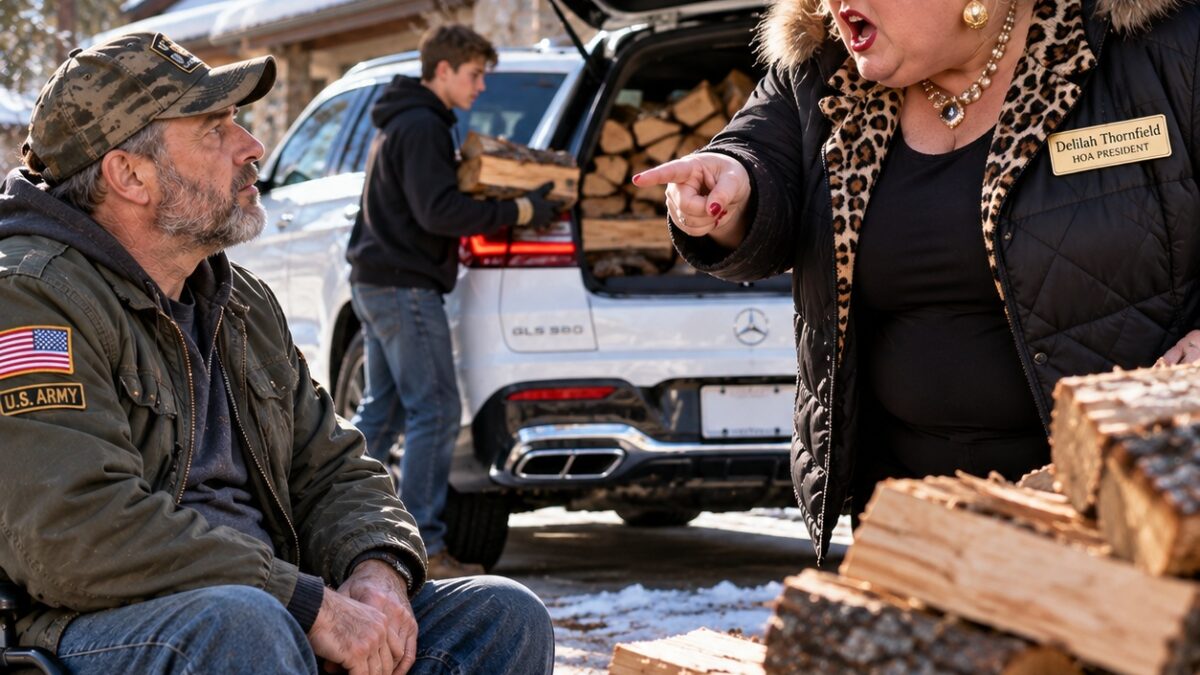
Delilah’s Mercedes idling near my property.
Her teenage son walking toward my wood pile.
Delilah standing beside the vehicle.
Watching the street.
The boy lifted one oak split.
Then another.
Then another.
Best pieces first.
He loaded them into the rear cargo area.
Delilah supervised the entire thing.
I watched the clip twice.
Then backed it up.
Three copies.
Cloud.
External drive.
Phone.
Old training.
Never trust one storage location.
That afternoon, I knocked on her door again.
She opened it holding coffee.
“I have footage.”
The cup stopped halfway toward her mouth.
“Of what?”
“You.”
Silence.
“And your son.”
More silence.
“Loading my firewood into your Mercedes.”
She recovered quickly.
“That material violated Section 4.7.2.”
“There is no Section 4.7.2.”
Her eyes narrowed.
“The wood constitutes a fire hazard.”
“You stole it.”
“I removed a hazard.”
“From private property.”
“As HOA president, I have enforcement obligations.”
“No.”
She stepped closer.
“Your tone is threatening.”
I almost laughed.
Not because it was funny.
Because I saw the move.
She could no longer deny the video.
So she was changing the story.
Not theft.
Enforcement.
Not victim.
Threat.
Not evidence.
Aggression.
By the end of that week, neighbors had heard that I was an unstable veteran with PTSD who had confronted a woman violently over firewood.
The phrase “combat trauma” appeared in conversations with people I barely knew.
I had not told most of those people anything about my medical history.
Delilah had.
That crossed another line.
Not because PTSD is shameful.
It is not.
But using a veteran’s diagnosis as a weapon to discredit him is something I have very little patience for.
So I filed another records request.
Financial statements.
Invoices.
Vendor payments.
And this time, I filed a complaint with the appropriate state oversight channels over the association’s refusal to provide records cleanly.
Delilah responded by calling an emergency board meeting.
No required advance notice.
No proper agenda distribution.
Topic:
“Problematic residents.”
Meaning me.
I went anyway.
Delilah sat at the front beside other board members.
She started with language about neighborhood harmony.
Safety.
Respect.
Threatening behavior.
When she finished, I stood.
Held up the original covenant.
“I’m trying to find Section 4.7.2.”
The room became quiet.
“Could somebody help me?”
No one answered.
I opened the document.
“The actual covenant allows homeowners to store heating fuel.”
Pages rustled.
People started reading.
One neighbor whispered to another.
Delilah interrupted.
“We’ve updated community standards since then.”
“Show the recorded amendment.”
“We don’t need to debate procedural technicalities.”
“That is exactly what an amendment is.”
The room changed.
Not completely.
But something cracked.
People who had spent years assuming Delilah knew the rules were reading them themselves.
That scared her more than anything I had said.
A few days later, my camera caught another theft.
Her son dropped a heavy oak split on the Mercedes hood.
The sound was glorious.
Metal.
A dinner-plate-sized dent.
He froze.
Looked around.
Then continued loading.
I saved that footage too.
The next morning, I started knocking on doors.
Not accusing.
Asking.
Mrs. Rodriguez invited me inside.
Tamales in the kitchen.
Flour on her hands.
She had been charged five hundred dollars for repairing a porch that was becoming unsafe.
“Architectural review fee.”
“Five hundred?”
“For replacing rotten boards.”
Bob had been cited for excessive vehicle storage.
Two vehicles.
His truck.
His dead wife’s sedan.
Delilah’s family owned four.
Another young couple had received lien threats over a toddler swing set.
An elderly widow had been ordered to remove a memorial garden her husband had planted because it allegedly attracted wildlife.
The pattern was not only selective enforcement.
It was selective money collection.
Violation.
Fee.
Processing charge.
Administrative penalty.
People were paying because the letters looked official.
Because foreclosure language frightens homeowners.
Because most people have jobs and children and sick parents and do not have time to become experts in HOA governance.
That night, twelve neighbors gathered inside my garage.
Coffee.
Folders.
Receipts.
Years of resentment.
Patricia Mills came with spreadsheets.
Retired teacher.
The kind of person who can reduce chaos to columns.
She had totaled unauthorized fees from our block alone.
More than eight thousand dollars.
Then she said:
“My daughter checked the state filings.”
Patricia’s daughter, Sarah, worked as a paralegal.
“What filings?”
“The association.”
She looked around the garage.
“Pine Ridge hasn’t filed required corporate documents for three years.”
Silence.
Bob stopped drinking coffee.
Mrs. Rodriguez stared.
I asked:
“What does that mean exactly?”
Patricia held up a printout.
“It means at minimum we have a serious authority problem.”
That sentence was careful.
Good.
I liked careful.
We did not immediately declare every action void.
We did not run through the neighborhood screaming that the HOA no longer existed.
We verified.
Sarah checked deeper.
We gathered documents.
I learned quickly that the original story some people would later tell online simplified the law too aggressively.
Corporate filing lapses can create serious consequences, but legal authority is not always as simple as “miss a report and everything vanishes.”
So we treated it correctly.
Evidence of noncompliance.
A major governance problem.
Something for counsel and regulators.
Not something to invent conclusions around.
That distinction became important because Delilah survived by inventing conclusions.
We would not copy her methods.
Then the next theft changed the scale.
My upgraded camera system captured Delilah moving more oak.
But she was not burning it.
She was selling it.
Facebook Marketplace.
Premium seasoned oak.
Three hundred dollars per load.
Customer photos.
Pickup arrangements.
Timestamps matching my footage.
She had turned my heating fuel into inventory.
I sat at my computer staring at one listing.
Seasoned Oak — Premium — Limited Supply.
My wood.
I had spent four hundred dollars I could barely spare to keep from freezing.
She had stolen it and built a side business.
That did something to me.
Not explosive anger.
Cold anger.
The kind that makes you very organized.
At the next HOA meeting, Delilah tried to have me removed for “community disruption.”
She packed the room with allies.
People who had done real-estate business with her.
Neighbors who owed favors.
Board members accustomed to agreeing.
Then Patricia stood.
“Before removing Mr. Caldwell, perhaps we should discuss the president’s firewood business.”
Screenshots went onto the table.
Facebook listings.
My camera timestamps.
The dented Mercedes footage.
Delilah’s face changed.
She tried to speak.
Patricia kept going.
“Why is the president selling premium oak that security footage shows being removed from another homeowner’s property?”
People started asking questions.
Fees.
Invoices.
Thornfield Property Solutions.
Mrs. Rodriguez brought her porch notice.
Bob brought his vehicle citation.
The young couple brought swing-set paperwork.
Delilah lost control of the room.
She shouted about harassment.
Threatened legal action.
Then left.
Three days later, a sheriff’s deputy came to my house.
Restraining-order petition.
Delilah claimed I had threatened violence.
The irony was almost too much.
But restraining orders are serious.
I could not afford private counsel on my disability income.
So I prepared myself.
Court morning was gray and cold.
Delilah had an attorney.
Expensive suit.
Polished shoes.
He described me as a combat veteran with documented PTSD and anger problems.
Judge Martinez looked at him over her glasses.
“Where is the threat?”
Her lawyer began discussing confrontations.
The judge repeated:
“What threat?”
Delilah testified.
She described my tone.
My size.
My military background.
My “aggressive presence.”
Then the judge asked for a specific statement where I threatened bodily harm.
Delilah could not provide one.
No witness.
No recording.
No message.
When my turn came, I showed the theft footage.
Calmly.
No speech.
No theatrics.
“Your Honor, these are the encounters she characterizes as threatening. I asked her to stop taking my heating fuel.”
The judge watched enough.
Then dismissed the petition.
Ten minutes.
Gavel.
Done.
Outside the courthouse, Delilah stared at me.
I said nothing.
That was important.
There was nothing useful left to say.
She retaliated by calling city code enforcement.
Illegal lumber business.
Commercial activity.
Inspector Mike arrived expecting something much larger than an injured veteran splitting wood for personal heat.
He looked at the pile.
Looked at me.
“Commercial?”
“No.”
“Selling?”
“No.”
“Personal heating?”
“Yes.”
He shook his head.
“I’m not citing people for staying warm.”
Complaint closed.
Meanwhile, Sarah continued working through financial records.
Contractor bills unpaid.
HOA reserves drained.
Delilah’s own mortgage reportedly in serious trouble.
The more we found, the more one thing became clear.
She was not merely power hungry.
She was financially desperate.
And financially desperate people who have normalized taking from others can become dangerous.
That was when I made the decision that later turned me into an internet story.
I want to be precise here.
I did not want to hurt Delilah.
I did not want to build something capable of hurting her.
I wanted evidence.
And I wanted her next theft to become impossible to deny.
So I replaced part of my visible wood pile with hollow decorative logs.
They looked like normal oak.
Inside, instead of anything harmful, I placed loose, non-toxic charcoal powder.
No shrapnel.
No flame.
No destructive charge.
Nothing designed to injure.
The point was simple.
If somebody stole one and handled it roughly, black powder would make the theft difficult to hide.
I added legal GPS tracking to several pieces and made sure cameras covered the pile.
That was enough.
Bob helped me test that the powder was simply messy.
Not dangerous.
Sarah insisted we keep everything focused on documentation.
Good.
By then, Delilah’s attacks on me had become uglier.
She began telling people veterans with PTSD were dangerous to families.
She suggested military disability attracted unstable residents.
That backfired spectacularly.
Bob called friends.
Other veterans started attending meetings.
Purple Heart recipients.
Bronze Star veterans.
A Medal of Honor recipient from the wider county veteran community.
They did not threaten anyone.
They simply stood up publicly and said:
“Stop using veterans as scarecrows.”
That mattered.
Because Delilah’s power depended on making targets seem isolated.
First me.
Then military families.
She kept creating larger groups of people willing to compare notes.
Sarah soon uncovered more issues in the association’s state filings and insurance-related claims.
The insurance records were especially interesting.
Delilah had apparently used photographs of my firewood while making claims about reducing neighborhood fire risks.
A fraud investigator became interested.
At that point, several processes were already moving independently.
Corporate compliance review.
Insurance inquiry.
Financial records.
Potential theft complaints.
Delilah did not know.
She kept stealing wood.
That was almost surreal.
Government agencies were beginning to examine her actions while she was still driving past my house planning her next morning raid.
Our neighbors began joking about the hollow logs.
I discouraged the joke from becoming recklessness.
“No one touches them except whoever chooses to steal them.”
That was the rule.
No traps on paths.
No device where an innocent person would encounter it.
Only objects inside my own wood pile.
The safest option would have been to let police handle every future theft without any deterrent.
In hindsight, that would have been cleaner.
But at the time, I wanted visible proof so undeniable that Delilah could not reinvent herself as a victim again.
Thursday was my next VA appointment.
The night before, I arranged the decoy logs among ordinary wood.
Then I went inside.
No celebration.
No countdown.
I slept badly.
Morning came.
I left loudly enough that anyone watching could see.
Not because I wanted to tempt her.
Because I had an actual appointment.
Patricia texted later.
Mercedes moving.
Then:
Across from your house.
Bob:
Engine idling.
I put my phone away while a VA nurse took blood.
There was something strangely peaceful about letting the cameras work.
For months, Delilah had made me feel like I had to be physically present every second or she would take something.
Now the property could record for itself.
Around eleven, my phone started vibrating.
I ignored it until the nurse finished.
Then looked.
Messages stacked one after another.
Patricia:
She’s at the pile.
Bob:
Confirmed.
Mrs. Rodriguez:
Her son is helping.
Then:
Oh my God.
I stared at that message.
Another arrived.
Black powder everywhere. Nobody appears hurt.
That mattered.
I exhaled.
Then another.
She keeps loading the wood.
I read it twice.
Even after the first decoy released charcoal powder, Delilah apparently kept taking logs.
Greed has remarkable momentum.
By the time I drove back to Pine Ridge, half the street seemed awake to what had happened.
I turned onto my road.
Saw the Mercedes first.
Rear cargo area open.
Oak stacked inside.
Then Delilah.
I almost did not recognize her.
White designer jacket turned gray-black.
Blonde hair dusted charcoal.
Hands black.
Face streaked from trying to wipe herself clean.
Her son stood beside the Mercedes looking miserable.
Black powder covered the leather interior.
Door handles.
Cargo floor.
Driveway.
Footprints crossed her concrete.
Neighbors stood at distances that were safe but close enough to see.
Phones out.
Delilah saw my truck.
Her face twisted.
“You psycho!”
I parked.
Got out slowly.
“What happened?”
“You tried to kill me!”
That accusation hit the neighborhood like a dropped plate.
Everyone went quiet.
I looked at her.
Then the firewood loaded into the Mercedes.
“Are you injured?”
“You booby-trapped your property!”
“Are you injured?”
She hesitated.
“No, but—”
“What is in your vehicle?”
“That has nothing to do with—”
Bob walked up beside me with his phone recording.
“Delilah, that’s Mack’s wood.”
She pointed at me.
“It was a fire hazard!”
Patricia approached from across the street.
“On his private property?”
“The HOA has authority.”
Mrs. Rodriguez already had emergency dispatch on the phone.
Delilah kept shouting.
The charcoal made every gesture worse.
Black fingerprints spread across her Mercedes door.
Her attempt to wipe her cheek left another streak.
If the situation had not involved months of theft, it would have been absurd.
Officer Martinez arrived.
Real police authority has a different feel than HOA authority.
No need for performance.
He stepped out.
Took in the scene.
Woman covered in black dust.
Luxury vehicle filled with wood.
Neighbors holding phones.
Me standing beside an obviously depleted wood pile.
“Everybody calm down.”
Delilah began immediately.
“He planted explosive devices!”
Martinez looked at me.
“Explosive?”
“No.”
“What is it?”
“Charcoal powder inside hollow decorative logs.”
“Anything flammable being ignited?”
“No.”
“Anything designed to injure?”
“No.”
“Any chemical irritant?”
“No.”
He looked at Delilah.
“Are you hurt?”
“My car is destroyed!”
“That isn’t what I asked.”
“No.”
Then he pointed toward the wood in her Mercedes.
“Whose is this?”
Delilah made the mistake that ended her ability to deny the core issue.
“I was removing it because his firewood violated community standards.”
Martinez paused.
“So you took it.”
“I removed a hazard.”
“From his property?”
“The HOA has—”
He raised one hand.
“Ma’am. Did you have his permission?”
Silence.
“No.”
There it was.
Not hidden.
Not implied.
A confession created entirely by her need to justify control.
I handed Martinez my phone.
Camera footage.
GPS data.
Multiple timestamps.
Bob offered his recording.
Patricia had photographs.
Mrs. Rodriguez had another angle.
Martinez looked through enough to understand the event.
He examined one of the remaining decoy logs.
No hidden violent mechanism.
Just a hollow decorative shell and messy black powder.
He turned back toward Delilah.
“Getting dirty while taking somebody else’s property does not make the taking legal.”
She pointed at me.
“He’s an unstable PTSD veteran!”
Three veterans stepped closer.
Not aggressively.
Just visibly.
Bob.
Mrs. Lucy’s son.
Mr. Rodriguez.
Martinez looked at Delilah differently.
He had military service himself.
I could tell from conversation and insignia.
“His medical history is not the issue.”
Then:
“Taking property without consent is.”
That sentence traveled through Pine Ridge faster than any HOA notice ever had.
Within hours, videos were circulating.
I did not post them.
Others did.
That part bothered me somewhat.
Public humiliation can become its own kind of cruelty.
But the central fact was now impossible to hide.
Delilah had been filmed repeatedly taking firewood from a disabled homeowner.
Her vehicle contained the wood.
She admitted taking it.
The charcoal merely made the scene visually unforgettable.
Monday night’s emergency HOA meeting drew forty-three of forty-seven homeowners.
I had never seen the community center so full.
Local media showed up.
Off-duty officers were there for security.
Delilah arrived in a conservative suit.
No bright athleisure.
No oversized sunglasses.
No performance confidence.
Some charcoal still appeared trapped around her fingernails.
She opened:
“We are here to address a terrorist-style attack against elected community leadership.”
The room murmured.
I sat near the back with one folder.
Not twenty.
One.
Organized.
She continued describing me as dangerous.
Militarized.
Unstable.
Then I stood.
“Before we discuss the charcoal, can we discuss the wood?”
The room quieted.
I walked forward.
Placed GPS records on the table.
“Logs moved from my property to Delilah’s vehicle while I was at a VA medical appointment.”
Then camera stills.
“Video shows the removal.”
Then the original 1987 covenant.
“The rule she claimed I violated does not appear in the recorded covenant.”
Delilah interrupted.
“Community standards evolve.”
“Then show the valid amendment.”
She could not.
Patricia stood next.
“Our corporate filings have also been delinquent for years.”
Sarah, careful and professional, explained the implications.
She did not overstate.
She explained that the filing failures, unauthorized collections, undocumented amendments, and financial practices created serious legal and regulatory problems.
Then she showed what had already been referred for review.
Insurance claims involving supposed fire hazards.
Financial records.
Vendor payments.
Delilah tried to pivot.
“This is all distraction from Mr. Caldwell’s attack.”
Bob stood.
“Attack?”
He put the Facebook Marketplace screenshots on the screen.
Delilah selling seasoned oak.
My oak.
Three hundred dollars per load.
Customer reviews.
Dates.
The room went silent.
Mrs. Rodriguez followed.
Her bogus five-hundred-dollar porch fee.
Young parents.
Swing-set threat.
Bob.
Vehicle-storage violation.
Mrs. Lucy.
Garden dispute.
One after another.
Not a mob.
A record.
That difference matters.
Nobody needed to scream.
Delilah’s system became obvious simply because people finally spoke in the same room.
Jessica Martinez from the local news station stood.
“Ms. Thornfield, do you have a response to allegations that you collected unauthorized fees while the association’s filings were delinquent and that you sold firewood taken from a homeowner?”
Delilah’s attorney whispered to her.
Then stood.
“My client will not make further substantive statements while investigations are pending.”
That silence was more powerful than any speech I could have given.
The board vote came afterward.
Remove Delilah from office.
Forty-one in favor.
Zero opposed.
Two abstentions.
Even people who had supported her for years would not defend the evidence in front of them.
When the result was announced, there was applause.
I did not stand.
I looked around the room instead.
Mrs. Rodriguez crying.
Bob nodding.
Patricia breathing like she had been holding air for three years.
Older homeowners staring at old violation notices in their laps.
That was the real moment.
Not Delilah losing.
Neighbors realizing they had never been powerless in the first place.
They had simply been separated.
The legal aftermath took months.
Real life is slower than viral stories.
There were investigators.
Interviews.
Bank records.
Insurance records.
Restitution calculations.
Delilah ultimately faced consequences involving fraud-related conduct and unauthorized collections.
She was ordered to repay money to affected homeowners.
Her real-estate career suffered licensing consequences.
The association’s finances were examined.
The exact legal language mattered less to me than one simple fact:
She no longer controlled Pine Ridge.
That alone changed the neighborhood almost immediately.
The emergency board election replaced her circle with people everyone already trusted.
Bob became treasurer.
Patricia handled records.
Mrs. Rodriguez became community liaison.
The new board’s first major act was not dramatic.
They opened the books.
That was all.
Every homeowner could see where money had gone.
Dues.
Invoices.
Maintenance.
Accounts.
No mystery.
No perfume-scented envelopes with invented processing fees.
No surprise meetings.
No threats.
Annual dues dropped substantially once unnecessary fees and questionable spending disappeared.
The difference between a good HOA and a bad one turned out to be painfully boring.
Transparency.
Procedure.
Actual votes.
Recorded amendments.
No one person controlling interpretation.
Pine Ridge slowly became the place many of us thought we had purchased into.
Then something happened I never expected.
Firewood became a community event.
Every October, instead of forty-seven households individually paying inflated delivery charges, we began making a bulk order.
Families gathered on weekends.
Split.
Stacked.
Shared.
Older residents who could not lift got help.
Younger people learned how to season wood properly.
Kids carried small pieces.
Mrs. Rodriguez arrived with food.
Bob complained about everybody’s splitting technique.
Patricia made spreadsheets.
Of course she did.
The sound of mauls hitting wood replaced the sound of violation letters being dropped into mailboxes.
The first year, I stood near the community pile and nearly laughed.
The thing Delilah had tried to use as a weapon had become the neighborhood’s strongest tradition.
No one stole anything.
If somebody needed extra wood, they asked.
Sometimes a person on a fixed income could not afford their full share.
We covered it.
Quietly.
No public charity performance.
That mattered to me.
I remembered spending my last four hundred dollars.
Remembered standing beside the missing pile wondering whether I would be choosing between heat and groceries.
No one in Pine Ridge should feel that way if the rest of us had wood stacked ten houses away.
The Rodriguez garden came back too.
Bigger.
Brighter.
Their blue shutters stayed.
No one cared.
The association eventually designated their cultural garden as a community gathering space.
Kids played there.
Families sat.
Mrs. Rodriguez pretended not to enjoy being right about everything.
Bob converted part of his garage into a shared workshop.
People borrowed tools.
Fixed snowblowers.
Repaired porch boards.
Veterans started meeting there once a month.
Not therapy exactly.
Support.
VA paperwork.
Home modifications.
Wheelchair ramps.
Heating repairs.
Things veterans sometimes need more than another speech about gratitude.
I helped where my leg allowed.
Some days that meant calculations.
Some days simply coffee.
The strangest part was what happened to me.
I had entered the fight thinking only about surviving winter.
Then theft.
Then evidence.
Then stopping Delilah.
But once the crisis ended, I realized how isolated I had become before any of it started.
After the IED.
Medical retirement.
Divorce.
Fixed income.
Pain.
I had become good at functioning alone.
Too good.
I knew exactly how much help I could avoid asking for.
The neighborhood conflict forced me to open my garage.
First to twelve angry neighbors.
Then more.
Eventually the garage stopped feeling like a bunker.
People came through it.
Bob.
Patricia.
Mrs. Rodriguez.
Veterans.
Young families.
My life got louder.
Better.
That was not Delilah’s gift.
I refuse to give abusers credit for what their victims build after surviving them.
It was our response.
Our choice.
The charcoal video became famous.
Much more famous than I wanted.
Millions of views eventually.
People online called me a genius.
A revenge engineer.
Some gave the decoy logs dramatic names.
I disliked most of it.
Because the viral clip made the entire story look like one clever trick.
It was not.
If all I had done was make Delilah dirty, nothing important would have changed.
She could have cleaned her Mercedes.
Changed jackets.
Invented another story.
What ended her control was documentation.
The original covenant.
Camera footage.
Marketplace listings.
Financial records.
Neighbors comparing notices.
Regulatory complaints.
Insurance records.
Corporate filings.
Police reports.
Witnesses.
The powder made a memorable picture.
Paper made consequences possible.
That is the lesson I kept repeating whenever someone asked how to “get revenge” on an HOA bully.
Do not begin with revenge.
Begin with the rules.
Read them.
Get the actual recorded version.
Keep letters.
Keep envelopes.
Save emails.
Request financials.
Document meetings.
Record legally where your jurisdiction permits.
Photograph your property.
Verify claims.
Ask who approved the fee.
Ask where the rule exists.
Ask when it was amended.
Ask how it was adopted.
Real authority can usually survive questions.
Fake authority gets angry when asked for evidence.
Delilah had become furious the first time I asked which supplier delivered the wood she claimed was hers.
Same pattern.
Ask one specific question.
The performance cracks.
Months later, one of the younger families asked me to speak at a homeowner workshop.
I almost refused.
Public speaking was never my thing.
Explosives and bridges were easier than microphones.
Patricia threatened to introduce me as “Professor Charcoal” if I declined.
I went.
The room had people from neighboring communities.
They expected the story.
The black Mercedes.
The screaming HOA president.
I gave them five minutes of that.
Then held up the original 1987 covenant.
“This is what mattered.”
A man raised his hand.
“Not the trap?”
“No.”
“The footage?”
“Useful.”
“The powder?”
“Messy.”
People laughed.
I waited.
“The document.”
I tapped it.
“She told me Section 4.7.2 prohibited my firewood.”
I flipped pages.
“It did not exist.”
That changed the room.
I told them:
“Titles are not laws.”
HOA president.
Board member.
Property manager.
Neighbor.
Veteran.
Engineer.
None of those titles make a person automatically correct.
Authority has a source.
Find it.
Delilah had trained Pine Ridge to respond to tone.
If she sounded certain, people paid.
The cure was not finding somebody louder.
The cure was teaching forty-seven households how to ask:
Where does it say that?
Those six words did more than any pile of charcoal.
The new board made that question part of the culture.
Not disrespectfully.
Productively.
If Patricia proposed a rule change, someone asked for the covenant basis.
She showed it.
If Bob recommended spending, homeowners saw numbers.
If Mrs. Rodriguez wanted garden funding, she put it on the agenda.
It became almost boring.
I loved it.
Healthy governance should usually be boring.
Bridges are the same.
Nobody wants an exciting bridge.
You want one that does its job every day without becoming the evening news.
The veteran group expanded.
We helped twelve families in the county during the first period.
One needed a wheelchair ramp.
Another needed someone to help navigate a VA heating grant.
One older Marine could no longer split his own wood.
We did it.
He hated accepting help.
I understood.
I stood beside him while the others worked.
“You don’t like this.”
“No.”
“Me neither.”
He looked at my leg.
“You?”
“Still terrible at it.”
He smiled.
That was enough.
Communities work better when help is normal rather than humiliating.
Delilah’s system had done the opposite.
Turned vulnerability into revenue.
Old?
Fee.
Young family?
Fee.
Different culture?
Violation.
Veteran?
Threat.
Financially stressed?
Pressure.
That was what made her behavior so destructive.
Not merely stealing money.
She found whatever made someone easiest to isolate and pushed there.
The answer was connection.
Mrs. Rodriguez knew the young parents.
Bob knew veterans.
Patricia knew records.
Sarah knew filings.
I knew systems.
Everyone had one piece.
Together, the pattern became obvious.
That may be the most important thing I learned.
Abuse often looks random when viewed one victim at a time.
Put experiences in the same room and suddenly it has architecture.
That is why Delilah feared meetings she did not control.
Architecture becomes visible.
A year after her removal, Pine Ridge held a normal annual meeting.
No news cameras.
No police.
No screaming.
Forty people attended.
Some complained about snow removal.
Someone wanted different mailbox paint.
Mrs. Rodriguez argued for more garden funds.
Bob complained the budget assumptions were “optimistic nonsense.”
Patricia told him to sit down.
I sat in the back.
Smiling.
That was democracy.
Messy.
Annoying.
Transparent.
No dictator.
No hero.
Just neighbors.
At the end, Patricia asked if I wanted to join the board.
“No.”
“Mack.”
“No.”
“You’d be good.”
“That is exactly how these things start.”
She laughed.
I continued:
“You don’t replace a tyrant by making another person indispensable.”
That became one of the new board’s unwritten principles.
Term limits.
Shared responsibility.
No one-person kingdoms.
Even good people need limits.
Especially good people who become convinced their judgment is always right.
I had seen enough command structures to know that.
The community later created a small scholarship fund using recovered money and voluntary donations.
Two thousand dollars annually.
Engineering.
Legal studies.
Public service.
The first winning essay was about institutional accountability.
I read it twice.
The student wrote something that stayed with me:
Corruption grows fastest when ordinary people mistake procedure for someone else’s responsibility.
Exactly.
Delilah had attended meetings.
Filed notices.
Sent bills.
People assumed somebody somewhere must have verified her authority.
Nobody had.
Procedure only protects you when people participate.
I eventually became involved in veteran outreach beyond Pine Ridge.
Not because I wanted to turn into a public figure.
Because Delilah’s anti-veteran campaign had exposed something ugly.
PTSD is still misunderstood.
People hear the acronym and imagine violence.
Danger.
Instability.
Most veterans I know with PTSD are far more likely to hurt quietly than hurt someone else.
I started talking openly about that.
My leg.
My appointments.
My sleep.
The fact that asking someone not to steal my firewood was not “combat aggression.”
You can be injured and rational.
Traumatized and safe.
Angry and disciplined.
Delilah had used my diagnosis because she thought shame would make me retreat.
Instead, veterans showed up.
That was one of the few things about the whole ordeal that still makes me smile immediately.
The first time Bob walked into a meeting with three other veterans, Delilah’s face changed.
She had turned one man’s medical history into a stereotype.
Then actual veterans filled the room.
Reality again.
Always the same ending.
Reality is extremely inconvenient for people who rely on caricatures.
My finances improved slowly.
Not dramatically.
I still lived on disability.
Still watched every bill.
But bulk purchasing cut heating costs.
The new HOA dues were lower.
Shared tools saved money.
Neighbors helped.
The community itself became cheaper to live in because people stopped feeding Delilah’s private fee machine.
That was justice I could feel every month.
Not headlines.
Bank balance.
Heat.
One winter morning, temperatures dropped hard again.
The kind of cold that started everything.
I went outside before dawn.
Snow crusted the yard.
My wood pile stood covered and full.
No missing section.
No Mercedes tracks.
No camera alert.
I lifted one normal split.
Real oak.
Solid.
Carried it inside.
The stove caught.
Heat spread.
I sat down with coffee.
And realized I was waiting for something.
Conflict.
An engine.
A knock.
A notice.
Nothing came.
For months, chaos had trained my body to expect the next escalation.
Peace initially felt suspicious.
Then it became ordinary.
That is when I knew the story was really over.
Not when Delilah lost the vote.
Not when investigators acted.
When I could look at firewood and think only:
Heat.
Objects deserve to become ordinary again after conflict.
A wood pile should be fuel.
Not evidence.
A garage should be a workshop.
Not a war room.
A neighborhood meeting should be boring.
Not a battlefield.
That transformation took longer than the legal one.
People underestimate what prolonged harassment does to your nervous system.
The body begins scanning.
Car outside?
Threat.
Envelope?
Threat.
Unknown number?
Threat.
Doorbell?
Threat.
Even after the person is gone, your body remains employed by them.
It took months to fire Delilah from my nervous system.
Community helped.
Routine helped.
Work helped.
I rebuilt an old bench in Bob’s garage.
Helped Mrs. Rodriguez repair garden irrigation.
Split wood.
Attended VA appointments without wondering what would be missing when I returned.
That last one mattered.
For months, Delilah timed thefts around my medical care.
Think about that.
She used the hours I spent dealing with injuries from military service as opportunities to take the fuel I needed to stay warm.
There is cruelty in that beyond the dollar value.
I began associating VA appointments with vulnerability at home.
After her removal, the first few appointments were difficult.
I would check cameras repeatedly.
Then less.
Eventually not at all until I returned.
Nothing missing.
Trust rebuilt.
Not trust in Delilah.
Trust in my environment.
A safe community is partly a place where you can leave your house without imagining your neighbors exploiting your absence.
Pine Ridge became that again.
Sarah later told me investigators appreciated how organized our evidence was.
I laughed.
“Engineer.”
She nodded.
“You timestamp everything.”
“Yes.”
“You even labeled the firewood camera angles.”
“Of course.”
“You are exhausting.”
Also true.
She became an attorney later.
I was not surprised.
Patricia was.
Not that Sarah succeeded.
That she willingly entered a profession involving so much paperwork after spending childhood with Patricia’s spreadsheets.
We stayed in touch.
She sometimes sent homeowners to me when they needed someone to explain a plat in plain English.
I always started with a warning.
“I’m not your lawyer.”
Then:
“Show me the document.”
Patterns become habits.
Years later, people still occasionally asked about Delilah.
Where she was.
Whether she apologized.
Whether the Mercedes was ever clean.
I did not know.
At some point, I stopped following.
That surprised people.
“How can you not want to know?”
Because knowing no longer improved my life.
Her legal consequences belonged to her.
My heat worked.
My neighbors were sane.
My wood stayed where I put it.
That was enough.
I did not need photographs of Delilah suffering to prove what happened mattered.
Revenge has a maintenance cost.
You keep checking.
Keep thinking.
Keep feeding attention into the person who hurt you.
I had better uses for attention.
Veterans.
Neighbors.
Winter preparation.
My own recovery.
That was freedom.
Not beating Delilah forever.
Reaching the point where beating her stopped being relevant.
The famous black-powder morning became almost funny with time.
Almost.
I can laugh at the image.
White jacket.
Gray hair.
Black fingerprints.
Mercedes interior looking like a chimney exploded.
But I never forget what came before.
A disabled man choosing between heat and groceries.
A widow losing a garden.
A family losing money.
Young parents scared by lien threats.
A community paying invented fees because nobody believed they could challenge the president.
The powder made people laugh.
The abuse was not funny.
That distinction matters when retelling the story.
Viral videos flatten context.
They turn long suffering into one satisfying payoff.
Real justice should do more than entertain.
It should reduce the chance of another victim.
That is why the new controls mattered more than Delilah’s embarrassment.
Independent review.
Open books.
Recorded rules.
Community participation.
Those changes are not viral.
They are useful.
One fall, during the annual wood-splitting weekend, a young boy asked why everybody worked together.
His father started explaining cost savings.
Bulk purchase.
Labor sharing.
The boy looked bored.
I gave him a simpler answer.
“Because winter is cold.”
He nodded.
That made sense.
Then I added:
“And nobody here freezes alone.”
His father looked at me.
I had not planned the sentence.
It stayed.
The next year, Patricia put it on a small sign near the community wood shed.
NOBODY FREEZES ALONE.
I pretended to hate it.
Secretly loved it.
That sign represented the exact opposite of Delilah’s Pine Ridge.
Her version asked:
What can I extract from your problem?
Ours asked:
What can we share?
Same forty-seven houses.
Different culture.
Leadership matters.
Systems matter.
People matter most.
Bob’s wife had been gone almost as long as my military career felt.
He eventually sold her sedan.
That was a big day.
He asked me to go with him.
We drove it to a young woman buying her first car.
Bob handed over the keys.
His hands shook.
On the drive back, neither of us spoke for a while.
Then he said:
“Thought I was keeping her by keeping the car.”
I looked out the window.
“Did it work?”
“No.”
Pause.
“You?”
“What?”
“Anything you’re keeping because you think losing it means losing someone?”
I thought about my old uniforms.
Boxes.
A few things from before the injury.
“Probably.”
Bob nodded.
We never finished the conversation.
Did not need to.
That was another form of community.
People who know where silence belongs.
Pine Ridge had become full of those small connections.
Mrs. Rodriguez brought tamales when my leg flared badly.
Patricia helped a widower sort medical-billing paperwork.
Young parents shoveled Mrs. Lucy’s driveway.
None of it required HOA enforcement.
The best community behavior was never produced by fines.
That amused me.
Delilah had believed control created standards.
In reality, trust created participation.
People take care of places they feel belong to them.
Threaten them constantly and they retreat into compliance.
Invite them and they contribute.
That is not complicated.
It took us years of nonsense to learn.
The scholarship student eventually came to one of our veteran meetings.
She was studying engineering.
Asked about Afghanistan.
I gave the answer I usually gave.
“Hot.”
She laughed.
Then asked:
“Did military engineering help you beat Delilah?”
I thought.
“Not the way people think.”
“What way?”
“Systems thinking.”
I pointed toward the whiteboard we used for community projects.
“You learn that visible failure is rarely the entire failure.”
She waited.
“Missing firewood was visible.”
“What was underneath?”
“Bad governance. Financial desperation. Secrecy. Isolation. People afraid to compare information.”
She nodded.
“So the powder wasn’t the solution.”
“No.”
“What was?”
“Connection.”
That surprised her.
Probably expected “documentation.”
Documentation too.
But information is useless if everyone keeps it alone.
The garage meeting changed everything.
Twelve people.
Coffee.
Folders.
That was the turning point.
Before that, Delilah had twelve separate problems she could bully individually.
After that, she had one informed community.
Much harder.
I began volunteering with homeowner education events because of that.
Nothing fancy.
Libraries.
Community centers.
Veteran groups.
I taught people how to organize records.
Folder structure.
Timeline.
Official versus unofficial documents.
Receipts.
Meeting notices.
Not legal advice.
Administrative survival.
People laughed at my labels.
Then called months later to say a timeline helped their attorney understand a two-year dispute in twenty minutes.
Engineers appreciate compression.
Chaos turned into sequence.
That is powerful.
I used Delilah’s firewood case as an example.
Month one:
Theft.
Rule citation.
Request rule.
No rule.
Month two:
Records.
Selective enforcement.
Marketplace sales.
Month three:
Community comparison.
Financial concerns.
False legal action.
Insurance issues.
Police evidence.
Meeting.
Removal.
When arranged chronologically, her story looked very different from:
“Difficult veteran keeps arguing with HOA president.”
Narratives are shaped by sequence.
Bullies often isolate each incident so it looks reasonable.
A fine.
A complaint.
A meeting.
Another fee.
One at a time.
Put them in order.
Pattern.
That is why I tell people:
Make a timeline before making a speech.
Speeches disappear.
Timelines remain.
My life became quieter over the years.
Pain in my leg never left.
Some days better.
Some worse.
I learned to stop treating limitations as moral failures.
The Army had trained us to push.
Civilian disability required a different discipline.
Rest before collapse.
Accept help before injury.
Use tools.
Ask.
Delilah had tried to shame disability.
The community response eventually taught me something healthier.
Being able to do everything alone is not strength.
Being able to build systems where people support one another is stronger.
Combat engineering is like that too.
No bridge gets built because one guy is tough.
Teams.
Measurements.
Materials.
Sequence.
Community.
Maybe I should have known.
One winter, my furnace finally died completely.
Years after the original story.
The old unit simply quit.
I stared at it.
Then laughed.
Of course.
The machine that began the entire firewood saga had finally chosen retirement.
Bob helped install a replacement.
The veteran group covered labor.
I paid materials over time.
While we worked, Patricia stopped by.
“Are we allowed to have this furnace?”
I stared.
She smiled.
“Section 4.7.2.”
I threw a shop rag at her.
We laughed until my side hurt.
That was healing too.
The invented rule had become a joke.
A thing that once scared people now produced laughter.
Fear loses power when a community learns its tricks.
We kept the original fake notice in the HOA archive.
Patricia insisted.
“Why preserve garbage?”
“History.”
“It’s embarrassing.”
“Exactly.”
She placed it in a folder with notes explaining what happened.
Future boards would see.
I changed my mind.
Institutions should remember failures.
Otherwise new leaders reinvent them.
The archive included:
Unauthorized fee examples.
Financial corrections.
Governance reforms.
Meeting minutes from Delilah’s removal.
Not as a shrine.
A warning.
No one is above process.
That phrase went into the new board handbook.
I wrote it.
Did not join the board.
Still proud.
Years later, a new president took office.
Quiet man.
Accountant.
First meeting, he said:
“If I ever start acting like I own your houses, remove me.”
Everyone laughed.
Good sign.
He served two terms.
Left.
No scandal.
Perfect.
I barely remember his name compared with Delilah’s.
That is the highest compliment I can give a community leader.
Do the work so competently nobody tells dramatic stories about you.
The annual wood day continued.
My original supplier started giving us a bulk discount.
He learned why the neighborhood had organized.
First time he delivered, he looked at me.
“You’re the charcoal guy.”
“I’m the guy who pays for his own oak.”
He laughed.
“Fair.”
We unloaded.
Real logs.
Solid.
No surprises.
Children helped stack.
I watched them and thought about the first pile.
My last four hundred dollars.
Fear.
Missing wood.
If somebody had told me then that years later forty-seven families would stack together, I would have thought they were being sentimental.
Yet there it was.
Community is sometimes built around the exact place harm occurred.
Not because harm was necessary.
Because people decide the response will be collective.
That difference always mattered to me.
I never thanked Delilah.
I never said:
Everything happened for a reason.
No.
She stole.
Lied.
Targeted people.
Used my military history against me.
Those were choices.
Wrong choices.
We created something good afterward.
That belongs to us.
Not her.
The scholarship.
Wood day.
Veteran network.
Transparent board.
Shared workshop.
Those are responses.
Victims own their responses.
Abusers do not get credit.
I repeated that to Maria once when she said maybe her family’s property fraud had “led her” toward engineering.
“It influenced you.”
“Yes.”
“But the person who hurt your family does not get credit for your career.”
She thought.
Then smiled.
“I like that.”
“Good.”
That lesson had taken me years.
People tell survivors:
Look how strong it made you.
Maybe.
But strength does not make the injury justified.
I would have preferred my leg intact.
I would have preferred Elena still alive.
I would have preferred never learning Delilah’s name.
Still, here we are.
You build with what remains.
Engineers understand that too.
Existing conditions.
You cannot design for the site you wish you had.
You design for the actual ground.
My actual ground contained injury.
Loss.
Fixed income.
Bad furnace.
A corrupt HOA president.
Then neighbors.
Evidence.
Wood.
A second chance at community.
I built from there.
Today, my winter wood sits under a proper covered rack.
Nothing special.
Solid logs.
Seasoned.
Stacked evenly.
The cameras remain.
Not because I expect theft.
Habit.
Security.
I do not stare at the alerts anymore.
Most clips are deer.
Occasional fox.
Bob walking over without texting.
One time Patricia stealing exactly one log.
She looked directly at the camera.
Held up a note:
SECTION 4.7.2
I laughed for five minutes.
Then charged her a twenty-five-dollar administrative processing fee.
She paid me in cookies.
Fair settlement.
That is what power looks like after fear.
Play.
You can joke about the symbol because it no longer owns you.
The black powder story will probably follow me forever.
Fine.
If it brings somebody to a meeting where they learn to read their HOA documents, good.
But whenever anyone asks for the “secret,” I disappoint them.
There was no secret.
Read.
Record.
Compare.
Connect.
Get actual legal help when needed.
Call authorities when conduct becomes criminal.
Do not let humiliation become the goal.
And never assume a title means somebody has rights they cannot show you on paper.
Delilah believed I would respond emotionally.
She was partially right.
I was furious.
Scared about heat.
Humiliated by the veteran stereotypes.
Angry enough sometimes that my hands shook.
The difference was what I did next.
I did not make anger the evidence.
I used anger as fuel to keep reading.
That is an engineering response.
Emotion gives energy.
Process gives direction.
Without process, energy becomes damage.
I had already seen enough damage.
The last time I saw Delilah in person was long after everything.
Across a parking lot.
Not Pine Ridge.
A shopping center.
She looked different.
Smaller somehow.
Not physically.
Context.
No Mercedes.
No HOA clipboard.
No crowd obliged to listen.
She saw me.
I saw her.
For half a second, old adrenaline rose.
Then disappeared.
She turned away.
So did I.
No confrontation.
No speech.
No need.
I realized she had become exactly what I wanted.
Irrelevant.
That was the real final victory.
If your peace requires your enemy to keep suffering, your enemy still holds a key.
I took mine back.
At home that evening, I lit the stove.
Wood caught.
Flame.
Warmth.
I sat in my chair.
Outside, snow moved across Pine Ridge.
Somewhere down the street, children were laughing.
Bob’s workshop light glowed.
The Rodriguez garden slept beneath winter.
Nothing dramatic.
No sirens.
No black cloud.
No cameras.
Just heat.
I thought about the first stolen third of my pile.
How violated I felt.
Not because wood is sacred.
Because somebody had looked at my financial vulnerability and treated it like an opportunity.
Now I sat in a community where nobody needed to guard their heating fuel from the president.
That was enough.
More than enough.
People online remember Delilah standing beside a charcoal-covered Mercedes.
I remember something else.
A garage with twelve neighbors.
Documents spread across my workbench.
Everybody realizing:
It happened to you too?
That was the exact moment her power began dying.
Not the powder.
Not police.
Not television.
Recognition.
You too?
Me too.
Show me your notice.
Here is mine.
That is how fear becomes evidence.
That is how isolation becomes community.
That is how a bully becomes one person standing against forty-seven homeowners who finally know what happened.
My engineering career taught me structures fail when loads exceed what isolated components can carry.
The solution is often distribution.
Share load.
Tie members together.
Create redundancy.
That is exactly what Pine Ridge did.
One homeowner alone could be frightened.
Forty-seven comparing records were much harder to deceive.
Sometimes social systems follow the same physics as bridges.
Connection creates strength.
I am still learning that.
The IED changed my leg.
The Army changed my reflexes.
Delilah changed nothing fundamental about me.
What changed me was the neighborhood that formed in response.
I stopped believing independence meant doing everything alone.
I stopped treating help as debt.
I stopped assuming asking questions made me difficult.
I started saying:
Show me.
Then listening.
That is a better life than the one I had before the theft.
Not because theft improved me.
Because people did.
If Elena had been part of this story—she was not, and I will not invent her where the source did not place her—I imagine she would have laughed at the charcoal.
But this is not her story.
It is mine.
A disabled veteran.
A firewood pile.
An HOA president who thought scarcity made me weak.
A neighborhood that finally stopped normalizing abuse.
That is enough.
The mountains are quiet tonight.
Snow has begun again.
The wood stove burns steady.
Outside, my covered stack sits beneath the light.
No one is stealing it.
Tomorrow Bob and I are helping an older couple repair their heating system before another cold front.
Mrs. Rodriguez is sending food.
Patricia has already made a checklist nobody asked for.
Normal Pine Ridge.
The kind of normal we should have had all along.
I place another split into the stove.
The wood catches.
Heat spreads through the room.
Four hundred dollars once bought me survival.
Three months of harassment taught forty-seven families to pay attention.
And one ridiculous black cloud finally gave everyone a picture they could not ignore.
But the picture was never the point.
The point was what happened after the smoke cleared.
People read.
People compared.
People spoke.
People voted.
People changed the system.
That is why Pine Ridge survived Delilah.
Not because one veteran was clever.
Because an entire neighborhood stopped acting like abuse was normal.
Delilah thought authority meant everyone else staying quiet.
She was wrong.
Authority without accountability is only intimidation wearing a nicer jacket.
And jackets wash.
Titles disappear.
Mercedes get sold.
Boards change.
But once people learn to ask where power comes from, it is very difficult to make them kneel again.
That is what I learned.
That is what Pine Ridge learned.
And every winter, when I stack my firewood in neat rows beneath the Colorado sky, I remember the simplest question that started everything:
Who gave you permission to take what belongs to me?
Delilah never had a good answer.
Eventually, the whole neighborhood noticed.
And after that, she never really had power again.

