PART2:My Fiancée Humiliated the New Maid for Three Days—Then I Stood Up at Rehearsal Dinner and Called the Maid “Mom”
PART2
I almost called the entire thing off before it started.
Not the wedding.
The plan.
When Mom stepped from the staff corridor wearing the uniform, something in my chest tightened.
The black dress was simple.
White collar.
Comfortable shoes.
Hair pinned back.
No jewelry except her wedding band, which she still wore more than two decades after my father died.
The sight pulled me backward.
Not to childhood exactly.
To fragments.
Mom leaving before dawn.
A cleaning cart.
The smell of lemon disinfectant on her coat.
A pair of work shoes drying near a radiator.
I hated seeing her dressed that way again.
She noticed.
“You’re making that face.”
“What face?”
“The one where you think money means I should be embarrassed by old work.”
“I don’t think that.”
“You’re close.”
I lowered my voice.
“We don’t have to do this.”
“Yes, we do.”
“No, we don’t.”
“You asked me if I trusted Caroline.”
“And you said you weren’t sure.”
“So let me become someone she doesn’t need to impress.”
“That sounds manipulative.”
Mom smiled faintly.
“It is observation.”
“You’re going undercover in my own house.”
“Undercover sounds much more exciting.”
“Mom.”
Her expression softened.
“Daniel, you’re about to marry someone.”
“I know.”
“You’re tying your life to hers.”
“I know.”
“And you are not a poor boy anymore.”
I hated where she was going.
“People behave differently around power.”
“I know that.”
“Do you?”
That irritated me.
“I run a company.”
“Yes.”
“So?”
“So almost everyone you meet now knows who you are before you say hello.”
I looked away.
She was right.
Restaurants.
Meetings.
Charity events.
Even neighbors.
Somebody always knew.
My photograph had been in business magazines.
Our company had become too visible.
Caroline had met me as Daniel Harper, founder.
Not Daniel whose mother cleaned offices after midnight.
Mom touched my sleeve.
“I am not trying to embarrass her.”
“What if she passes?”
“Then I apologize to you for doubting.”
“And if she doesn’t?”
Mom’s eyes were sad.
“Then I hope you love yourself enough to believe what you see.”
That was my mother.
Never dramatic when drama would have been easier.
I nodded.
Then the estate manager, Mr. Aldridge, walked over.
He had worked for me six years.
Former hotel operations executive.
Impossibly discreet.
“Mrs. Harper, everything is arranged.”
Mom gave him a look.
“Mrs. Marris.”
He corrected himself immediately.
“Of course.”
I exhaled.
“Three days.”
Mom nodded.
“Three days.”
I did not know then that I would need less than one.
Caroline arrived around four that afternoon.
Wedding planners were already coming and going.
Florists.
Rental coordinators.
Catering managers.
Bridesmaids.
Her phone seemed permanently attached to her hand.
She entered through the main foyer in a pale silk blouse, speaking quickly about seating arrangements.
Mom stood near the staircase.
Hands folded.
She looked exactly like a temporary staff member trying not to be noticed.
Caroline noticed her anyway.
Not as a person.
As an object requiring adjustment.
She lowered the phone.
“You’ll want to stand straighter.”
Mom blinked.
“Excuse me?”
“It looks more professional.”
Mom straightened a little.
“Yes, ma’am.”
Caroline resumed her call before Mom had finished answering.
That was the first thing.
Small.
Easy to excuse.
Professional standards.
Nothing cruel.
I told myself that.
I was standing near the mantel pretending to review an email.
Ten minutes later, Caroline handed Mom her coat.
No greeting.
No eye contact.
She simply extended the coat in Mom’s direction and released it before my mother fully had it.
Mom caught it.
Barely.
Caroline kept walking.
I looked at Mr. Aldridge across the hall.
He looked back.
Neither of us spoke.
Observation.
That was the agreement.
Then came the delivery.
A florist had left two boxes near the service hall.
Mom approached Caroline.
“Where would you like these placed?”
Caroline looked up from her phone.
“What?”
“The floral delivery.”
Caroline frowned.
“You do understand basic English, don’t you?”
Silence.
The question was light.
Almost conversational.
That made it worse.
Mom’s face did not change.
“I do.”
“Then the labels should be self-explanatory.”
She walked away.
I felt anger rise behind my ribs.
Fast.
Hot.
My first instinct was to stop everything.
Tell Caroline.
Tell Mom we were done.
But Mom had warned me.
“Don’t rescue me after the first uncomfortable moment.”
I had argued.
She said:
“If you step in too early, you’ll never know where her limits are.”
I hated that logic.
It was still logic.
So I remained beside the mantel.
Caroline turned a corner.
Mom looked at me.
Not wounded.
Not even angry.
Just watching me watch her.
Then she carried the boxes herself.
That evening, Caroline’s friends gathered in the sitting room.
Champagne.
Small plates.
Wedding conversation.
Mom passed with tea.
I stayed near the doorway.
Not hovering.
Listening.
One woman complained about staffing at a hotel her family used in Palm Beach.
Caroline laughed.
“Honestly, staff should be invisible.”
Someone chuckled.
“Exactly.”
Caroline continued.
“Background people.”
The phrase landed in me like something physical.
Background people.
I thought about my mother emptying trash cans in office buildings while executives walked past without knowing her name.
I thought about custodians who cleaned our headquarters every night.
Drivers.
Receptionists.
Security guards.
People who made the visible parts of wealth possible while being trained not to interfere with the view.
Mom moved through the room carrying the tray.
Not invisible.
Not to me.
Never to me.
Caroline took a cup without saying thank you.
Mom moved on.
I wanted to ask:
Is she background now?
Would she have been background when her second job paid for the computer I learned to code on?
Would she have been background when she cleaned offices until two and still woke me for school at six-thirty?
Would any of that matter to Caroline if she did not know?
That was exactly why Mom had done this.
I understood.
And suddenly I hated the plan less.
The following morning was worse.
Wedding planners had transformed the dining room.
Peonies.
Pale roses.
Place cards.
Silver polished until the chandelier reflected in it.
Caroline stood at the head of the table directing everything.
“Move that arrangement.”
“No, the smaller one.”
“Those candles are too warm.”
“Who approved that linen?”
Mom stood near the wall with sparkling water.
Caroline picked up one cream place card.
“Why is this here?”
No one answered.
“The Harringtons are not sitting near the window.”
She looked around.
Her eyes landed on Mom.
“Did you move this?”
“I haven’t touched the seating, ma’am.”
Caroline sighed.
Loud enough for the vendors.
“This is what happens when people don’t understand discretion.”
Two nervous chuckles.
Not because anyone found it funny.
Because people laugh when someone important signals that laughter is safer than silence.
I knew that kind of room.
Corporate meetings had them too.
Caroline looked Mom over slowly.
“Also, perhaps we can make sure staff look fresher during the events.”
Mr. Aldridge shifted his weight.
A bridesmaid near the flowers pressed her lips together.
Nobody spoke.
Caroline added:
“Presentation matters.”
Then:
“Everyone is replaceable.”
The glasses on Mom’s tray touched one another.
A tiny ringing sound.
Her hands had trembled.
Only for half a second.
Then they steadied.
That broke something in me.
Not because Mom was fragile.
She wasn’t.
Because I knew the history behind that tremor.
She had been dismissed before.
Years ago.
A building contractor cut cleaning staff without notice.
Mom came home with twenty-eight dollars in her wallet and no next paycheck.
I remembered her at the kitchen table.
Bills stacked.
Calculator.
Silence.
I had been twelve.
She had looked at me and said:
“We’re fine.”
We were not.
That phrase—everyone is replaceable—was not theoretical to her.
Caroline could not know that.
But that was the point.
Kindness is supposed to work without biography.
I found Mom later in the service pantry.
She was folding napkins.
“You okay?”
“Yes.”
“No.”
She smiled.
“I’m fine.”
“Your hand shook.”
“For a second.”
“Mom.”
She set the napkin down.
“You want to stop?”
“Yes.”
“I didn’t ask what you want.”
I stared.
She continued.
“Do you have enough information?”
I wanted to say yes.
But the honest answer was no.
We had seen arrogance.
Class prejudice.
A willingness to embarrass staff.
But I also knew wedding stress was real.
Not an excuse.
A factor.
Caroline had been planning for months.
Her family was arriving.
Vendors failing.
Expectations everywhere.
I hated myself for searching for explanations.
Mom saw it.
“You’re defending her.”
“I’m trying to be fair.”
“Good.”
That surprised me.
“Good?”
“Yes.”
“You should.”
“I thought you wanted clarity.”
“Clarity is not conviction before evidence.”
She picked up another napkin.
“Tomorrow is the rehearsal dinner.”
I exhaled.
“You want to continue.”
“I do.”
“What if it gets worse?”
She looked at me.
“Then you’ll know more.”
I rubbed my face.
“This is insane.”
“Marriage is a large decision.”
“That doesn’t make this normal.”
“No.”
Then she smiled.
“But it will make a good story someday.”
I did not smile.
She was right.
I hate when she is right.
That afternoon, Caroline’s mother arrived.
Margaret Carlisle.
Perfectly tailored navy dress.
Diamond earrings.
The expression of someone who had never been required to wonder whether a room would accommodate her.
She greeted me warmly.
She greeted Mom with:
“Coffee.”
No hello.
Just:
“Coffee.”
Mom brought it.
Margaret tasted.
“Too strong.”
Mom offered to replace it.
Margaret handed the cup back.
Caroline watched the exchange without reaction.
That bothered me more than Margaret.
People learn how to treat others somewhere.
Sometimes the family explains the individual.
Not excuses.
Explains.
I wondered how many years Caroline had watched her mother speak that way.
How many times nobody challenged it.
How often hotel staff smiled anyway because a Carlisle name belonged above their paycheck.
Patterns have childhoods too.
I spoke with Caroline privately that evening.
Not enough to reveal the plan.
Enough to test whether she could hear herself.
We stood near the balcony overlooking the water.
“You’ve been hard on the staff.”
She looked surprised.
“What?”
“The temporary maid.”
“Mrs. Morris?”
“Marris.”
“Whatever.”
That answer.
I should have ended it there.
I know that now.
Instead I kept going.
“You questioned whether she understood English.”
“She was moving slowly.”
“That has nothing to do with English.”
Caroline sighed.
“Daniel, please.”
“What?”
“I have forty people asking me questions every five minutes.”
“That doesn’t answer mine.”
She leaned against the railing.
“Why are you making this a moral issue?”
“Because how people get treated is usually moral.”
“She’s staff.”
I stared.
Caroline immediately understood how that sounded.
“That isn’t what I mean.”
“What do you mean?”
“I mean she’s here to do a job.”
“So?”
“So correcting her work is not cruelty.”
“Was telling vendors she needed to look younger correcting work?”
Caroline’s jaw tightened.
“I said more presentable.”
“You said younger.”
“This is ridiculous.”
“Maybe.”
She crossed her arms.
“Is this about your mother?”
That surprised me.
“In what way?”
“You’re sensitive about staff because of how she grew up.”
There it was.
She knew enough.
Not everything.
But enough.
She had heard Mom’s story.
Factory work.
Cleaning offices.
Single mother.
And still she had separated that past from the person wearing an apron in front of her.
I said:
“Maybe I am sensitive.”
“I think you are.”
“Maybe that is not a weakness.”
She looked toward the ocean.
“I don’t want to fight the night before rehearsal dinner.”
“Neither do I.”
“Then let it go.”
I did not answer.
She kissed my cheek.
“Tomorrow will be beautiful.”
Then she went inside.
I stayed outside a long time.
That night, I could not sleep.
The house was quiet.
Wedding flowers filled hallways.
Boxes of favors sat near the ballroom.
My tuxedo hung upstairs.
My future seemed physically present everywhere.
Seating charts.
Vows.
Suitcases for the honeymoon.
A life already scheduled.
People underestimate the momentum of a wedding.
Once invitations are sent, rooms booked, families traveling, deposits paid, it begins to feel like stopping would require more courage than continuing.
That is dangerous.
Large public decisions can make private doubt feel embarrassing.
You start thinking:
Maybe I am overreacting.
Maybe everyone has flaws.
Maybe she is stressed.
Maybe marriage will soften things.
Maybe I should not destroy an entire weekend over several ugly comments.
Then I thought of Mom.
Everyone is replaceable.
Background people.
Do you understand basic English?
I got out of bed.
Went downstairs.
Mom was sitting in the kitchen.
No uniform.
Robe.
Tea.
Of course.
“You’re awake.”
“So are you.”
“I’m seventy.”
“You’re not seventy.”
“Close enough to be awake whenever I want.”
I sat.
For a moment, neither of us spoke.
Then:
“Tell me to cancel.”
Mom shook her head.
“What?”
“I’m not deciding for you.”
“You started this.”
“No.”
“You absolutely started this.”
“I asked a question.”
“You put on a maid uniform.”
“That was my answer-gathering method.”
“Mom.”
She smiled.
Then became serious.
“Daniel, if I tell you to leave Caroline, you’ll always wonder whether it was my judgment.”
I looked down.
“You need to know yours.”
“I know what I saw.”
“Then what is your question?”
That was difficult.
Finally:
“Can people change?”
“Yes.”
Immediately.
“But?”
“No but.”
I looked at her.
“People change.”
She continued.
“Usually when they want to.”
“Does she?”
“That’s a different question.”
I sat quietly.
Mom added:
“Tomorrow night, stop watching whether she recognizes me.”
“What should I watch?”
“What happens when the room is watching her.”
That was the most important advice she gave me.
Private cruelty and public cruelty are related but different.
Some people lose patience in quiet moments.
Then feel shame.
Others perform superiority because an audience makes it enjoyable.
Mom wanted me to know which kind Caroline was.
I hated that we were finding out.
But I agreed.
One more night.
The rehearsal dinner began at seven.
Candlelight.
Crystal.
Eighty guests.
Long mahogany table.
Families on both sides.
Business partners.
Old friends.
Wedding party.
People who knew enough about etiquette to know exactly when they were supposed to pretend not to hear something.
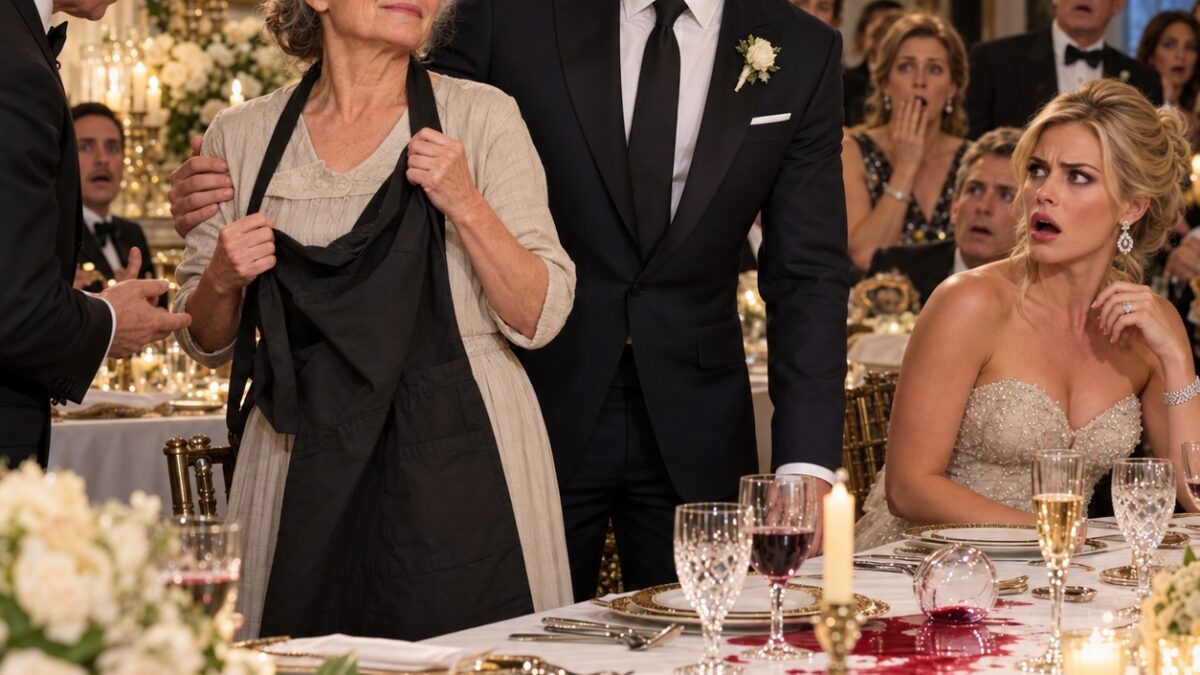
Mom wore the uniform.
Mrs. Marris.
She had asked to handle silver service during dinner.
I said no twice.
She ignored me twice.
At 7:40, Caroline snapped her fingers.
That sound still bothers me.
One sharp click through conversation.
Mom stopped beside her.
Caroline did not look up.
“Excuse me.”
The nearest conversations faded.
“If you’re going to polish the silver, at least try to keep up.”
Mom stood still.
“We have guests.”
“Of course, ma’am.”
Caroline exhaled.
“Honestly, it’s not that complicated.”
The room had become quieter than Caroline seemed to realize.
Mom reached for a wine bottle.
Caroline shifted her elbow.
Maybe accidental.
Maybe not.
I will never claim I can prove intent.
But I saw the movement.
The glass tipped.
Red wine spread across the white linen.
Several guests gasped.
Mom lowered her gaze.
Took the cloth.
Started blotting.
Caroline looked at the stain.
“Clean that properly.”
That was when I asked:
“Are you sure that’s how you want to handle this?”
Caroline looked at me.
A little laugh.
“Daniel, please.”
“Standards aren’t cruelty.”
She said it lightly.
Like a reasonable person correcting an unreasonable fiancé.
Then she turned toward Mom.
“Perhaps it’s time we consider refreshing the staff after the wedding.”
No one breathed.
“Younger.”
She glanced around.
“More presentable.”
A fork slipped from someone’s hand.
Hit porcelain.
Sharp.
Mom’s hands stopped.
The cloth remained against the stain.
Then she straightened.
Slowly.
Caroline looked annoyed.
“What?”
Mom set down the wine bottle.
Then removed the black apron.
Untied it.
Folded it once.
Perfectly.
Placed it on the table beside Caroline’s plate.
“Thank you, Caroline.”
Her voice was soft.
“You’ve demonstrated your values very clearly.”
Confusion moved around the room.
Caroline frowned.
“What does that mean?”
Mr. Aldridge stepped forward.
His voice became formal.
“Mrs. Evelyn Harper, would you like me to handle the rest?”
Caroline blinked.
I watched recognition fail to arrive.
“I’m sorry?”
I stood.
Walked around the table.
Stopped beside my mother.
Then said:
“Mom.”
One word.
Caroline’s face went white.
Not pale.
White.
She looked from me to Mom.
Then at the apron.
Then at the guests.
“This isn’t funny.”
Mom answered:
“It’s not meant to be.”
Nobody moved.
Nobody laughed.
Nobody seemed capable.
Mom looked around the room.
Then back at Caroline.
“This home exists because I cleaned houses for twenty-two years.”
Caroline’s mouth opened.
Mom continued.
“Including houses where people treated me exactly the way you treated me.”
No anger.
That made it harder.
Anger gives people something to defend against.
Truth does not always offer the same convenience.
Caroline forced a brittle laugh.
“Okay.”
She looked around.
“All right.”
No one joined her.
“This is stress.”
She gestured toward the room.
“Wedding stress.”
No answer.
“I have things I don’t mean when I’m overwhelmed.”
Mom looked at her.
“You said them repeatedly.”
“Because you were pretending!”
There it was.
The first defensive turn.
“As someone else.”
Mom nodded.
“As someone you believed did not matter.”
Caroline looked toward me.
“Daniel, tell them.”
I reached for my left hand.
The engagement ring felt heavier than metal should.
I slid it off.
Placed it on the table beside the folded apron.
The sound was small.
Metal against wood.
But everyone heard it.
Caroline stared.
“No.”
I kept my voice calm.
“This wasn’t about one mistake.”
“You set me up.”
“This was about character.”
“You lied to me!”
“My mother introduced herself under another name.”
“That is a lie!”
“Yes.”
I did not dodge it.
“She did.”
Caroline seized that immediately.
“So this entire thing is fraudulent.”
“No.”
“You manipulated me!”
“We created a situation where you believed one person in this house had no influence over you.”
“That is manipulation!”
“Maybe.”
I looked at her.
“But the words were yours.”
Silence.
“The behavior was yours.”
Her eyes filled with tears.
“Daniel.”
I hated seeing her cry.
That is another truth people prefer removed from clean moral stories.
I loved her.
Even in that moment.
Maybe especially because some part of me was mourning the person I thought she was.
She said:
“Please.”
I wanted to step toward her.
My body almost did.
Mom did not stop me.
That mattered.
She would have let me choose Caroline.
I know that.
But I looked at the table.
At the people who had watched Mom be humiliated and said nothing.
At Caroline’s friends who had laughed.
At vendors who had gone quiet.
At my mother’s folded apron.
Then I thought about years from now.
Children, maybe.
Employees.
Drivers.
Housekeepers.
Nurses.
Servers.
People Caroline would encounter without knowing their story.
Could I marry her and spend years wondering whether every smile to a waiter was temporary performance because I was watching?
Could trust survive that?
I already knew.
“No.”
She whispered:
“What?”
“The wedding is off.”
A few people inhaled.
Caroline stared at me.
“No.”
“I’m sorry.”
“You cannot do this.”
“I can.”
“Tomorrow?”
“Yes.”
“In front of everyone?”
“You asked me to tell them.”
Her face twisted.
“That’s cruel.”
Maybe it was.
I still think about that.
There may have been a kinder way to end the engagement.
But once the reveal happened publicly, pretending the wedding remained intact would have been a lie to everyone in the room.
Most importantly, to myself.
I said:
“I won’t humiliate you further.”
Her laugh broke.
“You already have.”
Then she left.
Her mother followed.
Several relatives too.
The room remained silent.
Mom touched my arm.
Not congratulating.
Grounding.
I had just ended the future I expected to live.
There was no victory in that.
Only clarity.
And clarity can hurt like grief.
By midnight, the house was nearly empty.
The wedding planners had stopped planning.
Flowers remained everywhere.
That was strangely painful.
Beauty prepared for an event that no longer existed.
Staff began clearing glasses.
Mom changed clothes.
I found her sitting on the back terrace.
I sat beside her.
For a while we listened to the water.
Finally:
“Do you feel better?”
I asked.
“No.”
That surprised me.
“You wanted me to know.”
“I wanted you to be safe.”
“That isn’t the same?”
“No.”
She looked at me.
“I did not want Caroline to fail.”
That almost broke me.
Neither did I.
People often imagine tests are designed because someone secretly wants to expose another person.
Mom had hoped she would be wrong.
I had too.
“What if she had treated you well?”
Mom smiled sadly.
“I would have taken off the apron and apologized for being suspicious.”
“You would’ve liked being wrong?”
“Very much.”
I looked toward the dark windows.
“She says we manipulated her.”
“We did.”
I turned.
Mom continued.
“Daniel, do not protect yourself with a lie.”
“What lie?”
“That we were perfectly innocent.”
I stared.
“We created deception.”
“Yes.”
“She did not consent to being tested.”
“No.”
“Then maybe I’m the bad guy.”
Mom shook her head.
“Life is not a children’s story.”
“Helpful.”
“You asked whether you should marry someone.”
“I questioned her character.”
“You arranged an answer.”
“That has consequences too.”
She reached for my hand.
“The question now is not whether we behaved perfectly.”
“What is it?”
“Whether what you learned matters.”
It did.
That was the painful part.
Two things could be true.
Our method was deceptive.
Caroline’s behavior was revealing.
I did not need to make one false to acknowledge the other.
The next morning, we issued a short statement.
No details.
No story.
No attack.
The wedding between Daniel Harper and Caroline Carlisle has been canceled by mutual private decision. We ask that both families be given privacy.
It was not exactly mutual.
But Caroline’s family agreed to the wording.
There was no reason to turn heartbreak into press entertainment.
Unfortunately, certain circles communicate without press releases.
People knew.
Guests talked.
Vendors talked.
Staff talked.
Not necessarily maliciously.
Events of that scale generate stories.
Within days, Caroline’s family hospitality business began receiving uncomfortable questions.
Not about the canceled wedding directly.
About culture.
Labor practices.
Treatment of employees.
Their group had been negotiating a joint venture with one of my affiliated companies.
That stopped immediately.
Not revenge.
I could not ethically proceed after what I had seen without reviewing their labor standards.
Other investors made their own decisions.
Some meetings were postponed.
Then canceled.
A charity board Caroline had been courting chose another candidate.
Nobody publicly said:
Because of the rehearsal dinner.
They did not need to.
Reputation often moves through implication.
That made me uneasy.
I did not want Caroline socially executed.
I had ended a marriage before it started.
That was enough consequence for me.
But I did not control everyone else.
Power cuts both directions.
People who had once welcomed her because of connections now distanced themselves because association suddenly carried risk.
There was something ugly in that too.
The same status-sensitive world that had encouraged her arrogance now punished her when the status math changed.
I noticed.
I remembered.
Caroline released a statement several weeks later.
Carefully written.
She acknowledged that stress had revealed “unexamined assumptions.”
She committed herself to growth.
She said she regretted causing pain.
People mocked it.
I did not.
Was it public relations?
Probably partly.
Could it also be sincere?
Possibly.
Human motives are rarely pure.
I did not need to decide.
We had no contact.
That was healthiest.
Forgiveness does not require reopening a relationship.
Sometimes growth happens in separate rooms.
The mansion changed.
I noticed that before anything else.
Staff conversations became different.
Not because Caroline was gone.
Because everybody knew what had happened.
People had watched how silence helped humiliation continue.
That created discomfort.
A housekeeper named Lena asked for a meeting.
She had worked for me four years.
I assumed she wanted to leave.
Instead she sat across from me and said:
“We need a staff dignity policy.”
I almost laughed.
“A what?”
“You heard me.”
“We already have employment policies.”
“Not the same.”
She was right.
We had wages.
Scheduling.
Harassment rules.
Complaint procedures.
But estate culture is strange.
Domestic workers often operate inside the intimate spaces of powerful people.
Homes.
Bedrooms.
Family events.
Places where formal corporate rules feel distant.
“Tell me what should change.”
Lena had a list.
Of course.
Names used.
Breaks.
Guest conduct.
No snapping fingers.
No throwing clothing at staff.
No demeaning language.
Right to remove themselves from abusive interactions without losing employment.
Clear escalation.
Vendor protections too.
Not revolutionary.
Embarrassingly basic.
I approved the framework.
Then asked our HR and legal teams to adapt it across estate operations and affiliated companies.
Mandatory respect and equity training followed.
I hated the phrase.
Training can become a checkbox.
So we added accountability.
Supervisors evaluated on complaints.
Contract language for vendors.
Reporting channels.
Audits.
Real consequences.
Not because one rich fiancée had embarrassed my mother.
Because my mother’s experience had exposed a blind spot in systems I controlled.
That made the failure partly mine.
If a temporary maid in my house could be mistreated in front of managers who felt unable to intervene, then my culture was not as healthy as I thought.
That was uncomfortable.
Useful.
Several weeks later, I announced a new foundation initiative focused on domestic-worker dignity and workplace rights.
Mom hated the idea at first.
“Do not put my face on anything.”
“I wasn’t planning to.”
“No gala.”
“Probably one fundraiser.”
“Daniel.”
“Fine.”
“No program called Evelyn.”
“I had not—”
“You were thinking it.”
She knew me.
The initiative partnered with existing worker organizations.
Legal assistance.
Emergency funds.
Employment education.
Training for household employers.
Resources for immigrant domestic workers.
I resisted the temptation to build something branded around my own morality.
The people already doing the work knew more.
We funded.
They led.
That was better.
Mom eventually approved.
Unofficially.
Her standard form of approval was complaining less.
Autumn came.
The gardens turned gold.
Wedding decorations were long gone.
The canceled date stopped appearing in my mind every morning.
Grief became less sharp.
Not gone.
One afternoon, I found Mom walking the stone path near the fountain.
No uniform.
Of course.
She wore a gray sweater and comfortable shoes.
Two staff members passed.
“Afternoon, Evelyn.”
Not Mrs. Harper.
Not ma’am.
Evelyn.
Mom smiled.
“Hey, Lena.”
Easy.
Affectionate.
That mattered.
I joined her.
She sat on the bench.
I said:
“Thank you.”
She brushed away a fallen leaf.
“For what?”
“You know.”
“I’d prefer specifics.”
Of course.
“For making me look.”
She nodded.
Then:
“Wealth reveals people.”
I waited.
“It does not create them.”
I thought about that.
“I’m not sure I agree completely.”
She looked interested.
“Go on.”
“Power changes incentives.”
“Yes.”
“It removes consequences sometimes.”
“Yes.”
“That can change behavior.”
“Behavior.”
She emphasized the word.
“Maybe not character.”
I smiled.
“Philosopher now?”
“I cleaned offices for twenty-two years.”
“Same thing?”
“More educational.”
Fair.
I asked whether she thought Caroline could change.
Mom answered immediately.
“Yes.”
“Really?”
“Of course.”
“After everything?”
“Daniel.”
She looked almost annoyed.
“If people cannot change, then why build programs about dignity?”
That shut me up.
“Do I think she has changed?”
Mom continued.
“I don’t know.”
“Do I think being exposed guarantees change?”
“No.”
“But no one is only the worst thing they have done.”
That surprised me.
Mom had been the target.
Yet she held less bitterness than many people who had merely heard the story.
Maybe because she had spent a lifetime understanding what power does to people.
Or maybe because she had survived too much to waste energy enjoying punishment.
She said:
“The question is whether she becomes curious about herself.”
I laughed.
“That sounds painful.”
“It is.”
Months later, Caroline sent a letter.
Handwritten.
Not through lawyers.
No demand.
No request to reconcile.
I almost did not open it.
Then did.
She apologized to Mom.
Not to me first.
That mattered.
She wrote that she had begun volunteering weekly with a worker-support organization.
I was suspicious.
So was Mom.
We did not investigate.
If it was performance, time would expose it.
If it was sincere, time would strengthen it.
Either way, our involvement was unnecessary.
Mom sent one short response.
I did not see it until years later.
She had written:
Growth is proven by how you treat the next person who cannot give you anything. I wish you well.
That was all.
Classic Evelyn.
No absolution.
No cruelty.
A standard.
My relationship with wealth changed after the incident.
Not dramatically.
I did not sell the house and move into a studio apartment.
That would have been performance in the other direction.
I still enjoyed good food.
Comfort.
Travel.
Beautiful spaces.
Wealth is not inherently corrupting.
But I became more aware of the invisible work beneath comfort.
A hotel room does not “stay clean.”
Someone cleans it.
A dinner does not “arrive.”
People prepare and carry it.
A house does not “run.”
Staff make thousands of tiny decisions.
My childhood should have made me see that automatically.
Success had softened my attention.
That embarrassed me.
I started learning every staff member’s name.
Not as a symbolic gesture.
Because somehow I had let the household grow large enough that I did not know everyone.
That was unacceptable to me after the dinner.
One groundskeeper named Mateo had worked there eighteen months.
I had said hello twenty times.
Never asked his last name.
He knew mine.
That imbalance bothered me.
I corrected it.
Not because knowing names fixes class inequality.
It simply prevents one particularly lazy form of invisibility.
I also began asking managers different questions.
Not:
Are there complaints?
That question is too easy to answer no.
Instead:
Who has left recently?
Why?
Who stopped speaking in meetings?
Which supervisor gets results but has high turnover?
Who receives praise upward and complaints downward?
How do guests treat staff when senior leadership is absent?
That last question became important.
Culture should be measured where power thinks nobody is watching.
Mom had taught me that with one apron.
The bridesmaid who had looked uncomfortable at rehearsal dinner contacted me later.
Her name was Sophie.
She apologized.
Not for Caroline.
For herself.
“I wanted to say something.”
“But you didn’t.”
“No.”
“Why?”
She cried.
“I thought I would ruin the dinner.”
That sentence stayed with me.
Everyone was protecting the dinner.
Me included.
The event.
The mood.
The social peace.
Meanwhile one person absorbed the disrespect.
That is how groups fail.
Nobody wants to be the person who makes the moment uncomfortable.
So the person being mistreated pays the price for everyone else’s comfort.
I told Sophie:
“Next time, ruin the dinner.”
She laughed through tears.
I meant it.
Some dinners deserve ruining.
Mr. Aldridge struggled too.
He had stood silent for most of Mom’s treatment because those were my instructions.
Afterward, he came into my office.
“I disliked the plan.”
“So did I.”
“I should have intervened.”
“You were told not to.”
“That does not make it feel right.”
No.
It didn’t.
The experiment had forced good people into complicity.
That was part of why I never repeated anything like it.
You can learn the truth through deception.
You can also damage the people asked to participate.
Important lesson.
Clarity has a cost.
Use carefully.
My head of security was more blunt.
“If anyone suggests another undercover family-member test, I quit.”
“Fair.”
“I’m serious.”
“So am I.”
“Good.”
Never again.
The canceled wedding cost a fortune.
People asked if I cared.
Deposits.
Flights.
Venue arrangements.
Flowers.
Food.
Money already spent.
No.
Not really.
A wedding is expensive.
A bad marriage is more expensive in ways accountants cannot model.
Money lost once is cheaper than trust lost daily.
I never regretted canceling.
I regretted needing to.
Different.
For nearly a year, I avoided dating.
Not because I believed Caroline represented everyone.
Because I did not trust my own judgment.
That is what betrayal sometimes damages first.
Not trust in others.
Trust in yourself.
How did I not see it?
Were there signs?
Yes.
Small ones.
Comments about servers.
Impatience with hotel staff.
A joke about a doorman.
Nothing I had classified as decisive.
Why?
Because she treated me beautifully.
There is narcissism in judging someone primarily by how they treat you.
Mom understood that.
I learned late.
One evening, she said:
“You chose based on the version of her you received.”
“What does that mean?”
“She loved you.”
“I think she did.”
“So she gave you tenderness.”
“Yes.”
“That was real too.”
I looked at her.
“Then how can both be true?”
“People are inconsistent.”
Not satisfying.
True.
Caroline could love me and still believe certain workers were beneath her.
One truth did not cancel the other.
That complexity made leaving harder.
It also made leaving necessary.
Marriage does not require your partner to be entirely bad before you are allowed to decide the values do not fit.
That was an adult lesson I wish had simpler language.
Years passed.
The foundation initiative expanded.
We funded legal clinics.
Worker hotlines.
Training materials in multiple languages.
Domestic workers learned contract rights.
Employers learned obligations.
We supported research on wage theft and workplace abuse.
My mother refused every attempt to make herself the public face.
When asked to speak once, she agreed under one condition.
“No introduction longer than fifteen seconds.”
The moderator ignored her.
Twenty seconds.
Mom glared.
Afterward she said:
“This is why I hate events.”
I laughed.
At the podium, she told a room full of wealthy donors:
“Do not congratulate yourself for treating workers like human beings.”
Silence.
Then laughter.
Then she continued.
“I am serious.”
The laughter stopped.
That was Mom.
She told them something else.
“If you are kind only when the worker’s employer is watching, you are not kind.”
I wrote it down.
She noticed.
“You already know this.”
“I like your phrasing.”
“Use your own.”
No.
Hers was better.
Caroline’s family business survived.
That matters.
The source story describes quiet reputational consequences, not total destruction.
Some partnerships fell away.
Some boards reconsidered.
Their hospitality group faced scrutiny.
Eventually they adjusted.
Updated worker standards.
New leadership in some divisions.
Whether that was sincere reform or reputational necessity, I cannot fully say.
Sometimes institutions improve for mixed reasons.
Workers benefit anyway.
That still counts.
Caroline herself disappeared from my social world.
Years later, I heard through mutual friends that she had become involved with workforce-development programs inside the hospitality industry.
I did not verify.
I hope it is true.
Not because I need redemption for the story.
Because people becoming better is preferable to people staying worse.
I never married her.
Obviously.
I eventually married someone else years later.
Different story.
The first time I saw my future wife thank a hotel housekeeper by name after reading the woman’s badge, I noticed.
Probably too much.
Trauma can turn ordinary kindness into evidence.
I had to unlearn testing people silently.
Trust cannot survive if every interaction is secretly an exam.
That was another consequence of the three-day experiment.
I told her the entire Caroline story early.
She listened.
Then said:
“Your mother sounds terrifying.”
I laughed.
“Accurate.”
She met Mom.
Loved her.
Mom approved.
Eventually.
She claims she approved immediately.
False.
The mansion remained grand.
Same chandeliers.
Same polished floors.
Same stone columns.
But the house no longer felt like a stage where staff had to disappear.
People spoke more.
Laughed.
Asked questions.
One afternoon, I heard two housekeepers laughing loudly in the hallway while guests were present.
Old me might have wondered whether it sounded unprofessional.
Instead I smiled.
A workplace where people feel safe enough to laugh is not automatically healthy.
But silence should never be the only acceptable sign of service.
That distinction mattered.
Mom eventually stopped wearing her wedding ring.
Not because she loved Dad less.
One morning it simply sat on her dresser.
I noticed.
She said:
“My finger’s swollen.”
Then never put it back.
Grief moves strangely.
No ceremony.
No announcement.
Just one day something heavy becomes something you can set down.
I thought about the black apron.
The ring.
The rehearsal dinner.
Objects carrying meaning until they do not.
The apron ended up in a storage closet.
I found it years later.
Black fabric.
Nothing special.
I held it.
Remembered wine spreading across white linen.
Caroline’s face.
Mom folding the apron.
My engagement ring striking wood.
I considered throwing it away.
Instead I gave it to Mom.
She stared.
“Why would I want this?”
“I don’t know.”
She handed it back.
“Then neither do I.”
We donated it with old clothing.
That felt right.
Not every symbol needs a museum.
The engagement ring stayed in my safe for two years.
I could not decide what to do with it.
Selling felt cold.
Keeping felt stranger.
Eventually I sold it and donated the money to the domestic-worker initiative.
Mom said:
“That is almost too symbolic.”
“Almost?”
“Very close.”
“But acceptable?”
She sighed.
“I suppose.”
Approval.
What happened at that table has been retold badly many times.
People simplify.
Rich man tests fiancée with disguised mother.
Cruel woman exposed.
Wedding canceled.
Justice.
That is satisfying.
It is also incomplete.
The fuller story contains uncomfortable questions.
Was it ethical to test Caroline without her knowledge?
Probably not in a pure sense.
Did the test reveal something real?
Yes.
Could I have learned the same thing through ordinary observation?
Possibly, if I had been more attentive.
Did my wealth create conditions where Caroline treated me differently than people beneath her social status?
Almost certainly.
Was canceling the wedding still the right decision?
For me, yes.
Those truths can exist together.
Life rarely gives moral clarity without residue.
Mom once asked whether I would tell the story publicly if someone asked.
I said no.
Then years later I changed my mind.
Why?
Because the lesson had become larger than Caroline.
I did not want the story used to mock one woman forever.
I wanted people to think about workers they overlook.
The server clearing their plate.
The janitor entering after everyone leaves.
The home-health aide.
The hotel housekeeper.
The nanny.
The landscaper.
The office cleaner.
The person wearing a uniform in a room full of people wearing status.
Who are you when you believe that person cannot help you?
That question matters.
I have watched powerful executives become charming when board members enter.
I have watched impatient donors become generous when cameras appear.
I have watched people apologize to assistants after realizing the assistant reports directly to someone important.
That behavior is not rare.
What Caroline did was dramatic because of the reveal.
The underlying habit is ordinary.
People sort.
Important.
Unimportant.
Useful.
Background.
That sorting is the danger.
Once a person becomes background in your mind, cruelty begins feeling consequence-free.
Mom knew that from experience.
She had been background to thousands of people.
Cleaning conference rooms.
Emptying bins.
Wiping fingerprints from glass walls while executives discussed leadership inside.
Sometimes they spoke around her as though she were furniture.
She remembered.
That is why she knew exactly what to watch for.
I once asked:
“What was the worst thing anyone said when you cleaned offices?”
She thought.
Then:
“Nothing.”
I was confused.
“Nothing?”
“They did not say anything.”
“That was worse?”
“Sometimes.”
She explained.
People would enter a room while she cleaned.
Talk past her.
Leave trash beside her hand.
Move a chair without acknowledgment.
Have conversations about bonuses larger than her annual pay while she wiped their table.
Not hostile.
Invisible.
“You can defend yourself against insult,” she said.
“Invisibility is harder because the other person does not know there is anything to defend.”
That changed how I understood the phrase:
Background people.
Caroline had not invented it.
She had simply said aloud what many people practice silently.
At our companies, we began including frontline workers in certain leadership reviews.
Not as theater.
Actual feedback.
How does a senior executive behave when traveling?
How do they treat drivers?
Assistants?
Receptionists?
Custodial teams?
Not every informal complaint became discipline.
But patterns mattered.
We discovered one executive with excellent board presence and terrible staff turnover.
Coaching failed.
He left.
Another senior leader received complaints about dismissiveness.
She listened.
Changed.
That was the system working.
Character can be coached if the person is willing.
The purpose is not punishment.
It is creating environments where everyone’s dignity is structurally relevant.
One of our cleaners eventually became a facilities supervisor.
Then operations manager.
Not because we launched some inspirational program after Mom’s story.
Because she was good.
That matters.
People often respond to stories about service workers by romanticizing them.
“They’re secretly brilliant.”
“They might become CEOs.”
Again, wrong lesson.
A cleaner deserves respect even if she remains a cleaner her whole career.
Human dignity is not a promotion program.
I became careful about that language.
Mom stayed in the coastal house less as she aged.
She preferred her own smaller place.
“Too many stairs.”
“We have an elevator.”
“That’s worse.”
“How?”
“I don’t trust elevators in houses.”
“You trusted factory machinery for twelve years.”
“Exactly why I don’t trust elevators.”
Impossible.
I visited her there.
She liked grocery-store flowers better than arrangements from florists.
Said the expensive ones were “trying too hard.”
We argued about everything.
Good years.
One afternoon, we discussed Caroline one last time.
Not intentionally.
A television story mentioned a hospitality initiative with her family’s company.
Mom recognized the name.
“Looks like they’re doing worker training now.”
I nodded.
“Maybe.”
“You sound skeptical.”
“I am.”
Mom shrugged.
“If workers are treated better, motive can catch up later.”
That was generous.
“Do you forgive her?”
Mom looked at me like the question was strange.
“I was never carrying her.”
“What does that mean?”
“Forgiveness implies I have been holding something she needs me to release.”
“Weren’t you?”
“No.”
“I learned what I needed.”
“Then I went home.”
That may be the healthiest definition I have heard.
I was not as quick.
For years, anger returned unexpectedly.
At weddings.
At certain restaurants.
Whenever someone snapped fingers at a server.
Once I heard a man in an airport lounge say:
“That’s what staff is for.”
I had to walk away.
Not because every arrogant sentence was Caroline.
Because memory attaches itself to phrases.
Eventually that faded.
Not entirely.
Maybe it should not.
Some memories are useful alarms.
The goal is not to silence them.
Just to stop letting them run the whole system.
The original dining table remained in the mansion.
I thought about replacing it.
Mom laughed.
“Because somebody was rude near it?”
“When you say it that way…”
“It’s a table.”
Right.
We kept it.
Years later, my family ate Thanksgiving dinner there.
Children spilled cranberry sauce.
Someone knocked over sparkling water.
Nobody was humiliated.
Mom sat at the head.
Not because she demanded it.
Because everyone kept putting her there.
At one point she looked at the white tablecloth.
Then at me.
We both remembered.
She smiled.
That was enough.
The chandelier still hangs above it too.
Crystal.
Beautiful.
At the rehearsal dinner, its light made everything look perfect while the room became morally ugly.
That contradiction stays with me.
Luxury creates beautiful surfaces.
It cannot create beautiful character.
Sometimes it hides the absence longer.
That is all.
People often ask whether wealth changes people.
Mom’s answer never changed.
“Wealth reveals.”
I still think it can do both.
It amplifies.
Removes constraints.
Adds options.
Makes certain consequences disappear.
A generous person can become more generous.
A controlling person can become more controlling.
A frightened person can build walls.
A kind person can create safety.
Money is leverage.
Character influences direction.
But character is not fixed.
That is where I differ slightly from Mom.
People can learn.
Sometimes through shame.
Sometimes through love.
Sometimes through consequences.
What matters is whether they do.
Caroline’s exposure was public.
That probably made change harder in some ways.
Shame makes people defensive.
If I could redesign the entire situation knowing what I know now, I might confront her earlier.
No disguise.
No reveal.
No eighty guests.
I might say:
“I’ve noticed how you talk to service workers.”
Then see whether she listened.
Maybe she would have dismissed me.
Maybe not.
We will never know.
That is the cost of the path we chose.
I accept that.
I still do not regret ending the engagement.
Those are separate questions.
Mom never regretted the disguise.
Of course.
“I told you what I needed to tell you.”
“You manipulated a situation.”
“Yes.”
“No remorse?”
“Some.”
“How much?”
“About this much.”
She held two fingers a quarter-inch apart.
Infuriating woman.
I loved her.
When she died years later, peacefully, I found a small box in her dresser.
Inside were old photographs.
Factory badge.
Cleaning-company ID.
My first school picture.
College acceptance letter.
A printed screenshot of the first major article about my company.
And, inexplicably, one photograph from the canceled rehearsal dinner.
Not the reveal.
Earlier.
Mom in uniform carrying a tray while people talked around her.
On the back she had written:
Never forget who becomes invisible when everyone is looking upward.
I sat on her bedroom floor and cried.
Not gracefully.
Not quietly.
I keep that photograph in my office now.
Private.
Not displayed for visitors.
For me.
When success gets noisy, I look at it.
Mom had once cleaned offices so I could study.
Years later, she put on a cleaning uniform again so I could see clearly.
That sentence sounds too perfect.
Real life rarely arranges itself that neatly.
But sometimes patterns reveal themselves only afterward.
She spent her life teaching me that work does not reduce a person.
Status does not enlarge one.
I understood intellectually.
Then Caroline forced me to understand emotionally.
That is different.
At the next foundation board meeting after Mom’s death, someone proposed naming the domestic-worker initiative after her.
I said no.
They argued.
I kept saying no.
Then Lena, my former housekeeper turned operations director, spoke.
“Daniel.”
“What?”
“Stop deciding what everybody else gets to remember.”
That sounded suspiciously like Mom.
I lost the vote.
The initiative became the Evelyn Harper Dignity Project.
Mom would have hated it.
Which makes me smile.
Sometimes the dead lose arguments.
The project’s mission statement is simple.
Respect is not a reward for status.
I wish I could say I wrote it.
Lena did.
Better than anything I had.
Years after the canceled wedding, I attended a hotel conference.
Hospitality executives.
Workers’ rights panel.
During a break, I saw Caroline across the lobby.
First time since everything.
She saw me.
We both stopped.
For a second, the entire rehearsal dinner came back.
Then she walked over.
Older.
Different haircut.
Less armor somehow.
“Daniel.”
“Caroline.”
No hug.
No hostility.
She said:
“I heard about Evelyn.”
“Thank you.”
“I’m sorry.”
She looked genuinely sad.
“She changed my life.”
That surprised me.
I said nothing.
Caroline continued.
“Not in a way I appreciated at first.”
I almost smiled.
“I assumed.”
“She wrote me back.”
“I know.”
“I still have it.”
We stood quietly.
Then she said:
“I treated people badly.”
Not:
I was stressed.
Not:
I was embarrassed.
Not:
You tricked me.
Simple.
“I did.”
I nodded.
“I know.”
“I’m not asking you to forgive me.”
“I know.”
“I just wanted you to know she was right.”
My throat tightened.
“She usually was.”
Caroline smiled faintly.
“I remember.”
Then she walked away.
No reconciliation.
No dramatic closure.
Just two people acknowledging history.
That was enough.
Later, I learned she had spent years working on labor practices in her family’s hospitality group.
Not just speeches.
Policy.
Wages.
Worker councils.
Complaint systems.
Maybe the exposure changed her.
Maybe losing the wedding forced self-examination.
Maybe aging did.
Maybe all of it.
Mom had been right again.
People can change.
Proof comes later.
Not in statements.
In patterns.
I am glad Caroline changed.
I am also glad I did not marry her hoping she would.
That distinction matters.
You do not owe someone a lifelong relationship merely because they might become better later.
You can wish them growth from a distance.
That is not cruelty.
Sometimes it is wisdom.
The story people tell usually ends when I remove the engagement ring.
Mine did not.
That was merely the decision point.
The more important work came after.
Changing policies.
Examining my own blindness.
Giving workers stronger protections.
Learning that the method we used had ethical costs too.
Letting anger become instruction instead of identity.
Watching Mom grow older.
Watching Caroline become someone I no longer needed to judge.
Living.
That is always what happens after viral moments.
Life gets less cinematic.
More important.
I still remember the red wine.
How it spread.
Slow at first.
Then widening.
White cloth turning crimson.
Mom blotting.
Caroline impatient.
Everyone watching.
It became the visual people remembered.
But what stayed with me was the silence.
Guests gasped.
Then nobody moved.
That silence was complicity.
Mine too, until I spoke.
I had agreed to observe.
But from Mom’s perspective, it was still her son sitting at the head of a table while someone demeaned her.
She told me later she never doubted why.
Still, I think about it.
Observation is not morally neutral when someone is being harmed.
There is always a line.
I am grateful she controlled the experiment because I might have let curiosity run too long.
Another lesson.
The sentence:
“Standards aren’t cruelty.”
Caroline said it as a defense.
She was right in the abstract.
Standards are not cruelty.
But standards can become a costume for cruelty.
Professionalism.
Presentation.
Culture.
Fit.
Discretion.
Words that sound neutral.
They can be used neutrally.
They can also become permission to rank people’s humanity.
That is why leaders must examine not only rules but how those rules are used downward.
Who gets corrected publicly?
Who gets grace?
Whose mistakes are interpreted as incompetence?
Who becomes “replaceable”?
Patterns reveal values.
The mansion no longer uses the phrase “the help.”
Not because I banned it.
People simply stopped.
Language changes when culture does.
Staff.
Team.
Household operations.
Names.
Names are usually best.
One evening, long after Mom was gone, I stood near the foyer staircase where Caroline had first told her to stand straighter.
A new employee was being introduced.
Young woman.
Nervous.
She straightened automatically when I approached.
I noticed.
“Relax.”
She smiled awkwardly.
“Sorry, Mr. Harper.”
“No need.”
Then I remembered Mom.
People stand differently around power.
I could not erase that.
But I could make the power less dangerous.
That became the goal.
Not pretending hierarchy does not exist.
Creating systems where hierarchy cannot excuse humiliation.
My company eventually required senior leaders to spend time with frontline teams.
Not symbolic “day in the life” publicity.
No cameras.
No posts.
Just work observation.
Listen.
Ask.
Understand.
Some executives hated it.
Good.
Comfort is not always the measure of useful learning.
One vice president told me:
“I already know how our facilities run.”
A warehouse supervisor later corrected him on six things.
He stopped saying that.
Mom would have enjoyed it.
At leadership retreats, I sometimes tell one story from childhood.
Not Caroline.
Not the disguise.
Mom cleaning offices.
One night, she brought me because childcare failed.
I sat in a break room doing homework while she cleaned executive offices.
There was a glass conference room.
Big table.
Leather chairs.
I asked:
“Do important people sit there?”
Mom said:
“People sit there.”
I laughed at the time.
Years later, I understood.
Rooms do not create importance.
Tables do not.
Titles do not.
Wealth does not.
People keep trying to assign human value through architecture.
Mom never believed it.
That saved me.
Eventually.
If you ask me whether I would recommend testing someone you love by disguising a family member as household staff, the answer is no.
Absolutely not.
Talk.
Observe ordinary behavior.
Listen to how they speak about people when those people are absent.
Notice how they treat servers when an order is wrong.
Notice whether they thank drivers.
Notice whether they become cruel when inconvenienced.
You do not need a theatrical test if you are paying attention.
I was not paying enough attention.
Mom compensated with theater.
Effective.
Messy.
Not a model.
But if you ask whether the core question was valid, absolutely.
How does someone behave toward the person they believe cannot help them?
That remains one of the best character questions I know.
Not the only one.
But a powerful one.
People perform upward.
Most of us do, at least a little.
We become more polished around people who can hire us, promote us, invest in us, love us, introduce us.
Character is easier to see when no reward is expected.
That was Mom’s point from the beginning.
Three days.
That was all it took.
Not because Caroline suddenly became cruel.
Because the disguise removed a reason for her to hide a cruelty already available to her.
That distinction matters.
The uniform did not create her behavior.
It changed what she believed the consequences would be.
Power did not create integrity.
Its absence exposed the lack of it.
And yet, years later, Caroline’s changed behavior exposed something else.
Character is not a prison.
A terrible pattern can be interrupted.
Not by a statement.
By repeated different choices.
I am glad I learned that too.
Otherwise my story would end in judgment.
I prefer responsibility.
The original wedding flowers were donated to hospitals and nursing homes the morning after cancellation.
Mom suggested it.
Of course.
Hundreds of arrangements.
Peonies.
Roses.
Things meant to decorate a celebration that never happened.
They brightened rooms where people were sick, lonely, recovering.
That may be my favorite detail from the entire weekend.
Failure repurposed.
Beauty redirected.
No need to waste everything because the original plan collapsed.
Another Evelyn lesson.
The catering food went to shelters and staff.
Wedding cake too.
One housekeeper took a section home for her grandchildren.
She later told me:
“Best canceled wedding ever.”
I laughed harder than I had in weeks.
Humor returns first sometimes.
Then peace.
My honeymoon reservation was canceled.
No travel.
Instead I spent three days with Mom.
We ordered takeout.
Watched old movies.
She criticized every film’s housekeeping realism.
“That woman has a mansion with no visible staff.”
“It’s a movie.”
“Dust would win in two days.”
Impossible.
I would choose those three days over the honeymoon I had planned.
Not because heartbreak was good.
Because my mother was there.
Time becomes more valuable once you know it ends.
I built my fortune line by line of code.
People love saying that.
It sounds disciplined.
Clean.
But the first investment in my future was not code.
It was a woman with raw hands cleaning offices at night.
Everything came after that.
The house.
The chandelier.
The company.
The canceled wedding.
The foundation.
All of it.
Mom never asked for repayment.
That is why I spent the rest of my life trying to make sure the work she once did was treated with the dignity she always deserved.
Not charity.
Dignity.
Different.
If Caroline had known Mrs. Marris was Evelyn Harper, mother of Daniel Harper, she would have behaved beautifully.
I have no doubt.
That is precisely why knowing would have told me nothing.
The painful discovery was that she had two standards.
One for people connected to power.
One for people she believed were beneath notice.
I could not build a marriage around hoping I would always remain in the first category.
And I could not raise children with someone if I worried what they might learn from the second.
That was my decision.
Not punishment.
Compatibility.
Values.
There is one final detail people misunderstand.
When I put the engagement ring on the table, I was not calm because I felt powerful.
I was calm because I was devastated.
Anger would have been easier.
Anger gives you motion.
Grief slows everything.
I remember hearing the ring hit the wood.
Tiny sound.
And thinking:
Tomorrow is gone.
The ceremony.
The vows.
The future children we had discussed.
The Christmases.
The ordinary mornings.
Gone.
One sound.
That is what ending an engagement felt like.
Not victory.
Loss chosen because the alternative would have been worse.
Sometimes integrity does not feel noble.
It feels expensive.
Mom understood that.
She did not smile.
Never looked satisfied.
Did not say:
I told you so.
After Caroline left the room, Mom squeezed my hand.
That was all.
Witness.
Not celebration.
That is why I trusted her through the aftermath.
She had not wanted to win.
She wanted me to see.
The head of security once said the most unsettling part of the dinner was not Caroline’s behavior.
“What was?”
“How fast everyone else adjusted after they knew who Evelyn was.”
I understood.
Before reveal:
Silence.
After reveal:
Concern.
Apologies.
Deference.
Same woman.
Same age.
Same dignity.
Different information.
That disturbed him.
Me too.
That is why our later training focused not only on direct abuse but on bystander behavior.
Would you intervene if you believed the person being mistreated had no powerful connection?
That is the harder test.
A bridesmaid stepped away from Caroline after the reveal.
A vendor avoided eye contact.
Guests suddenly looked sympathetic.
Where were those instincts twenty minutes earlier?
Inside them.
Suppressed by social risk.
People are not always cruel.
Sometimes they are cowardly.
The results can look similar to the person being harmed.
So we taught intervention.
Simple phrases.
“Please don’t speak to her that way.”
“That comment isn’t appropriate.”
“Let’s slow down.”
Small friction.
Enough to break momentum.
Not every act of dignity requires a speech.
I have seen that work.
At a later company dinner, a senior client snapped at a server.
Before I spoke, one of our junior managers said:
“Please don’t speak to her like that.”
The table froze.
The client apologized.
Conversation continued.
Afterward, the manager approached me.
“I thought I’d get fired.”
“For defending a server?”
“He’s a major account.”
I said:
“If we fire people for protecting dignity, our policies are decoration.”
That manager later became a director.
Not because of that moment.
But I never forgot it.
Culture became visible.
Mom’s test had propagated into a better reflex.
That made the whole painful story feel less wasted.
The real measure of character is not how elegantly someone behaves among equals.
Equals carry consequences.
The harder measure is downward.
When impatience costs nothing.
When contempt feels safe.
When the person receiving it cannot advance you, invest in you, introduce you, hire you, marry you, or damage you.
That is where unfiltered values often appear.
Mom knew.
Caroline learned.
I learned.
And eventually the systems around us learned too.
My name is Daniel Harper.
I built a company.
I became wealthy.
I bought a house people assumed had belonged to an important family for generations.
It had not.
Everything inside it existed because of work.
Mine.
Employees’.
And long before mine, my mother’s.
Evelyn Harper stood on factory floors for twelve hours at a time.
After my father died, she cleaned offices at night so I could stay in school.
Years later, before I married Caroline, Mom asked me one question:
How does she treat someone who has nothing to offer her?
I thought I knew the answer.
Mom was not sure.
So for three days she became Mrs. Marris.
A temporary maid.
Caroline told her to stand straighter.
Questioned whether she understood English.
Dropped a coat into her hands without looking at her.
Called staff background people.
Mocked her in front of vendors.
Suggested older employees should be replaced by people younger and more presentable.
And at the rehearsal dinner, she snapped her fingers at my mother and told her to clean spilled wine properly.
Then Mom folded the apron.
Mr. Aldridge said:
“Mrs. Evelyn Harper.”
I stood beside her.
“Mom.”
And the future I had planned ended before dessert.
That is the dramatic version.
But the part that matters came after.
I did not destroy Caroline’s family.
I did not use my companies to blacklist her.
I did not celebrate canceled partnerships.
I did not treat exposure as proof that people cannot change.
I changed the systems I controlled.
Worker protections.
Reporting.
Training.
Real accountability.
A foundation initiative.
Years later, Caroline changed parts of the systems she controlled too.
That mattered.
Because dignity should produce more dignity, not just a different hierarchy of humiliation.
Mom told me wealth reveals people.
I still hear her saying it.
Maybe wealth reveals.
Maybe power amplifies.
Maybe comfort removes filters.
Whatever the mechanism, I know this:
The chandelier did not make Caroline cruel.
The apron did not make Mom powerless.
The ring did not make me wise.
The house did not make any of us more human.
Those were objects.
Status markers.
Costumes.
The important things were choices.
Caroline’s choices when she believed nobody important was watching.
My choice when I finally understood.
Mom’s choice not to turn humiliation into revenge.
The guests’ choices about whether to speak.
The choices we all made afterward.
Character lives there.
Not in the chandelier.
Not in the uniform.
Not in the bank account.
In the next choice.
Especially when you believe the person in front of you cannot reward or punish you for it.
Years later, I still sometimes walk through that dining room.
The same long table.
Same crystal light.
No red wine stain.
No folded apron.
No engagement ring.
Just a room.
And whenever I pass the chair where my mother stood that night, I remember the woman Caroline thought was powerless.
A factory worker.
An office cleaner.
A widow.
A mother with cracked hands.
The woman whose labor helped create every opportunity I later called my own.
Caroline saw a maid.
I saw the foundation beneath my entire life.
That difference ended a wedding.
Then it changed far more than a wedding.
Because my mother was right from the beginning:
You learn very little about someone by watching how they treat the people they need.
Watch how they treat the person they believe does not matter.
That is where the truth usually stops pretending.

