PART2:My Daughter’s MIL Threw Her Belongings Onto the Lawn and Called Us “Trailer Trash”—Then She Saw Who Stepped Out of My Rolls-Royce
PART2
The first thing Abe did was rescue the luggage.
Not Joelle.
He knew me well enough to understand she was physically safe.
The things in the sprinkler were not.
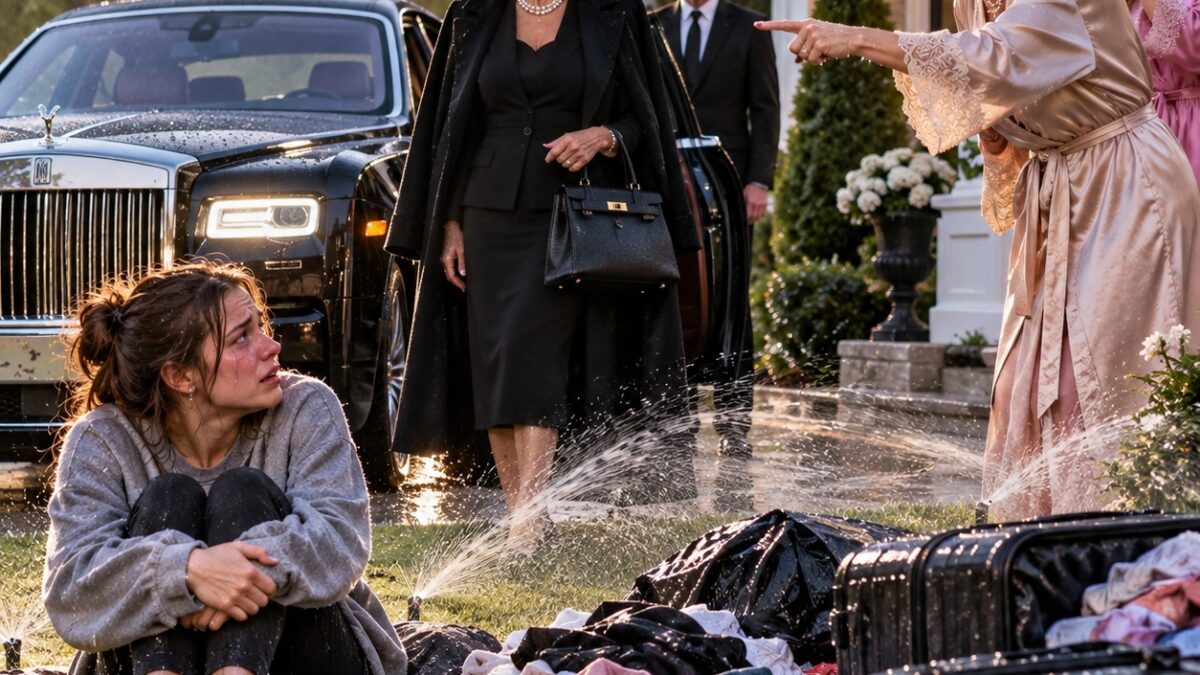
He stepped into the spray, lifted the mint-green suitcase Dan had bought Joelle for college graduation, and carried it toward the trunk.
One corner had cracked open against a flagstone.
A gray sweater hung from it, saturated.
Vivian watched from the porch.
Then she said, loudly enough that two neighboring houses could probably hear:
“Trash belongs on the lawn.”
Blair laughed so hard her phone shook.
I opened my door.
Abe glanced toward me.
“You want me there?”
“No.”
I stepped out.
Vivian’s attention moved immediately to the car.
I watched her make a decision before she even knew who I was.
That is something I learned during thirty-three years on a municipal bond desk.
People reveal themselves most clearly in the second before they realize more information is coming.
Vivian saw a Rolls-Royce.
My daughter on the curb.
Me climbing out.
And built an entire scandal.
“Well.”
She descended one porch step.
“Look who sent transportation.”
I walked toward her.
Joelle stood.
“Mom.”
I held up one hand.
Not yet.
Vivian looked at me from my shoes to my unbrushed silver-blonde hair.
“And you are?”
“Joelle’s mother.”
She stared.
Then laughed.
Not cruelly at first.
Almost delighted.
As if I had confirmed something she wanted.
“The mother?”
“Yes.”
She looked past me at the Rolls.
“Whose car?”
“Does it matter?”
Her smile sharpened.
“It might.”
Blair continued filming.
I noticed a man behind the glass storm door.
Douglas Langford.
Vivian’s husband.
He wore a golf shirt and held a coffee mug.
He did not come outside.
That told me something too.
Vivian folded her arms.
“Tell your daughter’s friend to get that ridiculous thing off my lawn.”
“Friend?”
“The owner of the car.”
I said nothing.
She continued.
“Although I suppose men like that have housekeepers and drivers for these situations.”
Then she looked directly at me.
“You people are trailer trash.”
Joelle made a sound behind me.
I did not answer.
Because something else had happened.
At three feet, with the porch light still glowing against the morning, I could see Vivian’s face clearly.
A pale scar curved through her left eyebrow.
Like a small crescent moon.
At her throat hung a silver locket.
Cheap.
Old.
Dented along one side.
The contrast was almost absurd.
Expensive robe.
Perfect house.
Diamond studs.
And a locket that looked like it had survived a fire.
Something moved in my memory.
Not enough.
A word came from Vivian next.
“Blair, turn that sprinkler off before it worshes out the flower bed.”
Worshes.
My mother used to say that.
Half the people in southern Ohio did.
Nobody in this part of Connecticut said worsh.
I stared at Vivian.
She noticed.
“What?”
“Nothing.”
I turned.
“Abe, please get the bags.”
“Yes, ma’am.”
Vivian called after me:
“Tell your daughter’s sugar daddy he owes me for the lawn.”
I kept walking.
Not because I was afraid.
Because I had learned long ago that when somebody is eager to humiliate you, silence often makes them expose more than argument does.
Joelle climbed into the back seat.
She was shaking.
Abe put the heat up even though it was May.
We drove.
For ten minutes I asked nothing.
My daughter stared through the window.
Finally:
“At four forty she knocked on our door.”
“The east wing?”
“Yes.”
“She said I had twenty minutes.”
“Why?”
“I don’t know.”
“Where were the bags?”
“Already in the hall.”
“So she packed before waking you.”
“Blair did.”
That mattered.
Planning.
Not rage.
“Douglas?”
“He came upstairs once.”
“What did he say?”
“‘Viv, it’s five in the morning.’”
“And?”
“He went back down.”
Of course.
I looked toward the front seat.
Abe’s jaw tightened.
He said nothing.
“Does Bennett know?”
Joelle rubbed both hands over her face.
“I don’t know.”
Then:
“He’s been weird for two weeks.”
“How?”
“Cold.”
“About what?”
“I don’t know.”
She started crying.
“I keep trying to figure out what I did.”
I reached for her.
“You did not do anything that justifies being put on a lawn.”
She nodded but did not look convinced.
Victims often begin by auditing themselves.
What did I say?
What did I miss?
What mistake made cruelty reasonable?
Usually none.
We drove another few miles.
Then Joelle said:
“There was something weird at Sunday dinner last month.”
“What?”
“Douglas asked where you grew up.”
I looked over.
“I said Sycamore Bend outside Zanesville.”
My body went still.
“Then?”
“Vivian dropped her fork.”
I stared.
“She got up.”
“What did she say?”
“Nothing. She left the table.”
Sycamore Bend.
I had not heard the name spoken by another person in years.
It was not a town.
Not really.
A trailer park along a muddy creek outside Zanesville, Ohio.
Two crooked rows of metal homes.
Lot 21 belonged to my mother.
Lot 19—
I stopped the thought.
Nothing yet.
Coincidences exist.
We returned to my farm shortly before six.
Abe carried the wet luggage into the kitchen.
The mint-green suitcase left a line of water across the floor.
Joelle opened it.
Clothes.
Books.
A framed photograph from her wedding.
Water had seeped beneath the glass.
The edges of the picture curled.
She and Bennett standing outside Hartford City Hall.
February 14, 2024.
Happy.
Or at least photographed happy.
Her phone buzzed.
Bennett.
She read.
Her face changed.
“What?”
She handed me the phone.
Mom sent pictures. Don’t come back to the house.
Joelle typed:
That was my mother’s car. Abe is her driver.
Three dots appeared.
Then:
Sure. Your trailer mom owns a Rolls-Royce. Mom told me what you’d say.
Joelle placed the phone on the table.
Very gently.
Then slid down the cabinet until she was sitting on the kitchen floor.
She had done the same thing at eight when overwhelmed.
Children grow.
Some distress positions do not.
“Trash belongs on the lawn.”
She said it quietly.
“She said it like she had practiced.”
I sat beside her.
Abe lifted the damaged suitcase.
“I can repair the corner.”
Joelle looked at him.
“You can?”
“Firehouse tape.”
He nodded.
“Ugly. Strong.”
She almost smiled.
That was enough for the moment.
I made tea.
Eggs.
Nobody ate.
Around seven thirty, Joelle opened her banking app.
Then stopped moving.
“What?”
No answer.
“Joelle.”
She handed me the phone.
Their joint house savings account.
For two years, she had transferred $1,100 from every paycheck.
Bennett contributed irregularly.
The balance should have been almost forty thousand dollars.
At 7:12 that morning, Bennett had transferred $38,600 into an account in his name.
At 7:15, the shared debit card had been frozen.
Joelle’s personal checking balance:
$412.
She whispered:
“He took it.”
I felt my anger sharpen into something useful.
Numbers do that for me.
Emotions can blur.
Numbers rarely do.
“Do not call him.”
Her head snapped up.
“Mom—”
“Do not text him.”
“He stole—”
“I know.”
“I need—”
“No.”
I put the phone down.
“You write nothing today that you would not want read aloud to a judge.”
She stared.
“Judge?”
“Yes.”
I had spent thirty-three years buying and selling municipal debt.
School districts.
Water systems.
Town bonds.
The least glamorous corner of finance imaginable.
But it teaches discipline.
Document first.
React second.
I called a family-law attorney named Celeste Cass.
It was Saturday.
Voicemail.
I left one sentence:
“My daughter was removed from her marital residence at dawn and her husband transferred nearly forty thousand dollars from their joint account this morning.”
Celeste called me Monday at eight.
By then, we had more.
A young woman named Libby sent Joelle a video.
Forty-one seconds.
Blair laughing as she kicked the mint-green suitcase down the front steps.
The suitcase hit stone.
Crack.
There was the damage.
Text over the video read:
TAKING OUT THE TRASH.
Joelle watched once.
I watched three times.
Not because I enjoyed it.
Timing.
Positions.
Who was visible.
Who spoke.
Libby called afterward.
“I’m sorry.”
She sounded sick.
“Blair posted it in the bridesmaids group.”
Blair was engaged to Teddy Fairbanks.
Large wedding planned for October.
Joelle had once been close enough to the circle to be invited into everything.
Now she was content.
Then Libby told us something worse.
Blair had shown the bridesmaids a contractor estimate dated May 4.
Renovations to the east wing.
The rooms where Joelle and Bennett lived.
The plan:
New bedroom.
Nursery.
Suite for Blair and Teddy after marriage.
Deposit already paid.
$4,200.
Joelle stared at me.
“She planned this before Saturday.”
“Yes.”
Libby continued.
“There’s more.”
Of course.
“Blair said she didn’t want a trailer mother in her wedding pictures.”
Joelle closed her eyes.
“And the sprinklers?”
I asked.
Silence.
Then Libby:
“She changed the timer Friday.”
I looked toward the window.
Tick.
Tick.
Hiss.
Not coincidence.
Performance.
The bags went out.
The water came on.
The phone camera was ready.
This was theater.
Cruelty staged for an audience.
Joelle whispered:
“She wanted my room.”
“Yes.”
“And me out of the pictures.”
“Yes.”
“Should I post the video?”
“No.”
Her eyes opened.
“Why?”
“Because Blair already made one mistake.”
“What?”
“She documented herself.”
I looked at the screen.
“Do not help her correct it.”
Celeste met us Tuesday morning.
Mid-fifties.
Glasses on a chain.
Stillness of someone who charges by the tenth of an hour.
She listened without interrupting.
Then:
“You cannot legally remove a resident from a home by throwing her belongings outside.”
Joelle nodded.
“You do not want to return.”
“No.”
“Good.”
Celeste continued.
“We file for divorce today.”
Joelle swallowed.
“And the money?”
“We ask the court to preserve it.”
“My things?”
“List everything.”
Then Joelle told her about the Rolls-Royce.
The alleged older man.
The photograph.
Celeste turned toward me.
“The car?”
“Mine.”
“Registration?”
“My name since 2016.”
She removed her glasses.
“Excellent.”
Joelle looked offended.
“How is that excellent?”
“Because right now they have gossip.”
Celeste smiled without humor.
“If you correct gossip immediately, people quietly revise it.”
“So?”
“We wait.”
“For what?”
“For them to become confident enough to put the lie in writing.”
I liked Celeste instantly.
One more question.
“Anything in that house you cannot replace?”
Joelle answered without hesitation.
“My father’s flag.”
Dan’s funeral flag.
Folded into the oak triangular case handed to her by a Navy sailor when she was twenty-three.
She had kept it beside her bed since.
I looked at Celeste.
“That comes home.”
“Yes.”
Wednesday brought a new escalation.
Vivian called Joelle’s elementary school.
My daughter was a speech-language pathologist.
She worked with six-year-olds who had trouble making sounds other children took for granted.
She loved that work.
Vivian told the principal Joelle was having an affair with an older man.
During work hours.
That she was unstable.
That the school should be concerned about who was around children.
There are forms of cruelty that reveal planning because they target livelihood.
Joelle attended a meeting with a union representative.
The principal, Ms. Pelletier, had already pulled gate-camera footage from April 21.
The photograph Vivian had been circulating.
The “rich older man.”
The camera showed Abe standing beside the Rolls.
Then Joelle leaning into the rear seat.
Hugging me.
Nine seconds.
Ms. Pelletier reportedly said:
“Your alleged lover appears remarkably interested in opening doors for your mother.”
Case closed.
In writing.
Then the principal added:
“Mrs. Langford asked me not to tell you she called.”
Joelle asked:
“And?”
“I don’t keep that kind of promise.”
Good woman.
Unfortunately, Vivian’s story had already moved beyond the school.
Garden club.
Bridesmaids.
Friends.
People who love gossip almost never ask the person in the story if it is true.
By Saturday, Bennett finally called.
Joelle put him on speaker.
I sat at the kitchen table.
He sounded exhausted.
“Mom showed me the picture.”
“When?”
“May third.”
“So you’ve been treating me like a criminal for three weeks because of one photograph?”
“I saw you getting into a Rolls.”
“With my mother.”
“Come on, Jo.”
He laughed.
“Your mom lives on a farm.”
I closed my eyes.
Joelle looked at me.
I nodded.
Let him continue.
He did.
“My mother says she cleans for the man.”
Joelle almost laughed.
“My mother does not clean his house.”
“Then who is he?”
“Abe.”
“Who is Abe?”
“Her driver.”
Another laugh.
Sure.
Then Bennett said the sentence that explained him.
“Dad is giving me the company presidency in January.”
Silence.
“If my house is in order.”
House.
In order.
Joelle looked as if someone had struck her.
I understood immediately.
Vivian had shown her son a photograph.
Connected it to an affair.
Connected the affair to reputation.
Connected reputation to succession.
And Bennett had chosen his possible corner office before asking his wife one honest question.
Joelle said:
“What about the $38,600?”
He paused.
“It’s protected.”
“From what?”
“From you.”
I watched something inside my daughter close.
Then she asked:
“Did you ever consider asking my mother?”
Bennett laughed again.
“What would I ask? She lives on a farm.”
He hung up.
Joelle looked at the phone.
I turned it face down.
Some marriages end in court.
Some end the moment you realize your spouse found suspicion more convenient than knowing you.
Three days later, Bennett’s lawyer sent an offer.
$15,000 relocation payment if Joelle signed a separation agreement before five Friday.
She would release support claims and any claim involving Langford family property.
Then came the sentence Celeste had been waiting for.
Our client has photographs documenting your client entering a luxury vehicle with an adult male.
I smiled.
Celeste smiled more.
Joelle did not understand.
“Why are you happy?”
“Because they wrote it.”
The letter also said remaining belongings would be donated after June 15.
Attached list:
Clothes.
Books.
Grandmother’s sewing machine.
Guitar.
Dishes.
Bicycle.
But no flag.
Joelle read twice.
“Dad’s flag isn’t there.”
I felt cold.
Celeste said:
“They are using it.”
“As leverage?”
“Yes.”
Joelle did not cry.
That worried me more.
She folded the letter smaller and smaller.
That evening, while sorting the clothes that had finally dried, Joelle said:
“You know what’s strange?”
“What?”
“Vivian hums when she’s furious.”
“What song?”
“You Are My Sunshine.”
My hands stopped.
Then she added:
“And that locket she wears.”
I looked up.
“What about it?”
“Old silver. Dented.”
I felt something unlock.
Scar.
Locket.
Worsh.
Sycamore Bend.
“Stay here.”
I went upstairs.
Then attic.
My mother, Mavis, died in 2003.
Her life fit into one cedar chest.
Hotel-laundry pay stubs.
Bible.
Recipes.
Photographs.
I sat under the attic bulb and began going through Polaroids.
Third picture.
I stopped breathing.
Metal steps of a trailer.
Lot 21.
Me at eighteen.
Strawberry-blonde hair.
Beside me:
A skinny seven-year-old girl in a flowered Easter dress too large for her.
Scar through her left eyebrow.
Silver locket at her throat.
I turned the photograph over.
My mother’s handwriting:
Millie and little Bren Puckett — Easter 1976.
Bren.
Brenda Lee Puckett.
Lot 19.
Next door.
Her mother worked nights when she worked at all.
My mother fed Bren dinner for years.
One extra plate.
Every night.
At six, Bren fell against our metal steps and split her eyebrow.
My mother used butterfly bandages from the hotel first-aid kit because nobody in Lot 19 had money for an emergency room.
Scar.
At Easter, Mama bought Bren a silver locket from Woolworths.
$3.99.
Then January 1977.
Fire.
An electric heater caught curtains in Lot 19.
I was eighteen.
I heard screaming.
Ran outside.
Smoke.
Blue trailer door.
I broke it open.
Found Bren curled against a wall gripping the locket so hard the metal bent into her palm.
I carried her through smoke and snow.
She weighed almost nothing.
Dent.
I sat on the attic floor for a long time.
Vivian Langford was Brenda Puckett.
The elegant woman who called us trailer trash had been the little girl from Lot 19.
The girl my mother fed.
The girl I carried out of a fire.
I brought the photograph downstairs.
Joelle stared.
Touched the eyebrow.
“That’s her.”
“Yes.”
“Vivian?”
“Bren.”
Joelle sat back.
Everything aligned.
At dinner, Joelle had said Sycamore Bend.
Vivian dropped the fork.
For decades Vivian had apparently constructed a different history.
Different origins.
Different story.
Then her daughter-in-law casually named the one place containing somebody who might recognize her.
Joelle’s anger rose.
“Tell people.”
“No.”
She looked at me.
“What?”
“Tell the garden club.”
“No.”
“She called us trash.”
“Yes.”
“She humiliated me.”
“Yes.”
“She told everyone you’re a housekeeper sleeping with some rich man.”
“I’m aware.”
“Then why are you protecting her?”
I slid the Polaroid into its envelope.
“Where she came from is not the shame.”
Joelle stared.
“What she did to you is.”
“She’s ashamed.”
“I know.”
“Then let her be.”
“No.”
My voice sharpened.
“I will not punish a woman for being poor at eight years old.”
Joelle’s eyes filled.
“She called you trailer trash.”
“She was talking to herself.”
Silence.
“My mother fed that child.”
I continued.
“I will not turn my mother’s kindness into a weapon forty years later.”
Joelle stayed angry for an hour.
Then she sat beside me on the porch.
No apology.
None needed.
In my family, sitting close sometimes means enough.
The lawyers moved.
Bennett was going to lose the temporary motions.
The morning bank transfer looked terrible.
The lockout looked worse.
So an agreement came.
The $38,600 moved into escrow.
Joelle would retrieve nine listed property categories.
Including:
One oak triangular flag case containing the United States flag presented at the funeral of Daniel Kavanaugh, 2019.
The pickup date:
June 13.
Two o’clock.
I did not understand why until Libby called.
“That’s Vivian’s garden-club installation.”
I closed my eyes.
Seventy guests.
Lawn luncheon.
Vivian becoming club president.
Of course.
“She picked an audience.”
“Yes.”
For weeks, Vivian had told those women about Joelle’s older lover.
The Rolls-Royce.
The affair.
The trash family.
Now she wanted everybody to watch the rich man come collect his mistress’s belongings.
She had turned a court-ordered property retrieval into another performance.
Fine.
The following day, Bennett’s attorney sent another letter.
Polite.
Formal.
And beautifully stupid.
It referred to Joelle’s “relationship with the paramour operating a black Rolls-Royce.”
Paramour.
On law-firm letterhead.
Celeste called me.
“They did it.”
“I know.”
“Registration?”
“Glove compartment.”
“Driver statement?”
“Abe will sign.”
“Good.”
She laughed.
“Until Tuesday, Amelia, congratulations.”
“For what?”
“You’re still the housekeeper.”
I laughed for the first time in weeks.
Then something uglier happened.
Vivian texted Joelle a photograph.
Dan’s flag case.
Sitting on a garage shelf between paint and weed killer.
A dried paint ring on the glass.
Message:
Come get your trash on the 13th. Bring your mother.
Joelle finally broke.
Not over Bennett.
Not the money.
Not the lies.
The flag.
I held her while she cried against my sweater.
Dan had been twenty-two years Navy.
He had once spent an entire afternoon teaching me to fold a flag with a dish towel because, in his words:
“You don’t get sloppy with somebody’s last day.”
I looked at Vivian’s message.
“Are we answering?”
Joelle asked.
“No.”
“Why?”
“Because she wants fear.”
I wiped her face.
“She gets a court order.”
We arranged a civil standby.
Officer Thomas Wilkes.
Local police.
Patient voice.
He explained:
“I keep the peace. I don’t decide property ownership.”
“You have a court order.”
“I read it.”
“If something is listed, I ask them to produce it.”
“And if somebody gets physical?”
“That becomes my problem.”
“Nobody on our side will.”
He chuckled.
“That’s usually the side I worry about least.”
I hired a small moving company.
Two men.
Sixteen-foot truck.
Abe asked where to park.
“Grass or gravel?”
“Gravel.”
He looked at me.
“Last time was a rescue.”
“Yes.”
“This time?”
“An appointment.”
He nodded.
Correct distinction.
I wrote the nine categories on an index card.
I never trust memory with something I cannot afford to lose.
Thursday evening Blair called Joelle.
Sweet voice.
Too sweet.
“Teddy’s mother will be there Saturday.”
Joelle put it on speaker.
“The whole club.”
Blair laughed.
“Mom told them your mother cleans houses for that man.”
I folded a dish towel at the kitchen counter.
Slowly.
“People will probably be filming.”
“Okay,” Joelle said.
Blair continued:
“And Sunday we’re measuring the east wing.”
Joelle’s face changed.
“For what?”
“Our nursery.”
“You’re pregnant?”
“Not yet.”
Bright laugh.
“Planning.”
She hung up.
Joelle stared at me.
“She’s planning a baby in my bedroom before my divorce is final.”
“A baby who does not exist.”
I kept folding.
“In a room she does not own.”
Then smiled faintly.
“And she just told us exactly who will be watching Saturday.”
Georgina Fairbanks.
Teddy’s mother.
The woman whose approval Vivian apparently wanted most.
Friday night, Abe brought the mint-green suitcase from the barn.
He had repaired the cracked corner with wide aluminum fire tape.
Silver strip.
Smooth edges.
Joelle ran her thumb across it.
“What is that?”
“Used it on hose couplings.”
“Will it hold?”
“Through anything reasonable.”
She hugged him.
Abe stood stiffly for a second.
Then patted her back.
That suitcase became a symbol despite none of us asking it to.
Cracked.
Repaired.
Still ugly.
Still usable.
Saturday was warm.
Eighty-one degrees.
No clouds.
We turned onto the Langford road at 1:50.
We could hear the luncheon before seeing the house.
String quartet.
Laughter.
Glasses.
Then the lawn appeared.
White tent.
Rows of women in pastel hats.
Pink lemonade.
Flowers.
Podium.
Vivian stood at the microphone wearing pale pink linen.
Silver locket at her throat.
The lawn had been repaired where Abe’s tires cut across it weeks earlier.
Fresh sod.
Seams visible if you knew where to look.
Sprinklers off.
Naturally.
Even the irrigation understood appearances.
The moving truck stopped on the road.
Officer Wilkes waited near the mailbox.
At 1:58, Abe drove the Rolls onto the gravel.
Not one tire touched grass.
Vivian saw us mid-speech.
Stopped.
The microphone carried the silence.
Then her smile returned.
“Don’t mind them.”
She looked toward the car.
“Trash goes on the lawn.”
A few women laughed.
Not many.
Blair stood at the tent edge with her phone raised.
I looked for Georgina Fairbanks.
Silver hair.
Navy dress.
No hat.
She did not laugh.
Officer Wilkes walked toward Douglas.
“Mr. Langford?”
He held out the papers.
“Civil standby pursuant to court order.”
Douglas read.
His face changed.
Bennett appeared behind him.
First time I had seen him since everything began.
He looked thinner.
He looked at Joelle.
Then the Rolls.
Then me.
Then his shoes.
Cowardice has many postures.
Looking down is one.
The movers came up.
Joelle walked toward the east wing.
Blue dress.
Head high.
I stayed near the car with my index card.
Item one.
Clothes.
Then workbooks.
Speech-therapy materials.
Sewing machine.
My mother’s old machine.
When it came past me, I had to look away.
Boxes of photographs.
Dan’s mother’s blue dishes.
Guitar.
Six categories.
At 2:21, Joelle came outside empty-handed.
“Item seven.”
I looked at my card.
“Flag.”
“It’s not where it was.”
Officer Wilkes turned toward Douglas.
Douglas looked toward the house.
Vivian left the tent.
Microphone still in her hand.
She crossed the lawn.
Stopped ten feet away.
“That old man’s flag?”
Her words carried through the speakers.
“I’m afraid it was donated.”
Joelle stared.
“Today is the thirteenth.”
“I told your lawyer things would be donated after the fifteenth.”
Officer Wilkes opened the court order.
Flat voice.
Clear.
He read the exact item description.
Then:
“Mrs. Langford, is the flag case on this property?”
Vivian lifted her chin.
“I cannot possibly keep track of every piece of trailer junk people drag into my house.”
Under the tent, chairs shifted.
Douglas whispered:
“Viv.”
Georgina Fairbanks stood.
Picked up her handbag.
Walked toward us.
She stopped beside the Rolls.
Looked at Vivian.
Then me.
“Vivian.”
The microphone was still live.
“Is this the car?”
Vivian smiled.
“The one and only.”
She pointed.
“Her mother’s employer. Or maybe her sugar daddy. Hard to know with people like this.”
Nervous laughter.
Then Abe opened the driver’s door.
He removed his sunglasses.
Folded them.
Put them in his shirt pocket.
“Ma’am.”
He addressed Georgina.
“I’m Abe Dabrowski.”
“Thirty years Hartford Fire.”
“Married thirty-eight years.”
“I drive for Mrs. Kavanaugh.”
Georgina turned toward me.
I said:
“The car is mine.”
Silence.
“My husband bought it in 2016.”
I glanced toward Vivian.
“It has been registered to me ever since.”
Somewhere under the tent, a woman whispered:
“Oh my God.”
Georgina asked:
“And the photograph outside the school?”
Abe answered:
“That was me holding the door.”
“Why?”
“Mrs. Kavanaugh had eye drops that afternoon and couldn’t see the curb clearly.”
The lie collapsed without drama.
That was the beauty of truth.
No speech.
No revenge monologue.
Registration.
Driver.
Eye appointment.
Done.
Blair lowered her phone slightly.
Bennett covered his mouth.
Vivian’s face went red.
Then white.
Then something harsher.
“I don’t care whose car it is!”
Her voice became shrill.
The microphone amplified every edge.
“They’re trash.”
Nobody laughed.
“Both of them.”
She stepped closer.
“Trailer trash who got lucky.”
The quartet had stopped.
Seventy women watched.
Vivian came until she stood three steps from me.
Exactly three.
At that distance, I could see the eyebrow scar beneath expensive makeup.
The dented locket against pink linen.
Forty-two years disappeared.
Snow.
Smoke.
Blue trailer door.
A little girl in my arms.
I had promised myself I would say nothing.
I kept that promise to everyone else.
Then I leaned slightly toward her.
Quiet enough that even Abe could not hear.
“Hello, Bren.”
Vivian stopped breathing.
Her hand rose automatically.
Closed around the locket.
I continued softly:
“That belonged to my mother.”
Her eyes widened.
“She paid $3.99 for it.”
Vivian’s lips moved.
No sound.
Then:
“Millie?”
Nobody called me that anymore.
Only people from Ohio.
Only people from before.
I did not answer.
Did not need to.
Recognition was complete.
Forty-two years.
My mother’s kitchen.
The fire.
The snow.
The locket.
Her entire constructed life had just collided with the one woman she could not convince.
And I still said nothing publicly.
Vivian turned toward the tent.
The microphone remained in her hand.
What happened next was entirely hers.
“Whatever this woman tells you about me is a lie!”
Seventy faces stared.
“She does not know me.”
Nobody had said she did.
“I have never lived in a trailer!”
Silence.
My heart sank.
Not because I had exposed her.
Because she had.
“I have never been to Ohio in my life!”
Georgina stared.
Then said quietly:
“Nobody said you had, Vivian.”
The silence afterward was extraordinary.
You could hear ice settling inside a glass.
Blair rushed forward.
“Mom, give me the microphone.”
Vivian jerked away.
Douglas called from the steps:
“Vivian, stop.”
Much too late.
She looked at me.
Fear.
Not anger now.
Fear.
For forty years, apparently, she had been waiting for someone to accuse her of where she came from.
Nobody did.
She accused herself.
Then the garage door opened.
Bennett emerged carrying Dan’s flag case.
Paint ring on the glass.
He walked toward us.
“It was behind some cans.”
He would not look at Joelle.
She reached for it.
Vivian moved faster.
“That stays here!”
She grabbed one corner.
Joelle held the other.
“Let go.”
“No.”
“It belongs to this family.”
“My father was never part of your family.”
Joelle pulled.
Vivian shoved her.
One hand against Joelle’s shoulder.
Joelle stumbled two steps backward on the gravel.
Still holding the flag.
Officer Wilkes moved before I did.
He stepped between them.
“Ma’am.”
His voice changed completely.
“Step back.”
Vivian started crying.
“She came to my house!”
“Step back.”
“She did this!”
“I watched what happened.”
The microphone had fallen into the grass.
Still live enough that the nearest speakers picked up pieces.
Officer Wilkes took out his citation pad.
What followed was not glamorous.
Name.
Address.
Date of birth.
Breach-of-peace summons.
Vivian stood on her perfect gravel drive answering a police officer while seventy members of the garden club watched.
The movers carried out the winter coat.
Bicycle.
Nine categories.
Every one.
Joelle carried the flag toward the Rolls.
Abe opened the trunk.
Inside sat the mint-green suitcase with the silver repaired corner.
Joelle placed Dan’s flag beside it gently.
Like putting someone to bed.
Before leaving, I walked back toward Vivian.
Three steps.
Again.
No audience could hear me.
“I never told anyone, Bren.”
She looked at me.
“Not in forty-two years.”
My voice remained low.
“You just did.”
Then I got into the car.
Abe backed down the driveway without touching her lawn.
It was 2:46.
Fourteen minutes before Vivian was supposed to take her oath as president of the Wexcom Garden Club.
She never took it.
Monday, the club’s executive board held an emergency meeting.
Nine to zero.
Nomination withdrawn under its conduct bylaws.
Twenty-six years as a member.
Zero days as president.
I felt no joy about that.
Consequences are not always satisfying in the moment.
Sometimes they are simply the natural collapse of a structure someone built on contempt.
The following Tuesday, Bennett’s lawyer withdrew every written allegation involving a “paramour.”
Celeste filed the Rolls-Royce registration anyway.
Forever part of the record.
Joelle received her share of the savings:
$19,300.
Plus $8,750 toward legal fees.
Bennett’s unilateral transfer did not become the brilliant protective move he had imagined.
It became evidence.
Vivian went to court over the shove.
She qualified for a first-offender program.
Supervision.
No cinematic prison sentence.
Good.
I had never wanted prison.
I wanted her hands off my daughter.
I wanted the truth written down.
I wanted Dan’s flag home.
That was enough.
Blair’s wedding fell apart too.
Not because of me.
Libby had already shown Georgina the “taking out the trash” video.
After the garden-club luncheon, Georgina showed it to Teddy.
I was told he watched it twice.
Then went for a long walk.
A few weeks later, the engagement ended.
Blair lost her $4,200 contractor deposit.
The east wing remained empty.
Nobody measured a nursery.
Douglas postponed Bennett’s promotion indefinitely.
The phrase I heard later was:
“His house was not in order.”
Irony is occasionally efficient.
Bennett texted Joelle once in July.
Six words:
I should have asked your mother.
Joelle stared at it.
Then deleted the entire thread.
No response.
I asked:
“You okay?”
She nodded.
“What would I say?”
I thought.
“Nothing.”
“Exactly.”
She returned to work.
Six-year-olds needed help with their R sounds.
Life did not stop because a marriage failed.
That matters.
At the end of July, a note came from Georgina Fairbanks.
Heavy cream paper.
Three lines.
You kept your voice down. I noticed.
Come to lunch sometime.
I would like to know you.
I still have it.
I may go someday.
Maybe not.
Then August brought something I had not expected.
A padded envelope.
No return address.
Inside:
The silver locket.
Dented.
Tarnished.
The one my mother bought for Bren almost fifty years earlier.
One folded note.
Elegant handwriting.
You could have told me who you were.
That was all.
No apology.
No thank-you.
No acknowledgment of Joelle.
No mention of my mother feeding her.
No recognition that I carried her through a burning doorway.
Just:
You could have warned me.
I sat at my kitchen table with the locket in my palm.
For a few minutes, I was angry.
Then sad.
Because I understood what she meant.
If she had known who I was before insulting me publicly, she would have behaved differently.
That was exactly the problem.
Character is not how gently you treat the person who can expose you.
Character is what you do when you believe the person standing in front of you cannot hurt you back.
Vivian thought I was a poor old housekeeper.
So she despised me freely.
She thought Joelle had no powerful family.
So humiliation became easy.
She thought Abe was somebody’s servant.
So he was irrelevant.
Then suddenly:
Money.
Registration.
History.
Recognition.
And she wanted advance notice.
No.
I did not owe her that.
I opened my mother’s cedar box.
Placed the locket beside the old Polaroid.
Little Bren in the oversized Easter dress.
Scar fresh.
Locket shining.
I looked at that girl for a long time.
I did not hate her.
I still do not.
That is important.
Poverty can make a child feel shame without teaching cruelty.
Humiliation can injure somebody without forcing them to humiliate others later.
Vivian had survived something difficult.
She had apparently spent decades outrunning it.
But somewhere along the way, she stopped trying merely to escape being looked down on.
She began looking down.
That was her choice.
Where she came from never embarrassed me.
What she did with the distance she traveled did.
Joelle’s divorce became final in September.
She rented a two-bedroom apartment in Hartford.
Third floor.
Small balcony.
No lawn.
She joked about that.
“No sprinklers.”
“Excellent.”
“No ticking.”
“Even better.”
The mint-green suitcase stood in her closet.
Silver fire tape across the corner.
She refused to replace it.
Dan’s flag sat on a shelf above.
Cleaned.
Paint removed carefully.
Oak polished.
Sometimes when I visit, I see both at once.
Cracked suitcase.
Flag.
Repair and memory.
Not bad symbols.
Joelle eventually told me the hardest part had not been Bennett taking the money.
Not Vivian’s insult.
Not even the lawn.
“The hardest part was Bennett believing her before asking me.”
I understood.
“You can survive being hated by someone who never loved you.”
I said.
“Being doubted by someone who promised to is different.”
She nodded.
For months, Joelle woke early.
Five.
Sometimes before.
Rain bothered her.
Sprinklers more.
A neighbor’s irrigation system clicked on one morning and she called me.
Not crying.
Just:
“Stay on the phone.”
So I did.
No advice.
No “you’re safe now.”
Just stayed.
Eventually, the sound became water again.
That is how some wounds heal.
Not by forgetting.
By giving the nervous system enough ordinary endings.
Sprinkler starts.
Nothing happens.
Suitcase stays in closet.
Door remains locked from the inside.
Morning comes.
Again.
Again.
Again.
She dated eventually.
Not quickly.
Good.
One man asked about her divorce on the third date.
She gave him the short version.
“My mother-in-law threw my luggage onto the lawn.”
He said:
“That sounds like something from television.”
Joelle answered:
“It felt worse in person.”
He did not laugh.
Good sign.
They did not marry.
Different reasons.
Also good.
Not every decent person needs to become the ending.
Joelle learned to live alone comfortably.
Then with someone later.
On her terms.
That mattered more.
As for me, people sometimes heard the Rolls-Royce part of the story and assumed that was the revenge.
Rich mother arrives.
Snobs embarrassed.
Secret fortune revealed.
No.
The money was almost incidental.
Yes, I had more than the Langfords imagined.
Much more.
By retirement, decades of municipal-bond trading, bonuses, disciplined investing, and a lifestyle that never grew as fast as my income had left me with roughly sixty-one million dollars.
I had never told Bennett.
At Joelle’s request.
“Let them love me plain.”
She once said.
I understood.
I grew up in Lot 21.
I knew what it felt like to wonder whether somebody liked you or what they thought you could provide.
So I kept quiet.
Perhaps too quiet.
That was one of my own lessons.
Respecting an adult child’s independence does not mean refusing to look closely when something feels wrong.
I had told myself I was honoring Joelle’s marriage by not interfering.
Mostly true.
But respect and attention are not the same thing.
I learned that on a lawn at 5:26 in the morning.
Had I asked more questions earlier, would Joelle have told me?
Maybe.
Would Bennett have changed?
Probably not.
Would Vivian?
No idea.
Regret loves hypothetical control.
I try not to feed it.
The Rolls mattered because it revealed them.
Not me.
Vivian saw that car and assumed affair before ownership.
Bennett saw the photograph and assumed betrayal before asking.
Blair saw Joelle’s mother and assumed poverty meant humiliation was safe.
They were not wrong because I secretly had money.
They were wrong because they believed money decided dignity.
That distinction matters.
If I had arrived in a twenty-year-old Ford, Vivian’s words would have been just as ugly.
If I had actually cleaned houses for a living, Joelle would have deserved the same respect.
If Abe had been a chauffeur with no firefighter pension, his marriage history would not have been required to prove he was not somebody’s lover.
Truth embarrassed them.
But wealth did not make us worthy.
We already were.
That was why I never told the garden club how much money I had.
I did not need to.
They learned the car was mine.
Enough.
I did not stand under Vivian’s tent and announce net worth.
Did not list my career.
Did not say:
I have more money than you.
Because that would have accepted her premise.
That some economic status must win.
No.
The person in the trailer is not trash.
The housekeeper is not trash.
The waitress is not trash.
The bond trader is not superior because her account has more zeroes.
Where you start is geography.
What you do with people is character.
That is the part Vivian never understood until maybe too late.
I thought often about Bren after receiving the locket.
Not Vivian.
Bren.
Eight years old.
Smoke.
Snow.
My arms around her.
My mother putting dinner on a table.
I wondered what happened after 1984.
How she became Vivian.
How much was reinvention.
How much fear.
Whether Douglas knew anything.
Whether Bennett did.
Probably not.
People can live beside someone for decades and still know only the biography they were given.
Did Vivian lie because she believed Charleston sounded better than Zanesville?
Maybe.
Did she decide a poor beginning would ruin her place in Connecticut society?
Probably.
Did somebody once humiliate her for it?
I suspect so.
But I never investigated.
I had evidence enough to hurt her more.
Old records.
Names.
Photographs.
People in Ohio.
I left them alone.
Not because she deserved protection from consequences.
Because the child in the Easter dress did.
That child had eaten at my mother’s table.
I would not sell her history to satisfy strangers.
The adult woman had already exposed enough.
My mother would have agreed.
Mavis did not feed Bren for applause.
She never kept a ledger.
Three winters of extra plates.
No debt.
That is how kindness should work.
Years later, I visited my mother’s grave.
Brought the Polaroid.
Not the original.
A copy.
Sat.
I told her:
“You remember Bren?”
Wind.
Nothing else.
“She got rich.”
I laughed.
“Might be the least important thing.”
I told Mama what happened.
Not every detail.
Enough.
Then:
“She sent the locket back.”
I touched the cedar box in my mind.
“I kept it.”
I imagined what my mother would say.
Probably:
“Well, of course you did.”
Then ask whether Joelle had eaten.
Mothers remain practical after death in our imagination.
Dan’s grave was nearby.
I went there too.
“I got your flag back.”
That sentence nearly broke me.
I sat on the grass.
“You would have hated them.”
Then reconsidered.
“No.”
I smiled.
“You would have hated the lawn.”
Dan had strong opinions about ornamental landscaping.
I could hear him.
Four acres and not one vegetable? Criminal.
I laughed alone in a cemetery.
Healthy enough.
Grief and humor eventually share rooms.
Abe stayed my driver.
He refused extra money for repairing the suitcase.
“I used six dollars of tape.”
“I can reimburse six dollars.”
“No.”
“Five?”
“Mrs. K.”
“Fine.”
He became part of Joelle’s family in a way job titles cannot describe.
At Christmas that year, she gave him a framed photograph.
Not expensive.
The repaired suitcase beside Dan’s flag.
Abe stared.
Then cleared his throat.
“This is manipulative.”
Joelle smiled.
“Correct.”
He hung it in the barn apartment.
The man who had once run into burning buildings for a living had carried wet luggage through sprinklers because that was the emergency in front of him.
People are often defined by grand acts.
I think small competence reveals more.
Pick up the suitcase.
Turn the heat up.
Repair the corner.
Open the trunk.
Stand there.
Abe did all of it without needing to become the center.
Maybe that is why I trusted him.
Years passed.
The Langfords became less relevant.
Bennett never became president of the family company while Douglas remained in charge.
Whether he eventually did, I do not know.
Joelle stopped asking.
Blair married someone else eventually, according to gossip I did not request.
Vivian remained in Wexcom.
I saw her once.
Unexpectedly.
Three years later.
A charity luncheon.
Not garden club.
I had gone because Georgina finally convinced me to have lunch and then, somehow, lunch became friendship.
That is another story.
Vivian entered across the room.
Older.
Still elegant.
No locket.
We saw each other.
Both stopped.
She could have left.
I could have.
Neither did.
Eventually she walked over.
“Amelia.”
“Vivian.”
No Bren.
Not there.
Not without permission.
She looked at my table.
Georgina was speaking to someone across the room.
Then back at me.
“How is Joelle?”
“Good.”
“That’s good.”
Silence.
“I’m sorry.”
I waited.
“For what?”
Important.
Her eyes filled.
“For what I did to her.”
I did not rescue her from the sentence.
She continued.
“And to you.”
I nodded.
No dramatic forgiveness.
No hug.
She looked toward the window.
“I was afraid.”
“I know.”
“That doesn’t excuse it.”
“No.”
“I spent my whole life making sure nobody could put me back there.”
I understood exactly what “there” meant.
“Then Joelle said Sycamore Bend.”
“Yes.”
“And I thought…”
She stopped.
“What?”
“That you would tell them.”
“I didn’t.”
“I know.”
Her mouth trembled.
“I know now.”
Silence.
“Why?”
I knew what she was asking.
“Because my mother loved that little girl.”
Vivian’s face broke.
Not theatrically.
Quietly.
I continued.
“And because being poor was never what you needed to apologize for.”
She cried.
“I know.”
“Do you?”
“Yes.”
This time I believed she might.
Then she said:
“I was cruel because I thought cruelty would make the distance permanent.”
I looked at her.
“Distance from what?”
“My mother.”
“Lot 19.”
“Being hungry.”
“The fire.”
“People knowing.”
She wiped her face.
“I built everything around never being that girl again.”
I thought about the lawn.
“You became the person that girl needed protection from.”
Her eyes closed.
“I know.”
Hard sentence.
Necessary.
We did not become friends.
I did not invite her to the farm.
She did not ask.
But before she walked away, I said:
“Vivian.”
She turned.
“Bren survived.”
Her face changed.
I continued.
“You didn’t need to spend forty years killing her.”
She covered her mouth.
Then left.
That was the last private conversation we had.
I never told Joelle every word.
Only:
“She apologized.”
Joelle asked:
“Did you forgive her?”
“I don’t know.”
“That’s very therapist of you.”
“I’m sixty-something years older than therapists.”
She laughed.
Eventually I decided forgiveness was not a door I had to label.
I no longer wanted Vivian punished.
I did not want her close.
Both could coexist.
Peace often looks less dramatic than people expect.
The story became family history.
The Rolls remained in my barn.
Abe eventually retired for real.
I hired someone else part time.
The first time the new driver touched the car, Abe stood six feet away giving instructions nobody requested.
Dan would have approved.
I still kept the Rolls mostly because of him.
Not because it had humiliated anybody.
The car itself did nothing.
It was merely expensive metal onto which everyone projected meaning.
Vivian projected adultery.
Bennett projected suspicion.
The garden club projected wealth.
Dan had projected fun.
I preferred his version.
Joelle eventually stopped being embarrassed by the story.
At first she hated that anyone knew.
Later she told it selectively.
Not the Bren part.
Never.
That remained private.
She honored my decision.
When asked why Vivian threw her out, Joelle would say:
“My ex-husband’s family believed a lie and cared more about reputation than truth.”
Enough.
When asked about the Rolls:
“My mother owned it.”
Then she smiled.
People usually laughed.
Not because the original morning was funny.
Because distance sometimes gives pain absurd edges.
The “secret lover” had been her sixty-one-year-old married former-firefighter driver escorting her half-blind mother after an eye appointment.
Sometimes lies collapse into comedy after they lose power.
The mint-green suitcase finally gave up seven years later.
The taped corner survived.
A wheel did not.
Joelle called Abe.
He was nearly seventy.
“Can you fix it?”
He said:
“Buy a new suitcase.”
She gasped.
“Betrayal.”
“Some things retire.”
She kept it anyway.
Storage.
Not travel.
Dan’s flag remained above it.
I liked that.
One object repaired beyond reason.
One protected exactly.
Both love.
My net worth changed over the years.
Markets.
Bonds.
Giving.
I donated more.
Quietly.
One scholarship program went to students from manufactured-home communities in Ohio.
No Kavanaugh name.
No Bren name.
Just tuition.
Somebody asked why.
“Because talent lives everywhere.”
True.
I thought of Lot 19.
Lot 21.
My mother ironing hotel sheets.
Me studying nights.
Bren eating at our table.
There is an obscenity in judging children by the structures they sleep inside.
A trailer.
Farmhouse.
Mansion.
None tells you what kind of adult emerges.
The adult decides that later.
Not completely.
Circumstances matter.
Trauma matters.
Opportunity.
Luck.
But choices accumulate.
Vivian built hers.
So did I.
So did Joelle.
At seventy-five, I stopped driving altogether, obviously.
My eyes worsened.
Abe called to mock me.
“You stopped seven years ago.”
“I stopped pretending I could.”
“Progress.”
Joelle took me to appointments sometimes.
One rainy morning, she drove the Rolls because the newer driver was sick.
Terrible idea.
She was nervous.
“Mom, this hood is the size of a dining table.”
“Dan used to say the same thing.”
“How much is a mirror?”
“Do not ask.”
We laughed.
At a stoplight, the wipers moved.
Tick.
Tick.
Hiss.
Joelle went quiet.
I noticed.
“You okay?”
She listened.
Then smiled.
“Yeah.”
That was all.
The sound had become a windshield again.
Not the lawn.
Years.
Evidence.
Safety.
The body learns.
Slowly.
When people tell this story now, they usually want one of two morals.
Never underestimate someone.
Or:
Be careful who you call poor because they might be rich.
I dislike both.
They leave the hierarchy untouched.
They simply warn cruel people that the target may secretly outrank them.
That is not the lesson.
The lesson is:
Do not call people trash.
Not because they might own a Rolls-Royce.
Not because they may have sixty million dollars.
Not because they might recognize you from childhood.
Because they are people.
That should have been enough.
Joelle was worthy on the lawn before the car arrived.
I was worthy before Vivian knew my balance sheet.
Abe was worthy before anyone knew he spent thirty years fighting fires.
Bren had been worthy at eight years old in a trailer with a broken heater and a hungry stomach.
That is the tragedy.
The woman who should have understood dignity without money became obsessed with proving dignity through appearances.
House.
Club.
Marriage.
Lawn.
Perfect children.
Perfect story.
Then when someone from her past appeared, she panicked.
Not because the past was shameful.
Because she had built her present on believing it was.
My mother never believed that.
She did not rescue Bren from shame.
She fed a hungry kid.
There is a difference.
If Mama had known where Bren ended up, I think she would have been sad.
Not furious.
Sad.
She would have looked at the woman in silk and said:
“Baby, what happened to you?”
Maybe Vivian spent decades afraid of that exact tenderness.
Tenderness can be harder to survive than contempt when you are ashamed.
I do not know.
That is speculation.
What I know is the lawn.
The bags.
The money transfer.
The school call.
The lawyer’s allegation.
The flag.
The shove.
Those were choices.
That is where accountability belongs.
Joelle once asked me:
“Would you have treated her differently that first morning if you recognized her immediately?”
I thought.
“Yes.”
She looked disappointed.
“How?”
“I might have called her Bren.”
“That’s all?”
“Probably.”
“Would you have told her to stop?”
“I told her without knowing.”
“How?”
“I took you home.”
That surprised her.
But it was true.
Not every confrontation needs the perfect speech.
Sometimes the strongest answer to humiliation is removal.
Get the wet luggage.
Take the daughter.
Document.
File.
Return under order.
Get the flag.
Leave.
The lawn eventually dried.
Grass grew.
Gossip moved.
The marriage ended.
Life continued.
That is another thing wealth taught me.
Markets move on whether you are ready.
Life does too.
Today Joelle still keeps Dan’s flag above the repaired suitcase.
She sleeps past six most mornings.
She owns her own home now.
Small.
Warm.
No east wing.
No one threatening to convert her bedroom into a nursery.
She has good friends.
A career she loves.
And when something goes wrong, she calls me.
Not always at five in the morning.
Thank God.
But I still answer.
Every time.
That may be the simplest thing I took from the whole mess.
When someone you love calls at dawn, you do not begin with:
What did you do?
You begin with:
Where are you?
Are you safe?
I’m coming.
Questions can wait.
Dignity cannot.
The morning Joelle called me, Vivian believed she had put trash on her lawn.
She believed she had reduced my daughter to wet suitcases, garbage bags, gossip and shame.
She believed the black Rolls-Royce arriving through her gates proved the story she had already chosen.
She was wrong about all of it.
The car was mine.
The “older man” was my driver.
The affair did not exist.
The money trail could be documented.
The video could be saved.
The flag could be ordered returned.
And the trailer-trash mother standing three steps from her was the same girl who had once carried Vivian out of smoke.
I never exposed that girl.
Vivian did.
That distinction still matters to me.
Sometimes I open the cedar box.
Locket.
Photograph.
A few papers.
I look at little Bren.
Oversized Easter dress.
Scar.
Silver necklace.
Thin arm holding mine.
And I think:
There you are.
Not trash.
Never trash.
Just a child who needed dinner.
Then I close the box.
Because where we come from is not the most shameful part of any story.
What we choose to do to other people once we believe we have escaped it can be.
Vivian learned that on the lawn she had prepared as her stage.
Joelle learned something different.
A cracked suitcase can still travel.
A marriage ending does not end the person inside it.
A flag can come home.
And sometimes, when somebody throws you onto the grass and calls you garbage, the person who loves you most does not need to destroy them.
She only needs to answer the phone, show up on time, and bring you home.

