PART2:My Daughter-in-Law Toasted Me as “The Old ATM” in Front of 30 Guests—Then Nine Women Reached My Airline Gate at 5:58 A.M.
PART2
Gavin met Sloane Mercer in 2019.
She was quick, funny and attentive.
At Raymond’s funeral, she stood beside the guest book for nearly two hours greeting people because I could barely remember how to form complete sentences.
I never forgot that kindness.
That matters.
People become too easy to understand if we rewrite their entire history after they hurt us.
Sloane was not cruel every day I knew her.
She could be thoughtful.
She loved her son.
She helped me when I broke my wrist.
She was also capable of looking at somebody else’s generosity long enough that eventually she stopped seeing generosity at all.
Only availability.
She and Gavin married in June 2021.
I paid $4,200 for their rehearsal dinner.
Forty-two guests at an Italian restaurant.
I did not resent a penny.
That was also the night I properly met Sloane’s mother, Rhonda Mercer.
Rhonda owned a hair salon called Studio 32 in Noblesville.
She had the loudest laugh in almost any room and a habit of holding your forearm while talking.
“So you’re Mrs. Airline.”
“Olivia is fine.”
“Must be nice.”
“What?”
“Flying free forever.”
“It isn’t free.”
I smiled.
“And it’s standby.”
She laughed like that distinction was adorable.
Later Sloane apologized.
“My mom thinks anybody with a pension is rich.”
I understood.
Rhonda had raised two daughters after her husband walked out and took much of their savings.
I knew women who had counted coins before buying groceries.
My mother had been one.
So I did not judge her.
What I failed to notice was that Rhonda was not merely curious about what I had.
She was calculating what could be used.
The first clear warning arrived in June 2023.
Sloane sat at my kitchen table with a pale pink folder.
Her son Milo was five months old, asleep in his car seat.
Inside the folder was a $40,000 small-business loan application.
Sloane wanted to launch an event-planning company.
Weddings.
Bridal showers.
Corporate parties.
She already had a logo.
Sloane Mercer Events.
“The bank needs a cosigner.”
She smiled.
“It’s basically a formality.”
I read every page.
Eleven-percent interest.
Payments starting in sixty days.
No established clients.
No complete business plan.
I closed the folder.
“I don’t cosign.”
Sloane’s smile stayed.
“For anyone?”
“For anyone.”
“But this is business.”
“Exactly.”
“You have the money.”
“The bank isn’t asking whether I have forty thousand dollars.”
I slid the paperwork toward her.
“They’re asking whether I’m willing to become responsible for your forty-thousand-dollar debt.”
Her smile tightened.
“You’d fuel a stranger’s airplane before your own family.”
“I fueled strangers’ airplanes because they were flights I was responsible for.”
“So we’re not your responsibility?”
“You’re my family.”
I kept my voice calm.
“That’s why I’ll help you build a business plan.”
She stared.
“But I won’t cosign.”
Something crossed her face.
Not anger.
Not sadness.
Calculation.
Then it disappeared.
She packed the folder.
“Okay.”
She even hugged me before leaving.
Three years later, she told me exactly what she decided that afternoon.
If I would not give her access one way, she would find another.
I just did not know it yet.
Gavin lost his job in January 2024.
Nine years at a logistics-software company.
One video conference.
One hundred forty layoffs.
He came straight to my house and sat in Raymond’s recliner without removing his coat.
“We have maybe six weeks.”
“For what?”
“Rent.”
Their townhouse cost $2,340 a month.
Three bedrooms.
A little pond.
Milo’s room had a moon painted across the ceiling.
Too expensive?
Probably.
But adults choose their own homes.
“I’ll cover three months.”
Gavin looked at me.
“Mom—”
“Three.”
“Until I get something.”
“Yes.”
That evening I created an automatic bill payment.
February.
March.
April.
Then May.
Gavin still had not found a job.
June.
July.
August.
Finally, he was hired as a warehouse systems analyst.
His new salary was about $22,000 lower.
I should have stopped paying.
Nobody asked me to continue.
Nobody asked me to stop either.
So September arrived.
Payment.
October.
Payment.
Then another year.
Why?
Fear.
I called it love.
Some of it was love.
But I was still fourteen years old somewhere inside myself, sitting beside two garbage bags while a landlord’s truck backed toward our porch.
I had spent a lifetime ensuring my child would never know that feeling.
The problem was that Gavin was no longer a child.
And his situation was not ours.
He had a job.
A wife.
Two incomes for much of that time.
Options.
A smaller apartment existed.
Different neighborhoods existed.
Budgets existed.
But fear is terrible at updating old information.
I continued paying.
Twenty-seven months.
Then came February 2025.
I slipped on ice outside my back porch and broke my right wrist in two places.
For seven weeks I could barely open jars, sign paperwork or type properly.
Sloane was genuinely good to me.
She brought soup.
Drove me to two orthopedic appointments.
Folded laundry.
Complained about my detergent.
One afternoon I told her I wanted to visit Winnie but could not manage Harbor Line’s employee-travel website one-handed.
“Give me your login.”
I hesitated.
“It times out constantly.”
“I can handle a website.”
“You have to understand the rules.”
She sat at my kitchen table.
I wrote the password with my left hand on an index card.
It looked like a kidnapping note.
Then I explained.
“I get twenty-four friends-and-family listings a year.”
“Twenty-four?”
“Yes.”
“Mom and Brooke can use them?”
“Yes.”
“You, Gavin and Milo too.”
Sloane smiled.
“Brooke will lose her mind.”
“But listen.”
She looked up.
“They cannot be sold.”
“Okay.”
“Not traded.”
“Okay.”
“Not exchanged for haircuts.”
She laughed.
“Mom.”
“I’m serious.”
“I know.”
“Not anything of value.”
“Got it.”
“And there is a service charge.”
“How much?”
“Depends. Usually around thirty-eight dollars for what you’d use.”
“Who pays?”
“My card is attached.”
Her eyebrows rose.
“I’ve always paid it for family.”
She smiled.
“You’re sweet.”
That phrase should have bothered me more.
Instead, I handed her the key to a door I had earned over thirty-six years.
The first charge showed up in April.
HBLEMPTRVL — $38.40
Rhonda had flown to Tampa.
Fine.
Then three charges the next month.
Also fine.
By September, there were eight.
I mentioned it.
“Your family’s traveling.”
Sloane laughed.
“Mom and Brooke discovered Nashville.”
“Eight listings in September.”
“I’ll tell them to slow down.”
“Just be careful.”
“Always.”
She answered easily.
I let it go.
Then January 17, 2026, a stranger stopped me beside cereal at Kroger.
Man in his sixties.
Colts cap.
Cart full of frozen pizzas.
“You’re Olivia, right?”
“Yes.”
“Sloane’s mother-in-law?”
“I am.”
He grinned.
“That girl saved my life.”
I smiled politely.
“How?”
“Got my boy home from Phoenix for Christmas.”
I assumed neighbor.
Salon friend.
Some distant connection.
Sloane knew everybody.
For thirty-six years, my job had been asking how.
That day, I did not.
The failure bothered me later.
Then Easter arrived.
Rhonda’s house.
Ham.
Deviled eggs.
A coconut cake leaning left.
I went into the kitchen looking for napkins.
Rhonda was beside the refrigerator with her back toward me.
Phone to her ear.
“Don’t worry.”
She laughed.
“The old ATM will cover it.”
Someone on the other end laughed too.
Rhonda turned.
Saw me.
No embarrassment.
She simply raised one finger as though I were waiting at the salon.
“Napkins are in the drawer, hon.”
I told myself she meant somebody else.
An actual ATM.
Some private joke.
I had become remarkably skilled at providing explanations nobody requested.
Then came Brooke’s bridal shower.
April 26.
Sloane’s younger sister was marrying Nate Olsen, a middle-school math teacher.
Brooke was a pediatric nurse.
Kind.
Soft-spoken.
The only person in that family who often seemed uncomfortable when Rhonda and Sloane became sharp.
At the bottom of the shower invitation someone had written:
Bride Squad flies to San Diego Friday, May 1.
I noticed because I was flying to San Diego that same morning.
Harbor Line 1147.
6:55 a.m.
I had listed myself weeks earlier.
Winnie and I planned a week together before Mother’s Day.
I bought Brooke the stand mixer on her registry.
Pistachio green.
$289.
Rhonda’s mailbox had pink-and-white balloons.
Inside:
Mimosas.
Cupcakes.
Thirty people.
I had barely set down the gift when a blonde woman wearing a glittery BRIDE SQUAD sash came rushing toward me.
“You must be Olivia.”
“Yes.”
“I’m Jackie Dorsey.”
She grabbed both my hands.
“Rhonda does my color.”
“Nice to meet you.”
“I just wanted to thank you for the pass.”
My smile stayed in place.
“What?”
“See you Friday!”
Then she disappeared toward the mimosa bar.
I stood there.
I had never heard of Jackie Dorsey.
Never listed her.
Never invited her.
Later, I learned she was a salon customer.
In dispatch, we call that a discrepancy.
One number does not match.
One fuel figure feels wrong.
One passenger count comes up short.
A discrepancy is not always disaster.
But you do not sign anything important while it remains unexplained.
So I sat near the gift table with club soda and watched.
Sloane stood by the fireplace.
Pink jumpsuit.
Champagne.
A folded index card.
Gavin leaned in the doorway of the den holding beer.
At 2:50, Sloane tapped her glass.
“Maid-of-honor speech.”
Everybody quieted.
She was good.
Funny stories about Brooke as a child.
Brooke trying to give mouth-to-mouth to a goldfish.
Brooke’s first pediatric shift.
Laughter.
Tears.
Then Sloane lifted her glass.
“And Friday morning, nine of us fly to San Diego.”
Cheers.
“For basically nothing.”
More laughter.
“Because some of us married into aviation royalty.”
Heads turned.
Toward me.
Then Sloane smiled.
“To Olivia.”
Her glass came up.
“And here’s to the old ATM.”
Laughter moved through the room.
Not loud.
That would have been easier.
It was familiar laughter.
Comfortable.
The kind people make when they have heard the joke before.
Rhonda threw her head back.
Jackie clapped.
Brooke laughed for half a second and then saw my face.
Stopped.
Then I looked at Gavin.
My son laughed too.
He saw me.
His smile disappeared.
His eyes went to the carpet.
That was the moment.
Not the toast.
My son.
Looking down.
He knew.
Maybe not everything.
But he knew enough to be ashamed.
I smiled.
Thirty-six years of operations rooms teach you how to keep your face neutral when everything is going wrong.
I walked to Brooke.
Hugged her.
“Congratulations.”
She whispered:
“You’re leaving?”
“Yes.”
“Olivia—”
“Enjoy your shower.”
I left at 3:05.
The drive from Noblesville to Plainfield takes about fifty minutes.
I used every one of them doing arithmetic.
Nine women.
Brooke.
Sloane.
Rhonda.
Four bridesmaids.
Seven.
Jackie made eight.
Who was nine?
And if they were all flying “basically free” on Friday morning, Harbor Line was the obvious answer.
It was our early nonstop to San Diego.
I kept finding alternatives.
Cheap fares.
A joke.
Maybe Jackie misunderstood.
Maybe “ATM” meant rent.
Then at 4:22, my phone buzzed.
Gavin.
Mom, can you send the rent before Friday?
No:
Sorry.
No:
Why did you leave?
No:
Sloane’s joke was wrong.
Just:
Rent.
I read it twice.
Typed:
The ATM is out of service.
Sent.
Thirty seconds.
??
Then:
She was joking, Mom. Come on.
Then Sloane:
Wow. Over a joke.
I turned the phone face down.
Made tea.
At 6:10, Rhonda left voicemail.
“Olivia, honey, don’t be dramatic.”
Warm voice.
“Everybody loves you.”
Then:
“Rent’s due Friday. Just send it and we’ll all forget this.”
I stood very still.
Rhonda knew my son’s rent due date.
Not approximately.
Friday.
I saved the voicemail.
Old habits.
Then I opened the drawer containing my Visa statements.
I took out every statement since March 2025.
Spread them across my kitchen table like radar charts.
And took out my old yellow mechanical pencil.
April through December:
Twenty-four pass charges.
Every friends-and-family listing I was allowed that year.
January through April:
Fourteen more.
Thirty-eight listings.
Thirteen months.
$38.40 each.
$1,459.20 charged to me.
I could personally identify eleven legitimate family trips.
That left twenty-seven.
Twenty-seven people I could not explain.
My kitchen clock read 9:31.
The house was silent.
I opened my laptop.
Logged into Harbor Line’s employee travel portal.
The same password I had written for Sloane.
A tab I had never bothered to open sat in the menu.
PASS RIDER HISTORY.
I clicked.
Rows appeared.
My name across the top:
INGRAM, OLIVIA — RETIRED — EMPLOYEE 40117
Then the list.
Rhonda Mercer.
Brooke Mercer.
Gavin Ingram.
Sloane.
Milo.
Fine.
Then strangers.
Tyler Grubb.
Jennifer Pike.
Dillard.
Dillard.
Crystal Flynn.
Las Vegas.
Again.
Again.
Again.
Relationship column:
FRIEND.
Twenty-seven times.
Then:
PENDING.
Friday.
May 1.
Flight 1147.
Indianapolis to San Diego.
Nine names.
Sloane.
Brooke.
Rhonda.
Four bridesmaids.
Jackie Dorsey.
Kim Albers.
Every one under my number.
Every fee set to hit my credit card.
The page showed I had one pass listing remaining for the year.
One.
Out of twenty-four.
I took my retiree lanyard from my purse.
Set it beside the computer.
Same number.
Thirty-six years of nights.
Thunderstorms.
Crew problems.
Diversions.
Christmas shifts.
Raymond eating dinner alone because weather trapped me at work.
Gavin opening presents while I slept after midnight operations.
All of it tied to that number.
And somebody had been selling it.
I did not feel rage.
Not yet.
I felt alert.
Dispatch alert.
The moment radar turns red.
There was one question:
What had those twenty-seven strangers paid?
I found the answer eleven minutes later.
Facebook.
Group:
Indy Travel Hacks and Deals.
Forty-one thousand members.
Post dated March 19, 2025.
Five days after I had handed Sloane my password.
Posted by:
Sloane Mercer Events.
Pink logo.
The words:
Standby passes available domestic anywhere. $175 per person per way. DM me. Groups welcome.
Two hundred twelve comments.
Interested.
DM sent.
Can you do Vegas?
Need two Phoenix Christmas week.
Then:
Got my son home from Phoenix. Total lifesaver.
Colts-cap man.
There he was.
Another comment from Rhonda:
Worked great for my girls at the salon.
I sat back.
Twenty-seven strangers.
$175 each.
$4,725.
Collected by Sloane.
Service charges:
Paid by me.
I opened Harbor Line’s policy manual.
Forty pages.
Section 7.
Pass travel misuse.
May not be sold.
May not be bartered.
May not be exchanged for anything of value.
Employee or retiree responsible for riders under their number.
Possible consequence:
Suspension.
Permanent loss of privileges.
My flights to Winnie.
My badge.
My thirty-six years.
At risk.
Then I found section 7.4.
Self-disclosure.
A retiree who reports third-party misuse within seventy-two hours of discovering it and cooperates fully will not be sanctioned for that misuse.
I wrote:
FOUND SUNDAY — APPROX. 10 P.M.
Then:
REPORT BY WEDNESDAY — 10 P.M.
I changed my password at 11:14.
Then I sat alone in my kitchen staring at Raymond’s empty chair.
For years I had believed keeping peace was kindness.
That night, I understood the peace had been bought with my silence.
Monday morning.
7:00 sharp.
Harbor Line pass-travel office.
A young man named Devon answered.
I gave employee number 40117.
Then I told him everything in chronological order.
Password.
Unauthorized listings.
Facebook sale.
Twenty-seven unknown riders.
Nine pending Friday.
Time discovered.
Time password changed.
He became quiet.
“Mrs. Ingram, are you self-disclosing under section 7.4?”
“Yes.”
“I’ve never personally taken one of these.”
“Well.”
I looked at my pencil.
“You have now.”
He opened a case.
PT-26-0419.
I wrote it on the back of my hand because the pencil rolled under my refrigerator at exactly the wrong moment.
Corporate security would contact me.
When the call ended, I used a spatula to retrieve my pencil.
Then wrote a letter.
No adjectives.
No insults.
No accusations I could not prove.
I had written dispatch releases with more emotion.
The letter said:
Beginning today, I would no longer pay Gavin and Sloane’s rent.
April had been the final payment.
Bill pay canceled.
Sloane’s permission to use my Harbor Line account revoked.
Password changed.
All thirty-eight listings reported.
Twenty-seven unknown passengers identified.
Facebook post reported.
Case number included.
All nine Friday riders included in the review.
I requested repayment of the $1,036.80 in service charges attributable to the twenty-seven unauthorized riders.
Then I wrote one thing separately.
Milo’s preschool.
$640 per month.
I would continue paying it directly to the school for as long as he remained enrolled.
That did not depend on Sloane.
Not rent.
Not apology.
Not anything.
I loved my grandson.
Children should not become bargaining chips.
At the bottom:
I am not angry. I am finished.
Then my name.
Employee 40117.
And beneath my signature, in pencil:
The ATM is out of service.
I delivered it personally.
Larkspur Commons.
Unit 14.
Sloane opened the door.
Black leggings.
Sweatshirt.
Phone in hand.
She smiled immediately.
“Here to apologize for leaving?”
I held out the envelope.
“This is for you and Gavin.”
She opened it on the doormat.
Read.
Her eyes stopped around the paragraph mentioning twenty-seven riders.
For several seconds she said nothing.
The only time I could remember seeing Sloane unable to produce a response.
Then she laughed.
“Harbor Line doesn’t care about a few passes.”
“Then you have nothing to worry about.”
“Everybody does it.”
I looked at her.
“Goodbye, Sloane.”
She folded the letter.
Closed the door.
Not slammed.
Closed.
At 3:30, Harbor Line headquarters called.
Renee Kowal.
Corporate security.
Her voice sounded like a nurse who had given difficult information often enough not to decorate it.
She asked eight questions.
I answered.
Then told her about the letter.
“That’s fine.”
“Should I cancel Friday’s listings?”
“No.”
I stopped.
“Why?”
“If they’re canceled now, we lose an opportunity to document how the riders obtained them.”
Silence.
“The money is probably already paid.”
“Yes.”
“You’re listed on 1147 too?”
“Yes.”
“Meet me Gate B9 at 5:45 Friday morning.”
I wrote it down.
Of course I did.
Tuesday evening Gavin came to my house.
No knock.
He still entered through the garage the way he had since adolescence.
He walked past Raymond’s white-oak crib and found me cooking chili.
“Mom.”
He held the letter.
“What is this?”
“A letter.”
“Sloane’s been crying for two days.”
I stirred.
“Her mother is furious.”
“I imagine.”
“Brooke’s trip is Friday.”
“I know.”
“It was one joke.”
I turned.
“One?”
“About the ATM.”
“This is not about the toast anymore.”
He held up the paper.
“Then just pay May.”
“No.”
“Just one month.”
“No.”
“We’ll lose the townhouse.”
“Then move.”
“With a three-year-old?”
“With a three-year-old.”
His mouth opened.
I continued:
“I moved at fourteen with two garbage bags.”
He stopped.
He had never heard that story.
I had hidden it because I thought protecting children meant not giving them your fear.
Instead, I had given him the consequences of it without the explanation.
He recovered.
“Sloane said you told her she could use the passes.”
“For family.”
“She says they’re all friends.”
“Come look.”
I turned the laptop.
Pass-rider history.
He stood.
Read fast.
Then slower.
Tyler Grubb.
Jennifer Pike.
Two Dillard brothers.
Crystal Flynn.
Las Vegas.
Four times.
Friend.
Friend.
Friend.
Twenty-seven.
Then Facebook.
$175 per person.
Rhonda’s comment.
Gavin sat in Raymond’s chair.
His face had gone pale.
“I didn’t know.”
I believed him.
Still do.
My son is not naturally dishonest.
His problem is different.
He lives beside dishonesty and waits for somebody else to explain the smell.
“Where did you think Sloane’s business money came from?”
“She told me she had clients.”
I looked at the Facebook post.
“She did.”
He rubbed his neck.
Then:
“We’ll still lose the townhouse.”
There it was.
The old track.
I sat opposite him.
“Milo’s preschool stays paid.”
“What about rent?”
“No.”
“You’re punishing him.”
“I am protecting Milo.”
I kept my voice level.
“I’m not financing the lie.”
Gavin left without eating chili.
At the garage door he stopped.
“Sloane says the passes still show active.”
“They do.”
“Are you stopping the trip?”
“No.”
He looked back.
“What are you doing?”
“Going to San Diego.”
Wednesday morning, a church friend sent me a screenshot.
Rhonda had posted a photograph of Milo online.
Caption:
Some grandmothers would rather watch a baby get evicted than share a dime.
Then:
Thirty-six years at an airline and she can’t spare rent for her own grandson. Pray for my daughter. #ATMClosed
Comments came quickly.
Heartless.
Greedy.
Old people hoard money.
One person from church called me.
I did not answer.
Another.
No.
A dispatcher I had worked with for twelve years wrote one sentence beneath Rhonda’s post:
There may be another side to this.
I appreciated him.
I still did not reply.
Silence is not always weakness.
Sometimes it is evidence management.
I called Renee.
Read the post.
“Does she mention pass sales?”
“No.”
“Of course not.”
I heard typing.
“They want the argument to be rent.”
“So nobody looks at Friday.”
“Exactly.”
“What should I do?”
“Nothing.”
“Good.”
That was already my plan.
That evening, doorbell.
Milo stood on the porch in dinosaur pajamas.
Sloane behind him.
Perfect makeup.
Keys in hand.
She had brought my grandson as leverage.
We both knew it.
“He wanted Grandma.”
Milo smiled.
“Grandma!”
My heart hurt.
“Come in.”
He ran to the hook near the back door.
Pulled down my Harbor Line lanyard.
Sat on my kitchen floor.
Pointed to the badge.
“Four zero one one seven.”
“That’s right.”
“Your airplane number?”
“My work number.”
Sloane leaned against the counter.
“You’re making my mother look crazy.”
“Your mother is handling her own public image.”
“Gavin showed me what you showed him.”
“Good.”
“So you know I wasn’t stealing.”
I looked at her.
“What do you call charging strangers $175 for something you were given free?”
“They were unused.”
“That isn’t an answer.”
“You barely use the passes.”
“I use my retiree travel.”
“You have twenty-four family passes.”
“They belonged to me.”
Something changed.
Her smile disappeared.
“June 2023.”
I knew immediately.
The pink folder.
“You told me no.”
“Yes.”
“Forty thousand dollars.”
“Yes.”
“You had it.”
“Yes.”
“You just didn’t want me to have it.”
“I did not want to cosign your loan.”
“Same thing.”
“No.”
She leaned closer.
“So I decided I would get it another way.”
There.
The truth.
“And I did.”
Milo looked up.
I kept my voice calm.
“You sold access tied to my employee number.”
“I sold passes you weren’t using.”
“You put my retirement privileges at risk.”
“Your airline doesn’t care.”
She smiled again.
“The listings are still there.”
“They are.”
“So Friday is happening.”
“If Harbor Line doesn’t care, you’ll be fine.”
She lifted Milo.
Pulled my lanyard gently from his hand.
Dropped it on the counter.
“See you at the gate, Grandma.”
Then left.
I sat on the back porch after dark.
Decaf cold in my hands.
For the first time, I stopped thinking about Sloane.
I thought about myself.
Fourteen.
Terre Haute.
My mother holding my hand.
Two garbage bags.
Landlord’s truck.
I had built my entire adult life in reaction to that morning.
Retirement account.
Paid-off house.
Emergency savings.
No cosigning.
Bills early.
Never let Gavin be exposed.
But somewhere along the way, my rule had changed.
From:
My child will never be abandoned without options.
To:
My adult child must never experience financial discomfort while I can prevent it.
Those are not the same.
Gavin had a job.
A wife capable of working.
A townhouse they had chosen.
Cars.
Family.
A mother paying Milo’s school directly.
He was not one missed payment from homelessness.
He was one missed payment from having to make a difficult adult decision.
Smaller apartment.
Lower spending.
Different plan.
For twenty-seven months, I had not been paying rent because Gavin needed saving.
I had been paying because Olivia at fourteen still needed proof the truck would never come again.
Fear wearing love’s coat.
Someone had noticed.
Then learned how to invoice it.
I went inside.
Opened my accounts.
My retirement portfolio held a little over $1.1 million.
Pension.
Paid-off house.
Savings.
I had enough.
The ATM was not empty.
It had simply been serving the wrong purpose.
At 9:15 that night, I opened a 529 education account for Milo.
In my name.
Automatic contribution:
$2,340 per month.
The exact amount I had been paying toward his parents’ townhouse.
I stared at the number.
Then confirmed.
There.
The money would still support my family.
Just farther forward.
Toward a child’s future instead of his parents’ avoidance.
Thursday, Winnie called.
“You’re still coming?”
“Yes.”
“Good.”
Pause.
“Bring sunscreen.”
“I will.”
“And leave whatever is happening in Indiana.”
I smiled.
“How do you know something is happening?”
“You have said ‘fine’ four times this week.”
“So?”
“You only say fine when the radar is red.”
Sisters.
No use hiding weather.
That afternoon Renee emailed.
Confirmed. Gate B9. 5:45 a.m. Bring retiree ID and printed copy of your letter.
I packed.
Two blouses.
Sweater.
Paperback.
Sunscreen.
Olive travel jacket.
Lanyard.
Then my mechanical pencil.
I did what I always did before any uncertain trip.
Filed an alternate.
If I did not clear on 1147, there was an 11:40 connection through Denver.
If there was a confrontation, I would not raise my voice.
If Sloane stayed home, I would go visit Winnie and never mention the gate again.
That was the plan I wanted.
It was not the plan I expected.
I woke before my 3:50 alarm.
Airport by 4:48.
Security.
Concourse B.
The building had that strange pre-dawn quiet airports have before they become cities.
Coffee shutters rising.
Cleaning crews finishing.
Families half asleep.
I reached B9 at 5:40.
Two people waited near the podium.
Renee Kowal.
Gray blazer.
Tablet.
Calm face.
Beside her:
Jerome Watts.
Lead gate agent.
Tall.
Silver hair.
Harbor Line pin.
He looked at my badge.
Then smiled.
“Duty Manager Ingram?”
I laughed.
“Nobody’s called me that since retirement.”
“I heard your voice on the operations frequency for twenty years.”
“Sorry.”
“You told me no a lot.”
“Somebody had to.”
Renee handed me a printed statement.
I read every line.
Signed at 5:52.
Then waited.
At 5:58, I heard Rhonda before I saw her.
Laughing.
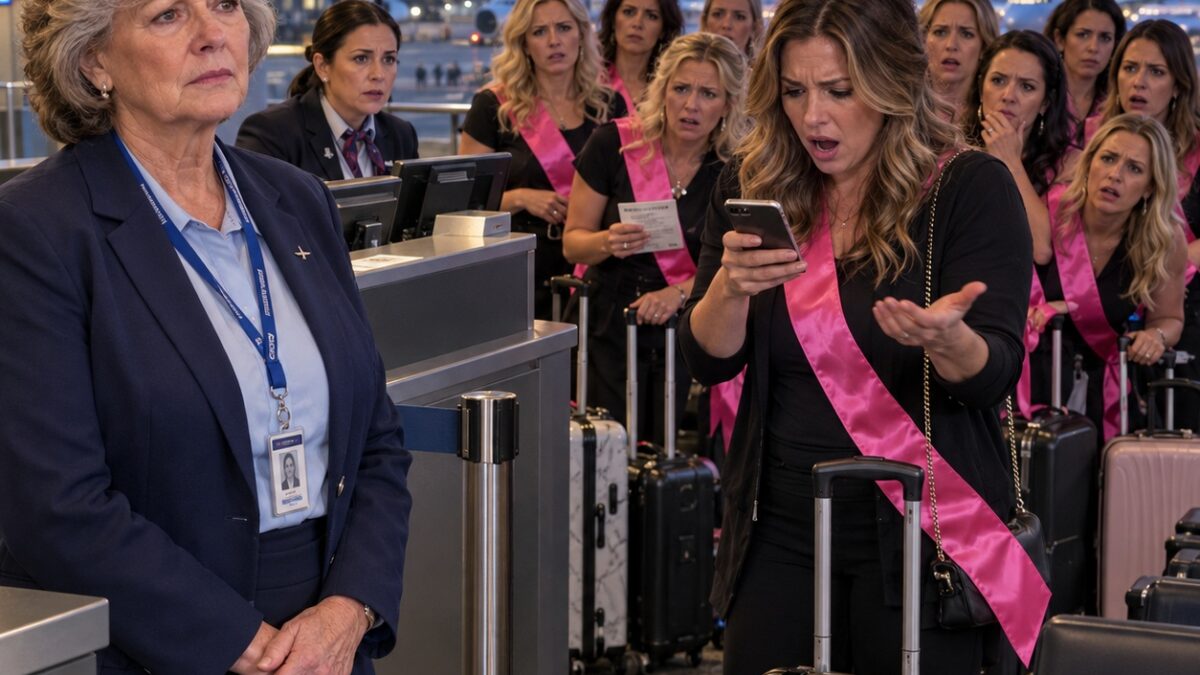
Nine women came down the concourse like a moving pink advertisement.
Matching glitter sashes.
Matching white carry-ons.
Rhonda leading in oversized sunglasses.
Neck pillow.
Sloane in a white jumpsuit with MAID OF HONOR across her chest.
Brooke looked tired but happy.
Four bridesmaids behind.
Jackie Dorsey.
Kim Albers.
They were excited.
That part hurt.
Some of them had no idea.
Sloane saw me.
Slowed.
Then continued.
She stopped three feet away.
Her eyes went from my lanyard to Renee.
“Well.”
Slight smile.
“Come to apologize?”
“I came to fly.”
Her smile shifted.
“You’re on this flight?”
“I’ve flown this route once a month for four years.”
Rhonda approached.
“Don’t engage her, sweetheart.”
Then to me:
“You came to make a scene.”
“I’m visiting my sister.”
Brooke looked between us.
“What’s happening?”
Sloane answered quickly.
“Nothing.”
Then:
“Go get a muffin.”
Brooke did not move.
Above the gate:
HARBOR LINE 1147 — SAN DIEGO — ON TIME
Standby list below.
My name near the top.
INGRAM O.
Then nine other names.
Beside each:
REF
Referred.
Nobody in pink noticed.
At 6:05, boarding began.
First class.
Families.
Military.
Groups.
The bride squad stayed near the window taking photographs.
At 6:20, the gate had mostly emptied.
Jerome picked up the microphone.
Two-tone chime.
“Good morning. The following standby passengers, please see an agent at the podium.”
He read:
“Ingram, Olivia.”
I walked up.
Then:
“Ingram, Sloane.”
“Mercer, Brooke.”
“Mercer, Rhonda.”
The pink group turned.
“Dorsey, Jacqueline.”
“Albers, Kimberly.”
Then four bridesmaids.
They gathered.
Phones out.
Bags rolling.
Still laughing.
Sloane reached the front and held up her phone.
Jerome did not scan it.
He looked toward Renee.
Renee stepped forward.
“Good morning, ladies. I’m with Harbor Line corporate security.”
The atmosphere changed immediately.
Renee continued.
“I have one question for each passenger.”
Jackie happened to be closest.
“Ms. Dorsey, your listing was created under a retired employee’s travel account. How did you obtain it?”
Jackie blinked.
“From Sloane.”
“Did you pay?”
Jackie laughed nervously.
“Yes.”
“How much?”
“$175.”
“How?”
“Venmo.”
She pulled out her phone.
“I have it.”
Renee looked.
“Thank you.”
Kim.
“Same question.”
“Rhonda told me about it at the salon.”
“Payment?”
“$175.”
Bridesmaid one.
$180.
“Airline fees.”
Bridesmaid two.
Same.
Another.
Same.
Brooke’s face was changing.
She held her phone flat against her chest.
Renee looked at her.
“Ms. Mercer?”
Brooke swallowed.
“$180.”
“To whom?”
“Sloane.”
“Why?”
“She said Olivia had given us the passes.”
Brooke looked at me.
“The money was the airline fee.”
Renee nodded.
Then Rhonda.
Rhonda raised her sunglasses onto her head.
“That is none of your business.”
Renee’s face did not move.
“It concerns travel booked on Harbor Line.”
“My daughter handled it.”
“Thank you.”
Rhonda frowned.
“I said I didn’t pay.”
“I heard you.”
Then Renee turned toward Sloane.
Sloane immediately spoke.
“These are family passes.”
“Mrs. Ingram authorized you to list family?”
“Yes.”
Renee turned toward me.
“Mrs. Ingram?”
“Yes.”
“For family.”
I looked at Sloane.
“And nobody was ever authorized to pay her for access.”
Sloane snapped:
“She’s lying.”
Renee looked toward Jackie.
Then Kim.
“These two ladies identify themselves as salon clients.”
No answer.
“Are they related to you?”
Sloane opened her mouth.
Nothing.
A phone behind us began recording.
I heard the little sound.
Brooke turned toward Jerome.
“Can I ask something?”
“Of course.”
“How much is the actual service fee?”
Renee nodded for him to answer.
Jerome looked at the booking.
“$38.40 one way.”
Brooke went still.
“And who pays that?”
“It charges the employee’s card.”
He looked toward me.
“In this case, Mrs. Ingram’s.”
Brooke slowly turned toward her sister.
“You charged me $180.”
“Brooke—”
“For my own bachelorette.”
“It’s not—”
“You charged Hannah.”
One bridesmaid looked at Sloane.
“You said that was the airline charge.”
Another whispered:
“She charged all of us.”
Brooke’s eyes filled.
“You told me Olivia offered.”
Sloane looked toward me.
For the first time, she seemed to want me to rescue her from the situation she had created.
I did not.
Renee continued.
“For the record, our review found thirty-eight listings under employee 40117 since March 2025.”
She scrolled.
“Twenty-seven were issued to people outside the family.”
Silence.
“We also recovered a public social-media post offering standby travel for $175 per person per direction.”
Rhonda stepped forward.
“This is ridiculous.”
Renee ignored the interruption.
“Mrs. Ingram reported the misuse herself Monday morning within the policy’s self-disclosure period.”
Sloane’s face changed completely.
The charm disappeared.
“She’s an ATM.”
Her voice cracked across Gate B9.
People turned.
“That’s what she is.”
“Sloane.”
Brooke touched her arm.
“No!”
Sloane pulled away.
“She has a pension.”
Her voice rose.
“A paid-off house.”
“She has money.”
“Two thousand three hundred dollars a month is nothing to her.”
Rhonda joined in.
“She’ll let her grandson get thrown out over plane tickets!”
Jerome said quietly:
“They’re passes, ma’am.”
Rhonda snapped:
“Nobody asked you.”
Three phones were recording now.
Sloane stepped close to me.
Vanilla perfume.
Angry eyes.
“Say something.”
I looked at her.
“Come on.”
She laughed shakily.
“You always have something to say.”
I thought about Raymond’s funeral.
Sloane standing beside the guest book.
I thought about the pink business-loan folder.
Milo reading my badge number on the kitchen floor.
Gavin staring at the carpet while everyone laughed.
Then I said:
“The ATM is out of service.”
Quiet.
No triumph.
No shouting.
Just fact.
Sloane made a strange sound.
Her hand lifted.
Not to hit me, I do not believe.
Just anger searching for somewhere physical to go.
Renee moved between us.
“Ma’am.”
No urgency.
“Lower your voice or I’ll ask airport police to join us.”
Sloane’s hand dropped.
Rhonda sank into a gate chair.
Started crying loudly.
Renee looked down at her tablet.
“All nine listings under employee 40117 are void effective immediately.”
Brooke’s mouth opened.
Then Renee looked at Sloane and Rhonda.
“Both of you are permanently barred from Harbor Line pass travel.”
“You’ll receive written notice.”
Then she turned toward me.
“Mrs. Ingram, your self-disclosure is accepted.”
Pause.
“No sanction will be placed on your retiree privileges.”
My lungs released air I had apparently been holding all week.
Then Renee addressed the other women.
“You were riders, not sellers.”
Her voice softened.
“If seats remain, you may purchase regular fares.”
Hannah asked:
“How much?”
Jerome checked.
“$389 one way.”
Groans.
“Six seats remain for paid purchase.”
Jackie looked at Kim.
“No.”
Kim shook her head.
They were going home.
Brooke stared at the screen.
Then took out a credit card.
“One.”
Sloane turned.
“Brooke.”
Brooke ignored her.
Hannah stepped forward.
“We’re coming too.”
The other bridesmaids nodded.
Four.
They would buy their own fares.
Brooke finally turned to Sloane.
Her face was wet.
Her voice was steady.
“Don’t buy one.”
Sloane froze.
“What?”
“I mean it.”
“Brooke.”
“Don’t come.”
“This is your bachelorette.”
“Yes.”
Brooke looked at her.
“And you lied to me.”
“About a fee.”
“About Olivia.”
“About the passes.”
“About all of us.”
Sloane whispered:
“I was trying to make the trip affordable.”
“You made money from us.”
Brooke shook her head.
“And she paid the fee.”
She looked toward me.
“You turned somebody else’s gift into your business.”
Sloane stared.
There was nothing useful left to say.
Jerome returned to the microphone.
Chime.
“Ingram, Olivia.”
He smiled at me.
“Seat 14C.”
Middle seat.
Between a Navy recruit and a man who had apparently fallen asleep before boarding began.
I have flown worse.
As I buckled my seat belt, my phone buzzed.
Gavin.
I knew about the name ATM. I didn’t know about the money.
I stared.
Then typed:
I know, honey.
Pause.
Then:
You laughed at both.
Dots.
Stopped.
Started.
Stopped.
No reply.
The cabin door closed at 6:47.
I turned off my phone.
We pushed back.
As the airplane taxied, I watched Indianapolis slide past the window.
I had spent thirty-six years helping thousands of people leave airports.
That morning I finally understood departure can be a boundary too.
You do not always need to win the argument.
Sometimes you close the door and go where you were going before somebody tried to make your life about them.
The aftermath moved quickly.
Monday, Brooke sent a written demand to Sloane requesting refunds for every woman who had paid for the San Diego trip.
She copied all of them.
By evening, Sloane had refunded $1,250.
Gavin told me later it came from money she had set aside toward a storefront for her event-planning business.
I felt no pleasure.
Cause.
Effect.
Friday, Harbor Line sent its official findings.
My privileges remained intact.
Sloane and Rhonda permanently barred from pass travel.
Previous unauthorized riders notified.
The Facebook sales post disappeared.
So did Rhonda’s #ATMClosed attack.
Apparently someone commented asking whether she was the same woman from the Gate B9 video.
The internet has many flaws.
Memory is not always one.
I spent Mother’s Day in California.
Winnie and I sat on her patio eating lemon bars.
Her lemons really were absurdly large.
I told her the whole story.
When I got to:
“The ATM is out of service,”
she laughed so hard she had to put down her tea.
“Daddy would have loved that.”
“Yes.”
Then she became serious.
“You okay?”
“I think so.”
“No.”
She shook her head.
“You’re Olivia.”
“Fine means thunderstorms.”
I smiled.
“I’m learning.”
Sloane repaid the $1,036.80 in service charges.
Two checks.
No note.
Brooke married Nate June 20 in a church in Carmel.
Sloane was no longer maid of honor.
She attended.
Fourth row.
Beside Gavin and Milo.
I did not stare.
At the reception, Brooke found me near the cake.
She hugged me.
Then whispered:
“You’re the only one who told me the truth.”
I hugged her tighter.
“That should not have been my job.”
“No.”
She pulled back.
“But thank you.”
July 1, Gavin and Sloane moved.
Two-bedroom apartment.
$1,590 a month.
Milo lost the painted moon ceiling.
He did not lose a home.
Important distinction.
Children can survive smaller bedrooms.
What they struggle to survive is being used as ammunition between adults.
I kept paying preschool directly.
$640.
Always direct.
No conditions.
No comments.
My grandson did not create this mess.
Then July 11, Gavin came to lunch alone.
No money request.
No crisis.
Just lunch.
I made chili.
He ate two bowls.
Then said:
“Tell me about when you were fourteen.”
I stopped.
“What?”
“The garbage bags.”
So I told him.
My father.
Rail yard.
Cosigned truck.
Bank.
Missed rent.
Landlord.
My mother sitting on the porch with two black bags.
The fear.
Everything I had decided that summer.
Gavin listened.
Really listened.
No phone.
No excuses.
When I finished, he said:
“I thought you just liked helping.”
“I did.”
I looked toward Raymond’s chair.
“I also liked not being afraid.”
Gavin nodded slowly.
“Of us losing the house?”
“Of watching you feel what I felt.”
“I’m thirty-seven.”
“Yes.”
“I have a job.”
“Yes.”
“You were still paying because of something that happened fifty-five years ago.”
“When you say it like that, it sounds ridiculous.”
“It sounds sad.”
That hurt more.
Because he was right.
“I think Sloane figured it out before I did.”
“What?”
“That I would pay if Milo was mentioned.”
Gavin looked down.
I continued.
“Your mother-in-law knew your rent due date.”
He winced.
“I know.”
“She knew because all of you talked about my money as though it were part of your household budget.”
He looked ashamed.
“Mom.”
“I’m not saying you stole passes.”
“I know.”
“But you laughed.”
His eyes closed.
“I know.”
“You laughed because the joke felt harmless while the money kept arriving.”
“Yes.”
There.
I had not realized how badly I needed him to say it.
He looked at me.
“I’m sorry.”
I nodded.
Not instant absolution.
Not punishment.
Acknowledgment.
He asked about the 529.
I told him.
$2,340 monthly.
His eyebrows rose.
“You’re putting the whole old rent amount into Milo’s college fund?”
“Yes.”
“Mom, that’s—”
“My choice.”
He stopped.
That phrase mattered.
Generosity chosen.
Not extracted.
“What if he doesn’t go to college?”
“Then we will make an appropriate plan when he is eighteen.”
Gavin almost smiled.
“You filed an alternate.”
“Always.”
He laughed.
That was the first conversation in years where my son left without taking anything from me except information.
I noticed.
So did he.
Sloane and I did not reconcile quickly.
There was no dramatic apology at my kitchen table.
Life is rarely that cooperative.
For months, contact happened through Gavin.
Then through Milo.
Birthdays.
Holidays.
Pickups.
She remained defensive.
She believed I had humiliated her at the gate.
I believed she had humiliated herself long before reaching it.
Both positions existed.
At Christmas she stood in my kitchen while Milo built a train track on the floor.
She said:
“You could have warned me they were investigating.”
“I did.”
“No.”
“You received my letter Monday.”
Her jaw tightened.
“You knew the passes were still active.”
“Yes.”
“You let us go.”
“I told you exactly what had been reported.”
“You knew something would happen.”
“I knew Harbor Line was reviewing misuse.”
“That is not the same.”
I looked at her.
“What warning would have satisfied you?”
She said nothing.
Then:
“You could have canceled them.”
“Yes.”
“Why didn’t you?”
“Corporate security asked me not to.”
Her face changed slightly.
“They wanted evidence?”
“Yes.”
She looked toward Milo.
Then:
“I still think that was cruel.”
I considered.
“Maybe it felt cruel.”
“That’s not an apology.”
“No.”
“I don’t think consequences are cruelty because they arrive in public.”
She laughed bitterly.
“Easy for you.”
“No.”
I shook my head.
“You called me an ATM in front of thirty people.”
Her face flushed.
“I remember public humiliation.”
Silence.
Milo drove a toy train into my foot.
We both looked down.
“Sorry, Grandma.”
“You’re forgiven.”
Sloane almost smiled.
Then did.
Small.
Human.
That was enough that day.
A year later, she asked to talk privately.
No Rhonda.
No Gavin.
No audience.
We sat at the same kitchen table where the pink loan folder had once appeared.
Sloane looked different.
Not physically.
Less certain.
“I was angry at you for saying no.”
“The loan.”
“Yes.”
“For three years?”
“Longer than I should have been.”
She rubbed her hands.
“My mom always said people with money decide who gets to breathe.”
I waited.
“Dad left.”
She continued.
“He took everything he could.”
“My mom worked constantly.”
“She made it sound like anybody who had money and didn’t share it was choosing to hurt us.”
“That explains something.”
“I know.”
She looked at me.
“It doesn’t excuse me.”
Good.
“I saw those passes.”
She swallowed.
“At first I used one for Mom.”
“Then Brooke.”
“Then somebody at the salon said she needed Phoenix.”
“The man in the Colts cap.”
Sloane nodded.
“She offered me money.”
“And?”
“I said no at first.”
That surprised me.
“Then?”
“She insisted on paying something.”
“I told myself the $175 covered hassle.”
“And the $38.40?”
“I knew you were paying it.”
Honesty.
Ugly.
Useful.
“After the first one worked, it felt easy.”
“Then another.”
“Yes.”
“Then your business.”
“Yes.”
She looked down.
“I started counting the passes like they were mine.”
That was the heart of it.
Not $4,725.
Not Facebook.
Entitlement.
“I’m sorry.”
I did not immediately say I forgave her.
She continued.
“The ATM joke was something Mom had been saying.”
“I figured.”
“I repeated it.”
“Yes.”
“I knew you were paying our rent.”
“Yes.”
“I knew you paid for the flights.”
“Yes.”
“And I still thought you were stingy because you wouldn’t cosign.”
She started crying.
“I don’t know when that started sounding reasonable.”
I did.
Entitlement rarely announces itself as entitlement.
It says:
You have more.
You will not miss it.
Family helps family.
This is temporary.
You said no when you could have said yes.
Then:
You owe me.
“I’m sorry,” she repeated.
I nodded.
“Thank you.”
“Do you forgive me?”
“I’m working on it.”
She accepted that.
That mattered too.
Boundaries improved our relationship more than unlimited generosity ever had.
I stopped paying Gavin’s household bills.
Completely.
Birthday gifts?
Yes.
Dinner?
Of course.
Milo’s preschool?
Direct.
529?
Monthly.
Emergency?
We discussed it.
Not assumed.
The strangest change was that Gavin became more comfortable talking to me after I stopped rescuing him financially.
At first, that seemed backward.
Then I understood.
Money had been crowding every conversation.
If he told me the car needed repairs, did that mean he was asking?
If he said work was stressful, would I offer cash?
If I asked about rent, was I monitoring?
Once the automatic support ended, information became information again.
He could say:
“We’re tight this month.”
And I could say:
“That sounds hard.”
Not:
“How much?”
The first time I did that, he laughed.
“What?”
“You didn’t reach for a checkbook.”
“I don’t use checks much anymore.”
“You know what I mean.”
“Yes.”
Then:
“You okay?”
He nodded.
“We’re figuring it out.”
Good.
Figuring it out is an adult skill.
I had accidentally delayed it.
Sloane returned to paid work while rebuilding her event-planning business more carefully.
Actual clients.
Actual invoices.
No airline inventory.
Brooke kept more distance from her sister for a while.
That relationship repaired slowly.
Not fully.
Some damage changes the shape of closeness.
Rhonda never gave me a sincere apology.
Not one I recognized.
She sent a Christmas card once with:
Family should always forgive.
I did not answer.
Forgiveness is not a subscription service.
And it is certainly not proof that an old arrangement should restart.
Years later, Milo asked why Grandma Rhonda and Grandma Olivia did not spend much time together.
I said:
“We’re very different people.”
He nodded.
Children often accept the answer adults should have accepted years earlier.
My retiree lanyard still hangs beside the back door.
Blue strap.
Badge.
Photo of a younger version of me who had recently retired and had not yet learned what boundaries would cost.
I still visit Winnie.
Still list standby.
Still check weather.
Still file an alternate.
The first trip after Gate B9 felt different.
I walked through that airport without wondering whether somebody else had used my number.
No strange charges.
No unknown riders.
I owned my work again.
That sounds dramatic for a travel privilege.
But it was never only about flights.
The account represented labor.
Thirty-six years.
Night shifts.
Missed holidays.
Storms.
Responsibility.
Sloane saw unused passes.
I eventually learned the difference between unused and available.
Not everything you are not currently spending belongs to somebody else.
Money.
Time.
Energy.
A spare bedroom.
A retirement account.
A flight pass.
Kindness.
Unused does not mean abandoned.
That lesson reached farther than Sloane.
It reached me.
I had treated my own resources as though saving them while family wanted something required justification.
It did not.
“No” is a complete financial plan sometimes.
That became easier with age.
Milo’s 529 grew.
Every month:
$2,340.
Automatic.
The same number once leaving my account for rent.
By the time Milo was old enough to understand money, the account had become substantial.
One afternoon, when he was thirteen, he asked:
“Dad says you used to pay their whole rent.”
“Yes.”
“Why?”
I considered giving him a simple grandmother answer.
Instead:
“I was afraid.”
“Of what?”
“That if I didn’t help enough, something terrible would happen.”
“Did it?”
“No.”
He thought.
“Then why did you keep paying?”
“Because sometimes fear keeps using an old map.”
He frowned.
I smiled.
“When I was your age, I lost my home.”
His face changed.
“Dad told me.”
“Good.”
“So you thought he would too.”
“Yes.”
“Even though he was grown up?”
“Yes.”
Milo nodded.
“That’s kind of weird.”
“Extremely.”
He smiled.
Then:
“Dad says you put the rent money somewhere else.”
“Yes.”
“Where?”
“That’s between me and Future Milo.”
He groaned.
“Grandma.”
“Future Milo is very trustworthy.”
He had no idea.
Good.
Children should not grow up counting inheritances.
When he turned eighteen, we would talk.
Until then, the account existed quietly.
That was the opposite of an ATM.
A machine dispenses because a code is entered.
A gift should arrive because someone chooses.
Years after the shower, I found the old text from Gavin while cleaning archived messages.
Mom, can you send the rent before Friday?
Then mine:
The ATM is out of service.
I stared.
At first, I had thought those five words were anger.
Later I understood they were permission.
Permission for Gavin to become financially responsible.
Permission for Sloane to discover whether her business could survive without somebody else’s credentials.
Permission for me to stop treating fear as a family obligation.
Boundaries sound like something you build against another person.
Sometimes you build them around the part of yourself that keeps volunteering to be used.
That was mine.
My fourteen-year-old self wanted to stop every moving truck forever.
She needed somebody older to tell her:
You survived.
Your son is not on that porch.
Your grandson is not being abandoned.
A smaller apartment is not homelessness.
A late fee is not childhood trauma.
You do not have to pay money every month to prove history will not repeat.
I wish Raymond had been alive for the whole thing.
He would have understood before me.
Raymond was generous but practical.
He repaired things.
He did not replace a whole door because one hinge squeaked.
He once told Gavin, when he was seventeen and angry about borrowing our old car:
“Wanting better is not the same as needing better.”
Gavin hated it.
I laughed.
Years later, that sentence fit the townhouse perfectly.
They wanted the three bedrooms.
The moon ceiling.
The pond.
Perfectly reasonable.
They did not need me to finance those preferences indefinitely.
When I finally told Winnie about opening Milo’s 529 with the old rent amount, she stared.
“You’re putting $2,340 a month into one child’s college account?”
“Yes.”
“For how long?”
“I’ll review it.”
“Olivia.”
“What?”
“You have always been slightly insane.”
“Raymond married me anyway.”
She laughed.
Then:
“That kid is going to have options.”
Exactly.
Options.
Not dependency.
That was the difference.
An education account does not tell Milo:
Grandma will pay whatever bill you create.
It tells him:
Somebody planned ahead for you.
He still chooses what to do with it.
Alternate.
Always an alternate.
Sloane and Gavin stayed married.
That surprised some people who heard the story.
They expected betrayal to produce immediate divorce.
Life is not obligated to satisfy narrative symmetry.
Their marriage struggled.
Of course.
Gavin had to deal with what Sloane did.
Sloane had to deal with the fact that Gavin publicly laughed along with an insult against his own mother but later acted shocked when the consequences reached him.
Neither was innocent in every part.
They went to counseling.
I know because Gavin told me.
I did not ask for details.
Not my marriage.
They moved twice.
Eventually bought a smaller house.
No financial help from me toward the down payment.
Gavin told me proudly.
“We did it ourselves.”
I smiled.
“That must feel good.”
“It does.”
Then:
“I understand why you stopped now.”
I looked at him.
“You didn’t then.”
“No.”
“Would you have if I explained better?”
He thought.
“Probably not.”
We laughed.
Honesty.
Late is still useful.
Brooke and Nate remained close to me.
Every anniversary near May, Brooke sometimes sent:
Bought my own ticket today.
A joke.
Gentle.
She had been innocent enough that morning.
She had believed her sister.
She had paid what she thought was the fee.
I never wanted her humiliated.
That was why Renee’s distinction mattered.
Seller.
Rider.
Knowledge.
Intent.
Accountability should be precise.
A dispatcher learns that too.
You do not cancel every flight in the country because there is weather over Kansas.
You identify the affected route.
Sloane and Rhonda lost pass privileges.
The other women had to decide whether to pay real fares.
Brooke did.
Her trip continued.
The bride should not lose San Diego because her sister lied.
Fairness is not maximal punishment.
It is the correct consequence reaching the correct person.
That may be the most professional thing I carried from dispatch into family life.
Rhonda hated me for years.
I heard that from people.
At first, it bothered me.
Then less.
Eventually not at all.
I did not need Rhonda to agree with the boundary for it to be valid.
That was another late lesson.
People who benefited from your lack of limits will often call limits cruelty.
They may even sincerely experience them that way.
If somebody has been drinking from your well without asking, the locked gate feels like theft.
Still your gate.
Still your water.
One afternoon, long after the gate incident stopped being fresh gossip, I saw Rhonda unexpectedly at a grocery store.
Different store from the Colts-cap man.
She froze.
I stopped.
We were standing near lemons.
Winnie would have enjoyed that.
Rhonda looked older.
So did I.
“Olivia.”
“Rhonda.”
She looked at my cart.
I looked at hers.
Then she said:
“You embarrassed my daughter.”
I could have walked away.
Instead:
“No.”
Her jaw tightened.
“You did.”
“Harbor Line investigated pass sales.”
“At the gate.”
“Yes.”
“You could have handled it privately.”
“I tried.”
She frowned.
“I sent a written letter four days before the flight.”
“She didn’t think they’d actually do anything.”
“That was her decision.”
Rhonda looked down.
Then:
“I still think you should have helped with the rent.”
I almost laughed.
Not cruelty.
Just disbelief.
“Why?”
“Because family helps.”
“I paid twenty-seven months.”
“She was building a business.”
“With my airline account.”
Rhonda winced.
“That was wrong.”
The first time I had heard her say it.
I waited.
“She shouldn’t have sold them.”
“No.”
“She thought…”
Rhonda stopped.
“What?”
“That you had so much.”
I nodded.
“I did.”
That surprised her.
“I still do.”
Her eyes flickered.
“Then—”
“No.”
I smiled gently.
“That is the part you still don’t understand.”
I touched my cart.
“My having enough does not create your daughter’s entitlement.”
Rhonda looked hurt.
Not angry.
Hurt.
Maybe it was finally the real wound.
“I raised my girls alone.”
“I know.”
“Nobody helped me.”
“I’m sorry.”
“I promised they’d never struggle like I did.”
There it was.
My mirror.
Not identical.
But close.
I looked at her differently.
“So did I.”
Rhonda stared.
“What?”
“My father died when I was fourteen.”
I told her just enough.
The truck debt.
The bags.
The porch.
Her face changed.
“You never said.”
“You never asked.”
Silence.
We stood beside a pile of supermarket lemons while two old women finally recognized the same fear had led them in opposite directions.
Mine:
Pay.
Rescue.
Overprotect.
Hers:
Take.
Secure.
Demand.
Neither fear excused harm.
But understanding it reduced the need to hate.
Rhonda whispered:
“I didn’t know.”
“No.”
She looked embarrassed.
“I called you an ATM.”
“Yes.”
“I was awful.”
“Yes.”
That made her laugh once through tears.
“You’re not going to make this easy.”
“I spent thirty-six years telling captains no.”
She wiped her face.
“I’m sorry.”
I accepted the apology.
Did not invite her into my finances.
Forgiveness and restored access are separate systems.
We said goodbye.
I bought lemons.
Called Winnie from the parking lot.
“You’ll never guess.”
She said:
“If it involves those sad Indiana lemons, I’m hanging up.”
Sisters.
Some stability is permanent.
The older I became, the less interested I was in dramatic revenge.
At sixty-nine, I thought Gate B9 was the climax.
Nine women.
Corporate security.
Sloane exposed.
Rhonda crying into a neck pillow.
My seat called.
It was certainly dramatic.
But real endings happen afterward.
The important part was not Sloane losing a flight.
It was Gavin learning to ask himself whether he could afford his life without assuming my account was part of it.
It was Brooke learning the difference between a gift and something sold under another person’s name.
It was Sloane eventually admitting that she had transformed resentment from one denied loan into permission to steal access.
It was Rhonda finally understanding abundance does not erase ownership.
It was me seeing a rent payment and no longer seeing a landlord’s truck from 1971.
That took longer than five days.
Much longer.
My badge remains by the back door.
Sometimes Milo, older now, still looks at it.
“40117.”
“Yes.”
“How many flights did you dispatch?”
“Too many.”
“How many did you cancel?”
“Not enough to make pilots like me.”
He laughs.
Then once he asked:
“Was Gate B9 the best flight you ever took?”
“No.”
He looked surprised.
“Why not?”
I thought about it.
“The flight itself was ordinary.”
“Then what was the best?”
“Probably one where nothing happened.”
He frowned.
“That’s boring.”
“Exactly.”
Dispatchers understand.
A perfect flight is boring.
No diversion.
No emergency.
No argument over fuel.
Everybody lands where they planned.
Family life should be allowed the same luxury.
Boring dinners.
Bills paid by the people responsible.
Gifts without leverage.
Grandchildren who come over because they want to see you, not because an adult sent them as emotional evidence.
Those became my favorite years.
Quiet.
The ATM joke disappeared.
No one in the family used it anymore.
Not even ironically.
Good.
I did not need the phrase preserved as a trophy.
I was not proud that people once saw me as useful primarily because I could pay.
I was proud that eventually I stopped cooperating with it.
There is a difference.
If I could go back to the bridal shower, I would still smile.
Still hug Brooke.
Still leave.
I would not throw champagne.
Would not make a speech.
Would not announce every dollar I had ever spent on Gavin.
Why?
Because a boundary is stronger when it does not require an audience.
The audience came later.
Accidentally.
At Gate B9.
But the actual boundary began alone in my Buick at 4:23.
Phone in hand.
One message.
Five words.
The ATM is out of service.
That was the moment I finally stopped filing every family emergency to myself as the only available alternate airport.
Gavin could land somewhere else.
Sloane could build a legitimate business.
Rhonda could live without treating my pension as community property.
Milo could still be protected without teaching his parents that protection meant unlimited rescue.
And Olivia Ingram could remain generous without remaining available for extraction.
That last part was hardest.
Because generosity was part of who I was.
I did not want Sloane’s betrayal to make me stingy.
That would have let her damage something I valued in myself.
So I kept giving.
Different rules.
Direct gifts.
Clear purpose.
My choice.
Preschool.
Church.
Aviation scholarship for young women studying dispatch.
Money to a food pantry in Terre Haute.
Winnie’s plane trips when she needed help later.
Generosity survived.
Entitlement did not.
That is the outcome I am proudest of.
Closing one machine did not close my heart.
It simply put the controls back where they belonged.
With me.
At seventy-something, I still take out my old mechanical pencil before travel.
Yellow barrel.
Worn clip.
I write flight number.
Weather.
Backup route.
Alternate.
Every time.
Sometimes I smile at the word.
Because for most of my life I thought an alternate was somewhere else to land when the original destination became impossible.
Now I know people need alternates too.
If somebody stops respecting your kindness, your alternate may be a boundary.
If helping becomes enabling, your alternate may be stepping back.
If an adult child mistakes your fear for obligation, your alternate may be letting them solve the next bill.
If somebody takes the gift and starts selling pieces of it, your alternate may be closing the account.
None of that means you stop loving them.
Gavin is still my son.
Sloane is still my daughter-in-law.
Milo is still the boy who used to sit on my kitchen floor and trace 40117 with his finger.
Love remained.
Access changed.
That was necessary.
Raymond would have understood.
Sometimes I imagine telling him everything.
He would be at the garage workbench.
Glasses down his nose.
Some broken hinge in one hand.
I would get to the bridal shower.
His jaw would tighten.
The unauthorized passes.
He would swear.
Gate B9.
He would laugh.
Then when I told him about moving the $2,340 into Milo’s college account, he would become quiet.
Finally:
“Good alternate.”
Exactly.
I wish he had been there.
But maybe part of growing old is learning to answer your own questions using the people you loved long enough to hear them inside you.
Raymond taught shop.
Repair before replace.
Measure before cut.
Do not force the wrong screw because eventually you ruin the thread.
I had been forcing the wrong solution onto my family for years.
More money.
More rescue.
More protection.
The thread was stripping.
Stopping saved more than continuing would have.
That is not the story people expect when they hear about a mother refusing rent.
They hear:
Cold.
Rich.
Punishing.
What they do not see is the history underneath.
My mother’s hand.
Two black bags.
The promise I made at fourteen.
The decades I spent making sure Gavin never feared money the way I had.
How a good instinct, applied too long and too broadly, became unhealthy.
That is why I do not tell this story as:
My greedy daughter-in-law got what she deserved.
Too simple.
Sloane made serious choices.
She lied.
Sold benefits that were not hers.
Profited from my credentials.
Humiliated me publicly.
Then minimized all of it.
She also had her own fear around scarcity.
Her own mother’s history.
Her own distorted story about people who had money.
Understanding does not erase accountability.
It makes accountability useful instead of merely satisfying.
The gate ended the misuse.
The years afterward taught us why it happened.
That matters more.
Brooke once asked me, years later:
“Were you scared they’d take your retiree privileges?”
“Yes.”
“Really scared?”
“Yes.”
“You looked so calm.”
I laughed.
“People confuse calm with lack of fear.”
“What was it?”
“Training.”
I looked at her.
“You do the next correct thing.”
That was my whole career.
Bad weather?
Next correct thing.
Mechanical problem?
Next correct thing.
Crew timing out?
Next correct thing.
Family betrayal?
Same.
Document.
Report.
Protect the innocent.
Stop the loss.
Do not improvise revenge.
Then reassess.
Maybe that is why Gate B9 ended the way it did.
I did not need Sloane dragged away.
Did not need Rhonda arrested.
Did not need the bride’s trip destroyed.
Brooke bought her ticket.
Her friends bought theirs.
They went to San Diego.
Sloane did not.
Appropriate.
I got seat 14C.
Appropriate.
Then I went to Winnie’s patio and ate lemon bars.
Also appropriate.
Life does not need fireworks after every boundary.
Sometimes the person who treated you like an ATM watches the machine close, and you board your flight.
That is enough.
Today, if anyone calls me the old ATM, they better mean the machine is permanently disconnected.
But I rarely think about the insult anymore.
I think about badge 40117.
Thirty-six years.
And I think about that first word I always wrote in the margin.
Alternate.
It took me until sixty-nine to understand I was allowed to have one in my own family.
I did not have to be the rent.
The emergency fund.
The pass office.
The co-signer.
The soft place where every consequence disappeared.
I could be a mother.
A grandmother.
A widow.
A retired dispatcher.
A woman who gave when she chose.
And a woman who could say no without defending the balance in her bank account.
Because kindness is not a machine.
It is not activated by guilt.
It does not owe you money because you know where the button is.
Generosity is a gift someone chooses each time they give it.
The moment you begin treating the giver like equipment, sometimes the kindest thing they can do—for themselves and for you—is shut the machine down.
My daughter-in-law raised a champagne glass and called me an ATM.
She meant it as a joke.
What she did not understand was that after thirty-six years of deciding when airplanes should leave the gate, I knew something about shutting systems down when the numbers stopped making sense.
So I checked the manifest.
Found twenty-seven strangers.
Reported the discrepancy.
Protected my number.
Filed an alternate.
And five mornings later, when nine women in pink sashes reached Gate B9 expecting my generosity to work like a vending machine, Harbor Line finally said the word I should have said much earlier.
No.
Then they called my name.
Ingram, Olivia. Seat 14C.
And I boarded.

