PART2:My Daughter-in-Law Threw Hot Tea in My Face Over a $19,400 Europe Trip—At 4:57 A.M., the Airport Went Silent
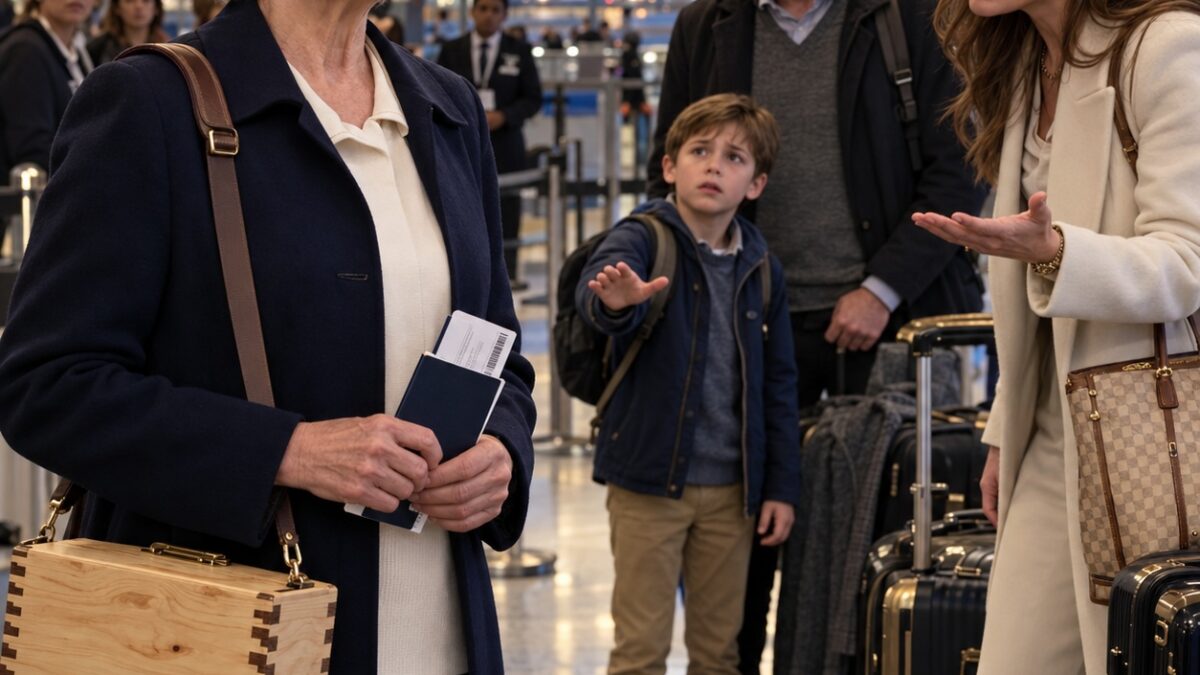
PART2
The first time Belle mentioned Europe, she was standing in my kitchen in January with her phone in her hand.
Her older sister Elodie had just turned forty.
Elodie was married to an orthodontist.
Elodie had recently been to Italy.
That was important because Belle’s relationship with her sister had always contained arithmetic.
Not affection arithmetic.
Status arithmetic.
Who had the larger house.
Who hosted Christmas.
Whose husband bought what.
Who traveled farther.
Who appeared more successful in photographs.
Belle showed me picture after picture.
Elodie on a balcony.
Elodie holding a giant lemon.
Elodie on a boat.
Blue water behind her.
Stone buildings.
Perfect sunlight.
“I stood up at her party and made a toast,” Belle said.
I was making coffee.
“To what?”
“To our Euro summer.”
I turned.
“Our?”
She smiled.
“All of us.”
I waited.
“You, me, Kellen, the kids, and Mom.”
Her mother was Dory Lasowski.
Sixty-four.
Hard worker.
Cleaned houses for thirty years.
Never owned a passport.
I respected the first fact.
The rest of my relationship with Dory was more complicated.
At Christmas, while eating my ham at my table inside my house, Dory had announced her theory of family finances.
“Grandparents with money pay.”
Then she laughed.
“That’s what they’re for.”
People reveal themselves when they think they are being funny.
I had remembered it.
Now Belle was standing in my kitchen showing me Italy.
She said:
“I told everyone we’re doing Europe this summer.”
“Told everyone?”
“At Elodie’s birthday.”
“Before booking anything?”
“We’re working it out.”
That was the first warning.
Not that she wanted Europe.
Wanting beautiful things is not a moral defect.
I wanted Norway.
Dory wanted Paris.
Belle wanted Positano.
The problem was that Belle had publicly promised something before privately determining who would finance it.
Embarrassed people make expensive promises.
I had spent decades watching businesses do the same thing.
I simply did not yet realize my name was already being written beneath hers.
Easter Sunday was April 5.
Kellen and Belle hosted at the rented split-level they had moved into after leaving our house.
Belle waited until everyone had food.
That was deliberate.
People are less likely to leave when they are holding plates.
“We need to talk about Europe.”
I continued cutting my ham.
Belle said:
“We need help.”
I looked at her.
“Your family.”
Still no number.
That was another pattern I recognized.
People planning to ask for a great deal of money rarely lead with the number.
They lead with emotion.
Family.
Need.
Opportunity.
Memory.
Then the number arrives after you have already accepted the premise.
So I skipped ahead.
“I’m not funding a European vacation.”
The table went quiet.
Belle blinked.
I continued.
“I will pay for Brier and Locky’s passports.”
I had checked the fees the night before because I suspected this conversation was coming.
“One hundred thirty-five dollars each.”
I took out a check I had already written.
Two hundred seventy dollars.
Placed it beside the serving dish.
“There.”
Belle stared at it.
“Passports.”
“Yes.”
“Wow.”
The word was flat.
“Generous.”
Kellen stared at his plate.
I ignored the sarcasm.
“And next summer, after I’m back, I would love to take Brier and Locky somewhere myself.”
“Next summer.”
Belle repeated it.
Then sighed.
And said the sentence that changed my financial life.
“Fine. We’ll wait.”
She reached for a roll.
“It’s all coming to Kellen anyway.”
I stopped chewing.
Dory looked down.
Kellen looked down too.
Belle buttered her roll.
As casually as if she had just discussed weather.
It’s all coming to Kellen anyway.
My house.
My savings.
My retirement accounts.
The money Arvid and I had spent forty-four years building.
She had converted my death into a delayed transfer.
That is what she meant.
And she said it while I was alive enough to hear.
I looked at my son.
Kellen’s eyes were fixed on two deviled eggs sitting side by side on his plate.
I waited for him to say:
Belle.
That’s my mother.
Enough.
He said nothing.
There were two eggs.
I remember that.
I remember their yellow centers.
The stupidest details survive emotional injury.
That night, I could not sleep.
When something keeps an actuary awake, she calculates.
So I calculated my life with my son.
Kellen was born in the spring of 1985.
I returned to work six weeks later.
Not because I wanted to abandon a baby.
Because Arvid’s teaching salary did not cover a mortgage and childcare and groceries.
Because Northern Prairie Mutual did not preserve ambitious positions indefinitely for women who stayed home.
Because I had spent years passing exams and I knew exactly how quickly a career could close.
So Arvid did school pickups.
Hockey.
Teacher meetings.
The long conversations in the truck.
I worked.
Sixty-hour weeks during difficult seasons.
I studied while Kellen slept on me when he was small.
I missed things.
Yes.
That mattered.
I carried guilt about it for decades.
And guilt is expensive.
Mine had purchased:
a used minivan.
college help.
dental surgery.
emergency money.
school costs.
and fourteen months of free housing when Kellen’s family needed somewhere to land.
Much of that time while his father was dying.
I had spent forty-one years attempting to reimburse my son for a childhood I believed I had partially missed.
Lying awake after Easter, I finally asked:
What did the reimbursement buy?
Not gratitude.
I did not require gratitude.
But did it buy basic respect?
Apparently not.
Did it buy a son willing to speak when his wife counted my estate before dessert?
No.
I realized something painful.
I had taught Kellen that if a problem became expensive enough, eventually his mother would pay.
That part was mine.
So on Tuesday, April 21, I put on my good gray coat and drove to the office of Merryweather Croll PLLC above the bakery on Main Street.
My attorney, Agada Merryweather, spent two hours with me.
I read every page twice.
She laughed once.
“Nobody does that.”
“I do.”
Then I signed.
Blue ink.
No announcement.
No family meeting.
No angry letter.
Just a pen.
Some decisions are made with emotion.
Mine was made after emotion had cooled enough to become policy.
What I changed was simple.
When I died, Kellen would not control my estate.
A professional trust company would.
The largest portion would fund the Arvid Eubanks Education Trust.
Brier and Locky could use it for education until age thirty.
Payments would go directly to schools.
Not to their parents.
Kellen would receive his father’s workshop tools.
And $25,000.
My house and savings would be handled according to the new trust.
I also changed my healthcare agent.
That position went to my neighbor Wilda Granlin.
Wilda did not know that yet.
Some conversations could wait.
I left the attorney’s office feeling neither triumphant nor angry.
Mostly tired.
A mother changing an inheritance is not victory.
It is evidence that something broke.
After Easter, my Sunday FaceTime calls with Brier stopped.
Every Sunday at four, she had called.
Drawings.
Loose teeth.
Science projects.
Birds at my feeder.
We had done that since they moved out.
April 19:
No call.
I tried at 4:15.
Nothing.
At six, Belle texted.
Kids are busy.
Next Sunday:
Same.
Two data points are not a pattern.
Two data points plus motive become a hypothesis.
I waited.
Then Belle sent a link.
No greeting.
A hotel in Positano.
White walls.
Blue sea.
Terraces stacked down the cliff.
Isn’t this a dream?
I looked.
It was.
I am not made of stone.
I wrote:
It’s lovely. Enjoy.
Three dots appeared.
Disappeared.
Again.
Finally:
Then we will. With or without you.
I placed the phone beside Arvid’s old ceramic key dish.
I did not respond.
The first Sunday in May, Belle brought the children to my house without warning.
She said they missed me.
That was probably true.
I also believed she wanted to see whether silence had softened my answer.
Locky ran directly to the cookie jar.
Brier hugged me for a long time.
Children should not have to explain why adults restricted a phone call, so I did not ask.
Then Brier saw the birch box on the shelf beside Arvid’s reading lamp.
“Is that Grandpa’s box?”
“Yes.”
“Are you still taking him to Norway?”
Belle removed her sunglasses.
“Norway?”
Brier nodded proudly.
“Grandma’s taking Grandpa back to the water where he asked her to marry him.”
Locky looked at the box.
“Is Grandpa in there?”
“Not all of him,” I said.
That was too philosophical for Locky.
He frowned.
“The rest is in your face. You have his chin.”
That satisfied him.
Brier touched the lid carefully.
“Can Grandpa sit by the window on the plane?”
“I’ll do my best.”
While I talked to the children, Belle wandered toward my refrigerator.
My itinerary was attached with a little cow magnet.
Flight numbers.
Departure times.
Every detail.
She lifted her phone.
“Locky, look. Grandma has a cow magnet.”
I heard the camera sound.
I thought she photographed the cow.
That was one mistake I made.
After the children went outside, Belle sat at my table.
“How much is Norway costing?”
“My business.”
“Fourteen? Fifteen thousand?”
Then she laughed.
“You’re spending fourteen thousand dollars on a dead man.”
Arvid’s reading lamp was ten feet away.
I folded my hands.
“Six thousand two hundred forty.”
She stared.
“I’m an actuary. I don’t round.”
For one second, that disrupted the performance.
Then she leaned forward.
“My kids have never seen Europe.”
“Okay.”
“Your husband already saw Europe.”
I looked at her.
“Now he’s in a box.”
She pointed toward the shelf.
“And you’re buying him a plane ticket.”
“He doesn’t need a ticket.”
She blinked.
“He’s a carry-on.”
Dry humor.
Arvid would have appreciated it.
Belle did not.
She stood so fast the chair scraped.
Called the children inside.
At the front door she turned.
“You’ll see.”
“Families travel together.”
Then she left.
I watched the minivan disappear.
At the time, I thought it was a threat made by someone frustrated.
I did not realize she meant she intended to be physically on my airplane.
Two days later, Dory arrived carrying tuna hot dish.
In Minnesota, hot dish is either comfort or confrontation.
From Dory’s lipstick, I knew which.
She sat in Arvid’s chair without asking.
I let that go.
Then she told me women like me had never worked.
That was interesting.
I told her about growing up on a farm outside Thief River Falls.
Forty cows.
January mornings.
Barn cold enough that fresh milk steamed.
Calculus by correspondence because I was the only girl in the county stubborn enough to take it.
Scholarship.
College.
Work.
Exams.
Dory listened as though facts were opinions.
Then said:
“Well, it worked out for you.”
“So share.”
“I do.”
I reminded her that her daughter and grandchildren had lived under my roof for fourteen months.
Dory pressed her lips together.
Then she accidentally gave me useful information.
“My ticket is already bought.”
I set down my coffee.
“What ticket?”
“Paris.”
She smiled.
“I’m sixty-four. I’m finally seeing Paris.”
“Who bought it?”
“Belle.”
“How many?”
“All five.”
That meant Belle, Kellen, Brier, Locky, Dory.
“Paid for?”
“Flights, yes.”
“With what?”
“Her tax refund. Some of my savings.”
“Which flight?”
Dory did not know.
Only that it left early in June.
I started understanding.
Not yet fully.
Enough to feel the first piece move.
That Thursday, Kellen came alone.
He sat at my kitchen table holding his mug with both hands the same way he had when he was nine.
For ten minutes he discussed weather.
Then:
“Mom.”
“Yes?”
“Belle needs this.”
“Europe?”
“She needs not to be the one who can’t.”
I said nothing.
He rubbed his face.
“Elodie’s husband bought her a boat.”
“A boat.”
“Mom.”
“I heard you.”
He looked down.
Then said something he had apparently been carrying for thirty years.
“You worked sixty hours a week my whole childhood.”
There it was.
“You owe me this one.”
The sentence hit.
I did not show it.
“I worked those hours so we could pay for the house you grew up in.”
Nothing.
“Your college fund.”
Nothing.
“So your father could remain a teacher instead of taking a job he hated.”
Kellen whispered:
“She’ll leave.”
I stopped.
“She’ll take the kids.”
That changed the equation.
Not the answer.
The equation.
My son was not asking me for a vacation.
He was asking me to buy stability in his marriage.
I softened.
“Then ask me for help with your marriage.”
He looked up.
“I’ll pay for counseling.”
“I’ll sit with you.”
“I’ll help with the children while you two work.”
“But I will not pay for Positano so your wife doesn’t leave.”
He stood.
Rinsed his mug.
Put it in the sink the way I taught him when he was seven.
Then left without hugging me.
I stood in the kitchen until the kettle boiled.
Then turned it off.
Went to bed.
The next morning, Wilda crossed the lawn in her bathrobe carrying two coffees.
Wilda had been my neighbor for twenty-six years.
Retired school nurse.
No patience for nonsense.
“Kellen was here.”
“Yes.”
“Forty minutes.”
“You timed it?”
“I time everybody leaving your house.”
We sat on my porch.
I told her about Europe.
The toast.
The demand.
Kellen’s accusation.
I did not tell her about my new trust.
Not yet.
She listened.
Then said:
“That boy hasn’t finished a sentence in his own house since 2012.”
I laughed unexpectedly.
“He finished one here.”
“Was it a good sentence?”
“Honest.”
“Not the same thing.”
No.
It wasn’t.
Mother’s Day arrived.
Nothing from Kellen until late afternoon.
No call.
No card.
No children.
Wilda brought rhubarb pie.
At 4:12 my phone buzzed.
Not a number.
An email address from an old iPad.
Happy Mother’s Day, Grandma. It’s Brier.
Then:
I’m on my old iPad. I’m not allowed to call. Mom says you picked Grandpa over us. I don’t think that’s true. Please don’t tell.
I read it standing.
Then sitting.
Then again.
My granddaughter was eleven.
She had dug out an old device, found Wi-Fi, and contacted me secretly because an adult was using access to children as leverage.
I wanted to write pages.
I wanted to drive over.
Instead:
I love you. Grandpa’s box will sit by the window.
Nothing else.
I did not want her caught.
Sometimes loving a child means refusing to recruit them into adult conflict.
A few days later Belle invited me to Sunday dinner.
We want to show you something. Bring an open mind.
Wilda read the message.
“Bring a checkbook in a locked box and leave the key with me.”
“I’m not bringing a checkbook.”
“What are you bringing?”
“Krumkake.”
Norwegian cookies.
Arvid’s mother taught me to make them after our wedding.
Thin.
Pressed on a hot iron.
Rolled quickly before they harden.
Hesitate and they crack.
I made three dozen.
Not one cracked.
I decided that meant nothing.
Then secretly decided it was a good sign anyway.
At Kellen’s house, the curtains were closed despite bright afternoon sun.
Belle stood beside the television with a remote.
Dory had wine.
Kellen had silence.
The children sat beside me.
“Euro Summer,” Belle announced.
The television displayed the Eiffel Tower.
Next slide.
Flights.
Minneapolis.
Chicago.
Amsterdam.
June 11.
6:45 a.m.
My flights.
Exactly.
I read the numbers twice.
Belle had photographed my itinerary.
There it was.
Five seats booked.
$7,410.
Paid.
Then Paris.
Then Positano.
Then transportation.
Tours.
Food.
And eventually Norway.
OPTIONAL?
My husband’s final wish had a question mark.
Then the last slide.
Large red letters.
GRANDMA’S PART: $19,400
Due June 9.
I added the categories mentally.
$3,840 hotel.
$7,250 Positano.
$1,860 trains and ferries.
$1,450 tours.
$5,000 “food and fun.”
Exactly $19,400.
The math was correct.
I almost respected that.
Locky tugged my sleeve.
“Mom says you’re taking us to Europe.”
My heart sank.
Not because I was changing my mind.
Because Belle had used the children to turn a request into a promise I had never made.
Dory lifted her wineglass.
“To Grandma.”
Everyone looked at me.
I folded my hands.
Waited until the room was completely quiet.
“I am not paying for any of it.”
Belle’s smile held.
I continued.
“Not hotels.”
“Not trains.”
“Not food and fun.”
“I am going to Norway for Arvid.”
“The passports were my gift.”
“That is my answer.”
Then I turned to Brier and Locky.
Important.
Children deserve direct sentences.
“I never told your mother I was taking you to Europe.”
Brier’s face changed.
“I would never break a promise to you.”
“I did not make this promise.”
Locky looked at Belle.
“Are we still going?”
“Of course.”
Belle said it quickly.
“Grandma just needs time.”
“No.”
I looked back at her.
“I answered at Easter.”
“The amount changed.”
“My answer didn’t.”
Belle smiled tightly.
“You’ll change your mind before June ninth.”
Kellen rotated his water glass on the tablecloth.
Quarter turn.
Quarter turn.
Silent.
Again.
On my way out, I passed the sideboard.
The cobalt teapot was there.
Arvid’s mother Ragna had carried it from Bergen in 1949, wrapped in a wool sweater inside a cardboard suitcase.
For more than sixty years, it had poured tea at family tables.
I gave it to Kellen and Belle on their wedding day.
Now it was filled with quarters and crumpled dollar bills from Belle’s small balloon business.
And a chip was missing from the spout.
White ceramic exposed beneath blue glaze.
I stood there for half a second.
Fourteen years.
One family heirloom.
Piggy bank.
Chipped.
I did not mention it.
I noticed.
That was my profession.
At home, I stood in front of my refrigerator.
My itinerary.
The cow magnet.
I heard Belle’s voice.
“Locky, look, it’s a cow.”
Camera shutter.
Then I understood the entire mechanism.
They had not merely booked Europe.
They had booked themselves onto my route.
If all five landed in Amsterdam beside me with tired children, luggage, no hotel I would allow them to sleep in, and Belle saying:
See? We’re here.
what would I do?
She knew me.
I would protect Brier and Locky.
She did not need my check in advance.
She needed physical proximity to my conscience.
She was planning to corner me in Europe.
That was not optimism.
It was strategy.
For ten minutes I considered changing flights.
Then I looked at Arvid’s box.
June 12 did not move because Belle wanted Positano.
Neither would I.
I called TSA Cares.
Confirmed every regulation for cremated remains.
Birch was good.
No metal.
X-ray safe.
Bring crematory documents.
They would not open the container.
Arvid had planned correctly.
Of course.
The woman on the phone said:
“He sounds careful.”
“He was.”
I hung up and left the trip unchanged.
Then Brier called again.
Late at night.
Old iPad.
Blanket over her head.
She had been crying.
“Grandma, Mom says you cancelled Europe.”
“I did not cancel your trip.”
“She says you love Grandpa’s box more than us.”
That sentence burned differently than tea eventually would.
I kept my voice calm.
“Brier.”
“Yes?”
“I love you more than any box.”
“Then why won’t you come with us?”
“I am going somewhere I promised Grandpa I would go.”
“And your mother planned something different.”
“That is between adults.”
“None of it is your fault.”
She whispered:
“Mom told Grandma Dory we’re going on your plane anyway.”
I closed my eyes.
“She said you’ll feel bad in Amsterdam and fix it.”
There.
Confirmation.
My arithmetic had been correct.
“Go to sleep, sweetheart.”
“Okay.”
“And don’t get in trouble for calling me.”
“I love you.”
“I love you too.”
When the screen went dark, I sat alone for a long time.
I missed Arvid so badly I could barely breathe.
He would have known what to say.
Probably something irritatingly simple.
He often did.
The next morning Dory left a voicemail.
“You’re spending it on a dead man’s soul.”
Then:
“You’ll die alone with that box.”
I deleted it.
Some insults do not become more informative through replay.
Then Norway called.
Arvid’s cousin, Kirsty, still lived near the Hardangerfjord.
She asked:
“Is this Belle woman your daughter-in-law?”
I closed my eyes.
“Yes.”
“She wrote to me.”
“Of course she did.”
“She wants five people to stay at the farm for three nights.”
I said nothing.
“She says you are paying and I must not tell you because it is surprise.”
I laughed once.
Not because it was funny.
Because astonishment eventually becomes absurdity.
“I’m coming alone.”
“Just me and Arvid.”
Kirsty paused.
“Good.”
Then:
“She asked if we have Wi-Fi before she asked how I was.”
I actually laughed that time.
Kirsty said the boat would be ready on the twelfth.
Just for me.
Just for Arvid.
“The water will be calm.”
That morning, something changed.
Until then, I had still felt sorry for Belle.
Embarrassed woman.
Struggling marriage.
Closed business.
Comparison with a wealthy sister.
All true.
But using my name to pressure an elderly relative across an ocean into housing a family while telling her to keep it secret?
That was not embarrassment.
That was entitlement with planning.
I stopped excusing it.
June approached.
Kellen came once to collect old Lego for Locky.
He stood in front of the birch box.
“That’s the one Dad built?”
“Yes.”
“After the diagnosis?”
“Yes.”
His hand moved as though he might touch the lid.
Then stopped.
He left.
I wondered what he was thinking.
I still do.
June 8.
Belle texted:
Tomorrow is the 9th.
I replied:
No.
June 9 passed.
No check.
No payment.
No argument.
Then June 10:
Dinner tomorrow? Last family dinner before Europe for the kids. 6 p.m.
I showed Wilda.
“Don’t go.”
“I want to hug the children before I leave.”
“Then hug them in the driveway.”
I smiled.
“I’ll be fine.”
Wilda stared.
“Sit near the door.”
I should have listened more carefully to that part.
I arrived at 5:58.
Seven suitcases lined the entryway.
Dory wore a T-shirt that said PARIS in rhinestones.
“We’re leaving right after dinner.”
“I know.”
“Early flight.”
“I know.”
“It’s mine.”
She either did not understand or pretended not to.
I took the chair nearest the door.
Wilda would have approved.
Dinner was roast chicken.
Potatoes.
Green beans.
Locky talked about airplane bathrooms three separate times.
Brier barely spoke.
She kept looking toward the suitcases.
Then toward her mother.
Kellen carved chicken.
Silence had become his normal weather.
Before dessert, Belle went into the kitchen.
I heard the kettle.
The whistle rose.
Stopped.
She returned carrying Ragna’s cobalt teapot.
The chipped one.
Steam curled from the spout.
Belle placed a white cup in front of me.
“For you.”
She poured.
I could feel the heat from a foot away.
Then she placed a sheet of paper beside it.
The final slideshow page.
GRANDMA’S PART: $19,400
A pen on top.
“One check.”
She smiled.
“Tonight.”
“And then we all forget this ever happened.”
The table went silent.
Dory crossed her arms.
The children stared.
Kellen stared at the tea.
I did not touch the cup.
I did not touch the pen.
I slid the paper back across the table.
Six inches.
“No.”
One syllable.
Enough.
Belle stared.
“Pay.”
“No.”
She stood.
Picked up the cup.
For one second, I thought she might drink it.
Then:
“Pay.”
Her voice changed.
“Or you’re dead to us.”
There are sentences that permanently divide your life into before and after.
That was one.
I looked at my son.
He was three feet away.
I wanted one thing.
Not a defense of my money.
Not an argument.
Just:
Belle, stop.
Kellen lowered his eyes.
Again.
And then she threw the tea.
It hit the left side of my face.
Jaw.
Ear.
Neck.
Into my blouse collar.
People use the word scalding loosely.
I will not.
I only know it was hot.
Very hot.
Then burning.
Then stinging.
Then one place below my ear began throbbing in rhythm with my pulse.
Locky screamed.
Dory said:
“For heaven’s sake, it’s just tea.”
My son did not move.
Three times now.
Easter.
Slideshow.
Tea.
Silence.
Then Brier moved.
Eleven years old.
She ran to the kitchen.
Water.
Came back with a cold wet towel folded carefully.
“Grandma.”
She pressed it to my face.
“Hold this.”
“Ten minutes.”
I looked at her.
I needed her to know I saw her.
She had done what every adult at that table had failed to do.
Respond.
I held the towel.
Then lowered it.
Dabbed my cheek.
Looked at Belle.
Then Kellen.
I smiled.
Not because anything was funny.
Because sometimes calm is the only dignity left available.
“Then consider me dead.”
I picked up my purse.
Keys.
Handed Brier the towel.
“You’re a very good nurse.”
Then walked past the seven suitcases.
Nobody followed me.
I drove home with the window down.
Cool air against my face.
Probably not medical advice.
It felt good.
Wilda was watering hostas.
She looked at me.
Turned off the hose.
“Get in my car.”
“It’s tea.”
“I’ve seen tea.”
“Get in my car.”
No argument.
Urgent care.
Bright lights.
Physician assistant.
First-degree burn across cheek and neck.
One small blister below my ear.
They flushed my eye.
Eye was fine.
Photographs.
Measurement ruler.
Documentation.
Then the physician assistant rolled back and asked:
“Mrs. Eubanks, did someone do this to you?”
I grew up on a Minnesota dairy farm in an era when families swallowed things.
Slaps.
Shoves.
Insults.
Whatever happened at the table stayed at the table.
You drank coffee over it the next morning.
I had swallowed plenty.
Especially for my son.
But Belle had told me I was dead to them.
Kellen had accepted the terms through silence.
Something changed.
Families swallow.
Strangers report.
They had decided I was a stranger.
So I answered:
“Yes.”
“My daughter-in-law.”
“Would you like us to contact police?”
I thought of Brier holding that towel.
“Yes.”
Officer Lance arrived.
Calm.
Gray-blonde braid.
Notebook.
She photographed everything.
Asked who was present.
Belle.
Kellen.
Dory.
Brier.
Locky.
Then:
“Have you lived with Belle?”
“Yes.”
“When?”
“Fourteen months.”
She underlined something.
“That matters.”
Because under Minnesota law, our prior shared household made this a domestic-assault situation.
I did not know that.
She explained probable-cause timing.
The flight.
If Belle left the country for sixteen days, immediate court conditions could become more complicated.
“Who decides whether she is arrested?”
“We do.”
“Not you.”
Then:
“You told the truth.”
“That’s all you did.”
I needed that sentence.
Because women my age were trained to believe that reporting harm causes the consequences.
No.
The act causes the consequences.
Truth only removes the curtain.
Wilda drove me home after ten.
At 10:31, Officer Lance called.
Police had gone to Kellen’s house.
Dark.
Minivan gone.
Suitcases gone.
At 10:58, my phone buzzed.
Kellen.
First message from him in a month.
We’re at the airport hotel. Bring it by 5. She’ll let it go.
I read it three times.
No:
Mom, are you hurt?
No:
Mom, I’m sorry.
No:
What Belle did was wrong.
Bring it by five.
And his wife would “let it go.”
I called Officer Lance.
Read it word for word.
“Airport hotel?”
“Yes.”
She said they would notify airport police.
“You fly as planned.”
“Do not engage.”
“I don’t intend to.”
After that call, I went to my desk.
Opened the bottom drawer.
Blue folder.
Merryweather Croll PLLC.
There it was.
April 21.
Restated trust.
They thought I was going to die someday and the money would arrive.
I had already priced that assumption.
It was expensive.
For them.
I set two alarms.
Needed neither.
Wilda arrived at 3:50 a.m.
Headlights off.
The birch box rode on my lap inside a canvas tote, wrapped in one of Arvid’s flannel shirts.
Crematory certificate beside my passport.
My face had faded to a pink burn with a small bandage below the ear.
At 4:35, we reached Terminal 1.
Wilda hugged me at the curb.
“Call from Bergen.”
“I will.”
“And don’t turn around.”
I smiled.
“Bossy.”
“Alive.”
Fair.
The terminal was half asleep.
Cleaning machines.
Dim early travelers.
Suitcases whispering over tile.
I checked my bag.
The agent asked:
“Window or aisle?”
“Window.”
I had promised Brier Grandpa’s box would sit by the window.
Seat 23A.
I put the tote over my shoulder.
Security was two hundred feet away.
My plan was very simple.
Walk.
Clear TSA.
Find bad airport coffee.
Sit with Arvid.
Ignore the world.
Then the revolving door turned.
It was 4:52.
I know because I looked directly at the large terminal clock.
A family of five entered.
Seven suitcases.
Two carts.
Locky asleep on the biggest bag.
Brier beside Kellen.
Dory in her Paris shirt.
Belle saw me.
She left the luggage cart and came across the terminal.
Fast.
Kellen followed.
Brier saw the bandage under my ear immediately.
Her face changed.
Dory raised her phone.
Recording.
Of course.
I turned toward security.
Belle stepped in front of me.
“Did you bring it?”
I touched the tote.
“I brought your father-in-law.”
A businessman nearby looked up.
Belle lowered her voice.
“Last chance.”
“The check.”
“Right now.”
“Or you never see these kids again.”
I looked at her.
Tired.
Angry.
Completely convinced she knew what I would do.
She had spent fourteen years studying my guilt.
She believed guilt was my operating system.
“You told me I was dead.”
I said.
“Dead women don’t write checks.”
“Don’t be dramatic.”
“I’m being accurate.”
Kellen stood behind her.
“Mom, please.”
“Just—”
He stopped.
Of course he stopped.
I tried to move around Belle.
She blocked me.
Then laughed.
“Fine.”
“You know what?”
“Keep your money.”
“You’ll die someday.”
“And every cent goes to Kellen anyway.”
There it was again.
“It’s all coming to Kellen anyway.”
Easter.
Dinner.
Now airport.
This time I had an answer.
“Not since April twenty-first.”
Belle stopped laughing.
“What?”
“April twenty-first.”
“I restated my trust.”
I spoke as though presenting reserve numbers to a board.
No performance.
“When I die, a trust company handles my estate.”
“Not Kellen.”
“Most of it funds education for Brier and Locky.”
“Payments go directly to their schools.”
“Kellen gets his father’s workshop tools.”
“And twenty-five thousand dollars.”
Silence.
Dory lowered the phone slightly.
Kellen’s hands whitened around the luggage cart.
Brier looked between adults.
Belle opened her mouth.
Nothing.
“You asked me to consider myself dead.”
I said.
“I did.”
“In April.”
“With a lawyer.”
It was 4:57 a.m.
The terminal seemed to stop.
Kellen stared at me.
“Mom.”
His voice cracked.
“What did you do?”
I looked at him.
“On Easter, you did nothing.”
“So in April, I did something.”
That landed.
Belle exploded.
“You vindictive old—”
She stopped the word halfway.
“That’s ours!”
There.
Not:
Kellen’s.
Ours.
“That was always ours!”
Then she reached for the tote.
Arvid.
She grabbed the strap.
Pulled.
The birch box pressed against my ribs.
I held on.
Did not yank.
Did not fight.
Just held.
Brier screamed:
“Mom!”
Everyone turned.
“Stop!”
Her voice echoed across the terminal.
“That’s Grandpa!”
Belle shouted:
“All this for a dead man!”
Then another voice came from behind her.
“Belle Eubanks.”
Even.
Controlled.
Belle’s hand opened.
The strap fell.
I turned.
Airport police.
Sergeant Benning.
Another officer.
And behind them:
Officer Lance.
The same braid.
Belle went perfectly still.
The officers had been waiting.
They knew the flight.
They knew the likely terminal.
They had arrived before I did.
Belle had spent the night believing the airport was her leverage.
She had not considered it could be law enforcement’s too.
Sergeant Benning said:
“Ma’am, we need to talk about last night.”
Belle backed toward the luggage cart.
“No.”
“It was an accident.”
“She’s lying.”
“It was lukewarm.”
Dory hurried forward.
“I was there.”
“It was just tea.”
Officer Lance did not argue.
She looked briefly at my bandage.
Then at Kellen.
“Sir.”
He froze.
“You were present last night?”
His mouth opened.
Nothing.
“Did your wife throw the tea at your mother?”
Silence.
Belle turned toward him.
“Kellen.”
One command.
“Tell them.”
Not:
Tell them the truth.
Just:
Tell them.
I did not look at him.
That part mattered.
I had spent years prompting.
Saving.
Answering.
Paying.
Explaining.
This sentence had to belong to him.
So I looked at the departures board.
Chicago.
6:45.
On time.
Then I heard my son clear his throat.
“Yes.”
Quiet.
Then again.
Louder.
“Yes.”
He lifted his head.
“She threw it at my mom’s face.”
That was all.
Seven words, depending how you count contractions.
The bravest sentence my son had said in years.
Not because it was poetic.
Because it cost him something.
Belle stared at him as though he had struck her.
“You’re dead to me.”
Then she screamed:
“Both of you.”
“You’re both dead to me!”
A toddler somewhere began crying.
Sergeant Benning took Belle by the arm.
Not roughly.
Guided her toward a small office.
Blinds eventually closed.
The children did not see what happened after.
I made sure.
Because I was already kneeling between Brier and Locky.
“Look at me.”
They did.
“None of this is yours.”
“Do you hear me?”
Locky nodded.
Half asleep.
Confused.
Brier’s eyes were wet.
She pointed to the tote.
“Is Grandpa’s box okay?”
I opened it enough to show the pale birch corner beneath flannel.
“Not a scratch.”
“He built it well.”
She touched the fabric.
I thought:
Your grandfather would be proud of you.
Not because she had chosen me over her mother.
She hadn’t.
Because she had responded to harm.
Twice.
Cold towel.
Airport.
She was eleven.
She should not have needed to.
Dory recovered first.
She pointed her phone at me.
“You planned this.”
“You set her up.”
“At an airport.”
“In front of her children.”
I stood slowly.
My knees were seventy-one.
“I didn’t choose the airport.”
I said.
“She did.”
Dory stared.
Then looked toward the closed gray office.
She pulled her suitcase toward the counter.
“The seat’s paid for.”
Apparently Paris still mattered.
In its own strange way, I admired the consistency.
Kellen stood beside the cart.
Two children.
Several suitcases.
Four airplane seats that would go unused.
He looked at me.
There was a time I would have instantly taken command.
Call the airline.
Call hotel.
Come home.
Bring the children here.
Do this.
Do that.
For forty-one years I had helped him finish decisions.
Not this one.
I hugged Brier.
Then Locky.
I touched Kellen’s arm lightly.
Just once.
Not forgiveness.
Not punishment.
Acknowledgment.
He was still my son.
Then I walked toward security.
The TSA officer placed the birch box through the X-ray.
Exactly as Arvid planned.
No opening.
No drama.
The tray came out.
The officer slid it toward me.
“Safe travels.”
“Thank you.”
I picked up my husband.
And kept walking.
At 6:12, I boarded.
Seat 23A.
Window.
The birch box stayed with me.
Dory ended up in row 31.
She had a ticket.
She used it.
We did not speak.
It was the most peaceful nine hours I ever spent within fifty feet of that woman.
Somewhere over the Atlantic, the cabin lights dimmed.
Most passengers slept.
I did not.
The box rested near me.
I touched the wood.
“Your family is exhausting.”
I whispered.
Arvid would have blamed mine.
Then we would have argued quietly for forty minutes and split the difference.
I missed him.
More than I missed the money.
More than I mourned Belle.
More, in that moment, than I even understood what had happened with Kellen.
Grief rearranges priorities.
People thought I chose a dead man over the living.
They were wrong.
I chose a promise over extortion.
Those are different things.
Kirsty met me in Bergen wearing a green raincoat.
She hugged me.
Then touched the tote.
“He came.”
“Yes.”
We drove for three hours along the water.
Mountains.
Gray-green slopes.
Farms.
Rain in the distance.
The fjord appearing and disappearing beside the road.
Arvid had described those places for forty-four years.
Seeing them without him felt like entering one of his memories alone.
June in Norway does something strange to night.
At ten p.m., the world still held light.
The sun seemed unwilling to leave.
On June 12, Arvid’s seventy-fifth birthday, Kirsty and I took the old rowboat.
The water was calm.
Exactly as she promised.
I sat in the stern with the birch box on my knees.
We passed the dock.
The same dock.
July 1979.
Rain.
Arvid kneeling.
A terrible jacket.
Too much hair.
Nervous enough to ask me twice because he thought I had not heard.
I had heard.
I simply wanted to make him sweat.
Forty-four years.
Marriage.
Son.
Grandchildren.
Illness.
Death.
And finally back to the question.
Kirsty stopped rowing farther out.
The farmhouse became small behind us.
The fjord flattened beneath the evening light.
I slid the lid.
Perfect.
Smooth.
The first time I had opened it since his ashes were placed inside.
“Happy birthday.”
My voice broke.
I told him security never opened the box.
I told him he had been right about birch.
I told him I had kept the window-seat promise to Brier.
Then I told him about Kellen.
Not everything.
Just enough.
“Your boy finally spoke.”
The water moved softly against the boat.
I laughed through tears.
“Only took him forty-one years.”
Then I lifted the box.
And slowly tipped Arvid into the water where he had asked me to marry him.
No music.
No applause.
No audience except Kirsty.
The ashes touched the fjord.
Spread.
Changed shape.
Then became impossible to separate from the water.
I kept the box.
Empty.
Light.
That mattered.
Some containers are meant to become empty.
When I returned home, I put the birch box back by the window.
I still dust it every Sunday.
The difference is that now it weighs almost nothing.
Grief is strange that way.
An empty object can feel heavier than a full one.
The rest of the summer arrived through letters and phone calls.
Belle had been booked into Hennepin County Jail the morning we left.
At her first court appearance, a domestic-abuse no-contact order was issued.
She could not call me.
Write me.
Come to my house.
Later, in September, she accepted a stay of adjudication.
Twelve months of probation.
A twenty-four-week domestic-abuse program.
The no-contact order remained.
If she complied with every condition, the case could eventually be dismissed.
If not, consequences remained.
I did not attend to watch her suffer.
I did not need spectacle.
The legal system had done what I asked it to do:
treat what happened as real.
That was enough.
The five plane tickets had cost $7,410.
Four were not used.
Dory continued.
She made it to Paris.
Spent four nights in a small hotel.
Ran short of money.
Returned home six days early.
Kellen told me this months later in the flattest voice I had ever heard.
I did not say:
I told you so.
Some victories become ugly the moment you announce them.
In July, Kellen moved into a two-bedroom apartment above a hardware store on Main Street.
Brier and Locky stayed with him part of every week.
Whatever happened inside his marriage was no longer my problem to finance.
That was harder to accept than saying it.
Mothers are trained by repetition.
Your child hurts.
Fix.
Your child struggles.
Pay.
Your child panics.
Intervene.
At seventy-one, I was learning that rescuing an adult repeatedly can become another way of keeping him weak.
Elodie sent me a card.
Belle’s sister.
The one with the orthodontist husband and the Italian photographs.
It said:
I’m sorry. I should have stopped the toast.
I appreciated it.
No grand reconciliation.
No explanation.
A sentence.
Sometimes a sentence is enough when it is the right one.
The last Sunday in August, Kellen walked up my front path.
He carried something in both hands.
Ragna’s cobalt teapot.
Clean.
Empty.
The chip still missing from the spout.
He set it on my porch.
For a moment neither of us spoke.
Then:
“Dad would want it here.”
I touched the blue ceramic.
“He would?”
Kellen looked down.
He still did that.
Maybe some habits take longer than one airport confession.
He did not apologize.
I had spent months imagining the apology.
Mom, I’m sorry I sat there.
Mom, I’m sorry I let her throw tea.
Mom, I’m sorry I asked you to buy my marriage.
Mom, I’m sorry I let the children be used against you.
None came.
That hurt.
Then I realized I had spent too much of my life waiting for my son to become the man I wanted before allowing myself to live as the woman I already was.
So I stopped waiting.
I gave him my rules.
Simple.
“I see Brier and Locky every Sunday afternoon.”
“At your apartment or the park.”
“Brier and I FaceTime every Wednesday at four.”
“On a real phone.”
Kellen almost smiled.
“I do not give you money.”
The smile disappeared.
“I am not funding legal bills.”
“Vacations.”
“Rent.”
“Marriage repairs.”
“You ask me for emotional help, I’ll decide what I can give.”
“You ask me for money, the answer is no.”
He nodded.
Then I added:
“And I don’t attend dinners where somebody else pours the tea.”
That did make him smile.
Small.
Painful.
But real.
The teapot went back into my kitchen.
Not the sideboard.
Not a display cabinet.
Kitchen.
Objects survive people strangely.
Ragna carried it from Norway in 1949.
Arvid grew up seeing it.
I gave it away at my son’s wedding.
Belle turned it into a coin jar.
Then a weapon delivered tea from it.
Kellen brought it home.
The chip remains.
I never repaired it.
Some things come back.
Not whole.
That is all right.
Whole is not the only form worth keeping.
My relationship with Kellen did not magically repair.
That would be a lie.
People love stories where one dramatic truth suddenly turns a weak person brave forever.
Life is slower.
Kellen had spoken at the airport.
That mattered.
He had told police the truth when his wife ordered him to protect her lie.
I will always give him credit for that.
He also spent years training himself into silence.
One true sentence did not erase them.
We rebuilt carefully.
Mostly around the children.
Sometimes he called.
Sometimes I answered.
Sometimes conversation was awkward.
Sometimes almost normal.
I stopped overfunctioning.
If silence appeared, I let him fill it.
Sometimes he did.
That was new.
Brier never forgot the towel.
Neither did I.
After the tea, adults sat frozen.
She moved.
At eleven.
I tried not to make her responsible for family courage.
That is too heavy a title for a child.
But I told her:
“You did exactly the right thing when someone was hurt.”
She said:
“Mom was really mad at me later.”
My heart tightened.
“You are not responsible for protecting adults from consequences.”
She looked older than eleven for one second.
Then asked if we could get ice cream.
Children deserve the ability to move on quickly.
We got ice cream.
Locky mostly remembered missing Europe.
At first.
He asked why they were not going.
Then later why Grandma Dory went without them.
Children understand fairness before legal procedure.
I told him:
“Adults made plans that didn’t work.”
He frowned.
“Because Mom threw tea?”
“Yes.”
He accepted that more easily than any adult.
Actions.
Consequences.
Eight-year-olds understand the structure.
I kept Norway photographs for them.
The fjord.
Farm.
Boat.
Dock.
Not Arvid’s ashes entering the water.
That was mine.
Brier loved the window photograph most.
A view from seat 23A with the edge of the canvas tote visible.
“You really got Grandpa a window.”
“I promised.”
She hugged me.
Promises matter differently when children have watched adults use them carelessly.
The education trust remained.
I did not reverse it after Kellen spoke at the airport.
That surprised him.
Maybe.
He never asked directly.
The point of the trust was not revenge against him.
It was protection for Brier and Locky.
Direct tuition.
Education.
No parent diverting funds.
No marriage threatening access.
No vacations built on future inheritance.
A decision can begin in anger and still become sensible after anger passes.
I reviewed the documents again after Norway.
The numbers still made sense.
So they stayed.
Wilda eventually learned she was my healthcare agent.
She came across the lawn waving the paperwork.
“You made me what?”
“My healthcare agent.”
“Without asking?”
“I knew you’d say yes.”
“That is not consent.”
“Would you have said yes?”
She glared.
“Yes.”
“See?”
“That is not the point.”
I made coffee.
She complained for twenty minutes.
Then took the folder home and created a color-coded medical binder.
Correct choice.
The tuna hot dish Dory had brought remained in my freezer all summer.
Every time I opened the door, there it was.
Glass pan.
Foil.
Frozen argument.
In August, I finally threw it away.
Wilda saw.
“Historic day.”
“I needed freezer space.”
“For what?”
“Blueberries.”
Also true.
Healing is often less dramatic than people want.
Sometimes you throw away a casserole.
I thought frequently about Belle’s words.
Pay or you’re dead to us.
It is a terrible sentence.
But eventually I became grateful for one thing.
Clarity.
Not for the abuse.
Never that.
But for the clarity.
For years, requests had been dressed as family duty.
Help.
Need.
Children.
Hard times.
Belle finally removed the wrapping.
Pay for access.
That was the offer.
Love with an invoice.
I rejected the contract.
I had misunderstood generosity.
I thought generous people should avoid keeping score.
That remains partly true.
If you give someone a birthday gift, do not weaponize it later.
If you help during an emergency, do not convert every meal into a debt.
But there is a difference between not keeping score and refusing to notice a pattern.
I had confused the two.
Actuaries should know better.
Patterns matter.
Kellen’s family lived with us fourteen months.
During ten of those, Arvid was dying.
Belle called our home hospice as if his dying inconvenienced her.
I excused it.
Stress.
Then Europe.
Stress.
Then blocking Brier’s calls.
Stress.
Then photographing my itinerary.
Desperation.
Then lying to Kirsty.
Embarrassment.
Then tea.
What excuse remains after impact?
At some point, understanding becomes permission.
I stopped granting it.
The hardest part was not Belle.
People always assume it was.
No.
The hardest part was Kellen looking at his plate.
If a stranger throws tea at you, the injury is physical.
When your child watches and does nothing, the injury has history.
I remembered the baby on my chest.
The boy with hockey skates.
The teenager asking for car keys.
The groom standing beside Belle.
The father of my grandchildren.
All inside the man looking at chicken.
That was the burn that lasted.
I had to decide what motherhood meant after that.
Was I still his mother if I stopped paying?
Yes.
Was I still his mother if I let him struggle?
Yes.
Was I still his mother if I refused to repair consequences he helped create?
Yes.
I had confused love with intervention.
Many parents do.
Especially parents carrying guilt.
I loved Kellen.
I also stopped subsidizing his avoidance.
Both truths fit.
Months later, he called one evening.
Nothing dramatic.
Asked how I was.
I almost said:
Fine.
Instead:
“Lonely tonight.”
Silence.
Then:
“Me too.”
That was more honest than most of our conversations had been.
We talked for twenty minutes.
No money.
No Belle.
No inheritance.
Just two people.
At the end, he said:
“Night, Mom.”
“Good night.”
I cried afterward.
Not because everything was repaired.
Because for once, the conversation cost neither of us anything.
Brier’s FaceTimes resumed.
Wednesday at four.
She drew.
I watched.
She asked questions about Arvid.
I told stories.
Locky sometimes burst into frame looking for snacks.
Normality returned in pieces.
I learned to value pieces.
The cobalt teapot became useful again.
I made tea in it once.
Wilda saw.
“You’re brave.”
“It’s ceramic.”
“You know what I mean.”
I did.
I poured carefully.
The chip on the spout changed the stream slightly.
A tiny imperfection.
You had to angle it differently.
That seemed appropriate.
Some things still work after damage.
You just learn the new angle.
I never served Belle from it again.
The no-contact order made that simple.
I did not follow her legal program.
Did not ask for progress reports.
Did not hope for failure.
Did not hope for misery.
Consequences had been assigned.
My task was not to become a second court.
That freed me.
Revenge would have required continued attention.
I had already given Belle enough of that.
Dory and I stopped speaking.
That was peaceful.
I heard she remained angry that I had “ruined Europe.”
People are allowed incorrect opinions.
I no longer need to correct every one.
She had wanted Paris.
She got four nights.
Perhaps that was enough.
The old insurance part of me occasionally calculated the financial loss of Belle’s plan.
Unused tickets.
Deposits.
Last-minute return.
Legal fees.
Separation.
Apartment.
All because $19,400 had become more important than accepting one word.
No.
That is the most expensive thing about entitlement.
Not wanting something.
Refusing to recognize another person’s boundary.
Belle heard no three times.
Then tried coercion.
The fourth no arrived with police.
Boundaries become more expensive the longer you refuse to respect them.
I wish she had learned at Easter.
The Europe slideshow remained almost funny in retrospect.
Almost.
Gold letters.
Eiffel Tower.
Little airplane graphics.
GRANDMA’S PART: $19,400
People can put audacity in PowerPoint and somehow believe formatting makes it reasonable.
I kept no copy.
I did not need one.
The number remained clear.
Actuaries remember numbers.
The red slide was not what changed my life.
The sentence at Easter did.
It’s all coming to Kellen anyway.
That revealed ownership before ownership existed.
When someone mentally spends your estate while you are still alive, believe the information.
Not necessarily with anger.
With planning.
I planned.
Agada Merryweather told me later:
“You made the trust before the assault.”
“Yes.”
“That matters.”
“Why?”
“Because someday someone may tell you that you changed everything in retaliation.”
I smiled.
“I changed it because they counted me dead before the tea.”
“Exactly.”
Documentation.
Another thing actuaries and attorneys agree on.
I retained my own independence too.
The trust did not mean I gave away control of my life.
While alive, my money remained mine.
I traveled.
Maintained my house.
Helped people when I chose.
Bought ridiculous birdseed Wilda said was overpriced.
Paid for things that made sense to me.
That was another adjustment.
I had spent years treating every dollar I enjoyed as something stolen from Kellen’s future.
That is a terrible way to age.
Children are not entitled to parents living as cheaply as possible so the inheritance grows.
I had earned retirement.
Arvid had earned Norway.
We were allowed to use our own lives.
I traveled again the following year.
Not Europe.
A smaller trip.
When I booked it, guilt appeared.
Then I looked at the empty birch box.
“Mind?”
Arvid did not answer.
Rude.
I booked anyway.
I began taking Brier and Locky on day trips.
Nothing elaborate.
Museum.
State park.
Lunch.
One summer weekend eventually.
But I did not use money to compete with Belle or Kellen.
That would have been another version of the same poison.
I wanted time.
Not loyalty.
Children should not be purchased from either direction.
Brier once asked:
“Grandma, are you rich?”
I laughed.
“Compared with whom?”
“Mom says you have a lot.”
“I have enough.”
“Enough for what?”
“To make choices.”
That was my definition.
I had no interest in teaching her wealth equals worth.
But financial independence does create one important freedom:
you can say no without needing permission.
I wanted her to understand that.
“Will I get your house?”
she asked.
Children are direct.
“No idea.”
Her eyes widened.
“But Mom said—”
“Your mother does not write my will.”
Brier considered that.
Then laughed.
Good.
Some family lessons can be light.
I told her about the education trust when she was older.
Not all details.
Enough.
“Grandpa and I saved for your education.”
“Mine and Locky’s?”
“Yes.”
“Dad can’t use it?”
“No.”
“Why?”
“Because education is what the money is for.”
She looked thoughtful.
“Are you mad at Dad?”
“I love your dad.”
“That’s not what I asked.”
Eleven became twelve, then thirteen, and questions sharpened.
“Yes.”
“Sometimes.”
“Can you love someone and be mad?”
“Absolutely.”
“That seems annoying.”
“It is.”
She accepted that.
Kellen eventually apologized.
Not at the teapot return.
Not when I wanted.
Later.
Much later.
And not perfectly.
We were sitting on a park bench while the children played.
He said:
“I should have stopped her.”
I did not rescue him from the discomfort.
“Yes.”
He looked at me.
“I was scared.”
“I know.”
“She kept saying she’d take the kids.”
“I know.”
“I thought if I disagreed in front of everyone, it would be worse.”
“For whom?”
He went silent.
Good question.
He eventually answered.
“For me.”
That honesty mattered more than excuses.
“Yes.”
He looked at the ground.
“I’m sorry.”
There.
The sentence I had stopped waiting for.
Funny how apologies sometimes arrive only after you no longer require them to breathe.
I touched his shoulder.
“Thank you.”
I did not say:
It’s okay.
Because it was not.
Forgiveness does not require falsifying history.
His apology helped.
But the relationship had already changed through behavior.
He facilitated the grandchildren’s visits.
He stopped asking for money.
He began finishing more sentences.
Not all.
Enough.
Healing often precedes the formal apology.
Another surprise.
I never told him the airport truth made everything fine.
It didn’t.
But I told him I was proud he spoke.
That is also true.
People are complicated.
A person can fail you badly and then do one brave thing.
You can acknowledge the brave thing without erasing the failure.
That is adulthood.
Not satisfying sometimes.
Still true.
When Kellen said:
“Yes, she threw it at my mom’s face,”
he lost something.
His marriage, maybe.
His ability to pretend.
Belle’s approval certainly.
Truth cost him.
That is why the sentence mattered.
Real courage is expensive to the speaker.
Cheap courage is usually performance.
Kellen paid.
I noticed.
The airport remained surreal in memory.
Fluorescent light.
Dory’s rhinestone shirt.
Locky asleep on a suitcase.
Brier staring at my bandage.
Belle blocking security.
The clock at 4:57.
Police appearing.
The departures board saying Chicago on time.
Small details around a large collapse.
That is how memory works.
Sometimes people later asked:
“Did you know police would arrest her at the airport?”
I knew police had the flight information.
I knew they intended to handle probable cause.
I did not choreograph the confrontation.
I did not summon officers for dramatic timing.
Belle chose the airport because she thought I would be easiest to corner there.
Police chose it because she made herself predictable.
I kept my flight because Arvid’s birthday did not move.
That is all.
People love masterminds.
Reality is usually simpler.
I went to Norway.
Police did their job.
Belle brought herself to the same place.
Was I satisfied when the officers appeared?
Relieved.
Yes.
Satisfied?
Not exactly.
Brier was watching.
Locky was waking from sleep.
Kellen looked broken.
No grandmother dreams of winning at an airport while her grandchildren’s family falls apart beside baggage carts.
There was no joy in that.
The satisfying part came later.
When Brier and Locky resumed normal contact.
When I reached Norway.
When Arvid’s ashes touched the fjord.
When nobody could use the children or my inheritance as ransom anymore.
That was satisfaction.
Freedom is quieter than revenge.
The fjord healed something in me the airport could not.
That evening with Kirsty, the water almost still, I understood Belle had framed my trip completely wrong.
She said I was spending money on a dead man.
No.
I was spending money on a promise made to the person with whom I had shared forty-four years.
Memory belongs to the living.
Ritual belongs to the living.
Grief belongs to the living.
Taking Arvid home was for him in one sense.
But it was also for me.
I needed to complete our last plan.
That is allowed.
Widows are still people.
Mothers are still people.
Grandmothers are still people.
We do not become family bank accounts after sixty.
I wish I had understood that younger.
Maybe Kellen would have learned sooner.
Generosity without boundaries can teach the recipient the wrong lesson and exhaust the giver.
Love must be generous.
It must also remain voluntary.
The moment affection depends on payment, the relationship is not healthier because the check clears.
It is simply delayed collapse.
Belle had said:
“Families travel together.”
What she meant was:
Families comply.
I no longer accept that definition.
Families can disagree.
Families can say no.
Families can have separate trips.
Different budgets.
Different dreams.
Family is not proof of financial obligation.
Arvid and I disagreed about money often.
He bought tools he did not need.
I tracked household spending to the cent.
He once purchased an expensive table saw without mentioning it.
I nearly made him sleep beside it.
But he never told me love depended on reimbursement.
That distinction now seems enormous.
The birch box became the symbol people focused on.
But the box itself was simple.
Arvid built it to meet airline rules.
No spiritual magic.
No hidden letter.
No secret inheritance.
Wood.
Craftsmanship.
Purpose.
That simplicity suited him.
The box did its job.
It carried him home.
Then returned empty.
Sometimes objects do not need secret compartments to matter.
I kept his flannel shirt too.
The one wrapped around the box.
Still smells faintly like woodshop if I convince myself hard enough.
Memory can manufacture scents.
I let it.
At seventy-one, I have earned a few harmless illusions.
I also kept the urgent-care photographs.
Not displayed.
Documentation.
The burn faded.
The blister healed.
Within weeks, my face looked normal.
That physical recovery was fast compared with the family one.
Funny.
Skin sometimes heals more efficiently than relationships.
People asked whether I forgave Belle.
I dislike that question.
It usually arrives too early.
Forgiveness is treated like a moral performance victims must complete to prove healing.
I stopped thinking in those terms.
I did not spend my mornings wishing her harm.
I did not stalk her case.
I did not fantasize about punishment.
I also did not invite her back.
Maybe that is forgiveness.
Maybe it is indifference.
Labels do not matter much.
Boundary mattered.
No contact.
The no-contact order eventually had its legal timeline.
My personal no-contact order did not need a court expiration date.
If Belle ever truly changed, that would be her work.
Not my assignment to verify.
I wished her no additional harm.
That was enough generosity.
Dory’s phrase stayed with me too.
“Grandparents with money pay.”
No.
Grandparents with money choose.
That is the whole point.
Choice.
I could pay for passports because I wanted to.
I could establish education funds.
I could buy ice cream.
I could take Norway.
I could say no to Positano.
Money does not become family property because the owner becomes old.
Age is not a transfer of title.
At one point, Kellen asked whether I regretted changing the trust.
“No.”
He nodded.
I could tell it hurt.
I continued.
“I regret that I needed to.”
Different.
He understood.
Maybe.
When Brier eventually applied to college, the trust became real in a new way.
Not theoretical inheritance.
Purpose.
Education.
Arvid would have loved it.
He believed shop class could save children who thought they were bad at school.
I believed education should expand choices.
The fund carried both of us.
That pleased me.
No vacation could have done that.
Locky grew into his grandfather’s chin.
I was right.
He also developed an interest in taking things apart.
Less skilled at putting them together.
Arvid would have laughed.
I gave him one of Arvid’s old measuring tapes when he was old enough.
Kellen technically inherited the tools after my death, not then, but I retained the right to give things while living.
Another advantage of not being dead yet.
I made that joke often.
“Remember, I’m dead.”
Brier would roll her eyes.
“Grandma.”
“What?”
“Stop.”
Humor reclaimed the phrase.
Eventually dead to us lost some power.
Language can be detoxified through repetition in safer contexts.
I enjoyed that.
The first Christmas after everything, I did not host a large dinner.
Too much.
I met Kellen and the children at a restaurant.
Wilda came too.
Nobody poured tea.
I ordered coffee.
Brier noticed.
“Scared?”
“No.”
“Strategic.”
She laughed.
Then ordered tea herself.
Life continued.
The teapot remained home.
By my second Christmas after Norway, I used it.
Just me and Wilda.
She inspected the cup dramatically.
“No projectiles?”
“I’ll behave.”
We drank.
The chipped spout dripped slightly.
Wilda placed a napkin beneath it.
“There.”
“Fixed.”
Not repaired.
Managed.
Another metaphor, unfortunately.
At my age everything becomes a metaphor if you stare long enough.
I never regretted Norway.
Not once.
Not the cost.
Not flying alone.
Not leaving while the family crisis unfolded.
Some people thought I should have stayed to help Kellen after Belle’s arrest.
That would have repeated the entire problem.
He was forty-one.
He had two children.
A phone.
A vehicle.
Friends.
Community.
His mother did not need to abandon her husband’s final wish because his adult choices had become complicated.
Kellen figured it out.
He rented an apartment.
Arranged custody.
Worked.
Struggled.
Survived.
Maybe my absence helped him discover he could.
Mothers sometimes mistake being indispensable for being loved.
I had.
There is a quiet ego in always being the rescuer.
If I am the only one who can fix things, surely I matter.
That is not the kind of importance I wanted anymore.
I wanted my son to call because he wanted to speak with me.
Not because he needed my checkbook.
The first call with no request was therefore priceless.
No amount attached.
No emergency.
Just:
“How are you?”
We had finally produced a conversation money could not improve.
Arvid would have liked that too.
He had always understood Kellen better.
Perhaps because he spent more ordinary time with him when Kellen was young.
That used to make me jealous.
Then guilty.
Then I paid.
The cycle became obvious only after Arvid died.
I wish I could tell him.
Maybe at the fjord, I did.
I spoke to him longer than I admitted to Kirsty.
After scattering his ashes, we drifted.
I said:
“I think I spoiled him.”
Then:
“No.”
“Not spoiled.”
“Rescued too much.”
Different.
Arvid had often told me:
“Let the boy solve something.”
I would answer:
“He’s ten.”
Then fifteen.
Then twenty-two.
Then thirty-five.
At some point, the boy was forty-one and still waiting for someone else to make the hard sentence.
At the airport, I finally let him.
He did.
Maybe Arvid was right.
Annoying man.
I brought the empty box back because Kirsty asked.
“You keeping it?”
“Yes.”
“Why?”
“He built it.”
Enough reason.
It sits beside his lamp.
The carpenter’s pencils remain in a jar.
Some sharpened.
Some flat.
His workshop smells faded from them years ago.
I still imagine it.
Again, harmless illusion.
I sometimes open the box.
Nothing inside.
I like the emptiness.
It means the promise was completed.
An unfinished promise feels heavy.
A completed one can remain empty without feeling absent.
The tea burn became a small mark in family history.
The airport became a larger one.
But Norway became the center for me.
That is important.
Belle did not get to turn Arvid’s final journey into her story.
I reclaimed it.
When I think of June 12, I do not first picture police.
I picture water.
That took time.
But it happened.
That is something I wish more people understood about surviving family conflict.
You do not have to let the worst person in the story remain the organizing principle of your memories.
Belle was present at the beginning of that trip.
She was not present at the fjord.
The fjord won.
I do not call what happened karma.
That word makes life sound mechanically fair.
It is not.
Good people sometimes suffer without reward.
Cruel people sometimes avoid consequences.
In our case, evidence existed.
Police acted.
The law had a structure.
That is not karma.
That is documentation meeting procedure.
Very actuarial.
I trust that more.
The urgent-care physician took photographs.
Officer Lance wrote notes.
Kellen gave a statement.
The text message preserved coercion.
Actions produced evidence.
Evidence produced consequences.
No universe balancing scales.
People doing jobs.
That is enough.
Likewise, my trust was not divine punishment.
I went to a lawyer.
Read pages.
Signed.
Practical boundaries are more reliable than hoping people learn lessons spontaneously.
If you fear someone is counting on money you do not want them to control, do paperwork.
Not speeches.
Not hints.
Paper.
I learned that before tea night.
Fortunately.
Had I waited until afterward, people could have convinced themselves the trust was rage.
But the truth was quieter.
Easter had already told me everything I needed.
Tea only added physical proof.
I think often about the chipped teapot.
Ragna carried it across an ocean intact.
Decades of family tables.
No chip.
Then my generation passed it forward.
Chip.
Still usable.
There is temptation to make that too symbolic.
But maybe it is exactly symbolic enough.
Objects pass through families.
So do damage and repair.
The goal is not pretending nothing happened.
The goal is deciding whether the object still belongs in your life.
Mine did.
Belle did not.
Different decisions.
I kept the teapot because it existed before her.
Family history was larger than one person’s misuse.
I kept Kellen too.
Same reason, perhaps.
He failed me badly.
But our relationship existed before that night and continued after.
Not unchanged.
Not automatically.
But possible.
That is where some people disagreed with me.
“Cut him off.”
“Disinherit him completely.”
“Never speak to him.”
Strangers love clean punishment.
Real mothers live with complex love.
Kellen did not throw the tea.
He also did not stop it.
Both matter.
He told the truth at the airport.
That matters too.
He apologized later.
Also matters.
I built boundaries around all those facts.
Not one fact alone.
The $25,000 remained.
Some people thought that was generous.
Some thought cruel.
It was neither.
It was a number I chose after considering my responsibilities.
Arvid’s tools meant more anyway.
At least to me.
Maybe eventually to Kellen.
Tools require use.
Money can disappear.
Arvid would have understood.
When I told Kellen the trust arrangement at the airport, his face looked wounded.
That hurt me.
I am still his mother.
But part of becoming an adult is realizing another person’s disappointment does not automatically mean you made the wrong decision.
I had spent too long treating Kellen’s discomfort as evidence of my failure.
No longer.
Brier once asked why I was not scared Belle would keep her from me permanently.
I had been.
Very.
That threat worked because the children were the strongest leverage.
But giving in would have taught everyone that threats against access to children work.
Then there would always be another demand.
Trips.
Cars.
Rent.
Anything.
There is no final payment in a ransom relationship.
So I accepted the risk.
That was terrifying.
People assume saying no feels powerful.
Sometimes it feels like choosing which pain you can live with.
I chose the pain of possibly losing access over the pain of teaching Belle that my grandchildren were currency.
Fortunately, legal and family circumstances later allowed contact.
I remain grateful.
Brier’s secret Mother’s Day message was one of the reasons I held the line.
She already understood something was wrong.
If I had written the check after she risked contacting me, what would I teach her?
That adults who isolate you become more powerful if they escalate?
No.
I wanted her future relationships to include the word no.
So mine had to.
I told her that when she was older.
She said:
“Grandma, I was eleven. I mostly wanted you to send fjord pictures.”
Fair.
Children rarely experience the symbolism adults assign them.
Probably healthy.
I did send pictures.
Many.
Kirsty’s sheep.
Mountain roads.
Water.
The old dock.
One terrible selfie where I accidentally cut off half my face.
Brier saved that one.
Rude.
Dory’s Paris experience became a family story I never told maliciously.
She wanted Paris.
She went.
Without my money.
That was actually what I had wanted from the beginning.
Adults paying for their own choices.
The fact that the trip did not match her fantasy was not my responsibility.
She still saw Paris.
Maybe she even enjoyed some of it.
I hope so.
Belle’s fantasy had depended on someone else absorbing costs when reality appeared.
That is the difference.
Dream.
Budget.
Pay.
Go.
Fine.
Dream.
Promise.
Pressure.
Demand.
Assault.
Not fine.
Simple structure.
I returned to actuarial habits after the crisis.
Lists.
Documents.
Financial review.
I updated emergency contacts.
Passwords.
Beneficiary information.
House records.
Wilda laughed.
“Trying to out-organize mortality?”
“Yes.”
“Working?”
“No.”
Still, I did it.
Control has limits.
Preparation does not.
I also wrote letters to Brier and Locky.
Not dramatic final letters.
Just notes.
Stories about Arvid.
Their father as a child.
The farm.
My career.
Things memory loses.
I put them with the trust documents.
If I died before they were old enough to ask, at least answers would exist.
That was a better use of thinking about death than letting Belle do it for me.
Counting your own death is different from having someone count it for you.
One is preparation.
The other is entitlement.
That distinction became clear.
I never again let inheritance become an unspoken family assumption.
If someone asked, I answered enough.
No one gets to spend an estate in advance.
Not theirs.
My life first.
That sounds obvious.
It took tea to make me say it aloud.
Would I have preferred Kellen to receive more?
Once.
Yes.
Maybe part of me still wishes circumstances had been different.
But the trust was not designed to punish.
It was designed to prevent money from becoming another source of coercion.
The children were protected.
Kellen received something.
Professional trustee.
Clear rules.
No debate.
I slept better.
That is good estate planning.
My attorney told me:
“Clarity reduces litigation.”
Actuaries and lawyers again.
We are boring people.
Useful, though.
The dramatic part of my story is easy to summarize.
Daughter-in-law throws hot tea.
Old woman reports assault.
Airport confrontation.
Police.
Inheritance surprise.
Norway.
But the real story began years earlier.
Every time I paid out of guilt.
Every time Kellen stayed silent.
Every time Belle interpreted generosity as obligation.
Every time I noticed and excused.
Systems form before they collapse.
That is true in insurance.
Families too.
If I could redo anything, I would not work fewer hours when Kellen was young.
That surprises people.
Those hours fed us.
Paid mortgage.
Protected futures.
I would change what I did with my guilt afterward.
I would spend more emotional time with him as an adult.
Listen.
Talk.
But I would not compensate with endless money.
Money is an easy substitute for uncomfortable closeness.
I used it.
Then blamed others for preferring it.
That part was mine.
Kellen’s accusation contained truth.
I did work.
A lot.
He missed me.
That deserved acknowledgment.
It did not entitle Belle to $19,400.
Two truths can coexist.
People become healthier when they stop requiring one truth to erase another.
I eventually told him:
“You were right that I missed things.”
He looked surprised.
“You still didn’t owe us Europe.”
“I know.”
We both laughed slightly.
Progress.
I asked:
“Did you really think I owed you?”
He thought.
“Sometimes.”
“Why?”
“Because Dad was always there.”
There.
The childhood wound.
Not money.
Presence.
I had been trying to pay a debt in the wrong currency for decades.
That realization hurt.
But it helped.
I could not give young Kellen his mother back in 1992.
I could give adult Kellen honesty now.
No check required.
That conversation did more for us than any car I bought him.
Too late perhaps.
Still useful.
Arvid had known.
Of course.
He had once said:
“You can’t buy back Tuesday.”
I thought he was criticizing my overtime.
Maybe he was warning me about the future.
I miss having someone around who was annoyingly right in plain language.
The last time Kellen and I discussed Belle directly, he said:
“I thought keeping peace was protecting the kids.”
I answered:
“Silence isn’t always peace.”
He nodded.
Airport.
Tea.
Easter.
We did not need examples.
He eventually became more protective of the children’s access to both sides of their family.
That mattered.
Brier no longer needed secret iPads.
Good.
Children should not become communication smugglers.
Brier’s old iPad message remained on my phone.
I never deleted it.
Eventually the device died.
The message stayed in backup.
I’m not allowed to call. Mom says you picked Grandpa over us. I don’t think that’s true.
I read it less over time.
Good.
Some evidence should become archival.
Not daily.
The urgent-care photo did too.
I do not look at my burned face for motivation.
I do not need anger to maintain boundaries anymore.
That is another sign of healing.
At first, anger held the door shut.
Later, values did.
Values are less exhausting.
I do not hate Belle.
That surprises people.
Hate requires maintenance.
I am retired.
I have other hobbies.
Birds.
Travel.
Krumkake.
Annoying Wilda.
Grandchildren.
Arvid’s memory.
Hate did not make the schedule.
I do think what Belle did was wrong.
Completely.
Understanding her insecurity does not soften the act.
Empathy and accountability are not enemies.
You can understand why someone became desperate and still insist they not throw hot tea at your face.
Very simple.
Dory’s defense—
“It’s just tea”—
was another lesson.
Minimization often arrives from people who need an event to remain small so they do not have to change their opinion of the person who caused it.
If it was “just tea,” Dory did not have to confront Belle’s violence.
If it was “just a family disagreement,” Kellen did not have to act.
If I was “just being dramatic,” Belle did not have to accept no.
Labels protect people from responsibility.
Documentation breaks labels.
First-degree burn.
Blister.
Photographs.
Domestic assault.
Facts.
That is why I am grateful to the physician assistant who asked directly:
“Did someone do this to you?”
No euphemism.
I answered directly.
“Yes.”
That was one of the most important words I said.
Older generations were trained to protect family reputation at personal cost.
I understand why.
Small towns.
Churches.
Economic dependence.
Shame.
But silence can become an inheritance too.
I did not want Brier inheriting it.
So I reported.
When she brought me the cold towel, I saw a child already behaving differently.
Help when someone is hurt.
Not:
Protect the adult who caused it.
That instinct deserved reinforcement.
At the airport, Kellen finally learned the same lesson.
Late.
Still.
Truth.
Maybe that is why his sentence moved me so much.
“Yes, she threw it at my mom’s face.”
No excuse.
No adjective.
Truth.
For once, he did not soften reality to prevent Belle’s reaction.
She reacted anyway.
And he survived it.
Important.
People who live around explosive personalities often forget that.
They imagine preventing explosion is their job.
So they bend.
Then bend.
Then disappear.
Kellen had disappeared sentence by sentence.
At the airport, one came back.
I hope he kept finding the others.
I no longer tried to find them for him.
That was love too.
The last Sunday in August, when he returned the teapot, I thought perhaps we would embrace.
We did not.
Maybe better.
He set it down.
“Dad would want it here.”
Then stood awkwardly.
I gave him the visitation rules.
He accepted.
Sometimes reconciliation begins without hugs.
Structure first.
Feeling later.
I can respect that.
By autumn, Sunday afternoons became routine.
Park.
Kellen’s apartment.
Brier with homework.
Locky with snacks.
Kellen sometimes there.
Sometimes busy.
No money changed hands.
Wonderful.
We discovered family could exist without financial transaction.
Revolutionary.
I occasionally brought food.
Food is not cash.
Wilda accused me of loopholes.
“Lasagna is assistance.”
“It’s dinner.”
“You made two pans.”
“Bulk cooking.”
She gave up.
Boundaries do not require becoming ridiculous.
Generosity remained mine to choose.
That was the key.
If Kellen had a true emergency involving the children, would I help?
Probably.
I am still me.
But the word emergency no longer included:
Belle feels embarrassed beside her sister.
That was progress.
I kept traveling.
Kept using money for living.
Every purchase initially felt rebellious.
Then normal.
Age should not make self-directed spending rebellious.
I hope more people understand that before seventy-one.
I also updated my funeral instructions.
Not because Belle inspired me.
Arvid did.
Simple.
No expensive coffin.
No elaborate flowers.
And absolutely no family member discussing inheritance beside deviled eggs.
Wilda wrote that last line into her copy.
I was joking.
Mostly.
When I die, the trust company will take over.
Brier and Locky will have education support.
Kellen will have Arvid’s tools.
Maybe by then he will understand why those matter more than a larger check.
Maybe not.
The gift does not require perfect interpretation.
My house may be sold.
Fine.
Buildings serve living people.
My memories are not drywall.
I learned that from taking Arvid home.
Possession is not the only form of keeping.
The empty birch box proves that.
Arvid is gone from it.
Still matters.
The blue teapot proves another thing.
It came back chipped.
Still useful.
And my relationship with Kellen proves perhaps the hardest.
Damage does not require pretending nothing broke.
Some things return differently.
That can still be worth accepting.
When people hear my story, they often cheer at the trust reveal.
I understand.
Airport.
Belle’s face.
“Not since April 21st.”
It has dramatic shape.
But I do not consider the trust my revenge.
The trust was my boundary.
The police were accountability.
Norway was closure.
Those are different things.
I needed all three.
If I had changed the trust only to hurt Belle, I would have remained tied to her.
Instead it protected the grandchildren.
That made the decision durable.
Always ask whether a boundary still makes sense after anger cools.
Mine did.
Keep it.
The same is true of reporting the assault.
After the burn healed, did I believe police involvement had been excessive?
No.
Because the principle remained:
No one gets to assault me over money.
Not daughter-in-law.
Not family.
Not stranger.
Age does not reduce that right.
The no-contact order gave me something I had not realized I needed.
Quiet.
No angry texts.
No demands.
No surprise visits.
No pressure through direct messages.
Quiet can feel medicinal after coercion.
I enjoyed it.
At first, I kept expecting my phone to light up.
It did not.
Eventually my nervous system believed the silence.
That is how boundaries become safety.
I made tea.
Read.
Fed birds.
Dusting Arvid’s box every Sunday became ritual.
Not sadness exactly.
Recognition.
He existed.
We had a life.
I kept one promise.
Then another.
Keep going.
On what would have been our next anniversary, I took the box down.
Sat at the kitchen table.
The cobalt teapot nearby.
Birch.
Blue ceramic.
Two objects.
One built by my husband.
One carried by his mother from Norway.
Both had traveled.
Both had returned changed.
I thought:
So did I.
Again, too metaphorical.
Still true.
I was not the same woman who sat at Easter dinner while Belle counted my death.
That woman still thought silence kept peace.
By autumn, I knew silence can also surrender territory.
I spoke more clearly.
Not louder.
Clearer.
There is a difference.
“Do you want to pay for this?”
No.
“Can we borrow?”
No.
“Will you change the trust?”
No.
“Are you angry?”
Sometimes.
“Do you love me?”
Yes.
These answers could coexist.
That was freedom.
The first time Kellen accepted no without sulking, I almost applauded.
He asked whether I could cover something ordinary.
I declined.
He said:
“Okay.”
Then changed subject.
I stared.
“What?”
“Nothing.”
“Mom.”
“I’m proud of you.”
“For what?”
“Nothing.”
He laughed.
Maybe he knew.
Growth is embarrassing when your mother notices.
Brier grew observant.
She had always been.
Locky continued noticing snacks.
Some traits persist.
They became teenagers.
Then older.
My access no longer depended entirely on adults controlling phones.
That helped.
Relationships matured.
Belle became less central to my story with them.
Exactly right.
Children should not become monuments to their parents’ conflict.
I never told them they had to choose sides.
Never insulted their mother to them.
That was sometimes difficult.
But necessary.
They could understand facts as they aged.
They did not need my bitterness as homework.
Brier eventually asked to see the burn photos.
I hesitated.
Then showed one when she was older.
She looked.
Said:
“I remember the towel.”
“I do too.”
“I was scared.”
“I know.”
Then:
“I thought Dad would do something.”
There it was.
A child’s disappointment.
Not only mine.
I did not defend him.
“He should have.”
She nodded.
“But he did at the airport.”
“Yes.”
Two truths.
Again.
That became a family skill.
I hope Brier carries that into adulthood.
People are rarely one moment.
But some moments require judgment.
You can forgive without erasing.
Love without funding.
Understand without excusing.
Speak without screaming.
All lessons I learned late.
Maybe she will learn earlier.
That would be worth every dollar I did not spend in Positano.
Locky once asked why Grandpa’s tools would go to Dad instead of him.
“Because they were your grandfather’s.”
“But Dad doesn’t build stuff.”
“He might.”
“Can I have them if he doesn’t?”
“Negotiate with your father after I’m dead.”
He groaned.
“Grandma.”
Dead jokes became normal.
I liked that.
Belle’s phrase no longer owned death either.
That may be my favorite revenge, if I must use the word.
Language she used to threaten me became something my family could laugh about safely.
The threat lost its teeth.
Still, I never joked about the tea.
Some things remain serious.
That is okay.
Healing is not making everything funny.
It is choosing what no longer hurts.
The physical scar below my ear disappeared completely.
I sometimes touch the spot anyway.
Body memory.
No mark.
But I know.
I do not hate that.
The skin healed.
Evidence moved into memory.
That is a good direction.
My face in the Norway photographs looked normal.
By the fjord, the pinkness was barely visible.
That felt important.
Belle’s final mark on my body was already fading while I completed Arvid’s promise.
Time had chosen its priorities.
At the fjord, I did not think about $19,400.
Not once.
That number had ruled weeks.
Then water made it irrelevant.
Perspective can arrive geographically.
Arvid’s ashes did not care how much the airfare cost.
Neither did the mountains.
Kirsty did not ask.
We simply rowed.
Some meaningful things exist outside economics.
Strange admission from an actuary.
But true.
Still, I kept the receipt.
Obviously.
$6,240.
I remain myself.
When I returned, Wilda asked:
“Worth it?”
“Yes.”
“Even with everything?”
“Especially because of everything.”
She nodded.
Then asked whether Norway had good coffee.
“No.”
“Then overrated.”
Friendship.
The house felt empty after travel.
Arvid’s box empty.
No Kellen family living there.
No children running.
At first, that emptiness frightened me.
Belle had predicted:
“You’ll die alone with that box.”
I sat in the quiet and considered it.
Then Wilda knocked without waiting.
Brier called Wednesday.
Locky came Sunday.
Kellen eventually.
Kirsty sent photographs.
My world was not empty.
It was simply no longer crowded by people living there because they needed my resources.
Different.
Better.
Being alone is not the same as being abandoned.
I had to learn that.
Belle had weaponized the fear.
Many older parents carry it.
If I say no, will they still come?
If I stop paying, will anyone call?
That question can turn love into extortion without anyone naming it.
I finally tested mine.
Some relationships changed.
The ones worth keeping adjusted.
Brier called.
Locky ate my cookies.
Kellen came awkwardly.
Wilda crossed the lawn whether invited or not.
Enough.
I was not alone.
And if one day I am?
I would still rather live honestly alone than purchase a full table where everyone is waiting for inheritance.
That became my answer.
Money can fill chairs.
It cannot guarantee companionship.
I knew that professionally before I knew it personally.
My life after Arvid was always going to require rebuilding.
Belle’s conflict simply forced me to rebuild more honestly.
Again, that does not make the assault good.
Nothing about it was necessary.
But once harm occurs, you decide what lessons you keep.
I kept boundaries.
I discarded humiliation.
The teapot still pours.
The box still sits.
My grandchildren still call.
My son is still my son.
Belle is not in my life.
Norway is no longer unfinished.
That is the balance sheet.
If you insist on one.
Assets:
Dignity.
Choice.
Grandchildren.
Memory.
Promises kept.
Boundaries.
One stubborn neighbor.
One repaired relationship.
Liabilities:
A chipped spout.
Some regret.
A son who took too long to speak.
A burn that healed.
I can live with those numbers.
On the first anniversary of the airport, I noticed the date only because Brier mentioned it.
“Isn’t this when we were supposed to go to Europe?”
I checked.
“Yes.”
“What did you do?”
“I went.”
She laughed.
“No, I mean today.”
“Oh.”
I had grocery shopping.
That pleased me.
A traumatic anniversary had become errands.
Normality again.
I bought tea.
English breakfast.
When I got home, I used another pot.
Not because I feared the blue one.
Because it was in the dishwasher.
Life refuses symbolism when you let it.
Healthy.
Sometimes people want to know what Belle did after probation.
I do not know.
Truly.
That surprises them.
“How could you not know?”
I did not ask.
There are stories in which the antagonist remains necessary for the ending.
Mine was not one.
My ending did not depend on whether Belle became better, worse, richer, poorer, remarried, regretted, apologized, or blamed.
Once no-contact and boundaries were established, her life returned to her.
Mine returned to me.
That is the cleanest separation I could get.
I hope she learned.
For Brier and Locky’s sake.
For Kellen’s.
For herself.
But hoping is different from monitoring.
I refuse the second.
Dory eventually stopped recording everything.
At least around me.
Again, hearsay.
Not my concern.
Elodie’s apology card stayed in a drawer for a while.
Then I threw it away.
The apology had done its work.
Objects do not need eternal storage.
I was learning that too.
Arvid would laugh given the number of boxes I still keep.
Selective growth.
The birch box stays.
No discussion.
Kellen once asked whether he could have it someday.
I said:
“No.”
He blinked.
“Why?”
“It’s mine.”
He smiled slightly.
“Fair.”
That one word showed me how far we had come.
Fair.
Not:
It’s all coming to me anyway.
Good.
Perhaps someday Brier gets it.
Perhaps I am buried with it.
Perhaps Wilda uses it to store tax receipts out of spite.
The future can wait.
The box does not need an heir today.
Neither do I.
I am alive.
That is the point.
That is what Belle had forgotten.
I was still alive.
Still traveling.
Still deciding.
Still capable of changing documents.
Still capable of calling police.
Still capable of boarding a plane without permission.
Age had made me look, to her, like an estate with legs.
I reminded everyone there was a person inside.
Not through revenge.
Through decisions.
At seventy-one, I learned one of the strangest lessons of my life:
Sometimes the most powerful thing an older woman can say is not a speech.
It is no.
No explanation after the third one.
No negotiation.
No guilt performance.
No.
And then action consistent with it.
I had said no on Easter.
Belle heard:
Maybe.
I said no at the slideshow.
She heard:
Not yet.
I texted no before the trip.
She heard:
Pressure harder.
At dinner, I said no.
She threw tea.
Then police, lawyers, trust documents, airline security, and my own continued life translated the word for her.
No means no.
Even when Grandma says it.
That should not have required such a lesson.
But it did.
I still think about the dinner table after the tea.
The adults frozen.
Brier moving.
If I could change one thing, I would spare her that role.
Children should not need to be the first competent person in a room.
But I cannot change it.
I can honor what she did without making her responsible for us.
That is what I tried to do.
I also think about Locky screaming.
He had been so excited about airplane bathrooms.
Then his mother threw tea at his grandmother.
Children remember strange juxtapositions.
I hope the adults around him helped.
Kellen did, as far as I could tell.
Another place he eventually stepped forward.
Good.
No family leaves a crisis untouched.
The goal is not pretending children did not see.
It is making sure they do not carry adult blame.
At the airport I told them:
“None of this is yours.”
I meant it.
I kept repeating it in different forms for years.
Brier once said:
“But if I hadn’t gotten the towel—”
“You would still not be responsible.”
“If Dad hadn’t told police—”
“Still not your responsibility.”
“If Mom—”
“Stop.”
She looked at me.
“Adults own adult actions.”
She rolled her eyes.
“I know.”
Good.
Let her know.
My generation often handed children family secrets and called it loyalty.
I wanted better.
The trust company will someday send tuition payments directly.
Brier may choose college.
Locky may choose trade school.
Both qualify under provisions my attorney helped structure.
Arvid would particularly like the trade-school option.
Education does not mean only universities.
We made sure.
Again:
planning.
A promise can be built into paperwork.
That comforts me.
I do not need Kellen’s gratitude for the trust.
I do not need the grandchildren to call it generous.
I need it to function.
That is enough.
That may be the actuary in me.
Results over applause.
My relationship with money changed after the crisis.
I stopped using it to communicate emotions.
No more apology money.
No more guilt money.
No more please-love-me money.
Gifts remained gifts.
Support remained deliberate.
Everything clearer.
That improved every relationship.
Even Wilda, though she still lets me buy coffee because “you’re richer.”
Hypocrite.
I gave money to causes Arvid cared about.
Shop education.
Local school programs.
That felt right.
No family bargaining.
Just purpose.
One year, I funded tools for a vocational class anonymously.
Then accidentally told Wilda.
She told three people.
Never trust a retired school nurse with secrets.
Still worth it.
Arvid spent his career teaching teenagers how to measure twice.
I spent mine calculating risk.
Between us, we should have produced the most cautious family alive.
Instead, our son married Belle.
Life enjoys irony.
I can laugh now.
That is good.
I no longer replay the tea impact at night.
For months, I did.
The cup lifting.
Steam.
Pay.
Dead to us.
Heat.
Then Brier.
Eventually the replay changed.
It stopped at the towel.
Then later, at the airport.
Then later, at the fjord.
Memory can migrate toward safety if you give it enough new material.
I did.
The strongest new material was the boat.
Still water.
No demands.
No inheritance.
No family argument.
Just Arvid.
Me.
Kirsty.
Light.
That image outranked the kitchen eventually.
I am grateful.
That is why I tell the story all the way to Norway.
If I stopped at the arrest, Belle would remain the ending.
She was not.
Arvid was.
Promise was.
Water was.
My life was.
The police did not make me whole.
The trust did not.
The airport certainly did not.
Keeping my promise did something closer.
I had let Belle turn the trip into a test of loyalty.
At the fjord, it became what it always was:
goodbye.
A wife keeping faith with her husband.
That was mine.
No one could invoice it.
I kept the birch box.
People ask why if the purpose was finished.
Because purpose can change.
Before:
container.
Now:
memory.
The empty box reminds me completion is possible.
Heavy things can become light.
That is worth keeping on a shelf.
The teapot reminds me differently.
Some things come back chipped.
You do not have to throw them away.
You do have to stop pretending the chip is not there.
Also useful.
Kellen is the teapot, perhaps.
I told you everything becomes metaphor eventually.
Sorry.
He came back.
Not whole in the old sense.
Neither was our relationship.
But usable.
Capable of warmth.
Needs a slightly different angle.
I can live with that.
Belle was different.
Not everything needs restoration.
That is also maturity.
My story did not end with a perfect son.
I do not want it to.
Perfect endings insult real families.
Kellen improved.
He also carried years of habits.
We built something more honest.
That satisfied me.
He became more direct with Brier and Locky.
I watched him tell them no sometimes.
Good.
Then hold the boundary without bribery.
Better.
Maybe cycles can change.
Once Brier asked him for something expensive in front of me.
He said:
“No.”
She groaned.
Then looked at me.
“Grandma?”
Kellen and I locked eyes.
I smiled.
“Ask your father.”
Brier threw her head back.
“You guys are impossible.”
I nearly applauded.
No triangulation.
Healthy family skill.
Arvid would have been pleased.
That may be the most satisfying later moment nobody would put in a viral headline.
A granddaughter tries to recruit Grandma after Dad says no.
Grandma refuses.
Everyone survives.
No tea thrown.
Progress.
I baked krumkake that Christmas.
A few cracked.
I was distracted.
I looked at the broken ones.
A year earlier I had taken perfection as a sign.
Now I ate the cracked one.
Still tasted fine.
Too obvious a metaphor.
Still true.
My life became less afraid of cracks.
Maybe because I had survived larger ones.
I do not regret being generous before.
Generosity was not the mistake.
Lack of boundaries was.
People sometimes overcorrect after betrayal.
Never help anyone.
Trust no one.
Keep everything.
That is fear pretending to be wisdom.
I refused.
I still give.
Still trust.
Still love.
I just stopped confusing access with entitlement.
Wilda says that sounds like something printed on a mug.
She is probably right.
I do not own that mug.
Yet.
I am older now than when the tea hit me.
Obviously.
Age continues despite family drama.
That is another useful fact.
Things that feel like the end often become a story you tell while folding laundry years later.
Time demotes crises.
Let it.
If I think of Belle now, I remember the airport more than the table.
Her face when I said:
“Not since April 21st.”
Not with pleasure.
With distance.
She truly believed my estate belonged to her family automatically.
The surprise was not punishment.
It was encountering another person’s autonomy.
That is a shock entitlement never enjoys.
If I think of Kellen, I remember:
“Yes, she threw it at my mom’s face.”
Not the eggs.
Not forever.
That sentence earned a place too.
If I think of Brier, I remember the towel.
If Locky, tiny airplane bathrooms.
If Dory, row 31.
If Wilda, “I’ve seen tea.”
If Kirsty, green raincoat.
If Arvid:
water.
Always water.
And if I think of myself?
Seventy-one.
Pink cheek.
Bandage.
Canvas tote.
Walking toward airport security while a family crisis unfolded behind me.
For years, I had thought strength meant carrying everybody.
That morning, strength meant continuing to walk.
I did not turn around.
Not because I stopped loving them.
Because sometimes turning around enables the very thing destroying the people you love.
Kellen had to handle his children.
Police had to handle Belle.
Dory had to handle Dory.
I had to handle Arvid.
Clear assignments.
At last.
I boarded the plane.
That action mattered.
Not leaving in anger.
Leaving in alignment with a plan made before the crisis.
There is power in refusing to let chaos rewrite your calendar.
Arvid’s birthday was June 12.
The water was calm.
I kept my promise.
Everything else could wait.
By the time I returned, the world had not ended.
Kellen survived.
Children survived.
Legal process existed.
House remained.
Wilda had probably inspected my mail without permission.
Life.
That taught me something else.
We often imagine if we do not fix everything immediately, catastrophe follows.
Sometimes other adults solve their parts.
Let them.
My son became more adult when I stopped functioning as emergency infrastructure.
I wish I had understood sooner.
But seventy-one is not too late to learn.
That is another thing I want remembered.
Old age is not a finished personality.
We can still change rules.
Documents.
Relationships.
Habits.
Flights.
We are alive until we are not.
Treat us accordingly.
I refuse to be remembered only as someone’s mother or grandmother.
I am both.
Proudly.
I was also a chief actuary.
A farm girl.
Arvid’s wife.
A widow.
A traveler.
A woman who knows exactly what six thousand two hundred forty dollars means.
A woman who said no.
That full personhood matters.
Belle reduced me to:
Grandparent with money.
Kellen reduced me temporarily to:
mother who owed.
Dory reduced me to:
wealthy woman who should share.
I reclaimed the fuller accounting.
That was perhaps the deepest victory.
I am not a bank.
Not an inheritance event.
Not a guilt machine.
Not a seat-filler in someone else’s Euro summer.
I am Sva Eubanks.
Alive.
The day I finally threw out Dory’s hot dish, I opened the freezer afterward and laughed.
So much space.
There is another metaphor for you.
I promise that is the last.
Probably.
Brier called that evening.
“Grandma, what are you doing?”
“Throwing away old food.”
“Exciting.”
“You’ll understand at seventy-one.”
“I hope not.”
I laughed.
“You will.”
Then she showed me a drawing.
Normal.
That is the reward.
Normal relationships after abnormal conflict.
My rules remain simple.
I see the grandchildren.
I protect their education.
I do not fund manipulation.
I do not attend dinners where someone’s love is attached to a dollar amount.
And if someone throws hot tea at me again, I already know where urgent care is.
Wilda says this is not funny.
I disagree.
The teapot still sits in my kitchen.
The chip catches light.
I have considered repairing it.
Never do.
Maybe because repair would hide history.
The pot still works.
That is enough.
Arvid’s box sits by the window.
Empty.
Light.
I dust it every Sunday.
Sometimes Brier touches it when she visits.
Locky less often.
He prefers the cookie jar.
Reasonable.
Kellen occasionally stands near it.
The way he did before Norway.
One afternoon, he finally touched the lid.
Ran his thumb over the dovetail joint.
“Dad was good.”
“Yes.”
“He could’ve bought one.”
“Yes.”
“He’d rather build it.”
“Yes.”
Kellen smiled.
“Of course.”
We stood quietly.
No inheritance.
No Belle.
No apology.
Father.
Son.
Mother.
Wood.
Enough.
Sometimes the most satisfying reconciliation is not a speech.
It is being able to stand near the same object without old conflict filling the room.
That happened.
I am grateful.
Would Arvid have changed the trust differently?
Maybe.
He was softer with Kellen.
Or maybe harder.
Dead husbands become convenient imaginary allies.
I try not to use him that way.
The trust was my decision.
I own it.
Good decisions do not need ghost approval.
I do believe he would have liked the education fund.
That one I’ll claim.
The trip he planned ended exactly where he wanted.
That is the promise I care most about.
When he built the box, he did not know what our family would become after him.
Neither did I.
He simply prepared.
Read the rules.
Measured wood.
Built carefully.
Maybe that is the final lesson he left me.
Prepare what you can.
Then let the rest happen.
I prepared my itinerary.
Belle copied it.
I prepared my trust.
Belle did not know.
I prepared the crematory paperwork.
Airport security worked.
I did not prepare for hot tea.
Urgent care existed anyway.
You cannot predict everything.
Even actuaries know that.
But preparation creates options when the unexpected arrives.
That saved me more than anger did.
If I had no independent money, no lawyer, no documents, no ticket, no neighbor, the story might be different.
I know that.
Not everyone can simply say no without economic consequences.
That is why I do not turn my story into a slogan.
Circumstances matter.
Still, wherever choice exists, protect it.
Even small choice.
Document.
Ask for help.
Tell the truth.
Those are not wealthy-person tools.
They belong to everyone.
Officer Lance gave me one of the most important reminders:
“You told the truth.”
That was all.
I did not arrest Belle.
I did not break Kellen’s marriage.
I did not strand their trip.
I told the truth about what happened.
Then other systems responded.
People who harm others often prefer the person reporting it to feel responsible for the fallout.
No.
Consequences belong nearer the act.
I carried that principle into everything after.
When Kellen was upset about the trust:
I did not cause his disappointment by telling him.
The document existed.
When Dory complained about Paris:
I did not cause her limited budget.
I declined to replace it.
When Belle faced legal consequences:
I did not create the burn.
She did.
That mental separation saved me.
Guilt had controlled too many decades.
I stopped volunteering for extra.
My name is Sva Eubanks.
I was seventy-one when my daughter-in-law threw hot tea into my face because I refused to pay $19,400 for a European vacation she had promised before asking me.
My son sat three feet away and said nothing.
My granddaughter brought me cold water.
I reported the assault.
Then, before dawn, I went to the airport exactly as planned.
Belle came too.
So did police.
And for the first time in years, my son finished a sentence that cost him something.
“Yes.”
“She threw it at my mom’s face.”
That sentence did not repair everything.
It did begin something.
I boarded without them.
I took my husband to Norway.
I put his ashes into the fjord where he had asked me to marry him.
I kept the box.
I came home.
The law handled Belle.
My son learned to live without my checkbook.
My grandchildren returned to my life without being used as payment.
The chipped teapot returned too.
Some things came back damaged.
Some came back changed.
Some never came back at all.
That is family sometimes.
But the thing Belle had tried hardest to control came back completely.
My choice.
I could choose where my money went.
Choose whom I saw.
Choose which promises I kept.
Choose what I tolerated.
Choose when a relationship needed distance.
Choose to love my son without financing his fear.
Choose to protect my grandchildren without buying access to them.
Choose to carry my husband across an ocean.
Choose to say no.
Those choices were worth more than $19,400.
The last thing Belle said before police took her away was that Kellen and I were dead to her.
I did not answer.
I had already answered the night before.
“Then consider me dead.”
But death turned out to be a poor metaphor.
Because I had never felt more alive than I did walking alone toward that security checkpoint.
Burn on my cheek.
Passport in hand.
Arvid over my shoulder.
Nothing left to negotiate.
And when the plane climbed out over Minnesota that morning, the houses became squares.
Roads became thin lines.
Arguments became invisible.
Somewhere below were four unused tickets, seven suitcases, one broken marriage, and a family finally being forced to solve problems I had spent decades solving for them.
Ahead was Chicago.
Amsterdam.
Bergen.
The fjord.
A promise.
I rested my hand against the canvas tote and looked through the window I had promised Brier.
For once, I did not calculate the risk.
I did not calculate the inheritance.
I did not calculate what my son thought of me.
I simply watched the clouds.
The next day, on calm Norwegian water, I opened the birch box.
Arvid had built it so well the lid still slid perfectly.
I wished him happy seventy-fifth birthday.
Then I gave him back to the place where our life had begun.
The ashes disappeared.
The box became light.
And for the first time since Easter dinner, so did I.
Months later, when Kellen returned the chipped cobalt teapot, he said:
“Dad would want it here.”
I never asked whether Belle had thrown the tea from it because she knew what it meant to our family.
I did not want to know.
Intent would not change the burn.
Instead I washed it once more.
Filled it with clean water.
Put it where Ragna’s teapot belonged.
Not because everything was forgiven.
Because everything was mine again.
My kitchen.
My rules.
My money.
My memories.
My voice.
And those rules stayed simple.
My grandchildren were welcome.
My son could come if he came as my son, not my creditor.
My money would go where I chose.
My husband’s promise remained honored.
And I would never again sit silently at a table while someone put a price on whether I belonged to my own family.
Love that requires payment is not love.
It is ransom.
I had paid enough.
So I stopped.
And once I stopped paying to keep everyone else comfortable, I finally had enough left—money, time, dignity, and courage—to keep the promises that were actually mine.

