PART2:My Daughter-in-Law Ordered Me Out of Thanksgiving While My Son Looked at His Phone—For Seven Years, I Had Been Paying to Stay Needed
PART2
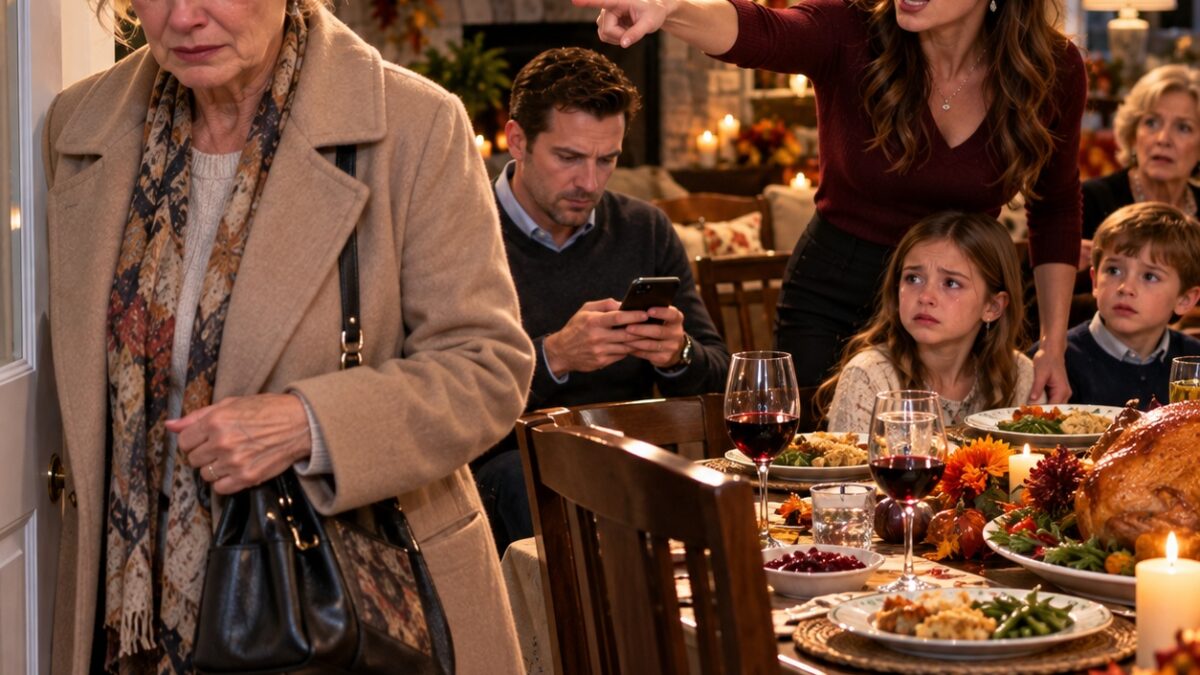
My son sat near the window.
Phone in his hand.
He had heard everything.
I knew because his thumb had stopped moving across the screen.
“Kevin?”
He looked up.
Our eyes met.
For one second.
Then he looked back down.
That movement hurt more than Melissa’s words.
More than anything she could have said.
Because Melissa and I had never understood each other especially well.
Kevin and I had.
Or I thought we had.
I had been there for scraped knees.
College applications.
His first breakup.
His first mortgage.
His first child.
I had held him after Graham died when both of us were pretending to be stronger than we were.
And now I was being asked to defend my right to exist in my grandchildren’s home while my son studied a dark phone screen.
Melissa straightened.
I think she had expected me to apologize immediately.
I usually did.
Not because I always believed I was wrong.
Because apologizing was faster.
If Melissa said I had overstayed, I left earlier next time.
If she said I bought Zoe too much, I bought less.
If I brought food and she had already planned dessert, I apologized.
If I gave advice and she did not want it, I apologized for interfering.
I had become very good at making myself smaller without ever admitting that was what I was doing.
That Thanksgiving, something in me stopped cooperating.
Melissa said:
“You know what?”
“If you’re going to sit there like you did nothing wrong, maybe you should just go.”
I looked at her.
“Are you asking me to leave Thanksgiving dinner?”
“I’m saying if you can’t admit when you’ve overstepped, then yes.”
Still nothing from Kevin.
Not:
Melissa, stop.
Not:
Mom, don’t go.
Nothing.
I thought about every possible response.
I thought about the $55,000 down payment.
The $1,700 a month I had been paying toward Zoe’s private-school tuition.
The furnace two Novembers earlier.
The plumbing emergency.
The three months of mortgage payments after Kevin’s company restructured and he unexpectedly came home without a job.
I thought about every Sunday drive.
Every dinner.
Every pickup.
Every birthday gift.
Every pie.
And I said none of it.
Because if I had to list what I had paid for to prove I deserved basic respect, the relationship was already more damaged than I wanted to admit.
So I stood.
Picked up my purse.
“I hope you all have a lovely rest of your evening.”
Zoe appeared in the hallway.
Wide eyes.
“Grandma?”
Her voice was so small.
I smiled at her.
“I’ll talk to you soon, sweetheart.”
I kissed the top of her head.
Then hugged Finn.
He was six and did not understand the emotional architecture of the room.
He simply wrapped his arms around my waist with that loose, trusting embrace children give before adults teach them to hold things back.
I walked toward the front door.
I kept listening.
For Kevin.
My hand reached the doorknob.
Nothing.
I opened it.
Nothing.
Closed it behind me.
Still nothing.
That was the sound I remembered all the way home.
My son not following me.
The 401 was unusually quiet.
I drove with the radio off.
My hands stayed steady.
That surprised me because inside I felt as if something structural had shifted.
Not exploded.
Shifted.
Like a foundation settling after years of stress.
At home, I made tea.
Sat at the kitchen table.
Watched it go cold.
I kept replaying the scene.
At first, I concentrated on Melissa.
Her tone.
Her face.
The word guest.
Then I realized she was not the center of what hurt.
Kevin was.
Kevin staring at his phone.
Kevin allowing his daughter to watch me being asked to leave.
Kevin deciding that avoiding an argument with his wife mattered more than saying four simple words:
Mom, please stay.
I had heard complaints from Melissa for years.
Hints.
Sighs.
Little corrections.
I told myself families were difficult.
Mothers-in-law had to be careful.
Boundaries mattered.
She was the mother.
It was her home.
All true.
But somewhere between respecting boundaries and fearing exclusion, I had stopped having any boundaries of my own.
Graham had been gone four years.
After he died, I threw myself into Kevin’s family.
I told myself that was what Graham would want.
That was partly true too.
But that night, with cold tea in front of me, I admitted something I had never said out loud.
I had not only been giving because they needed help.
I had been giving because I needed to be needed.
That was harder to face than anything Melissa said.
The $1,700 school payment gave me a role.
The mortgage rescue gave me a role.
The furnace.
The plumbing.
The Sunday drives.
The babysitting.
The pies.
Every time I solved something, I told myself:
See?
You still matter.
They cannot possibly push you away if part of their life depends on you.
I had turned myself into infrastructure.
And infrastructure does not get thanked every morning.
Nobody kisses the furnace.
Nobody sends flowers to the plumbing.
Infrastructure is noticed when it stops working.
I sat there until nearly midnight.
Then I went to bed.
For the first time in years, I did not set an alarm for anything involving Kevin’s family.
The next morning my phone was silent.
No Kevin.
No Melissa.
Not even:
Mom, are you okay?
Around noon, Zoe sent a voice message.
“Grandma, I hope you feel better.”
I listened twice.
That told me they had explained my departure as illness.
Not conflict.
Grandma got sick.
Grandma left.
Simple.
Convenient.
I did not correct an eight-year-old.
At 2:30, Kevin finally texted.
Mom, Melissa’s still upset. I think if you reached out and apologized, it would smooth things over. It’s hard being in the middle.
I read it three times.
Not:
I’m sorry I didn’t say anything.
Not:
I hated seeing you leave.
Not:
Are you hurt?
His problem was still the discomfort inside his house.
And I was still expected to fix it.
I placed the phone facedown.
Then opened my laptop.
There was a folder in my email from Sandra Kowalczyk.
Sandra and I had known each other since university.
Forty-three years.
Two years earlier, she moved to Portugal.
A small town on the Algarve coast.
She sent photographs.
Blue tiles.
Markets.
Orange trees.
Fishing boats.
Sunlight on water.
I always looked at them and thought:
Good for Sandra.
Never:
Maybe me.
Because my life was in Ontario.
Kevin.
Zoe.
Finn.
Sunday dinners.
Private school pickups.
Emergencies.
But months earlier, Sandra had sent one specific email.
There’s a little place two streets over from mine. Ground floor. White walls. Terrace southwest. The landlord is lovely and the rent is practically nothing compared with Ontario. If you ever get tired of Hamilton winters, you know where I am.
I had answered with a laughing emoji.
Nothing else.
That afternoon, I read it again.
Then called her.
Sandra answered on the second ring.
“Audrey.”
She sounded delighted before I spoke.
In the background I heard voices.
Ceramic clattering.
Maybe a market.
“I need to ask you something.”
“I’ve been waiting for this call for two years.”
Despite everything, I smiled.
“Is that apartment still available?”
A pause.
Not shock.
Just:
“Let me find out.”
It was.
That fact felt almost offensive.
As though another life had been sitting there quietly while I spent years insisting there was only one place I could belong.
Three days later, I met with Linda, my financial planner.
The appointment was already scheduled.
Routine year-end review.
Linda had managed my accounts long enough to know I was careful.
Predictable.
Generous to Kevin.
Probably too generous, though she had never said that.
I sat across from her desk.
“I want to cancel the automatic transfers.”
She looked up.
“All of them?”
“Yes.”
“The school payment?”
“Yes.”
“Anything going to Kevin and Melissa?”
“Yes.”
Then:
“I want the bulk of my savings moved into an account in my name only.”
She removed her glasses.
“Audrey, has something happened?”
“Yes.”
“Do you want to tell me?”
“Not particularly.”
She accepted that.
Good professional.
Then:
“This will have significant consequences for their budget.”
“I know.”
“The school fees alone are seventeen hundred dollars a month.”
“I know.”
“You’ve been paying that four years.”
“Yes.”
She hesitated.
“And the other recurring expenses?”
“Cancel them.”
The cleaning service.
Car-related payments.
The little automatic things that had accumulated because each one, individually, had seemed harmless.
Linda leaned back.
“Do you want to give them notice?”
I thought about Thanksgiving.
About Kevin’s phone.
“No.”
Then I corrected myself.
“They’ve had four years of notice.”
“How?”
“I’m sixty-seven.”
“I could have become ill.”
“I could have died.”
“I could have lost money.”
“I could have stopped working with you.”
“They built a household budget around money that never belonged to them.”
“That was a choice.”
Linda looked at me for a long moment.
Then nodded.
She turned her monitor.
“We can do it today.”
My hand shook while signing the authorization.
Not because I doubted the decision.
Because choosing yourself after years of automatic sacrifice can feel physically wrong at first.
I had trained my nervous system to interpret “no” as danger.
No to school fees meant Zoe might suffer.
No to the cleaning service meant Melissa might resent me.
No to mortgage rescue meant Kevin might struggle.
No to a Sunday visit meant the grandchildren might forget me.
Every boundary came attached to a fear.
I signed anyway.
When I left Linda’s office, my phone buzzed.
Kevin.
Mom, she’s really hurt. I know you two don’t always see eye to eye, but she’s my wife. I need you to meet her halfway. Please just call her.
I stood beside my car reading it.
He still had not asked if I was hurt.
That decided something inside me more completely than anger ever could.
The following two weeks were strange.
Practical.
Terrifying.
Liberating.
I arranged a long-term sublet for my condo.
A young couple.
Both teachers.
Careful.
Polite.
They loved the light in the living room.
I donated winter clothes.
Coats.
Boots.
Thick sweaters that had carried me through four decades of Canadian cold.
I kept Graham’s things selectively.
Letters.
Photographs.
A small oil painting of Georgian Bay that had hung above our fireplace for thirty years.
And my mother’s mixing bowl.
The bowl was not in my condo.
It was at Kevin and Melissa’s house.
I had lent it to Melissa three Christmases earlier.
Asked twice for it back.
Each time:
“Oh, yes, next time.”
It never came.
The night before my flight, I sat on the bedroom floor surrounded by three suitcases.
The condo looked hollow.
That was when fear finally arrived properly.
What if I was making a terrible mistake?
What if Kevin never forgave me?
What if Zoe and Finn grew up believing Grandma abandoned them?
What if Portugal felt beautiful for a month and unbearably lonely afterward?
What if I spent the rest of my life wishing I had simply apologized?
I sat with all of it.
No inspirational music.
No sudden certainty.
Then I remembered Kevin’s eyes dropping to his phone.
I remembered the front door closing behind me.
I remembered waiting for footsteps.
None came.
I stood.
Zipped the last suitcase.
Before Pearson Airport, I stopped at Kevin’s house.
They were both working.
I still had a key.
Separate ring.
For emergencies.
For school pickups.
For all the ways I had made myself useful.
I let myself in.
The house looked completely ordinary.
Finn’s toys on the stairs.
Melissa’s work bag near the door.
Three jackets crowded onto one hook.
A cereal bowl in the sink.
I loved that house.
That remained true.
I loved the people who lived there.
Also true.
Love and departure are not opposites.
I walked into the kitchen.
Placed their key on the counter.
I found an old grocery receipt in my purse.
On the back, I wrote:
Here is your key. I love you both. Please take care of my grandchildren. Mom.
I nearly wrote a page.
I wanted to explain.
Defend.
Accuse.
Remind them of every payment.
Every silence.
Then I realized explanation would give them something to argue with.
The truth they needed was simpler.
I was leaving.
They would notice the space afterward.
At the back door, I saw the ceramic bowl.
Cream-colored.
Blue rim.
My mother had mixed Christmas cake in it when I was a child.
I picked it up.
Held it.
For a second, I felt ridiculous.
Of all the things.
A bowl.
Then I thought:
It’s mine.
That sentence felt new.
Not selfish.
Accurate.
I carried it out.
The cab ride to Pearson was silent.
Perfect.
The flight took eleven hours with the Lisbon connection.
I read a novel I had been meaning to finish for a year.
I ate the entire airline meal without wondering whether someone else needed me to pick up a child, pay something, answer a call, or solve a small crisis.
I slept for three hours over the Atlantic.
I never sleep on planes.
When we descended toward the Algarve, the light looked impossible.
Orange.
Amber.
The Atlantic a shade of blue that seemed invented.
Sandra waited outside arrivals with a homemade sign.
FARNSWORTH
Letters large enough for an airport runway.
“You absolute idiot.”
I laughed before reaching her.
“I know.”
She hugged me.
Then pulled back.
“You look different.”
“I’ve been traveling fifteen hours.”
“Not that.”
She studied me.
“You look lighter.”
I almost cried.
Instead:
“Wait until you see the luggage.”
The apartment was exactly as she promised.
Small.
White walls.
Terracotta floor.
Southwest terrace.
Sandra had placed a flowering plant outside to welcome me.
I later learned it was a geranium.
I had spent sixty-seven years recognizing exactly three categories of plants:
roses,
weeds,
and “something green.”
Sandra found that offensive.
I put my mother’s bowl on a kitchen shelf.
Hung Graham’s painting above the small table.
That first evening, Sandra and I sat outside.
Olives.
Wine.
Sea in the distance.
She did not interrogate me.
Not once.
Forty-three years of friendship gives a person the right to recognize when explanations can wait.
We talked about the apartment.
Weather.
Her neighbor’s dog.
Coffee.
By ten o’clock, I realized nobody had asked me to fix anything all day.
I went to sleep.
The consequences in Hamilton arrived exactly as scheduled.
Automatic payments do not care about family conflict.
They simply fail.
The school called Kevin.
Then emailed.
Then called again.
The cleaning service sent a polite payment reminder.
The car-related payment stopped.
Other small conveniences suddenly became household expenses instead of Audrey expenses.
Kevin called eleven times in two days.
Melissa called four.
I watched the notifications.
Did not answer immediately.
The messages changed.
Mom, where are you? Something’s wrong with the accounts.
Then:
The school says the fees didn’t go through. Is everything okay?
Then:
Please call. I’m worried.
Then finally:
What is this? Why would you do this?
That last message told me the transition from concern to inconvenience had completed.
I waited until evening.
Sat on my terrace.
Wine beside me.
Called Kevin.
He answered instantly.
“Mom, where are you?”
“Portugal.”
Silence.
I checked the screen to make sure the call had not dropped.
“Portugal?”
“Yes.”
“What are you doing in Portugal?”
“Living.”
“Living there?”
“Yes.”
“For how long?”
“I don’t know yet.”
“Mom!”
“Kevin.”
I said his name gently.
Not sarcastically.
Not to punish him.
“The school fees were never mine to carry.”
He inhaled sharply.
“That’s not—”
“I was glad to help.”
“I’m still glad.”
“But help became the budget.”
“The mortgage payments after you lost your job were supposed to be temporary.”
“They became part of a larger pattern.”
“Mom, we counted on that money.”
“I know.”
“That’s why this has to change.”
“You can’t just turn everything off.”
“I already did.”
“That’s not fair.”
Maybe it wasn’t.
I considered that honestly.
Then:
“Neither was being asked to leave Thanksgiving while you stared at your phone.”
Silence.
Long.
Finally:
“I should have said something.”
His voice sounded different.
Smaller.
“Yes.”
“I just…”
“When Melissa gets angry, I don’t know…”
He stopped.
Then did something important.
He corrected himself before I had to.
“That’s not an excuse.”
“No.”
“It isn’t.”
We spoke for almost an hour.
Not a reconciliation.
Not an apology big enough to erase Thanksgiving.
But the first conversation we had where I did not solve the discomfort for him.
Near the end, Kevin asked:
“Can I still call?”
My heart broke a little.
“Of course.”
“You’re my son.”
“And the kids?”
“Kevin.”
“They’re my grandchildren.”
“Nothing about money changes that.”
I heard him exhale.
Maybe he had believed I was disappearing completely.
Maybe part of him had never understood that boundaries could exist without abandonment.
To be fair, neither had I.
The first weeks in Portugal were not a constant vacation.
I want that clear.
There were mornings when I woke disoriented and reached mentally for an old schedule.
Sunday.
Drive to Hamilton.
Wednesday.
School payment.
Friday.
Call Zoe.
Then I remembered.
My calendar was empty.
At first, emptiness felt like failure.
Then it started feeling like room.
Sandra signed us up for watercolor.
I was terrible.
Not modestly terrible.
Actually terrible.
My first attempt at painting a fishing boat looked like a blue potato floating in soup.
Sandra framed it as a joke.
I threatened our friendship.
We drove into the hills.
Village markets.
Honey.
Dried lavender.
Painted tiles.
I learned enough Portuguese to order coffee.
Then learned enough to apologize for my Portuguese.
Those two skills covered most of my needs.
I walked more.
My blood pressure improved.
I slept.
I stopped checking my banking app every morning for other people’s expenses.
Kevin called every week.
At first, every conversation was about money.
School.
Cars.
Budget.
Mortgage.
Things they could no longer afford the same way.
I listened.
I did not offer checks.
This was extraordinarily difficult.
The first time Kevin said:
“We may have to move Zoe to public school,”
every old instinct inside me screamed.
Pay it.
Seventeen hundred dollars was manageable for me.
Why let your granddaughter change schools when you can prevent it?
I almost said:
I’ll continue until the end of the year.
Then I stopped.
If I resumed every payment at the first sign of discomfort, nothing had changed.
So I asked:
“What are you thinking?”
Kevin sighed.
“There’s a good public school nearby.”
“Melissa toured it.”
“What does Zoe think?”
“She’s nervous.”
“She likes her friends.”
“Of course.”
Then I said:
“Transitions are hard.”
That was all.
No rescue.
Months later, Kevin told me Zoe had settled in well.
Good teachers.
New friends.
Her Heritage Fair obsession survived.
The catastrophe I imagined had not happened.
That taught me something.
My money had not been protecting my grandchildren from disaster.
Often, it had only been protecting the adults from adjustments.
They sold the second car.
Made a real budget.
Kevin told me this with the bewildered tone of someone describing the discovery of agriculture.
“We actually wrote everything down.”
“Everything?”
“Everything.”
“Melissa made a spreadsheet.”
He sounded almost impressed.
“She’s very good at it.”
I smiled.
“She’s capable.”
The sentence was deliberate.
I had spent years quietly behaving as though Melissa and Kevin would collapse without me.
Perhaps part of them had begun believing it because I kept proving it.
Capability grows when required.
So does resentment when help becomes control.
I was beginning to see my own role more clearly.
Not equal responsibility.
But a role.
I thought a lot about that $55,000 down payment.
I never regretted it.
It was a gift.
Freely given.
The mistake came later.
I kept behaving as if generosity bought membership.
I would never have said that aloud.
But emotionally, some part of me believed:
I helped buy the house.
I pay school fees.
I am here every Sunday.
Therefore, I belong.
Melissa’s sentence had attacked precisely that assumption.
In my house, you’re a guest.
She was right in one narrow sense.
It was her home.
I did not get unlimited authority because I helped financially.
But she had been wrong to use that fact to diminish me.
And I had been wrong to make myself financially indispensable because I feared being emotionally optional.
Both things could be true.
That realization was uncomfortable.
Also useful.
The first winter without Canada felt strange.
Sandra sent Kevin a photograph of me drinking coffee outside in January.
He texted:
This is offensive. We have freezing rain.
I wrote:
Thoughts and prayers.
He called laughing.
That was the first easy conversation we had after Thanksgiving.
No crisis.
No money.
Just weather.
It mattered.
Gradually, our calls changed.
Less:
What are we going to do?
More:
Zoe got an A.
Finn lost a tooth.
I burned dinner.
The furnace made a noise but we called someone ourselves.
That last one nearly made me laugh.
Good.
Call someone.
Pay them.
Solve it.
Life.
Then one evening, Kevin said:
“Mom, I owe you an apology.”
I was on my terrace.
Sun going down.
The Atlantic turning silver.
“You’ve apologized.”
“No.”
“Not properly.”
I waited.
“I let you become the answer to everything.”
He said it slowly.
“As soon as something happened, I thought, Mom can help.”
“Sometimes I didn’t even think.”
“It was just automatic.”
I said nothing.
He continued.
“You offered.”
“You almost never said no.”
“So I told myself it was okay.”
“But I never asked what it cost you.”
“Not money.”
“Everything.”
“Time.”
“Driving.”
“Your own plans.”
“I just assumed you’d always be there.”
My throat tightened.
Then he returned to Thanksgiving.
“The reason I didn’t say anything that night…”
He paused.
“I was afraid of the fight.”
“With Melissa?”
“Yes.”
“If I defended you, she would be furious.”
“And instead of dealing with that, I looked at my phone.”
He exhaled.
“I chose my own comfort over protecting you.”
There it was.
Not:
Melissa made me.
Not:
You two put me in the middle.
Not:
You overreacted.
Ownership.
“I’ve been thinking about it for months.”
“Good.”
“I’m sorry, Mom.”
“A real sorry.”
“I know.”
“Is that enough?”
I looked across the terrace.
The water.
Geraniums.
A life I had not known existed.
“No.”
He went quiet.
Then I smiled even though he could not see me.
“But it’s a real start.”
Kevin breathed out.
“Fair.”
That was when I knew something had changed.
He could hear not enough yet without treating it as rejection.
The grandchildren called more often too.
Zoe showed me school projects over video.
Finn carried the phone around at impossible angles.
Half our conversations consisted of his forehead.
I missed them terribly.
That never disappeared.
Distance is not a cure for love.
Sometimes it sharpens it.
There were days I wanted to book a flight simply because I imagined Finn getting taller without me seeing it.
Or Zoe losing another little piece of childhood while I sat thousands of kilometers away.
Then I reminded myself:
The goal was never to prove I could live without them.
The goal was to stop making my entire existence dependent on being constantly available to them.
Those are different things.
I visited through screens.
Sent birthday gifts.
Not extravagant ones.
Talked.
Listened.
Did not pay school tuition.
The relationship survived.
That was evidence I desperately needed.
In spring, Kevin called.
“Could we come visit?”
My answer was immediate.
“Yes.”
He sounded relieved.
“Me and the kids.”
“Yes.”
Then:
“What about Melissa?”
He asked carefully.
I became quiet.
I did not hate her.
But I did not want her inside the small apartment I had built as the first space in years that felt entirely mine.
“Not this time.”
Another pause.
Old Kevin might have negotiated.
Explained.
Pressured.
Newer Kevin said:
“Okay.”
That single word meant more than a dramatic speech could have.
Then I added:
“You should stay in a rental nearby.”
“Not here.”
Again:
“Okay.”
No sulking.
No:
But you have room.
No:
The kids want to stay with Grandma.
He respected the wall.
That was how I knew he understood what I meant by boundaries.
They arrived in June.
Thursday afternoon.
Taxi.
Zoe came out first.
Then Finn.
Both jet-lagged.
Wide-eyed.
Finn looked around.
“Grandma.”
“Yes?”
“It’s warm.”
He announced it as though I had personally arranged Mediterranean climate policy.
“I know.”
“How?”
“Connections.”
He believed me for about two seconds.
Then they ran into my arms.
I held them.
Longer than necessary.
Maybe too tightly.
Zoe had grown.
That hurt.
Finn’s face looked older.
That hurt too.
Children keep moving whether you are ready or not.
Kevin waited until they released me.
Then hugged me.
He held on slightly longer than usual.
“I know.”
I whispered.
He nodded against my shoulder.
That was enough.
For a week, Portugal became theirs too.
Old stone streets.
Grilled fish.
Ice cream.
The market.
Zoe chose a hand-painted tile and immediately declared it too beautiful ever to use.
Finn fell asleep on my shoulder after dinner one evening.
Kevin took a photograph.
It is still on my phone.
I look tired.
Finn’s mouth is open.
My hair is frizzy from sea air.
It may be my favorite picture of myself.
Because nobody needed anything.
No bill.
No crisis.
No performance.
Just a little boy asleep on his grandmother.
The cleanest form of being needed I had experienced in years.
Not financially.
Not strategically.
Simply loved.
Melissa had not come.
We did not discuss her much until the final evening.
The children were back at the rental.
Kevin and I sat on my terrace.
Harbor lights in the distance.
Local wine.
He said:
“She wants to make things right.”
I nodded.
“In her own way.”
he added.
“Which is slow.”
“And not always graceful.”
“I know.”
He looked at me.
“Is there room for that?”
I thought carefully.
About Thanksgiving.
About Portugal.
About every transfer I had cancelled.
Every phone call.
Every mile between us.
“There’s room.”
Kevin looked relieved.
Then I continued.
“But the room has walls.”
He waited.
“The walls are not punishment.”
“They are what it looks like when I take care of myself.”
He nodded.
No argument.
Then:
“You seem different.”
I raised an eyebrow.
“Old?”
“No.”
He laughed.
“Not different like that.”
He searched for the right words.
“You seem like…”
“You.”
I looked away toward the water.
Because that one nearly broke me.
For years, I had been:
Graham’s wife.
Kevin’s mother.
Zoe and Finn’s grandmother.
Financial backup.
Sunday visitor.
Pie maker.
Emergency contact.
I had forgotten Audrey existed beneath all those useful titles.
Portugal had not invented her.
It merely gave her room to reappear.
One week after Kevin and the children returned to Canada, Melissa sent me a message.
Not through Kevin.
Directly.
I’ve been thinking about Thanksgiving. I wasn’t fair to you. I’m sorry.
I read it several times.
It was not everything.
There was no paragraph about the years of small dismissals.
No admission that making Kevin’s mother feel barely tolerated while accepting financial help had been contradictory.
No acknowledgment of the money.
No explanation.
Just:
I wasn’t fair.
I’m sorry.
At one time, I would have needed more.
Then perhaps I would have accepted too little just to restore peace.
Now I could evaluate it without hunger.
It was incomplete.
But it was hers.
She had sent it without Kevin standing behind her.
That mattered.
So I wrote:
Thank you for saying that. It means something.
Nothing else.
I did not fling the door open.
I did not slam it shut.
There was room.
With walls.
Exactly as I had told Kevin.
I have replayed that Thanksgiving many times.
Not obsessively anymore.
But thoughtfully.
I imagine the version where I apologized.
That version is easy to picture.
Melissa says I overstepped.
I say:
“I’m sorry.”
Kevin relaxes.
Brenda changes subject.
Zoe stops looking worried.
I stay.
Eat another piece of pie.
Drive home.
The next Sunday, I return.
I keep paying $1,700.
I keep driving.
I keep solving.
Maybe the family remains superficially peaceful.
And perhaps five years later I am still doing exactly the same thing.
Older.
More tired.
Still afraid that saying no might cost me my place.
That alternate life is what finally taught me I did not leave because I was impulsive.
I left because Thanksgiving exposed something that had already existed for years.
I had made myself so available that everyone—including me—had stopped distinguishing between Audrey the person and Audrey the resource.
That is why I do not describe what I did as revenge.
If I wanted revenge, I would have announced the cancelled payments dramatically.
I would have said:
Remember the $55,000?
Remember the furnace?
Remember the mortgage?
Good luck.
I did none of that.
I simply stopped paying bills that were not mine.
The consequences felt punitive because everyone had become accustomed to my support.
But discontinuing a gift is not the same as imposing a punishment.
That distinction took me months to understand without guilt.
Kevin and Melissa had jobs.
A home.
Education.
Abilities.
They were adults.
My money had made their life easier.
It had not made their life possible.
When it disappeared, they adjusted.
Public school.
One car.
Budget.
Less cleaning help.
Their lives changed.
They did not collapse.
That was healthier for them too.
Kevin eventually admitted it.
“We should have done this years ago.”
“Probably.”
“I hate that you were right.”
“I’m a mother.”
“It’s a professional hazard.”
He laughed.
I also had to admit ways my help had become intrusive.
Not because Melissa’s Thanksgiving behavior was justified.
It was not.
But money can blur boundaries in both directions.
If you pay school fees, you start feeling entitled to ask how the school is going.
If you help buy a house, you may unconsciously feel more at home in it than the owners do.
If you babysit constantly, you develop routines with grandchildren their parents may want changed.
I had sometimes entered the kitchen and simply started helping without asking.
Moved serving dishes.
Folded things.
Rearranged.
In my mind:
Love.
In Melissa’s mind:
Control.
Both experiences were real.
If we had talked honestly years earlier, perhaps Thanksgiving would never have happened.
But we did not.
She sighed.
I apologized.
Kevin avoided.
Money filled gaps conversation should have filled.
Eventually the gaps became a canyon.
Portugal did not erase that.
Distance gave us enough room to look across it.
My mornings now are simple.
Coffee.
Terrace.
Geraniums.
Sometimes Sandra.
Sometimes silence.
I am not lonely.
I am alone often.
There is a difference.
It took me sixty-seven years to learn it.
Loneliness is not the absence of people.
I was lonely sitting in Kevin’s living room while everyone else pretended not to hear Melissa diminish me.
Solitude is different.
Solitude is making coffee at seven and realizing nobody is disappointed if you spend the morning reading.
It is walking to the market without checking your phone every five minutes.
It is eating dinner at nine because that is when you got hungry.
It is arranging napkins however you like in your own kitchen.
Or not using napkins at all.
A small life can feel enormous when it finally belongs to you.
Sandra teases me about the geraniums.
“You love those things more than people.”
“They complain less.”
“Kevin complains.”
“Less now.”
She smiles.
She has never asked me to move back.
Good friend.
When I occasionally say:
“I miss the kids.”
she does not answer:
Then go home.
She says:
“Of course you do.”
Missing people does not automatically mean your decision was wrong.
Another lesson.
My blood pressure really is better.
My doctor in Portugal was delighted.
“What changed?”
he asked.
I nearly said:
“I stopped paying seventeen hundred dollars a month to maintain emotional access to my family.”
Instead:
“Less stress.”
Accurate enough.
Kevin still calls every week.
Not always Sunday.
Sometimes Monday.
Sometimes Wednesday.
The best calls are the ones where nothing is urgent.
Recently he talked almost an hour about a camping trip he wants to take with Zoe and Finn near Algonquin.
They are borrowing a tent.
Borrowing.
Not buying the best tent.
Not asking whether I can contribute.
He complained that Finn wants to bring approximately twenty-seven unnecessary objects.
I said:
“That is camping.”
He laughed.
We talked about weather.
Mosquitoes.
Zoe wanting her own sleeping bag.
Nothing required fixing.
At the end:
“Love you, Mom.”
“Love you too.”
Then the call ended.
No money transferred afterward.
No problem solved.
No guilt.
Just love.
The first time that happened, I sat for several minutes staring at my phone.
Because I finally understood something.
For years, saying I love you had secretly been attached to work.
Drive here.
Pay this.
Help with that.
Stay useful.
Now the sentence stood alone.
It cost nothing.
That made it worth more.
Melissa and I are not close.
I do not pretend otherwise.
We exchange messages occasionally.
Birthdays.
Pictures.
Once she sent a photograph of Zoe holding a school award.
I wrote:
Tell her Grandma is ridiculously proud.
Melissa replied:
She knows.
That felt like progress.
Not intimacy.
Progress.
I do not need every relationship to become warm to consider it healed enough.
Sometimes respect is the realistic goal.
There is dignity in accepting that.
Brenda eventually sent me a holiday card.
Nothing about Thanksgiving.
Probably better.
I had spent too many years thinking every awkward relationship needed a summit meeting.
Some things simply become less important.
Distance does that too.
My mother’s mixing bowl remains on the kitchen shelf.
Every morning sunlight hits it.
Cream ceramic.
Blue rim.
A tiny chip near one side.
For years it sat in Melissa’s kitchen because I did not want to make a fuss over a bowl.
That phrase—
I don’t want to make a fuss—
explains more of my old life than I am proud of.
I did not want to make a fuss about the bowl.
The money.
The small insults.
The Sunday expectations.
The assumption I would help.
The way Kevin vanished into his phone when conflict appeared.
So I swallowed all of it.
Then one day I carried the bowl across an ocean.
It did not make me powerful.
It simply reminded me that reclaiming a life often begins with tiny sentences.
That belongs to me.
I don’t want to pay that anymore.
No.
Not this time.
I’ll stay somewhere else.
You may call me, but I won’t fix this.
Small sentences.
Large consequences.
Graham would have understood some of this.
Maybe not all.
He was generous to a fault too.
When Kevin was younger, Graham loved solving problems for him.
Car trouble?
Dad fixed it.
Tuition issue?
We figured it out.
First apartment deposit?
We helped.
We believed providing was one of the cleanest forms of love.
Often it is.
The danger comes when providing replaces confidence.
At some point, children need to know:
I believe you can survive this without me.
My money had sometimes said the opposite.
You still need Mom.
Maybe I needed that message more than Kevin did.
After Graham died, being needed made widowhood bearable.
That is another truth I no longer judge myself for.
I was grieving.
I lost my husband.
My routines.
The person who knew me before motherhood.
Kevin’s family gave me somewhere to pour everything.
Love.
Money.
Energy.
Attention.
It kept me moving.
It also delayed the question:
Who is Audrey when no one needs immediate rescuing?
Portugal forced me to answer.
I like her.
She is terrible at watercolor.
Her Portuguese is embarrassing.
She buys too much honey.
She sometimes spends half a day doing nothing productive.
She is still learning.
I wish I had met her earlier.
I have not cut Kevin out of my estate.
People ask this when they hear abbreviated versions of the story.
As though every family conflict must end with inheritance revenge.
No.
He is my son.
My grandchildren matter.
I changed how I help while living.
That was the issue.
I do not need death to punish anyone.
Nor do I need money to reward apologies.
The relationship should stand without financial tests.
That is the entire point.
I also did not demand the $55,000 back.
It was a gift.
A gift remains a gift even when a relationship later becomes painful.
Turning generosity into retroactive debt would only recreate the same transactional thinking I was trying to escape.
I gave it willingly.
Done.
The school tuition was different.
Recurring support.
Ending it was not reclaiming old money.
It was declining to promise future money.
Once I understood that, the guilt decreased.
Kevin asked me once:
“Did you stop paying because you wanted to scare us?”
“No.”
“Were you angry?”
“Yes.”
“But that’s not why.”
“Then why?”
“Because I realized my money had become part of the relationship.”
“And I needed to find out whether the relationship existed without it.”
He went quiet.
“That’s brutal.”
“It felt brutal from this side too.”
Then:
“And?”
“And you still call.”
He laughed softly.
“Yeah.”
“Exactly.”
That conversation gave me more reassurance than any financial dependence ever had.
Zoe understands more now than she did at Thanksgiving.
Children notice.
Eventually she asked me why I moved.
I did not blame Melissa.
I said:
“Grandma realized she wanted to try living somewhere new.”
“Because Mom made you leave?”
That question stopped me.
“How do you know about that?”
“I remember.”
Of course she did.
Adults always underestimate the memory of children.
I answered carefully.
“That night helped me realize some things.”
“Were you mad?”
“Yes.”
“At Mom?”
“At the situation.”
She frowned.
“Mom says she was mean.”
I let the silence sit.
Then:
“Your mom and I are working on being kinder to each other.”
Zoe accepted that.
She did not need me to make her mother a villain.
Grandchildren should not become courts of appeal for adult conflicts.
I am very firm about that.
Finn barely remembers Thanksgiving.
Good.
His strongest memory of me now may eventually be Portugal.
The warm terrace.
The ridiculous weather.
Falling asleep on my shoulder.
I prefer that.
The first time Kevin visited, staying in the rental instead of my apartment was important for me.
The second time, perhaps that changes.
Perhaps not.
Boundaries are not stone walls that must remain exactly where they were placed during pain.
They can move when trust changes.
The important thing is that I move them.
Not fear.
Not guilt.
Not pressure.
Me.
That is what I was missing before.
Choice.
Melissa may visit someday.
If she does, I hope we sit on the terrace.
I hope she sees my mother’s bowl.
Maybe she will recognize it.
Maybe we will laugh.
Maybe we will talk about Thanksgiving.
Maybe we won’t.
I no longer rehearse the scene.
I do not need a perfect apology.
I do not need her to admit I was completely right.
I wasn’t.
I need respect.
If that exists, there is room.
Walls and all.
There was a time when I believed moving to Portugal meant admitting the family had failed.
Now I see it differently.
Families sometimes need enough distance to stop repeating themselves.
In Hamilton, I was trapped in choreography.
Sunday.
Drive.
Pie.
Help.
Pay.
Apologize.
Repeat.
Portugal interrupted the dance.
Kevin had to become the person who solved his own mortgage.
Melissa had to become the person who built a budget.
I had to become a woman who could survive a Sunday without being expected anywhere.
That reset saved more than staying would have.
The most difficult part was recognizing that Kevin’s dependence had not been created only by him.
I offered.
Again.
Again.
Again.
Why?
Love.
Grief.
Habit.
Fear.
All of them.
I cannot blame him for assuming a faucet would continue running when I had never told him there was a valve.
But once Thanksgiving showed me the cost, I was allowed to turn it off.
And he was allowed to be upset.
Boundaries do not guarantee the other person will agree.
They simply clarify what you will do.
That was new for me.
Linda, my financial planner, emailed me after six months.
Routine account update.
She ended:
I hope Portugal is treating you well.
I replied:
My budget is boring now. It’s wonderful.
She wrote:
That may be the best financial goal I’ve heard this year.
I laughed.
My money now mostly pays for me.
Rent.
Food.
Travel.
Healthcare.
A watercolor class where I continue abusing paper.
I help the grandchildren occasionally.
Birthday money.
A book.
Something specific.
Not structural expenses.
I no longer finance the floor beneath another household.
That is their floor.
Mine is terracotta.
One morning Sandra asked:
“Do you regret leaving?”
I thought carefully.
“I regret that I needed to.”
“That’s different.”
“Yes.”
“I wish Kevin had looked up.”
“I wish Melissa had stopped before telling me to leave.”
“I wish I had spoken sooner in all the years before.”
“But do I regret coming here?”
I looked at the sea.
“No.”
That remains true.
I do not tell this story as a formula.
Not every mother who feels unappreciated should move to Portugal.
Not every parent should stop helping adult children.
Not every daughter-in-law conflict means exploitation.
My life is not a universal instruction manual.
It is simply what happened when I realized help had stopped feeling freely chosen.
That is the point I wish I had noticed earlier.
Generosity should feel like:
I want to do this.
Not:
If I stop, will they still love me?
The moment a gift becomes insurance against abandonment, something needs attention.
Maybe not relocation.
Maybe conversation.
Therapy.
A budget.
A boundary.
In my case, I needed an ocean.
I have always been dramatic about geography, apparently.
The apartment landlord still seems mildly surprised that I treat the place like a permanent home.
I added another geranium.
Sandra says this is how it starts.
“Next you’ll have twelve.”
“No.”
“You have six.”
“I have self-control.”
“You moved countries in two weeks.”
“Unrelated.”
She laughs.
Friendship without dependency feels different too.
Sandra does not need me.
I do not need her to need me.
We simply like each other.
At sixty-seven, that feels revolutionary.
My health improved.
Not because Portugal possesses magic sunlight.
Because my nervous system stopped waiting for emergencies.
I had not realized how much of my body remained on alert.
Kevin loses job.
Fix it.
School bill.
Fix it.
Furnace.
Fix it.
Melissa upset.
Smooth it.
Grandchildren need something.
Drive.
After years of that, calm initially felt suspicious.
Now it feels normal.
My doctor says my blood pressure is excellent.
I tell him the geraniums are responsible.
He does not believe me.
Some Sundays are still hard.
Especially around holidays.
The first Thanksgiving here, Sandra invited me to dinner.
No turkey.
Grilled sea bass.
Potatoes.
Wine.
She folded napkins badly.
I stared at them.
She said:
“Don’t you dare fix those.”
I laughed until I cried.
Actually cried.
Not from sadness entirely.
Memory.
Relief.
Absurdity.
I left them exactly as they were.
Terrible napkins.
Excellent dinner.
Kevin sent a photograph from Hamilton.
Zoe helping with pumpkin pie.
Finn holding a wooden spoon.
Melissa in the background.
He wrote:
Thinking of you.
I answered:
Thinking of you too.
That was enough.
No guilt trip.
No:
You should be here.
No:
Come home.
Respect sometimes looks like leaving a message unburdened.
Later that evening, Melissa sent:
Happy Thanksgiving, Audrey.
I stared.
Then wrote:
Happy Thanksgiving, Melissa.
Progress can be very small.
Do not underestimate small things.
I sometimes think about the word guest.
Melissa said:
“In my house, you’re a guest.”
At the time, it felt like rejection.
Now I think perhaps I needed to accept part of it.
I was a guest there.
A beloved grandmother, yes.
A major financial contributor, yes.
But still not the homeowner.
Not the parent.
That did not make me lesser.
Guests deserve respect too.
If I had understood that earlier, perhaps I would have entered the house differently.
Asked before reorganizing.
Offered rather than assumed.
And perhaps Melissa would have felt less threatened.
That does not excuse what she did.
But healing became easier once I stopped needing to prove only one of us had ever crossed a line.
The difference is that when Melissa drew her boundary, she did it cruelly.
Publicly.
In front of the children.
And Kevin abandoned his responsibility to intervene.
That deserved correction.
But I did not need to make myself morally flawless to deserve an apology.
That is another thing women sometimes do.
We think we need courtroom-level innocence before asking not to be mistreated.
No.
You can have flaws and still deserve dignity.
I wish I had known that younger.
Kevin told me recently that he and Melissa are better with money now.
Not rich.
Not carefree.
Better.
They plan.
They argue about budgets.
Then resolve them.
Public school reduced pressure.
The second car is gone.
Cleaning service never came back.
Their mortgage gets paid by them.
Every month.
He sounded proud.
He should.
That pride belongs to him.
If I had continued paying, perhaps he would never have earned it.
That is the paradox of rescue.
Sometimes what feels loving today steals tomorrow’s confidence.
I had no intention of doing that.
Still did it.
We can cause harm with generous motives.
That truth keeps me humble.
The grandchildren also learned something.
Not directly about money.
About Grandma having a life.
Zoe asked during the Portugal visit:
“Do you have friends here?”
“Yes.”
“Besides Sandra?”
“Rude.”
She laughed.
“Yes.”
“Do you go places without us?”
“Constantly.”
She looked impressed.
I realized she had mostly known me as an extension of her family.
Grandma appeared Sundays.
Grandma brought pies.
Grandma helped.
Now she saw Grandma as a person with a class, terrace, friends, favorite café, terrible paintings.
That was good for her too.
Children should know older women have lives after motherhood and grandmotherhood.
Maybe especially girls.
I want Zoe to love deeply someday.
But not disappear.
I want Finn to grow up believing care should not be extracted silently from women because they are capable of providing it.
I cannot teach them that with speeches if I model the opposite.
Portugal became a lesson I never intended to give.
Maybe a useful one.
Graham’s painting still hangs above my table.
Georgian Bay.
Gray-blue water.
Pines.
Canadian sky.
Some mornings, Atlantic light falls across it.
Two landscapes.
Two lives.
I like that.
Moving did not erase Canada.
Choosing myself did not erase family.
That was the fear that kept me stuck longest.
I thought there were only two choices:
Stay completely available.
Or become selfish and alone.
False.
There was a third.
Love them.
From a life that is also mine.
That is where I live now.
If Kevin called tomorrow with a genuine emergency, would I help?
Probably.
I am still his mother.
If Zoe needed something important?
Of course I would consider it.
Boundaries are not vows of indifference.
The difference is that now I ask:
Is this truly an emergency?
Am I choosing this?
Can they solve it themselves?
Will helping support growth or replace it?
Those questions did not exist in my old life.
My answer was always yes before anyone finished asking.
No wonder everyone stopped asking properly.
Kevin understands this.
Once he started a sentence:
“Mom, the car needs—”
Then stopped.
I waited.
He laughed.
“Never mind.”
“What?”
“I was about to ask if you could help.”
“And?”
“We can handle it.”
“Good.”
He paused.
“Are you proud of me?”
“Ridiculously.”
“Don’t make it weird.”
Too late.
That call made me happier than paying for a new car ever could.
Because capability is a better inheritance than dependence.
Melissa’s apology remains in my phone.
I have not deleted it.
Not because I need evidence.
Because it represents the first thing she sent me that I did not have to pull out of her through Kevin.
Her own words.
Her own choice.
That is why I answered gently.
Not extravagantly.
Thank you for saying that. It means something.
It did.
Not everything.
Something.
Healthy relationships make room for “something.”
My old habit was all-or-nothing.
Either everything was fine or the family was broken.
That pressure created denial.
Now I can say:
This part healed.
That part still hurts.
This relationship is improving.
That one remains distant.
I love Kevin.
I do not trust him the way I once did.
Trust is growing.
All true.
Human relationships can survive complexity.
I no longer need Melissa to love me.
That changed everything.
I need civility.
Respect.
Access to my grandchildren that is not manipulated through money.
A willingness to communicate.
If affection comes later, lovely.
If not, we can still behave well.
There is great freedom in lowering a relationship from impossible fantasy to realistic terms.
Kevin once asked:
“Do you think Dad would be angry with me?”
I hated the question.
Because Graham was not here to answer.
“I think your father would be hurt.”
Kevin looked down.
“Would he understand?”
“Eventually.”
“How do you know?”
“I don’t.”
Then:
“But he loved you.”
“That part I know.”
Kevin nodded.
We left it there.
I refuse to use dead people as weapons.
Graham would not want that.
I am fairly certain.
I think he would be amused by Portugal.
Graham hated cold weather.
Complained every November like winter was a personal betrayal.
He would have loved the terrace.
He would have hated my watercolor paintings.
Accurately.
Sometimes I sit outside with wine and imagine him saying:
“Took you long enough.”
Maybe.
Grief has become softer here.
Less tied to responsibility.
In Canada, after he died, I reacted by becoming indispensable.
Here, I can miss him without immediately doing something useful.
That is healthier.
I have learned there is a form of grief hidden inside over-functioning.
If you keep solving, organizing, paying, driving, feeding, there is less time to feel absence.
Kevin’s family became my full-time emotional occupation.
When I stopped, Graham returned to me differently.
Memories.
Letters.
Not just the hole I needed to fill.
Perhaps Portugal did not only separate me from unhealthy dependence.
It finally let me mourn my husband properly.
That realization came months later.
I cried for an entire afternoon.
Then slept beautifully.
Healing is strange.
Eight months after arriving, my life is not perfect.
Some days I miss Ontario rain.
I miss my old grocery store.
I miss hearing Zoe’s footsteps in person.
I miss Finn climbing into my lap.
Sometimes Portuguese bureaucracy makes me consider swimming back to Canada.
Sandra says this is normal.
But I no longer wake up with the feeling that my worth depends on who needs me before breakfast.
That alone has changed my body.
My mind.
My relationships.
I still bake pumpkin pie occasionally.
The apartment oven is temperamental.
The first one burned underneath.
Sandra ate two pieces anyway.
“Authentic Canadian cuisine.”
“Get out.”
“Your terrace or Portugal?”
I threw a napkin at her.
Unfolded.
Improperly arranged.
Progress.
One day I may return to Canada.
Not permanently, perhaps.
Maybe longer visits.
Nothing is fixed.
That is another thing I learned.
Choosing Portugal did not require declaring Canada dead.
Choosing distance did not mean permanently closing the door.
I used to make decisions as if every boundary were irreversible.
That made boundaries terrifying.
Now I understand:
You can adjust.
You can visit.
You can forgive.
You can still say no.
Life is not a single verdict.
I hope Melissa and I eventually sit together without tension.
I hope she understands that my leaving was not a campaign against her.
I hope I understand more about what it felt like for her to have a mother-in-law who was always present, always helping, always financially woven into the household.
I hope Kevin keeps speaking instead of hiding inside his phone.
That may be the most important change.
If conflict happens now, I expect him to stay in the room.
He knows that.
I know it.
During the Portugal visit, Zoe and Finn argued over a souvenir.
Kevin stepped in immediately.
Calm.
Direct.
No phone.
I watched.
He caught me watching.
“What?”
“Nothing.”
“Mom.”
“Growth.”
He rolled his eyes.
Wonderful.
On their last morning, Finn cried because he did not want to leave.
I almost said:
“Then stay.”
Of course I did not.
He had school.
Parents.
Life.
I hugged him.
“You’ll come again.”
“Promise?”
“We’ll make a plan.”
That answer mattered.
Not:
Grandma will fix everything.
A plan.
Shared.
Reasonable.
He accepted it.
Children can handle boundaries when adults present them without fear.
Perhaps adults can too.
After the taxi left, I went inside.
The apartment felt very quiet.
Their cups in the sink.
One of Finn’s socks under the chair.
A hair tie of Zoe’s on the bathroom counter.
My chest hurt.
I sat on the edge of the bed.
For perhaps ten minutes, I wondered if I had made a terrible mistake by building a life so far away.
Then I picked up Finn’s sock.
Laughed.
Called Kevin.
“You forgot evidence.”
“What?”
“Finn’s sock.”
“Keep it.”
“I don’t want it.”
“He loses one everywhere.”
“Family tradition?”
“Apparently.”
We laughed.
The sadness remained.
But it was clean sadness.
Not resentment.
Not fear.
Just missing people I love.
That kind I can live with.
There are still people who hear my story and say:
“You stopped paying for your granddaughter’s school because your daughter-in-law hurt your feelings?”
No.
That is the easiest version.
And the least accurate.
I stopped paying because the Thanksgiving conflict revealed that recurring financial support had become entangled with my fear of exclusion.
Once I saw that, continuing without examining it would have been dishonest.
Zoe’s education remained her parents’ responsibility.
They found a good alternative.
She is thriving.
If circumstances had been genuinely harmful to her, I would have considered another approach.
They were not.
Discomfort is not harm.
That lesson matters.
I did not stop loving Kevin.
I stopped funding the belief that love required dependence.
That is the entire story.
There is another thing I want to say about apology.
For years, I apologized too quickly.
Fast apologies are useful.
They end tension.
They also sometimes prevent understanding.
If every conflict ends with the same person saying:
“I’m sorry, forget it,”
the system never has to change.
That Thanksgiving, Melissa expected the familiar sequence.
Criticism.
Audrey apologizes.
Everyone moves on.
When I did not, the machine stopped.
That stoppage felt catastrophic.
It was necessary.
The family had to learn another way to function.
We are still learning.
Now, when I am actually wrong, I apologize.
Properly.
During Kevin’s Portugal visit, I criticized how he handled Finn at dinner.
Small thing.
Old habit.
Kevin said:
“Mom, I’ve got it.”
My first instinct was defensiveness.
Then I stopped.
“You’re right.”
“I’m sorry.”
Done.
No shame.
No collapse.
Boundaries work both directions.
Respect does too.
That made me realize I was becoming less afraid of apologies now that they were not my admission fee to the family.
Funny.
The title “Grandma” feels different now.
Before, I treated it like a job description.
Available.
Helpful.
Generous.
Now it is relationship.
Zoe does not love me because I pay tuition.
Finn does not care about my bank account.
They want stories.
Attention.
Games.
My terrible Portuguese makes them laugh.
Those things survive distance.
Money was never the bond I thought I was protecting.
That may be the best discovery of all.
My terrace faces southwest.
Every evening the light crosses the tiles and touches my mother’s mixing bowl through the kitchen window.
Sometimes I think about that bowl sitting on Melissa’s shelf for three years.
I had asked twice.
Then stopped.
Why?
Because I did not want to sound petty.
Maybe that is how entire lives get misplaced.
One small surrender at a time because reclaiming something feels rude.
A bowl.
A Sunday.
A hundred dollars.
A thousand.
A boundary.
A voice.
Then one day you are sitting in someone else’s living room being told you are only a guest, and you realize you have been renting your own sense of belonging with money and silence.
I took the bowl.
Then I took myself.
Both survived the flight.
Kevin’s family is surviving too.
That matters.
Their mortgage is theirs.
Their budget is theirs.
Their parenting is theirs.
Their marriage is theirs.
I am available for love.
Not management.
That is a cleaner role.
Last Sunday he called at noon.
Almost an hour.
No emergency.
No problem.
Camping.
Work.
The children.
Melissa’s spreadsheet.
A story about Finn trying to convince everyone a raccoon had “invited itself” into the garbage.
At the end:
“Love you, Mom.”
“Love you too.”
The line went quiet after we hung up.
I sat with the phone in my hand.
No anxiety.
No need to send money.
No calendar to check.
No forty-five-minute drive.
Just love.
For the first time in years, it cost me nothing.
That is how I knew it was finally real again.
I do not believe being needed is bad.
We all need one another.
Community matters.
Family matters.
Generosity matters.
But need and love should not be confused.
Need can disappear.
Jobs change.
Children grow.
Bills get paid.
Furnaces get repaired.
If a relationship survives only while one person provides the infrastructure, then the infrastructure has replaced intimacy.
I had to switch mine off to learn that.
Kevin still called.
Zoe still loved me.
Finn still climbed into my arms.
Melissa eventually apologized.
The relationship remained.
Different.
Less financially comfortable.
More honest.
I would choose that trade again.
I am sixty-seven years old.
I live in Portugal.
My bank account is healthy.
My blood pressure is better than it has been in a decade.
My son is paying his own mortgage.
My granddaughter attends a good public school.
My grandson is still destructive with wooden spoons.
My daughter-in-law and I are slowly building something that may one day resemble mutual respect.
And I no longer drive forty-five minutes every Sunday because I am terrified of what will happen if I miss one.
When I visit my family now, I will be there because we chose the visit.
Not because a payment schedule placed me inside their household.
That is freedom.
Thanksgiving did not destroy my family.
It exposed a version of the family that could not keep going.
There is a difference.
The version where I paid.
Fixed.
Drove.
Apologized.
Stayed useful.
That version ended.
Good.
What remains has a chance to become something better.
Kevin can love me without needing my bank account.
I can love him without preventing every consequence.
Melissa can establish boundaries without erasing me.
I can respect her home without purchasing my place in it.
The grandchildren can know both their mother and grandmother without being forced to choose sides.
That is the family I want.
Messier.
Smaller in some ways.
Real.
If I ever sit at their Thanksgiving table again, I may bring pies.
Probably pumpkin and apple.
Because I like baking them.
Not because that is the only contribution nobody objects to.
If Zoe asks me to fold napkins into fans, I will probably ask:
“Is your mother okay with this?”
Then we will laugh.
Or maybe we will not fold them at all.
It does not matter.
The important thing will be that I am sitting there because I was invited.
And if I ever feel unwelcome, I know something now that I did not know seven years into trying to earn my place.
I can leave.
Not in defeat.
Not as punishment.
Simply because my dignity is allowed to travel with me.
Mine crossed the Atlantic.
It is sitting here now.
On a little terrace facing southwest.
Beside six geraniums Sandra insists will become twelve.
Beside coffee I drink slowly.
Beside a phone that sometimes rings because my son wants to tell me absolutely nothing urgent.
And beside a ceramic mixing bowl that belonged to my mother.
I look at that bowl every morning.
It reminds me of one sentence I should have learned decades earlier.
You do not have to make yourself indispensable to deserve being loved.
I wish I had understood it before Thanksgiving.
Before the transfers.
Before the cold drive home.
Before I spent years confusing usefulness with belonging.
But I understand it now.
And sixty-seven is not too late.
Not for Portugal.
Not for boundaries.
Not for love that costs nothing to say.
Not for a life that finally has my own name on it.
My name is Audrey Farnsworth.
I am still a mother.
Still a grandmother.
Still part of my family.
But I am no longer their infrastructure.
And that, more than the sunlight, the sea, the healthier bank account, or even the geraniums, is why I finally feel at home.

