PART2:My Daughter-in-Law Invited Me to Her Anniversary Just to Pay the $2,487 Bill—One Extra Letter Exposed Everything
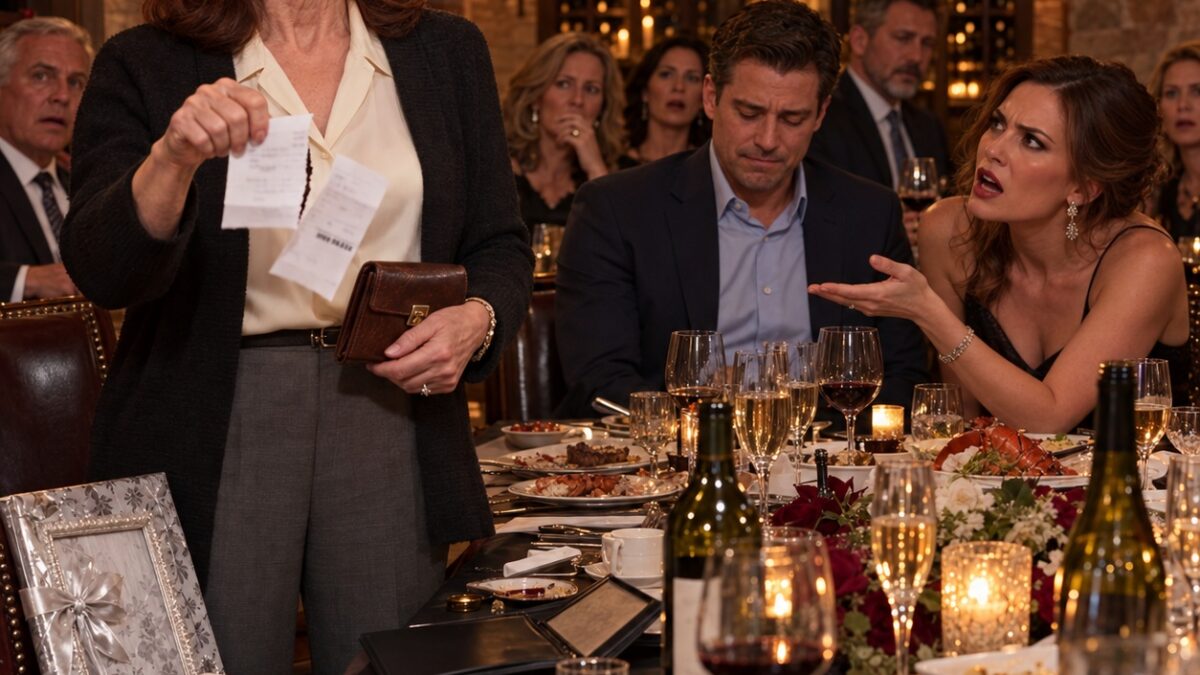
PART2
Only one person at that table did not laugh.
Sabine’s aunt Rosalyn.
She stared at her hands.
I noticed.
I noticed everything.
That had been my job for decades.
Mara leaned toward me.
“Don’t look so shocked, Waverly.”
Then:
“You can afford it.”
I did not answer her.
I looked at Graham.
My son.
Thirty-nine years old.
The child I had raised.
The boy whose school lunches I packed.
The teenager whose first car I helped buy.
The man whose children I adored.
I waited for four words.
Mom, that’s not funny.
That was all.
Four words and I probably would have sat down.
I probably would have paid.
Not because the stunt was fair.
Because mothers are ridiculous creatures.
We will forgive almost anything if the child we love gives us one small reason.
Graham picked at the label on his beer bottle.
He said nothing.
So I put down the silver frame.
Picked up the bill.
Old habit.
Read top to bottom.
Three bottles of Napa Cabernet at $180 each.
Seafood tower.
Two lobster tails.
Steaks.
Desserts.
Automatic twenty-percent gratuity.
$390.88.
They had even allowed the restaurant to tip itself in my name.
Sabine smiled.
“Take your time.”
Then:
“It’s a lot of numbers for you.”
Someone snickered.
That almost amused me.
I had spent my professional life processing medical claims with more codes on one page than Sabine had probably seen in a year.
The math was not difficult.
The insult was.
I held the bill with both hands.
Then tore it down the middle.
Slowly.
One clean sound.
The laughter stopped.
I folded the halves together neatly.
Set them beside Sabine’s wineglass.
Then I took Lel’s wallet from my purse.
Opened it.
Closed the brass clasp.
Click.
“The wallet is closed.”
Nobody laughed.
I slid the silver frame toward Graham.
“Happy anniversary.”
Then stood.
At the stairs, Sabine called after me:
“You’ll pay one way or another.”
I kept walking.
At the top stood Iness Molnar, Brightwater’s owner.
She had run the restaurant for thirty years.
She had apparently witnessed enough from the landing to understand.
She did not ask questions.
Did not embarrass me further.
She simply nodded.
One working woman to another.
I nodded back.
I reached my car at 8:36.
I know the exact minute.
Later, it became one of the most important numbers in the entire story.
At home, I made chamomile tea.
Sat at my kitchen table.
Did not drink it.
The house was quiet.
Lel had been gone for years, but some evenings I still expected to hear him moving in the next room.
He had worked all his life.
He believed in paying your debts.
He also believed in never paying for your own humiliation.
That was one of those Lel sentences I had remembered without properly understanding.
Not yet.
At 10:52, my phone lit up.
Sabine.
Hope you’re proud of yourself.
I turned the phone facedown.
Washed my untouched cup.
Went to bed.
I did not sleep much.
Because the truth was uncomfortable.
Sabine had called me the wallet.
Cruel.
But not entirely false.
I had been my son’s wallet long before Sabine entered our family.
Not because anyone held a gun to my head.
Because guilt is capable of opening a purse faster than any thief.
In June of 2000, Graham graduated from eighth grade.
I was not there.
I was in Columbus in a windowless conference room trying to save a hospital contract that kept eleven employees working.
Graham was thirteen.
Almost fourteen.
He looked for me in the bleachers.
Later, he told Lel he did not care.
He cared.
I knew.
And I carried it.
I missed school events.
Some dinners.
Too many evenings.
My company started small.
Two employees.
Secondhand fax machine.
Garage office.
Then clinics depended on us.
Then rural hospitals.
Then payroll.
Then people’s mortgages depended partly on whether I kept contracts alive.
I worked.
And because I worked, I compensated.
A school fee here.
Car repair there.
Christmas.
Vacations.
Emergency money.
When Graham was laid off the previous July, I paid my granddaughter Poppy’s preschool tuition for ten months.
I bought tires for their minivan.
I helped because I could.
I never wrote any of it down.
A gift is not a loan.
You do not keep receipts on love.
At least, that is what I told myself.
But gifts repeated often enough can become expectations.
Expectations repeated often enough can become job descriptions.
And that Saturday night my daughter-in-law finally announced mine publicly.
The wallet.
At 8:10 Sunday morning, while my coffee was brewing, the telephone rang.
Unknown number.
Out-of-state area code.
I almost ignored it.
Almost.
“Good morning. Is this Waverly Overbeck?”
“Yes.”
“My name is Odette Pharaoh. I’m calling from the fraud department at Northgate National Bank.”
I sat down.
She continued.
“We’re calling to verify a credit application submitted in your name.”
“I don’t bank with Northgate.”
“That’s why I’m calling.”
Something cold moved through me.
Odette spoke carefully.
“At 9:14 p.m. last night, an application for a Northgate Rewards Visa was submitted online in your name.”
I looked at the kitchen clock.
9:14.
Thirty-eight minutes after I had left Brightwater.
“It was approved with a twelve-thousand-dollar limit.”
I stopped breathing normally.
“The applicant received an instant card number.”
I reached for Lel’s wallet.
Opened it.
Driver’s license.
Medicare card.
Two credit cards.
Debit card.
Everything where it belonged.
“Mrs. Overbeck?”
“I’m here.”
“There is one transaction.”
I already knew.
Still, hearing it was different.
“At 9:22 p.m., the new card was charged $2,487 at Brightwater Chop House.”
My coffee maker clicked off.
I stared at it.
Exactly $2,487.
The dinner.
The bill I tore.
Somebody had opened a credit card in my name after I left and paid it.
Eight minutes after approval.
Odette explained the system.
Instant approval.
Code to applicant’s phone.
Manual review the following day.
“We approve fast and verify slow.”
“I noticed.”
She apologized.
I did not blame her.
Systems are built by people.
People make imperfect systems.
I had spent my career inside those imperfections.
“Do I owe anything?”
“No.”
“Good.”
“Mrs. Overbeck, did you apply for this account?”
“No.”
“Then somebody opened a wallet in your name.”
I looked down at Lel’s brown wallet.
“I closed mine at 8:36.”
I said it without thinking.
She paused.
“What was that?”
“Nothing.”
Then I asked the question that changed everything.
“What mailing address was used?”
Keys clicked.
“418 Coventry Court, Pemrook, Ohio.”
My son’s house.
I closed my eyes.
Then asked one more thing.
“How is my first name spelled?”
Odette hesitated.
Then:
“W-A-V-E-R-L-E-Y.”
I opened my eyes.
There it was.
One extra E.
My name is Waverly.
W-A-V-E-R-L-Y.
No second E.
My mother named me after a street in the town where she grew up.
She cared deeply about the spelling.
In sixty-nine years, almost nobody got it wrong.
Almost.
In 2023, I had my left knee replaced at Pemrook Valley Medical Center.
When they placed the hospital bracelet on my wrist, it said:
Waverley.
With the extra E.
I pointed it out.
Called registration later.
Twice.
The patient portal never changed.
The error still sat inside that hospital’s system.
And my daughter-in-law Sabine had worked in patient registration there since 2020.
I did not tell Odette.
Not yet.
I said:
“What should I do?”
She closed the account.
Started the fraud process.
Recommended a police report.
Federal Trade Commission identity-theft report.
Credit monitoring.
Then she asked:
“Do you know who might have done this?”
“I have an idea.”
Pause.
“But I’d like to be sure before I say it out loud.”
That became the rule for everything that followed.
Paper first.
Feelings later.
The phone rang again before I had properly processed the first call.
Graham.
9:40 Sunday morning.
He did not say:
Mom, are you okay?
He said:
“You embarrassed Sabine.”
I almost laughed.
“Good morning to you too.”
“Don’t do that.”
His voice sounded rough.
Four bottles of wine divided among eleven people rough.
“You tore up the bill and walked out on our anniversary.”
“I know.”
“Do you know how that looked?”
“Kenzie was recording. I imagine I’ll find out.”
He ignored that.
Then said:
“Anyway, it’s fine.”
I waited.
“Sabine put it on your card.”
Every muscle in my body became still.
“My card?”
“The one you gave her in the spring for kid stuff.”
I looked at Lel’s wallet.
“Which card, Graham?”
He sighed.
“Don’t play dumb.”
“I’m not.”
“You know which card.”
I did not argue.
Because something important became clear.
My son genuinely believed I had given Sabine access to a card.
Not pretending.
Not covering.
He sounded bored with the entire issue.
As though his mother simply forgot her own generosity.
Behind him, I heard Sabine.
“Tell her the kids want to know why Grandma is mad at us.”
Graham repeated:
“The kids want to know why you’re mad.”
Word for word.
I closed my eyes.
“Tell Rowan I love him.”
“And Poppy.”
Then:
“Tell Sabine I heard her.”
I hung up.
My son believed his wife’s story.
The question was no longer only:
Did Sabine steal my identity?
It was:
How long had she been constructing a version of reality for Graham?
Monday morning, I filed an identity-theft report with the Federal Trade Commission.
The form asked whether I knew who had done it.
I selected:
Not sure.
That was not entirely dishonest.
I knew who I suspected.
I did not yet know how much.
After lunch I drove to the Pemrook Police Department.
Detective Arturo Beal interviewed me in a small room that smelled like burnt coffee.
Reading glasses on his head.
Slow handwriting.
I liked him immediately.
Slow writers usually listen.
“Mailing address?”
“418 Coventry Court.”
“Who lives there?”
“My son, his wife, and my grandchildren.”
He stopped writing.
“So you think it’s family.”
“I think the address is family.”
He looked at me.
“Do you want to name someone?”
“I want to name the right someone.”
Then:
“Give me a week.”
“I’ll bring you paper, not feelings.”
He studied me.
Then nodded.
That was the beginning.
My grandchildren were the reason I moved carefully.
Rowan was eight.
Obsessed with sharks.
He could tell you the hunting range of a great white but forgot his shoes in the car three days a week.
Poppy was five.
Recently started kindergarten.
Insisted everyone call her Captain.
For three years, Wednesday afternoons had belonged to me.
At 3:05, I sat in the same elementary-school pickup line every week.
Then waffles at my house.
Poppy believed waffles were dinner food.
I had never corrected her.
If Sabine had committed identity fraud, this was no longer simply a mother-in-law conflict.
It was a criminal investigation involving the mother of two children I loved.
I did not enjoy that.
People sometimes confuse consequences with revenge.
I did not.
Monday evening, Sabine’s sister Kenzie uploaded the anniversary video.
Forty-one seconds.
Caption:
When your boomer rage tears the anniversary bill.
By Tuesday morning:
18,000 views.
The video started with my torn bill beside Sabine’s wineglass.
My name clearly visible.
Then me walking toward the stairs.
My voice:
“The wallet is closed.”
What the video did not include was:
“Mom, you’re the wallet. That’s why we invited you.”
Kenzie had trimmed it away.
Editing can transform cruelty into victimhood with one cut.
The comments flooded in.
Imagine hating your son’s wife this much.
That poor girl.
My MIL is the same.
Mara commented:
Some people think money makes them family.
A woman from church sent me the link with a question mark.
My hairdresser sent three.
Neighbors began waving strangely.
I said nothing.
Gossip craves reaction.
Reports prefer evidence.
I have always been better with reports.
My oldest friend Constance Ferrer called.
“Come over.”
“Bring coffee.”
“And every piece of paper you have.”
Constance was an attorney.
She had represented my company years earlier.
Handled the sale when I retired.
She knew exactly how much money I had.
She had never told anyone.
Her dining room table was clear when I arrived.
Legal pad.
Three sharpened pencils.
Perfectly aligned.
I told her everything.
Dinner.
Bank call.
Coventry Court.
The extra E.
Constance listened.
When I finished, she tapped the pad.
“Paper first.”
“Feelings later.”
“That’s my line.”
“I stole it from you in 1998.”
Then she opened her laptop.
“We pull all three credit reports.”
“Today.”
“We freeze your credit.”
“I already have a fraud alert.”
“A fraud alert is a note on the door.”
“A freeze is a lock.”
She was right.
Annoyingly.
Then:
“Did you ever give Sabine your Social Security number?”
“No.”
“Never?”
“Never.”
“Then how would she have it?”
I said:
“With an E.”
Before I could explain, the first credit report loaded.
Constance stopped.
There were two entries I had never seen.
First:
Hearthline Furniture.
Store card opened May 3.
One purchase.
$6,340.
Payments made every month since June.
Remaining balance:
$4,112.
Mailing address:
418 Coventry Court.
Name:
Waverley Overbeck.
Extra E.
Second:
Hard inquiry from Summit Lending.
August 28.
Application for $15,000 personal loan.
Declined.
Constance leaned back.
“Why declined?”
“The fraud alert.”
The furniture account was opened before the alert.
The loan came after.
I suddenly remembered Graham and Sabine’s living room.
A large new gray sectional.
New dining table.
Eight chairs.
I had sat on that sofa at Rowan’s birthday party.
Eating cake from a paper plate.
Sabine said:
“We splurged with our tax refund.”
I had complimented the fabric.
I had been sitting on debt opened in my own name.
That realization did something different than the restaurant fraud.
A thief who steals once may panic.
A thief who opens an account in May, pays it reliably for four months, then attempts another loan in August and another card in September is not panicking.
That person has a system.
Constance said quietly:
“Someone didn’t open one wallet.”
“They opened two.”
“And tried a third.”
Exactly.
That evening, I logged into my patient portal.
Welcome, Waverley.
There it was.
The typo.
I knew hospital information systems.
I had built my career around billing and compliance.
Every employee who opens a medical record leaves an electronic footprint.
Who.
When.
Which workstation.
Which section.
Patient privacy laws require it.
Sabine worked in patient access.
Registration.
Insurance cards.
Addresses.
Dates of birth.
Social Security numbers.
Three days a week, she worked remotely.
She had joked at Easter:
“I can register people from my couch in pajamas.”
The gray couch.
My gray couch, financially speaking.
I opened a blank document.
Wrote a formal privacy complaint.
No accusations.
No adjectives.
Dates.
Facts.
Requested a complete audit of all access to my record since January 1.
Printed.
Signed.
Planned to deliver it Thursday.
At 9:02 p.m., Sabine texted.
Since you’ve made your position clear, don’t bother picking up the kids Wednesday. Wallets don’t babysit.
I read it three times.
Then closed the phone inside a drawer.
Wednesday afternoon, at 3:05, I stood in my kitchen beside a bowl of waffle batter.
I had mixed it automatically.
Habit.
There was no Rowan.
No Captain Poppy.
I could have driven to the school.
Could have created a scene.
Could have called Graham ten times.
Instead, I poured the batter down the sink.
Because if I appeared where Sabine had explicitly told me not to, she would gain another video.
Another story.
Raging grandmother ignores parents’ boundaries.
I refused to provide it.
But rinsing waffle batter from that bowl hurt more than the restaurant laughter.
Money was one thing.
My grandchildren were another.
Thursday morning, I delivered the privacy complaint to Pemrook Valley Medical Center.
Yolanda Kek from the privacy office called later.
“We’ll perform a full access audit.”
“Up to thirty days.”
Then:
“Please don’t discuss this with any hospital employee.”
“I won’t.”
“That’s rather the point.”
Five days passed.
No Graham.
No Sabine.
No grandchildren.
The video climbed past 30,000 views.
Then Tuesday night at 9:47, an unfamiliar number sent me a message.
This is Rosalyn. Sabine’s aunt. I can’t keep this on my phone anymore.
Four screenshots followed.
Family group chat.
Rusk Crew 🍷
Members:
Mara.
Sabine.
Kenzie.
Rosalyn.
Her husband Hector.
And Graham.
My son.
The first screenshot was dated Friday, September 12.
The night before dinner.
Sabine:
Dinner’s at 6. Telling Graham’s mom 8:30. She walks into the check. 😂
Mara:
About time that woman pays what she owes this family.
Kenzie:
I’m filming.
Under Sabine’s message was a thumbs-up reaction.
I enlarged it.
Graham.
I put my phone down.
Stared at the kitchen wall.
Until that moment, part of me had imagined my son had simply gone along with something unfolding too quickly.
No.
He knew.
He had approved the setup before I arrived.
That hurt differently from the laughter.
The fourth screenshot mattered even more.
Saturday night.
9:25 p.m.
Sabine:
Handled while it’s open after all. 😘
I checked my notes.
Northgate application:
9:14.
Brightwater charge:
9:22.
Three minutes later:
Handled.
Rosalyn’s final message to me read:
I didn’t laugh that night. I should have said something. I’m saying it now. You can show these to whoever you need to.
I wrote:
Thank you. I won’t forget this.
Then sat alone in my kitchen.
My son had approved my humiliation.
That much was proven.
Whether he knew about identity fraud remained unclear.
It mattered to me not to convict him emotionally before the evidence did.
That was difficult.
Mothers want either innocence or guilt.
Ambiguity is harder.
Nine days after my police report, I called Detective Beal.
“You said a week.”
“It’s been nine days.”
“I’m sixty-nine. I round generously.”
That earned a small laugh.
Then I gave him everything.
Sabine’s full name.
The screenshots.
Credit reports.
Misspelling.
Hospital complaint.
He listened.
Then said:
“I’m going to request application records from Northgate and Hearthline.”
“I’ll contact the hospital.”
“This takes weeks.”
“I understand.”
Then:
“You can tell your family what happened to you.”
“That’s your story.”
“Just don’t tell them what we have.”
“Let me do my part.”
“Paper, not feelings.”
“Something like that.”
Afterward, I sat on my back porch thinking about Rowan and Poppy.
Police would eventually speak to their mother.
Maybe arrest her.
Maybe charges.
Maybe job loss.
Those things would affect children.
I took no pleasure in it.
But I kept returning to one fact.
My name was attached to debts I did not create.
A mother protects children.
At sixty-nine, I was still allowed to protect myself.
Friday morning, Mara arrived on my porch filming.
“Say hi to the internet, Waverly.”
I stepped outside.
Closed the door behind me.
She would not be invited in.
Mara was sixty-three.
Gold jewelry.
Voice capable of crossing parking lots.
I had actually known her longer than she had been Graham’s mother-in-law.
Most people forgot that.
Mara did not.
“You know what you did?”
she demanded.
“Is that why you came?”
“Somebody has to say it.”
Then she revealed a grievance I had not heard in sixteen years.
“You fired me.”
“November 2009.”
“Three weeks before Christmas.”
“In front of the whole floor.”
I remembered.
Clearly.
“I worked for you three years.”
“You walked me out like a criminal because I spoke up.”
Interesting wording.
Then:
“When Sabine married Graham, I thought maybe now we were even.”
“But we aren’t.”
“You owe us, Waverly.”
Sixteen years.
Suddenly, their family arithmetic became visible.
Everything I had paid for Sabine’s wedding.
Everything I bought the children.
Every emergency.
Every Christmas.
All of it had apparently been interpreted not as generosity but as repayment of an old debt I had never accepted.
“Sabine says you’ll never see those kids again.”
Mara held the camera closer.
“Not until you apologize on camera.”
I looked directly at her.
“I remember why you left my company.”
Quietly.
“So do you.”
For the first time, the phone dipped.
Her eyes moved away.
Then she recovered.
Turned.
Walked to her car.
I did not explain.
Not yet.
For sixteen years, I had protected Mara’s reputation.
Standing there, I began wondering what that silence had taught her daughter.
Saturday, Sabine posted a photograph.
The restaurant bill.
My torn halves taped back together.
Clear tape running through my name.
Caption:
10 years. One torn bill. Some people show you who they are. We paid it ourselves. 💔
Two hundred fourteen comments by Sunday.
At church, women who had known me for decades found the bulletin board unusually fascinating when I walked by.
I sat in my normal pew.
Sang badly.
I had been singing off-key at St. Aldrich’s for thirty years.
Facebook would not change that.
After church, I reread Sabine’s caption.
We paid it ourselves.
That was no longer merely an insult.
It was a false written statement of fact.
They had not paid it themselves.
A fraudulent card opened in my name had paid it.
I took a screenshot.
Sent it to Detective Beal.
No commentary.
Paper.
Tuesday evening, Graham came to my house alone.
He sat at my kitchen table.
Same chair where he once did homework.
Thirty-nine years old.
Shoulders drawn upward like a boy expecting punishment.
“The bank shut down the card.”
I waited.
“Sabine got a letter.”
“She says you reported it as fraud out of spite.”
“Did she?”
“Mom.”
“You gave her that card.”
I stared at my son.
“She showed it to me.”
“On her phone.”
“Your name was on it.”
I asked:
“How was my name spelled?”
He went quiet.
“Graham.”
Nothing.
“I never gave Sabine a credit card.”
His voice cracked.
“Why would she lie?”
That question contained fear.
Not curiosity.
He needed me to restore the reality he preferred.
I could not.
Detective Beal had asked me not to disclose evidence.
And Graham was not ready.
Then old hurt burst through.
“You missed my eighth-grade graduation.”
There it was.
“You missed half my life for that company.”
“Paying for one dinner was the least you could do.”
I let him finish.
“I paid for twenty-five years.”
“Graham.”
“That was the least and the most.”
His face hardened.
“So you’re cutting us off.”
“The wallet is closed.”
I said it gently.
“Not my door.”
“Not my heart.”
“The wallet.”
He leaned forward.
“We need the $2,487 to make it right with the bank.”
“No.”
He stood.
Chair scraped.
Stormed out.
Door slammed hard enough to shake a frame on the wall.
I remained seated.
He still believed the card existed legitimately.
He had no idea it had been created while he sat in Brightwater.
That mattered.
He had participated in humiliating me.
He may not have participated in stealing from me.
I held that distinction until the evidence became clearer.
Thursday, the hospital called.
Yolanda.
“Our audit is complete.”
I pulled a pad toward me.
“Go ahead.”
Four accesses to my medical record.
The first:
March 11.
Legitimate.
My annual mammogram.
Sabine had checked me in herself.
She laughed that day about the extra E.
“System still loves that letter.”
I had laughed too.
The other three accesses:
No legitimate job reason.
Friday, May 2.
2:14 p.m.
Thursday, August 28.
9:03 a.m.
Saturday, September 13.
9:06 p.m.
Remote access.
I wrote each date.
Then beside each one:
May 2.
Hearthline furniture card opened May 3.
August 28.
Summit personal-loan application August 28.
September 13 at 9:06.
Northgate card opened at 9:14.
Eight minutes.
The dates aligned like teeth in a zipper.
Yolanda continued.
“The employee’s access has been revoked.”
“They’ve been placed on administrative leave.”
“We’ve referred the matter to law enforcement.”
“Can you tell me the employee’s name?”
“No.”
“I understand.”
I did.
Privacy rules apply even when the answer seems obvious.
But Sabine had apparently thought avoiding paper was careful.
She never wrote down my Social Security number.
Instead, every time she needed it, she returned to my chart.
And every time, the system wrote down that she had looked.
Careful people often leave the neatest trails because they repeat the same method.
At 7:48 that evening, Sabine left me a voicemail.
One minute fifty-two seconds.
I listened once.
Her voice shook.
“You reported me to my job.”
Twice.
“They walked me out in front of everyone like a criminal.”
Then:
“You think you can do that to me?”
“I have two kids.”
“You’ll never see Rowan and Poppy again.”
“I’ll tell them Grandma picked money over them.”
Then lower:
“And I’ll sue you for every word.”
The message ended with a clatter.
I saved it.
Forwarded it to Detective Beal.
Then sat down because my knees were not as steady as I wanted.
What struck me was this:
I had never been told the hospital named me as the patient.
Yolanda would not even tell me the employee’s name.
Yet Sabine’s first reaction was not:
Why was I suspended?
Or:
What happened?
It was:
You reported me.
Guilt reads quickly.
I did not return the call.
There was nothing my voice could improve.
For the first time in weeks, I slept through the night.
The next morning, Brightwater’s owner Iness called.
“Waverly.”
“I think we have the same problem.”
She had received a chargeback notice.
The fraudulent $2,487 payment had been reversed.
Because the card numbers had been manually entered, the restaurant—not the bank—was taking the loss.
Plus a $25 chargeback fee.
Total:
$2,512.
The server, Ezra, lost his $390.88 tip in the reversal.
Iness paid him herself.
“He’s in nursing school.”
Then she told me what her staff remembered.
Around 9:20 that anniversary night, Sabine had called Ezra over.
Held up her phone.
Said:
“The chip is broken. Just type it in.”
Then read numbers from the screen.
There had never been a chip.
The card had existed for six minutes.
I closed my eyes.
Iness had called the reservation number repeatedly.
Sabine had blocked her.
Then I asked:
“Is the cellar room available Saturday, October 11?”
Pause.
“Yes.”
“I’d like it.”
“For what?”
“To finish the dinner.”
Iness was silent for a moment.
Then:
“I’ll be there.”
By then, four weeks had almost passed.
The internet still thought I was a bitter grandmother who stormed out rather than contribute to her son’s anniversary.
Sabine’s family still thought I owed them.
My son remained confused.
My grandchildren remained away from me.
Police were investigating.
The hospital had acted.
The bank had acted.
But the eleven people who laughed in that cellar room had never heard the full truth.
I decided I wanted one thing.
Not revenge.
A corrected record.
Same room.
Same eleven people.
Separate checks.
My evidence.
Nothing Detective Beal asked me to withhold.
That was all.
Before inviting them, I reminded myself who I actually was.
Because Sabine never learned.
At nineteen, in 1975, I answered phones at a county hospital for $2.10 an hour.
Windowless switchboard room.
Doctors who never learned my name.
A billing clerk showed me claim forms.
I went to night school for four years.
By 1994, I was thirty-eight and tired of making money for men who called me “billing girl.”
So I started Overbeck Claim Solutions in my garage.
Two employees.
Secondhand fax machine.
Small clinics.
Rural hospitals the large companies ignored.
I worked eighty-hour weeks sometimes.
I missed things.
Including an eighth-grade graduation.
By 2019, I had sixty-four employees.
That March, I sold the company to Metasource Partners.
$4.2 million.
My family knew I “did well.”
They did not know how well.
Lel and I had always lived simply.
I still drove a nine-year-old sedan.
I clipped coupons partly because I enjoyed winning against grocery stores by thirty-seven cents.
Money had never been meant to buy Graham’s love.
It existed so I would never have to become anybody’s wallet.
I had forgotten that.
Sabine reminded me.
Harshly.
Sunday, October 5, I sent the same text to eleven people.
Saturday, October 11. 7:00 p.m. Brightwater cellar room. I’d like to say something to everyone who was there. —Waverly
No promise.
No apology.
No mention of dinner payment.
Rosalyn sent me a screenshot within an hour.
Sabine in the family chat:
She’s caving. Order the lobster.
Mara:
Wear something nice for her apology.
Kenzie:
Round two. I’m filming.
Hector:
Huh?
That last one was my favorite.
Monday, Graham called.
“Are you apologizing Saturday?”
“That would really help.”
“Sabine’s been through a lot.”
I almost admired his consistency.
“I’m explaining.”
“What?”
“To everyone who laughed.”
Long pause.
“We’ll be there.”
All eleven accepted.
Of course they did.
They believed a wallet was reopening.
Wednesday, Detective Beal called.
“We’ll be talking to Sabine next week.”
Then:
“Whatever you say Saturday, use only your own papers.”
“I understand.”
Friday night, I spread everything across my kitchen table.
Northgate letter.
Account opened September 13.
9:14 p.m.
Coventry Court mailing address.
Waverley with extra E.
Hospital privacy letter.
Four chart accesses.
Three unauthorized.
Last:
9:06 p.m.
Credit reports.
Hearthline furniture account.
Summit inquiry.
Rosalyn’s screenshots.
Permission to use them.
Fresh itemized Brightwater bill from Iness.
Untorn.
No handwritten Waverly on top.
And the old plastic hospital bracelet from 2023.
Waverley.
I slid everything into a manila envelope.
Then picked up Lel’s brown wallet.
Held it.
Years earlier, not long after we married, one of Lel’s coworkers invited us to steak dinner and somehow left Lel with the entire check.
Lel paid.
In the car afterward, he said:
“Never pay for your own humiliation, Waverly.”
“Not with money.”
“Not with silence.”
I had remembered the sentence for decades.
I had simply never applied it to my own family.
At 9:14 Friday night, a video call came from Graham’s tablet.
Rowan.
Whispering.
Shark poster behind him.
“Grandma?”
“Hi, sweetheart.”
“Are you mad at us?”
My chest tightened.
“No.”
“Not you.”
“Not ever.”
“Mom says you picked money.”
He frowned.
“But you don’t even like money.”
“You cut coupons.”
I laughed.
“I do.”
“So why aren’t you coming Wednesdays?”
I wanted to tell him everything.
Hospital records.
Credit cards.
Police.
Lies.
Instead:
“Grown-ups are working something out.”
“It is grown-up business.”
“It isn’t your fault.”
“Not Poppy’s either.”
“When you’re older, if you still want to know, I’ll tell you.”
He thought.
Then:
“Did you know a great white shark can go three months without eating?”
“I did not.”
“Poppy says you can go longer without waffles.”
“Tell Captain Poppy I’m working on it.”
He smiled.
Then a door opened behind him.
Sabine:
“Who are you talking to?”
The screen went black.
I sat holding the dark phone.
The next evening, I went back to Brightwater.
I arrived at 6:52.
Eight minutes early.
This time, I was the first one there.
Same cellar room.
Same brick walls.
Same Edison bulbs.
Same long table.
Twelve chairs.
Twelve folded napkins.
I sat in the chair that had been left untouched for me four weeks earlier.
My chair.
I ordered iced tea.
Put the manila envelope beside my plate.
They arrived in groups.
Rosalyn and Hector first.
She squeezed my shoulder.
Then friends.
Kenzie and her boyfriend Jet.
Phone already filming.
Mara wearing a gold necklace enormous enough to anchor a boat.
Then Sabine.
Last.
On Graham’s arm.
White dress.
Satisfied smile.
For a woman on administrative leave, she looked remarkably celebratory.
“Waverly.”
Sweet voice.
“Glad you came to your senses.”
Mara did not even open the menu.
She called to Ezra:
“The lobster.”
“The big one.”
Ezra nodded politely.
Then addressed the table.
“Just so everyone knows, Mrs. Overbeck requested separate checks tonight.”
“Twelve of them.”
Silence.
Sabine turned.
“Excuse me?”
Mara closed her menu.
Slowly.
I smiled.
“Please order anything you want.”
“Each of you will receive your own bill.”
Sabine’s expression changed.
“So you brought us here to humiliate us?”
“No.”
“I invited you here to finish a conversation.”
“You started it in this room.”
Ezra left quietly.
I put my hand on the envelope.
“Four weeks ago, Sabine said something to me at this table.”
I looked around.
“She said, ‘Mom, you’re the wallet. That’s why we invited you.’”
“Most of you laughed.”
Several people looked down.
Then:
“She was right about one thing.”
“That night, I was the wallet.”
“Just not in the way any of you thought.”
I opened the envelope.
Placed the Northgate letter in the center of the table.
“At 8:36 that night, I left.”
“At 9:14, thirty-eight minutes later, someone opened a credit card online in my name.”
“Mailing address: 418 Coventry Court.”
Graham looked up.
“At 9:22, that card paid $2,487 to Brightwater.”
Sabine immediately said:
“That’s a lie.”
High.
Fast.
“You gave me a card in the spring.”
Then turned.
“Graham, tell them.”
I looked at my son.
“Read the date.”
He pulled the letter closer.
His lips moved.
“September 13.”
Quiet.
Then his face changed.
“That’s…”
One of Sabine’s friends finished.
“The night we were here.”
Sabine shook her head.
“The bank messed up.”
“Anybody could use her name.”
“Anybody?”
I reached into the envelope.
Took out the hospital bracelet.
“Only somebody who spells it wrong.”
I placed it beside the bank letter.
“My name is Waverly.”
“No second E.”
“The Northgate application spells it Waverley.”
“So does this.”
I tapped the bracelet.
“Pemrook Valley Medical Center has spelled my name incorrectly since my knee surgery.”
“There is exactly one place in my life where that typo exists.”
Kenzie’s phone had stopped moving.
I put down the hospital privacy letter.
“The hospital audited access to my medical record.”
“Someone who works there opened it three times this year without legitimate reason.”
“The last unauthorized access was September 13 at 9:06 p.m.”
“Remotely.”
“Eight minutes before the Northgate application.”
I did not say Sabine’s name.
Did not have to.
She shoved her chair backward.
Metal screeched against brick.
“You got me suspended!”
Every person turned toward her.
“You reported me to my job!”
Silence.
It took perhaps half a second before Sabine realized what she had done.
Nobody had accused her directly.
She had identified herself.
Rosalyn spoke.
Very quietly.
“The cards got declined that night.”
Sabine looked at her.
Rosalyn continued.
“Yours and Graham’s.”
“You went to the restroom.”
“Almost twenty minutes.”
“When you came back, you called the server over with your phone.”
“Then you wrote ‘handled’ in the group chat.”
“Aunt Ros.”
Sabine’s face twisted.
“How could you?”
Rosalyn’s voice trembled.
But she answered:
“How could you?”
Sabine began crying.
Angry tears.
Not quiet.
“You made me do this!”
She pointed at me.
“You never help unless somebody’s watching!”
“You treated me like a thief from the day I married your son!”
The cellar door opened.
Iness came down.
Ezra followed.
Iness carried a sheet of paper.
“I’m sorry to interrupt.”
She looked at Sabine.
“I’ve called you five times.”
Sabine wiped her face.
“I don’t know what you’re talking about.”
Iness placed the chargeback notice on the table.
“The payment for your anniversary dinner was reported as fraud.”
“The card was entered manually.”
“The bank reversed it.”
“The loss is mine.”
“Two thousand four hundred eighty-seven dollars.”
“Plus twenty-five-dollar fee.”
Then Ezra spoke.
Twenty-four years old.
Nervous.
Still upright.
“You told me the chip was broken.”
He looked directly at Sabine.
“You read the numbers from your phone.”
Kenzie’s boyfriend made a low sound.
Kenzie elbowed him.
Iness said:
“I’d like this settled tonight.”
“$2,512.”
“If it isn’t, I will file a theft-of-services report Monday.”
“That is my policy for every customer.”
“Not a favor to anyone.”
Sabine turned to Graham.
“Pay her.”
I watched my son.
He stared at his wife for a long moment.
Then slowly took out his own wallet.
His hands shook.
He had been driving for a delivery company since August.
I knew $2,512 would hurt.
Iness took his debit card upstairs.
Ezra followed.
Graham looked at Sabine.
His voice became very small.
“I thought Mom gave you a card.”
Sabine said nothing.
“I really thought she did.”
For a second, I saw the boy who once searched the bleachers for me.
And because truth is rarely satisfied with only one wound, I took out the Hearthline credit report.
Slid it toward him.
“The gray sectional in your living room.”
He looked at the circled account.
“Bought May 3.”
“Store card.”
“My name.”
“Extra E.”
Graham stared.
“You said it was the tax refund.”
Sabine still said nothing.
Mara stood abruptly.
“This is revenge!”
Her chair struck the brick floor.
“This is about 2009.”
“You humiliated me in front of the entire floor.”
“Now you’re doing it to my daughter!”
Sabine whispered:
“Mom, sit down.”
Mara ignored her.
“My daughter came to you before her wedding.”
“June 2015.”
“Nineteen thousand dollars in credit-card debt.”
“What did you do?”
“You paid the florist.”
“You treated her like a thief.”
“I paid for her wedding.”
I kept my voice calm.
“Every vendor.”
“Twenty-one thousand dollars.”
“I told Sabine I pay for things.”
“Not debts I cannot see.”
“I still believe that.”
Mara pointed.
“You owed us.”
“After what you did to me, you owed us.”
Sixteen years.
I had protected her for sixteen years.
Suddenly, I was tired of letting my silence become somebody else’s lie.
“Mara.”
She stopped.
“I fired you because you opened a patient’s medical file fourteen times.”
The room went still.
“Your ex-husband’s new wife.”
“You had no business reason.”
“You wanted to look.”
Mara’s face changed.
“I told the entire staff it was restructuring.”
“I never told your family.”
“I never told mine.”
“I protected you.”
Sabine slowly turned toward her mother.
“You told me you were fired for speaking up.”
Mara snapped:
“Everybody looks.”
Too loudly.
“Everybody peeks.”
“It’s not a crime.”
“It is when you use what you see.”
That sentence belonged to both generations of women.
Maybe that was the saddest part.
Sabine had not invented the idea that medical records were private doors she could open for personal reasons.
She had inherited it.
Not biologically.
Behaviorally.
Kenzie’s boyfriend reached over.
Lowered her phone.
This time, she let him.
Nobody spoke.
Then Graham looked at me.
“Mom.”
His voice shook.
“Can you just not file anything?”
“For the kids.”
There it was.
My son had just paid a debt that was not his.
And immediately asked me to absorb one that was not mine.
I looked at him for a long time.
“I filed the police report September 15.”
“Before I could prove who did it.”
He stared.
“The truth does not come with a family discount.”
Sabine stood.
“You bitter, lonely old woman!”
Mascara running.
“You’ll die alone in that house with your coupons!”
I did not raise my voice.
Ezra returned.
Handed Graham his debit card.
Receipt.
Then placed a small folder beside me.
One iced tea.
$4.50.
I opened Lel’s wallet.
Took out a ten.
Placed it inside.
“Keep the change.”
Then I closed the brass clasp.
Click.
Every person heard it.
Mara flinched.
“The wallet is closed.”
I looked at Graham.
“One more thing.”
“My door is open to Rowan and Poppy every Wednesday at three.”
“That part never closes.”
Then I picked up my envelope.
Walked upstairs.
For the second time in four weeks.
Behind me, I heard Ezra circling the table.
One small leather check folder.
Then another.
Then another.
Eleven separate bills.
Placed in front of eleven people who had arrived expecting me to pay.
Nobody followed me into the parking lot.
Kenzie deleted her video Sunday.
41,200 views.
Gone.
Sabine’s Facebook post disappeared too.
No public apology.
No correction.
Just silence.
People become very quiet when the edited version is no longer flattering.
I did not demand an apology.
The internet had already received too much of my family.
On October 20, Pemrook Valley Medical Center terminated Sabine.
I did not hear it from the hospital.
Their official letter simply said the matter had been resolved according to policy.
Rosalyn told me the rest.
On November 6, the county prosecutor filed two identity-fraud counts.
One for Hearthline.
One for Northgate.
Her attorney discussed possible diversion requiring full repayment.
That became between Sabine, the court, and her lawyer.
I had done my part.
Hearthline removed the fraudulent account from my credit.
Summit removed the inquiry.
Northgate confirmed again that I owed nothing.
My credit remains frozen at all three bureaus.
Constance was right.
A fraud alert is a note.
A freeze is a lock.
Brightwater was paid in full.
Ezra kept his tip.
He was graduating nursing school in May.
I decided I would attend.
I had learned a few things about missing graduations.
Mara stopped attending St. Aldrich’s.
I heard she found another church.
I sincerely hoped their choir was better than ours.
Graham moved into a friend’s basement apartment the week after our second Brightwater dinner.
He never told me whether he intended to divorce Sabine.
I never asked.
That was his marriage.
For too many years, I had treated his adult life as something I was responsible for financing, repairing, explaining, or cushioning.
No more.
I could love him.
I could leave his choices with him.
Those two things were not opposites.
The third Wednesday after that dinner, at 3:40, a car entered my driveway.
I looked through the window.
Graham.
Rowan jumped out first.
Library book about hammerhead sharks.
Poppy followed.
“CAPTAIN’S HERE!”
I opened the door before she reached the porch.
She ran straight into me.
I held her so hard she complained.
“Grandma.”
“Can’t breathe.”
I loosened.
Rowan came in more carefully.
“Did you know hammerheads can see almost all the way around themselves?”
“No.”
“You really need to learn more.”
Apparently.
Graham stood at the bottom of the porch steps.
Hands in his pockets.
He looked tired.
Older.
“Thanks for having them.”
That was all.
Not an apology.
I know the difference between an apology and a start.
It was a start.
I had always believed in starts.
“Five-thirty?”
I asked.
He nodded.
Then left.
Inside, Poppy had already opened the refrigerator.
“Waffles.”
“It’s four o’clock.”
“Dinner.”
Of course.
We made waffles.
Poppy ate hers with her hands.
Rowan told me twelve shark facts, three of which contradicted each other.
I did not correct him.
My kitchen felt right again.
Not because I had won.
Because the part of my family I had refused to put a price on had returned without an invoice.
I eventually did something with the money nobody in my family knew I had.
Not for Graham.
Not for Sabine.
For Rowan and Poppy.
I opened education savings accounts.
I remained the owner.
Nobody else could withdraw.
Nobody could borrow against them.
Nobody could redirect the money.
Nobody could spell my name with an extra E and take control.
When those children were ready, the money would be ready.
That was generosity again.
The kind I chose.
Not the kind assigned to me as a job.
There is a difference.
I had spent years pretending there wasn’t.
Lel’s brown wallet no longer lives in my purse.
I placed it on the shelf beside my front door.
Not because I stopped carrying money.
I own another wallet now.
Nothing sentimental.
Practical.
But Lel’s wallet had completed its work.
For forty-six years, its brass clasp had opened and closed through groceries, school fees, emergencies, Christmases, wedding bills, grandchildren, tire purchases, preschool payments, and all the invisible little transactions a mother makes while telling herself she is simply helping.
Now it sits where I can see it.
Sometimes I pick it up.
The leather is cracked near one corner.
The brass is worn.
It still closes perfectly.
Click.
I finally understand why that sound mattered.
Closing a wallet does not mean closing a heart.
That was the mistake my family made.
Maybe the mistake I made too.
I believed if I stopped paying, I stopped loving.
So I paid.
Again.
Again.
Again.
Until somebody else began calling generosity my responsibility.
I still buy things.
I buy Poppy school shoes.
I buy Rowan books about sharks even though his room already looks like a marine-biology gift shop.
I buy waffles.
I buy flowers.
I intend to buy Ezra very nice graduation flowers because that young man lost a $390.88 tip due to fraud and still came downstairs four weeks later and told the truth while clearly terrified.
I will pay for a competent attorney if I ever need one again.
I pay church donations.
I pay property taxes.
I pay too much for decent coffee because life is short.
What I no longer pay for is humiliation.
Not with dollars.
Not with silence.
Lel was right.
It only took me more than forty years to understand him.
People sometimes ask whether I regret tearing up the original bill.
No.
I regret something else.
I regret the twenty-five years before it.
Every time I gave money instead of saying:
I missed your graduation, Graham, and I am sorry.
Every time I thought a check could repair an empty seat in a school gymnasium.
Every time he struggled and I rushed in before he had to struggle long enough to learn anything.
Every time I mistook being needed financially for being loved.
That is what I regret.
Because Sabine did not make me the wallet by herself.
She simply named the job I had already accepted.
That truth was painful.
Also freeing.
If I gave myself the job, I could resign.
Graham returned slowly.
Not dramatically.
There was no tearful speech on my porch.
No instant reconciliation.
No moment where he dropped to his knees and begged forgiveness.
Life is not usually that efficient.
At first, he only brought the children.
Then occasionally came inside.
Coffee.
Five minutes.
Ten.
Sometimes silence.
One afternoon he looked at the wall where I kept family photographs.
His eighth-grade picture was there.
Cap too large.
Awkward smile.
He said:
“You still have that?”
“Of course.”
He stared.
“I really did look for you that day.”
“I know.”
“How?”
“Your father told me.”
He looked uncomfortable.
“I was mad for a long time.”
“I know.”
“I guess I still am.”
I nodded.
“That’s allowed.”
He looked surprised.
I continued.
“I’m sorry I wasn’t there.”
No explanation.
No hospital contract.
No eleven employees.
Those facts were real.
But apologies do not need legal defenses attached.
“I’m sorry.”
Graham swallowed.
Then:
“I shouldn’t have done what I did at Brightwater.”
Not:
I’m sorry.
Not yet.
Still, more than before.
“You knew about the setup.”
I said.
“Yes.”
“You laughed.”
“Yes.”
He looked down.
“I thought it was just a joke.”
“Was it?”
“No.”
That answer mattered.
Later came another conversation.
He said:
“I really believed you gave Sabine the card.”
“I know.”
“She showed me a screenshot.”
“I know.”
“I didn’t know about the furniture.”
“I know.”
Then:
“I should have asked you.”
“Yes.”
I did not rescue him with:
You could not have known.
Because he could have asked.
That is what repair requires sometimes.
Not cruelty.
Accuracy.
He could have asked.
He had spent years trusting the version of me that made his life easier.
Mother pays.
Mother forgets.
Mother fixes.
Sabine exploited that.
But the pattern existed before her.
I helped build it.
So did Graham.
Repair belonged to both of us.
I never told my grandchildren their mother was evil.
Because she was their mother.
Children should not be forced to hate somebody to prove loyalty to another adult.
When Rowan asked why I stopped Wednesdays, I told him grown-ups had a serious problem to work through.
When Poppy asked:
“Did Mommy do bad?”
I said:
“Mommy made some serious choices that adults are handling.”
She frowned.
“Like when I draw on the wall?”
“More serious.”
“Like two walls?”
I almost laughed.
“Much more serious.”
That was enough at five.
Truth can be age-appropriate without becoming dishonest.
Sabine’s threats about the children gradually lost power once Graham began bringing them himself.
The first Wednesday mattered.
The second felt less fragile.
By the fifth, Poppy no longer asked whether she was “allowed” to come.
Rowan resumed leaving shark books at my house.
Normal behavior is one of the best signs that a family is healing.
Not perfection.
Normal irritation.
Normal mess.
Normal forgotten backpacks.
I had spent weeks fearing I would never see them.
Then one afternoon I found a wet towel on my bathroom floor and nearly cried with gratitude.
Children had become ordinary in my house again.
That was enough.
Kenzie never apologized for the video.
Not directly.
But months later, I received a message.
I deleted everything.
I answered:
I know.
Then:
You should have left the beginning in.
Three dots appeared.
Then disappeared.
No reply.
That was fine.
Not every person becomes brave.
Some simply become quieter.
Rosalyn and I had coffee once.
She apologized.
“I should have stopped it that first night.”
“You eventually did.”
“Too late.”
“Late is not the same as never.”
I meant that.
If we require people to act perfectly the first time or else their later courage has no value, nobody learns.
Rosalyn was afraid of her family.
She spoke anyway.
Her screenshots mattered.
Her testimony at the second dinner mattered.
She moved.
That counted.
Mara never apologized.
Not for the restaurant.
Not for the video.
Not for the old lie about why I fired her.
I eventually stopped caring.
That surprised me.
For years, I had protected Mara’s secret partly because I believed dignity meant not exposing another woman’s worst professional mistake.
Perhaps I was right.
Perhaps I was wrong.
What I learned was that protecting someone from consequences can become permission for them to rewrite history.
Mara told her daughter she had been fired for speaking up.
The truth was that she accessed a patient’s record fourteen times for personal reasons.
Sixteen years later, her daughter used the same kind of access.
Patterns can cross generations without anyone announcing them.
The second dinner forced that pattern into the open.
After that, it was no longer mine to manage.
The $4.2 million from selling my company remained mostly where it had been.
Invested.
Quiet.
My family still did not know every detail.
They did not need to.
Privacy is not deceit.
I had spent decades earning enough money to create choices.
The irony was that I had used those choices primarily to keep other people comfortable.
After Brightwater, I began asking a different question before spending:
Do I want to do this?
Not:
Will they be disappointed?
Not:
Will Graham be angry?
Not:
Will Sabine let me see the children?
Do I choose it?
Sometimes the answer remained yes.
That made giving feel good again.
I had forgotten generosity could feel good.
I replaced my old habit of automatic rescue with specific help.
When Rowan needed new glasses:
Yes.
When Poppy wanted an absurdly expensive toy because another child had one:
No.
When Graham asked if I could watch the children during a work shift:
Yes.
When he hinted about a deposit on a better apartment:
No.
At first, every no felt cruel.
Then I noticed the world continued.
Graham solved things.
Sometimes imperfectly.
But he solved them.
Perhaps Lel would have smiled.
He had always been better at letting Graham fall down and stand back up.
I used to accuse him of being too hard.
Maybe I had been too fast.
Months after the second dinner, Graham finally said the sentence I had stopped expecting.
We were sitting on my porch.
Children inside.
Poppy loudly singing something about pirates.
Graham stared across the yard.
“Mom.”
“Yes?”
“I’m sorry.”
I stayed still.
He continued.
“For the first dinner.”
“For laughing.”
“For knowing they told you the wrong time.”
“For the thumbs-up.”
He swallowed.
“And for believing her before asking you about the card.”
I looked at him.
There were a dozen possible responses.
I chose one.
“Thank you.”
He waited.
Maybe expecting:
It’s okay.
I did not say it.
Because it had not been okay.
Forgiveness does not require lying about the past.
After a while, he nodded.
“I get it.”
Maybe he did.
Maybe he was beginning.
Starts.
I still believed in starts.
We never returned to the relationship we had before.
I am grateful.
The old relationship had too much money in it.
Too much guilt.
Too much avoidance.
The new one was smaller.
Cleaner.
Sometimes awkward.
But more honest.
He stopped bringing every financial problem to me.
I stopped interpreting his silence as a request I should fill.
When he needed emotional support, I tried to give it.
When he needed money, he learned to ask plainly and accept the answer.
Sometimes yes.
Mostly no.
No explosions.
No manipulation.
No lobster.
Progress.
The first time Graham asked for something and accepted no calmly, I almost laughed.
“Mom, can you help with—”
“No.”
He blinked.
Then:
“Okay.”
Changed subject.
I stared.
“What?”
“Nothing.”
“You’re looking at me.”
“I’m proud of you.”
“For what?”
“Never mind.”
He rolled his eyes.
For a second, he looked thirteen again.
Not the thirteen-year-old searching bleachers.
Just my son.
That was nice.
I also learned something uncomfortable about public humiliation.
When Kenzie’s video circulated, I desperately wanted to explain myself.
The church women.
My hairdresser.
Neighbors.
People who knew one edited clip.
My instinct was:
Correct every person.
Constance stopped me.
“You have a police investigation.”
“You do not need a public-relations campaign.”
She was right.
The truth moved slower than the video.
But it lasted longer.
When the posts disappeared, many people probably never learned the full story.
That bothered me at first.
Then less.
You do not need every stranger to agree with you before your reality becomes valid.
Another late-life lesson.
Useful.
The woman from church who sent the question mark eventually approached me after service.
“I think I judged too quickly.”
I smiled.
“So did a lot of people.”
“I’m sorry.”
“Thank you.”
Then we discussed the bake sale.
Life moved on.
That was enough.
Iness became a friend in a strange way.
Restaurants remember families.
She remembered Lel’s sixtieth birthday.
He ordered a tomahawk steak because he had read about it for a year.
When it arrived, he stared at it and said:
“That’s ridiculous.”
Then ate almost all of it.
Iness remembered.
After the fraud, she sometimes seated me upstairs when I visited because she thought the cellar room might bother me.
Eventually I asked for the cellar.
“Are you sure?”
“Yes.”
I ate there alone once.
Not because I wanted a dramatic reclamation.
Because they had good soup and the upstairs room was crowded.
That ordinary meal helped more than any symbolic gesture.
I sat.
Paid my own bill.
Left.
Nothing happened.
Rooms become harmless again when life continues inside them.
Ezra did graduate nursing school.
I attended.
Bought flowers.
He laughed when he saw me.
“You really came.”
“I miss enough graduations.”
He did not understand the whole weight of that sentence.
He did not need to.
His family was there.
I sat near the back.
Clapped.
Then went home.
Some debts can be paid properly.
Not financial ones.
Attention.
Presence.
I was learning the right currency.
Rowan’s education account grew.
So did Poppy’s.
I told them nothing when they were small.
Money intended for children often becomes poison when introduced too early as identity.
When they were older, I would explain:
There is help.
It has rules.
It is for education.
Nobody is entitled to cash simply because Grandma worked hard.
Structure protects love from turning into negotiation.
I wish I had learned that before Graham was grown.
Better late than never.
My credit remains frozen.
I recommend it.
Constance still teases me.
“You built a medical billing company and didn’t freeze your credit?”
“I had a fraud alert.”
“Polite note on door.”
“I remember.”
“Good.”
She enjoys being right far too much.
I tolerate it because she was there.
When I brought emotion, she demanded paper.
That saved me from confronting Sabine too soon.
Had I called that first morning and screamed:
You stole my identity!
Sabine might have deleted chats.
Changed stories.
Warned others.
Instead, I waited.
The evidence accumulated.
Bank.
Credit bureau.
Hospital access logs.
Restaurant.
Group chat.
Public posts.
Every piece came from somebody else’s system.
I did not have to invent anything.
That is why the second dinner worked.
I did not accuse.
I laid paper on a table.
Truth is difficult to shout over when it arrives itemized.
There is one detail people love most when I tell the story.
The extra E.
They call it karma.
I do not.
It was data.
A typo became a fingerprint because Sabine copied information from a source she should never have opened.
She probably believed using exactly what the hospital showed her made the fraud look more legitimate.
Instead, she imported the hospital’s mistake into every account.
Hearthline.
Northgate.
The same spelling.
The very thing that seemed to protect her—using official data—connected the crimes.
A careful error.
That is what I call it.
I kept the old hospital bracelet.
It sits in the same drawer where I once stored rubber bands.
Not as a trophy.
As a reminder.
Information leaves traces.
People do too.
The hospital eventually corrected my name.
After all those years.
I almost missed the extra E.
Almost.
Mara’s old case also stayed with me.
I wondered whether I had made the wrong decision in 2009 by telling employees her termination was restructuring.
I wanted to protect her dignity.
That was humane.
But she later built an entire grievance around my silence.
Maybe the right thing would have been more direct with her family.
Maybe not.
We cannot rerun lives with different variables.
What I know is this:
Privacy should not become false history.
If I ever faced a similar decision again, I would document why I acted and make sure the person involved understood exactly what was being protected.
Silence should be chosen carefully.
It can protect.
It can also fertilize lies.
Sabine’s criminal case moved without my involvement.
That was healthy.
I provided what police requested.
Then stepped away.
I did not attend hearings simply to watch.
I did not track every filing.
I did not ask Rosalyn for gossip.
The prosecutor had the case.
The hospital had its process.
The banks had theirs.
My life had mine.
This separation mattered.
Victims can become trapped by monitoring the person who hurt them.
I did not want Sabine occupying more years.
She had already taken enough Wednesdays.
I hope she changed.
People sometimes look surprised when I say that.
Why wouldn’t I?
She was still Rowan and Poppy’s mother.
I did not want her destroyed.
I wanted the stealing to stop.
The lying to stop.
The manipulation to stop.
If consequences helped accomplish that, good.
If not, the legal system would handle what came next.
But I did not need suffering for suffering’s sake.
That is not justice.
That is appetite.
I had no appetite left.
What I wanted was simple.
My name back.
My credit clean.
My grandchildren safe.
My son responsible for himself.
My money under my control.
My door open because I chose it.
That was enough.
One Wednesday, Poppy found Lel’s old wallet on the shelf.
She picked it up.
“Is this the famous wallet?”
I laughed.
By then, enough time had passed that even she had heard some sanitized version.
“Yes.”
“Why don’t you use it?”
“It retired.”
“Like you?”
“Exactly.”
She opened it.
“Nothing in it.”
“That’s the point.”
Then she snapped the brass clasp.
Click.
I froze for half a second.
The cellar room returned.
Eleven people.
Wineglass.
“The wallet is closed.”
Then Poppy opened it again.
“Can I put a sticker in it?”
Memory broke.
I laughed.
“No.”
“Why?”
“Because some boundaries remain.”
She groaned.
Good.
The sound became ordinary again.
That is healing.
I eventually told Graham about the $4.2 million sale.
Not immediately.
Not because he had a right to know.
Because our relationship became honest enough that secrecy no longer served a purpose.
He stared.
“Four point two?”
“Before taxes.”
“You drive that car.”
“My car starts.”
“You use coupons.”
“Coupons are free money.”
He laughed.
Then became quiet.
“Sabine thought…”
“I know what Sabine thought.”
“And I…”
“I know.”
I waited.
He said:
“You could’ve paid that dinner a thousand times.”
“More.”
“Then why didn’t you?”
That question deserved an answer.
“Because affordability is not obligation.”
He looked at me for a long time.
Then nodded.
That was one of the moments I knew something had actually changed.
Old Graham might have heard:
You had the money and refused.
New Graham heard:
The choice mattered.
Better.
There is an odd cruelty in telling somebody:
You can afford it.
As though financial capacity transfers ownership.
A wealthy person can afford many things they do not owe.
A poor person can be generous too.
The morality lives in choice.
Sabine erased choice.
That was the core harm before the fraud ever appeared.
She invited me after dinner.
Put my name on the bill.
Had a camera ready.
Assumed public embarrassment would force payment.
Identity theft was simply the most extreme version of the same belief.
If Waverly will not open her wallet voluntarily, open one for her.
That was the pattern.
Once I saw it, everything made sense.
I no longer blame myself for all of it.
That took time.
I did encourage financial dependence.
Yes.
I gave too quickly.
Yes.
I avoided direct emotional conversations with Graham.
Yes.
But generosity did not cause Sabine to commit fraud.
Guilt did not type my Social Security number into an application.
My missed graduation did not force anyone to access my medical file.
Adults own their choices.
Including me.
Including them.
That distinction keeps accountability fair.
I apologized to Graham for the graduation.
He apologized for Brightwater.
Neither apology erased the other person’s responsibility.
That is what mature repair looks like.
No scorekeeping.
No:
I hurt you because you hurt me first.
Just:
This part is mine.
I am sorry.
Then behavior.
Graham began attending some of Rowan’s school events even when work made it difficult.
Once he called me from a crowded gymnasium.
“You’d hate this.”
“Why?”
“Bad folding chairs.”
I laughed.
Then he said:
“I get it now.”
I did not ask what.
Some things do not need explanation.
He stayed.
That mattered.
I attended Poppy’s kindergarten performance even though she spent most of it facing the wrong direction.
I took pictures.
Bad ones.
I was there.
Presence cannot be retroactively purchased.
But it can be practiced now.
That was the lesson I wished I had known at forty.
I learned it at sixty-nine.
Still useful.
My company had been worth $4.2 million.
That number once felt like proof I had built something.
Now I think differently.
The company mattered.
I am proud.
Sixty-four employees.
Hospitals served.
Careers built.
But numbers are not the only measures.
A Wednesday waffle can matter too.
One is not morally superior.
The problem is when you use one to avoid the other.
I had used money to avoid sitting with guilt.
No more.
I still miss Lel.
That never became tidy.
He would have had things to say about the second dinner.
He disliked confrontation but hated bullies.
He probably would have asked why I paid ten dollars for a $4.50 iced tea when I clipped coupons.
Then smiled when I explained Ezra.
I can hear him.
Memory becomes conversation when you have been married long enough.
I do not think that is strange anymore.
His wallet remains my clearest physical connection to him.
Christmas 1979.
Young marriage.
Promotion.
He handed it to me and said:
“Now you need somewhere to keep all that money you’re apparently going to make.”
We had almost none.
He was teasing.
Neither of us imagined medical billing company.
Millions.
Fraud.
Grandchildren.
Life is rude that way.
It refuses to show you the ending at the beginning.
The brass clasp still works.
Sometimes I snap it shut just to hear it.
Not with anger.
With satisfaction.
The sound means something different now.
Not punishment.
Agency.
Open when I choose.
Close when I choose.
My wallet.
My decision.
Simple.
Sabine called me the wallet in front of eleven people.
She thought the insult reduced me to money.
Instead, it forced me to see how much of myself I had voluntarily reduced to money already.
That is why I cannot say nothing good came from the night.
The humiliation itself was not good.
The fraud was not good.
The lost Wednesdays were not good.
But once harm exists, we decide whether it teaches us anything.
I learned.
That belongs to me.
I learned that people who love you can still become entitled.
I learned that guilt can masquerade as generosity.
I learned that evidence is kinder than accusation because it gives truth somewhere solid to stand.
I learned that protecting your adult child from every consequence can become another way of preventing adulthood.
I learned that being old does not mean becoming family property.
I learned that children notice more than adults think.
I learned that a closed wallet and an open door can exist at the same time.
Most importantly, I learned what Lel meant.
Never pay for your own humiliation.
Not with money.
Not with silence.
I still attend St. Aldrich’s.
Same pew.
Same terrible singing.
Some people know the whole story.
Some do not.
The bulletin board still changes every month.
Life does not revolve around us as much as humiliation makes us believe.
Eventually, another scandal comes.
Another fundraiser.
Another wedding.
Another bake sale.
Good.
I am glad the world moved on.
So did I.
Brightwater remains open.
Iness still owns it.
Ezra became a nurse.
The cellar room still has twelve chairs.
I have eaten there since.
Sometimes I imagine the two versions of myself occupying the same chair.
First Waverly arrives at 8:30.
Dinner gone.
Bill waiting.
Eleven people laughing.
Second Waverly arrives at 6:52.
Envelope waiting.
Separate checks.
Same woman.
Different boundaries.
That is the whole story, really.
Nothing magical changed between those dinners.
I simply stopped cooperating with the role they assigned me.
People cannot make you the wallet indefinitely without your participation.
They can ask.
Pressure.
Mock.
Manipulate.
Sometimes steal.
Those things require consequences.
But the quieter, everyday version of wallethood often survives because we keep opening it.
To stop may upset people.
Let them be upset.
Disappointment is survivable.
So is saying no.
I wish someone had told me that when Graham was twenty.
I do not regret helping my son when he truly needed me.
I regret not distinguishing between help and rescue.
Help says:
I will stand beside you while you solve this.
Rescue says:
Move. I’ll solve it for you.
I chose rescue too often.
Then resented being expected to rescue.
That was unfair to both of us.
Now, with Graham, I try to stand beside.
Sometimes I fail.
I am still a mother.
We are professionally bad at watching children struggle.
Even when they are thirty-nine.
One evening, Graham called.
Car trouble.
Old version of me would have asked:
How much?
New version:
“What are you going to do?”
He paused.
“Call the mechanic.”
“Good.”
Silence.
“Mom?”
“Yes?”
“You’re really enjoying this.”
“A little.”
He laughed.
No resentment.
Progress.
Rowan and Poppy eventually learned there were college accounts.
Their reactions were different.
Rowan asked about investment returns.
He remained a facts child.
Poppy asked whether she could use hers to become a ship captain.
“If the school is accredited.”
“What does that mean?”
“Ask me when you’re eighteen.”
She seemed satisfied.
The accounts belonged to their futures.
Not their parents’ present.
That distinction mattered deeply to me.
I had seen what happens when future inheritance becomes assumed present property.
Sabine believed my resources were already available because family connected us.
Mara believed old grievance entitled her family to repayment.
Graham believed missed time created financial debt.
I wanted the grandchildren to learn something different.
Money is a tool.
Not proof of love.
Not punishment.
Not identity.
Not ransom.
When I die, whatever remains will go where my documents say.
Until then, I am alive.
That sentence should not feel radical.
Sometimes in families it does.
Older parents often discover people discussing their house as though death were a scheduled closing date.
Furniture.
Savings.
Jewelry.
Who gets what.
Planning is practical.
Entitlement is different.
The line matters.
Nobody has asked me for Lel’s wallet.
Good.
It is not especially valuable.
Maybe that protects it.
The most meaningful things often survive because nobody can monetize them enough to fight.
Brown leather.
Brass clasp.
One man’s Christmas gift to his wife.
Priceless to me.
Almost nothing at auction.
Perfect.
The silver anniversary frame eventually came back too.
Graham returned it months later.
Still held their wedding photograph.
He handed it over.
“I don’t know what to do with this.”
I looked.
Sabine smiling.
Graham young.
Ten years before everything broke.
“Keep it.”
He frowned.
“Why?”
“Because that day still happened.”
That surprised him.
But I meant it.
Erasing the past does not produce truth.
They were happy that day.
Or believed they were.
The marriage mattered because two children came from it.
You do not have to burn every photograph to acknowledge what happened later.
I had already torn enough paper.
He kept it.
I do not know where it sits now.
Not my business.
Another phrase I learned late.
Not my business.
Very peaceful words.
Sabine’s future remained hers.
Graham’s marriage remained his.
Mara’s grievances remained hers.
Kenzie’s follower count remained hers.
Rosalyn’s courage belonged to her.
The grandchildren’s relationship with their mother belonged to them.
My responsibility became smaller.
My life became larger.
Interesting how that works.
For decades I thought family responsibility expanded forever.
Child.
Spouse.
Grandchildren.
Problems.
Bills.
You carry more.
Maybe healthy family is not about carrying everything.
Maybe it is knowing what belongs in your hands and what belongs in somebody else’s.
Lel’s wallet?
Mine.
Sabine’s debt?
Hers.
Graham’s marriage?
His.
Rowan and Poppy’s safety when they are with me?
Mine.
My credit?
Mine.
My name?
Absolutely mine.
That clarity is worth more than every dollar in my portfolio.
I still think about that extra E sometimes.
One small letter.
So easy to overlook.
It connected a hospital registration error to two fraudulent accounts.
The person who used my information knew my Social Security number, date of birth, address history, and financial details.
But she did not know my name well enough to notice it was spelled wrong.
There is something almost unbearably intimate about identity theft.
Somebody can know your numbers and still not know you.
Sabine knew the data.
Not Waverly.
Maybe that was the deeper problem all along.
To her, I was always resources.
Wallet.
House.
Preschool.
Tires.
Wedding vendors.
Money.
She never learned the person.
The extra E proved it.
Graham did know me.
But for years, even he allowed my financial role to become louder than everything else.
Afterward, we both had to rediscover the rest.
He began asking about the old company.
Not money.
Stories.
Employees.
How I started.
Why I worked.
I told him about answering the switchboard for $2.10 an hour.
Night school.
Lel making dinner while I studied.
The first clinic contract.
The panic of payroll.
The sale.
He listened.
Once, he said:
“I didn’t know half of that.”
“I didn’t tell you.”
“Why?”
“I thought providing was enough.”
There it was again.
We both understood.
Sometimes the problem is not that a child refuses to know a parent.
Sometimes the parent has only shown one role.
I had shown provider.
I had hidden fear.
Ambition.
Mistakes.
Exhaustion.
Maybe because I thought mothers were supposed to appear certain.
At sixty-nine, I became more human to my son.
It helped.
I told him about the day I sold the company.
$4.2 million looked enormous on paper.
I went home and made grilled cheese.
Lel laughed.
“Shouldn’t we buy champagne?”
“We have milk expiring.”
That was us.
We drank champagne the next night.
After finishing the milk.
Graham laughed harder than I expected.
Stories create a different kind of inheritance.
I began giving him more of those.
Less cash.
Better trade.
Poppy still calls herself Captain.
Rowan still loves sharks.
Wednesdays remain waffles.
Not every Wednesday.
Children grow.
Activities change.
Schedules crowd.
But enough.
The first time one Wednesday passed because Rowan had practice and Poppy had a birthday party, I felt a flash of old fear.
Are they being kept from me again?
Then Graham texted:
Next week? Kids are slammed.
Direct.
Normal.
I replied:
Next week.
No panic.
No manipulation.
Trust had become possible again.
That may be the most satisfying consequence of everything.
Not police charges.
Not job loss.
Not separate checks.
Trust becoming ordinary where it could.
I sometimes wish Sabine had simply asked.
That thought still comes.
“Waverly, we can’t afford our anniversary dinner. Would you help?”
Would I have?
Maybe.
Probably some of it.
That is the tragedy of entitlement.
It destroys gifts that might have been freely given.
I paid for so much because I loved my family.
The moment they decided my yes was guaranteed, they lost access to a generosity they never needed to steal.
One honest request might have produced kindness.
Instead, humiliation produced no.
Fraud produced police.
Choice matters.
I also wish Graham had said those four words that first night.
“Mom, that’s not funny.”
Everything after might still have happened because Sabine apparently had already committed earlier fraud.
The furniture account existed.
The Summit attempt existed.
But the dinner might have ended differently emotionally.
I might have sat down.
Maybe the card would not have been opened that night.
Maybe.
Alternate timelines are useless.
Still human.
I eventually stopped living inside them.
What happened happened.
I responded.
We moved.
Enough.
There is something I want to make clear.
Closing the wallet did not make me cold.
For a while, I worried it would.
I had spent decades associating generosity with identity.
If I stopped writing checks, who was I?
Turns out:
Still Waverly.
Still grandmother.
Still mother.
Still friend.
Still retired businesswoman.
Still bad singer.
Still coupon clipper.
Still woman who brings too much food to church events.
Still capable of helping.
Boundaries did not shrink me.
They returned dimensions money had covered.
That was unexpected.
When Lel died, I thought losing him was the hardest reinvention I would ever face.
Widow.
One word changes every routine.
Then family conflict forced another.
Woman without financial usefulness as the center of relationships.
That one was quieter.
But important.
I began accepting invitations without assuming I would pay.
If somebody invited me, I asked:
“What time?”
“Do I need to bring anything?”
If the answer was:
Just yourself.
I practiced believing it.
Most people meant it.
That healed something.
Constance invited me to dinner months after the case settled.
At the end, the server brought one check.
I reached automatically.
Constance slapped my hand.
“I invited you.”
“I can pay.”
“I know.”
“Then why—”
“Because you’re not the wallet.”
I laughed so hard the server looked over.
That may have been the first time the phrase became funny.
I let Constance pay.
Receiving is also a skill.
I had neglected it.
The viral video eventually disappeared from public attention.
Forty-one thousand views sounds enormous until the internet finds another thing.
Most strangers forgot.
Some never knew correction existed.
That no longer bothers me.
People who matter know enough.
More importantly, I know.
Your reputation with strangers is not worth sacrificing your sanity to defend every hour.
Evidence where evidence matters.
Silence where gossip does.
Another lesson.
Detective Beal later told me Sabine’s case had strong documentation because of the timeline.
Hospital access.
Applications.
Charges.
Messages.
Not because I had been dramatic.
Because I had been precise.
That felt like a strange professional full circle.
At nineteen, I learned claims forms.
At sixty-nine, I built my own claim.
Facts.
Dates.
Records.
No adjectives.
The skills that built my company protected me after retirement.
I liked that.
Maybe that is why I finally decided to attend Ezra’s graduation.
People deserve to know careful work matters.
He was a restaurant server.
He did what many servers would do when a customer says a chip is broken.
Entered numbers.
Then fraud hit his tip.
Four weeks later, he stood in a room full of angry adults and told exactly what happened.
That kind of calm truth will make him a good nurse.
At least, I hope so.
I told him that after the ceremony.
He smiled.
“Mrs. Overbeck, you’re intense.”
“Occupational hazard.”
Mara’s church move became gossip for approximately two weeks.
Then nobody cared.
Good.
I did not want my story becoming permanent entertainment in Pemrook.
Small towns have long memories but short attention spans if you wait.
We all continued.
When I turned seventy, Graham brought a cake.
No lobster.
No surprise bill.
He paid for it himself.
I checked.
He rolled his eyes.
“Seriously?”
“Professional habit.”
Poppy shouted:
“Grandma thinks everybody is fraud!”
“No.”
I corrected.
“I think everybody should keep receipts.”
Rowan nodded solemnly.
“That’s smart.”
My people.
Graham gave me a card.
Inside:
Happy Birthday, Mom. No invoice enclosed.
I laughed.
Then cried.
He pretended not to notice.
Good son.
Improving.
Repair sometimes looks like humor returning to the place where shame used to live.
The wallet became a joke we could make carefully.
Not with Sabine.
Not about the crime.
But between Graham and me, eventually.
That was a sign the word no longer belonged entirely to the worst night.
I do not know if he will ever completely understand what it cost me emotionally to hear him laugh.
Maybe parents and children never fully understand each other’s injuries.
I do know he understands more now.
Enough.
I understand his graduation wound more too.
Enough.
Relationships do not require perfect understanding.
They require enough honesty to stop repeating the same harm.
We are working on that.
Sometimes I imagine Lel watching the second Brightwater dinner.
He would hate the theatrical part.
He disliked scenes.
But when I snapped his wallet shut?
He would smile.
Not because of revenge.
Because I finally listened.
Never pay for your own humiliation.
Not with money.
Not with silence.
I hope somewhere, if such things exist, he knows I heard him eventually.
I have considered replacing the brown wallet’s worn clasp.
I never do.
It works.
The leather is aged.
So am I.
No reason to make everything look new.
Some objects are valuable because they show every year they survived.
I understand that better now.
My name is Waverly Overbeck.
No second E.
I was sixty-nine years old when eleven people invited me to an anniversary dinner at 8:30 after eating since six and left one clean chair beside a $2,487 bill with my name on it.
My daughter-in-law laughed.
My son laughed.
I tore the bill in half.
I thought that was the confrontation.
It was not.
The confrontation came the next morning when a bank told me someone had opened credit in my name.
Then my own records told the rest.
One furniture account.
One attempted personal loan.
One fraudulent bank card.
Three unauthorized hospital-chart accesses.
One family group chat.
One edited viral video.
One public lie saying:
We paid it ourselves.
Paper corrected all of it.
Not immediately.
Not painlessly.
But eventually.
Four weeks after the first dinner, I sat in the same chair.
Sabine believed I had returned to apologize.
Mara believed I had returned to pay.
Kenzie believed she had returned to film round two.
My son believed, perhaps, that I might still restore the version of reality in which his mother had given his wife a credit card and forgotten.
Instead, I gave them dates.
9:06.
9:14.
9:22.
May 2.
May 3.
August 28.
September 13.
Numbers.
Numbers had always been my language.
That night they spoke for me better than anger ever could.
Sabine accused me of destroying her job.
She revealed herself before I named her.
Iness demanded payment for the fraudulent dinner.
Graham paid.
Then learned the sofa beneath his own roof had been bought in my name too.
Mara accused me of sixteen years of revenge.
I finally told the truth about why I fired her.
Then Graham asked me to stop the police report.
For the children.
I looked at my son and realized he was still asking his mother to absorb consequences for other adults.
So I said the sentence I needed him to hear:
“The truth doesn’t come with a family discount.”
That may have been the hardest sentence I ever gave him.
Also one of the kindest.
Because afterward, he finally had to stand inside his own life.
I paid $4.50 for iced tea.
Left a $5.50 tip.
Closed Lel’s wallet.
Told eleven people:
“The wallet is closed.”
Then told Graham:
“My door is open to my grandchildren every Wednesday at three.”
Both statements were true.
That is the balance I had spent my whole life failing to find.
Closed wallet.
Open heart.
Open door.
Clear boundary.
No contradiction.
The police report stayed open.
The fraud accounts closed.
The false posts disappeared.
Sabine lost her hospital position.
The prosecutor filed charges.
The restaurant got its money.
Ezra kept his tip.
My credit became mine again.
My grandchildren came back for waffles.
Graham eventually apologized.
Not because I paid him into becoming better.
Because I stopped paying him out of responsibility.
That difference changed everything.
The college accounts for Rowan and Poppy continue growing.
I remain the owner.
No one else can touch them.
That gives me peace.
Not because I distrust the children.
Because love deserves structure when money is involved.
Generosity should arrive cleanly.
Purpose clear.
No hidden conditions.
No entitlement.
No leverage.
When they are ready, their education money will be ready.
Until then, it stays exactly where it belongs.
Lel’s wallet sits by my front door.
Sometimes before leaving the house, I touch the brass clasp.
I do not open it.
There is nothing inside I need.
What it taught me is already mine.
I spent twenty-five years making up for one missed graduation.
I paid preschool.
Tires.
Christmases.
Weddings.
Emergencies.
I kept trying to turn money into time.
It never worked.
Then one night, after eleven people laughed at me, I finally stopped.
The world did not end.
My son still loved me, imperfectly.
My grandchildren came back.
The people who only valued access to my money became angry.
Then quieter.
And I became lighter.
I still give.
That is important.
I refuse to let Sabine turn generosity into something I fear.
I refuse to become suspicious of every request.
I refuse to measure love in dollars simply because someone else tried.
I choose now.
That is the whole difference.
If I buy school shoes, I chose them.
If I make waffles, I chose that too.
If I attend a graduation with flowers, it is because I want to stand in the room this time.
If I say no, I do not apologize for having the right to say it.
Sabine once called me a bitter, lonely old woman who would die alone in a house with coupons.
I still clip coupons.
She was right about that part.
I am not particularly lonely.
Wilda? No—that was another woman’s story.
My people are different.
Constance calls.
Rowan arrives with shark facts.
Poppy arrives announcing herself as Captain.
Graham sometimes brings coffee.
Rosalyn occasionally sends a Christmas card.
Iness still remembers Lel’s steak.
Ezra will probably spend his career telling people to follow discharge instructions.
My life is full enough.
Not because every relationship survived.
Because the ones that remained no longer require purchase.
I no longer count the people at my table to see whether I am loved.
I count because that is what I do.
Twelve chairs.
Eleven used.
One clean.
Once, that clean chair told me I had been excluded until the bill arrived.
Four weeks later, I sat there first.
That chair became mine again.
Not the wallet’s.
Mine.
Waverly Overbeck.
Correct spelling.
No extra E.
That is the part I want remembered.
Not Sabine’s arrest.
Not Mara’s humiliation.
Not even the $4.2 million they never knew I had.
Those are details.
The real ending happened when I understood something simple:
Generosity is not a debt.
Love is not a subscription.
Being someone’s mother does not mean becoming financially available forever.
Being a grandmother does not mean access to children should be purchased.
And having enough money to pay a bill does not mean somebody else gets to decide that you owe it.
I had carried Lel’s wallet since 1979.
For decades, every time the clasp opened, I thought the important thing was what came out.
Cash.
Card.
Check.
Help.
I was wrong.
The important thing was always that the clasp belonged to me.
I decided when it opened.
I decided when it closed.
That was the dignity I had forgotten.
Sabine called me the wallet.
She was right about one thing.
I had been one.
I had made generosity my job long before she laughed about it in front of eleven people.
I had done it because I loved my son.
Because I felt guilty.
Because I missed one graduation.
Because money was easier to give than an apology.
Because being needed felt safer than wondering whether I was wanted.
Those were my choices.
Which meant I was also the only person who could choose differently.
So I did.
I closed the wallet.
I did not close my heart.
I did not close my door.
I did not abandon my son.
I did not abandon my grandchildren.
I simply stopped paying for the privilege of being family.
And once the money was no longer standing between us, the people who truly wanted a relationship had to learn how to come through my door without reaching for my purse.
Some did.
Some did not.
That answer was worth more than every check I had ever written.
And Lel’s old brass clasp still makes the same small, polite sound when I close it.
Click.
Only now, when I hear it, I know exactly what it means.

