PART2:My Daughter-in-Law Called Me a Freeloader in My Own House—Then Her Father Asked Why He’d Been Sending Her $1,000 a Month for Me
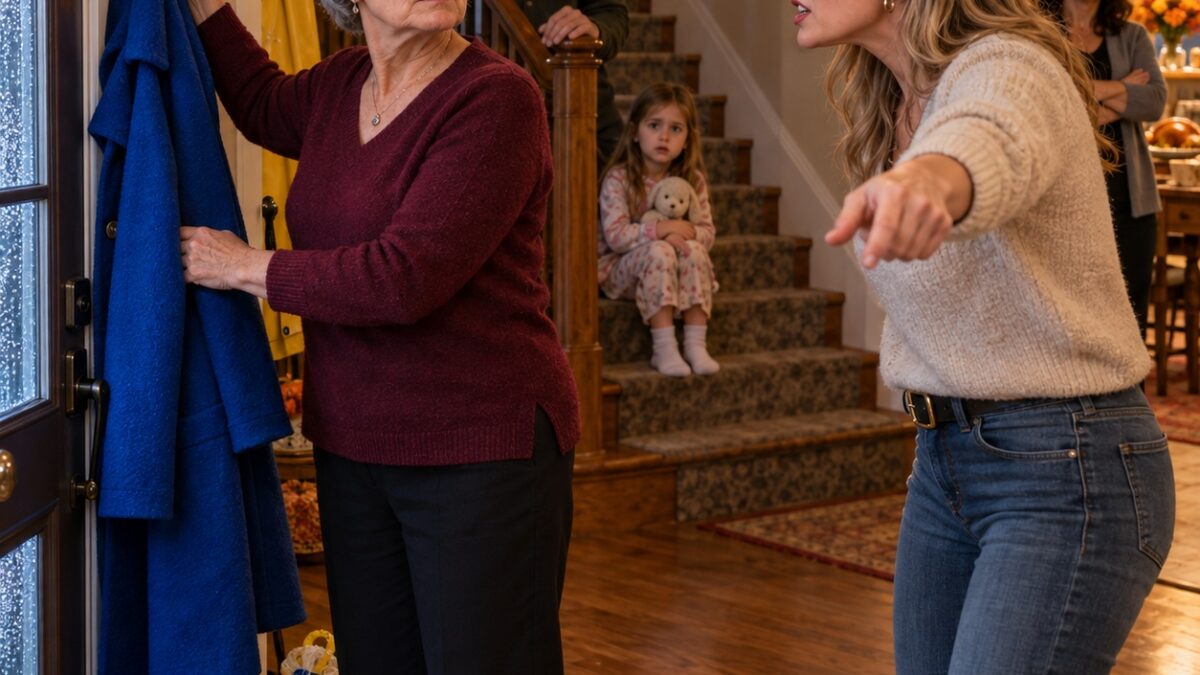
PART2
Shelby’s jaw tightened.
“They land at 9:40.”
She spoke slowly, as though talking to someone stubborn and dim.
“Be gone by nine.”
Then she turned and went upstairs.
Her bedroom door slammed.
Tara looked from me to Adam.
For the first time since I had known her, the woman who always had a comment had nothing.
She picked up her purse.
Left.
Adam stayed near the stairs.
I looked at him.
He looked at the floor.
“Mom…”
I waited.
He did not finish.
That had become a pattern too.
Adam had spent two years beginning sentences and allowing Shelby to decide their endings.
I picked up the turkey.
Carried it into the kitchen.
Placed it on the bottom refrigerator shelf.
Then I washed my hands.
No packing.
No motel.
No argument.
At six o’clock I was still in my house.
At seven.
At eight.
At nine, when Shelby expected me to disappear, I turned on the porch light.
Because by then, something else had started bothering me more than the insult.
Before my parents arrive.
That was what she had said.
Not:
I want privacy.
Not:
There isn’t room.
Not even:
My parents don’t like you.
Before my parents arrive.
Meaning my presence itself was evidence.
I had spent thirty-nine years around medical billing.
You learn peculiar things in a billing office.
People lie.
People panic.
People misunderstand.
People also become very creative when they are terrified another person will see the real account.
When someone is desperate to hide the patient, you do not argue.
You pull the file.
Because the file usually explains the panic.
So I asked myself:
What story had Shelby told her parents that required the actual owner of the house to vanish before they walked through the door?
That was the question.
I had no answer.
Yet.
My career began in 1981.
I was twenty-three.
Wexley Regional Medical Center had one billing office back then.
Basement.
Next to laundry.
Bleach smell.
Carbon paper.
I made $4.10 an hour typing hospital bills.
People think billing is numbers.
It isn’t.
Billing is where frightened people arrive after medicine has finished talking.
A doctor tells you:
Surgery went well.
Then three weeks later an envelope tells you:
$18,742.
That is when people come to the window.
They clutch paper.
Raise voices.
Cry.
Threaten.
Beg.
I learned early never to meet panic with panic.
You pull the account.
Read it.
Line by line.
Accounts do not have feelings.
That is their advantage.
I took night classes three evenings a week.
Finished my business degree at Bowling Green State University in 1991.
By 1998, I became director of patient financial services at Wexley.
I held that position twenty-two years.
When I retired in 2020, my department had forty-one people.
Jean teased that I had become “queen of the bills.”
I told him queens were paid better.
He said:
“Your parking spot has your name on it. Close enough.”
We had bought the house on Lynen Street in 1993.
Narrow two-story.
Oak trim.
Yellow kitchen tile I kept meaning to replace and never did.
Mortgage paid off in 2011.
Jean died five years later.
The house became quiet.
Then Adam, Shelby, and Ren moved in.
At first, the noise felt like rescue.
Little shoes by the stairs.
Cartoons.
Bathwater running.
Ren putting syrup on everything.
I loved it.
Maybe that love made it easier not to notice when my home became someone else’s performance.
Shelby had always wanted to be seen as successful.
Her boutique, Shelby and Sage, sold linen aprons, candles, decorative pillows.
Sixty-dollar aprons.
Pretty website.
Good photography.
Weak cash flow.
When it failed, she did not tell her parents.
I learned later that Dwayne, her father, had built his own house in Prescott, Arizona in 1988.
Every stud.
Every cabinet.
Shop teacher for thirty-four years.
Proud man.
Not cruel.
But proud.
At Shelby’s wedding in 2018, he had raised a glass and said:
“In the Ror family, we don’t live on anybody’s charity.”
I barely heard him because the band was tuning.
Shelby did.
Apparently she never stopped hearing him.
When the boutique collapsed, she moved into my paid-off house and told her parents something else entirely.
I just did not know what yet.
Earlier that month, the first crack had appeared.
November 2.
Sunday dinner.
Pot roast.
Shelby’s iPad chimed.
Ren grabbed it.
She had recently learned to read and considered every visible sentence public property.
“From Grandpa Dwayne!”
She announced.
Then slowly:
“Booked. Landing November twenty-six. Nine-forty p.m. Staying a week.”
She squinted.
“Want to see the house you bought and settle…”
Adam interrupted.
“Settle what’s owed.”
His voice went quiet.
Ren smiled proudly because she had successfully read a difficult message.
Shelby snatched the iPad.
Her face had gone pale.
“Grandpa’s coming for Thanksgiving!”
Too bright.
“Isn’t that fun?”
I said nothing.
But while washing the roasting pan later, one phrase kept repeating.
The house you bought.
Bought.
Shelby and Adam had not bought a house.
They had moved into mine.
Then eight days later Shelby suggested I spend Thanksgiving with Jean’s sister in Toledo.
“Wouldn’t you rather?”
“No.”
“She’s always asking.”
She had asked once.
In 2017.
I declined.
She looked relieved.
“I’ve cooked Thanksgiving in this kitchen thirty-two years.”
Shelby’s smile disappeared.
“My parents are particular.”
“Then they’ll like my stuffing.”
“It’s very particular.”
No laugh.
Door slammed upstairs.
That night I saw the pharmacy calendar on the refrigerator.
November 26.
Shelby had written:
Mom and Dad — flight lands 9:40 — the house you bought.
I stood there looking at the handwriting.
What exactly had she been telling them?
Two days before Thanksgiving, she produced the hotel confirmation.
Route 30 Budget Inn.
Seven nights.
$79 per night.
$553.
Charged to Adam’s card.
Her friend Tara sat at my counter eating my grapes.
“It’s a vacation.”
Shelby smiled.
“The hotel has a pool.”
“It’s November.”
Tara snorted.
“Free vacation, Francine.”
Then she mentioned something that seemed irrelevant at the time.
“I work hospital bills all day at Lakeline Medical Billing.”
I filed the name away.
I used to file things mentally the way other people remember recipes.
Lakeline.
Medicare card.
Hospital mail.
Phone turned facedown.
All loose pieces.
No picture yet.
My knee surgery had been in March.
Partial replacement.
Same hospital where I had worked most of my life.
Adam drove me.
Shelby surprised me by becoming attentive.
Chicken soup.
Magazines.
Pill schedule.
She carried my mail in.
One afternoon she sat on my bed.
“Can I get a picture of your Medicare card for the pharmacy?”
I was taking pain medication.
She had brought soup.
I handed it over.
Why would I suspect kindness?
Then twice that month she asked whether any hospital mail had arrived.
“Just making sure nothing gets lost.”
Nothing was lost.
My coverage was excellent.
Medicare plus Plan G.
The only thing I owed for the surgery was the annual Part B deductible.
$257.
I paid it online April 11.
Four minutes.
Balance zero.
By June I was walking two miles a day.
No cane.
No debt.
So later, when Shelby’s parents behaved as if I were medically ruined, the question became obvious.
Why had Shelby needed my Medicare card?
I should have asked in March.
I did not.
At 10:50 Thanksgiving Eve, Adam and Shelby left for the airport.
Ren went with them.
Before leaving, Shelby walked through the kitchen.
Saw me sitting there.
Her expression asked a question she did not say.
Why are you still here?
I smiled.
“Drive safely.”
She stared.
Then left.
I made the upstairs guest room.
Good sheets.
Fresh towels.
Lavender soap.
Two mugs by the coffee maker.
If Shelby’s parents had been lied to, they were not responsible for believing their daughter.
Not yet.
I would not punish strangers before knowing what they knew.
At 11:18, headlights crossed the ceiling.
Suitcase wheel caught in the crack on the walkway Jean always meant to repair.
A man’s voice:
“Watch the step, Patty.”
I opened the door.
Dwayne filled the porch.
Tall.
Square.
Brown canvas jacket.
His wife Patrice stood beside him in a red wool coat.
Behind them, Shelby held sleeping Ren.
Her face looked empty.
Adam moved luggage from the trunk as slowly as a man could reasonably move luggage.
“Come in.”
I took Dwayne’s coat.
Then I saw the hooks.
My cobalt coat on the left.
Jean’s hook empty on the right.
For reasons I still cannot fully explain, I hung Dwayne’s jacket on Jean’s hook.
It looked right.
Two shop teachers.
Different generations.
Same calloused hands.
Patrice’s red coat went beside mine.
“Welcome to my home.”
Nobody answered immediately.
Patrice stared at me.
Then dropped her bag.
“Francine!”
She threw her arms around me.
“Oh, honey.”
“You’re up.”
She pulled back.
Looked at my legs.
“You’re standing!”
I blinked.
“My knee is fine.”
“We prayed for you every Sunday.”
“Whole women’s circle.”
“That’s kind.”
Dwayne shook my hand.
“Glad our little bit each month helps.”
There it was.
I kept my face still.
Thirty-nine years at billing windows teaches you that before anything else.
Do not react before the account finishes speaking.
Behind them, Shelby suddenly appeared.
“Dad, you’re exhausted.”
“Let’s get the bags upstairs.”
Dwayne ignored her.
“How are you feeling?”
“I’m well.”
Patrice touched my arm.
“If you need anything, honey, that’s what family is for.”
She meant it.
That was the part that hurt.
This woman was not mocking me.
She believed she had been helping me.
Regularly.
For a long time.
And I had never received a dollar.
In the kitchen, Patrice unzipped her quilted carry-on.
“I wasn’t going to give you this until tomorrow.”
She pulled out a quilt.
Log-cabin pattern.
Cobalt and cream.
Hand stitched.
Four feet square.
Beautiful enough that Jean would have inspected every seam.
“Eight months.”
Patrice smiled.
“I started it when Shelby told us about your surgery.”
She handed it to me.
A little label in the corner read:
For Francine, with love — Patrice R.
I ran my hand over the stitching.
Across the kitchen, Shelby stared at the floor.
Dwayne laughed.
“She wouldn’t let me pack my good boots because the quilt had to fit.”
“It’s beautiful.”
My voice remained steady.
“Thank you.”
Patrice hugged me again.
“You just get well.”
“I am well.”
“Then get weller.”
She laughed.
I held that quilt against my chest.
Eight months.
A woman in Arizona had spent eight months sewing for a supposedly sick widow.
I looked at Shelby.
Then I made a decision.
Whatever Shelby had done, Patrice would not discover it at midnight in her socks after traveling across the country.
Not that way.
Not from me.
Not yet.
By midnight, the house was quiet.
Dwayne and Patrice upstairs.
Ren asleep.
Shelby and Adam behind their door.
I sat in my little room with the quilt across my knees.
Added things up.
They believed I was sick.
Poor.
Dependent.
They had been sending “a little bit each month.”
Regularly.
Regular money creates records.
Records create an account.
If the money was not in my account, it was in someone else’s.
Then:
Get this freeloader out of my house.
I finally understood why Shelby needed me gone.
If her parents saw me walking independently through a house I owned, cooking Thanksgiving dinner, paying my own bills, the story would begin collapsing before dessert.
I considered waking them.
Then remembered Dwayne had undergone bypass surgery in February 2024.
Fresh scar.
Long flight.
One in the morning.
I would be a stranger accusing their daughter.
My word against hers.
No.
You do not argue with a family at the window.
You pull the account.
So I decided to wait.
As it turned out, I did not have to wait long.
At 1:05 a.m., the kitchen floor creaked.
I came out in my robe.
Dwayne stood at the counter wearing a gray sweatshirt and reading glasses.
He was trying to operate my coffee maker.
“Sorry.”
“It’s only eleven back home.”
“My body thinks it’s evening.”
“Instant coffee is in the left cabinet.”
“The machine has opinions.”
He laughed.
We sat together at my kitchen table with two mugs.
Two retired night-shift people pretending it was normal to be awake.
He told me about teaching shop.
Welding.
Small engines.
Cabinetry.
“Built my house in ’88.”
“Every stud.”
“How many?”
“Two thousand one hundred.”
He knew exactly.
I liked him.
Then his mug began turning slowly beneath his hand.
“Francine.”
“I’ll be honest.”
“I came partly to settle the rest of your hospital bill.”
I said nothing.
“Shelby handles it through the portal.”
“I trust her.”
“But I like to see things paid myself.”
“What hospital bill?”
He looked surprised.
“The knee.”
“Four thousand two hundred still due.”
“Is that what Shelby told you?”
He missed the change in my voice.
“Yes.”
He went upstairs.
Returned with a manila folder.
Opened it.
Placed a pale-green sheet in front of me.
My name at top.
Wexley Regional Medical Center.
Blue oak-tree logo.
Patient statement.
Francine Offner.
Account number 4471203.
Date of service March 18, 2025.
Patient responsibility:
$11,000.
Payments received:
$6,800.
Balance:
$4,200.
Statement date April 30.
Remit to P.O. Box 4410.
Billing phone number.
I needed ten seconds.
Four things were wrong.
First:
Wexley patient accounts had started with H followed by nine digits since 2012.
I had overseen the conversion.
This account had seven digits.
No H.
Second:
P.O. Box 4410 had been closed in 2019.
I signed the paperwork moving payments to a bank lockbox in Columbus.
Third:
A Medicare patient with Plan G could not owe $11,000 after a knee replacement in the manner shown.
The insurance structure simply did not work that way.
Fourth:
Tiny code in the lower corner.
LMB-S4.
I knew I had seen it somewhere.
Could not place it yet.
Dwayne watched me.
“Something wrong?”
“Old habits.”
I said.
“I used to read these for a living.”
Then he opened his phone.
Zelle history.
$1,000 to Shelby Offner.
First of every month.
October 2023 through November 2025.
Then one payment:
$6,800.
April 4, 2025.
“I even called the number in April.”
“Girl confirmed the balance.”
My stomach went cold.
“May I photograph this?”
“Sure.”
I took a clear picture.
Then:
“Monday morning.”
“We go pay it together.”
“In person.”
“I know the office.”
Dwayne smiled.
“Deal.”
He returned upstairs at 1:40.
I waited for the guest-room door.
Then opened my laptop.
Logged into Wexley’s patient portal.
My real account:
H4417263.
Date of service:
March 18.
Total charges:
$38,412.
Meaningless hospital sticker price.
Medicare paid.
Plan G paid.
Patient responsibility:
$257.
Payment:
April 11.
Balance:
$0.00.
I printed it.
Printed the Medicare Summary Notice.
Printed my debit receipt.
Put them beside the fake statement photograph.
Then I calculated.
$1,000 each month.
October 2023 through November 2025.
Twenty-six payments.
$26,000.
Plus $6,800.
Total:
$32,800.
Thirty-two thousand eight hundred dollars.
Sent by two retirees in Arizona to help a supposedly sick, broke widow who lived in a house paid off fourteen years earlier, drew a hospital pension, had retirement savings, and had never asked them for a penny.
Shelby had not only lied about me.
She had monetized the lie.
At 2:37 a.m., I emailed Ivonne Petraus.
I hired Ivonne as a billing clerk in 2002.
She now ran my old department.
Counterfeit patient statement using Wexley name and logo. Family from out of state. Can I bring them Monday at 9?
Then I slept.
Hard.
Because once the account exists, fear becomes work.
And work had always been easier for me than fear.
Thanksgiving morning, I woke at six.
Turkey.
Sage butter.
Stuffing.
Green beans.
Sweet potatoes.
Tradition.
Shelby came down at ten and began rearranging my serving dishes.
At two, we sat.
Seven places if you counted Ren’s stuffed rabbit, which Ren insisted we do.
Shelby stood at the head of my table.
Said grace.
I had never heard her say grace.
Then she played hostess.
Passed food she had not cooked.
Accepted compliments.
At one point she leaned toward Patrice.
“She doesn’t lift a finger, honestly.”
Not quietly enough.
“We even pay her phone bill.”
I was standing behind her holding an eighteen-pound turkey on a platter.
Dwayne looked at me.
New knee.
Electric carving knife Jean gave me in 1998.
Turkey I had cooked.
His eyebrows drew together.
Patrice asked:
“Francine, how’s your sister-in-law in Toledo?”
“Fine.”
“Shelby says you usually spend Thanksgiving there.”
“I’ve never spent Thanksgiving there in my life.”
Shelby’s fork stopped.
Patrice blinked.
“Oh.”
“I must have misunderstood.”
“Easy to do.”
I set the turkey in front of Dwayne.
“White or dark?”
He looked at me.
“Dark.”
Adam ate without lifting his eyes.
I watched him.
All of dinner.
Because my son knew something.
I no longer knew how much.
Afterward, Dwayne needed his reading glasses from his jacket.
We went toward the front hall.
My cobalt coat was missing.
Patrice’s red coat occupied the left hook.
Dwayne’s canvas jacket still rested on Jean’s hook.
“Did someone move my coat?”
From the living room, Shelby said:
“Made room for guests.”
I found my coat in the garage.
Rusty nail.
Beside recycling bins.
Rock salt.
Adam’s old snowboard.
Hem touching a wet cardboard box.
I stood there for a long moment.
Holding it.
The coat itself did not matter nearly as much as what the empty hook meant.
Shelby wanted her father walking through my front hall without evidence that another woman lived there.
No cobalt coat.
No owner.
No contradiction.
She was erasing me one household object at a time because my existence threatened the story she had sold.
I brought the coat inside.
Moved Patrice’s red coat one inch.
Hung mine beside it.
Two women’s coats.
No competition.
No hiding.
Patrice watched.
Her eyes moved from the coats to Shelby.
She said nothing.
Not yet.
Friday morning, Ivonne replied.
Monday 9 sharp. Bring ID. Bring original statement if family has it. Desmond will want it.
Desmond Farley.
Hospital compliance and privacy officer.
If somebody used Wexley’s logo to collect money, Desmond would care.
Then the code came back to me.
LMB-S4.
Spring 2018.
Wexley had considered outsourcing billing for certain clinic accounts.
Three companies gave presentations.
One:
Lakeline Medical Billing.
I sat through their presentation.
Young man with painfully white teeth.
Ugly sample statements.
Balance in the wrong box.
Confusing payment stub.
Template code on every page.
LMB-S1.
LMB-S2.
And patient-friendly design:
LMB-S4.
We declined them.
I wrote the memo.
Four days earlier, Tara had sat in my kitchen eating grapes.
“I do hospital bills at Lakeline Medical Billing.”
Now the document had a creator.
Or at least someone with access to the software needed to create it.
One question remained.
Who answered Dwayne’s fake “hospital billing” number?
I had the number.
Could have called.
Did not.
You never warn the account before pulling it.
I put the phone face down.
Went back to leftover turkey.
Saturday morning, Shelby cooked pancakes.
She had not made breakfast once in twenty-seven months.
Something was coming.
“Dad.”
Syrup pouring.
“About Monday.”
“I don’t want you wasting your trip at a hospital office.”
“It’s no waste.”
“I want a receipt.”
“They won’t talk to you.”
“HIPAA.”
She said it like a magic spell.
“They can only talk to the patient.”
Dwayne frowned.
“Then I’ll pay online tonight.”
Shelby brightened.
“Exactly.”
“Easy.”
Then Dwayne pointed his fork at me.
“Francine comes with me.”
“She’s the patient.”
“They’ll talk to her.”
Shelby smiled.
The corners went rigid.
Later she cornered me beside the dishwasher.
“Can I get your portal login?”
“Why?”
“So I can print Dad a receipt.”
“No.”
“It’s for my father.”
“Then your father can ask.”
“He hasn’t.”
She stared.
“You’re a guest here too, you know.”
“For the week.”
I dried a plate.
Placed it in the cupboard where it had lived since 1993.
“I’m not a guest, Shelby.”
“But I’ll be a gracious host.”
She stared at me for a long time.
Trying to calculate what I knew.
I let her.
Uncertainty was the first thing she had ever taken from me that I enjoyed watching her carry.
Saturday night, Adam sat in the garage.
On an overturned bucket near Jean’s workbench.
Unopened beer.
I walked in.
“Did you know?”
He did not pretend.
“I knew she told them we bought the house.”
“When?”
“September 2023.”
“She was talking to her dad.”
“Said we bought a place.”
“Her mother lives with us.”
“She’s got nothing.”
“And you said nothing.”
He looked at Jean’s workbench.
“You don’t know her dad.”
“Apparently I’m getting to.”
Adam swallowed.
“At our wedding, his toast.”
“Rors don’t take charity.”
“I remember.”
“She’d lost the boutique.”
“Fifty-eight thousand in debt.”
“Minimum payments were $1,140 a month.”
“She couldn’t tell him we moved into my mother’s house.”
“She’d rather die.”
I watched my son.
“Did you know about the money?”
He looked up.
“What money?”
I told him.
$1,000 a month.
Twenty-six months.
$6,800 knee payment.
Fake hospital statement.
$32,800.
He set the unopened beer on the concrete very carefully.
“I swear.”
“Mom.”
“I swear on Ren.”
“I didn’t know.”
I believed him.
That is the terrible and wonderful thing about being a mother.
Sometimes you recognize truth in your child before you want to.
“Then say it Monday.”
“In front of Dwayne.”
Adam looked at the rusty nail.
Long time.
“I can’t promise that.”
My heart sank.
Not because he had lied.
Because even knowing the scale of what Shelby had done, he still feared speaking more than he feared silence.
Sunday morning, Shelby came into the kitchen waving her phone.
“Good news, Dad.”
“I paid the $4,200 online last night.”
“Done.”
“No hospital trip.”
Dwayne set down his mug.
“Good.”
Shelby smiled.
“Then Monday I’ll pick up the receipt.”
Smile vanished.
“You don’t need one.”
“It’s in the portal.”
“I’ve kept every receipt since 1972.”
“I want a paper one.”
“Hospital stamp.”
That was the moment Shelby ran out of doors.
You cannot tell your father you paid a bill Saturday, then refuse to let him collect a receipt Monday.
She knew it.
We knew it.
“Fine.”
She said.
“I’ll come.”
“I’ll handle it.”
Patrice smiled.
“We’ll all go.”
“Lunch after.”
“Is there somewhere good nearby?”
“Diner across the street.”
I said.
“Pie is famous.”
Half an hour later, Shelby left her phone face up while changing Ren’s shirt.
It buzzed.
I did not touch it.
The messages appeared anyway.
Tara.
Is she going to let her go? If he calls me I’ll say paid in full. Like April.
There it was.
The fake phone number.
Tara.
Like April.
I kept wiping the counter.
No screenshot.
No stealing the phone.
No dramatic confrontation.
Monday was close.
At Sunday dinner, Patrice finally asked:
“Francine, what did you do for work?”
Shelby answered before I could.
“Hospital clerical.”
I looked at Patrice.
“I started clerical.”
“In 1981.”
“Typed bills in the basement.”
“And then?”
Patrice asked.
“I became director of patient financial services.”
“Twenty-two years.”
“Forty-one people when I retired.”
Patrice put down her fork.
Shelby laughed.
“She was a clerk.”
Ren spoke through a mouthful of roll.
“Grandma’s picture is on the wall.”
“By the elevator.”
“Gold letters.”
Silence.
Dwayne looked toward the manila folder on the sideboard.
Then at me.
“Director?”
“Retired.”
“Now I mostly make stuffing.”
Adam laughed accidentally.
Stopped himself.
Patrice reached across the table.
Touched my hand.
Very lightly.
“I think I’m going to need that pie tomorrow.”
Shelby stood.
Went to the kitchen.
Turned on water.
Let it run for a long time.
Washed nothing.
That night I laid my documents on my bed.
Real Wexley statement.
Balance zero.
Medicare Summary Notice.
Debit card receipt:
$257.
Fake green statement.
Ivonne’s email.
Then I clipped them together.
Plain white folder.
No labels.
Shelby liked labels enough for the whole house.
I did not need one.
I hung my cobalt coat on my left hook.
Patrice’s red coat beside it.
Dwayne’s jacket on Jean’s.
Patrice’s quilt rested on my reading chair.
I touched it before bed.
Good faith has a different texture than deception.
Every stitch in that quilt had been made because a woman in Arizona believed I needed comfort.
Shelby’s lie did not contaminate the kindness.
I intended to keep both truths separate.
Monday morning was gray.
Thin sleet.
December 1.
We dropped Ren at school at 7:45.
Dwayne drove.
Patrice front seat.
Me in back.
Shelby beside me.
Phone in her lap.
Adam followed in his car.
I watched his headlights.
Wexley Regional looked almost exactly as it always had.
1958 brick building.
Glass wing added in 2011.
I knew every parking-lot speed bump.
My knee probably did too.
We entered.
Past gift shop.
Past chapel.
Elevator.
Second floor.
Doors opened.
Dwayne stepped out.
Stopped.
On the wall to the right hung retired department directors.
My photograph.
Fourth from left.
Navy blazer.
Hair mostly silver.
Gold letters.
Francine Offner
Director, Patient Financial Services
1998–2020
Dwayne read it.
Twice.
Patrice covered her mouth.
Shelby kept walking.
Heels clicking.
Faster.
As though reaching the billing office first could still allow her to control what would happen inside.
She could not.
But hope is stubborn.
At 8:58, we entered patient financial services.
Nine blue chairs.
Ticket machine.
Muted weather channel.
Five windows.
Coffee and hand lotion.
Quiet worry.
Nothing had changed except the furniture.
I pulled ticket 47.
Before sitting, the inner door opened.
Ivonne.
Gray cardigan.
Reading glasses on chain.
“Francine.”
She hugged me.
Two clerks I had trained waved through the glass.
One mouthed:
“Welcome back.”
I introduced everyone.
Dwayne.
Patrice.
Adam.
Shelby.
Ivonne shook Shelby’s hand too.
Professional.
No clue in her face.
Proud moment for me.
I trained her well.
Shelby spoke quickly.
“We just need a receipt.”
“Five minutes.”
“Don’t want trouble.”
“No trouble.”
Ivonne smiled.
The digital display chimed.
NOW SERVING 47 — WINDOW 3
Behind window three sat Latoya.
Long braids.
Christmas-tree pin on her lanyard.
She had no idea what was about to arrive through the slot.
Dwayne stepped forward.
Opened the folder.
Placed the green statement beneath the glass.
“Good morning.”
“I’m here about Francine Offner’s account.”
“My daughter paid the balance online Saturday.”
“I’d like a receipt.”
Latoya looked at the document.
Then at him.
Professional smile.
“Are you the patient, sir?”
“No.”
“Family.”
“I’m sorry.”
“I can’t discuss a patient’s account without written authorization.”
“Federal privacy law.”
Shelby moved instantly.
“See, Dad?”
“I told you.”
“Come on.”
“Let’s get pie.”
She actually took his arm.
Started turning him away.
That was her last attempt.
I stepped forward.
Placed my driver’s license on the counter.
“Good morning, Latoya.”
“I’m the patient.”
Latoya looked at me.
Then the license.
Then perhaps the photograph she had passed for five years.
Eyebrows lifted.
“I’d like to sign authorization for Mr. Ror.”
“He can hear anything regarding my March account.”
“Of course.”
She slid the form through.
I knew the form.
I had approved much of its wording in 2003.
Patient name.
Date of birth.
Authorized person.
Purpose.
Signature.
For purpose I wrote:
To confirm balance and payments.
Signed.
Dated.
Returned it.
Behind me, Shelby took one step backward.
Quietly.
Ivonne came behind the glass.
Stood at Latoya’s shoulder.
Latoya typed.
Keys sounded impossibly loud.
Ivonne read:
“Account H4417263.”
“Date of service March eighteenth.”
“Total charges, $38,412.”
Dwayne leaned forward.
“Medicare paid its portion.”
“Supplement paid its portion.”
Scroll.
“Patient responsibility: $257.”
“Paid by Mrs. Offner by debit card April eleventh.”
Pause.
“Balance zero.”
Dwayne blinked.
“Zero?”
“Zero.”
“Since April.”
His face changed.
“And the $4,200 my daughter paid Saturday?”
Ivonne scrolled.
Slowly.
“There is no payment Saturday.”
“There is nothing owed to pay.”
Dwayne slid the green document back beneath the glass.
“Then what is this?”
Ivonne picked it up.
Held it away.
Closer.
Turned it over.
“This isn’t ours.”
Dwayne almost laughed.
“It has your logo.”
“It has our name.”
“It is not our statement.”
She pointed.
“Our account numbers start with H and nine digits.”
“This has seven.”
“We closed P.O. Box 4410 six years ago.”
“We do not accept Zelle.”
“And a Plan G patient could not owe eleven thousand dollars under these circumstances.”
“That balance never existed.”
The waiting room had gone quiet.
John Deere cap man stopped reading his envelope.
Young mother stopped rocking the baby carrier.
Dwayne stood still.
Very still.
“Then…”
His voice caught.
“Who did I send $6,800 to?”
Nobody answered.
Shelby’s knuckles were white around her phone.
Ivonne tapped the fake statement.
“Mr. Ror.”
“There’s a phone number here.”
“Did you call it in April?”
“Yes.”
“Girl answered.”
“Confirmed everything.”
“Would you call it again?”
“Right now.”
“Speaker.”
Shelby’s head snapped up.
“Dad, that’s ridiculous.”
“It’s probably disconnected.”
Dwayne was already scrolling.
He had saved the number as:
Hospital Billing
Careful man.
He placed the phone flat on the counter.
Pressed speaker.
Ring.
Once.
Twice.
Then:
“Billing, this is Tara.”
Bright voice.
Familiar.
Then:
“Hi, Mr. Ror. All paid up, right? Shelby said you’d call.”
Nobody breathed.
Ivonne leaned toward the phone.
“Good morning.”
“This is Ivonne Petraus, manager of patient financial services at Wexley Regional Medical Center.”
“Which billing office is this, please?”
Silence.
Long.
On the other side, I could faintly hear a printer.
Then:
Click.
Call ended.
Dwayne stared at his phone.
Slowly turned toward his daughter.
And Shelby broke.
“She set this up!”
She pointed at me.
Across Window 3.
Voice cracking against glass.
“She did this!”
“She’s twisting everything!”
“She’s the freeloader!”
“She’s lived off us for two years!”
The baby began crying.
Patrice said:
“Shelby.”
“Lower your voice.”
“She hates me!”
Shelby screamed.
“She’s always hated me!”
I said nothing.
I did not need to.
The account had answered.
That was the point.
The inner door opened.
Desmond Farley entered.
Late fifties.
Bald.
Bow tie.
Legal pad.
Hospital compliance officer.
“Mrs. Offner.”
He shook my hand.
Then looked at Dwayne.
“May I see the document?”
Dwayne handed him the green statement.
Desmond needed about ten seconds.
Same as I had.
Then:
“Mr. Ror.”
“I’m going to be direct.”
“Someone created a counterfeit hospital statement using our name and logo.”
“They used it to collect money from you.”
“When that happens, we document it immediately.”
Dwayne swallowed.
“What happens now?”
“I keep the original.”
“You receive a certified copy.”
“I prepare an incident report this morning.”
“And a signed hospital letter stating this balance never existed and this document did not originate with Wexley.”
Then:
“Our security desk can contact Wexley Police.”
“If you want to file a report.”
Dwayne did not hesitate.
“Call them.”
“Daddy, no.”
Shelby’s entire voice changed.
Small.
Childlike.
“Daddy.”
“Please.”
Then, finally, she said something real.
“I did it for you.”
Dwayne stared.
“For me?”
“You’d have been ashamed.”
Tears.
Real ones.
“I lost everything.”
“I couldn’t tell you.”
“We were living in her house.”
“You always said Rors don’t take charity.”
“I did it because I wanted you to still be proud of me.”
That was the confession.
Not legal.
Not complete.
But emotional.
She had built a fake life because she feared disappointing her father.
Then financed the fake life by exploiting his love.
She cried.
Mascara ran.
But one word never appeared.
Sorry.
Not to Dwayne.
Not Patrice.
Not me.
Dwayne’s face changed more slowly.
He looked at Desmond.
The document.
His daughter.
“Thirty-two thousand eight hundred dollars.”
Quiet.
“Our little bit each month.”
He looked toward Patrice.
“Your mother skipped her dentist.”
Patrice looked down.
“We told the women’s circle.”
“They prayed for her.”
Then he pointed at me.
“A woman whose picture is hanging on the wall outside.”
His eyes returned to Shelby.
“Who’s the freeloader?”
Shelby had no answer.
For the first time in twenty-seven months, I think she had no prepared version.
Then Adam spoke.
He had been standing near the ticket machine.
Quiet.
I had almost forgotten him.
His voice came rough.
Like a door rusted shut.
“It’s Mom’s house.”
Shelby turned.
Adam cleared his throat.
“It has always been Mom’s house.”
“She never charged us rent.”
“Not one cent.”
“I knew you told your parents we bought it.”
“I let you lie.”
“I’m done.”
Shelby stared at him.
“You coward.”
“You absolute coward.”
Adam nodded once.
“Yeah.”
“For two years.”
Then:
“Not today.”
I looked at my son.
He was late.
Very late.
But he was speaking.
Late is not never.
Patrice held the edge of a blue plastic chair.
Looked at me.
“The quilt.”
Her voice broke.
“Oh, Francine.”
“I made you a quilt.”
I walked to her.
“I’m keeping the quilt.”
She looked up.
“It was made in good faith.”
“Every stitch.”
She cried.
So did I, finally.
Not loudly.
Just enough.
Because that quilt had become the one completely innocent thing in the room.
Shelby’s lie had not made the love inside it false.
That mattered.
Shelby looked at me.
Red-faced.
“Are you happy?”
“Is this what you wanted?”
My hands rested on my white folder.
I looked at her for a long moment.
“I don’t need you to be sorry, Shelby.”
That surprised even me.
“I need you to be accurate.”
That was all.
Officer Ben Samsky arrived at 9:31.
Young.
Polite.
Tablet.
Took Dwayne into a small office.
Green statement.
Hospital letter.
Zelle screenshots.
Phone number.
Tara’s name.
Case number.
Shelby was not handcuffed.
Nobody was.
He spoke with her privately near the window.
Ten minutes.
She no longer cried.
When Dwayne came out, he held the case card as though it were heavy.
He walked directly to Shelby.
“You’ll repay every dollar.”
“In writing.”
“I’ll have an agreement ready tomorrow.”
“Dad, I don’t have—”
“Then you pay a little at a time.”
“The way we sent it.”
He turned away.
No shouting.
No performance.
I understood him better in that moment.
Shop teacher.
Measure.
Cut.
Fix what can be fixed.
I thanked Latoya.
Hugged Ivonne.
Shook Desmond’s hand.
He told me my old training binder was still used.
That may have been the nicest thing anyone said to me all year.
As we walked toward the elevator, Dwayne stopped at my photograph.
Read it again.
“Director.”
“Twenty-two years.”
“Yes.”
He nodded.
“I’m sorry, Francine.”
“I should have come sooner.”
“I should have asked you directly.”
“You’re here now.”
Then:
“Let’s get that pie.”
That was all I needed.
We returned to Lynen Street that evening.
Two cars.
Ren included.
I entered first.
Removed my cobalt coat.
Hung it on the left hook.
Patrice hung her red coat beside mine.
Dwayne lifted his canvas jacket toward Jean’s hook.
Then stopped.
“Is this okay?”
I looked at him.
“I didn’t know whose hook this was.”
“Tonight it is.”
He hung his jacket.
Shelby stood in the hallway.
Same place where five days earlier she had thrown my coat onto the floor.
Adam beside her.
A few inches farther away than usual.
I spoke evenly.
“Adam.”
“Shelby.”
“You need your own place by Saturday, January tenth.”
“Forty days.”
“Enough time.”
Shelby’s mouth fell open.
“You can’t just throw us—”
“I’m not throwing anything on the floor.”
She stopped.
I held her eyes.
“This is my house.”
“Not your doghouse.”
“You are welcome to visit.”
“Knock first.”
Adam nodded.
No argument.
I think part of him was relieved.
Some people live so long without boundaries that being given one feels almost like rescue.
Shelby went upstairs.
That night, for the first time in more than two years, she did not slam the door.
Tuesday night, Shelby signed Dwayne’s repayment agreement at my kitchen table.
$32,800.
$500 every month starting January 1, 2026.
Sixty-five payments of $500.
Final payment $300.
Paper.
Not promises.
Dwayne preferred it that way.
So did I.
On Friday, December 5, he and Patrice flew home to Arizona.
Before leaving, Patrice hugged me twice.
“Call me.”
“I will.”
“You mean it?”
“Yes.”
Dwayne shook Adam’s hand.
Then mine.
Longer.
“Thank you for not telling us the first night.”
I thought about Patrice in her socks.
The quilt.
His heart surgery.
“You needed sleep.”
He nodded.
Then looked toward Shelby.
She was upstairs.
No goodbye at the door.
That was her choice.
Lakeline Medical Billing fired Tara.
Desmond had sent them a copy of the counterfeit statement with LMB-S4 circled.
I felt no satisfaction.
Tara had used her company’s software to help create a fake hospital statement.
Then answered a fake billing phone line to confirm money that was never owed.
Those were her choices.
Consequences followed.
That was all.
The police case remained open.
Dwayne asked authorities to keep it there while payments continued.
That arrangement belonged to him, Shelby, and the legal system.
I did not interfere.
For thirty-nine years, I had learned not to enter other people’s accounts without authorization.
It was time to apply that rule outside hospitals too.
January 10 came.
Cold.
Clear.
Adam and Shelby moved into a two-bedroom apartment across town.
$1,275 a month.
Their money.
Their lease.
Their responsibility.
I did not pay the deposit.
Did not buy furniture.
Did not cover movers.
That was harder than I expected.
My hands almost reached for my checkbook out of habit.
Then I remembered the cobalt coat on the garage nail.
Stopped.
Adam had a job.
Shelby had to rebuild hers.
They could solve it.
And they did.
The world did not end.
The house became quiet again.
At first, too quiet.
No Ren running down stairs.
No cartoon voices.
No Shelby moving bowls where I could not reach them.
No Adam arriving late.
I stood in the kitchen one night and wondered whether I had made myself lonely to prove a point.
Then Friday afternoon came.
Doorbell.
Ren.
Backpack.
Stuffed rabbit.
“Grandma!”
She slept in the upstairs room that had once been hers.
Now it was hers again one night a week.
She crawled into my bed Saturday morning and asked:
“Do freeloaders make pancakes?”
I looked at her.
“What?”
She explained very seriously.
“Mommy said before you were a freeloader.”
“Grandpa Dwayne said Mommy was taking stuff.”
“Daddy said people should stop saying that word.”
“So what is it?”
I chose carefully.
“A freeloader is someone who takes from other people and expects someone else to carry everything.”
Ren considered.
Then:
“So somebody who takes stuff and says thank you to the wrong person?”
I smiled.
“Close enough.”
Children do not need adult indictments.
They need simple truth.
Adam began calling every Sunday.
At first, conversations were awkward.
Weather.
Ren’s school.
Work.
Then one afternoon:
“Mom.”
“Yes?”
“I’m seeing a counselor.”
“Good.”
“Shelby started coming too.”
I paused.
“I hope it helps.”
“I don’t know if we’re going to make it.”
“That’s your marriage.”
He became quiet.
Old me would have filled the silence.
New me waited.
Eventually he said:
“I know.”
That was progress.
We had our own reckoning later.
Not dramatic.
No audience.
He sat at my kitchen table.
Same table.
Same room.
His childhood home.
“Why didn’t you tell me sooner?”
he asked.
“About the fake bill?”
“About everything.”
“I didn’t know everything.”
“But you knew she was lying about the house.”
“No.”
“You knew.”
His face tightened.
“You had to know something was wrong.”
I looked at him.
“That question belongs to you too.”
He stared.
“You heard her tell her father you bought my house.”
“You said nothing.”
He looked down.
“I was scared she’d leave.”
“And take Ren.”
There it was.
My fear had been the same.
We had both stayed quiet because we feared losing the same child.
Interesting.
“Adam.”
“You and I both let fear keep Shelby’s story alive.”
He looked at me.
“I’m sorry.”
Not polished.
Not perfect.
But real.
“I should’ve said something that day.”
“At the house.”
“At the hospital.”
“Long before.”
I nodded.
“Yes.”
He swallowed.
“I’m sorry.”
“Thank you.”
I did not say:
It’s fine.
It wasn’t.
But I accepted the apology.
That is different.
Patrice called every other Thursday.
Exactly.
She liked schedules.
We talked about quilts.
Ren.
Arizona.
Ohio weather.
Once, daughters.
For almost an hour.
She said:
“I keep wondering what I did wrong.”
I answered carefully.
“Shelby made choices.”
“So did Dwayne.”
“So did Adam.”
“So did I.”
“We can all examine our choices.”
“But we don’t get to claim hers.”
Patrice was quiet.
Then:
“That sounds like something a billing director would say.”
“Accounts need correct ownership.”
She laughed through tears.
Afterward, I used her quilt that evening while reading.
Cobalt and cream.
Warm.
Every stitch still good.
Her kindness survived her daughter’s lie.
That remains one of the things I am most grateful for.
The brass hooks by my front door changed too.
My cobalt coat stayed on the left.
After Dwayne left, Jean’s hook was not empty anymore.
Because just before going to the airport, Dwayne removed his canvas jacket.
Then took a maroon knit cap from his bag.
PRESCOTT HIGH SCHOOL stitched in gold.
He placed it on Jean’s hook.
“So the hook’s not lonely.”
I stared.
“I’ll get it next Thanksgiving.”
I almost cried.
Jean would have liked him.
Two shop teachers.
One who knew exactly how many studs were inside his own house.
One who installed two brass hooks and accidentally left behind a family landmark.
I let the hat stay.
That was the first object on Jean’s hook in nine years.
And somehow it did not feel like betrayal.
It felt like hospitality.
Grief had changed.
Or maybe I had.
Thanksgiving the following year looked very different.
Dwayne and Patrice returned.
This time, nobody pretended whose house it was.
Dwayne knocked.
I opened.
He pointed at the maroon cap.
“Told you I’d get it.”
“You can leave it another year.”
He smiled.
“Jean charging rent?”
“Very high.”
We laughed.
Patrice brought another small quilted piece.
Not because she thought I was sick.
Because she liked me.
That difference mattered.
Adam came.
Ren came.
Shelby came later.
She knocked.
I opened the door.
We looked at each other.
She said:
“Happy Thanksgiving.”
“Happy Thanksgiving.”
No hug.
No dramatic apology.
No pretending.
She entered as a guest.
That was accurate.
Accuracy was still enough for me.
Shelby had been making the $500 payments.
Dwayne kept records.
Of course.
If one was late, he called.
Not me.
Not Adam.
Her.
Correct ownership.
I appreciated that.
I did not ask about every payment.
It was not my money.
That was an important distinction.
The theft had used my name.
The money had belonged to Dwayne and Patrice.
Once truth was established, their repayment became their account.
I left it closed.
That was another lesson.
You do not have to manage every consequence merely because you helped expose the problem.
My own finances remained unchanged.
House paid.
Hospital pension.
403(b).
Savings.
I was not rich in the dramatic sense.
But I was secure.
The irony of being called a freeloader by someone living rent-free in my paid-off house became funny eventually.
Not immediately.
But eventually.
One afternoon Patrice said:
“I still can’t believe she called you that.”
I answered:
“People often choose insults that describe their own fear.”
Patrice laughed.
“You sound wise.”
“I’m old.”
“Not the same.”
Fair.
The fake green statement remained part of the police file.
I kept a certified copy.
Not displayed.
Not cherished.
Documented.
The real statement I kept too.
Balance zero.
Two pieces of paper.
One built to manipulate.
One built by a real system.
The difference between them was not appearance.
The fake looked good.
Logo.
Account number.
Professional colors.
The difference was verification.
That is worth remembering.
Fraud often looks respectable.
Sometimes more respectable than truth.
Truth may be an ugly portal printout.
Still truth.
I thought often about how Shelby’s lie grew.
It probably began small.
“My mother-in-law lives with us.”
Easier than:
We live in my mother-in-law’s house because my business failed.
Then:
“She’s struggling.”
Then:
“We help her.”
Then her father sends money.
Once money arrives, the lie must become more detailed.
Medical problems.
Bills.
Fake statements.
Phone numbers.
A friend posing as billing.
My Medicare card.
My surgery.
My coat disappearing before Thanksgiving.
Lies require maintenance.
The bigger they become, the more people they employ.
Eventually Shelby had Tara helping.
Adam staying silent.
Her parents paying.
Me being erased.
She built an entire economy around avoiding one sentence.
“Dad, I failed.”
That was the tragedy.
Failure would have been cheaper.
Honesty would have been cheaper.
Embarrassment would have been cheaper.
Instead:
$32,800.
A lost job for Tara.
Police case.
Family damage.
Moving out.
Counseling.
All because shame demanded interest.
Dwayne once told me on the phone:
“I should’ve made it easier for her to tell me.”
That was a brave sentence.
I said:
“Maybe.”
He was quiet.
“I talked too much about charity.”
“Maybe.”
“Made pride sound like morality.”
“Maybe.”
He laughed.
“You’re not going to let me off?”
“No.”
“Fair.”
He continued.
“But she still stole.”
“Yes.”
Two truths.
Parents can contribute to a child’s fear without becoming responsible for the child’s crime.
That distinction helped all of us.
I examined myself too.
Why had I allowed Shelby to control the house so long?
Ren.
Fear.
But also something else.
After Jean died, I became uncertain how much space I was allowed to occupy.
Widowhood does strange things.
Your house feels too large.
Your routines feel selfish.
Then a young family arrives and fills every room.
At first, you are grateful.
Then you begin giving space because giving feels like usefulness.
My bedroom.
My pantry.
My kitchen.
My authority.
Little by little.
I told myself:
They need it more.
That sentence can become dangerous when repeated.
Need does not create ownership.
Compassion does not require self-erasure.
I learned that late.
Still learned it.
I reclaimed the kitchen gradually.
Not dramatically.
My cast-iron pan returned from the garage.
Mixing bowls came down from the top shelf.
I removed most of Shelby’s labels.
Not all.
Some were actually useful.
The irony irritated me.
But accuracy is accuracy.
Flour label stayed.
Sugar stayed.
One label said:
FRANCINE
She had placed it on the lowest pantry shelf when assigning everyone space.
I peeled that one off.
The entire pantry was Francine’s.
No label needed.
The little room off the kitchen became a reading room again.
Not my bedroom.
I moved upstairs.
Back to the bedroom Jean and I had shared.
First night was difficult.
His side empty.
But I slept.
Sometimes reclaiming space includes reclaiming grief.
The next morning, sunlight came through the old curtains.
I realized I had spent twenty-seven months sleeping in a workshop while other people occupied the rooms I owned.
That was almost harder to accept than the financial deception.
Because nobody forced me.
I agreed.
Silently.
Again and again.
Boundaries rarely disappear in one dramatic theft.
They erode through a thousand unchallenged inches.
Ren noticed immediately.
“Grandma, you moved!”
“Yes.”
“Why?”
“Because this is my room.”
She accepted it in four seconds.
Children are often less confused by boundaries than adults pretend.
Friday sleepovers became one of my favorite things.
Ren picked the upstairs room.
We made pancakes.
Not always waffles.
She corrected me if I used too little syrup.
Her parents worked through whatever they were working through.
I did not question her.
Did not use her for information.
Did not ask:
What did Mommy say?
Is Daddy sleeping on the couch?
Do they fight?
Children should not become surveillance systems for adults.
I knew enough.
Ren needed Grandma.
That account remained simple.
Shelby and I eventually had one private conversation.
Months after moving out.
She came for Ren.
Adam was late.
Ren upstairs gathering her bag.
Shelby stood in my kitchen.
Looked around.
At bowls.
Pan.
Window.
She said:
“I really did think you hated me.”
I considered.
“Why?”
“You never trusted the boutique.”
“I didn’t trust the business plan.”
“Same thing.”
“No.”
“It isn’t.”
She looked away.
“You paid for things but never gave me money.”
“That bothered you?”
“You made me show receipts.”
“I paid vendors directly.”
“You made me feel like a child.”
“You had nineteen thousand dollars in debt before your wedding.”
That was not even part of this story, but it was true.
She flinched.
“I didn’t trust debt I couldn’t see.”
“Still don’t.”
She folded her arms.
“Dad trusted me.”
“Yes.”
“He paid thirty-two thousand eight hundred dollars based on what you told him.”
That landed.
I continued:
“Trust without verification is not always kindness.”
“Sometimes it is opportunity.”
She looked at me.
“You always have an answer.”
“No.”
“I have records.”
That almost made her smile.
Almost.
Then she said:
“I was ashamed.”
“I know.”
“I didn’t know how to get out.”
“You could have told the truth at any time.”
She cried quietly.
Not like Window 3.
Different.
“I know.”
I did not hug her.
Did not punish her either.
Ren came down.
Conversation ended.
That was enough.
I never needed Shelby to beg.
That surprised me.
When I first understood the fraud, I imagined confrontation.
Confession.
Apology.
Maybe public humiliation equal to what she tried to do to me.
But by the time Window 3 happened, paper had replaced fantasy.
The truth was sufficient.
Dwayne saw.
Patrice saw.
Adam spoke.
Hospital saw.
Police saw.
Tara’s employer saw.
I had my house.
What more would screaming add?
Noise.
I had worked around enough noise.
That is why my sentence to Shelby remained:
“I don’t need you to be sorry.”
“I need you to be accurate.”
Some people hear that as cold.
I do not.
Accuracy is mercy when everyone has been living inside distortion.
The house was mine.
Say it.
The hospital bill was zero.
Say it.
Dwayne’s money went to Shelby.
Say it.
The fake statement was fake.
Say it.
Adam knew about the house lie.
Say it.
Tara answered the phone.
Say it.
Shelby was ashamed.
Say it.
Once facts are correctly assigned, people can decide what to do emotionally.
Before that, emotions are built on sand.
Adam’s counseling changed him slowly.
He became more direct.
Not suddenly brave.
I distrust sudden personality transformations.
But he started finishing sentences.
That mattered.
One Sunday, I asked whether he wanted coffee.
“No.”
Then he stopped.
We both noticed.
He laughed.
“Look at me.”
“Full sentence.”
“Proud.”
“Don’t overdo it.”
Small things.
Later, when Shelby interrupted him while explaining Ren’s schedule, he said:
“Let me finish.”
Nothing exploded.
The ceiling remained.
Good.
Courage can begin in embarrassingly ordinary places.
Their marriage remained theirs.
Sometimes they looked closer.
Sometimes strained.
I did not ask.
Adam once started explaining an argument.
I raised a hand.
“Do you want support or advice?”
He stopped.
“Support.”
“Okay.”
That was new for both of us.
He talked.
I listened.
No fixing.
No checkbook.
No calling Shelby.
No taking sides.
When he finished, he said:
“Thanks.”
That felt healthier than twenty-seven months of free housing ever had.
Patrice and I became unlikely friends.
Every other Thursday became weekly sometimes.
She told me about quilting groups.
I told her hospital stories.
We both talked about daughters eventually.
She asked:
“Do you trust Shelby around Ren?”
I said:
“She loves Ren.”
“That’s not what I asked.”
Fair.
“I trust Adam and Shelby to parent.”
“I also trust myself to respond if Ren tells me something concerning.”
Patrice sighed.
“This is hard.”
“Yes.”
No perfect answers.
Adults love children who are connected to other adults who disappoint them.
Complexity is not failure.
It is family.
Dwayne remained obsessed with receipts.
On the third payment from Shelby, he mailed me a photocopy.
I called.
“Why are you sending me this?”
“Documentation.”
“It’s your account.”
“Thought you’d appreciate it.”
“I appreciate you not sending me the next sixty-two.”
He laughed.
Stopped mailing them.
Growth.
The police case remained open as the source of accountability.
No cinematic handcuffs.
No courtroom speech.
I was grateful.
Real life does not need every wrongdoing converted into spectacle.
Paper existed.
Case number existed.
Payments existed.
Shelby knew another missed obligation could change the situation.
Sometimes structure is enough.
Tara never contacted me.
Probably wise.
I learned Lakeline dismissed her.
That was all I needed.
She had used professional tools to create a counterfeit document.
Medical billing carries trust.
People see hospital logos and assume truth.
I had spent decades protecting that assumption.
What Tara did angered me deeply.
But once her employer acted, I stepped away.
Again:
Not my account.
The hospital created new internal training after the incident.
Ivonne mentioned it casually.
Counterfeit communications.
Verification.
Escalation.
She said:
“We used your old rule.”
“What rule?”
“If a balance looks wrong, verify the system before arguing with the patient.”
I smiled.
“Good rule.”
She rolled her eyes.
“You know it is.”
Sometimes legacy arrives as boring procedures.
I like that.
My photograph still hangs by the elevator.
Ren loves it.
Whenever we go to the hospital for something unrelated, she points.
“That’s Grandma.”
People usually assume she is joking.
Then read the plaque.
She beams.
I pretend not to enjoy it.
I enjoy it.
The first Thanksgiving after everything, Ren helped place coats.
Patrice’s red coat.
Dwayne’s canvas jacket.
Adam’s.
Shelby’s.
Mine.
She looked at Jean’s hook.
Maroon Prescott cap still there.
“Grandpa Dwayne forgot his hat again.”
“He left it.”
“Why?”
“So the hook isn’t lonely.”
Ren looked at the hook.
Then at me.
“Hooks don’t get lonely.”
“Probably not.”
“People do.”
Children occasionally say things adults spend years learning.
“Yes.”
“People do.”
She hung her scarf over the banister instead.
Correct.
Jean’s hook stayed for the hat.
I sometimes touch the screw Jean drove into that oak board.
Hand drill.
He would have hated the entire mess.
Not confrontation itself.
Dishonesty.
Jean was uncomplicated about ownership.
If you borrowed a wrench, return it.
If you broke something, say so.
If you owed money, pay.
If you were ashamed, tell the truth before the lie became more expensive.
He would have liked Dwayne.
I remain certain.
When Dwayne visited again, he stood in front of Jean’s old workbench.
Ran a hand across it.
“Good bench.”
“Jean built it.”
“Figured.”
Then they would have talked about planes and joinery for three hours if Jean had still been alive.
That grief came gently.
Not sharp.
I took it as a sign that something in me had healed.
The cobalt coat remains.
I wear it rarely.
Ohio winters still justify wool, but I own lighter things now.
Still, every November I bring it down.
Brush it.
Hang it left hook.
Not because I need a symbol.
Because it is a good coat.
And perhaps because I enjoy the accuracy.
My hook.
My coat.
My house.
No speech needed.
I changed one thing about the entryway.
A small framed card sits on the console table.
Not for visitors.
For me.
It says:
Ownership is not hostility.
Constance? No, that was another woman.
I wrote it myself.
Because for years I confused claiming my own space with rejecting family.
That confusion cost me twenty-seven months of quiet surrender.
Hospital people understand consent better than most.
We ask who can receive information.
Who can sign.
Who can access.
Who owns responsibility.
I had applied those principles professionally for decades and forgotten them at home.
Now I remember.
When Adam first asked whether Ren could sleep over every Friday, he sounded nervous.
“Is that too much?”
“No.”
“You sure?”
“Yes.”
“Do you want us to pay for food?”
I almost laughed.
“No.”
“Mom.”
“It’s my granddaughter.”
“I want her here.”
“That’s different.”
He nodded.
He understood.
Choice makes generosity clean.
I could feed Ren every Friday for the rest of my life and never feel used because I choose it.
If someone told me it was my job?
Different.
That line matters.
Shelby once tried to reimburse groceries for Ren.
Twenty dollars.
I returned it.
She stared.
“I thought you didn’t want to pay for us.”
“I don’t want to be assigned costs.”
“I am allowed to buy my granddaughter strawberries.”
She looked confused.
Then perhaps understood.
Boundaries are not punishment.
They restore voluntariness.
That was new for all of us.
The $32,800 repayment will take years.
That is appropriate.
The deception took years too.
Dwayne could have demanded more aggressively.
He chose structure.
I respect him.
Patrice once said:
“He checks the payment before breakfast on the first.”
“I believe it.”
“He still has the Zelle history printed.”
“Of course.”
Shop teachers are just billing directors with more sawdust.
She laughed.
The women’s circle in Arizona eventually learned enough to know Francine was not destitute.
Patrice was embarrassed.
I told her:
“You prayed for me.”
“Nothing wrong with that.”
“For the wrong reason.”
“Prayer survives bad paperwork.”
She liked that.
I do too.
I kept the quilt.
Use it every evening.
Not because I am recovering from surgery.
Because it is warm.
Cobalt.
Cream.
The little stitched label remains.
For Francine, with love.
The word love was true even when the reason was not.
That distinction comforts me.
People can act sincerely inside false information.
Once truth arrives, do not punish sincerity for having been deceived.
Patrice deserved that.
My relationship with Shelby never became warm.
That is another truth.
We became civil.
Accurate.
She knocked.
I answered.
She did not rearrange my kitchen.
I did not interrogate her marriage.
She brought Ren.
Sometimes sat for coffee.
Sometimes not.
One afternoon she noticed Patrice’s quilt.
“You still use that?”
“Yes.”
“She made it because I lied.”
“She made it because she cared.”
Shelby stared.
Then nodded.
That was perhaps the closest thing to understanding we ever had.
I do not know whether she fully forgave herself.
I do not know if I fully forgave her.
I stopped caring about the label.
We had boundaries.
That mattered more.
Forgiveness without boundaries becomes invitation.
Boundaries without hatred become peace.
I can live there.
At sixty-seven, I got my house back.
Not through eviction.
Not through revenge.
Through correction.
Shelby and Adam moved because the arrangement had become unhealthy.
Forty days.
Enough notice.
No coat thrown.
No screaming.
No motel booked behind their backs.
I gave them what I wanted for myself.
Dignity.
Even while saying no.
That mattered to me.
When they moved out, the upstairs rooms looked enormous.
Marks on walls.
Ren’s crayon line inside closet.
A sticker behind the bedroom door.
Shelby had left labels in the linen cupboard.
I peeled them slowly.
Then stopped at one.
GUEST TOWELS
Accurate.
Kept it.
I am not unreasonable.
I found one of Jean’s old pencils under a dresser.
Probably carried upstairs by Ren.
Flat carpenter pencil.
His name faint on one side.
I put it in the workbench drawer.
House returning.
Not to 2016.
You cannot go backward.
To something new.
Mine, but still open to family.
That distinction became important.
I did not want a museum.
I wanted a home.
The first night completely alone after they moved, I made one bowl of soup.
Sat at the kitchen table.
No television.
I expected loneliness.
Instead I heard the refrigerator.
Furnace.
House settling.
My own spoon.
Quiet.
Not hostile.
Just quiet.
Then my phone rang.
Adam.
“Everything okay?”
“Yes.”
“House weird?”
“A little.”
“Ours too.”
We laughed.
Then Ren shouted from somewhere:
“Tell Grandma Friday!”
“Friday.”
He said.
“I know.”
We hung up.
I finished soup.
Not lonely.
Connected.
Different.
People sometimes think reclaiming independence means cutting everyone off.
It does not.
It means contact happens by choice.
Visits.
Calls.
Friday sleepovers.
Thanksgiving.
Coats on hooks.
People arrive.
People leave.
Nobody quietly becomes owner simply because they stayed longest.
Nobody has to disappear so someone else’s story survives.
That is home.
The fake statement had told Dwayne:
Patient responsibility $11,000.
Payments $6,800.
Balance $4,200.
The real statement told him:
Patient responsibility $257.
Paid.
Balance zero.
Four numbers.
Enough to collapse two years of fiction.
Sometimes truth is beautifully uncreative.
Zero.
Nothing owed.
I love that number now.
Zero was not just my medical balance.
It became the amount I owed for Shelby’s shame.
Zero.
Amount I owed for Adam’s silence.
Zero.
Amount I owed because Dwayne valued independence.
Zero.
Amount I owed to justify living in my house.
Zero.
The only debts that remained were the ones belonging to the people who created them.
That was a satisfying accounting.
I did owe myself something.
An apology.
For staying small in my own hallway.
For sleeping in Jean’s workshop while other people filled rooms I owned.
For allowing fear of losing Ren to convince me I had to tolerate being erased.
For handing over authority one inch at a time.
I could understand why I did it.
Still apologize.
“Francine.”
“You deserved better from yourself.”
That sounds strange.
It helped.
Fear of losing grandchildren controls many grandparents.
I understand.
Parents control access.
That reality gives enormous power to adult children and spouses.
Most do not abuse it.
Some do.
The temptation is to submit to anything for one more Wednesday.
But children also watch what we tolerate.
Ren heard the word freeloader.
Saw my coat on the floor.
Saw her father silent.
Saw me pick it up.
I am glad she also saw what happened afterward.
Not revenge.
A woman remaining in her own home.
Adults correcting truth.
People moving out responsibly.
Visits continuing.
Maybe someday she will remember.
Maybe not.
But children learn atmosphere before lessons.
I wanted the atmosphere to become accurate.
Ren later told me:
“Mommy says she made a big mistake.”
I said:
“Yes.”
“Grandpa was mad.”
“Yes.”
“Daddy was scared.”
“Yes.”
“You were mad too.”
“Yes.”
She thought.
“Everybody was a mess.”
I laughed.
“That is accurate.”
Then:
“Can I have ice cream?”
Also accurate child priority.
We had ice cream.
The phrase freeloader eventually became less sharp.
One Friday Ren finished all the strawberries.
I looked at the empty bowl.
“You little freeloader.”
She gasped dramatically.
Then laughed.
I only used it because by then she understood the joke.
Shelby heard once.
Her face tightened.
I stopped.
Some words belong to different wounds for different people.
Accuracy includes knowing when humor is not shared.
Dwayne’s maroon hat still rests on Jean’s hook most of the year.
He picks it up when visiting.
Then leaves it again.
“Next Thanksgiving.”
Every time.
The hook is no longer lonely.
Neither am I.
That is not because my house stays full.
It does not.
Because loneliness and solitude are not identical.
Jean’s death taught me that.
Shelby’s deception taught me again.
You can be surrounded by family and still erased.
You can sit alone under a handmade quilt and be deeply connected.
Important distinction.
I still miss Jean most in November.
Thanksgiving was his holiday.
He believed turkey should rest exactly twenty-three minutes.
No scientific basis.
He timed it.
One year Dwayne asked why.
“Jean’s rule.”
“Good rule?”
“No idea.”
“Then why follow it?”
“Because he’s dead.”
Dwayne nodded solemnly.
“Strong argument.”
We waited twenty-three minutes.
Turkey was fine.
Jean wins again.
Patrice and I carved it together.
Shelby brought a pie.
Purchased.
Good pie.
Nobody pretended she baked it.
Progress.
Adam eventually returned Jean’s tools he had borrowed over the years.
Not because I asked.
One Saturday he came with a box.
Drill bits.
Clamps.
Hand plane.
“These belong here.”
I looked.
“You can keep the drill.”
“Dad would want me to use it.”
“Then use it.”
He hesitated.
“You sure?”
“Yes.”
Generosity.
Chosen.
Clean.
He smiled.
That moment mattered more than many apologies.
The therapy helped him say no.
To Shelby.
To me.
To people at work.
Sometimes he overcorrected.
That happens.
He told me:
“No, we’re not coming Sunday.”
Sharp.
I blinked.
Then:
“Okay.”
He called back later.
“Sorry, I sounded rude.”
“You sounded direct.”
“Same thing?”
“No.”
We were all learning.
Shelby eventually found new work outside patient billing.
That was probably wise.
I did not ask for details.
Patrice told me once.
I changed the subject.
Not my account.
That sentence has saved me hours of unnecessary stress.
The police case’s final outcome remained unresolved for a while.
Payments continued.
Dwayne kept his arrangement.
I respected it.
A satisfying ending does not always require prison or a courtroom.
Sometimes the most fitting consequence is years of repayment, lost professional trust, having to tell the truth to the people whose respect you feared losing, and rebuilding from a smaller apartment you actually pay for.
That was enough for me.
I did not need a judge’s gavel to know what happened.
Tara’s consequence was similar.
She lost the job whose tools she misused.
I hope she learned.
I do not know.
Again:
Not my account.
What stayed mine was the house.
The hook.
The coat.
The quilt.
The relationship with Ren.
The difficult, improving relationship with Adam.
My own name.
My own history.
Nobody could rewrite those again without me standing there.
That was the real victory.
My front hallway looks ordinary now.
Oak board.
Two brass hooks.
Cobalt coat sometimes.
Maroon cap.
Umbrella stand.
Small scuff where the coat landed that day.
I considered sanding it.
Did not.
Not for symbolism.
Because I am sixty-seven and sanding floors is annoying.
Practicality wins.
People tell stories about houses as investments.
Mine is not.
Jean and I bought it in 1993 because the school district was good and the kitchen window faced east.
We raised Adam there.
Buried Jean while living there.
Sheltered Adam’s family there.
Lost ourselves a little there.
Found ourselves too.
The deed matters legally.
But ownership became emotional only when somebody told me to leave.
Funny.
Sometimes you do not know how much a place belongs to you until someone else claims it.
Shelby had said:
“My house.”
Repeated enough, maybe she believed it.
That is another danger of lying.
The liar becomes the audience too.
By the time her parents arrived, she may have needed me gone not only to fool them but to preserve the version she had begun inhabiting herself.
Truth was threatening because it required a complete identity revision.
From:
successful homeowner helping impoverished mother-in-law
to:
failed business owner living rent-free in mother-in-law’s house while taking parents’ retirement money.
That is a brutal distance.
Still, reality was reality.
She could cross it voluntarily or be dragged.
Window 3 did the dragging.
Dwayne’s quiet question remains one of the hardest moments.
“Who did I send $6,800 to?”
You could hear his entire trust collapsing.
He had worked decades.
Saved.
Had bypass surgery.
His wife skipped dental work.
They sent money because they thought they were helping someone vulnerable.
Their kindness had been converted into theft.
I hated that for them.
It would have been easy to become cynical.
They did not.
Patrice still quilts for people.
Dwayne still helps former students.
That is resilience I admire.
Do not let one person’s misuse of generosity teach you generosity itself is foolish.
Just add verification.
Dwayne once mailed me a photograph of a shed he built with a former student.
On the back:
2x4s verified before installation.
I laughed.
Sent back:
Receipt attached?
He mailed me an actual receipt.
Of course.
The friendship between us became another unexpected result.
Shelby had tried to keep us apart because together we would compare stories.
Once we did compare, we found we liked each other.
That is often why manipulators isolate people.
Not always because they fear confrontation.
Because relationships between the isolated parties create independent information channels.
Once Patrice could call me directly, Shelby could no longer tell her:
Francine is bedridden.
I could answer:
I just walked two miles.
Once Dwayne could ask:
Did my payment arrive?
I could say:
What payment?
Deception hates direct lines.
We created them.
After that, Patrice never asked Shelby how I was.
She called me.
Simple.
Adam never told me what Patrice believed.
I asked Patrice.
Simple.
If Dwayne wanted to know about a hospital bill, he asked the patient.
Simple.
Families become healthier when messages stop traveling through the person with the biggest reason to edit them.
Another late lesson.
I think often about my Medicare card.
Small rectangle.
I handed it to Shelby while medicated because she brought soup.
The betrayal of kindness hurt.
For a while, I became suspicious whenever someone offered help.
That bothered me.
I did not want Shelby taking generosity from me in both directions.
So I practiced accepting help again.
After a dental procedure, Patrice offered to bring soup when visiting.
I said yes.
Did not hide my insurance card.
Improvement.
Trust should not be blind.
Neither should it be dead.
Both extremes make life poorer.
I aim for informed trust now.
Very billing-director phrase.
Still.
My Wexley coworkers occasionally ask me to lunch.
I go.
They tell me office gossip I pretend not to enjoy.
My old department changed software.
Again.
Everyone hates it.
Tradition.
The training binder remains.
Ivonne threatened to scan it.
I told her paper has dignity.
She told me it has dust.
We disagree.
At Window 3, Latoya still works.
The first time I returned afterward, she saw me.
“Balance zero?”
she called.
“Still.”
We laughed.
That room no longer belongs to crisis.
Good.
I keep a copy of the real statement for one reason.
Not fear.
Perspective.
$257.
That was what my knee actually cost me.
Shelby turned it into $32,800 from her parents because a believable lie rarely begins with a completely imaginary event.
I did have surgery.
I did need recovery.
There was a real bill.
She simply enlarged reality until it became useful.
That is how many effective lies work.
They wear a truth underneath.
Pay attention to proportions.
When Patrice first said:
“We prayed for you,”
I was angry later.
Not at her.
At Shelby.
Then I realized there was something beautiful despite the deceit.
People I had never met had prayed for my recovery.
I was already recovered.
Still.
Kindness had traveled.
I chose to keep that part.
The women’s circle eventually sent me a card after learning more.
No dramatic apology.
Just:
Glad you are well.
I wrote back:
Me too.
Enough.
My knee remains excellent.
I walk two miles.
Sometimes more.
Every loop around the old high-school track passes Jean’s wood-shop windows.
I imagine him inside.
Saw buzzing.
Teenagers pretending not to listen.
He always said shop class taught consequences quickly.
Measure wrong, board too short.
Cut wrong, cannot glue length back.
Maybe life is similar.
Some mistakes cannot be undone.
But you can build the next piece correctly.
I think Adam is trying.
Shelby too, in her way.
I am.
I do not need the family to return to what it was before November.
Before was not healthy.
A peaceful lie is not better than difficult truth.
Now our relationships have seams.
Visible.
Like Patrice’s quilt.
Hand stitched.
Some imperfect.
Still strong.
I prefer that.
When I sit beneath the quilt, I sometimes trace the log-cabin pattern.
Strips moving around center squares.
Outward.
Layer by layer.
Jean would have admired the geometry.
I think about how families are built similarly.
One action around another.
One story around another.
If the center is false, every layer shifts.
Patrice built her quilt around accurate centers.
Shelby built two years around a lie.
One held.
One collapsed.
There is probably a lesson there.
I will spare you the metaphor beyond that.
Ren is older now.
She knows more.
Not all.
One evening she asked:
“Did Mom steal Grandpa’s money?”
I said:
“She took money from Grandpa Dwayne by telling him things that weren’t true.”
“Is that stealing?”
“Yes.”
“Did she steal from you?”
“She used my medical information in a story that wasn’t true.”
Ren looked upset.
“Do you hate her?”
“No.”
“Why?”
“Because hate and accountability are different.”
“That sounds like Grandma talk.”
“It is.”
She rolled her eyes.
Then:
“Do you love her?”
I thought.
“I care about what happens to her because she is your mother.”
“That’s not love.”
“Maybe not.”
“Not everything needs the same word.”
She considered that.
Children eventually outgrow simple answers.
We owe them better ones then.
Adam worries sometimes that Ren will judge him for his silence.
Maybe she will.
He cannot control that.
He can control what she sees now.
He speaks.
Shows up.
Apologizes when wrong.
That is what I tell him.
“You can’t rewrite Window 3.”
“You can write Tuesday.”
Jean would approve.
The biggest change in Adam is that he no longer says:
“I’ll let you two figure it out.”
That sentence used to be his escape hatch.
Now, when conflict involves him, he stays.
Sometimes awkwardly.
Sometimes badly.
Still stays.
I notice.
I tell him.
Praise should be accurate too.
Shelby once said:
“You always take his side.”
I answered:
“No.”
“I take the side supported by facts.”
She sighed.
“Of course you do.”
Maybe that is as close to affection as we get.
Fine.
I no longer fear losing Ren every time I say no.
That fear never disappeared completely.
Parents can still control access.
Life can change.
But I know now that abandoning myself guarantees a different kind of loss.
Grandchildren do not benefit from grandparents without boundaries.
They benefit from adults who model dignity.
I hope.
At least, that is the account I am willing to carry.
On my sixty-eighth birthday, Adam asked what I wanted.
“Nothing.”
“Mom.”
“Dinner.”
“Where?”
“My house.”
“Who cooks?”
“You.”
He looked horrified.
“Takeout?”
“Accepted.”
We ate Chinese food.
Patrice called from Arizona.
Dwayne shouted in background:
“Ask her if the house is still hers.”
I shouted back:
“Still checking county records!”
Everyone laughed.
Even Shelby.
That was a good night.
Not perfect.
Good.
I have become fond of good.
Perfect is expensive.
The brass hooks remain the first things I see when entering.
Left:
my coat.
Right:
Dwayne’s hat when he is not visiting.
Sometimes nothing else.
I no longer keep Jean’s hook empty out of grief.
That was another change.
Leaving it empty had once felt like loyalty.
Now allowing a friend’s hat there feels like honoring what Jean built the hook for.
Holding things.
Simple.
Objects do not require mourning forever.
People can change the rules when grief changes.
I wish I had known.
Patrice’s quilt changed rules too.
Originally a recovery gift for an illness that had been exaggerated.
Now simply my evening quilt.
Meaning can survive incorrect origins.
Another comfort.
The fake hospital statement no longer frightens me.
It interests me professionally.
LMB-S4.
Wrong account format.
Closed P.O. box.
Impossible insurance math.
A good counterfeit to a layperson.
A terrible counterfeit to someone who ran the department.
That irony still makes Dwayne laugh.
“She picked the one mother-in-law in Ohio who would know the P.O. box.”
“Bad risk assessment.”
“Very.”
We joke.
Carefully.
Humor comes after safety.
Not before.
If I had gone to the Route 30 Budget Inn, the lie might have survived Thanksgiving.
Dwayne and Patrice would enter.
No Francine.
Shelby would say:
“She’s too sick.”
Or:
“She’s embarrassed.”
Or:
“She stays with family.”
They would see no coat.
No woman carving turkey.
No former director photograph later.
Dwayne might have paid $4,200.
Then another bill.
Maybe another year of $1,000 payments.
That thought still chills me.
Sometimes the decisive act in a family crisis is simply refusing to disappear.
I did not expose anyone on Thanksgiving Eve.
I stayed visible.
That was enough to let facts begin colliding.
Shelby needed me gone because reality was my strongest evidence before I had any paper.
A healthy woman.
Standing.
Cooking.
Owning.
That is why she threw the coat.
Not merely anger.
Erasure.
Once I understood that, the coat mattered even more.
Putting it back on the hook was the first correction.
Small.
But exact.
The second correction was the hospital authorization form.
One signature.
The privacy rule Shelby had used as a shield became the mechanism that exposed her.
Interesting.
She kept saying:
HIPAA.
They can’t talk to Dad.
True.
She forgot one detail.
The patient can authorize them.
Me.
Again:
ownership.
The patient controlled the account.
The homeowner controlled the house.
The person whose life was being narrated still had a voice.
That is the heart of it.
At Window 3, I signed my name.
Francine Offner.
No tricks.
No hidden investigation.
I simply gave permission for truth to be spoken in front of the people who needed to hear it.
There is power in that.
Not flashy.
Not revenge.
Authorization.
Dwayne later said:
“The second you stepped to the window with your license, I knew.”
“Knew what?”
“That I’d been lied to.”
“Before they even read the account?”
“Yes.”
“Why?”
“Because Shelby tried so hard to stop you.”
People often reveal truth through what they fear verification will show.
I had learned that at billing windows.
He learned it at one.
Patrice’s moment came earlier.
The coat.
The turkey.
The sister-in-law question.
My job title.
Her mind had been recalculating all weekend.
By Monday, the fake bill simply closed the equation.
She told me later:
“I think I knew Sunday night.”
“Why didn’t you say anything?”
“She’s my daughter.”
There it was.
Same as me.
Love delays conclusions.
Sometimes wisely.
Sometimes painfully.
We understood each other better after that.
Mothers are often asked to choose between truth and children.
False choice.
Truth can hurt children.
Lies can shape them.
Our job is not to avoid every pain.
It is to choose the pain that leads somewhere healthier.
I hope that is what we did.
Ren still loves her mother.
Good.
She loves her father.
Good.
She loves me.
Good.
No loyalty contest.
That is one boundary I enforce fiercely.
If adults want to fight, keep children out of scoring.
I had enough of people using Ren’s presence as leverage.
Never again if I can help it.
I did not tell Ren about the $32,800 until she was old enough to ask directly and understand.
Even then, I did not show her bank histories.
She does not need evidence packets to love her grandparents.
The adults needed the papers.
The child needed stability.
Different audiences.
Different accounts.
My old billing career taught me another thing:
Not everyone is authorized to receive every detail.
Privacy is not secrecy.
Sometimes it is care.
That became useful inside family life.
When people in Pemrook heard pieces, I did not correct them all.
Somebody said:
“I heard your daughter-in-law tried to steal your house.”
Not true.
I answered:
“No.”
They looked disappointed.
Truth is often less dramatic than gossip.
Another person:
“I heard she forged your signature.”
No.
Different fraud.
I corrected when necessary.
Otherwise let it die.
I did not want the worst month of our family becoming community entertainment.
The people who needed accuracy had it.
Enough.
The house deed remained in my safe.
I checked it once after everything.
Not because Shelby could somehow own the house by saying so.
Because seeing my name helped.
Francine Offner.
Recorded 1993.
Jean’s name too, in old documents.
Mortgage release 2011.
Paper.
Truth.
The county did not care who labeled the pantry.
Good.
I moved one framed photo into the hallway.
Jean standing beside the oak hook board with the drill in his hand.
Young Adam in background making a face.
I had forgotten the photo existed.
It reminds me the house had a story before Shelby.
And will have one after me.
No one owns forever.
But while responsibility is yours, do not surrender it by accident.
Eventually I will die.
The house will go according to my estate plan.
Adam knows enough.
Ren may inherit part someday.
Maybe sold.
Fine.
Ownership is temporary.
But temporary does not mean meaningless.
You are still allowed to say:
Mine.
Now.
Respect it.
That was the lesson Shelby forced me to learn.
At sixty-seven, I did not become harder.
I became clearer.
That distinction matters.
Hardness would have meant:
No more family.
No more help.
No more trust.
Clarity means:
Knock first.
Ask.
Tell the truth.
Do not use my name.
Do not move my coat to hide me.
Do not spend other people’s money under false pretenses.
Simple rules.
Most people can manage them.
Shelby is managing them now.
That is something.
The last time Dwayne visited, he stood at the front door before leaving.
Took his maroon cap from Jean’s hook.
Put it on.
Then removed it.
Hung it back.
Patrice groaned.
“You’re impossible.”
He smiled.
“Next Thanksgiving.”
Then he looked at me.
“Okay?”
I looked at the hat.
The hook.
Jean’s old rule.
Right one’s mine.
No trespassing.
I smiled.
“Okay.”
He hugged me.
Shop teachers are not dramatic men.
His hug was brief.
Enough.
After they left, I stood alone in the hall.
Cobalt coat on left.
Maroon cap on right.
Patrice’s quilt on my chair visible through the living-room doorway.
The house quiet.
Mine.
But not empty.
There are different kinds of possession.
Shelby had tried to claim my property through narrative.
I reclaimed it through truth.
Patrice’s quilt belonged to me because she gave it.
Dwayne’s cap belonged temporarily to the hook because I allowed it.
Ren’s Friday nights belonged to us because everyone agreed.
That is healthy ownership.
Consent everywhere.
Imagine that.
I still cook Thanksgiving.
Eighteen-pound turkey is too much now.
I buy fourteen.
My knee remains good.
The yellow tile remains ugly.
I am considering replacing it.
Have been since 1998.
Probably will die first.
That is fine.
Some problems deserve to outlive us.
On Thanksgiving morning, I still use sage butter under the skin.
Jean’s rule.
Twenty-three-minute rest.
Patrice brings pie.
Dwayne complains Ohio is too cold.
Adam helps with dishes.
Ren steals rolls.
Shelby usually brings something.
One year green beans.
Overcooked.
Nobody lied about who made them.
A successful holiday by any reasonable standard.
At grace, I sometimes look around the table and think about that first Thanksgiving.
Shelby at head.
Claiming dishes.
Adam silent.
Dwayne believing he was supporting me.
Patrice thinking I was recovering.
Me holding the truth alone but not yet understanding its shape.
Then I look at now.
No one is perfect.
But everyone knows whose house they are sitting in.
Everyone knows who paid for what.
Everyone knows a lie can be checked.
That is oddly comforting.
People imagine family peace requires never mentioning money.
I disagree.
Money should be spoken about clearly.
Who owns.
Who owes.
Who gives.
What is a gift.
What is a loan.
What is support.
What ends.
Vagueness breeds resentment.
Secrecy breeds opportunity.
Clear accounts can protect affection.
Another billing lesson.
The repayment agreement between Shelby and Dwayne was one of the healthiest pieces of paper in the story.
Why?
Because it converted shame into responsibility.
Not:
You are a terrible daughter forever.
But:
You took $32,800.
You repay $32,800.
$500 monthly.
Specific.
Measurable.
Finite.
Actions can have finite remedies even when emotional repair takes longer.
I respect that.
I did not need Shelby ruined.
I needed the transaction corrected.
That is perhaps why I am not bitter.
I got what mattered.
Truth.
House.
Boundaries.
Relationship with Ren.
A son beginning to speak.
Parents no longer deceived.
Everything else belongs to time.
My phone still has the photograph of the fake green statement.
I almost deleted it.
Did not.
Professional curiosity.
Sometimes I zoom in on LMB-S4.
One tiny template code.
Like a loose thread.
Pull.
Entire garment comes apart.
People think lies collapse because of dramatic confessions.
Often they collapse because somebody notices a code in the corner.
Pay attention to corners.
The hospital statement had four errors.
Any one enough to raise suspicion.
All four together made the lie obvious.
That is how truth often works.
You do not need one giant revelation.
Small inconsistencies align.
House you bought.
Monthly help.
Medicare card.
Hospital mail.
Face-down phone.
Lake Line.
LMB-S4.
Each one alone explainable.
Together:
Account.
Never ignore accumulation.
I once told Adam:
“The first lie wasn’t the fake bill.”
He asked:
“What was?”
“I don’t know.”
“Probably something small.”
“That’s why it matters.”
He thought.
Then said:
“Maybe when she told them we were renting-to-own.”
I looked at him.
“What?”
He froze.
Then we both laughed.
“See?”
Small lies.
Always another one.
We agreed not to excavate every old version.
The point was current truth.
Enough archaeology.
Patrice once asked whether I wished she had confronted Shelby sooner.
“No.”
“Why not?”
“Because you believed your daughter.”
“That is normal.”
Then:
“But once the papers changed, you changed too.”
“That’s what matters.”
She cried.
Parents need permission to believe children until evidence says otherwise.
Otherwise love becomes permanent suspicion.
No one wants that.
Dwayne had a harder time.
His pride was part of the mechanism.
He knew it.
He said once:
“If I hadn’t made such a big deal about never taking charity…”
I interrupted.
“She still had options.”
He nodded.
I continued:
“You can regret pressure.”
“She can own deception.”
“Both.”
Two truths.
We got good at that.
The women’s circle still sends Patrice quilting patterns.
Apparently they know my name now for more accurate reasons.
One Christmas card was addressed:
Francine — the real homeowner.
Patrice apologized.
I thought it was funny.
Kept it.
Adam stopped calling my home “the house.”
He says:
“Mom’s.”
That subtle change pleases me more than it should.
Language matters.
Ren says:
“Grandma’s house.”
Correct.
Shelby says:
“Francine’s.”
Also correct.
Nobody says:
“Our place.”
Good.
Accuracy.
I do not know how long I will keep the house.
Maybe eventually smaller condo.
Fewer stairs.
I am sixty-seven, not immortal.
If I sell, it will be because I decide.
Not because someone removes my coat from a hook and tells me to disappear before nine.
That difference is everything.
The day I do move, I will unscrew the brass hooks.
Take them.
Jean installed them.
They belong in whatever entryway comes next.
Left and right.
Maybe Dwayne’s cap will travel too if he keeps forgetting it.
That would make Jean laugh.
If Ren wants the house someday, we will discuss it like adults.
No hidden promises.
No assumptions.
No:
It’s coming to us anyway.
I have learned to dislike future ownership spoken in present tense.
Life should remain with the living until it ends.
Shelby’s mistake began partly because she could not bear the truth of needing help.
I want Ren to learn needing help is not shame.
Lying to obtain help is.
I tell her:
“Ask.”
“If someone says no, figure out another plan.”
“Do not create a fake bill.”
She rolls her eyes.
“That’s very specific.”
“Family history.”
One day she may understand more.
There is another detail I keep returning to.
When Shelby threw my coat, Tara left.
She said nothing.
Later we learned she was deeply involved in the fake bill.
Why leave?
Maybe the scene scared her.
Maybe she realized things were escalating.
Maybe seeing me put the coat back on the hook changed her confidence.
We never know which moment tells an accomplice the plan is failing.
She left.
Still answered the phone later that weekend.
People can recognize danger and continue participating.
Again:
Choices.
I do not waste time deciding whether Tara was manipulated.
Her employer handled her professional conduct.
Police had the number.
The rest was theirs.
Not mine.
My life became much easier when I stopped adjudicating every soul.
The old Francine would have worried:
What will Tara do?
What will Shelby do?
What will Mara—no, wrong family. Different story.
What will Patrice think?
What will Dwayne think?
What will neighbors think?
New Francine asks:
What do the records say?
What is mine to do?
Then stops.
Very peaceful.
Wexley’s old billing window taught me almost everything.
Families show up scared.
Some angry.
Some ashamed.
Some confused.
You do not shame them.
You do not assume.
Pull account.
Explain.
Correct.
Offer options.
That is what I eventually did with my family.
It just took me forty years to apply workplace wisdom at home.
Common problem.
We are often most competent with strangers.
If Shelby had come to me in 2023 and said:
“Francine, the boutique failed.”
“We owe $58,400.”
“We are ashamed.”
“Can we live here?”
I would have said yes.
I did anyway.
If she had said:
“My father will think I’m a failure.”
I might have said:
“Then let him be disappointed.”
“Disappointment won’t kill either of you.”
Instead, she built another identity.
House owner.
Provider.
Caretaker of impoverished mother-in-law.
The lie gave her temporary dignity.
Then took nearly everything else.
Truth would have hurt once.
Lies charged monthly.
Another billing metaphor.
Sorry.
Occupational hazard.
When the fake bill said $11,000 patient responsibility, I almost admired the audacity.
Then the professional part of me became offended.
At least make the insurance math plausible.
Dwayne teases me about that.
“You were more insulted by bad billing than theft.”
“Bad billing is theft’s sloppy cousin.”
He agrees.
We have laughed a lot since.
That surprises me.
The story hurt.
Still does in places.
But pain cannot own every retelling.
Sometimes I tell the coat story and Dwayne says:
“Wish I’d seen her throw it.”
Patrice elbows him.
I say:
“You would’ve had a heart attack.”
He says:
“Worth it.”
We laugh.
Healing does not mean forgetting the seriousness.
It means memory can carry more than one emotion.
I still remember my hands shaking for an hour after Shelby went upstairs.
Calm outside.
Washing machine with a brick inside.
People sometimes praise my composure.
Do not confuse composure with lack of fear.
I was terrified.
Of losing Ren.
Of being hated by Adam.
Of discovering something worse.
Of becoming the villain in another family’s story.
Courage was not absence of shaking.
It was waiting until the shaking stopped and then making the guest bed.
That is all.
I made the bed because Patrice and Dwayne deserved sheets.
That ordinary act kept me from becoming reactive.
Fresh towels.
Lavender soap.
Mugs.
Decaf.
Hospital billing taught me professionalism.
Hospitality did the rest.
Sometimes dignity is making the guest room while knowing the guests may unknowingly carry evidence against their own daughter.
Life is strange.
If I had exploded, Shelby could have pointed:
See?
She’s unstable.
She’s difficult.
She hates us.
Instead, her parents arrived to a lit porch and a woman saying:
“Welcome to my home.”
Reality spoke before I did.
That was more effective.
I will never forget Patrice’s face when she saw me standing.
She thought I was barely mobile.
Maybe destitute.
She had prayed.
Sewn.
Sent money.
She looked at my legs like they were evidence of a miracle.
The miracle was paperwork.
My knee simply healed normally.
I am glad I did not humiliate her that night.
She had been deceived too.
Victims can accidentally stand on opposite sides of the same lie.
Do not mistake them for enemies before comparing accounts.
That lesson may be the most useful one.
Dwayne and I were both victims.
He lost money.
I lost identity and authority in my own home.
Patrice lost trust.
Adam lost years to cowardice.
Ren lost some innocence.
Even Shelby lost the image she had been trying desperately to protect.
Nobody truly won.
But truth gave everyone a chance to rebuild from the real floor instead of the fake one.
That is enough.
When Dwayne said:
“Who’s the freeloader, Shelby?”
I felt no triumph.
People expect that moment to be satisfying.
It was devastating.
His voice was so quiet.
He had done the math.
He knew his wife skipped dental care.
He knew church friends prayed for me.
He knew he had wired retirement money every month.
He knew his daughter received it.
That was a father grieving a version of his child.
Not a villain defeated.
I could not cheer.
I still cannot.
The satisfying part came later.
The repayment agreement.
The move.
The calls.
Ren’s Friday nights.
Patrice’s quilt.
Dwayne’s hat.
Adam saying:
“It’s Mom’s house.”
Then acting like it afterward.
Those things satisfied me.
Because consequences without repair are just damage.
We got some repair.
Not perfect.
Enough.
The final payment of Shelby’s agreement is still years away.
That is fine.
Some debts require time.
She sends $500.
Dwayne records.
Each month tells the truth once more:
This money was taken.
This money is being returned.
No shame story.
No fake hospital.
No charity narrative.
Just debt.
Clear.
Finite.
That is healthier than pretending it never happened.
I have never asked Dwayne whether he will forgive the final $300.
He will not.
I know him.
Good.
Accuracy to the end.
Adam and Shelby’s apartment became their first truly independent home together.
Rent.
Utilities.
Groceries.
Their names.
At first, Shelby hated it.
Small.
No yard.
No upstairs.
Then Ren told me proudly:
“Mom says this is really ours.”
That sentence made me happy.
Not because they owned property.
They rented.
But because the story finally matched reality.
Theirs.
Paid by them.
Honest.
That is dignity.
I told Shelby once:
“I’m glad.”
She looked surprised.
“Really?”
“Yes.”
“Why?”
“Because you don’t have to hide the owner.”
She looked away.
Then:
“Yeah.”
That was enough.
My own front door remains unlocked more often than it should.
Dwayne scolds me.
I remind him Ohio is not Arizona.
He says crime has airplanes.
Fair.
I lock it more now.
Another kind of boundary.
The brass hooks have become a family joke.
When anyone new visits, Ren explains:
“Left one is Grandma’s.”
“Right one belonged to Grandpa Jean but Grandpa Dwayne borrows it.”
Very accurate.
I approve.
Patrice once tried hanging her red coat on Jean’s hook.
Ren corrected her.
“No, Grandma Patty.”
“That’s Grandpa Dwayne’s borrowing hook.”
Patrice looked at me.
I shrugged.
“House rules.”
We laughed.
Family reorganizes itself in strange little language.
I still work occasionally as a consultant.
Very little.
Enough to keep my brain occupied.
Hospitals call about billing workflows.
I charge appropriately.
No family discount.
Kidding.
Mostly.
Work reminds me who I was before motherhood, widowhood, grandmotherhood.
Those identities are important.
Not complete.
I am Francine beyond what anyone needs from me.
That became important after being called a freeloader.
I had spent years measuring my value through usefulness.
Cooking.
Housing.
Childcare.
Bills.
Then Shelby inverted it.
Called me useless while using everything I provided.
It forced a question.
If I stopped providing, would I still deserve my place?
Of course.
Obvious intellectually.
Hard emotionally.
Now I know.
My right to exist in my own life is not based on service.
That may be the deepest recovery.
Ren does not love me because of waffles.
She loves waffles.
Different.
Adam does not love me because I housed him.
Maybe gratitude is mixed.
Still different.
Patrice calls because we became friends.
Dwayne leaves a hat because he wants to return.
Nobody pays me for these relationships.
Good.
I think Jean understood that better.
He did not measure love through transactions.
The coat itself proves it.
$240 was a lot in 2009.
I protested.
He said:
“It matches your eyes.”
It did not.
He bought it because he wanted to see me in something beautiful.
No expectation.
That is a gift.
When Shelby threw it down, perhaps that is why the moment hurt so much.
She was not throwing wool.
She was throwing one of the cleanest acts of love still hanging in my house.
So I picked it up.
Of course.
I wear it when Dwayne and Patrice visit.
Patrice says cobalt does match my eyes.
I accuse her of taking Jean’s side.
She says dead men need advocates.
Fine.
The coat has a small stain near the hem from the wet cardboard in the garage.
Dry cleaner improved it.
Did not remove completely.
I kept it.
Again, not symbolic.
Or maybe symbolic.
We do not always control what objects become.
One winter morning, Ren noticed.
“What’s that?”
“Old stain.”
“From when Mommy put it in the garage?”
I looked at her.
“Yes.”
“Why don’t you get a new coat?”
“Because this one still works.”
She accepted that.
Good answer for more than coats.
Our family still works.
Different.
Stained.
Rearranged.
But working.
That is enough for me.
The story people like to tell is that a sixty-seven-year-old widow “outsmarted” her daughter-in-law.
I do not like that version.
I did not trick Shelby.
I stayed home.
Listened.
Read.
Verified.
Signed an authorization.
The lies collapsed because they could not survive contact with records.
That is not revenge genius.
It is patience.
There is something empowering in that.
You do not need to become manipulative to defeat manipulation.
You can become precise.
I never forged.
Never snooped through her phone.
Never lied to her parents.
Never secretly recorded.
I let the systems speak.
Hospital.
Portal.
Zelle.
Template code.
Phone call.
Paper.
That matters to me.
I did not have to become someone else to take my story back.
I just had to become more fully myself.
Billing woman.
Homeowner.
Mother.
Widow.
Grandmother.
Francine.
That is why I kept telling myself:
Paper, not feelings.
Feelings mattered.
My hands shook.
My heart broke.
My fear of losing Ren was real.
But feelings guided care.
Paper guided accusations.
Good balance.
People sometimes use “trust your gut” too loosely.
My gut told me something was wrong.
Useful.
Then I verified.
Even better.
Intuition should open the file.
Not replace it.
Another rule.
If I had accused Shelby solely because she turned her phone facedown months earlier, I might have been wrong.
If I ignored every clue because I lacked certainty, the fraud could continue.
So:
Notice.
Document.
Verify.
Then act.
That is the sequence I trust.
The one thing I did rely on without paper was Adam’s face in the garage.
When I told him about the $32,800, he swore he did not know.
I believed him.
No document.
Just motherhood.
Was that inconsistent?
Maybe.
People are allowed some human exceptions.
I was right.
He spoke Monday.
Not early enough.
But truthfully.
That matters.
I also believed Patrice’s quilt.
No paper needed.
Every stitch said enough.
Again:
human exceptions.
I am not actually an account ledger.
Despite appearances.
My family knows now that if they give me a bill, I will read it.
Carefully.
This has become a joke.
At restaurants, Adam says:
“Don’t let Mom see the itemized receipt or we’ll be here all night.”
I respond:
“Then stop ordering add-ons.”
Normal teasing.
Nice.
The word bill no longer frightens me.
Good.
The next time we ate at a restaurant together, the server asked:
“One check or separate?”
Everybody looked at me.
I said:
“Separate.”
Then laughed before anyone could.
Shelby did too.
A little.
Healing is weird.
I tipped generously.
By choice.
The $32,800 number no longer dominates my thoughts.
At first, I calculated what else Dwayne and Patrice could have done.
Dental work.
Travel.
Home repairs.
Savings.
Then stopped.
Money returned slowly.
They made choices based on false information.
The point of repayment was correction.
Not endless grief.
Dwayne said:
“I’ve spent more fixing tractors.”
Probably false.
Made Patrice laugh.
Useful.
She got the dental work later.
I asked.
She showed me.
Too much detail.
Friends.
One day, Patrice mailed a photograph of the quilt before it was finished.
Half assembled.
On her dining table.
Caption:
Before I knew you. Still meant every stitch.
I framed it.
That may be the most accurate summary of our friendship.
Good faith can precede truth.
Then survive it.
Shelby’s shame did not survive truth.
That was necessary.
Shame built the lie.
Maybe humility builds what comes after.
I cannot do that work for her.
Adam still struggles with conflict.
Progress is not cure.
Sometimes he retreats.
I call him out.
“Finish the sentence.”
He groans.
“Mom.”
“Sentence.”
He finishes.
We laugh.
Jean would be proud.
Or annoyed.
Maybe both.
Ren is old enough now to remember Jean only through stories.
She was not born when he died.
Yet she knows the hooks.
The workbench.
Turkey-rest rule.
My coat.
Dwayne’s hat.
Family identity can include people you never met.
I like that.
Shelby’s lie once tried to erase Jean too by erasing ownership of the house we built together.
The hooks kept evidence.
Funny what survives.
I have never moved Jean’s workbench.
Adam offered.
“No.”
“Why?”
“Because I don’t want to.”
Best reason.
No further explanation.
Boundaries can be simple.
My yellow kitchen tile remains.
Shelby used to hate it.
Patrice calls it cheerful.
Dwayne calls it “historically significant.”
Ren thinks it looks like butter.
I may replace it someday.
If I do, I will choose the tile.
That is the point.
The day after Adam moved out, I changed exactly one thing immediately.
The name on the Wi-Fi.
It had been ShelbySageHome.
She changed it two years earlier.
I had let her.
I renamed it:
Lynen1993
Password private.
Very satisfying.
Small.
Accurate.
When Shelby visited, her phone did not connect automatically.
She asked for password.
I gave it.
I am not petty.
Mostly.
The house itself relaxed after they moved.
That sounds impossible.
Buildings do not relax.
But rooms feel different when no one is policing who belongs.
No slammed doors.
No label maker.
No hiding coats.
No whispered Arizona calls.
I could leave mail on counter without wondering who would open it.
That mattered.
I changed my patient-portal password too.
The old one from 2014 had been terrible.
Ivonne scolded me.
“Former director.”
“Embarrassing.”
“Yes.”
I use a password manager now.
Growth at any age.
I also reviewed credit reports.
No identity theft in my name.
Shelby had not used my credit, only my medical story and her parents’ money.
That distinction is important.
I refuse to embellish harm.
Truth is enough.
She did enough.
No need to add crimes she did not commit.
That is another rule:
Do not exaggerate someone’s wrongdoing just because they actually did wrong.
Accuracy protects your credibility and your own conscience.
I had spent too much career time correcting inflated claims to start producing them personally.
So the facts are these.
Shelby lied to her parents that she and Adam bought my house.
She portrayed me as dependent and sick.
Her parents sent $1,000 monthly from October 2023 through November 2025.
She obtained $6,800 additional money using a counterfeit hospital statement after my knee surgery.
She had access to my Medicare information while helping during recovery.
The fake statement used a Lakeline Medical Billing template.
Her friend Tara worked there.
Tara answered the fake billing number and confirmed the false account.
Dwayne’s total payments were $32,800.
My real hospital balance had been zero since April after I paid $257.
Those are the facts.
They are enough.
Consequences:
Hospital compliance documented the counterfeit.
Police report.
Tara lost her job.
Shelby signed repayment.
Adam and Shelby moved out.
Counseling began.
Visits continued.
Ren remained loved.
Patrice remained my friend.
Dwayne’s hat lives on Jean’s hook.
My house is mine.
Also enough.
I do not know whether people want bigger punishment.
Internet stories often do.
Arrest.
Prison.
Inheritance cut off.
Public humiliation.
I understand the appetite.
But this was not a story about making Shelby suffer as much as possible.
It was about stopping her story from replacing mine.
Once that happened, the ending became satisfying to me.
She had to live in reality.
Reality was enough consequence.
She pays rent now.
She repays her parents.
She no longer controls my house.
She cannot call me a freeloader without the word collapsing under its own absurdity.
She knows her parents know.
She knows Adam knows.
She knows I know.
No performance left.
That is a heavy enough mirror.
And I got something better than revenge.
Friday nights with Ren without fear.
A son who calls every Sunday.
A friend in Arizona.
A quilt.
A house.
A hook.
Those are things I can live inside.
Revenge is only something you look at.
I prefer a life.
The most painful image in the story is not the fake bill.
Not Window 3.
Not Dwayne’s face.
It is Adam at the stairs while my coat lay on the floor.
His mouth opening.
Nothing coming out.
Because silence from someone you love can make another person’s cruelty feel official.
That is what happened.
Shelby called me a freeloader.
Adam’s silence stamped it.
For five terrible seconds.
Then I picked up the coat myself.
That matters.
When no one defends you, sometimes you begin by restoring the object to its hook.
One small act says:
I am still here.
Adam knows that image too.
He once said:
“I see the coat sometimes.”
“So do I.”
“I hate it.”
“Good.”
He looked surprised.
“Not because I want you miserable.”
“Because discomfort means you remember what silence cost.”
He nodded.
Hard lesson.
Useful.
I do not rub it in.
Memory does enough.
Our goal is not eternal shame.
It is different behavior.
He behaves differently now.
So I let the past remain past most days.
Shelby’s line:
“Get this freeloader out of my house before my parents arrive.”
became almost prophetic in reverse.
Her parents arrived.
They stayed in my house.
They learned.
And the person who eventually moved out was the one pretending to own it.
I see the irony.
I do not need to celebrate it loudly.
Life handled that without my help.
The day they moved, Shelby carried boxes through the hallway.
At one point, she paused beneath the brass hooks.
My cobalt coat hung left.
Dwayne’s maroon hat right.
She stared.
Then looked at me.
“I really did think if Dad knew we were here, he’d never respect me again.”
I answered:
“And now?”
She swallowed.
“He knows.”
“And?”
“He’s still my dad.”
There it was.
The tragedy in one sentence.
The truth she feared would destroy love had not destroyed it.
Her lie almost had.
I did not say that.
She knew.
She picked up another box.
Walked out.
No slammed door.
That was enough.
Dwayne’s pride had been harsh.
Shelby’s fear understandable.
Her deception unacceptable.
All three can be true.
Mature stories allow multiple truths without diluting responsibility.
I wish our family had learned earlier.
We learned eventually.
Patrice says Thanksgiving is better now.
Less performance.
More food.
She is right.
Shelby no longer says grace unless she wants to.
Fine.
Authenticity beats spectacle.
Adam helps carve turkey.
Dwayne counts studs in every renovation he sees.
Ren still counts stuffed animals as guests.
I still use good butter.
Some traditions survive correction.
The cobalt coat is too warm most Thanksgivings.
I hang it anyway.
Visible.
Not as a warning.
As mine.
If someone asked me what I would do differently, I know exactly.
When Shelby first signed for a package and told the driver:
“I’m the homeowner,”
I would step forward.
Smile.
Say:
“Actually, I am.”
Not angrily.
Not cruelly.
Accurately.
Small correction.
Maybe the larger lie would have become harder to grow.
Maybe not.
But boundaries are easiest at the first inch.
After twenty-seven months, they require moving trucks.
Remember that.
I would also ask about the Medicare card.
Why?
Which pharmacy?
Who requested it?
Not because family should be interrogated.
Because personal information deserves purpose.
Trust does not eliminate questions.
I would not move into the workshop for two years.
That one is easy.
Guests can take the smaller room.
Homeowners do not need to exile themselves to prove kindness.
I would still let them move in.
That surprises people.
They needed help.
Ren needed stability.
I do not regret opening the door.
I regret leaving it without rules.
Generosity needs shape.
Otherwise people redraw the house around it.
Six months could have been six months.
Rent could have been zero.
Still:
date.
Plan.
Responsibilities.
Who pays what.
Who owns what.
Who decides.
Family does not become less loving because terms are clear.
Maybe more.
Ambiguity is not affection.
I know that now.
The last payment on the fake hospital debt will eventually arrive.
When it does, Dwayne will probably send me a photograph despite instructions.
Patrice will probably call.
Shelby may feel relief.
I will feel… maybe nothing dramatic.
Accounts close.
That is what they do.
The emotional account closed earlier for me.
At Window 3.
When the clerk said:
“Balance zero.”
And everything false became visible.
Zero is still my favorite number.
Clean.
Complete.
No amount owed.
No explanation required.
The story began with someone calling me a freeloader.
It ends with me owing nobody proof that I belong in my own life.
That is a better ending than punishment.
My name is Francine Offner.
I am sixty-seven years old.
I worked in hospital billing for thirty-nine years.
I raised a son.
Loved a husband.
Lost him.
Opened my home.
Stayed quiet too long.
Had my coat thrown on the floor.
Picked it up.
Stayed.
Read the account.
And took my story back.
The cobalt coat still hangs on the left brass hook.
Jean’s hook holds Dwayne’s maroon Prescott High School cap until his next visit.
Patrice’s log-cabin quilt rests over my reading chair.
Adam calls every Sunday.
Ren sleeps over every Friday.
Shelby knocks before entering.
And when she does, I open the door if I choose.
That is the whole difference.
The house is mine.
But more importantly, so is the decision about who enters it.
My money is mine.
But more importantly, so is the decision about who receives it.
My medical information is mine.
My name is mine.
My history is mine.
My version of what happened is mine.
No one gets to rewrite those things simply because I am older, widowed, generous, or afraid of losing someone I love.
Shelby once tried to make me disappear so her parents could keep believing a lie.
I did the opposite.
I stayed visible.
I made the bed.
I turned on the porch light.
I opened my own front door.
I served Thanksgiving dinner.
I signed my own hospital authorization.
I stood at Window 3.
I let the account speak.
And once everybody finally saw the same facts, I did not have to throw anyone out in anger.
I simply gave them forty days to find a home of their own.
There is dignity in that distinction.
I kept mine.
Eventually, I think they began finding theirs too.
People can tell any story they want about you.
They can call you dependent while living under your roof.
Poor while spending money sent in your name.
Sick while you are walking two miles a day.
A freeloader while you pay the property taxes.
They can repeat it until other people believe them.
They can even begin believing it themselves.
But somewhere, if you are patient enough, truth usually leaves a record.
A deed.
A bank transfer.
A medical account.
A payment receipt.
A photograph on a hospital wall.
A tiny template code in the corner of a counterfeit statement.
The truth is often less dramatic than the lie.
But it has one enormous advantage.
It does not have to keep inventing itself.
That Monday morning, all I had to do was place my driver’s license on the counter and sign my name.
The account did the rest.
So if I have learned anything from sixty-seven years, thirty-nine years in billing, one cobalt coat, one counterfeit green statement, and one daughter-in-law who needed me erased from my own hallway, it is this:
You do not have to scream louder than the person lying about you.
You do not have to humiliate them back.
You do not have to become cruel simply because someone else was willing to.
Stay where you belong.
Keep the paper.
Ask the question.
Pull the account.
And when the truth finally reaches Window 3, let it speak in its own voice.
Mine said only two words.
Balance zero.
And for the first time in twenty-seven months, so was the amount of my own life I was willing to surrender to keep somebody else’s story alive.

