PART2:My 9-Year-Old Granddaughter Hadn’t Spoken in Six Years—Then She Whispered, “Grandma, Don’t Let Mom and Dad Come Back Tonight”
PART2
I sat on the edge of the bathtub holding that ring light while water ran behind me.
Nora splashed quietly.
I tried to make the pieces fit.
They would not.
A nine-year-old child did not need a ring light to sleep at Grandma’s house.
When she came out wearing one of my oversized T-shirts, she walked past it deliberately.
Did not glance down.
Did not touch it.
Went to the couch.
Pulled a blanket over her legs.
Stared at the front door.
At 9:40, my phone rang.
Brin.
Video call.
Full makeup.
At 9:40 at night.
My daughter-in-law has two voices.
Camera voice.
And the one she uses when there is no audience.
That night, I heard both.
“Drew! Hi!”
Bright smile.
“How’s our girl?”
“She ate.”
“She’s on the couch.”
“Good.”
Pause.
Then:
“Is she holding a pencil?”
The question was so strange that for a second I thought I had misunderstood.
“What?”
“A pencil.”
I looked toward the dining table.
Yellow pencil lying across Nora’s paper.
“She drew a car.”
Brin became completely still.
Three seconds.
In a video call, three seconds is a long time.
Then the camera smile returned.
“So listen.”
“Don’t give her the pencil too much, okay?”
“Why?”
“She gets dependent.”
“Dependent on writing?”
“On the shortcut.”
She laughed.
“Nora doesn’t need words.”
“She has me.”
I had worked around children with disabilities.
Adults losing speech after strokes.
People relearning communication after injuries.
I had never heard a parent describe access to communication as a shortcut.
“Has she seen a speech therapist lately?”
“We’re past that.”
Then Brin glanced away.
Someone laughed offscreen.
Carla, probably.
Brin said:
“Hey, can you get me a twenty-second clip of her sleeping?”
“For what?”
“Sunday post.”
“Just breathing.”
“Nothing weird.”
“I don’t know how.”
“It’s three buttons, Drew.”
“I’ll ask somebody else.”
Then her voice changed.
Lower.
“Everybody’s counting on Sunday.”
“Don’t make me explain you again.”
Call ended.
I stood in my kitchen holding my phone.
In four minutes Brin had asked about Nora.
Asked about a pencil.
Asked for footage.
Not once did she ask to see Nora.
Not once:
“Sweetheart, how are you?”
I looked at the couch.
Nora was staring back.
At 12:20 a.m., floorboards creaked.
I came into the hall.
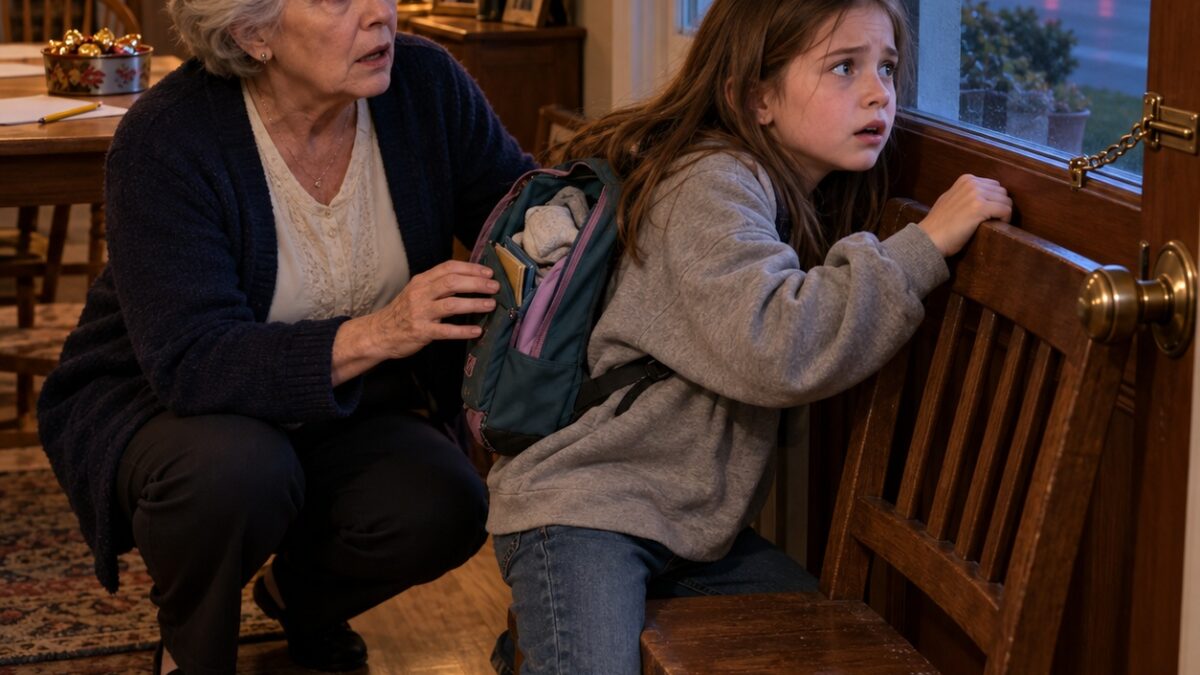
Nora was standing at the front door in my T-shirt.
On tiptoe.
Thumb running along the chain.
Checking.
Third time that evening.
I did not turn on the light.
I sat on the floor four feet away.
Said nothing.
Four minutes passed.
She sat too.
Closer.
Then whispered:
“We go away soon.”
My heart started pounding.
“Away where?”
No answer.
She breathed onto the hall mirror.
Used one finger.
AZ
“Arizona?”
She nodded.
“Vacation?”
Hard head shake.
She got the pencil.
Wrote on the back of her car drawing:
NO SCHOOL THERE EITHER
Either.
That word.
“Nora.”
I made myself speak slowly.
“Do you go to school here?”
She looked at me like I had asked whether gravity existed.
Then she wrote:
DON’T LET THEM COME BACK
I wanted to promise something enormous.
Instead:
“Nobody takes you anywhere tonight.”
That was a promise I could keep.
She slept facing the door.
At 7:05 Saturday morning, a car pulled into my driveway.
A day early.
Before I reached the window, I knew there would be three people inside.
Trent driving.
Brin passenger.
Carla in back.
Three stick figures.
Brin entered first.
Fast.
Smiling.
Straight to Nora.
She gathered her into a hug while holding her phone at arm’s length.
“We came back early for you, baby.”
To the camera.
Not Nora.
Trent stood in my entryway.
Looked at the light switch.
“Morning, Mom.”
“What’s in Arizona?”
His eyes snapped toward Brin so quickly it was almost a physical reflex.
Brin lowered the phone.
One-note laugh.
“Who told you about Arizona?”
Then she turned.
Not toward me.
Toward Nora.
“She’s very suggestible, Drew.”
“You have to be careful what you plant.”
They were gone in under four minutes.
Carla never entered the house.
At the door, Nora grabbed my hand.
Held hard.
One extra second.
Then let go.
Walked to the car.
I watched them turn onto Leadbetter.
Only when I closed the blinds did I see the backpack.
Still on my floor.
She had left it.
Deliberately.
I cleaned because that is what I do when I am powerless.
Folded blanket.
Washed cups.
Put pencil away.
Then I opened the old Danish cookie tin Walt had used for butterscotch discs since 1994.
A folded piece of paper was wedged beneath the lid.
Eight folds.
Pressed flat.
Nora’s block capitals.
DON’T TELL THEM I TALKED
Second line:
I CAN STOP AGAIN IF I HAVE TO
I sat down.
A child who physically cannot speak does not write again.
A child who has lost language does not describe silence as a thing she can choose to restart.
Nora had not lost her voice.
She had put it somewhere.
Six years earlier.
And she was warning me that if I mishandled this, she would put it back.
That was the moment I stopped asking myself whether I was overreacting.
Monday morning, I called a speech clinic in Rockford.
Alpine Road.
Dentist downstairs.
Insurance office.
I had been there once in 2020.
Waited in the parking lot because I was not allowed inside.
“I’m trying to reach whoever evaluated Nora Hensley in October 2020.”
Hold.
Four minutes.
Then a woman.
Denise Row.
Speech-language pathologist.
Fifties.
Flat Midwest voice.
People who deliver hard information for a living often sound like that.
“My name is Drusilla Hensley.”
“I’m Nora’s grandmother.”
Silence.
Then:
“Hensley.”
“Four sessions.”
“You remember her?”
“I remember all of them.”
Pause.
“I remember her differently.”
Privacy rules meant Denise could not simply hand me Nora’s medical record.
I knew that.
Thirty-one years in a hospital made me the last grandmother likely to demand a protected chart.
But she could discuss things she personally observed.
Before she did, she asked:
“Does Nora still hold a pencil?”
I answered immediately.
“She writes constantly.”
“Block capitals.”
“Better handwriting than mine.”
Long silence.
Then Denise said:
“Mrs. Hensley.”
“I have been waiting six years for somebody in that family to call me.”
I went the next morning.
Her office was nine feet by eleven.
Plastic farm animals beneath the window.
No drama.
No giant revelation file.
Just dates.
October 14, 2020.
Session one.
No speech.
Normal.
Session two.
Nods.
Session three.
Whispered two words into a doll’s ear.
Denise had placed the doll there specifically because some frightened children communicate more easily when pretending the words are for someone else.
Session four.
November 11.
Denise flattened her hands on the desk.
“She spoke one sentence clearly enough for me to hear across the table.”
“What?”
“Can I come back?”
I looked at the plastic animals.
Then:
“Did you report anything?”
“Yes.”
“When?”
“October twenty-first.”
“After session three.”
“Why?”
“Her mother saw her whisper.”
Denise said Brin told her therapy was making Nora worse.
I swallowed.
“I made a report too.”
Denise stared.
“When?”
“September tenth.”
“The morning after something happened.”
Her eyes narrowed.
“Mine came back unfounded.”
“So did mine.”
She wrote one date on a sticky note.
November 3, 2020.
Both reports closed that day.
Eight days later, Nora spoke aloud in therapy.
November 18 appointment?
Cancelled by Brin.
Denise called the house three times afterward.
Eventually Trent told her they had found “a different approach.”
I sat there understanding something neither of us had known in 2020.
Two adults saw different pieces.
Both reported.
Both cases closed.
Nora briefly felt safe enough to speak.
Then the adults around her changed the rules again.
Until that week, I had never watched their online channel.
I knew it existed.
Trent mentioned it one Thanksgiving like a hobby.
Baby pictures, I assumed.
Family updates.
I did not want to become the nosy mother-in-law who audits somebody’s internet presence.
At nine that night, I opened my laptop.
I shut it at four in the morning.
Channel:
Nora’s Quiet World.
First major video:
November 19, 2020.
Eight days after Nora spoke in Denise’s office.
Title:
Our Girl Went Quiet — We’re Learning Her Language
Every video began with the same sound.
Click.
Electrical hum.
Then light changed across Nora’s face.
The ring light.
I sampled more than four hundred videos.
Not every second.
That would have taken days.
But enough.
412 videos.
Not one pencil.
Not one crayon.
Marker.
Whiteboard.
Notebook.
Stylus.
Nothing.
A child who wrote paragraphs in my kitchen appeared online for six years without being allowed one visible writing tool.
Then I found a Fourth of July video.
Nora on picnic blanket.
Somebody handed her a sparkler.
Pencil beside her knee.
She picked it up.
Held it maybe two seconds.
Adult hand entered frame.
Removed it.
Cut.
I watched that moment over and over.
That was not an accident.
That was set management.
By sunrise, I had a legal pad.
Numbers.
412,000 followers.
Donation page:
Nora’s Voice Fund.
Lifetime contributions:
$186,300.
Specialized communication care.
Merchandise store.
Hoodies.
Totes.
Coffee mugs:
TEAM NORA
Contact email:
Carla Loftess.
Sponsor banner:
Meridian Voice Ranch — Sedona, Arizona
A “residential communication recovery program.”
Pinned post.
61,000 likes.
Brin looking into camera.
“Nora doesn’t need words.”
“She has me.”
I had managed a hospital pharmacy budget for eleven years.
You can rename money.
Donations.
Partnerships.
Support.
But revenue has a shape.
And Nora had one.
Then I read the About page.
Nora is homeschooled so she can heal at her own pace.
I put down my pen.
Nine visits.
I had been inside their house.
No schoolbooks.
No workbooks.
No lesson calendar.
No pencils.
No worksheets.
No educational materials that looked used rather than staged.
One real library book.
Fourteen months overdue.
Hidden in Nora’s backpack.
I felt cold.
Sunday, September 20, I drove the backpack to 14 Ren Hollow Road.
Partly to return it.
Mostly because I wanted to see whether anyone would let me inside a house I owned.
Two cars in driveway.
Kitchen light.
No answer.
I rang twice.
Nothing.
I set the backpack on the mat.
Its side pocket opened.
Something plastic caught porch light.
A laminated index card.
Three by five.
Professionally sealed.
Front:
MY FIRST WORDS — OCT 16
Underneath:
- Hi everybody.
- Thank you for waiting for me.
- Mommy never gave up on me.
Below those:
wide push-in / mom reaction / crowd ash
Shot list.
Camera directions.
I stood on my son’s porch holding a script for the first words of a child everyone claimed could not speak.
October 16 was not the date Nora would be ready.
October 16 was the date production had been scheduled.
Tickets.
Sponsor.
Stage.
Camera angles.
That explained the ring light in her overnight bag.
Nora had not packed it because she wanted to film at Grandma’s.
She had removed it so they could not rehearse without it.
I turned the card over.
Three words scratched in pencil so hard the graphite scored the laminate.
NOT THOSE WORDS
I had to lean against the railing.
Nora was not asking me to invent a sentence for her.
She had one.
She was trying to protect it.
Screen door opened.
Carla.
Cardigan.
Coffee mug.
“You don’t come here without calling.”
“I’m returning her backpack.”
“You’re confusing her.”
“She was fine.”
“Now she’s stimming again.”
“That’s you.”
“Carla.”
“Does Nora go to school?”
“She’s homeschooled.”
“By whom?”
Carla looked at my car.
“You’re not her mother, Drew.”
“You’re a guest who keeps forgetting to leave.”
She held out a hand.
I gave her the backpack.
Not the card.
It was already inside my coat.
Then I said:
“My name is on the deed.”
“I’ll knock when I feel like being polite.”
I drove home slowly.
Sat at my table.
Graph-paper notebook.
At top:
DON’T LET MOM AND DAD COME BACK TONIGHT
Then:
What can I prove?
Not what I feared.
Not what I felt.
What survives under oath?
Denise Row observed speech in November 2020.
Two separate hotline reports.
No visible school records yet.
Scripted “first words” event.
My deed.
Month-to-month occupancy agreement Trent signed in May 2020.
Public donations.
Public sponsorship.
Public monetization.
Then I wrote:
How this feels.
Crossed it out.
Feelings mattered to me.
Courtrooms needed dates.
Attorney Francis Odell had an office above a shoe repair shop in Rockford.
Everybody called her Frankie.
Fifty-eight.
Reading glasses on a chain.
She listened twenty minutes without interruption.
Good lawyers are expensive partly because silence is rare.
When I finished, she took off glasses.
“Three things.”
“Go ahead.”
“First.”
“Since July 2024, Illinois has a law covering minors under sixteen appearing in monetized content.”
She explained the source law as it applied to Nora.
Parents had obligations to track appearances and set aside a share of gross earnings in a protected trust.
“Where is the trust?”
“I don’t know.”
“Exactly.”
“Second.”
“Financial recovery does not stop Arizona.”
“Money is slow.”
“Custody is faster.”
“And third?”
She slid a statute number toward me.
“Grandparent guardianship.”
“Not visitation.”
“Guardianship.”
My stomach tightened.
“That is the road.”
“It ends with adults answering under oath.”
Then:
“Has any mandated reporter seen Nora in the last year?”
Teacher?
Nurse?
Dentist?
Coach?
Anyone?
I thought.
No.
Frankie leaned back.
“That’s not neglect by accident.”
“That’s design.”
Then she tapped the table.
“She has an audience.”
“You’re going to use a docket.”
Trent came to my house Wednesday night at eleven.
I turned on porch light.
Did not remove chain.
Four inches between door and frame.
My son on concrete step where he learned to ride a bike.
Me in robe.
Chain between us.
“Mom.”
“Take it off.”
“I don’t think I will.”
He gave one humorless laugh.
“This.”
“This is exactly what Brin means.”
“What?”
“You’re escalating.”
“Trent.”
“Does Nora go to school?”
No answer.
“Has she ever been enrolled?”
“She has needs.”
“You don’t understand her days.”
“Then explain them.”
He rubbed his face hard.
Same motion he used at seventeen when he had broken something and had not figured out whether lying would make it worse.
Then he said:
“If I stop, I don’t know who I am.”
I believed him.
That may have been the truest sentence my son had spoken to me in six years.
The channel.
Audience.
Sponsors.
Family identity.
Brin’s entire public life.
Trent’s role inside it.
If Nora was not the silent child everyone was helping, what were they?
I felt sorry for him.
Genuinely.
Then I asked:
“Trent.”
“Do you know she can talk?”
“She can’t talk.”
Too fast.
No pause.
Then he looked down the street.
Lowered voice.
“And don’t tell Brin you asked me that.”
My thirty-eight-year-old son asked his mother to keep a secret from his wife about whether his child could speak.
The next morning, according to the source timeline, he signed power of attorney giving their brand manager authority over Nora’s appearance contracts.
That was when pity stopped being useful.
Brin posted a six-minute-forty-second video:
Boundaries With a Grandparent — This Is Hard
No name.
Did not need one.
Older relative.
Showing up unannounced.
Disrespecting protocols.
Putting ideas into Nora’s head.
Causing regression.
At minute four, Brin cried beautifully.
At end:
“Nora doesn’t need words.”
“She has me.”
61,000 likes in nine hours.
Hundreds of strangers told Brin to protect Nora from me.
I watched twice.
Not because I enjoyed punishment.
Because something in background bothered me.
At 4:12, behind Brin’s shoulder, Nora sat out of focus on sofa arm.
Brin was describing the dangerous grandmother.
Nora looked directly into camera.
And shook her head.
Once.
Maybe an inch.
Tiny.
Most viewers saw nothing.
I saw a child disagreeing through the only channel available to her.
“All right.”
I said to the screen.
“If that’s the channel, I’ll take it.”
Denise made a second hotline report September 25.
This time she did not call with a worry.
She read clinical notes.
Dates.
Previous report number.
Asked them to attach the old file.
Frankie specifically told me not to call.
“You’re filing guardianship.”
“If you call now, opposing counsel says you’re weaponizing the state.”
“Let the mandated reporter report.”
So I did something I controlled.
Certified letter to Trent.
Termination of month-to-month occupancy at 14 Ren Hollow Road.
Thirty days.
But with one condition.
If Nora was enrolled in Hartley Grove School District before October 25, the rent-free arrangement continued indefinitely as long as she remained enrolled.
I was not taking a house away from my son.
I put school on the lease.
One form.
No rent.
Thirty days.
He never filed it.
Joanne Brackett helped me verify records.
Retired elementary principal.
Two doors down.
She knew who to call.
By four that afternoon:
No enrollment record in three local districts.
No withdrawal record.
No homeschool notification in regional file.
No school immunization record.
No routine school vision and hearing screening.
One trace.
August 2022.
Kindergarten screening appointment at Hartley Grove.
9:15 Tuesday.
Cancelled 8:35.
Forty minutes before.
Cancelled by:
Grandmother C. Loftess
Reason:
Family relocating.
They never relocated.
Same house.
My house.
Joanne also checked the overdue library book.
Beloit branch.
Checked out August 9, 2025.
Carla’s card.
Fourteen months overdue.
The picture formed painfully.
At some point someone had taken Nora to a library.
She found one real book.
Kept it more than a year.
Carried it in her escape backpack.
Six years of content.
No school.
I called Frankie.
“How fast can you file?”
September 28.
Winnebago County.
Twenty-two-page guardianship petition.
Frankie removed nearly every adjective I wrote.
I had written about Nora sleeping facing the door.
She crossed it out.
“Why?”
“Because judges read forty petitions.”
“Boring wins.”
“Yours is boring.”
“And true.”
“Don’t improve it.”
Evidence:
Denise affidavit.
Four therapy dates.
Joanne affidavit.
School records.
Copies of laminated script.
Front and back.
Sponsor screenshots.
Donation page.
Pinned post.
House deed.
Occupancy letter.
And one four-sentence question Frankie wrote.
Where is the minor’s block trust?
October 1, court appointed guardian ad litem.
Hollis Puit.
Forty-seven.
His job was not to represent me.
Not Trent.
Not Brin.
Nora.
“Will he make her speak?”
I asked.
Frankie looked over glasses.
“Nobody makes a child talk.”
Then:
“But it’s the only room in her life where the adults are legally required to be quiet.”
Interview:
October 8.
Eight days before gala.
Hollis chose Hartley Grove Public Library.
Meeting Room B.
Not courthouse.
Trent brought Nora under court order.
Then sat in truck.
Brin did not come.
She posted from her car instead.
Nora carried gray stuffed rabbit.
Pim.
Walt bought it in 2018 at a Beloit drugstore.
One arm had been cut and resewn with green thread.
Child-sized stitches.
In her sweatshirt pocket:
one butterscotch disc.
She had kept my candy sixteen days.
Hollis sat on carpet against bookshelf.
Paper.
Two pencils.
He talked badly about Chicago Bears for eleven minutes.
I sat in hall.
Door open four inches.
At around twenty minutes, pencil started moving.
At thirty-one, Velcro.
Quiet.
Later, Hollis told me.
Nora opened the green stitching beneath Pim’s arm.
Pulled out four folded squares of paper.
Each dated.
Earliest three years earlier.
She had been documenting since she was six.
Hiding evidence inside a stuffed rabbit.
Waiting for a room where nobody was counting what she said.
At thirty-eight minutes, through that four-inch doorway, I heard her voice.
Low.
Raspy.
Real.
Then Hollis put down pen.
He came into hall afterward.
Sat beside me.
Looked at his hands.
“I’m going to tell you what she told me.”
“Because you’ll hear it in court.”
“And I would rather you be sitting down.”
September 9, 2020.
Nora was three years and three months old.
Her parents went to an event.
Left her home alone.
6:10 p.m. to 10:30.
Four hours twenty minutes.
Walt had programmed my phone number into one key.
Bird sticker.
Something Nora could recognize.
She called me.
Told me she was alone.
TV had turned off.
Could not reach light.
That was why I called the hotline September 10.
I remembered everything.
Her tiny voice.
“I’m by myself.”
I remembered driving.
Police.
Trent furious afterward.
Brin crying.
Case eventually closed.
What I did not know was what happened the following morning.
Brin knelt so her face was level with Nora’s.
And said:
Say it again and they’ll take Grandma away forever.
A three-year-old did not understand investigations.
Child protection.
Evidence.
Jurisdiction.
She understood one equation.
Talk = Grandma disappears.
She could not know which words were dangerous.
So she stopped all of them.
Every word.
For six years.
To protect me.
I bent forward until my forehead touched my hands.
Hollis waited.
Then said there was more.
Nora had overheard Arizona plan in July.
She practiced locking my front door in her head.
Counted motions.
Four seconds.
She asked Hollis:
“Is Grandma still allowed to have me?”
That question nearly destroyed me.
Original hearing date:
October 13.
Gala:
October 16.
Flight to Phoenix:
October 18.
Five days margin.
Then their attorney requested delay.
Retained forty-one hours earlier.
Asked for twenty-one days.
Judge Alma Reic gave fourteen.
New hearing:
October 27.
Nine days after Phoenix flight.
When Frankie told me, I sat on sofa.
Said nothing twenty seconds.
That afternoon Brin posted praying hands.
Carla texted me:
told you stay home
Four words.
At 4:40, Frankie called back.
Different voice.
“One door left.”
Emergency temporary guardianship.
Attach Hollis affidavit.
District records.
Script card.
Judge can sign on papers.
Or decline.
“When?”
“File eight tomorrow.”
“And if she doesn’t sign?”
“Friday night you’re a spectator with a ticket.”
I set two alarms.
I was sixty-eight.
One alarm is optimism.
Wednesday morning.
8:00.
Emergency motion filed.
Nineteen pages.
Three exhibits.
Proposed order ready.
Wednesday evening.
Nothing.
Thursday noon.
Nothing.
Friday noon.
Nothing.
Meanwhile Fairlon Community Center filled with chairs.
160 seats.
$75 each.
Banner:
MERIDIAN VOICE RANCH — PROUD PARTNER
Merchandise.
Hoodies.
Totes.
Coffee mugs.
Carla behind table with cash box.
Little stage.
Projector screen.
Microphone stand.
Lowered.
About four feet.
Nine-year-old height.
That detail stayed with me.
Somebody measured my granddaughter to stage-manage the moment she would supposedly recover her voice.
I arrived 6:40.
Navy blazer.
The one I wore to budget meetings.
Real pockets.
I sat row nine.
Aisle.
Nobody recognized me immediately.
Older women become invisible in community centers if we behave ourselves.
Useful skill.
In my purse was a craft envelope.
Unsealed.
Folded once.
At 6:52, phone buzzed.
Frankie.
Two words.
She signed.
I read them twice.
Put phone face down.
Folded hands over it.
At 7:04, lights dimmed.
Ring light clicked.
Hum.
The sound I had heard in hundreds of videos.
Brin walked on stage.
Cream dress.
Six-minute speech.
412,000 followers.
Journey.
Criticism.
Hard year.
Meridian Voice Ranch.
A family member who “made this season painful.”
Denise sat row three.
When Brin thanked Meridian for believing in Nora “when the medical system wrote her off,” Denise covered her mouth.
Then Brin said the line.
“People ask me how I do it.”
Pause.
“I always say the same thing.”
Another pause.
“Nora doesn’t need words.”
“She has me.”
Applause.
Nine or ten seconds.
Then:
“But tonight, my daughter would like to try.”
Carla brought Nora out.
By wrist.
In Nora’s right hand:
a second laminated script.
Replacement.
She stopped two steps before microphone.
Looked into row nine.
Found me.
Looked at card.
Three seconds.
The audience thought she was reading.
She wasn’t.
She was deciding.
Nora crouched.
Set card face down on stage.
Walked to microphone.
Already at her height.
Ring light humming twelve feet away.
Then my granddaughter spoke.
A voice low.
Scraped.
Unused.
“They left me alone.”
“I told Grandma.”
“Then Mom said they’d take Grandma away.”
She stopped.
Breath.
“So I stopped talking.”
“I’m done now.”
Twenty-two words.
No applause.
Nobody moved.
That was not a performance sound.
It was truth entering a room that had paid admission for a different story.
A chair scraped.
Someone half stood.
Sat again.
Music cut.
Denise cried silently.
Meridian partnerships representative set down drink.
Nora turned.
Looked for me.
Brin reached microphone in four strides.
Pulled it off stand.
“Okay.”
“Okay.”
Voice higher.
“You all don’t know her.”
“You don’t know her days.”
Someone said:
“Let her finish.”
Brin pointed at nothing.
“She’s been coached.”
“This was staged.”
“My mother-in-law has been working on that child for three weeks.”
“I have documentation.”
“I will sue every person in this room who repeats this.”
Live stream still running.
3,100 viewers.
Climbing.
Ring light still on.
I stood in row nine.
Walked aisle.
Frankie had been sitting unnoticed in row two since 6:15.
I handed her envelope.
She walked to stage.
Laid out three documents.
Temporary guardianship order signed at 3:41 that afternoon.
Hollis Puit affidavit.
Notice under Illinois child-influencer law demanding gross revenue records and proof of protected trust within fourteen days.
I said fourteen words that night.
I counted later.
“She’s coming home with me tonight.”
“The rest is in the envelope.”
Brin stared.
“You’re a bitter old woman who couldn’t stand not being needed.”
“Maybe.”
I said.
“The order’s still signed.”
Meridian representative walked to banner.
Removed it himself.
Eight feet navy and gold.
Corner dragging across chairs.
Nobody helped.
One woman asked for $75 back.
Ten minutes later, seventy-four people were lined at merchandise table.
Not to buy.
Carla shut cash box.
Walked out kitchen door.
No word to Brin.
Frankie read one sentence from Hollis affidavit.
Flat lawyer voice.
No emphasis.
Say it again and they’ll take Grandma away forever.
Nothing shouted that evening sounded louder.
Trent sat on stage edge.
Head in hands.
Thirty seconds.
Then went to parking lot with his wife.
I took Nora’s hand.
Side door.
Forty seconds from her last word to night air.
They waited beside my car.
Of course.
Brin filming.
“You are not taking her.”
“You are not taking my daughter.”
I held out order.
“My attorney’s number is page two.”
“Don’t call me.”
“Call her.”
Trent said:
“Mom.”
One word.
Same way he said it at four years old.
I looked at my son across roof of a nine-year-old Buick.
“You had six years to ask her one question.”
“I’m going to spend the next six answering hers.”
I buckled Nora into back seat.
She let me lean across.
Click.
We sat with engine off.
Somebody laughed near community-center doors.
Ordinary parking-lot laugh.
Sounded like another year.
Then Nora looked at me.
First question she had asked anyone aloud in six years.
“Is the tin at your house still full?”
“Yes.”
It was a lie.
Four candies.
I stopped at gas station on Route 173.
Bought two bags.
Made it true.
Afterward, I kept myself to facts.
October 27.
Judge Reic extended temporary guardianship for twelve months.
Named me guardian of Nora’s person.
Revenue production order followed.
November 20.
Records came in.
Gross receipts from November 2020 through October 2026:
Advertising.
Sponsorships.
Brand deals.
Merchandise.
$728,500.
Block trust balance:
$0.
Recorded hours of Nora’s appearances:
none.
No logs.
December 4.
Court ordered protected trust established.
Funded:
$291,400.
Sealed until Nora turns eighteen.
Donation fund:
$186,300.
Placed under court supervision.
Channel demonetized October 21 after platform review.
412,000 followers became numerically impressive and financially useless.
Brand manager removed her name from posts within forty-eight hours.
Carla was never criminally charged.
She still tells people at church I bought a judge.
Some stories are too useful to surrender.
Trent and Brin were out of 14 Ren Hollow Road by November 1.
I rented it to a night-shift nurse and her two boys.
$1,150 a month.
Below market.
I did not care.
When I checked house, ring light sat in cardboard box by curb.
Clamp still attached.
I did not photograph it.
Did not need one more image.
I went home.
Filled cookie tin.
Put second chair beside kitchen counter.
Nora began fourth grade at Hartley Grove Elementary October 26.
Two months late.
Reading three grades ahead.
She saw Denise twice weekly.
Denise gave school one instruction.
“When she talks, don’t make it a moment.”
For six weeks Nora did not speak at school.
She wrote.
Teacher Mrs. Bellweather put a little wire basket on desk for Nora’s notes.
By Halloween, half the class was putting notes into it.
Because nine-year-olds, when adults get out of the way, can be extraordinarily decent.
December 11.
Roll call.
Teacher:
“Nora Hensley?”
Nora:
“Here.”
Mrs. Bellweather:
“Thank you, Nora.”
Next name.
No applause.
No video.
No crying.
No ring light.
Nora told me about it in the car like she was reporting weather.
That was exactly how it should have been.
Her father received two supervised hours a month.
He came to three of first five visits.
Allowed to see his daughter.
Not allowed to film her.
Those are different rights.
Only one was ever his.
Brin filed objection in January.
Withdrew February.
Carla had no contact.
I returned overdue library book.
Included check for $11.20.
The librarian sent receipt.
I kept it for a while.
Then threw it away.
Not everything needs to become evidence forever.
One Saturday morning in February, I came into kitchen.
Something looked wrong.
Then I realized.
Front-door chain.
Hanging loose.
Middle of day.
Nobody had checked it.
No dining chair beneath knob.
No four-second drill.
Nora stood at counter.
On tiptoe.
Opened dented Danish tin.
The lid made a click I had not heard a child make in decades.
She took one butterscotch.
Then another.
One into cheek.
One into pocket.
Same as first night.
But her hand did not press over pocket like seat belt.
She did not stare at door.
She simply walked to table.
Opened homework.
Pencil.
Ordinary yellow pencil.
Nobody took it.
That was when I finally cried.
Not at gala.
Not court.
Not when Hollis told me why she stopped speaking.
That morning.
Because healing had become boring.
And boring was exactly what she deserved.
Nora still does not talk much.
That is fine.
Speech is not proof of recovery.
Silence is not automatically damage.
She says what she wants.
Writes what she wants.
Sometimes communicates by pointing because she feels like it.
No one performs delight.
No camera turns.
No audience counts syllables.
If she does not want to speak, I say no for her.
Out loud.
To anybody.
That is all I actually gave her.
Permission to have one adult whose job was not extracting anything.
She did everything else.
I think often about those six years.
People ask:
“How could Trent not know?”
I do not have a simple answer.
He knew pieces.
He ignored others.
He participated in some.
He also lived inside a machine that rewarded not looking too closely.
Followers.
Income.
Public sympathy.
Identity.
Brin became the mother who spoke for the silent child.
Trent became father protecting extraordinary family.
Carla managed merchandise.
Brand manager managed appearances.
Sponsors arrived.
Every adult gained something from the version where Nora stayed silent.
Maybe that is why nobody asked whether she wanted to.
Systems become dangerous when truth threatens everybody’s role at once.
Then denial starts feeling like survival.
It is still denial.
Still harmful.
But understanding mechanics helps me remain accurate.
I do not need monsters.
I need adults responsible for choices.
Brin once said I could not stand not being needed.
That sentence stayed.
Because part of it touched something true.
After Walt died, I wanted family.
I offered housing.
Help.
Advice.
I watched my son pull away and perhaps clung harder.
But being imperfect does not make evidence false.
That was something Frankie taught me.
You do not need to be a flawless grandmother before you are allowed to protect a child.
You can be lonely.
Controlling sometimes.
Too involved.
Wrong in some moments.
And still correctly say:
This child needs school.
This child deserves independent communication.
This child’s earnings need legal protection.
This child should not be scripted into silence.
Victims do not require perfect rescuers.
They require adults willing to keep going when paperwork becomes boring.
The house at 14 Ren Hollow Road bothered me for a long time.
I bought it intending safety.
It became a controlled set.
That felt like personal failure.
Then the nurse moved in.
Night shift.
Two boys.
Bicycles in driveway.
Backpacks.
School bus at corner.
One afternoon I drove past.
Did not stop.
Saw one boy kicking a soccer ball against brick.
The other sitting on porch reading.
Normal.
The house had become a house again.
That helped.
Buildings do not keep moral residue forever.
People change what rooms are for.
The butterscotch tin still has dent in one corner.
Walt bought it in 1994 after his mother died.
He said:
“A house should have one thing in it a kid can always get without asking.”
I understood that differently after Nora.
It was never really about candy.
It was about one thing a child controls.
One yes that does not require performance.
One access point no adult uses as leverage.
So the tin stays full now.
Always.
Sometimes Nora checks without taking one.
That is fine too.
Pim the rabbit sits on her bed.
Green stitches remain beneath arm.
We did not repair them.
Not because trauma should be worshiped.
Because Nora said:
“Leave it.”
So we left it.
Her choice.
That became rule in our house.
Not:
What will look best?
Not:
What will viewers understand?
Not:
What does Grandma think?
What does Nora want?
Sometimes she does not know.
Then we wait.
Waiting is allowed.
Denise once told me:
“People think communication means getting a child to produce something.”
“Words.”
“Signs.”
“Writing.”
“But communication also means respecting refusal.”
That line changed me.
Because for months I had been desperate to hear Nora speak.
Understandable.
Still, if my goal became hearing her voice, I risked becoming another adult who needed something from her.
So I stopped treating speech as finish line.
The first time she went three days without talking to me after moving in, I panicked internally.
Outwardly:
“Want toast?”
She nodded.
Toast.
No interrogation.
On fourth day:
“Grandma, where’s my blue sweater?”
I answered:
“Laundry.”
No tears.
No hug.
No celebration.
Just sweater.
Denise would have been proud.
Trent’s supervised visits were difficult.
For him.
For Nora.
For me.
But I was not in room.
That mattered.
Hollis and court professionals handled boundaries.
I did not use visitation to punish.
Nor to force reconciliation.
Nora’s relationship with her father belonged primarily to Nora.
One afternoon after visit she came home.
Sat at table.
Opened tin.
Then said:
“Dad cried.”
I waited.
“He said he’s sorry.”
I nodded.
“What do you think?”
She shrugged.
That was answer.
I did not say:
You should forgive him.
Or:
Never trust him.
Children deserve room to form their own judgments when safe adults and courts provide protection.
So:
“Want noodles?”
“Yes.”
Butter.
Too much pepper.
Our family specialty.
I do not know what Trent will become.
Source ends with supervised visits and inconsistent attendance.
I will not invent a redemption arc that is not there.
Maybe he changes.
Maybe not.
What matters now is that Nora’s safety does not depend on guessing.
There are orders.
Supervision.
School records.
Therapy.
A guardian.
A trust.
Paperwork.
People sometimes mock bureaucracy.
I understand.
But after six years in which everything depended on whatever story adults told most convincingly, I became grateful for boring forms.
Forms create places where a child can exist without being edited.
Brin remains more complicated in my mind.
I have replayed her videos enough for one lifetime.
I do not watch anymore.
No need.
The channel is demonetized.
Records exist.
The court has what it needs.
I refuse to make monitoring her my retirement.
That would let the old system keep controlling my attention.
I am sixty-eight.
I have books.
A granddaughter.
A garden Walt planted badly.
Life left.
I intend to use it.
Carla’s church story reached me eventually.
Apparently I bought Judge Reic.
I laughed.
Not because false accusations are funny.
Because if I could afford to buy judges, I would not have spent thirty-one years arguing with pharmacy vendors over twelve-cent unit-dose increases.
People create explanations that preserve identity.
Carla’s requires corruption.
Fine.
Mine requires documentation.
I prefer mine.
The Child Influencer money never felt like victory.
$291,400 in trust sounds large.
It is.
But every dollar represents a childhood turned into content without proper protection.
I hope when Nora turns eighteen, money feels boring.
Tuition.
Apartment.
Savings.
Therapy.
Whatever she chooses.
I hope she never has to think:
This is what my silence earned.
No child should carry that.
The $186,300 donation fund under supervision bothers me differently.
People gave because they thought they were helping a silent child access care.
Some donations came from people who probably could not afford them.
That trust was part of what made public deception especially dangerous.
I could not fix every donor.
Courts and administrators handled what could be handled.
Again:
Not my job to repair entire internet.
Protect Nora.
That was enough.
One afternoon, she found old video clip on a device.
Ring-light click.
Her own face.
She froze.
I moved toward tablet.
Stopped.
“Want me to turn it off?”
She nodded.
I did.
Nothing else.
Later, she asked:
“Do people still watch me?”
“No.”
“Can they?”
“Some old things may still exist.”
She thought.
“Can we make them all gone?”
I wished I could promise.
“I don’t know.”
“But Frankie can tell us what can be removed.”
Nora nodded.
Real answers are sometimes less comforting than false promises.
Still better.
We met with school about internet safety.
No public photographs without guardian approval.
No school social media.
No “inspiring story” feature.
Principal understood.
At first, one teacher said:
“But her journey could help other children.”
I felt something flare.
Then Nora wrote on paper:
NO
Teacher read it.
“Okay.”
That was it.
No explanation required.
I nearly hugged the woman.
Did not.
Professional restraint.
Nora likes science.
That surprised me.
Maybe because silence had made people assume she was artistic.
Quiet children are constantly assigned poetry by adults.
She likes weather systems.
Volcanoes.
Astronomy.
She hates glitter.
Useful facts.
None of them were in 412 videos.
Imagine documenting a child for six years and still not knowing she hates glitter.
That tells you everything.
Content can reveal a face while hiding a person.
She eventually asked why I had only seen her nine times.
There is no painless answer.
I did not blame her parents entirely.
I told truth appropriate to age.
“Your parents and I had disagreements.”
“They limited visits.”
“I was afraid if I pushed too hard, they would stop visits completely.”
She looked at me.
“You should’ve pushed.”
“Yes.”
I said.
“I should have.”
No defense.
That is one of my deepest regrets.
Fear of losing access made me accept almost no access.
Nine visits.
Six years.
I wrote dates instead of challenging pattern.
People sometimes call that patience.
Sometimes patience is fear wearing better clothes.
I know that now.
If I had pushed sooner, would things have changed?
Maybe.
Maybe not.
Two hotline reports already closed.
Denise tried.
I tried.
Systems missed.
But I might have called school districts.
Asked more.
Looked at channel.
Visited more.
I did not.
That is mine.
Accountability does not stop at villains.
Love means examining where your own fear helped silence continue.
I can regret without pretending I caused what Brin and Trent did.
Both truths fit.
Walt would have noticed something sooner.
I tell myself that.
Maybe unfair.
Dead husbands become very competent in memory.
In life, Walt misplaced his glasses while they were on his head.
Still, he understood children.
The bird sticker on the phone key saved a three-year-old one night.
The butterscotch tin became an anchor six years later.
Pim rabbit became hiding place.
Small acts survive people.
That comforts me.
Nora sometimes asks about him.
“Would Grandpa Walt have believed me?”
“Yes.”
I answer immediately.
Do I know?
I know enough.
Then I tell her stories.
Snowblower.
Terrible pancakes.
The time he put red sock in white laundry and spent week pretending pink undershirts were intentional.
She likes those better than saint stories.
Good.
Dead people deserve humanity too.
The first anniversary of gala came.
October 16.
I worried.
Nora said nothing about date.
I did not either.
At dinner she asked for more noodles.
We watched nature documentary.
Before bed, she checked no locks.
I realized I had spent all day bracing for a traumatic anniversary she did not choose to mark.
That taught me another lesson.
Do not turn someone else’s trauma into your calendar unless they do.
The internet had spent six years announcing milestones for Nora.
I would not.
At 7:04 p.m., I remembered ring light.
That was mine.
I made tea.
Let memory pass.
People sometimes ask what her “first real words” were.
I hate question.
Was it:
“Grandma, don’t let Mom and Dad come back tonight”?
Probably first words I heard in six years.
But Denise heard:
“Can I come back?”
Then Nora had hidden whispers.
Notes.
Maybe she spoke alone.
Speech is not performance.
We do not need to crown one sentence.
The important thing is she controls words now.
That is enough.
The line everyone remembers from stage is twenty-two words.
But my favorite thing she ever said came months later.
We were driving home from school.
Rain.
She looked out window.
“Grandma?”
“Yes?”
“I don’t want people to clap when I talk.”
“They won’t.”
“What if they do?”
“I’ll tell them to stop.”
She nodded.
Then:
“Okay.”
That is the job.
Not making her brave.
Not making her inspirational.
Making sure she knows somebody will say no when she cannot or does not want to.
Sometimes that means loudly.
Hospital pharmacy made me cautious about volume.
I learned calm.
But calm is not silence.
There is a difference.
For six years, I confused noninterference with respect.
Now I understand that children sometimes need an adult willing to become inconvenient.
To ask school district.
Call clinician.
Hire lawyer.
Send certified mail.
Sit through boring filings.
Wait fourteen days.
Show up in row nine.
Not to steal child’s voice.
To create conditions where it belongs to her.
Frankie once said:
“Most family cases are lost in the weeks nobody finds dramatic.”
I believe her.
Everyone remembers stage.
Few remember Joanne calling three districts.
Certified occupancy letter.
Denise reading 2020 notes into hotline.
Hollis sitting on library carpet talking badly about Bears.
Those boring actions made the stage moment survivable.
Without paperwork, Nora’s truth might have been livestreamed, denied, then taken to Arizona two days later.
Truth alone is powerful.
Protection needs structure.
I learned that late.
Arizona trip never happened.
That matters.
Meridian Voice Ranch sponsorship disappeared.
The plane left without Nora.
No dramatic airport confrontation.
No rescue at gate.
Paper stopped it before that.
Good.
I do not need children traumatized in terminals for a satisfying ending.
The laminated original script remains with legal file.
I have copy.
I rarely look.
MY FIRST WORDS — OCT 16
Three scripted lines.
Mom reaction.
Crowd.
Shot list.
On back:
NOT THOSE WORDS
That is the real heart of everything.
Not those words.
Nora had a sentence of her own.
The adults around her had already decided what she would say.
Which words.
Which angle.
Which reaction.
Which sponsor.
She chose something else.
That choice is what I protect now.
Her teacher once assigned personal narrative.
Nora wrote about library book.
Not gala.
Not silence.
A girl finds a book about wolves and forgets to return it for fourteen months because she likes wolves.
Mrs. Bellweather gave A-minus because ending was abrupt.
Nora was furious.
I loved it.
She got to be an ordinary student annoyed by a grade.
What luxury.
At dinner:
“She said I need transitions.”
“Do you?”
“No.”
I read essay.
“She may have a point.”
Nora glared.
I laughed.
Guardianship does not require agreeing with every nine-year-old opinion.
Normal conflict is another kind of healing.
The door chain stays on.
We did not remove it.
One day Nora asked why.
“Security.”
“Do you use it?”
“At night.”
She nodded.
No fear.
Just door hardware.
A thing can stop being symbol and return to being object.
I like that.
The chair she wedged beneath knob is still dining chair.
We eat on it.
Nobody talks about it.
Again:
Object.
Not shrine.
I think that is why I never saved ring light.
Could have.
Evidence already documented.
I left it curb.
Some things deserve no museum.
My son sometimes sends letters through counsel.
Later, short notes directly when permitted.
I read only what arrangements allow.
I do not intercept Nora’s relationship.
The temptation exists.
I am angry.
Still.
But guardianship is not ownership.
Important.
I criticized Brin for treating Nora as content and extension of self.
I cannot become another version of that by turning Nora into proof I was right.
She belongs to herself.
Even at nine.
Especially after six years.
I also stopped telling story publicly in town.
People know pieces.
I do not correct every rumor.
Court orders speak enough.
Nora deserves privacy more than I deserve vindication.
That is a clean trade.
The irony is that 412,000 strangers knew Nora’s face.
But almost nobody knew her.
Now far fewer people see her.
And far more people do.
Mrs. Bellweather knows she hates glitter.
Denise knows when to wait.
Hollis knows she keeps old candies.
Joanne knows she reads above grade.
I know she likes too much pepper on noodles.
That is being seen.
Not views.
One evening, Nora asked:
“How many people watched?”
I knew exactly what she meant.
“Too many.”
“Numbers?”
I hesitated.
Then told her.
She listened.
No visible reaction.
Then:
“That’s stupid.”
“Yes.”
“Why would they watch?”
“Some cared.”
“Some were curious.”
“Some believed they were helping.”
“Some just kept scrolling.”
She thought.
“Did they know?”
“No.”
“Then why are you mad at them?”
Good question.
“I’m not mad at all of them.”
“Mostly at adults who knew more.”
She nodded.
That distinction mattered.
Crowds are easy villains.
Responsibility is usually closer.
I still have parking pass from Wickham Regional in a drawer.
Sometimes I take it out.
Thirty-one years.
I thought that career taught me everything about systems.
Dosages.
Records.
Compliance.
Escalation.
Turns out grandmotherhood gave final exam.
The most important medication principle applies to families too:
Right person.
Right information.
Right time.
Right route.
You cannot fix wrong dose with stronger emotion.
You check order.
Nora taught me something beyond that.
When somebody’s communication changes suddenly, do not assume absence of words means absence of thought.
Silence can be strategy.
Protection.
Fear.
Choice.
Exhaustion.
The adult’s job is not always to extract language.
Sometimes it is to reduce cost of speaking.
Brin raised cost until one sentence threatened Grandma.
Denise reduced it in therapy.
Hollis reduced it by requiring adults to be quiet.
School reduced it by not making roll call a celebration.
I try to reduce it at home by letting words be ordinary.
That is the pattern.
One year after temporary guardianship, court reviewed everything.
I will not invent a permanent resolution beyond source facts that are not there.
At the source endpoint, I had twelve-month guardianship.
That is where I keep story.
Open enough for courts to do what courts do.
Definitive enough for Nora’s immediate safety.
She lived with me.
Attended school.
Received therapy.
Her earnings were protected.
Her father had supervised contact.
Her mother’s objection was withdrawn.
That is enough ending.
Not every family story needs lifetime prediction.
The real ending happened in February.
Door chain loose.
Cookie tin click.
Pencil on table.
No camera.
Nobody counting.
Nora did homework.
I made coffee.
Sun hit kitchen floor.
She opened tin without asking.
Took candy.
Then said:
“Grandma.”
“Yes?”
“Do we have more yellow pencils?”
“Drawer.”
She opened it.
Full box.
I had bought thirty-six.
She stared.
“That’s a lot.”
“I buy in bulk.”
She smiled.
Actually smiled.
Then took one.
Went back to homework.
That is where I would freeze the frame if I were the kind of person who froze frames.
Not stage.
Not judge.
Not Brin’s face.
A child choosing a pencil.
No one taking it away.
My name is Drusilla Hensley.
I am sixty-eight.
I saw my granddaughter nine times in six years because I was afraid pushing harder would make my son close the door completely.
Then one Friday night, that child opened her mouth and used the first words I had heard from her since toddlerhood to ask me to keep that door shut.
She had practiced locking it.
Four seconds.
She brought a ring light so rehearsal could not happen.
Left backpack.
Hid a note beneath a cookie-tin lid.
Carried a script she had rewritten on the back.
Stored three years of evidence inside a stuffed rabbit.
She did not need me to give her a voice.
She had one.
She needed one adult to believe that silence and voicelessness were not the same thing.
I almost missed it.
Then I did not.
For six years, adults made money from the story that Nora had nothing to say.
It took her eleven seconds on a stage to destroy that story.
But I do not call those eleven seconds the rescue.
The rescue was what came after.
School.
Notes.
Therapy.
Boring roll call.
A trust.
Supervised visits.
Unfilmed afternoons.
A loose door chain.
A full candy tin.
Pencils.
Choices.
Privacy.
That is the life she deserved before anybody knew her name online.
It is the life she has now.
A child does not always go quiet because she has nothing to say.
Sometimes she goes quiet because someone teaches her what speaking will cost.
And if that happens, the answer is not demanding courage from the child.
It is changing the price.
Removing the threat.
Silencing the audience.
Doing the paperwork.
Showing up when nobody is filming.
Then waiting.
Nora had waited six years.
The least I could do was learn how.

