PART2:I Went to the Shelter “Just to Look”—Then Bruno Wrapped His Paws Around My Waist and Refused to Let Me Leave
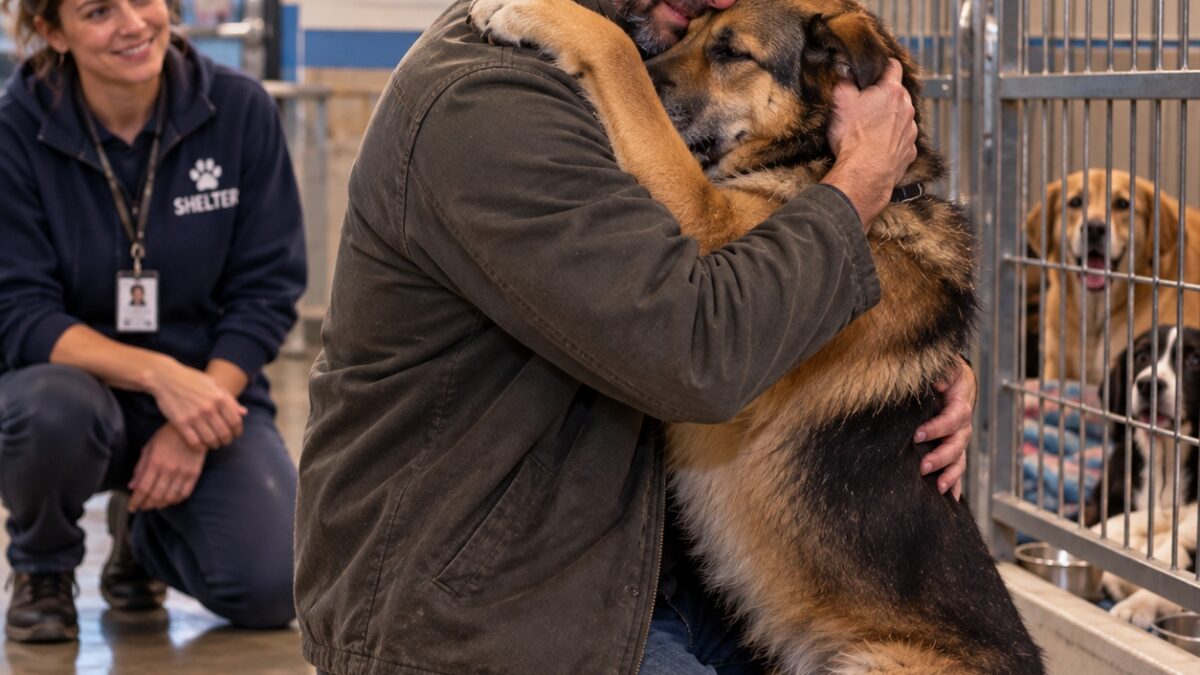
PART2
Emma smiled.
Not the broad, cheerful smile people use when selling something.
A softer one.
The kind I later learned shelter workers wear when they realize an animal may finally be leaving for the right reason.
“That’s a beautiful decision.”
she said.
“But let’s go inside first.”
“There’s paperwork.”
“And I need to tell you about him.”
I nodded.
Bruno did not move.
I tried standing.
He stood with me.
I took one step.
Bruno pressed against my leg.
Another.
His paw landed on the top of my shoe.
At first, I thought it was accidental.
Then he did it again.
Every few steps.
Touch.
Walk.
Touch.
Walk.
As if he needed to verify that I had not disappeared between one footfall and the next.
I looked at Emma.
“Is he always like this?”
“Not exactly.”
“What does that mean?”
“He usually refuses to walk toward the reception area.”
“Why?”
“He associates the front door with people leaving.”
That sentence stopped me.
Bruno looked up.
His shoulder remained pressed against my knee.
Emma continued.
“When he first arrived, he wouldn’t eat.”
“For how long?”
“Not normally.”
“Just enough to worry us.”
“He would lie beside the kennel door.”
“Whenever someone came into the building, he’d stand.”
“Then when they walked past…”
She did not finish.
Did not need to.
“He’d lie down again.”
I looked at Bruno.
A dog waiting for someone who had already decided not to return.
I had no idea what his old family had been like.
I did not ask Emma to turn them into villains.
People abandon animals for complicated reasons.
Sometimes cruel.
Sometimes desperate.
Sometimes selfish.
Sometimes all three.
The only thing that mattered to Bruno was simpler.
Someone he trusted disappeared.
And for weeks, he had believed the next footsteps might bring them back.
Emma said:
“Today was the first time he stood up without anyone calling him.”
“What do you mean?”
“When you stopped in front of his kennel.”
“He looked at you.”
“Then stood.”
I did not know what to say.
So I looked at Bruno.
He was sitting beside my chair now.
One shoulder touching my knee.
Those amber eyes studying me.
“I think he knew.”
I said quietly.
Emma tilted her head.
“Knew what?”
“That I wasn’t going to be able to walk out without him.”
The adoption paperwork took longer than I expected.
Name.
Address.
Phone.
Employer.
Housing.
Lease information.
Daily schedule.
Veterinary plans.
Emergency contact.
Questions designed to discover whether I had considered the difference between wanting a dog for fifteen emotional minutes and caring for one for years.
I appreciated that.
Bruno lay across my feet while I filled everything out.
Not near them.
On them.
His head rested across both shoes.
Every time I paused to think about an answer, he raised his head.
I would reach down.
Touch his ears.
He would lower his head again.
One section asked:
How many hours per day will the animal be alone?
I stopped.
Eight-hour workday.
Sometimes more.
That was the truth.
I looked at Emma.
“This might be a problem.”
“It might.”
She did not soften it.
“Bruno has separation anxiety.”
“How bad?”
“He doesn’t destroy things.”
“At least he hasn’t here.”
“He doesn’t become aggressive.”
“But absence is hard for him.”
“He waits.”
That word again.
Waits.
I looked down.
Bruno had closed his eyes.
His weight across my feet felt oddly grounding.
“I can change things.”
I said.
Emma watched me.
“What things?”
“Morning routine.”
“Walks.”
“I can come home at lunch some days.”
“Maybe ask about remote work occasionally.”
“I’m not promising I’ll never leave him.”
“That wouldn’t be realistic.”
“Good.”
she said.
“He needs safety, not a world where doors never close.”
That sentence stayed with me.
I wrote honestly.
Apartment.
Not huge.
Bright.
No yard.
But parks nearby.
Standard job.
Eight hours.
Sometimes more.
Willing to change routine.
Willing to work with him.
Willing to be patient.
The last form came.
Emma placed it in front of me.
I held the pen above the signature line.
Then stopped.
She waited.
“Something wrong?”
“No.”
I looked at Bruno.
He was sitting now.
Watching.
“I just want to remember this moment.”
Emma said nothing.
I signed.
David.
Then Bruno’s name beside mine.
My signature looked ordinary.
Black ink.
Nothing ceremonial.
But when I lifted the pen, the room felt different.
Maybe imagination.
Maybe not.
Bruno stood.
Looked at Emma.
Then at me.
Then back at Emma.
Like he was checking whether some invisible rule had changed.
Emma gathered the forms.
“That’s it.”
I swallowed.
“That’s it?”
“That’s it.”
I looked down.
Bruno looked up.
“Well.”
I said.
“Apparently you live with me now.”
His tail moved.
Once.
Then again.
Emma gave me a small starter package.
Leash.
Food samples.
Basic information.
Medical history.
Notes about the first weeks after Bruno arrived.
As she explained them, I felt my excitement mix with fear.
“He may not understand the apartment immediately.”
“I know.”
“He may follow you constantly.”
“Okay.”
“He may sleep by the door.”
“Okay.”
“He may become distressed when you leave.”
“We’ll work on it.”
“He might take time to believe this is permanent.”
That one hurt.
I looked at Bruno.
“Then I’ll give him time.”
Emma nodded.
“That’s all anyone can do.”
We walked outside in the early afternoon.
Golden light.
Bruno beside me.
Leash loose.
Head higher than it had been in the kennel.
He only stopped once.
At my car.
He looked back toward the shelter.
Not panicked.
Not pulling.
Just looking.
I wondered what the building meant to him.
Safety?
Loss?
Waiting?
All of it?
I opened the passenger door.
Bruno sat.
Did not climb in.
I crouched.
“I know.”
He looked at me.
“It’s strange leaving somewhere that kept you safe.”
“Even if you were unhappy there.”
He did not understand the words.
Probably.
But he understood tone.
I waited.
No pulling.
No lifting.
Eventually Bruno placed one paw inside.
Then another.
Climbed onto the seat.
I closed the door gently.
Walked around.
Sat behind the wheel.
For several seconds, neither of us moved.
Then I turned the key.
The engine started.
Bruno lowered himself.
Head across my thigh.
I laughed.
“You’re making driving difficult.”
He sighed.
I lowered the window a few inches.
Bruno raised his nose.
Air moved over his face.
His eyes half closed.
There was no wild joy.
No jumping.
It was quieter.
A dog finally allowing himself to breathe.
I drove slowly.
Partly because I did not know how he would handle the car.
Partly because I wanted the drive to last.
That sounds ridiculous now.
I was nervous about reaching the apartment.
What if I had made a mistake?
What if Bruno hated it?
What if eight hours alone was impossible?
What if my loneliness had made me impulsive?
Then Bruno shifted.
His head pressed more firmly against my leg.
I looked down briefly.
“Too late now.”
His tail tapped the seat.
At my apartment door, I stood with keys in my hand.
Bruno sat beside me.
Staring at the door.
“This is home.”
I said.
Then immediately felt foolish.
Home is not declared.
It is learned.
“I don’t know how this is going to work.”
I admitted.
“But this is yours too now.”
I unlocked the door.
Bruno entered carefully.
One step.
Sniff.
Another.
Living room.
Couch.
Rug.
Kitchen entrance.
Hallway.
Bedroom.
Bathroom door.
He inspected everything methodically.
Like he was mapping exits.
Or memorizing evidence.
I did not follow too closely.
Let him move.
He returned to the living room.
Stopped in front of me.
Then sat.
Placed his head against my knees.
I touched the side of his face.
“Well.”
I whispered.
“You found everything.”
“Except the rent.”
“That’s my problem.”
His eyes softened.
That first evening was quiet.
But not the same silence I knew.
There was another breathing rhythm in the room.
Paws moving across the floor.
Water bowl.
A collar touching metal.
The tiny sounds of a living creature occupying space.
I had never understood how loud absence was until Bruno gave the apartment new sounds.
I made dinner.
He followed me into the kitchen.
I moved left.
He moved left.
I went to the refrigerator.
He went to the refrigerator.
I turned.
Nearly tripped over him.
“Bruno.”
He looked up.
“You’re going to kill me before we’ve been together twelve hours.”
Tail.
One movement.
I laughed.
That sound surprised me.
I had not realized how rarely I laughed in my apartment.
At bedtime, I placed a blanket beside my bed.
“You can sleep there.”
Bruno smelled it.
Circled.
Lay down.
I turned off the light.
For perhaps an hour, everything remained quiet.
Then sometime after midnight, I woke because something warm pressed against my back.
I stayed still.
Bruno had climbed onto the bed.
He was stretched behind me.
Back against mine.
Breathing deep.
Peaceful.
I should have moved him.
Maybe.
Set boundaries.
Teach habits.
All the sensible things.
Instead, I lay there listening.
His breathing.
Mine.
Two rhythms.
The apartment no longer sounded empty.
I closed my eyes.
For the first time in a long time, I slept without leaving the television on.
The next morning, I called Emma.
She answered.
“Shelter.”
“Hi.”
“David?”
“Yes.”
Immediate concern.
“What happened?”
“Nothing.”
I laughed.
“I just wanted to tell you we’re okay.”
Pause.
Then her voice softened.
“How’s Bruno?”
“Ate breakfast.”
“Drank water.”
“Slept beside me.”
“On the bed?”
“Possibly.”
Emma laughed.
“That took less than twelve hours.”
“He’s efficient.”
I looked toward the living room.
Bruno was sitting where he could see me.
“Emma.”
“Yes?”
“I think this is going to work.”
She was quiet.
Then:
“You have no idea how happy that makes me.”
I heard something tremble in her voice.
That was when I understood shelter workers did not stop worrying the moment the paperwork was signed.
They carried animals past the door too.
Not physically.
Emotionally.
The first week was difficult.
More difficult than that first night had prepared me for.
I had to work.
Real life does not disappear because you adopt a dog with abandonment fear.
Monday morning, I put on my shoes.
Bruno immediately noticed.
His body stiffened.
Keys.
Jacket.
Shoes.
Those objects meant something to him.
I crouched.
“I’m going to work.”
He stared.
“I’ll come back.”
No reaction.
“I know you don’t believe me.”
That was the painful part.
Promises do not mean much to a creature whose past has contradicted them.
I left.
Closed the door.
On the other side, silence.
No barking.
No scratching.
That almost made it worse.
I stood in the hallway for ten seconds.
Wanted to reopen the door.
Did not.
If I made leaving impossible, I would not help him.
Work that day lasted approximately nineteen years.
Every hour I thought about Bruno.
At lunch, I nearly drove home.
Could not.
Meeting.
When I finally returned, the hallway seemed too long.
I unlocked the door.
Bruno was lying directly inside.
Head toward entrance.
Waiting.
The second the door moved, he exploded upward.
Tail.
Whole body.
He pressed into my legs.
Head against my waist.
Not jumping exactly.
Embracing.
I dropped my bag.
Put my hands on him.
“I came back.”
His body shook with relief.
“I told you.”
That reunion lasted maybe thirty seconds.
But the intensity of it frightened me.
What had he been doing all day?
Waiting?
Listening?
Assuming each sound outside might be me?
I felt guilty.
Then remembered Emma’s words.
Safety.
Not a world where doors never close.
So I did not apologize for having a job.
I simply came back.
The next day too.
And the next.
Every morning became a lesson.
Keys.
Bruno watches.
Jacket.
He stands.
Shoes.
He approaches.
“I’ll come back.”
Then I left.
Every evening:
Door.
Bruno waiting.
I returned.
Again.
Again.
Again.
Consistency is boring to humans.
To a frightened animal, it is evidence.
I began waking earlier.
Morning walks.
At first short.
Then longer.
Bruno smelled everything.
Fire hydrants.
Grass.
Telephone poles.
Edges of sidewalks.
He did not rush.
I had always walked quickly.
Purposefully.
Bruno destroyed that habit.
He could spend forty seconds analyzing one patch of grass.
I would sigh.
“Any breakthroughs?”
Nothing.
Eventually I stopped rushing.
What was the point?
The walk was for both of us.
He followed me around the apartment constantly.
Bathroom door.
Kitchen.
Living room.
Bedroom.
If I moved, Bruno moved.
Sometimes it annoyed me.
I am embarrassed to admit that.
You can love a dog deeply and still think:
I am walking seven feet to get a glass of water. You do not have to form a security detail.
But then I remembered the shelter.
Waiting at the door.
The family who never returned.
So instead of frustration, I tried to see the question underneath.
Are you staying?
Yes.
I am staying.
That did not mean I encouraged every anxious behavior.
I began practicing.
Close bathroom door for thirty seconds.
Open.
Bruno there.
No celebration.
Walk to trash room.
Return.
Two minutes.
Mailbox.
Return.
Five minutes.
Small grocery trip.
Return.
Every time, I used the same phrase.
“I’m coming back.”
At first Bruno followed me to the door and stayed there.
Later, he began waiting from a few feet away.
Tiny changes.
I learned not to demand more quickly.
Trust cannot be bullied into efficiency.
About one month after the adoption, something happened that I still remember clearly.
Morning.
Workday.
Normal.
Coffee.
Shower.
Bruno had eaten.
We had already walked.
I put on my jacket.
Picked up my keys.
Then stopped.
Bruno was on the couch.
Head lifted.
Watching me.
But he did not get down.
I stared.
He stared.
I almost called his name.
Did not.
I walked toward him.
Bent down.
Rubbed his ears.
“I’ll be back.”
Bruno looked at me.
Then lowered his head onto his paws.
That was all.
No following.
No door.
No waiting position.
I stood there longer than necessary.
My eyes burned.
Because for the first time, he seemed to believe me.
Not love me.
He had done that almost immediately.
Trust me.
Different.
Love can happen fast.
Trust is built from repeated proof.
I left.
That evening, he still met me at the door.
Tail everywhere.
Body against me.
But something had shifted.
He had learned departure did not equal abandonment.
The apartment could remain safe even when I was not inside it.
That felt enormous.
That evening, we walked to a small park several blocks away.
Bruno took his time.
Grass.
Flowers.
Bench legs.
Everything required investigation.
I let him.
An older woman approached.
She smiled.
“What a beautiful dog.”
Bruno sat beside my leg.
Curious.
Not afraid.
“There’s something in his eyes.”
she said.
I looked down.
“Yes.”
“He’s seen a lot.”
The woman extended her hand carefully.
Bruno smelled her fingers.
Then allowed her to stroke his head.
I watched.
Surprised.
Weeks earlier, every person leaving had seemed to reinforce loss.
Now Bruno could meet a stranger without treating connection as emergency.
The woman smiled.
“He’s gentle.”
“He is.”
“What’s his name?”
“Bruno.”
“Good name.”
She walked away.
Bruno watched her.
Then looked at me.
No panic.
No attempt to follow.
A person could enter his world.
Leave.
And his world stayed intact.
That was progress.
Autumn arrived.
Then winter.
Bruno became the center of my routine.
Morning walks before sunrise.
Evening walks at dusk.
New routes.
Different parks.
I learned his body language.
Ears forward when birds moved in bushes.
Slower steps when tired.
Press against my leg if something worried him.
Head tilt when he wanted to understand a sound.
A particular sigh when he thought I was taking too long to prepare dinner.
He learned me too.
If I came home exhausted and sat without turning on lights, Bruno knew.
He did not demand play.
He came close.
Placed his muzzle across my knee.
If I laughed at something, his tail started moving before he knew why.
If I picked up the leash, transformation.
Head.
Ears.
Body.
Ready.
He made my life more structured.
That was good.
I had not realized how much I had been drifting through days.
Bruno created anchors.
Morning.
Walk.
Breakfast.
Work.
Return.
Walk.
Dinner.
Bed.
Routine sounds dull until you have lived too long without anything depending on your return.
One evening I came home after an awful day.
Nothing dramatic.
Just one of those workdays that drains every reserve.
Problems.
People.
Deadlines.
I entered.
Bruno greeted me.
I put down my bag.
Then, for reasons I could not fully explain, sat on the floor near the front door.
Not couch.
Floor.
Back against wall.
Hands over my face.
Bruno stopped.
Watched.
Then sat directly in front of me.
I lowered my hands.
Amber eyes.
Steady.
And suddenly I saw something I had not allowed myself to see before.
Bruno had lost everything.
Whatever his previous life had been, it ended.
He had been left in a shelter.
Waited beside a door.
Stopped eating properly.
Watched people pass.
Still, when I stood in front of him, he chose attachment.
Again.
He had every reason to decide closeness was dangerous.
He chose closeness anyway.
He was afraid of abandonment.
Still willing to love.
I looked at him.
“You know something?”
Bruno’s ears shifted.
“I was scared too.”
He moved closer.
“I was scared that letting anything matter again would just give me something else to lose.”
I had never said that out loud.
Not even to myself.
Maybe that was why my apartment had stayed empty.
No dog.
No relationship.
No one waiting.
Safety through absence.
Nothing to lose if nothing attaches.
Bruno placed one paw on my knee.
I held it between both hands.
“You showed me something.”
I whispered.
“Waiting isn’t the same as giving up.”
“And being afraid doesn’t mean you have to stop loving.”
Bruno obviously did not understand the philosophy.
He leaned forward.
Pressed his forehead against my chest.
That was enough.
We sat like that for a long time.
Two creatures who had found each other at exactly the moment neither was looking for anyone.
Months passed.
Bruno became healthier.
Not physically transformed into some different animal.
His change was subtler.
His body loosened.
He slept more deeply.
He stopped tracking every movement I made.
Sometimes I could walk into another room without him following.
The first time that happened, I almost went back to check whether he was sick.
He was sleeping.
I laughed at myself.
Progress can feel strange when you have adapted to anxiety.
I learned that his independence was not rejection.
It was security.
He no longer needed to verify my location every thirty seconds because he knew the pattern.
David leaves.
David returns.
Door closes.
Door opens.
Morning comes.
Home remains.
Evidence.
He still slept beside me.
Most nights.
I bought him a proper dog bed.
Expensive.
Thick.
Orthopedic.
He smelled it.
Walked away.
My bed remained preferred real estate.
Occasionally he slept on his own cushion.
Usually only until I was fully asleep.
Then I would wake with his back pressed against mine.
I stopped pretending to object.
My apartment changed.
Dog bowls.
Leash by the door.
Toys under furniture.
Hair everywhere.
I vacuumed more.
Complained more.
Laughed more.
Silence no longer dominated.
Bruno was not noisy.
That was not the difference.
His presence filled space.
A breath.
A collar.
Paws.
A sigh.
A body turning in sleep.
The apartment stopped feeling like a place where I stored myself between workdays.
It became home.
That was not entirely because of Bruno.
But he forced me to participate in my own life again.
People noticed.
Coworkers.
“You seem happier.”
I hated that observation.
Too intimate.
I usually said:
“I adopted a dog.”
As if that explained nothing.
It explained almost everything.
On weekends, Bruno and I found longer trails.
He liked wooded paths.
Slow pace.
He was interested in smells far more than scenery.
I learned not to pull him past things just because I had already seen them.
There is a humility in walking with a dog.
Your priorities become questionable.
You may believe the lake view is beautiful.
The dog has discovered a leaf.
The leaf wins.
I started noticing more because Bruno made me stop.
Morning light.
Cold air.
Birds.
The exact smell before rain.
These were things I had moved past for years.
He gave them back by taking too long.
One afternoon we passed a bench where a man sat alone.
Bruno stopped.
Looked at him.
Then approached slowly.
The man held out his hand.
Bruno touched it with his nose.
The man smiled.
“Good dog.”
That was all.
We kept walking.
I realized Bruno no longer treated every new person as a possible permanent attachment.
He could have a small interaction.
Then leave.
That was a kind of freedom.
Attachment without panic.
Connection without catastrophe.
I thought about myself.
Maybe I was learning the same thing.
I started saying yes to things.
Coworker dinner.
Coffee after work.
A neighbor invited me to watch a game.
Before Bruno, I often declined.
Going home to an empty apartment made evenings feel pointless, so somehow I had built a life where I went directly home anyway.
With Bruno, I had a reason to return.
Strangely, that made leaving easier.
Home existed.
It would wait.
That lesson sounds obvious.
It was not obvious to me.
Emma and I stayed in contact.
Occasional message.
Photo.
Update.
She asked:
“How’s our boy?”
I always answered:
“Our boy is fine.”
One day, months after adoption, I decided to take Bruno back to the shelter.
Not because something was wrong.
Because I wanted Emma to see him.
I wanted her to know what happened after the paperwork.
Shelter workers deserve endings too.
We drove on a Saturday.
As the building appeared, I wondered how Bruno would react.
Would he freeze?
Panic?
Think I was returning him?
That fear hit me unexpectedly hard.
I nearly turned around.
Then I looked at Bruno.
He sat calmly.
Window.
Air.
No tension I could see.
Still, when we entered, his tail moved faster.
He recognized the place.
Emma came out from the office.
Stopped.
“Look at him.”
Bruno went toward her.
Smelled her hand.
Tail moving.
She crouched.
“Oh, Bruno.”
He accepted a few strokes.
Then turned around.
Walked back to me.
Sat on my feet.
Exactly where he had sat during the adoption paperwork.
Emma looked up.
Her eyes shone.
“He’s a completely different dog.”
I shook my head.
“No.”
She waited.
“He’s the same dog.”
“He just knows there’s a place where somebody always comes back.”
Emma smiled.
That shelter smile again.
The one I now understood.
She stood.
“David.”
“Yes?”
“You saved him.”
I looked down.
Bruno leaned against my shin.
I bent.
Ran one hand over his head.
“No.”
I said.
“He saved me.”
Emma did not argue.
Neither did I.
We stayed a while.
Walked the courtyard.
The same concrete where Bruno had wrapped himself around me months earlier.
I stood in almost the same place.
Remembered his paws around my waist.
My fear of moving.
The question:
What papers do I need?
Bruno wandered several feet away to smell a bush.
That made me smile.
The first day, he could barely take a step without touching me.
Now he moved away because he knew I was still there.
That is what trust looked like after enough time.
Not holding tighter.
Knowing you can let go.
When we left the shelter that second time, Bruno did not stop at the car.
No long look backward.
He climbed in.
Settled.
Home was elsewhere now.
I do not know why that affected me so deeply.
Maybe because I had spent months thinking I was teaching Bruno to trust my return.
But somewhere along the way, I had started believing in return too.
I had stopped treating every attachment like an invitation to eventual loss.
People leave.
Animals die.
Relationships change.
Nothing prevents that.
Avoiding attachment does not prevent grief.
It only removes what comes before it.
Bruno understood something I had forgotten.
Love is not safe because nobody ever leaves.
Love is valuable because somebody stays while they can.
That night, Bruno slept on my bed.
Head on my pillow.
Of course.
I bought him his own cushion.
He continued ignoring it with impressive commitment.
My phone buzzed.
Emma.
How’s our boy?
I looked at Bruno.
Deep breathing.
Paw near my hand.
I typed:
Our boy is good. He’s home.
Sent.
Then lay back.
Sometimes I think about his old family.
Not angrily.
Mostly curiously.
Did they miss him?
Did they ever wonder whether he found someone?
Did they know he waited?
I do not know.
Their chapter ended before mine began.
I do not need to turn them into villains for my relationship with Bruno to matter.
The only fact that matters now is that he did wait.
Then one day, he stopped waiting for them.
Not because he forgot.
Because he found somewhere else to belong.
I also think about how easily I could have left the shelter that first day.
If Bruno had stayed lying down.
If I had visited another kennel first.
If Emma had been busy.
If I had told myself:
Apartment too small.
Work hours too long.
Not ready.
All reasonable.
Maybe somebody else would have adopted him.
Maybe not.
Life is filled with decisions that feel ordinary when made and enormous only afterward.
I went to look.
I came home with Bruno.
That sentence contains the dividing line of my life.
Before.
After.
The first weeks taught me that rescue is not the adoption signature.
That was administration.
The real rescue was repetition.
Coming home.
Morning after morning.
Evening after evening.
Letting Bruno discover that one departure did not predict permanent disappearance.
And he rescued me in almost the same way.
Not one dramatic moment.
Not one hug.
Repeated life.
Walk.
Breakfast.
Work.
Return.
Dinner.
Sleep.
A future made believable by routine.
That is what both of us needed.
Bruno still reacts when I come home.
Not with the desperate intensity of the first week.
His tail moves.
Sometimes he brings a toy.
Sometimes he barely lifts his head if he is comfortable enough.
I prefer that.
The first days, every return felt like resurrection.
Now it can be ordinary.
Ordinary is a privilege.
It means he expects me back.
What greater evidence of trust could there be?
There was a time when I would leave and Bruno seemed to prepare himself for the possibility that I might disappear forever.
Now I leave and he stays on the couch.
Maybe watches the door.
Maybe sleeps.
He has learned the sentence I repeated hundreds of times.
I’ll be back.
Not because he understands English.
Because I made the sentence true.
Again.
Again.
Again.
Words become trustworthy when behavior supports them.
That lesson applies to more than dogs.
Bruno also taught me something about attachment.
People talk about attachment as if too much of it is weakness.
Sometimes it is unhealthy.
Sometimes fear can make us hold so tightly we hurt ourselves and others.
But attachment itself?
Connection?
Wanting another living being near?
That is not a defect.
Bruno’s fear had made closeness desperate.
Safety changed the fear.
It did not remove his capacity to love.
Thank God.
The dog who wrapped himself around me the first day still leans against me.
Still sleeps close.
Still follows me sometimes.
The difference is that now he can also rest.
That is growth.
Not becoming indifferent.
Becoming secure.
I think I changed similarly.
Before Bruno, I had confused independence with isolation.
No one needs me.
I need no one.
Safe.
Simple.
Then a dog with abandonment fear refused to let me leave.
And I discovered how exhausting it had been to protect myself from caring.
Attachment is risk.
Yes.
It is also where most of life happens.
Bruno accepted that risk before I did.
Maybe that is why I say he saved me.
I am forty-seven years old.
Not elderly.
Not at the end of anything.
But before Bruno, I had begun living as though the important emotional parts of life were already behind me.
Work.
Sleep.
Bills.
Repeat.
I had made my life efficient.
Bruno made it inconvenient.
Walks in rain.
Vet appointments.
Dog hair.
Routines.
Food.
A body taking up half my bed.
And somehow inconvenience made everything larger.
There is a lesson there.
Comfort and aliveness are not the same thing.
Sometimes I sit on the floor where Bruno can lean into me.
He still does.
Not because he thinks I am leaving.
Just because he likes contact.
I put an arm around him.
No desperation now.
No trembling.
No shelter gate.
Only weight.
Warmth.
Trust.
I remember that first embrace.
His paws around my waist.
My hands frozen in the air.
At the time, I thought he was begging:
Please do not leave me.
Maybe he was.
Now when he leans against me, the message feels different.
I’m here.
You’re here.
That is enough.
The shelter has hundreds of stories.
Dogs waiting.
Cats hiding.
Animals whose lives depend on somebody walking through a door on the right day.
I cannot adopt all of them.
Neither can anyone.
But Bruno changed how I think about “just looking.”
Sometimes looking is how life catches you before you have time to retreat.
You see one face.
One pair of amber eyes.
One frightened animal.
And suddenly every argument you prepared for staying unchanged becomes less convincing.
I still remember Emma telling me:
“He stood up for you without being called.”
Maybe Bruno saw something.
Maybe he simply liked my smell.
Dogs do not owe us mystical explanations.
But whatever happened in that moment, I am grateful.
Because I had walked into that shelter believing I was observing animals.
Bruno was watching me too.
And somehow we both said yes.
Last week, after our visit to Emma, I came home exhausted again.
Dropped my keys.
Sat on the floor.
Old habit now.
Bruno walked over.
Sat opposite me.
Amber eyes.
Same dog.
Different certainty.
He lifted one paw.
Placed it on my knee.
Exactly as he had months before.
I held it.
“Yeah.”
I said.
“We’re still here.”
His tail moved.
That was all.
No speech needed.
Tonight Bruno is on my bed.
Head on my pillow.
His own bed sits unused in the corner.
I have stopped resenting the purchase.
It is now decorative.
His breathing is deep.
Outside, the sky is clear.
My phone sits beside me with Emma’s message still visible.
How’s our boy?
Our boy is home.
That word means more to me now.
Home is not only the apartment.
It is expectation.
Knowing someone notices when you return.
Knowing absence has an end.
Knowing a door can close without becoming abandonment.
Bruno had to learn that.
So did I.
Tomorrow morning, I will wake up.
Bruno will stretch.
I will take the leash.
He will act as if he has never been on a walk before in his entire life.
We will go outside.
He will stop to smell something completely unremarkable for far too long.
I will pretend to complain.
Then let him finish.
We will come back.
I will go to work.
He will watch me leave.
Maybe from the couch.
Maybe the doorway.
But he will not believe the world is ending.
And I will not believe that loving him means I am giving fate something to take from me.
We will simply live.
That is how the story ends.
Not because Bruno stopped being afraid forever.
He did not.
Not because I stopped being afraid of attachment.
I did not.
Fear did not disappear.
Trust grew larger around it.
That is different.
And better.
Bruno once lay beside a shelter door waiting for somebody who never returned.
Now he lies on my bed waiting for me to turn off the light.
He once watched every person walking through a building as a possible rescue.
Now he can meet a stranger in a park, accept a gentle hand, and continue walking because his home does not depend on that stranger staying.
He once wrapped himself around my waist because maybe letting go felt unbearable.
Now he can sleep while I leave for work.
Because somewhere along the way, he learned what I promised him on the first morning after adoption.
I come back.
And somewhere along the way, I learned his version of the same promise.
He comes back too.
When I am tired.
When I am sad.
When I sit on the floor with my head in my hands.
Bruno comes.
Muzzle on my knee.
Paw against my leg.
Body close.
He cannot solve anything.
He does not need to.
Presence is not a small thing.
I know that now.
I used to think attachment was dangerous because it creates the possibility of loss.
Bruno taught me the opposite question.
What does avoiding attachment create?
Silence.
Empty rooms.
A life where nobody waits at the door.
Maybe that is safer.
It was not better.
I went to the shelter “just to look.”
I left with a leash in one hand and a dog beside me who did not yet believe that anyone could leave and return.
Months later, Bruno believes it.
So do I.
That is why, when Emma told me I had saved him, I could not accept the sentence.
I signed the paper.
I opened my door.
I bought the food.
I came back from work.
Yes.
But Bruno was the one who walked into the empty parts of my life and refused to treat them as permanent.
He put his paws around my waist on the first day.
And in his own silent way, he said everything I had been too afraid to admit I needed to hear:
Stay.
Let someone need you.
Let yourself need someone too.
I did.
He did.
And now, every night when Bruno curls against me and every morning when his tail starts moving before I even reach for the leash, I understand what that first embrace really meant.
It was not just a frightened dog asking me not to leave.
It was the beginning of two lives learning how to stay.

