PART2:I Went to the Market for Horse Supplies—Then an Old Chained Hound Lifted His Head and Looked Straight at Me
PART2
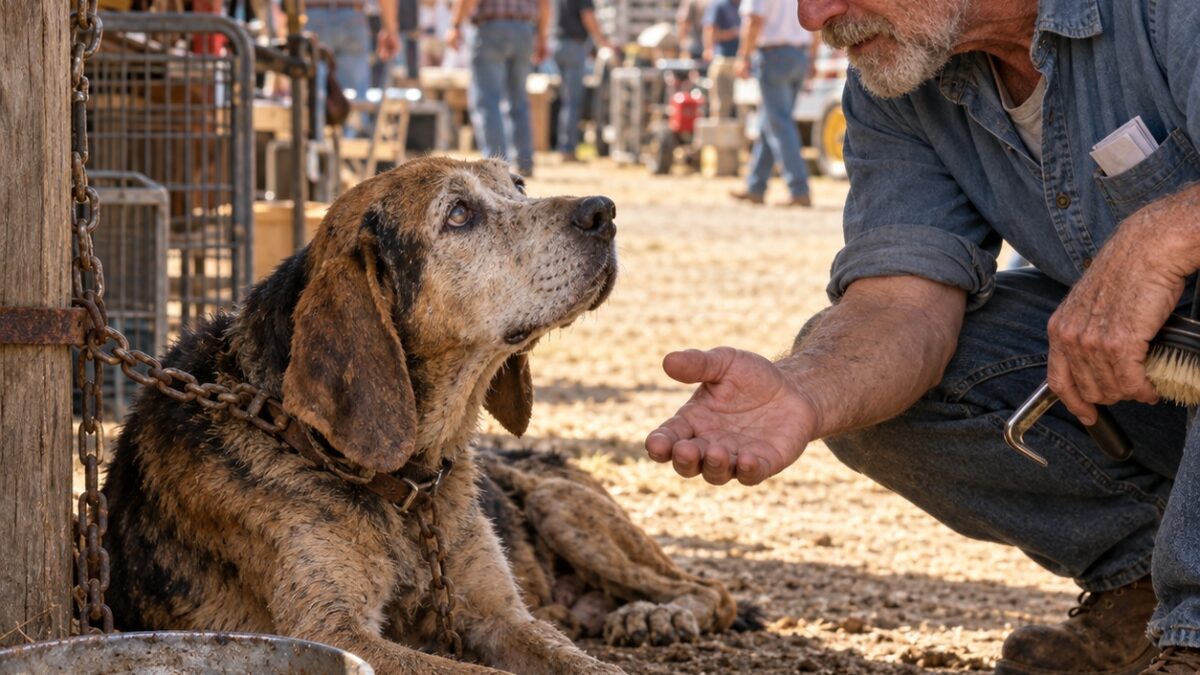
I stood there longer than made sense.
People moved around me.
A man carried two feed buckets past.
A child cried because his mother would not buy him a rabbit.
Somebody shouted about the price of a chainsaw.
The dog kept looking at me.
Eventually, a man came from behind the stall.
Late fifties.
Baseball cap.
Cigarette behind one ear.
“That yours?”
I asked.
He looked at the dog.
“More or less.”
“What does that mean?”
“Old hunting dog.”
“What happened to him?”
The man shrugged.
“Got old.”
I looked at the dog’s ribs.
“That doesn’t explain this.”
“He won’t hunt anymore.”
“So?”
Another shrug.
“Costs money to feed.”
I felt something cold move through me.
“How long has he been tied here?”
“Brought him in this morning.”
“That’s not what I asked.”
The man stared.
I stared back.
I am sixty-seven.
Too old to impress people.
Too old to scare easily.
Too tired to pretend cruelty is complicated when it is not.
“He’s been around.”
The man finally said.
“Chain dog.”
“For how long?”
“Years.”
The word landed heavily.
I crouched near the dog.
Not close enough to touch.
He watched.
No growl.
No tail movement.
Nothing.
“You selling him?”
The man laughed.
“You want him?”
“I asked a question.”
“Twenty dollars.”
I stood.
“Take the chain off.”
The man looked surprised.
“You serious?”
“Yes.”
“Dog’s probably half dead.”
“Take the chain off.”
He did.
Not carefully.
I hated that.
The dog flinched when the metal moved.
Then tried to stand.
His front legs straightened.
Back legs shook.
He nearly fell.
I caught him under the chest.
He froze.
His body went rigid.
I kept my hands still.
“Easy.”
He looked at me.
“Easy, old boy.”
For several seconds, neither of us moved.
Then something in him loosened.
Not trust.
That would come much later.
Maybe just exhaustion.
I paid the man.
Twenty dollars.
I have spent more money on fence hinges.
Nothing I ever bought mattered more.
The dog could not walk to the truck.
I lifted him.
He weighed almost nothing.
Bones.
Fur.
Heat.
That was all.
I put him on the passenger seat.
He tried to sit.
Could not.
Lay down instead.
Head near the door.
Eyes open.
Watching.
I climbed behind the wheel.
For a moment, I did not start the engine.
I looked at him.
He looked at me.
“Well.”
I said.
“I guess I’m not getting the hoof pick.”
One ear moved.
That was our first conversation.
The drive home took forty minutes.
The dog stayed on the seat beside me.
At some point, his head slowly moved until it rested on my right thigh.
I did not touch him.
Did not want to risk breaking whatever fragile decision had allowed him to make contact.
He did not sleep.
He stared through the windshield.
Sometimes at me.
His expression was difficult to describe.
Not gratitude.
Animals do not owe us gratitude for basic decency.
It was closer to disbelief.
Like he was waiting for the truck to turn around.
Waiting to be returned.
Waiting for kindness to reveal its price.
I drove more carefully than usual.
When we reached the farm, I parked in front of the house.
Opened his door.
He tried to stand.
His legs folded.
I caught him.
“Okay.”
I whispered.
“I’ve got you.”
I carried him inside.
He felt lighter than a bale of straw.
That frightened me.
I placed him on the old braided rug in the living room.
Elsie had made that rug from strips of worn clothing.
There was probably part of one of my old work shirts inside it.
The dog lay down immediately.
I brought water.
A large bowl.
He stared at it.
Then at me.
I moved back.
He crawled forward.
Drank.
Slowly at first.
Then deeper.
Longer.
As though he believed the water might disappear if he paused.
“Easy.”
I said.
He ignored me.
Good.
That meant he still wanted something.
I offered food.
Wet dog food from a can I kept for the barn cats when one of them was sick.
Dry kibble borrowed from my neighbor.
Warm chicken.
He sniffed all three.
Then turned his head away.
I sat on the floor.
“What?”
Nothing.
“You just drank half the county.”
His eyes stayed open.
“Food is allowed too.”
He did not eat.
I left it.
Sat nearby.
The afternoon faded.
I canceled everything else.
Fence could wait.
Stalls could wait.
The hoof pick was still at the market.
By evening, the dog had shifted maybe three feet.
That was it.
When darkness came, I found an old blanket.
Blue wool.
Elsie used to keep it on the couch.
I hesitated.
For five years, I had protected certain objects as though touching them wrong would erase her.
Then I looked at the dog shivering in a warm room.
I wrapped him in the blanket.
He stiffened.
Then slowly relaxed.
His eyes closed halfway.
“Tomorrow.”
I told him.
“Dr. Harper comes tomorrow.”
He opened one eye.
“She’s bossy.”
Nothing.
“You’ll like her.”
That night, I slept badly.
Around three, I woke because something had changed.
Not a sound exactly.
Presence.
I opened my eyes.
The dog sat beside the bed.
Not on it.
Not touching.
Just sitting.
Watching me.
I looked at him.
“How did you get up here?”
He remained still.
I patted the mattress.
“Come on.”
He lowered his head.
No.
“All right.”
I got out of bed.
He took one step backward.
I sat on the floor.
He looked exhausted.
Gray muzzle.
White markings.
A name came to me.
Finn.
Old Irish name.
Fair.
Bright.
White.
Elsie had loved Irish names.
I do not know why that mattered.
Maybe because grief keeps small pieces of the dead inside every future choice.
“Finn.”
The dog lifted his head.
I smiled.
“Finn.”
His eyes stayed on mine.
“All right.”
“That’s you.”
The next morning, Dr. Harper drove out.
She had treated every animal on my property for twenty years.
Horses.
Barn cats.
A goat Elsie once adopted after finding it beside a county road.
Dr. Harper climbed the porch with her black bag and called:
“What did you do now, Samson?”
“I bought a dog.”
“You don’t own a dog.”
“I do now.”
She stopped when she saw Finn.
“Oh.”
No joke after that.
She knelt beside him.
Did not touch immediately.
Let him smell her hand.
Finn turned his face away.
“Poor old man.”
She examined him for nearly an hour.
Weight.
Teeth.
Eyes.
Skin.
Joints.
Heart.
Lungs.
Paws.
Temperature.
Finn tolerated most of it silently.
When she touched one rear leg, he flinched.
Dr. Harper stopped.
“Arthritis.”
“How bad?”
“Hard to tell until he gains strength.”
She stood.
Her face had gone serious.
“He’s dehydrated.”
“I know.”
“Severely undernourished.”
“Yes.”
“Likely parasites.”
“Okay.”
“Joint inflammation.”
I nodded.
“And he is old.”
“How old?”
“Nine.”
“Maybe ten.”
I looked down.
Finn lay beneath Elsie’s blanket.
“Can he recover?”
Dr. Harper did not answer immediately.
That scared me.
“Physically?”
She said.
“I think we can improve a lot.”
“What about the rest?”
She looked at me.
“The bigger problem may be psychological.”
“He doesn’t trust people?”
“Not exactly.”
I frowned.
“He let me carry him.”
“That’s why I’m saying not exactly.”
She crouched again.
Finn’s eyes followed her.
“He doesn’t seem afraid of people in the usual way.”
“What does that mean?”
“He’s afraid of expectation.”
I stared.
“Expectation?”
“Hope.”
I almost laughed because it sounded sentimental.
Dr. Harper did not.
“When animals are neglected long enough, some stop asking.”
She said.
“They stop signaling.”
“Stop reacting.”
“Stop believing the next person, meal, bowl of water or open door will change anything.”
She looked at Finn.
“Hope becomes painful.”
“Because disappointment keeps following it.”
Something inside my chest tightened.
I had spent five years doing exactly that.
Not starving.
Not chained.
Nothing comparable.
But emotionally?
I understood the arithmetic.
Expect less.
Lose less.
That had been my life after Elsie.
I stopped planning trips.
Stopped inviting people.
Stopped imagining futures.
Not because I wanted to die.
Because expectation hurt.
I looked at Finn.
He looked back.
Dr. Harper closed her bag.
“Feed small amounts.”
“I’ll bring a high-calorie formula.”
“Parasite treatment.”
“Pain medication once we have bloodwork.”
“And Samson?”
“Yes?”
“Do not force affection.”
“I know.”
“Routine.”
“Same times.”
“Same hands.”
“Same place.”
“He needs to learn that good things repeat.”
That sentence stayed with me.
Good things repeat.
For the first week, Finn barely moved.
Dr. Harper came every day.
Then every other day.
Medication.
Supplements.
Special food.
I learned to hide pills in small pieces of chicken.
At first, he would only take food from my palm.
Not a bowl.
Not a plate.
My hand.
He would stare for several seconds.
Then lean forward.
Take one piece.
Back away.
Wait.
I never reached toward him after.
That seemed important.
Give.
Then stop.
Let him decide.
By day four, he took three pieces.
Day six:
Half a bowl while I held it.
Day eight:
He ate while the bowl was on the floor and my hand rested beside it.
The first time he emptied the bowl completely, I sat at the kitchen table and cried.
That embarrassed me.
Nobody saw.
Finn did.
He stared.
“Mind your business.”
His tail moved.
Not a wag.
Maybe just repositioning.
Still.
I noticed.
Finn slept on the living-room rug.
Never the dog bed Dr. Harper brought.
The bed was too soft.
Maybe unfamiliar.
He preferred the floor.
Back against the couch.
Face toward the door.
Every time I entered, his eyes opened.
Every time I left, his head lifted.
I began narrating.
“Barn.”
“Back in twenty.”
“Kitchen.”
“Still here.”
“Bathroom.”
“You don’t need details.”
No response.
But I kept talking.
The house had been silent for five years.
Now my voice returned because a dog needed it.
Or because I did.
I started leaving the radio on softly.
Elsie used to listen to country music in the mornings.
I had not played that station since she died.
The first song hit me like a fist.
I almost turned it off.
Finn lay near the stove.
Eyes open.
I left it.
One morning, a song Elsie loved came on.
I stopped making coffee.
Held the counter.
Finn stood slowly.
Walked toward me.
Sat near my leg.
Not touching.
But close.
I looked down.
“Yeah.”
I whispered.
“I miss her too.”
I know a dog does not understand a widow’s grief.
That is not the point.
Presence does not need comprehension to help.
Week two, Finn began following me.
Not everywhere.
Just sometimes.
Kitchen to living room.
Porch to kitchen.
He still moved stiffly.
Rear legs weak.
But he chose movement.
Week three, he stepped onto the porch.
Stopped immediately.
Open land spread in front of him.
Fields.
Barn.
Fence.
Sky.
No walls.
No chain.
He backed inside.
I did not coax.
“Tomorrow.”
I said.
Next day, same.
Door open.
Finn sniffed.
One paw out.
Back in.
Day after:
Two paws.
By the end of the second month, he walked fully into the yard.
I remember the morning.
Sun.
Cool air.
Bell calling from the pasture.
Finn stood on the threshold.
His nose worked constantly.
Then he stepped outside.
One.
Two.
Three.
He made it halfway across the yard.
Stopped.
Turned.
Looked at me.
Checking.
I raised one hand.
Still here.
Finn lowered himself onto the grass.
Then rolled slightly onto one side.
Sun on his ribs.
Eyes half closed.
I sat on the porch steps.
Did nothing.
That became one of the happiest mornings of my life.
Nothing happened.
That was why.
No crisis.
No doctor.
No chain.
An old dog slept in sunlight.
And an old man watched.
Sometimes healing is spectacular only to the person who remembers what came before.
Finn gradually became part of the farm.
The first time I took him toward the stable, he stopped thirty feet away.
Bell lifted her head.
Rosie snorted.
Major stomped.
Finn retreated immediately.
“Big.”
I said.
He looked at me.
“Yeah.”
“Very big.”
I walked toward Bell.
Touched her muzzle.
Finn watched.
Bell had always been gentle.
Elsie used to say Bell could tell when somebody was sad before people could.
I believed that after Elsie died.
Some days Bell would simply stand with her head against my chest.
That was all.
I brought Finn closer over days.
Not hours.
Twenty feet.
Fifteen.
Ten.
Bell never moved toward him.
Smart mare.
One morning, Finn reached the stable doorway.
Bell lowered her head.
Blew softly.
Finn jumped.
Then froze.
Bell waited.
Finn stepped forward.
Sniffed her muzzle.
Bell breathed again.
Finn licked her nose.
I stood there holding a feed bucket.
Tears running down my face.
“Good.”
I whispered.
“Good boys.”
Bell was not a boy.
Neither cared.
From then on, Finn came to the stable every morning.
Sat near the door while I fed.
He never became fearless around the horses.
That was fine.
Trust is not pretending size does not exist.
He learned:
Bell is safe.
Rosie is noisy.
Major steals hay.
That was enough.
His body changed slowly.
Third month:
Ribs less visible.
Coat smoother.
Muscle returning along his shoulders.
He walked with more confidence.
Dr. Harper kept measuring weight.
Every pound felt like a victory.
“Don’t fatten him too fast.”
She warned.
“He deserves steak.”
“He deserves functioning organs.”
She was always ruining my generosity.
The arthritis remained.
Old joints do not become young because someone finally loves you.
But medication helped.
Warmth helped.
Movement helped.
Finn started trotting short distances.
The first time I saw it, he was following me toward the barn.
Three steps.
Four.
A little awkward.
Then walking again.
I laughed.
“Show-off.”
His tail moved.
Now definitely a wag.
The bigger change was in his eyes.
At the market:
Nothing but exhaustion.
At home:
Attention.
Curiosity.
Expectation.
Sometimes joy.
Small at first.
When I reached for the leash.
When I opened the truck.
When chicken smelled from the kitchen.
When I came back from the mailbox.
That last one mattered.
I would leave for five minutes.
Return.
Finn waited at the door.
Tail.
Not wildly.
But there.
Good things repeat.
Dr. Harper had been right.
One evening, I sat on the porch reading.
Finn lay below the steps.
Sunset over the fields.
Orange.
Pink.
The kind of evening Elsie used to call “show-off weather.”
I was halfway through a page when Finn climbed the steps.
Slowly.
Walked to me.
Then placed his head on my lap.
He had never done that before.
Not deliberately.
I stopped reading.
Did not move.
His head felt heavy.
Warm.
Trust has weight.
I lowered my hand.
Touched him between the ears.
“You’re a good boy, Finn.”
He sighed.
Deep.
Full-body.
Satisfied.
Something opened inside me.
I cannot explain it better.
For five years after Elsie died, I had kept grief closed tightly because I was afraid opening it would mean never stopping.
Finn put his head on my knee.
And for the first time, grief and comfort occupied the same place.
I cried quietly.
Finn stayed.
No need to fix anything.
That is one of the gifts animals give better than humans.
They do not panic when sadness appears.
They do not say:
Move on.
Stay strong.
Everything happens for a reason.
They stay.
That is enough.
Finn became my shadow.
Fence work?
Finn nearby.
Tractor maintenance?
Finn in the shade.
Stable?
At the door.
Trip into town?
Passenger seat.
At first, he hated the truck.
Not panicked.
But tense.
I wondered if vehicles reminded him of being moved between hunters or owners.
We went slowly.
First:
Engine off.
Sit.
Treat.
Then engine on.
Then driveway.
Then mailbox.
Eventually town.
Months later, he would climb into the passenger seat before I finished opening the door.
Head near my leg.
Exactly like the first day.
But now the look had changed.
No disbelief.
Expectation.
We are going somewhere.
We will come back.
One afternoon, I stumbled crossing a field.
Caught my boot in a shallow rut.
Went down hard on one knee.
Nothing serious.
Mostly dignity.
Before I could stand, Finn came running.
Running.
Not trotting.
Running.
I had never seen him move that quickly.
He stopped beside me.
Sniffed my face.
Then barked.
Loud.
Clear.
Again.
I stared.
“You have a voice.”
Another bark.
I started laughing.
Really laughing.
Not the polite little sound I made around people.
Not amusement.
Laughter.
The kind that hurts your stomach.
“I’m fine.”
Finn barked again.
“Enough.”
He stopped.
Stepped closer.
Licked my cheek.
I sat there in the grass laughing until tears came.
That was the first time I realized I had not laughed that way since Elsie.
Not once.
Finn stood beside me.
Tail moving.
Apparently pleased with himself.
“You’re dramatic.”
I told him.
He licked my face again.
That evening, I called my sister.
Then my neighbor.
Then Dr. Harper.
“Finn barked.”
“Congratulations.”
She said.
“He’s a dog.”
“You don’t understand.”
“I understand perfectly.”
She paused.
“Sounds like he decided you’re worth warning about.”
That sentence stayed.
Worth warning about.
Worth watching over.
I had saved Finn from a chain.
Finn had begun watching me as though I mattered too.
The balance changed.
Not rescuer.
Rescued.
Something closer to companionship.
That is healthier.
People like stories where one person saves another completely.
Life is rarely that clean.
I got Finn out.
Dr. Harper treated him.
Food restored his body.
Routine restored expectation.
But Finn also restored things in me.
I began making plans again.
Small.
Repair the north fence in spring.
Visit my brother in Ohio.
Drive to the county fair.
Plant tomatoes.
Nothing extraordinary.
That was exactly the point.
After Elsie died, the future had become something to endure.
Finn turned it into tomorrow.
Tomorrow, feed horses.
Tomorrow, medication.
Tomorrow, walk.
Tomorrow, vet appointment.
Tomorrow, sun.
Tomorrow started mattering.
Months passed.
Finn learned the farm.
Bell became his favorite horse.
I sometimes found him lying outside her stall.
Bell would lower her head over the door.
They would breathe near each other.
That was their relationship.
No need for more.
He stopped flinching every time I picked up a broom.
Stopped shrinking when I raised my hand too quickly.
Started sleeping deeply.
At first, Finn never slept on his side.
Always curled.
Ready.
Later, one afternoon, I found him stretched across the living-room rug.
Belly partly exposed.
One hind leg crooked sideways.
Completely vulnerable.
I stood in the doorway for several minutes.
Did not want to wake him.
Safety can be seen in sleeping positions.
I learned that from Finn.
He eventually used the dog bed.
Then ignored it again for the couch.
Typical.
I bought that bed because Dr. Harper said the orthopedic foam might help his joints.
One hundred twenty dollars.
Finn preferred Elsie’s old rug.
I complained.
He did not care.
One night, thunder rolled over the hills.
Finn woke.
Head up.
I expected fear.
Instead, he looked at me.
I looked back.
“It’s weather.”
He lowered his head again.
I nearly cried.
Not because thunderstorms matter.
Because his first instinct was no longer:
Danger.
It was:
Check Samson.
Good things repeat.
One year after the market, Dr. Harper examined him again.
She listened to his heart.
Checked joints.
Pressed ribs.
Looked at gums.
Then stood.
“Well.”
“What?”
“This is not the same dog.”
I smiled.
“He’s exactly the same dog.”
“You know what I mean.”
Weight normal.
Parasites gone.
Coat healthy.
Inflammation reduced.
Muscle improved.
Arthritis controlled.
She looked at Finn.
He lay on the exam table with his tail slowly moving.
“The mental change is bigger.”
She said.
“How do you measure that?”
“I don’t.”
“Then how do you know?”
She pointed.
Finn was watching me.
Not the door.
Not her.
Me.
“He expects to go home with you.”
That was the answer.
Expectation.
Once dangerous.
Now safe.
I scratched his neck.
Finn leaned closer.
“I’m happy too.”
I said.
Dr. Harper smiled.
“I can see that.”
I never returned to the market asking about Finn’s history.
People sometimes find that strange.
“Don’t you want to know who had him?”
Part of me did.
I wanted names.
Reasons.
I wanted to understand how a dog could spend years tied somewhere while people walked past.
But eventually, I realized knowing would not change what Finn needed.
His future did not require me to become an investigator of his suffering.
It required me to be consistent.
So I stopped building imagined versions of his past.
I knew enough.
Chain.
Neglect.
Hunger.
Years.
That was enough.
The rest belonged to him.
I focused on what came after.
Breakfast.
Water.
Medicine.
Warm floor.
Open yard.
Truck rides.
Bell.
Porch.
Me.
That became his life.
And mine.
My brother came to visit that fall.
He stood on the porch watching Finn follow me toward the barn.
“You got a dog.”
“I noticed.”
“No.”
He smiled.
“You got a dog.”
“What’s that supposed to mean?”
“I haven’t seen you this attached to anything since Elsie.”
I turned away.
“Don’t.”
“I’m not insulting you.”
“I know.”
My brother walked beside me.
“You sound different on the phone.”
“How?”
“Alive.”
I hated the word because it was too accurate.
“I was alive before.”
“Technically.”
I gave him a look.
He laughed.
Finn trotted between us.
My brother bent to pet him.
Finn allowed it.
Months earlier, he would have stepped away.
Another little miracle.
My brother said:
“Good dog.”
Finn looked toward me.
As if checking whether the assessment was official.
“Yeah.”
I said.
“He is.”
Christmas arrived.
I had not decorated much since Elsie died.
Maybe a wreath.
Maybe nothing.
That year, I brought in a small tree.
Not because Finn cared.
Because I suddenly did.
I found Elsie’s ornaments.
Opened the box.
Cried.
Closed it.
Opened again the next day.
Hung three.
Then five.
Then all.
Finn watched from the rug.
At one point, he stole a felt horse ornament and carried it to the couch.
“Absolutely not.”
He looked at me.
“That is thirty-seven years old.”
Finn placed one paw on it.
I traded him a biscuit.
Negotiation.
Elsie would have loved that.
Christmas morning, I put a wrapped treat beside the tree.
Then felt ridiculous.
Finn tore it open anyway.
Paper everywhere.
I laughed.
The house had noise again.
Paper.
Paws.
Fire.
Coffee.
Me talking to a dog.
Not the same as Elsie.
Nothing would be.
That was another important thing Finn taught me.
Healing is not replacement.
He did not fill the hole Elsie left.
He built something beside it.
New love does not erase old love.
There is room.
The heart is not a barn stall where only one animal fits.
It expands in directions grief cannot predict.
By spring, Finn could walk the entire fence line with me.
Slowly.
We stopped often.
He sniffed everything.
Hound behavior finally appearing.
At the market, he had looked barely alive.
Now he could spend ten full minutes investigating one rabbit track.
Progress can be irritating.
“Come on.”
I would say.
Finn ignored me.
“Fence isn’t fixing itself.”
Nothing.
“Elsie would call you stubborn.”
Tail.
“Fine.”
I waited.
That is another thing old dogs teach old men.
Patience.
One afternoon, we sat near the pond.
Bell grazing behind us.
Wind moving across the water.
Finn lowered himself beside me.
I said:
“Do you remember that market?”
His ear moved.
“Probably not like I do.”
I looked at his gray muzzle.
“I almost walked past.”
That still bothers me.
Maybe not guilt.
Awareness.
One different decision.
One distraction.
One vendor calling my name.
I might have kept walking.
The hoof pick would have come home.
Finn would not.
People call things fate after they work out.
I do not know about fate.
I believe in choices.
I saw him.
Stopped.
Looked.
Asked.
Paid twenty dollars.
Lifted him.
Drove home.
Nothing supernatural.
Just choices.
That matters because people sometimes wait for a feeling of destiny before doing the right thing.
You do not need one.
You need to stop.
Look.
Decide.
Compassion does not require magic.
It requires action.
Finn became well enough that strangers stopped seeing his history.
When we went to town, people saw:
Old hound.
Gray muzzle.
Slow walk.
Friendly enough.
They did not see chain marks that had faded.
They did not know he once refused chicken because he did not believe food was allowed.
I liked that.
Survival does not need to remain visible forever.
But I remembered.
So I respected every ordinary behavior.
Finn begging near the table?
Beautiful.
Finn barking at a truck?
Wonderful.
Finn taking up too much space near the fireplace?
Perfect.
Animals who have been deprived need the right to become inconvenient.
That is part of recovery too.
One evening, I left a plate too close to the couch.
Finn stole half a biscuit.
I caught him.
He froze.
Body stiff.
Eyes wide.
Old fear.
My heart broke.
“Hey.”
I sat.
“That’s mine.”
Finn lowered his head.
“But you’re not in trouble.”
I took the plate.
Then gave him a small dog biscuit.
His body slowly relaxed.
That moment reminded me recovery is never complete in the way people imagine.
A year of safety does not erase years of fear.
You build new patterns around old scars.
That is enough.
I have scars too.
Elsie’s coffee cup remains in the cabinet.
Her coat still hangs upstairs.
Some evenings, grief hits without warning.
I can be repairing a hinge and suddenly remember her hands.
Or how she used to hum while peeling potatoes.
Finn does not erase that.
He comes closer.
That is different.
Once, I sat on the floor beside the kitchen cabinet because I found one of Elsie’s handwritten grocery lists.
Ridiculous thing.
Milk.
Flour.
Apples.
Soap.
Her handwriting.
Five years after her death, it knocked the breath out of me.
Finn walked in.
Saw me.
Lay down.
Put his head on my leg.
Same gesture he had offered on the porch months earlier.
I cried.
He stayed.
Neither of us needed the other to stop hurting.
Only not hurt alone.
That may be what companionship really is.
Dr. Harper eventually reduced his visits.
“Call if anything changes.”
“What about his joints?”
“Keep medication.”
“Food?”
“Same.”
“Walks?”
“Let him set pace.”
I sighed.
“He already does.”
“He trained you well.”
True.
Finn aged normally after that.
Gray spread.
Walk slower.
More naps.
But old no longer looked like abandonment.
Old looked like warmth.
A blanket near the fire.
Medicine in chicken.
A hand on his head.
A porch in sunset.
That changed my understanding of age too.
At sixty-seven, I had begun thinking of myself as a man whose important years were behind him.
Finn was nine or ten.
Old for a large hound.
His previous owner had apparently decided old meant useless.
That is a dangerous word.
Useless.
As if life must justify itself with production.
Finn no longer hunted.
So what?
He watched sunsets.
Walked beside me.
Loved Bell.
Alerted when I fell.
Got me out of bed.
Made me laugh.
Was that useless?
People become cruel when they believe value depends on function.
Animals.
Workers.
Old people.
Anyone.
Finn taught me another measure.
Presence.
Sometimes presence is enough.
I began helping at a local animal rescue once a month.
Nothing heroic.
Repairs.
Fences.
Transport.
I did not become one of those people with twelve dogs.
Dr. Harper would have killed me.
But I helped.
Partly because of Finn.
One Saturday, a young volunteer asked:
“Why hounds?”
“What?”
“You always stop at the hound kennels.”
I looked at him.
“No reason.”
She laughed.
“Sure.”
Maybe I was looking for Finn in every old face.
Not to adopt.
Just to see.
Sometimes I would sit outside a kennel for ten minutes.
No touching.
No pressure.
The same way I sat beside Finn at home.
I understood waiting animals differently now.
People walk shelter aisles looking for enthusiasm.
Tail.
Eyes.
Come here.
Pick me.
But some animals have learned not to ask.
That does not mean they have nothing to give.
Maybe they are protecting the last piece of themselves from another disappointment.
Dr. Harper’s words stayed with me.
Afraid of hope.
I used to think hope was always good.
Not anymore.
Hope without safety can hurt.
The answer is not demanding more hope.
The answer is becoming reliable enough that hope stops feeling dangerous.
That is what Finn needed.
Maybe people do too.
My farm became less silent.
Neighbors stopped by.
My brother visited.
I joined a monthly breakfast with three other farmers.
Elsie used to beg me to go.
I always said I was too busy.
After she died, I became less busy and even more isolated.
Finn changed that because people talked to me when I brought him.
“What kind?”
“How old?”
“Where’d you get him?”
I told the story.
Not dramatically.
Market.
Chain.
Truck.
Home.
People listened.
Sometimes someone said:
“You saved him.”
I always answered:
“He helped.”
Because that felt closer to truth.
One year after I brought Finn home, I returned to the same market.
I needed fence staples.
Actually needed them this time.
Finn came in the truck.
I almost left him home.
Then decided no.
We parked.
He sat beside me.
Window cracked.
I bought staples.
Brush.
Hoof pick.
Finally.
On the way back, I passed the stall where I had found him.
Different vendor.
Different equipment.
No dog.
The post remained.
I stared at it.
Rust stain near the bottom.
Finn waited in the truck.
I stood there longer than necessary.
Then walked back.
Opened the passenger door.
Finn looked at me.
No fear.
No recognition that I could see.
Maybe he did not connect the place.
Good.
I climbed in.
“We’re done here.”
Finn put his head against my leg.
Same as the first drive.
But not the same dog.
Not the same man.
We went home.
That evening, sunset burned orange and pink behind the fields.
I sat on the porch.
Finn lay at my feet.
Bell grazed near the fence.
Crickets.
Warm air.
Nothing special.
Everything special.
I placed my hand on Finn’s head.
“Thank you.”
I said.
Finn lifted his eyes.
Then put his head back on my boot.
I thought about what I was thanking him for.
Not making me less lonely.
That sounded selfish.
Not saving me.
Too dramatic.
Maybe simply:
Thank you for staying.
He had learned I would stay.
I had learned he would too.
Mutual certainty.
That was enough.
Tonight, as I write this, Finn is beside my bed.
Not on the floor because he is afraid to climb.
Beside the bed because that is where his orthopedic cushion is now, and at his age he finally admits it is comfortable.
His breathing is slow.
Even.
Outside, crickets.
Horses quiet.
The farmhouse no longer feels hollow.
Elsie’s absence remains.
It always will.
But absence is not the only thing here anymore.
There is Finn.
Mud near the back door.
Dog hair on my work jacket.
Medicine on the counter.
Water bowl in the kitchen.
A leash hanging beside my hat.
Evidence of another life sharing mine.
Sometimes I wonder what would have happened if I had stayed on the main path at the market.
Bought my tools.
Loaded the truck.
Driven home.
I do not spend much time there.
That future did not happen.
This one did.
A tired dog lifted his head.
An old farmer stopped.
That was enough.
I used to think beginnings should feel important.
Weddings.
Births.
New jobs.
Big decisions.
But some beginnings look like mistakes in the schedule.
Wrong turn.
Unexpected stall.
A dog you did not plan to own.
A twenty-dollar decision.
You do not know it is a beginning until months later when the entire shape of your life looks different.
Finn taught me that.
He also taught me that being old does not mean being finished.
He was nine or ten when I found him.
I was sixty-seven.
Both of us had histories.
Both had losses.
Neither needed to become young again.
We needed room for what came next.
Finn did not become the dog he might have been if someone had treated him well from puppyhood.
I did not become the husband I was before Elsie died.
That is not recovery.
We became something new.
A farmer who talks too much to his dog.
A hound who sleeps in front of the fireplace.
A horse named Bell who lets a dog lick her nose.
A farm with one more heartbeat.
Enough.
Tomorrow morning, I will wake before sunrise.
Kitchen.
Coffee.
Finn will hear the cup.
His nails will move slowly across the floor.
I will open the back door.
He will stand on the porch and smell the air.
Then we will walk to the stable.
Bell will call.
Finn will sit near the doorway while I feed.
Afterward, we will return to the porch.
I will drink coffee.
Finn will lie at my feet.
Nothing dramatic.
No rescue.
No chain.
No hunger.
No market.
Just morning.
That is the ending I wanted for him.
Maybe for myself too.
Not some grand new life.
A good ordinary one.
There is more grace in ordinary days than I understood when I was younger.
Food when you are hungry.
Water when you are thirsty.
A place to sleep without fear.
Someone who notices when you fall.
Someone waiting when you return.
Sunlight.
A porch.
A familiar hand on your head.
People spend fortunes chasing happiness.
Finn and I found ours in repetition.
Dr. Harper once asked whether I regretted bringing home a senior dog.
She did not ask cruelly.
Older dogs mean medication.
Vet bills.
Limited years.
Goodbyes sooner than anyone wants.
I answered immediately.
“No.”
“What about knowing you won’t have twenty years?”
“I didn’t have twenty guaranteed with Elsie either.”
Dr. Harper went quiet.
Neither of us said more.
That is the thing about love.
Duration matters.
Of course.
But duration is not the measure.
Presence is.
Finn had already spent too many years waiting.
I will not cheapen the years he has now because they might be fewer.
A day of safety is still a day.
A year of love is still a year.
An old dog does not need a promise of forever.
He needs today to be good.
I can do today.
So can he.
If tomorrow comes, we do it again.
Good things repeat.
I still think about Dr. Harper saying that.
Maybe that was the whole cure.
Not medicine.
Not food alone.
Repetition.
Water appears.
Food appears.
Samson returns.
Door opens.
No chain.
Bell is gentle.
Truck goes home.
Hand does not hurt.
Tomorrow resembles today.
Eventually, the nervous system believes what the mind cannot.
Safe.
That word became real for Finn.
It became real for me too.
Five years after losing Elsie, I had treated life like something that could only disappoint me if I expected too much.
Finn reminded me expectation can become joy again when the world proves itself carefully enough.
I no longer say:
Nothing good lasts.
I say:
This is good now.
That is sufficient.
When Finn rests his head on my knee, I do not wonder how many evenings remain.
Not usually.
I put my hand on him.
Feel warmth.
Breathe.
Stay.
That is all.
I once believed I bought an old hunting dog for twenty dollars.
Wrong.
I paid twenty dollars to remove a chain.
Everything important came afterward.
Trust could not be bought.
Health could not be bought instantly.
Companionship could not be demanded.
Finn gave those things only when he was ready.
So did I.
That is why the story matters to me.
Not because I rescued a dog.
Because two tired creatures met at the point where neither expected much from life anymore.
One looked up.
The other stopped walking.
And somehow, that was enough to begin again.
My name is Samson Cole.
Sixty-seven-year-old farmer.
Widower.
Horseman.
And now, apparently, the kind of man who schedules his day around an elderly hound who has opinions about breakfast.
Finn is sleeping beside me.
One ear twitches.
Outside, stars cover the fields.
Tomorrow will be ordinary.
I am grateful for that.
Because once, Finn lived every day waiting for something bad to happen.
And I lived every day expecting nothing good.
Now he sleeps without watching the door.
And I wake up looking forward to morning.
That is more than either of us had when we met.
That is enough.
More than enough.

