PART2:I Took a Wrong Turn Behind an Abandoned Warehouse—Then I Heard a Chain Move in the Weeds
PART2
The rescue dispatcher asked where I was.
I tried to explain.
“Behind the old warehouse on Mercer Industrial Road.”
“Is the dog loose?”
“No.”
“Contained?”
“He’s chained.”
Pause.
“Chained to what?”
“A post.”
Another pause.
“Is anyone else there?”
“No.”
“Do you know who owns the property?”
“No.”
“Do not remove the chain yourself.”
I looked at the dog.
“Why?”
“If he has been there a long time, he may panic.”
“He can barely stand.”
“Sir, frightened animals can still bite.”
She gave me instructions.
Keep distance.
Water if possible.
Do not feed too much immediately.
Do not corner him.
A rescue team was coming.
Twenty-five minutes.
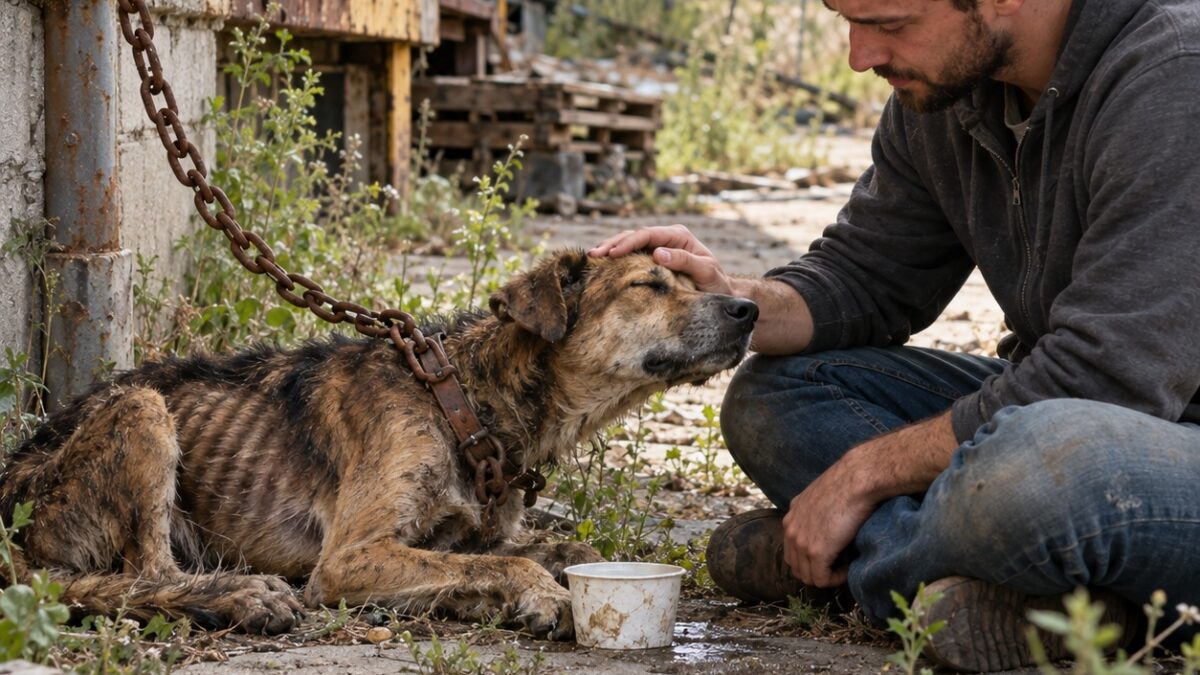
I sat on the ground.
Not close.
Maybe eight feet away.
The dog watched me.
I talked because silence felt worse.
“My name is Owen.”
His eyes remained on me.
“I don’t know if dogs care about introductions.”
Nothing.
“I’m guessing no.”
I looked around.
“Pretty terrible place.”
One ear moved.
“That wasn’t criticism of your decorating.”
For the first time, his nose lifted slightly.
I do not know whether he understood my voice or simply smelled something.
Still, I continued.
“I’m not going anywhere until somebody gets here.”
That sentence changed the air.
Or maybe I imagined it.
The rescue vehicle arrived first.
Two people.
A woman named Mara and a younger man named Devin.
Mara looked to be in her forties.
Calm face.
Hair tied back.
She approached me before approaching the dog.
“You found him?”
“Yes.”
“How long have you been here?”
“Maybe half an hour.”
“Has he tried to bite?”
“No.”
“Growl?”
“No.”
“Stand?”
“Barely.”
She looked past me.
Her expression changed.
“How long has he been chained?”
“I don’t know.”
She crouched near the edge of the loading platform without moving closer.
The dog immediately pressed himself against the wall.
His eyes widened.
Mara stopped.
“Okay.”
Soft voice.
“No pressure.”
She turned toward me.
“Dogs that have been isolated a long time can become defensive because fear is the only thing keeping them alive.”
“He hasn’t been defensive with me.”
“I can see that.”
Devin carried a catch pole and blanket.
The moment the metal pole shifted, the dog flinched violently.
Mara raised one hand.
“Put that down.”
Devin did.
A veterinary van arrived about twenty minutes later.
Dr. Patterson.
Mid-fifties.
Glasses.
Knees that apparently did not enjoy crouching.
He watched the dog for several seconds.
Then tried one careful step forward.
The dog scrambled backward until the chain pulled tight.
His body flattened against the concrete.
Dr. Patterson stopped immediately.
“He’s terrified.”
I said:
“Can I try?”
Everyone looked at me.
Mara answered first.
“Owen, there’s still a bite risk.”
“I know.”
“He may tolerate you until suddenly he doesn’t.”
“I know.”
Dr. Patterson asked:
“What have you been doing?”
“Sitting.”
“That’s all?”
“Talking.”
He looked at the dog.
Then at me.
“Do exactly what you did.”
I stood slowly.
The dog’s eyes followed me.
I did not walk directly toward him.
I angled sideways.
No eye contact.
Stopped maybe three feet away.
Then sat on the ground.
Concrete cold through my jeans.
I put my hands on my knees.
Waited.
One minute.
Two.
Nobody spoke behind me.
The dog’s breathing was fast.
His entire body remained tight.
I wanted to reach out.
Did not.
There are moments when helping means doing less.
Eventually, he shifted.
An inch.
Maybe two.
Toward me.
I stayed still.
Another minute.
He leaned again.
I lifted my right hand.
Slowly.
Stopped halfway.
His eyes moved from my hand to my face.
Back to the hand.
I waited.
He did not move away.
I lowered my palm onto the top of his head.
His fur felt rough.
Dirty.
Warm.
The dog closed his eyes.
Not for long.
Maybe two seconds.
But he closed them.
Behind me, somebody exhaled.
I stroked his head once.
Then stopped.
He leaned into my palm.
I remember thinking:
Well.
That’s it.
I cannot leave you here.
Dr. Patterson worked from my side.
He touched the dog only after I did.
Heart rate.
Mouth.
Eyes.
Skin.
The dog tolerated it while keeping his shoulder pressed against my leg.
Mara said:
“He’s using you.”
“For what?”
“Safety.”
That word landed differently than she probably intended.
I had not felt particularly useful to anyone in a long time.
Now this exhausted animal had decided my knee was the safest object available.
Devin cut the chain.
The metal fell.
Clang.
The dog jumped so hard his body hit mine.
I put both arms around him instinctively.
“Easy.”
He trembled.
“It’s okay.”
The collar remained.
The chain was gone.
For what may have been the first time in years, nothing tied him to that wall.
He did not run.
He stayed pressed against me.
Mara whispered:
“Look at that.”
Dr. Patterson shook his head.
“What?”
“He could leave.”
The dog did not.
He sat beside me.
That became the first thing about him I could not stop thinking about.
Freedom arrived.
And he chose connection.
We got him onto a blanket.
Four people lifted.
He weighed far less than a dog his size should have.
At the rescue clinic, they asked if I wanted to leave my contact information.
“Why?”
“So we can update you.”
“Yes.”
I gave them everything.
Phone.
Email.
Address.
Emergency number.
Mara smiled.
“We probably don’t need your mother’s number.”
“I panicked.”
“I can tell.”
The shelter registered him under a temporary name.
Hope.
I did not choose it.
One of the intake workers did.
“Because he needs some.”
I almost objected.
Names like Hope can feel too obvious.
Then I looked at him.
“Hope is fine.”
But privately, I called him something else.
The waiting dog.
Because that was what I saw when I looked at him.
A dog who had waited.
For food.
For water.
For fear to pass.
For someone to return.
Maybe for years.
Later, after the rescue began asking around the old industrial area, neighbors told them pieces.
People remembered seeing a dog behind the warehouse.
Not recently.
Years.
A maintenance worker believed the chain had been there for most of the decade.
Nobody could give a complete history.
No reliable owner stepped forward.
No one could explain exactly how Hope had survived for so long.
Food had apparently appeared sometimes.
Water sometimes.
Not enough.
Never consistently.
The shelter’s best estimate was horrifying.
Close to eight years.
Eight years.
I was twenty-nine.
That meant while I had been finishing school, changing jobs, moving apartments, complaining about traffic, buying phones, dating, breaking up, starting over—
Hope had been behind a warehouse.
Waiting.
For the first three days, he ate only when nobody was watching.
The staff put food down.
Left.
Returned later.
Bowl empty.
If someone stayed in the room, Hope curled against the wall and stared.
I visited every day.
At first, staff seemed surprised.
“You’re back.”
“Yes.”
Then it became:
“Your guy is in room four.”
My guy.
I pretended that phrase did not affect me.
I sat on the floor.
Same place.
Hands on knees.
Talked.
I told Hope about work.
About stupid emails.
About my upstairs neighbor who vacuumed at six-thirty in the morning.
About my brother Nathan living two states away.
About my mother.
I had not spoken to her properly in months.
Not because we had fought.
That would have been simpler.
We had drifted.
After my father died, Mom became more anxious.
Called too much.
Asked whether I was eating.
Sleeping.
Dating.
Saving.
I answered less.
Then she called less.
Two people protecting themselves from rejection can create an impressive amount of silence.
Hope listened better than most humans.
Mostly because he could not interrupt.
For the first week, he stayed several feet away.
Second week:
Closer.
One day I realized his front paws were almost touching my shoes.
I did not mention it.
I had learned not to celebrate too quickly.
Then one morning, I arrived with coffee.
Hope was lying in the corner.
A tennis ball sat near the wall.
Old.
Faded.
Some volunteer had left it.
I sat.
“Morning.”
Hope stood.
That alone was progress.
He walked to the tennis ball.
Picked it up.
Turned toward me.
I smiled.
“What?”
He walked closer.
Dropped the ball at my feet.
I stared.
Mara was standing outside the kennel.
She froze.
“Owen.”
“I see it.”
Hope looked at the ball.
Then me.
I picked it up.
He took one step backward.
I rolled it.
Not threw.
The ball moved across the floor.
Hope watched.
Then walked after it.
Picked it up.
Brought it back.
That was his first invitation.
Not food.
Not fear.
Play.
I started crying.
Immediately.
Embarrassingly.
Mara pretended not to notice.
I wiped my face.
“Something in my eye.”
“Of course.”
Hope dropped the ball again.
“Okay.”
I rolled it.
He brought it back.
Five times.
Then lay down, exhausted.
I sat beside him.
Not touching.
We stayed there for half an hour.
A few days later, Hope ate while I was in the room.
I had been talking about Nathan.
“My brother keeps telling me to visit.”
Hope looked at his bowl.
“I keep telling him work is busy.”
One bite.
I stopped speaking.
Hope froze.
I looked away.
Started again.
“Which is mostly a lie.”
Second bite.
“My job is not that important.”
Third.
“I think I just don’t like admitting I’ve become boring.”
Hope kept eating.
I laughed.
“Thanks.”
He finished half the bowl.
That was when I realized routine was helping both of us.
Hope needed predictability.
So did I.
I started waking earlier because visiting before work meant leaving my apartment by seven.
I stopped staying up until one watching meaningless television.
I bought groceries because coming home after the shelter hungry was getting expensive.
I started answering Nathan’s texts.
Small things.
Nothing dramatic.
Hope’s recovery became the spine of my days.
The shelter did not pressure me to adopt.
Not once.
That mattered.
Mara asked:
“Have you thought about what happens next?”
“Next?”
“When he’s medically cleared.”
I stared at Hope.
“I assumed you find him a family.”
“We do.”
Something unpleasant moved in my chest.
“Good.”
Mara watched me.
“Good?”
“Yes.”
“You don’t sound good.”
“I’m fine.”
She smiled.
I hated that.
“What?”
“You say fine exactly like every man who is not fine.”
I left offended.
Then came back the next morning.
Hope gained weight slowly.
His coat improved.
The collar marks around his neck began healing.
Dr. Patterson told me the years of restraint had affected his muscle tone and joints, but not as badly as they feared.
“He’s resilient.”
Everyone kept saying that.
I wondered if resilient was just the polite word we use when something survives what should never have happened.
Hope did not become cheerful overnight.
Some days, he seemed better.
Next day:
Corner again.
A dropped metal bowl once sent him into a panic.
His body slammed against the back wall.
I sat outside the kennel for forty minutes before he moved.
Another time, a man wearing heavy work boots entered the hallway.
Hope began shaking.
Nobody knew why.
We stopped trying to guess every trigger.
Recovery is not a detective story.
You do not need to solve every injury before you respect it.
You simply learn:
This sound is hard.
This movement is scary.
This person needs space.
Then act accordingly.
Weeks passed.
One afternoon, I arrived later than usual.
Work meeting.
Traffic.
I had texted the shelter like Hope could read.
Tell him I’m coming.
Mara replied:
I’ll put it on his calendar.
When I walked into the adoption center hallway, Hope was at the far end with a young staff member.
He saw me.
Stopped.
I stopped too.
For one second, neither of us moved.
Then Hope ran.
I had never seen him run.
Not like that.
His paws slipped on the polished floor.
He recovered.
Kept coming.
Straight toward me.
I dropped to my knees.
“Hey.”
He almost knocked me backward.
His head pushed beneath my hand.
Tail moving so hard his entire body swung.
I laughed.
Cried.
Held his face.
“Okay.”
“Okay.”
“I’m here.”
The young staff member covered her mouth.
“Oh my God.”
Mara came from another room.
“What happened?”
The staff member pointed.
“He’s never done that.”
Hope pressed closer.
Mara looked at me.
Then Hope.
Then said nothing.
She did not need to.
I knew.
Not intellectually.
Somewhere lower.
Deeper.
The dog had chosen me.
And I had already chosen him.
I simply had not signed anything yet.
The next week, I officially adopted Hope.
I sat in the shelter director’s office with paperwork spread across a desk.
Medical history.
Behavior notes.
Medication.
Training recommendations.
Microchip information.
The director, Ellen, had probably overseen hundreds of adoptions.
She watched me sign.
Then said:
“You know, we see people save animals all the time.”
I looked up.
“But every once in a while…”
She smiled.
“It goes the other direction.”
“What does?”
“The animal saves the person.”
I laughed.
“I’m not sure I need saving.”
Ellen gave me a look.
“Most people who do need it aren’t.”
I signed the final line.
She slid the folder toward me.
“Congratulations.”
Hope waited outside with Mara.
When I stepped into the hallway holding his leash, he looked at me.
Then the door.
Then me.
I crouched.
“You want to go home?”
He did not understand the word.
Not yet.
The ride to my apartment took twenty-three minutes.
Hope lay on the back seat.
Not relaxed.
Head up.
Eyes watching every turn.
When we reached my building, I opened the car door.
He did not move.
“It’s okay.”
Nothing.
I waited.
Did not pull.
Eventually he stepped down.
The elevator was worse.
Small metal box.
Hope froze.
So we took the stairs.
Four flights.
By the third, I regretted living there.
At the apartment door, he stopped again.
Inside:
Soft bed in the corner.
Water.
Food.
Toys.
A basket.
I had spent far too much money for a man who claimed he was simply adopting a dog.
“Come on.”
Hope looked inside.
Then at me.
Then inside again.
His body was tense.
As if the apartment might be a trap.
I sat just inside the doorway.
No leash pressure.
“Take your time.”
He put one paw across the threshold.
Stopped.
Second paw.
Then stepped inside.
He sniffed the floor.
Wall.
Bed.
Water bowl.
Walked into the kitchen.
Returned.
Looked at me.
I smiled.
“This is yours.”
He stared.
“Okay.”
“Technically, most of it is mine.”
Nothing.
“But we’ll negotiate.”
Hope sat.
That first night, he did not use the bed.
He slept on the floor with his back against the wall and his eyes facing the front door.
Every noise woke him.
Footsteps in the hall.
Elevator.
Car outside.
Pipe knocking.
Around three, I got up for water.
Hope immediately stood.
“You don’t have to.”
He followed me.
Kitchen.
Back to bedroom.
Then returned to the wall.
The next morning, I began a routine.
Up at six-thirty.
Water.
Breakfast.
Walk.
Coffee.
I sat on the floor while Hope ate.
At first, he would not.
So I moved farther away.
Turned sideways.
Talked.
“Today I have a nine o’clock meeting.”
Nothing.
“Dan is going to pretend the deadline wasn’t his idea.”
Hope sniffed food.
“And Susan will say ‘circle back’ at least four times.”
One bite.
“Good.”
He stopped.
“Sorry.”
I looked away.
More bites.
Every morning.
Same time.
Same voice.
Same floor.
Predictability.
Hope gradually ate while I remained in the room.
Then began lying closer.
One morning, I was telling him about Nathan.
“My brother has a kid now.”
Hope looked at me.
“She’s three.”
He tilted his head.
“Apparently, I’m a bad uncle.”
Hope came closer.
“He lives far away.”
Closer.
“I miss him.”
Hope placed his head on my knee.
I stopped breathing.
He had never done that.
Not at the shelter.
Not deliberately.
His chin rested across my leg.
Then he sighed.
A long, exhausted sound.
I put my hand on his head.
“Yeah.”
I whispered.
“Me too.”
After that, things changed faster.
Not perfectly.
But visibly.
He followed me from room to room.
Started sleeping beside the couch instead of the wall.
Then, one evening, he put two front paws on the couch.
Looked at me.
“Come on.”
He climbed up.
Very carefully.
Lay at the far end.
The next night, middle cushion.
Week later, half on top of me.
Apparently trauma recovery also involved learning terrible boundaries.
I loved it.
I had bought a dog bed for eighty dollars.
Hope preferred the couch.
Naturally.
The vacuum cleaner terrified him.
First time I turned it on, he ran behind the dining table and shook.
I switched it off immediately.
Sat on the floor.
“I’m sorry.”
He stared.
I placed the vacuum in the corner.
For three days, did not touch it.
Then began moving it slightly without turning it on.
Treat.
Wait.
Move.
Treat.
Weeks later, I could vacuum one room while Hope stayed in another.
Progress.
The doorbell was another problem.
Every ring brought him upright.
Rigid.
Watching.
So we practiced.
My neighbor Jen helped.
Ring.
Treat.
Door opens.
Nobody dangerous.
Again.
Again.
Eventually, the bell became annoying instead of terrifying.
That felt like victory.
Hope never jumped onto my bed at first.
He would stand in the doorway at night.
Watch me.
Then lie down beside the wall.
One evening, maybe six weeks after adoption, I came home from work.
Unlocked the door.
No Hope in the living room.
“Hope?”
Nothing.
Kitchen.
Empty.
My heart jumped irrationally.
“Hope?”
Then I walked into my bedroom.
He was stretched across the bed.
Head on my pillow.
Tail moving slowly.
I stopped.
He looked at me.
I laughed.
A real laugh.
Loud enough that I surprised myself.
“Well.”
Hope stayed.
“So this is where we are.”
Tail.
“Great.”
That night, he slept on the bed.
Not beside me.
At the foot.
Next night:
Closer.
A month later, he had somehow taken enough space for a much larger animal.
I did not complain.
Not seriously.
The biggest breakthrough came with a stuffed frog.
Green.
Ugly.
Squeaked badly.
I had bought it during an irresponsible visit to a pet store.
Hope had ignored it for weeks.
One evening I sat reading on the couch.
Hope lay on the floor.
He stood.
Walked to the toy basket.
Dug around.
Pulled out the frog.
Brought it to me.
Dropped it at my feet.
I looked down.
Then at him.
“You sure?”
Hope stared.
I threw it lightly across the room.
He watched.
Looked at me.
“Go get it.”
He ran.
Picked it up.
Brought it back.
Dropped it.
Again.
Again.
Again.
Fifteen minutes.
Maybe twenty.
By the end he lay beside me panting, tail still thumping.
I picked up my phone.
Called my mother.
She answered on the fourth ring.
“Owen?”
“Hi, Mom.”
Pause.
“Are you okay?”
That hurt.
Because she assumed an emergency before a casual call.
“Yeah.”
“I’m okay.”
“What happened?”
“Nothing.”
“Nothing?”
“I adopted a dog.”
Silence.
“You what?”
I laughed.
“I adopted a dog.”
I told her about Hope.
Warehouse.
Chain.
Shelter.
Tennis ball.
Hallway.
Apartment.
Stuffed frog.
Mom listened without interrupting.
Then said:
“You’ve always been like that.”
“Like what?”
“Finding things that need you.”
I stared at Hope.
“I don’t think I’ve been helping many people lately.”
“You don’t have to rescue the whole world.”
She said.
“Sometimes one thing is enough.”
We talked for forty-three minutes.
Longest conversation in more than a year.
At the end, she said:
“I miss you.”
I closed my eyes.
“I miss you too.”
Hope had fallen asleep with the stuffed frog under one paw.
After we hung up, I sat there for a long time.
Ellen’s words returned.
Sometimes the animal saves the human.
I still resisted the sentence.
Hope was not a therapist.
He was not responsible for fixing me.
That would be unfair.
But loving him required me to return to my own life.
Routine.
Patience.
Outside.
Movement.
Conversation.
Responsibility.
Hope needed breakfast whether I felt empty or not.
Needed walks.
Needed veterinary appointments.
Needed me to come home.
When another living thing depends on your return, disappearing into yourself becomes more difficult.
That was good for me.
My first trip with Hope outside our neighborhood was not good.
A truck dropped something metal.
Bang.
Hope collapsed against my legs.
Shaking.
People walked past.
Someone stared.
I sat on the sidewalk.
Right there.
Suit pants.
Backpack.
Did not care.
I put both arms around him.
“Easy.”
He trembled harder.
“I’m here.”
Cars passed.
Someone stepped around us.
“I’m not going anywhere.”
Five minutes.
Ten.
His breathing slowed.
I whispered:
“We’ll get there.”
Hope looked at me.
“Together.”
We went home.
The next day, we walked the same route.
Not because I wanted to force him.
Because fear grows around avoided places.
We stopped before the corner.
Treat.
Went home.
Two days later:
Closer.
A week:
Past it.
No noise.
Hope looked at me.
I looked at him.
“See?”
Tail movement.
Small.
But there.
We both became students of repetition.
He learned:
I leave for work.
I return.
Doorbells happen.
Nothing bad follows.
Vacuum makes noise.
Then stops.
People can reach down without hurting.
Food appears tomorrow too.
I learned:
Progress is not linear.
A bad day does not erase twenty good ones.
Fear returning does not mean trust disappeared.
Waiting can be active.
Patience can be work.
Some mornings, Hope seemed fearless.
Afternoons, a sound sent him backward.
At first, I took regressions personally.
“Did I do something?”
Mara, who still checked in, told me:
“No.”
“His nervous system is remembering before his brain catches up.”
I liked that explanation.
Not because it was scientifically perfect.
Because it gave me patience.
One night Hope woke from sleep and ran to the front door.
Growled.
Low.
I checked.
Nothing.
He stood there for ten minutes.
I sat behind him.
Did not touch until he leaned backward against me.
Then we returned to bed.
Another night, a storm hit.
Rain.
Thunder.
Hope slept through it.
I found that strange.
He was terrified of dropped metal.
Not thunder.
Trauma has its own logic.
You do not get to vote.
Months passed.
Hope gained weight.
His coat became fuller.
The dullness disappeared.
At the shelter, he had walked with shoulders low.
At home, he started carrying himself differently.
Head higher.
Tail neutral.
Then wagging more.
He discovered squirrels.
Apparently eight years of captivity had not eliminated genetic hatred of squirrels.
First one he saw from my window, his entire body changed.
He rushed toward the glass.
Bark.
I nearly dropped coffee.
“You can bark?”
He barked again.
Loud.
Offended.
The squirrel escaped.
Hope looked at me as if I had failed to secure the perimeter.
“Good job.”
He wagged.
I laughed.
My life became louder.
Better.
Mom visited three months after the adoption.
Hope hid when she first entered.
She did not approach.
I had coached her.
“Sit.”
“Ignore him.”
“Let him decide.”
Mom took it seriously.
She sat on the couch.
Hands folded.
Talked to me.
Twenty minutes.
Hope emerged.
Sniffed.
Retreated.
Returned.
Eventually, he sat three feet away.
Mom’s eyes filled.
“Don’t cry.”
I whispered.
“I’m not.”
“You are.”
“Quiet.”
Hope came closer.
Sniffed her hand.
She kept it still.
Then he touched his nose to her fingers.
Mom looked at me.
I nodded.
She stroked beneath his chin once.
That night, she said:
“I understand.”
“What?”
“Why you called.”
I looked toward Hope sleeping beside the couch.
“Me too.”
Nathan came several months later with his wife and daughter, Lily.
I was terrified about Hope around a three-year-old.
Not because he had ever shown aggression.
Because children move unpredictably.
We made rules.
No hugging him.
No touching while eating.
No taking toys.
No cornering.
Let Hope come to her.
Lily listened for almost twelve minutes.
Then forgot she was three.
Hope handled it beautifully.
He kept distance.
Watched.
Eventually Lily sat on the floor coloring.
Hope lay beside her.
Not touching.
Two separate activities.
Peace.
Nathan looked at me.
“You seem different.”
“That sounds insulting.”
“You know what I mean.”
I did.
I was different.
Not transformed into some permanently happy person.
Life does not work that way.
I still had lonely nights.
Work problems.
Anxiety.
Days I did not want to talk.
But I had stopped believing those days defined everything.
Hope had taught me that too.
A bad hour can be an hour.
Not a prophecy.
The shelter director once invited us back for an adoption event.
I hesitated.
“What if it stresses him?”
“We can leave immediately.”
We went.
Hope entered the building slowly.
Sniffed.
Paused.
Then continued.
Staff recognized him.
People gathered.
Mara crouched several feet away.
“Hey, handsome.”
Hope saw her.
Tail.
Then walked over.
She cried.
“No.”
I said.
“You’re not allowed.”
“You cried over a tennis ball.”
“Different.”
“How?”
“I don’t remember.”
The young employee who had watched Hope run toward me was there.
She covered her mouth again.
“He looks completely different.”
I looked at Hope.
She was right.
But not because he was heavier.
The biggest change was where he looked.
When I found him, his eyes searched constantly for danger.
Now he looked for people.
For me.
For doors that might open.
For the next interesting thing.
Safety had not made him careless.
It had made curiosity possible.
That might be what healing is.
Not forgetting danger exists.
Having enough safety left over to become curious again.
At the event, someone asked:
“Was he really chained there eight years?”
“That’s the best estimate.”
The woman looked horrified.
“How did he survive?”
“I don’t know.”
“Do you know who did it?”
“No complete history.”
“Aren’t you angry?”
Yes.
Of course.
There were nights I imagined the person responsible.
Wanted a name.
Wanted explanation.
Wanted punishment.
But anger had limits.
Hope was home.
My energy belonged to him now.
“I try not to make his future about whoever caused his past.”
I said.
The woman nodded.
That sentence stayed with me.
Hope did not need me spending every day hating someone.
He needed walks.
Dinner.
Medicine.
Play.
He needed me present.
So I gave him that.
On the first anniversary of finding him, I drove back to the abandoned warehouse.
Alone.
Hope stayed with Mom.
I did not know why I went.
Maybe I needed to see it again.
The building looked smaller.
More ruined.
The weeds taller.
The loading platform where Hope had been chained remained.
The metal post too.
No chain.
I stood there.
Remembered the cup of water.
His eye opening.
The first touch.
I sat where I had sat that afternoon.
Concrete.
Cold even in late summer shade.
For several minutes, I said nothing.
Then:
“You’re not here anymore.”
Obviously.
But I needed to hear it.
The place looked abandoned because it was.
Hope was no longer part of its meaning.
I left.
Went home.
He met me at the door.
Tail.
Stuffed frog in mouth.
I laughed.
“Perfect timing.”
We played for twenty minutes.
That evening, Hope slept with his paw touching my hand.
Not gripping.
Just contact.
I thought about how many years he had spent alone.
Then about how many evenings I had spent alone by choice while telling myself it did not matter.
Our loneliness was not the same.
I would never insult his suffering by pretending it was.
But I understood something about waiting.
You can adapt to isolation so completely that connection becomes frightening.
Hope had done it to survive.
I had done it to avoid disappointment.
Both of us had to relearn people.
The work continues.
Even now.
Hope is beside me while I write this.
Rain against the window.
Steady.
His breathing deep.
He no longer raises his head at every hallway sound.
Does not sleep facing the door anymore.
His favorite sleeping position is now upside down with his legs bent in ways that look medically irresponsible.
He snores.
Loudly.
Sometimes dreams.
Paws move.
One ear twitches.
Tonight, one paw rests against my hand.
I can move.
He will probably wake.
So I am typing awkwardly with the other.
Worth it.
People sometimes ask:
“Who saved who?”
I used to dislike the question.
Too neat.
I found Hope physically trapped.
Rescuers cut the chain.
Veterinarians treated him.
Shelter workers fed him.
I adopted him.
Those are facts.
But Hope changed the direction of my life too.
Not through magic.
Not because damaged animals possess supernatural wisdom.
Because caring about him required me to practice things I had stopped practicing with myself.
Patience.
Routine.
Connection.
Forgiveness for bad days.
Showing up again tomorrow.
Hope did not heal me.
He gave me a reason to participate in my own healing.
That is better.
More honest.
I call Mom every Sunday now.
Sometimes twice a week.
Nathan and I visit each other more.
Lily calls Hope “Uncle Hope,” which makes no biological sense and is therefore exactly the kind of title a child invents.
Hope loves her.
From a safe distance when she gets loud.
He has preferences.
Boundaries.
Good.
One night Mom said:
“You know what I think?”
“What?”
“I think you found Hope because you were supposed to.”
I rolled my eyes.
“You know I don’t believe that.”
“I know.”
She smiled through the phone.
“I do.”
I looked at Hope asleep beside me.
Maybe life has a plan.
Maybe it does not.
Maybe wrong turns are just wrong turns until someone decides what to do next.
I had taken the wrong road.
Heard a chain.
Could have backed out.
Could have assumed somebody else would handle it.
Could have called and left.
Instead, I stayed.
That one decision changed two lives.
I do believe that.
No cosmic explanation required.
The shelter asked me once to speak to a small volunteer group.
I almost refused.
Public speaking terrifies me more than abandoned warehouses apparently.
But I went.
Someone asked:
“What should people do if they find a dog like Hope?”
I gave practical answers.
Call professionals.
Do not rush a frightened animal.
Offer water carefully.
Keep yourself safe.
Document location.
Do not assume a terrified dog is aggressive.
Let trained rescuers remove restraints when possible.
Then I said the thing that mattered most to me.
“Stay.”
A woman frowned.
“What?”
“If it’s safe and help is coming, stay.”
I looked around the room.
“Because sometimes the animal has already learned that people leave.”
“You don’t have to fix everything.”
“You may not be the rescuer.”
“You may not be the veterinarian.”
“You may not become the adopter.”
“But for twenty minutes…”
I swallowed.
“You can be the person who doesn’t leave.”
That was what Hope first trusted.
Not my competence.
I had none.
Not my experience.
I had none.
Presence.
I sat.
He watched.
I stayed.
Maybe that is why he leaned toward me.
Maybe not.
We will never know exactly what was inside his head.
But I know what was inside mine.
At first:
Poor dog.
Then:
Please survive.
Then:
Please trust somebody.
Then:
Please trust me.
And eventually:
Come home.
He did.
Not immediately.
Not easily.
One inch at a time.
One meal.
One tennis ball.
One hallway run.
One threshold.
One couch cushion.
One stuffed frog.
One night on my bed.
One morning with his head on my knee.
Trust was not a switch.
It was a road.
Hope walked it slowly.
So did I.
There are still things he will probably always fear.
Sudden metal sounds.
Some boots.
Certain narrow spaces.
I stopped viewing those reactions as failures.
Healing does not mean becoming a creature who was never hurt.
It means hurt no longer controls every decision.
Hope can hear a sound.
Get scared.
Then look at me.
Recover.
Continue.
That is enough.
I try to do the same.
There are mornings I wake feeling inadequate.
Behind.
Disconnected.
The old thoughts.
Then Hope appears.
Leash.
Tail.
Breakfast demand.
Life.
We go outside.
Sometimes recovery is philosophical.
Sometimes it needs to pee at 6:15.
Both count.
Last week, I found the original tennis ball.
The faded one from the shelter.
I had saved it.
Of course.
It sat in a box beside adoption papers.
Hope saw it in my hand.
His ears lifted.
I rolled it.
He chased it.
Slower now.
But joyful.
Brought it back.
Dropped it at my feet.
I bent down.
Picked it up.
For a second, I could see every version of him at once.
The dog against the warehouse wall.
The terrified dog in the clinic.
The dog refusing to eat while watched.
The dog placing that ball at my feet.
The dog running down the shelter hallway.
The dog hesitating at my apartment door.
The dog on my bed.
The dog beside Lily.
The dog sleeping peacefully while rain hits the window.
All Hope.
None erased.
That is important.
We do not need to erase the frightened version of ourselves to become something else.
He deserved compassion too.
The dog who could not play.
The dog who could not eat while someone watched.
The dog who slept facing the door.
He was surviving.
Not failing.
I think about that when I remember my own quiet years.
Maybe I was surviving something too.
Grief.
Loneliness.
Fear.
Whatever name fits.
Then one afternoon, a chain scraped against concrete.
Life interrupted.
Hope moves now in his sleep.
His paw presses harder against my hand.
I stop typing.
Stroke the fur between his ears.
He does not wake.
That would have been impossible once.
At the warehouse, my touch required negotiation.
Now he sleeps through it.
People talk about trust as though it is given once.
I think trust is thousands of small permissions.
Touch me while I sleep.
Leave the apartment.
Come back.
Stand near my food.
Open the door.
Invite someone inside.
Make noise.
Hold the leash.
Throw the toy.
I will believe you this time.
Again.
Again.
Again.
Eventually the body stops counting.
Maybe Hope no longer thinks about whether I will return.
I hope so.
That would be the greatest gift.
Not love.
Certainty.
The ordinary certainty that when I leave for work, I come back.
That the water bowl will be full tomorrow.
That nobody will attach a chain to his neck.
That the bed is still his.
That there will be another walk.
Another meal.
Another stupid stuffed frog flying across the room.
He waited close to eight years for life to change.
I cannot return those years.
Nobody can.
But I can make sure he never waits like that again.
Tomorrow morning, Hope will wake before me.
He will stand beside the bed.
Probably stare.
If that fails, he will put his nose against my hand.
I will complain.
He will ignore me.
We will walk.
He will sniff every bush as if the neighborhood changed overnight.
He will stop for no obvious reason.
Look at people.
Some will pet him.
Some will not.
We will come home.
Breakfast.
Coffee.
He will find a patch of sun.
Eventually I will sit beside him.
And Hope will not wonder whether I am staying.
He already knows.
That is what eight years behind a warehouse could not teach him.
That is what months of safety finally did.
And maybe that is what he taught me too.
Waiting is not always surrender.
Being afraid is not the same as giving up.
A life can become very small and still expand again.
Trust can return after years without it.
Home can begin with one open door.
And sometimes the most important thing that happens to you starts because you take the wrong road, hear a chain move in the weeds, and decide—for reasons you cannot yet explain—not to keep driving.
My name is Owen.
I am twenty-nine years old.
And the dog sleeping beside me was once the animal I called the waiting dog.
I do not call him that anymore.
He does not wait for somebody to come.
He does not wait for somebody to remember him.
He does not wait behind a wall wondering whether the next person will leave.
His name is Hope.
He has a home.
He has people.
And when he wakes up tomorrow, I will still be here.

