PART2:I Lay Injured Outside My Remote Cabin for Hours—Then My 13-Year-Old Rescue Dog Looked at Me and Walked Away
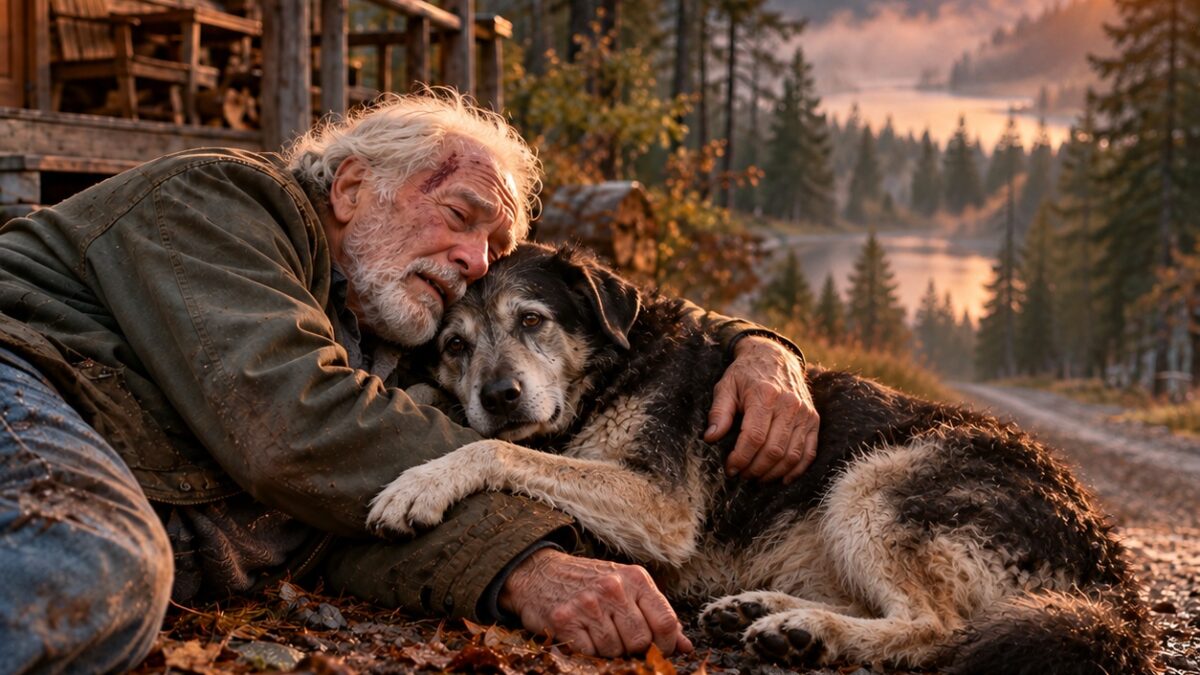
PART2
For a few seconds, I could not breathe properly.
I stared at the dark outline of the cabin.
The door was less than twenty feet away.
Twenty feet.
I had walked farther than that to get the newspaper thousands of times.
Now it might as well have been twenty miles.
“Gita.”
She was beside me instantly.
I put one hand against the ground.
Tried to push myself upright.
My hip answered with pain so sharp my vision flashed.
I dropped back.
Breathed.
Tried again.
Nothing.
“Okay.”
I said aloud.
Not because anything was okay.
Because speaking kept panic from becoming the only voice in my head.
I tried crawling.
Left arm forward.
Right.
Drag.
My body moved maybe six inches.
Then pain exploded through my pelvis and leg.
I stopped.
My chest was pounding.
The glucose alarm.
Low blood sugar.
Broken hip.
Cold morning.
Remote cabin.
Those facts arranged themselves in my mind without mercy.
“Help!”
I shouted.
The word disappeared into the woods.
No response.
“HELP!”
Nothing.
Our cabin had always felt private in the best way.
The driveway curved through the trees so completely that someone driving the road would never know a home sat back there.
Janet had loved that.
“No neighbors staring at us.”
She used to say.
“No traffic.”
“No streetlights.”
Just trees.
Quiet.
Privacy.
That morning, every feature we had loved became a problem.
Nobody could see me.
Nobody could hear me.
My vehicle was there.
My phone was not in my pocket.
The front door was open.
Orange juice waited inside.
Twenty feet away.
I lay on cold ground and stared at it.
“Come on, Keith.”
I whispered.
“You can do twenty feet.”
I tried again.
Pain.
I made maybe another few inches.
Then nausea came.
Sweat despite the cold.
My hands started trembling.
I knew some of it could be the glucose.
That frightened me more than I wanted to admit.
If I lost consciousness, the day would become whatever happened without me.
Gita stood close.
Pacing.
Whining softly.
“Hey.”
She looked at me.
“It’s okay.”
A lie.
Dogs probably know when we lie about pain.
She came closer.
Sniffed my face.
I put my hand behind her neck.
Her fur was cold on top and warm underneath.
For thirteen years, I had been responsible for this dog.
I measured her food when she was young because she would have eaten until she exploded.
I drove her to the vet.
Held her during thunderstorms.
Pulled burrs from her coat.
Cleaned cuts.
Made decisions.
When Janet died, I became even more protective.
Because Gita was not just a dog anymore.
She was one of the few living things that remembered our marriage from the inside.
She had slept at the foot of our bed while Janet still breathed.
She had been there on the last normal mornings.
The last Christmas.
The last spring.
She knew the sound of Janet’s voice.
After Janet died, Gita searched the house.
That memory came back to me while I lay outside.
For nearly two weeks, every time the front door opened, Gita lifted her head.
She checked the hallway.
Went to the bedroom.
Sniffed Janet’s chair.
At night, she sometimes stood beside Janet’s side of the bed.
Waiting.
I used to say:
“She isn’t coming back, sweetheart.”
I do not know whether I was telling Gita or myself.
Eventually, Gita stopped checking every door.
Then she attached herself to me.
Bathroom?
Gita outside.
Kitchen?
Gita.
Cabin?
Gita.
I would drive into town and return to find her waiting at the window.
Some people might call that separation anxiety.
I called it marriage by proxy.
She had lost Janet too.
Now she was beside me again.
I looked at her gray face.
“You and me.”
I whispered.
Her tail moved once.
“That’s what we’ve got.”
Then I called for help again.
No answer.
Time began losing shape.
The sun slowly made the trees visible.
The sky turned gray.
Then pale.
The ground beneath me grew colder.
I tried moving several more times.
Each attempt ended quickly.
At some point I stopped because I understood I could make things worse.
I did not know exactly how long I had been down.
An hour?
Two?
My mouth felt dry.
My body shook.
Gita stayed.
She sat.
Stood.
Walked a few feet.
Returned.
At one point she lowered herself beside me.
Her back pressed against my chest.
I put my arm around her.
“Good girl.”
She sighed.
That sound nearly broke me.
Janet used to call Gita “my little shadow.”
Even when Gita became a seventy-pound adult.
“Where’s my little shadow?”
She would ask.
Gita would come running.
There are memories you expect grief to take.
The big ones.
Wedding.
Funeral.
Birthdays.
What it actually gives back most often are tiny voices.
My little shadow.
I closed my eyes.
Saw Janet kneeling on the shelter floor in 2011.
Gita’s paws on her knees.
Janet looking at me.
That smile.
Please.
Without saying please.
I had pretended to object.
Truth was, I wanted the puppy too.
I just liked watching Janet win.
I opened my eyes.
Gita was still there.
“Your mother would be mad at me.”
Her ears moved.
“She’d say I should’ve gotten the orange juice.”
I paused.
“She’d be right.”
That was the worst part about losing Janet.
Death had not made her less right.
I laughed once.
Weak.
It hurt.
Gita turned her head.
“I’m fine.”
Another lie.
She shifted closer.
At some point fear stopped being dramatic and became practical.
Would anybody come to the cabin that day?
Probably not.
Was I expected anywhere?
Not soon enough.
Could I reach the door?
No.
Could I stand?
No.
Could Gita do anything?
That question stayed.
I had never trained her to fetch a person.
She was not a service dog.
Not search and rescue.
Not police.
Just Gita.
An old shelter dog.
But animals understand routines.
They understand distress.
Maybe they understand requests better than we think.
I put both hands around her face.
She looked at me.
“Gita.”
Her eyes stayed on mine.
“You need to go.”
She did not move.
“Find somebody.”
Nothing.
I almost laughed at myself.
What did I expect?
A nod?
Then sprinting music?
I tried again.
“Go get help.”
I pointed toward the driveway.
“Go.”
She looked in that direction.
Then back at me.
“Please.”
That word came out differently.
Not command.
Not training.
A frightened old man asking the last creature available to do something impossible.
“Please, sweetheart.”
I pressed my forehead against hers.
“I don’t think I can get myself home.”
My voice broke.
There it was.
The truth.
For eighty-four years, I had been a man who believed he could usually get himself home.
Maybe slowly.
Maybe stubbornly.
But I could do it.
Fix the fence.
Drive the truck.
Carry the groceries.
Handle the diabetes.
Survive Janet’s death.
I had done all of it.
Now the door was twenty feet away.
And I could not get there.
“I need you.”
I whispered.
Gita licked my chin.
Then stood.
She stared at me for several seconds.
I will remember that look for the rest of my life.
Maybe I have added meaning to it afterward.
Memory does that.
Maybe she simply heard something beyond the trees.
But I saw hesitation.
She took three steps.
Stopped.
Looked back.
“Go.”
I said.
She walked toward the driveway.
“Good girl.”
Another few steps.
“Go.”
Then she disappeared between the trees.
And suddenly I was alone.
Completely alone.
The first emotion was relief.
She had gone.
Maybe she understood.
The second was terror.
What if she did not?
What if she wandered?
What if she reached the road and got hit?
What if someone took her?
What if she never came back?
At eighty-four, lying on the ground with a broken hip, I discovered there is still a little boy inside a man who can feel abandoned.
“Gita?”
Nothing.
I immediately regretted sending her.
“Gita!”
I almost called her back.
Then stopped myself.
No.
If she came back, we were exactly where we started.
I stared down the driveway.
“Keep going.”
I whispered.
“You keep going.”
I had no idea what she was doing.
Later, people told me.
Deputy Colton Wright was patrolling the area.
He saw an old dog alone on the roadway.
No visible homes.
No person.
No obvious explanation.
Gita.
My girl.
He stopped.
Called to her.
Tried to coax her toward his patrol vehicle.
She refused.
That detail brings tears to my eyes every time.
Because Gita loved cars.
Always had.
Say:
“Ride?”
She was ready.
Janet used to spell the word.
R-I-D-E.
Gita learned the spelling.
Then Janet tried:
“Want to go in the V-E-H-I-C-L-E?”
That worked twice.
Dogs train people quickly.
So when Deputy Wright opened his vehicle and tried to get her inside, getting in would normally have been exactly what Gita wanted.
She refused.
Because the ride was not what she needed.
He checked nearby homes.
Asked around.
Nobody recognized her.
He could have moved on.
There was no sign attached to Gita saying:
MY OWNER IS INJURED DOWN A HIDDEN DRIVEWAY.
She was simply an old dog where an old dog should not have been.
Something about leaving her there did not feel right to him.
That sentence matters.
Something did not feel right.
Good people pay attention to that feeling.
He returned.
Gita was lying near the centerline.
Making herself impossible to ignore.
He tried again.
Gita got up.
Then headed toward our driveway.
The entrance was easy to miss.
Deputy Wright followed.
While all of that happened, I knew none of it.
I lay outside.
Listened.
Waited.
Shivered.
The cabin door stayed open.
At some point, sunlight touched part of the porch.
I tried calculating time.
Failed.
My hip throbbed constantly now instead of sharply.
That scared me too.
Pain changing does not always mean improvement.
My throat hurt from shouting.
I called occasionally.
“Help!”
Then stopped.
Saved energy.
There is a moment in fear when you begin thinking about death not as an idea but as logistics.
Would anyone find me today?
Tomorrow?
Would Gita come back?
Would she stay with my body?
I hated myself for thinking it.
Then Janet entered my mind again.
The hospital.
Her last days.
One afternoon, she looked at me and said:
“Keith.”
“Yes?”
“You can’t disappear after I do.”
I was offended.
“What does that mean?”
“You know.”
“No.”
“You’ll go to the cabin.”
“I like the cabin.”
“You’ll stop answering people.”
“I answer people.”
“You answer me.”
Silence.
She took my hand.
“Promise me you’ll stay in the world.”
I did not want that conversation.
“Janet.”
“Promise.”
So I promised.
After she died, I did not exactly keep it.
I did not disappear entirely.
But I shrank.
Fewer friends.
Fewer visits.
More cabin.
More quiet.
Gita became my bridge to ordinary life.
Walk the dog.
Buy dog food.
Veterinarian.
Neighbors asking how she was.
I sometimes wondered if Janet somehow knew that would happen.
Now, lying outside, I thought:
I promised you.
And here I am.
I laughed weakly.
“You’d hate this.”
Trees did not answer.
I closed my eyes.
Not sleeping.
Just resting.
Then I heard something.
Engine.
Far away.
I opened my eyes.
Held my breath.
Maybe road noise.
Maybe imagination.
Nothing.
“HELP!”
My voice cracked.
“HELP!”
Silence.
I stared.
Then—
an engine again.
Closer.
I shouted until my chest hurt.
“OVER HERE!”
The sound continued.
Tires on gravel.
The driveway.
Somebody was coming down the driveway.
For a second, I genuinely wondered whether I had imagined it.
Then I saw movement between the trees.
A vehicle.
Deputy’s vehicle.
I tried to sit up.
Pain stopped me.
Then a human voice.
“Sir?”
I cannot describe what hearing another person sounds like after hours of believing nobody can hear you.
It was not merely sound.
It was the world reopening.
“Here!”
I yelled.
“Over here!”
Deputy Wright appeared.
And then I saw Gita.
I cried immediately.
No dignity.
No attempt to hide it.
“Gita!”
She came toward me.
My hand reached for her before it reached for the deputy.
That may sound rude.
Colton Wright has never held it against me.
He knew.
“Are you Keith?”
“Yes.”
“What happened?”
“Fell.”
“My hip.”
“How long have you been out here?”
“I don’t know.”
“Hours.”
“Diabetic?”
“Yes.”
“Blood sugar was low.”
His face changed.
He started moving quickly.
Radio.
Emergency medical response.
Assessment.
Questions.
I answered what I could.
Gita stood near my head.
Deputy Wright looked at her.
Then at me.
“Is this your dog?”
I laughed and cried at the same time.
“Yes.”
“She brought me here.”
I turned toward Gita.
“You did.”
She licked my hand.
“You actually did.”
For hours, I had wondered whether she understood.
Now she was back with a sheriff’s deputy.
That answer was good enough.
Deputy Wright stayed with me.
He talked.
Kept me alert.
Asked about the fall.
The diabetes.
Pain.
I kept reaching for Gita.
Every few minutes.
Touch.
Fur.
Real.
She had come back.
That mattered nearly as much as the rescue.
Part of me had feared that sending her away meant losing her.
Instead, she had widened the circle of help and returned inside it.
When the ambulance arrived, everything became busy.
Medical questions.
Equipment.
Movement.
Pain.
I remember being lifted.
I remember hating it.
I remember Gita trying to stay close.
“Easy.”
Someone told her.
I reached down.
“Good girl.”
Then:
“Where will she go?”
That question became urgent.
Not my hip.
Not surgery.
Gita.
“I can’t leave her.”
One of the EMS team members said they would make sure she was cared for.
“Promise?”
I sounded like a child.
“Yes.”
“Promise.”
“I promise.”
Only then did I let them take me.
The ambulance doors closed.
Gita disappeared from sight.
That hurt more than I expected.
For years after Janet died, whenever I left Gita behind, I knew when I was coming back.
That day, I did not.
Hospital lights.
White ceilings.
Questions.
X-rays.
Broken hip confirmed.
Surgery required.
Words moved around me.
I answered.
Signed what needed signing.
But my thoughts kept going backward down that wooded driveway.
Gita.
Had she eaten?
Was she frightened?
Did she think I had abandoned her?
That last thought nearly destroyed me.
Because I knew what abandonment looked like to an animal.
Shelter.
New home.
Then Janet gone.
Now me taken away in an ambulance.
I asked a nurse:
“My dog?”
She did not know.
Another person eventually reassured me.
A member of the EMS team had volunteered to care for Gita.
Not send her to some unfamiliar kennel if it could be avoided.
Take her personally.
Food.
Home.
Safety.
I closed my eyes.
“Thank you.”
That stranger’s kindness became another link in the chain.
Gita had found Deputy Wright.
Wright found me.
EMS came.
Someone cared for Gita.
Doctors cared for me.
No one person completed the rescue.
That matters.
People like simple heroes.
The dog saved the man.
True.
But Gita needed a deputy willing to stop.
The deputy needed the dog to lead.
I needed EMS.
The EMS team needed someone willing to take responsibility for an old dog after the ambulance left.
Then surgeons.
Nurses.
Therapists.
Life is often saved by a chain of people doing one decent thing each.
Gita started the chain.
That is why I will always call her my hero.
Surgery went well.
That is the clean sentence.
The reality was less clean.
Pain.
Medication.
Confusion.
Sleep that did not feel like sleep.
Waking and forgetting where I was.
Then remembering.
I would reach toward the side of the bed.
For Gita.
Nothing.
Old habits can hurt.
A nurse caught me doing it once.
“You looking for something?”
“My dog.”
“She’s safe.”
“I know.”
“You miss her.”
“Yes.”
I paused.
“My wife too.”
The nurse pulled the blanket higher.
“Tell me about them.”
Them.
I appreciated that.
Not:
Tell me about your wife.
Tell me about your dog.
Them.
My family.
So I told her.
Janet choosing Gita.
The vomit in the truck.
Gita stealing half a sandwich from Janet’s plate.
Janet pretending she was angry.
Cabin trips.
The three of us.
I did not realize until then how deeply those memories had become intertwined.
You could not tell the story of Janet’s final years without Gita.
You could not tell the story of Gita’s life without Janet.
And now you could not tell mine without either.
Eventually came rehabilitation.
I hated it.
That is the truth.
I was grateful.
Also hated it.
At eighty-four, being told how to stand can feel humiliating.
A therapist named Maria would position herself beside me.
“Keith, nose over toes.”
“I know how to stand.”
“I know you knew.”
“I still know.”
“Then show me.”
I glared.
She smiled.
No sympathy.
I liked her eventually.
Not immediately.
“Hands here.”
“I don’t need—”
“Keith.”
“All right.”
Push.
Pain.
Weight.
Fear.
Your body remembers falling.
That is something I had not considered.
Even after the bone is repaired, part of you expects the ground to disappear again.
My arms shook.
“Good.”
Maria said.
“That was terrible.”
“It was standing.”
“I’ve done better.”
“You’ve had eighty-four years of practice.”
“Exactly.”
“Now we’re rebuilding.”
I hated the word.
Rebuilding means something was broken.
I was broken.
At least physically.
Maybe more.
Rehabilitation gives you too much time to think.
You repeat movements.
Sit.
Stand.
Step.
Rest.
And in the spaces between, memory arrives.
Janet’s illness.
The cabin.
Gita walking away.
I kept seeing that last one.
Her back.
Gray tail.
Trees swallowing her.
Even knowing the ending, it hurt.
Perhaps because leaving is an old wound for anyone who has lost someone.
Janet left because death made the decision.
Gita left because I asked.
My body did not care about the distinction in that moment.
It knew only:
Someone I love is moving away.
Then the most extraordinary thing happened.
Gita came to visit me.
Someone from the EMS team brought her.
I did not know exactly when.
They kept it somewhat quiet.
Maybe because they knew I would spend the entire morning looking at the door.
A staff member said:
“Keith, somebody’s here.”
I expected a person.
Then I heard nails.
That sound.
Click.
Click.
Click.
A sound I had heard thousands of times.
My heart knew before my eyes did.
Gita entered.
Old.
Gray.
Perfect.
“Gita.”
My voice disappeared halfway through her name.
She saw me.
For one second she stopped.
Then came forward.
Not running.
She was thirteen.
But faster than her usual walk.
Straight to me.
I reached down.
Pain in my hip forgotten.
She pressed her head against my hands.
I bent as far as I safely could.
“Hi, sweetheart.”
She whined.
Low.
I had rarely heard that sound from her.
“I know.”
I stroked her face.
“I know.”
The person who brought her stepped away.
People in rehabilitation know when privacy can exist even in a public room.
Gita put her muzzle on my knee.
Exactly where she used to rest it at the cabin.
I cried into the fur on top of her head.
“Thank you.”
Again.
“Thank you.”
She looked at me.
No idea what she had done.
Or maybe every idea.
Who knows.
Dogs do not need to understand the human narrative around their actions.
Gita did not know the sheriff’s office would issue a statement crediting her with saving my life.
She did not know people would tell her story.
She did not know anyone would call her heroic.
She knew me.
Maybe that was enough.
I kept thinking of Janet.
How much she would have loved seeing us reunited.
How proud she would have been of Gita.
She would have taken full credit.
No question.
“You didn’t want to adopt her.”
She would say.
“I said we should think.”
“You said no.”
“I said no before seeing the paperwork.”
“You said no while she was licking me.”
“That was negotiation.”
Janet would laugh.
Then tell everybody:
“I picked that dog.”
And I would let her.
Because she did.
The dog she picked in 2011 saved my life in 2024.
I sometimes imagine telling her.
I picture wherever she is—if there is a wherever—looking satisfied.
“I told you she was special.”
Yes, Janet.
You did.
Gita visited again during rehabilitation.
And again.
Each visit changed the day.
Before she arrived, everything was exercise.
Medication.
Schedules.
Pain.
After she arrived, I remembered why I was exercising.
Home.
Not simply a building.
A life.
A dog expecting me.
The cabin.
Maybe sitting on the porch again someday.
A bowl needing filling.
A leash.
The ordinary responsibilities that make being alive more than a medical condition.
One afternoon after Gita left, Maria asked:
“Ready to walk?”
“No.”
She raised an eyebrow.
“Then why are you smiling?”
“I’m not.”
“You are.”
“Maybe my face is having a problem.”
“Stand up.”
I did.
One step.
Then another.
Pain.
Fear.
But something had changed.
Before Gita’s visit, walking was something people wanted me to do.
Afterward, walking was how I would get back to her.
That is different.
Motivation becomes physical when something you love is waiting at the end.
I took five steps that day.
Five.
To an eighty-four-year-old man who once walked acres of forest, five steps sounded pathetic.
To Maria, they were progress.
To me, they were distance toward home.
“Again tomorrow.”
She said.
“Six?”
“Maybe five.”
“I just did five.”
“Then maybe four.”
“You are terrible at encouragement.”
“You keep coming back.”
So did Gita.
That became our shared skill.
Coming back.
Janet’s death had taught me what does not come back.
Rehabilitation and Gita taught me to notice what does.
Strength.
Slowly.
Confidence.
Slowly.
A dog through the doorway.
A deputy down a hidden driveway.
Morning after night.
People after loneliness.
The sheriff’s office later publicly credited Gita with saving my life.
When I heard the wording—
We credit Gita for saving his life that day.
—I had to sit quietly.
Saving my life.
That phrase is enormous.
It sounds dramatic.
Movie-like.
But the morning itself did not feel like a movie.
It felt cold.
Painful.
Confusing.
It felt like dirt beneath my hands.
An open door I could not reach.
A dog beside me.
Then no dog.
Then waiting.
Heroism often looks ordinary from inside the moment.
Gita did not leap over flames.
She walked to a road.
Deputy Wright did not solve a mystery with some brilliant clue.
He noticed an old dog where she did not belong and refused to ignore her.
Sometimes saving a life is a sequence of ordinary decisions made at exactly the right time.
Stop.
Look.
Return.
Follow.
Call.
Stay.
Care.
That is all.
That is everything.
The story spread farther than I expected.
People liked the idea of a thirteen-year-old rescue dog saving the man who had once rescued her.
I understand why.
It makes a perfect circle.
But I am careful with that version.
Janet and I did not adopt Gita because we expected repayment.
You do not rescue an animal and create a debt.
Love is not a loan.
Gita did not save me because she owed thirteen years of room and board.
She saved me because somewhere in those thirteen years, I became part of her world.
That is different.
A much better story, I think.
For thirteen years, we built familiarity.
She knew the rhythm of my steps.
The sound of my voice.
The way I opened a door.
How long I usually stayed outside.
What normal looked like.
That morning, normal disappeared.
Maybe Gita understood only that.
Keith is on the ground.
Keith is not getting up.
Keith sounds wrong.
Something must happen.
That kind of knowledge can only be built through thousands of ordinary days.
Which means the rescue did not truly begin on September 25.
Maybe it began in 2011 when Janet knelt on a shelter floor.
Maybe it began the first night Gita slept in our house.
The first walk.
The first feeding.
The first time she learned we returned after leaving.
The first cabin trip.
Thirteen years of ordinary life prepared an old dog to recognize an extraordinary emergency.
There is something beautiful about that.
After Janet died, I became more isolated than I admitted.
People called.
I sometimes let it ring.
Friends invited me to dinner.
I declined.
Family asked me to visit.
Maybe later.
The cabin became easier than people because the trees did not ask whether I was doing okay.
Gita was different.
She required contact without conversation.
Breakfast.
Door.
Walk.
Water.
Touch.
She prevented me from disappearing completely.
I think about that now.
Maybe September 25 was not the first day she saved me.
Maybe it was simply the first day a sheriff’s office wrote it down.
There were mornings after Janet’s death when getting up seemed pointless.
Then Gita stood beside the bed.
Needed outside.
So I got up.
There were evenings when the silence became unbearable.
Then Gita shifted beside my chair.
One living thing.
Enough to make silence different.
There were days when I might have stayed in the cabin and spoken to nobody.
Gita needed food.
So I drove to town.
Someone at the store said hello.
Small.
Invisible rescues.
No report.
No ambulance.
No broken bone.
Just one creature keeping another connected to the world.
I wish I had understood that sooner.
Maybe Janet did.
She always understood people and animals better than I did.
One day in rehabilitation, I told Maria the whole story.
Not the short version.
The long one.
Janet.
Shelter.
Gita.
Cabin.
Fall.
Deputy.
Maria listened while adjusting something on my walker.
At the end she said:
“You know what I hear?”
“What?”
“You had a reason to come back before you fell.”
I frowned.
“What does that mean?”
“Your dog.”
“I know.”
“No.”
She looked at me.
“You talk about her like she is your responsibility.”
“She is.”
“Maybe responsibility is one of the ways love keeps us alive.”
I disliked that because it sounded wise and I prefer medical professionals to stay annoying.
But I thought about it.
Responsibility.
After Janet died, I had very few things that absolutely required me.
Gita did.
Maybe being needed is not always a burden.
Sometimes it is a rope tied gently around your waist, keeping you connected to shore.
But that morning, the roles reversed.
I became the one who needed her.
And Gita pulled.
Not physically.
She could not drag an eighty-four-year-old man to safety.
She pulled the world toward me instead.
That may be the most extraordinary part.
When she could not bring me to help, she brought help to me.
There were nights in rehabilitation when sleep came badly.
Pain.
Unfamiliar room.
Machines.
Hallway sounds.
I would imagine the cabin.
Gita.
Janet.
The three of us from years earlier.
One memory came repeatedly.
A winter evening.
Fire in the stove.
Janet on the couch reading.
Gita asleep near her feet.
I was repairing some ridiculous little piece of fishing gear at the table.
Nothing happened.
That is why I remember it now.
We were all there.
Alive.
Nobody sick.
Nobody missing.
Nobody heroic.
Just a family occupying one room.
When I was younger, I thought important memories announced themselves.
They do not.
The best ones often disguise themselves as ordinary evenings.
If I could go back, I would look longer.
I would put down whatever I was repairing.
I would sit beside Janet.
Scratch Gita’s ears.
Notice.
That is what age teaches after it becomes too late to use the lesson backward.
You notice now.
When Gita visited rehabilitation, I noticed.
Every gray hair.
The way her back legs took a little longer to settle.
Her warm breath against my hand.
I did not rush the moments.
Thirteen years old.
I knew what age meant.
I did not know how many visits remained.
So each one mattered without needing to become sad.
That is difficult.
Loving an old dog contains grief in advance.
You see time.
Gray muzzle.
Slow steps.
Long naps.
But Gita had just shown me something important.
Old is not useless.
Thirteen did not prevent courage.
Thirteen did not prevent intelligence.
Thirteen did not make her disposable.
Old age changed the way she moved.
It did not erase what she could still give.
I was eighty-four.
Maybe I needed that lesson too.
After the fall, I sometimes felt reduced to numbers.
Age.
Blood sugar.
Fracture.
Fall risk.
Walker.
Assistance.
But I was still Keith.
I still had memories.
Humor.
Stubbornness.
Love.
A future, however long or short.
Gita was still Gita.
Not “senior dog.”
Not “thirteen-year-old rescue.”
Those labels described facts.
Not value.
Janet would have understood.
She hated when people talked about age as though it were a diagnosis.
On her seventy-fifth birthday, someone said:
“You look great for your age.”
Janet answered:
“What should seventy-five look like?”
The woman nearly swallowed her fork.
I laughed for ten minutes.
That was Janet.
I missed her every day.
Still do.
But Gita made the missing less empty.
Maybe that is the difference between grief alone and grief accompanied.
The wound remains.
There is simply somebody beside it.
The EMS worker caring for Gita sent updates.
Photos.
Gita sleeping.
Gita outside.
Gita eating.
I studied every one.
My dog looked comfortable.
That helped me concentrate on recovery.
Generosity from strangers does strange things to you.
It can make you feel hopeful and ashamed at the same time.
Why should somebody else rearrange their life for my dog?
Because they chose to.
That is the answer.
Receiving kindness requires humility too.
I had always been better at helping than accepting help.
Old men can be stupid that way.
Being independent becomes part of identity.
Then a fall strips it quickly.
Someone lifts you.
Someone helps you dress.
Someone walks beside you.
Someone takes your dog home.
You can fight the humiliation.
Or you can learn that dependence for a while does not erase dignity.
Gita had depended on Janet and me her entire life.
We never thought less of her.
Why did I think needing help made me less?
I started accepting assistance more gracefully.
Not perfectly.
Maria would disagree if she read this.
But better.
One afternoon, after a difficult therapy session, I sat exhausted.
Gita was visiting.
She rested beside my chair.
I put my hand on her back.
“You know what the funny thing is?”
She ignored me.
“I spent thirteen years thinking I took care of you.”
One ear moved.
“Turns out we had an arrangement.”
She sighed.
I smiled.
Fair.
Dogs have no patience for philosophical breakthroughs.
Gita did not need the story to mean anything.
Humans do.
We build meaning because meaning helps us carry what happened.
So here is the meaning I chose.
Janet and I gave a puppy a home.
That puppy grew old beside us.
Then Janet died.
The dog stayed with me.
When my body failed and I could not reach anyone, the dog left long enough to bring the world back.
That is enough.
I do not need fate.
I do not need coincidence explained.
I do not need to believe Gita understood every word.
What she did was real.
That matters more.
I eventually spoke with Deputy Wright again.
I thanked him.
He gave Gita most of the credit.
I gave him some back.
“You could have left.”
I told him.
He said something like:
“It just didn’t seem right.”
Exactly.
How many lives are changed because somebody does not ignore the thing that feels wrong?
An old dog on a road.
A child sitting alone.
Smoke where there should not be smoke.
A neighbor who has not picked up the newspaper.
Good communities are partly built by people willing to notice.
Gita made herself noticeable.
Deputy Wright noticed.
The rest followed.
When I think of him trying to coax her into the patrol vehicle, I almost laugh.
Gita refusing.
Old girl planting herself there.
Probably giving him that look.
Janet knew the look.
I knew the look.
It meant:
You are not understanding.
Come on, human.
Try again.
Deputy Wright did.
He deserves credit for listening to a creature that could not speak.
That is harder than people think.
The first time I managed a longer walk during rehabilitation, Gita was not there.
Maria was.
Probably for the best.
I would have tried too hard.
“Ready?”
“No.”
“Good.”
“Why good?”
“If you say yes, I know you’re lying.”
I stood.
Walker.
Weight.
Breath.
Step.
Another.
My hip hurt.
Not the original unbearable pain.
Different.
Healing pain.
Still unpleasant.
“Keep going.”
“I am.”
“Look ahead.”
“I am.”
“You’re looking at your feet.”
“My feet are interesting.”
“Keith.”
I looked up.
At the end of the hallway was a window.
Trees beyond.
Washington sky.
I thought about the cabin.
Gita.
My chair.
Coffee.
The road she had taken.
I walked.
Not far.
But farther than before.
When I sat again, Maria said:
“That was good.”
I was breathing hard.
“It was terrible.”
“You’re impossible.”
“Janet said that.”
“Smart woman.”
I smiled.
“Yes.”
She was.
Recovery did not happen because I became inspirational.
It happened because people made me repeat boring things.
Again.
Again.
Again.
That is how most healing works.
Gita probably understood repetition better than I did.
For thirteen years:
Food appears.
Door opens.
Keith comes back.
Janet comes back.
Until one day Janet did not.
I wonder what that did to Gita’s understanding.
Then years later, an ambulance took me.
Maybe she thought:
Again.
Maybe that is why her visits mattered to me so much.
I wanted her to know:
I am still here.
I did not choose to disappear.
Maybe animals do not need explanations.
But people do.
So every time she visited, I told her.
“I’m coming back.”
I would scratch her ears.
“Not today.”
“But I’m working on it.”
Gita would look at me.
I imagined she believed me.
Maybe because I needed to believe me.
I started thinking of the cabin differently.
Before the fall, it had been refuge.
After, part of me feared it.
That bothered me.
I did not want one bad morning to steal a place Janet and I loved.
But fear is not always irrational.
Remote locations are remote.
I was older.
Diabetic.
Now recovering from a broken hip.
Independence had to become smarter.
Not smaller.
I talked with family.
People.
Plans.
Communication.
What would change when I eventually returned.
I would not rely on luck.
Or Gita.
Heroism should not be a safety system.
She had done her part once.
More than enough.
That thought became important.
People joked:
“You’ve got your own Lassie now.”
I smiled.
But Gita was not a device.
Not an alarm system.
She was an old dog.
She deserved to be old.
Sleep.
Eat.
Walk.
Lie in sun.
Not spend the rest of her life responsible for keeping an eighty-four-year-old man alive.
Love means appreciating what someone gave without turning it into permanent obligation.
I wanted Gita to return to ordinary life.
So did I.
Ordinary became my goal.
Not heroic recovery.
Not proving anything.
Coffee.
Breakfast.
Walking safely.
Gita nearby.
That is enough at eighty-four.
Actually, it was probably enough at forty.
We just take longer to realize it.
One day, Gita visited while I was doing exercises.
She lay nearby.
Watching.
Maria said:
“You have an audience.”
“She’s judgmental.”
Gita’s eyes followed me.
I stood.
Took steps.
Sat.
Gita got up.
Came over.
Placed her head against my thigh.
Maria smiled.
“Approval.”
“Or pity.”
“Take the win.”
I did.
I ran my hand over Gita’s head.
Her fur had become almost white around her muzzle.
“Your mother would be proud.”
I whispered.
There it was again.
Janet.
Always present in the conversation.
I no longer tried to stop that.
For a long time after she died, mentioning Janet made people uncomfortable.
They worried they were reminding me.
As if I could forget.
Eventually people stopped saying her name.
That hurt more.
Gita never stopped carrying her in the shape of our routines.
The dog bed Janet bought.
The commands Janet used.
The way Gita still perked up at certain phrases.
Animals can become living archives.
That may sound strange.
But when Gita rested against me, I sometimes felt closer to the years Janet and I shared.
Not because Gita replaced her.
Because she remembered the same home.
That is why sending Gita down the driveway had felt so frightening.
For a few minutes, it felt as though the final witness to our shared life was disappearing into the woods.
I did not know then that she was carrying that history outward.
Toward help.
Toward my future.
The moment she returned with Deputy Wright became part of our history too.
New memory.
After Janet.
That mattered.
Grief can make you believe all meaningful memories are behind you.
Gita proved otherwise.
At eighty-four, lying broken on the ground, I accidentally created one of the most important memories of my life.
I would not recommend the method.
But the lesson remained.
The future can still contain something you will remember forever.
Even when you think the important chapters are finished.
Especially then.
I asked myself many times whether I would have survived without Gita.
I do not know.
Nobody can know.
Maybe someone eventually came.
Maybe I managed to crawl.
Maybe not.
The sheriff’s office said Gita saved my life.
I accept that.
Not because I need the story made dramatic.
Because the facts are enough.
Old man.
Diabetes.
Low glucose.
Broken hip.
Hours outside.
Remote cabin.
No one hearing calls.
Dog finds deputy.
Dog leads deputy back.
Help arrives.
I do not need to exaggerate what could have happened.
It was dangerous enough.
Gita changed the timing.
Timing matters in emergencies.
Sometimes timing is everything.
I also think about her age.
Thirteen.
People hear that and imagine weakness.
She was old.
Yes.
So was I.
Old things still have purpose.
Old people.
Old dogs.
Old marriages carried in memory.
Old cabins.
Old routines.
A thirteen-year-old dog did not need youthful speed.
She needed determination.
An eighty-four-year-old man did not need to be physically strong enough to crawl twenty feet.
He needed to accept that someone else could help.
Age stripped away some abilities.
It did not strip away worth.
That became another part of the story I carried out of rehabilitation.
I had always hated being treated as fragile.
Still do.
But there is a difference between acknowledging vulnerability and surrendering identity.
I broke my hip.
I needed help.
I was still Keith.
Gita slowed down.
She was still Gita.
The most remarkable morning of her life happened when she was already gray.
Maybe our culture spends too much time admiring beginnings.
Puppies.
Young athletes.
First careers.
New marriages.
But endings contain strength too.
Late chapters can hold courage the early ones never needed.
Janet and I adopted Gita when she was young.
I loved her as a puppy.
I loved her more at thirteen.
Not because she saved me.
Because thirteen years had accumulated between us.
Time deepens attachment.
A puppy is possibility.
An old dog is history.
Gita carried thirteen years every time she walked into my rehabilitation room.
I could feel it.
Her head beneath my hand.
All those mornings.
Janet.
Cabin.
Home.
I kept working.
Step after step.
On days when progress felt nonexistent, I remembered the driveway.
Gita probably did not know whether she would find anyone.
She went anyway.
That became useful.
I did not know whether therapy that day would be better.
Do it anyway.
I did not know how much independence I would regain.
Work anyway.
You do not always need certainty to move.
Sometimes direction is enough.
Gita moved toward the road.
I moved toward home.
Those became parallel journeys in my mind.
Hers lasted maybe a short time.
Mine took weeks and months.
Both began because staying where we were could not be the final answer.
When people visited, they wanted the heroic story.
I told it.
But privately, I thought more about the hours before the rescue.
Fear.
Cold.
Holding Gita.
Asking her to leave.
That was the emotional center for me.
Because love sometimes asks for the opposite of what you want.
I wanted Gita beside me.
Needed her beside me emotionally.
But physically, her presence could not fix my hip.
Could not raise my glucose.
Could not call 911.
Keeping her close would comfort me and maybe cost me the chance of rescue.
So I sent away the thing comforting me.
That was hard.
Maybe harder than people understand.
After Janet died, I held tighter to what remained.
The cabin.
Gita.
Routines.
Memories.
Loss teaches grabbing.
But sometimes survival requires release.
“Go.”
I told Gita.
That word contains the entire story for me.
Go.
Then come back.
Love trusted enough to create distance.
The older I get, the more I think marriage taught me the same thing.
Janet and I did not spend forty years attached at the hip.
We had separate interests.
Separate frustrations.
Arguments.
Distances.
But there was always return.
Home.
Conversation.
Bed.
Morning.
Then death came.
No return.
That is why Gita’s return with Deputy Wright hit me so hard.
She came back.
The story did not end with someone leaving.
Not this time.
I needed that.
Even at eighty-four.
Maybe especially then.
A nurse once asked:
“Do you think Gita understood she was saving you?”
I thought about it.
“I think she understood I needed something.”
“That’s enough?”
“Yes.”
More than enough.
Humans sometimes ruin love by demanding that it be fully understood before it counts.
Children do kind things without understanding the lifelong importance.
Animals comfort without understanding grief.
Strangers help without knowing your history.
Intent matters.
Understanding does too.
But action carries its own truth.
Gita acted.
Deputy Wright acted.
EMS acted.
That is why I lived to think about meaning afterward.
I became more aware of rescue dogs after the story.
People would tell me:
“We adopted ours too.”
They showed pictures.
Old dogs.
Young dogs.
Tripods.
Scared dogs.
Dogs sleeping upside down on couches after difficult beginnings.
I liked those stories.
Not because every adopted dog becomes a lifesaver in some dramatic emergency.
Most will not.
They do not need to.
A dog does not have to save a human life to justify being saved.
Gita was worth adopting in 2011 even if September 25, 2024, never happened.
That is important.
Her value did not appear when she became useful to me.
She had value in the shelter.
As a puppy.
As a companion.
As an old dog.
The rescue story is beautiful because love already existed.
Not because heroism created worth.
Janet believed that naturally.
I learned it from her.
And from Gita.
If someone asked what I missed most about Janet during rehabilitation, I would not say her advice.
Or cooking.
Or laughter.
I missed being known without explanation.
A spouse of decades knows the small signals.
How you hold your cup when worried.
Which silence means anger.
Which means tired.
When you need conversation.
When you need none.
Gita also knew me without language.
Not with the complexity Janet had.
But enough.
She knew that morning was wrong.
Maybe that is another reason the story hurts and heals me.
The two beings who knew me best were Janet and Gita.
One was gone.
One saved me.
Life can be cruel and generous in the same sentence.
I stopped demanding that it make sense.
Eventually, there came a day in rehabilitation when I walked farther than I had since surgery.
I reached a chair near the end of a corridor.
Maria stood beside me.
I sat.
Sweating.
Exhausted.
Happy.
She said:
“You’re getting there.”
“I’m not there.”
“No.”
She looked toward the window.
“But you’re not where you were.”
That line stayed with me.
Not where I was.
Grief is like that too.
You are never “over” someone.
You simply become not where you were.
The pain moves.
Changes.
Makes room for other things.
Gita had helped move me through Janet’s death without either of us realizing it.
Now I was moving physically again.
Slow.
Painful.
Real.
When Gita visited next, I told her:
“I walked.”
She wagged.
“More than last time.”
Tail.
“You’re not impressed enough.”
She put her head on my knee.
That was her answer.
I wondered whether she remembered finding Deputy Wright.
Probably not as a heroic episode.
Maybe dogs store such things differently.
Road.
Man.
Vehicle.
Driveway.
Keith.
Then normal.
Perhaps that is healthier.
Humans can become trapped in their own important stories.
Gita returned to ordinary life as soon as she could.
Eat.
Sleep.
Visit Keith.
That helped me too.
I did not want the rest of my life to be:
The old man saved by his dog.
I wanted to be Keith.
A man who happened to have an extraordinary old dog.
There is a difference.
I was grateful when people celebrated Gita.
But after a while, I wanted her story to become ours again.
Private.
Quiet.
Her muzzle under my hand.
No cameras.
No headlines.
Just us.
I imagine Janet would agree.
She loved telling stories, but she also protected the center of things.
Not everything meaningful needs an audience.
The morning Gita saved me became public.
The years that made her capable of loving me that deeply were mostly private.
Thirteen years no one saw.
That is the true foundation.
People often see the rescue.
They do not see the repetition behind it.
Thousands of bowls filled.
Doors opened.
Walks.
Car rides.
Vet trips.
Quiet evenings.
Janet calling:
“Gita, leave Keith’s sock alone.”
Me saying:
“She likes my socks.”
Janet:
“She likes garbage too.”
Ordinary life.
Then crisis comes.
And all that ordinary life becomes trust.
Maybe the lesson is not:
Raise a heroic dog.
Maybe it is:
Never underestimate what ordinary love is building.
You may not know until the day it is tested.
I also thought about Deputy Wright’s role often.
What if he had been hurried?
Distracted?
What if he had decided:
Animal control will deal with it.
What if he had not returned after checking nearby houses?
Our lives turn on other people’s extra minute sometimes.
That humbles me.
An extra look.
An extra question.
A return.
Deputy Wright followed Gita because something did not add up.
I hope I do that for people too.
Notice.
Not assume.
If an elderly neighbor suddenly stops appearing.
If someone says “I’m fine” in a voice that is not fine.
If an animal seems to be trying to lead instead of flee.
Pay attention.
You do not need to become suspicious of everything.
Just available enough to notice what does not fit.
I think Janet lived that way.
She noticed people.
That was why she noticed Gita at the shelter.
Out of all the puppies.
One.
“She looks scared.”
Janet said.
“She looks energetic.”
I answered.
“Same thing sometimes.”
Years later, I understood that line differently.
Fear can look like energy.
Silence can look like independence.
Old age can look like weakness.
Things are not always what they first appear.
An old dog alone on a road looked like a loose pet.
She was a message.
An old man living alone looked independent.
I was vulnerable.
A woman dying looked like a life ending.
Her choices continued saving me years afterward.
Janet picked Gita.
Gita picked up the thread after Janet was gone.
I find comfort in that.
Not proof of anything supernatural.
Just continuity.
Love influences decisions that outlive us.
That is enough mystery for me.
My relationship with the cabin changed.
I wanted to return.
Also feared it.
The first time I imagined standing outside the door again, my hip almost hurt from memory.
But I did not want September 25 to take the cabin too.
That place belonged to Janet.
Gita.
Years.
One fall should not own all of it.
Still, I had to be realistic.
My body had changed.
My confidence too.
I made plans.
More safety.
Better access.
People knowing when I was there.
Communication.
The details mattered less than the principle:
I would not confuse isolation with strength anymore.
That was another lesson.
After Janet died, I sometimes thought independence meant needing nobody.
Wrong.
Real independence includes systems that let help reach you.
It includes relationships.
People knowing where you are.
Accepting that being eighty-four is information, not an insult.
I could still make decisions.
I could also prepare.
Gita had already paid the price for my lack of preparation once.
I did not want to ask it again.
One evening during rehab, after everyone had gone, I looked out the window.
Dark trees.
Reflection of an old man in the glass.
I barely recognized myself.
Thinner.
Tired.
Walker nearby.
I thought about the younger Keith.
Husband.
Strong.
Working.
Driving.
Carrying things.
Then I thought:
He was never as independent as he believed either.
He had Janet.
Friends.
Doctors.
Coworkers.
Community.
We are all supported.
Some support is simply invisible until it disappears.
Maybe aging reveals the structure.
Not always comfortably.
I stopped resenting it quite so much.
Not completely.
I am still me.
One afternoon, Gita visited and fell asleep beside me.
She looked exhausted.
I watched her breathe.
Thirteen years.
I thought about the morning she walked down the driveway.
How much effort did that take?
Old joints.
Road.
Unfamiliar patrol vehicle.
Stranger.
Then back.
I had spent weeks calling her my hero.
Suddenly, I also felt guilty.
She should not have had to do it.
That thought surprised me.
I told the EMS worker caring for her:
“I’m sorry she had to go through that.”
The person answered:
“She seemed pretty determined.”
That helped.
Gita had not been helpless in the story.
She had agency.
Purpose.
She chose action.
Maybe we should not always reduce love to suffering.
Sometimes doing something for someone we love gives meaning too.
Gita could help.
She did.
Then returned to being cared for.
There is dignity in both roles.
Giving.
Receiving.
I was learning the receiving half.
Eventually, the sheriff’s office story reached people who sent messages.
Strangers saying:
“Good girl.”
Some said it made them hug their old dogs.
I liked that.
If Gita’s story did anything beyond saving me, let it be that.
Go sit beside the old dog.
Do not wait for heroism.
The dog sleeping on the couch is already part of your life.
Notice now.
Take the walk.
Give the extra scratch.
Let the gray muzzle be beautiful instead of sad.
Time is happening whether we notice or not.
That is one of Janet’s lessons I learned too late.
She noticed ordinary things.
I rushed.
Now I try not to.
When Gita visits, I do not spend the entire time worrying about when she has to leave.
I touch her.
Look at her.
Be there.
That is all.
The final stage of rehabilitation was not a dramatic finish line.
No crowd.
No triumphant music.
More walking.
More practice.
More decisions about what came next.
But inside me, there was a clear destination.
Gita.
Home.
Whatever version of home I could safely return to.
I thought about what she had done that morning.
When staying could not save me, she left.
Now I had to do the reverse.
I had been removed from my life by injury.
I had to find my way back.
Not exactly the same way.
Not the same body.
Not the same assumptions.
But back.
That is what healing often is.
Not returning unchanged.
Returning capable.
People kept asking:
“Are you ready to go home?”
I would say:
“I’m ready to see my dog without visiting hours.”
That was true.
Home is where your routines are allowed to become boring again.
I wanted boring.
Gita scratching at the door.
Me complaining.
Breakfast.
Weather.
Cabin plans made carefully.
Janet’s photograph on the shelf.
No sirens.
No rescue.
Ordinary.
The more dramatic an emergency, the more precious ordinary life becomes afterward.
I sometimes wonder what Gita thought during those hours when I was gone.
After EMS took me.
Did she search?
Wait by the door?
Did she sleep?
Did she understand the person caring for her was temporary?
I cannot know.
I know she adapted.
Dogs do.
That does not mean they do not feel loss.
It means survival and love can coexist with uncertainty.
Maybe that is why Gita and I belonged together after Janet died.
We both knew that.
Someone can be gone.
You can still eat breakfast.
Walk.
Sleep.
Love again.
Not because the absence stops mattering.
Because life continues around it.
One day I whispered to Gita:
“You know I didn’t leave you, right?”
She looked at me.
Then turned her head because somebody opened a snack nearby.
Probably healthier response than mine.
I laughed.
That laugh felt good.
Janet used to say:
“If Gita ever has to choose between us and cheese, don’t be offended.”
She was right about that too.
I miss being corrected by her.
That is an odd thing to say.
But when you love someone long enough, even their irritation becomes precious after they are gone.
The story of Gita saving me cannot be separated from my love for Janet because Janet is the reason Gita entered my life.
People sometimes say:
“What are the odds?”
I do not know.
I am not interested.
Odds cannot measure meaning.
A shelter puppy.
Thirteen years.
A fall.
A deputy.
Those are facts.
The emotion comes from everything between.
There is one memory of Janet I returned to repeatedly.
We were at the cabin.
Gita maybe two.
Young.
Restless.
She disappeared behind the cabin for several minutes.
Janet panicked.
“Gita!”
I said:
“She’ll come back.”
“How do you know?”
“She always does.”
A minute later, Gita came charging out of the woods carrying a stick almost as long as she was.
Janet knelt.
“You scared me.”
Gita dropped the stick.
Janet hugged her.
I teased:
“You knew she’d come back.”
“No.”
“You just said—”
“I hoped.”
That is different.
I understand now.
Hope is living beside uncertainty without letting uncertainty have the final word.
On September 25, I watched Gita disappear and hoped she would come back.
She did.
With help.
Maybe that is why the memory healed something older too.
Janet did not come back.
I had spent years learning that some departures are permanent.
Gita gave me one departure that was not.
I did not know I needed that.
But I did.
When she walked into rehabilitation, some part of me that had been waiting since Janet’s death seemed to breathe.
Not because Janet returned through Gita.
That would cheapen them both.
Because the world showed me that leaving does not always mean loss.
Sometimes it means someone is going to get what you need.
I can live with that lesson.
The older I became, the more I stopped chasing explanations.
Why Janet?
Why cancer?
Why that morning?
Why the fall?
Why did Deputy Wright happen to patrol there?
Why did Gita know enough to lead him?
We can turn coincidence into philosophy forever.
At some point, life needs to be lived instead of solved.
What happened happened.
The question becomes:
What do I do with it?
I became more grateful.
Not in the irritating way where every sunrise becomes a speech.
I still complain.
I still get annoyed.
I still dislike some vegetables.
Gratitude that requires pretending life is perfect is exhausting.
Mine became specific.
I am grateful Gita refused the patrol car.
I am grateful Deputy Wright came back.
I am grateful someone from EMS cared for her.
I am grateful surgery worked.
I am grateful therapists were stubborn.
I am grateful Janet insisted we adopt a puppy in 2011.
Specific gratitude is easier to carry.
Real.
I also became more willing to tell people I loved them.
Age should make that less embarrassing.
Sometimes it does.
I told family.
Friends.
People who helped.
I told Gita constantly.
She preferred treats.
Fair enough.
One day, after a rehabilitation visit, the EMS caregiver prepared to leave with her.
Gita stood.
I hated that moment every time.
“Come back soon.”
I said.
The caregiver smiled.
“She will.”
Gita looked back at me from the doorway.
That image echoed the cabin morning.
Her walking away.
But now I knew.
Return.
I did not panic.
I lifted one hand.
“Go on.”
She left.
I sat quietly.
There it was.
Another small healing.
The same image.
Different meaning.
At the cabin:
Please come back.
At rehab:
I know you will.
Trust changes the emotional meaning of distance.
Janet and I knew that in marriage.
Gita taught it again.
I started wondering how many of our deepest lessons repeat because we forget them in new forms.
Maybe all of them.
Love.
Trust.
Letting go.
Accepting help.
Returning.
I had learned these things before.
Then life changed the test.
At eighty-four, I was still a student.
That humbles you.
Maybe that is good.
The day I heard the sheriff’s office had publicly called Gita a lifesaver, I looked at her photograph for a long time.
I said aloud:
“Your mother would never let me hear the end of this.”
Then I cried.
Five years? Ten? However long after Janet, tears still come.
Grief does not follow a respectable calendar.
It should not.
A person who mattered for decades should be allowed to matter for the rest of your life.
The difference is grief eventually learns to share space.
At first it takes the entire room.
Later, Gita can lie there too.
Laughter.
Coffee.
Recovery.
New memories.
Grief becomes one piece.
Still heavy.
Not everything.
That may be the kindest thing time does.
Gita helped time do it.
If I were telling this story only for emotion, I could make the ending huge.
A return to the cabin.
Sunset.
Me walking perfectly.
Gita running.
That is not how real life behaves.
Real life ends chapters in smaller ways.
A few more steps.
A dog visiting.
A man realizing he wants tomorrow.
A deputy saying:
“She brought me to you.”
A sheriff’s office saying:
“We credit Gita.”
An old man scratching an old dog under the chin.
That is enough.
I do not need to turn recovery into a miracle.
Being alive was already the miracle-sized part.
The rest could be work.
And it was.
I worked toward walking again.
Not because walking itself proved anything.
Because walking represented access.
Door.
Porch.
Gita.
Life.
Every step carried meaning I had never given walking before.
We waste so much gratitude on rare things and ignore the body doing ordinary work.
Stand.
Walk.
Breathe.
Drink juice.
Open a door.
Until one morning those things disappear.
Then they become sacred.
I wish I could say I remember that every day.
I do not.
Nobody does.
But more often now.
I look at my hands.
They still work.
I look at Gita.
Still here.
I think:
Good.
Today is good enough.
That became my philosophy after the fall.
Good enough today.
Not forever.
Not guaranteed.
Today.
Janet used to plan far ahead.
Vacations six months away.
Christmas lists in October.
I teased her.
Now I understand why.
Planning is an act of faith.
You assume there will be a future worth preparing for.
After she died, I stopped planning much.
Gita brought planning back accidentally.
Food next week.
Vet next month.
Cabin trip.
Then my rehabilitation schedule.
Future.
Appointments.
Goals.
There is something psychologically powerful about putting something on a calendar.
It says:
I expect to be here.
I began doing that again.
Small things.
That is another way Gita saved me.
She gave the future obligations.
Then meaning followed.
People may prefer the road rescue story.
I understand.
It has action.
But if you ask me what really matters, it is the accumulation.
She saved me loudly once.
Quietly many times.
That is what companions do.
Janet did too.
A marriage contains thousands of invisible rescues.
A bad day softened.
A doctor appointment insisted upon.
A hand held.
An argument that stops you making a mistake.
Someone remembering your medication.
Someone saying:
“Eat.”
“Sleep.”
“Come home.”
We do not call those rescues because they look like life.
Maybe that is what love is.
Rescue disguised as routine.
When I lay outside, routine was broken.
Gita restored it by bringing help.
Then, in rehabilitation, routine rebuilt me.
Everything connected.
I sometimes wonder what Deputy Wright thought when Gita first refused him.
Probably:
Stubborn dog.
Correct.
She had always been stubborn.
Janet called it “strong-minded.”
I called it stubborn.
That morning, stubbornness saved me.
Traits do not exist as purely good or bad.
Context decides.
A dog who refuses to cooperate can be annoying.
A dog who refuses to leave until a deputy follows may save a life.
Janet’s stubbornness got us Gita.
Gita’s stubbornness got me Deputy Wright.
Perhaps I owe my life to two stubborn females.
I have said that before.
I imagine Janet approving.
The months after surgery gave me time to understand something else.
I had been afraid of becoming a burden.
Most older people know that fear.
You hear yourself say:
“I don’t want to bother anyone.”
“I can manage.”
“No need to come.”
Sometimes dignity.
Sometimes pride.
Sometimes fear that if you ask too much, people stop loving you.
That morning destroyed the illusion that never needing help is possible.
I needed help absolutely.
And people came.
No one looked at me with disgust.
No one said:
Why didn’t you manage better?
They helped.
Maybe being needed by someone is not always burden.
Remember what Gita did.
I had fed her for thirteen years.
Did I consider her a burden?
Sometimes expensive.
Sometimes inconvenient.
Never a burden in the sense that mattered.
Care is part of relationship.
Giving and receiving change directions.
That is allowed.
I began accepting more from people.
A ride.
A visit.
Help.
Not because I surrendered independence.
Because I stopped treating love like a debt I should avoid creating.
That was difficult.
Still is.
But I am better.
When Gita needed care while I recovered, someone helped.
When I needed care, people helped.
Nobody’s dignity decreased.
Maybe community is simply people taking turns.
I like that idea.
The day Gita first found me outside the cabin—no, that is wrong.
She did not find me.
She was already there.
That matters too.
People say:
“She went and saved you.”
Yes.
But first she stayed.
She lay beside me.
Let me hold her.
Gave me warmth.
Company.
Maybe enough calm to think.
Then, only after staying stopped being enough, she left.
That sequence is important.
Good helpers know when to stay.
Good helpers know when staying is no longer enough.
Gita somehow did both.
Perhaps instinct.
Perhaps bond.
Either way.
I learned from it.
Sometimes someone grieving needs you to sit.
Not solve.
Then maybe later they need a call made.
A doctor.
A meal.
Action.
Knowing the difference is love’s intelligence.
Janet had it.
Gita seemed to as well.
I am still learning.
If somebody asked me what was the worst moment of September 25, they might expect:
The fall.
No.
Pain was terrible.
The worst moment was watching Gita disappear and not knowing whether I would ever see her again.
Because pain is physical.
Loss hits somewhere else.
I had already lived through one permanent goodbye.
I did not want another.
The best moment?
Not the ambulance.
Not the hospital.
It was seeing Gita behind the deputy.
Coming back.
That was when I knew the world had not closed completely.
Help existed.
My dog existed.
I was still connected.
When your life narrows to a patch of cold ground, connection becomes survival.
She restored it.
That is why, when people call her heroic, I smile.
They are right.
But the word still feels smaller than the thing.
Hero sounds like one act.
Gita was thirteen years.
Janet.
Shelter.
Cabin.
Grief.
Road.
Deputy.
Return.
You cannot fit that into one word.
So I call her my girl.
That feels closer.
“My good girl.”
She understands that.
Or at least she knows treats often follow.
As I worked toward going home, I became aware of how much I wanted to tell Janet about everything.
That surprised me.
Years after death, major events still trigger the instinct.
Wait until Janet hears.
Then the mind catches itself.
She won’t.
That pain never disappears completely.
But I developed a habit.
I tell her anyway.
Not because I expect an answer.
Because forty years of conversation should not have to end all at once.
I say:
“You should have seen Gita.”
Or:
“I walked farther today.”
Or:
“You were right about adopting her.”
Especially that one.
I imagine Janet:
“I know.”
I always make her a little smug in my imagination.
Accurate.
One evening, I told Gita:
“I hope she knows.”
Gita lifted her eyes.
“You think?”
Tail.
“Good enough.”
Maybe faith begins there.
Not certainty.
Enough.
I have no grand answer for why some people get rescued and others do not.
Search-and-rescue stories can become cruel if we pretend goodness guarantees survival.
It does not.
I was fortunate.
Deputy Wright was there.
Gita found him.
EMS came.
Surgery succeeded.
I do not turn that luck into proof I deserved saving more than anyone.
I simply receive it.
Gratefully.
Then try to live in a way that honors the extra time.
Not dramatically.
Call people.
Prepare better.
Notice.
Love Gita.
Remember Janet.
Accept help.
That is enough responsibility for surviving.
I do not need to become a saint because my dog saved me.
Gita would find that exhausting.
She likes me as I am.
Probably because I control the food.
The first time someone asked if I planned to get Gita a medal, I laughed.
“What would she do with a medal?”
“Wear it.”
“She’d rather have chicken.”
So chicken it was.
A medal means something to humans.
A warm bed means something to a dog.
Reward people in the language they understand.
Janet used to say that about marriage too.
I would buy her flowers.
She appreciated them.
What she really wanted was for me to fix the porch light without being asked six times.
Love languages become very practical after forty years.
Gita’s were simpler.
Food.
Presence.
Walk.
Touch.
Return.
That last one may be the most important.
Return.
Dogs build their lives on it.
You leave.
You come back.
Again.
Again.
Again.
Until absence stops feeling permanent.
Janet’s death broke that rule once.
My ambulance ride broke it temporarily.
So every Gita visit in rehabilitation became another return.
For both of us.
She returned to me.
I was returning to her.
Different speeds.
Same direction.
That is why the story has never felt to me like:
Dog saves man.
It feels like:
We kept finding our way back to each other.
First in 2011, when Janet brought her home.
Then after Janet died.
Then September 25.
Then rehabilitation.
Family is partly the practice of return.
I believe that now.
There is a detail about the fall I rarely told people.
At some point before Gita left, I apologized to her.
I said:
“I’m sorry.”
For what?
I do not know.
Falling?
Being old?
Needing her?
Putting her in a situation she did not understand?
Maybe everything.
Guilt appears quickly when we become dependent.
I see now how unnecessary that was.
Gita did not need an apology.
She needed information.
Something is wrong.
Go.
People we love usually need less guilt from us and more honesty.
“I need help.”
Those words can be harder than:
“I’m sorry.”
I said both that morning.
Only one changed the outcome.
I need you.
That lesson stayed.
I wish more men my age learned it earlier.
We were taught strength meant self-sufficiency.
But strength that cannot ask for help eventually becomes isolation.
My cabin proved that literally.
Hidden driveway.
No one hearing.
A beautiful metaphor I could have lived without.
Now I ask sooner.
Not always.
But sooner.
Gita taught me.
An old dog.
No motivational speaker required.
As rehabilitation progressed, people asked whether I was afraid of falling again.
Yes.
Absolutely.
I did not enjoy admitting it.
Fear is not always dramatic.
Sometimes it is a hesitation before standing.
A hand gripping the rail too tightly.
Looking at the floor.
Maria noticed.
“Trust the leg.”
“I trusted it before.”
“That was a different leg.”
“Same leg.”
“Different condition.”
I hated therapist logic.
But she was right.
Healing asks the body to update its information.
Before surgery:
Weight = danger.
After healing:
Weight can become safe again.
Slowly.
Gita had done something similar after Janet died.
Door opens.
Maybe Janet.
Not Janet.
Again.
Eventually the body stops expecting.
We are all nervous systems updating.
Some losses take longer.
Some never fully rewrite.
That is okay.
I would not want to erase Janet from expectation completely.
Sometimes still turning to tell her something is painful.
Also proof she mattered.
Not every ache needs curing.
Some are love’s shape after absence.
Gita carried that shape beside me.
I think that is why she was more than companionship.
She was continuity.
And when continuity walked away down the driveway, I thought I was losing it.
Instead, she preserved it.
There is poetry there whether I want it or not.
Janet would.
She liked poetry more than I did.
I preferred instructions.
“Orange juice.”
Would have been useful.
I laugh now.
Gently.
You have to.
Otherwise regret becomes cruel.
Yes, I should have gotten the juice first.
Yes, I made a poor decision.
No, I do not need to spend the rest of my life punishing the man who opened the door.
He was eighty-four.
Half awake.
Low blood sugar.
His dog wanted outside.
Humans make small mistakes.
Sometimes consequences are large.
That does not make the mistake a moral failure.
Therapy taught me that too.
Different kind of therapy.
Maybe age softens self-judgment eventually.
Or maybe being rescued by a dog makes certain forms of pride look ridiculous.
Either way.
I forgive myself for the door.
I am grateful for what happened afterward.
Not the injury.
The people.
The dog.
The proof I was not as alone as I thought.
That may be the deepest part.
After Janet died, loneliness told me:
You are alone now.
Gita had been contradicting it every day.
September 25 made the contradiction impossible to ignore.
I was lying somewhere no human could hear me.
And still, I was connected to the world through one old dog.
She carried my need outward.
A deputy answered.
That is not being alone.
That is belonging in a form I did not recognize until crisis revealed it.
Belonging is not always a room full of people.
Sometimes it is one animal who refuses to leave your problem unsolved.
One deputy who turns around.
One medic who takes your dog home.
One therapist who insists on another step.
One nurse who asks about your wife.
Maybe my world had become smaller.
It had not become empty.
There is a difference.
Gita taught me that by walking away.
Eventually, there came a moment when I knew I was going to be okay.
Not exactly as before.
But okay.
It was not a doctor’s announcement.
Not discharge planning.
Gita was visiting.
I was sitting.
She put her head on my knee.
I scratched the white fur under her chin.
And suddenly I pictured tomorrow.
Not abstractly.
A real tomorrow.
Breakfast.
Therapy.
Another visit.
Then another day.
I wanted it.
That was the moment.
Wanting tomorrow.
Grief had taken that from me for long periods after Janet died.
I had lived because life continued.
Now I wanted continuation.
Gita was part of that.
Maybe survival is not complete until desire returns.
The body survives first.
Then the heart catches up.
Mine did slowly.
Old hearts do most things slowly.
That is fine.
When I tell the story now, I always begin with Janet.
People sometimes want me to skip ahead.
Tell us about Gita finding the deputy.
But without Janet, you miss the heart of it.
A woman sees a shelter puppy.
Insists.
Thirteen years later, the decision reaches into the woods and pulls her husband toward life.
That is legacy.
Not money.
Not property.
Choices that continue creating good after you are gone.
Janet’s choice did.
She could not save me that morning.
She had been gone.
But something she put into my life did.
I find enormous comfort in that.
We do not know which loving decisions outlive us.
Make them anyway.
Adopt the dog.
Call the person.
Teach the child.
Plant the tree.
Show up.
Maybe years later something good will still be moving because you once said yes.
Gita is my proof.
When she became tired during visits, I let her sleep.
I stopped needing her awake every second.
That was growth too.
At first, because I missed her so much, I wanted to touch constantly.
Talk.
Keep her engaged.
Then I realized:
She is thirteen.
Let the hero nap.
So she would sleep beside my chair.
I would read.
Sometimes watch her breathe.
Peace.
There is something profoundly comforting about an old dog sleeping without fear.
She had done her job.
I was doing mine.
Recover.
One afternoon, I reached down while she slept.
My hand rested on her back.
I thought:
This is the same body that walked to the road.
Same legs.
Same old joints.
Same heart.
The ordinary contains the extraordinary without changing appearance.
I think that is true of people too.
Deputy Wright probably looked like a deputy doing his job.
The EMS worker looked like someone finishing a shift.
Maria looked like a therapist giving instructions.
None wore capes.
Thank God.
Capes would be unsafe around medical equipment.
Ordinary people.
Ordinary dog.
Extraordinary outcome.
That is hopeful because it means goodness does not require special identity.
You can stop.
Notice.
Follow.
Care.
Any day.
I became more conscious of old dogs in shelters afterward.
Not because every one will save someone.
Again, they should not have to.
But because age had almost no relationship to Gita’s worth.
People often choose puppies.
Understandable.
Puppies are adorable.
Also destructive.
Ask my truck blanket.
But old dogs carry something else.
History.
Calm.
Specific personalities.
A sense of time.
Gita at thirteen was not less Gita than at one.
She was more.
More known.
More woven into me.
If I had lost her that morning on the road, the grief would have been enormous.
That was part of why I feared sending her.
But love cannot be protected by refusing necessary risk.
She went.
She returned.
I keep circling that because it remains the wound and cure in one image.
Away.
Back.
Away.
Back.
Maybe every person who has lost someone understands why that matters.
We wish departures worked like that.
Most do.
Some do not.
You learn to cherish the ones that return.
At the end of difficult therapy days, I sometimes told Maria:
“I’m done.”
She answered:
“For today.”
Important addition.
Not:
Done.
For today.
Rest is not surrender.
A lesson I should have learned from Gita.
After she returned with the deputy, she did not keep working.
She stayed.
Someone else took over.
Deputy.
EMS.
Doctors.
We all have a portion.
Trying to do everyone’s part is not heroism.
It is exhaustion.
I had spent years after Janet dying trying to carry grief privately.
My part and everyone else’s.
Maybe that made it heavier.
I began talking more.
Accepting visits.
Letting family know when I was scared.
Not turning every conversation into:
I’m fine.
I am still not excellent at it.
Progress.
Gita did not need me excellent.
Neither did people.
That was freeing.
Eventually, the thought of home stopped feeling like a fantasy.
Plans became concrete.
Safety arrangements.
Medical follow-up.
Mobility.
Gita.
I imagined the first quiet evening.
I did not need fireworks.
I wanted her nearby.
A cup of something.
Janet’s photograph.
Maybe television too loud.
Simple.
If I have learned anything from eighty-four years, it is that peace is usually simple and expensive only because we realize its value after losing it.
A door you can reach.
A body that can stand.
A dog breathing nearby.
That is wealth.
The fall made me poor for a morning.
Recovery slowly returned those riches.
I no longer take them completely for granted.
Completely is impossible.
Mostly.
That is enough.
Someone asked me once:
“What did you say to Gita when you realized she had brought the deputy?”
I tried to remember.
Probably her name.
Good girl.
Thank you.
Nothing elegant.
The deepest emotions often destroy vocabulary.
That is why we repeat names.
Janet.
Gita.
Names carry more than sentences can.
When Janet was dying, I said her name constantly.
“Janet.”
She would look at me.
No need for more.
When Gita returned:
“Gita.”
Same thing.
You are here.
I know you.
Thank God.
Names are a form of home.
Maybe that is why dogs respond to them.
Maybe people too.
In rehab, when somebody said:
“Mr. Johnson,”
I was a patient.
When Gita walked in, I became Keith.
She did not care about fracture status.
She knew the person under it.
That helped.
People recovering from injury need to be reminded they are more than the injury.
Families do that.
Animals too.
I was not broken hip in room whatever.
I was the man Gita came to see.
Identity returned through relationship.
Another invisible rescue.
The days moved.
I got stronger.
Gita got older.
That inequality bothered me sometimes.
I was recovering.
She was aging.
Time returned me something while continuing to take from her.
That is life.
No fairness.
Only presence.
I decided not to spoil the time by grieving it in advance.
Hard.
I failed often.
I would look at her white face and think:
How long?
Then stop.
Today.
She is here today.
Use today.
Janet had taught me that during illness too, though I had not learned well enough.
You cannot live entirely in anticipation of goodbye.
The person is still here.
The dog is still here.
Be here too.
That became my practice.
When Gita visited, I put down the phone.
Stopped thinking about discharge.
Touched her.
Talked.
Today.
The future would arrive without my assistance.
At eighty-four, I was finally learning patience.
Very inconvenient timing.
But better late.
People told me Gita was loyal.
Yes.
But loyalty is sometimes described too simply.
Like a dog remaining beside your grave.
Staying.
Waiting.
Gita showed me another version.
Loyalty can move.
It can leave your side because your side is not where help is.
It can make itself visible.
Refuse distraction.
Lead.
Return.
Active loyalty.
That distinction changed how I thought about love in general.
Love is not always closeness.
Sometimes it is doing the necessary thing at a distance.
Parents sending children away to school.
Spouses allowing medical teams to take over.
Friends making calls you do not want made.
A dog leaving an injured man.
Distance can serve connection.
That is one of the hardest truths for anyone who has experienced loss.
Because distance feels dangerous.
Sometimes it is exactly what saves.
Gita walked away.
And because she did, I got more time beside her.
That is the paradox I will carry.
When the story appeared publicly, people praised Gita.
Some called her brilliant.
Some miraculous.
I think she was attentive.
Determined.
Bonded to me.
Those qualities are miraculous enough.
I do not need to turn her into something she was not.
She was a shelter dog.
A puppy Janet loved.
An old companion.
No formal rescue training.
That makes what she did more moving, not less.
It came from relationship.
Thirteen years of:
This is my person.
Something is wrong with my person.
Find somebody.
That is beautiful.
No embellishment required.
The same is true of Deputy Wright.
He was patrolling.
Saw something unusual.
Made a decision.
Returned.
Followed.
Competence plus care.
Sometimes that is all a hero is.
I hope people hearing the story do not merely think:
What an amazing dog.
I hope they also think:
What might I notice today?
An animal.
A person.
Something wrong.
Maybe stop.
Maybe look twice.
Because Gita could not save me if Deputy Wright refused to be curious.
Saving lives can be collaborative even when the collaborators cannot speak to one another.
That thought still amazes me.
Human and dog.
Roadside.
No plan.
They communicated through movement.
Then came down my driveway.
Sometimes understanding begins after action.
Follow first.
Figure it out.
I am glad he did.
If I ever doubted the value of law enforcement simply being present in rural communities, I do not anymore.
That morning, one patrol became my lifeline.
I remain grateful.
There is one more part people rarely ask.
What was I thinking when I heard the vehicle?
Janet.
I thought:
You’re not getting me yet.
That makes me laugh now.
Maybe inappropriate.
But it was true.
I had spent hours thinking she would be furious about the orange juice.
When I heard that engine, I imagined her saying:
“Good.”
“Now do what the doctors tell you.”
She knew me.
She would have known compliance was the next challenge.
I tried.
Mostly.
Maria may dispute.
When life gives you another chance, people sometimes feel pressure to become different.
I did not become another man.
I stayed stubborn.
Loved Gita.
Missed Janet.
Complained.
But I became more aware.
That was enough change.
Awareness is no small thing.
I became aware that solitude can become danger.
That dogs notice.
That asking for help is not failure.
That old age is not uselessness.
That ordinary relationships build extraordinary trust.
That strangers can become part of your survival in minutes.
That tomorrow is not guaranteed but still worth preparing for.
That grief and gratitude can sit in the same chair.
These were not abstract lessons anymore.
They had names.
Janet.
Gita.
Colton.
Maria.
People.
Moments.
That makes lessons harder to forget.
One day, I asked the person caring for Gita during recovery how she behaved away from me.
“Good.”
“That means nothing.”
“She eats.”
“Okay.”
“Sleeps.”
“Okay.”
“Waits near the door sometimes.”
That hurt.
“Does she seem upset?”
“She misses you.”
Then quickly:
“But she’s okay.”
Both can be true.
Miss someone.
Be okay.
That was exactly what I had been learning since Janet.
I wanted to tell Gita:
Yes.
That is how we do it.
We miss them.
We keep going.
Then we reunite when reunion is possible.
When it isn’t, we carry.
Maybe Gita already knew better than I did.
Animals live closer to acceptance.
Not because they feel less.
Because they spend less time arguing with reality.
I could learn from that.
Gita did not sit in rehab demanding September 25 be different.
She sat with me now.
I began doing the same.
Now.
Not the fall.
Not death.
Not fears.
Now.
Hand on dog.
Breath.
Chair.
Alive.
There are worse spiritual practices.
I never became a philosopher before breakfast.
But I understood presence better.
I also understood why Janet had loved mornings.
She used to say:
“The day hasn’t had time to misbehave yet.”
I would say:
“Give it ten minutes.”
Now, when I picture a future morning with Gita, I hear Janet.
Maybe that is how the people we lose continue.
Not ghosts.
Phrases.
Habits.
Ways of seeing.
I look at Gita and Janet’s voice says:
“My little shadow.”
I make coffee and hear:
“Too weak.”
I complain and hear her answer.
Memory becomes internal companionship.
Then Gita adds physical companionship.
Together, they made old age gentler.
Not painless.
Gentler.
I am grateful.
If the story had ended with my fall, people might say:
An elderly man living alone faced a dangerous accident.
True.
Because it continued, the story says something else too.
Connection can reach farther than a voice.
Mine could not reach the road.
Gita did.
That image will always matter.
My voice stopping at the trees.
My dog continuing beyond them.
Perhaps love sometimes carries our messages where we cannot send them ourselves.
There is your poetry, Janet.
I hope you appreciate it.
I would never have said something like that while you were alive.
You would have teased me for a week.
I would give a lot for the teasing.
The ache remains.
But so does gratitude.
Both.
Always both.
When people asked whether Gita knew she was a hero, I said:
“No.”
Then sometimes:
“She knows she’s getting better snacks.”
That was easier.
But privately, I think she knew something changed between us.
Maybe I looked at her differently.
More intensely.
She would catch me staring.
“What?”
I would say.
She would stare back.
“I know.”
Then:
“You’re a good girl.”
Tail.
There.
Conversation complete.
I tried not to make gratitude heavy for her.
Dogs do not need to carry human emotional debts.
She saved me.
I did not turn that into responsibility for my happiness forever.
That is important.
Love should not imprison the rescuer.
Gita deserved to remain a dog.
Sleep.
Sniff.
Eat.
Be old.
She did not need to become my guardian angel every morning.
I made arrangements.
Human ones.
That was my part.
The better we prepare, the more our animals can simply be animals.
I learned late.
Still useful.
Eventually, I began thinking less about the moment of danger and more about what came after.
That is healing.
At first, trauma is the entire story.
Then other scenes accumulate.
Gita visiting.
Steps.
Jokes with Maria.
Calls.
Plans.
The rescue becomes a chapter instead of the whole book.
I wanted that.
I did not want September 25 to be the last important day of my life.
Even at eighty-four, there could be more.
Maybe quieter.
Still more.
That idea felt rebellious.
Old age is often narrated as ending.
Why?
Until there is no tomorrow, tomorrow remains available.
Gita proved that with her own age.
Thirteen.
Still capable of one of the biggest acts of her life.
Maybe my biggest act after eighty-four would simply be appreciating it.
Enough.
I stopped measuring value only by productivity.
Janet would approve.
She had tried to teach me retirement for years.
I was slow.
So was my hip.
Eventually we both got there.
One afternoon, after Gita left rehab, I sat alone with the photograph someone had taken of us during her visit.
Me seated.
Her beside me.
Our heads close.
I looked tired.
She looked gray.
It was not a beautiful photograph by ordinary standards.
I loved it.
Because it showed two survivors without turning either into tragedy.
We were just together.
That became my favorite image from the whole story.
Not Gita on the road.
No photograph exists.
Not the ambulance.
Not surgery.
Together.
After.
That is what rescue is for.
After.
If there is no after, rescue becomes only an event.
The gift is the days that follow.
I wanted as many ordinary after-days as I could get.
With Gita.
With family.
With Janet’s memory.
That was my plan.
Simple.
One night, I dreamed about the morning.
In the dream, Gita walked away.
But this time I could stand.
I followed.
Down the driveway.
To the road.
Janet was there.
Not Deputy Wright.
She crouched and called:
“Gita.”
The dog ran to her.
I woke crying.
Dreams are cruel and generous.
For several minutes, I wanted to go back asleep.
Then I understood something.
In the dream, I walked.
Maybe my mind was practicing hope.
I told Maria.
She said:
“That’s nice.”
“Is that your professional analysis?”
“Yes.”
“You charge for this?”
“Stand up, Keith.”
No sentiment survived Maria long.
Good.
I walked.
Maybe dreams do not need interpretation.
Sometimes they just remind you what you want.
I wanted to walk.
I wanted Gita.
I wanted Janet.
Two of three were possible in the physical world.
One in memory.
I would work with that.
People survive by accepting mixed realities.
The life you have.
The life you lost.
The life still possible.
All together.
Gita lived in the possible.
So I followed her there.
The more I recovered, the more I thought about that original shelter day.
Janet signing forms.
Me pretending reluctance.
If I could speak to that version of myself, I would not say:
Take the dog because she will save your life someday.
That would ruin it.
I would say:
Take the dog because Janet loves her.
Take the dog because Gita needs you.
That is enough reason.
We should not need future utility to justify compassion.
The fact that kindness later returned to me so dramatically is beautiful.
Not transactional.
A bonus.
A grace.
Whatever word fits.
I never wanted people to hear the story and think:
Adopt a dog; maybe it will save you.
Adopt because a dog deserves a home.
Love because love is worthwhile before any reward.
Then if one September morning that love takes the shape of a gray dog standing in the middle of a rural road, be astonished.
I was.
Still am.
I sometimes replay what Deputy Wright described.
Gita refusing the vehicle.
Checking houses.
Nobody knowing her.
Then lying centerline.
Waiting.
There is intelligence in persistence.
When the first strategy failed, she did not simply return.
She stayed visible.
Then led.
I do not know if that was conscious planning.
Does not matter.
Behavior solved the problem.
Animals are often smarter than our definitions of intelligence allow.
We test commands.
Memory.
Tasks.
But relationship creates its own intelligence.
Gita knew what mattered.
Me.
She kept the deputy engaged until he moved in the right direction.
That is enough evidence for me.
During one visit, I told her:
“You’re smarter than I am.”
She yawned.
No argument.
Fair.
As recovery continued, I got more impatient.
That is another sign of improvement.
At first, survival is enough.
Then you want speed.
“Why am I not farther?”
I asked.
Maria answered:
“Because you’re eighty-four with a repaired hip.”
Unnecessarily factual.
“I feel stronger.”
“You are.”
“Then—”
“Stronger is not healed.”
I sighed.
Gita slept nearby.
“See?”
I told her.
“They keep me prisoner.”
Maria said:
“Your accomplice is asleep.”
Traitor.
I laughed.
Humor mattered.
Pain narrows attention.
Laughter widens it.
Janet had been my main source of laughter for decades.
After she died, I laughed less.
Not intentionally.
Gita brought some back.
The rescue story brought strange humor too.
An old dog outsmarting a patrol deputy long enough to make him follow.
Me getting marital advice from a physical therapist.
Life does not remain solemn just because something serious happened.
Thank God.
Solemnity is exhausting.
The best memorial to survival is eventually being able to laugh again.
I think Janet would agree.
She laughed in hospitals.
Sometimes too loudly.
Once a nurse told her:
“Mrs. Johnson, we need you to rest.”
Janet said:
“I can rest when Keith stops telling that story wrong.”
I would say:
“I am telling it exactly right.”
She answered:
“That is the problem.”
God, I miss her.
Writing that still hurts.
Maybe it always will.
Good.
A painless memory of forty years might feel like losing her twice.
The ache means connection remains.
Gita never tried to remove it.
She simply made room beside it.
That was enough.
When I was finally nearing the end of the most intensive rehabilitation, one of the staff asked what I was most excited about.
I answered without thinking:
“Having my dog ignore me in my own house.”
They laughed.
I meant it.
I wanted Gita asleep somewhere while I did something else.
No visit schedule.
No dramatic reunion.
Proximity without occasion.
That is home.
Being able to take one another for granted in the healthy sense.
I wanted the privilege of saying:
“Move, Gita.”
And having her not move.
I wanted to refill her water.
Complain about hair.
Those things became sacred because they had been interrupted.
Maybe that is what rescue gives.
Not merely survival.
The chance to become ordinary again.
I held onto that.
The morning outside the cabin would always remain.
I did not want to live inside it forever.
Gita did not.
She had moved on the moment the deputy arrived.
Maybe she was wiser.
Eventually, I started doing the same.
When someone asked me to tell the story, I could tell it without feeling the ground beneath me.
That was progress.
Memory became narrative instead of re-experience.
I could say:
“I fell.”
“I broke my hip.”
“Gita went for help.”
Without my body believing it was happening again.
Healing.
Slow.
Real.
And every time I reached the part where Deputy Wright followed her, I smiled.
Because I knew what came next.
Help.
Sometimes knowing the ending changes the pain of remembering the middle.
Not erases.
Changes.
I wished I could give that knowledge to the man on the ground.
You are going to hear an engine.
She is coming back.
Hold on.
We cannot send messages backward.
So maybe we give them forward instead.
To someone else afraid:
Hold on.
Not because every story ends like mine.
Because the next minute may contain something you cannot see yet.
A dog.
A deputy.
Help.
I am careful with hope.
I do not promise outcomes.
But uncertainty includes good possibilities too.
Fear forgets that.
Gita reminded me.
When she disappeared down the driveway, fear said:
Gone.
Reality said:
Working.
Those are very different.
We often misread absence because we cannot see what is happening beyond our view.
I have thought about that regarding Janet too.
Not in a religious certainty.
Just humility.
I do not know what exists beyond my view.
I used to need answers.
Now I can live with:
I don’t know.
Janet taught me love.
Gita taught me trust.
Age taught me uncertainty.
All three together made me softer.
Still stubborn.
Softer.
If there is one image I want people to remember, it is not me injured.
It is Gita on that road.
Thirteen years old.
Gray muzzle.
No house visible.
Refusing to get into the patrol car.
Because somewhere behind the trees, her person needed help.
There is heartbreak in that image.
An old dog standing alone in the road.
But also purpose.
She was not lost.
She knew exactly where home was.
She was trying to bring someone to it.
That is the part that makes me cry.
People who saw her might have thought:
Lost dog.
She was the opposite.
Gita knew where she belonged.
She needed a human to understand.
Deputy Wright did.
Then she took him home.
To me.
Maybe all love eventually becomes some version of that.
Knowing where home is.
Finding the person who needs help getting there.
Sometimes Janet did that for me.
Sometimes I did it for her.
Gita did it literally.
A path through trees.
A driveway.
A man on the ground.
Home.
I am eighty-four in this story.
But when I remember hearing that vehicle, I feel five years old.
Relief strips age away.
Someone came.
That is one of the oldest human needs.
Someone came.
I had called.
Nobody heard.
Then Gita became my voice beyond the trees.
And someone came.
If that does not move you, perhaps you have never been afraid nobody would.
Most of us have.
Not always physically.
Emotionally.
Grief.
Illness.
Loneliness.
We send signals.
Sometimes badly.
We hope somebody notices.
That morning, my signal had four legs.
I am alive because someone noticed her.
That sentence still amazes me.
I never wanted to become famous for being helpless.
Nobody does.
But I am not ashamed of the story.
Helplessness came for me one morning.
It comes for everyone eventually in some form.
The meaningful question is not whether you were helpless.
It is whether connection existed.
Mine did.
Gita.
That is why I tell it.
Not as humiliation.
As gratitude.
Afterward, I became less afraid of admitting vulnerability.
If an old dog can stand in a road on my behalf, I can tell another person:
I need help.
That is not weakness.
It is communication.
Gita figured it out before I did.
One more lesson from my dog.
She has accumulated many.
The last time she visited during one stage of rehab, she settled beside me and slept almost immediately.
I watched her for a long time.
Then I said quietly:
“You know, girl, when you walked away, I thought you were leaving me.”
Her ear moved.
“I was wrong.”
I rubbed her shoulder.
“You were going for me.”
She opened her eyes.
Looked at me.
Then closed them again.
That was enough.
Maybe the deepest apologies we owe animals are for all the times we misunderstand their behavior through our own fears.
She was not abandoning.
She was acting.
I knew that now.
Sometimes I think about Janet’s final months.
There were moments I misunderstood her distance too.
When she was tired, she talked less.
I sometimes took it personally.
She was not leaving emotionally.
Her body was exhausted.
Grief revisits old scenes with better information.
That can hurt.
It can also forgive.
Maybe Gita helped me understand Janet a little more.
Leaving and abandonment are not the same.
Silence and absence are not the same.
A person can love you while moving somewhere you cannot follow.
That lesson is much larger than a dog rescue.
I carry it carefully.
I cannot follow Janet where she went.
Not yet.
But until then, I am still here.
That was her instruction.
Stay in the world.
I nearly failed that promise quietly after she died.
Then September 25 made the world come looking for me through Gita.
There is something almost funny about it.
Janet dies and tells me not to disappear.
Years later, I hide myself in a remote cabin so effectively that only my dog can find someone to find me.
Janet would have raised one eyebrow.
“Keith.”
“I know.”
“What did I tell you?”
“I know.”
I imagine apologizing.
Then doing better.
That is all we can do with lessons from the dead.
Do better now.
I did.
I stayed more connected.
Not because solitude became evil.
I still loved quiet.
But chosen solitude and accidental isolation are different.
I learned the boundary.
People knew where I was.
I answered more calls.
I let others into the life Janet had left me.
Gita remained at the center.
As she should.
The story began with two of us adopting her.
It continued with two of us surviving Janet’s absence.
Then Gita ensured it did not end outside a cabin.
That is a lifetime of meaning for one dog.
No wonder I cry when I touch her gray face.
She is not just herself.
She is time.
Our family.
Before and after.
Janet’s hands once held this same head.
That fact comforts me.
Physical continuity matters when somebody dies.
Objects.
Places.
Animals.
Things they touched.
You touch them later.
Distance collapses slightly.
Not magic.
Memory.
Enough.
Gita was the warmest piece of Janet’s world I still had.
And she saved me.
I cannot say that without feeling something in my throat.
Maybe I never will.
That is okay.
Some stories should remain capable of hurting.
Pain keeps them from becoming slogans.
Gita is not “inspirational content” to me.
She is my dog.
Janet’s dog.
A living relationship.
I want the story handled gently.
No exaggeration needed.
She did enough.
Deputy Wright did enough.
The truth itself is emotional because the bond was real.
That is the part I hope survives every retelling.
An old man.
An old dog.
A long driveway.
One impossible request.
Go get help.
Then she did.
When I worked toward walking again, I sometimes imagined Gita ahead of me.
Not literally.
Just mentally.
She had gone down the driveway without knowing what waited.
I could take another step without knowing exactly how recovery would end.
Forward.
That was all.
Forward.
At eighty-four, you learn not to demand certainty before movement.
Maybe younger people should learn sooner.
We wait to feel ready.
Gita did not look ready.
She went.
I did not feel ready to stand.
I stood.
Life often requires action before confidence.
Confidence follows evidence.
One step.
I survive.
Another.
I survive.
Gita leaves.
Finds deputy.
Returns.
Evidence.
Trust grows.
That is how we build ourselves back.
The first time I could stand longer without fear, I thought:
Janet, look.
Then immediately laughed.
Still reporting progress to my wife.
Marriage is stubborn too.
Perhaps love never learns death’s rules.
Good.
Maybe it shouldn’t.
I want some parts of me to keep turning toward her.
As long as I also keep turning toward the living.
Gita taught balance.
Memory behind.
Dog beside.
Future ahead.
That became enough.
I know this story will eventually have another goodbye.
Gita is old.
I am older.
No one needs to explain arithmetic.
But I refuse to let the future goodbye erase today.
That would be another kind of abandonment.
Grieving someone before they leave can steal the time they are still offering.
I did some of that with Janet during illness.
Understandable.
Still.
With Gita, I try differently.
She is here.
Touch her.
Talk.
Feed.
Love.
When goodbye comes, grief will know where to find me.
It does not need reservations.
Today belongs to us.
That is the promise.
Maybe that is why September 25 became less about death narrowly avoided and more about life returned.
An ambulance did not merely take me away.
It carried me toward surgery.
Rehab.
More days.
Gita’s decision created those days.
I try to use them.
Not perfectly.
Ordinarily.
That is enough.
One morning in rehab, sunlight hit the floor in a rectangle.
Gita was visiting.
She moved into the sun and lay down.
Old dogs understand sun better than most humans.
I watched her.
Her eyes closed.
Breathing slowed.
Nothing happening.
I felt completely happy.
Not excited.
Not relieved.
Happy.
That quiet form.
I thought:
This.
This is what being saved is for.
Not fame.
Not stories.
Not gratitude speeches.
A patch of sunlight.
Your dog asleep.
You alive enough to watch.
If I had died outside the cabin, I would have lost this ordinary moment.
That realization made the moment almost unbearable.
Then I stopped analyzing.
Just watched.
Gita slept.
Sun moved.
Life.
That is the ending I prefer.
Not the deputy arriving.
Though thank God he did.
Not the sheriff’s quote.
Though I cherish it.
The true ending is that there was an after.
Gita and me.
Still together.
Me working toward walking.
Her visiting.
The future not closed.
Years earlier, Janet and I brought a shelter puppy home.
We had no idea how important that decision would become.
That is how many of the best things happen.
You think you are changing one small life.
You do not know the life may someday change yours.
But even saying that risks making love transactional.
So let me say it differently.
We took Gita home because she needed us.
For thirteen years, we became family.
Then one morning, family did what family sometimes does.
It went for help.
That is all.
And it is everything.
If I could return to the moment before Gita left me on the ground, I would not stop her.
I would hold her face again.
I would say the same words.
Maybe clearer.
“Go.”
Because now I know what was on the other side of those trees.
Deputy Colton Wright.
A road.
Help.
Another chance.
I would still be afraid.
Courage does not erase fear.
Neither does trust.
You let someone go while your heart screams for them to stay because you believe going may save something larger.
That is what happened.
Gita walked away.
Every step took her farther from me.
And every step brought help closer.
I did not know that.
The reader knows now.
That difference is why remembering hurts less.
I can watch her disappear in memory and whisper:
Keep going, girl.
There’s somebody on the road.
Keep going.
He’ll see you.
Don’t get in the car.
Make him follow.
Keep going.
Bring him home.
She did.
My thirteen-year-old shelter dog, gray around the muzzle and slowing with age, brought a sheriff’s deputy through the woods to the man who had once brought her home.
The circle is almost too perfect.
Real life occasionally permits itself poetry.
Janet would have loved that sentence.
So I will keep it.
My name is Keith Johnson.
I was eighty-four years old when my body failed me on a cold morning outside a cabin hidden in the Washington woods.
My calls disappeared into the trees.
My hip was broken.
My blood sugar had already warned me something was wrong.
The door was close enough to see and too far to reach.
For hours, the only living creature beside me was an old rescue dog my wife and I had adopted thirteen years earlier.
I held Gita.
I asked her for something she had never been trained to do.
Then I watched her leave.
At the time, I thought that was the loneliest moment of my life.
I know better now.
I was not alone.
I was connected to the road by Gita.
Connected to Deputy Wright by her persistence.
Connected to strangers who would care for her.
Connected to doctors.
Therapists.
Family.
Connected to Janet through the little gray dog she once refused to leave at a shelter.
Gita was carrying all of that down the driveway with her.
I simply could not see it yet.
That may be the most important thing I learned.
Sometimes, when everything you love appears to be walking away from you, you do not yet know what it is going to bring back.
Gita brought help.
She brought time.
She brought an after.
And when she walked into rehabilitation and placed her head against my knee, I held her face between my hands and finally understood the full meaning of what she had done.
Thirteen years earlier, Janet and I had saved a place for Gita in our home.
On September 25, 2024, Gita saved a place for me in the world.
I bent down as far as my healing hip would allow.
Pressed my forehead to hers.
And whispered the only words big enough because they were the same words we had been saying to her all her life.
“Good girl.”
Her tail moved against the floor.
Once.
Then again.
I closed my eyes.
For a second I could almost hear Janet laughing beside us.
Not gone from memory.
Gita not gone from me.
And me—
still here.
Exactly as I had promised.

