PART2:I came home from burying my younger sister and found forty years of my life scattered across the front lawn—my clothes soaked in sprinkler water, my late husband’s photographs facedown in the grass, and the hand-knitted shawl my grandmother had given me hanging from a bougainvillea branch like trash.
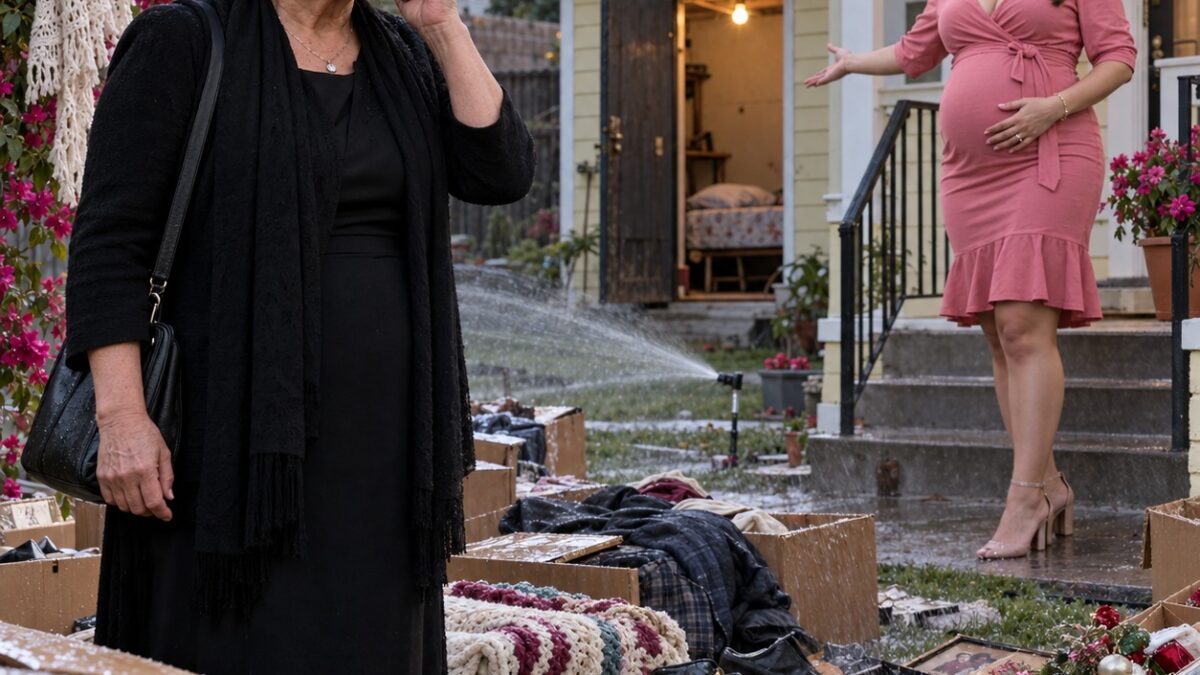
PART2
Mr. Mendez answered on the third ring.
“Carol?”
He knew where I had been.
“Are you home?”
“Yes.”
“How was Grace’s service?”
I looked at Danielle.
“We’ll talk about Grace later.”
Something in my voice changed his.
“What happened?”
“I need an appointment tomorrow.”
“Are you safe?”
That question almost broke me.
I swallowed.
“Yes.”
“Eight-thirty.”
“I’ll be there.”
When I hung up, Danielle crossed her arms.
“What exactly are you planning?”
“I’m tired.”
“That’s not what I asked.”
“I heard you.”
She stepped closer.
“This house belongs to Robert.”
I looked at her.
“And I’m his wife.”
“Congratulations.”
Her jaw tightened.
“So if you want to keep staying here, you follow our rules.”
I could have argued.
I could have told her I had paid for the house myself after forty years cleaning other people’s offices, schools, medical buildings and banks.
I could have reminded her that Robert had not contributed one dollar toward the purchase.
Instead, I nodded.
“All right.”
That surprised her.
“You understand?”
“Perfectly.”
Then she added that there was no room for my food in the refrigerator and she did not want me using the kitchen at odd hours.
The baby needed peace.
Her pregnancy required routine.
I listened.
Then carried what I could salvage from the lawn into the utility room.
I closed the door.
And cried.
Not politely.
Not a few dignified tears.
I folded over on that miserable bed and cried so violently my chest hurt.
Grace.
Ernesto.
My mother.
My house.
My son.
Especially my son.
Robert had once made me a Mother’s Day card that said:
My mom can fix anything.
I had kept it for thirty years.
Now I wondered whether I had spent too long fixing things for him.
That night I waited for his car.
Eleven fifteen.
Voices.
Danielle laughing.
I waited another forty-five minutes.
No knock.
No:
Mom?
No:
How was Aunt Grace?
At midnight, I walked into the house barefoot.
The hallway tiles were cold.
I knocked on the master-bedroom door.
“Robert.”
Silence.
Again.
“Son?”
The door opened five inches.
My oldest boy looked through the gap.
Forty-one years old.
Tired.
Thinner than I remembered.
“Mom, it’s midnight.”
“I know.”
“What’s wrong?”
For one second I honestly thought he was joking.
“Your wife threw my belongings onto the lawn.”
He rubbed his eyes.
“Mom.”
“She put me in a storage room.”
“Utility room.”
“Thank you for correcting me.”
“Danielle needs the bedroom.”
“She told me she is pregnant.”
He looked down.
“I was going to tell you.”
“When?”
“You were dealing with Aunt Grace.”
“I just buried her.”
“I know.”
“No, Robert.”
My voice broke.
“I don’t think you do.”
He sighed.
“Can we talk tomorrow?”
I stared.
“Did you know she was moving my things?”
He did not answer immediately.
That was the answer.
“Robert.”
“She said you had too much stuff.”
“Did you know?”
“Yes.”
Something inside me went very quiet.
“And you allowed it.”
“Mom, I’m trying to keep peace.”
“With whom?”
“Danielle is my wife.”
“And I am?”
“Don’t do this.”
“What am I?”
“You’re my mother.”
“Then why am I sleeping beside bags of cement?”
“She’s pregnant.”
“And?”
“She’s my priority now.”
I closed my eyes.
Years earlier, I had taught Robert that when he married, his wife should come first.
I meant:
Protect your marriage.
Do not let your mother interfere.
Build your own household.
I had never meant:
If your wife humiliates the woman who raised you, help her move the boxes.
“Not like this.”
I whispered.
“Mom, please.”
He started closing the door.
“We’re exhausted.”
“Robert.”
“Tomorrow.”
The door shut.
I stood there staring at white paint.
My son had just closed a bedroom door in my face in the house I bought.
I returned to the utility room.
And stopped crying.
At two in the morning, I opened an old notebook.
I kept records of household expenses.
Always had.
Poor people learn bookkeeping without calling it bookkeeping.
You remember every electric bill because one forgotten bill can turn off the lights.
When I allowed Robert to live in the house after marrying Danielle, I told him:
“Keep me informed about major expenses.”
At first he did.
Roof repair.
Water heater.
Property tax.
Then Danielle arrived.
Receipts stopped.
Conversations changed.
I flipped through my notes.
January.
$4,500.
Living room remodel.
February.
$5,200.
Furniture.
March.
$3,800.
No description.
April.
$6,100.
Miami trip.
May.
$4,800.
June.
$5,400.
July.
$7,300.
August.
$7,900.
Over forty-five thousand dollars.
My hands started shaking.
Robert earned decent money as an engineer.
But not enough for that.
Then I remembered the emergency savings account.
Almost sixty thousand dollars.
My retirement severance.
Money I had saved in case of surgery, illness, roof failure, disaster.
I had given Robert a linked debit card.
“If there is ever a real emergency.”
I found the latest statement.
Balance:
$8,954.
I stared.
Then sat down on the floor because my knees stopped working.
More than fifty thousand dollars nearly gone.
While I was in Phoenix helping Grace die.
I felt ashamed.
That was my first reaction.
Which makes no sense.
I had been robbed of trust, yet somehow I felt stupid for trusting.
Then I looked through the tiny window toward my neighbor Lucy’s kitchen.
Light.
Lucy baked biscuits before dawn to sell.
Widow.
Sixty-nine.
Hard hands.
Soft heart.
I put on a robe and walked over.
She opened immediately.
“Carol?”
Then saw my face.
“Oh, honey.”
She gave me coffee before questions.
Finally I asked:
“Have you seen anything strange at my house?”
Lucy hesitated.
That hesitation told me more than words.
“What?”
“Danielle spends.”
“I know.”
“No, baby.”
Lucy leaned forward.
“A lot.”
Different cars.
Designer bags.
Deliveries.
Then Lucy said:
“There’s something else.”
“What?”
“Two weeks ago, men came with a truck.”
My stomach tightened.
“What did they take?”
“Furniture.”
I froze.
“The old carved set.”
My mother’s furniture.
Hand-carved mahogany.
Family pieces brought from Philadelphia decades earlier.
The table where I taught Robert to read.
The sideboard my mother polished every Sunday.
“Danielle stood outside counting cash.”
The coffee cup slipped from my fingers.
Shattered.
Lucy jumped.
I barely noticed.
“How long?”
“About two weeks.”
I returned home at dawn.
The sky turning gray.
And that was when I remembered something Danielle did not know.
Something Robert had apparently forgotten.
The house was still legally mine.
Three years earlier, I had told Robert I wanted him to have it.
We discussed transferring title.
He never completed the paperwork.
No final deed.
No recorded transfer.
Only permission.
I had given him my home emotionally.
Legally, I had not.
At 8:30, I walked into Manuel Mendez’s office wearing the black dress from Grace’s funeral.
He hugged me.
Then I put everything on his desk.
Photographs.
Bank statements.
Notebook.
Deed.
He listened for almost an hour.
When I finished, he leaned back.
“Carol.”
“Yes?”
“The house is yours.”
“I gave it to him.”
“You intended to.”
He tapped the deed.
“But title remains in your name.”
My breath changed.
“He told Danielle it was his.”
“That does not change the deed.”
Then he examined the bank account.
“Did you authorize these transfers?”
“No.”
“Is Robert a joint owner?”
“No.”
“Authorized card user?”
“Yes.”
“That complicates things, but it does not automatically mean he had permission to spend fifty thousand dollars on whatever he wanted.”
“I don’t want my son arrested.”
“I didn’t say arrested.”
Manuel’s voice softened.
“You need leverage before you decide mercy.”
That sentence stayed with me.
We changed every password.
Bank.
Email.
Financial accounts.
Canceled the debit card.
Documented the sold furniture.
Then he said:
“You have two choices regarding the house.”
“Eviction?”
“That is one.”
“And the other?”
“Formal tenancy.”
“Rent.”
“Yes.”
I stared at him.
“My son.”
“Your son placed you in a utility room in your own home.”
That ended the hesitation.
Manuel also reminded me of something else.
The small apartment Ernesto had left me in the old factory district.
I had rented it for eighteen hundred dollars a month.
That income went into a separate maintenance account.
Robert did not know.
Neither did Danielle.
“You can live independently.”
Manuel said.
The sentence frightened me.
I had cared for people my entire life.
Children.
Husband.
Mother.
Grace.
Living alone at sixty-seven felt almost selfish.
Then Manuel asked:
“What do you actually want?”
I thought.
Not revenge.
Not prison.
Not seeing Danielle homeless.
I wanted my name returned to my own life.
“I want justice.”
I said.
“And respect.”
“Then we start there.”
That evening I returned to Jakaranda Street.
There were cars in the driveway.
Danielle had invited her parents.
Beatrice and Frank Armstrong.
Family conference.
Of course.
Danielle wore pale pink.
Robert wore a shirt too tight at the neck.
Frank Armstrong shook my hand like he was negotiating a contract.
“Carol.”
He began over dinner.
“There have been misunderstandings.”
My fork stopped.
“Misunderstandings.”
“Danielle says you feel displaced.”
Beatrice smiled.
“You have to understand young families need space.”
I looked at Robert.
He stared at his food.
Then came the retirement-home suggestion.
“Very nice communities.”
Beatrice said.
“Activities.”
“People your age.”
That was the plan.
Not just the utility room.
Remove me.
Use the bedroom.
Control the house.
Keep the savings.
When I refused, Frank shifted to finances.
“Danielle mentioned some confusion with the bank accounts.”
There it was.
They knew the card had stopped working.
“No confusion.”
I said.
“I changed the passwords.”
Danielle dropped her fork.
“Why would you do that?”
“Because the accounts are mine.”
“That money was for the family.”
“Whose family?”
“Ours.”
“Forty-five thousand dollars in eight months.”
Her face changed.
“What did you spend it on?”
“House improvements.”
“Miami improved the house?”
Silence.
I stood.
“And while we’re discussing my property, where is my mother’s furniture?”
Robert finally looked up.
Danielle snapped:
“Those old pieces?”
“You sold them.”
“They were useless.”
“How much?”
Nobody answered.
My voice got louder.
“How much?”
Robert whispered:
“Fifteen hundred.”
I almost lost my balance.
The set was worth far more.
But value was not the point.
“My grandmother brought that furniture to this city in 1952.”
I said.
“My mother polished it until her fingers hurt.”
“I taught your husband to read at that table.”
Danielle rolled her eyes.
“Carol, they were objects.”
“So are your handbags.”
Her face hardened.
“Sell those.”
Then I said:
“The house is still mine.”
Silence.
True silence.
Danielle laughed once.
“What?”
“Title never transferred.”
Her head turned slowly toward Robert.
“Tell me she’s lying.”
Robert put his face in his hands.
She screamed.
“You told me you owned this house!”
“I thought—”
“You promised me!”
Frank stood.
Beatrice went pale.
And then Danielle said the sentence that told me more about her marriage than anything before it.
“I married you because you had assets!”
Robert looked as if she had slapped him.
I felt almost sorry for him.
Almost.
Frank pointed at me.
“A real mother would never do this to her son.”
I looked at him.
“A real mother teaches consequences.”
Then I went to the utility room.
At eleven, Robert pounded on my door.
“Mom.”
I did not answer.
“Please.”
I opened it eventually.
He looked wrecked.
“Don’t take the house.”
I stared.
Not:
I’m sorry you slept here.
Not:
I’m sorry about Grace.
The house.
“Robert.”
“I’ll fix it.”
“You allowed your wife to put me in this room.”
“I didn’t know she would throw everything outside.”
“But you knew she was taking the bedroom.”
“Yes.”
“You knew she sold furniture?”
“No.”
“You knew she was using the card?”
“I knew some.”
“You closed the door in my face.”
His eyes filled.
“I’m sorry.”
Then he got on his knees.
I hated that.
Not because I enjoyed seeing him humbled.
Because he was still trying to produce the correct gesture instead of understanding the damage.
“Stand up.”
“Mom—”
“Stand.”
He did.
“I am not throwing you onto the street.”
Relief.
Too quick.
“But tomorrow you come with me to Mr. Mendez.”
His face tightened again.
“You and Danielle will sign a real lease.”
“Rent?”
“Yes.”
“And the money?”
“Returned.”
“Mom, we don’t have—”
“Then you will repay it over time.”
He nodded because he was afraid.
Fear is not change.
I knew that now.
At Manuel’s office the next morning, Danielle came wearing sunglasses and carrying a tissue she never used.
Manuel laid out the deed.
House:
Mine.
Bank transfers:
$45,300.
Furniture:
Unauthorized sale.
Danielle argued until Robert admitted the truth.
Then Manuel explained their options.
Thirty days to leave.
Or formal lease.
I surprised even myself.
“Twelve hundred a month.”
Robert stared.
“And one thousand monthly toward repayment.”
“That’s twenty-two hundred.”
“Yes.”
“We can’t afford that.”
I looked at Danielle.
“Then two adults will need two incomes.”
“I’m pregnant.”
“So was I while cleaning floors.”
Her eyes turned vicious.
“You’ll never meet this baby.”
Pain shot through me.
She saw it.
And smiled.
“If you do this, you die alone.”
I wanted to surrender right then.
That was the old Carol.
The woman terrified of losing love.
Then I thought of my wet photographs on the lawn.
“If that is the cost of dignity.”
I said.
“I will pay it.”
They signed.
When we left, I felt no victory.
Only grief.
Three days later, my heart gave out.
Not completely.
Enough.
I woke in a hospital with an IV and a nurse telling me I had suffered a minor heart attack.
“Your neighbor found you.”
Lucy.
Of course.
Then the nurse said:
“Two of your children are outside.”
“Robert?”
She hesitated.
“No.”
Marianne had flown from Denver.
George from Austin.
Robert lived twenty minutes away.
He had been notified seven hours earlier.
He never came.
That hurt worse than the heart attack.
Marianne entered first.
My daughter.
Lawyer.
Always organized.
Her blouse was buttoned wrong.
George followed with hair sticking up and tears already falling.
They hugged me carefully.
Then demanded the truth.
So I told them.
Everything.
The lawn.
Utility room.
Money.
Furniture.
Danielle.
Robert.
By the end, Marianne was pacing.
George was swearing.
“Why didn’t you call us?”
“I didn’t want to burden you.”
Marianne stopped.
“Mom.”
“What?”
“You almost died because you were trying not to burden your children.”
I looked away.
The doctor later confirmed stress had contributed significantly.
Blood pressure dangerously high.
Medication.
Therapy.
Rest.
Then he asked what was causing the stress.
“My oldest son.”
I whispered.
He recommended no contact for at least three months.
Medical permission to step away.
I needed that more than I should admit.
When I left the hospital, I did not return to the utility room.
I moved into a small apartment near the old factory district.
One room.
Tiny kitchen.
Clean bathroom.
Sunlight.
Marianne bought curtains.
George ordered a proper mattress.
Lucy brought biscuits.
I bought plants.
For the first time in decades, every object around me had been chosen for me.
A week later, Manuel called.
“First payment arrived.”
“Rent?”
“Everything.”
$1,200.
Plus $1,000 repayment.
Then:
“Danielle has a job.”
I almost laughed.
“Where?”
“Department store perfume counter.”
The woman who said old things were useless was now standing eight hours a day selling expensive smells to strangers.
Life has humor.
Robert asked Manuel whether he could speak with me.
I refused.
Not yet.
Two weeks later, he found my apartment.
He knocked until I answered.
He looked terrible.
Weight gone.
Dark eyes.
“Five minutes.”
I said.
He sat on my couch.
“Danielle is destroying me.”
I almost closed the door.
“Robert.”
“I know.”
He rubbed his face.
“That sounded wrong.”
“Yes.”
“I’m not asking you to fix it.”
“Good.”
He apologized.
Really apologized.
Not only for the house.
The room.
The money.
The furniture.
The hospital.
The door he shut in my face.
Then he asked:
“Do you love me anymore?”
That question reached the part of me he had been trying to reach all along.
“I will love you until I die.”
He cried.
“But I don’t trust you.”
His head dropped.
“What do I do?”
“Grow up.”
He looked at me.
“Stop asking your mother to tell you how to solve your marriage.”
“Stop expecting me to repair the consequences of decisions you made.”
“Decide what kind of man you want to be.”
“And become him whether or not I forgive you.”
He nodded.
At the door, he asked:
“When the baby comes…”
I stiffened.
“Would you meet him?”
“If I am genuinely welcome.”
“You are.”
“Danielle decides that too.”
He left.
That night, Marianne called.
“Mom, something strange happened.”
“What?”
“Danielle’s mother contacted me.”
Beatrice.
The woman who had suggested a retirement community.
“She wants to meet.”
“Why?”
“She says she has information about Danielle.”
We met the next afternoon.
Coffee shop downtown.
Marianne beside me.
Beatrice arrived without makeup.
Hair uncombed.
Hands trembling.
She placed an envelope on the table.
Inside:
Credit-card statements.
Twenty-three thousand dollars in hidden debt.
Medical documents.
Screenshots.
Messages.
And a truth so ugly I initially refused to believe it.
Danielle was not pregnant.
She had never been pregnant.
According to the records and her own messages, she had a long-standing medical condition that made natural pregnancy impossible.
She knew.
Her mother knew.
Robert did not.
Beatrice cried.
“She lied.”
“Why?”
“Because she needed the house.”
I stared.
Beatrice showed me messages.
Danielle telling her mother she would claim a miscarriage after she was fully established in Robert’s home.
Messages about debt collectors.
Messages about positive pregnancy tests purchased online.
Then something worse.
“This isn’t the first man.”
Beatrice whispered.
“Three before Robert.”
Fake pregnancies.
Money.
Gifts.
Disappear.
My stomach turned.
“You knew?”
“I kept paying her debts.”
“Why?”
“She’s my daughter.”
I looked at her.
“So you protected her from consequences.”
The words hit both of us.
Because I had done my own version with Robert.
Not fraud.
Not crime.
But rescue.
Again.
Again.
Until adults remained children because mothers were too afraid to stop saving them.
Beatrice covered her face.
“I’m done.”
Marianne asked:
“Will you testify?”
“Yes.”
“Provide certified records?”
“Yes.”
“Tell your husband?”
Beatrice began crying harder.
“Yes.”
I thought about Robert.
My son had hurt me.
Terribly.
But he was also being deceived.
I called him.
“Come here.”
“Mom?”
“Bring Danielle.”
Forty minutes later they entered my apartment.
Danielle looked irritated.
“I left work for this.”
Marianne stood beside me with the folder.
Robert looked nervous.
I began:
“Your mother came to see me.”
Danielle’s face emptied.
Then everything happened quickly.
Medical records.
Messages.
Debt.
Past scams.
Robert read the screenshots three times.
Then looked at his wife.
“Tell me they’re fake.”
“They are.”
“Then show me a recent medical pregnancy test with your name.”
“I have one at home.”
“Let’s go to the hospital.”
She froze.
“Now.”
“No.”
“Emergency department.”
“No.”
“Danielle.”
His voice cracked.
“Please.”
She started crying.
Then whispered:
“I’m not pregnant.”
Robert made a sound I hope never to hear again.
A grown man discovering that the child he already loved had never existed.
He stood.
Sat.
Stood again.
“Why?”
“I needed the house.”
“Me?”
He pointed at himself.
“What about me?”
“I had debts.”
“You made me believe I was going to be a father.”
“I was going to tell you I lost the baby.”
Robert staggered backward.
I saw him remember everything at once.
The nursery.
My belongings.
The utility room.
His mother’s humiliation.
The money.
All justified by a child who did not exist.
“You let me destroy my relationship with my mother.”
Danielle screamed:
“You chose that!”
And she was right.
That mattered.
Robert looked at me.
I did not rescue him from it.
Danielle had manipulated him.
Robert had still made choices.
Both truths existed.
“Get out.”
He said.
“Robert—”
“Get out.”
She reached toward him.
He recoiled.
“Don’t touch me.”
Danielle turned toward me.
Hatred.
“This is your fault.”
“No.”
I said.
“Your lies simply reached the end of the road.”
“We could have been happy.”
“Happiness built on fraud isn’t happiness.”
She grabbed her bag and slammed the door.
Robert collapsed.
On my floor.
Crying like the little boy who used to wake after nightmares.
For months, I had imagined this moment.
My son finally understanding.
I thought it would feel satisfying.
It did not.
It felt like watching part of him die.
I sat beside him.
Slowly.
Then put my arms around him.
First time since Christmas.
“Mom.”
“I’m here.”
“I’m sorry.”
“I know.”
“I hurt you.”
“Yes.”
“I chose her.”
“Yes.”
“How can you forgive me?”
I rocked him.
“I can forgive you and still remember.”
He cried harder.
“That isn’t the same as restoring trust.”
He nodded against my shoulder.
“Then I’ll earn what I can.”
That was the sentence I needed.
Not:
Give me the house.
Not:
Fix me.
Not:
Tell me I’m good.
Earn what I can.
Robert filed for divorce.
Danielle fought.
The fake-pregnancy records, debts and messages destroyed most of her lies.
Beatrice testified.
Frank Armstrong learned everything and ended up hospitalized from the shock and stress.
Danielle eventually found herself largely alone.
I did not celebrate.
There is a dangerous pleasure in seeing someone who hurt you suffer.
I refused to build my healing around it.
Justice mattered.
But I had another life to live.
Robert moved into a small studio near work.
Paid his own bills.
Every month:
$2,200.
No missed payment.
No complaint.
Two months after the divorce, he came for coffee.
He looked healthier.
Not happy.
Clear.
“I think I understand why I married her.”
“Why?”
“Fear.”
“Of Danielle?”
“No.”
He looked down.
“Of not being enough.”
Ernesto died when Robert was fifteen.
Robert had watched me clean offices late at night.
Raise three children.
Save.
Sacrifice.
“I always felt I had to prove your suffering was worth something.”
His voice broke.
“I wanted the house.”
“Successful wife.”
“Perfect family.”
“I wanted you to look at me and know you hadn’t worked that hard for nothing.”
I felt tears rise.
“Robert.”
“And when Danielle wanted all those things, it felt like proof.”
He looked at me.
“Then I started sacrificing you to protect the picture.”
That was brutally honest.
“I betrayed everything you taught me because I was afraid of looking unsuccessful.”
I moved beside him.
“You were wrong.”
“I know.”
“But you are not required to spend the rest of your life being the worst thing you ever did.”
He stared.
“Really?”
“Change is what comes next.”
Three months later, Manuel called.
Danielle had been arrested.
After the divorce, she had apparently tried a similar scheme on another man.
Fake pregnancy.
Money.
Property.
This time, the man hired an investigator.
Past victims surfaced.
Beatrice cooperated.
Charges followed.
Manuel explained the details.
I listened.
Then asked one question.
“How is Robert?”
“He says it is no longer his problem.”
I smiled.
Good.
Not revenge.
Not obsession.
Separation.
Then Manuel said:
“He’s made every payment.”
“I know.”
“He wants to renegotiate.”
My body tightened.
“Less money?”
“No.”
“To see you.”
I went quiet.
“He says he misses talking to his mother.”
I swallowed.
“Tell him Sunday.”
“Dinner?”
“Pot roast.”
Robert arrived carrying flowers and chocolate cake.
Unnecessary.
Sweet.
We talked for hours.
Work.
Marianne.
George.
Grace.
His father.
Nothing dramatic.
Healing often looks almost boring from the outside.
Then Robert took an envelope from his backpack.
“Open it.”
Inside were legal papers.
I looked at him.
“What did you do?”
“The house.”
Title confirmation.
Waivers.
Documents making clear I held complete ownership.
No future claim from him.
No expectation.
“Robert.”
“It was always yours.”
“I meant it as a gift.”
“You gave too much.”
His voice shook.
“I accepted too much.”
“I want my own home someday.”
“One I buy.”
“Something I can stand inside and know nobody had to disappear so I could have it.”
I started crying.
“You don’t have to do this.”
“Yes.”
He smiled sadly.
“I do.”
“Not legally.”
“Personally.”
That difference mattered.
I signed what required my signature.
Manuel handled the rest.
Six months later, I moved back into Jakaranda Street.
Not because I had won.
Because I wanted to.
That distinction meant everything.
The utility room became storage again.
The stained folding bed went into a dumpster.
I stood there while George threw it away.
“Want to set it on fire?”
He asked.
“No.”
“Disappointing.”
I laughed.
Marianne helped repaint the kitchen.
Yellow.
Warm.
Robert repaired the fence.
Paid for it himself.
We could not recover my mother’s furniture.
That loss stayed.
Some consequences cannot be reversed.
So Robert found a local woodworker and commissioned a small mahogany table using photographs of the old one as reference.
When he showed it to me, I cried.
“It isn’t Grandma’s.”
He said.
“I know.”
“I can’t replace what I helped lose.”
“I know.”
“But maybe we can make something new without pretending it’s the same.”
That sentence stayed with me.
We placed the table near the window.
I kept one of Grace’s photographs on it.
Life after betrayal is often like that table.
Not restoration.
Rebuilding.
Different wood.
Same room.
One year after the day I returned from Phoenix, Marianne, George and Robert sat with me beneath the bougainvillea in my garden.
Lemonade.
Late-afternoon sun.
Robert had been coming every Sunday.
Never late.
Never asking for money.
Never treating access to me as something he had automatically earned.
I looked at my three children.
“Do you know what today is?”
Marianne shook her head.
Robert knew immediately.
His face fell.
“Mom.”
“No.”
I touched his arm.
“I’m not punishing you.”
Then I looked toward the lawn.
“Exactly one year ago, my suitcase was there.”
Nobody spoke.
“I thought I had lost everything.”
“My house.”
“My son.”
“My dignity.”
“My family.”
George asked:
“What do you think now?”
I smiled.
“I lost illusions.”
Robert wiped his eyes.
“I lost the idea that giving somebody everything guarantees they will value you.”
“I lost the belief that motherhood means accepting anything from your child.”
“I lost the fear that saying no makes me cruel.”
Marianne lifted her lemonade.
“Good things to lose.”
“Yes.”
I looked at Robert.
“And I found something.”
He waited.
“A son willing to become better after discovering how badly he had failed.”
He bowed his head.
“I’m still sorry.”
“I know.”
“You don’t need to apologize every Sunday.”
“Maybe every other Sunday?”
George laughed.
I did too.
That mattered.
Laughter in that garden.
A year earlier, I thought peace meant everyone staying together no matter what happened.
I know better now.
Peace is not lack of conflict.
Peace is knowing nobody in your home is allowed to erase you.
That night, after the children left, I walked alone through the house.
My bedroom.
Mine again.
But changed.
New bedding.
Different paint.
Grace’s photograph on the dresser.
Ernesto’s picture beside it.
The old nursery plans Danielle had made were gone.
No baby had ever existed.
But the pain of learning about that imaginary grandchild had been real.
I sat on the edge of my bed.
For a while I thought about Beatrice.
A mother who loved her daughter so desperately she covered debts and lies until the lies became dangerous.
I thought about myself.
A mother who gave Robert a house, emergency savings and endless forgiveness without demanding adult responsibility.
Different children.
Different mistakes.
Same fear beneath them.
If I stop saving my child, will my child stop loving me?
That question ruins many parents.
Because sometimes the most loving answer is:
Let them be angry.
Let them blame you.
Let them discover the bill has their name on it.
Let them make decisions.
Let them fail.
Let them rebuild.
That does not mean abandoning someone in danger.
When Robert was broken, I hugged him.
When he needed truth, I gave it.
If he had needed medical help, I would have gotten it.
But I stopped confusing help with removing consequences.
That saved both of us.
A few months later, Robert asked whether I regretted giving him the house in the first place.
We were repairing the porch rail.
I held the flashlight.
He held the drill.
“I never actually transferred it.”
“You know what I mean.”
I thought.
“No.”
He looked surprised.
“Why?”
“Because at that moment, I wanted to give you security.”
“That was love.”
“The mistake wasn’t giving.”
“What was?”
“Never checking whether the gift was making you stronger or weaker.”
He nodded.
Then smiled.
“So no more houses?”
“Absolutely not.”
“Cars?”
“Buy your own.”
“Vacation?”
“Maybe I’ll send you a postcard.”
He laughed.
Good.
He had begun saving.
Slowly.
He bought a used sedan.
Nothing impressive.
He loved it.
The first time it broke down, he fixed what he could and paid for the rest.
He called me afterward.
“Do you know what a transmission costs?”
“Yes.”
“Why didn’t anyone warn me?”
“Welcome to adulthood.”
He groaned.
I smiled for an hour.
Marianne once accused me of enjoying his financial inconveniences too much.
Maybe.
But there is something beautiful about watching an adult child discover competence.
Robert eventually bought a small condo.
He saved for the down payment for years.
The day he got the keys, he invited me over.
Two bedrooms.
Tiny balcony.
Ordinary kitchen.
He stood in the living room.
“What do you think?”
I looked around.
Then asked:
“Who owns it?”
He grinned.
“I do.”
“Who paid?”
“I did.”
“Then it is the most beautiful house I have ever seen.”
He hugged me.
No shame.
No debt hidden beneath the hug.
That was worth more than Jakaranda Street.
Danielle’s case moved through the system.
I followed almost none of it.
Beatrice sometimes called.
Her relationship with her daughter did not magically repair.
She entered counseling.
So did Robert.
So did I.
Therapy was not easy for me.
I had spent sixty-seven years believing strength meant carrying pain privately.
My therapist asked:
“When did you first learn that needing something from others was dangerous?”
I laughed.
“Do we have all afternoon?”
We talked about my father leaving.
My mother.
Poverty.
Ernesto’s death.
Grace.
How quickly I rushed to solve my children’s discomfort.
How terrified I was of being unwanted.
One day she asked:
“When Danielle put you in the utility room, what hurt most?”
“The disrespect.”
“More.”
“My son allowed it.”
“More.”
I cried.
“That maybe they were right.”
“About?”
“That I had become useless.”
There.
The shame beneath everything.
Old.
Widowed.
Retired.
No longer needed to raise children.
I had secretly wondered whether I was taking up space.
Danielle simply weaponized the fear already living inside me.
Healing required more than reclaiming property.
I had to reclaim value independent of usefulness.
That was harder.
I started volunteering twice a week at a community center.
Not because anybody needed me specifically.
Because I liked it.
I joined a walking group.
Took a pottery class.
Terrible at pottery.
Kept going.
Visited Marianne in Denver without offering to clean her kitchen.
That was growth.
Visited George in Austin and let him pay for dinner.
More growth.
I took myself to Phoenix one year after Grace died.
Alone.
Visited her grave.
Sat on the grass.
“Everything exploded after you left.”
I told her.
Wind moved across the cemetery.
I talked for almost an hour.
About Robert.
The house.
My heart attack.
Danielle.
Then:
“I think I’m okay.”
I cried.
“I wish you were here to see it.”
Grace had spent her last months telling me not to waste time.
I finally understood.
Time is not only wasted by laziness.
It is wasted by remaining where love is used to shrink you.
When I returned to Chicago, I removed several boxes from my house voluntarily.
Clothes I did not need.
Old kitchenware.
Papers.
But I chose.
That distinction transformed the act.
Danielle had called it a cleanout.
A year later, I really did one.
Not of people.
Of fear.
Old obligation.
Guilt.
The idea that every object had to stay because someone dead had touched it.
I kept what mattered.
Released what did not.
Including some anger.
Not all.
Forgiveness does not require amnesia.
One Sunday, Robert noticed the utility room door open.
He stopped.
“Can I go in?”
“Why?”
“I don’t know.”
I shrugged.
He walked inside.
Now shelves.
Garden tools.
Paint.
No bed.
He stood silently.
Then touched the wall.
“I can’t believe I let you sleep here.”
I stayed in the doorway.
“I can.”
He flinched.
“That sounded bad.”
“It is not punishment.”
I said.
“We have to be able to name what happened.”
“I keep wishing I could change it.”
“You can’t.”
He looked at me.
“So what do I do with it?”
“Remember enough that you never become that man again.”
He nodded.
Then asked:
“Do you ever trust me fully again?”
I considered.
“No.”
Pain crossed his face.
I continued.
“Not the way I trusted you before.”
He looked down.
“That trust was blind.”
I stepped closer.
“What we have now is better.”
He looked up.
“I trust you based on what you do.”
“Every Sunday.”
“Every payment.”
“Every truth.”
“Every boundary you respect.”
“That trust can grow.”
His eyes filled.
“Okay.”
“Okay.”
That became our relationship.
Not erased history.
Accumulated evidence.
Years later, Robert remarried.
Not quickly.
He dated a woman named Elena.
Nurse.
Divorced.
One teenage daughter.
The first time he brought her to dinner, Elena helped me clear plates without asking where my house came from.
Good beginning.
I watched Robert closely.
Not because I wanted to control.
Because habits reveal character.
He asked Elena before making plans.
She disagreed with him openly.
He did not collapse.
She teased him about his old sedan.
He laughed.
Later, before proposing, he came to me.
“Mom.”
“No.”
He stared.
“I haven’t asked anything.”
“You’re making that face.”
“What face?”
“The big question face.”
He laughed.
Then became serious.
“I want your blessing.”
I looked at him.
“For marriage?”
“Yes.”
“Do you love her?”
“Yes.”
“Does she respect you?”
“Yes.”
“Do you respect her?”
“Yes.”
“Can she support herself?”
He smiled.
“She earns more than I do.”
“Excellent.”
“Mom.”
“What?”
“I learned.”
“I know.”
He married Elena in a small ceremony.
No claims of pregnancy.
No property promises.
No performance.
I danced with my son.
At one point he whispered:
“Thank you for not giving up on me.”
I answered:
“I did give up on one version of you.”
He pulled back.
“What?”
“The one who thought love meant everyone else carrying him.”
He laughed.
“Fair.”
“And then you built someone better.”
He hugged me harder.
That is what makes the ending satisfying for me.
Not Danielle being arrested.
Not my house coming back.
Not the repayment.
Those things mattered.
But victory is not another person’s destruction.
Victory is refusing to be destroyed with them.
Danielle had tried to erase me.
She sold furniture.
Moved photographs.
Took my room.
Used my money.
But she did not actually have the power to remove my history.
My mother still existed in me.
Ernesto still existed in our children.
Grace still existed in the way I laughed when I was nervous.
Furniture can disappear.
People die.
Houses change.
Dignity is different.
You surrender dignity slowly.
One swallowed insult.
One closed door.
One silence.
Then one day you realize you are sleeping in a utility room because everybody has become comfortable with your surrender.
Reclaiming it can also happen slowly.
One photograph taken for evidence.
One lawyer called.
One password changed.
One boundary.
One hospital room where you finally admit:
My child is hurting me.
One apartment of your own.
One dinner where a son comes because he wants his mother, not her house.
That is how I rebuilt.
I remained on Jakaranda Street.
The walls stayed pale yellow outside.
I kept the bougainvillea.
It grew enormous.
Every summer, purple-red flowers covered the wall near the place where Danielle once piled my belongings.
People thought I should remove it because it reminded me.
I refused.
Why let a bad day own a beautiful plant?
That lawn saw humiliation.
Later it saw my grandchildren play.
Marianne’s children.
George’s.
Eventually Elena’s daughter sitting beneath the bougainvillea doing homework while Robert fixed the sprinkler.
Life reclaimed the location.
I liked that.
On the fifth anniversary of Grace’s death, the whole family came for dinner.
Robert brought pot roast.
Bad pot roast.
I said nothing until he asked.
“Well?”
“Needs salt.”
He laughed.
“You could lie.”
“I spent too many years doing that.”
Everyone at the table laughed.
Then Marianne raised a glass.
“To Aunt Grace.”
We toasted.
Then George said:
“To Mom.”
I groaned.
“No speeches.”
“Too late.”
He looked around.
“Five years ago, Mom thought being strong meant doing everything alone.”
“Now she knows strength means bossing all of us around equally.”
I threw a napkin at him.
More laughter.
Robert became quiet.
Then said:
“I’d like to say something.”
I immediately pointed.
“Careful.”
He nodded.
“Five years ago, I failed my mother.”
Silence.
“I don’t tell this story because I’m proud of the apology.”
“I tell it because I want my kids to know apologies are not enough.”
His eyes met mine.
“Change is what makes an apology real.”
I looked down because tears were coming.
He continued.
“My mother did not save me from what I did.”
“She loved me while making me live through the consequences.”
“That saved me more than money ever did.”
No one clapped.
Thank God.
We simply sat together.
Family.
Not perfect.
Real.
Later that night, after everybody left, I walked outside.
Stars.
Warm air.
Bougainvillea shifting in the breeze.
I thought about the Carol who came home from Phoenix wearing funeral black.
Her purse falling into grass.
Her hands trembling.
The humiliation.
If I could stand beside her now, I would not tell her:
Don’t cry.
I would not tell her:
Everything will be fine.
Some things were not fine.
Grace stayed dead.
My mother’s furniture stayed gone.
My heart was damaged.
My trust in Robert never returned to its innocent form.
I would tell her:
Pick up the photographs.
Take pictures of everything.
Call Manuel.
Then sleep when you can.
You do not have to solve your entire life today.
But do not go back inside and pretend this is acceptable.
That is what I wish older women understood.
Age does not make you furniture.
Motherhood does not cancel ownership of yourself.
Grandchildren are not bargaining chips.
A child can be your child and still be wrong.
A daughter-in-law can be pregnant—or claim to be—and still owe you respect.
Family does not mean the person who sacrifices most loses every vote.
And love is not proven by how much humiliation you can survive without leaving.
I was sixty-seven when I learned that.
Late?
Maybe.
Still in time.
I thought often about the first words Danielle said.
“Those old things are useless now.”
That sentence changed my life.
Because eventually I realized she was not talking only about clothes or furniture.
She was telling me how she saw age.
History.
People who no longer served her plan.
Useless.
The cruelest thing about that worldview is that everybody becomes old eventually.
Everybody stops being useful to somebody.
If human value depends on usefulness, none of us is safe.
So I changed the rule.
People do not need to earn dignity.
Dignity comes first.
Then boundaries protect it.
My house became mine again.
Not because the deed said so.
It always had.
Because I stopped behaving as though gratitude from my children was the price of occupying my own life.
Robert became my son again.
Not because blood automatically repaired what he did.
Because he returned differently.
He paid.
He apologized.
He stopped asking me to fix his marriage.
He got counseling.
He built his own home.
He respected closed doors.
He showed up.
Week after week.
Year after year.
Trust returned in layers.
That is the only reconciliation I believe in now.
Not tears.
Not promises made during panic.
Evidence.
I never met the imaginary baby Danielle used against me.
For months, that grief confused me.
How do you grieve someone who never existed?
But I had imagined holding that child.
Bought a tiny yellow blanket before the truth came out.
I kept it for a while.
Then one day I donated it to a women’s shelter.
A real baby needed it.
That felt right.
Years later, when Elena’s daughter had her first child, Robert became a grandfather by marriage before biology.
He adored that baby.
I watched him hold her in my living room.
Careful.
Awkward.
Tears in his eyes.
He looked at me.
“Life is strange.”
“Yes.”
“You okay?”
I knew what he meant.
The baby Danielle invented.
The grandmotherhood she threatened to withhold.
I smiled.
“I’m more than okay.”
He nodded.
No need to say more.
Love found another route.
It often does.
Manuel retired eventually.
At his retirement dinner, he introduced me to his wife as:
“The woman who made me rewrite a lease agreement while threatening to personally haunt my office if I went soft.”
“I never threatened haunting.”
“You implied.”
His wife laughed.
I thanked him.
Not only for the house.
For asking:
What do you want?
At sixty-seven, nobody had asked me that in years.
Not:
What do your children need?
What did Grace need?
What did Ernesto need?
What should the family do?
What do you want?
That question may have saved me as much as any deed.
My answer changed over time.
At first:
Justice.
Then:
Peace.
Then:
Life.
I traveled.
Not extravagantly.
Phoenix.
Denver.
Austin.
New Orleans with Lucy before arthritis made travel difficult.
We ate beignets and complained about humidity.
I took Grace’s photograph.
Set it on the hotel nightstand.
Lucy said:
“She would have loved this.”
“Yes.”
“And probably complained about the price.”
“Absolutely.”
We laughed.
Those moments mattered because Danielle had once made me believe my life was narrowing.
Utility room.
No kitchen.
No refrigerator space.
Be discreet.
Stay out of the way.
Instead, my world expanded.
That was revenge enough.
Actually, no.
I stopped calling it revenge.
Freedom is not revenge.
It is simply freedom.
On the tenth anniversary of Ernesto’s death, Robert came early.
We sat at the small reproduction mahogany table he had commissioned.
He traced the edge.
“I still think about the original.”
“So do I.”
“I’m sorry.”
“I know.”
He had said it hundreds of times.
Then:
“Dad would be ashamed of me.”
I shook my head.
“He would have been furious.”
Robert winced.
“Thanks.”
“But ashamed forever?”
“No.”
I looked at him.
“Your father believed people could repair things.”
“He spent his life repairing everything.”
“Cars.”
“Walls.”
“People less successfully.”
Robert smiled.
“He would have made you earn forgiveness.”
“I know.”
“And then he would have asked you to help with something heavy because apparently sons exist for lifting.”
We laughed.
Then Robert said:
“I wish he could see us now.”
I looked around.
“He can’t.”
That is one thing grief taught me.
I no longer pretend certainty.
“But we can live in a way that would make the love he gave us useful.”
Robert nodded.
“That’s enough.”
Yes.
Enough.
At seventy-two, my doctor told me my heart looked stable.
Medication.
Walking.
Less stress.
“Whatever you changed five years ago, keep doing it.”
I smiled.
“Evicted disrespect.”
He laughed because he thought I was joking.
Mostly.
My life became ordinary again.
That is the ending people underestimate.
Drama ends.
You need somewhere to live afterward.
Somebody must take blood-pressure pills.
Water plants.
Replace a roof.
Remember birthdays.
Cook Sunday dinner.
Peace is built from ordinary repetition.
Robert knocking.
Waiting.
Me opening.
Not because he owns access.
Because I want him there.
That difference is everything.
One Sunday he arrived late.
Twenty minutes.
I opened the door.
He looked horrified.
“I’m sorry.”
“Traffic.”
“I should have called.”
“Robert.”
“What?”
“You’re allowed to be late once without becoming evil.”
He stared.
Then laughed so hard he leaned against the wall.
I laughed too.
Healing also means consequences stop being expected everywhere.
He did not have to spend the rest of his life terrified that one mistake would send him away.
Boundaries work both directions.
They protect me.
They also define the path back.
At eighty, if I reach it, perhaps I will sell Jakaranda Street.
Maybe move somewhere smaller.
Maybe closer to Marianne.
If I do, Robert gets no vote unless I ask.
He knows.
More importantly, I know.
The house is no longer proof of victory.
It is simply a house.
That may be my greatest freedom.
I once thought reclaiming it would heal everything.
It did not.
Legal ownership cannot heal betrayal.
What healed me was discovering I could lose approval and remain whole.
I could disappoint my son.
Anger my daughter-in-law.
Let relatives call me selfish.
Live alone.
Ask for help.
Receive help.
Say no.
Change my mind.
Forgive without returning to the old arrangement.
Love someone I no longer trusted.
Trust them later after evidence.
Those things restored me.
The deed was paper.
Necessary paper.
But paper.
The night of the one-year anniversary, I stood under the stars and whispered:
“Thank you, Grace.”
The wind moved through the bougainvillea.
For a second, I could hear her laugh the way she used to when we were girls.
Maybe imagination.
Maybe memory.
Enough.
“You were right.”
I told her.
“Life is short.”
I looked through the kitchen window.
The small mahogany table.
Photographs.
My yellow walls.
My home.
Then:
“I’m living now.”
And I meant it.
Because a year earlier, Danielle had tried to clean me out of my own life.
She threw my history onto the grass.
Took my bedroom.
Used my savings.
Sold what belonged to my mother.
Then told me the remaining six feet of damp concrete was enough for an old woman.
She was wrong.
But the most important discovery was not that I owned the house.
It was that I owned the rest of my life.
No deed could give me that.
No son could take it.
No daughter-in-law could throw it onto a lawn.
I had to claim it myself.
So I did.
And years later, when Robert sits across from me every Sunday, sometimes telling me about work, sometimes complaining about his knees, sometimes helping me reach a shelf I could probably reach myself, I do not see the man kneeling outside the utility room begging me not to take his house.
I see a man who learned that a gift is not ownership.
That forgiveness is not permission.
That marriage is not an excuse for cowardice.
That a mother is not an endless account you can withdraw from.
And when he looks at me, he does not see an old woman taking up space.
He sees Carol.
His mother.
The woman who cleaned offices for forty years.
The woman who raised three children after becoming a widow.
The woman who survived burying her sister, betrayal, humiliation and a heart attack.
The woman who once thought love meant never closing a door.
And then learned sometimes the most loving thing you can do is close it, lock it, heal behind it—and only open it again when the person on the other side has finally learned how to knock.

