PART2:HOA Threatened to Put a Lien on My House—Then the County Plat Showed My Property Was 20 Feet Outside Their Boundary
PART2
Three days later, the certified letter arrived.
Heavy paper.
Association letterhead.
Formal language.
The kind of envelope designed to make a person feel behind before he even understands what he supposedly owes.
I signed for it at the door.
My daughter was doing homework at the kitchen table.
She looked up.
“Bad mail?”
“Maybe.”
“Taxes?”
“Worse.”
She made a face.
“What’s worse than taxes?”
“People pretending they are taxes.”
She had no idea what I meant.
Honestly, neither did I yet.
I opened the envelope.
The HOA cited landscaping violations.
An unapproved accessory structure.
Failure to cooperate with inspection.
Attached was a fine schedule with neat columns.
First offense.
Second offense.
Continuing noncompliance.
Administrative costs.
Legal escalation.
My address appeared under a heading identifying all properties within Phase Three.
That was the key.
Not my legal description.
Not my parcel number tied to a recorded covenant.
My address.
Addresses are useful.
They are not title instruments.
I read the letter once.
Then again.
Slower.
That was another habit from construction disputes.
The first read tells you what somebody wants you to feel.
The second tells you what they actually said.
The HOA kept referring broadly to “governing documents.”
“The Declaration.”
“Phase Three restrictions.”
“Association authority.”
But nowhere did the letter identify the recorded document attaching my particular parcel to that declaration.
No book and page.
No instrument number.
No annexation exhibit.
Nothing.
I put the letter beside my closing file.
Then I went outside.
My daughter followed.
“What’s an accessory structure?”
She asked.
I pointed toward the rear corner.
“The shed.”
“The little one?”
“Yes.”
“The one that came with the house?”
“Yes.”
She looked confused.
“How can it suddenly be illegal?”
“Good question.”
She was twelve.
Already better at jurisdiction than the HOA.
The first neighborhood cookout after that was awkward.
I almost skipped it.
Then decided not to.
There is a tendency, when people are making you feel unwelcome, to help them by disappearing.
I was not going to do that.
So my daughter and I went.
Hot dogs.
Paper plates.
Someone had a Bluetooth speaker playing old rock music.
Normal suburban life.
Until I walked toward the food table.
Conversations softened.
Not stopped.
Shifted.
That tells you everything.
One neighbor named Carl clapped me on the shoulder.
“Heard you’re already behind on compliance.”
He said it lightly.
Probably meant nothing hostile.
Still, the wording stayed with me.
Behind.
As though membership were a fact and I had simply failed to keep up with the responsibilities.
I smiled.
“Apparently.”
“Those guys are strict.”
“So I’m learning.”
“You’ll figure it out.”
Maybe.
But his comment showed me how association power often develops.
Not through law first.
Through repetition.
The board says you are a member.
A letter says you are a member.
The accounting system says you are a member.
Neighbors call you a member.
Soon everybody forgets to ask the only question that matters.
What recorded document makes you a member?
Assumption becomes repetition.
Repetition becomes culture.
Culture begins to feel like law.
But title does not work that way.
The second letter arrived two weeks later.
$150 added.
Continued noncompliance.
Willful refusal.
Immediate corrective action recommended.
The tone had changed.
Not:
Please contact us.
Now:
You are defying authority.
I still did not respond emotionally.
That irritated my brother when I told him.
“You’re just letting them fine you?”
“They can write any number they want.”
“That’s still a fine.”
“No.”
“It’s a demand.”
“Difference?”
“Authority.”
He groaned.
“You always do this.”
“Do what?”
“Turn normal human problems into contract seminars.”
Maybe.
But he understood once I explained.
Anybody can mail you an invoice for a million dollars.
The paper itself does not create the obligation.
The question is whether the sender has a lawful or contractual basis.
The third letter arrived before the second one had much time to age.
Cumulative amount:
$450.
Then the phrase:
Failure to remit may result in legal review and lien proceedings.
That was the first time I felt genuine anger.
Not fear.
Anger.
A lien is not an annoying yellow notice.
A lien can cloud title.
Interfere with refinancing.
Complicate sale.
Become expensive even if wrongful.
Threatening one without authority is not neighborhood theater.
It is serious.
Still, anger is not strategy.
I put the third letter in the growing file.
Then something happened that moved me from patient to active.
I was washing dishes one evening when movement behind the house caught my eye.
A man stood on the common trail beyond my rear fence.
HOA compliance polo.
Phone in hand.
He raised the phone over the fence slats.
Angled it downward.
Photographing my backyard.
He shifted.
Another photograph.
Then another.
I walked outside.
Did not shout.
He saw me.
Lowered the phone.
“Can I help you?”
“Compliance documentation.”
“For property you have not established authority over?”
He gave me a rehearsed smile.
“You can raise jurisdictional concerns with the board.”
“I already have.”
He walked away.
That night I wrote my first response.
Three sentences.
Nothing more.
I requested documentation demonstrating recorded covenant applicability to my specific tax parcel.
I asked for the recording book and page or instrument number.
And I asked them to identify the formal annexation instrument, if any, by which my parcel had been added to Phase Three.
Certified mail.
Return receipt.
No argument about the shed.
No argument about landscaping.
Because those issues were downstream.
First establish jurisdiction.
Without jurisdiction, the rest was noise.
Their reply came quickly.
Thick packet.
For about ten seconds, I thought perhaps they actually had the annexation.
Then I opened it.
Bylaws.
Twenty-eight pages.
Meeting procedures.
Voting rights.
Board elections.
Assessment collection rules.
Committee structure.
Useful documents.
Wrong documents.
Bylaws govern the operation of an association among people already subject to it.
They do not magically attach land to a declaration.
That comes from recorded covenants.
Declarations.
Annexation instruments.
Deeds.
Proper filings.
I searched the entire packet anyway.
Nothing.
No parcel-specific attachment.
No recorded annexation.
No legal description matching mine.
They had answered a title question with governance rules.
That told me one of two things.
Either they did not understand the distinction.
Or they hoped I did not.
I did not respond.
Silence can be useful.
People who rely on momentum often become uncomfortable when you refuse to participate in the emotional rhythm they set.
Letter.
Threat.
Deadline.
Fine.
Your panic.
Your payment.
Repeat.
I stepped out of the rhythm.
The president began copying the association attorney.
That changed the tone.
The next letter referred to:
“Formal enforcement.”
“Willful resistance.”
“Legal remedies.”
“Costs recoverable against owner.”
They still had not answered my question.
I read every line.
Then ordered records.
Full title history.
Certified subdivision plat.
Tax parcel confirmation.
Recorded declaration.
All amendments.
All supplemental declarations.
All annexation instruments touching Phase Three.
County recorder website first.
Then certified copies where needed.
The plat arrived in a large envelope.
Stamped.
County seal.
Recorded date.
Survey bearings.
Coordinates.
Lot lines.
I cleared the kitchen table.
My daughter brought her cereal over.
“What’s that?”
“Map.”
“Treasure?”
“Maybe.”
We spread it out.
Phase Three boundary ran in a straight measured line along the rear portion of the subdivision.
I found the neighboring lots.
Then my parcel.
And stopped.
There it was.
Not complicated.
Not vague.
No strange overlap.
No competing survey calls.
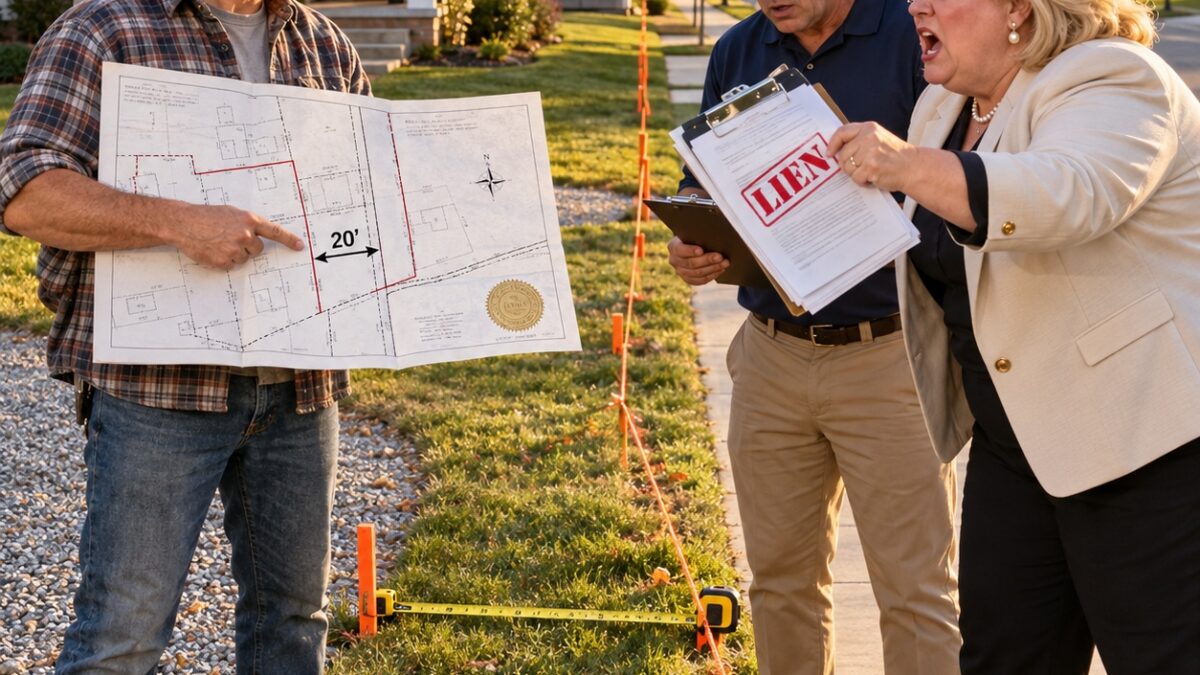
The Phase Three boundary terminated twenty feet before my parcel began.
Twenty feet.
My daughter leaned over.
“Is our house outside the line?”
“Yes.”
“How far?”
“Twenty feet.”
She grinned.
“So they’re wrong.”
“Looks that way.”
“Can you tell them?”
“Eventually.”
“Why not now?”
That was a fair question.
Because I wanted more than a map.
I wanted the entire chain.
The title history confirmed it.
Years before the HOA filed the Phase Three expansion, my parcel had been carved from an adjacent tract.
Separate metes and bounds.
Separate legal description.
Separate recording.
I traced every later filing.
No amendment annexing it.
No supplemental declaration.
No owner consent.
Nothing.
My property had never legally entered the HOA.
Then I found the fact that explained the confusion.
The previous owner had been paying dues.
Regularly.
For years.
I stared at that record longer than anything else.
There was the ghost.
The HOA had received payment.
Entered the address in its database.
Started treating the parcel like a member.
The previous owner never challenged it.
Neighbors saw the dues.
Board members inherited the assumption.
Years passed.
Habit hardened.
But voluntarily paying an invoice does not redraw a recorded plat.
It does not move a legal boundary twenty feet.
It does not manufacture an annexation instrument that was never filed.
Somebody should have checked.
Nobody had.
Until me.
I sat at the kitchen table with everything spread out.
Three violation notices.
The president’s letters.
The attorney’s correspondence.
Plat.
Title chain.
Declaration.
I could have mailed copies immediately.
One certified envelope.
End it.
Probably.
Instead, I decided to wait a little longer.
Not to trick them.
Not because I wanted more fines.
Because they had already threatened a lien.
I wanted the position fully documented before I forced the issue.
There is a difference between a mistaken first notice and a board persisting after a specific request for authority.
Every letter they sent after refusing to produce the annexation strengthened the record of what had happened.
Still, I was not foolish enough to rely on my own interpretation.
I made an appointment with a real-estate attorney downtown.
His name was Andrew Mercer.
Mid-fifties.
No dramatic office.
No giant mahogany desk.
Just shelves of binders and a conference table covered with yellow legal pads.
I walked in carrying one organized binder.
He looked amused.
“You brought tabs.”
“Yes.”
“Good tabs?”
“Color-coded.”
“Now I’m worried.”
I started with the plat.
Then title chain.
Then declaration.
Then letters.
Andrew read quietly.
Occasionally asked a question.
“Any deed covenant incorporation?”
“No.”
“Any recorded consent?”
“No.”
“Annexation instrument?”
“Couldn’t find one.”
He checked the index himself.
Then leaned back.
“Without a recorded annexation attaching this legal description to their declaration, they don’t have covenant enforcement authority over your parcel.”
I had expected that answer.
Hearing it from him still changed the room.
“Walk me through it.”
He did.
I asked again.
He did it again.
Not because I doubted him.
Because I wanted to understand every step well enough that nobody could confuse me later by talking louder.
Then Andrew said:
“There’s another issue.”
“What?”
“They’ve threatened a lien.”
“Yes.”
“If they actually record one without a legal basis, that creates a different problem.”
“How different?”
“Wrongful lien issues.”
He was careful.
Lawyers should be.
“Potential statutory claims depending on what they file, notice, intent, and state law.”
He pointed toward the letters.
“I would not let this drift much farther without putting the jurisdiction problem formally before them.”
“Board meeting next Tuesday.”
He looked at me.
“How do you know?”
“Association calendar.”
“Planning to attend?”
“Yes.”
“Good.”
Then he smiled slightly.
“Bring the tabs.”
I built one binder for myself.
One duplicate.
Certified plat.
Full title report.
County parcel record.
Recorded declaration.
Phase Three expansion filing.
Search confirmation showing no annexation instrument.
Correspondence.
Fine notices.
Photographs.
Everything clean.
No handwritten insults.
No sarcastic notes.
No headline reading:
PEOPLE WHO SHOULD HAVE CHECKED THE PLAT.
Tempting.
But unnecessary.
Then I looked at the board agenda online.
Midway down:
ESCALATED COMPLIANCE REVIEW — LOT 47
That was me.
They were preparing to authorize legal action.
Possibly collection.
Possibly lien work.
My daughter saw the agenda printed on the counter.
“Are you going to yell at them?”
“No.”
“Why not?”
“Because the map doesn’t need help.”
She thought.
“That sounds like one of your weird sayings.”
“Probably.”
Tuesday evening, about thirty homeowners attended.
More than usual.
Maybe word had spread about Lot 47.
Maybe people liked conflict when it belonged to somebody else.
The clubhouse had beige walls.
Folding chairs.
Coffee urn.
A table at the front for five board members and their attorney.
The president sat in the center.
Same polished confidence.
Same smile.
I took a seat in the third row.
Binder on my lap.
No conversation.
The meeting moved through ordinary business.
Landscaping budget.
Reserve study.
Pool repairs.
Then:
“Escalated compliance matter, Lot Forty-Seven.”
The president’s tone became formal.
She summarized the alleged violations.
Landscaping deficiencies.
Unauthorized structure.
Inspection refusal.
Outstanding penalties.
Failure to cooperate.
She used the phrase:
“Repeated unwillingness to comply with the community’s governing obligations.”
It sounded impressive.
That was the purpose.
She also stated that the board was considering authorizing further collection measures.
Possibly lien review.
Several neighbors turned toward me.
I felt my pulse increase.
I was not calm because I felt nothing.
I was calm because emotion was not useful yet.
When she finished, she said:
“Mr. — you may respond before the board considers action.”
I stood.
Picked up the binder.
Walked forward.
Set it on the table.
“I have one question before any vote is taken.”
The president leaned back.
“Go ahead.”
“Can you show me the recorded covenant instrument attaching my parcel to this association?”
She blinked.
“We’ve already provided the governing documents.”
“You provided bylaws.”
“The Phase Three expansion clearly includes your address.”
“I’m not asking about the address.”
I kept my voice level.
“I’m asking for the recorded instrument annexing my parcel’s legal description.”
The secretary opened her binder.
Pages shifted.
The president said:
“Your property has historically been treated as part of Phase Three.”
“I understand.”
“And prior owners paid dues.”
“I understand that too.”
“Then—”
“Payment is not the question.”
I opened my binder.
Removed the certified plat.
County seal visible.
“I’m asking about recorded jurisdiction.”
The association attorney looked at the document.
His expression changed before anyone else’s.
That told me I had the right paper.
I handed it to the secretary.
“Would you please read the relevant boundary description into the minutes?”
The president frowned.
“That’s unnecessary.”
The attorney spoke for the first time.
“Let her read it.”
Silence.
The secretary adjusted her glasses.
Then read.
Metes.
Bounds.
Bearings.
The line.
The endpoint.
The recorded Phase Three boundary.
I placed my parcel record beside it.
“My property begins twenty feet beyond that line.”
Someone in the audience whispered:
“Seriously?”
I continued.
“My parcel was separately created and recorded before the Phase Three declaration.”
Another document.
“I have searched the declaration, all recorded supplements, and county index.”
Another.
“There is no annexation amendment adding my legal description.”
The president said:
“The association’s records show—”
I looked at her.
“Your internal records do not change the county plat.”
That sentence made the room very quiet.
Not dramatic shouting.
Just recalibration.
People were watching the line between what they had assumed and what the public record said.
I continued.
“Without a recorded annexation, covenant enforcement does not attach to this parcel.”
The attorney was reading quickly now.
I did not accuse anyone of fraud.
Did not call them incompetent.
Did not demand resignations.
I added one sentence.
“Continuing to assess fines or threatening lien action after notice that the association lacks jurisdiction may expose the board to liability.”
The attorney leaned toward the president.
Whispered.
She whispered back.
He shook his head.
Another board member asked something I could not hear.
Then the attorney stood.
“We need a short recess.”
And just like that, authority became quiet.
The recess lasted nineteen minutes.
I know because I checked.
People approached me.
Carl from the cookout came first.
“So you really aren’t in the HOA?”
“That’s what the record indicates.”
“How does that happen?”
“Someone assumed.”
“For how long?”
“Years.”
He looked toward the board table.
“That’s crazy.”
“Mostly it’s paperwork.”
A woman I barely knew asked:
“Does that mean the previous owner gets dues back?”
“I don’t know.”
“Are you suing?”
“I haven’t decided anything.”
My daughter had stayed home with my sister.
I was glad.
Not because the meeting was hostile.
Because adults become strange when they discover something they accepted as obvious may be wrong.
Some got excited.
Some suspicious.
One man said:
“If he benefited from the HOA, he should still pay.”
Maybe.
That was a separate policy argument.
But benefits do not create recorded covenants by osmosis.
If the association wanted to offer a voluntary service agreement, fine.
That was not what they had done.
They had claimed mandatory authority.
Different thing.
The board returned.
The president looked different.
Same clothes.
Same posture.
Less certainty.
The attorney spoke instead.
“After reviewing documentation presented this evening, the board is tabling enforcement regarding Lot Forty-Seven pending further title verification.”
Tabling.
Not dismissing.
Lawyers love temporary language when facts arrive unexpectedly.
I did not object.
“No vote will occur tonight,” he continued.
“All collection and escalation activity regarding the matter will be suspended.”
The president said nothing.
No mention of the $450.
No mention of lien review.
No inspection demand.
Meeting moved to landscaping expenses.
Nobody listened.
The real meeting had already happened.
I went home.
Made tea.
My daughter came downstairs in pajamas.
“What happened?”
“They stopped.”
“For good?”
“Pending review.”
She frowned.
“That sounds like not for good.”
“Correct.”
“So what now?”
“We wait.”
“Again?”
“Again.”
She shook her head.
“You really like waiting.”
“No.”
I looked at the binder.
“I like letting documents finish conversations.”
She rolled her eyes.
Twelve-year-olds are immune to legal philosophy.
Six days later, a certified envelope arrived.
Association counsel.
Careful wording.
I opened it at the kitchen table.
The first paragraph reviewed the issue.
Second acknowledged further title examination.
Third mattered.
After review of recorded documents, the Association acknowledges that the property identified in Association records as Lot 47 is not currently subject to the Declaration of Covenants governing Phase Three.
I read it twice.
Then:
All fines and enforcement assessments previously issued against the property are hereby rescinded.
Then:
Future enforcement action will cease absent formal annexation in accordance with applicable recording requirements.
No apology.
No admission that the inspections were wrongful.
No statement saying:
We should have checked before threatening your title.
Just:
Administrative clarification.
That was enough for the immediate problem.
I handed the letter to my daughter.
She read.
“So we won.”
“I wouldn’t say that.”
“Why not?”
“Because there shouldn’t have been a fight.”
“That sounds like winning.”
Maybe.
The neighborhood learned before I told anyone.
Neighborhoods have communication systems no governing document can explain.
By evening, three people had texted.
Next morning, Carl stopped me.
“How’d you pull that off?”
“Pulled what off?”
“Got out of the HOA.”
“I didn’t get out.”
“You’re not paying dues.”
“I was never in.”
He stared.
“That sounds like the same thing.”
“It isn’t.”
That distinction mattered to me.
I had not found a loophole.
Had not exploited a technicality.
Had not “escaped.”
The boundary existed before I arrived.
The HOA simply failed to respect it because habit had replaced verification.
I told people one thing.
“Check your paperwork.”
That became my whole speech.
No anti-HOA crusade.
No social-media campaign.
No celebration.
Check your documents.
Because if mine were wrong in the database, perhaps someone else’s were too.
Andrew called after reading the letter.
“You have potential grounds to pursue fees.”
“For what?”
“Attorney time. Possibly costs tied to wrongful enforcement threats, depending on how aggressive you want to be.”
“I don’t.”
“Why?”
“This was never about getting paid.”
He paused.
“You sure?”
“Yes.”
“I’m your lawyer. I’m required to at least be slightly disappointed.”
I laughed.
Then became serious.
“I want one more thing.”
“What?”
“Written confirmation my parcel won’t appear in future budgets, compliance logs, governance documents, or assessment schedules unless there is an actual recorded annexation.”
“Good.”
He drafted it.
I sent the final certified letter.
No demand for damages.
No threat.
Just clarity.
The association responded within ten days.
Clear.
Unambiguous.
Lot 47 would be excluded from future HOA enforcement and assessment systems absent a properly executed and recorded annexation.
Closed.
My daughter and I walked the rear property line that evening.
The maple we planted had grown.
Not much.
Enough.
Near the edge was the survey marker.
Metal cap.
Easy to overlook.
She crouched.
“So this is basically what caused everything?”
“The marker?”
“The line.”
“Kind of.”
She stood.
“It’s weird.”
“What?”
“You can’t see the HOA line.”
“No.”
“No fence.”
“No.”
“But it still matters.”
“Yes.”
That was the lesson I wanted her to understand.
Not just about HOAs.
Boundaries are not always visible.
Authority is not always a uniform.
Ownership is not always where grass changes color.
The law often exists in words, measurements, filings, and signatures that nobody notices until conflict appears.
“What would’ve happened if you hadn’t checked?”
She asked.
I considered.
“The previous owner kept paying.”
“So you probably would have too.”
“Maybe.”
“And they would’ve kept fining you.”
“Probably.”
“And eventually everyone would think it was normal.”
That was exactly it.
I looked at her.
“You understand the whole story.”
She smiled.
“Can I have twenty dollars?”
Lesson over.
For a while, I expected retaliation.
Another letter.
A technical challenge.
Maybe a new theory.
Nothing came.
The president stopped walking past my property.
Compliance officers stopped photographing the shed.
The common trail became just a trail again.
I thought I would enjoy that more.
Instead, I found myself thinking about the previous owner.
Had he known?
Probably not.
Maybe someone sent him the first dues invoice years ago.
He paid.
Then another.
Then another.
The HOA recorded the payments.
Eventually everybody forgot the first question.
Is this parcel actually subject to the declaration?
There is a broader lesson there.
Systems inherit assumptions.
Every new employee, board member, owner, or contractor trusts whatever the spreadsheet already says.
A database entry looks official because somebody typed it before you arrived.
But old mistakes do not become true through age.
They become harder to notice.
A month later, the HOA attorney called Andrew.
Not me.
Professional courtesy.
They wanted to discuss whether I would voluntarily annex.
Andrew asked my opinion.
“No.”
“Immediately no?”
“Yes.”
“Want to hear their offer?”
“No.”
He laughed.
“Why?”
“I bought the property understanding the recorded restrictions.”
“Which do not include them.”
“Correct.”
“If you annex, they may offer reduced dues.”
“No.”
“You are a very exciting client.”
I did not hate the association.
That is important.
If circumstances changed one day and there were compelling benefits, perhaps I could consider joining voluntarily.
But not after being threatened into membership they never possessed.
Consent means more when somebody first tried to pretend consent was unnecessary.
Some neighbors were uncomfortable with my status.
Most were fine.
A few thought it was unfair that I drove on roads near the association while not paying assessments.
That question was more complicated.
Some roads were public.
Some common facilities were private.
I did not use private amenities.
If shared-service costs ever legitimately applied through easement agreements, I was willing to pay whatever those documents required.
Again:
Paper.
Not assumption.
One neighbor tried arguing at a mailbox cluster.
“You benefit from our landscaping.”
I looked at the flowers.
“How?”
“You see it.”
I laughed.
He did too.
Argument ended.
Reasonable people can disagree once nobody is threatening liens.
The president remained in office for another year.
That surprised some people who expected my story to end with her removal.
Why?
She made a serious mistake.
The board corrected it.
I did not uncover embezzlement.
No conspiracy.
No criminal plot.
No secret plan to steal my house.
That would have made a more dramatic story.
It would also have been false.
The truth was more ordinary and, in some ways, more useful.
They assumed.
Then defended the assumption too aggressively.
When challenged, they substituted bylaws for title records.
They escalated before verifying.
Then, when confronted with the recorded documents in a public meeting, their attorney stopped them.
The system eventually corrected itself.
Late.
After threats.
But it corrected.
I did not need to destroy everyone involved for that to matter.
At the next annual meeting, I did not attend.
Not my association.
That felt strangely satisfying.
Carl later told me there had been a long discussion about title verification.
The board had ordered a parcel audit.
Good.
Apparently two other properties had questionable records.
Not identical to mine.
One involved an incomplete annexation exhibit that was later corrected.
Another had been miscoded internally but was legitimately included in the declaration.
That was exactly why review mattered.
Not every discrepancy proves lack of authority.
You follow the chain.
You find the answer.
I liked knowing the HOA had learned that lesson.
The shed remained.
Same structure.
No one ever inspected it.
The landscaping remained.
Ironically, the HOA president complimented the maple once while walking past on the public trail.
She stopped.
Looked over.
“That tree has grown.”
I was surprised she spoke.
“My daughter planted it.”
“Nice placement.”
“Thanks.”
That was the entire conversation.
No apology.
No argument.
Sometimes coexistence is enough.
Months later, a new family bought the house next door.
Young couple.
First home.
They asked about the HOA.
I gave them the declaration.
Not my opinion.
The document.
The husband laughed.
“You carry this around?”
“No.”
“I have copies.”
“Of course you do.”
I pointed to their legal description.
“You’re inside Phase Three.”
He looked disappointed.
“Can’t I be twenty feet lucky too?”
“No.”
They joined.
Paid dues.
Followed rules.
No problem.
That was important.
My story was never:
Ignore your HOA.
It was:
Know whether the HOA actually governs you.
If it does, your obligations are real.
If it does not, its confidence cannot create them.
My brother still thought I should have sued.
He brought it up at Thanksgiving.
“You had them.”
“I didn’t want them.”
“Could’ve gotten attorney fees.”
“Maybe.”
“Damages.”
“For what actual damage?”
“Stress.”
I laughed.
“That’s every homeowner.”
He shook his head.
“You’re no fun.”
Maybe.
But litigation has costs beyond money.
Time.
Attention.
Energy.
Once I had what I wanted—written recognition of the boundary—I preferred my life back.
Victory that keeps you emotionally attached to the opponent can become another form of losing.
I wanted the HOA to become irrelevant again.
It did.
The letters went into a box.
Certified receipts too.
The binder stayed in my office.
Not displayed.
Not framed.
There were no newspaper articles.
No viral video.
Nobody was arrested.
A man challenged an HOA’s jurisdiction.
The public record supported him.
The HOA rescinded the fines.
That sounds boring.
Good.
Property law is often boring until someone ignores it.
A year later, I refinanced.
The title company pulled the records.
I waited.
Part of me expected the old HOA issue to reappear.
It did.
Not as a lien.
As an internal question.
“Is this parcel part of Phase Three?”
The closing agent asked.
I smiled.
“No.”
“How sure are you?”
I reached into my folder.
“Very.”
Certified plat.
Association acknowledgment.
Final confirmation.
She read.
Then laughed softly.
“You came prepared.”
“I’ve had experience.”
The refinance closed cleanly.
That moment validated something I had worried about during the dispute.
The HOA’s threats could have become a title problem if they had continued unchecked.
They did not.
Because the line was corrected while it was still only paper threats.
My daughter became fascinated with maps for a while.
Not forever.
Children move on.
But one school project involved local land records.
She chose our parcel.
Printed the plat.
Marked the twenty-foot gap.
Her teacher wrote:
Interesting boundary history.
That was an understated description.
She received an A.
I pretended the grade mattered more than the story.
One evening she asked:
“Were you scared when they said lien?”
“Yes.”
She looked surprised.
“You didn’t act scared.”
“Those are different things.”
“Why didn’t you tell me?”
“You were twelve.”
“I knew something was happening.”
I thought about that.
Adults often believe calm protects children from uncertainty.
Sometimes it just leaves them inventing explanations.
“I should’ve explained more.”
She shrugged.
“It’s okay.”
Then:
“What were you scared of?”
“Losing control of something I worked hard to own.”
“Could they have taken the house?”
“Not based on the documents we found.”
“But before you knew?”
“That was the fear.”
She nodded.
Then looked toward the maple.
“Good thing you read boring stuff.”
There it was.
My entire personality summarized by a teenager.
Years later, the lesson from that project still shapes how I handle contracts.
People sometimes tease me.
A contractor says:
“We always do it this way.”
I ask:
“Where does it say that?”
A supplier says:
“The city requires this.”
I ask:
“Which code section?”
A client says:
“The permit was approved verbally.”
I say:
“Send me the stamp.”
Not because everyone is dishonest.
Because confidence is cheap.
Verification is usually cheaper than correction.
I think back to that first knock.
Polo shirts.
Clipboards.
Association logo.
The president half a step forward.
“Mandatory compliance inspection.”
Everything about the scene communicated authority.
Uniform.
Language.
Records.
Procedure.
She probably believed it herself.
That is what makes these situations difficult.
People assume false authority always sounds suspicious.
It often sounds completely normal.
Sometimes the person asserting it inherited the error and never questioned it.
That is why your own preparation matters.
Not paranoia.
Preparation.
The HOA had my address.
The previous owner paid dues.
Neighbors assumed membership.
The board database classified the parcel.
Every internal sign pointed one way.
Only the recorded documents pointed another.
And real property runs through the recorded chain.
Not neighborhood consensus.
That was the technical heart of the dispute.
The emotional heart was different.
This house mattered.
It was not an investment property.
Not a rental.
Not something I bought to flip.
After years moving for work and a life that had never felt especially rooted, this was the first place my daughter referred to as:
“our house”
instead of:
“the place we’re living.”
We planted that maple because she believed she would be around long enough to watch it grow.
When somebody threatened a lien on the place based on an authority they could not prove, I felt more than legal irritation.
I felt protective.
That is why I worked so hard not to let emotion control the response.
The house mattered too much.
People imagine anger makes you stronger in disputes.
Sometimes.
More often, clarity does.
The president expected me to argue about dandelions.
I asked for recording numbers.
She expected me to defend the shed.
I asked for the annexation instrument.
She expected me to negotiate fines.
I asked where Phase Three ended.
She expected me to fear the word “lien.”
I got a lawyer.
That did not make me brilliant.
It made me disciplined.
There is a difference.
I also learned not to confuse administrative records with recorded rights.
The HOA’s database was wrong.
That does not mean databases are useless.
The bylaws were real.
They simply were not the document needed to answer my question.
The president was not lying when she said my address appeared in association records.
It did.
The mistake was believing an internal record could substitute for the legal event that should have created it.
That is a broader systems lesson.
A spreadsheet should reflect reality.
It does not create reality merely because people rely on it.
If the association had produced an annexation amendment, my story would have ended differently.
I would have reviewed it.
If valid, I would have complied or challenged specific rules through the correct process.
That possibility matters.
You do not ask for evidence only because you expect the other side cannot provide it.
You ask because the answer should change your behavior.
Otherwise you are not investigating.
You are performing.
Andrew Mercer once told me:
“The best client is one who wants the right answer more than the preferred answer.”
I said:
“That sounds like something lawyers say to charge people for disappointment.”
He laughed.
Maybe.
But he was right.
If the plat had shown my parcel inside Phase Three, I would not have liked it.
Still would have mattered.
Documents are useful precisely because they do not care what outcome you wanted.
Several years after the dispute, my daughter went to college.
The maple was taller than both of us.
On the morning we packed her car, she walked into the backyard.
Touched the trunk.
“Oliver’s doing okay.”
“You still call it Oliver?”
“Obviously.”
“You’re twenty.”
“So is Oliver emotionally.”
I did not ask.
We stood near the survey marker.
She looked toward the HOA side.
“Twenty feet.”
“Still.”
“You think they’ll ever try again?”
“No.”
“How do you know?”
“Because now everybody knows where the line is.”
That is the advantage of a corrected record.
Conflict becomes less likely once ambiguity is removed.
I eventually gave her copies of the important property documents.
She laughed.
“Is this my inheritance?”
“Part of it.”
“Most dads give jewelry.”
“I gave you a plat.”
“You’re unbelievable.”
She took it anyway.
Good.
One day the house may be hers.
I want her to know exactly what she owns.
Not what somebody tells her.
What the record says.
The HOA itself improved.
At least from what neighbors told me.
New title-verification process.
Outside counsel review before major lien action.
Better notice language.
Parcel identifiers used instead of addresses alone.
I had no role in designing those changes.
Good.
Organizations should be capable of learning without turning every corrected person into a permanent consultant.
They made a mistake.
The mistake exposed a weakness.
They strengthened the process.
That is how systems should work.
Once, a neighbor asked why I never demanded a public apology.
Because an apology would not have changed my title.
The rescission letter did.
The final jurisdictional confirmation did.
The corrected database did.
I am not against apologies.
They matter emotionally.
But I did not need one enough to keep fighting after the practical issue was resolved.
Sometimes people spend another year chasing language after they already obtained protection.
I preferred the protection.
I did receive one almost-apology.
Three years later.
The former president saw me at a grocery store.
She was no longer on the board.
We recognized each other.
She hesitated.
Then approached.
“I heard your daughter’s doing well.”
“She is.”
“That’s good.”
Pause.
Then:
“We should have verified the plat earlier.”
There it was.
Not:
I’m sorry.
But close enough to truth.
I said:
“Yes.”
She nodded.
“So should the previous board.”
“Yes.”
Another pause.
“I’m glad it got corrected.”
“So am I.”
We went our separate ways.
I felt no need to win the conversation.
That surprised me.
The older I get, the less interested I am in defeating people.
Correcting systems is more satisfying.
People leave.
Boards turn over.
Presidents resign.
Lawyers change firms.
Documents remain.
If the documents are accurate and the process respects them, personalities matter less.
That is healthy.
The most dramatic part of the story will always be the board meeting.
Thirty homeowners.
Agenda item.
President presenting me as a willful violator.
Certified plat on the table.
Secretary reading the boundary.
Twenty feet.
Attorney asking for recess.
People love that moment.
I understand.
It has structure.
Build-up.
Reveal.
Silence.
But the most important part happened before.
At closing.
When I noticed my parcel number was missing from the subdivision declaration.
And instead of forgetting that odd detail, I kept the papers.
Nothing dramatic.
Just attention.
Years later, that tiny memory prevented someone else’s administrative assumption from becoming my legal problem.
I tell younger contractors that all the time.
Keep records.
They groan.
Nobody likes records until memory becomes contested.
Then the person with documents becomes very popular.
The same is true in property ownership.
Deed.
Title policy.
Survey.
Plat.
Recorded easements.
Restrictions.
Closing statement.
Keep them.
Not because you expect war.
Because ownership is important enough to understand.
The first commercial renovation that taught me this lesson was expensive.
Three months lost.
Six-figure client gone.
At the time, I hated that experience.
Years later, standing in an HOA clubhouse with a plat in my hand, I realized the lesson had finally paid me back.
Authority lives on paper.
Not exclusively.
But when someone claims legal authority over land, there should be a record.
Tone is not a recording stamp.
A clipboard is not jurisdiction.
A database is not a covenant.
A history of payment is not an annexation.
And a threat of a lien is not the same as a valid lien.
Those distinctions saved me a lot more than $450.
The house is still mine.
Same rear shed.
Same yard.
Same maple.
The HOA line remains twenty feet away.
You cannot see it standing there.
Grass does not change color.
Birds cross without permission.
Rain falls on both sides.
But the legal boundary exists.
And because it exists, authority changes at that line.
That is not hostility.
That is order.
Good boundaries make good neighbors because everyone knows which decisions belong to whom.
One Saturday, years after everything, I was working near the maple when a new HOA compliance officer walked the common trail.
Young guy.
Probably had never heard the story.
He waved.
I waved back.
He looked toward the shed.
Then down at his tablet.
For one second, old instincts returned.
Here we go.
Then he smiled.
“Morning.”
“Morning.”
He kept walking.
I laughed at myself.
The database had been fixed.
My parcel did not appear.
The system had learned.
That was the ending.
Not fear.
Not eternal vigilance.
A correction that lasted long enough that the next employee did not even know there had once been a dispute.
That is what successful accountability looks like.
The problem becomes boring.
My daughter came home for Thanksgiving that year.
We walked the property after dinner.
She stopped beside the maple.
Much taller now.
“So,” she said, “tell me the HOA story again.”
“You know it.”
“I like the part where the lawyer panics.”
“He did not panic.”
“He called recess.”
“That’s not panic.”
“Legal panic.”
I laughed.
Then she pointed toward the survey marker.
“This?”
“Yes.”
“Still twenty feet?”
“Land hasn’t moved.”
“Good.”
She put her hands in her coat pockets.
“You know what I remember most?”
“What?”
“You didn’t yell.”
I was surprised.
“You were barely involved.”
“I watched you before the meeting.”
“What do you mean?”
“You were angry.”
“Yes.”
“But you kept organizing paper.”
I smiled.
“That sounds healthy when you say it like that.”
“It taught me something.”
“What?”
She looked toward the house.
“You don’t have to match somebody else’s volume.”
I did not answer immediately.
That may have been the best thing to come out of the whole mess.
Because that is exactly what the association expected.
Escalation.
They sent a notice.
Expected me to argue about the violation.
They raised the fine.
Expected me to negotiate.
They threatened legal action.
Expected fear.
Instead, I kept returning to the foundational question.
Show me where your authority begins.
That question was quieter than everything they sent.
It was also stronger.
The association president said:
“Your address is in our records.”
The county said:
Your parcel begins twenty feet beyond the recorded boundary.
The HOA said:
The previous owner paid dues.
The title chain said:
No annexation ever occurred.
The HOA sent bylaws.
The declaration search showed:
No instrument attaching my land.
The president said:
Willful noncompliance.
The attorney eventually said:
Enforcement suspended.
Then:
Fines rescinded.
Then:
Property not subject to the declaration.
That progression is why I never needed to scream.
Every document narrowed the disagreement until there was nowhere left for confidence to hide.
I sometimes wonder what would have happened if I had responded to the first inspection by letting them inside.
Probably photographs.
Violation file.
More notices.
Maybe I would have paid.
Maybe not.
But the important thing was not refusing inspection because I disliked inspectors.
It was refusing because they had not established the legal relationship giving them inspection rights.
That distinction matters.
If your property is lawfully in an HOA and the declaration grants reasonable inspection authority, simply yelling “private property” may not solve anything.
Read your documents.
Always.
My story is not a universal script.
It is a lesson about jurisdiction.
I also would not advise people to deliberately let fines accumulate just to create leverage.
I waited because I had strong documentary evidence, legal advice, and a board meeting approaching.
That was my situation.
Someone else may face different deadlines, state laws, or lien procedures.
Ignoring valid notices can become very expensive.
The right lesson is not:
Ignore the HOA.
It is:
Verify authority early and respond intelligently.
The previous owner never contacted me.
I considered reaching out.
Then decided against it.
Maybe he knew.
Maybe he did not.
Maybe he willingly paid because he liked community services.
His reasons were his.
The error was not that he paid.
The error was later treating his payment as legal proof binding future owners.
Personal behavior should not silently rewrite recorded property rights.
The final certified letter from the association remains in my closing folder.
Not as a trophy.
As part of the title history.
One day, when the house sells, the next owner will receive it.
They will not have to repeat my fight.
That may be the most valuable thing I accomplished.
Conflict solved privately can return if the institutional record remains wrong.
We corrected the record.
Future owner protected.
That is better than an apology.
The maple tree is large now.
My daughter jokes that it is worth more emotionally than the house.
Maybe.
We planted it when she still had to stand on a bucket to help position the root ball.
She lives several hours away now.
When she visits, we usually end up in the backyard.
The tree has crossed no legal boundaries.
Good citizen.
One evening, she rested a hand against the trunk.
“Funny that all this almost became an HOA issue.”
“It was an HOA issue.”
“No.”
She shook her head.
“It was a paperwork issue pretending to be an HOA issue.”
I stared at her.
“You’ve become annoying.”
“Genetics.”
Fair.
There is wisdom in that description.
The people on my porch were not monsters.
They were people carrying an unverified assumption inside an institution.
The dangerous part was how quickly institutional confidence turned the assumption into threats.
Inspection.
Fine.
Second fine.
Lien language.
Attorney.
All before anybody pulled the plat.
That is the cautionary part.
Organizations should verify jurisdiction before enforcement, not during litigation.
Homeowners should verify obligations before surrender, not after a lien.
Everybody benefits when the foundational question is answered first.
I did not defeat the HOA.
I corrected it.
I still believe that.
Some people prefer the dramatic wording.
“Man beats HOA.”
“Homeowner humiliates board.”
“HOA forced to surrender.”
Fine.
But humiliation was never the point.
At the board meeting, when the secretary read the boundary and the president’s confidence faded, I did not feel triumphant.
I felt relieved.
Because the people threatening my home finally saw the same document I had been seeing.
Once everyone shares the same facts, conflict has a chance to become administrative instead of personal.
That is what happened.
They reviewed.
They wrote.
They rescinded.
Done.
If they had recorded a wrongful lien, I would have fought harder.
If they had ignored the plat, I would have litigated.
If they had continued photographing the property after acknowledgment, I would have acted.
Boundaries require enforcement when somebody refuses to respect them.
But they did respect it once counsel verified the record.
So I stopped.
Proportional response.
That matters too.
Winning should not make you addicted to escalation.
The whole experience changed how I see official-looking paper.
Not to distrust it.
To classify it.
Notice.
Demand.
Invoice.
Contract.
Recorded instrument.
Court order.
Different things.
Different weight.
People often panic because all formal paper feels equally powerful.
It is not.
Learn the hierarchy.
Ask the basis.
That knowledge can turn fear into questions.
Questions are manageable.
At work, years ago, somebody trusted a handshake instead of a zoning record.
It cost us months.
At home, an HOA trusted years of payments instead of an annexation record.
It almost cost me far more.
Same mistake.
Different setting.
Assumption replacing filing.
The lesson followed me until I finally learned to recognize it immediately.
Today, if someone asks me how I “beat” the HOA, my answer disappoints them.
“I ordered the plat.”
That is all.
No secret hack.
No revenge plan.
No politician cousin.
No judge friend.
No viral confrontation.
I ordered the plat.
Then the title history.
Then I paid a lawyer to tell me whether I was reading it correctly.
Then I asked one question in public.
Show me the recorded document.
They could not.
Everything after that was paperwork cleaning up paperwork.
That is why the twenty feet matter.
Not because twenty feet is a dramatic distance.
It is tiny.
A pickup truck is longer.
You could throw a baseball across it.
Standing in my backyard, you cannot feel the legal change.
Yet those twenty feet were the difference between:
Mandatory inspection.
And no inspection authority.
Fine.
And no fine authority.
Lien threat.
And no covenant basis for lien enforcement.
Membership.
And no membership.
Sometimes enormous consequences live inside very small measurements.
My name does not matter to this story as much as the parcel number did.
Lot 47.
That was how the board referred to me.
Fine.
Property law often reduces people to descriptions.
Coordinates.
Bearings.
Book.
Page.
Parcel.
That can feel cold.
But in this case, the cold precision protected something deeply personal.
My home.
My daughter’s room.
The maple tree.
The first place in years that felt anchored.
The paperwork protected the life behind it.
That is why I respect it.
If there is one thing I would tell any homeowner after what happened, it is this:
Do not let somebody else’s certainty substitute for your own understanding.
That does not mean assume everyone is wrong.
It means know what document creates the authority being asserted.
If the HOA is valid, understand the declaration.
If an easement crosses your land, find the recording.
If somebody claims a setback, check the plat.
If somebody threatens a lien, get qualified legal advice early.
And keep your closing file.
Seriously.
Keep the file.
The day after my daughter moved into her first apartment, she called me.
“Dad?”
“What happened?”
“My landlord says I can’t put shelves up.”
“Lease?”
Pause.
“I knew you were going to say that.”
“What does it say?”
“I haven’t checked.”
“Check.”
She groaned.
“You ruined me.”
“No.”
“Normal people just ask.”
“And then?”
“Fine.”
Ten minutes later:
“Lease says small wall anchors are allowed.”
“There you go.”
“I hate that this works.”
I smiled.
The lesson had crossed generations.
Good.
One autumn afternoon, I walked the back line alone.
Leaves around the maple.
Survey marker partly covered.
I brushed it clean with my boot.
Twenty feet away lay the Phase Three boundary.
Invisible.
Quiet.
No conflict.
The common trail beyond the fence had people walking dogs.
One couple waved.
I waved.
Normal.
I thought about the president’s first words years earlier.
“Mandatory compliance inspection.”
Then the final letter.
“Property is not currently subject to the declaration.”
Same institution.
Same property.
Different understanding.
That is how much accuracy matters.
Authority can sound enormous when nobody has measured it.
It arrives with logos.
Titles.
Legal language.
Fine schedules.
Attorney names.
Lien warnings.
People naturally assume the person speaking has already checked.
Sometimes they have.
Sometimes they have not.
The only way to know is to ask for the foundation.
In my case, the foundation was a recorded line on a county plat.
Twenty feet short.
That was it.
Twenty feet.
Enough to stop three violation letters.
Enough to erase $450 in assessments.
Enough to halt lien threats.
Enough to turn a board meeting from an enforcement vote into a title review.
Enough to make an attorney whisper to a president:
Stop.
And in the end, the most satisfying sound was not applause.
There was no applause.
It was not the president admitting defeat.
She never did.
It was not my lawyer promising a lawsuit.
I declined.
It was the sound of the secretary reading the legal description aloud in a quiet clubhouse while thirty homeowners listened.
Bearings.
Measurements.
Boundary.
Then silence.
That silence was the moment assumption ended.
The paper had spoken.
Everything after that got quieter.
The fines disappeared.
The letters stopped.
The compliance officers stopped photographing my yard.
My parcel disappeared from their enforcement system.
The association went back to governing the land it actually governed.
I went back to living on the land it did not.
That was all I wanted.
Years earlier, I lost months of work because somebody trusted a verbal zoning approval that did not exist.
I promised myself I would never make that mistake again.
I did not know that promise would one day protect my home.
But it did.
So when people tell me I was unusually calm while the HOA threatened me, I always think the same thing.
I was calm because I had already learned the expensive version of the lesson.
Authority is loudest when people assume it.
It gets very quiet when someone finally measures the line.
And on my property, that line ended twenty feet before the HOA ever began.

