PART2:HOA Sent a Deputy and Locksmith to Take My Mountain Cabin—They Didn’t Know I Designed Federal-Grade Biometric Locks
PART2
I called it Watchwoman.
The name came to me around two-thirty in the morning while I was sitting in my basement workshop in Boulder surrounded by wiring diagrams, access-control modules, coffee cups, and the kind of anger that becomes useful only after you stop shouting.
I had spent seven years in the Air Force working on classified facility access.
After that, I moved into private security engineering.
Federal laboratories.
Courthouses.
Sensitive corporate facilities.
The occasional billionaire with too much money and too many enemies.
I held eleven patents.
Most of them would put a normal person to sleep.
I liked that.
Boring technology is often the technology keeping people alive.
Del Beaumont had assumed I was another absentee homeowner she could bury in paperwork.
That assumption was about to become expensive.
Friday afternoon, Mason climbed into my truck wearing his robotics hoodie inside out.
I did not ask why.
Experience had taught me that teenage boys sometimes create mysteries no adult needs solved.
He looked at the four bankers boxes strapped into the truck bed.
“Dad?”
“Yeah?”
“What’s all that?”
“Hardware.”
“For the cabin?”
“Yes.”
“What are we building?”
I started the truck.
“Documentation.”
He squinted.
“That sounds less cool than revenge.”
“It is less cool than revenge.”
“So we’re doing revenge?”
“No.”
He looked disappointed.
“Justice?”
“Documentation first.”
“Then justice?”
“Hopefully.”
He nodded toward the boxes.
“What’s in them?”
“Doors. Cameras. strikes. sensors. redundant cellular uplink.”
Mason stared.
“You’re turning Mom’s cabin into Fort Knox.”
“No.”
“Federal black-site cabin?”
“No.”
“Mountain Batman?”
“Get in the truck.”
He was already in the truck.
He grinned.
I hated how much that grin looked like Hannah’s.
Aspen Ridge sat on one hundred eighty acres of high-country meadow and timber.
Seventy-eight custom homes.
Most expensive.
Some ridiculous.
The community had been created in 1991 by a rancher who apparently distrusted committees enough to leave behind only four pages of covenants.
Four.
No industrial use.
No major exterior modification without review.
No rentals under thirty days.
That was basically it.
Then came committees.
Then subcommittees.
Then Del Beaumont.
By 2022, Aspen Ridge had a sixty-seven-page rulebook.
Architectural standards.
Sign standards.
Parking standards.
Mailbox standards.
Landscaping standards.
Noise schedules.
Exterior lighting restrictions.
Holiday decoration windows.
There were rules governing things nobody in the original development had imagined needed governance.
Del had been HOA president for nine years.
Early fifties.
Blonde hair from a salon in Aspen that probably charged by the individual follicle.
Expensive quilted vests.
Pearls.
Always pearls.
Her husband Travis Beaumont sold real estate.
Mostly inside Aspen Ridge.
That detail did not seem important when I first met them.
It would become the center of the entire case.
Mason and I reached the cabin around six that evening.
The aspens were blazing gold.
Hannah’s favorite time of year.
For five minutes, I almost forgot Del.
Then I looked at the front door.
Hannah’s green paint.
The place where a locksmith had been expected to remove my ownership with a screwdriver.
I opened the truck bed.
“Let’s work.”
We worked until nearly midnight.
First, exterior doors.
Steel-core units.
Biometric strikes.
Custom keyways.
Then cameras.
Eleven primary feeds.
Four exterior infrared units with independent cellular backup.
Three deck positions.
Two side approaches.
Driveway.
Additional interior cameras just inside the exterior entries.
Then perimeter coverage.
Every feed encrypted.
Time-stamped.
Uploaded in real time to two separate servers.
Denver.
Salt Lake City.
Mason held a flashlight while I wired one of the ceiling junctions.
He said:
“This is excessive.”
I looked down.
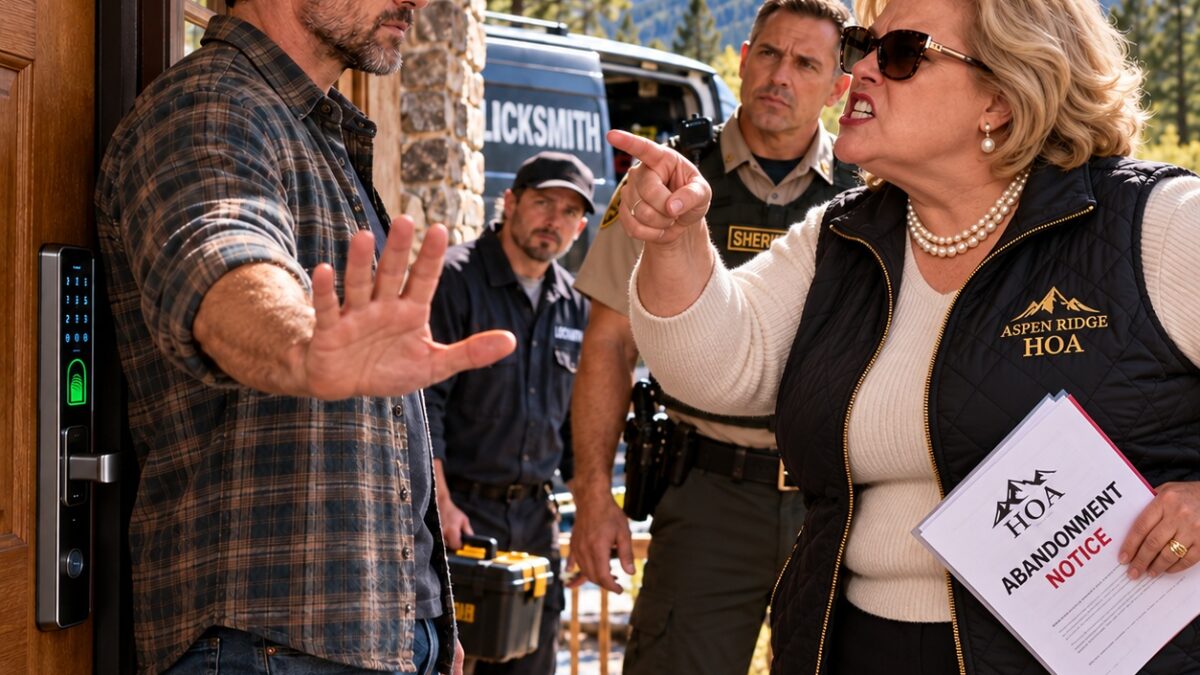
“A sheriff’s deputy stood on this deck while somebody tried to steal the house.”
“Fair.”
He handed me a screwdriver.
I mounted the Watchwoman controller inside the front entry.
Face scan.
Fingerprint authorization.
Entry logging.
Tamper alert.
Forced-door alarm.
Remote notification.
The system was not designed to hurt anyone.
It did not need to.
It was designed to remember.
That is more dangerous to certain kinds of people.
By Saturday morning, the cabin could identify every person approaching the main entrances and archive them before they touched the door.
I programmed three primary face profiles.
Mine.
Mason’s.
Del Beaumont’s.
Mason watched over my shoulder.
“You’re giving Del access?”
“No.”
“Then why is she in the database?”
“Analytics.”
He smiled.
“You’re tracking her specifically.”
“I’m documenting her specifically.”
“Right.”
He took a sip of terrible instant coffee.
“Documentation.”
Del arrived at eleven.
Of course she did.
No phone call.
No email.
No appointment.
Just her white SUV climbing the gravel.
Mason and I were on the deck.
I saw her before the driveway camera alert reached my phone.
She came up the steps with a clipboard.
Did not knock.
She tried the handle.
The biometric strike stayed locked.
She tried again.
Then pulled out keys.
Several.
Interesting.
She pushed one into the new keyway.
It did not enter.
Second.
Nothing.
Third.
Nothing.
She stepped back.
Saw the camera.
Her expression changed.
She walked to the side entrance.
Tried that.
Then the rear deck.
Then returned to the front.
Four minutes and seventeen seconds.
All recorded.
I leaned over the upper deck rail.
“Lose something, Del?”
She jumped.
Actually jumped.
For a moment, the president of Aspen Ridge looked like somebody had fired a starter pistol behind her.
Then the smile returned.
“Mr. Sutherland.”
“Reed is fine.”
“I was conducting an HOA inspection.”
“You were trying keys in my locks.”
“Under association authority.”
“You have none.”
She held up the clipboard.
“Our governing documents—”
“Del.”
I pointed toward the camera.
“There are eleven cameras recording you.”
Her eyes flicked upward.
“The access system identified you when you came onto the property.”
Her face went tight.
“You installed surveillance without architectural approval.”
“I installed security equipment after the president of the HOA sent a locksmith to change my locks.”
“That is not how the association views the matter.”
“I don’t care.”
Mason sat behind me trying very hard not to smile.
I continued.
“You’re trespassing. Leave.”
Her voice sharpened.
“This is community property.”
“No, it isn’t.”
“Lot Nineteen falls within Aspen Ridge.”
“The road does. The common meadow does. My deeded parcel does not become your living room because you were elected president.”
She stared.
Then turned.
Walked down the driveway.
Fast.
Halfway to her SUV, she turned.
“You’ll be hearing from our attorney.”
I lifted my mug.
“Looking forward to it.”
The Watchwoman incident report arrived before she reached the road.
BEAUMONT, DELPHINE — ATTEMPTED ENTRY — 4:17 — ARCHIVED.
I forwarded it to my attorney.
Eleanor Davenport.
Denver.
Brilliant.
Unimpressed by bullies.
Her reply came eight minutes later.
Good. Do not engage beyond what is necessary. Preserve everything.
Mason looked at me.
“This is cool.”
“This is evidence.”
“Sometimes same thing.”
I looked at him.
Hannah would have laughed.
Tuesday morning, my phone buzzed with a real-estate alert.
I was still at the cabin.
Mason had returned to Boulder for school.
I was eating cereal at the kitchen island.
The alert came from a listing service I used to monitor Aspen Ridge sales.
I opened it casually.
Then stopped chewing.
The photographs were mine.
My cabin.
My deck.
My meadow.
Three bedrooms.
Two baths.
Mountain retreat.
HOA auction.
Motivated sale.
Price:
$785,000.
My cabin was worth considerably more.
The listing agent:
Travis Beaumont.
I read it twice.
Then a third time.
The description stated that title would be conveyed by the Aspen Ridge HOA following abandonment forfeiture.
There is a specific physical sensation when anger crosses into disbelief.
Your ears get warm.
Your body gets cold.
Your brain slows down because it wants to verify reality before reacting.
I took screenshots.
Archived the listing.
Printed the page.
Then called Eleanor.
She answered:
“Morning, Reed.”
“Are you at a computer?”
“I’m an attorney. Of course I’m at a computer.”
“I’m sending you a link.”
“What is it?”
“My house.”
Pause.
“What about it?”
“It’s for sale.”
Longer pause.
“By you?”
“No.”
I heard her keyboard.
Then silence.
Then:
“Oh.”
I had never heard Eleanor Davenport say “oh” like that.
She read.
Scrolled.
Then said:
“Send me the deed.”
“You have it.”
“Send it again.”
I did.
“The abandonment notice.”
Sent.
“Locksmith job ticket.”
Sent.
“Del’s entry video.”
Sent.
“Screenshots of this listing.”
Sent.
Eleanor became very calm.
That was never a good sign for the other side.
“Reed, I’m filing for emergency injunctive relief today.”
“Good.”
“And I’m sending preservation notices to Del, Travis, the HOA, the brokerage, and the listing platform.”
“Good.”
Then she paused.
“One question.”
“What?”
“Has this happened before?”
I looked out at the meadow.
“I don’t know.”
“Find out.”
There were communal mailboxes near the bottom of Aspen Ridge Drive.
That afternoon, I drove there.
I had no formal investigation plan.
No badge.
No authority.
Just a question.
A woman in her seventies was retrieving mail.
Wool cardigan.
White hair.
Steady hands.
She looked at my truck.
Then at me.
“You’re Lot Nineteen.”
I smiled.
“Am I that obvious?”
“You’re the man Del is furious about.”
“That obvious?”
“Yes.”
She extended her hand.
“Maeve Patterson. Lot Thirty-Six.”
“Reed Sutherland.”
“I know.”
Of course.
Small communities spread information faster than fiber optic networks.
I leaned against the mailbox housing.
“Can I ask you something?”
“You already did.”
I smiled.
Maeve did not.
That told me she had been waiting a long time for someone to ask the next question.
“Has the HOA ever declared another home abandoned?”
She looked at me.
Long.
Carefully.
Then she set her mail on the hood of her Subaru.
“Come have tea.”
I followed her.
Maeve’s kitchen smelled like cinnamon and furniture polish.
She poured tea.
Did not sit immediately.
Instead, she went to a cabinet.
Opened it.
Pulled out a spiral notebook.
Placed it between us.
“I started writing things down four years ago.”
“Why?”
“Because people were telling me I remembered wrong.”
I opened the notebook.
Names.
Dates.
Addresses.
Notices.
Sales.
One name circled twice.
IRIS REYNOLDS — LOT 51.
Maeve sat.
“Iris was my best friend.”
I waited.
“Her husband died in 2019.”
“I’m sorry.”
“She owned her cabin since 1987.”
Before the HOA.
Before Del.
Before most of Aspen Ridge’s current homes existed.
Maeve continued.
“Iris needed hip surgery.”
She went to Denver.
Stayed with her daughter during recovery.
Six months after her husband died, Del served an abandonment notice.
I felt something cold behind my ribs.
“What happened?”
“They told Iris the property had been deemed functionally vacant.”
“By who?”
Maeve laughed.
No humor.
“Them.”
“Court?”
“No.”
“Lien?”
“Not originally.”
“What did she do?”
“She panicked.”
Of course she did.
Widowed.
Recovering from surgery.
Living temporarily in Denver.
An HOA president telling her she was about to lose the house she had owned for three decades.
Maeve continued.
“Travis contacted her.”
That was the moment.
My mind clicked.
“Offered to sell?”
“Yes.”
“At what price?”
“About sixty-five percent of market.”
I sat back.
“What happened after the sale?”
“The buyer resold four months later.”
“Through Travis?”
Maeve nodded.
“At full market.”
“Who was the buyer?”
“An LLC.”
My pulse slowed.
The engineer in me was taking over.
Not because emotion had disappeared.
Because pattern had appeared.
Maeve slid the notebook closer.
Two more names.
Lillian Holloway.
Greta Olmstead.
Both widows.
Both over seventy.
Both served with abandonment notices.
Both pressured into discounted sales.
Both homes later resold through Beaumont Mountain Realty.
I stared at the page.
“Maeve.”
“Yes?”
“How many?”
“I know three.”
Pause.
“Maybe more.”
I closed the notebook.
Del had not invented this scheme on my deck.
She had practiced.
And she had chosen people who were grieving.
Old.
Alone.
Tired.
People likely to believe a notarized letter and a deputy standing on a porch meant the law had already decided.
I thought about Hannah.
About how useless I had been in the first year after she died.
How many letters I barely opened.
How many calls I ignored.
How easily somebody authoritative could have convinced me I had missed something.
Del understood grief as leverage.
That changed my anger.
Before, I wanted her off my property.
Now I wanted to know every property she had touched.
I drove back to the cabin after sunset.
The wind had risen.
Aspen leaves moved across the road like sheets of gold paper.
I sat on the deck.
Cold enough that coffee cooled before I finished it.
I called Eleanor.
She answered:
“What did you find?”
“Three widows.”
Silence.
I told her.
Names.
Lots.
Dates.
Discount sales.
Resales.
Travis.
LLCs.
She said:
“Send me everything.”
“I will.”
“Reed?”
“Yeah?”
“This is no longer just your property dispute.”
“I know.”
“We need records.”
“I know.”
“County deeds.”
“Yes.”
“Buyer entities.”
“Yes.”
“Board minutes.”
“Yes.”
“Notary trail.”
“Yes.”
She sighed.
“You already made a list.”
“I’m an engineer.”
“Of course you did.”
Then:
“I’m going to have my paralegal pull every transfer in Aspen Ridge for the last six years.”
I looked at the mountain.
“Do it.”
The next morning, Eleanor called at nine.
“Sit down.”
“I’m sitting.”
“Good.”
The railing was rimed with frost.
I watched sunlight move slowly across the meadow.
She said:
“Eleven.”
I did not answer.
“Eleven properties transferred under HOA abandonment notices in six years.”
My hand tightened around the mug.
“All listed by Beaumont Mountain Realty.”
I stood despite her instruction.
“How many below market?”
“All.”
“How far below?”
“Thirty to forty percent.”
My jaw tightened.
“How many resold?”
“Nine.”
“How soon?”
“Within twelve months.”
“Through Travis?”
“Yes.”
I stopped pacing.
“How much?”
“Total spread is just under three million dollars.”
The meadow disappeared.
Not literally.
I simply stopped seeing it.
“Who were the buyers?”
“Mostly LLCs.”
“Owned by?”
“Working on full beneficial ownership. But so far, Travis. His brother-in-law. At least two linked directly to Del.”
I said nothing.
Eleanor continued.
“Reed?”
“I’m here.”
“This looks organized.”
“Yes.”
“This looks criminal.”
“Yes.”
“You understand what I’m saying?”
“I do.”
Then I looked toward Hannah’s empty deck chair.
Eleven houses.
Eleven families.
Mostly widows.
A woman who had turned an HOA presidency into a filter for vulnerable property owners.
Her husband’s brokerage turning fear into inventory.
Cheap acquisition.
Fast flip.
Profit.
And deputies showing up to make stationery look like law.
I said:
“Who investigates this?”
“Potentially state regulators.”
Pause.
“Potentially federal.”
“Why federal?”
“If mail or wires were used as part of a fraudulent scheme, federal jurisdiction is possible. If there’s public corruption involving deputies, more so.”
I thought of Marlon Krieger.
Thumbs in his belt.
Bored voice.
No court order.
“I want every victim identified.”
“Agreed.”
“And I don’t want this hidden in filings for six months.”
“What do you want?”
“The annual HOA meeting is in eleven days.”
Silence.
Then Eleanor said:
“No.”
“Listen.”
“No.”
“All seventy-eight owners.”
“Reed.”
“One room.”
“This is not a movie.”
“I know.”
“You cannot ambush witnesses inside an active investigation.”
“I’m not asking to.”
“What are you asking?”
“I want to present public records to the membership.”
She did not answer.
“Every deed.”
“Every notice.”
“Every resale.”
“No accusations beyond documents.”
“Victims present if they choose.”
“Then a vote.”
Eleanor sighed.
“What vote?”
“Remove Del.”
“And board members who signed.”
“Independent forensic audit.”
“Withdraw the suit against me if they file one.”
“Victim legal fund.”
“You have been thinking.”
“Yes.”
“How long?”
“Since you said eleven.”
She was quiet.
Then:
“I hate that I like this.”
“So that’s a yes?”
“That is a ‘we do it correctly or we don’t do it at all.’”
“Fine.”
“I’ll contact someone.”
“Who?”
“FBI Denver.”
I sat back down.
“Public corruption?”
“Yes.”
“Who?”
“Special Agent Cole Harrington.”
“You know him?”
“He owes me.”
“For?”
“Don’t ask.”
I did not.
The next six days were the hardest I had worked since my Air Force years.
Not physically.
Mentally.
Mason came up Friday night.
I had butcher paper taped to the kitchen wall.
He dropped his backpack.
“What is this?”
“Eleven properties.”
He stared.
“What happened?”
“Your mother’s cabin was not the first.”
That changed him.
Mason knew enough about what Del had tried to do.
I had not told him the broader pattern yet.
I explained.
He sat.
Quiet.
Then asked:
“Old people?”
“Mostly.”
“Widows?”
“Mostly.”
His face tightened.
“Because they were easier?”
“I think so.”
Mason looked at Hannah’s photograph on the counter.
“People after Mom died could’ve done that to us.”
“Yes.”
He stood.
“What do you need?”
That was my son.
We built the wall together.
Column one:
Victims.
Iris Reynolds.
Lillian Holloway.
Greta Olmstead.
Then more.
Maeve helped locate former owners.
Phone calls.
Some suspicious.
Some afraid.
Some relieved that somebody finally believed them.
One man told me his mother had died two years after selling.
“She thought she had failed my father.”
That sentence stayed.
Another woman said:
“I thought I was stupid.”
No.
That was the mechanism.
Make them think they were behind.
Confused.
Out of compliance.
Then offer the “solution.”
Sell.
Cheap.
Fast.
Column two:
Method.
Fake abandonment notices.
Same template.
Same nonexistent rule citation.
Same notary.
Del’s sister.
Same pressure sequence.
Notice.
Threat.
Broker contact.
Discounted offer.
LLC.
Resale.
Column three:
People.
Del.
Travis.
Notary.
Selected board members.
Deputy Krieger appearing at multiple lockouts.
Other buyers.
Affiliates.
The structure became visible.
Mason looked at the wall.
“It’s like a control system.”
“How?”
“Del triggers the notice.”
“Travis captures the property.”
“LLC hides the buyer.”
“Resale cash comes back through brokerage.”
I looked at him.
“You should study fraud.”
“I’m sixteen.”
“Start early.”
He drew arrows.
Color-coded.
Blue for documents.
Red for money.
Black for enforcement.
By midnight, the wall looked like an engineering schematic for corruption.
That was the point.
People get lost in stories.
A chart is harder to argue with.
Eleanor brought in a forensic accountant named Stewart Brennan.
He pulled public records.
Entity filings.
Property transfers.
Brokerage connections.
Nothing illegal.
Nothing hacked.
Nothing obtained through fantasy.
Just records people assume nobody will line up side by side.
By Thursday, Stewart had a one-page map.
Green dots.
Victims.
Red lines.
Money.
Yellow node in the center.
Beaumont Mountain Realty.
Mason stared at it.
“That’s almost too simple.”
“Good.”
“Why?”
“Complexity hides wrongdoing. Simplicity exposes it.”
He nodded.
Then wrote that down.
I pretended not to notice.
Wade the locksmith was harder.
I called.
He sounded nervous from the first second.
“Mr. Sutherland, I don’t want trouble.”
“I know.”
“I just do locks.”
“You did the right thing.”
“I left.”
“Yes.”
“I don’t want Mrs. Beaumont saying I—”
“I’m not asking you to accuse anyone.”
Silence.
“I want a factual affidavit.”
“About what?”
“Who hired you.”
“What you were told.”
“What documents you were shown.”
“What Deputy Krieger said.”
“And that no court order was produced.”
“I don’t know.”
“I’ll pay for your time.”
“No.”
“I’ll cover independent counsel if you want one.”
He said nothing.
Then:
“My mother lives in Aspen Ridge.”
I sat up.
“What lot?”
“Forty-Four.”
Pause.
“She’s a widow.”
I closed my eyes.
“Was she served?”
Another silence.
“This spring.”
My pulse changed.
“What happened?”
“She called me.”
“I told Del no locksmith would touch that house without a judge.”
“They backed off.”
A twelfth target.
The first one we knew had escaped.
Wade said:
“I’ll send the affidavit.”
“Thank you.”
“My mother wants to come to the meeting.”
“Does she want to speak?”
“She says she does.”
“Then she speaks.”
I hung up.
Mason had been standing at the refrigerator.
He handed me water.
No joke.
No question.
Just water.
Hannah had done that when she knew I was overloading.
Mason had learned from her.
Three days before the annual meeting, I rented a projector.
Four thousand lumens.
Wireless link.
Large enough to make public records impossible to ignore.
Mason and I built sixteen slides.
No animations.
No dramatic music.
No graphics beyond what clarity required.
Slide one:
Iris Reynolds.
Her photograph.
Not because I wanted emotion.
Because numbers are easier to dismiss when no face is attached.
Slide two:
Her deed history.
Slide three:
Abandonment notice.
Slide four:
Discount sale.
Slide five:
LLC buyer.
Slide six:
Resale.
Then the pattern widened.
Eleven.
The final slide:
Satellite image of Aspen Ridge.
Eleven red pins.
Each pin a person.
Each pin a home somebody had believed was safe.
The night before the meeting, Mason and I sat on the deck.
Hot chocolate.
Coats zipped high.
Clear sky.
Milky Way above the ridge.
He said:
“Dad?”
“Yeah?”
“What if Del says we’re lying?”
“She will.”
“What if people believe her?”
“Some will.”
“What if the FBI doesn’t do anything?”
“Possible.”
“What if the board refuses to remove her?”
“Then we keep going.”
Mason looked at the stars.
“So what makes tomorrow a win?”
I thought.
“If the people she hurt stop believing they were stupid.”
He turned toward me.
“That’s it?”
“No.”
“But that comes first.”
He nodded.
“Mom would hate Del.”
I smiled.
“Your mother disliked almost everyone who wore pearls before breakfast.”
“That’s oddly specific.”
“She had standards.”
Mason smiled.
Then asked:
“Do you think Mom would’ve wanted us to fight?”
I looked at the cabin.
The deck.
The aspens.
The place Hannah had chosen so our son could learn to fail in open air.
“Yes.”
“But not because of the cabin.”
“Because of the widows.”
Exactly.
Del did not wait for the meeting.
Wednesday afternoon, Watchwoman alerted.
Two faces.
Del.
Travis.
The Range Rover came up the driveway.
I was inside.
They climbed the deck.
Travis tried the front door.
Once.
Then again.
Del tried after him.
The system denied both.
Anti-tamper warning chirped after repeated attempts.
They looked at the cameras.
Then argued.
No audio from that angle.
Only body language.
Travis pointed toward the road.
Del pointed toward the cabin.
He shook his head.
She jabbed a finger toward the door.
They left.
Eleven minutes and nine seconds.
Archived.
Sent to Eleanor.
Sent to Cole Harrington’s secure contact.
Eleanor called forty minutes later.
“Do they understand cameras?”
“I don’t think so.”
“Travis attempting access to a property he has listed without authorization is exceptionally stupid.”
“Agreed.”
“Do not taunt them.”
“I didn’t.”
“Good.”
Pause.
“Although I know you wanted to.”
“Yes.”
Thursday morning, certified letter.
HOA versus Reed Sutherland.
Obstruction of community governance.
Unauthorized surveillance.
Unauthorized exterior modifications.
Demand:
$42,000.
Removal of all cameras.
Injunction requested.
I laughed.
Actually laughed.
Made a sandwich.
Scanned it.
Sent it to Eleanor.
She called.
Laughing harder.
“They filed a lawsuit demanding you remove evidence.”
“Yes.”
“Signed by board members?”
“Five signatures.”
“Keep original.”
“Already sleeved.”
“I hate you.”
“Why?”
“Because you enjoy exhibits too much.”
“Occupational hazard.”
“This is Exhibit B.”
“What’s Exhibit A?”
“Everything else.”
That night, Krieger drove past four times.
Nine.
Nine-fourteen.
Nine-fifty-one.
Ten-oh-eight.
Not in a cruiser.
Civilian truck.
Fourth pass, he stopped.
Got out.
Walked up my driveway in uniform.
Off duty.
That combination bothered me more than if he had been officially dispatched.
He reached the deck.
Put a hand on the handle.
Then slowly removed it.
Maybe he saw the biometric scanner.
Maybe he remembered the cameras.
Maybe somebody had warned him.
He stood there.
Then turned.
Saw me through the kitchen window.
Lights off.
Coffee in my hand.
Watching.
Five seconds.
Neither of us moved.
Then Krieger raised one hand.
Half-wave.
Embarrassed.
Caught.
He walked back to his truck.
Left.
The video went to Eleanor.
And Cole.
Cole called at ten-thirty.
“Reed.”
“Yeah?”
“Tell me that is not Deputy Krieger.”
“It is.”
“He’s off duty?”
“Yes.”
“In uniform?”
“Yes.”
“On private property?”
“Yes.”
“Touching the door?”
“Yes.”
Silence.
Then:
“I’m making a call tonight.”
“To who?”
“Internal affairs.”
Another pause.
“I want him off active duty before Saturday.”
I looked out into the dark.
“Good.”
Friday morning, Wade arrived.
Six forty-two.
Locksmith van.
He brought his mother.
Lorraine McKinney.
Lot Forty-Four.
Widowed in 2018.
She walked carefully with a cane.
Wade carried a manila envelope.
Inside:
Three-page affidavit.
Notarized.
Detailed.
Del hired him.
Told him HOA authority existed.
Told him law enforcement would supervise.
No court order provided.
No judicial document.
No foreclosure paperwork.
Lorraine sat at my kitchen table.
I made coffee.
She said:
“I want to testify.”
“You don’t have to.”
“I know.”
“You may get questions.”
“I know.”
“People may know your name.”
“They already know my house.”
I stopped.
She looked at me.
“Mr. Sutherland.”
“Reed.”
“Reed.”
She put both hands around the coffee mug.
“They came for my husband’s house four months after he died.”
Not hers.
Her husband’s.
That language matters.
Grief leaves ownership emotionally frozen.
“They said I had abandoned it because I went to stay with my sister.”
“How long?”
“Five weeks.”
My jaw tightened.
“Wade stopped them.”
She looked at her son.
“He knew better.”
Wade looked uncomfortable.
Lorraine continued.
“I thought maybe I misunderstood.”
“You didn’t.”
“I thought maybe Del was right.”
“She wasn’t.”
Tears filled her eyes.
“I thought maybe I was old.”
That sentence.
I would hear versions of it again and again.
Not:
I thought they were criminals.
I thought I was old.
Confused.
Wrong.
Behind.
That was the weapon.
I reached across the table.
“You weren’t wrong.”
Lorraine nodded.
“I know now.”
Good.
That was one win already.
Saturday morning.
Aspen Ridge Community Clubhouse.
Timber frame.
High windows.
Mountain views.
Riverstone fireplace.
The kind of building designed to make wealthy people believe they had returned to something rustic while standing on heated floors.
Meeting scheduled for ten.
At nine, parking lot full.
At nine-thirty, cars lining the road.
At nine-forty-five, standing room only.
Mason and I arrived at nine-fifty-five.
I carried the projector.
He carried the laptop.
Eleanor was already there.
So was Cole Harrington.
Button-down.
Jeans.
No badge displayed.
Private citizen.
Observer.
Maeve.
Iris.
Lillian.
Greta.
Lorraine.
Wade.
Some in wheelchairs.
All dressed carefully.
Church clothes.
That detail broke me a little.
They had dressed for dignity.
Del sat at the head table.
Best quilted vest.
Fresh hair.
Pearls.
Four loyal board members beside her.
Travis in the front row.
Krieger in the third row.
Not in uniform.
That told me Cole’s call had landed somewhere.
Krieger looked pale.
Mason set up the projector.
People watched.
Del frowned.
Then dismissed it.
At ten-oh-three, she tapped the gavel.
“Good morning, neighbors.”
Her voice had the polished brightness of somebody accustomed to controlling rooms.
“Before we begin today’s agenda, I would like to address a regrettable matter involving harassment, unauthorized surveillance, and litigation initiated by Mr. Reed Sutherland of Lot Nineteen.”
People turned.
I remained seated.
Del continued.
“The board has attempted repeatedly to resolve these concerns privately. Unfortunately, Mr. Sutherland has chosen escalation.”
Mason looked at me.
I shook my head slightly.
Not yet.
Del said:
“In the spirit of community, we would again ask Mr. Sutherland to remove his unauthorized electronic monitoring and engage this board in good faith.”
She paused.
Expected applause.
About eleven people clapped.
Weakly.
Habit.
Del’s smile flickered.
I stood.
“Madam President?”
She looked at me.
“May I address the room?”
Everything in her face said no.
Two hundred people turned toward her.
“By all means.”
I walked to the front.
Mason turned on the projector.
White screen.
I held the remote.
“Neighbors,” I said, “before we talk about me, I want to talk about Iris Reynolds.”
Click.
Her photograph filled the wall.
The room changed.
Not dramatically.
Quietly.
People turned toward the back.
Iris sat in her wheelchair beside Maeve.
I continued.
“Iris owned Lot Fifty-One for thirty-two years.”
Click.
Deed.
“In 2021, while recovering from hip surgery in Denver, she was served with an Aspen Ridge abandonment notice.”
Click.
Notice.
“Six months after losing her husband.”
Nobody moved.
“The notice cited Article Eleven, Section Three.”
Click.
Highlighted citation.
“That section does not exist.”
A murmur.
“Iris was told the HOA could take control of her home.”
Click.
Sale.
“She sold under pressure for roughly sixty-five percent of fair market value.”
Click.
LLC.
“The buyer was an entity connected by public records to Delphine and Travis Beaumont.”
The room inhaled.
Click.
Resale.
“Four months later, Beaumont Mountain Realty resold the property at full market value.”
Del stood.
“This is defamatory.”
I looked at her.
“Every document on this screen comes from county records, recorded association documents, or your own signed correspondence.”
“You are mischaracterizing—”
“Madam President.”
My voice stayed calm.
“You will have the floor when I’m finished.”
That sentence would have enraged me if someone said it to me in my own meeting.
Good.
She sat.
Slide by slide.
I did not rush.
Lillian.
Greta.
Others.
Dates.
Notices.
Discounts.
LLCs.
Resales.
Eleven homes.
Eleven patterns.
Nine resold within twelve months.
Approximately three million dollars in spread.
I watched faces in the room.
At first confusion.
Then recognition.
Then anger.
A woman near the fireplace covered her mouth.
A man in the second row started photographing every slide.
Someone whispered:
“Oh my God.”
Mason advanced the flowchart.
The simple one.
Victim.
Notice.
Discount sale.
LLC.
Resale.
Brokerage.
Money.
Travis stopped looking at me.
He stared at the floor.
Del stared directly ahead.
Jaw tight.
Slide eleven:
My forfeiture notice beside Iris’s.
Same template.
Same nonexistent section.
Same notary.
Same formatting.
Same punctuation.
I said:
“This is the document used against me.”
Then pointed.
“And this is the document used against Iris.”
The similarities were embarrassing.
Not sophisticated.
Not clever.
Just repetition protected by nobody comparing files.
Slide twelve:
Krieger on my deck.
Then three other lockout images from other owners’ footage.
Same posture.
Uniform.
Presence.
Letterhead doing the job of a court order.
Someone in the back said:
“Lord have mercy.”
Krieger put his hands together.
Stared down.
Slide thirteen:
Del and Travis on my deck days earlier.
Trying the biometric lock.
I said:
“There are eleven minutes of video associated with this still.”
Pause.
“I will not play it today.”
Del looked almost relieved.
“I have already provided the file to counsel and federal investigators.”
Her relief disappeared.
I looked toward Cole.
He gave one small nod.
I turned back.
“Neighbors, this is Special Agent Cole Harrington of the FBI Denver Field Office, Public Corruption Unit.”
The room froze.
“He is here today as a private citizen and witness.”
Pause.
“A federal preliminary inquiry was opened ten days ago.”
Del sat down very slowly.
Travis finally looked up.
Krieger left.
I did not notice exactly when.
One moment he was in the third row.
Then he was gone.
Slide fourteen.
The lawsuit.
Blown up large enough to read from the back.
“Two days ago, Del Beaumont and four sitting board members signed this demand.”
I pointed to the line.
“Forty-two thousand dollars in damages.”
Then:
“And removal of my cameras.”
I let that sit.
“The same cameras preserving evidence already provided to federal investigators.”
People turned toward the board.
The four directors looked sick.
I read their names.
“Doug Henley.”
“Madeline Cruz.”
“Sarah Brackett.”
“Phil Donovan.”
I pointed to the signatures.
“Please raise your hands if that is your signature.”
Nothing.
I waited.
The room waited.
“Doug?”
His hand rose.
Trembling.
Then Madeline.
Sarah.
Phil.
“Thank you.”
I turned toward Del.
“Madam President?”
She did not move.
“Your signature is there as well.”
She raised her hand maybe four inches.
Dropped it.
That tiny movement did more damage than any speech.
Slide fifteen.
Watchwoman incident log.
No interpretation.
Just dates.
Times.
Names.
Del attempted entry.
Del and Travis attempted entry.
Krieger perimeter approach.
Repeated.
Archived.
Mason had formatted it beautifully.
Clean.
Clinical.
The way an engineer presents failure logs.
Del’s face was red.
Travis whispered something to her.
She ignored him.
Slide sixteen.
Satellite image.
Aspen Ridge.
Eleven red pins.
Names beside each.
No money.
No arrows.
Just homes.
People.
That was the slide Mason and I cared about most.
I faced the room.
“This is what I am asking you to do.”
I put down the remote.
“Tonight, remove Del Beaumont and the four signing board members from office.”
Noise rose.
I lifted a hand.
“Replace them with a temporary board for ninety days.”
“Commission an independent forensic audit.”
“Do not pay it through a special assessment.”
“Use recovered association funds where legally available.”
“Withdraw the suit against me.”
“Rescind any pending abandonment actions.”
“Create independent legal support for owners over sixty-five who receive enforcement notices they do not understand.”
I looked at Iris.
Maeve held her hand.
“I propose that the forty-two thousand dollars the board attempted to claim from me be redirected into the initial reserve for that legal support.”
Applause began.
I waited.
Then:
“And I propose that this association assist every owner or former owner identified in recovering what was taken from them.”
Iris cried.
Maeve nodded.
Lorraine looked straight at Del.
Not angrily.
That was worse.
Like a person who had finally stopped being afraid.
I invited Cole forward.
He walked up.
No performance.
No dramatic badge reveal.
He said:
“I can confirm a federal inquiry is underway.”
The room became absolutely still.
“I can confirm that my office has received documentation from Mr. Sutherland, his counsel, Mr. McKinney, and several property owners.”
He looked around.
“I cannot discuss details.”
Pause.
“If anyone has relevant information, I will remain after the meeting.”
Then he stepped away.
That was enough.
Del stood.
“Travis.”
They moved toward the side exit.
Nobody blocked them.
Nobody needed to.
The room had changed.
Power can disappear before a person physically leaves.
That is what happened.
Two hundred fourteen people now understood that the woman who had spent nine years telling them what color their shutters could be might have been using the association to identify vulnerable owners and feed discounted properties to her husband’s business network.
Maeve walked forward.
She did not use a microphone.
Did not need one.
“I move that we adopt Mr. Sutherland’s proposal in full.”
A man in the third row:
“Second.”
Then a voice at the board table.
Doug Henley.
Quiet.
Shaking.
“All in favor?”
The room said yes.
Not politely.
Not carefully.
Yes.
A wall of sound.
Mason stood beside the projector.
He did not celebrate.
He leaned toward me.
“Dad.”
“Yeah?”
“Mom would’ve liked that.”
That nearly broke me.
I put one arm around his shoulders.
“Yes.”
“She would have.”
The federal investigation did not end that day.
Real investigations rarely end in rooms full of folding chairs.
They take records.
Interviews.
Subpoenas.
Accounts.
Time.
Eight months later, the snow remained deep across the meadow when the major consequences finally settled.
Del Beaumont was indicted on federal mail and wire fraud charges.
State-level fraud and elder-abuse allegations followed.
Travis lost his real-estate license.
He was indicted too.
Both later accepted plea agreements.
Del received four years federal custody.
Travis received three.
Restitution:
$3,142,000.
Permanent prohibitions from certain real-estate and nonprofit-board activity were included in the final resolutions described to us.
I did not attend sentencing for revenge.
I attended because Iris asked me to drive her.
She wore blue.
Maeve came too.
When Del entered the courtroom, she looked smaller.
No pearls.
No quilted vest.
No gavel.
Just a defendant.
I expected satisfaction.
I felt something else.
Sadness.
Not for what happened to her.
For how ordinary she looked.
Cruelty is easier to understand when we imagine monsters.
Del was not a monster.
She was a person who discovered a system could be manipulated and then kept choosing profit over people.
Again.
Again.
Again.
Until she built an identity around never being challenged.
That is more frightening.
Because ordinary people can do it.
Marlon Krieger did not remain a deputy.
Internal affairs moved quickly.
The footage helped.
So did other lockout incidents.
The federal case later included a deprivation-of-rights charge connected to his conduct.
He pleaded guilty.
Eighteen months.
No future law-enforcement career.
I never spoke to him again.
Part of me wanted to ask:
Why?
Money?
Friendship?
Habit?
Did Del call and say:
“Come keep the peace,”
and he simply stopped asking what law allowed him to stand there?
Maybe the answer would have disappointed me.
Sometimes corruption is not an envelope of cash.
Sometimes it is laziness mixed with authority.
A willingness to let someone else’s confidence replace your own duty to verify.
That still harms people.
Doug Henley resigned the night of the meeting.
The next morning, he sent me a letter.
Handwritten.
First line:
Mr. Sutherland, I knew. I knew for years. I told myself I didn’t.
I read it twice.
He explained that Del dominated the board.
That he questioned notices once.
Was told counsel had approved them.
Then stopped asking.
He signed papers.
Attended votes.
Accepted explanations.
His apology did not erase that.
But he did something afterward.
He kept showing up.
When I wrote back, I said:
“Apology counts only if it changes your behavior.”
Then invited him to help Maeve with the interim-board election.
He came.
Counted ballots.
Stuffed envelopes.
Set chairs.
Did the boring work.
Maeve eventually started calling him “my envelope guy.”
That became his punishment and maybe his redemption.
I liked that better than public humiliation.
Accountability should change a person if possible.
Not just destroy them.
Iris’s cabin was complicated.
Too many transfers had happened.
Restoring title directly through federal restitution was not simple.
Then the neighborhood did something I did not expect.
The HOA recovered funds.
The new board reviewed options.
Current owners of Iris’s former cabin were approached.
They had not been part of the original scheme.
They had bought later.
In good faith.
They agreed to sell at fair market value.
The HOA used recovered reserves and authorized settlement funds to purchase it.
Then deeded it back to Iris for one dollar.
One.
The day she returned, the whole road filled.
Porch warming.
Not housewarming.
Porch warming.
Mason built her a bird feeder in shop class.
Crude little thing.
Slightly crooked.
He apologized.
Iris cried.
Then Mason cried because Iris cried.
I made coffee because somebody in that group needed dignity.
Iris walked through her old front door.
Stopped.
Touched the wall.
She did not say anything for a long time.
Then:
“Jim painted this.”
Her husband.
Gone.
But his paint remained.
That was the point.
A home is not value per square foot.
It is accumulated life.
Del had known that too.
She had simply calculated that grief made people easier to separate from it.
Iris returning was the answer.
Lillian and Greta did not want their old homes back.
They had moved.
Built new lives.
Received restitution.
Both chose to stay where they were.
Maeve visited them twice a month.
Sometimes brought them up to Aspen Ridge events.
The point was not to force everyone back into the past.
Justice does not always mean reversal.
Sometimes reversal is impossible.
Sometimes money is imperfect.
Sometimes acknowledgment matters.
Sometimes simply hearing:
“You were not stupid.”
is part of restoration.
I learned that repeatedly.
The Aspen Ridge Widow Protection Reserve began exactly as proposed.
Independent attorney review for older homeowners receiving HOA notices they did not understand.
Not free legal war.
Not a blank check.
Review.
Clarity.
Somebody outside the association explaining:
“This letter means this.”
“This rule exists.”
“This one does not.”
“You have this deadline.”
“You can ask this question.”
Maeve chaired the committee.
Of course she did.
The woman had spent years documenting quietly because nobody else had.
Now she had a title.
She hated the title.
Loved the work.
Every time somebody asked whether she had legal training, she said:
“No. I have reading glasses and trust issues.”
Mason adored her.
The second project mattered to me personally.
Hannah Sutherland Sunset Overlook.
Small wooden platform.
Two benches.
Highest common point in Aspen Ridge.
Facing west.
No plaque.
I did not want one.
Hannah did not need her name carved into wood for us to know why it was there.
Mason and I built the benches ourselves.
May.
Aspens just beginning to leaf out.
Air still cold in shadow.
I held boards.
He drove screws.
Halfway through, he stopped.
“Dad?”
“Yeah?”
“Mom’s going to sit here with us sometimes, right?”
I looked at him.
Sixteen-year-old kid pretending to ask a philosophical question casually while holding an impact driver.
I said:
“Every sunset.”
He nodded.
“Even if we can’t see her?”
“Especially then.”
He drove another screw.
The wind moved through the new leaves.
That papery silver sound aspens make.
Hannah used to say it sounded like applause.
For once, I agreed.
I kept Watchwoman installed.
Some neighbors asked whether I still needed it.
“Yes.”
Not because I expected Del to return.
Because the system had become part of the cabin.
Documentation.
Memory.
A boundary.
I removed Del’s special analytics profile.
Then added Maeve.
Iris.
Lillian.
Greta.
Lorraine.
Access authorization.
No key.
If they came by, the door opened.
Mason saw the list.
“You gave the widows biometric access?”
“Yes.”
“Why?”
“Because if anyone owns the right to walk in without knocking, it’s them.”
“That is not secure design.”
“Shut up.”
He smiled.
The first winter after everything ended, Mason and I spent Christmas at the cabin.
Just us.
Snow heavy.
Fire going.
Hannah’s records playing.
Mason worked on a new robot.
This one could climb exactly one stair before falling backward.
Progress.
Around nine, the Watchwoman system chimed.
Authorized face.
Maeve.
Then Iris.
I opened the door.
They carried pie.
Lorraine behind them with wine.
Maeve said:
“We’re invading.”
“I noticed.”
Iris looked at the biometric panel.
“You put my face in there.”
“Yes.”
“What if I bring criminals?”
“Are they over seventy?”
“Maybe.”
“Then probably fine.”
She laughed.
We ate pie.
Mason demonstrated the robot.
It fell backward.
Lorraine applauded.
Hannah’s record played in the background.
For the first time since she died, Christmas at the cabin did not feel like a reenactment of a family missing somebody.
It felt like a new family built around the missing person.
That difference mattered.
People later asked whether I considered running for HOA president.
No.
Absolutely not.
I did not want the gavel.
That was one of the lessons.
Power held too long becomes identity.
Identity becomes entitlement.
Entitlement becomes:
My decision is law because I am the person who usually decides.
I wanted process.
Term limits.
Independent review.
Conflict-of-interest disclosures.
Recorded votes.
Legal opinions available to members.
Transparency.
Boring things.
Boring things are good.
Boring things prevent pearl-wearing dictatorships.
Aspen Ridge amended its governance rules.
Not sixty-seven more pages.
Fewer.
Clearer.
No board action affecting title or possession without independent legal review.
No enforcement relying on internal language inconsistent with recorded covenants.
Mandatory conflict disclosure for any board member or family member involved in property transactions.
No use of association funds for enforcement against an owner unless proper authorization existed.
External review for elderly or disabled homeowners requesting it.
Members received summaries written in normal English.
Maeve insisted.
“If I need a lawyer to understand the rule about my garbage can, the rule is bad.”
Reasonable.
Travis’s brokerage disappeared.
The building remained.
New company later occupied it.
Different sign.
I drove past once.
Felt nothing.
That surprised me.
I had imagined satisfaction.
Instead:
A building.
People.
Traffic.
Life.
Revenge is overrated.
Systems matter more.
If the only victory is one bad actor leaving, another can replace them.
The real victory was making the mechanism harder to repeat.
Mason changed through all of it.
That mattered more than most legal outcomes.
He had watched me angry.
Not violent.
Not reckless.
Methodical.
I was not perfect.
There were nights I wanted to drive to Del’s house and scream.
Eleanor stopped me from sending three emails.
Mason stopped me from sending one.
He read the draft.
“Dad.”
“What?”
“This sounds insane.”
“It’s accurate.”
“It has seventeen semicolons.”
“So?”
“Nobody sane uses seventeen semicolons when angry.”
I deleted it.
Good call.
He learned that fighting does not have to look like shouting.
Sometimes it looks like a folder.
A timeline.
A backup server.
A witness statement.
A projector.
The patience to let someone sign their own name enough times that eventually the pattern becomes undeniable.
One evening at the overlook, months after sentencing, Mason asked:
“Was Watchwoman the reason we won?”
“No.”
“The cameras were huge.”
“Yes.”
“But not why?”
“No.”
“What was?”
I thought.
“Maeve’s notebook.”
He looked surprised.
“Seriously?”
“Yes.”
“Why?”
“Because it proved somebody else had been seeing the pattern before I ever showed up.”
Then:
“Wade leaving the driveway.”
“Lorraine speaking.”
“Iris showing up.”
“The county records.”
“Eleanor.”
“Cole.”
“Stewart.”
“You.”
He smiled.
“So everyone.”
“Pretty much.”
He looked across the sunset.
“What about you?”
“I got angry at the right time.”
He laughed.
“That’s your superpower?”
“Unfortunately.”
Years earlier, Hannah once accused me of treating every problem like a failed circuit.
Trace source.
Find break.
Replace component.
Test.
Repeat.
She said:
“People aren’t circuits, Reed.”
I argued.
She was right.
Mostly.
But sometimes systems are systems.
Del’s scheme worked because certain points failed repeatedly.
HOA governance.
Legal oversight.
Law-enforcement judgment.
Member awareness.
Victim support.
Transparency.
Fixing the people mattered.
Fixing the points mattered more.
Hannah would have understood that.
She might have mocked my charts.
But she would have understood.
I still remember Del’s first smile.
The one in my driveway.
Like she had won something before I arrived.
That smile bothered me for a long time.
Not because it was arrogant.
Because it was practiced.
She had smiled that way before.
At other doors.
Other people.
Other owners standing confused while a deputy and a locksmith made paper look official.
That was the part I could not forgive easily.
Not the attempted theft of my cabin.
The repetition.
The selection.
People already wounded.
Spouses dead.
Bodies recovering.
Children far away.
Del understood the moment a person’s resistance was lowest.
Then applied pressure.
It was efficient.
That word still makes me angry.
Iris once asked me whether I thought Del hated widows.
“No.”
Iris seemed surprised.
“Then why us?”
“Because she thought you were easier.”
Iris nodded.
“That’s worse.”
Yes.
Hatred at least acknowledges a target as powerful enough to inspire emotion.
Predation reduces people to opportunity.
That is worse.
The first time the Widow Protection Reserve prevented another problem was almost embarrassingly ordinary.
An eighty-two-year-old owner named Carl received a letter about an unapproved shed.
He panicked.
Called Maeve.
The attorney reviewed it.
The shed genuinely violated a recorded setback.
No fraud.
No secret scheme.
Carl moved it twelve feet.
Done.
Maeve called me.
“You know what’s funny?”
“What?”
“This system works even when the HOA is right.”
“That’s the point.”
People trust enforcement more when they know someone independent can verify it.
That is governance.
Not obedience.
Eleanor later told me the federal case was unusually easy to explain because the records aligned so clearly.
“Criminals love repetition,” she said.
“Why?”
“Because repetition feels efficient until somebody compares files.”
I thought of Del’s identical notices.
Same article.
Same notary.
Same structure.
She had built the evidence herself.
Most people imagine intelligence in wrongdoing as complexity.
Sometimes the smartest thing a victim can do is simply preserve what the wrongdoer repeats.
The locksmith Wade expanded his business after the case.
Not because of publicity.
Because people trusted him.
That matters.
He could have changed my locks.
He had a deputy present.
An HOA president telling him authority existed.
Most contractors would have thought:
Not my problem.
Wade asked.
Then walked away.
One decision.
Later, his affidavit mattered.
Then Lorraine testified.
Then more people spoke.
Moral courage does not always arrive dramatically.
Sometimes it is a man with a beard saying:
“No, I’m not touching that lock.”
I told him that once.
He said:
“Please stop making me sound heroic.”
“Fine.”
“You were scared.”
“Terrified.”
“Better story.”
He laughed.
Cole Harrington never became a friend exactly.
Friendly.
Professional.
He sent me a holiday card once.
No message.
Just:
Backup your backups.
I appreciated that.
He told Mason that public-corruption cases often depend less on one spectacular piece of evidence than on disciplined records.
Mason later used that quote in a school essay.
Got an A-minus.
He complained.
“What cost you the A?”
“Teacher said I overused technical details.”
“That is discrimination.”
“Exactly.”
Hannah would have rolled her eyes at both of us.
The cabin remains.
Same lot.
Same stone hearth.
Same deck.
Doors are different now.
Cameras better.
Mason eventually repaired the stair-climbing robot enough that it could climb three steps.
Then left for college.
Engineering.
Of course.
The first weekend after he moved out, I drove to the mountain alone.
That silence felt familiar.
Too familiar.
I sat at the kitchen island.
Looked at Hannah’s chair.
Then Mason’s empty bedroom.
For a few hours, grief changed shape again.
Not wife.
Son growing.
Life moving.
I went to the overlook before sunset.
Maeve was already there.
She sat on one bench.
I sat on the other.
She said:
“You look miserable.”
“Thank you.”
“Boy gone?”
“College.”
“He’s supposed to leave.”
“I know.”
“Knowing is not the same as liking.”
“No.”
We watched the sun.
She said:
“Hannah would be proud.”
I looked at her.
“You never met Hannah.”
“No.”
“Then how do you know?”
Maeve shrugged.
“She raised the boy.”
Fair.
I sometimes think about what would have happened if I had not driven up that Wednesday.
If Del’s locksmith had arrived when nobody was there.
If Krieger had stood by while the locks changed.
If the listing had stayed live.
If some buyer had placed money into escrow.
Would they have actually succeeded?
Probably not permanently.
Title systems are not that easy to erase.
But the harm could have been enormous.
Legal fees.
Time.
Stress.
Clouded transactions.
More pressure.
That was the scheme’s genius and weakness.
They did not necessarily need airtight law.
They needed frightened people to believe resistance would cost more than surrender.
That is how a lot of abuse works.
The threat does not have to be legitimate if the victim believes the fight will destroy them.
That is why I keep telling people:
Paper is not authority just because someone uses letterhead.
A uniform is not a court order.
A notarized statement is not automatically law.
A board vote cannot manufacture property rights out of nothing.
And cameras are not magic.
They only matter if you preserve, organize, and use the information correctly.
Most important:
Do not stay alone.
Del’s real advantage was isolation.
One widow receives a notice.
She thinks:
This is happening to me.
Another receives one two years later.
She thinks:
I must have done something wrong.
No one compares.
No one counts.
The moment Maeve opened that notebook, Del’s advantage began dying.
The notebook connected the victims.
Connection turned fear into pattern.
Pattern turned pattern into evidence.
Evidence brought action.
At the second annual meeting after Del left, attendance was lower.
Good.
Normal.
No federal agent.
No projector.
No dramatic slides.
People complained about snow removal.
Someone wanted a different landscape contractor.
A man argued that the pool should stay open two weeks longer.
Maeve complained the coffee was weak.
That meeting was one of my favorite outcomes.
Boring.
Functional.
Nobody crying.
Nobody losing a house.
No one needing to expose corruption.
Just people arguing about normal HOA nonsense.
Boring governance is underrated.
Iris attended.
Sat beside Maeve.
During a break, she came to me.
“I still wake up and think I’m in my daughter’s guest room.”
I smiled.
“How long until you realize you’re home?”
“Few seconds.”
“Good seconds or bad?”
She thought.
“Best seconds.”
Then:
“I don’t think I ever thanked you.”
“You did.”
“No.”
She took my hand.
“Thank you.”
I looked toward Mason, home from college, talking to Wade near the coffee urn.
“I didn’t do it alone.”
“I know.”
Then Iris smiled.
“That’s why I’m thanking you.”
I understood.
The opposite of Del’s scheme was not Reed Sutherland.
It was everybody.
There is a temptation in stories like this to make the ending about punishment.
Four years.
Three years.
Licenses lost.
Badge gone.
Restitution.
Those things matter.
Consequences matter.
But prison was never the image that stayed with me.
Iris touching the wall Jim painted.
Lorraine drinking coffee at my kitchen table.
Maeve opening her notebook.
Wade driving away instead of changing my lock.
Doug counting ballots.
Mason driving screws into the overlook bench.
Those are the images.
Because those are the places where choice changed direction.
Punishment closes one chapter.
Better choices keep writing the next.
The Watchwoman system still sends me alerts.
Most are boring.
Delivery.
Wind moving branches.
Authorized faces.
Once, years after the case, I got an alert at one in the afternoon.
REYNOLDS, IRIS — FRONT ENTRY.
I opened the camera feed.
Iris stood at my door holding a pie.
She looked directly into the camera.
Said:
“I know you’re watching. Open the damn door.”
I laughed so hard I nearly dropped my phone.
Remote unlock.
She entered.
Later she told me:
“I like this system.”
“Why?”
“Because nobody gets to decide I’m not supposed to be somewhere without the machine keeping receipts.”
That may be the best product testimonial I have ever received.
Mason eventually asked whether we should commercialize a residential version of Watchwoman.
“Target market?”
“People with hostile HOAs.”
“Too small.”
“You have not been on the internet.”
Fair.
We never turned it into that.
The technology already existed in other forms.
The value in our story was never the facial recognition itself.
It was intentional logging.
Redundancy.
Independent backup.
A system designed around the assumption that someone might later deny what happened.
That principle applies beyond doors.
Hannah used to say:
“If something matters, take a picture.”
She meant sunsets.
Mason’s first fish.
Bad pancakes.
Snow.
I turned that instinct into infrastructure.
Cameras.
Logs.
Backups.
But years later, I realized documentation without people is incomplete.
The footage of Del trying the door mattered.
The testimony of Iris mattered differently.
One proves conduct.
One explains harm.
You need both.
Numbers and faces.
That is why slide one was Iris.
Not money.
Not Del.
Iris.
If I had opened with three million dollars, people would have thought scandal.
I wanted them thinking neighbor.
The community eventually added one more rule I strongly supported.
Any board member with an immediate family member involved in a property transaction inside Aspen Ridge had to disclose it publicly and recuse from related enforcement.
Obvious.
Should not need writing.
Apparently it did.
Many safeguards are written because one person once made the obvious necessary.
That is okay.
We learn.
I occasionally receive letters from people who heard about the case.
Some ask for advice.
I am not a lawyer.
I tell them that.
Some send HOA horror stories.
Some real.
Some misunderstandings.
Some genuine abuse.
The pattern I tell them to watch is not “HOA equals evil.”
That is lazy.
The pattern is:
Authority without verification.
Conflicts hidden.
Rules cited but not produced.
Pressure to act before you can review.
Threats designed to isolate.
Documents that do not match recorded instruments.
Those are warning signs.
Then I tell them:
Get counsel.
Get records.
Get calm.
Do not threaten people on social media.
Do not invent legal theories.
Do not destroy your credibility with rage.
Document.
That word again.
Mason was right.
Sometimes documentation is cool.
Years after the case, I found the first fake abandonment notice in a file box.
I had kept the original copy Del handed Krieger.
One page.
Cheap paper.
HOA letterhead.
Notary stamp.
Article Eleven, Section Three.
I held it.
This ridiculous sheet had nearly triggered everything.
Then I realized:
No.
Del did.
The paper was just paper.
The danger came from people agreeing to pretend it was more.
Krieger.
Board members.
Locksmith, until he stopped.
Victims under pressure.
The lesson was not:
Fear paperwork.
It was:
Ask what gives the paper power.
Sometimes the answer is law.
Sometimes contract.
Sometimes court.
Sometimes nothing.
Know the difference.
Mason came home one Thanksgiving and found me staring at the notice.
“You okay?”
“Yes.”
“That thing?”
“Yes.”
“Why keep it?”
I thought.
“Reminder.”
“Of Del?”
“No.”
“Then what?”
“That confidence and authority aren’t the same thing.”
He nodded.
Then:
“You should frame it.”
“Eleanor said that.”
“Smart woman.”
“She charges accordingly.”
Del never contacted me after release.
I did not expect her to.
I do not know what she thinks now.
Whether she believes she was unfairly prosecuted.
Whether she understands.
Whether she still blames me.
It does not matter.
Accountability does not require the person who caused harm to agree with the lesson.
That is another thing people get wrong.
We want confession because confession feels like moral closure.
Sometimes you do not get it.
Records still stand.
Victims still know.
Systems still change.
Enough.
Travis’s Range Rover disappeared from Aspen Ridge long before sentencing.
Somebody else bought it, I heard.
Good.
Objects should not be convicted by association.
Although I admit I disliked that vehicle irrationally.
At the overlook, the two benches have weathered.
Mason and I resealed them once.
Then again.
No plaque.
People asked whether we should add Hannah’s name officially.
I kept saying no.
Finally Maeve said:
“Reed, people already call it Hannah’s overlook. You lost the vote without having one.”
True.
Sometimes memory does not need permission.
Maeve got older.
We all did.
One afternoon she handed me the original spiral notebook.
The one from her kitchen.
“Keep this.”
“Why?”
“My daughter wants me to throw things away.”
“Sensible.”
“I refuse.”
“Also sensible.”
“Keep it.”
I opened it.
Iris.
Lillian.
Greta.
Dates.
Notes.
Four years of suspicion.
“This started everything.”
“No.”
Maeve looked at me.
“Del started everything.”
Fair.
“This helped stop it.”
“Yes.”
I put the notebook in my fireproof cabinet beside Hannah’s documents.
Different kinds of family history.
Lorraine McKinney died peacefully several years later.
Wade called.
I attended the funeral.
Maeve too.
Iris.
Mason came home.
Afterward, Wade said:
“My mother talked about the cabin case until the end.”
I smiled.
“She liked causing trouble.”
“She loved it.”
Then he handed me a small envelope.
Inside was a copy of Lorraine’s testimony.
At the bottom she had written:
I was not confused.
Four words.
That was her final claim over the story.
Not:
I was a victim.
Not:
They hurt me.
I was not confused.
I understood why she kept it.
That phrase belongs beside Maeve’s notebook in my mind.
Because schemes like Del’s depend on making people doubt themselves.
Not only property.
Reality.
Did I miss something?
Did I sign something?
Does the board really have this power?
Maybe I am forgetting.
Maybe I am old.
No.
The greatest service we gave those owners was not technology.
It was corroboration.
You remember correctly.
This happened.
Here is the record.
That is powerful.
The cabin is quieter now.
Mason has his own life.
I go up alone sometimes.
I still make bad coffee.
Sit on the deck.
Watch weather move across the high peaks.
Hannah is everywhere and nowhere.
That used to hurt.
Now it mostly comforts.
She chose this place.
Del almost turned it into inventory.
Instead it became the place where a community found out what was happening inside itself.
I think Hannah would appreciate the irony.
She loved irony.
One late September evening, almost exactly on the anniversary of the first lockout attempt, I sat on the deck.
Aspens gold.
Air sharp.
Same smell of pine and wood smoke.
The Watchwoman system chimed.
Authorized approach.
Mason.
I had not expected him.
He climbed the stairs carrying two coffees.
“You still drink the terrible kind?”
“Yes.”
He handed me one.
Sat.
For a while, we watched the light.
Then he said:
“You remember the deputy?”
“Yes.”
“Standing right there?”
He pointed.
“Yes.”
“And the locksmith?”
“Yes.”
“Del?”
“Yes.”
He shook his head.
“That was insane.”
“Yes.”
Then:
“Were you scared?”
I thought.
“Very.”
He looked surprised.
“You didn’t look scared.”
“I was furious.”
“Same thing?”
“No.”
“Close?”
“Sometimes.”
He nodded.
Then asked:
“What were you most scared of?”
Not losing the cabin.
That surprised me when I realized it.
“I was scared you’d watch somebody take your mother’s place away and think I let them.”
Mason looked at me.
“Dad.”
“I know.”
“You didn’t.”
“I know now.”
He leaned back.
“Mom wasn’t the cabin.”
“No.”
“She was Mom.”
“Yes.”
“And the cabin is ours.”
“Yes.”
“So even if we lost it…”
I looked at him.
He shrugged.
“We’d still have her.”
There are moments when your children become wiser than the version of you who raised them.
That was one.
I lifted the coffee.
“To documentation.”
He laughed.
“To Mom.”
Better.
We tapped paper cups.
If you ask me now what Del Beaumont’s greatest mistake was, it was not picking the wrong homeowner because I happened to know biometric access systems.
That helped.
But there was something more fundamental.
She thought every person she targeted was separate.
One widow.
One cabin.
One notice.
One frightened decision.
Then another.
She counted on nobody comparing.
Nobody asking.
Nobody preserving.
Nobody standing beside the person before the sale papers were signed.
She thought isolation was permanent.
It was not.
The second Maeve opened that notebook, the victims stopped being separate.
The second Wade wrote his affidavit, the contractor stopped being separate.
The second Cole took the documents, local conduct became part of a larger system.
The second two hundred fourteen neighbors saw the same slides, confusion became collective knowledge.
That was the collapse.
Not my cameras.
Connection.
Bullies count on speed.
Sign this.
Move out.
Pay now.
Comply.
Do not ask.
They count on exhaustion.
Grief.
Age.
Fear.
Embarrassment.
They want you reacting one step behind them.
The answer is not always to become louder.
Sometimes the answer is to become slower.
Read.
Copy.
Compare.
Call someone.
Ask for the recorded authority.
Request the court order.
Document the time.
Save the email.
Back up the video.
Then speak when your facts can stand without your anger.
That is what I learned.
The final time I saw Iris at her restored cabin, she was sitting on the porch.
Bird feeder Mason built hanging crookedly.
She refused to replace it.
“Birds don’t care.”
Fair.
I sat beside her.
She said:
“You know the strange part?”
“What?”
“I used to think Del took my house because I was weak.”
I waited.
“I wasn’t weak.”
“No.”
“I was tired.”
“Yes.”
“Different.”
Very.
People confuse tired with weak constantly.
Predators do too.
Iris smiled.
“I’m still tired.”
“You’re older.”
“Rude.”
“Accurate.”
She laughed.
Then looked at the meadow.
“But I’m home.”
That was enough.
The Watchwoman system logged its ten-thousandth access event years later.
Mason sent me the notification because apparently he still had admin access I had forgotten to remove.
His text:
10,000. Justice has uptime.
I replied:
You are banned from slogans.
He replied:
Documentation is justice that takes its time.
That was his line from the beginning.
Maybe he was right.
My name is Reed Sutherland.
I am a security systems engineer.
I spent twenty years building locks for people who believed something important stood on the other side of a door.
For most of that time, I thought security meant preventing entry.
Then Del Beaumont came to my mountain cabin with an HOA notice, a deputy, and a locksmith.
She taught me something else.
Sometimes security is not stopping the wrong person from touching the door.
Sometimes it is making sure the world can later see exactly who touched it, when, under what claim, and what happened next.
The lock protected the cabin.
The record protected the truth.
But the people protected each other.
That part no biometric system can automate.
Maeve had to keep the notebook.
Wade had to walk away.
Lorraine had to speak.
Iris had to show up.
Doug had to admit he signed.
Eleanor had to push.
Cole had to investigate.
Mason had to stand beside me.
Two hundred fourteen neighbors had to finally look at eleven red pins and understand those were not properties.
They were people.
That is the ending I remember.
Not Del in federal custody.
Not Travis losing his license.
Not Krieger losing his badge.
Not even three million dollars in restitution.
I remember a room full of people turning toward the widows.
Seeing them.
Finally.
I remember Maeve raising her voice:
“I move that we accept the proposal.”
I remember the room answering yes.
I remember Mason standing beside the projector and whispering:
“Mom would have liked that.”
He was right.
Hannah would have liked it.
Not because we destroyed anyone.
Because the people Del thought were too old, too tired, too alone, or too frightened to fight finally discovered they had never been alone at all.
Del Beaumont came to my cabin expecting a key.
She never got one.
Instead, she gave me the reason to build a system that recorded every step she took.
Then those recordings led me to the paperwork.
The paperwork led me to Maeve.
Maeve led me to Iris.
Iris led us to the others.
The others led us to the money.
And the money led investigators back to the people who had spent years believing nobody would ever put the whole pattern together.
We did.
That was the real lock Del could not break.
Not steel.
Not facial recognition.
Not encryption.
A community that had finally learned to keep records, compare stories, and stand beside one another.
The cabin still sits at 8,200 feet.
The aspens still turn brass every September.
Hannah’s deck still faces east.
The sunset overlook still faces west.
Mason still says the coffee is terrible.
And the front door still opens for me, for him, and for a handful of women Del once believed she could frighten out of their homes.
No key required.
Every time one of them walks through, the system logs the face, time, and entry.
Not because I distrust them.
Because there is something beautiful about a record that says, in its own cold mechanical language:
Authorized.
That word means more to me now than it ever did when I worked on federal facilities.
Authorized to enter.
Authorized to belong.
Authorized to return.
Nobody gets to call these women abandoned again.
Nobody gets to turn grief into an eviction notice.
Nobody gets to make a widow believe she imagined what happened.
The cameras are still rolling.
The backups are still redundant.
Maeve’s notebook is still in my cabinet.
And on quiet evenings, when the wind moves through the aspens and the leaves make that soft silver sound Hannah loved, I sit on the deck and think about the first morning Del Beaumont tried to take my keys.
She thought she was coming for a house.
What she actually did was wake up an entire mountain.

