PART2:HOA Queen Tried to Absorb My 40-Acre Montana Cabin Into Her HOA—Then I Opened My Father’s Steel Box
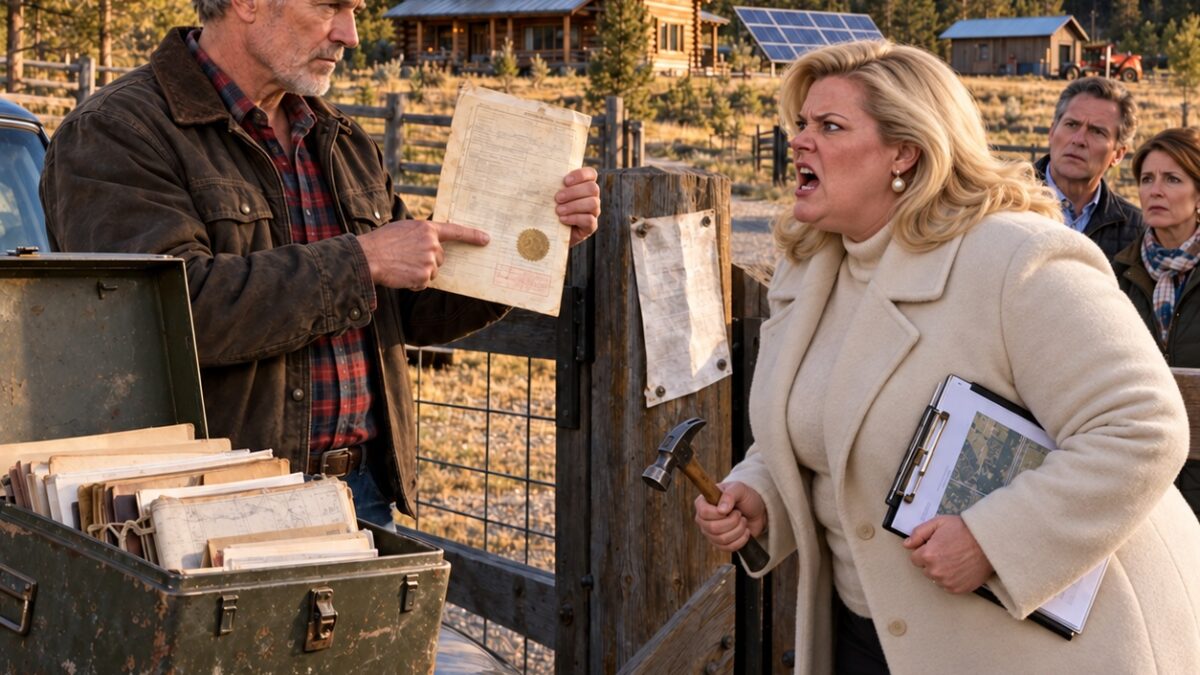
PART2
Six months earlier, apparently, Whispering Ridge had filed paperwork with Flathead County attempting to expand its jurisdiction.
I did not know that until Darlene Whitcomb drove onto the public road outside my gate in a white Lexus with a magnetic HOA logo stuck to the door.
She stepped out wearing pressed khaki pants, a Patagonia vest, and the facial expression of a person accustomed to hearing herself finish every conversation.
“Mr. Pruitt?”
“That depends who’s asking.”
“Darlene Whitcomb. President of the Whispering Ridge Homeowners Association.”
“I don’t live in Whispering Ridge.”
She smiled.
Pleasantly.
The kind of pleasant that arrives before condescension.
“That’s what we need to discuss.”
She looked past me toward the cabin.
Roof.
Solar panels.
Workshop.
Her eyes moved the way an inspector’s might, except real inspectors usually know their jurisdiction.
“Your structure does not meet our approved aesthetic standards.”
“My structure?”
“The metal roof is outside the accepted palette. The solar array is unscreened from public view. And the accessory building appears too close to the road.”
I stared at her.
Then at my cabin.
Then back at her.
“This isn’t Whispering Ridge.”
She reached into a folder.
Pulled out a document.
Handed it through the gate.
“Not anymore.”
I read the heading.
County administrative filing.
Whispering Ridge had petitioned to extend covenant jurisdiction to parcels within a two-mile radius using the same county-maintained access road.
My parcel was listed as pending review.
The legal hook was an access easement.
Because my property used the same road that crossed a small piece of land associated with the original ranch, Whispering Ridge was claiming that road access somehow made me a beneficiary of the development infrastructure.
And therefore subject to the covenants.
Creative.
Very creative.
Darlene watched me read.
“Well?”
I folded the paper.
“An easement for passage is not covenant jurisdiction.”
She tilted her head.
“The county accepted the filing.”
“The county accepting paper doesn’t make the paper right.”
“You’ll have thirty days to correct the exterior violations.”
“No.”
Her smile changed.
Barely.
“You should speak with counsel before taking that position.”
“I probably will.”
“Good.”
She turned toward her Lexus.
I called after her.
“Darlene.”
She stopped.
“If you come back, bring the document where I agreed to your covenants.”
She faced me again.
“We’ll be in touch.”
She left.
Thirty-two days later, the first fine arrived.
Two hundred fifty dollars.
Three categories.
Roof color.
Solar visibility.
And my favorite:
AESTHETIC NONCONFORMITY — GENERAL.
That was impressive.
They had found a bureaucratic way to tell me my property’s face offended them.
I did not pay.
Instead, I drove into Kalispell.
County recorder’s office.
Fluorescent lights.
Plastic chairs.
Paper smell.
A woman behind the counter who had probably watched five decades of property owners discover that family legends and recorded documents were not always the same thing.
I gave her my parcel number.
“Everything.”
“How far back?”
“1979.”
She looked at me.
“Everything?”
“Everything.”
Forty minutes later I had a stack.
I read every page.
Deed.
Tax references.
Easements.
Access rights.
Recorded plats.
The HOA filing.
There it was.
Their claim relied on the road-access easement.
The argument was effectively:
You use the same road.
Therefore you are part of us.
I had spent thirty years reading property documents through the Corps.
Rights-of-way.
Access.
Drainage.
Utility corridors.
Acquisition.
Dedications.
An easement grants whatever the easement says it grants.
Not magical extra rights because a board wishes they were included.
Still, I knew enough to know arrogance and certainty are dangerous substitutes for local counsel.
So I called property lawyers.
The first told me paying the fines might be cheaper than fighting.
I thanked him.
The second suggested negotiating with the HOA.
I thanked him too.
The third was Cecily Hargrove.
Solo practice.
Converted Victorian building on Main Street.
Sharp voice.
Sharper mind.
She read the filing summary.
Called me back less than an hour later.
“This is garbage.”
I liked her immediately.
“Legal term?”
“Professional summary.”
She continued.
“The road easement conveys passage.”
“I know.”
“It does not convey covenant authority.”
“I know.”
“The HOA is treating access like annexation.”
“That’s what it looks like.”
“It looks like it because that’s what they did.”
I leaned back in my chair.
“So the county approval?”
“Administrative staff accepting a filing is not a judicial determination that the claim is enforceable.”
“What do you recommend?”
“Dispute jurisdiction immediately. In writing. Certified.”
We did.
Formal notice.
Specific statutory references based on Cecily’s interpretation.
Demand to stop punitive fines while jurisdiction was disputed.
Clean.
No insults.
No story about Darlene’s Lexus.
Just documents.
Three days later, Darlene came back.
This time, she brought a man with a camera and clipboard.
“Compliance officer,” he said.
He was photographing my property through gaps in the gate.
I watched from the porch.
Coffee in hand.
Wood smoke from the gasifier boiler moving through the cold air.
Eventually, I walked down.
“You’re on the public road.”
Neither answered.
“You can photograph what you can lawfully see.”
The man lowered the camera slightly.
“But I have a licensed surveyor coming.”
Darlene folded her arms.
“And?”
“If either of you steps one inch past my gate without written permission, I’ll report trespass.”
The compliance officer looked at her.
Darlene smiled.
Thin.
Practiced.
“We’ll see you in court, Mr. Pruitt.”
I nodded.
“I’m counting on it.”
That was when I realized something.
Darlene did not expect me to fold immediately anymore.
So she changed methods.
If legal certainty was questionable, social pressure could do the work.
She organized what she called a Community Values Meeting.
Nice phrase.
Community values.
Sounds warm.
Civic.
Responsible.
Apparently one community value was discussing a man who was not invited.
My neighbor Beaumont Cress attended.
Beau had known my father for roughly four decades.
Retired Forest Service ranger.
Weathered face.
Dry humor.
The kind of man who had encountered real wildfires and therefore had very little patience for people manufacturing emergencies.
He called me afterward.
“She called your place a code-deficient eyesore.”
I looked out my window at the cabin.
“Did the eyesore collapse during the meeting?”
“Not that I heard.”
“What else?”
“She showed Commissioner Ellerby a picture of your solar array.”
Vance Ellerby.
County commissioner for our district.
Local politician.
Bolo tie.
Smile.
A man who could agree with three contradictory people inside fifteen minutes if all three were voters.
“What picture?”
“Made the place look rough.”
“It’s a solar rack.”
“She called it a fire hazard.”
I stopped smiling.
That was different.
Aesthetics were stupid.
Falsely representing a permitted electrical system as a fire hazard to a public official was something else.
“What did Ellerby say?”
Beau exhaled.
“‘I’ll look into it.’”
Which meant:
Darlene had gotten the commissioner’s attention.
I decided to get there first.
I pulled both county inspection certificates.
Passed.
Signed.
Dated.
Then I requested another independent structural review.
If Darlene wanted to tell the county my cabin was unsafe, I wanted the county’s own file to become impossible to misunderstand.
Six-week scheduling delay.
Fine.
Meanwhile, Darlene escalated again.
The Montana Department of Environmental Quality contacted me regarding my rainwater collection system.
Complaint alleged unregistered water-right diversion.
Now, rainwater in Montana can involve regulatory issues.
That much was real.
My system held eighteen hundred gallons.
Based on the threshold Cecily and I were working under, my setup did not require the registration Darlene was implying.
Still, a complaint creates work.
Documents.
Tank certificates.
Installation records.
Responses.
I sent everything within four days.
Two weeks later:
No violation found.
I printed the letter.
Certified copy.
Evidence binder.
That was the moment the binder got a name.
Not written on the cover.
Just in my head.
The Darlene File.
I wish that had been the worst thing she tried.
It was not.
Beau called again.
“Word is she wants the road made private.”
I sat upright.
“What?”
“The access road.”
“My road?”
“Your road, their road, county road. She’s talking to homeowners about petitioning the county to put it under HOA control.”
That changed the temperature of the entire fight.
Fines could be challenged.
Aesthetic letters could be ignored.
If Darlene gained control over the road and gated it, she could potentially interfere with the only practical access to my forty acres.
Landlock the property.
I called Cecily.
“She’s trying to make access leverage.”
“Yes.”
“What are my options?”
“If they actually block legal access, we fight that immediately.”
I stared at the timber wall I had framed myself.
“Or we make sure she never gets close.”
Silence.
Then Cecily:
“What are you thinking?”
“I’m done reacting.”
Going on offense does not mean shouting louder.
Not if you know what you’re doing.
It means learning more.
I spent the next three nights doing what I had done professionally for thirty years.
Reading.
Original Whispering Ridge formation documents.
CC&Rs.
Recorded plats.
Board minutes.
Financial disclosures.
Vendor records.
Because if the HOA claimed I was inside its jurisdiction, I was suddenly “affected” enough to request information.
Darlene’s assistant, Priscilla, emailed me a zip file around eleven one night.
Dozens of PDFs.
Probably assumed no sane person would read them all.
She had not met enough retired engineers.
I read every page.
At first:
Boring.
Landscaping.
Lighting.
Reserve contributions.
Maintenance.
Then a set of minutes from fourteen months earlier.
Attendance was strangely thin.
Darlene effectively dominating the meeting.
Resolution:
Strategic Boundary Expansion.
Allocated funds:
$28,000.
Source:
General reserve.
I read the CC&Rs again.
Reserve account designated for maintenance, repair, and emergency expenditures.
Not boundary-expansion campaigns.
I printed the minutes.
Then the reserve provision.
Placed them beside each other.
Interesting.
Not proof of every legal conclusion by itself.
Enough to ask questions.
Then the annual financial disclosure.
Dues revenue.
Expenses.
Tight but plausible.
One line:
Whitcomb Property Consulting LLC — Administrative and Management Services — $31,400.
Whitcomb.
I opened the Montana business registry.
Search.
There it was.
Whitcomb Property Consulting LLC.
Registered owner:
Darlene Whitcomb.
I stared at the screen.
Read it again.
Printed.
Added to binder.
The woman trying to fine me into obedience was paying her own company more than thirty-one thousand dollars out of HOA funds for “management services.”
The homeowners deserved to know whether that arrangement had been disclosed and approved.
I called Cecily the next morning.
“Found something.”
“One thing?”
“Two.”
“Start with the worse one.”
“I don’t know which is worse yet.”
I told her about the reserve transfer.
Then the LLC.
Long silence.
Finally:
“Garrett.”
“Yes?”
“Stop thinking of this as your cabin case.”
I understood.
If the records were what they appeared to be, Darlene’s fight with me was only one piece of a broader governance problem.
Then Beau called.
Again.
That man had developed a hobby.
“Got another one.”
“What now?”
“Ellerby.”
Commissioner Vance Ellerby.
“What about him?”
“Whispering Ridge got expedited county review.”
“How expedited?”
“About four months.”
I frowned.
“Normally?”
“Closer to eighteen.”
“That’s a gap.”
“And guess who had money in the original development partnership?”
I waited.
“Ellerby’s brother-in-law.”
I stood.
“Still?”
“Sold his interest eight months before approval.”
“How much?”
“One hundred eighty thousand.”
I closed my eyes.
One relationship does not prove corruption.
Timing does not prove corruption.
But timing plus money plus unusually fast review?
Enough for scrutiny.
I did two things.
First:
Called Cecily.
Second:
Called Loretta Vance at the Flathead Beacon.
No relation to Commissioner Ellerby.
Loretta was an investigative reporter I had known from an Army Corps story fifteen years earlier.
She read zoning documents for fun.
A dangerous personality trait in a reporter.
“I have something.”
“How good?”
“Potentially very.”
“Send it.”
“Not yet.”
“Why are you calling me?”
“To tell you to give me a few weeks.”
She laughed.
“Garrett, journalists don’t usually get previews of stories we aren’t allowed to see.”
“You’ll like this one.”
Pause.
“Good ones are worth waiting for.”
That was Loretta.
Then the entire case changed because I went looking for canned tomatoes.
The root cellar was cool.
Earthy.
Wood smell.
I was moving jars when I saw my father’s old steel document box.
I had put it there after his death.
Locked.
Untouched.
Not because I forgot.
Because grief can turn paper into explosives.
Dad’s handwriting.
Tax bills.
Old permits.
Things that make dead people feel temporarily present.
I had avoided opening it fully.
That afternoon, I did.
Original deed.
Tax records.
Receipts.
Then a handwritten letter dated 1981.
Flathead County Engineer’s Office.
Clipped behind it:
Formal plat acknowledgment.
I read.
Then again.
Then a third time.
In 1981, my father had formally dedicated a thirty-foot strip along the eastern boundary to the county as a public access corridor.
In exchange, he received a county road-maintenance credit.
Recorded.
Permanent.
Running with the land.
The road Darlene wanted to privatize ran directly through that dedicated corridor.
I sat down on the cellar steps.
The cold worked through my jeans.
Read it again.
Darlene’s entire road strategy depended on treating that route as something an HOA could potentially control.
Dad had dedicated the strip to public access forty-three years earlier.
I started laughing.
Loud enough that if anyone had heard me from outside, they probably would have assumed the lonely engineer in the woods had finally cracked.
But it was not victory laughter.
Not entirely.
It was relief.
My father had protected the road decades before Whispering Ridge existed.
He had done it because, as Beau later reminded me, Dad hated the idea that anyone in the valley should ever be beholden to a private gate.
I photographed everything.
Called Cecily.
“Sit down.”
“I am sitting.”
“Dad dedicated the road.”
“What?”
“1981. Thirty feet. Permanent public access corridor. Recorded plat.”
Silence.
Long.
Then:
“Send it.”
I emailed the scans.
She reviewed.
Called back.
Her tone had changed.
“Garrett, this isn’t defense anymore.”
“I know.”
“You have potential basis for a quiet-title action related to the road.”
“Yes.”
“Possible fiduciary issues with the HOA.”
“Yes.”
“Possible ethics inquiry around Ellerby.”
“Yes.”
“And if we can document Darlene knowingly giving false information about your property, there may be a defamation angle.”
“So what do we do?”
“Nothing.”
I smiled.
“Nothing?”
“Not yet.”
She continued.
“She thinks she’s winning because you’re still receiving letters.”
“So we let her keep moving.”
“Every public move gives us evidence.”
That made sense.
Engineers understand load.
You do not test a structure by yelling at it.
You understand where forces travel.
Darlene was creating load paths everywhere.
Finance.
County politics.
Property access.
Public statements.
The trick was documenting them before the structure failed.
First:
Survey.
I hired Franklin Odessa.
Licensed surveyor.
Pressed khakis in the field.
Equipment stored in cases that looked ready for NASA.
Two days.
He located the 1981 dedication boundaries.
GPS documentation.
Formal recorded survey.
Cost:
Forty-seven dollars to record.
Certified copies:
Twelve dollars each.
I ordered six.
Best seventy-something dollars I spent during the entire dispute.
Second:
Ellerby.
Cecily filed an ethics complaint asking the appropriate state body to examine the family financial connection and timing of the expedited approval.
Important distinction:
We did not accuse him of a crime.
We documented.
Asked for inquiry.
Let the record decide what the record could support.
Third:
Homeowners.
This was Beau’s idea.
Whispering Ridge had forty-four homes.
Under the procedure Cecily was relying on, a threshold number of homeowner signatures could force a special meeting to review board financial records.
We needed seven.
Beau talked to people.
Coffee.
Fences.
Driveways.
No dramatic campaign.
He asked simple questions.
“Seen the reserve balance lately?”
“Know what the management fee pays for?”
“Know whose company receives it?”
Six signed quickly.
The seventh was Opal Fitch.
Retired teacher.
Lived near the end of the ridge.
Had apparently spent years finding Darlene “unnecessarily imperial,” which may be the most polite description of her I ever heard.
Opal signed on a Wednesday.
Drove the petition to Beau’s truck herself.
The special meeting became unavoidable.
Fourth:
Witness statements.
I contacted homeowners who had attended the Community Values Meeting.
Asked if they would describe exactly what Darlene said about my cabin and solar array.
No coaching.
No pressure.
Four agreed.
Cecily notarized statements.
Fifth:
Cameras.
This part I enjoyed.
Darlene had been photographing through my gate.
Fine.
I installed trail cameras covering the road approach.
Then replaced the gate.
Taller.
Timber framed.
Clear signage.
Private property.
Trespass statute reference.
Notice regarding the recorded public-road dedication.
Motion-activated floodlight.
Visible camera.
Backup camera.
If someone wanted to play games with access, I wanted high-resolution memories.
Then Darlene began acting like someone who sensed the room changing.
First, she wrote my employer.
Or rather:
My former employer.
I had retired eight years earlier.
The letter described me as a disruptive presence harassing a lawful community association.
HR probably wondered why they were receiving complaints about a retired man living in the mountains.
Cecily saved the letter.
Next:
A Missoula law firm sent a demand accusing my records requests of being abusive and threatening fee recovery if I continued.
Cecily wrote back in one paragraph.
My request, she said, was lawful under the framework the HOA itself claimed applied to me.
If they wanted me governed by the association, they could not simultaneously argue I was too external to see the records supporting enforcement.
She copied the relevant oversight office.
No second demand came.
Then two men appeared at my gate.
Trail camera captured them.
Seven minutes.
One photographed posted notices.
The other examined the latch.
They did not cross.
I still filed an observation report with the sheriff’s office.
The deputy recognized one.
Local property-management contractor.
I looked up the company.
Past work for Whitcomb Property Consulting LLC.
Interesting.
Not proof of a conspiracy.
Enough to upgrade cameras.
I added another set farther up the road.
Independent solar backup.
I told the deputy:
“I’m expecting possible interference.”
He nodded.
“Keep the cameras on.”
Good advice.
Meanwhile, Darlene called homeowners individually trying to get petition signatures withdrawn.
Opal told Beau that Darlene called her at eight in the morning.
Opal considered eight a.m. on a Tuesday a moral offense.
She did not withdraw.
One week before the special meeting, Darlene distributed the agenda.
Single item:
Annual Financial Review.
Nothing about $31,400.
Nothing about the reserve transfer.
She clearly intended to provide a summary.
The homeowners had stopped being interested in summaries.
The night before the meeting, I barely slept.
Not nerves exactly.
Scenario planning.
What if she withheld ledgers?
Cecily had a response.
What if she canceled?
Response.
What if she arrived with counsel?
Fine.
Loretta would be there.
Beau would be there.
I would be there.
The homeowners who signed would be there.
At some point, good preparation becomes calming.
You cannot control the room.
You can control whether your documents are real.
The next afternoon, I drove down in my old F-250.
Two hundred fourteen thousand miles.
Diesel.
Old leather.
Windshield crack I had been meaning to fix since Barack Obama was president.
I parked in front of the Whispering Ridge clubhouse between newer Lexuses and Range Rovers.
Childish?
Maybe slightly.
Worth it?
Absolutely.
Inside:
Rows of folding chairs.
Board table.
Darlene.
Hartwell.
Cheryl.
The latter two looked increasingly like people who had recently learned their volunteer board position contained surprises they had never agreed to.
Darlene saw me.
Her face went through four stages.
Surprise.
Recognition.
Calculation.
Professional smile.
“Mr. Pruitt, this meeting is for Whispering Ridge homeowners.”
I smiled.
“I’m an affected party under your own jurisdiction filing.”
Then sat beside Beau.
Hartwell visibly exhaled.
That told me plenty.
Meeting began.
Darlene placed a one-page financial summary on the screen.
Everything healthy.
Everything managed.
Nothing unusual.
She had barely started when Rutherford raised his hand.
Retired accountant.
Meticulous enough that I imagine his spice cabinet had depreciation schedules.
“Line item 7C.”
Darlene paused.
“Yes?”
“Thirty-one thousand four hundred dollars paid to Whitcomb Property Consulting.”
Quiet.
Darlene adjusted papers.
“Contracted management services.”
Rutherford held up a printout.
“And who owns Whitcomb Property Consulting LLC?”
The room changed.
Not loud.
Not yet.
Electric.
Darlene stared.
“This is not the appropriate forum—”
“It’s registered to you.”
Rutherford did not raise his voice.
“I checked the Secretary of State registry.”
Murmurs.
Cheryl turned toward Darlene.
“You never told us.”
Her voice was soft.
That made it worse.
Darlene shifted into survival mode.
I will give her credit for one thing.
She was fast under pressure.
She redirected.
“The reason this association has faced unusual expenses is because outside individuals have engaged in deliberate disruption.”
There it was.
She looked at me.
“Mr. Pruitt has manipulated residents, challenged lawful authority, resisted community standards, and maintained a property that continues to negatively affect Whispering Ridge values.”
Beau’s jaw moved slightly.
I touched his arm.
Wait.
Darlene kept going.
“My responsibility has always been protection of this community from people who refuse to cooperate.”
I let her finish.
Then stood.
“I’d like to respond.”
No objection.
I carried my folder to the front.
First:
County inspection certificates.
I placed them down.
“My cabin has passed two county inspections.”
Second:
DEQ letter.
“No water violation.”
Third:
1981 public-road dedication.
I placed certified copies before the board.
“This is the road Ms. Whitcomb has discussed privatizing.”
People leaned forward.
“My father recorded this dedication forty-three years before Whispering Ridge existed.”
I slid the survey beside it.
“Thirty-foot public access corridor.”
Then one-page summary.
Reserve-fund provision.
Board minutes authorizing twenty-eight thousand dollars for strategic boundary expansion.
Darlene’s eyes stayed on me.
Finally:
LLC registry.
“The thirty-one-thousand-four-hundred-dollar management vendor is controlled by the board president.”
Homeowners already knew that now.
But seeing the documents together changed the shape.
This was no longer:
Garrett versus HOA.
This was:
What exactly has our board been doing?
I handed Loretta copies.
Darlene’s face tightened.
I continued.
“My property was never lawfully annexed into Whispering Ridge merely because I use a public access road.”
Cecily had told me to avoid sweeping conclusions beyond the documents.
So I stayed narrow.
“The easement and dedication documents do not contain a grant of HOA covenant authority over my forty acres.”
I looked at the room.
“The fines were issued on a claim I formally disputed.”
Then:
“Every complaint Darlene filed regarding code and water issues has been answered by the relevant agency documentation.”
I looked toward Darlene.
“And homeowners should ask independent counsel about the reserve funds and undisclosed management payments.”
Then I sat down.
No speech about justice.
No dramatic threat.
The room did the rest.
Homeowners began talking at once.
Darlene stayed standing.
Then she leaned across the table.
“I know people in this county, Mr. Pruitt.”
The room quieted enough that several people heard.
Loretta heard.
Cecily heard.
I heard.
“This is not going to go the way you think.”
Cecily’s hand touched my arm.
The signal.
Do not answer.
So I did not.
I looked at Darlene.
She looked at me.
Four seconds.
Maybe less.
Then Beau stood.
He was six-one.
Built like a man who spent a career outside.
Forty Montana winters written into his face.
“Darlene.”
She turned.
“I knew Garrett’s father thirty-five years.”
Nobody moved.
“Earl Pruitt built that road himself in 1979 with a rented Cat and a level.”
Beau pointed toward the recorded dedication.
“And he dedicated the strip to the public because he said no one in this valley should ever be beholden to somebody else’s gate.”
Darlene opened her mouth.
Beau finished.
“You need to sit down.”
She sat.
The meeting stopped being an HOA meeting.
It became an audit performed by angry homeowners in folding chairs.
Reserve fund.
Dues.
Legal costs.
Management contract.
Board approvals.
Who knew what?
Who signed what?
Hartwell spoke first.
“I was not informed of the LLC ownership.”
Cheryl:
“Neither was I.”
Someone asked whether they had approved the twenty-eight-thousand-dollar transfer knowingly for boundary expansion.
They looked at Darlene.
The answers got uglier.
Finally, Hartwell said:
“I am suspending my participation in this board pending an independent financial review.”
Cheryl nodded.
“Same.”
Darlene stared at them.
Without them, she had no functioning quorum.
Whatever authority she imagined flowed from being president suddenly depended on something mundane:
Other board members willing to sit beside her.
They were not.
Then a side door opened.
Flathead County sheriff’s deputy.
Same one who had taken my gate report.
He walked in holding papers.
Darlene turned.
The room went silent again.
He was not arresting anyone.
No handcuffs.
No television drama.
He served documents.
Civil summons related to Cecily’s road action.
Notice connected to the ethics complaint involving Commissioner Ellerby.
Darlene read the first page.
Then the second.
Behind her sat forty-four households watching the machinery she had used against others begin operating in the opposite direction.
Then Loretta stood.
Notebook ready.
“Ms. Whitcomb?”
Darlene looked at her.
“Loretta Vance, Flathead Beacon.”
Pause.
“I’d like your comment on the $31,400 payment to Whitcomb Property Consulting and the reserve-fund transfer.”
Darlene did not answer.
She gathered her things.
Walked out.
No last speech.
No slammed binder.
No dramatic curse.
White Lexus started.
Then disappeared.
That was the closest thing the story had to a mic-drop moment.
Not because she had been humiliated.
Because she had finally run out of mechanisms.
The headline appeared that Thursday.
The Beacon ran the story prominently.
By Tuesday, larger regional outlets had picked it up.
Shared thousands of times online.
People love HOA stories because nearly everyone either has one or knows someone who does.
But public attention was not the outcome I cared about.
Records were.
Commissioner Ellerby did not seek re-election that fall.
The ethics inquiry later resulted in a formal finding framed as an appearance of impropriety and a censure in his record.
Darlene resigned from the HOA board six days after the meeting.
As part of the civil resolution involving homeowners, she repaid the $31,400 to the association reserve fund.
Her LLC later dissolved.
The road case took months.
Eventually, the ruling confirmed what my father’s recorded dedication already said.
Public.
Permanent.
Not an HOA road.
The final order was recorded near Dad’s old filing.
I went to the recorder’s office to see it.
Same fluorescent lights.
Same plastic-chair feeling.
Different clerk.
I held the certified copy.
Dad’s 1981 dedication.
Court confirmation decades later.
Side by side in the chain.
I thought about calling him.
That irrational impulse grief leaves behind.
You were right.
He would have enjoyed that.
Then he probably would have asked why it took me so long to find the steel box.
Whispering Ridge did not collapse.
That matters.
The homeowners were not villains.
Most had no idea what Darlene was doing.
They wanted roads maintained.
Common landscaping kept clean.
Budgets managed.
Ordinary things.
They elected a new three-person board.
Rutherford joined.
Of course.
If you expose a thirty-one-thousand-dollar vendor conflict with a registry printout in your hand, eventually someone makes you treasurer or equivalent.
Opal joined too.
She took financial oversight with the enthusiasm of a retired teacher who had finally found a rulebook worthy of her attention.
Once the management fee disappeared, annual dues fell by roughly four hundred dollars.
That did more to reform HOA culture than any philosophical speech ever could.
People understand transparency quickly when it lowers a bill.
The following spring, Beau came to the cabin.
Snow had cleared from the high ridges.
Montana in May does this thing where the valley turns green so quickly you can almost watch it happen.
We sat on my porch.
Coffee.
No urgent conversation.
That is how you sit with someone you trust.
Eventually Beau looked across the ridge.
“Your dad would’ve loved this.”
“He would’ve handled it faster.”
Beau laughed.
The sound carried into the valley.
Then said:
“No.”
I looked at him.
“He’d have handled it louder.”
I laughed too.
That was probably true.
The strange part began after the news coverage.
Loretta told me her office received more paper mail about that story than anything they had run in years.
Actual letters.
People describing their own HOA disputes.
Mailbox colors.
Holiday lights.
Fences.
Fines.
Boards controlled by one personality.
But some letters were not funny.
People who had spent thousands defending title.
People who sold because they could not afford a legal fight.
People who had never known where to look for help.
I read several.
Then stopped.
Then read more.
One sentence kept appearing in different forms:
I thought I had no options.
That bothered me more than Darlene’s original nail.
Because I had options.
Engineering background.
Time.
Money enough to hire Cecily.
Property-document experience.
Beau.
Loretta.
County records.
Cameras.
What about the person who works sixty hours a week and receives a threatening letter on Friday?
What about a widow?
A young couple?
Someone who sees “attorney fees” and pays because fear is cheaper than research?
I called Cecily.
“I have another idea.”
“That phrase has become expensive.”
“Not for me.”
“That is not comforting.”
I told her.
Free education sessions.
Property records.
HOA documents.
Basic process.
How to ask for ledgers.
How to read easements.
When to call counsel.
How to distinguish a scary letter from a valid claim.
We partnered with the Swan River Conservation Trust.
Created the Ridge Rights Clinic.
Once a quarter.
Kalispell.
Open to Montana property owners with HOA questions.
Cecily volunteered.
Two colleagues joined.
Beau and I distributed notices.
Community boards.
Hardware stores.
Libraries.
Over time, hundreds attended.
Fourteen property owners eventually challenged HOA actions using information they had learned through the clinic.
Not every challenge succeeded.
That was important.
The goal was not teaching people that every HOA is wrong.
The goal was teaching them to ask for authority before assuming authority exists.
Sometimes the board had the right document.
Fine.
Then the homeowner could make an informed decision.
Sometimes it did not.
Then questions mattered.
That felt useful.
More useful than simply enjoying the fact that Darlene had lost.
Then we created something else.
The Earl Pruitt Memorial Scholarship.
Flathead Valley Community College Foundation.
Construction trades.
Land surveying.
The first recipient was nineteen.
From Ronan.
He reminded me, in a general way, of myself before experience teaches you how much you do not know.
I met him.
He asked why land surveying.
I told him:
“Because a line on paper can save somebody forty years later.”
He looked confused.
Good.
He would understand eventually.
My cabin remained exactly where I built it.
Weathered gray standing-seam roof.
Still legal.
Solar array still facing south.
Still unscreened.
Rainwater tanks still holding the same capacity.
Root cellar still sitting around fifty-five degrees.
Gate still timber-framed.
Cameras still there.
Not because I expected Darlene back.
Because good security does not become stupid just because one dispute ends.
The public-road notice remained.
Correct.
Recorded.
Boring.
Beautiful.
I used to think I built the place alone.
Physically, largely true.
My hands.
My calculations.
My money.
My weekends.
But defending it?
Not alone.
Cecily.
Beau.
Rutherford.
Opal.
Loretta.
Even Priscilla, in a way, by sending records the association was required to provide.
The county clerks.
Surveyor Franklin.
Homeowners willing to sign.
People willing to state what they witnessed.
My father, forty-three years earlier, recording a dedication because he distrusted private gates.
That changed my understanding of independence.
People like me romanticize self-reliance.
Montana encourages it.
Cabin.
Tools.
Truck.
Do it yourself.
But independence does not mean isolation.
It means standing on your own feet while knowing when the right people should stand beside you.
Dad understood that too.
I had forgotten.
The ridge does look better when you have neighbors worth keeping.
Beau reminded me.
One afternoon after everything settled, I walked down to the gate.
Same place Darlene had nailed the first notice.
I could still see tiny marks in the timber where the nail had gone in.
I ran my thumb over them.
Funny.
The entire fight began because someone used a hammer instead of knocking.
Maybe that tells you something about personality.
She did not arrive asking:
Is your parcel actually subject to our covenants?
She arrived having already decided.
The nail was symbolic before I knew there was a story.
Statement.
Not conversation.
The lesson for me was not:
Always fight.
That is childish.
Some notices are valid.
Some boards are right.
Some property owners are wrong.
The useful lesson was:
Never confuse confidence with authority.
Ask:
Where is it recorded?
What document?
What vote?
What statute?
What inspection?
What ledger?
Who owns the vendor?
Who approved the expenditure?
What does the easement actually grant?
Those questions are not rebellion.
They are governance.
Good authority survives them.
Bad authority becomes irritated.
Darlene became irritated early.
That should have told me plenty.
She counted on friction.
Most people stop when a dispute becomes inconvenient.
A certified letter.
Attorney language.
Daily fines.
Threat of court.
A complaint to an agency.
Public embarrassment.
Road-access fear.
Every escalation was meant to increase the cost of refusing her.
She made one mistake.
She assumed cost only moved in one direction.
Then I began documenting her costs.
Reserve fund.
Self-dealing concern.
Ethics exposure.
Public statements.
Legal fees.
Homeowner distrust.
Press.
Eventually her campaign became more expensive to maintain than abandon.
That is how institutional overreach often ends.
Not with a moral awakening.
With changed incentives.
I never received an apology.
Not from Darlene.
Did not ask.
Her resignation was enough.
The repayment was enough.
The court record was enough.
An apology is nice.
Recorded title is better.
My father would have agreed.
The strangest emotional moment came when the final road ruling was recorded.
I drove home.
Parked near the cabin.
Walked down the same access road.
Forty-three years earlier, Dad had signed the dedication.
He could not have known Whispering Ridge.
Darlene.
A white Lexus.
Solar-panel complaints.
County politics.
None of it.
He simply believed a road used by people in that valley should remain public enough that nobody could suddenly stand behind a gate and say:
Pay me.
Obey me.
Ask permission.
That principle outlived him.
Paper carried it.
That is one reason I became obsessed with records in the first place.
People die.
Memory shifts.
Institutions change.
Recorded documents remain available to whoever bothers looking.
Darlene counted on no one looking.
I looked.
Every word.
That was the real fight.
Not me versus her.
Documents versus assumptions.
She had more confidence.
I had better paper.
Paper won.
Months after the clinic started, a man approached me after a session.
Older.
Cap in his hands.
His HOA had threatened fines over a drainage area.
He had arrived angry.
Ready for war.
Cecily helped him read the recorded plat.
Turned out the HOA actually had the easement right.
He was disappointed.
I told him:
“This is a good result.”
He laughed.
“I lost.”
“No. You learned the claim was real before spending ten thousand dollars pretending it wasn’t.”
He thought about that.
Then nodded.
That was exactly what the clinic was supposed to do.
Information before ego.
If the board is right, comply or negotiate.
If it is wrong, challenge with evidence.
Not every disagreement needs a villain.
Mine happened to contain one unusually aggressive president.
That did not mean every board member was corrupt.
Hartwell and Cheryl had been kept in the dark.
When they learned enough, they stepped away.
That mattered.
I did not sue them simply for having once sat beside Darlene.
Responsibility should follow conduct.
Rutherford later told me:
“I thought you hated us.”
“No.”
“You looked like you hated us.”
“I hated being fined by people who didn’t own jurisdiction.”
“Fair.”
“I didn’t know most of you.”
He laughed.
“We didn’t know you either.”
That was part of the problem.
Darlene had turned me into an abstraction.
The eccentric cabin owner.
The eyesore.
The noncompliant parcel.
Once homeowners met me, heard Beau, saw the inspections, everything became less useful as propaganda.
It is easy to control a narrative about someone excluded from the room.
Much harder when he walks in with certified copies.
That is why open meetings matter.
That is why records matter.
That is why reporters matter.
That is why whistleblowers, annoying accountants, retired teachers, and old Forest Service rangers matter.
Institutions are safer when one person cannot control every gate to information.
Darlene controlled too many for too long.
Then the gates opened at once.
Priscilla sent files.
Beau talked to neighbors.
Rutherford checked the registry.
Loretta investigated.
Cecily filed.
I documented.
The homeowners asked questions.
By the time Darlene realized the information structure had changed, her authority was already shrinking.
No dramatic overthrow required.
Transparency did the work.
I thought about the manipulated-looking solar photograph too.
How absurd.
My array still stood.
Same bolts.
Same orientation.
Same inspected electrical system.
A photograph framed to make it look questionable had briefly threatened public perception.
Then two inspection certificates made the photo irrelevant.
That taught me another useful rule.
When someone is exaggerating a fact, do not fight adjectives.
Produce measurements.
“Unsafe.”
Inspection.
“Illegal.”
Permit.
“Private road.”
Recorded dedication.
“Management service.”
Vendor registry.
“Community funds.”
Ledger.
Facts have edges.
Adjectives are fog.
I spent my career around structures.
You calculate.
You do not ask a bridge whether it feels strong.
Load.
Material.
Connection.
Foundation.
Property disputes are surprisingly similar.
What is the load?
Where does authority transfer?
What carries it?
Where is the connection weak?
Darlene’s whole campaign depended on one weak connection:
Road access equals covenant authority.
It did not.
Everything built on top leaned.
Then I found stronger foundation:
1981 dedication.
Once that appeared, the road strategy collapsed.
Then the financial records introduced a second failure.
The rest was gravity.
Cecily once told me:
“You know what made this easy?”
“Nothing about this was easy.”
“Relatively easy.”
“What?”
“She documented herself.”
True.
Board minutes.
Vendor payments.
Letters.
Complaints.
Agenda.
Phone calls to homeowners.
Threat in front of witnesses.
Darlene seemed to believe formal-looking actions strengthened authority.
Often they strengthened the evidence.
That is why I never begged her to stop after the first few weeks.
Once Cecily and I understood what was happening, patience became strategy.
Let the record develop.
Difficult discipline.
When someone threatens your land, instinct says respond immediately.
Sometimes you should.
Other times, the strongest response is carefully timed.
That was a professional habit from engineering.
Do not repair before understanding failure.
If you patch the visible crack without knowing the load path, you hide information.
I needed to understand the structure.
So I read.
Waited.
Documented.
Then acted.
The story people told afterward made me sound calmer than I was.
I was angry.
Of course.
When Darlene threatened the road, I slept badly.
When two men examined the gate latch, I checked cameras at two in the morning.
When the DEQ letter came, my stomach dropped before logic returned.
When she wrote my former employer, I felt something close to disgust.
Calm is not absence of fear.
It is behavior despite fear.
That matters.
I never want the Ridge Rights Clinic to teach people they must become stone.
You can be furious.
Scared.
Embarrassed.
Still respond cleanly.
Emotion is not weakness.
Bad documentation is weakness.
I think Margaret from another life would have agreed.
Dad certainly would.
Dad was emotional in his own way.
He simply disguised it with work.
When upset, he fixed fences.
When grieving, he split wood.
When proud, he said:
“Not bad.”
The highest compliment.
If he could have seen the final court order, I think he would have looked at it.
Then at me.
“Not bad.”
I would have taken that.
The scholarship carrying his name meant more to me than the news stories.
Because the whole conflict started with inheritance.
Land.
Documents.
Road.
His values.
Turning some of the aftermath into opportunity for young people learning trades or surveying felt right.
One student asked me:
“Why surveying?”
I said:
“Because someday somebody will stand in a field arguing about a line you measured forty years ago.”
He laughed.
I did not.
Then he realized I was serious.
“Do it correctly.”
That is the burden of technical work.
Most people never notice when you are right.
Then decades later, someone desperately needs you to have been.
The surveyor in 1981 probably never knew what his lines prevented in 2024.
That is legacy.
Quiet work remaining useful after the worker is forgotten.
My cabin has the same quality for me.
Every beam I placed.
Every connection.
No audience.
No HOA approval.
Just work.
When snow loads the roof, calculations matter.
Not compliments.
When Darlene called the place an eyesore, I did not feel insulted about aesthetics.
I felt amused.
I had built for wind.
Snow.
Heat.
Water.
Durability.
Not her color palette.
Aesthetic standards have a place in neighborhoods that voluntarily adopt them.
I did not.
That was the point.
Freedom is not the absence of all rules.
It is knowing which rules legitimately apply to you.
County building code?
Yes.
Fire safety?
Yes.
Environmental rules?
Yes.
An HOA two miles away deciding my solar panels should be hidden?
Show me the covenant.
There was none that bound me.
That distinction gets lost in these stories.
People cheer:
“No HOA can tell me anything!”
Wrong.
If your deed is lawfully burdened by recorded covenants, an HOA may have powers you agreed to or inherited with title.
Read them.
My case was different.
The board tried to expand that authority onto land outside its original covenant structure using a road-access theory.
That required challenge.
Details matter.
That was what I taught at the clinic.
Never assume someone else’s story matches yours.
Get your documents.
Your parcel.
Your covenants.
Your state law.
Your facts.
Internet outrage is free.
Legal mistakes are not.
I was lucky to have Cecily.
She told me things I did not want to hear sometimes.
“Don’t send that.”
“Why?”
“Because it’s angry.”
“It’s accurate.”
“It can be both.”
Delete.
Rewrite.
She removed adjectives from my letters.
Engineers love precise insults.
Lawyers often prefer none.
She was right.
Eventually, our correspondence became almost sterile.
Good.
Let Darlene supply heat.
We supplied record.
At the special meeting, that contrast mattered.
Darlene attacked me.
I put paper on a table.
One looked emotional.
One looked verifiable.
Even when I was angrier.
That is strategy.
Not personality.
People later said:
“You destroyed her.”
I disliked that.
No.
She resigned.
Repaid funds.
Lost authority.
Her LLC dissolved later.
That was consequence.
I did not need destruction.
She was not a building to demolish.
The goal was stopping conduct and repairing governance.
When people turn conflict into annihilation, they often keep fighting after the useful outcome already exists.
I did not want Darlene living in my head for the rest of retirement.
I wanted my cabin.
My road.
My coffee.
My ridge.
I got them.
Then I moved on.
The most satisfying morning afterward was not court.
Not headlines.
It was a Tuesday.
Snow on the ridge.
I made coffee.
Walked outside.
No violation notice.
No camera at the road.
No certified envelope.
Nothing.
Silence.
Just wind moving through trees.
The same silence I had built the cabin to have.
That was victory.
Ordinary life restored.
HOA wars make good stories.
Normal days make good lives.
I prefer the second.
Beau still comes by.
Less often than I would like.
We sit.
Coffee.
Occasionally discuss Darlene.
Usually not.
One afternoon, he looked toward the gate.
“You ever fix that windshield?”
“No.”
“Of course not.”
I smiled.
“Structural crack isn’t growing.”
“That’s not how windshields work.”
“Stayed stable for eight years.”
“Garrett.”
“Beau.”
He shook his head.
Some things never improve.
The F-250 still runs.
Root cellar still works.
Solar still works.
Roof still gray.
Life.
Occasionally a Whispering Ridge homeowner drives past and waves.
I wave back.
That is another outcome I did not expect.
During the fight, I had started thinking of the development as one organism.
It was not.
Forty-four households.
Different people.
Different opinions.
Some afraid of Darlene.
Some indifferent.
Some supportive.
Some angry at me initially.
Then things changed.
Afterward, several apologized.
I accepted.
One man said:
“We thought you were trying to hurt property values.”
“I was trying to keep my property.”
“I know now.”
Good enough.
Another said:
“I should’ve checked the financial statements sooner.”
“Yes.”
He laughed.
“You don’t soften much.”
“I built with Douglas fir for a reason.”
Neighbors can recover from disagreement if nobody insists everyone rewrite history perfectly.
Some were wrong.
Then corrected.
Fine.
The ridge looked better with neighbors worth keeping.
Dad again.
Always Dad.
I suppose the entire story was a long conversation with him after his death.
His land.
His road.
His steel box.
His filing.
His saying.
His scholarship.
Even Beau’s memories.
Death ends conversation in one direction.
Not always influence.
Dad answered Darlene from 1981.
He had no idea.
That still amazes me.
A signature older than Whispering Ridge beat a modern board petition.
Not because old is better.
Because recorded rights have continuity.
That is civilization at its best.
No need for whoever shouts loudest to win.
We can look backward.
See what was granted.
What was reserved.
What was dedicated.
Then act accordingly.
Darlene tried to turn volume into title.
The recorder’s office disagreed.
Quietly.
Permanently.
The Ridge Rights Clinic eventually added a session called:
READ THE PAPER BEFORE YOU PANIC.
Cecily hated the title.
I loved it.
We compromised.
Official title became more professional.
I still called it that.
We taught people:
Start with deed.
Then plat.
Then easements.
Then CC&Rs.
Then amendments.
Then minutes.
Then finances where relevant.
Do not begin with Facebook.
Do not begin with a neighborhood rumor.
Do not begin with “someone told me.”
Find the primary document.
One woman attended because her HOA claimed an access strip behind her house.
She brought screenshots.
I asked:
“Recorded instrument?”
She did not know.
Cecily helped her locate it.
HOA actually had access rights.
She looked disappointed.
Then relieved.
“At least I know.”
Exactly.
Knowing is powerful even when the answer is not what you wanted.
Fear thrives in ambiguity.
Darlene used ambiguity.
I reduced it.
That was the method.
The special meeting became famous locally for a while.
People exaggerated.
Some claimed Darlene was arrested.
She was not.
Some claimed the sheriff shut down the HOA.
No.
Some claimed the county seized records.
No.
Reality was better.
Homeowners asked questions.
Two board members stepped aside.
No quorum.
Civil papers served.
Reporter asked for comment.
Darlene left.
Less cinematic.
More credible.
I prefer credible.
Truth does not need handcuffs added to become satisfying.
The road stayed public.
That was enough.
Darlene repaid $31,400.
Enough.
Ellerby received a formal censure and did not seek re-election.
Enough.
The homeowners rebuilt their board.
Enough.
My cabin stayed mine.
More than enough.
If someone had told me when I first found that laminated notice nailed to my gate that the whole thing would end with a legal clinic and scholarship, I would have told them to stop writing movie endings.
Yet that is what happened.
Private conflict expanded into community benefit.
That was the unexpected part.
I built the cabin alone because I wanted independence.
The fight taught me community does not have to mean surrendering independence.
Healthy community protects boundaries.
It does not erase them.
Beau could support me without owning my land.
Rutherford could expose Darlene without becoming my best friend.
Opal could demand records without agreeing with me about everything.
That is how good communities work.
Cooperation among separate people.
Not forced sameness.
Whispering Ridge’s mistake under Darlene was confusing cohesion with control.
My cabin looked different.
So what?
Difference is not disorder.
A gray metal roof does not threaten a subdivision two miles away.
Solar panels do not become immoral because they are visible.
My root cellar does not need granite countertops.
Forty acres of Montana do not need to pretend they are lot forty-five.
Once Darlene left, the new board seemed to understand.
They managed their property.
I managed mine.
Peace.
A few years later, a wildfire-prevention discussion came up in the valley.
This time Whispering Ridge contacted neighboring owners properly.
Including me.
No fake jurisdiction.
No fines.
Just:
We’re coordinating defensible-space planning. Interested?
I attended.
Useful meeting.
Imagine that.
Same development.
Different leadership.
We shared maps.
Talked access.
Water.
Evacuation.
My engineering background helped.
Nobody cared about roof color.
That was community.
Voluntary cooperation around actual risk.
At the end, Rutherford said:
“This is better.”
“Yes.”
“We should’ve started here.”
“Yes.”
Sometimes the answer really is that simple.
Ask.
Do not annex.
I went home that evening thinking Dad would have liked that too.
He was stubborn.
But generous.
People mistake those as opposites.
They are not.
A strong boundary makes generosity safer.
If I know you cannot take my land by assumption, I can share access willingly when needed.
If I fear every favor becomes a permanent claim, I stop giving favors.
Lawful boundaries preserve neighborliness.
That was the deepest lesson beneath the road dispute.
Dad dedicated public access deliberately.
He did not lose control accidentally.
He chose.
Choice makes all the difference.
That is why the 1981 document mattered emotionally, not just legally.
My father was not anti-community.
He was anti-coercion.
The dedication proved it.
He gave something to the public permanently because he believed it served the valley.
Darlene tried to use that gift as a bridge to private HOA control.
The irony was almost perfect.
The document she needed to defeat me was the document that ultimately defeated her theory.
Dad had given the road away from private gatekeeping decades earlier.
Full circle.
One summer afternoon, I stood beside the eastern boundary while a young survey student from the scholarship program practiced with equipment.
He asked about the markers.
I showed him.
He asked:
“Is this the famous road?”
“Unfortunately.”
He laughed.
“What was Darlene like?”
I considered.
“Confident.”
“That bad?”
“Confidence is neutral.”
I pointed at his equipment.
“Being wrong confidently is expensive.”
He nodded.
Then adjusted his setup.
Good student.
That phrase became another one I used at the clinic.
Being wrong confidently is expensive.
For property owners.
For boards.
For governments.
For engineers.
Especially engineers.
That is why we calculate.
Why we record.
Why we review.
Humility built into process.
Darlene’s biggest failure was not wanting more authority.
People want things.
It was refusing to test her assumption seriously before escalating.
She could have called Cecily’s equivalent.
Asked:
Does road access create covenant authority?
If answer uncertain:
Stop.
Research.
Instead:
Fine.
Complain.
Threaten.
Expand.
Private-road plan.
Every escalation increased cost.
Her own.
The board’s.
Homeowners’.
Mine.
That is bad governance.
Not because it lost.
Because it skipped verification.
The new board eventually adopted better financial controls.
Conflict disclosures.
Vendor review.
Reserve restrictions.
I did not write them.
Did not join.
That mattered to me.
I never wanted Whispering Ridge governed by Garrett Pruitt either.
The lesson was not:
Replace Darlene with me.
The lesson was:
Do not design a system where one personality matters so much.
Checks.
Records.
Independent review.
Quorum.
Transparency.
Boring safeguards.
Boring is beautiful.
A bridge that never collapses is boring.
A clean HOA audit is boring.
A public road remaining public is boring.
Give me boring.
Excitement is expensive.
I had enough.
My retirement returned to what I intended.
Cabin.
Maintenance.
Occasional engineering consultation.
Ridge Rights Clinic.
Scholarship.
Beau’s coffee.
The elk still judge me.
No fines yet.
I sometimes reread the original violation letter.
I kept it.
Not because I treasure it.
Historical artifact.
The hammer holes in the laminate are still visible.
Thirty days.
Aesthetic standards.
Daily fines.
The language feels almost quaint now.
At the time, it represented a threat to everything I had built.
Now it is one sheet in a thick file.
That is perspective.
Problems look enormous when they are the current page.
Then life keeps writing.
One page becomes small.
I wish people trapped inside HOA disputes could feel that sooner.
Do not ignore legitimate deadlines.
Do not assume every threat is empty.
But do not let one letter become your entire horizon.
Get help.
Read.
Document.
Answer.
There may be options.
That is why we built the clinic.
Not to promise victory.
To create horizon.
People need that.
Darlene tried to shrink my horizon to thirty days and $250.
I expanded it backward to 1979.
Then 1981.
Forward to court.
Outward to homeowners.
That changed everything.
Time is powerful in property disputes.
The current board president feels permanent.
She is not.
Recorded title may last generations.
Read accordingly.
One morning, years later, I opened the root cellar.
Same earth smell.
Same cool air.
Dad’s steel box still there.
I no longer avoid it.
I added copies.
Court order.
Scholarship documents.
A photograph of the first recipient.
Ridge Rights Clinic flyer.
Not because Dad needs proof.
Because someday someone else may open that box.
Maybe my heirs.
Maybe a buyer.
They should understand what the road means.
No rediscovery.
No family legend replacing record.
I labeled everything.
Engineers improve after pain too.
The 1981 letter sits near the front now.
Easy to find.
If some future HOA queen arrives in a flying car fifty years from now, whoever owns the place should not have to spend an afternoon moving tomato jars.
I smiled at that thought.
Closed the box.
The cabin above me creaked slightly with temperature change.
Normal.
I knew every sound.
Ten years building something teaches you its language.
That is another reason Darlene’s “eyesore” language never penetrated deeply.
She saw appearance.
I knew structure.
I knew which beam carried what.
Which wall hid which conduit.
Where rain moved.
Where winter wind hit hardest.
A person who knows a thing deeply is difficult to intimidate with superficial judgment.
That applies beyond cabins.
Know your work.
Know your land.
Know your documents.
Then outside confidence loses some power.
Not all.
Enough.
The last conversation Beau and I had about the fight happened on the porch.
Years later.
He said:
“You know what Earl would’ve hated?”
“What?”
“That clinic.”
I stared.
“You said he’d love it.”
“He’d love the purpose.”
“Then why hate it?”
“He’d hate the meetings.”
I laughed.
Absolutely.
Dad despised meetings.
Could solve a fence issue in three sentences.
Still, I think he would have gone.
Sat in the back.
Said nothing until someone asked something stupid.
Then said exactly one sentence that made everybody uncomfortable.
Beau drank his coffee.
“The ridge looks good.”
I looked.
It did.
Whispering Ridge roofs visible in the distance.
My solar panels.
Forest.
Road.
All different.
All still there.
“Neighbors worth keeping.”
Beau nodded.
“Mostly.”
Montana optimism.
I smiled.
The nail marks remain in my gate.
I never sanded them out.
Maybe I should.
But I like them.
Not as scars.
Reference points.
One Tuesday, someone tried to tell me a thing I knew was mine belonged under their rules.
I asked for paper.
Then I kept asking.
That is all the legend needs.
Not revenge.
Not humiliation.
Verification.
The whole conflict turned because Darlene assumed nobody would read deeply.
County filing.
Board minutes.
Vendor ledger.
Business registry.
My father’s steel box.
She counted on paperwork being boring enough to protect her.
She was right about one thing.
Paperwork is boring.
That is why it is powerful.
Most people stop.
I did not.
I read every word.
And hidden in those words were the limits of her authority, the homeowners’ money trail, the public status of the road, and forty-three years of protection my father had left behind without knowing I would ever need it.
My cabin is still there.
Weathered gray roof.
Solar south.
Rainwater tanks.
Root cellar cool.
The road remains public.
The gate remains mine.
And when I stand on the porch now, I no longer think first about Darlene Whitcomb.
I think about Dad.
Eleven thousand dollars cash in 1979.
A rented dozer.
A public-road dedication in 1981.
A man who distrusted private gates enough to solve a fight before it existed.
He once told me never to let a stranger tell me what to do on my own land.
For years, I thought that meant stubbornness.
Now I understand it meant something more precise.
Know what is yours.
Know what is public.
Know what you have agreed to.
Know what you have not.
Help your neighbors.
Respect real law.
And when someone arrives with invented authority, do not answer confidence with louder confidence.
Answer with the record.
Darlene brought a hammer.
I brought a paper trail.
In the end, the paper trail lasted longer.

