PART2:HOA Queen Towed My Hand-Control SUV From My Disabled Parking Space—Then My Lawyer Found the Document She Had Signed Years Earlier
PART2
The driver looked about twenty-three.
Maybe twenty-four.
Baseball cap.
Diesel smell on his jacket.
The expression of a young man who had realized too late that the job he accepted was stranger than dispatch had described.
He stepped out of the truck.
Looked at my Expedition.
Looked at the blue wheelchair symbol.
Looked at me.
Then at Beverly.
“Ma’am?”
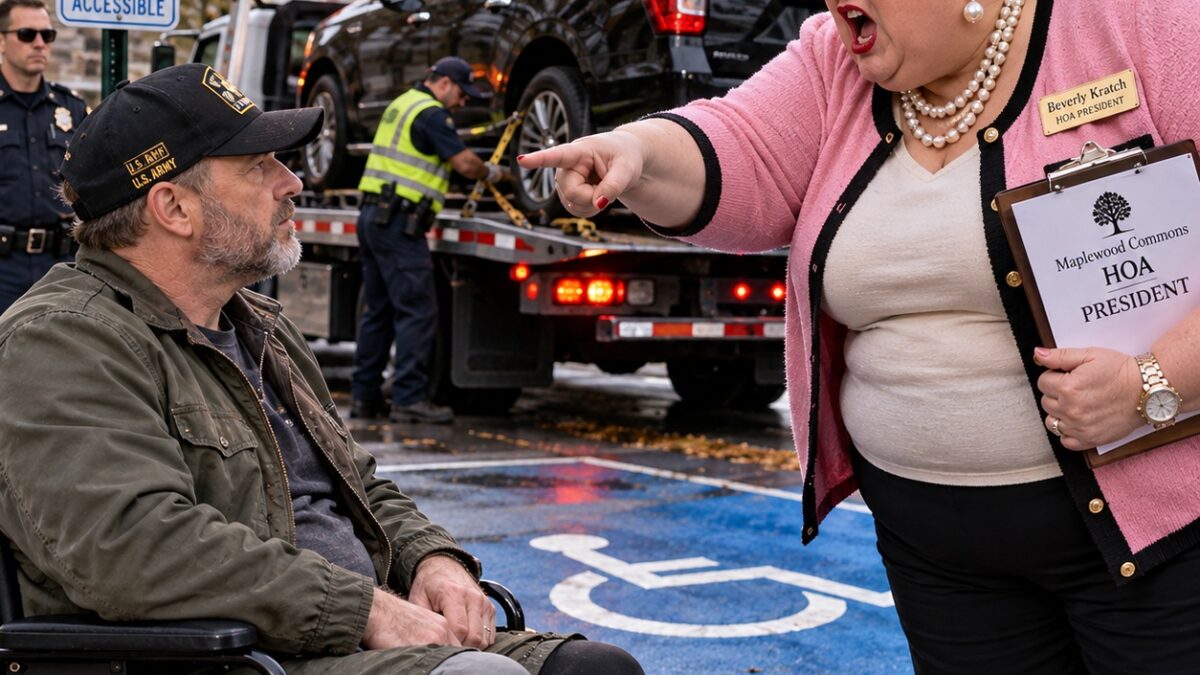
She held up her clipboard.
“Unauthorized vehicle.”
The driver looked at me again.
I said:
“That is my legally approved accessible space.”
Beverly cut in immediately.
“It is under review.”
The driver shifted his weight.
“You got board authorization?”
“I am the board president.”
Not the same answer.
He knew that.
I knew that.
Beverly either did not know or did not care.
The driver walked toward the Expedition.
I checked my phone.
The tow truck had arrived eleven minutes after Beverly placed the call in front of me.
Eleven.
That number stayed in my head.
Clearfield towing response is many things.
Eleven minutes is not usually one of them.
She had called before I came outside.
This had been arranged.
She had not woken up and encountered me.
She had scheduled my humiliation.
The chains came out.
Cold steel against asphalt.
Hooks.
Winch cable.
Metal clanging across the parking lot.
I could feel windows opening behind me.
Neighbors watching.
Beverly wanted a scene.
I could tell by the way she stood.
Arms crossed.
Eyes on me.
She expected anger.
Maybe shouting.
Maybe profanity.
Something she could later call threatening.
I gave her none.
I took out my phone.
Started recording.
Wide angle first.
Beverly.
Clipboard.
My wheelchair.
Tow truck.
Space 7.
The sign.
Then closer.
The vehicle.
Driver.
Chains.
I said calmly:
“For the record, this is Space 7 at Maplewood Commons, my approved accessible parking accommodation for the last three years.”
Beverly said:
“You can narrate all you want, Garrett.”
I looked at her.
“Thank you.”
“For what?”
“Talking on camera.”
Her face changed slightly.
Not enough to stop.
The winch engaged.
My Expedition rose.
A vehicle I had modified because my body sometimes could not use ordinary pedals.
A vehicle that represented the difference between dependence and independence.
Lifted from the space that had been approved specifically because I needed it.
Beverly watched the whole thing.
Never looked away.
The tow truck pulled off.
I kept filming until it turned out of the lot.
Then I stopped the recording.
Beverly looked satisfied.
“You can submit a grievance if you disagree.”
I said:
“I’m sure I can.”
Then I called Opal Whitmore.
Opal lived in Building A.
Retired schoolteacher.
Late sixties.
Gray hair she cut herself because she said beauty salons were organized extortion.
She answered on the third ring.
“Garrett?”
“I need a favor.”
“Are you dying?”
“No.”
“Then this must be serious.”
“My car was towed.”
Pause.
“From your space?”
“Yes.”
Longer pause.
“I’ll get my keys.”
She drove me to Braddock’s Towing.
Recovery fee:
$312.
Storage would have been another $45 per day if I had waited.
I paid.
Got the receipt.
Drove home.
Parked the Expedition back in Space 7.
Then I rolled into my unit, made coffee, sat at the kitchen table, and did what I had been trained to do long before Beverly Kratch learned the phrase “administrative review.”
I defined the problem.
You cannot solve a problem while treating it as an insult.
Insults are emotional.
Problems have structure.
I opened the approval letter.
Three years old.
Board vote unanimous.
Beverly’s signature at the bottom.
I opened my VA records.
Doctor’s recommendation.
Mobility limitations.
Then Beverly’s review notice.
No prior notice.
No hearing.
No stated basis.
No documentation request before the tow.
Nothing.
I started reading.
Housing disability protections.
Reasonable accommodations.
Fair Housing Act materials.
State statutes.
Association procedures.
I was not trying to become a lawyer overnight.
That is another mistake people make.
Google gives you confidence faster than competence.
I wanted enough understanding to know what kind of lawyer I needed.
By Wednesday morning, I had a folder.
By Thursday, I had a name.
Franklin Oaks.
Ohio Warrior Advocacy Project.
A veterans legal-aid organization in Columbus.
Pro bono civil-rights representation for disabled veterans.
I called.
Consultation Friday.
Franklin appeared on video from an office with three bookshelves and absolutely nothing decorative except an Army challenge coin sitting beside his keyboard.
Late forties.
Calm voice.
The kind of lawyer who did not react emotionally because he had already converted emotion into questions.
“Original approval?”
I showed him.
“Signed by?”
“Beverly.”
“Current medical documentation?”
I showed him.
“Tow notice?”
I showed him.
“Did you receive this before the tow?”
“No.”
“Any hearing?”
“No.”
“Any written request for recertification before they removed the accommodation?”
“No.”
“Video?”
“Yes.”
“Receipt?”
“Yes.”
He became quiet.
Then asked:
“Has she done this to anyone else?”
That question changed the scale of everything.
“I don’t know.”
“Find out.”
I went door to door.
Not all at once.
Two weekends.
Twenty-nine doors.
Some people were friendly.
Some suspicious.
Some did not want involvement.
Understandable.
HOA disputes make neighbors nervous because people imagine conflict spreads by proximity.
Nine conversations mattered.
Two elderly residents had been towed after accessibility “reviews.”
One paid and decided it was easier to avoid confrontation.
The other was Cornelius Brandt.
Sixty-eight.
Building D.
Retired union electrician.
Degenerative arthritis in both hips.
When I knocked, he answered using a cane.
I introduced myself.
He looked at the wheelchair.
Then toward the parking lot.
“You’re Space 7.”
Apparently I had become a geographic identity.
“Yes.”
He stepped aside.
“Come in.”
Cornelius’s apartment was immaculate.
Tools organized on a pegboard near the utility closet.
Old union photographs on one wall.
Family photographs on another.
We sat.
I explained why I was asking.
He was quiet for a while.
Then said:
“They did it to me too.”
“What?”
“Threatened towing.”
“How many times?”
He laughed without humor.
“Enough.”
“Did they actually tow?”
“Once.”
“Accessible space?”
“Yes.”
“Approved?”
“Yes.”
“Why?”
“Beverly said I was inconsistent.”
“In what way?”
“She saw me walking.”
I looked at his cane.
He looked at my wheelchair.
We both understood the stupidity of that logic.
Mobility disability does not require permanent visual suffering.
Cornelius said:
“I can walk from my door to the car most days.”
“Okay.”
“I can’t walk across the outer lot without pain.”
“Okay.”
“That’s why I had the space.”
I nodded.
He looked toward the window.
“After the tow, she kept threatening more reviews.”
“What did you do?”
“I stopped driving.”
The words landed harder than I expected.
“You stopped?”
He nodded.
“My daughter gets groceries.”
“How long?”
“Six months.”
I stared.
Cornelius gave me a tired smile.
“It’s easier.”
There it was.
Not legal defeat.
Not a court order.
Exhaustion.
The harassment had not officially taken his right to drive.
It had made using that right expensive enough that he surrendered it himself.
“What about appointments?”
“Daughter.”
“Friends?”
“Sometimes they come here.”
“You liked driving?”
He looked almost embarrassed.
“Yeah.”
That made me angrier than my own $312.
Beverly had not merely moved cars.
She had trained a man to make his own life smaller.
I asked:
“Would you be willing to write down what happened?”
Cornelius looked at me.
“What are you doing, Garrett?”
“Figuring out the shape of the problem.”
He smiled faintly.
“Army?”
“Army.”
He nodded.
“I’ll write it.”
The next HOA meeting came Thursday.
Fifteen residents.
Beige clubhouse.
Folding chairs.
Carpet-cleaner smell.
Coffee that tasted like someone had threatened water with a bean.
Beverly sat at the board table.
Doug Pelham to her left.
Real-estate agent.
Pleasant man as long as Beverly agreed first.
Shirley Voss to her right.
Retired hospital administrator.
Sharp eyes.
Quiet.
I had always suspected Shirley saw more than she said.
I requested four minutes during open forum.
Beverly granted them as though granting clemency.
I wheeled to the front.
No theatrics.
Original accommodation.
Approval letter.
Video still.
Tow receipt.
Medical documentation.
I explained what Franklin had told me about disability accommodation protections.
Then:
“I am asking for three things.”
Beverly folded her hands.
“One: written acknowledgment that Space 7 remains my approved accessible space.”
“Two: reimbursement of the $312 tow.”
“Three: written confirmation that my vehicle will not be removed again absent a lawful process.”
I sat.
Beverly waited.
Made sure everyone was looking at her.
Then adjusted her reading glasses.
“The board appreciates your concern.”
I knew immediately how this was going.
“However, parking enforcement remains within the discretion of the board president.”
I looked at Shirley.
Her eyes lowered briefly.
Beverly continued.
“We believe the review was properly initiated.”
“You never sent it to me.”
“You’re receiving notice now.”
“After the tow.”
“You may contest the action through formal grievance.”
“Fine.”
She smiled.
“There is a fifty-dollar grievance fee.”
The room went dead quiet.
Fifty dollars to complain about paying $312 to recover my own accessible vehicle.
Behind me, Opal made a sound.
Not a word.
More like compressed outrage escaping a human body.
Beverly looked toward her.
Opal stared back.
I looked at Beverly.
“Put your response in writing.”
She blinked.
“Excuse me?”
“The board’s position.”
“Parking discretion.”
“Accommodation under review.”
“Fifty-dollar grievance fee.”
“All of it.”
“In writing.”
She smiled.
“Of course.”
“Thank you.”
I went back to my seat.
That written response became one of the best things she ever gave me.
Over the next ten days, she towed my Expedition twice more.
Second tow:
$389 because the car remained overnight.
Third:
Another fee.
Same company.
Same basic authorization.
Each time I retrieved it.
Each time I parked it back in Space 7.
Each time I documented.
People asked why I did not move the vehicle.
Because the space was mine.
Not emotionally.
Documented.
Approved.
I was not going to voluntarily surrender the accommodation and then spend months proving I still needed it.
Beverly also sent a community email.
No name.
“Concerns about accommodation fraud.”
“Resident abuse of protected designations.”
Everyone knew.
Then the Facebook posts began.
Maplewood Commons private group.
Moderated by Beverly.
Posts about people exploiting disability law.
Claims that “some veteran disability classifications may no longer reflect current functional ability.”
That one made my stomach turn.
Not because she insulted me.
Because I knew what the sentence was doing.
It invited strangers to debate whether a man they had never examined was sufficiently disabled.
Warren Taft noticed.
Former middle-school principal.
Building A.
Quiet man.
Good posture.
The sort of person who spent forty years breaking up hallway fights without raising his voice.
He screenshotted everything.
Posts.
Comments.
Dates.
Times.
Deleted remarks.
Sent the archive to Franklin.
Subject line:
THIS NEEDS TO BE PART OF THE RECORD.
He was right.
I never replied publicly.
Not once.
Beverly wanted emotional content.
I gave her metadata.
Then she called Opal.
Opal called me less than an hour later.
“I wrote it down.”
“What?”
“Everything.”
Beverly had “suggested” that Opal’s continued public support of a resident under accommodation review might influence how the board handled Opal’s future requests.
I became very still.
“Exact words?”
“As close as I can.”
“Date?”
“Yes.”
“Time?”
“Yes.”
“Send it.”
My phone buzzed.
Opal’s written account.
I forwarded it to Franklin.
He called.
“That’s retaliation.”
“I know.”
“Do not confront Beverly.”
“I know.”
“Garrett.”
“What?”
“I mean it.”
“I said I know.”
“You sound like a man currently planning to confront Beverly.”
I took a breath.
“I am currently planning dinner.”
“What?”
“Chicken.”
Pause.
“Good.”
Then:
“I found something else.”
Before Franklin explained, Beverly created another problem for herself.
Emergency board meeting.
New parking amendment.
All disability accommodations subject to annual recertification.
Residents required to submit full updated medical documentation within thirty days or lose their designation.
Three board votes.
Out of forty-two homes.
Mailed first class.
No certified service.
No signature confirmation.
My copy arrived six days after the date printed on it.
Twenty-four days left.
I read it at my kitchen table.
Then read the Ohio HOA statute Franklin had pointed me toward.
The source transcript framed the relevant threshold as requiring a sixty-seven percent homeowner vote for the kind of governing-document change Beverly had attempted.
She had three votes.
She needed twenty-eight.
The amendment was not what she believed it was.
Franklin drafted a preservation letter to the board.
He kept it professional.
No insults.
No threats.
It identified the procedural defect.
The disability-accommodation issues.
The retaliation.
The towing.
Then demanded confirmation that Space 7 remained valid.
Beverly received it Monday.
By Tuesday evening she had done three things.
One:
Preauthorized additional tows with Braddock’s Towing.
Two:
Called more residents and implied that supporting me could affect their HOA matters.
Three:
Sent an official email, using her board-president title, to an Ohio HOA management organization asking about procedures for reporting a resident she accused of accommodation fraud to disability oversight authorities.
She copied enough people that the message reached us.
Franklin read it.
Then said:
“There it is.”
“What?”
“She put intent on letterhead.”
That sentence stayed with me.
Then he showed me what he had found.
County records contained the original 2019 accessibility modification file.
Attached to it was an exhibit I had never seen.
A compliance agreement.
Maplewood Commons HOA.
City of Clearfield.
Federal community-development money.
Amount:
$180,000.
The money had paid for parking lot renovation.
Clubhouse improvements.
The same asphalt beneath Space 7.
The same clubhouse where Beverly charged me fifty dollars to grieve an illegal tow.
As a condition of the grant, Maplewood Commons had entered into a fifteen-year HUD compliance obligation relating to accessibility and nondiscrimination.
Through 2033.
I read Franklin’s summary twice.
Then a third time.
Beverly’s name appeared in the records.
She knew.
This was no longer simply:
President misapplies parking policy.
The HOA had taken federal money under accessibility conditions.
Now its president was systematically challenging accommodations and towing vehicles.
The agreement also contained a self-reporting requirement for accessibility violations.
Beverly had reported nothing.
Of course not.
Franklin explained the risk.
HUD enforcement could potentially include repayment demands depending on findings.
$180,000.
Already spent.
If the community ended up responsible for repayment, homeowners could face the consequences.
Forty-one neighbors dragged into financial exposure because Beverly wanted to prove she controlled one blue parking space.
I rolled to the window.
Looked outside.
Space 7.
Wheelchair symbol.
My Expedition.
Then thought about Cornelius.
A man who had stopped driving.
Not because his doctor told him to.
Not because the state revoked his license.
Because Beverly had made independence exhausting.
I called Franklin.
“File.”
He said:
“Already drafting.”
The next three weeks were disciplined.
Not dramatic.
Discipline rarely is.
Franklin filed the HUD complaint.
Documentation included:
Tow receipts.
My accommodation approval.
Medical documentation.
Beverly’s review notice.
Her emails.
Warren’s screenshots.
Opal’s account.
Statements from Cornelius and others.
The grant agreement.
He also filed with the Ohio Civil Rights Commission.
Two tracks.
State.
Federal.
Then I focused on residents.
Not an HOA meeting.
A gathering.
Opal’s living room.
Fourteen people showed up.
Some stood.
Some sat on furniture.
Cornelius came.
Warren.
A younger couple from Building E.
Two widows.
Shirley did not.
I spread documents across Opal’s coffee table.
No speeches.
I explained.
“The HOA accepted $180,000.”
Silence.
“Federal money.”
More silence.
“In exchange, it agreed to accessibility compliance requirements.”
I pointed to the document.
“Now we have repeated towing and accommodation enforcement that may violate that agreement.”
Someone asked:
“What happens to us?”
“That’s one of the reasons we need to fix this now.”
Warren said:
“What can residents do?”
“Force a special meeting.”
“How?”
“Ten percent of owners can compel one.”
“How many?”
“Five.”
Opal laughed.
“There are fourteen people in this room.”
We circulated the petition.
Not fourteen signatures.
Twenty-two.
By the time I left.
More than half the complex.
That mattered.
Not because Beverly suddenly became powerless.
Because people had stopped being isolated.
I went to Braddock’s Towing next.
Terry Braddock owned the company.
Fifties.
Hands black around the nails from a lifetime near engines.
His office smelled like coffee, motor oil, paper, and winter air slipping through an old door.
I rolled in.
He recognized me.
“Mr. Dillard.”
“Garrett.”
He looked uncomfortable.
“I’m sorry about all this.”
“I’m not here for an apology.”
That surprised him.
I put the HUD agreement on his desk.
Then copies of my approval.
Then Beverly’s orders.
I explained, carefully, that Franklin was building a fair-housing complaint.
That repeated towing connected to disability accommodation enforcement could draw scrutiny.
That licensing and regulatory questions could follow.
Terry read.
Slowly.
He looked up.
“She told me she had full authority.”
“I know.”
“She never told me you had a prior accommodation.”
“I know.”
“She said you were abusing the space.”
“I know.”
Terry leaned back.
“What do you want?”
“Dispatch logs.”
His face tightened.
“All Maplewood Commons tows.”
“Related to accessibility enforcement.”
He looked at me a long time.
Then:
“I need to call my lawyer.”
“Please do.”
He did.
I waited outside.
Twenty minutes later, he came out.
“Come back in.”
He gave me copies of every relevant dispatch record.
Dates.
Calls.
Authorization.
Beverly.
Sole verbal authorization.
Then he signed an affidavit.
Going forward:
No Maplewood Commons tow on Beverly’s word alone.
Written board authorization required.
The pipeline closed.
I thanked him.
Terry said:
“I should’ve asked more questions.”
“Yes.”
He nodded.
No defensiveness.
That mattered.
HUD acknowledged the complaint.
Then opened a full investigation.
Three investigators assigned.
Estimated arrival:
Fourteen days.
I printed the email.
Placed it in my fireproof lockbox.
Then rolled outside.
Sat in my Expedition.
Engine off.
Sun across the blue wheelchair symbol.
Fourteen days.
Not because federal investigators were cavalry.
I did not think like that.
Because outside eyes were finally coming.
That matters when a small system has been dominated by one person for too long.
Beverly learned.
Of course.
Information in small communities travels by channels nobody can map.
By Monday morning, she was moving.
Attorney.
Email.
Management company.
Neighbors.
She told the community a disgruntled resident had filed a frivolous federal complaint designed to destabilize Maplewood Commons.
No name.
Again.
No need.
She demanded that property manager Keith Aldridge issue a statement supporting the board.
Keith declined.
Politely.
Very politely.
The kind of politeness that sounds like a steel door closing.
Then Beverly hired Patricia Weld.
Housing specialist from Columbus.
Three hundred fifty dollars an hour.
Patricia reviewed the file.
Apparently told Beverly she needed to understand the seriousness of the situation.
Beverly responded by posting online.
Long statement.
Outside agitators.
Federal complaint abuse.
Residents hiding behind disability status for financial advantage.
During an active federal discrimination investigation.
Warren screenshotted it within four minutes.
Sent it to Franklin.
Subject line:
SHE DID IT AGAIN.
Franklin added it to the file.
No editorial comment needed.
Then Beverly tried refunds.
Not apologies.
Refunds.
She went to Cornelius’s door.
Envelope.
Cash reimbursement for towing.
Cornelius told me later.
“She thought I wanted money.”
“What did you say?”
“I said I wanted my space back.”
I smiled.
“And an apology.”
He handed the envelope back.
Closed the door.
That was not the Cornelius I had met weeks earlier.
That man had stopped driving.
This man had found his anger.
There is a difference between anger that burns you and anger that returns your dimensions.
Cornelius was getting bigger again.
Not physically.
In life.
The special meeting was scheduled for the second Friday in April.
Beverly controlled the agenda.
So she filled it.
Old business.
Financial report.
Maintenance.
Mailbox paint.
Anything that could consume time.
We anticipated that.
Warren had copies of the state meeting statute in his jacket.
Cornelius had one.
Four others.
I invited two journalists.
Clearfield Gazette.
Regional outlet covering HOA disputes.
Public meeting.
Documents provided.
No promises.
“Observe.”
That was all I asked.
The HUD investigators were scheduled three days after the meeting.
At least that was what we thought.
Then Franklin suggested one more thing.
Accessibility audit.
Professional.
Independent.
Not simply my parking space.
Whole property.
Darcy Stanton came from Columbus.
Measuring wheel.
Level.
Checklist.
No emotion.
She walked every relevant area.
Parking lot.
Signs.
Access aisles.
Clubhouse entrance.
Ramp.
Two days later:
Report.
Four additional deficiencies.
Faded signage.
An access aisle too narrow.
Ramp slope outside the required specification described in the audit.
Other maintenance issues.
None created by me.
All on property renovated with accessibility-related federal compliance obligations.
The case stopped looking like:
Garrett versus Beverly.
It became:
What has this association actually been managing?
I sent the audit to Franklin.
Then, at his direction, a copy went to the board.
No accompanying threat.
Just report.
Beverly received it the day before the meeting.
Patricia Weld reportedly gave her simple advice.
“Don’t speak.”
I almost felt sorry for Patricia.
Meeting day.
Beverly posted one more Facebook message.
Angry.
Personal vendetta.
Lawyer exploiting a disabled veteran.
She tagged the Clearfield Gazette.
Apparently believing attention was a weapon she still controlled.
The reporter’s editor responded by sending a photographer.
At 6:45 p.m., thirty-seven of forty-two unit owners were inside the clubhouse.
Two journalists.
Photographer.
Franklin.
Me.
Opal.
Warren.
Cornelius.
Shirley.
Doug.
Beverly.
And two people seated quietly in the back whom I did not recognize.
Plain clothes.
One woman.
One man.
Franklin looked at me when I entered.
Tiny nod.
I followed his eyes.
The woman in back shifted.
A federal credential edge briefly visible near her bag.
HUD.
They had moved up their visit.
I looked back at Franklin.
He nodded once more.
That was all.
Beverly arrived at 6:58.
Pastel polo.
Lanyard.
Clipboard.
Of course.
She scanned the room.
Journalists.
Camera.
Residents.
Franklin.
Then the back row.
She did not recognize the investigators.
Something still changed in her face.
The turnout alone told her the meeting was no longer hers.
She sat.
Smoothed her shirt.
Adjusted the lanyard.
Called the meeting at 7:03.
Then tried to outrun the clock.
Financials.
Reserve balance.
Landscaping.
Mailbox repainting.
Drainage.
Every topic given generous time.
People grew restless.
She ignored them.
Doug Pelham looked pale.
Shirley Voss sat with hands folded.
Perfectly calm.
I learned later that Shirley had retained her own attorney two days earlier.
She had submitted a written statement describing multiple instances where she raised concerns about Beverly’s parking enforcement and had been overruled.
Shirley had finally stopped protecting the board’s appearance.
She was protecting the record.
When Beverly moved toward adjournment, Warren stood.
“I’d like Mr. Dillard recognized under new business.”
Beverly stared.
“We’re out of time.”
Warren removed the printed statute from his jacket.
“We have quorum.”
Silence.
Beverly knew.
“Four minutes.”
I wheeled forward.
One folder.
No speech in my hand.
I had rehearsed until I no longer needed paper.
Four minutes passed.
I kept speaking.
Beverly started to interrupt.
Warren raised the statute.
She stopped.
I spoke for nine.
I began with the easiest fact.
“Three years ago, this board approved Space 7 as my accessible parking accommodation.”
Held up approval.
“Signed by Beverly Kratch.”
Next.
“Last month, my vehicle was towed from that space.”
Receipt.
“Then again.”
Second receipt.
“Then again.”
Third.
Somebody behind me whispered:
“Three?”
I continued.
“No prior hearing.”
“Review notice not delivered before the first tow.”
“Fifty-dollar grievance fee demanded afterward.”
Then the emails.
Retaliation.
Opal.
Social media.
Void recertification process.
Grant agreement.
I held that one higher.
“In 2018, Maplewood Commons received $180,000 in community-development funding.”
People shifted.
“This agreement attached to the project establishes accessibility obligations through 2033.”
Someone asked:
“What?”
Beverly said:
“Garrett, that is a misrepresentation—”
I looked at her.
“Please let me finish.”
She did.
I explained the potential exposure.
Not as a threat.
As a fact we needed counsel to address.
Then Darcy’s audit.
Four deficiencies.
“Those issues are not Beverly-versus-Garrett issues.”
“They are Maplewood Commons issues.”
I looked around.
“So tonight I am asking for something very simple.”
Space 7 formally acknowledged.
Audit deficiencies corrected.
Written accommodation procedure.
Compliance with the grant requirements.
That was all.
No demand that Beverly resign.
No public execution.
No speech about patriotism.
I did not mention Iraq.
Did not mention Fallujah.
My disability did not become more legitimate because I got it in combat.
A resident with arthritis deserved the same dignity.
Cornelius deserved the same dignity.
I looked at Beverly.
“That’s what I’m asking the board to do.”
Silence.
Her attorney was not there yet.
Patricia had told her not to speak.
Beverly spoke.
Of course.
“Mr. Dillard, this entire presentation is a deliberate campaign to undermine this board and intimidate residents using federal—”
The woman in the back stood.
Beverly stopped.
The woman held up identification.
Introduced herself.
HUD Regional Fair Housing and Equal Opportunity Investigator.
Columbus office.
Her colleague remained seated.
She said, clearly:
“A formal federal investigation concerning Maplewood Commons Homeowners Association is currently open.”
Nobody moved.
“We are present as observers.”
Then:
“Statements made during this meeting may be considered part of the evidentiary record.”
She sat.
No shouting.
No dramatic gasp.
The room exhaled.
All at once.
Thirty-seven people.
Then everyone started talking.
Doug leaned physically away from Beverly.
Shirley stayed still.
Hands folded.
A woman who had already made peace with the truth before entering the room.
Then Patricia Weld came in.
Four minutes late.
She saw the HUD badge.
Saw Beverly.
Saw Franklin.
Understood enough.
Walked forward.
Put a hand on Beverly’s arm.
“Beverly.”
Beverly turned.
Patricia spoke more quietly.
“Stop talking.”
For the first time since I had known her, Beverly Kratch obeyed advice.
The vote came within twenty minutes.
Formal acknowledgment of Space 7.
Commitment to correct every audit deficiency.
Written accessibility policy.
Review of prior towing actions.
Twelve to zero among the voting members represented in the source account.
Beverly did not vote.
She sat.
Silent.
Clipboard on the table.
The object that had looked like a weapon on the morning of my first tow now looked like exactly what it was.
Cardboard.
Paper.
Metal clip.
No authority of its own.
Only what people agreed to let it represent.
When the vote finished, I looked at Cornelius.
He had tears in his eyes.
Not crying exactly.
Holding.
He nodded once.
I nodded back.
That was enough.
People sometimes imagine resolution should arrive at the emotional peak.
It rarely does.
Real outcomes happen afterward.
Emails.
Orders.
Meetings.
Inspections.
Revised policies.
Settlements.
The boring machinery that turns a public moment into lasting change.
HUD concluded the investigation four months later.
The finding was clear enough.
Maplewood Commons had violated the federal compliance obligations connected to its accessibility practices.
But HUD did not demand full repayment of the $180,000.
That mattered to everyone.
The agency recognized that corrective measures were underway and that Beverly’s conduct had driven much of the problem.
Instead:
Formal compliance order.
Correct the four audit deficiencies.
Create a written accommodation process.
Annual reporting for five years.
Oversight.
Boring.
Effective.
Exactly what a community needs after one person turns discretion into a personal weapon.
Beverly resigned eleven days after the special meeting.
One paragraph.
Personal reasons.
No apology.
No acknowledgment.
Nothing about Space 7.
Nothing about Cornelius.
Nothing about Opal.
She simply left the presidency she had occupied for six years.
At one time, I thought I needed her to admit what she did.
By then, I did not.
Evidence does not require confession.
Her attorney handled the private settlement with me.
Terms confidential.
What I can say because it is part of my own decision:
I received reimbursement related to towing and legal costs.
I donated the full amount to the Ohio Warrior Advocacy Project.
Franklin told me I did not have to.
“I know.”
“You could keep it.”
“I know.”
“Why donate everything?”
“Because I had help.”
He looked at me.
“That isn’t a legal reason.”
“It’s the only reason I need.”
The organization that connected me with Franklin had given me tools Cornelius had not had.
Maybe the money could help the next Garrett.
Or, more importantly, the next Cornelius.
Cornelius got his parking space back.
Not temporarily.
Not “under review.”
In writing.
Properly designated.
No harassment.
That summer, he bought a car.
Silver sedan.
Practical.
Nothing dramatic.
I saw him one Saturday washing it.
Bucket.
Hose.
Cane leaning against the side.
He moved slowly.
Carefully.
I rolled by.
He looked up.
We stared for a second.
Then he nodded.
I nodded.
Neither of us said:
This is what winning looks like.
We did not need to.
A sixty-eight-year-old man washing his own car in the parking lot because he had started driving again.
That was the victory.
Not my settlement.
Not Beverly resigning.
That.
The election turnout reached seventy-one percent.
Highest Maplewood Commons had ever seen.
People who once ignored HOA emails showed up.
Read ballots.
Asked questions.
Shirley Voss became president.
Opal Whitmore became secretary.
When I heard, I laughed.
Opal called.
“What’s funny?”
“You’re secretary.”
“I can spell.”
“That was not my concern.”
“Good.”
The new board’s first official action:
Formal accessibility accommodation policy.
Clear.
Written.
Review process.
Notice.
No president deciding alone.
Second:
Replace parking signage professionally.
Third:
Written apology to every resident improperly towed during Beverly’s enforcement period.
Board letterhead.
This time, letterhead used for something useful.
Doug Pelham resigned.
Later appeared at a community barbecue.
Ate one hot dog.
Avoided eye contact with everyone.
Opal told me this as if reporting wildlife behavior.
I laughed for five minutes.
Terry Braddock sent a note.
Handwritten.
Three months later.
He said he was glad I had come to his office instead of treating him as automatically malicious.
Said he wished he had asked more questions before the first tow.
That note mattered.
I still have it.
Why?
Because accountability does not require pretending every participant had the same intent.
Terry should have asked.
He admitted it.
Then he changed his procedure.
That is what learning looks like.
You do not have to become innocent.
You have to become better.
The new board partnered with the veterans legal-aid group.
Community events raised money.
Small scholarship.
$1,500.
Disabled veterans pursuing vocational training or continuing education.
Shirley proposed the name.
Space 7 Scholarship.
I told her it sounded ridiculous.
She said:
“Good.”
“Why good?”
“You’ll remember it.”
She was right.
Passed unanimously.
The first recipient was a thirty-one-year-old former Army medic studying respiratory therapy.
I met her briefly.
She had never heard the whole story.
Good.
The scholarship did not need to become a monument to me.
Space 7 began as paint.
Then became a fight.
Then became a resource for somebody else.
That was enough.
I still live in Maplewood Commons.
Same unit.
Same ramp.
Same parking lot.
Same black Expedition for longer than any reasonable person should keep one.
Space 7 remains mine.
Some mornings I walk on prosthetics.
Some mornings I roll.
Cold still makes the decision for me sometimes.
There are days I make it from bed to vehicle without thinking about Beverly at all.
Those are good days.
Because the goal was never to turn a parking space into a memorial.
The goal was normal.
Ordinary.
I come outside.
My vehicle is there.
I get in.
I leave.
Nobody debates whether my legs grew back overnight.
Nobody demands annual proof that the IED remained effective.
Nobody posts online about whether I deserve access.
Unremarkable.
Exactly right.
But Cornelius stayed with me.
More than Beverly.
More than HUD.
More than the towing receipts.
A man who stopped driving.
People hear stories like mine and imagine oppression only counts if someone wins a lawsuit against you.
If there is a dramatic arrest.
A courtroom.
A headline.
But petty authority often works by erosion.
One fee.
One letter.
One threat.
One embarrassing tow.
One neighbor looking away.
One bureaucratic barrier.
Then another.
Eventually, a person decides:
It is easier not to go out.
Easier not to complain.
Easier not to park there.
Easier not to attend the meeting.
Easier to become smaller.
That is how bad systems survive.
Not because every victim is weak.
Because everybody has a limited supply of energy.
Beverly counted on using more of yours than you could afford.
My military history helped me in one narrow way.
I knew how to compartmentalize.
Not because combat and an HOA are comparable.
They are not.
I would never cheapen war by pretending a parking dispute belongs in the same category.
But certain habits transfer.
Collect information.
Control what you can.
Do not waste movement.
Do not respond to provocation just because it was designed to provoke.
Know your objective.
My objective changed over time.
First:
Get my car back.
Then:
Protect Space 7.
Then:
Stop Beverly.
Then Cornelius showed me the real objective.
Make sure people who were too tired to fight still benefited from the fight.
That changed everything.
Opal understood before I did.
One evening after the meeting, we sat in her living room.
Same coffee table where I had spread the grant agreement.
She said:
“You know why people signed the petition?”
“Because of the $180,000.”
“No.”
“That helped.”
“Sure.”
“But people signed because Cornelius stopped driving.”
I looked at her.
“You think?”
“I know.”
She was a teacher.
Teachers know when a room understands the human example before the abstract principle.
“Money scared them.”
She continued.
“Cornelius embarrassed them.”
“Why?”
“Because everybody had watched him disappear.”
That hurt.
He had stopped driving.
Stopped going out.
Neighbors noticed less of him.
But nobody asked why.
Until the pattern became visible.
Sometimes community failure is not active cruelty.
It is failure to ask where somebody went.
Warren Taft became unofficial archivist.
Not by appointment.
By personality.
He saved everything.
Board minutes.
Policies.
Election notices.
At one point, Shirley joked:
“Warren, if civilization ends, historians will reconstruct Maplewood Commons from your email account.”
He said:
“Only if they have the password.”
Opal replied:
“You’re seventy. Write it down.”
Normal arguments.
Healthy.
The kind that happen after fear leaves.
The compliance work took months.
Parking stripes.
Sign heights.
Ramp correction.
Access aisle.
Contractors.
Quotes.
Dust.
Complaints about construction.
One resident asked why the clubhouse entrance had to be torn up.
Shirley answered:
“Because it’s out of compliance.”
The resident said:
“It was fine for years.”
Shirley:
“That does not mean it was right for years.”
I liked that.
The same could be said about Beverly.
Five-year reporting sounded burdensome.
It was.
That was the point.
Systems behave differently when someone outside them expects receipts.
The new board learned quickly.
Document approvals.
Document denials.
Explain reasoning.
Keep records.
No off-book parking reviews.
No verbal tow orders.
No president using “discretion” as a substitute for process.
Boring governance.
I became a fan.
One afternoon, Beverly’s old HOA business card turned up in a drawer at the clubhouse.
Opal found it.
Brought it to me.
White cardstock.
BEVERLY KRATCH
PRESIDENT
MAPLEWOOD COMMONS HOA
Embossed letters.
She had handed them out like government credentials.
Opal said:
“Want it?”
“No.”
“Burn it?”
“No.”
“Frame it?”
“No.”
“What do I do with it?”
“Recycle.”
She looked disappointed.
“That’s not dramatic.”
“Exactly.”
Some symbols deserve to become pulp.
I did not hate Beverly.
People find that hard to believe.
I was angry.
Deeply.
Still can be when I remember the first tow.
But hatred gives somebody permanent housing in your mind.
I had already paid enough for parking.
I was not giving Beverly free rent.
What I hated was what she represented.
The idea that power becomes legitimate if nobody challenges it.
The idea that disability must perform visibly for strangers.
The idea that older residents should accept humiliation because fighting is tiring.
Those ideas remained worth fighting long after Beverly left.
My prosthetics still hurt.
That did not improve because I won.
Some mornings, skin breaks down.
Some afternoons, I remove them early.
The wheelchair still comes out.
That is another thing I want clear.
Legal victories do not turn disabled people into inspirational transformations.
My legs did not return.
I did not “overcome” being an amputee.
I live with it.
Good days.
Bad days.
Tools.
Adjustments.
Pain.
Humor.
Normal life.
The victory was not becoming less disabled.
The victory was forcing the environment to stop punishing me for being disabled.
That distinction matters.
A year after Beverly resigned, a new resident moved into Building F.
Young mother.
Temporary mobility impairment after spinal surgery.
Needed an accessible space for several months.
She submitted the request.
Doctor’s note.
Shirley called her.
Not to interrogate.
To ask which location worked best.
Approval took three days.
Sign installed.
No debate.
No Facebook posts.
No fraud language.
No fee.
She later thanked the board.
Shirley told me:
“That should be boring.”
“Yes.”
“I like boring.”
“Me too.”
That interaction may have been the cleanest proof that Maplewood changed.
The $50 grievance fee disappeared.
Not just for disability matters.
Entire grievance policy revised.
Reasonable procedure.
No paywall just to tell the board it might be wrong.
Doug had once defended the fee as necessary to discourage “frivolous complaints.”
Opal’s response at a later meeting:
“If you make people pay to tell you you’re wrong, only rich people get to correct you.”
The policy changed.
Teachers.
Never underestimate them.
Franklin and I stayed in touch.
Occasionally.
Holiday messages.
Veterans-project fundraiser.
He once asked me to speak to a small legal-aid training group about documenting harassment.
I said no.
Then yes.
I hate public speaking.
I stood before maybe thirty lawyers and advocates.
Told them about Space 7.
But I spent more time on Cornelius.
One attorney asked:
“What was the key evidence?”
I said:
“All of it.”
They laughed.
I was serious.
No single thing won.
Video without approval documents could be reframed.
Approval documents without video leave factual disputes.
Facebook screenshots show retaliation.
Opal’s notes show intimidation.
Tow logs show repetition.
Grant agreement creates institutional context.
Darcy’s audit expands the scope.
Residents show pattern.
Evidence works like rope.
One thread can break.
Many strands become difficult to dismiss.
Franklin smiled.
Afterward:
“You should’ve been a lawyer.”
“No.”
“Why not?”
“Too many ties.”
Fair.
The young tow driver from the first morning came by once.
Months later.
I was cleaning the Expedition.
He pulled into a visitor space.
Got out.
Same baseball cap.
Older somehow.
“Mr. Dillard?”
“Yeah.”
He looked embarrassed.
“I’m Josh.”
I remembered.
“First tow.”
“Yes.”
He shoved both hands into his pockets.
“I wanted to say I’m sorry.”
“You were doing your job.”
“That doesn’t mean I couldn’t ask.”
Terry’s influence.
I nodded.
“You’re right.”
He looked surprised.
People often expect forgiveness to erase responsibility.
It does not.
“I should’ve asked.”
“Yes.”
He exhaled.
“Okay.”
Then:
“Thanks.”
“For what?”
“Not pretending I didn’t screw up.”
I laughed.
He smiled.
Left.
That conversation mattered too.
Maplewood did not need heroes and villains only.
It needed people capable of admitting where they had failed.
The first anniversary of the tow fell on another cold March morning.
I remembered because my phone calendar had an old reminder from legal documentation.
7:45 a.m.
I rolled outside.
Space 7.
Expedition.
No Beverly.
No tow truck.
Cornelius drove past slowly in his silver sedan.
Rolled down the window.
“Morning.”
“Morning.”
“You going anywhere?”
“VA.”
“Coffee after?”
“Sure.”
That was it.
One year.
No ceremony.
A man driving.
Another man parking.
Ordinary.
Sometimes normality is the anniversary celebration.
Later that spring, Shirley unveiled the Space 7 Scholarship at the clubhouse.
I had not been told she planned to announce the name publicly.
She stood at the same board table where Beverly once told me I owed fifty dollars to complain.
Shirley said:
“This scholarship recognizes disabled veterans pursuing education or vocational training.”
Then she looked at me.
“And it reminds this board that an accessible parking space is not a favor granted by leadership.”
Good line.
Probably Opal wrote it.
Afterward, I asked.
Opal smiled.
“Maybe.”
Teacher.
The blue paint on Space 7 faded eventually.
Public works contractors restriped the lot under the compliance plan.
I watched them repaint it.
Fresh blue.
Wheelchair symbol.
Straight lines.
New reserved sign.
One worker asked:
“You the guy?”
“What guy?”
“The parking-space guy.”
I sighed.
“Apparently.”
He laughed.
“Boss told us this one better be perfect.”
“It’s paint.”
“Yeah, but famous paint.”
I went inside.
There are worse legacies.
I keep the first tow receipt.
$312.
Not framed.
Folder.
Then the second.
The third.
Beverly’s review notice.
Her signed original approval.
Grant agreement.
Opal’s notes.
Warren’s screenshots.
Terry’s affidavit.
Darcy’s audit.
HUD closure documents.
All archived.
Not because I expect another fight.
Because records matter even after the fight.
Memory changes.
Paper does not get tired.
There was a moment during the special meeting I rarely talk about.
Right after the HUD investigator stood.
Before everyone started talking.
Maybe two seconds.
Beverly looked at me.
Not angry.
Not smug.
Confused.
She genuinely did not understand how the situation had reached that point.
I think about that.
From her perspective, perhaps every step had seemed small.
Question the space.
Send notice.
Tow car.
Charge fee.
Post online.
Call Opal.
Change policy.
Tow again.
Send letter.
Each step internally justified.
That is how abuse of authority often grows.
Not one giant decision.
Many small decisions never corrected because the person making them refuses to accept limits.
By the time reality arrives, they think reality is the ambush.
Power needs friction.
That is another thing I learned.
A second signature.
An appeal.
A hearing.
Independent counsel.
Public records.
Member vote.
External review.
People complain that these things slow systems down.
Good.
Sometimes the purpose of a safeguard is to make power slower than anger.
Beverly could tow my vehicle in eleven minutes.
It took months to undo what she started.
A healthy system should make taking someone’s rights harder than returning them.
Maplewood had that backward.
We fixed some of it.
Cornelius once told me he felt embarrassed that he stopped driving.
I said:
“Don’t.”
He shook his head.
“You fought.”
“I had resources.”
“I should’ve—”
“No.”
He looked at me.
“You were tired.”
“So?”
“So tired is real.”
I leaned back.
“People love pretending resistance is a character trait.”
“What do you mean?”
“Like if you don’t fight, you must be weak.”
He waited.
“Sometimes you don’t fight because your hips hurt, your money’s tight, your daughter’s worried, you already spent forty years fighting other things, and one more certified letter is too much.”
Cornelius stared.
“That sounds like an excuse.”
“No.”
“It sounds human.”
He looked away.
After a while:
“Thanks.”
That was probably the most important conversation I had after the case.
Because winning should not become another way to shame people who could not.
Veterans get told we are resilient.
Sometimes true.
Sometimes exhausting.
Resilience can become an expectation other people use to avoid helping you.
“You’re strong.”
Meaning:
Handle it yourself.
I had Opal.
Franklin.
Warren.
Cornelius.
Terry.
Darcy.
Twenty-two petition signatures.
Journalists.
HUD investigators.
I did not win alone.
That is not weakness.
That is how rights work.
A right nobody helps you enforce can become theoretical very quickly.
The community barbecue changed too.
Beverly used to control everything.
Sign-up sheets.
Serving order.
Music volume.
After she left, Opal volunteered.
Chaos.
Children ran everywhere.
Doug showed up.
Nobody assigned tables correctly.
Someone burned hamburgers.
Cornelius drove himself.
Parked.
Walked slowly with his cane.
Sat near me.
He looked around.
“This is badly organized.”
“Extremely.”
He smiled.
“Better.”
Much.
One resident who had supported Beverly apologized to me.
Woman named Linda.
She had commented online under one of Beverly’s posts.
Something about “people taking advantage.”
She approached at the barbecue.
“I didn’t know.”
I said:
“You could’ve asked.”
She winced.
“Yes.”
Silence.
“I’m sorry.”
I nodded.
She did not ask whether I forgave her.
I appreciated that.
Apologies should not become requests for emotional labor.
She changed how she behaved.
That was enough.
When the first five-year compliance report came due, Shirley asked me to review the parking section informally.
I said:
“I’m not your compliance officer.”
“No.”
“You’re the reason we have one.”
“Still no.”
Opal called.
“Do it.”
I did.
Old habits.
The report was boring.
Correct signage.
Approved requests.
No disputed tows.
Training completed.
Boring.
Beautiful.
I occasionally thought about moving.
Not because of Maplewood.
Life.
Maybe somewhere warmer.
Cold and amputations are not friends.
Arizona sounded attractive.
Then I would look out the window.
Opal walking to her car.
Cornelius washing his sedan.
Warren collecting mail.
Shirley measuring something because once you survive one compliance investigation, you become obsessed with rulers.
This place had become more than the site of conflict.
Leaving solely because Beverly once tried to push me out would have felt like giving her too much influence.
So I stayed.
For now.
People ask what I would have done differently.
I would have documented the early comments.
That is one.
Beverly had made remarks for months.
Accommodation fraud.
Parking abuse.
I ignored them.
Not because every stupid comment deserves a file.
But because repeated statements from someone with authority can become context later.
Second:
I would have spoken to Cornelius sooner.
Not after my car was towed.
Sooner.
I had seen him less.
Never asked why.
That bothers me.
Third:
I would have involved Shirley earlier.
I assumed silence meant agreement.
It did not.
Silence can mean fear.
Conflict avoidance.
Uncertainty.
We should ask.
Shirley apologized to me privately.
“I should’ve stopped her.”
“You challenged her?”
“Not enough.”
“You documented later.”
“After damage.”
“Yes.”
She looked down.
“In hospitals, we teach people to escalate concerns.”
“HOAs apparently need the same training.”
She laughed.
Then:
“I’m serious.”
“So am I.”
She became a good president partly because she knew exactly what passive governance costs.
The federal investigators were not dramatic people.
I met with them twice.
Questions.
Documents.
Timelines.
No speeches about justice.
They cared about consistency.
Who knew what when.
What policy existed.
What changed.
What notices were sent.
Who authorized tows.
What the grant required.
That was reassuring.
Beverly had lived in emotional framing.
Fraud.
Abuse.
Disgruntled resident.
Outside agitator.
Investigators lived in dates.
Dates are hard to bully.
The Facebook group eventually got new moderators.
Three.
Not one.
Posts about board disputes had archiving rules.
No deleting comments solely because they criticized leadership.
It seems absurd that a neighborhood social-media page needed governance.
Maybe everything does once somebody abuses it.
Warren was invited to moderate.
Declined.
“I enjoy evidence more than management.”
I understood.
There is one photograph from the special meeting.
The regional photographer sent me a copy.
I am at the front.
Wheelchair.
Folder in my lap.
Beverly behind the board table.
Shirley beside her.
Residents in rows.
You cannot see the HUD investigators clearly.
What I like about the image is not me.
Cornelius is visible near the aisle.
Sitting upright.
Looking toward the front.
Not withdrawn.
Not avoiding.
Present.
I framed that one.
Not the tow.
The first tow video exists too.
I rarely watch it.
Beverly crossing her arms.
Chains.
SUV rising.
Me in the chair.
It makes people angry.
I understand why.
But I do not need anger anymore.
The evidence did its work.
There is no virtue in reopening a wound merely because it was well documented.
I prefer the picture of Cornelius.
A reporter once asked:
“Did Beverly target you because you were a veteran?”
“I don’t know.”
“Do you think your status mattered?”
“She questioned my disability.”
“Would the story have been different if you weren’t a veteran?”
“Legally or morally?”
“Morally.”
“No.”
That mattered to me.
The veteran angle drew attention.
But Cornelius had not served.
He still deserved his space.
Disability rights are not medals.
You should not need military service to make people ashamed of mistreating you.
I also refused the phrase:
“wheelchair-bound.”
A reporter used it.
I corrected her.
“I use a wheelchair.”
“What’s the difference?”
“I’m not tied to it.”
She changed the article.
Small thing.
Words influence how people see independence.
My chair expands my movement.
It does not imprison me.
Beverly understood that backward too.
She told me to move “that chair” as if the wheelchair itself were disrespectful.
The chair was doing exactly what it was built to do.
Keeping me mobile.
There are no medals for getting your car back.
Good.
I had enough medals in a box somewhere.
What mattered was a reliable process.
That sentence would have bored twenty-five-year-old Garrett.
Fifty-three-year-old Garrett meant it.
A year and a half later, I attended a VA appointment.
Long one.
Prosthetics clinic.
Socket adjustment.
By the time I returned, both stumps hurt.
I parked in Space 7.
Turned off the Expedition.
Sat for a moment.
Through the windshield, the sign looked almost ridiculous in its simplicity.
Reserved accessible parking.
No argument.
No review notice.
No woman with a clipboard.
I transferred into the chair.
Rolled up the ramp.
Halfway to my door, Opal yelled from across the lot:
“Garrett!”
“What?”
“Meeting Thursday.”
“I know.”
“You’re coming.”
“Why?”
“Gutter contract.”
“I fought for civil rights so I wouldn’t have to discuss gutters.”
“Seven o’clock.”
I laughed.
That was normal community.
You win the right to live normally, and normal life rewards you with gutter meetings.
Beautiful.
The Space 7 Scholarship grew slightly.
Community fundraiser.
Veterans group matched some donations one year.
Still modest.
That was good.
Small, sustainable things beat grand gestures that disappear.
One recipient sent a thank-you letter.
He wrote:
I did not know the scholarship had a parking-space story behind it until after I applied.
Then:
I like that something meant to reduce somebody’s independence became something that helps people build more of it.
I kept that letter.
Good sentence.
Beverly’s former unit eventually sold.
The new owners had no connection to her.
Young couple.
Baby.
They asked why people sometimes went quiet when they mentioned the previous resident.
I said:
“Long story.”
They said:
“We’ve heard pieces.”
I told them:
“Your house is your house.”
That mattered.
Places should not inherit guilt.
People should get fresh starts when they had nothing to do with what came before.
Cornelius died several years later.
Not dramatically.
Heart condition.
His daughter called me.
I attended the service.
Photographs showed him younger.
Electrician.
Hard hat.
Wedding.
Kids.
Union picnic.
Then one recent photo.
Silver sedan.
He was standing beside it with the cane.
I stared.
His daughter came over.
“He loved that car.”
“I know.”
She smiled.
“He talked about you.”
“That worries me.”
She laughed.
Then became serious.
“He said you gave him driving back.”
I shook my head.
“The board did.”
“No.”
She looked at me.
“You made them.”
I did not argue.
Some compliments are really grief speaking.
You let them land.
After the service, I drove home.
Parked in Space 7.
Sat in the vehicle.
Thought about the first time Cornelius said:
“I stopped driving.”
That sentence had changed my objective.
He never knew how much.
Maybe he did.
Opal got older too.
Slower.
Still dangerous.
She once threatened a landscaping contractor with “the full force of board minutes.”
I told her she was becoming Beverly.
She said:
“Take that back.”
Immediately.
“Sorry.”
Acceptable boundary.
Shirley served two terms.
Then stepped down voluntarily.
Important detail.
At her final meeting, she said:
“Power should have an expiration date even when you think you’re using it well.”
I clapped first.
She glared.
“Don’t make this emotional.”
I clapped louder.
The new president was younger.
Software manager.
Loved spreadsheets.
We got along.
Maplewood had gone from personality rule to process rule.
That was the real structural repair.
People should be able to disagree with a president without fearing parking retaliation.
Obvious.
But every community has some obvious lesson it learned the expensive way.
Ours was Space 7.
I sometimes get asked whether I would still have fought if the first tow had been reimbursed immediately.
Probably not in the same way.
If Beverly had said:
“We made a mistake.”
Reimburse.
Restore space.
Apologize.
Done.
I would have moved on.
That is the tragedy of ego in authority.
Small mistakes become large cases because somebody cannot tolerate admitting wrong.
Beverly doubled down.
Then tripled.
Then documented the doubling down.
Then retaliated against witnesses.
Then changed rules improperly.
Then attacked the complainant during an active investigation.
She did not lose because I was brilliant.
She lost because she refused every exit ramp.
The Army taught me something similar.
Bad decisions compound.
The earlier you correct, the cheaper correction is.
That applies to organizations too.
First tow:
Apologize.
Second:
Stop.
Board meeting:
Listen.
Lawyer letter:
Get independent advice.
HUD complaint:
Say nothing publicly and fix problems.
She had opportunities.
Power convinced her that changing course would look weak.
Actual weakness is needing every decision you make to have been right.
I do not know what Beverly does now.
I do not check.
That is intentional.
Her chapter in my life ended.
If she has changed, good.
If not, also not my job.
The system around me changed.
That was my responsibility while I lived inside it.
The first time a new board member asked me to explain what happened, I gave him the short version.
“She towed my car.”
He laughed.
“That can’t be all.”
“No.”
“What’s the long version?”
I looked at Space 7.
“She mistook inconvenience for authority.”
He wrote that down.
I said:
“Don’t.”
“Why?”
“It sounds smarter than I meant it.”
Too late.
The blue sign faces Beverly’s old building.
It always did.
That detail had infuriated me during the fight.
She could see the sign from her unit.
She knew.
No plausible confusion.
Now I find the geography almost funny.
Every morning for three years before the tow, Beverly could look out and see the space her own signature had created.
Then one day she decided paper could mean the opposite of what it said.
That is the core.
She thought authority meant she could redefine yesterday whenever today became inconvenient.
Records exist to prevent that.
I keep one copy of the original accommodation approval in the glove compartment.
Not necessary.
Habit.
Beside insurance.
Registration.
Emergency medical information.
Sometimes I see Beverly’s signature.
No anger.
Just proof.
She signed.
Then denied.
Then lost.
Simple.
The final HUD report sits in my fireproof box.
So does the petition.
Twenty-two signatures.
That page means more to me than the federal letter.
Why?
Because agencies can enforce rules.
Neighbors create communities.
Twenty-two people said:
We will attend.
We will ask.
We will not let one person control the story.
Beverly survived six years because people assumed somebody else would object.
The petition was everybody realizing:
We are the somebody else.
There was a moment during Opal’s living-room gathering when one resident said:
“I don’t want trouble.”
I answered:
“Neither do I.”
He looked at all the papers.
“This looks like trouble.”
“No.”
“This is what happens after trouble has already arrived.”
That is a distinction worth remembering.
People accuse the person who documents abuse of creating conflict.
No.
Conflict existed before the folder.
The folder just makes it harder to hide.
Warren later told me he had almost deleted the first screenshot archive.
“Why?”
“Felt petty.”
“What changed your mind?”
“Former principal.”
He smiled.
“Kids always said, ‘Everybody knows.’”
“And?”
“Everybody knowing means nothing if nobody writes it down.”
True.
Rumor evaporates.
Records persist.
Terry changed tow-company policy for all HOA calls, not just Maplewood.
Written authorization.
Verification when accessibility markings involved.
His choice.
No law required that exact internal policy.
He said:
“I don’t want my drivers in the middle of board politics.”
Good business.
Good ethics often overlap with good risk management.
People act surprised by that.
They should not.
I once asked Franklin whether Beverly would have gotten away with it if I had not been a veteran with legal-aid access.
He did not answer immediately.
Then:
“Possibly longer.”
“Not forever?”
“Nothing is forever.”
He paused.
“But plenty of bad conduct lasts long enough to ruin lives.”
Cornelius again.
That is why systems cannot depend on the most resilient victim appearing.
Rights should work for tired people too.
That became my lasting belief.
The new accommodation policy included assistance filling forms.
Plain language.
No excessive medical disclosure beyond what was necessary.
Clear timeline.
Written decisions.
Appeal path.
No fee.
No president acting alone.
I read it.
Approved.
Not formally.
Shirley asked:
“Veteran blessing?”
“No.”
“Garrett.”
“It’s good.”
“Thank you.”
Then she added:
“You’re still coming to the gutter meeting.”
I hated democracy.
The neighborhood changed subtly.
People waved more.
Or maybe I noticed more.
Cornelius drove.
Opal organized things.
Warren archived.
The woman whose car had been towed before mine received reimbursement.
Another resident restored an accessible designation she had stopped using.
No parade.
No headlines.
Small repairs.
That is how real reform often looks from the ground.
A person resumes a routine.
My Expedition eventually needed a new hand-control module.
The shop technician asked where I parked.
“Reserved accessible.”
“Good.”
Then:
“You ever have trouble with people using it?”
I laughed.
“What?”
“Long story.”
Maybe every scar becomes a long story if you live long enough.
I am fifty-something and getting older.
At some point, prosthetics may become harder.
Wheelchair more frequent.
Maybe full time.
I do not fear that the way I once did.
Mobility changes.
Independence adapts.
The danger is not needing help.
The danger is a system deciding help makes you less entitled to exist publicly.
Space 7 is one tiny defense against that.
Paint.
Sign.
Policy.
But tiny infrastructure changes entire lives.
Ramps.
Wide doors.
Hand controls.
Reserved parking.
People call them accommodations.
Sometimes that word makes them sound optional.
For the person who needs them, they are architecture for participation.
Beverly once said my space was under review.
What she meant, underneath all the paperwork, was:
Your independence is conditional on my approval.
That was the statement I fought.
Not merely:
Give me my parking spot.
The answer became:
No single neighbor gets to decide whether another neighbor is allowed to participate in ordinary life.
Once the community understood that, the rest became easier.
The last time I spoke about Space 7 publicly was at the scholarship ceremony.
A student asked:
“What should somebody do if an HOA violates their rights?”
I resisted giving a slogan.
Then said:
“Get help early.”
Not dramatic.
True.
“Document.”
“Do not assume a board letter is automatically correct.”
“Do not assume it is automatically wrong either.”
“Ask for the authority.”
“Get legal advice if the issue matters.”
“Talk to neighbors.”
“Do not let embarrassment isolate you.”
That last one mattered most.
Beverly used embarrassment.
The visible tow.
The fraud insinuations.
The Facebook comments.
Shame makes people hide.
Isolation makes authority easier to abuse.
So:
Do not hide.
That is what I would tell Cornelius if I could return to before he stopped driving.
Call somebody.
My name is Garrett Dillard.
I did three tours.
I lost both legs below the knee.
I learned to walk again.
Then learned that walking was not the measure of whether my disability was real.
I learned to use a wheelchair without treating it as failure.
I learned to drive with my hands.
I found a townhome close to my VA clinic.
I asked for one parking accommodation.
The HOA approved it.
For three years, life worked.
Then one Tuesday morning, Beverly Kratch stood between my wheelchair and my SUV and told me:
“Your spot isn’t yours anymore.”
She expected resistance she could label disrespect.
Or surrender she could label compliance.
Instead, I recorded.
That recording led to a lawyer.
The lawyer asked about other residents.
That question led me to Cornelius.
Cornelius led me to understand the problem was bigger than one parking space.
The county records led Franklin to the federal grant agreement.
The grant agreement led to HUD.
The retaliation created more evidence.
The petition turned private frustration into community action.
The tow-company logs shut down the pipeline.
The audit measured problems Beverly could not talk away.
The special meeting put thirty-seven owners in one room.
The HUD investigators made sure everyone understood the record mattered.
And then the community did something Beverly never expected.
It stopped being afraid of her.
That was the collapse.
Not the federal badge.
Not the reporters.
Not my Army background.
Not Franklin’s letter.
Fear stopped working.
Once that happened, a clipboard became a clipboard.
A lanyard became a lanyard.
A board president became one homeowner among forty-two.
Exactly as she should have been.
Today, some mornings I open my front door standing.
Some mornings seated.
On cold days, usually seated.
I roll down the ramp.
Space 7 is directly ahead.
My SUV is there.
I transfer.
Fold the chair.
Load it.
Start the engine.
Leave.
No audience.
No chains.
No arguments.
Cornelius once lost that ordinary freedom because harassment exhausted him.
That is why I never describe what happened as merely a parking dispute.
Parking was the location.
Independence was the issue.
Beverly thought $312 would teach me the cost of resisting.
Then $389.
Then another tow.
Then a $50 grievance fee.
She thought inconvenience would accumulate faster than resolve.
For some people, it does.
That is not shameful.
People run out of money.
Energy.
Time.
Health.
Fight.
I happened to have enough.
A lawyer.
A retired teacher who wrote things down.
A principal who saved screenshots.
A towing-company owner willing to hand over records.
An accessibility expert with a measuring wheel.
Twenty-two neighbors willing to sign.
A board member who finally told the truth.
Federal investigators who arrived early.
Not everyone gets that.
Which is exactly why people who do get those things have an obligation to use them for more than themselves.
I fought for Space 7.
But by the end, Space 7 was not the point.
Cornelius driving again was the point.
The next disabled resident getting an accommodation in three quiet days was the point.
A five-year compliance process was the point.
A scholarship carrying that ridiculous number forward was the point.
A board learning that power needs procedure was the point.
And every morning when I see that blue wheelchair symbol beneath my car, I remember the chains tightening around the Expedition while Beverly stood there with her arms crossed.
She thought the tow truck was removing my leverage.
Instead, she was creating it.
Receipt by receipt.
Email by email.
Post by post.
Call by call.
She built a record so complete that by the time federal investigators opened the file, there was almost nothing left to argue about.
I did not need to outshout her.
I needed to outlast the story she was trying to tell.
She said I was abusing an accommodation.
The approval letter said otherwise.
She said parking enforcement was discretionary.
The process said otherwise.
She said the community supported her.
Twenty-two signatures said otherwise.
She said the complaint was frivolous.
The federal investigation said otherwise.
She said Space 7 was not mine anymore.
Years later, I still park there.
Cornelius drove again.
Beverly resigned.
The board changed.
The accessibility policy changed.
And the most important lesson was never about one HOA president.
It was about what unchecked petty authority does when nobody interrupts it.
It rarely arrives announcing itself as tyranny.
It arrives as a fee.
A form.
A tow.
A warning.
A review.
A sentence in an email.
A neighbor deciding it is easier to stay home.
Then another.
Then another.
Until somebody asks:
Who gave you the authority to do this?
Sometimes the answer is legitimate.
Sometimes it is not.
Either way, ask.
That question protects more than parking spaces.
It protects the difference between rules and intimidation.
Between governance and ego.
Between assistance and control.
Between a man staying home because fighting feels too expensive and that same man standing beside a silver sedan, hose in one hand, washing the car he finally feels free to drive again.
That is the image I carry.
Not Beverly.
Not the tow truck.
Cornelius.
Sun on the hood.
Water running across the asphalt.
Accessible space beneath his car.
His cane against the fender.
He looked up at me.
Nodded.
I nodded back.
Nothing else needed saying.
For months, Beverly’s harassment had taught him to become smaller.
Then a whole community finally told him:
You do not have to.
That is why Space 7 still matters to me.
Not because it is mine.
Because eventually, we made sure nobody had to earn the right to be treated like they belonged there.

