PART2:HOA Queen Smashed My Girlfriend’s Pickup With a Crowbar—Then She Learned Who Owned the Government-Plated Truck
PART2
Over the next several months, I started seeing the pattern.
Mrs. Chen received notices constantly.
Her vegetable garden was too visible.
Her trellis was too tall.
Her tomatoes supposedly created an “agricultural appearance inconsistent with community character.”
I remember reading that phrase and wondering what tomatoes had done to become ethnically suspicious.
The Johnsons lived two streets over.
Black husband.
White wife.
Good people.
Their garbage cans were apparently the most dangerous objects in Willowbrook.
Three inches too far forward.
Out twelve minutes early.
Visible from the side street.
Meanwhile, Victoria’s friends parked RVs for weeks.
Nothing.
Her son hosted a college party.
Five cars lined the street for six days.
Nothing.
Her brother-in-law parked a work truck on Elm Avenue for almost two weeks.
Nothing.
I noticed.
But at that stage, noticing and fighting were different things.
Then I met Maria.
Maria Thornfield was the first good thing that happened after my divorce that I did not immediately distrust.
We met at a coffee shop near the courthouse.
I had stopped there after repairing an MRI system in a surgical center.
My shirt smelled faintly like machine oil.
There was black grease near one cuff.
She was in line ahead of me.
Dark hair.
Gray blazer.
No wedding ring.
She turned when the barista called the wrong name.
Her coffee nearly collided with mine.
“Sorry.”
“My fault.”
“It was definitely mine.”
“Then I accept your apology.”
She laughed.
That was it.
Nothing cinematic.
No thunderbolt.
We ended up at adjacent tables.
Started talking.
Then exchanged numbers.
Maria told me she “worked in legal.”
I assumed paralegal.
Maybe court administration.
She never corrected me directly.
Looking back, she was careful.
Our relationship moved slowly.
That suited both of us.
Dinner.
Coffee.
Weekends.
Eventually she stayed at my house.
Her vehicle was a practical Ford F-150.
Dark blue.
Plain.
Government plates.
I noticed the plates once.
Asked.
She said:
“County fleet.”
“What department?”
“Legal.”
That fit my paralegal theory well enough.
I stopped thinking about it.
Victoria did not.
Maria’s truck became a regular sight outside my house.
Then, three weeks after Maria and I decided we were officially together, Willowbrook suddenly developed a guest-parking emergency.
Bright notice in every mailbox.
NEW GUEST PARKING GUIDELINES
Maximum:
Forty-eight hours in any thirty-day period.
After that:
$75 per day.
Retroactive.
I read it twice.
Maria had stayed three nights that week.
At dinner, I put the notice on the table.
“She’s timing my driveway now.”
Maria read it.
Her eyebrow lifted.
“Did members vote on this?”
“Vote?”
“She can’t necessarily invent new use restrictions alone.”
“You sound suspiciously informed for someone who watches courtroom shows.”
Maria smiled.
“I’ve dealt with property matters.”
“How?”
“Work.”
Still vague.
I let it go.
The next morning:
$225 violation under Maria’s windshield wiper.
I stood in my driveway holding it.
Then looked down the street.
Victoria’s son’s friends were still parked outside her house.
Day five.
No tickets.
Something inside me shifted.
Not anger exactly.
Curiosity.
And curiosity is dangerous when you work on diagnostic equipment for a living.
My entire career involved figuring out why a system behaved differently from what the manual said it should do.
So I started measuring.
For two weeks, I walked Willowbrook every morning before work.
Coffee.
Phone.
Photos.
Dates.
License plates.
Nothing intrusive.
Just publicly visible parking.
Victoria’s house:
Five guest cars.
Six days.
No violations.
Book club:
Silver Mercedes.
Nine nights.
No violation.
Brother-in-law:
Work truck.
Fourteen days.
No violation.
Mrs. Chen’s daughter:
Three days.
$225.
Johnsons’ son:
Weekend.
Fine.
Another Hispanic family:
Overnight guest.
Fine.
By day fourteen, I had a spreadsheet.
Maria saw it.
“You made a parking database?”
“I fix MRI scanners.”
“That does not answer the question.”
“It does if you know me.”
She laughed.
Then became serious.
“This is selective enforcement.”
“I know.”
“Possibly discriminatory.”
“I know.”
“Are you going to challenge it?”
“Yes.”
I submitted a formal written complaint.
Requested board minutes.
Parking-rule adoption documents.
Enforcement records.
Meeting notices.
Voting records.
Professional.
No insults.
No references to Victoria as a suburban dictator, despite temptation.
The response arrived in a thick envelope.
And Mrs. Patterson accidentally changed everything.
Mrs. Patterson was the HOA secretary.
Seventy-something.
Kind.
Old school.
Printed everything.
Emails.
Attachments.
Board communications.
She filed actual paper.
In folders.
With labels.
While responding to my records request, she accidentally included internal emails Victoria had never intended me to see.
The first one was enough.
That Mexican guy is becoming a real problem. His truck-driving girlfriend makes the whole street look like a trailer park. We need to get rid of him before he brings down all our property values.
I sat at my kitchen table staring at the words.
Mexican guy.
I am Spanish American.
Born in San Antonio.
College educated.
I make a living repairing machines worth more than most houses in Willowbrook.
Not that any of that should have mattered.
Brown skin plus last name Castellanos was apparently enough for Victoria’s classification system.
I kept reading.
It got worse.
She discussed “problem households.”
Demographics.
Targeted inspections.
Using violations to “encourage voluntary relocation.”
Mrs. Chen.
The Johnsons.
Rodriguez family.
Me.
It was not subtle.
It was policy by prejudice.
Maria walked in that evening carrying takeout.
Stopped when she saw the papers.
“What happened?”
I handed her the email.
She read.
Then another.
Then another.
Her face changed.
Not shocked exactly.
Focused.
Professional.
“This is serious.”
“I figured.”
“No, Riley.”
She put the papers down.
“This is civil-rights evidence.”
“You really have dealt with property law.”
She gave me that mysterious half smile again.
“Something like that.”
I should have pushed.
I did not.
I was too busy realizing Victoria had handed me evidence of discrimination in her own words.
Neighbors began talking.
Quietly.
Mrs. Chen nodded when I passed.
Mr. Johnson asked whether I wanted copies of his fines.
A few residents said:
“Be careful.”
That told me more than support would have.
People were afraid of an HOA president.
Not physically.
Administratively.
Fines.
Liens.
Inspections.
Contractors.
Selective enforcement.
Petty authority can be powerful when it controls enough inconvenience.
Victoria sensed the resistance.
Her response was immediate.
If parking would not drive me out, landscaping might.
The new rules arrived under the title:
LANDSCAPE QUALITY INITIATIVE
Mandatory professional maintenance.
Monthly inspections.
$200 fines for weeds or nonconforming vegetation.
All work performed by approved HOA vendors.
Only one approved company.
Peton Premium Landscaping.
Owner:
Randy Peton.
Victoria’s brother-in-law.
I had three dandelions.
Three.
The notice described them as:
VISIBLE WEED INFESTATION NEGATIVELY AFFECTING NEIGHBORHOOD APPEARANCE
I called the county extension office.
That led me to Dave.
Sun-beaten face.
Khaki shirt.
The enthusiasm of a man who had waited his whole career for someone to ask about drought-resistant landscaping.
I showed him the HOA documents.
He grinned.
“You like lavender?”
“What?”
“Lavender.”
“I don’t know.”
“California poppies?”
“I’m not much of a flower guy.”
“You are now.”
He explained state protections for water-conscious landscaping.
Native plants.
Drought resistance.
Conservation rules.
HOAs could regulate reasonably, but they could not simply force residents to waste water to preserve a grass aesthetic where state protections applied.
Three days later, I started removing my lawn.
The neighbors thought I had lost my mind.
Out came thirsty grass.
In went lavender.
Bunch grasses.
Poppies.
Native groundcover.
Victoria arrived during installation.
She stood on the sidewalk staring.
“This isn’t lawn.”
“No.”
“You’re destroying the uniform appearance.”
“I’m conserving water.”
“The guidelines require maintained turf.”
I handed her printed statutes and county material.
She scanned.
Her mouth tightened.
“This does not supersede HOA authority.”
“It appears to.”
“We’ll see.”
She walked away.
By the next afternoon, an “inspector” arrived.
County-branded polo.
Clipboard.
Pickup.
Randy Peton.
I knew him from Victoria’s family photos.
He said:
“County inspection.”
I smiled.
“Great.”
His confidence dropped.
“May I see your county credentials?”
“My what?”
“Badge.”
Silence.
“Employee number.”
He shifted.
“Left my ID in the truck.”
“No problem.”
I pulled out my phone.
“I can verify your number online.”
He stared.
Then suddenly remembered an appointment.
The truck left fast enough to spray gravel.
Within an hour, three neighbors asked Dave’s office about converting their lawns.
Victoria had accidentally started a native-plant movement.
She was furious.
Then came the violation blitz.
Seven notices in ten days.
Garbage can three inches wrong.
Bedroom blinds insufficiently opaque.
Driveway “oil stains” that were tree shadows.
Pet-noise complaint.
I had no pet.
One notice alleged barking at 2 a.m.
I had been asleep.
After a fourteen-hour hospital shift.
Every notice:
Fine.
Processing fee.
Inspection fee.
They piled up.
That was when I requested financial records.
Not because I expected millions.
Because every broken system eventually reveals itself through money.
The numbers were unbelievable.
Victoria’s compensation had increased dramatically.
Consulting payments to shell entities.
Randy’s landscaping contract far above comparable rates.
Vendor relationships with relatives.
Unusual reimbursements.
And then the violation metadata.
Some photographs were old.
Dates changed.
Images reused.
Violations backdated.
At least one notice claimed I had committed an infraction on a day location records showed me sixty miles away servicing medical equipment.
Maria came over.
Found me surrounded by spreadsheets.
“You look deranged.”
“I’m doing forensic accounting.”
“That explains nothing.”
I showed her.
She became quiet.
“Riley.”
“What?”
“This isn’t harassment anymore.”
“I know.”
“This looks like organized theft.”
I stared.
“You’re very comfortable with that phrase.”
She caught herself.
“I watch legal shows.”
“Right.”
She smiled.
Lucky me.
The anonymous envelope appeared the next morning.
No return address.
Inside:
Victoria’s personal financial information.
Credit-card debt.
Real-estate ethics suspension.
Divorce paperwork.
Connections to shell businesses.
A note.
She’s stealing from all of us. Some of us see it. Time to act.
I did not know who sent it.
I still do not.
Maybe I never will.
But somebody inside Victoria’s circle had cracked.
Maria and I spent that evening arranging documents.
I calculated.
Cross-checked.
Built timelines.
She moved through financial patterns with ease that should have finally made me suspicious.
Instead, I teased her.
“Lots of courtroom television?”
“Extensive education.”
Then Victoria went silent.
Four days.
No notices.
No calls.
Nothing.
That scared me more than seven violations.
Bullies do not suddenly become reasonable.
They pause when they are changing tactics.
I spent the quiet days digging through county archives.
That was where I found Willowbrook’s 1995 incorporation documents.
Old scan.
Hard to read.
Buried in attachments.
Fee limits.
Annual increase capped at three percent or cost-of-living adjustment, whichever was lower.
I stared.
Current dues:
$285 per month.
I built the lawful progression from the baseline.
Approximate lawful amount under the source documents:
$126.
Difference:
$159 per household per month.
Willowbrook supposedly had 847 homes across its full association footprint.
Eight years.
I calculated.
Then recalculated because the number looked absurd.
Over ten million dollars in excess collections under the source accounting theory.
I sat back.
My hands shook.
This was not:
Victoria likes fines.
This was:
A financial system had been built.
I called Maria.
“You need to sit down.”
“I’m sitting.”
“You know the HOA stuff?”
“Yes.”
“It’s bigger.”
“How big?”
I explained.
She went silent.
Then I said:
“Maria, I need you to tell me exactly what you do.”
Long pause.
Finally:
“I’m the district attorney for Riverside County.”
I stood.
“What?”
“I’m the elected district attorney.”
“You told me you worked in legal.”
“I do.”
“That is like a surgeon saying she works around hospitals.”
“I know.”
I walked around the kitchen.
“You’re the DA?”
“Yes.”
“Why didn’t you tell me?”
“Because I was trying to date like a normal human being.”
“That ship sailed when you started analyzing HOA bylaws over tacos.”
She laughed once.
Then became serious.
“And because Victoria Peton is part of an investigation.”
I stopped moving.
“What?”
“We’ve been investigating HOA fraud for almost two years.”
My mouth went dry.
“Willowbrook?”
“Primary case.”
“Victoria?”
“Yes.”
“RICO theories?”
“Yes.”
“Vendor fraud?”
“Yes.”
“Civil-rights issues?”
“Yes.”
I sat.
The woman I had been casually calling my legal-drama girlfriend was the prosecutor already building the case I thought I had discovered alone.
Maria said:
“Riley, the evidence you gathered matters because you gathered it independently.”
“You knew this whole time?”
“I knew pieces.”
“You watched her target me.”
Her voice softened.
“I could not compromise an active investigation.”
I hated that answer.
I also understood it.
Eventually.
Then she said:
“We were preparing arrests.”
“When?”
“Soon.”
I looked at the fee calculation.
The emails.
The violations.
Then remembered her truck.
Government plates.
I did not know yet how important that truck would become.
Maria brought official case materials to my house once disclosure became appropriate within her investigation strategy.
Not everything.
Enough.
Vendor schemes.
Shell companies.
Board members.
Recorded calls.
Transfers.
Victoria had been running Willowbrook like a revenue engine.
Inflated contracts.
Preferred vendors.
Selective fines.
Pressure campaigns.
People who challenged her became targets.
People who cooperated became invisible.
Randy was connected.
Other relatives too.
Maria traced relationships on a chart.
“This is why pattern matters.”
I looked at the lines.
“You’re really a prosecutor.”
“Disappointed?”
“Terrified.”
“Good.”
She smiled.
Then:
“We’re coordinating the next move with a town hall.”
“You want her arrested at the meeting?”
“I want residents to see the evidence.”
“That’s not the same.”
“No.”
“But if probable cause and warrants are in place, accountability may become public.”
I stared at her.
“You have dreamed about this.”
“For two years.”
Fair.
I began organizing residents.
Mrs. Chen had two folders.
Every garden citation.
Photographs.
Dates.
The Johnsons had parking records.
Rodriguez had emergency inspection fees.
Sarah Kim had a paint-color fine despite her house matching twelve others.
Twenty-three families committed first.
Then more.
Group messages exploded.
Everyone had a story.
$400 roof inspection after light drizzle.
Inspector related to a vendor.
$500 sidewalk review.
No defect.
$600 paint fine.
Identical color elsewhere.
Guest-parking penalties.
Trash-can fines.
Selective enforcement.
It became obvious how Victoria survived eight years.
Everybody thought their incident was isolated.
One household.
One fine.
One annoying president.
The moment residents compared records, isolated annoyances became a system.
That is when fear started collapsing.
We scheduled a budget-transparency town hall.
Public under association rules.
Sunday.
Two p.m.
I borrowed recording equipment from the hospital training department.
Nothing hidden illegally.
Cameras covering the room.
Backup audio.
Projector.
Evidence copies.
Maria emphasized chain of custody.
Original files.
Hashes where needed.
Screenshots with metadata.
Emails preserved.
Do not edit originals.
Do not turn evidence into memes.
The neighbors found that last instruction disappointing.
By Saturday:
Eighty-seven confirmed attendees.
Then eighty-nine.
Hundreds of documents.
An indexed digital folder.
Victoria tried to cancel the meeting.
Could not.
Then she fired the management company.
Or tried.
Then attempted an emergency $3,000 special assessment for “critical infrastructure.”
Nobody knew what infrastructure.
People laughed.
That was new.
For years, Victoria’s notices created panic.
Now desperation made them look desperate.
Power weakens rapidly once its symbols stop frightening people.
Then came Tuesday.
6:17 a.m.
Security alert.
I woke to a metallic crash.
At first I thought accident.
Then another.
Glass.
I looked through the kitchen window.
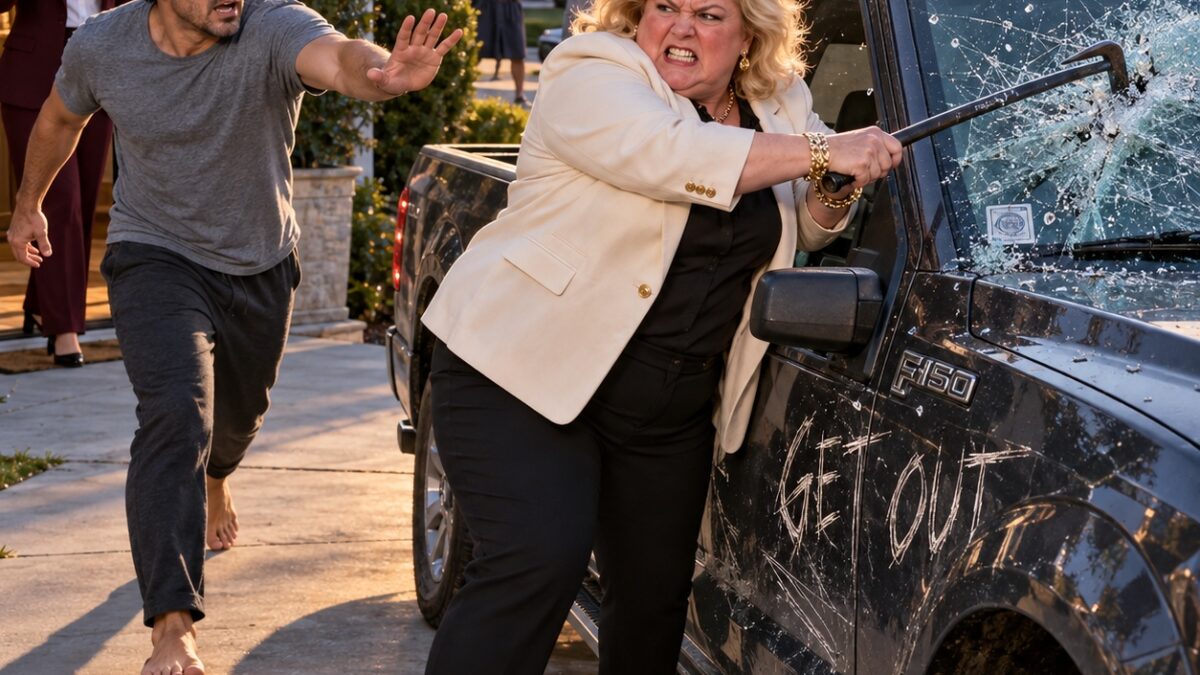
Victoria stood beside Maria’s F-150.
Crowbar raised.
Tennis skirt.
Sneakers.
Hair tied back.
Like she had gone out for cardio and decided on felony vandalism instead.
She swung.
Windshield.
Glass exploded.
I ran outside.
Barefoot.
Pajama pants.
“STOP!”
Victoria hit the driver-side mirror.
It snapped.
“What are you doing?”
She spun.
“This junk is destroying our property values.”
“That isn’t my truck!”
“I don’t care whose trash it is!”
She drove the crowbar against the door.
Metal screamed.
Then scratched letters.
G.
E.
T.
O.
U.
T.
Across the government-owned paint.
Neighbors opened doors.
Phones appeared.
My own 4K cameras recorded everything.
Victoria was not hiding.
She wanted me to see.
That was the point.
Not merely property damage.
Humiliation.
Warning.
Leave.
I stood in the driveway watching a woman who had spent eighteen months manufacturing my violations commit an actual crime in front of six cameras and half the block.
Then she looked at me.
Breathing hard.
Crowbar in hand.
“You should have listened.”
I said:
“You have no idea whose truck you’re destroying.”
She laughed.
“Your girlfriend’s?”
“Yes.”
“Then maybe she’ll stop parking her junk here.”
“She’s the district attorney.”
Victoria stopped.
No movement.
No sound.
The crowbar remained halfway raised.
“What?”
“Riverside County District Attorney Maria Thornfield.”
Her face changed.
Not slowly.
Instantly.
Color vanished.
Eyes widened.
She looked at the government plate.
Then at me.
Then at the truck.
That moment lasted maybe three seconds.
It felt like a minute.
She dropped the crowbar.
Not intentionally.
It hit pavement.
She backed away.
“This is—”
I said nothing.
“You set this up.”
“No.”
“You knew.”
“I knew whose truck it was.”
She stared.
Then left.
Fast.
No clipboard.
No final threat.
Just fear.
Maria arrived twenty minutes later.
She looked at the F-150.
Windshield destroyed.
Mirror hanging.
Deep gouges.
GET OUT carved through paint.
She walked around once.
No dramatic reaction.
Then looked at me.
“You okay?”
“I’m not the truck.”
“Riley.”
“Yes.”
“I’m asking.”
“I’m fine.”
She nodded.
Then examined the cameras.
“You saved originals?”
“Yes.”
“Neighbors?”
“Several recordings.”
“Crowbar?”
“Still there.”
“Don’t touch it.”
I had not.
Police arrived.
Report.
Photos.
Evidence.
What made the incident devastating for Victoria was not some magical rule that every damaged government truck automatically created federal jurisdiction.
What mattered was context.
Government-owned county vehicle.
Clear recorded identification.
Ongoing criminal investigation.
Possible intimidation of a prosecutor’s associate.
Potential obstruction and retaliation theories layered onto existing financial and civil-rights evidence.
Maria did not need exaggeration.
Reality was enough.
I said:
“Are you arresting her today?”
“No.”
“Why?”
“Because we’re finishing the larger case.”
I hated patience.
She continued.
“If we move on one vandalism count and compromise the rest, that helps her.”
“So we pretend?”
“No.”
“We document.”
That word again.
I sighed.
“Fine.”
Maria smiled faintly.
“Welcome to prosecution.”
The neighborhood reaction moved faster.
Three board members resigned within twenty-four hours.
News crews covered the truck.
Headline:
HOA PRESIDENT ACCUSED OF VANDALIZING RESIDENT’S GUEST VEHICLE
Nobody yet knew the full ownership story publicly.
Victoria’s reputation changed.
Before:
Strict.
Controlling.
Difficult.
Now:
Unstable.
Then she hired a private investigator to research Maria.
I wish I had seen the report.
I did not.
But the result became obvious.
Victoria learned Maria’s actual job.
Then learned the fraud investigation existed.
Most people, when told the county’s elected prosecutor has spent two years building a case involving them, hire competent counsel and stop talking.
Victoria broke into my backyard.
Two a.m.
Claimed later she was “preserving evidence.”
Security footage showed her near my shed with a flashlight.
Then came threatening phone calls to neighbors.
Recorded.
Promises of consequences if they testified.
By Friday, even her lawyer was reportedly telling her to stop.
She did not.
Sunday morning, Victoria held a press conference.
Two hours before our town hall.
I watched the livestream while setting up the projector.
She wore a conservative blue suit.
Minimal makeup.
Calm voice.
“I have been the victim of an organized harassment campaign.”
I looked at Maria.
Maria looked at me.
Neither spoke.
Victoria continued.
“A disgruntled resident has coordinated with outside criminal elements to undermine legitimate community governance.”
Then:
“A corrupt prosecutor has abused public resources.”
Maria raised an eyebrow.
“Is she referring to you?”
“Apparently.”
“How do you feel?”
“Professionally delighted.”
I laughed.
Victoria was attacking the integrity of a prosecutor during an active investigation, on camera, while Maria’s office coordinated warrants and financial actions.
Every sentence became evidence.
That was the tragedy of Victoria by then.
She had lost the ability to distinguish speaking from helping the prosecution.
By eleven, the community center was packed.
Mrs. Chen front row.
Two folders.
The Johnsons had a timeline.
Rodriguez.
Kim family.
Retirees.
Young families.
People I had never seen at meetings.
Eighty-nine residents.
Some brought family members.
Local press.
Financial-crimes investigators in plain clothes.
Detective Morrison sat like a concerned homeowner.
Maria stayed out of sight initially.
Not for theater.
To keep the meeting focused on residents before the law-enforcement action.
That was what she told me.
I still thought it was theater.
Good theater.
Victoria arrived at noon.
Navy suit.
Briefcase.
Hair perfect.
She entered like she still owned the room.
That was the most revealing part.
Even after the vandalism.
The investigation.
The resignations.
She expected obedience.
Eight years creates habits on both sides.
She took the microphone without invitation.
“Ladies and gentlemen.”
Nobody interrupted.
Old reflex.
“Before we address this unfortunate gathering, I need to disclose important information about the criminal conspiracy targeting your elected leadership.”
I sat third row.
Victoria pointed toward me.
“Riley Castellanos has coordinated with outside agitators to undermine Willowbrook Estates.”
People murmured.
Not agreement.
Anticipation.
She continued.
“His mysterious girlfriend is associated with corrupt legal interests.”
Someone near the back laughed.
Victoria’s eyes flashed.
“Mr. Castellanos must be removed from this community for the safety of law-abiding homeowners.”
That was my cue.
I stood.
Rolled the banker’s box onto the front table.
Then looked at Victoria.
“Thank you.”
She stared.
“For what?”
“The introduction.”
I took the microphone.
“Now I’d like to show everyone the records.”
First slide:
1995 incorporation documents.
Fee limits highlighted.
I explained the source figures.
Baseline.
Increase cap.
Current assessment.
Projected lawful amount.
Then:
“The numbers in the records indicate the association collected substantially more than the governing formula authorized.”
I did not call the $10.8 million figure final theft.
Maria had drilled that into me.
Financial cases require exact accounting.
So I described the source calculation.
“If this historical formula is applied as written, the difference across the full association footprint over the relevant years reaches into eight figures.”
The room exploded.
People started calculating.
Victoria shouted:
“That is false.”
Second slide.
Vendor payments.
Randy.
Related entities.
Inflated contracts.
Third.
Victoria compensation.
Consulting fees.
Fourth.
Selective violation records.
Minority families compared with favored households.
Fifth.
Internal email.
I enlarged it.
Then I pressed play on an audio reading from the authenticated file packet.
Victoria’s words:
That Mexican guy is becoming a real problem. His truck-driving girlfriend makes the whole street look like a trailer park. We need to get rid of him before he brings down all our property values.
Absolute silence.
Mrs. Chen looked at Victoria.
Mr. Johnson looked at Victoria.
Not me.
Her.
The people she had targeted were finally hearing proof they had not imagined the pattern.
I said:
“There are additional communications concerning targeted enforcement against specific residents.”
Victoria shouted:
“Those were private!”
She realized what she had said.
Too late.
A private discriminatory email does not become less discriminatory because the sender wanted privacy.
Then:
The truck video.
The room watched Victoria raise the crowbar.
Crash.
Windshield.
Crash.
Mirror.
Screech.
GET OUT.
On a twelve-foot screen, every movement looked even more deliberate.
Victoria went pale.
I paused on a frame.
Her face.
Crowbar.
Government plate visible.
I said:
“This truck belongs to my girlfriend.”
Victoria snapped:
“I don’t care what some random woman—”
“District Attorney Maria Thornfield.”
The room erupted.
I continued.
“Riverside County’s elected district attorney.”
Victoria froze.
The projected Victoria froze too.
Crowbar hanging over the truck.
Two versions of the same moment.
Then the side door opened.
Maria entered.
Dark suit.
Badge credentials.
Detective Morrison.
Two investigators.
Camera flashes started.
Victoria stared at Maria.
I had never seen a human expression contain so many calculations at once.
Recognition.
Fear.
Anger.
Disbelief.
Maria stepped to the microphone.
“Mrs. Peton.”
Victoria’s lawyer, seated near the front, stood.
“Do not say anything.”
Finally good advice.
Maria continued.
“Pursuant to warrants issued this morning, you are being placed under arrest in connection with an ongoing investigation involving financial fraud, racketeering-related conduct, civil-rights violations, obstruction, and destruction of government property.”
Victoria looked toward the door.
An investigator moved.
Not aggressively.
Just enough.
No exit.
The handcuffs closed.
No giant speech.
No movie music.
Metal.
Click.
That was all.
Victoria Peton, who had spent eight years making adults fear yellow paper, stood in front of the community while another authority finally told her what she was required to do.
Remain silent.
The irony did not need explanation.
Some residents applauded.
I did not.
Mrs. Chen cried.
The Johnsons held hands.
A man behind me whispered:
“Eight years.”
That sentence mattered more.
Eight years.
Not one bad week.
Not one misunderstanding.
People had lived under a system.
The arrest did not repair them instantly.
It simply stopped the person running it.
After Victoria left, the meeting continued.
That surprised people.
They expected climax.
Maria had warned me:
“Do not let the arrest become the entire story.”
So we kept going.
Resident statements.
Financial review.
Board resignations.
Motion for temporary governance.
Independent audit.
Vendor suspension.
Record preservation.
Equal-enforcement policy.
Competitive bidding.
Refund analysis.
People who had been afraid to speak started talking too much.
That was good.
Messy democracy is healthier than efficient fear.
Mrs. Chen stood.
Read dates.
Fines.
Photos.
She said:
“For years, I thought maybe I was too sensitive.”
Mr. Johnson said:
“We thought maybe we were the problem.”
That hit me harder than the handcuffs.
Because abuse of authority does not only take money.
It makes people distrust their own perception.
The investigation continued for months.
Not everything from the town hall became a final criminal charge.
That is how real cases work.
Some allegations remained civil.
Some accounting figures changed after forensic review.
Some transactions were legitimate but badly documented.
Others were not.
Victoria eventually pleaded guilty to federal counts rather than take the full case to trial.
The source outcome placed her sentence at eighteen months and restitution around $347,000.
Her real-estate license was permanently revoked under the source ending.
I did not celebrate the sentence.
I was relieved.
There is a difference.
Her husband suffered consequences too, although I learned to be cautious with stories about spouses.
Marriage does not automatically make someone criminally responsible for everything the other person does.
What mattered was evidence.
Not association.
That principle had to apply even when I disliked the people involved.
The financial recovery process was complicated.
The original source described average refunds of $2,847 per household.
Residents received money back through a combination of corrected assessments, recovered funds, and settlement mechanisms.
The exact amount varied.
The important part was simpler.
For the first time, Willowbrook sent residents statements that showed where their money actually went.
Line by line.
No mystery consulting charges.
No preferred-relative monopoly.
No “emergency” costs without explanation.
Mrs. Chen became treasurer.
I could not have invented better poetic justice.
The woman fined for tomatoes now controlled the budget spreadsheets.
She was terrifyingly good at it.
At her first meeting she said:
“If you want reimbursement, attach receipt.”
People laughed.
She did not.
Perfect treasurer.
The Johnsons joined the architectural committee.
Their first proposal:
Standardized enforcement checklist.
No names until after objective review when possible.
Photos.
Rule citation.
Appeal path.
Equal comparison.
One board member complained:
“That seems bureaucratic.”
Mr. Johnson said:
“Good.”
Exactly.
Procedure is annoying until you live under personality.
Then procedure becomes freedom.
The guest-parking rule disappeared.
Not modified.
Gone.
Residents could have normal visitors again.
Maria parked outside my house whenever she wanted.
The first weekend after repeal, she stayed three nights.
I came outside Monday.
No ticket.
I looked at the windshield anyway.
She caught me.
“Trauma?”
“Habit.”
She kissed my cheek.
“Want me to move it?”
“No.”
“Two more days?”
“Push it.”
She smiled.
Randy Peton lost the landscaping monopoly.
Contracts opened for bids.
Costs dropped dramatically.
Professional crews took over common areas.
Ironically, fewer people used them.
Because my native garden had spread.
Twelve families converted within the first year.
Then more.
Lavender.
Poppies.
Sage.
Native grasses.
Water use dropped significantly under the source outcome.
Birds returned.
Butterflies.
Less fertilizer.
Less leaf-blower noise.
Victoria had tried to use landscaping as punishment.
Instead, she helped start the most popular neighborhood change in years.
That still makes me smile.
One afternoon, Dave from the county extension office came to see the street.
He stood looking at the gardens.
“You started a movement.”
“I planted lavender out of spite.”
“Many revolutions begin badly.”
“Is that official county guidance?”
“Absolutely.”
We drank coffee on my porch.
My mailbox remained faded navy.
Nobody cared.
That may have been the greatest reform.
Victoria’s house sat empty for a while.
Then the community acquired access through the legal and financial resolution described in the source ending.
Residents proposed turning part of the property into a common space.
Someone joked:
“Violation museum.”
Rejected.
Good.
Eventually the area became a community garden.
Vegetables.
Food-bank donations.
Mrs. Chen led it.
Of course.
The woman once fined for visible vegetables now organized rows of them on the property associated with the president who had fined her.
Tomatoes everywhere.
A staggering number.
One day I said:
“This feels personal.”
Mrs. Chen looked at the tomatoes.
“Maybe.”
I respected that.
Maria’s office created a dedicated HOA-fraud unit after the investigation revealed similar problems elsewhere.
Not every HOA complaint became a criminal case.
Most did not.
Some were simply bad governance.
Others civil disputes.
But systematic theft, conflicts of interest, forged records, discrimination, and fraud deserved scrutiny.
Our case helped people understand the distinction.
HOA authority can be legitimate.
So can HOA enforcement.
The problem is not that rules exist.
The problem is when someone decides they are the rules.
Victoria had stopped seeing Willowbrook as an association of homeowners.
She saw it as a kingdom she managed on their behalf.
Without their permission.
I started getting calls.
Other neighborhoods.
Other residents.
“How did you fight?”
“What do we document?”
“Can you review this?”
I am not a lawyer.
I said that constantly.
But I knew process.
So I started workshops.
Nothing dramatic.
Bring governing documents.
Bring notices.
Build timeline.
Separate facts from emotion.
Photograph selectively.
Preserve originals.
Request records formally.
Compare enforcement.
Check voting procedures.
Check conflicts of interest.
Get counsel when needed.
Do not post threats online.
Do not invent crimes because you are angry.
Evidence works best when you respect it.
Maria helped occasionally.
People loved her.
I hated that because she stole my audience.
She said:
“I’m the prosecutor.”
“I’m the victim.”
“Exactly.”
Rude.
Seventeen communities across three counties reportedly used some version of our documentation approach in later disputes.
Some removed board members.
Some corrected accounting.
Some discovered their HOA was actually doing things correctly.
That last category mattered.
Not every unpopular board decision is corruption.
Sometimes the rule applies.
Sometimes your fence really is on common property.
Sometimes you missed the deadline.
Truth has to work both directions.
Otherwise accountability becomes another form of bullying.
I emphasized that.
Maria and I stayed together.
That surprised me more than the arrest.
Relationships formed during crises can collapse when the crisis leaves.
Ours did not.
Partly because we had started before I knew her title.
She was Maria first.
District attorney second.
Though once you learn your girlfriend can authorize criminal investigations, arguments about whose turn it is to buy groceries become slightly different.
I joked about prosecutorial intimidation.
She threatened to prosecute me for leaving wet towels on furniture.
No statute exists.
I checked.
Trust was harder.
I had been angry that she concealed her job.
She understood.
“I should’ve told you sooner.”
“Yes.”
“But I could not tell you about the investigation.”
“I know.”
“Those are separate.”
“I know.”
It took time.
Eventually I understood she had been navigating ethics, personal safety, and an active case while falling in love with someone living at the center of it.
Not ideal.
Human.
We worked through it.
That mattered more than making either of us perfectly right.
The anonymous source inside Victoria’s circle was never officially revealed to me.
Mrs. Patterson was suspected by some.
She denied it.
I believed her.
She was too proud of her printed records to be anonymous about anything.
Maybe another board member.
Maybe vendor.
Maybe someone in Victoria’s family.
It stopped mattering.
Whistleblowers are not obligated to satisfy curiosity.
The information did what it needed.
Mrs. Patterson became a neighborhood legend.
She had accidentally preserved evidence because she printed everything.
The younger residents started calling her:
“Cloud backup with glasses.”
She hated it.
Then adopted it.
At one meeting she said:
“I have records from 2004 and none of you people know where your passwords are.”
Correct.
She helped rebuild the archive.
Digital and paper.
Redundant.
I approved professionally.
The new board adopted term limits.
Financial reviews.
Competitive bids.
Conflict disclosures.
Member-access rules.
Published minutes.
Recorded votes for major actions.
Nothing revolutionary.
That was the point.
Good governance should sound boring.
Whenever someone proposed giving the president unilateral emergency power, Mrs. Chen said:
“No.”
Nobody argued.
I eventually learned more about Victoria’s psychology through court filings.
Debt.
Status anxiety.
Career problems.
Need for control.
None excused her.
But understanding motive reduced the urge to turn her into a cartoon villain.
People like cartoons because villains are easy.
Victoria was not supernatural.
She was insecure, prejudiced, financially motivated, and increasingly convinced that because nobody had stopped her before, whatever she did next must also be acceptable.
That is more useful to understand than evil.
Systems should be designed for ordinary people with bad incentives.
Not mythical monsters.
The discriminatory email hurt longer than I expected.
That Mexican guy.
I knew it said more about her than me.
Still.
There is something ugly about discovering somebody has reduced you in private while smiling in public.
For months, every time a neighbor said:
“Riley,”
I remembered:
Mexican guy.
Then Mrs. Chen once said:
“You know what she called me?”
I looked.
“She never used my name either.”
We sat quietly.
Then she said:
“Now everybody knows our names.”
That helped.
The Johnsons struggled too.
For years, they thought the enforcement pattern might be coincidence.
When the emails confirmed targeting, relief and anger arrived together.
Mr. Johnson told me:
“I wanted to be wrong.”
I understood.
Being proven right about discrimination is not satisfying.
It means the bad thing was real.
That distinction got lost in media coverage sometimes.
People framed it as vindication.
It was.
But vindication carries grief.
The community garden became one of Willowbrook’s strongest traditions.
Children planted.
Seniors managed herbs.
Food went to local shelters.
Some residents grew ugly vegetables.
Nobody issued citations.
At harvest festival, Mrs. Chen held up an enormous misshapen tomato.
“Non-compliant.”
Everybody laughed.
Healing sometimes requires jokes made by the people who were hurt.
The new landscaping reduced water usage enough that the association actually lowered common-area expenses.
That created another irony.
Victoria’s preferred vendor had charged premium prices for high-maintenance landscaping.
The native conversion was cheaper.
Cleaner.
More resilient.
Her aesthetics had been expensive partly because they fed a family contract.
Once the incentive disappeared, beauty became flexible.
My work continued.
Hospitals do not stop needing MRI machines because your HOA president gets arrested.
The morning after the town hall, I drove to Mercy Regional at six.
Scanner cooling fault.
Nurses complaining.
Normal.
I spent nine hours troubleshooting.
At lunch, one technician asked:
“Dude, weren’t you on TV yesterday?”
“Yes.”
“Your HOA president got arrested?”
“Yes.”
“And you’re here?”
“The magnet does not care.”
He nodded.
Fair.
Ordinary work saved me from becoming a person whose entire identity was:
Guy Who Beat HOA.
I still had machines to fix.
That mattered.
Maria became nationally quoted after the case.
She hated that too.
Every interview wanted:
“Lessons from HOA corruption.”
She said:
“Read your documents.”
Reporters wanted something stronger.
“Anything else?”
“Follow the money.”
Better.
Then:
“Good people staying silent is how petty abuse becomes institutional.”
That line spread.
I teased her.
“You have a slogan.”
“I’m a public official.”
“Dangerous.”
We spoke to community groups together.
She handled law.
I handled documentation.
One woman asked:
“What if I’m scared they’ll retaliate?”
I answered:
“Assume retaliation is possible.”
Maria looked at me.
I continued:
“Then document that too and get help.”
I did not tell people to be fearless.
Fearless advice is often irresponsible.
People can lose money.
Housing.
Time.
Peace.
You plan around fear.
You do not shame it.
I thought often about my first $150 mailbox fine.
If I had challenged it then, would everything have changed sooner?
Maybe.
Maybe Victoria would have targeted me faster.
Maybe not.
I stopped punishing myself for paying.
New homeowners want peace.
That is reasonable.
Responsibility belongs with the person abusing power, not the person who did not recognize it immediately.
Still, I learned.
Small unfairness can be data.
Not every unfairness deserves war.
But repeated asymmetry deserves attention.
One year after the arrest, I repainted my mailbox.
Same navy.
Exactly approved shade.
Maria watched.
“After everything, you’re complying?”
“The mailbox actually needs paint.”
“Disappointing.”
“I’m not anti-rule.”
“I know.”
I looked at her.
“I’m anti-Victoria.”
She laughed.
Reasonable.
We never changed the neighborhood name.
Some residents wanted to.
Willowbrook carried bad memories.
Others argued the place should not belong to Victoria historically.
They won.
Keep the name.
Change the meaning.
I liked that.
The wildlife sanctuary in the source ending grew from recovered funds and conservation work.
A small common area behind the neighborhood.
Native habitat.
Education signs.
School programs.
I helped install a monitoring station because apparently my reward for beating HOA corruption was more volunteer work.
Children used it.
Bird counts.
Pollinator surveys.
Dave from the extension office was thrilled.
Victoria would have hated the “messy” native grasses.
Another reason to keep them.
The first annual native-plant festival was chaotic.
Too many booths.
Not enough parking.
Somebody forgot extension cords.
Maria was asked to cut the ribbon.
She refused.
“Riley started the garden.”
“I did not.”
“You started the spite garden.”
Fair.
I cut the ribbon.
Mrs. Chen shouted:
“Watch the landscaping!”
People laughed.
That felt like closure more than sentencing.
Victoria served her time under the source ending.
Eventually she left prison.
I received a message from a reporter asking whether I was afraid she might return.
No.
Not because people cannot retaliate.
Because the system around us was no longer hers.
That is the difference between defeating a person and changing structure.
If Victoria walked into a meeting tomorrow and demanded arbitrary authority, people would ask:
“Show us the rule.”
That question is stronger than any one hero.
Her old tactics depended on nobody asking.
Mailbox?
Pay.
Guest car?
Pay.
Landscape?
Use approved vendor.
Special assessment?
Pay.
Inspection?
Accept.
She built momentum out of obedience.
Once people learned to ask:
Where was the vote?
What section?
Who approved the vendor?
Where are the bids?
What is the appeal?
Why is this family cited when that one is not?
The empire became paperwork.
And paperwork can be audited.
One evening, Maria and I walked past the community garden.
Children running between beds.
Someone grilling.
Lavender in the air.
She said:
“You know what I learned?”
“What?”
“Most abuse survives because good people are isolated.”
I thought.
“Not silent?”
“That too.”
“But isolation comes first.”
She nodded toward the houses.
“Mrs. Chen thought it was only her.”
“The Johnsons thought it was only them.”
“You thought you were the new guy getting picked on.”
“Exactly.”
“Then everyone compared.”
The community did not become powerful because every resident became brave at once.
It became powerful because nobody had to be brave alone.
That was better.
I still have the crowbar.
Legally released after the case.
Maria asked:
“Why?”
“I don’t know.”
“Put it in the garage.”
I did.
It sat there for months.
One day, I needed leverage to move a heavy shelving unit.
Used it.
Maria came in.
Stopped.
“Is that—”
“Yes.”
“You’re using evidence from a federal case to move garage shelves?”
“It’s a crowbar.”
She laughed.
That was when I knew I was over it.
The object had become a tool again.
Not a symbol.
The F-150 was repaired.
New windshield.
Mirror.
Door panels.
Paint.
Government fleet insurance handled it.
For a long time, faint differences remained where the door had been repainted.
Maria could have requested a different vehicle.
She did not.
“Why keep it?”
“Runs fine.”
“People recognize it.”
“Good.”
One day she parked in my driveway.
I looked at the door.
No GET OUT.
Just reflection.
Good.
There is a photograph from 6:17 a.m.
Victoria mid-swing.
Crowbar raised.
My face in background.
Barefoot.
Pajamas.
Ridiculous.
News outlets loved it.
I hated it.
I preferred another photograph.
Months later.
Same driveway.
Maria’s truck.
Mrs. Chen walking past carrying tomatoes from the garden.
Johnson kids riding bicycles.
No violation notices.
No confrontation.
Nobody looking at cameras.
That is what success should eventually look like.
People forgetting they once had to fight for normal.
I did not marry Maria immediately.
People always ask.
“Did you marry the DA?”
Eventually.
Three years later.
Small ceremony.
No HOA clubhouse.
Absolutely not.
Mrs. Chen attended.
Johnsons.
Mrs. Patterson.
Dave.
Even Detective Morrison.
At the reception, someone parked longer than forty-eight hours.
No fine.
Beautiful.
Maria kept her surname.
Obviously.
I kept mine.
Also obviously.
Victoria would have hated the wedding guest list.
Another bonus.
The workshops continued for a while.
Then less.
Other advocates took over.
That was good.
A healthy reform should outgrow the person whose story started it.
I returned to fixing medical equipment.
Still answered emails.
Still kept templates.
Records request.
Enforcement comparison chart.
Timeline worksheet.
Conflict-of-interest checklist.
Practical things.
No revolutionary slogans.
One young homeowner contacted me after receiving repeated roof violations.
He wanted to expose “massive corruption.”
I reviewed what he sent.
The roof genuinely violated the recorded color standard.
He was furious.
“So you’re siding with the HOA?”
“I’m siding with the document.”
“But your story—”
“My story is not that HOAs are always wrong.”
Silence.
“It’s that authority has to follow its own rules.”
He hated the answer.
Later replaced the roof.
Sometimes accountability points toward you.
That matters too.
Willowbrook’s new board made mistakes.
Normal ones.
Budget estimate wrong.
Pool contract delayed.
Meeting notice posted late once.
Residents complained.
Board corrected.
Nobody was arrested.
That was progress.
A system does not become healthy because nobody ever makes mistakes.
It becomes healthy because mistakes can be corrected without retaliation.
Mrs. Patterson eventually retired as secretary.
Her farewell gift was a scanner.
She looked offended.
“You people think paper is obsolete.”
“No.”
“We think your basement is a fire hazard.”
She accepted.
Then still printed everything.
Some reforms have limits.
Randy moved away.
I heard his landscaping business shrank.
I did not follow.
Not every supporting character needs an ending.
He participated in a corrupt arrangement.
Contracts ended.
Consequences followed.
Enough.
Victoria’s husband largely disappeared from community life.
The source story attached consequences to his pension through association.
I learned to be cautious with claims like that.
Legal consequences depend on actual conduct and applicable rules, not simply marriage.
So I stopped repeating rumors.
That was another lesson.
When you win with evidence, do not contaminate the victory with gossip.
Truth is enough.
The audited financial picture also proved more nuanced than the first ten-million-dollar calculator shock.
Some dues increases were unauthorized under the source documents.
Some expenditures were improper.
Some funds were recoverable.
But forensic accounting distinguished exact criminal amounts from broader disputed collections.
That distinction mattered.
The first calculation woke us up.
The audit established what could actually be proven.
I came to respect that process.
Anger wants the biggest number.
Justice needs the correct one.
Maria loved reminding me of that.
“You told eighty people ten million.”
“I said the source calculation reached that range.”
“You were very dramatic.”
“You arrested someone in front of cameras.”
“Professionally.”
“You enjoyed it.”
“No comment.”
Marriage.
Years later, I found the first $150 mailbox check in an old bank statement.
I laughed.
That little fine had once felt irritating but harmless.
Then it became the first tile in a pattern.
Not because mailbox color mattered.
Because unequal enforcement mattered.
I printed the statement.
Maria said:
“Why are you keeping that?”
“History.”
“You have enough history.”
True.
I shredded it.
Growth.
I am older now.
Not dramatically.
Enough to appreciate peace differently.
My divorce once made me think home meant ownership.
Deed.
Keys.
Mortgage.
Then Victoria taught me property can feel insecure even when legally yours if the social system around it is hostile.
Willowbrook became home only after the neighbors stopped treating each other like isolated addresses.
That is the paradox.
I fought for my individual rights.
I ended up valuing community more.
One Saturday morning, I woke around six.
Same light as the crowbar morning.
I went outside.
Barefoot again.
By coincidence.
Maria’s truck in the driveway.
Dew.
Birds.
Lavender.
Across the street, Mr. Johnson waved while bringing out coffee.
Mrs. Chen was already in the garden.
No Victoria.
No crash.
No glass.
I stood where the windshield had shattered years earlier.
Nothing special happened.
That was the point.
I went inside.
Made breakfast.
If you ask me what Victoria’s worst mistake was, people expect:
Destroying the DA’s truck.
No.
That was the funniest mistake.
Not the worst.
The worst mistake was believing everybody she targeted would remain separate.
One Mexican guy.
One Chinese widow.
One interracial family.
One resident with a paint issue.
One homeowner with a parking fine.
One secretary with paper records.
One vendor contract.
One forged timestamp.
One person is easy to dismiss.
Eighty-nine people with organized records are not.
Her whole system depended on fragmentation.
The moment we compared experiences, her authority started shrinking.
The crowbar only accelerated what was already happening.
And Maria?
Victoria thought Maria was:
truck-driving girlfriend.
That phrase still makes Maria laugh.
She uses it sometimes.
“I’m going to court.”
“Okay, truck-driving girlfriend.”
“I can charge you.”
“No you can’t.”
“Marriage fraud.”
“Not a crime.”
“Give me time.”
She never changed vehicles because of Victoria.
Good.
The government plates were not magic.
Neither was Maria’s office.
What mattered was that Victoria had escalated from discriminatory HOA abuse into conduct that produced evidence within an existing investigation.
The truck did not save me.
The documentation did.
The neighbors did.
The records did.
The law did.
Maria’s title created a memorable reveal.
But without eight years of files, emails, financial records, witnesses, and patterns, one vandalized truck would have been one vandalized truck.
Never confuse dramatic evidence with complete evidence.
The full case was built in folders long before the glass broke.
That is what I teach when people ask.
Start before the dramatic moment.
Save the letter.
Keep the envelope.
Download the email.
Photograph the condition.
Write the date.
Ask for the minutes.
Request the vote.
Read the bylaws.
Compare treatment.
Do not threaten.
Do not trespass.
Do not edit originals.
Do not exaggerate.
Especially do not exaggerate.
Reality is often strong enough.
Victoria proved that.
Nobody had to invent a villain.
She wrote her own emails.
Approved her own vendors.
Issued her own fines.
Called her own meetings.
Raised her own crowbar.
The record simply let everybody see the same person at once.
I still live in Willowbrook Estates.
Same house.
Same driveway.
Same mailbox.
The front lawn is now almost entirely drought-resistant.
Lavender larger than I intended.
Birds everywhere.
The HOA fee is transparent.
Guest cars come and go.
Mrs. Chen’s tomatoes are visible from the street.
Scandalous.
The Johnson kids grew up.
Mrs. Patterson sends Christmas cards printed on actual paper, naturally.
Maria’s F-150 still looks slightly newer on one door.
And every once in a while a new neighbor hears the story and asks:
“Is this really the place where the HOA president smashed the DA’s truck?”
I say:
“Yes.”
Then they ask:
“Which house was hers?”
I point toward the community garden.
Tomatoes.
Herbs.
Kids.
Food donations.
I say:
“There.”
They usually smile.
That is enough.
Victoria once tried to carve GET OUT into our lives.
That was the message beneath every violation anyway.
Mailbox.
Parking.
Landscape.
Demographics.
Guests.
She wanted a neighborhood that reflected her preferences strongly enough that people who did not fit would remove themselves.
In the end, the letters stayed only long enough to be photographed.
The truck was repaired.
I stayed.
Maria stayed.
Mrs. Chen stayed.
The Johnsons stayed.
Rodriguez stayed.
The people Victoria wanted to push out became the people who rebuilt the place.
That is the ending I care about.
Not handcuffs.
Not federal charges.
Not a prison sentence.
Belonging.
I used to think fighting authority meant becoming defiant.
Sometimes.
More often it means becoming precise.
Victoria was loud.
I became precise.
She was fast.
I kept dates.
She used accusations.
I requested records.
She controlled meetings.
We brought minutes.
She relied on fear.
We compared stories.
She destroyed property.
Cameras recorded.
She attacked Maria’s identity without knowing who she was.
Then Maria walked through the side door carrying the authority Victoria had spent eight years pretending she possessed.
That moment was satisfying.
I will admit it.
But the deeper lesson came after.
Real authority is constrained.
Maria had rules.
Warrants.
Ethics.
Evidence.
Judges.
Disclosure.
Appeals.
Victoria’s version of authority had no limits because nobody around her had insisted on them.
That difference changed how I understand power.
Good power has friction.
Bad power hates questions.
When Maria and I speak to community groups now, she usually ends with one sentence.
“Do not wait for a hero.”
I add:
“Become organized.”
People laugh.
But that is the truth.
I was not a hero.
I was a divorced MRI technician angry about a mailbox.
Mrs. Chen was a gardener.
Mr. Johnson was a neighbor.
Mrs. Patterson printed emails.
Dave liked native plants too much.
Warren saved screenshots.
Residents kept receipts.
Maria did her job.
Detectives did theirs.
No capes.
Folders.
Spreadsheets.
Meetings.
That is how most durable accountability actually happens.
And if I had to choose the image that represents the whole thing, it would not be Victoria in handcuffs.
Not even Victoria frozen after hearing Maria’s title.
It would be the moment after the crowbar hit the ground.
She looked at the government plate.
Then at me.
For the first time, the woman who had spent eight years deciding what everybody else should fear looked afraid herself.
Not because I threatened her.
I never did.
Because she suddenly realized there was a world beyond Willowbrook.
A legal system outside her clubhouse.
Records outside her control.
People she could not fine.
Investigators she could not intimidate.
And consequences that did not care how many years she had been HOA president.
That realization broke the illusion.
The rest was procedure.
My name is Riley Castellanos.
I moved to Willowbrook Estates because I wanted somewhere quiet to rebuild after a divorce.
I found an HOA president who treated selective enforcement like a management style.
She fined my mailbox.
Targeted my girlfriend’s truck.
Changed guest parking rules.
Tried to force residents into her brother-in-law’s landscaping company.
Used fake or recycled evidence.
Targeted families who did not fit her preferred demographic.
Sent emails stupid enough to preserve the discrimination in writing.
Raised fees.
Steered contracts.
Threatened residents.
And eventually stood in my driveway at 6:17 in the morning swinging a crowbar because she believed destruction would accomplish what eight years of paperwork had failed to do.
She was wrong.
The windshield shattered.
The mirror broke.
Paint came off.
The neighborhood did not.
If anything, that was the morning Willowbrook finally came together.
Neighbors opened doors.
Phones came up.
People recorded.
People compared.
People spoke.
And when Victoria walked into that town hall expecting one more room full of frightened homeowners, she found eighty-nine people who had finally realized something simple:
She had never been more powerful than all of us.
She had only been more organized.
So we became organized too.
That was the difference.
That was how the emails surfaced.
How the finances unraveled.
How the vendor schemes became visible.
How the discrimination stopped looking accidental.
How the board collapsed.
How the money started coming back.
How Mrs. Chen went from fined gardener to treasurer.
How the Johnsons went from targets to rule reformers.
How one spite garden became a neighborhood full of native plants.
How Victoria’s empty house became a place growing vegetables for people who needed them.
And how the words GET OUT, carved into a truck door by someone desperate to control who belonged, became almost laughable afterward.
Because I did not get out.
Neither did the people she wanted gone.
We stayed.
We documented.
We organized.
And eventually, Willowbrook stopped being Victoria Peton’s neighborhood.
It became ours.
That is the story I remember whenever I walk outside early in the morning and see Maria’s truck sitting peacefully in my driveway.
No crowbar.
No violation ticket.
No clipboard.
Just a truck.
A house.
Lavender.
Neighbors.
Home.
And sometimes the strongest answer you can give a bully who keeps telling you to leave is not a speech.
It is simply still being there when they are gone.

