PART2:HOA Queen Poisoned My Trout Farm to Shut Me Down—She Didn’t Know Her Own Drinking Water Came From My Lake
PART2
County zoning.
Environmental health.
Business licensing.
Groundwater concerns.
Noise.
Traffic.
Waste disposal.
She filed everything.
Some complaints contradicted others.
One claimed excessive customer traffic.
Another implied the farm was abandoned and unsupervised.
One alleged fish-processing waste was entering public water.
I did not process fish onsite.
At first, I handled it like any regulatory problem.
Respond.
Document.
Stay boring.
Then county inspector Jake Morrison arrived.
Thursday morning.
I was checking aeration.
He climbed out of his truck looking like a man who had already read too many accusations before breakfast.
Clipboard.
Boots.
Gray jacket.
“Ezra Blackwood?”
“That’s me.”
“I’ve got a commercial fishing complaint.”
“I figured.”
He looked toward the pens.
Then at me.
His sleeve pulled up slightly.
Marine Corps tattoo.
I said:
“Semper Fi?”
He looked at my prosthetic.
Then back at me.
“Army?”
“Engineer.”
He smiled.
“Nobody’s perfect.”
That broke the tension.
Jake still did the inspection properly.
Water quality.
Stock records.
Fish-health logs.
Waste protocol.
Customer parking.
Permit numbers.
He checked everything.
I wanted him to.
When you are being targeted, the cleanest answer is a clean operation.
By noon, he had found nothing.
Not “nothing serious.”
Nothing.
He stood on the dock looking over my records.
“You run this tighter than most outfits twice the size.”
“Couldn’t afford mistakes.”
He nodded.
“I can see that.”
Then he looked at the complaint.
“This doesn’t match what I’m standing in.”
“No.”
“Personal issue?”
“HOA president.”
He closed his eyes.
“Of course.”
Jake had seen people move into rural counties and then treat existing land use like a zoning mistake.
He had a name for it.
Harassment radar.
Delilah had set it off.
His written report arrived three days later.
Legal operation.
Strong environmental practices.
No observed contamination problem.
Complaints inconsistent with onsite conditions.
He also noted that the pattern appeared potentially motivated by personal conflict rather than regulatory necessity.
That sentence enraged Delilah more than a simple dismissal would have.
Because now there was a record saying somebody outside her neighborhood did not believe her.
She escalated.
Two weeks later, three black SUVs came up my driveway.
Not sheriff’s vehicles.
Private security.
Six men in tactical gear.
Body armor.
Matching patches.
A bullhorn.
I was replacing a timer near the feed shed when one of them announced:
“Sir, step away from the water.”
I stared.
“Why?”
“Environmental investigation.”
“By who?”
Delilah stepped from the lead SUV.
Clipboard.
Of course.
“Document the fishing equipment,” she told them.
One man started photographing my dock.
Another moved toward the lake carrying sample containers.
I raised a hand.
“Don’t touch the water.”
He stopped.
Delilah said:
“They’re authorized.”
“By who?”
“The homeowners association.”
I laughed.
That was becoming a bad habit around her.
“This is not HOA property.”
“We have a legitimate environmental interest.”
“You have a subdivision downstream.”
“Exactly.”
“That does not make you law enforcement.”
She stepped closer.
“You need education about compliance.”
I took out my phone.
Called Jake.
Speaker.
“Jake.”
“Yeah?”
“Remember the harassment problem?”
Pause.
“What happened?”
“I’ve got six private security contractors photographing my legal operation while Delilah plays field commander.”
Silence.
Then:
“Are they on your deeded property?”
“Yes.”
“Did you invite them?”
“No.”
“Don’t touch them. Don’t threaten them. I’m coming.”
Thirty minutes later, Jake arrived with two real sheriff’s deputies.
The difference between costume authority and legal authority became obvious very quickly.
One deputy spoke with the security leader.
Then Delilah.
Then me.
“You want them trespassed?”
“Yes.”
The deputy turned.
“You need to leave.”
Delilah’s face changed.
“We are conducting an investigation.”
“No, ma’am.”
The deputy’s tone stayed flat.
“You’re on private property without permission.”
The security team packed.
One man looked almost relieved.
Delilah waited until they were at the vehicles.
Then turned toward me.
“This isn’t over.”
I rested my hand on the rail.
“No, ma’am.”
Pause.
“But next time hire people who understand where your property ends.”
Her mouth tightened.
She left.
That should have been enough humiliation for a normal person to reconsider.
Delilah did the opposite.
Billy Redstone called two weeks later.
“Ezra.”
His voice was wrong.
“What happened?”
“They’re blocking the road.”
“What road?”
“The county access easement.”
I drove down.
Delilah had placed “PRIVATE PROPERTY — NO TRESPASSING” signs along the public access route used by my customers.
Two hired guards.
Portable booth.
Generator.
Cars being turned away.
Parents with kids.
Fishing rods sticking out of pickup beds.
A little boy in one truck had his face pressed against the window.
I walked to the booth.
The guard was enormous.
Name badge said Derek.
“This is a public easement.”
He looked at a clipboard.
“Whole area’s private now.”
“No.”
“HOA business.”
“No.”
He frowned.
“Ma’am says—”
“Ma’am is wrong.”
The blockade hurt Billy more than me at first.
His guide clients came from multiple states.
Families had booked weeks in advance.
Then the nuisance lawsuit arrived.
Twenty-three pages.
Cease fishing.
$50,000 damages.
Alleged loss of property value.
Disturbance.
Environmental degradation.
The goal was obvious.
Not to win quickly.
To make defending expensive.
Wealth can use litigation like weather.
Keep raining until the other person leaves.
I had disability income.
Farm revenue still thin.
Delilah knew enough to assume prolonged legal costs might finish what the complaints had not.
Then Emma Vasquez showed up.
Emma wrote for the Bitterroot Valley News.
Former military spouse.
Sharp.
Prepared.
Not impressed by wealthy committees.
She had been investigating conflicts between long-term rural landowners and new developments.
The road blockade gave her the visual she needed.
The morning she arrived, Derek turned away an older disabled veteran with his grandson.
The boy was maybe eight.
Tiny fishing rod.
Future Marine T-shirt.
“Grandpa said we were gonna catch trout.”
Derek told them access was closed.
Emma’s photographer captured it.
Then Delilah arrived.
Probably because she saw cameras.
She assumed publicity was an opportunity.
That lasted until Emma asked the first question.
“Mrs. Thornfield, your professional background is in regulatory compliance, correct?”
Delilah smiled.
“Thirty years.”
“Then you’re familiar with easements?”
The smile became cautious.
“We’re protecting residents.”
“By blocking recorded public access?”
“It’s a safety measure.”
Emma already had county records.
Already had Jake’s inspection.
Already knew the farm permits.
Delilah had walked into an interview assuming nobody else did homework.
Emma asked about environmental damage.
Then cited the positive inspection.
Asked about disabled visitors being turned away.
Asked whether the HOA had legal authority over the easement.
Delilah started sweating.
In October.
By Tuesday, the article ran.
Headline emphasizing HOA interference with a disabled veteran’s legal business and public fishing access.
Photos.
Documents.
The story spread.
Veterans groups shared it.
Local residents shared it.
People who had never cared about Willowbrook Estates suddenly had opinions.
The county attorney got involved.
The roadblock came down.
Fast.
Derek’s little guard booth disappeared.
The signs disappeared.
Customers came back.
Delilah stood across the road watching.
“This isn’t over.”
Again.
I looked at her.
“Keep digging.”
“What?”
“Eventually you’ll hit something.”
I did not know then that what she would hit was her own water supply.
The warning came from Margaret Woo.
HOA treasurer.
Quiet woman.
Accountant.
Had never spoken publicly against Delilah.
She called me Tuesday evening.
“Mr. Blackwood?”
“Yes?”
“I think you should know something.”
Her voice shook.
“What?”
“Delilah authorized emergency spending.”
“For what?”
“Algae treatment.”
I stood.
“What chemical?”
Pause.
“Copper sulfate.”
My skin went cold.
“How much?”
“Forty pounds.”
I said nothing.
Margaret continued.
“She says your lake is contaminating our groundwater and the HOA needs chemical treatment supplies.”
“Where is the chemical now?”
“I don’t know.”
Copper sulfate has legitimate uses.
Controlled algae treatment.
Specific dosage.
Specific conditions.
It is not evil powder.
Dosage is everything.
Forty pounds introduced irresponsibly into an aquaculture lake could be catastrophic.
“Margaret.”
“Yes?”
“Did the board approve this?”
“No.”
“Did anyone authorize application to my property?”
“No.”
I closed my eyes.
“Send me the purchase record.”
“I shouldn’t.”
“Then call the sheriff.”
Silence.
Finally:
“I’ll send it.”
Five minutes later, an image appeared.
HOA credit card.
Agricultural supply vendor.
Copper sulfate.
Forty pounds.
I did not sleep much for three nights.
I checked cameras.
Walked the shoreline.
Varied my routine.
Opened windows at night.
Listened.
Owls.
Beavers.
Trucks on Highway 93.
Wind.
Nothing.
Until Tuesday.
2:17 a.m.
I did not wake when it happened.
That bothers me.
Some part of you thinks catastrophe should make enough noise to announce itself.
It did not.
Morning began with smell.
I opened the cabin door around six.
Stopped.
Rotting fish.
Chemical bitterness.
Something metallic and dead.
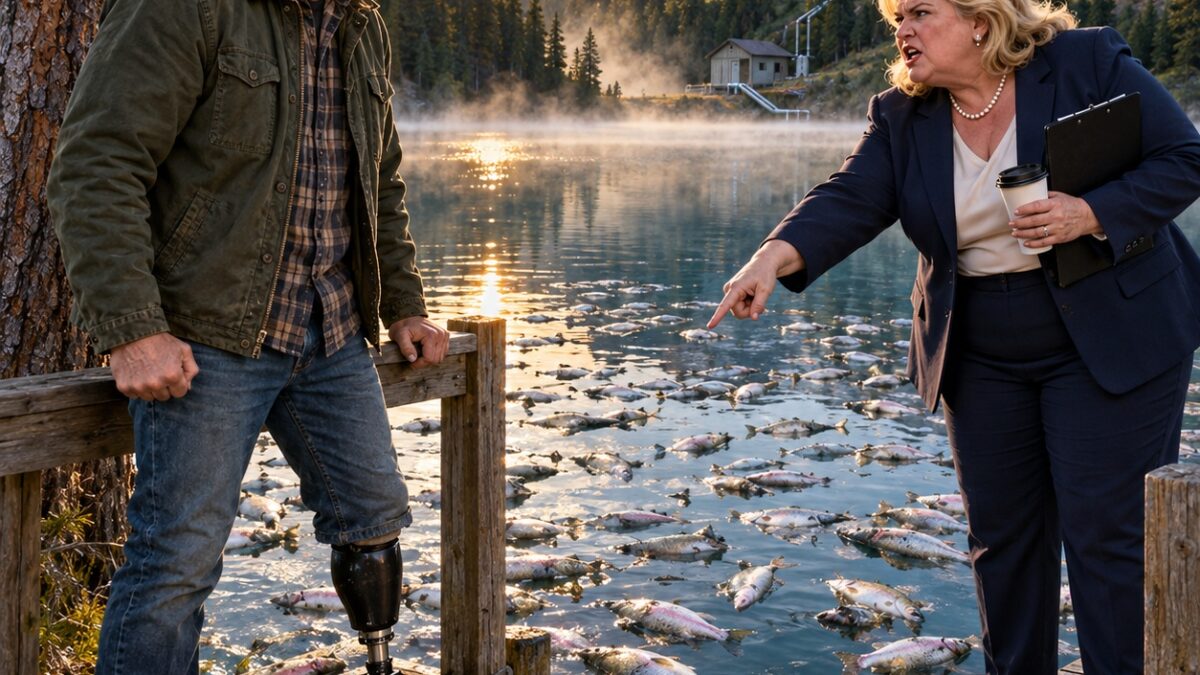
Then I saw the lake.
Silver shapes everywhere.
Hundreds.
Rainbow trout floating belly-up.
The surface looked glittered from a distance.
Up close it was death.
Five hundred fish.
Maybe more.
I walked to the dock.
My prosthetic felt wrong.
Everything felt wrong.
Five years.
Breeding stock.
Selective lines.
$180,000.
Inventory is the accounting word.
But these fish had represented something else.
Proof.
That after Afghanistan, after losing a leg, after losing the Army, I could still build.
I knelt as far as the prosthetic allowed.
Reached into the water.
Picked up one trout.
Gill tissue dark.
No movement.
I sat there holding it.
Billy arrived before seven.
Took one look.
“Jesus.”
He began photographing.
Not because he was cold.
Because he knew evidence disappeared.
Wildlife officer Rebecca Torres arrived two hours later.
Testing equipment.
Samples.
Shoreline.
Sediment.
She looked at the first field reading.
Then did it again.
Then a third time.
“This is not natural.”
“What?”
“Copper.”
“How much?”
Her expression hardened.
“Massive.”
She moved toward another sample point.
“Somebody overdosed this lake.”
I went to the wildlife camera.
The one I had installed months earlier for beaver activity near the north bank.
Scrolled.
Darkness.
Deer.
Nothing.
Then:
2:17 a.m.
A kayak.
Person in dark clothing.
Moving across the lake.
Stopping.
Pouring from bags.
Moving.
Pouring again.
Methodical.
The camera angle caught part of a vehicle near the launch afterward.
Plate not fully readable.
But enough.
Rebecca watched over my shoulder.
“Save that.”
“Already copying.”
Billy said:
“Someone murdered the lake.”
I looked at the screen.
“I think I know who.”
The purchase record did the rest.
The agricultural supplier had cameras.
Rebecca obtained the footage through the investigation.
A woman matching Delilah.
Forty pounds copper sulfate.
Emergency pond treatment.
HOA credit card.
Receipt.
Timestamp.
Then my camera.
Kayak.
2:17 a.m.
Then lab results.
The paper trail was almost insulting.
Delilah had spent decades in compliance and still apparently believed confidence could substitute for invisibility.
Emma arrived before noon.
Police radio.
Wildlife response.
News travels.
Her photographer stood on the dock.
Dead fish against shore.
My life reduced to images.
Emma asked Rebecca:
“Is this a property dispute anymore?”
Rebecca shook her head.
“No.”
“What is it?”
“Intentional environmental contamination is a serious criminal matter.”
Emma looked at me.
I looked across the water.
Delilah had wanted fishing gone.
She had succeeded.
For one morning.
Then geology entered the story.
Emma called Friday.
“Ezra, I found something.”
“What?”
“Water.”
“That’s usually easy to find around a lake.”
“Not funny.”
“What?”
“I’m coming over.”
She arrived with Dr. Amanda Foster.
University of Montana hydrogeologist.
Folder.
Maps.
Cross sections.
They covered my kitchen table.
Dr. Foster pointed to the geological survey.
Clearwater Lake sat over limestone.
Underground channels.
Spring system.
Arrows leading downslope.
Then Willowbrook.
Private wells.
I stared.
“What am I looking at?”
Emma said:
“Your lake feeds them.”
I looked again.
Dr. Foster explained.
Water leaving Clearwater moved through the limestone system, then reemerged into the aquifer feeding Willowbrook’s wells.
Not immediately.
Travel time.
Weeks.
Based on survey data and flow estimates.
“Approximately six to eight weeks.”
My coffee stopped halfway to my mouth.
“You’re telling me their drinking water comes from here?”
“Yes.”
“All of it?”
“The system is strongly connected according to these surveys.”
I looked toward the window.
Dead trout still being collected.
Emma said:
“Delilah poisoned upstream from her own subdivision.”
There are moments irony becomes so complete it stops being funny.
This was one.
Dr. Foster explained copper movement through limestone systems.
Binding.
Release.
Dilution.
Uncertainty.
Monitoring would be necessary.
She was careful not to oversimplify.
That mattered.
Emma was less careful.
“She poisoned her own well.”
Dr. Foster sighed.
“Potentially, yes, depending on transport and concentration.”
We took water samples from Willowbrook.
Current levels were safe.
For now.
Then established a monitoring schedule.
The projection was not a promise of catastrophe.
It was a warning.
Contamination could migrate.
Children lived there.
Elderly people.
People who had supported Delilah.
People who had mocked me online.
None of that mattered.
Poison does not distinguish between loyalists and critics.
I said:
“We warn them.”
Emma looked surprised.
“Immediately?”
“Yes.”
Then I corrected myself.
“We document first. Notify agencies. Then warn through proper channels.”
Not revenge.
Not theater.
Public safety.
That was the first decision I made after the lake died that felt like rebuilding.
EPA personnel became involved.
County health officials.
Rebecca coordinated wildlife evidence.
Monitoring wells.
Sampling.
Legal notices.
My property looked less like a trout farm every day.
More like an incident site.
Delilah’s husband Marcus began appearing less in public.
Margaret Woo kept sending financial records to investigators.
Unauthorized spending.
Chemical purchase.
Legal expenses.
The HOA itself started fracturing.
Some residents demanded emergency meetings.
Others defended Delilah.
Then my cameras caught her again.
Three weeks before the annual meeting, a motion alert woke me.
Dark figure near the workshop.
Infrared.
I watched from inside.
Delilah.
No mistake.
Crowbar.
Trying a side door.
I stared at the monitor.
This woman had poisoned a lake on camera and apparently decided the solution was to steal the camera evidence.
The floodlights triggered.
Instant daylight.
Delilah froze.
Her face turned toward the camera.
Perfect image.
Then she ran.
Dropped the crowbar.
Deputies recovered it.
Fingerprints.
The video had already uploaded offsite.
She could have burned the entire workshop and still not erased the file.
That part almost made me feel sorry for her.
Almost.
Then she tried bribery.
Rebecca called.
“You sitting down?”
“Yes.”
“Delilah just offered me twenty-five thousand dollars.”
I thought she was joking.
She was not.
Coffee shop.
Envelope.
Cash.
Future consulting promise.
In exchange for shifting blame toward my farm.
Security cameras.
Rebecca recording.
Federal investigators involved within hours.
By then, Delilah was not defending one bad decision.
She was creating new crimes to bury the old one.
That is what panic does to people who think consequences are negotiable.
The HOA discovered another problem.
Margaret identified roughly $47,000 in association money used for legal expenses Delilah had not properly authorized.
Residents who once defended her stopped answering calls.
Janet Powell, retired teacher and longtime critic, organized them.
Marcus started drinking.
He talked.
Too much.
At the pool.
At the clubhouse.
To neighbors.
About lawyers.
Water.
Prison.
Canada.
Delilah’s world was coming apart before the annual meeting even happened.
Then Marcus did what Delilah had spent weeks trying to prevent.
He told the truth in front of witnesses.
Dr. Gerald Stackhouse had been hired to create an alternative explanation.
Environmental consultant.
Expensive.
Polished.
His theory:
Naturally occurring copper.
Geological variation.
Existing aquaculture risk.
He was preparing a presentation at the community center when Marcus came in drunk.
Janet was there.
Margaret.
Several board members.
Marcus looked at the title slide.
NATURAL COPPER OCCURRENCE IN MONTANA LIMESTONE FORMATIONS
Then laughed.
“Stop lying for her.”
People turned.
Dr. Stackhouse tried calming him.
Marcus pointed.
“She poisoned the lake.”
Silence.
Then:
“I drove the car.”
Margaret dropped her pen.
Marcus continued.
“Forty pounds.”
His voice cracked.
“Two in the morning.”
“Because she hated the fishing.”
Janet’s phone was recording.
She had started documenting HOA meetings months earlier.
Marcus did not know.
Delilah arrived twenty minutes later.
Too late.
Marcus repeated parts of it in front of her.
She screamed:
“Shut up.”
Again.
Too late.
The recording spread.
News picked it up.
Delilah’s remaining support collapsed.
Dr. Stackhouse withdrew.
Federal investigators expanded the case.
Public-health monitoring intensified.
And the annual meeting became unavoidable.
I did not want a circus.
Emma did.
That sounds harsher than I mean.
She understood public accountability.
I understood evidence.
Dr. Foster understood science.
Rebecca understood law enforcement.
We argued.
The source version of this story included a dramatic two-tank fish demonstration.
I kept the concept, but with one condition:
Nobody would claim the demonstration itself was literal proof of what residents were already drinking.
The science had to remain the science.
So we prepared.
Tank one:
Clean spring water.
Healthy trout.
Tank two:
Controlled demonstration water prepared to illustrate copper toxicity at a measured concentration.
Separate from actual current household tap samples.
Dr. Foster would explain the distinction.
No deception.
No panic theater.
Real measurements on a screen.
Actual Willowbrook samples tested independently.
Projected transport.
Risk window.
Clear.
If Delilah had built her power on confusion, I was not going to defeat her by creating more.
The annual meeting drew nearly two hundred people.
Homeowners.
Press.
Environmental reporters.
Veterans.
County officials.
Federal investigators.
The Willowbrook community center held far fewer comfortably.
People stood against walls.
Cameras everywhere.
Cables.
Tripods.
Whispering.
Delilah arrived at ten.
Lawyer beside her.
No Marcus.
By then, he had been taken into custody after violating conditions related to the investigation.
Delilah looked different.
Same expensive clothes.
Same posture.
But the certainty was gone.
Hollow eyes.
Tight mouth.
Residents stared.
Some angry.
Some frightened.
Parents had begun using bottled water out of caution.
Emergency planning was underway.
The threat had become real enough that nobody cared about fishing etiquette anymore.
I stood at the microphone.
My prosthetic leg hurt.
I remember that detail because life refuses to make symbolic moments physically convenient.
I looked at the crowd.
Then at Delilah.
“My name is Ezra Blackwood.”
No need to explain who I was.
Everyone knew by then.
“Three weeks ago, Clearwater Lake was intentionally contaminated with forty pounds of copper sulfate.”
Screen behind me.
Dead fish.
No dramatic zoom.
Just photographs.
“Approximately $180,000 in breeding stock died.”
Next.
Wildlife-camera still.
Time:
2:17 a.m.
Kayak.
Next.
Purchase record.
HOA credit card.
Next.
Supplier footage.
Next.
Lab results.
Then I stopped.
Let Dr. Foster take over.
She projected the geological survey.
Clearwater Lake.
Limestone.
Flow paths.
Willowbrook.
“You are looking at a connected groundwater system.”
Murmurs.
She pointed.
“Water originating near Clearwater travels through these subsurface channels and contributes to the aquifer supplying Willowbrook’s private wells.”
Someone shouted:
“Are you saying our water comes from his lake?”
Dr. Foster answered carefully.
“I’m saying the systems are hydrologically connected.”
Then monitoring data.
Current household samples.
Projected migration.
Uncertainty ranges.
Expected risk window.
People began talking.
Phones came out.
A woman grabbed her husband’s arm.
Dr. Foster raised her voice.
“Please understand: this does not mean every faucet is currently toxic.”
That mattered.
“We are monitoring because the contamination has the potential to migrate into your source water.”
A father shouted:
“What do we do?”
County health officials answered.
Do not use unverified well water if advisories change.
Follow testing.
Bottled supply available.
Emergency planning.
Then I stepped forward again.
“Here is what happened to living organisms at the contaminated lake.”
I pointed to photographs.
Then the demonstration tanks.
“Tank two is not your current tap water.”
I said it clearly.
“It is a controlled demonstration of copper exposure at a concentration prepared by Dr. Foster for educational purposes.”
She confirmed.
Healthy trout went into the demonstration environment.
Distress followed.
The crowd understood.
Not because we tricked them.
Because they had already seen what copper had done to Clearwater.
The visual made toxicity real.
Delilah tried to stand.
Her attorney caught her arm.
Then Janet Powell stood.
“You poisoned our children’s water source.”
Delilah snapped:
“I protected this community.”
Noise exploded.
People shouted.
“From what?”
“Fishing?”
“Families?”
“Kids?”
“You used our money!”
The attorney whispered urgently.
Delilah moved toward the exit.
She did not make it.
Federal agents stepped forward.
Patricia Hawkins identified herself.
Delilah’s face went blank.
The arrest came there, in front of the community she had claimed to protect.
Environmental charges.
Conspiracy.
Bribery allegations.
Obstruction-related conduct.
Other counts would be sorted through later.
Handcuffs closed.
No cheer at first.
Just stunned quiet.
I looked at Delilah.
For months, I had imagined what I might say.
Something clever.
Something cruel.
The source story had me offering her contaminated water.
In real life, I would never hand someone potentially dangerous water to create a dramatic moment.
So I did something simpler.
I said:
“You could have stopped at the first complaint.”
She stared at me.
Nothing.
Agents escorted her out.
That was enough.
After the meeting, people acted like the story was over.
It was not.
Environmental damage does not disappear because somebody gets arrested.
Clearwater Lake remained poisoned.
My fish remained dead.
Willowbrook’s wells still needed monitoring.
Livelihood did not regenerate overnight.
The next weeks were water trucks.
Filters.
Sampling.
Meetings.
Insurance disputes.
Government response.
Residents organizing deliveries.
Children asking whether tap water was safe.
Elderly homeowners needing bottled water carried indoors.
Neighbors who had barely spoken before sharing supplies.
Crisis has a strange ability to expose which parts of a community were decorative and which were real.
Delilah had spent years talking about property values.
Now residents cared about gallons.
Filters.
Neighbors.
The legal consequences came later.
Delilah received a federal sentence.
Seven years in the source outcome.
Restitution roughly $2.8 million.
Marcus cooperated and received probation tied to his lesser role, along with treatment for alcohol abuse.
Assets were liquidated.
Investments.
Vacation property.
Vehicles.
Money redirected toward cleanup and compensation.
I did not attend every hearing.
There were too many.
By then, I had learned another lesson.
You can become addicted to watching consequences.
It feels like justice.
Sometimes it is merely attention transferred from your recovery to someone else’s collapse.
I had a lake to rebuild.
Environmental remediation took time.
Sediment.
Filtration.
Repeated testing.
Restocking only after conditions stabilized.
Dr. Foster’s research team stayed involved.
University students came.
EPA technicians.
Wildlife biologists.
The lake changed from crime scene to restoration project.
That transformation saved me.
The morning after the poisoning, I had looked at five years of work floating dead.
For weeks, every dock board reminded me.
Every empty pen.
No jumping trout.
Silence.
Then the first restoration aerator went in.
Then filtration.
Then clean samples.
Then insect life returned.
Then small fish.
Eventually trout.
Not the same stock.
You cannot replace five years of breeding by writing a check.
But life returned.
That mattered more than symmetry.
Willowbrook changed too.
The authoritarian HOA collapsed under the legal and political damage.
Residents reorganized.
The new structure focused less on cosmetic enforcement and more on environmental management.
They called it the Willowbrook Environmental Cooperative.
Janet Powell became the first president.
Retired teacher.
The woman who had quietly recorded meetings while Delilah believed nobody was listening.
Her priorities were almost aggressively reasonable.
Transparent budgets.
Open records.
Water testing.
Conservation.
Emergency planning.
No committee measuring mailbox height.
I attended the first cooperative meeting as an invited guest.
Janet opened by saying:
“We are going to begin with the water report because apparently we have learned that water is more important than paint color.”
People laughed.
Dark humor.
Healthy.
Then they actually discussed water.
My compensation came from multiple sources.
Insurance.
Victim funds.
Restitution process.
Not one magical check.
Enough to rebuild.
Then more than rebuild.
I had an idea.
It began with veterans.
Billy helped.
Emma encouraged.
Dr. Foster offered university support.
Clearwater Conservation Foundation.
At first it was a name on paperwork.
Then a small education shed.
Then a program.
Disabled veterans learning sustainable aquaculture.
Fishing as therapy.
Business training.
Environmental monitoring.
School visits.
Research access.
I had once believed the fish farm was my second career.
It became the foundation of something larger.
Not because poisoning was “a blessing.”
I hate that phrase.
The poisoning was wrong.
The loss was real.
The expansion came afterward because people chose what to build from the damage.
That is different.
The first veteran I taught was a former infantry sergeant named Luis.
Spinal injury.
He looked across the pens.
“You really make money with fish?”
“Sometimes.”
“That confident?”
“I’m honest.”
He laughed.
I showed him oxygen levels.
Feed rates.
Stocking density.
Water testing.
He asked:
“Hard part?”
“Paperwork.”
“Seriously?”
“Fish are easier than agencies.”
He nodded.
“Sounds like the Army.”
Fair.
By the end of the season, Luis had written a business plan for a small operation near Helena.
The foundation helped with equipment connections.
He eventually opened.
When he sent me a photograph of his first harvest, I stared at it for ten minutes.
That felt more like victory than Delilah’s sentencing.
The Clearwater Festival came later.
What started as a small restoration open house became annual.
Families.
Students.
Veterans.
Environmental groups.
Local food.
Fishing clinics.
Three thousand visitors one year.
Roughly $85,000 raised for a veterans scholarship program.
Children learned water testing.
Parents learned where private wells actually get water.
Billy Redstone shifted part of his guide service toward environmental education.
Tom and Sarah Tatum converted part of their remaining ranch into regenerative agriculture demonstrations.
The valley gained a reputation not for the poisoning itself, but for what it built afterward.
Property values recovered.
Not because somebody forced fishing out.
Because clean water, transparency, and functioning community turned out to be valuable.
Imagine that.
Emma Vasquez won a regional journalism award.
She hated when I introduced her that way.
“Tell them the article mattered.”
“It did.”
“Then why mention the award?”
“Because it annoys you.”
Her follow-up documentary covered the case.
She titled it:
Poisoned Wells: How One Woman Destroyed Her Own Community.
I told her the title was subtle.
She said:
“I learned subtlety from Delilah.”
Fair.
Her reporting went national.
Then she started writing a syndicated column about rural development, environmental conflict, and power.
She once told me:
“You know what the real story was?”
“The poisoned lake?”
“No.”
“The assumptions.”
“What assumptions?”
“That your land was backward.”
“That their subdivision was modern.”
“That their HOA had authority over anything it could see.”
“That groundwater respected property lines.”
She smiled.
“Geology doesn’t care about covenants.”
Best sentence she ever wrote.
Rebecca Torres received a promotion.
Regional wildlife supervisor.
Her work on the case changed coordination between agencies.
At least that is what she claimed.
I think she just enjoyed bossing more people.
I told her.
She said:
“Careful, Blackwood. I still have handcuffs.”
Fair.
Dr. Foster established a small research station near Clearwater.
Students monitored the cave system.
Copper movement.
Recovery.
Spring chemistry.
Aquifer connections.
Her work contributed to broader research on contamination in karst systems.
I did not understand half the papers.
She tried explaining one.
After ten minutes I said:
“Amanda.”
“Yes?”
“I raise fish.”
“You asked.”
“I regret it.”
She laughed.
Then simplified.
The important part was that what happened here became useful beyond here.
Again, not because the damage was good.
Because knowledge extracted from damage can prevent repetition.
Delilah’s house eventually sold.
I drove past once.
New family.
Kids.
Bicycles in the driveway.
No idea whether they knew the history.
I hoped not.
A house should not be permanently sentenced for its former occupant.
The BMW went too.
I heard it was sold during asset liquidation.
People expected that to make me happy.
It did not.
It was a car.
The lake mattered.
The people mattered.
Objects are easy.
The first time I saw Delilah after sentencing was not in person.
Television clip.
Prison transfer.
No makeup.
No pearls.
No clipboard.
I watched for maybe ten seconds.
Then turned it off.
Billy said:
“That’s it?”
“What?”
“You’re not gonna watch?”
“No.”
“Why?”
“I know where she’s going.”
“That doesn’t feel satisfying?”
I looked toward the lake.
New trout were jumping.
“That does.”
He understood.
One morning, years after the poisoning, I walked onto the dock at dawn.
Mist.
Pine.
Water like glass.
A trout broke the surface.
Then another.
For a second, I was back before Delilah.
Before Willowbrook.
Before dead fish.
Then a school bus came down the road toward the education center.
Kids.
Noise.
Life.
I realized Clearwater was not restored to what it had been.
It had become something else.
I used to hate that idea.
I wanted the old lake back.
Exact.
Impossible.
Restoration is not reversal.
You remove contamination.
Repair systems.
Restock.
Rebuild.
But time does not run backward.
The goal becomes health, not imitation.
That principle helped with more than water.
My leg still hurts.
That matters too.
The foundation did not cure disability.
Purpose did not remove phantom pain.
Some days the prosthetic fit poorly.
Some days I use a cane.
Some days I do not leave the cabin until noon.
I do not tell veteran groups that aquaculture “saved me.”
That is too simple.
It gave me work.
Routine.
Community.
A place to apply skills.
Then the poisoning almost took that.
Then the restoration expanded it.
Life is not one rescue.
It is repeated adjustments.
Engineering, basically.
Maybe I never stopped being an engineer.
I kept the original wildlife camera.
The one that captured 2:17 a.m.
It sits on a shelf in my workshop.
Retired.
Mason—one of the younger veterans in our program, not a relative—once asked why.
“Evidence?”
“History.”
“Same thing?”
“Sometimes.”
The camera was designed for beavers.
It recorded environmental crime.
Tools do not care what story they enter.
They only record what happens in front of them.
That is why documentation matters before you know you need it.
I also kept one feed scoop from before the poisoning.
Wooden handle.
Copper stain from remediation testing accidentally splashed near it.
People ask why.
I do not know.
Humans keep strange objects after catastrophe.
Maybe because memory likes something it can touch.
The hardest conversation I had after the case was with Margaret Woo.
She came to the farm six months into restoration.
Still blamed herself.
“I signed expense forms.”
“You warned me.”
“Late.”
“You warned me.”
“I should’ve stopped her earlier.”
“Maybe.”
She looked at me.
“That’s not comforting.”
“I’m not trying to make you innocent.”
Her eyes filled.
“But you did something when it mattered.”
“I was scared.”
“Good.”
“What?”
“Courage without fear is usually just ignorance.”
She laughed through tears.
Margaret later became treasurer of the cooperative.
Appropriate.
Every chemical purchase required dual approval.
No single president could spend association funds on “emergency pond treatment.”
I supported that rule enthusiastically.
Marcus wrote me a letter from treatment.
I almost threw it away.
Then read.
Apology.
Confession.
No excuses.
He said he drove.
Said Delilah convinced him the chemical would “reset” the lake and that nobody would prove anything.
He knew it was wrong.
Did it anyway.
That sentence mattered.
Not:
I was manipulated.
Not:
I was drunk.
I knew it was wrong.
That is the beginning of accountability.
He asked forgiveness.
I did not answer for months.
Eventually:
I accept that you told the truth when it mattered. What you did still harmed me. I hope treatment helps you become someone who would refuse next time.
That was all.
Forgiveness is not acquittal.
One Willowbrook resident apologized too.
Her name was Cynthia.
She had posted online that my farm was “industrial blight.”
After the poisoning, she showed up carrying bottled water for volunteers.
We stood awkwardly.
She said:
“I was wrong.”
I waited.
“I believed Delilah.”
“Why?”
Cynthia thought.
“Because she sounded certain.”
That answer interested me.
Certainty.
People mistake certainty for expertise constantly.
Delilah always sounded certain.
Property values.
Environmental harm.
Legal authority.
Chemical safety.
She rarely understood the systems beneath the words.
That became the lesson I heard everywhere afterward.
Do not confuse confidence with knowledge.
Especially when water flows underground.
Willowbrook residents eventually learned where every gallon came from.
The cooperative funded annual well testing.
Results posted publicly.
No jargon-only summaries.
Dr. Foster insisted on plain-language explanations.
Source water.
Contaminants.
Treatment.
Trends.
Children in the subdivision could probably explain hydrogeology better than Delilah ever could.
That made me laugh.
The fishing returned gradually.
First limited.
Then more.
Billy brought clients again.
The first family after reopening included a little girl who caught a trout and screamed like she had hooked a whale.
Her father tried helping.
She refused.
I watched from the dock.
Billy looked over.
“You okay?”
“Yeah.”
“Thinking about the blockade?”
“No.”
Truth.
I had been thinking:
This is what Delilah wanted gone.
Not industrial damage.
A kid holding a fishing rod.
Sometimes power invents enormous language to justify very small resentments.
I never joined Bitterroot Angling Club.
They invited me after the case.
Three times.
The irony was obvious.
I declined three times.
Billy said:
“Why?”
“I already have a lake.”
Fair enough.
The old Tatum family remained neighbors.
Tom told me he never trusted Willowbrook.
Then admitted he liked the cooperative.
Sarah became friends with Janet.
They fought about compost.
Healthy communities contain disagreement without turning every disagreement into warfare.
That distinction sounds obvious until you live through someone who treats every preference as a mandate.
At one Clearwater Festival, Janet introduced me.
“Ezra Blackwood, founder of Clearwater Conservation Foundation.”
I leaned toward the microphone.
“And former neighborhood nuisance.”
Crowd laughed.
Janet said:
“Still a nuisance.”
Fair.
Then she looked at the lake.
“We owe him.”
I shook my head.
“No.”
She frowned.
I continued.
“You owe clean water to yourselves.”
“That’s the point.”
The crowd got quieter.
“If this community only changed because it felt guilty toward me, the change would end when I’m gone.”
I pointed toward the kids testing water.
“You changed because you understand this watershed belongs to everyone who depends on it.”
That mattered.
Environmental responsibility cannot be repayment to one victim.
It has to become culture.
The scholarship program helped twelve veterans start aquaculture or related sustainable operations over the next several years.
Not all succeeded.
That is another thing I refuse to romanticize.
One closed after eighteen months.
One changed to greenhouse work.
One decided entrepreneurship was terrible and took a job with a state hatchery.
Success is not one form.
The foundation helped people test possibilities.
Sometimes the correct result is:
Not for me.
I respected that.
One veteran named Aaron lost an arm.
He designed a one-handed feeding tool after struggling with our standard equipment.
We patented nothing.
Published the design open source.
Other adaptive farms started using it.
He said:
“You could sell these.”
I said:
“You could too.”
He thought.
“Free’s better.”
Sometimes.
The Army had taught us enough about expensive equipment.
Clearwater’s restoration data eventually became part of university courses.
Students came with notebooks.
They asked about copper.
Flow.
Fish mortality.
Then inevitably:
“What was Delilah like?”
I started refusing.
“She is not the science.”
That was deliberate.
Bad actors consume stories if you let them.
The lake deserved to be more than the place Delilah poisoned.
So did I.
The foundation built a small memorial board.
Not for Delilah.
For the original stock.
Photograph of the lake before poisoning.
Then restoration timeline.
No dramatic caption.
Just:
CLEARWATER LAKE — CONTAMINATION EVENT AND RECOVERY
Students see ecosystems.
Businesses see losses.
I see five years of work.
All true.
One anniversary morning, Emma came without a camera.
We sat on the dock.
She said:
“Do you still hate her?”
“No.”
“Really?”
“I don’t think about her enough.”
“That’s not the same.”
“Then maybe no.”
She skipped a stone.
“People online still do.”
“People online need hobbies.”
She laughed.
Then:
“Do you believe in karma?”
I looked at Willowbrook.
Roofs below.
Springs under the earth.
“No.”
“You’re kidding.”
“No.”
“This is the most karma story I’ve ever covered.”
I thought.
“I believe in systems.”
“That is the most engineer answer possible.”
“The poison moved downhill because water moves downhill.”
“Not morality.”
“No.”
“Consequences?”
“Yes.”
She nodded.
“Maybe that’s better.”
I think so.
Calling it karma makes nature sound like it arranged punishment.
It did not.
Delilah contaminated a connected water system she failed to understand.
Consequence.
Not magic.
That matters because the lesson is learnable.
Understand the system before you act.
The geological survey had existed for years.
County records.
Public.
Nobody in Willowbrook knew.
That still amazes me.
Forty-seven expensive homes.
Private well system.
No one had asked:
Where does the water come from?
People buy houses and study countertops harder than aquifers.
After the case, local real-estate disclosure practices improved.
Not because of one law.
Because buyers started asking.
Source.
Testing.
Watershed.
Septic.
Access.
Actual rural questions.
Good.
Delilah had cared obsessively about the view.
That was the absurd root.
She disliked seeing fishing clients.
Boats.
Activity.
She wanted Clearwater to look untouched from the subdivision.
But “untouched” is often a fantasy created by people who do not know who maintains the landscape.
My aeration.
Fish-health work.
Access management.
Shore protection.
Permits.
The lake looked natural partly because somebody worked constantly.
Same with ranches.
Forests.
Water systems.
Maintenance is invisible until it stops.
One afternoon, a new Willowbrook resident came up.
Young tech executive.
Polite.
Asked about fishing membership.
Then said:
“I heard the old HOA tried to shut this down.”
“Yes.”
“Why?”
“View.”
He stared at the lake.
“But it’s beautiful.”
“Exactly.”
He did not understand.
Good.
Maybe some stupidity should become historically confusing.
The foundation’s disabled-veteran fishing clinic became my favorite program.
Not because fish are therapeutic magic.
Because adaptive fishing is practical.
Modified rods.
Stable platforms.
Wheelchair access.
No speeches.
People come.
Fish.
Talk if they want.
Stay quiet if they do not.
One man with severe PTSD sat for three hours without saying anything.
At the end, he said:
“I forgot to be angry for a while.”
We did not put that on a brochure.
Some things should remain human instead of becoming marketing.
My grandfather would have hated the education center.
Too many signs.
He believed if someone fell in the lake once, they learned where the edge was.
Different era.
But he would have loved the veterans fishing.
And the trout.
Especially the trout.
I sometimes imagine him walking the dock, checking construction.
He would find three things wrong immediately.
That comforts me.
I replaced the original dock eventually.
Copper exposure.
Age.
Damage.
When workers removed the old boards, I kept one.
Again.
Strange relics.
The board had a stain where dead fish had washed against it.
I stored it behind the workshop.
Maybe one day I will throw it away.
Not yet.
One of the most important changes happened quietly.
The cooperative signed a formal mutual-notification agreement with my farm.
If I observe water changes affecting downstream users, I notify.
If Willowbrook well tests show unusual chemistry, they notify me.
Same watershed.
Different properties.
Cooperation instead of pretending property boundaries stop ecology.
That is mature governance.
Delilah saw upstream land as an enemy.
Janet saw it as part of a system.
Everything improved from there.
Billy still guides.
Older.
Slower.
Claims his knees are “weather instruments.”
He tells clients exaggerated versions of the poisoning story.
I interrupt whenever I hear him.
“I did not wrestle Delilah out of a kayak.”
“Ruins the story.”
“She was never chased by a grizzly.”
“Could’ve happened.”
“No.”
Kids love Billy.
Facts less so.
One school group asked:
“Why would somebody poison fish?”
I paused.
How do you explain resentment to nine-year-olds?
“Because she wanted to control something that wasn’t hers.”
A boy said:
“That’s dumb.”
“Yes.”
Best summary.
Then a girl asked:
“Did she know it would hurt her own water?”
“No.”
“Why not?”
“She didn’t learn how the water worked.”
The teacher looked at me.
There was the lesson.
Education.
Not villainy.
Learn the system.
I became obsessive about backup cameras after the case.
Billy calls the ranch NORAD.
I tell him that is classified.
The important thing is not surveillance everywhere.
It is evidence around vulnerable assets.
Fuel.
Chemical storage.
Dock.
Access points.
The cameras caught bears too.
One black bear spent fifteen minutes trying to open a feed bin.
More competent than Delilah at breaking in.
I saved that footage.
Better viewing.
There were lawsuits.
Civil claims.
Insurance disputes.
Environmental cost allocation.
I will not pretend I enjoyed them.
People imagine once the villain is arrested, money flows magically toward the victim.
No.
Forms.
Proof.
Adjusters.
Depreciation arguments.
Business interruption calculations.
Stock valuation.
Lawyers.
Experts.
Months.
Sometimes years.
Justice can be administratively boring.
Still necessary.
The first profitable season after restoration made me nervous.
I expected something to fail.
Trauma does that.
When stability returns, part of you waits for the next explosion.
Water tests clean.
Fish healthy.
Customers booked.
Still, I woke at two.
Checked cameras.
Checked pumps.
Checked dissolved oxygen twice.
Dr. Foster said:
“You know the lake is okay.”
“I know.”
“That’s not why you’re checking.”
“No.”
Eventually the checking reduced.
Not disappeared.
Recovery includes allowing normal risk to feel normal again.
Margaret once asked if I regretted building the farm.
After everything.
“No.”
“Even the loss?”
“The loss doesn’t rewrite the five years before it.”
That answer surprised me when I said it.
People think bad endings invalidate beginnings.
They do not.
Even if Clearwater had never recovered, the years I built it would still have mattered.
Purpose does not become fake because something later destroys it.
That lesson helped veterans I worked with.
The cooperative eventually removed almost half the old HOA rules.
People discovered civilization survived.
Mailbox heights varied slightly.
No plague.
Holiday lights stayed up too long.
Children remained unharmed.
Property values rose anyway.
Janet called it “the great deregulation.”
She kept rules that mattered.
Road maintenance.
Shared utilities.
Environmental protections.
Noise after reasonable hours.
Removed performative control.
I approved.
Not officially.
She would have ignored me anyway.
Willowbrook children started fishing at Clearwater.
That was perhaps the cleanest ending.
The subdivision that once tried to block families now brought them.
One girl caught a trout beside her father.
I recognized the man.
He had once commented online that my farm was “commercial exploitation.”
He recognized me too.
Awkward.
Then:
“Ezra.”
“Yeah?”
“I was wrong.”
I nodded.
His daughter held up the fish.
“Look!”
I helped her release it.
We did not need a longer conversation.
Sometimes change is visible in who shows up.
The Clearwater Festival added a geology walk.
Dr. Foster loved it.
I did not.
Forty-five minutes of rocks.
Children loved it more than expected.
They learned limestone can hold and move water underground.
Parents learned too.
At the end, Dr. Foster always said:
“You are standing on systems you cannot see.”
That sentence could summarize everything.
Water.
Power.
Money.
Community.
Consequences.
Invisible does not mean absent.
The poisoning case became a cautionary story far beyond Montana.
I sometimes disliked that.
Strangers knew the headline but not the rebuilding.
“Are you the fish guy?”
“Yes.”
“The HOA poisoned you?”
“The lake.”
“Right.”
Then they wanted drama.
Handcuffs.
Poisoned water.
I redirected.
“You want to see the filtration system?”
Usually they lost interest.
Good.
The people who stayed for filtration were my kind of people.
One journalist asked:
“What was the exact moment you knew you had won?”
I said:
“Wrong question.”
She frowned.
“When Delilah was arrested?”
“No.”
“When the lake reopened?”
“Closer.”
“Then what?”
“The first time a Willowbrook kid tested water here and wrote the result into a notebook without being afraid.”
She stared.
“That’s not dramatic.”
“Exactly.”
Victory should eventually become boring.
My VA disability check still arrives.
I no longer feel ashamed of that.
I used to.
Thought successful people should “move past” needing government support.
Stupid.
I paid for that check with a leg.
Then I built a business.
Both can be true.
Delilah once used “disabled veteran” as part of her contempt.
After the case, media used it as hero branding.
Both flatten a person.
I am disabled.
Veteran.
Farmer.
Engineer.
Teacher sometimes.
Bad cook.
Stubborn.
None should erase the others.
When veterans come to Clearwater, I never begin with Delilah.
I begin with fish.
Water temperature.
Feed.
Equipment.
Business math.
If they ask about the poisoning, I tell them.
But I refuse to make suffering the admission price for purpose.
You do not have to survive a villain to deserve a second career.
You can simply start.
I wish somebody had told me that after Afghanistan.
I still receive letters from people dealing with hostile HOAs.
Most are about fences.
Parking.
Solar panels.
Landscaping.
Some genuine abuse.
Some ordinary disputes inflated by anger.
I give the same advice.
Know whether the HOA actually governs your property.
Read the recorded documents.
Separate rude behavior from legal authority.
Document.
Use professionals when stakes rise.
Do not sabotage yourself with threats.
And if chemicals appear anywhere in the story, call authorities immediately.
That last part came from experience.
Delilah’s greatest mistake was not poisoning the lake.
That was her worst act.
Her greatest strategic mistake came earlier.
She assumed because she could see my property from Willowbrook, she could govern it.
That assumption created everything.
Covenant notices.
Complaints.
Security theater.
Road blockade.
Litigation.
Then poison.
Once somebody convinces themselves they have rightful authority over what belongs to someone else, escalation becomes easier.
Each boundary crossing makes the next feel normal.
That is how absurdity becomes crime.
I think about her first words sometimes.
“Your fishing circus ends today.”
It did end.
Temporarily.
Then became a conservation foundation.
Education center.
Veterans program.
Festival.
Research station.
Scholarship.
Guide expansion.
Restoration model.
If you want irony, there it is.
Not poison flowing toward her faucet.
That part was dangerous, not funny.
The real irony is that every attempt to make the fish disappear ultimately gave Clearwater a larger public role.
She wanted fewer people looking at the lake.
Now thousands come.
That would irritate her more than prison.
Probably.
Eighteen months after the poisoning, I stood on the dock at sunrise.
The lake looked clean.
Not metaphorically.
Actual testing supported it.
Trout moved beneath the surface.
Young stock.
Strong.
Mist rose.
Pine.
Cold air.
A research student was already setting up sampling equipment on the far dock.
Two veterans were arriving later for training.
School bus scheduled at ten.
Billy had a guide trip.
Busy.
I remembered the morning when dead fish covered this same water.
For years, I thought healing meant no longer remembering.
Wrong.
Healing meant the memory no longer owned the view.
I could see both.
Death then.
Life now.
One did not erase the other.
I walked to the edge.
Dropped feed.
The trout rose.
Silver flashes.
The sound hit me harder than expected.
Water breaking.
Fish feeding.
Normal.
I laughed.
Alone.
Then my left leg hurt and I sat down because symbolism does not override prosthetic discomfort.
I poured coffee.
Watched.
Complete peace is probably too strong.
The source version of this story says I felt complete peace with my purpose.
Maybe that is what it looked like.
What I felt was quieter.
Alignment.
The work made sense.
The pain had a place.
The land had a future.
That was enough.
Emma arrived later.
No photographer.
Two coffees.
She handed me one.
“You ever think about retiring?”
“From fish?”
“From everything.”
“No.”
“You’re getting old.”
“You’re rude.”
“Journalism.”
We watched the trout.
She said:
“Delilah wanted this shut down.”
“Yep.”
“Now you have a research station.”
“Yep.”
“Festival.”
“Yep.”
“Foundation.”
“Yep.”
“Veterans program.”
“Emma.”
“What?”
“Say karma and I’m throwing you in.”
She laughed.
“Systems.”
“Thank you.”
Then:
“Still a pretty good story.”
I looked across the lake.
“Better ending.”
There is no clean lesson that explains everything.
Not:
Never mess with veterans.
That is childish.
Not:
Karma always wins.
It does not.
Not:
Bad people always get punished.
They do not.
The lesson I trust is narrower.
Learn the system you are trying to control.
Delilah knew rules.
She did not know property law well enough.
Did not know environmental science.
Did not know groundwater.
Did not understand aquaculture.
Did not understand that a county easement remained an easement because she disliked who used it.
Did not understand that forty pounds of a legal chemical can become catastrophic when used recklessly.
Most importantly, she did not understand people.
She thought fear would isolate me.
It connected Jake.
Billy.
Emma.
Rebecca.
Dr. Foster.
Margaret.
Janet.
Residents.
Veterans.
Investigators.
Each escalation created another witness.
Another record.
Another person willing to ask questions.
Control works best in darkness.
Delilah kept turning on lights.
And I learned too.
I learned being right does not protect you automatically.
You still need records.
Allies.
Professionals.
Patience.
I learned the environment does not respect property grudges.
Water moves.
Wildlife moves.
Contamination moves.
Responsibility follows.
I learned restoration is harder than punishment.
Arrest took minutes.
Lake recovery took months and years.
Community recovery took longer.
I learned that people who once opposed you can still become useful partners if they change honestly.
Margaret.
Some Willowbrook residents.
Even Marcus, in a limited way, helped investigators after choosing badly.
Human beings are not fixed roles.
That matters.
I kept one photograph from the poisoning day.
Not the worst one.
No close-up dead fish.
Wide shot.
Lake.
Morning mist.
Silver bodies across the surface.
Me standing at the end of the dock.
Small.
I put it beside another photograph.
Same angle.
Years later.
Festival day.
Children.
Research tents.
Veterans.
Trout pens.
Two images.
Same land.
Different consequences.
When students ask which is the real Clearwater, I say:
“Both.”
Places contain what happened.
Then they contain what people do next.
The foundation’s mission statement is short.
Clean water. Sustainable work. Second chances.
I argued against “second chances.”
Too sentimental.
The board overruled me.
Healthy governance.
Sometimes you lose.
Nobody poisoned anything.
Progress.
Janet eventually stepped down after two terms.
Voluntarily.
At the final cooperative meeting, residents gave her a fishing rod.
She said:
“I don’t fish.”
Billy said:
“You do now.”
She learned.
Badly.
Her first cast tangled in a tree.
I laughed until my leg hurt.
She told me to shut up.
Community leadership ended exactly as it should.
With no crisis.
No arrest.
No cult of personality.
Just somebody else elected.
Margaret stayed treasurer longer.
Nobody could beat her spreadsheets.
Every transaction visible to residents.
Chemical purchases had a special approval line.
That was darkly funny.
She knew it.
The first time the cooperative bought approved algae treatment for a decorative retention pond, Margaret called me.
“Ezra.”
“Yes?”
“We are buying copper sulfate.”
I was silent.
She rushed:
“Two pounds.”
“For the retention pond?”
“Yes.”
“Applied by licensed contractor?”
“Yes.”
“Board approval?”
“Yes.”
“Water testing?”
“Yes.”
“Why are you calling me?”
“I thought you might have feelings.”
I laughed.
Then:
“Buy the chemical.”
Chemicals are tools.
Intent and dosage matter.
That was part of healing too.
Not turning one substance into a supernatural symbol.
Clearwater never became identical to the old lake.
Species balance changed slightly.
Some vegetation returned differently.
Dr. Foster said ecosystems remember disturbance.
Humans too.
That does not mean permanently broken.
It means history becomes part of the system.
I liked that.
Sometimes at dawn, I still catch an industrial smell that is not there.
Memory.
My brain reconnecting that morning to the present.
I stop.
Test the air.
Then hear fish.
Ground myself.
People assume environmental trauma belongs to landscapes.
It belongs to people as well.
The lake was poisoned.
So was my sense of safety.
Both recovered slowly.
The first night I slept through without checking cameras came almost a year later.
I woke at six.
Panicked because I had not panicked.
Ran outside.
Lake fine.
That was when I realized vigilance had become habit.
I reduced alerts.
Not all.
Enough.
Security should protect life.
Not consume it.
Billy says I became philosophical after the poisoning.
I tell him he became annoying before it.
We remain friends.
The right kind.
A child at the festival once asked:
“Did the bad lady say sorry?”
“No.”
“Why?”
“I don’t know.”
“Do you need her to?”
I thought.
“No.”
The child nodded.
“Okay.”
Then ran toward the trout tanks.
Children move on efficiently.
Maybe adults can learn.
Delilah’s apology never came.
That is fine.
The record exists.
The lake exists.
The foundation exists.
The community changed.
An apology would not improve the water chemistry.
Sometimes closure is overrated.
Work is better.
The last object I kept from the old Delilah fight was Covenant 4.7B.
The first violation notice.
The rule she claimed applied to me.
I framed it in the foundation office.
Underneath, Mason—the veteran engineer in our program—added a label without asking:
EXHIBIT A: ALWAYS CHECK WHETHER THE RULE APPLIES TO YOU.
I considered removing it.
Did not.
Good lesson.
New visitors sometimes think Clearwater is public.
It is not.
Private property.
Managed access.
Permitted business.
Conservation easements in places.
I still enforce boundaries.
That surprises people.
“You fought an HOA over access.”
“No.”
“I fought people claiming authority they did not have.”
Boundaries matter both directions.
Freedom is not absence of rules.
It is legitimate rules applied by legitimate authority for legitimate reasons.
Engineering again.
My grandfather’s two hundred acres remain.
Some fenced.
Some restored.
Some demonstration land.
Some untouched.
Willowbrook remains downstream.
Different governance.
Different relationship.
The springs still flow.
Same route they followed before any subdivision existed.
Before Grandpa.
Before me.
Water outlasts arguments.
That keeps ego in perspective.
If Delilah had bothered to ask one hydrogeologist a single question—
Where does our water come from?—
everything could have been different.
If she had accepted Jake’s inspection.
If she had removed the roadblock.
If she had lost the nuisance suit gracefully.
If she had listened to Margaret.
If she had not purchased the chemical.
If she had stopped before the kayak.
So many exits.
She chose escalation every time.
People like to say she destroyed herself.
Partly.
But that phrase can hide the harm she caused others.
My fish died.
Residents lived through water fear.
Cleanup cost millions.
Marcus’s life collapsed too.
Staff spent years repairing.
Consequences are rarely neat enough to call poetic.
They spread.
Like water.
That is why the ending I choose is not her arrest.
It is the annual festival.
Kids leaning over tanks.
Veterans comparing equipment.
Dr. Foster correcting somebody’s geology.
Emma arguing with a cameraman.
Billy lying to tourists.
Janet attempting to cast without hitting a tree.
Margaret checking receipts even though she is off duty.
Trout jumping.
Clean water.
That is justice I can use.
I am Ezra Blackwood.
Former Army engineer.
Disabled veteran.
Trout farmer.
Foundation director.
The man Delilah Thornfield called “soldier boy” while telling me my legal business was costing her neighborhood money.
She filed complaints.
Sent private security.
Blocked an easement.
Sued me.
Used her association’s money to buy forty pounds of copper sulfate.
Then crossed my lake in the dark at 2:17 in the morning and dumped enough chemical into the water to kill hundreds of trout and destroy the business she had failed to shut down legally.
What she did not understand was underground.
That may be the perfect metaphor for the entire story.
She only saw the surface.
Her view.
My boats.
My customers.
My fish.
Her subdivision.
Her rules.
She never looked beneath.
Beneath the lake were limestone channels.
Beneath the HOA was misuse of authority.
Beneath her legal threats was resentment.
Beneath the community’s confidence in her was ignorance.
Beneath my farm was a watershed connecting all of us whether we liked each other or not.
Six weeks.
That was the approximate travel time that turned her private act into a public emergency.
Six weeks of consequences moving underground.
Slow.
Invisible.
Unstoppable by slogans.
By the time Willowbrook understood, the poison did not care who had supported Delilah and who had opposed her.
That was the lesson.
Reality does not join factions.
Chemistry does not recognize HOA boundaries.
Water does not read covenants.
And consequences do not disappear because the person who created them believes she had a good reason.
The morning the lake died, Delilah stood on my dock with coffee and looked at five years of work floating dead.
She believed she had finally won.
That memory used to make me furious.
Now it makes me think about how little people sometimes understand the moment they call victory.
A destroyed competitor.
A silenced neighbor.
A blocked road.
A signed citation.
A poison poured where nobody was supposed to see.
Victory can be ignorance wearing confidence.
She solved nothing.
She exposed everything.
The camera.
The receipt.
The water connection.
The finances.
The bribery.
The burglary attempt.
Marcus’s confession.
All of it came from the decision to keep escalating rather than accept a boundary.
Today, when I feed trout at dawn, they rise in silver flashes.
The same sound I loved before Willowbrook existed.
Water breaking.
Feed hitting the surface.
Fish turning.
Sometimes a student is beside me.
Sometimes a veteran.
Sometimes nobody.
I like nobody best in the early morning.
Mist comes off Clearwater.
Pines reflect in the surface.
If you did not know the story, you might think nothing terrible had ever happened here.
That is not true.
But neither is the opposite.
Something terrible happened here.
And then thousands of smaller good things happened afterward.
Tests.
Filters.
Meetings.
Apologies.
Research.
Restocking.
Teaching.
Fishing.
New rules.
Better leadership.
Second careers.
Children learning where water comes from.
Recovery is not one dramatic act.
It is repetition.
Enough healthy days stacked on top of the bad one that eventually the bad day stops being the only thing the place means.
I still carry a small water-test kit in my truck.
Habit.
Maybe superstition.
Dr. Foster says field kits do not replace laboratory analysis.
I know.
I still carry it.
Some habits do not need curing if they do no harm.
The foundation office overlooks the lake now.
On the wall:
Grandpa.
Army photograph.
First harvest.
Poisoning recovery map.
Festival photo.
No photograph of Delilah.
That was intentional.
She already occupied enough years.
The story belongs to what survived.
The first sentence visitors see when they enter comes from something Dr. Foster said during restoration.
YOU ARE ALWAYS PART OF A WATERSHED, WHETHER YOU UNDERSTAND IT OR NOT.
I liked it because it applies to more than water.
Communities too.
Your decisions flow.
Into neighbors.
Families.
Institutions.
Children.
Sometimes underground.
Sometimes years later.
You rarely control where consequences finally surface.
Delilah did not.
Neither do I.
All we can do is choose what we put into the system.
She poured poison.
We put back clean water.
Fish.
Knowledge.
Work.
Trust.
Not perfectly.
Enough.
And every morning, when Clearwater reflects the Montana sky and trout rise where hundreds once floated dead, I remember the simplest truth Delilah never understood:
You can own a clipboard.
You can run an HOA.
You can hire lawyers.
You can send guards.
You can file complaints until the mailboxes overflow.
But you cannot command geology.
You cannot order water to forget where it came from.
And you cannot poison the source without eventually living downstream from what you poured into it.
That is not karma.
It is consequence.
It is connection.
It is the way water works.
And after everything Delilah tried to take from me, that is the lesson Clearwater gave back.

