PART2:Her Owner Sealed This Elderly Dog Inside Two Bags and Drove Away—Months Later, She Finally Stopped Waiting to Be Abandoned Again
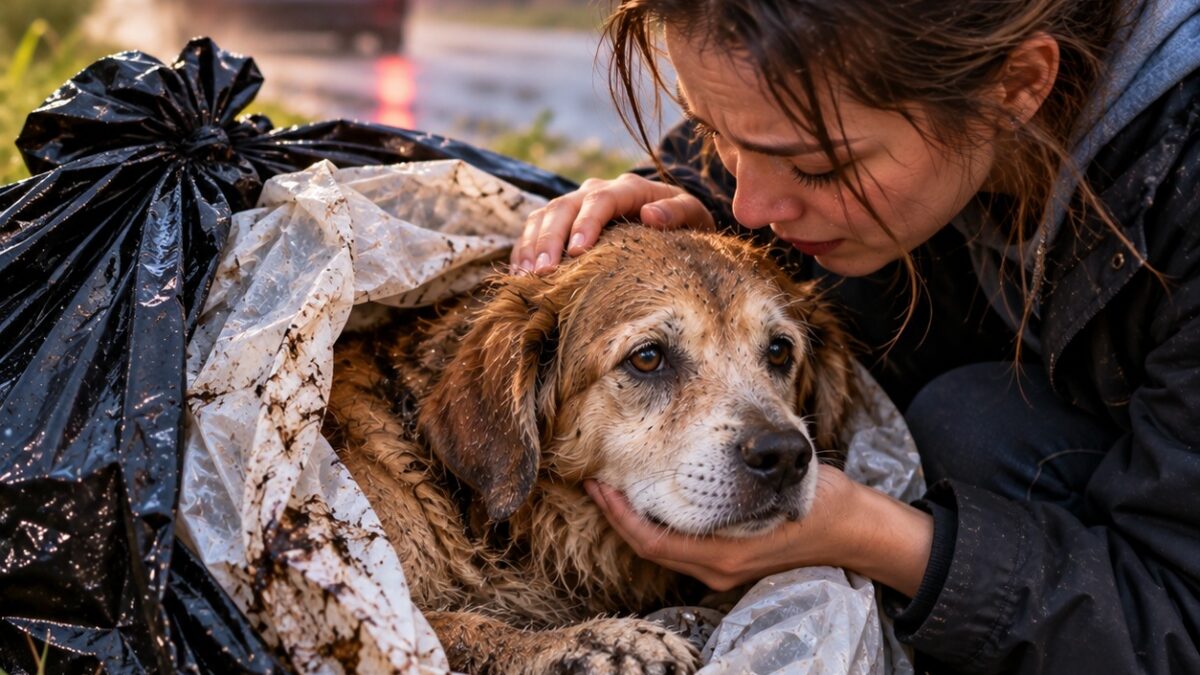
PART2
I named her Milagros before she ever decided she liked me.
In Spanish, it means “miracles.”
Some people thought the name was optimistic.
Maybe it was.
But I did not name her because I expected a miraculous transformation.
I named her because she had survived something that should never have happened.
A bag had moved.
Someone noticed.
Someone opened it.
Sometimes a miracle is painfully ordinary.
A person paying attention.
I brought Milagros home.
She tolerated the car.
That is the word.
Not enjoyed.
Not relaxed.
Tolerated.
She sat low against the blanket in the back.
Her eyes followed windows.
Hands.
Doors.
Every stop seemed to make her tense.
When we arrived, I opened the car.
Did not pull her.
Waited.
Milagros eventually stepped down.
Slowly.
Older joints.
Careful paws.
She sniffed the ground.
Then walked away from the house.
Not far.
Just toward the yard.
I had prepared a bed inside.
Food.
Water.
Blankets.
A quiet corner.
None interested her.
She went outside.
Circled twice.
Curled up against a wall.
I sat nearby.
Not close.
The evening cooled.
I waited for her to choose the house.
She did not.
Eventually I brought a blanket outside.
Placed it near her.
Milagros stood.
Moved three feet away.
I stopped.
That was the first lesson.
Even kindness can feel like pressure when an animal has lost control over what happens to her body.
I left the blanket.
Went inside.
Watched through the window.
Twenty minutes later, Milagros moved onto one edge of it.
Not completely.
Two paws.
Then more.
Tiny.
But hers.
That night I checked her more often than I slept.
She remained outside longer than I wanted.
I could have carried her in.
Physically, yes.
Emotionally?
No.
The last time someone took control of her movement, she ended up sealed inside bags.
I would not begin our relationship by making every choice for her simply because mine was kinder.
Eventually the cold became enough that I coaxed her indoors with food.
No grabbing.
No closing around her.
She stepped through the door.
Ate a little.
Then chose the farthest corner.
That became her place.
For the first week, Milagros lived as though she were trying not to inconvenience the house.
That is the best way I can explain it.
She did not bark.
Rarely asked.
Did not come looking for attention.
She moved quietly.
Ate when food appeared.
Drank.
Went outside.
Returned only when encouraged.
Then curled away.
People visited.
She watched.
No aggression.
No joy.
When a hand reached toward her, she usually lowered her head.
Not necessarily in expectation of being hit.
Something more complicated.
Submission.
Resignation.
I hated it.
I wanted to say:
You are safe.
But safety is not a sentence.
It is evidence.
The next morning, I took her to the veterinarian.
Old dog.
Abandoned.
Quiet behavior.
There were too many possible explanations.
Pain.
Organ disease.
Neurological problems.
Arthritis.
Dental issues.
Anemia.
Heart disease.
Age-related changes.
Anything could hide beneath the surface.
Milagros underwent an examination.
Blood work.
Basic testing.
The veterinarian checked her joints.
Heart.
Lungs.
Eyes.
Mouth.
Abdomen.
She stood patiently.
Too patiently.
The kind of dog who does not object because perhaps objection never changed anything.
I stayed close.
Not touching constantly.
Just visible.
The results were almost shocking.
For an elderly dog who had just been treated as disposable, there was no major hidden illness explaining the abandonment.
Age-related issues.
Yes.
Normal senior concerns.
But no devastating disease.
No diagnosis that suddenly made what her former owner did understandable.
I remember asking:
“That’s it?”
The veterinarian looked at me.
“That’s good.”
“I know.”
I touched Milagros’s back.
“I just…”
Could age alone have been enough?
Had she become inconvenient?
Slower?
Needed more patience?
Maybe had accidents?
Maybe required more attention?
We did not know.
And I was careful not to invent motive as fact.
But the question remained.
What had changed for her former owner?
Because Milagros had not stopped being alive.
She had not stopped needing care.
She had only gotten older.
I brought her home.
The investigation would take its own course.
A report had been filed.
Witnesses existed.
The former owner was under investigation.
People asked me whether I wanted her punished.
Of course I wanted accountability.
But Milagros did not need me spending every hour furious at someone who was no longer touching her life.
She needed dinner.
Water.
A quiet bed.
A person noticing when she went outside.
My work was in front of me.
That became the rule.
Handle the legal part through the proper people.
Handle Milagros through care.
The first month was harder emotionally than medically.
She was not critically ill.
There were no machines.
No emergency surgery.
No countdown.
That made her story look easier from the outside.
It was not.
Physical rescue can happen in seconds.
Trust recovery happens at the speed of the animal.
There is no medication that makes a dog believe:
This person will not leave me.
I began with routine.
Breakfast at the same time.
Morning walk.
Rest.
Dinner.
Outside.
Bed.
Again.
Milagros learned quickly that food came.
That seemed simple.
But I noticed something.
At first, she never ate until I stepped away.
I would place the bowl.
She waited.
If I stayed nearby, she watched me.
Not the food.
Me.
So I gave her space.
Eventually I could sit across the room.
Then closer.
Weeks later, I moved through the kitchen while she ate.
No tension.
That was progress.
Small enough nobody online would celebrate.
Huge enough I noticed.
Walking revealed another side.
Milagros liked the outdoors.
Not in an excited puppy way.
She moved slowly.
Sniffed.
Stopped often.
Looked around.
At first, every car made her pause.
That hurt.
I never knew whether she remembered the abandonment as a car ride.
Dogs do not narrate trauma the way humans do.
But bodies remember associations.
Sound.
Movement.
Smell.
If a vehicle passed too near, she sometimes stopped.
I waited.
No pulling.
When she moved, we moved.
One day a dark car stopped near us.
A neighbor.
Nothing threatening.
Milagros froze.
Her body lowered.
I crouched.
Not touching.
“I’m here.”
The neighbor got out.
Walked away.
Car stayed.
Milagros stared.
Then looked at me.
I took one step.
She followed.
That was all.
No breakthrough.
But another piece of evidence.
The car did not take her.
I did not disappear.
We went home together.
At night, Milagros slept alone.
Always.
I bought three beds.
She ignored two.
The third she used only when nobody was near.
If I sat beside it, she stood.
So I stopped sitting beside it.
That sounds almost ridiculous.
People wanted me to cuddle her.
“She needs love.”
Yes.
But affection delivered against preference can become another form of control.
Milagros needed choice.
Love sometimes looks like leaving an animal alone without leaving the animal.
I stayed in the room.
Read.
Worked.
Watched television quietly.
Milagros slept ten feet away.
That was companionship.
Eventually eight feet.
Then six.
One evening I looked down and realized she had moved her bed herself.
Not literally dragged it.
She had simply chosen the floor closer to my chair.
No announcement.
I kept reading.
Inside, I was celebrating.
Another week:
She slept near the couch.
Then one evening, while I was sitting, I felt something against my foot.
Milagros.
Her back.
She had lain down touching my shoe.
I froze.
Every instinct said:
Pet her.
Do not.
Let the choice remain hers.
I waited.
Five minutes.
Ten.
Then Milagros sighed.
Deep.
Her body softened.
I kept my hands to myself.
That was one of the hardest acts of love I ever performed.
Eventually she turned her head.
Looked at me.
I lowered one hand.
Slowly.
Stopped halfway.
Milagros lifted her nose.
Touched my fingers.
Then withdrew.
Enough.
The next night, she did it again.
This time, when I touched her forehead, she stayed.
Three seconds.
Then left.
I smiled.
“Good girl.”
She looked back.
Maybe the words meant nothing.
Tone did.
She returned to her bed.
Trust does not arrive as one decision.
It accumulates.
That was Milagros.
Evidence stacked one ordinary day at a time.
Nobody put her in a bag.
Breakfast returned.
Doors opened.
Doors did not trap.
Hands stopped when she moved away.
I came home.
Always.
That last part mattered more than I realized.
The first time I left for several hours, I prepared too much.
Another rescuer stayed nearby.
Food.
Water.
Everything.
When I returned, Milagros was outside.
Curled near the same wall she had chosen on her first day.
My heart dropped.
I walked into the yard.
“Milagros.”
Her head lifted.
For the first time, her reaction was immediate.
She stood.
Not running.
She was old.
But she came.
Directly toward me.
Stopped one foot away.
I crouched.
She leaned her shoulder against my knee.
I almost cried.
Not because she missed me.
Because she had allowed herself to expect return.
There is risk in loving someone who can leave.
Milagros had begun taking that risk.
I touched her head.
“I came back.”
She stayed.
That became a sentence I said often.
I came back.
Not:
I will never leave.
That promise is impossible.
People die.
Life changes.
But:
I left this morning.
I came back this afternoon.
Evidence.
Again.
Again.
Again.
One evening there was thunder.
Milagros went outside before I noticed the storm approaching.
A loud crack sent her underneath a covered table near the patio.
I found her.
Did not pull her out.
I sat several feet away.
Rain started.
Not heavy.
Enough.
I talked about nothing.
Dinner.
A dog I had rescued years earlier.
The fact that the weather forecast was unreliable.
Milagros listened or did not.
After fifteen minutes, she crawled out.
Not toward the house.
Toward me.
She stood beside my shoulder.
I touched her chest.
Her breathing slowed.
Then together we went inside.
That was the first time she chose me over hiding.
I did cry afterward.
Privately.
Milagros would have found it embarrassing.
By the second month, personality started appearing.
Quiet did not mean she had no opinions.
Milagros disliked one brand of food.
Strongly.
I discovered this after buying too much.
She looked at the bowl.
Then at me.
Walked away.
“You ate worse things before.”
She refused.
Good.
Animals should be allowed standards after survival.
I bought different food.
She ate.
Milagros liked blankets folded, not piled.
If I created a fluffy nest, she flattened it.
Every time.
She liked morning sun.
She disliked one particular neighborhood dog for reasons known only to her.
She began wagging.
At first, barely.
One small movement when I approached with the leash.
Then more.
The first full wag happened over chicken.
Not me.
Fair.
I held the piece.
“Really?”
Tail.
“Food gets this?”
Tail.
“I rescued you.”
Nothing.
“Excellent.”
She ate the chicken.
Our relationship had become insulting enough to be healthy.
That is when I knew she was becoming comfortable.
Fear makes animals careful.
Comfort creates preferences.
Sometimes demands.
Milagros started asking.
She would stand near the door when she wanted outside.
At first, silent.
Then one day:
A small bark.
I turned.
She surprised herself too.
Her ears shifted.
I laughed.
“What?”
Another bark.
I opened the door.
Milagros walked out with the authority of someone who had discovered customer service.
Good.
The dog who once waited inside sealed bags for someone else to decide whether she breathed had learned she could ask for a door.
That mattered.
Visitors noticed changes.
“She looks happier.”
Maybe.
I preferred:
More relaxed.
More engaged.
Happiness is hard to measure in dogs.
But she was present.
She watched.
Approached familiar people.
Accepted affection.
Made canine friends.
That part came slowly too.
One younger dog overwhelmed her.
Too much bouncing.
Milagros growled.
The owner apologized.
I said:
“No.”
The younger dog backed away.
Milagros had communicated a boundary.
Perfect.
She was allowed.
Another dog, older and calm, became easier.
They sniffed.
Walked.
Rested in the same area.
No pressure.
Eventually they lay near each other.
Milagros did not need a pack.
She needed choices.
She made a friend.
People online loved photographs of them.
Two senior dogs in sunlight.
I understood why.
Old animals carry a kind of quiet beauty.
Not because aging is tragic.
Because age makes ordinary comfort feel precious to humans aware of time.
Milagros did not know she was a senior rescue story.
She knew the sun was warm.
Better.
The legal investigation continued in the background.
Occasional calls.
Questions.
Statements.
Marcos and Elena repeated what they saw.
I provided veterinary records.
People online wanted dramatic justice.
They asked:
“Was the owner arrested?”
“What sentence did she get?”
“Did she pay?”
I refused to invent an ending that did not exist in the information I had.
The matter was reported.
Investigated.
That was the truth available to me at the time.
And strangely, as months passed, I thought about the former owner less.
Not because what happened mattered less.
Because Milagros mattered more.
Anger had originally filled the story.
Then the dog filled it.
That is what healing sometimes does.
It changes the center.
The bags had been the first thing everyone talked about.
Eventually, when I looked at Milagros, I thought about the way she snored.
Yes.
Milagros snored.
Softly.
Then loudly.
For an old lady with a quiet personality, she slept like machinery.
The first night she slept deeply enough to snore beside me, I turned off the television just to listen.
Ridiculous.
Beautiful.
Deep sleep is vulnerable.
An animal worried about danger wakes easily.
Milagros had spent months sleeping lightly.
Head rising with footsteps.
Body shifting when doors moved.
Now:
Snore.
I sent a recording to Elena.
She replied:
That is the best sound.
Yes.
The woman who saw Milagros trapped in bags now got to hear her sleeping loudly enough to be annoying.
That was justice of another kind.
Not legal justice.
Life justice.
The bad act did not remain the final scene.
One afternoon, Marcos and Elena came to visit.
Milagros watched them enter.
Elena crouched.
“Do you remember us?”
Nobody knew.
Dogs remember scent remarkably well, but I never claimed certainty.
Milagros sniffed.
Then leaned toward Elena.
Elena immediately cried.
Marcos laughed at her.
Then cried too.
We all became useless.
Milagros stood in the middle looking mildly concerned about the unstable humans who surrounded her.
Elena touched her face.
“You look so good.”
Milagros’s coat had improved.
Her body looked healthier.
Not young.
That was never the goal.
Nobody needed to turn her back into a puppy to prove rescue worked.
She remained an old dog.
Slow.
Gray.
Sometimes stiff.
That was part of what made the abandonment hurt.
She had reached the stage of life when loyalty should become easier.
You know the animal.
Their routines.
Their face.
Their history.
And somehow someone had chosen bags.
Elena whispered:
“I still see her coming out.”
I knew.
Certain images stay.
I said:
“Look at her now.”
We did.
Milagros wandered away because conversation bored her.
Good.
The old story did not own her attention.
Months passed.
Winter came.
Senior dogs and cold floors are not friends.
I put rugs down.
More beds.
Milagros chose one finally.
A thick orthopedic bed near the heater.
I had bought it months earlier.
She ignored it for weeks.
Then one morning I found her sprawled across it.
All four legs loose.
Head hanging slightly off the edge.
I almost photographed.
Stopped.
Just watched.
There are moments you ruin by turning them immediately into content.
I wanted this one for me.
The dog who had first chosen outdoor corners was asleep in the center of the house.
Not near an exit.
Not hidden.
Center.
That location mattered.
I walked around her carefully.
She did not wake.
Again:
Evidence.
She trusted the floor beneath her.
The roof.
The sounds.
The person moving nearby.
I made coffee.
Milagros slept.
Ordinary morning.
That became one of my favorite memories.
Nothing happened.
Safety often looks like nothing happening.
No bags.
No car leaving.
No confrontation.
No rescue.
Just an old dog sleeping while someone makes coffee.
Milagros began greeting me at the door.
Not every time.
She was still a senior.
Energy has limits.
But often.
When keys sounded:
Head.
Stand.
Slow walk.
Tail.
The first time, I nearly turned around and left just to experience it twice.
I did not.
Dignity.
She stopped several feet away.
I kneeled.
“Hi.”
She approached.
Pressed her head against my chest.
Not dramatic.
But I remembered the first day.
Same dog.
Then: distance.
Now: contact.
No training forced that.
Time did.
Choice did.
Predictable care did.
Milagros was not becoming dependent.
She was becoming secure enough to attach.
There is a difference.
Fear says:
If I love you, you can hurt me.
Safety says:
I will risk it anyway because you keep proving something else.
One evening, she did something I had been secretly waiting for.
She climbed onto the couch.
Milagros was not athletic.
It took effort.
Front paws.
Pause.
Back legs.
I almost helped.
Stopped.
She managed.
Then instead of taking the far cushion, she walked directly toward me.
Circled.
Lowered herself against my hip.
I did not breathe for several seconds.
She sighed.
I touched her shoulder.
No movement away.
Then her head came down across my thigh.
That was it.
The moment.
Not the rescue.
Not the veterinary report.
Not the first wag.
This.
Milagros choosing to sleep against a person.
I stared at her gray face.
“Are you sure?”
No answer.
Already asleep.
I cried silently.
Because for months, I had been careful not to demand evidence that she loved me.
That would have been another burden.
I fed her.
Protected her.
Took her to the veterinarian.
Returned.
Did it again.
Whether she ever became cuddly was supposed to be irrelevant.
But when she finally chose closeness, I understood how much I had wanted her to feel safe enough to want it.
Not for me.
For her.
She deserved comfort without calculation.
From then on, the couch became ours.
Some nights she stayed ten minutes.
Some an hour.
Sometimes not at all.
Choice remained.
The first time she left after thirty seconds, I felt almost rejected.
Then laughed at myself.
Healing does not mean an animal owes you affection on schedule.
Milagros slept where she wanted.
That was the point.
Her senior care increased with time.
Joint supplements.
Routine checks.
Watching weight.
Dental monitoring.
Comfort.
Aging continued.
Rescue did not stop biology.
I knew when I took her that we might not have ten years.
Maybe not five.
Maybe far less.
People sometimes avoid senior adoption for that reason.
“I’ll get attached.”
Yes.
That is the plan.
Attachment creates grief eventually.
It also creates everything before grief.
Milagros deserved someone willing to pay that emotional cost.
I began thinking about permanence.
At first, I had described my home as temporary.
Rescue placement.
Safe while we evaluated.
Then medical care.
Then rehabilitation.
Then:
We’ll see.
I never actively searched for another adopter.
That became increasingly obvious.
A friend asked:
“When is Milagros available?”
I stared.
“She’s not.”
The answer came automatically.
My friend smiled.
“Oh.”
“What?”
“Nothing.”
I looked at Milagros.
She was asleep nearby.
That was the moment I realized the decision had already happened.
No formal ceremony.
No big announcement.
She was home.
Mine, if she wanted.
More accurately:
I was hers.
I completed whatever formal rescue documentation was needed.
Permanent care.
No transfer.
No next home.
Milagros would spend whatever time remained here.
When I told Marcos and Elena, Elena cried.
Again.
Marcos said:
“We knew.”
“How?”
“You talk about her like a mother talking about her child.”
Embarrassing.
Probably true.
I told Milagros:
“You’re staying.”
She sniffed my hand.
“That’s it?”
Nothing.
“Very emotional.”
She walked toward the kitchen.
Food.
As usual, the dog understood priorities.
The first anniversary of her rescue came.
I did not call it abandonment day.
I hated giving the worst person in her story ownership over the calendar.
We called it Milagros Day.
No reenactment.
No photos of bags.
Chicken.
Walk.
Sun.
Visitors she liked.
A new blanket.
She preferred the old one.
Naturally.
At one point, she lay in the grass.
The same basic material where someone had discarded her.
Grass.
Yet now completely different.
Fenced yard.
Water nearby.
Door open.
Me ten feet away.
Milagros rolled slightly onto one side.
Closed her eyes.
The contrast hit me.
Once, bags in grass meant death might arrive unnoticed.
Now grass meant afternoon.
Context changes the world.
She woke.
Saw me.
Did not get up immediately.
That was trust too.
She did not need to monitor whether I was leaving.
I sat beside her after a while.
Not touching.
Then Milagros moved closer.
Leaned.
I scratched her chest.
“Happy miracle day.”
Tail.
Chicken had helped.
Over the following years—yes, years, more than I initially allowed myself to imagine—Milagros became an ordinary senior dog.
That is the best sentence in this story.
Ordinary.
She had veterinary appointments.
Sometimes upset stomach.
Stiff mornings.
Long naps.
A favorite bowl.
A hated raincoat.
I bought it because I thought old dogs needed protection from cold rain.
Milagros thought dignity mattered more.
She froze whenever I put it on.
Refused to walk.
I removed it.
She immediately moved.
Message received.
We compromised with shorter outings.
She hated baths.
Loved towel drying.
She liked one neighbor.
Ignored another.
She became strangely interested in cats from a safe distance.
Never aggressive.
Just confused.
She had preferences.
History no longer introduced every day.
People visiting for the first time sometimes had no idea what happened.
They simply met Milagros.
That pleased me.
One visitor said:
“She’s so calm.”
I almost said:
You should have seen her when—
Stopped.
No.
Milagros did not need her trauma offered as conversational trivia.
“She is.”
Enough.
Sometimes people asked her age.
I would give the estimate.
Then:
“She’s an old lady.”
Milagros looked insulted.
Fair.
Age is not a diagnosis.
That became another lesson.
Was her age why someone abandoned her?
We never knew with certainty.
But I knew old age was exactly why she deserved more patience, not less.
Senior dogs change.
They slow.
Need help.
May become expensive.
Sleep more.
Sometimes hearing fades.
Vision.
Bladder control can change.
The bargain is not:
I love you while convenient.
The bargain is:
You gave me your years.
I will not disappear when the years begin showing.
Milagros taught me that without trying.
One winter, she began struggling slightly on the stairs.
I blocked them.
Changed the house.
Someone joked:
“She owns you.”
Correct.
I put rugs over slippery floors.
Moved food.
Added a ramp.
The world adjusted around an old dog.
Nobody complained.
That was the exact opposite of what abandonment had said.
Abandonment says:
You no longer fit my life.
Care says:
Then I change the space.
Milagros noticed none of the symbolism.
She used the ramp.
Good.
Her hearing slowly declined.
At first, she stopped reacting to distant sounds.
Then keys.
Then sometimes my voice unless close.
Door greetings changed.
Not because love changed.
She simply did not hear me.
So I began touching the floor gently when approaching.
Creating vibration.
Avoid startling.
Milagros learned.
When she saw me:
Tail.
Still.
Old body.
Same answer.
The first time she slept through my arrival entirely, I stood in the doorway watching her breathe.
Years earlier, I would have interpreted that as distance.
Now I understood it as safety.
She could sleep through doors opening.
That was enormous.
No need to know who came.
No need to know who left.
Home had become reliable.
Eyesight dimmed later.
Not completely.
Enough that evening walks became slower.
I followed her pace.
What rush?
We sniffed the same tree for several minutes sometimes.
Milagros apparently discovered a rich social network through urine.
I waited.
People passed.
Some smiled.
One young man asked:
“Is she sick?”
“No.”
“Just old?”
I looked at Milagros.
“Just old.”
What a privilege.
Just old.
Not discarded.
Not unwanted.
Old.
The word became beautiful.
Eventually health concerns became more frequent.
Nothing dramatically tied to the abandonment.
Time.
Body.
I watched carefully.
Pain.
Appetite.
Mobility.
Interest.
The things senior guardians learn.
Aging asks a different kind of rescue.
Not save at all costs.
Support.
Adapt.
Know when discomfort changes.
Know when treatment helps.
Know when your own fear of grief begins speaking louder than the animal’s quality of life.
I hoped I would be brave enough when the time came.
For a long time, it did not.
Milagros kept eating.
Kept enjoying sun.
Kept walking.
Slowly.
Kept coming for affection.
Those were good days.
We took them.
One afternoon, Marcos and Elena visited again.
Milagros was much older.
Elena sat beside her.
“You remember the bags?”
She asked me quietly.
“Yes.”
“I sometimes dream about them.”
“So do I.”
Marcos looked toward Milagros.
She was sleeping.
He said:
“I used to wish we’d stopped the car before she drove away.”
I understood.
“If you had?”
“Maybe we could’ve made her take responsibility immediately.”
I thought.
“Maybe.”
Then:
“But you opened the bags.”
He looked at me.
“That was enough that day.”
People who witness cruelty often torture themselves with what more they should have done.
But there is an important difference between imperfect action and no action.
Marcos and Elena acted.
Milagros breathed because of it.
Elena touched the dog’s shoulder.
Milagros woke.
Saw her.
Tail.
Elena smiled.
“Worth it.”
Yes.
After they left, I thought about the word miracle again.
Milagros.
At first, I thought the miracle was that the bag moved while someone was watching.
Then maybe that she was physically healthy.
Then trust.
Then years.
Eventually I realized miracle was too dramatic a word for what really changed her life.
The change came from ordinary consistency.
Open bag.
Open door.
Food.
Vet.
Blanket.
Return.
Patience.
Again.
Again.
Again.
No single act healed betrayal.
Hundreds of safe acts outnumbered it.
That is how her story became satisfying.
Not because the former owner suffered enough.
I never measured Milagros’s recovery against someone else’s punishment.
The satisfying part was that abandonment failed.
Whoever put her in those bags had made a decision that said:
This life is disposable.
Everything afterward contradicted it.
Marcos:
No.
Elena:
No.
Me:
No.
The veterinarian:
No.
Every bowl.
No.
Every warm night.
No.
Every time she was noticed.
No.
Every year added.
No.
Milagros was not trash.
She was an aging animal requiring exactly what aging animals require.
Care.
The bags never became more important than that answer.
One of my favorite photographs was taken late in her life.
Milagros standing beside the open back door.
Sun behind her.
Gray face.
A little thin with age.
She could go outside or inside.
Her choice.
That picture meant more to me than anyone else understood.
Open door.
Choice.
No bags.
No sealing.
No trapping.
Milagros looked outside.
Then turned.
Walked back into the house.
I cried after taking it.
Because she chose inside.
Not because outside was frightening.
Because inside belonged to her.
There is a difference between being kept somewhere and choosing to stay.
Milagros had finally experienced the second.
Toward the end, her world became smaller again.
Not from fear.
From age.
Long walks became short.
Then yard.
Then mostly house.
Her bed moved closer to mine.
Eating needed encouragement sometimes.
We adjusted food.
Veterinary guidance.
Comfort.
She still wanted chicken.
Some truths survive everything.
One evening, she did not want dinner.
That worried me.
Next morning, some.
Then less.
We went to the veterinarian.
Tests.
Age-related decline.
Nothing dramatic enough to fight.
Supportive treatment.
Monitor.
I had known this day would come from the first time I heard “elderly dog.”
Still unprepared.
Milagros improved for a while.
A few more months.
Good months.
Sun.
Food.
Sleeping.
One afternoon she even barked at the door again.
I laughed.
“Yes, Madam.”
Opened it.
She stepped outside.
Stood in grass.
Wind moving through her coat.
Then came back.
That evening she slept beside my chair.
I watched her.
No regret.
Only time.
Eventually the balance changed.
She struggled to stand.
Helped.
Then ate very little.
Her eyes still found me.
But her body had become tired.
The veterinarian and I talked about comfort.
Quality.
Pain.
I listened.
There was no tumor to remove.
No infection to cure.
No dramatic villain inside her body.
Age was completing what age completes.
The hardest truth in senior rescue is that love is measured partly by whether you can accept the ending you knew was coming.
I took Milagros home.
Not because we had given up.
Because home was where she belonged while we decided.
I made her favorite place comfortable.
Blanket.
Water.
Quiet.
I sat on the floor.
Milagros lay near me.
Then, slowly, she moved.
Closer.
Her head touched my leg.
The same old choice.
I lowered my hand.
She leaned.
Years disappeared.
First day.
Corner.
Distance.
Now this.
I whispered:
“You did it.”
No response.
“You really did.”
She breathed slowly.
“You trusted me.”
That was not quite right.
Trust was not an achievement I could claim.
She had given it.
I had simply tried not to waste it.
“I’m here.”
That was better.
Milagros closed her eyes.
I stayed.
The next day, after another veterinary conversation, I understood that keeping her longer would increasingly mean keeping her for me.
Pain was becoming more difficult.
Mobility poor.
Appetite fading.
Joy narrowing.
There are decisions rescue cannot make emotionally satisfying.
Only kind.
I arranged for her final moments to be gentle.
No bags.
No strangers leaving.
No grass beside a road.
Me.
Her blanket.
My hands.
The veterinarian.
Quiet.
When the time came, Milagros rested against me.
I thought about the first woman who had held her life and decided to discard it.
Then stopped.
That person did not belong in the room.
This was not her ending.
Milagros looked at me once.
Or perhaps simply toward me.
I touched her forehead.
“You’re staying with me.”
Not physically forever.
But for this.
This moment.
No leaving before her.
No making her watch a door close.
“I’m here.”
The medication relaxed her.
Her breathing slowed.
Her body softened.
The veterinarian waited.
I kept touching her.
No rushed goodbye.
No dramatic last gesture.
Milagros simply became still.
Old.
Loved.
Not alone.
The silence afterward was enormous.
I held her longer.
There was nowhere else I needed to be.
When I finally returned home, the first thing I saw was her bed.
Empty.
I sat beside it.
Cried.
Then laughed because one corner was flattened exactly the way Milagros always arranged it.
Old lady.
Particular until the end.
Grief came in routines.
No bowl.
No door bark.
No slow footsteps.
No body near my chair.
No reason to watch for her when I opened the gate.
People wrote kind messages.
Some said:
“At least you saved her.”
I understood.
But “saved” was not how I thought of it anymore.
Marcos and Elena saved her from the bags.
The veterinarian helped protect her health.
I gave her a home.
Milagros did the rest.
She learned the house.
Chose the blanket.
Made friends.
Set boundaries.
Demanded chicken.
Slept.
Aged.
Loved.
Her life after abandonment belonged to her.
That mattered.
Months later, I found one of the old photos from the first day.
Milagros outside.
Curled alone.
Body turned away from the people who had just rescued her.
I stared.
The dog in that photograph had no idea how the story ended.
She did not know there would be years.
No idea that she would someday sleep so deeply she snored through me entering the house.
No idea she would bark to demand doors.
Reject food she disliked.
Choose couches.
Make friends.
Become old enough for age itself—not abandonment—to determine the final chapter.
That was the part that satisfied me most.
Whoever put Milagros in those bags tried to make her life end as something unwanted.
They failed.
Completely.
The bags became one awful event.
Not the definition.
The definition became the years afterward.
If you had visited our house before Milagros died and knew nothing about her history, you would not have seen an abandoned dog.
You would have seen an old lady sleeping near the heater.
Maybe asking for chicken.
Maybe ignoring you.
Maybe allowing a scratch.
That ordinariness was victory.
The first time someone made room for her, Milagros stayed outside.
By the end, the house was hers.
That is the story.
Not that rescue immediately repaired her.
It did not.
Trust took months.
Security took repetition.
Love arrived without demanding a response.
The person caring for her kept showing up on days Milagros hid.
Fed her on days she would not approach.
Sat nearby without touching.
Opened doors.
Came back.
Stayed.
Eventually, Milagros stopped living like every good thing had an expiration date.
She stopped sleeping near exits.
Stopped watching every movement.
Started asking.
Started choosing.
Started leaning.
And finally, she grew old in a place where age was not a reason to throw her away.
If I could return to the day I first met her, I would not rush toward the corner.
I would sit where I sat.
Maybe say even less.
Because now I know what Milagros needed to hear was never really in words.
Not:
You are safe.
Not:
I love you.
Not:
Nobody will hurt you again.
Those are beautiful sentences.
But for a betrayed animal, they are still only sounds.
The real message came later.
Breakfast.
I’m here.
Dinner.
I’m here.
Night.
I’m here.
Morning.
Still here.
Month.
Still.
Year.
Still.
Until one day the old dog no longer needed to ask.
Someone had put Milagros inside two bags and driven away while she was still alive.
That will always be the cruelest sentence in the beginning of her story.
But it is not the sentence I remember last.
The last one is quieter.
An elderly dog asleep against my leg, inside a warm house, with an open door only a few feet away.
She could have moved.
She could have hidden.
She could have chosen the far corner.
She didn’t.
Milagros stayed beside me.
And this time, so did I.

