PART2:Her Owner Brought Home a New Puppy While Gracie Hid Outside With Raw, Infected Skin—She Was Too Afraid to Let Me Touch Her
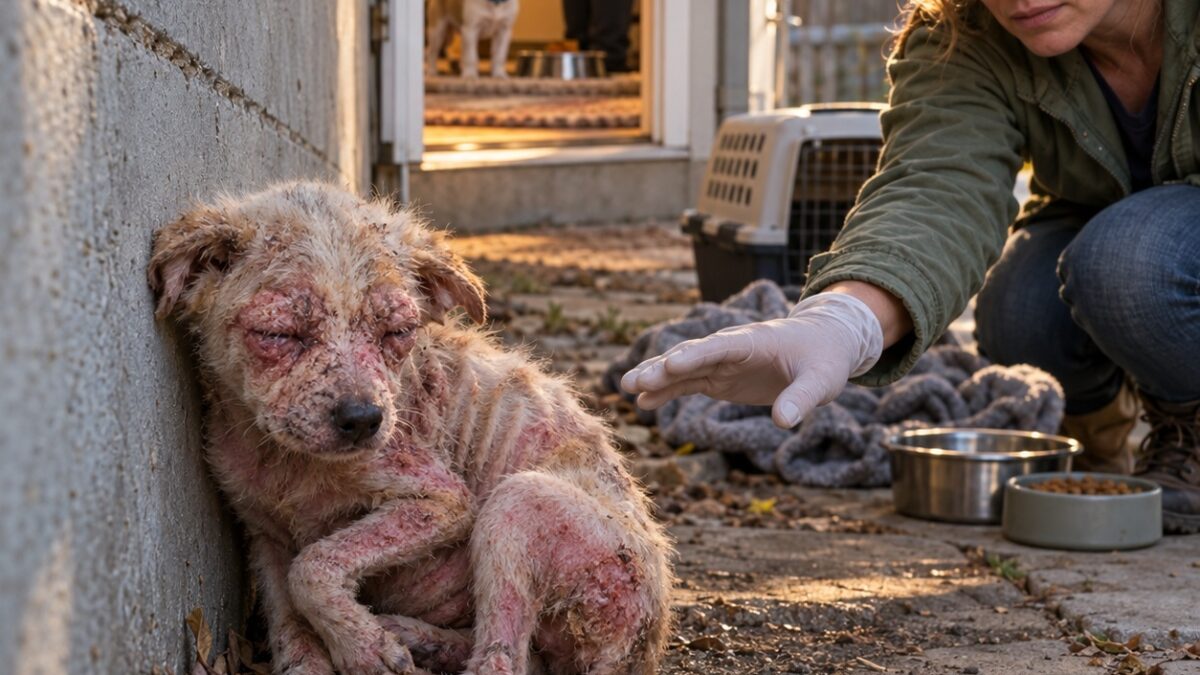
She did not relax in my arms.
That is something people often imagine about rescue.
They picture the dog realizing instantly:
I’m safe.
Then melting into the rescuer.
Gracie did not know the word safe yet.
Her body stayed rigid beneath the blanket.
Every muscle braced.
Her head remained turned away from me.
Her breathing was shallow and fast.
I could feel her heart racing through the thin towel.
“Easy.”
I kept saying it.
“Easy, baby.”
The words were mostly for me.
I had to carry her past the gate, down the street, and into the car without frightening her more than necessary.
Every step, I could feel how unfamiliar touch was.
Not just scary.
Foreign.
She did not lean into warmth.
Did not seek a chest.
Did not tuck her face beneath my chin the way frightened puppies often do.
She tolerated being held because she no longer had enough strength to escape.
That realization hurt more than I expected.
A puppy should know comfort.
Even puppies born in rough places usually understand something about curling against another body.
Mother.
Littermates.
Warmth.
Gracie seemed to have learned isolation first.
I set her carefully on the back seat.
Blankets beneath her.
Water nearby.
She lifted her head once.
Looked toward the door.
As if calculating whether she should run.
“You don’t have to,” I whispered.
“You can rest.”
I closed the door gently.
Then walked around the car.
By the time I sat behind the wheel, she was asleep.
Not peaceful sleep.
Collapse.
Her head had dropped sideways against the blanket.
Her little front legs stretched awkwardly.
I watched her in the mirror.
For the first few miles, every time we hit a bump, I checked whether she was breathing.
That is the kind of fear neglect creates.
You find yourself watching a sleeping puppy and praying the chest keeps moving.
At a red light, I turned around.
Gracie did not wake.
Her eyes remained mostly swollen shut.
The skin around them looked painful.
Her ears had irritated patches.
Her legs were thin.
The smell of severe skin infection filled the car.
I have smelled it before.
You do not forget.
Inflammation.
Infection.
Dirty fur.
A body trying to fight while underfed.
I cracked the window.
Then immediately felt guilty, as though Gracie might somehow understand.
“Sorry, baby.”
She slept.
The veterinary hospital knew we were coming.
I called ahead.
“Female puppy.”
“Severe skin disease.”
“Very underweight.”
“Dehydrated.”
“Eyes swollen.”
“Possible prolonged neglect.”
“How responsive?”
The veterinarian asked.
“Barely.”
“Bring her straight in.”
I drove faster.
Not dangerously.
But every traffic light felt personal.
Every slow vehicle seemed cruel.
I remember looking at the clock and thinking:
You have already been waiting two days.
You should not have to wait another minute.
When we arrived, two veterinary technicians met me outside with a stretcher.
I shook my head.
“I can carry her.”
One tech looked at Gracie.
Then at me.
“Okay.”
I opened the back door.
Gracie woke immediately.
Her body tightened.
The technician reached.
Gracie tried to pull away.
I said:
“Wait.”
I leaned inside.
“Gracie.”
It was the first time I called her that.
She did not have a name I wanted to keep from her old life.
The name came to me because I needed something gentle to say.
“Gracie.”
Her swollen eyes moved toward my voice.
Maybe coincidence.
Maybe not.
“Come on.”
I gathered her again.
This time she resisted for only a second.
Then her head fell against my forearm.
Inside the examination room, the veterinarian took one look at her and went quiet.
Veterinarians see suffering daily.
When they go quiet, rescuers notice.
He put on gloves.
Examined her skin.
Checked hydration.
Gums.
Eyes.
Temperature.
Weight.
Every place he touched made Gracie flinch.
Not dramatically.
Tiny contractions.
As though her body expected pain before contact even arrived.
The doctor said:
“She’s severely dehydrated.”
I nodded.
“Malnourished too.”
“Yes.”
He looked more closely at the skin.
The longer he examined it, the less he spoke.
Finally:
“This is very bad.”
“How bad?”
“I rarely see skin disease this advanced in a puppy this young.”
My stomach tightened.
He took samples.
Skin scrapings.
Blood.
Cultures.
Checked for parasites.
Secondary infection.
He explained that the inflammation was not just uncomfortable.
It could become systemic.
Her damaged skin barrier made her vulnerable.
Her body was already compromised by poor nutrition and dehydration.
“We’ll start fluids.”
“Antibiotics.”
“Supportive care.”
“And dermatologic treatment.”
“Can she recover?”
The question came out smaller than I intended.
The veterinarian looked at Gracie.
“Yes.”
Then added:
“But this will take time.”
Time.
Rescuers hear that word constantly.
Weeks.
Months.
Slow healing.
Slow trust.
You learn to respect it.
“Whatever she needs.”
The veterinarian nodded.
Then:
“One medication may be difficult to source locally.”
“What do you mean?”
“We may need to bring it in from abroad.”
I stared.
“For her skin?”
“Yes.”
“How long?”
“We’ll start everything else immediately.”
“And get the special medication ordered as quickly as possible.”
I looked at Gracie.
She had curled herself into the corner of the examination table as much as she could.
An entire hospital around her.
People trying to save her.
And all she understood was that strangers kept touching the places that hurt.
I put my hand near her nose.
Not on her.
Near.
She did not sniff.
But she stopped trying to move away.
Small.
Very small.
I took it anyway.
While Gracie received fluids, I went back outside to make calls.
That is the unglamorous part of rescue.
You do not simply pick up an animal and love her back to health.
There are forms.
Reports.
Questions.
Money.
Medical decisions.
Evidence.
Authorities.
I called the person who had first contacted us.
Then someone who knew more about the home beside the spot where Gracie had hidden.
The story became clearer.
And worse.
Gracie had spent much of her short life confined in a cramped, filthy cage.
Not a temporary crate.
Not safe confinement for training.
A place where she had existed because someone wanted a puppy before understanding that a puppy requires time, medicine, cleaning, patience, money.
Her skin had worsened.
The owner said he had tried to treat her.
Maybe he had.
I was not standing inside his past.
I could not know every attempt.
But I knew the present.
Gracie had been outside for two days.
Severely ill.
Hungry.
Dehydrated.
Afraid of people.
And a new puppy had already been brought home.
That fact sat inside me like a stone.
One puppy sick.
Replace.
New puppy healthy.
Start again.
As though Gracie were a broken appliance.
I asked directly:
“Did he say he doesn’t want her?”
“Yes.”
“Did he surrender her?”
“He says he can’t manage her anymore.”
I looked through the veterinary hospital window.
A technician was hanging fluids.
Gracie lay beneath a blanket.
Could not manage her.
She was a baby.
A sick baby.
I asked for everything to be documented.
The conditions.
The timeline.
The new puppy.
The statements.
We reported the situation to the appropriate authorities.
What happened legally would not be mine to decide.
My job was Gracie.
I went back inside.
The technician had given Gracie a small bowl of food.
She sniffed.
Then looked away.
“Too stressed,” the tech said.
I nodded.
“Can I try?”
She handed it to me.
I sat on the floor.
Not beside Gracie.
A few feet away.
I placed one small piece of soft food on my palm.
“Gracie.”
Her eyes opened slightly.
“Come on.”
Nothing.
I set the food on the floor between us.
Waited.
She watched.
I moved my hand back.
Another minute.
Her nose twitched.
Then one paw moved.
Slow.
Careful.
She crawled forward.
Not walking.
Crawling because standing required energy.
She reached the food.
Sniffed.
Ate.
Then immediately retreated.
My throat tightened.
“Good girl.”
She looked at me.
I put another piece down.
Closer to me this time.
She waited longer.
Then came.
Ate.
Backed away.
We repeated that for ten minutes.
Food.
Retreat.
Food.
Retreat.
No touching.
No pressure.
By the fifth piece, she did not retreat as far.
By the eighth, she stayed where she was.
The technician whispered:
“That’s good.”
I nodded.
Could not speak.
People imagine dramatic rescue moments.
Dog running into arms.
Tail wagging.
Instant trust.
Sometimes rescue looks like a puppy eating one piece of food and choosing not to crawl backward afterward.
That can feel like a miracle too.
Gracie remained at the hospital.
I hated leaving her.
Absolutely hated it.
The first night, I stood near her kennel longer than necessary.
The veterinary staff had made it soft.
Blanket.
Clean pad.
Water.
Low light.
No cage filth.
No hard floor.
Still, Gracie curled into the farthest corner.
As far from the door as possible.
The technician said:
“She’ll be monitored overnight.”
“I know.”
“We’ll call if anything changes.”
“I know.”
“She’s safer here.”
“I know.”
I stayed.
The technician smiled gently.
“You’re allowed to go home.”
“I know.”
I finally crouched near the kennel.
“Gracie.”
Her head lifted.
Barely.
“I’m coming back.”
She had no reason to believe me.
Dogs do not understand promises because humans say them.
They understand repetition.
You leave.
Do you return?
You reach.
Does it hurt?
You bring food.
Does it stay?
You speak softly.
Does the softness continue when they make a mistake?
Trust is not language.
It is pattern.
I touched two fingers to the kennel door.
“See you tomorrow.”
She lowered her head.
I left.
I cried in the parking lot.
Not dramatically.
Just sat behind the wheel for five minutes with tears running down my face.
Because sometimes you hold yourself together until the animal is safe.
Then your body collects the bill.
The next morning, I arrived early.
The veterinarian met me with cautious news.
“She ate overnight.”
“How much?”
“Enough.”
“Fluids?”
“Helping.”
“Temperature?”
“Improving.”
“Skin?”
He gave me a look.
I stopped asking.
That would take longer.
He showed me photographs from the examination.
Under proper lighting, the condition looked even worse than I had understood outside.
Inflamed patches.
Crusting.
Open irritated areas.
Swelling.
Secondary infection.
Her body was trying desperately to protect itself.
“She must have been miserable.”
I said it quietly.
The doctor nodded.
“Very.”
“Was it painful?”
“Yes.”
I looked through the glass.
Gracie was awake.
She saw me.
Then something happened.
Nothing dramatic.
Her head lifted.
That was all.
But she recognized me.
Or recognized the person who had fed her.
I entered.
Sat.
“Morning.”
She remained in the corner.
I put food down.
She came sooner.
That became our ritual.
The first bath was terrible.
Necessary.
Terrible.
The medicated wash would help her skin.
Remove buildup.
Allow topical treatment.
Soothe infection eventually.
But Gracie did not know any of that.
Water terrified her.
The moment she heard it running, she began trembling.
When a technician lifted her toward the basin, she panicked.
Her legs kicked.
Her eyes widened.
A sound escaped her.
Not a bark.
A small cry.
I stepped in.
“Wait.”
We lowered her.
I held her against my body while the technician wet a cloth instead.
Slow.
One area at a time.
Gracie shook so hard I could feel it through my arms.
“I know.”
I whispered.
“I know.”
“This is help.”
Of course she did not understand.
All she knew was restraint.
Wetness.
Hands.
Unfamiliar sensations on skin already burning.
Halfway through, she twisted and tried to climb out of my arms.
For one second, I wanted to stop completely.
No treatment.
No bath.
Nothing that frightened her.
But compassion cannot always mean avoiding discomfort.
Sometimes healing hurts.
The difference is what comes around it.
We slowed.
Paused.
Let her breathe.
Fed tiny treats.
Started again.
Nobody shouted.
Nobody forced faster.
Nobody punished fear.
By the end, Gracie was exhausted.
So was I.
The technician wrapped her in a warm towel.
I expected her to pull away.
Instead, for the first time, she rested her chin against my arm.
Only for a second.
Then lifted it again.
I looked at the technician.
She had seen it too.
Neither of us spoke.
I held Gracie a little longer.
Days became a schedule.
Medicine.
Food.
Fluids.
Skin cleaning.
Rest.
Veterinary checks.
Waiting for the imported medication.
I visited constantly.
Probably too constantly.
The hospital staff stopped asking my name.
“Gracie’s person is here.”
That phrase embarrassed me.
Also made me proud.
I was not her owner.
Not yet.
Maybe never.
Rescuers often become bridges.
You save.
Heal.
Teach trust.
Then let someone else become home.
That is the job.
It can break your heart.
It is still the job.
At first, Gracie did not understand toys.
I brought a soft ball.
Set it near her.
She sniffed once.
Walked away.
A stuffed little dog.
Nothing.
Rope toy.
Nothing.
She understood food.
Water.
Corners.
Distance.
Those were her priorities.
Play requires safety.
A dog cannot waste energy chasing a ball if her nervous system still believes survival is uncertain.
So I stopped trying to make her play.
I simply sat.
Sometimes for an hour.
Phone away.
No constant touching.
No baby talk.
Just presence.
Gracie would lie several feet away.
Watch me.
Fall asleep.
Wake.
Check whether I was still there.
Sleep again.
That was play enough for the beginning.
The special medication finally arrived.
I remember the box because everyone in the clinic looked relieved.
Not celebratory.
Relieved.
The veterinarian explained dosage.
Monitoring.
Possible reactions.
Follow-up tests.
We began.
And then we waited again.
Healing does not usually happen in one cinematic jump.
No magical morning where the dog wakes covered in fur.
It changes by percentages.
Less redness.
Less swelling.
One patch beginning to close.
Eyes opening a little wider.
Appetite stronger.
Energy lasting five minutes longer.
You learn to celebrate things other people would never notice.
One morning, the veterinarian said:
“Look at her eyes.”
I did.
Gracie was looking directly at me.
Not through swollen slits anymore.
Open.
Still irritated.
But open.
Dark, soft eyes.
Curious.
For the first time, I could really see her face.
“Oh, baby.”
She tilted her head.
Then sneezed.
I laughed.
Gracie startled.
Immediately moved backward.
My laughter died.
“Sorry.”
I lowered my voice.
“It’s okay.”
That reminded me how fragile progress was.
Joy could sound like danger if danger had always been loud.
So I learned to celebrate quietly.
The first tail movement happened over food.
Barely.
One tiny sweep.
I almost missed it.
I entered with breakfast.
Gracie stood.
Not crouched.
Stood.
Her tail moved once.
Then stopped.
I froze.
“Did you…”
The technician behind me whispered:
“She did.”
I sat down.
Gracie walked toward the bowl.
No crawling.
No retreat.
She ate.
Then looked at me.
Tail.
One more movement.
I cried again.
Gracie stared as though humans were the strangest animals alive.
Correct.
Her old cage haunted me.
I had not seen it directly at first.
Photographs came later through the report.
Cramped.
Dirty.
A puppy confined where she could not experience normal life.
The images made sense of so much.
Why open space confused her.
Why being picked up frightened her.
Why she did not understand toys.
Why outside noises startled her.
Why her first reaction to movement was retreat.
People often say:
Dogs live in the present.
They do.
But the nervous system carries history.
Gracie did not sit around thinking:
Once I lived in a dirty cage.
But her body remembered confinement.
The first time we moved her to a larger recovery space, she stayed pressed against one wall.
A whole clean area available.
She used only a corner the size of her old world.
That broke me.
I placed her bed near the wall.
Food nearby.
Toys farther out.
No forcing.
Each day, the bed moved a few inches.
Not because I was tricking her.
Because I wanted open space to become ordinary.
Eventually she crossed the middle of the room without panicking.
Nobody else would have called that important.
I did.
The owner’s explanation reached me through authorities and people involved.
He said he had tried to treat her.
Could not manage.
Did not know what else to do.
I listened.
I wanted to be fair.
I still do.
Poverty, lack of education, limited access to veterinary care—these are real.
Sometimes people love animals and become overwhelmed.
That is different from cruelty for pleasure.
But there was one fact I could not soften.
Another puppy had been brought home.
Gracie had been left outside.
If you cannot care for one sick animal, you do not solve it by replacing her with a healthy one.
You ask for help.
You surrender her.
You call someone.
You do not let a sick puppy hide hungry for two days while another puppy sleeps inside.
That was the line for me.
The situation had been reported.
Authorities would handle what they could.
I stopped spending energy imagining punishment.
Gracie needed something more useful from me.
Attention.
She began responding to her name.
“Gracie.”
Head turn.
“Gracie.”
Eyes.
“Come here.”
No.
Not yet.
I laughed softly.
“Fair.”
A few days later, I sat on the floor with a toy.
Small plush rabbit.
Moved it slightly.
Gracie watched.
I moved it again.
Her ears shifted.
Again.
She lifted one paw.
Then put it down.
I slid the rabbit a foot.
Gracie walked toward it.
Sniffed.
Mouthed one ear.
Stopped.
Looked at me.
I moved it.
She grabbed it.
Just for a second.
Then released.
I clapped once without thinking.
Gracie startled.
I immediately lowered my hands.
“Sorry.”
She looked at the rabbit.
Then grabbed it again.
Longer.
The rescuer beside me whispered:
“She’s playing.”
I whispered back:
“I know.”
Gracie tugged once.
Weak.
But real.
That was the first time I saw the puppy hidden beneath the illness.
Not patient.
Not victim.
Puppy.
She had been there the whole time.
Waiting for enough safety to appear.
Her baths changed too.
The second was frightening.
The third less.
By the fourth, she trembled only at the beginning.
We used warm water.
Slow movements.
Treats.
Same people when possible.
Same words.
Same towel.
Predictability.
Gracie began learning that being touched could end without pain.
One afternoon, I rubbed medication gently along a healing patch.
She did not flinch.
I stopped.
Not because I needed to.
Because I realized what had happened.
My fingers were on her skin.
She was relaxed.
I moved my hand away.
Then placed it back.
Still relaxed.
“Good girl.”
Her eyes closed.
I stroked her head.
She leaned.
Not much.
A fraction.
Into my palm.
That tiny lean felt heavier than every animal I had carried.
Because Gracie was making a choice.
Touch had once meant danger.
Now she was asking for more.
Her fur began returning in soft patches.
Nothing even.
Some areas remained thin.
Others grew faster.
She looked awkward.
Beautiful.
Rescue dogs in recovery often pass through a stage where they look almost worse because the body is changing unevenly.
People online love before-and-after photos.
They skip the middle.
The middle is the real work.
Medicine alarms.
Laundry.
Skin flakes.
Vet visits.
Diarrhea from treatments.
Food adjustments.
Fear setbacks.
Nights when a dog seems sad.
Mornings when progress stalls.
The middle does not fit neatly into inspirational captions.
But Gracie lived in the middle for weeks.
And every day, she became more herself.
I started bringing different foods.
Not because she needed luxury.
Because I wanted to learn preferences.
Chicken?
Yes.
Pumpkin?
Maybe.
A particular soft treat?
Absolutely.
Carrot?
She looked personally betrayed.
I laughed.
She wagged.
A real wag this time.
Three sweeps.
Then four.
“Okay.”
“No carrots.”
She learned my voice.
I learned hers.
Gracie was not a loud dog.
Little whines.
Tiny sighs.
Eventually one ridiculous bark when the plush rabbit rolled under a chair.
I stared.
She barked again.
Then jumped backward from her own sound.
I laughed so hard I had to sit.
She wagged.
Maybe laughter had changed meaning too.
That mattered.
The first time she climbed into my lap, I was answering messages.
I sat cross-legged on the floor.
Gracie had been wandering.
Sniffing toys.
Exploring.
Then suddenly two front paws touched my knee.
I looked down.
She froze.
“Hi.”
One paw moved higher.
Then the other.
She climbed awkwardly onto my legs.
Turned around twice.
Curled.
I did not touch her.
Not immediately.
I was terrified of breaking the moment.
She placed her head against my thigh.
My eyes filled.
Slowly, I rested one hand on her back.
She sighed.
Not fear.
Comfort.
The sound was tiny.
It destroyed me.
I thought about the day I found her.
My hand entering her space.
Her body scrambling away.
Now she had crossed a room voluntarily to put herself under that same hand.
Trust is not forgetting.
It is learning something new strongly enough that the old lesson no longer controls every decision.
Gracie was learning.
So was I.
A friend brought her a bed.
Soft.
Cream-colored.
Round.
Too luxurious for a dog who had once slept in filth, someone joked.
I did not find that funny.
Nothing is too soft for a dog who has known hard ground.
We placed it in her recovery room.
Gracie approached cautiously.
Sniffed.
One paw.
Backed off.
Sniffed again.
Then stepped in.
Her feet sank slightly into the cushion.
She froze.
Looked down.
As though the bed had moved.
Then she bounced.
One tiny hop.
Turned.
Bounced again.
Started digging at the cushion with both front paws.
We laughed.
Gracie spun.
Tail going now.
Whole body involved.
She dropped onto the bed.
Rolled.
Kicked one leg.
Sat up.
Looked at us.
Then collapsed into the middle.
Her expression changed.
I swear it did.
Not human.
Not smiling in the way people project onto dogs.
But relaxed.
Delighted.
The kind of body language that says:
This feels good.
My friend whispered:
“She knows it’s hers.”
Maybe.
I wanted to believe it.
I sat beside the bed.
Gracie reached one paw over the edge and touched my leg.
A puppy who once curled outside because nobody wanted her now had a bed nobody else could take.
I cried into my sleeve.
Again.
Rescue made me cry constantly.
Apparently this was my life.
The authorities continued their process regarding the former owner.
I received updates when relevant.
I provided medical documentation.
Photographs.
Veterinary notes.
Timeline.
What happened afterward was not the center of Gracie’s story.
That mattered to me.
People sometimes become obsessed with punishment.
“Did the owner get arrested?”
“Was he fined?”
“Did they take the new puppy?”
Questions understandable.
But Gracie’s recovery could not depend on vengeance.
Her body did not heal faster because someone else suffered consequences.
Her trust did not improve because strangers online were angry.
Justice matters.
So does not letting the person who caused harm remain the main character forever.
I wanted Gracie to become the center.
Not him.
Her first walk came after the veterinarian cleared her.
That morning I packed too much.
Water.
Treats.
Towels.
Extra harness.
Medication.
Phone.
Emergency contact.
You would think we were crossing a continent.
We were walking down a quiet path.
Gracie had never experienced the world normally.
Not like a puppy should.
The cage.
The hiding place.
Hospital.
Recovery room.
Now grass.
Trees.
Wind.
Cars at a distance.
Birds.
Smells.
So many smells.
I fitted the harness slowly.
Gracie stood still.
Good sign.
The leash clipped.
She looked at it.
Then at me.
“Ready?”
Obviously she did not answer.
We walked outside.
Gracie stopped at the threshold.
Completely.
One front paw lifted.
Would not place it down.
Behind her:
safe room.
Ahead:
everything.
I crouched.
No pulling.
“Take your time.”
She sniffed.
Wind moved across her face.
Her nose began working.
One step.
Then another.
Grass touched her paws.
She jerked back.
Then sniffed.
Stepped again.
The tail was low.
But not tucked.
We walked six feet.
Stopped.
Ten feet.
Stopped.
A bird flew from a tree.
Gracie ducked.
I waited.
A bicycle passed far away.
She watched.
The world was enormous.
I realized something then.
For people, freedom is usually imagined as joy.
For an animal raised in confinement, freedom can be terrifying.
Open space has no walls.
Noise comes from every direction.
Choice itself is unfamiliar.
So the first walk was not a triumphant run.
It was slow.
Careful.
A puppy learning that the horizon would not hurt her.
We made it to the end of the path.
Maybe fifty yards.
I was more proud than if she had climbed a mountain.
On the return, Gracie moved faster.
Near the door, she looked back once.
At the grass.
Then inside.
The next day she stopped at the threshold for only ten seconds.
A week later, she pulled gently toward the path.
There she was.
Puppy again.
Her health improved enough that the conversation we had all been avoiding became real.
Adoption.
The word made me happy.
Then sick.
This is rescue.
You save someone.
Then eventually success looks like goodbye.
People asked:
“Why don’t you keep her?”
Easy question.
Hard answer.
Because if rescuers keep every animal they love, they stop being able to save the next one.
Because my home and responsibilities were not always the best permanent match for every dog.
Because fostering and rescue require believing another person can love the animal as much as you do.
Still.
Gracie was different.
They are all different.
But some get inside a specific wound.
I had watched her become alive.
Watched her learn touch.
Play.
Beds.
Walking.
I knew which treat she hated.
Which ear she liked rubbed.
How she slept.
How she checked the room when waking.
How she leaned against your ankle when tired.
Letting go felt impossible.
So I became picky.
Very picky.
Potential adopters asked.
I said no.
Not because they were bad.
Because I knew what Gracie needed.
Patience.
Quiet.
Gentle handling.
Someone who would understand setbacks.
A home where affection was wanted, not tolerated.
A person who would not become frustrated if Gracie suddenly feared a sound or bath.
Someone who understood that healing does not mean history disappears.
Then a woman contacted us.
Her name was Anna.
Kind voice.
No dramatic promises.
She had experience with sensitive dogs.
She asked more questions than she answered.
Good sign.
“What scares her?”
“What does she do when she’s overwhelmed?”
“Does she like being held?”
“Does she prefer a bed near people or farther away?”
“What food is working?”
“How often does she need skin follow-ups?”
“What should I absolutely not do?”
That last question mattered.
People in love with the idea of adoption ask:
How quickly will she love me?
People ready for a real dog ask:
How do I help her feel safe?
We arranged a meeting.
I was nervous all morning.
Ridiculous.
Gracie was not interviewing for college.
Still.
I brushed her gently.
Not because appearance mattered.
Because she liked the brush now.
Another miracle.
Anna arrived quietly.
No squealing.
No rushing forward.
She sat on the floor.
Ignored Gracie at first.
Perfect.
Gracie watched from behind my leg.
Anna talked to me.
Not her.
After five minutes, Gracie sniffed the air.
Moved closer.
Anna did not reach.
Another minute.
Gracie sniffed her shoe.
Anna smiled but stayed still.
Then Gracie touched her nose to Anna’s hand.
Anna let her.
No grab.
No pet.
Waited.
Gracie did it again.
This time Anna scratched lightly beneath her chin.
Gracie stayed.
Then moved closer.
I felt my throat tighten.
Traitor.
I thought lovingly.
Gracie looked at me.
Then back at Anna.
Tail.
One wag.
Anna whispered:
“Hi, sweetheart.”
Gracie sat beside her.
That was when I knew.
Not certainty.
But possibility.
After the meeting, Anna asked:
“Does she need to keep the name Gracie?”
I said:
“No.”
Then immediately:
“But…”
Anna smiled.
“I like it.”
“Good.”
“It feels like her.”
I looked at Gracie.
It did.
A name born during rescue.
A name attached to survival.
Grace.
Unmerited kindness.
A second chance no animal should have needed but deserved anyway.
Anna said:
“She can stay Gracie.”
I looked away quickly so nobody would see me cry.
They saw.
Of course.
We did the home check.
Safe.
Clean.
Warm.
A bed waiting.
Not just one.
Two.
Anna laughed.
“I panicked.”
Understandable.
Bowls.
Toys.
A quiet corner.
Secure doors.
A small yard.
Everything.
I walked through imagining Gracie there.
Morning sun.
Kitchen floor.
Bed near sofa.
A person who wanted her.
Not as replacement.
Not because another puppy became inconvenient.
Her.
Gracie.
Wanted specifically.
That distinction meant everything.
The adoption was approved.
Then came the day.
I hated that day.
I loved that day.
Rescue contains contradictions.
That morning, Gracie woke cheerful.
Of course.
She had no idea I was grieving.
She ate breakfast.
Played with the plush rabbit.
Stole a towel.
Ran badly after a ball.
Her fur had returned enough that the old photographs barely looked like the same dog.
Skin still needed care.
Some areas still healing.
But her eyes were open.
Bright.
She had gained weight.
Her body looked like a puppy’s.
Not a shadow.
I packed her things.
Medication.
Medical records.
Food.
Favorite treats.
Rabbit.
Bed.
Anna already had beds.
I sent Gracie’s anyway.
I wanted one familiar smell.
I folded the little blanket from the car ride.
Stopped.
That blanket had held the sick puppy who collapsed on the back seat.
Now Gracie grabbed the corner and tugged.
“Seriously?”
She pulled.
I laughed through tears.
“You have no respect for symbolism.”
Good.
Dogs are healthier than humans that way.
Anna arrived.
Gracie recognized her.
Tail immediately.
That hurt.
And healed.
Both.
Anna knelt.
Gracie approached.
No hesitation.
She leaned into the woman’s hand.
I remembered the first day.
My hand reaching.
Gracie running.
Now touch was something she sought.
I had to look away.
Anna saw.
“We can wait.”
“No.”
My voice cracked.
“No.”
“This is what we wanted.”
Gracie walked back to me.
Put her front paws against my leg.
I picked her up.
She was heavier now.
Warm.
Healthy enough to squirm.
I held her close.
She licked my chin.
That was new.
“Gracie.”
I could barely speak.
“You have no idea what you did to me.”
She licked again.
I laughed.
I pressed my face into the side of her neck.
Her skin no longer burned.
No infected smell.
Soft fur returning.
I whispered:
“You were never the problem.”
That sentence mattered to me.
Maybe more than to her.
“You were never too much.”
“Never too sick.”
“Never too ugly.”
“Never replaceable.”
My voice failed.
Anna stood quietly.
I continued:
“I’m sorry the first people in your life taught you otherwise.”
Gracie moved because she wanted down.
Perfect.
Even emotional speeches had limits.
I set her on the floor.
She trotted toward Anna.
Then back to me.
Then Anna.
Confused by two people she trusted.
What a beautiful problem for her to have.
Too many safe hands.
We loaded the car.
Her bed.
Food.
Records.
Toys.
Medication.
I gave Anna instructions she already knew.
Then repeated them.
Then texted them.
She did not complain.
At the car, Gracie paused.
The open door.
Another ride.
Months earlier, I had carried her into my car because she could barely stand.
This time she placed two paws on the seat.
Tried to climb.
Failed.
Looked offended.
Anna lifted her gently.
Gracie allowed it.
No panic.
No twisting.
Just help.
I put the familiar blanket beside her.
She turned twice.
Sat.
Looked out.
I closed the door.
My hand stayed on the glass for a second.
Gracie placed her nose near it from inside.
I almost changed my mind.
Almost opened the door.
Almost said:
No.
Mine.
But love cannot become another cage.
I stepped back.
Anna hugged me.
“I’ll send pictures.”
“Too many.”
“I promise.”
“Every day.”
“I promise.”
“Call if anything—”
“I will.”
“Even if—”
“Claire.”
She smiled.
“I’ve got her.”
That sentence hurt.
Because it was true.
I nodded.
The car pulled away.
Gracie looked through the window.
Then disappeared around the corner.
I cried until my chest hurt.
Then went inside.
Her recovery room was empty.
The indentation in the bed remained.
One toy forgotten under the chair.
I sat on the floor.
For the first time since finding Gracie, there was nothing urgent to do.
No medication.
No bath.
No appointment.
No frightened puppy needing me.
Success felt lonely.
Anna sent a photograph that evening.
Gracie asleep.
Not curled tightly in a corner.
Stretched across a bed.
One paw hanging over the edge.
Her head resting against Anna’s leg.
Caption:
She ate dinner, explored every room, and finally crashed. I think she’s home.
I stared.
Then laughed and cried at the same time.
Home.
The word I had wanted for her from the first day.
The first week, Anna sent videos.
Gracie following her into the kitchen.
Gracie discovering a squeaky toy.
Gracie barking at her own reflection.
Gracie sleeping upside down.
That one mattered.
Dogs expose their bellies when they feel safe.
Not always.
But Gracie’s posture said everything.
Loose body.
Open.
No corner.
No tension.
I compared it mentally to the puppy hiding beside the old house.
I stopped.
She was not that puppy anymore.
History mattered.
But Gracie deserved to be seen as who she had become too.
Not forever:
the abused dog.
The abandoned puppy.
The sick rescue.
She was Gracie.
A dog who liked soft beds.
Hated carrots.
Loved chin scratches.
Thought squeaky toys needed to be murdered.
Pulled slightly on walks when excited.
Slept like rent was due and she had no intention of paying.
That was better.
Anna kept the name.
She told everyone:
“This is Gracie.”
Not:
“This is my rescue who was abused.”
Just:
Gracie.
I appreciated that.
Trauma is not an introduction.
The medical follow-ups continued.
Her skin improved.
The special medication did its job.
Fur thickened.
Inflammation faded.
Her eyes became completely comfortable.
The veterinarian who had first seen her looked at new photos.
For several seconds he said nothing.
Then:
“That’s the same dog?”
I smiled.
“Yes.”
He shook his head.
“Remarkable.”
I knew what he meant.
But I also knew recovery was not magic.
Medicine.
Nutrition.
Clean bedding.
Time.
Safety.
Care.
Gracie’s body had done extraordinary work once given the basic things it should have had from the beginning.
That is not a miracle.
It is biology finally receiving support.
Still, it felt miraculous to witness.
A few months after adoption, Anna invited me over.
I arrived nervous.
Would Gracie remember?
Stupid question.
Dogs remember through senses we barely understand.
Still.
I knocked.
Heard nails against floor.
The door opened.
Gracie stood behind Anna.
For half a second, she stared.
Then exploded.
Not frightened.
Joy.
Tail whipping.
Whole body bending.
She ran at me.
Jumped.
I dropped to my knees.
“Gracie!”
She climbed against my chest.
Licked my face.
Made little sounds I had never heard before.
I laughed so hard I cried.
Anna laughed too.
“There’s your answer.”
I held Gracie.
Then she escaped and ran around the room in circles.
Zoomies.
Full.
Ridiculous.
Alive.
The puppy who once had no energy to run from my hand now had so much joy she could barely keep all four feet on the ground.
That was the moment.
If someone asked me when the story became complete?
That one.
Not adoption paperwork.
Not the first walk.
Not medical clearance.
Gracie running because she could.
Because she wanted to.
Because no one was chasing her.
Her home looked lived in.
Toys everywhere.
Bed near the sofa.
Another near the bedroom.
A blanket on a chair.
Anna’s shoes covered in dog hair.
Perfect.
On the refrigerator:
A photo of Gracie.
Wanted enough to be on the refrigerator.
I thought about the old house.
New puppy inside.
Gracie outside.
Then stopped myself again.
Do not let the old home follow her forever.
This was home.
Look here.
We went for a walk.
Anna clipped the leash.
Gracie stood at the door dancing.
Remember the threshold?
I did.
Gracie did not seem to.
Or the new memory had become stronger.
Door opened.
She moved forward confidently.
Nose down.
Tail up.
Grass.
Trees.
People.
Life.
A child passed and asked:
“Can I pet your dog?”
Anna looked at Gracie.
Not automatically yes.
Good.
Then:
“Hold out your hand.”
The child did.
Gracie sniffed.
Moved closer.
Allowed a gentle touch.
Then leaned.
I had to turn away for a second.
A stranger’s hand.
Once unimaginable.
Now Gracie decided.
Her choice.
That was the difference.
She met other dogs carefully.
Learned games.
Learned routines.
Learned that meals came every day.
That beds stayed.
That people left for errands and returned.
That bath time ended with towels and treats.
That medicine sometimes tasted terrible but nobody became angry if she resisted.
That “no” could be gentle.
That mistakes did not mean abandonment.
That one person could walk toward her carrying nothing but affection.
These things sound ordinary.
For Gracie, ordinary was the happy ending.
People online responded strongly when her story was shared.
Anger.
Tears.
Offers.
Some asked why anyone would abandon a dog because she became sick.
Some were furious another puppy had been brought home.
Understandable.
I felt those things too.
But I kept returning to one idea.
Do not let anger at what happened become louder than joy over what happened next.
Gracie deserved more than being a symbol of neglect.
She deserved a life.
And she had one.
One photograph became my favorite.
Not the dramatic before-and-after comparison.
Not the veterinary exam.
Not the new fur.
Anna took it on a Sunday morning.
Gracie was lying sideways across her bed.
Sunlight on her face.
Eyes half closed.
One paw stretched toward Anna’s slipper.
Nothing happening.
That was why I loved it.
Nothing.
No emergency.
No fear.
No treatment.
No dramatic rescue.
A dog resting because she assumed she would still be safe when she woke.
That is trust at its deepest.
Sleep is vulnerability.
Gracie once slept in my car because exhaustion defeated fear.
Now she slept because fear no longer needed to stay awake.
Those are two completely different sleeps.
Months later, I asked Anna:
“Does she ever hide food?”
“Not anymore.”
“Corners?”
“Sometimes when there’s thunder.”
“Baths?”
“She gives me a dirty look but tolerates them.”
I laughed.
“Touch?”
Anna smiled.
“She thinks everybody’s hands belong on her.”
That sentence nearly broke me.
In the best way.
The former owner faded from the story.
As he should.
Authorities had the report.
The situation had been documented.
What consequences came belonged to that process.
I no longer checked constantly.
Gracie was not waiting for a verdict.
She had already received the thing that mattered most to her.
A person who wanted her close.
People sometimes asked whether Gracie understood she had been abandoned.
Dogs do not narrate their lives the way we do.
I cannot know what she understood.
I know behavior.
She feared people.
She feared touch.
She had lived confined.
She hid.
She went hungry.
She became sick.
Then behavior changed.
She approached.
Played.
Rested.
Sought affection.
Walked confidently.
Loved.
That is enough evidence for me.
If I could speak to the version of Gracie I found that first day in a language she understood, I would not tell her:
Everything will be okay.
I did not know that yet.
I would say:
You only need to survive the next five minutes.
Then the next.
Then the car.
Then the hospital.
Then the first meal.
Then tonight.
Healing can be too big when viewed from the beginning.
Sometimes all you can promise is the next safe moment.
Enough safe moments become a life.
That is what happened.
The hardest memory remains her trying to escape my hand.
Not the skin.
Not the weight.
Not even the old cage photographs.
The hand.
Because puppies should reach toward us.
We have spent thousands of years teaching dogs that human hands bring food, games, scratches, warmth, safety.
Someone had reversed that lesson for her.
I remember reaching.
Gracie scrambling away.
That is the image that still hurts.
Then I remember the adoption day.
Anna kneeling.
Hand still.
Gracie walking toward it.
Choosing contact.
That is the image that heals the first one.
The new bed mattered too.
People laughed when I said that.
“It’s just a dog bed.”
No.
It was a place that belonged to her.
A puppy who had once existed in a filthy cramped cage, then outside with nowhere to go, had a clean soft circle in the world where nobody would make her move.
Territory without fear.
Comfort without payment.
Rest without punishment.
You can call it a bed.
I call it evidence.
Her first walk mattered for the same reason.
Not because walking dogs is special.
Because Gracie had spent so much of life with her world reduced by other people.
Cage.
Corner.
Hiding place.
Then the leash became not confinement but connection.
A line between her and someone safe while the world opened.
Grass.
Wind.
Trees.
Distance.
Choice.
Everything.
She learned the world was larger than the place she had been hurt.
Humans need that lesson too sometimes.
One year after the rescue, Anna sent me an anniversary photo.
Gracie wearing a simple bandana.
No party hat.
Thank God.
She looked healthy.
Coat full.
Eyes bright.
Body strong.
Caption:
One year home.
I stared at those words.
Not:
One year rescued.
One year since abuse.
One year since abandonment.
One year home.
That was the right measurement.
I visited.
Gracie greeted me with the same wild joy.
Then, after ten minutes, she went back to Anna.
That made me happier than if she had stayed glued to me.
Rescue worked.
She loved me.
But she belonged with Anna.
Her center had moved.
Exactly as it should.
I sat on the sofa.
Gracie climbed beside Anna.
Pressed her body against the woman’s hip.
Anna scratched her chest.
Gracie’s eyes closed.
I watched.
No jealousy.
Only relief.
People love the phrase:
Who rescued whom?
I understand why.
Animals change us.
But sometimes we do not need to turn rescue into a philosophical exchange.
Gracie needed rescuing.
Humans had failed her.
Other humans stepped in.
That responsibility matters.
She did not owe us a lesson.
Did not owe inspiration.
Did not need to heal us in return.
Her job was to be a dog.
That was enough.
The fact that loving her changed me was extra.
She did teach me something anyway.
Trust is not granted because we mean well.
I meant well the first day.
Gracie still ran.
And she was right to.
She did not know me.
My intentions existed only in my head.
To her, I was another hand.
Trust began only after my behavior became predictable.
Food.
Return.
Gentleness.
Patience.
Again.
Again.
Again.
That lesson followed me beyond rescue.
People too.
You cannot demand trust by saying:
I’m different.
You become different through repetition.
Gracie’s life became beautifully ordinary.
Vet visits.
Walks.
Beds.
Toys.
Nap.
Food.
Visitors.
The occasional stolen sock.
She developed a habit of carrying one slipper from room to room.
Only one.
Never chewing it.
Just relocation.
Anna complained.
I laughed.
“Maybe she’s an interior designer.”
“Bad one.”
Another habit:
Gracie slept pressed against the side of the couch while Anna watched television.
If Anna got up, Gracie followed.
Bathroom.
Kitchen.
Laundry.
Some might call it separation anxiety.
There was probably some.
They worked gently on independence.
Short departures.
Returns.
No drama.
Over time, Gracie learned:
People can leave and still come back.
That may have been the hardest lesson of all.
One afternoon, Anna sent me a video.
She had stepped outside briefly.
A camera inside showed Gracie waiting near the door.
Not panicking.
Just lying down.
Anna returned ten minutes later.
Gracie stood.
Wagged.
No frantic crying.
I watched twice.
Then once more.
Trust had reached absence.
That is advanced healing.
You can be alone without being abandoned.
The skin infection left some lasting sensitivity.
Nothing dramatic.
Certain products needed avoidance.
Regular checkups.
Occasional flare-ups.
Healing does not always mean no evidence remains.
Gracie’s body carried history.
But history became manageable.
Anna learned what to watch.
A small red patch?
Call.
No waiting.
No guessing.
That was another difference.
In her old life, illness had made her disposable.
In the new one, illness made someone pay closer attention.
That is what commitment looks like.
Not loving the healthy version only.
Staying when care becomes inconvenient.
I remember telling Anna that once.
“She may always need extra skin care.”
Anna shrugged.
“So?”
One syllable.
Perfect answer.
So?
Medicine.
Bath.
Vet.
Whatever.
No replacement puppy required.
I smiled for the rest of the day.
Gracie eventually met another dog belonging to Anna’s sister.
Older.
Calm.
The introduction went slowly.
At first, Gracie hid behind Anna.
Then sniffed.
Walked away.
Returned.
The older dog did not push.
Within an hour, they were lying several feet apart.
Within weeks, they played.
Gracie had another relationship to learn.
Dog trust.
Maybe that part had been damaged too.
She learned.
Again.
There is a photo of them sleeping together.
Gracie’s head resting across the older dog’s back.
I keep it saved.
Not because every dog needs another dog.
Because connection had expanded.
The puppy who hid alone had options now.
People.
Dogs.
Rooms.
Beds.
Outside.
Inside.
Choice everywhere.
Choice is the opposite of a cage.
When people ask for the most heartbreaking part, they often expect me to say the skin.
It was awful.
The malnutrition.
Awful.
The dehydration.
Terrifying.
But the thing I cannot forget is that another puppy was already inside.
Gracie was not forgotten accidentally.
Life had moved on around her.
That image carries a particular cruelty.
She was close enough to the home to see it.
Maybe hear it.
Smell food.
Hear voices.
Know the place.
And still be outside.
Two days.
Sick.
Hungry.
Why did she stay nearby?
Maybe because dogs return to what they know.
Even when what they know has hurt them.
Maybe she was waiting for the door to open.
I do not know.
That thought makes me cry every time.
But the satisfying part is this:
Eventually, a different door opened.
And this time, Gracie walked through because someone wanted her.
Not reluctantly.
Not temporarily.
Not until treatment became difficult.
Wanted.
Anna closed that door behind Gracie and made the inside hers.
A bowl with her name.
Bed.
Toys.
Warmth.
Hands.
Everything the old word home should have meant.
Years from now, Gracie will not know the details people tell about her rescue.
She will not remember dates.
Reports.
Imported medicine.
Authority complaints.
She will know routines.
The sound of Anna’s key.
The place sunlight falls in the room.
The cupboard where treats live.
The route of her favorite walk.
The couch.
The bed.
The voice saying her name.
That is enough.
A dog’s happy ending is not understanding the past.
It is no longer needing to survive it.
I sometimes revisit the first photograph.
I do not show it often.
Gracie pressed near the wall.
Skin red.
Eyes barely open.
Small body folded into itself.
Then I look at a recent one.
Same dog.
Head lifted.
Fur.
Bright eyes.
Bed.
The distance between those images looks impossible.
It was built one day at a time.
No miracle montage.
Day.
Medicine.
Food.
Bath.
Trust.
Sleep.
Repeat.
That is rescue.
The veterinarian who treated her still asks occasionally.
“How’s Gracie?”
I show pictures.
He smiles.
He remembers the first exam.
One time he said:
“I didn’t know if she’d ever become comfortable being handled.”
“Neither did I.”
He looked at a video of her rolling over for belly rubs.
“Apparently she disagreed.”
Gracie always had opinions.
We just needed her healthy enough to express them.
I think about the phrase:
The owner tried but couldn’t.
Maybe part of that is true.
Perhaps he did buy medication once.
Maybe he did not understand.
Maybe resources were limited.
But responsibility is not measured only by whether your first attempt works.
It is measured by what you do when it does not.
Ask.
Surrender.
Seek help.
Do not let the animal deteriorate.
Do not replace her.
That is why reporting the situation mattered.
Not revenge.
Prevention.
The new puppy mattered too.
If one animal had already suffered, someone needed to make sure the pattern did not repeat.
Authorities were responsible for that part.
I focused on the puppy already in my arms.
Gracie became affectionate beyond anything I expected.
Not clingy every second.
Affectionate.
She greeted people carefully.
Then warmly.
Loved chin scratches.
Leaned into legs.
Sometimes rested one paw on a knee as if keeping contact.
The irony was almost painful.
A dog who had been denied gentleness turned out to be full of gentleness.
That is true for many rescue animals.
People see fear and assume temperament.
Fear is not personality.
It is a state.
Remove danger.
Give time.
Then meet the animal underneath.
Gracie underneath was sweet.
Curious.
Playful.
Ridiculous.
Loving.
She had been there from the beginning.
Suffering had simply covered her.
Her eyes changed most.
Not color.
Expression.
First day:
narrowed from inflammation.
Avoidant.
Watching for danger.
Later:
open.
Soft.
Following people because she wanted to know what they were doing.
I can usually tell which stage a photograph came from by the eyes alone.
Safety shows there.
Her ears also became expressive.
One up.
One sideways.
Both back when happy.
People said she looked like she was smiling.
Maybe.
Dogs do not smile exactly the way humans do.
But relaxed mouths and loose faces tell their own truth.
She was comfortable.
That is enough.
One afternoon at Anna’s house, Gracie fell asleep with her head in my lap.
Anna took a photo.
Later she sent it.
Caption:
She still remembers who came for her.
I stared.
Then replied:
And she knows who kept her.
That was the whole journey.
Someone came.
Someone stayed.
Both mattered.
Would I rescue her again knowing how much the goodbye hurt?
Immediately.
Every time.
Pain after successful fostering is evidence of attachment, not error.
The alternative would have been leaving her outside to avoid breaking my own heart.
No.
Take the heartbreak.
Give the dog the life.
Easy choice when phrased correctly.
Gracie’s adoption story encouraged other people to consider dogs who looked sick, frightened, imperfect.
That pleased me cautiously.
I always warned:
Do not adopt from pity alone.
Love the dog you will have after the dramatic story fades.
Medical bills.
Behavior.
Time.
Routine.
Commitment.
Gracie succeeded because Anna did not want to rescue an image.
She wanted Gracie.
Specific.
Real.
That is adoption.
A year later, Anna sent a message:
She destroyed the corner of a pillow today. Thought you’d want to know your angel is a criminal.
I laughed.
Best update ever.
Trouble.
Normal puppy trouble.
A dog finally safe enough to be naughty.
I replied:
Evidence of full recovery.
Anna:
You’re paying for the pillow.
No.
That kind of mischief delighted me.
People who have watched an animal barely survive often become absurdly happy about chewed shoes.
Not because destruction is good.
Because energy is.
Confidence.
Curiosity.
A dog needs to feel secure enough to make dumb decisions.
Gracie had earned some dumb decisions.
The new bed from my friend eventually wore out.
Anna told me Gracie refused the replacement for two nights.
Slept beside the old one.
Then finally accepted the new bed after they placed the familiar blanket inside.
Memory again.
Scent.
Continuity.
They kept the old bed for another month.
Then Gracie stopped caring.
Good.
Objects should become replaceable once safety is not.
I have rescued other dogs since Gracie.
Of course.
Some worse physically.
Some harder emotionally.
I try not to compare.
Suffering is not competition.
But when I reach toward a terrified dog now and the animal pulls away, I sometimes think:
Gracie did too.
Not as a promise that every case will end the same.
They will not.
As a reminder.
The dog in front of me may not be rejecting kindness.
She may simply have no evidence for it yet.
Give evidence.
Again.
Again.
Again.
That is our work.
I also learned to respect the moment an animal says no.
Gracie taught me.
Touch is not always comfort just because we intend it as comfort.
Ask through body language.
Approach.
Pause.
Let the dog choose when possible.
Medical treatment sometimes requires restraint.
But affection should not.
By the time Gracie was healthy, most touching became her idea.
That was better.
If people remember only one scene from her story, I do not want it to be the cage.
Or the inflamed skin.
Or the owner’s new puppy.
I want the bed.
Gracie discovering softness.
Paws sinking.
Body bouncing.
Spinning.
Dropping into the center as if she had just discovered a law of physics nobody had bothered to explain.
Comfort exists.
And some of it belongs to you.
That was the moment she started looking like a dog with a future.
Or maybe the first walk.
Her paw hovering over the threshold.
Then touching grass.
That image stays.
A puppy facing more world than she knew what to do with.
One step.
Then another.
Healing often begins exactly like that.
Not running.
Stepping.
Or adoption day.
Gracie moving between me and Anna.
Two safe people.
Unable to decide.
Beautiful.
Because once there had been nobody.
Then there were two.
Then more.
Maybe there is no single scene.
Maybe the story is the accumulation.
That is what healing is.
The final time I visited before Gracie’s first adoption anniversary, Anna and I sat outside.
Gracie lay between us.
Warm evening.
Her coat caught the light.
No visible sign of the worst skin damage from a distance.
She rolled onto her side.
Anna rubbed her belly.
I scratched behind one ear.
Gracie sighed.
Three bodies under a quiet sky.
Nothing dramatic.
I said:
“You know, the first time I touched her she tried to run.”
Anna looked down.
“Really?”
“You’ve seen the videos.”
“I know.”
“But it’s different hearing you say it.”
“She hated hands.”
Anna smiled.
“She literally pushes my hand back onto her when I stop petting her.”
As if summoned, Anna stopped.
Gracie opened one eye.
Lifted a paw.
Touched Anna’s wrist.
We laughed.
There.
The answer.
I looked at Gracie.
“Bossy.”
Tail thump.
“Very bossy.”
Another thump.
I thought about the puppy who had once been too exhausted even to fight being carried.
The contrast was so complete that grief and gratitude became the same feeling.
I touched her head.
She leaned into me.
No fear.
No hesitation.
That was enough.
People often ask whether animals forgive.
I do not know if dogs conceptualize forgiveness the way humans do.
I know Gracie did not hold every human responsible for the first ones.
That alone feels extraordinary.
After everything, she remained willing to try us again.
Slowly.
Carefully.
But she tried.
Humans should be humbled by that.
Not because dogs are saints.
Because trust after harm is expensive.
Gracie spent it anyway once she found people worth investing in.
Her new life never required her to forget.
It required the present to become more convincing than the past.
Food arrives.
Hands are gentle.
Doors reopen.
Beds remain.
Medicine helps.
People return.
Home stays.
Day after day.
Eventually the evidence becomes overwhelming.
Maybe that is how all safety is learned.
The day I found her, I promised silently:
The next hands will mean something different.
I could not guarantee every hand.
No one can.
But the hands around Gracie did change.
Veterinary hands held her carefully.
My hands fed her.
Technicians washed infection from her skin.
My friend carried a bed.
Anna’s hands became home.
A child’s hand later touched her only after she chose.
The meaning changed.
That promise became true through many people.
I like that.
No one rescues alone.
The imported medicine mattered.
The veterinarian mattered.
The staff who cleaned her bedding mattered.
People who donated mattered.
The person who first noticed her mattered.
The friend who brought the bed mattered.
Authorities who received the report mattered.
Anna mattered.
Gracie mattered most.
Rescue is rarely one hero and one victim.
It is a chain of small decisions toward life.
That chain held her when the first one failed.
If the person who originally owned Gracie ever sees her now, I hope the first feeling is not embarrassment.
I hope it is understanding.
That sick animals are not disposable.
That fear is not bad temperament.
That replacing an animal is not the same as solving suffering.
That asking for help before abandonment can change everything.
I do not need revenge from him.
I need the lesson not repeated.
That is more useful.
Gracie got something revenge could never provide.
She became loved.
Deeply.
Normally.
Not as compensation.
As life.
She has a person who notices when she scratches more than usual.
A person who knows which food agrees with her.
A person who remembers medication.
A person who sees fear and slows down.
A person who buys beds.
Too many beds.
A person who takes walks according to Gracie’s pace.
A person who comes home.
That is the happy ending.
Not one dramatic adoption photo.
Daily return.
The puppy people once avoided because her skin looked frightening became the dog people wanted to touch.
But even that is not the best part.
The best part is she learned she could choose.
Approach.
Step away.
Come back.
Lean in.
Trust.
She became an active participant in affection.
That is dignity for an animal.
There is one video I keep returning to.
Anna sits on the floor.
Gracie enters frame carrying the old plush rabbit.
She walks directly to Anna.
Drops the rabbit in her lap.
Backs up.
Tail wagging.
Anna throws it.
Gracie runs.
Brings it back.
Again.
Simple fetch.
People watch and see a dog playing.
I see layers.
The first toy ignored.
The puppy who did not understand play.
The body with no spare energy for joy.
The animal who believed people were threats.
Now she brings a person an object and asks:
Do something fun with me.
That is trust turned into play.
Maybe the purest evidence we ever got.
Gracie was not saved in one day.
She was removed from danger in one day.
Different.
Saving took longer.
Medical care.
Behavior.
Home.
Time.
That distinction matters.
Rescue is not pickup.
Pickup is the beginning.
The ending comes when survival is no longer the animal’s full-time job.
Gracie reached that ending.
I know because once, months after adoption, Anna called.
Not urgent.
Laughing.
“You need to hear this.”
“What?”
“She won’t get out of bed.”
I froze automatically.
“Is she sick?”
“No.”
“She’s lazy.”
I laughed.
Apparently it was raining.
Gracie had gone outside.
Decided weather was unacceptable.
Returned to bed.
Refused walk.
Anna tried treats.
Nothing.
Blanket.
Sleep.
I laughed until I cried.
From sleeping in exhaustion because she had nothing left…
to refusing to leave a warm bed because rain was inconvenient.
That is the kind of spoiled I believe in.
Gracie now had preferences.
Boundaries.
Moods.
She could be inconvenienced.
That sounds ridiculous.
It is not.
Animals in survival do not get to be picky.
Safety creates room for personality.
Gracie earned rain complaints.
On hot days, she chose the cool floor.
Cold days, blanket.
She liked one particular window.
Barked at delivery scooters.
Disliked carrots forever.
Loved chicken.
Had a complicated relationship with vacuum cleaners.
Adored Anna.
Remembered me.
All ordinary.
All precious.
If I could show the frightened puppy one image of her future, I would not choose the healthiest portrait.
I would choose Gracie refusing a rainy walk because her bed was too comfortable.
Because the greatest proof of rescue is not merely being alive.
It is having enough security to be mildly unreasonable.
The day we found her, her whole body had almost nothing left to give.
That line stayed with me.
Almost nothing left.
But almost nothing is not nothing.
There was still life.
Still appetite.
Still a tiny response to food.
Still the ability to learn.
Still the possibility of a wag.
A bed.
A walk.
A home.
We did not create those things inside her.
We gave them space to return.
Gracie did the rest.
Her body healed.
Her fear softened.
Her curiosity expanded.
Her affection emerged.
That deserves credit.
Animals are not passive recipients of rescue.
Recovery is work for them too.
Imagine being terrified of touch and allowing one more bath.
One more examination.
One more hand.
One more doorway.
Courage can look like a puppy putting one paw onto grass.
Gracie was brave in ways she never understood.
When she finally went home with Anna, some people wrote:
“She got the fairy-tale ending.”
I smiled.
Fairy tales end at the castle.
Real life starts there.
Vet appointments.
Cleaning.
Training.
Patience.
Bills.
Rainy walks.
Chewed pillows.
That is better than fairy tales.
Real love is maintenance.
Anna did the maintenance.
That is why the ending worked.
Years from now, when Gracie becomes older and slower, the commitment will matter again.
Maybe skin needs more care.
Maybe joints.
Maybe medicine.
I have no doubt Anna will adjust.
Because she did not adopt the healthy-looking outcome.
She adopted the whole dog.
Past.
Present.
Future.
That is what Gracie should have had from the beginning.
Sometimes I think of the new puppy at the old home.
I hope that dog was cared for properly.
I hope intervention prevented another Gracie.
I hope someone learned.
I cannot know everything.
Rescue requires living with incomplete endings outside the animal you saved.
Focus where you have evidence.
Gracie.
Safe.
Loved.
Home.
Enough.
The story began with a puppy hiding near a place she once belonged.
It ends with a dog who no longer has to hide anywhere.
That symmetry feels almost too clean.
But it is true.
She does not hide from footsteps.
Does not press into corners when someone reaches.
Does not sleep outside waiting for a door.
She has her own door now.
Her own bed.
Her own person.
Her own routine.
A whole ordinary world.
I once asked Anna where Gracie sleeps most nights.
She laughed.
“Where do you think?”
“Her bed?”
“No.”
“Your bed?”
“Of course.”
Naturally.
The expensive dog beds were apparently decorative.
Gracie sleeps near Anna’s legs.
Sometimes stretched across too much space.
Another privilege.
Taking up space.
The puppy who tried to make herself invisible now sleeps as though the mattress was purchased in her name.
I love that more than I can say.
There is something deeply satisfying about watching an unwanted animal become mildly entitled.
Not rude.
Secure.
She assumes dinner.
Assumes warmth.
Assumes affection.
Assumes tomorrow.
That last one.
Tomorrow.
Neglected animals live in the immediate.
Safety allows expectation.
Gracie expects Anna to wake up.
Food.
Walk.
Return.
Bedtime.
The future became predictable.
That may be the greatest gift a home gives.
On the second anniversary, Anna sent one sentence:
She has no idea she was ever unwanted.
I read it again and again.
Technically, Gracie’s body probably carries some memory.
But I understood.
Her daily life no longer reflected rejection.
She behaved like a dog who expected love.
Mission accomplished.
I replied:
Good. Let that be the story she lives.
I will remember the old story.
Someone should.
Not to trap her inside it.
To honor the distance.
I remember the inflamed skin.
The swollen eyes.
The two days outside.
The cage.
The way she ran from my hand.
The weight of her sleeping body in the car.
The veterinarian’s face.
The special medication.
The frightened bath.
The first treat.
The first tail movement.
The first toy.
The first lap.
The bed.
The walk.
Anna.
The car leaving.
The reunion.
All of it.
But Gracie does not need to carry that narrative.
Humans can carry the record.
She can carry the rabbit.
One afternoon, during another visit, I sat outside while Gracie explored the yard.
She found a patch of sunlight.
Circled twice.
Lay down.
Anna brought coffee.
We talked about nothing important.
Weather.
Work.
A broken kitchen drawer.
Gracie rolled onto her back.
Paws loose.
Eyes closing.
I watched.
Then I realized I had stopped scanning her skin for problems.
Stopped calculating weight.
Stopped looking for fear.
For months, every glance had been clinical.
Is she eating?
Redness?
Hydration?
Pain?
Now I was just looking at a dog sleeping in the sun.
That was another finish line.
I had allowed her to become ordinary in my own mind.
Not a patient.
Not a project.
Gracie.
I said:
“She’s okay.”
Anna looked at me.
“You just figured that out?”
I laughed.
“Apparently.”
“She’s been okay for a while.”
“I know.”
But rescuers sometimes remain in emergency mode after emergencies end.
We need evidence too.
Gracie gave me enough.
She woke.
Saw me.
Stretched.
Walked over.
Pressed her forehead against my knee.
I scratched behind her ears.
“Hey, kid.”
Tail.
I said:
“You scared me.”
She had no idea.
“You were a mess.”
Tail.
“You hated me.”
Another tail thump.
Anna said:
“She did not hate you.”
“I know.”
“She was scared.”
“I know.”
That difference mattered enough to repeat.
Gracie had never been difficult.
Never ungrateful.
Never stubborn because she refused touch.
She was scared.
Behavior makes more sense when you ask what fear is underneath.
Another lesson.
A lot of dogs get mislabeled.
Aggressive.
Difficult.
Unsocial.
Impossible.
Sometimes those words hide pain.
Not always.
But sometimes.
Gracie could easily have been described as:
Won’t let anyone touch her.
Runs away.
Doesn’t play.
Instead we asked:
Why?
The answer changed with safety.
That is why patient assessment matters.
The day she was adopted, I worried Anna might expect quick affection.
She did not.
That probably helped affection arrive faster.
Pressure delays trust.
Space invites it.
Gracie chose.
Again and again.
That choice became her recovery.
I never want her story used to shame someone who cannot afford expensive veterinary care.
That is important.
People struggle.
Medical treatment can cost more than families can manage.
Asking for help is not failure.
Surrendering an animal so she can receive treatment is not necessarily betrayal.
Leaving her sick outside while replacing her is different.
That distinction matters.
If you cannot provide care, say so.
Reach out.
Rescues exist.
Shelters.
Clinics.
Community groups.
Someone may help.
Pride should not become an animal’s suffering.
Gracie’s original owner said he had tried.
I hope people understand the lesson from where the attempt stopped.
When your best is not enough to keep an animal safe, the next responsible act is not pretending.
It is transfer.
Help.
That can be love too.
Even painful love.
Gracie was lucky someone noticed.
That thought haunts me.
How many animals hide where nobody looks?
Quiet suffering.
No viral image.
No message.
That is why neighbors matter.
Observation.
Reporting.
Not confrontation when unsafe.
Just refusing to look away.
Someone saw Gracie.
That first person mattered as much as anyone.
If nobody had sent the message, I would never have driven there.
Rescue begins with noticing.
I hope people who hear her story remember that.
Look.
Not suspiciously.
Compassionately.
An animal repeatedly hiding.
Severe skin disease.
Visible malnutrition.
A dog outside without shelter.
These things deserve attention.
Sometimes one message changes a life.
Gracie’s did.
But again, I do not want to end on warning.
I want to end at home.
Because Gracie earned that.
Picture her now.
Not hiding.
Not trembling.
Not pressed against dirt.
She is lying on a bed that is probably more comfortable than mine.
Her fur has returned.
Her eyes are open.
There is a toy nearby.
Maybe the old rabbit.
Maybe something newer she has already partially destroyed.
Anna is somewhere in the house.
Gracie knows this.
She does not need to see her every second.
She knows.
That knowledge is home.
A sound comes from the kitchen.
Gracie lifts her head.
Maybe food.
She gets up.
Stretches.
Walks down the hallway.
No hurry.
No fear.
Her paws make soft sounds against the floor.
Anna looks down.
“Hi, Gracie.”
Tail.
Simple.
That is the ending.
The puppy who once believed footsteps might mean danger now follows footsteps because they belong to someone she loves.
The puppy who once flinched from hands now pushes her head under a palm when petting stops.
The puppy who once curled on hard, dirty ground now complains when rain interrupts bed time.
The puppy who once had nowhere to go now knows exactly where home is.
The puppy someone replaced became irreplaceable to someone else.
There is justice in that.
Not punishment.
Not revenge.
Love arriving correctly.
My name is Claire.
I was the person who reached for Gracie when she did not know that a hand could come toward her without hurting.
She tried to run.
I have never blamed her.
She had evidence.
Her whole short life had taught her to be afraid.
So we did not ask her to forget.
We gave her new evidence.
Food.
Medicine.
Warm water.
Soft voices.
Clean blankets.
Toys.
A bed.
Grass beneath her paws.
People who returned.
Then Anna.
Day after day, the evidence changed.
And eventually Gracie changed what she expected from us.
That is trust.
Not innocence.
Experience rewritten.
The day I first carried her to my car, her little body went limp from exhaustion before we reached the hospital.
I remember checking the mirror at every red light.
“Still breathing?”
“Still here?”
I did not know whether she would become healthy.
Did not know whether she would ever like touch.
Did not know whether anyone would want to adopt a dog with that medical history.
I knew only one thing.
She was not going back.
Sometimes rescue starts with one boundary.
No more.
No more cage.
No more hunger.
No more untreated skin burning.
No more hiding outside while another puppy gets the home.
No more.
Then you build something after the boundary.
Gracie’s life was built after no more.
At the hospital, they told me her skin was among the worst they had seen.
She needed medicine we could not immediately get.
Her body was dehydrated.
Underfed.
Exhausted.
But she ate one piece of food.
Then another.
That was enough for the day.
Next day:
More.
Next:
A little eye opening.
Next:
Less redness.
Next:
Touch tolerated.
Next:
Toy.
Next:
Tail.
Next:
Bed.
Next:
Walk.
Next:
Home.
Recovery looks enormous only when you stand at the end.
While living it, it is mostly next.
And that is why the final photograph makes me cry more than the first one.
In the first photo, suffering is obvious.
Anyone can understand the emergency.
In the last photo, nothing is happening.
Gracie is asleep.
Safe.
That means nobody needed to save her that day.
No one needed to medicate an emergency.
No one needed to report anything.
No one needed to carry her.
She had reached the kind of life where love had become boring enough to disappear into routine.
That is the most beautiful kind.
When Anna told me:
She has no idea she was ever unwanted,
I knew that was as close to a perfect ending as rescue gives us.
Not because Gracie forgot.
Because rejection stopped being reinforced.
No new abandonment.
No new cage.
No new hand teaching fear.
Only repetition of the opposite.
Stay.
Feed.
Touch gently.
Return.
Again.
Again.
Again.
Until safety becomes expectation.
Sometimes people ask whether the name Gracie has a special meaning.
It does now.
At first, it was simply the name I needed to call her when she had none that felt like hers.
Later, I thought about grace.
Something good given when the world has not been fair.
But even that makes it sound as though Gracie received charity.
She deserved care.
That is different.
Maybe the name fits because she learned to give humans another chance.
Maybe because we were lucky enough to witness it.
Maybe because Anna kept it.
I do not need a perfect explanation.
She is Gracie.
That is enough.
And somewhere, if another frightened dog is hiding tonight, I hope someone notices.
I hope they move slowly.
I hope they understand that a dog running from help is not refusing rescue.
She may simply not know what rescue feels like yet.
Gracie did not.
Until one day she did.
The last time I saw her, she followed me to the door when I left Anna’s house.
For one dangerous second, an old part of me hoped she would try to come with me.
She did not.
She stood beside Anna.
Tail wagging.
Watched me put on my shoes.
I crouched.
Gracie came over.
I rubbed her chest.
She licked my hand.
Then walked back to Anna.
Perfect.
I opened the door.
Looked once more.
Gracie was already turning toward the living room.
Toward her bed.
Toward her life.
She did not need to follow the rescuer anymore.
She had arrived.
I stepped outside.
Anna closed the door gently behind me.
And this time, when the door closed between Gracie and the world outside, she was exactly where she belonged.

