PART2:Her Chain Was Frozen So Deep in the Snow She Couldn’t Reach the Food in Front of Her—Then She Looked at Me
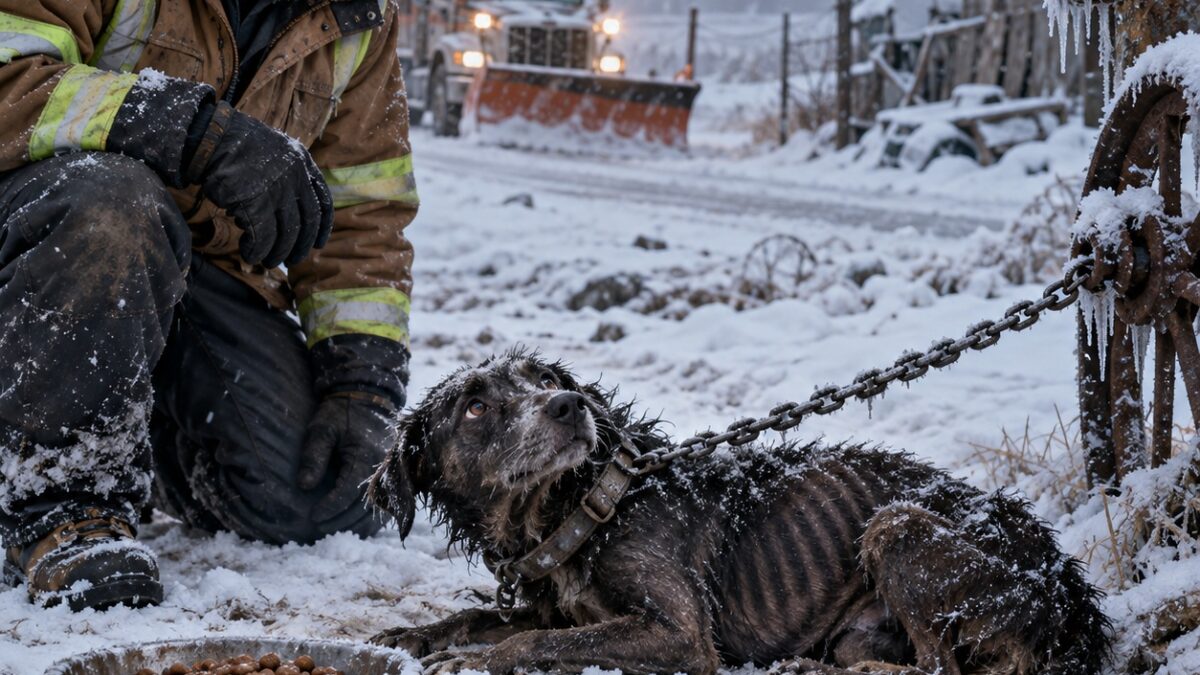
PART2
I hated that answer at first.
Not because it was wrong.
Because the dog was right there.
The chain was right there.
I had gloves.
Helena had tools.
My brain wanted the simplest possible sequence.
Cut metal.
Pick up dog.
Leave.
Helena saw me staring at the chain.
“We can’t just go in.”
“Why?”
“She’s frightened.”
“She doesn’t look aggressive.”
“That’s not what I said.”
Helena lowered her voice.
“Fear can become panic very quickly.”
She pointed toward the frozen section.
“The chain is locked into the ice.”
“If she bolts while somebody is cutting near her, it could tighten around her neck.”
“She could hurt herself badly.”
“So what do we do?”
“Slow down.”
Those two words felt obscene while a starving dog lay in snow.
Helena continued.
“We get her calm.”
“Warm the ice gradually.”
“Get her comfortable with people close to her.”
“And we let her decide when she can handle the next step.”
I stared.
“She’s freezing.”
“I know.”
“There’s food right there.”
“I know.”
“She can’t reach it.”
“I know.”
Helena did not become defensive.
That helped.
Then she said:
“Ryan, I need you to understand something.”
“What?”
“If we force her because we’re upset, we make ourselves feel better.”
“We don’t necessarily help her.”
That shut me up.
A young rescuer named Daniel moved first.
He walked into the snow and stopped maybe six feet from the dog.
He did not stare.
Did not reach.
Did not call repeatedly.
He simply sat.
Right there.
In the snow.
Hands on his knees.
The dog raised her head.
Her ears flattened.
She looked at Daniel.
Then me.
Then Helena.
Then Daniel again.
Minutes passed.
Nobody did anything.
That kind of waiting is harder than it sounds.
We are trained to believe action equals help.
Standing still feels like failure.
But Daniel waited.
Eventually, the dog shifted.
Then she did something that broke something open inside me.
She tried to move closer.
Not fast.
Not frightened.
She leaned toward him.
One step.
Then another.
The chain tightened.
Stopped her.
She froze.
Lowered her head.
And stayed there.
No whining.
No pulling.
Just a posture so defeated that my throat closed.
It looked like an apology.
I know that is a human interpretation.
Dogs do not apologize for existing the way people do.
Still, that was what I saw.
A creature who had learned that wanting closeness caused pain.
A creature asking for almost nothing.
Then correcting herself when the chain reminded her of the rules.
I looked away.
Snow stung my face.
I blamed the wind for my eyes watering.
Helena did not.
“You okay?”
“Fine.”
“You don’t look fine.”
“I drive snowplows.”
She almost smiled.
“I’m sure that makes you emotionally indestructible.”
I did not answer.
Because the truth was I had spent years trying to become exactly that.
Indestructible.
Not happy.
Not connected.
Just difficult to hurt.
People sometimes think fear of attachment looks like avoiding relationships entirely.
Mine looked more respectable.
Work.
Long shifts.
Keeping busy.
Living alone.
Answering invitations with:
“Maybe next week.”
Buying enough food for one person.
Telling myself I liked my schedule.
No dog because dogs were too much responsibility.
No serious relationship because work was unpredictable.
No reason to depend on anyone.
No reason for anyone to depend too much on me.
Clean.
Efficient.
Lonely in ways I had stopped naming.
My father had died years earlier.
We had been close.
Closer than I admitted while he was alive.
Afterward, his truck sat in my driveway for months because I could not bring myself to sell it.
People would ask:
“You going to keep it?”
I said:
“Haven’t decided.”
Truth:
I did not want another goodbye.
Eventually I sold the truck.
Then I got even better at avoiding things that might matter enough to hurt.
That dog knew nothing about me.
Still, watching her stop at the end of the chain felt too familiar.
Something you want.
Close.
Then pain.
So you learn the boundary.
You stop pulling.
Helena placed a small warming pack near the ice.
Slowly.
She approached from the side.
Never straight at the dog.
Placed it in the snow near where the chain disappeared into the frozen ground.
Then backed away.
The dog watched.
No panic.
Daniel remained seated.
He began talking softly.
I could not hear every word.
Something about weather.
Maybe his breakfast.
Maybe nothing important.
The content did not matter.
Tone did.
Steady.
Human.
No demands.
The dog listened.
Her ears moved with his voice.
Helena sat too.
Closer now.
About three feet away.
Then she placed a small bowl of water in the snow.
The dog looked at it.
Looked at Helena.
The water was within reach.
Still, she hesitated.
That hesitation hurt almost as much as the chain.
Imagine thirst so severe you stare at water and still distrust the world enough not to move.
Helena looked away deliberately.
Daniel kept talking.
The dog stood.
Her legs trembled.
She waited.
Then took one step.
Another.
The chain pulled taut.
But the water was just inside the limit.
She reached it.
Lowered her head.
Drank.
Slowly at first.
Then deeply.
We listened.
Lapping water.
Wind.
Engine idling in the distance.
No one spoke.
When she finished, she lifted her head.
Water clung to the fur beneath her mouth.
She looked at Helena.
Then her tail moved.
Once.
A tiny motion.
Then again.
I sat down in the snow.
I did not plan to.
My knees simply stopped negotiating with me.
Something about that tail movement was unbearable.
This dog had almost nothing.
Food she could not reach.
Chain frozen to the ground.
Body weak.
Strangers surrounding her.
And still, somewhere inside her, enough hope remained to wag.
Daniel glanced toward me.
“You good?”
“No.”
He nodded.
“Me neither.”
For another twenty minutes, Helena worked the warming pack.
The ice loosened slightly.
Daniel moved closer.
The dog allowed it.
Then Helena approached with a cutting tool.
She showed it to the dog first.
Held it low.
Let her see.
No sudden movement.
The dog’s breathing increased.
Helena stopped.
Waited.
Daniel spoke.
“It’s okay.”
The dog looked at him.
Then Helena.
Then me.
I do not know why she kept checking me.
Maybe because I had been there first.
Maybe because my truck was loud.
Maybe because I was imagining significance where none existed.
But every time those amber-brown eyes landed on me, I felt as though I had been assigned a responsibility I had not volunteered for.
Stay.
That was all.
So I stayed.
Daniel held the section of chain still.
Helena positioned the cutter.
Metal resisted.
She adjusted.
The dog tensed.
“Easy.”
Daniel whispered.
“Easy.”
Then—
snap.
A small sound.
Nothing dramatic.
The chain fell into the snow.
For several seconds, the dog did not move.
Everyone waited.
She looked down.
At the chain.
Then lifted her head.
I expected her to run.
She did not.
She sat.
Turned slightly.
As if testing something inside her own understanding.
Then she looked at me.
Straight at me.
And I swear the question in her eyes was:
Now what?
Freedom is romantic from the outside.
From inside captivity, freedom may simply be unfamiliar.
She had learned where the chain ended.
Now there was no end.
No metal tightening.
No rule.
That did not automatically create knowledge of what to do next.
Helena approached.
“Okay, sweetheart.”
The dog let her close.
Daniel moved too.
They lifted her carefully.
Only then did I understand how little she weighed.
Her ribs were visible.
Her legs thin.
Her body seemed made mostly of fur and exhaustion.
She did not resist.
Her head rested briefly against Helena’s arm.
I stood.
My pants were soaked from sitting in snow.
Did not matter.
They carried her toward the rescue vehicle.
I followed.
Helena opened the door.
Blanket inside.
Warmth.
The dog looked back once.
At the frozen spot.
The chain lay dark against the white.
Then she disappeared inside.
Helena came toward me.
“You found her.”
“I stopped.”
“That’s what finding starts with.”
“I’m not a rescuer.”
“You called.”
“Anybody would.”
Helena looked at me for a long moment.
“No.”
I knew what she meant.
Not everybody stops.
I had almost not stopped.
The thought followed me all day.
I drove the remaining route.
Cleared roads.
Salted intersections.
Answered radio calls.
Everything looked normal.
My hands did the job from habit.
My mind stayed beside that dog.
Food beyond reach.
Chain tightening.
Tail moving twice.
I kept hearing Helena.
You stayed.
At home that night, I showered.
Made dinner.
Barely ate.
Turned on the television.
Muted it.
Snow moved against the windows.
I thought about the dog lying somewhere unfamiliar.
Was she warm?
Eating?
Would she sleep?
Was the chain still around her neck mentally even though the metal was gone?
At 10:40, I went to bed.
At 11:15, I got up.
Made tea.
At midnight, I looked up the rescue contact information.
Did not call.
Too late.
At 1:20, I stared at my ceiling.
At 5:30, I gave up sleeping.
By eight, I called.
A woman named Rachel answered.
I explained badly.
“The dog.”
Pause.
“Which dog?”
“The one from yesterday.”
“Frozen chain.”
“Oh.”
Her voice changed.
“You’re Ryan.”
I had no idea how she knew.
“Yes.”
“She’s safe.”
The relief was so immediate I had to sit.
“How is she?”
“Thin.”
“Exhausted.”
“Dehydrated.”
“She’s being monitored.”
“Eating?”
“A little.”
“Is that bad?”
“It’s not unusual.”
“What does that mean?”
“It means we’re careful.”
“What about the chain?”
“It’s gone.”
“I know.”
Stupid question.
I rubbed my eyes.
Rachel continued.
“We’re cautiously optimistic.”
I hated phrases like that.
“What does that actually mean?”
Rachel went quiet for a second.
Then answered:
“It means she’s still trying.”
I did not expect those words to hurt.
They did.
“She hasn’t given up.”
Rachel continued.
“That’s the part we can work with.”
I asked if visitors were allowed.
She said:
“Not usually this early.”
Then:
“But Helena told us you might call.”
That embarrassed me for some reason.
“Oh.”
“Come this afternoon.”
“I’m working.”
“After work.”
I told myself I was only going to check.
That was the lie I used for two weeks.
Just checking.
The shelter smelled like disinfectant, dog food, laundry, and something warm I cannot name.
Rachel met me.
“You look tired.”
“I plow snow.”
“Everyone keeps using jobs as explanations around here.”
She reminded me of Helena.
I liked her immediately despite that.
She led me through a quieter area.
The dog lay on a soft blanket.
Clean.
No snow.
No chain.
For one second, seeing her without the winter around her made her condition look worse.
Snow had hidden some of the thinness.
Inside, under lights, I could see every rib.
Her hips.
The narrowness of her waist.
She looked small.
Not physically small.
Reduced.
That is the word.
Life had reduced her.
I stopped outside.
Rachel looked at me.
“You can go in.”
“Will I scare her?”
“She met you yesterday.”
“That doesn’t mean she likes me.”
“No.”
Rachel smiled.
“But watch.”
I entered slowly.
The dog raised her head.
Her eyes met mine.
Then her tail moved.
Once.
Twice.
Same as the water bowl.
My chest tightened.
“You remember.”
I whispered.
Maybe scent.
Maybe voice.
Maybe nothing as complicated as memory.
It did not matter.
I sat on the floor.
Not close.
The dog watched.
“Hi.”
Tail.
“I’m Ryan.”
No response.
“You already know that?”
Nothing.
“I drive the plow.”
Her ears moved.
“It’s not very impressive.”
I spent forty minutes there.
Mostly talking.
Work.
Roads.
Snow.
My father.
I do not know why I told her about him.
Maybe because he had been on my mind since Helena said I stayed.
Dad would have stayed too.
He was the type of person who carried jumper cables, blankets, extra gloves, coffee, and enough tools to fix half the county.
He believed being prepared was a form of respect for other people’s bad days.
Once, when I was seventeen, we came across a woman whose car had slid into a ditch.
It was nearly midnight.
I said:
“Someone will come.”
Dad stopped anyway.
After we got her out, I asked why.
He said:
“Because we were already here.”
That was his entire philosophy.
You are here.
Therefore you help.
I had forgotten how much of him lived inside me until that dog.
The next day, I returned.
Then again.
Every day for two weeks.
At first, I pretended it was temporary.
Rachel stopped pretending before I did.
“Your dog is doing better.”
She said one afternoon.
“She’s not my dog.”
“Sure.”
“She belongs to the shelter.”
“Technically.”
“I’ve never owned a dog.”
“I know.”
“How?”
“You’ve mentioned it nine times.”
I sat beside the dog.
“She’s a lot of responsibility.”
Rachel leaned against the doorway.
“So is being emotionally unavailable.”
I looked up.
“That’s inappropriate.”
“Probably.”
She left.
I stayed.
The dog slowly improved.
Food.
Rest.
Medical treatment.
Warmth.
The basics can look miraculous when someone has been without them.
Her body began filling out.
Not much.
Enough.
She started standing more confidently.
Walking around.
At first, every time she reached an invisible distance from her bedding, she stopped.
That fascinated me.
No chain.
Still stopping.
Maybe coincidence.
Maybe not.
I watched her test spaces.
A few feet.
Look back.
More.
Then farther.
It reminded me that metal is only one kind of restraint.
Bodies remember.
Expectations remember.
Fear remembers.
You can remove the thing causing pain and still need time before the nervous system believes the pain will not return.
I knew something about that.
Not in the same way.
I would never insult what she had survived by pretending my emotional life was equivalent to a frozen chain.
But I understood self-imposed limits.
Do not get too attached.
Do not need too much.
Do not let someone matter enough that losing them destroys the structure.
Stay inside the safe radius.
I had lived that way for years.
No visible chain.
Same logic.
One day, I told her:
“I think you and I have a problem.”
She looked at me.
“We’re both cowards.”
Her tail moved.
“That was not agreement.”
She stood.
Walked closer.
Then sat beside my boot.
I laughed softly.
“Okay.”
“Maybe just me.”
I eventually started calling her Frost before I had any right to name her.
Not to the staff.
Only privately.
The first time came accidentally.
She had a small patch of white along part of her muzzle where snow had clung the morning I found her.
I was talking.
“You’re tougher than you look, Frost.”
The name came out.
She looked up.
I stopped.
“Frost.”
Tail.
I did not want to name her for suffering.
That mattered later.
When people asked why Frost, I would say:
“Because she survived the cold.”
But even that explanation was incomplete.
Frost is not only cold.
It is what remains after a night hard enough to freeze everything.
It covers.
Transforms.
Then the sun reaches it.
It melts.
Water returns.
I liked that.
The shelter used another temporary name for paperwork.
I kept Frost inside my head.
I was still not adopting her.
Of course.
I was just visiting every day.
Bringing approved treats.
Asking medical questions.
Reading articles about dog behavior at midnight.
Looking at dog beds online “out of curiosity.”
Completely normal behavior for a man not getting a dog.
My work schedule became organized around visits.
During storms, I worked long shifts.
If the shelter closed before I could get there, I called.
“How is she?”
“Fine.”
“Eating?”
“Yes.”
“Walking?”
“Yes, Ryan.”
“Any fear?”
“She misses your monologues.”
“Funny.”
“You know you can take a day off visiting.”
“No.”
The word came too fast.
Rachel paused.
“Okay.”
That moment scared me.
Not because I did not want Frost.
Because I did.
I wanted something.
That was dangerous.
Wanting creates possible loss.
I had built years around avoiding that equation.
I began sleeping worse.
Thinking more.
One night, I dreamed about the chain.
In the dream, I cut it.
Frost ran.
Not toward me.
Away.
I woke angry.
At myself.
Why should freedom mean she chose me?
That was not the point.
A rescue is not a trade.
I stop.
You love me.
No.
She did not owe me anything.
I had to decide whether I wanted to care for her without demanding she repair the parts of me I had neglected.
That was harder.
A dog is not therapy.
Not proof.
Not a reward for stopping.
She is a life.
Food.
Exercise.
Medical care.
Training.
Years.
Possible heartbreak.
Exactly the things I had avoided.
Responsibility.
Attachment.
Loss.
The whole package.
One afternoon, while I sat beside her, I said:
“I’m scared of you.”
Frost looked up.
“Not like that.”
I scratched behind her ear.
“I know what happens when something matters.”
She leaned closer.
I swallowed.
“It can disappear.”
The sentence sounded childish when spoken aloud.
Still true.
My father had disappeared in the ordinary way people die.
Hospital.
Funeral.
Calls.
Paperwork.
A house full of his tools.
Nothing dramatic enough to justify how empty it felt.
After him, I became efficient.
I told myself grief was proof attachment had been reckless.
That is one way fear rewrites love.
It says:
If you had never cared, you would not hurt.
Correct.
You also would not have had the person.
Fear leaves that part out.
Frost rested her chin on my knee.
I stopped talking.
Her weight was light.
Warm.
Real.
For several minutes, neither of us moved.
My father used to tell me:
“Cold makes everything contract.”
Metal.
Roads.
Hands.
People too, maybe.
Heat expands.
I wondered if Frost was warming something I had allowed to contract for years.
I did not like that thought.
Too sentimental.
Probably true.
At the end of two weeks, Rachel called before I arrived.
I was sitting in the plow yard doing paperwork.
“Ryan.”
“What happened?”
“Nothing bad.”
My chest had already tightened.
“Then don’t start with my name like that.”
“Frost is medically cleared.”
I froze.
It was the first time Rachel used the name.
“You called her Frost.”
“You’ve been calling her that for twelve days.”
“Not officially.”
“We adapt.”
“What does medically cleared mean?”
“Healthy enough for adoption.”
Silence.
I stared through the windshield.
Snowbanks.
Salt pile.
Gray sky.
I had known this was coming.
Still felt sudden.
“That’s good.”
“Yes.”
“Really good.”
“Yes.”
“So someone can adopt her.”
“Yes.”
The truck cab became too small.
Rachel waited.
Then:
“Ryan.”
“What?”
“I’m not trying to pressure you.”
“Good.”
“But I see how she looks at you.”
I said nothing.
“And I see how you look at her.”
“Rachel.”
“What are you waiting for?”
The question irritated me because I did not have an honest answer that did not make me sound afraid.
Maybe I was waiting for my job to become predictable.
It never would.
Snow does not schedule itself around pets.
Maybe waiting for certainty I would be good at it.
No one gets that.
Maybe waiting to stop caring enough that the decision became safe.
Impossible now.
I said:
“I need to think.”
“Then think.”
“No pressure?”
“No.”
“Really?”
“Ryan, adoption should be a commitment, not panic.”
“Think.”
So I thought.
For six days.
Visited every day.
Did not decide.
The shelter had other inquiries.
That should have relieved me.
Good family.
Someone with experience.
Maybe fenced yard.
Maybe better schedule.
Every possibility felt reasonable.
Every possibility made my stomach hurt.
I hated that about myself.
This was not about me.
Frost deserved the best home.
If that was someone else, I should celebrate.
One afternoon, a couple visited.
They were kind.
Calm.
Frost approached cautiously.
I watched from outside.
She sniffed the woman’s hand.
Tail moved.
My chest felt physically painful.
Rachel stood beside me.
“Jealous?”
“No.”
“Liar.”
“They seem nice.”
“They are.”
“Good.”
“They have another dog.”
“Good.”
“Big yard.”
“Great.”
Rachel looked at me.
“You look like I just told you your truck is on fire.”
“I want what’s best for her.”
“Then decide what you think that is.”
“That’s not fair.”
“No.”
“It isn’t.”
She walked away.
The couple ultimately decided on another dog.
I was relieved.
Then ashamed of relief.
That night I sat alone in my apartment.
No television.
No music.
I imagined Frost in another home.
Not suffering.
Loved.
Safe.
That should have been enough.
Then I imagined coming home after a storm.
Opening my door.
No Frost.
My apartment suddenly looked exactly like what it was.
A place I slept between work shifts.
Not home.
I hated realizing that.
I walked to the kitchen.
Opened the refrigerator.
Closed it.
Looked at the empty floor beside the table.
Then heard my father’s voice in memory.
Because we were already here.
I had stopped.
Stayed.
Visited.
Connected.
Now I was inventing reasons to leave before attachment could ask anything permanent.
I called Rachel.
It was after hours.
She answered anyway.
“Ryan?”
“I want her.”
Silence.
Then:
“I know.”
“Please don’t ruin this by being smug.”
“I’m trying very hard.”
“I mean it.”
“So do I.”
“What do I have to do?”
“We start paperwork tomorrow.”
I sat down.
“Okay.”
“Ryan?”
“What?”
“Breathe.”
I had not realized I was holding my breath.
The adoption became official on March 2.
I remember the date because I had written it on three separate calendars.
Paperwork.
Food instructions.
Medical history.
Behavior recommendations.
Leash.
Collar.
Microchip.
Emergency contacts.
I read everything twice.
Rachel watched.
“You know most people sign faster.”
“I drive on ice.”
“I read.”
“Good trait.”
When everything was done, Frost sat beside Helena.
I had not seen Helena since the rescue day.
She came for the adoption.
“You look different.”
She told me.
“So does she.”
“I meant you.”
“That’s invasive.”
She smiled.
Frost saw me.
Stood.
Tail.
I crouched.
“You ready?”
She walked toward me.
No chain.
No hesitation.
I clipped the leash.
The leash bothered me emotionally for about three seconds.
Then I reminded myself:
A leash is not a chain.
Same physical concept—connection.
Different meaning.
One prevents choice through neglect.
The other keeps a dog safe while exploring the world with someone.
Context changes everything.
At the car, Frost stopped.
My heart dropped.
The rescue vehicle.
Transport.
Uncertainty.
Maybe cars meant change she did not control.
I opened the back door.
She stared.
I did not pull.
“Take your time.”
Helena stood several feet away.
Rachel too.
Frost sniffed the doorway.
One paw up.
Back down.
I waited.
The old Ryan would have been uncomfortable with people watching.
Would have felt pressure to make the dog perform adoption correctly.
I no longer cared.
Five minutes.
Ten.
Frost eventually put both front paws inside.
Then climbed.
I exhaled.
Rachel handed me a blanket.
“Congratulations.”
I looked at Frost.
“Thanks.”
Helena said:
“Remember the first day?”
I did.
Frozen chain.
She had not moved after being freed.
Now she was choosing to enter my car.
Progress.
Not flashy.
Real.
The drive home was quiet.
Frost sat on the back seat.
I checked the mirror too often.
“You good?”
She stared out the window.
“Me too.”
At my apartment, I opened the door.
Frost entered.
Stopped in the middle of the living room.
Looked around.
I had bought too much.
Bed.
Bowls.
Blanket.
Toys.
Leash hooks.
A ridiculous container for treats.
Everything placed as though I had been preparing for months.
Which technically I had.
Frost ignored all of it.
She walked to the window.
Sunlight came through a break in the winter clouds.
A warm rectangle across the floor.
She stepped into it.
Turned twice.
Lay down.
Then sighed.
I had heard her breathe many ways.
Fast from fear.
Slow from exhaustion.
Careful while sleeping in the shelter.
This sound was different.
Deep.
Long.
Release.
I sat on the floor several feet away.
“Yeah.”
I whispered.
“Me too.”
The first week was hard.
Not disastrous.
Hard.
Frost would not eat unless I stayed in the room.
If I stood and moved toward the door, she stopped chewing.
Looked at me.
So I stayed.
Sat at the table.
Pretended to read.
She ate.
When I went to the bathroom, she followed.
Not close.
Several feet behind.
Kitchen.
Behind.
Bedroom.
Behind.
Always a distance.
As if proximity itself had rules.
At night, she slept beside my bed on the floor.
I had bought her a bed.
Of course.
She ignored it.
At two in the morning, I would wake and hear her breathing.
Open my eyes.
She was there.
Head up sometimes.
Watching.
The first few nights, I barely slept.
Not because Frost made noise.
Because I kept checking.
Still there.
Still breathing.
I had taken something into my life.
Now there was something to lose.
Fear arrived exactly as expected.
The difference was I did not run.
One morning I woke and Frost was not beside the bed.
My heart went from sleeping to panic in one second.
“Frost?”
I stood.
Living room.
Nothing.
Kitchen.
Nothing.
I found her in the patch of sunlight near the window.
Asleep.
I leaned against the wall.
“You can’t do that.”
She opened one eye.
“You cannot disappear from your designated location without notification.”
Eye closed.
“That’s a rule.”
Nothing.
I laughed at myself.
There it was.
Attachment.
Messy.
Ridiculous.
Alive.
Over the first weeks, Frost moved closer.
At first, five feet.
Then three.
When I sat on the couch, she lay on the floor nearby.
One evening, she placed her chin on the cushion.
I looked.
She withdrew.
I pretended not to notice.
Next night, both front paws on the couch.
Then off.
A few days later, she climbed up completely.
Sat at the far end.
Rigid.
I continued watching television.
Did not reach.
Ten minutes passed.
Frost lay down.
Another ten.
She moved closer.
Eventually, her back touched my leg.
Barely.
I did not move for forty minutes.
My foot went numb.
Worth it.
Another night, she leaned fully against me.
Her weight warm.
I put one hand gently on her side.
She sighed.
I stared at the television without seeing anything.
This was the dog who had stopped at the end of a chain because pulling hurt.
Now there was no tension between us.
No force.
Only choice.
That mattered.
Her eating improved too.
I learned routine.
Same bowl.
Same place.
Same times.
No standing over her.
I would stay nearby because she wanted that.
Eventually, she started eating when I left the room.
The first time, I did not celebrate until I was out of sight.
I stood in the hallway smiling.
Trust can look like not needing constant proof someone remains.
That was Frost’s lesson.
Maybe mine too.
My first overnight plow shift after adoption terrified me.
Not Frost.
Me.
Snow began around eight.
Dispatch called.
I had to leave.
I had arranged someone to check on her.
Food.
Walk.
Everything.
Still, putting on my coat felt wrong.
Frost watched.
My stomach tightened.
“This is work.”
She stood.
“I have to go.”
She followed to the door.
I knelt.
“I’m coming back.”
I hated how emotional that sentence felt.
Frost looked at me.
“I mean it.”
I left.
Sixteen minutes later, I considered turning around.
Did not.
At work, I checked my phone constantly.
Update:
Frost ate.
Update:
Walked.
Update:
Sleeping.
I drove roads for ten hours.
Snow thick.
Wind.
Visibility poor.
Exactly the work I had done for years.
But everything felt different because someone was waiting.
My father had often talked about coming home after storms.
I never understood why that mattered so much to him.
Now I did.
The storm has two directions.
Out.
Back.
At sunrise, I parked.
Walked toward my door.
Before the key reached the lock, I heard movement inside.
Frost.
The door opened.
She stood several feet away.
Tail moving wildly.
Not cautious.
Not questioning.
Joy.
I crouched.
“Hey.”
She came to me.
Head against my chest.
I closed my eyes.
“I told you.”
She licked my chin.
“I came back.”
That became our pattern.
I leave.
I return.
Again.
Again.
Again.
Each return seemed to teach her something.
Maybe teach me too.
Absence is not always abandonment.
Work is not disappearance.
A closed door is not permanent.
Someone can leave and still love you.
Those are difficult lessons if life taught the opposite first.
Frost learned through repetition.
So did I.
My fear of attachment had always been based on one fact:
People and animals can disappear.
Correct.
The missing second fact was:
While they are here, you get to love them.
Fear had treated eventual loss as evidence love was a mistake.
Frost challenged that.
Not intellectually.
By being at the door.
Every morning.
Every evening.
Presence.
One morning, weeks after adoption, she put her muzzle on the edge of my bed.
I woke.
Two amber eyes.
“Too early.”
Tail.
“You do not need anything.”
Tail.
“I know you went out at five.”
She put her chin on the mattress.
I sighed.
“Come on.”
She did not jump.
Maybe unsure.
I patted the bed.
“Your decision.”
Frost lifted front paws.
Then climbed.
Carefully.
She circled at my feet.
Lay down.
I smiled in the dark.
Did not move.
The next night, she slept there again.
Eventually, the bed became hers in ways I had not approved.
She stretched sideways.
Kicked once in sleep.
Stole blankets.
I complained.
Loved every second.
Then came the walk.
The moment from the source of this story that people like because it sounds cinematic.
It did not feel cinematic before it happened.
The snow had mostly melted.
Road edges wet.
Air smelled like early spring.
Frost walked beside me.
Leash loose.
Her stride looked confident now.
Not perfect.
But relaxed.
No constant scanning.
We reached a quiet stretch.
Frost stopped.
I stopped.
“What?”
She looked at me.
I thought she had heard something.
Then she moved suddenly.
Up.
Front paws against my chest.
Her face near mine.
And she licked me.
Once.
Twice.
Then repeatedly.
I laughed.
Not chuckled.
Not smiled.
Laughed.
Loud.
A sound I had not heard from myself in years.
“Okay!”
Frost continued.
“Okay, okay.”
She dropped down.
Tail flying.
I bent over, hands on my knees, still laughing.
People say laughter comes from joy.
Sometimes it comes from relief.
Sometimes surprise.
Sometimes a sealed room inside you finally opening a window.
Frost looked at me.
Mouth open.
Eyes bright.
And I saw something I had not seen in her the morning of the chain.
Joy.
Not survival.
Not cautious trust.
Joy.
The difference was enormous.
Then I realized I was feeling it too.
That scared me for maybe half a second.
Then I let it happen.
We continued walking.
The rest of the day was ordinary.
That made the moment better.
No revelation changed the weather.
No music.
We walked home.
Frost drank water.
I made food.
Life.
But something had shifted.
I stopped thinking of myself as the person who rescued Frost.
That story was too one-sided.
I had called rescuers.
Stayed.
Visited.
Adopted.
Yes.
But Frost had changed the architecture of my life.
Before:
Work.
Apartment.
Sleep.
Work.
After:
Work.
Home.
There is a difference.
An apartment is where your things are.
Home is where someone notices you came back.
Frost noticed.
I started calling my mother more.
Not because Frost told me to.
Because caring for her made me notice other forms of distance I had created.
My mother once said:
“You sound different.”
“How?”
“Less like you’re trying to end the call.”
“That’s rude.”
“It’s true.”
I laughed.
Then she became quiet.
“I’ve missed you.”
That hurt.
Because she had been alive and available while I protected myself from future grief by creating present absence.
I apologized.
Not dramatically.
Just:
“I know.”
“I’m sorry.”
We talked longer.
Frost lay beside me.
One connection made another easier.
I visited my father’s grave too.
Had not gone in years.
I brought no flowers.
Dad would have called flowers wasteful.
I stood.
Snow almost gone.
Mud.
I said:
“I got a dog.”
Obviously ridiculous opening.
Still.
Then I told him everything.
The chain.
Helena.
Daniel.
Frost.
The shelter.
The adoption.
I could hear him:
You were already there.
Yes.
I was.
Then:
“I almost drove away.”
No imagined answer.
I stood there.
“I’m glad I didn’t.”
Wind moved through bare branches.
That was enough.
Frost stayed in the car because the cemetery required leashes and I had not planned the visit.
When I returned, she was waiting.
Tail.
I opened the door.
“Come on.”
We walked the perimeter.
Dad’s lesson followed me home.
You are here.
Help.
But Frost added another.
You are here.
Stay.
Those are different.
Stopping begins care.
Staying builds trust.
Helena had praised me for staying on rescue day.
At the time, I thought she meant an hour.
Maybe two.
Later I understood staying can become years.
Food.
Veterinarian.
Walks.
Storm shifts.
Coming home.
Love is often less dramatic than rescue.
Harder too.
You do not get applause for refilling water at six in the morning.
Good.
Love does not need applause.
Frost began developing preferences.
This delighted me.
She liked sleeping near windows.
Preferred one particular treat.
Did not enjoy the vacuum.
Hated when the snowplow boots came too close to her bed.
Loved riding once she learned every ride did not mean change.
The first time she willingly jumped into my vehicle, I nearly cheered.
Did not.
Did not want to scare her.
We drove nowhere important.
Around town.
Back home.
Frost watched through the window.
No chain.
Movement entirely voluntary.
I thought about the rescue vehicle.
Her first ride away from snow.
Then my car on adoption day.
Fear.
Now:
Adventure.
Context rewriting memory.
Maybe that is healing.
Not erasing old associations.
Adding enough new ones that the old are no longer the only answer.
Frost did that with everything.
Hands.
Doors.
Cars.
People leaving.
Beds.
Food.
Snow.
Snow itself became complicated for me.
The first new snowfall after adoption, Frost stood at the window.
Watched flakes fall.
I watched her watching.
My chest tightened.
Did she remember?
No idea.
Animals do not owe us access to their internal worlds.
I opened the door.
Frost stepped out.
Sniffed.
One paw in fresh snow.
Then another.
She looked back.
I waited.
She moved forward.
Soon she was walking.
Then trotting.
Nose down.
Exploring.
At one point, she pushed her face into powder and came up covered in white.
I laughed.
There.
Snow had once surrounded a chain.
Now it was simply snow.
Not every environment needs to remain owned by trauma.
I loved seeing her reclaim it.
Maybe I reclaimed it too.
Winter had always been work.
After Frost, it became something else.
A season containing history.
Danger.
Rescue.
Home.
She taught me the same substance can mean different things depending on what surrounds it.
Snow plus chain:
Captivity.
Snow plus open yard:
Play.
Connection plus force:
Restraint.
Connection plus choice:
Love.
I became more careful with language.
People would say:
“You saved her.”
I started answering:
“A lot of people did.”
Helena.
Daniel.
Rachel.
Veterinary staff.
Shelter workers.
Whoever provided food.
Whoever cleaned bedding.
Whoever made space.
I found her.
That is all.
Even finding was accidental.
The rescue existed because people each did their part.
I called.
They came.
Daniel sat.
Helena waited.
Rachel cared.
Frost tried.
I adopted.
No single hero.
That felt important.
Hero stories can discourage people.
They make help sound like something extraordinary people do.
Most help is ordinary people doing one useful thing.
A snowplow driver stops.
A rescuer sits in snow.
A shelter worker answers a phone.
A person adopts.
Anyone can enter the chain of care.
Frost’s old chain controlled her.
The new chain—people connected through responsibility—freed her.
I liked that contrast.
One night, after a fourteen-hour storm shift, I came home destroyed.
Back sore.
Hands aching.
Snow still falling.
Frost met me.
I dropped my coat.
Sat on the floor.
Did not even remove boots.
She came close.
Pressed against me.
I put one arm around her.
For a long time, nothing moved except her breathing.
I thought:
This is why people do it.
Not animal rescue specifically.
Connection.
You carry one another differently.
I had spent years thinking responsibility meant being trapped.
A dog means you cannot travel freely.
Have to come home.
Pay vet bills.
Plan.
True.
Responsibility is a form of limitation.
But not all limitations are chains.
Some are direction.
Knowing someone needs you can organize a life.
Frost did.
I returned when tired.
Went outside when cold.
Bought food.
Made plans.
And in exchange—not payment, not debt—I received a life containing relationship.
Worth it.
I started volunteering occasionally with the shelter.
Nothing dramatic.
Transport.
Snow clearing.
Fixing things.
Rachel joked:
“We got two rescues for the price of one.”
“I’m not rescued.”
“Sure.”
I ignored her.
But I kept going.
The first time I saw another dog afraid to approach, I understood Daniel differently.
I sat.
Waited.
No pressure.
The dog eventually sniffed my boot.
Small moment.
I thought:
This is how it spreads.
Someone teaches you patience.
You use it elsewhere.
Frost’s rescue created skills in people who might help another animal.
That mattered.
I did not become someone who believed I had to save every dog.
That way lies burnout and chaos.
But I stopped telling myself suffering was automatically someone else’s problem.
If I could help, I did.
If I could call, I called.
If I could stay, I stayed.
My father would have approved.
One afternoon Helena visited the shelter while I was helping.
She saw me carrying bags.
“Snowplow driver.”
“Yes.”
“Still just a driver?”
“I contain multitudes.”
She laughed.
“How’s Frost?”
“Runs my house.”
“Good.”
“She takes my bed.”
“Better.”
“She has no gratitude.”
“Perfect.”
I smiled.
Then said:
“Thank you.”
“For what?”
“For not cutting the chain immediately.”
Helena looked surprised.
“I was angry at you.”
“I knew.”
“I thought you were wasting time.”
“I knew.”
“You weren’t.”
“No.”
We stood quietly.
Then she said:
“People who care want to remove pain fast.”
“Sometimes care is tolerating how slow safety has to be.”
That sentence stayed too.
I had spent my life preferring solutions.
Road blocked?
Plow.
Ice?
Salt.
Truck broken?
Repair.
Emotional pain does not respond as cleanly.
Neither does fear.
You cannot salt grief.
You cannot plow attachment avoidance into a ditch.
You stay.
Repeat safety.
Let time work.
Frost had required that.
So had I.
The first time Frost slept with her back completely turned toward the door, I noticed.
She usually positioned herself where she could see entrances.
Not obsessively.
Enough.
One evening, she lay on the couch.
Back to the room.
Head on my leg.
Eyes closed.
Door behind her.
I stared.
Trust is often measured by what the body stops monitoring.
Frost no longer needed to watch every exit.
I put my hand lightly on her side.
She did not wake.
There are moments nobody else would consider milestones.
That was one.
Another came with food.
Early on, she would eat everything immediately.
Later, one evening, she left several pieces.
Walked away.
Drank water.
Lay down.
I looked at the bowl.
Something in me tightened.
Tomorrow exists.
That is what leaving food says to an animal who has known scarcity.
More later.
No need to consume everything.
I started understanding abundance differently.
Abundance is not having a huge amount.
It is trusting replenishment.
Enough today plus belief in tomorrow.
Frost learned that.
I learned something similar with people.
You do not have to grip every good moment because loss is possible.
There can be more.
Not guaranteed.
Possible.
Attachment became less like standing on the edge of disaster.
More like accepting time as it comes.
Frost would grow old.
I knew.
Someday I would lose her unless she lost me first.
That truth stopped being an argument against love.
It became a reason to notice.
The fear did not disappear.
It matured.
Instead of:
Do not attach because you may lose.
It became:
You will lose eventually, so be here while you have.
My father’s death had not taught me that because I was too hurt.
Frost did.
Maybe lessons need different forms before we can hear them.
One morning, I found myself buying a ridiculous dog raincoat.
I held it in the store.
Thought:
Who are you?
The clerk said:
“She’ll look cute.”
“She’ll look humiliated.”
“You’re still buying it.”
“Yes.”
Frost hated it.
We compromised.
No raincoat.
Another lesson in consent.
She had spent enough of life wearing what humans decided.
I returned it.
Bought treats instead.
My apartment changed physically.
Dog hair.
Toys.
Bowls.
Blankets.
Leash.
A scratch near the door.
At first, I cleaned constantly.
Then gave up.
A lived-in place is not a failure.
My life before Frost had been neat because almost nothing happened in it.
Now things happened.
Mud.
Noise.
Schedules.
Love is messy.
Very inconvenient.
Highly recommended.
There were setbacks too.
Not everything improved in a straight line.
A sudden metallic sound once sent Frost backward so fast she hit a wall.
I froze.
Her body trembled.
Maybe chain memory.
Maybe something else.
I sat on the floor.
Did not touch.
“Okay.”
Minutes.
She watched.
I waited.
Eventually, Frost moved closer.
Her breathing slowed.
Later, she slept.
The next day, she was fine.
I had to learn that fear returning does not erase trust.
A trigger is not betrayal of progress.
The nervous system remembers before the conscious mind, if dogs have anything equivalent to conscious interpretation.
We did not make the sound into a crisis.
We added another safe ending.
Noise.
Fear.
Ryan stays.
Nothing hurts.
Repeat.
Over time, recovery is partly building enough safe endings.
That idea helped me personally too.
A relationship might end.
But that does not mean every relationship ends badly.
Someone can leave and still have loved you.
Someone can die and the love still have been worthwhile.
Grief is not proof you made the wrong choice.
That became one of Frost’s largest gifts.
Not because she knew philosophy.
Because she slept on my feet.
People often romanticize animal-human relationships with phrases like:
“She rescued me.”
I use that phrase carefully.
Frost did not fix depression.
I was not diagnosed with anything.
She did not magically erase grief.
She did something simpler.
She made avoidance harder.
If I withdrew, she still needed care.
If I worked too much, she waited.
If I ignored people, she drew people toward me.
Neighbors learned her name.
People stopped us during walks.
My mother asked for photos.
The shelter became part of my life.
Connection expanded around her.
She changed the conditions in which I lived.
I changed because conditions matter.
That is enough.
No magic needed.
One year, during a bad storm, I found another animal.
Not chained.
A stray cat sheltering under a loading dock.
I called the proper people.
Waited until someone came.
It took forty minutes.
I thought of Frost.
The cat did not become mine.
That was fine.
I went home.
Frost met me.
I told her:
“Your fault.”
She wagged.
Another small ripple.
Maybe that is how kindness multiplies.
Not through inspiration alone.
Through changed behavior.
I stopped once.
Then stopping became easier.
The hardest thing is sometimes the first interruption.
After that, your identity shifts.
I am someone who stops.
Dangerous identity if taken recklessly.
Useful if paired with judgment.
I learned boundaries from the rescue team.
Do not rush.
Call experts.
Stay safe.
Help effectively.
Caring does not mean ignoring skill.
That mattered.
The first morning I had found Frost, my instinct was to cut the chain myself.
If I had, she might have panicked.
I did not know.
Good intentions without expertise can harm.
Calling professionals was not weakness.
It was correct action.
Another lesson for a man trained to solve problems himself.
Dad would probably approve.
Maybe laugh first.
Then approve.
I kept his old saying alive.
Snow never asks if you’re ready.
Frost added:
Neither does love.
I did not plan her.
Did not prepare emotionally.
Did not think:
Today I will reorganize the next decade of my life around a dog.
I stopped for a shape in the snow.
Then life changed.
Some beginnings arrive disguised as delays.
A wrong turn.
A roadside stop.
An hour waiting in cold.
At the time, inconvenience.
Later:
Origin story.
That makes me wonder how many important things we miss because we are too committed to schedules.
Not every interruption is meaningful.
Most are simply interruptions.
But availability matters.
Leave some part of yourself capable of noticing.
I had almost lost that.
Frost restored it.
She became healthier.
Coat better.
Weight appropriate.
Strength returned.
The shelter had done much of that before adoption, and I continued routine veterinary care.
The physical transformation was satisfying.
Still, the moments I treasured most were psychological.
The first time she slept deeply while I left the room.
The first time I came home and she greeted me with excitement rather than fear.
The first time she chose the couch.
The first time she barked at something ridiculous outside.
I nearly dropped my coffee.
“What was that?”
Frost barked again.
A garbage truck.
“You have opinions now?”
Another bark.
Good.
A dog confident enough to complain about municipal services.
Progress.
The first time she stole food from the counter, I was less delighted.
Still secretly delighted.
Chicken.
Half a piece.
I turned.
Frost froze.
Eyes wide.
Old fear flashed instantly.
That hurt.
I lowered my voice.
“Hey.”
No yelling.
I removed the rest.
“Not yours.”
Her body remained tense.
I sat.
Waited.
She relaxed.
Then I gave her an actual dog treat several minutes later—not as reward for stealing, but because I wanted the scene to end without fear.
Boundaries without terror.
Rules without violence.
That matters to animals with histories we do not fully know.
She learned.
So did I.
The counter became safer.
Mostly.
We celebrated her first adoption anniversary quietly.
March 2.
I bought a good chew.
Made coffee.
Took her on a longer walk.
No party hat.
I refused to humiliate her.
At sunset, we sat near the window.
Snow mostly gone.
I thought about the frozen chain.
Frost slept.
A year.
Time can be strange.
One year earlier, I was afraid to sign adoption papers because love had an expiration date built into it.
Now the expiration date still existed.
Everything living has one.
I simply no longer used it as a reason not to begin.
That felt like growth.
I touched Frost’s head.
“Good year.”
She opened one eye.
Then slept.
Exactly the level of ceremony appropriate.
People sometimes asked why I chose the name Frost.
I gave the short version.
“Found in winter.”
Not accurate enough.
She was not named for what hurt her.
She was named for survival.
But even survival can become too central.
Eventually, Frost was just Frost.
Name detached from origin.
That felt healthy.
You should not have to explain your trauma every time somebody asks who you are.
Animals either.
The name became hers.
Not the snow’s.
I liked that.
Winter returned.
Then another.
Each season, Frost behaved more normally around snow.
She loved certain days.
Hated deep drifts.
Would stand at the door if weather was especially bad and look at me as if asking why the outdoors had become incompetent.
I would say:
“You of all dogs should be tougher.”
She refused.
Fair.
Survival does not require enjoying the thing survived.
I stopped projecting symbolic meaning onto every snowflake.
Sometimes snow is just cold.
Sometimes a dog wants inside.
Good.
Normality is freedom from constant metaphor.
Still, when heavy snow covered the city and I climbed into the plow, I sometimes remembered her in that yard.
It sharpened my attention.
Roadside shapes.
Abandoned places.
Animals.
People.
I noticed more.
That was her legacy inside my work.
One night, near three in the morning, I saw a car stopped with hazards on.
Old me might have radioed it and kept moving if it looked safe enough.
I stopped.
Driver had a dead battery.
We got help.
Nothing dramatic.
The man thanked me.
I heard Dad.
Because we were already here.
Then I heard Helena.
You stayed.
Two philosophies now.
Stop.
Stay.
Frost slept at home.
My life felt connected across generations.
Father.
Me.
Dog.
Strangers.
Maybe that is what adulthood eventually becomes.
A collection of other people’s sentences living inside you.
You pass them onward through behavior.
Frost could not quote anyone.
She carried lessons physically.
Trust.
Return.
Stay.
I learned from her without words.
That seemed fair.
My mother eventually met Frost.
She sat carefully on my couch.
Frost watched.
Mom did what I told her.
No reaching immediately.
Ignore.
Let Frost choose.
Ten minutes.
Frost sniffed.
Mom kept her hand low.
Eventually Frost approached.
Mom stroked her once.
Then looked at me.
Her eyes were wet.
“Oh, Ryan.”
“What?”
“You’re in love.”
“With the dog?”
“With your life.”
I laughed.
“That’s dramatic.”
She shrugged.
“Maybe.”
Frost moved closer to her.
Mom smiled.
“My granddog.”
“Please don’t say that.”
Too late.
The term stuck.
My mother visited more often.
Again:
One connection opening another.
Frost became a social bridge because animals make silence easier.
If Mom and I had nothing to say, Frost did something.
Wanted out.
Moved.
Sighed.
No pressure.
Conversation resumed.
I started realizing connection does not have to be intense to matter.
Not every relationship requires constant emotional exposure.
Presence.
Routine.
Shared coffee.
Dog.
Enough.
That made relationships less frightening.
I had been avoiding closeness partly because I imagined it demanded vulnerability all at once.
It does not.
Trust builds like Frost’s did.
One step.
Wait.
Another.
No pulling.
Maybe Helena’s rescue method applied more widely than she knew.
You cannot drag trust without damage.
Let the other person decide when to move.
Stay available.
That is better.
I became less defensive when people invited me places.
Sometimes I went.
Sometimes no.
The point was I stopped using work as automatic shelter.
I remained a snowplow driver.
Still liked solitude.
Frost did not transform me into an extrovert.
Thank God.
She simply made solitude a preference instead of a prison.
That is the difference.
I could be alone without avoiding everyone.
Could love without believing loss would annihilate me.
Could have a dog and still work nights because systems existed.
I became more flexible.
Less frozen.
Yes, I understand the metaphor.
I would mock it too if it were not accurate.
Frost thawed me.
Not by being inspirational.
By needing breakfast.
That is the less poetic truth.
Some mornings transformation looks like opening a can at 6:10.
Fine.
I believe in boring miracles now.
A formerly chained dog asleep on furniture.
A man calling his mother.
Food left in a bowl.
A leash hanging beside the door.
Coming home.
These are enough.
I returned once to the location where I had found Frost.
Not with her.
I did not know whether bringing her would matter or hurt.
No reason to test.
I went alone.
The snow was gone.
Ground muddy.
The old wheel still there.
The exact place looked smaller.
Most sites of trauma do.
Memory enlarges them.
I found the spot where the chain had been frozen.
Nothing remarkable.
Dirt.
Old metal.
I stood.
Thought about the food bowl.
That still hurt most.
Not the cold.
Not the chain itself.
Food visible.
Unreachable.
There is a particular cruelty in hope placed inches beyond possibility.
I imagined Frost stretching.
Chain tightening.
Learning.
Stop trying.
I hated it.
Then I remembered her now.
Jumping onto my bed.
Stealing chicken.
Barking at garbage trucks.
The place lost some power.
Good.
I did not need to destroy the wheel.
No dramatic act.
I left.
At home, Frost greeted me.
I knelt.
“Still here.”
Tail.
That was enough victory.
The past does not need to be defeated theatrically.
Sometimes you simply build a present bigger than it.
Frost’s present was.
So was mine.
Helena once told me:
“Some animals surprise you with how quickly they trust again.”
I asked:
“Why?”
“No idea.”
“Maybe because animals are better than us.”
“Or maybe they’re just better at living with evidence.”
“What does that mean?”
“If every day is safe, eventually safety becomes the strongest evidence.”
I liked that.
Evidence.
Frost did not trust because humans deserved trust in the abstract.
She trusted because specific humans behaved reliably.
Day after day.
That felt healthier than romanticizing unconditional love.
Trust should have evidence.
Food comes.
Ryan returns.
Hands gentle.
Door opens.
No chain.
Again.
Eventually:
safe.
I began evaluating my own relationships similarly.
Not promises.
Patterns.
Who returns?
Who shows up?
Who treats vulnerability carefully?
Who only speaks well?
This made me less fearful, strangely.
Standards create safety.
Trust does not mean closing your eyes.
It means seeing enough consistency to rest.
Frost eventually rested.
So did I.
The first time she slept completely upside down, belly exposed, paws bent strangely, I took a photograph.
Sent it to Rachel.
Very dignified.
Rachel replied:
That’s trust.
I stared.
She was right.
A body that once guarded every movement now displaying the least defensible sleep position imaginable.
I saved the photo.
Not because cute.
Because proof.
Evidence.
Safe.
There were other milestones.
First vet visit without major fear.
First overnight stay with my mother when work demanded it.
First time Frost stayed calm when I packed a bag.
That last one was difficult.
Bags can mean leaving.
Maybe past.
Maybe not.
We worked slowly.
I packed.
Did not leave once.
Packed.
Left briefly.
Returned.
Eventually, travel became manageable.
Again:
Safe endings.
Build enough.
Life expands.
I understood trauma treatment in a simple, nonclinical way through Frost.
The world teaches fear through repetition.
Safety has to become repetitive too.
One good moment is not always stronger than a hundred bad ones.
So give hundreds of good ones.
That takes time.
People want transformation.
Give routine.
Routine does the transformation quietly.
I became an advocate for boring.
At the shelter, new adopters sometimes wanted immediate affection.
I told them about Frost.
“Let the dog decide.”
“What if she never comes to me?”
“Then keep being safe.”
“How long?”
“As long as it takes.”
I heard Helena in my own voice.
There it was again.
Lessons passed onward.
Maybe Frost rescued more than herself indirectly.
Not through heroism.
Through changed humans.
I liked that thought but tried not to turn her into a symbol.
She was still Frost.
She cared about cheese more than philosophical impact.
Good.
Animals should remain specific.
Frost disliked blueberries.
Loved chicken.
Snored lightly.
Preferred the right side of the couch.
Got offended when wet.
These details matter more to me than metaphor.
Love is built from specificity.
You do not love “a rescued dog.”
You love the way Frost leans before lying down.
The one ear that turns first.
The look when breakfast is late.
General love becomes real through details.
That is why eventual loss frightens us.
Details disappear from the world.
But avoiding love means never receiving them.
I choose details now.
I choose the risk.
Frost taught me.
Years passed.
Not too many for this story.
Enough for the chain memory to become history instead of daily identity.
I worked.
She waited.
I returned.
We walked.
Snow came.
Melted.
Repeated.
Life became exactly what I once thought too unpredictable for a dog.
Turns out predictability is partly something you create inside unpredictability.
My work schedule changed.
Weather changed.
But certain things stayed.
Food.
Care.
Return.
Frost did not need every hour scheduled.
She needed reliability inside variation.
Maybe humans too.
I stopped waiting for life to become perfectly safe before attaching.
It never would.
Safety is not absence of uncertainty.
It is confidence that support remains when uncertainty arrives.
That is what Frost and I built.
One evening, I found the old collar from adoption paperwork in a drawer.
Not the chain collar.
A shelter collar.
Small thing.
I held it.
Frost slept nearby wearing her current collar.
Tags.
My number.
Her name.
The word Frost engraved.
I remembered the chain.
Metal attached to something frozen.
Now metal tags attached to a collar connected her to home.
Again, objects can look similar and mean opposite things.
Ownership can be control.
Or responsibility.
The difference is care.
I never wanted Frost to feel like property.
She was dependent on me legally and practically.
But relationship mattered more.
I listened.
Allowed choices where possible.
Walk left or right.
Bed or couch.
Approach people or not.
Something as simple as choice can be restorative.
I saw it.
Sometimes she chose distance.
I respected it.
That made closeness more meaningful when she chose that too.
I learned this lesson with humans.
Ask.
Do not assume.
Connection without control.
Maybe I had feared attachment partly because I confused it with being trapped.
Frost showed another model.
Belonging can increase freedom.
When someone has your back, you explore farther.
That was true for her.
Maybe me too.
I volunteered more.
Called people.
Tried things.
Because home existed.
There was somewhere to return.
The chain had reduced Frost’s world.
Home expanded it.
I loved that.
The night I finally understood rescue went both ways, Frost was sleeping at my feet while I wrote some notes for work.
Outside, snow began falling.
Big flakes.
Streetlight turning everything pale.
I looked down.
Her paw rested against my boot.
Warm.
Then I remembered the first morning.
Her paw in snow.
Chain.
Food.
Distance.
I felt something move through me.
Not sadness exactly.
Gratitude mixed with grief.
I had spent years thinking attachment was a chain.
Something that binds you to future pain.
But here was Frost.
Attached to me.
Free.
Here was me.
Attached to her.
More alive.
Maybe the problem was never attachment.
It was attachment without safety.
Attachment without choice.
Love without respect.
Those become chains.
Healthy attachment is different.
It does not keep you from reaching what you need.
It walks with you toward it.
I looked at Frost.
“That’s annoyingly profound.”
She slept.
Of course.
I worked that night.
When I came home at dawn, she waited near the door.
Not frantic.
Not afraid I had vanished forever.
Certain.
There.
That word.
Certain.
I had wanted certainty my whole adult life.
Tried to get it by loving less.
Wrong strategy.
Certainty does not come from eliminating possible loss.
It comes from repeated trust in the present.
I will return tonight.
Food at six.
Walk after.
Frost is here.
Today.
Enough.
The future remains uncertain.
I stopped demanding more.
That felt peaceful.
My father’s phrase changed in my mind.
Snow does not ask if you are ready.
Neither does grief.
Neither does love.
We learn.
We adapt.
We keep the roads open.
That was my job literally.
Maybe metaphorically too.
A road blocked by snow does not mean the destination stopped existing.
You clear enough to move.
Frost had a blocked road to trust.
Helena.
Daniel.
Rachel.
Shelter staff.
Then me.
We cleared it slowly.
No dragging.
No forcing.
Warm the ice.
Wait.
Let her step.
That original rescue method became the blueprint for everything.
I think that is why the story stays with me.
The chain was physically frozen.
We could not simply pull.
Warm.
Wait.
Cut carefully.
Then choice.
How many people need that too?
Not rescue with force.
Safety.
Time.
Choice.
I stopped trying to fix everyone, including myself, quickly.
Some ice has to thaw.
My fear did.
Slowly.
Frost’s did too.
One day Rachel asked if I remembered telling her dogs were too much responsibility.
“Vaguely.”
“You said your life was too unpredictable.”
“Still is.”
“And?”
I looked at Frost lying across my feet.
“I was wrong.”
Rachel smiled.
“Record that.”
“I will deny it.”
But I meant it.
I had assumed responsibility shrinks life.
Sometimes it gives life structure big enough to grow around.
Frost required things.
In meeting those needs, I became more reliable too.
To her.
To myself.
To others.
I do not make grand claims about becoming a better man.
I became a man with a dog.
That alone changed enough.
The story could end there.
But there is one moment I keep returning to.
Not the chain falling.
Not adoption.
Not the first laugh.
It is the moment Frost first tried to move toward Daniel.
Remember?
She wanted closeness.
The chain tightened.
She stopped.
Head down.
That is the image that hurt most.
Not because pain happened.
Because desire was punished.
Wanting something good had taught her to stop.
Then, later, she came toward me without a chain.
Again and again.
Shelter.
Home.
Walk.
Couch.
Bed.
Every approach rewrote that first one.
Come closer.
Nothing hurts.
Again.
Come closer.
Nothing tightens.
Again.
Come closer.
You are welcome.
Again.
I think love is partly that.
Creating enough experiences where wanting something good does not end in punishment.
Eventually, the body believes.
Frost did.
So did I.
I had trained myself not to want too much.
Then Frost came close.
I let her.
Nothing broke.
Except the wall I had mistaken for safety.
Good.
It needed breaking.
Now, when Frost rests beside me while snow covers the city, I do not see the chained dog first.
That changed with time.
I see Frost.
My dog.
The one who steals my side of the bed.
Who waits by the door.
Who thinks every grocery bag might contain something for her.
Who hates blueberries.
Who loves snow only when it is not too deep.
Her rescue history matters.
It does not dominate her identity.
That is exactly what I hoped.
Someday people who meet her may not know.
Good.
She does not owe strangers the worst chapter of her life.
She gets to be ordinary.
That is what rescue should produce.
An ordinary life strong enough to make the extraordinary suffering feel far away.
Still true.
No longer central.
I know there are other animals outside.
Chained.
Cold.
Afraid.
I cannot save all of them.
That realization used to make me feel guilty.
Helena corrected me once.
“You don’t have to be everywhere.”
“Then what?”
“Be where you are.”
There it was.
Dad again.
Because we were already here.
See the animal in front of you.
Make the call.
Do what you can.
Then trust the chain of care.
Not the kind around Frost’s neck.
The good kind.
Humans linked by responsibility.
One person notices.
Another responds.
Another treats.
Another fosters.
Another adopts.
That chain should never freeze.
I became part of it.
Still am.
Not full-time.
Not heroically.
I plow snow.
Pay bills.
Walk my dog.
Help sometimes.
Enough.
You do not need to change careers to become kinder.
You need to change what you do when kindness interrupts your day.
That is Frost’s biggest lesson to me.
The day I found her, I was busy.
Roads.
Schedule.
Weather.
I almost continued.
The entire rest of this story exists because I stopped.
That scares me.
Also motivates me.
Our lives can hinge on minutes we initially resent.
I try to remember that.
Not every delay is destiny.
But some deserve attention.
Frost’s did.
I am grateful.
When I write this now, Frost is beside me.
Outside, it is snowing again.
I will work tonight.
The truck is ready.
Salt loaded.
Radio charged.
My boots are by the door.
Frost knows the routine.
She will watch me put on my coat.
Maybe walk with me to the door.
I will kneel.
Touch her head.
“I’ll be back.”
I no longer say it because she looks terrified.
She does not.
I say it because promises repeated become the architecture of trust.
“I’ll be back.”
Tail.
Then I leave.
Hours later, maybe before sunrise, I return.
Frost will be there.
Not because she believes abandonment is around every corner.
Because this is home.
Home contains departures.
Home also contains returns.
That difference took both of us time to learn.
I used to believe the safest life was one where nobody depended too much on me and I did not depend too much on anyone.
That life was clean.
Quiet.
Controlled.
It was also frozen.
Frost did not rescue me from some dramatic crisis.
She brought warmth into places I had intentionally stopped heating.
Connection.
Family.
Responsibility.
Laughter.
Fear too.
You cannot have one without accepting the other.
I accept it now.
Someday Frost will leave in a way she cannot return from.
That sentence still frightens me.
I do not let it make today smaller.
That is the difference.
Fear used to steal the relationship before loss ever arrived.
Not anymore.
When goodbye comes, it will hurt because something mattered.
That is not failure.
That is the cost of having had the thing.
I would rather pay it later than live empty now.
Frost taught me.
Or maybe she simply gave me enough evidence to teach myself.
Either way.
I am grateful.
Sometimes I think about that bowl of food on the snow.
Still.
Of all the images, that is the one I cannot forget.
Food close.
Dog hungry.
Chain shorter than hope.
If you ever see something like that, do not tell yourself distance makes it almost okay.
Almost reachable is still unreachable.
Almost fed is still hungry.
Almost safe is not safe.
Somebody has to change the conditions.
That morning, it was us.
Helena warmed the ice.
Daniel sat.
I stayed.
The chain fell.
Later, Rachel cared.
I adopted.
Many people.
One dog.
That is how the impossible distance disappeared.
Now Frost’s bowl sits in my kitchen.
She can reach it whenever she walks over.
Water too.
I refill both.
Such simple things.
Sometimes I catch myself watching her drink.
Remembering Helena’s bowl in the snow.
Frost glances at me like I am strange.
Correct.
Trauma turns ordinary care into something sacred for the witness.
The survivor just wants water.
I let her drink without turning everything into a memory.
Mostly.
Progress for me too.
There are evenings Frost falls asleep so deeply her paw touches my foot.
The first time, I did not move.
Now I sometimes shift her gently because I need circulation.
That is healthy.
Love becoming normal.
I no longer treat every touch as evidence of survival.
It can simply be a dog taking up too much space.
Perfect.
That is where I want the story to end.
Not with Frost forever symbolizing cold and chains.
With her inconveniencing me.
Waiting at the door.
Sleeping on my bed.
Living so normally that some days I forget to be amazed.
Then winter returns.
Snow starts.
A plow truck warms outside.
I look at Frost.
Memory comes.
Not as pain exactly.
As gratitude.
I once thought she was trapped by a chain.
Later I understood I had been trapped too.
Different chain.
Invisible.
Self-made.
Fear of caring.
Fear of losing.
Fear of letting another life matter enough to disrupt mine.
Frost’s chain was cut with a tool.
Mine took longer.
It came loose through routine.
Her head on my knee.
Her body against my side.
A leash in my hand.
A tail at the door.
A laugh in the street.
One day I realized nothing was holding me back anymore.
I had friends at the shelter.
Talked to my mother.
Visited my father’s grave.
Helped when I could.
Had a dog waiting for me.
A home instead of an apartment.
The world had expanded.
Freedom can happen quietly.
Frost taught me that too.
My name is Ryan.
I am a snowplow driver.
I am not an animal rescuer by profession.
I am not particularly brave.
I am still afraid of losing things I love.
I simply no longer believe fear deserves the final vote.
Years ago, on one of the coldest mornings I can remember, I saw a dog lying in snow beside food she could not reach.
I stopped.
Rescuers came.
We waited.
We warmed the ice.
A young man sat in snow for as long as she needed.
A woman refused to let urgency turn into force.
Then a piece of metal fell.
Frost looked at the chain.
Then at us.
She did not understand yet that her life had changed.
Neither did I.
Months later, she stood on a clear street with the snow gone.
She looked at me.
Jumped up.
Put her paws against my chest.
Licked my face.
And I laughed from a place inside myself I had spent years trying not to feel.
That was when I finally understood.
I had thought the story was about a dog trapped in the cold.
It was really about what happens when somebody stays long enough for fear to thaw.
Helena stayed.
Daniel stayed.
Rachel stayed.
I stayed.
Frost stayed.
Then, gradually, staying stopped meaning captivity.
It became belonging.
That is the difference between a chain and a home.
One holds you because you cannot leave.
The other becomes the place you choose to return to.
Frost is sleeping beside me now.
Her paw is resting against my boot.
Outside, snow covers the road.
Soon I will leave for work.
When I open the door, cold air will rush in.
Frost may lift her head.
I will tell her the same thing I always tell her.
“I’ll be back.”
And she will believe me.
Not because dogs understand promises the way we do.
Because I have already returned enough times.
That is how trust works.
Evidence.
Again.
Again.
Again.
The chain that once defined Frost’s world is gone.
The frozen ground melted long ago.
The bowl is within reach.
The door opens.
The house is warm.
And when I come home after the storm, she will be waiting—not because she is afraid nobody else will come, but because she already knows exactly where she belongs.
So do I.

