PART2:He Stood at the End of His Chain and Cried at Everyone Who Passed—But Nobody Stopped Until We Did
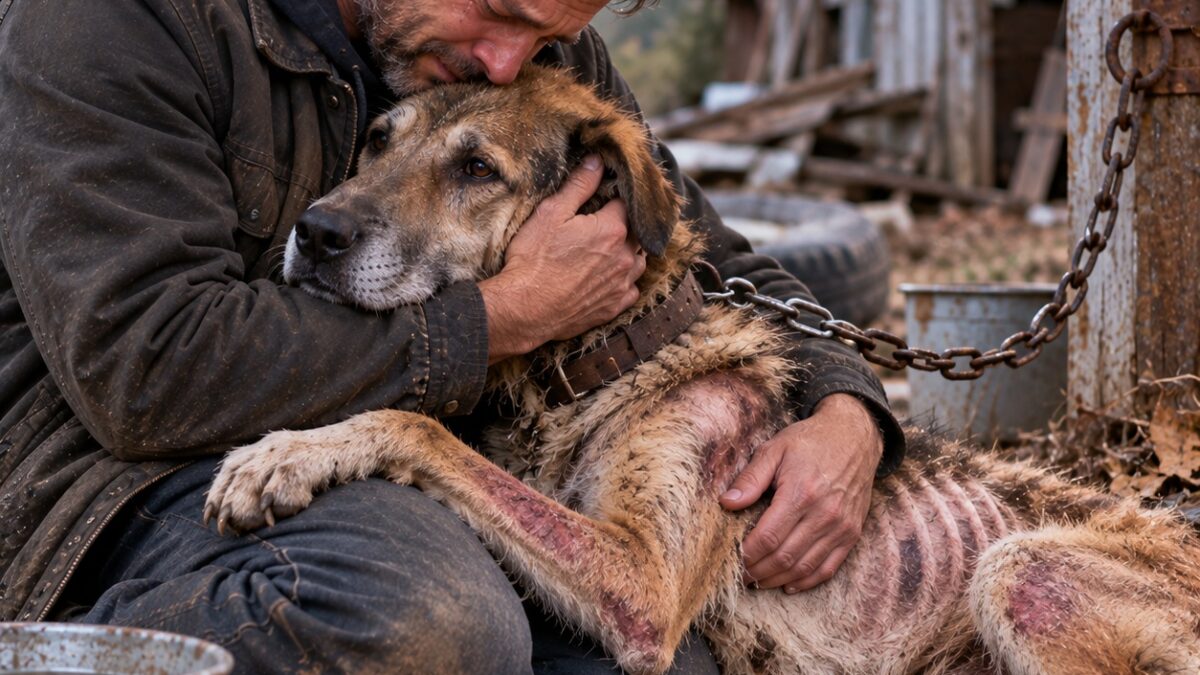
PART2
When the chain finally came loose, Ragnar did something I did not expect.
Nothing.
He did not run.
He did not jump.
He did not suddenly become the dog people imagine in rescue videos.
There was no dramatic explosion of freedom.
He stood where he had always stood.
His head low.
Body tense.
The chain lay on the ground.
For several seconds, Ragnar simply looked at the space in front of him.
Open.
Available.
His.
And he did not seem to understand what to do with it.
Someone whispered behind me:
“He’s free.”
But freedom is a human description.
To Ragnar, the world had not yet become safe just because the metal had been removed.
I stepped backward.
“Come on.”
Nothing.
Another step.
“You can come.”
He looked at me.
Then down at the chain.
Then finally lifted one front paw.
One step.
Stopped.
Another.
The chain stayed behind.
Ragnar turned his head.
Looked at it.
I will never forget that.
The dog looked back at the object that had defined the size of his world.
Then he looked at us.
And walked forward.
Slowly.
Weakly.
But forward.
I had to turn my face away for a moment because I was crying.
I did not want the first thing Ragnar learned about freedom to be that humans fall apart when he uses it.
We got him into the vehicle.
Even that took time.
Ragnar had almost no strength.
His paws slipped.
He tried to climb and could not.
So we lifted him carefully.
He stiffened the second hands went under him.
I felt every rib.
There are animals that look thin in photographs.
Then you touch them.
Photographs cannot show what malnutrition feels like beneath your fingers.
Too little between skin and bone.
A body reduced.
You instinctively want to feed immediately.
Everything.
As much as they will eat.
But severely undernourished animals cannot simply be given unlimited food.
Recovery has to be managed.
Measured.
Careful.
That was the first of many lessons Ragnar taught us.
Wanting to fix suffering quickly does not make quick fixes safe.
We drove him to medical care.
He sat curled against the side of the crate.
Not looking out.
Not sleeping.
Just existing.
I talked to him quietly.
Mostly nonsense.
“You’re okay.”
“We’re almost there.”
“You don’t know us yet.”
“That’s okay.”
“You don’t have to.”
I kept thinking about my promise.
Never back on that chain.
That part I could guarantee.
Everything else?
I did not know.
His skin frightened me.
There were sores.
Inflammation.
Hair loss.
Places that looked as though they had been irritated for far longer than any animal should have endured without proper treatment.
He smelled of neglect.
There is a smell to animals who have not been properly cared for.
Old skin.
Dirt.
Infection.
Fear.
It is not their smell.
It is what life has put on them.
At the clinic, Ragnar was weighed.
The number was worse than we expected.
Everyone in the room went quiet.
One of the veterinary staff looked at his chart, then at him, as though hoping the body on the table might contradict the number.
It did not.
Severely malnourished.
Skin disease requiring urgent care.
Weak.
Fragile.
His body had been surviving.
Not living well.
Surviving.
They started treatment.
Nourishing food in controlled amounts.
Medication.
Skin care.
Tests.
Cleaning.
Comfort.
The first meal Ragnar ate with us was small.
Painfully small to watch.
He lowered his nose.
Sniffed.
Looked around.
Then ate.
Too fast at first.
He stopped.
Looked again.
I wondered whether he expected someone to take it.
We stayed quiet.
The bowl remained.
He ate again.
Afterward, he licked it long after there was nothing left.
That image followed me home.
An empty clean bowl.
A dog still licking because some part of him did not believe another meal would come.
The next one came.
Then another.
Then another.
Consistency is one of the least glamorous parts of rescue.
It is also one of the most powerful.
Food today.
Food tomorrow.
Medicine today.
Medicine tomorrow.
Clean bedding.
Water.
A hand that touches gently.
A person returning at the same time.
No chain.
Again.
Again.
Again.
At first, Ragnar showed very little interest in anything beyond immediate need.
He did not care about toys.
Did not investigate much.
Did not react when other dogs became excited.
A ball could roll past him.
Nothing.
Someone could squeak a toy.
He might glance.
Then lower his head again.
People sometimes expect rescued animals to look grateful.
That expectation is unfair.
Ragnar did not owe us happiness.
He did not owe us play.
He had spent too long using his energy to survive.
Joy requires spare energy.
Curiosity requires some belief that the next minute is safe.
Ragnar did not have much of either.
So we stopped expecting.
We gave him what he needed.
Food.
Medical care.
Time.
Then came the skin.
For a while, treatment seemed to help.
The inflammation reduced in a few places.
We celebrated quietly.
A patch that looked less red.
A sore drying.
Less scratching.
We started imagining the path forward.
Then the skin worsened.
Again.
Ragnar scratched until we worried he would injure himself more.
New irritation appeared.
Places that had looked better flared.
We changed treatment.
Medication adjusted.
New approach.
Wait.
Watch.
For a few days:
Maybe.
Then worse.
Another doctor.
Another plan.
Another attempt.
If you have never cared for an animal with a stubborn medical condition, you may imagine recovery as a line.
Sick.
Treatment.
Better.
Home.
It is often nothing like that.
Ragnar’s recovery was a series of doors that seemed to open and then shut.
Every improvement made hope dangerous.
Every setback hurt more because we had already pictured him on the other side.
One evening I sat beside his bedding after another difficult update.
Ragnar was awake.
His skin looked uncomfortable.
He shifted.
Could not settle.
I put my hand near him.
He leaned his shoulder lightly against my fingers.
The gesture was tiny.
It nearly destroyed me.
Because while we were frustrated that medicine was not working fast enough, Ragnar was still learning something completely different.
Humans can stay.
He did not understand treatment protocols.
He understood presence.
Maybe that was the first thing healing inside him.
His body?
Not yet.
Trust?
A little.
We kept going.
Veterinary appointment.
Medication.
Bathing.
Food.
Rest.
Different doctor.
Different possibility.
Sometimes we felt as though we were failing him.
That is a terrible feeling in rescue.
You remove an animal from cruelty believing the direction is obvious.
Away from bad.
Toward good.
Then you discover that the damage came with him.
Of course it did.
You cannot unclip years of neglect from a collar.
The chain leaves.
The consequences remain.
Ragnar was free.
His body was still carrying captivity.
His thinness.
Skin.
Fragility.
His indifference to toys.
His low expectations.
Every part of him had been shaped by what had happened before we arrived.
I had to remind myself:
We did not cause this.
But now we were responsible for what came next.
That distinction kept me from drowning in guilt.
The cruelty had been reported.
That mattered.
There should be consequences for neglect.
But Ragnar could not wait for any legal process to give him his life back.
His healing had to happen now.
So we focused on him.
One day, after another treatment adjustment, someone brought him a soft bed.
Ragnar stood beside it.
Looked.
Walked around.
Then lay on the floor.
We laughed softly.
Not at him.
At ourselves.
Of course.
The floor was what he knew.
Comfort can be unfamiliar enough to feel suspicious.
We left the bed.
Did not put him on it.
Did not insist.
Two days later, one front paw rested on the edge.
The next week, half his body.
Eventually, Ragnar slept fully on it.
Curled.
His head sinking into the padding.
I photographed him.
Then stared at the picture for a long time.
The first images showed a skeletal dog at the end of a chain.
Now:
A dog sleeping on something soft.
Still thin.
Still sick.
Still far from recovered.
But sleeping.
Not standing at the end of anything.
That mattered.
Meanwhile, people were following his progress.
Some wanted constant good news.
“Is he better?”
“How soon can he be adopted?”
“Is his fur growing back?”
We wanted those answers too.
The most honest response was:
We don’t know yet.
That is difficult in a world that likes rescue stories with clean endings.
Ragnar’s body did not care about narrative structure.
His skin flared when it flared.
Medicine worked or did not.
Weight came slowly.
There were no guarantees.
Then we found the dermatologist.
By that point, we had already tried enough that hope felt cautious.
The specialist examined Ragnar carefully.
Reviewed what had been done.
His history.
The patterns.
The relapses.
A new treatment was prescribed.
We began again.
Not with dramatic optimism.
With discipline.
Give medication.
Observe.
Care.
Wait.
The first week, I barely allowed myself to notice anything.
By the second, some areas looked less inflamed.
I said nothing.
Third:
Still better.
The sores did not disappear forever.
Some returned.
There were setbacks.
But something was different.
Ragnar’s skin was beginning to respond.
Small patches of fur appeared.
Tiny.
Almost ridiculous to celebrate.
We celebrated.
I remember one patch near his shoulder.
Just enough hair to cover a fingertip.
I called someone over.
“Look.”
“What?”
“Here.”
They leaned close.
“Oh.”
That little patch felt like spring after a brutal winter.
Hair.
Ordinary hair.
We had never been so happy to see fur.
Ragnar could not have cared less.
He wanted food.
Good.
Wanting food was progress too.
He had begun gaining weight.
Slowly.
His body started filling out.
Not dramatically.
Week by week.
A little less hollow around the hips.
A little more muscle.
His face changing.
Eyes brighter.
The food bowl no longer triggered the same desperate speed.
Sometimes he even walked away with a few crumbs left.
The first time that happened, I stared.
Ragnar looked back as if to ask why humans were so strange.
You left food.
Do you understand what that means?
Another meal is expected.
Tomorrow exists.
That is what abundance eventually teaches an animal who has known scarcity.
You do not have to consume everything now.
There will be more.
The same thing happened with affection.
At first, Ragnar accepted touch.
Later, he sought it.
There is a difference.
One afternoon, I sat on the floor answering messages.
Ragnar was several feet away.
I felt something touch my elbow.
His nose.
I turned.
He stood beside me.
“You need something?”
He leaned.
Full body against my shoulder.
I forgot every message.
I put my arm around him carefully.
Ragnar stayed.
No chain holding him.
No food in my hand.
He simply chose proximity.
That was one of the first times I understood the scale of his recovery.
Weight charts matter.
Skin matters.
Bloodwork matters.
But a dog choosing contact when he is free to walk away?
That is another kind of measurement.
Ragnar was becoming interested in the world.
Not quickly.
One thing at a time.
A smell outside.
Another dog passing.
Grass.
A person entering.
A sound.
He began lifting his head more.
Following movement.
Standing at gates because he wanted to see what was happening, not because a chain forced him to occupy one place.
We introduced toys again.
Mostly ignored.
Fine.
Then one day, someone rolled a soft toy near him.
Ragnar watched it.
Waited.
Then nudged it once with his nose.
Everybody nearby froze.
Nobody wanted to ruin the moment.
Ragnar nudged it again.
That was it.
No dramatic game.
No fetch.
Two nose taps.
We talked about those two taps for hours.
People who have not watched a shut-down animal awaken may find that absurd.
It is not.
When someone has lost interest in the world, curiosity is a victory.
The family who wanted Ragnar entered the story while he was still far from ready to leave.
I remember being cautious.
Interest is easy.
Commitment during chronic medical uncertainty is harder.
People see a rescue photo.
Feel emotion.
Say:
“I want him.”
Then bills arrive.
Appointments.
Medication.
Relapses.
Specialists.
The dog may not behave like the fantasy they built from one image.
We had learned to protect animals from good intentions that were not strong enough to survive reality.
This family was different.
They did not ask:
“When can we take him?”
First.
They asked:
“What does he need?”
That question told me something.
They helped with medical expenses.
Brought food.
Stayed informed.
When treatment changed again, they did not disappear.
When Ragnar’s skin flared after looking better, they did not say:
“Maybe he’s too complicated.”
They waited.
At one point, I told them:
“I need you to understand this may take a while.”
One of them answered:
“We know.”
“We’re not going anywhere.”
I looked at Ragnar.
Then at them.
There are sentences you want to believe.
You learn not to believe them immediately.
So we watched.
Weeks passed.
They stayed.
Another bill.
Stayed.
Another treatment adjustment.
Stayed.
Bad skin day.
Stayed.
Good update.
Stayed.
The same behavior regardless of whether the news was emotionally rewarding.
That is how trust is built.
Not through speeches.
Repetition.
Ragnar was learning it from caregivers.
We were learning it from his future family.
Eventually, his recovery reached another difficult point.
His rescuers were told he needed a stem cell transplant.
Even hearing the words felt heavy.
We had already fought so hard to stabilize him.
Now another major step.
And it required a donor dog.
Finding one was not simple.
The search took time.
Calls.
Questions.
Possibilities that did not work.
More waiting.
Ragnar, of course, knew none of this.
He knew meals.
Medication.
People.
Beds.
Walks.
He did not know a network of humans was searching for another dog who might help his body heal.
Sometimes rescue is strange that way.
An animal sleeps while strangers fight invisible battles on his behalf.
We worried.
Would we find the right donor?
How long would it take?
How would Ragnar handle another procedure?
Could his fragile body tolerate everything asked of it?
I began resenting uncertainty.
Then Ragnar would look at me.
And I would remember:
He had lived almost entirely inside uncertainty.
Would food come?
Would water?
Would anybody stop?
Would pain ease?
Would tomorrow be different?
Compared with him, we had the luxury of planning.
So we kept searching.
Finally—
a donor was found.
I wish I could recreate the relief of that moment without making it sound bigger than it was.
Nobody screamed.
No music.
Just an update.
We have one.
And suddenly a path existed where, the day before, there had only been waiting.
Ragnar underwent the procedure.
We watched.
Waited.
Again.
Recovery after medical intervention is cruel to impatient people.
You want proof immediately.
You want to look at the dog and know.
Instead, bodies work on their own schedules.
Ragnar rested.
We followed instructions.
Watched for changes.
Kept feeding.
Kept treating his skin.
Kept showing up.
The family kept helping.
Nothing dramatic happened overnight.
Then gradually—
his body began to recover.
The changes were small until one day they were not.
Weight.
Heavier.
Shoulders.
Fuller.
Coat.
Thicker.
The patches of exposed skin becoming smaller.
Fur returning.
A dog beginning to occupy his own frame.
Someone placed an early photograph beside a recent one.
I almost could not look.
The original Ragnar seemed like a different animal.
Thin neck.
Sharp bones.
Damaged skin.
Eyes asking nothing because asking had failed too often.
Beside it:
Ragnar now.
Still healing.
Still carrying scars.
But stronger.
Standing differently.
Looking outward instead of only inward.
There is no single moment when a rescued animal becomes “recovered.”
We like dates.
Before.
After.
Reality blurs.
Was Ragnar recovered when he gained the first pound?
When fur returned?
When the dermatologist’s treatment worked?
After the stem cell transplant?
When he sought affection?
When he finally went home?
Maybe recovery is all of it.
A thousand small yeses.
Yes, food.
Yes, medicine.
Yes, touch.
Yes, sleep.
Yes, tomorrow.
Yes, family.
There were still days his skin reminded us it had not forgotten.
Sores could return.
I hated that.
Every flare felt unfair.
Had he not suffered enough?
That question is useless medically.
Bodies do not distribute fairness.
But emotionally?
I asked it constantly.
He had spent a lifetime chained.
He had been hungry.
Neglected.
His skin had burned and itched.
Then even after rescue, there was no easy cure.
Why did he have to fight so hard just to reach normal?
There is no answer.
Some animals receive safety at eight weeks.
Some fight for it after years of cruelty.
The only meaningful response is to make the safety real once you have the chance.
So when Ragnar’s skin worsened, we did not interpret it as failure.
We treated it.
Again.
When he needed another appointment, he went.
Again.
Medication.
Again.
Food.
Again.
Care.
Again.
Because recovery from long neglect is often repetitive and boring and expensive and emotionally exhausting.
That is exactly when abandoned animals need people not to become bored with them.
Ragnar had already known what it meant for humans to lose interest.
We refused to repeat it.
I remember one particularly bad night.
His skin had flared again.
He was restless.
I sat near him.
Ragnar kept shifting.
Lie down.
Stand.
Scratch.
Stop.
Turn.
I felt helpless.
That feeling can become anger if you let it.
Not anger at the dog.
At the situation.
At whoever allowed him to deteriorate.
At medicine for not working faster.
At the universe for making a dog suffer after he had already been rescued.
I rested my hand near his paw.
“I’m sorry.”
Ragnar looked at me.
“I know that does nothing.”
He moved his paw forward.
Placed it over two of my fingers.
Maybe accidental.
I did not move.
For fifteen minutes, we stayed that way.
His paw over my hand.
He finally slept.
I did not.
I stared at him.
The dog who once stood at the end of a chain crying toward strangers was now sleeping with his paw on a person who had promised to stay.
I thought:
Maybe that is the whole story.
Not cure.
Not adoption.
Stay.
The cruelty in Ragnar’s life had not only been what was done to him.
It was also what was not done.
People did not feed enough.
Did not provide adequate care.
Did not solve his medical suffering.
Did not stop.
Did not stay.
Neglect is made of absence.
Recovery had to be made of presence.
That is why the family waiting for him mattered long before they took him home.
They were already participating in the opposite of his past.
Past:
People pass.
Present:
People return.
Past:
Need ignored.
Present:
Need addressed.
Past:
Chain.
Present:
Choice.
Past:
No future promised.
Present:
A family organizing part of their life around the day Ragnar would be ready.
He did not know.
We did.
Sometimes that made watching him emotional in a completely different way.
I would see Ragnar sleeping and think:
There are people somewhere buying your food.
Waiting.
Asking about you.
Planning for you.
You have no idea.
After a lifetime of being unwanted enough to leave chained and sick, you are now wanted before you are even ready to leave.
I wished I could explain that to him.
“You have a home waiting.”
He would look at me.
Then sniff something.
Dogs are often more sensible than humans.
They do not need promises about the future.
They need today treated correctly.
So we made today good.
Then tomorrow.
The family visited when appropriate.
Careful.
No forcing.
Ragnar was interested.
Cautious.
One of them sat on the ground.
Ragnar sniffed.
Walked away.
Returned.
Another person offered a hand.
Ragnar touched it with his nose.
No dramatic music.
No instant bond.
Good.
Real relationships should be allowed to start quietly.
The family did not chase him.
That mattered.
They let him decide distance.
A dog who had spent years unable to control distance deserved that.
At the end of the visit, Ragnar stood watching them leave.
I wondered what he thought.
Then reminded myself not to narrate feelings into him.
He would show us.
Next visit, he approached faster.
That was enough.
The family brought food.
Helped cover more treatment.
Asked questions.
“What medication?”
“What does his skin need?”
“What should we watch for?”
“What happens if it flares again?”
Not:
Will he look normal?
Not:
Will all his fur grow back?
Questions about responsibility.
That is love before possession.
A willingness to prepare for the inconvenient version of the future.
We needed that for Ragnar.
He had been failed by someone who treated care as optional.
His new home had to understand care was the agreement.
Eventually, the difference in him became impossible to ignore.
The dog who had once moved like every calorie mattered began walking with more energy.
His steps stronger.
His body heavier.
He sometimes looked toward doors with interest.
He noticed when meals were being prepared.
His coat no longer looked like something disappearing.
It was returning.
Not all at once.
But enough.
One day, someone touched his back and said:
“Look how thick this is getting.”
I ran my fingers gently over the fur.
Soft.
Real.
Ragnar turned his head.
Probably wondering why humans had become obsessed with petting one specific section of his back.
We laughed.
Laughter around him felt like another milestone.
In the beginning, everybody whispered.
Illness creates quiet.
People move carefully.
Faces serious.
Later, as Ragnar became stronger, normal sounds returned.
Conversation.
Laughter.
Dogs barking.
Bowls moving.
Life.
He was no longer the emergency in the room.
He was becoming a dog inside it.
That transition is one of the best parts of rescue.
At first:
Patient.
Victim.
Case.
Then gradually:
Ragnar.
A dog with preferences.
He liked certain food more.
Certain places to sleep.
Some people earned quicker tail movement than others.
He had opinions.
Good.
Individuality had been hidden beneath survival.
As survival became less urgent, personality emerged.
I did not realize how much I had waited for that.
One afternoon, Ragnar was resting when someone walked past with food.
His head snapped up.
He stood.
Followed.
I laughed.
“There he is.”
Ragnar looked at me.
The dog who once seemed indifferent to the world had developed the ancient canine conviction that all food anywhere might belong to him.
Beautiful.
At another point, he discovered a comfortable spot and refused to move.
We worked around him.
Also beautiful.
People imagine rescue success as obedience.
I began to see it as inconvenience.
A dog confident enough to be in the way.
A dog who assumes he belongs.
That was what I wanted for Ragnar.
Not gratitude.
Belonging.
The waiting family continued waiting.
Months can feel longer when the finish line becomes visible.
They could see Ragnar improving.
They wanted him.
Still, they did not pressure.
That mattered.
The decision about when he could leave had to be based on his health.
Not human impatience.
Every time I thought:
They really mean it.
Another part of me relaxed.
Ragnar had already experienced one home that failed the basic definition of home.
We would not send him into another because emotions were high.
He deserved preparation.
Then came the conversation we had all been waiting for.
He was getting close.
Not magically cured.
Not guaranteed never to need medical care again.
But stronger.
Stable enough.
His body responding.
His weight improved.
Coat growing.
Family ready.
The day was coming.
I thought I would feel only happiness.
Instead, grief arrived.
That surprised me.
Rescue is strange.
You spend months trying to get an animal well enough to leave you.
Then success means goodbye.
Good goodbye.
Necessary goodbye.
Still goodbye.
I looked at Ragnar.
Remembered the chain.
The vehicle.
The first meal.
Bad skin days.
His paw on my fingers.
Then pictured his future home.
Family.
Care.
Affection.
No chain.
He belonged there.
Love in rescue has to become generous enough to let the animal leave.
We are bridges.
Not destinations every time.
That can hurt.
I did not let the hurt become a reason to delay him.
Ragnar had waited long enough for home.
The family prepared.
Food.
Medical information.
Instructions.
Follow-up.
Everything.
There was no casual:
We’ll figure it out.
They had figured out as much as anyone reasonably could.
The rest would be learned together.
That is what families do.
The day Ragnar left, I arrived early.
I wanted time.
Maybe selfishly.
He looked good.
Not perfect.
I hate that word anyway.
Strong.
That was better.
His body had filled out enough that the old images almost seemed impossible.
His coat covered much of what had once been exposed.
The fur was thicker.
His face looked alive.
Eyes engaged.
I crouched.
“Big day.”
Ragnar came closer.
I touched his chest.
“You know these people.”
Tail movement.
“They’ve been waiting for you.”
His tail moved again.
I smiled.
“Probably the food.”
He leaned against me.
And I lost the argument with my tears.
I wrapped one arm around him.
Careful.
Always careful.
“You were worth waiting for.”
That sentence came out before I planned it.
I cried harder.
Because it was not only about the family.
People had walked past Ragnar when he cried.
Day after day.
Maybe years of his life had taught him the opposite.
Not worth stopping for.
Not worth feeding properly.
Not worth medical care.
Not worth freeing.
Wrong.
Ragnar had always been worth stopping for.
His worth did not appear when his coat grew.
It did not increase when he gained weight.
He was worth care while skeletal.
Worth love while his skin was raw.
Worth a home before he knew how to play.
The family understood that.
They had chosen him before he looked healed.
That mattered more than anything.
When they arrived, their excitement was restrained by emotion.
Nobody rushed Ragnar.
They greeted him.
Let him move.
Someone knelt.
Ragnar walked over.
Sniffed.
Then stayed.
I watched.
Every rescue story should contain one moment where the past becomes visibly impossible.
This was ours.
Ragnar stood beside people.
No chain.
He could walk away.
He did not.
He stayed.
Paperwork.
Instructions.
Medication.
Food.
Information.
All the practical pieces.
Then the leash.
Not chain.
Leash.
A temporary line between a dog and people taking him home.
The difference felt enormous.
Someone held it loosely.
Ragnar walked beside them.
At the vehicle, he paused.
Looked around.
My chest tightened.
I went closer.
“You’re okay.”
He looked at me.
Then at the open door.
His family waited.
No pulling.
No lifting unless necessary.
Ragnar stepped forward.
Climbed in.
That was it.
No cinematic speech.
A dog entering a car.
But everyone who knew where he came from understood.
He was not being transported away as property.
He was going home.
I put my hand through the open door.
Ragnar sniffed it.
Then licked my fingers once.
I laughed through tears.
“Yeah.”
I whispered.
“Go.”
The door closed.
The vehicle pulled away.
I stood there until it disappeared.
Then I cried the way rescuers sometimes cry only after the animal has left.
Everything you held during the crisis arrives at once.
The chain.
Thin body.
Skin.
Treatment failures.
Fear.
Hope.
The donor search.
Procedure.
Weight gain.
Fur.
Family.
Home.
All of it.
Someone stood beside me.
“You okay?”
“Yes.”
It was true.
Sad.
But okay.
That night, I looked at the first photograph again.
I had avoided it for a while.
Ragnar at the chain.
Body thin.
Eyes tired.
I enlarged the image.
His face.
I wanted to go backward and tell that dog something.
Not:
You’ll be fine.
Too simple.
Not:
Everything gets better.
Recovery had been too hard for that lie.
I wanted to say:
Someone is coming.
Not the people who pass.
Different people.
They will stop.
They will remove the chain.
Your skin will get worse before it gets better.
People will change medicines.
Doctors will try.
There will be nights no one knows what to do.
They will stay anyway.
There will be another dog somewhere who will one day become part of your recovery.
People you have never met will help pay for your care.
A family will start loving you before you are healthy enough to go home.
You will not understand any of this.
You do not need to.
Just keep breathing.
Someone is coming.
That thought shattered me.
Because not every animal gets that sentence.
Some cry.
People continue walking.
That is why Ragnar’s story should not only make people feel good.
It should hurt.
The chain came off because someone stopped.
That means the people who pass suffering have power too.
Not always to solve everything.
But to start.
See.
Report.
Call.
Do something.
Ragnar’s rescue did not begin with advanced treatment.
It began with refusal.
We refused to leave him there.
Every other step became possible afterward.
The dermatologist.
The nutrition.
The donor.
The transplant.
The family.
None happens if the first person says:
Not my problem.
That is the part I carry most heavily.
Ragnar had probably encountered people before us.
We cannot know every story.
Maybe some tried.
Maybe some did not understand.
I do not want to invent villains out of strangers I never met.
But we know this:
Ragnar remained chained while he deteriorated.
For too long.
His body proved it.
If you see an animal whose suffering is obvious, do not assume somebody else has already handled it.
Verify.
Make the call.
Ask.
Sometimes everyone is waiting for everyone.
The animal is the one paying the price.
After Ragnar went home, updates came.
I lived for them.
Eating.
Resting.
Exploring.
Skin.
Good days.
Some flare-ups.
Of course.
Recovery did not end at adoption.
Home was not a magic cure.
The family continued what they had already promised.
Care.
Medication.
Appointments when needed.
Food.
Patience.
Ragnar began settling into routine.
The photographs changed.
At first, he looked uncertain in new spaces.
Then:
Sleeping.
Stretching.
Lying in comfortable places.
Standing near his people.
The background became a home instead of a clinic.
That mattered more than any before-and-after collage.
A bowl in a kitchen.
A blanket.
Furniture.
Human legs nearby.
Ordinary life.
One photo showed Ragnar asleep so deeply his mouth had fallen slightly open.
I stared at it.
That kind of sleep is trust.
Dogs who expect danger do not fully surrender.
The body keeps watch.
Ragnar looked surrendered to rest.
I sent a message:
That’s the picture.
Someone asked:
“What picture?”
The one I wanted.
Not a perfect coat.
Not a certain weight.
Sleep.
Safe enough to sleep.
That was success.
Another update showed him standing outside.
Sunlight.
His coat thicker.
Body strong.
He looked like the dog hidden inside the chained one.
People say:
He looks completely different.
I understand the phrase.
But I resist it a little.
He was always Ragnar.
The healthy version was not the “real” dog replacing the sick one.
The sick dog was real too.
The thin one.
The shut-down one.
The one with painful skin.
He deserved love before transformation.
Sometimes rescue culture accidentally praises animals only after they become visually pleasing again.
Look how beautiful now.
Yes.
But he was worth saving when beauty was difficult to see.
That matters.
Especially because old cruelty often teaches the victim:
You are valued only if you are useful, attractive, easy, healthy.
Ragnar’s new life had to teach the opposite.
You belong while needing care.
You belong during flare-ups.
You belong before the fur is perfect.
You belong on bad days.
That is family.
A place where illness does not cancel membership.
I thought about the people who helped with his medical expenses.
Rescue costs are real.
Good intentions do not pay dermatologists.
Food.
Medication.
Procedures.
Specialists.
Transportation.
Stem cell work.
Every part requires resources.
Someone choosing to help financially may never touch the dog.
Still part of the rescue.
That humbled me.
Ragnar’s new life was built by many hands.
The rescuer who stopped.
The person documenting cruelty.
Veterinary staff.
Caregivers.
Dermatologist.
Donor search.
The donor dog and the people responsible for that process.
People sending money.
Food.
The family waiting.
No one person can point and say:
I saved Ragnar.
The accurate sentence is:
We refused to let him remain where he was.
Then we kept refusing every time his recovery gave us a reason to feel discouraged.
That is rescue.
A series of refusals.
No, he will not go back.
No, we will not stop because the first treatment failed.
No, we will not call him hopeless because the skin flared.
No, we will not abandon medical care because it became expensive.
No, we will not rush him into a home before he is ready.
No, we will not forget him once the dramatic chain-removal photo becomes old.
No.
Stay.
Try again.
That is how Ragnar got home.
I used to think the chain was the cruelest object in his story.
Now I am less certain.
Metal is easy to recognize.
Indifference is harder.
A chain says:
You cannot go.
Indifference says:
I can see you cannot go, and I will continue with my day.
That is more frightening to me.
Ragnar had stood at the end of the chain and cried.
Somebody heard.
Then kept walking.
The chain restricted his body.
Being ignored must have damaged expectation.
That damage took longer to heal.
When he first came into care, he showed little interest.
Maybe people interpreted it as sadness.
Could have been exhaustion.
Could have been medical.
Could have been learned helplessness.
I am careful with labels.
I only know what I saw.
A dog who did not expect much.
Then slowly:
Food expected.
Touch sought.
People followed with his eyes.
Toy nudged.
Family approached.
World returning.
That progression meant more to me than the fur.
Hair grows from skin when the body can support it.
Expectation grows when life becomes reliable.
Both required treatment.
One medical.
One relational.
The family gave him the second.
I remember visiting after enough time had passed for Ragnar’s new home to feel like his.
He was not waiting nervously by the door for someone to take him away.
He was settled.
That is another kind of miracle.
An animal who has experienced instability can remain ready for departure.
Bag.
Door.
Car.
New place.
Where now?
Ragnar looked rooted.
A bed that smelled like him.
A bowl in its place.
People moving around him without making him anxious.
He knew routines.
I sat down.
Ragnar looked at me.
I wondered:
Will he remember?
He walked over.
Slowly.
Sniffed.
Then leaned into me.
I almost laughed.
“You remember.”
Tail.
I scratched his neck.
His coat felt different.
Thicker.
I remembered the inflamed skin under my hand months earlier.
Now fur.
Soft.
Warm.
I closed my eyes.
Ragnar eventually moved away.
Went toward his family.
That was the best part.
Not that he remembered me.
That he chose them.
I had been part of getting him from there to here.
Here belonged to them.
That is the goal.
A rescue should become unnecessary.
The rescuers should eventually stop being the center of the animal’s safety.
Home should take over.
I watched Ragnar settle near his people.
No jealousy.
Only relief.
“You did it.”
I whispered.
Maybe to Ragnar.
Maybe to everyone.
Maybe to myself.
The family told me about his routines.
Food.
Sleeping spots.
Medical care.
The normal concerns of loving a dog.
They had waited so long for him that even small inconveniences seemed cherished.
At one point Ragnar wanted something at an inconvenient hour.
They laughed.
I thought:
Good.
Let him inconvenience you.
A lifetime chained turns normal demands into victory.
Ask to go out.
Want another meal.
Take up space.
Bark.
Choose.
An animal who once had almost no control should be allowed opinions.
Ragnar had opinions now.
That was home.
One of the most emotional updates came months later.
Not because anything dramatic happened.
Ragnar was simply lying near his family.
Healthy enough.
Coat fuller.
Eyes soft.
Nothing urgent.
I looked at it and thought of the line I had whispered when we found him:
I see you.
Now he no longer needed strangers to see him.
He had people who knew him.
There is a difference.
Being seen can save you.
Being known lets you live.
They knew which food he liked.
What his skin looked like before a flare.
How he rested.
When he wanted touch.
When he wanted space.
What normal meant for Ragnar.
That is intimacy.
Not a viral photograph.
Daily knowledge.
He had finally entered the ordinary privacy of being loved.
I began thinking less about his cruelty case.
Not because it did not matter.
It did.
Neglect should be reported.
Accountability matters.
But I did not want the person who harmed him to remain the main character of Ragnar’s life forever.
Too many rescue stories stay emotionally attached to the abuser.
Look what they did.
Look what they did.
Necessary at first.
Evidence matters.
But eventually I wanted the sentence to change.
Look where Ragnar sleeps now.
Look how he eats.
Look at his coat.
Look at the people waiting for him.
Look at him choosing.
The person who failed him had already taken enough years.
They did not deserve the rest of the story too.
Ragnar did.
His future family did.
So when people asked:
“Did the owner get punished?”
I answered what I could based on what was known.
The cruelty was reported.
Then I redirected.
“Do you want to see Ragnar now?”
That was where my heart lived.
Present.
Not chain.
Home.
One of the family members once said something I never forgot.
“We thought we were waiting for Ragnar to get better.”
Pause.
“Then we realized waiting was already part of loving him.”
Exactly.
They were not postponing the relationship until adoption day.
They were participating already.
Money.
Food.
Questions.
Visits.
Patience.
They had begun caring before legal possession.
That challenged the idea that family starts at a front door.
Sometimes family starts with:
We’ll wait.
There is enormous love in waiting without demanding a deadline.
Especially for a dog whose old life was defined by the opposite kind of waiting.
Ragnar once waited for people who never stopped.
Now people waited for him.
Think about that reversal.
He stood at the edge of a chain:
Please.
Someone.
His family stood on the other side of recovery:
Take your time.
We’re still here.
That may be the sentence I want most from this story.
Take your time. We’re still here.
How many wounded animals need that?
How many wounded people?
Healing becomes harder when love is conditional on speed.
Get better.
Be easier.
Be normal.
Ragnar had no deadline.
His family wanted him healthy enough to come home.
They did not need him to perform recovery for them.
That is why I trusted them.
That is why watching him leave with them hurt less.
He was not going from caregivers to strangers.
He was going toward people who had already proved they could wait.
Years of cruelty can teach a dog:
People disappear.
Recovery must teach:
Some do not.
Ragnar learned.
Slowly.
Maybe never perfectly.
Animals carry history in ways we cannot measure.
A certain movement.
Sound.
Skin sensation.
Being left alone.
Who knows what remained?
A happy ending does not require total erasure of trauma.
That is another myth I reject.
Ragnar could live well and still have scars.
Physical or otherwise.
His sores could recur.
His skin still needed attention.
That did not make adoption less successful.
A healed life is not necessarily an unscarred life.
It is a life where scars no longer determine whether you are loved.
That was Ragnar’s future.
I thought about my promise again.
“You are never going back on that chain.”
At first, I believed the promise meant only metal.
Later, I understood it more broadly.
Never back to being ignored.
Never back to untreated suffering.
Never back to hunger becoming ordinary.
Never back to affection being uncertain.
Never back to people seeing pain and deciding it can wait indefinitely.
No chain.
In any form we could prevent.
That is the promise rescue makes.
Not:
Nothing bad will ever happen.
Impossible.
Not:
You will never be sick.
Impossible.
The promise is:
You will not face it alone because nobody cares.
That we could keep.
When Ragnar’s skin flared in his new home, his family noticed.
Responded.
Treatment.
Care.
That alone marked a complete difference from his old life.
Illness itself is not cruelty.
Ignoring it can be.
Ragnar was no longer ignored.
That is what mattered.
One evening, I went through photographs from the entire journey.
I placed them chronologically.
Chain.
Removal.
Clinic.
Thin body on bedding.
Skin at its worst.
First signs of improvement.
Fur.
Weight.
Family visits.
Stronger body.
Home.
I expected the final photo to affect me most.
It did not.
The one that broke me was from early treatment.
Ragnar asleep.
Still very thin.
Skin still bad.
But under a clean blanket.
That photograph sat between suffering and recovery.
Nothing had been solved yet.
No dermatologist breakthrough.
No donor found.
No adoption day.
Just care.
That image represented faith.
We did not know whether treatment would work.
We cared anyway.
That is more meaningful to me now than certainty.
Anybody can celebrate the healthy dog.
Love is revealed beside the sick one when nobody can promise an ending.
Care anyway.
Stay anyway.
Spend anyway.
Try again.
That is where Ragnar was actually saved.
Not on the last day.
In all the middle days when the outcome was unclear.
His family understood that too.
They helped before the “after” photo existed.
That is why the final home felt earned.
Not purchased.
Earned through reliability.
I sometimes receive messages from people who say Ragnar’s story made them cry.
I understand.
It makes me cry too.
But I hope they cry at the right part.
Not only because he was chained.
Not only because he was thin.
Cry because he kept standing up for strangers.
Cry because he still asked.
Cry because people walked past.
Then let the tears turn into something useful.
Notice the next dog.
The next animal.
The next suffering thing.
Emotion without action can become another form of walking past.
Ragnar did not need people to be sad about him from a distance.
He needed somebody to stop.
That lesson is uncomfortable.
Good.
Some lessons should be.
I also hope people understand long-term rescue.
Taking an animal away from cruelty is visible.
Everybody can cheer.
The difficult phase begins after cameras leave.
Medical uncertainty.
Bills.
Behavior.
Specialists.
Relapse.
Slow progress.
Finding the right home.
That work needs support too.
Rescues do not survive on dramatic moments.
They survive because people donate food.
Money.
Transport.
Foster care.
Time.
Because a dermatologist agrees to keep looking.
Because someone searches for a donor dog.
Because a family waits.
Ragnar’s life was held up by all those ordinary contributions.
A chain is one object.
It took a community of care to replace what it had represented.
Dependence.
Control.
Neglect.
We replaced those with:
Nutrition.
Medicine.
Choice.
Attention.
Home.
Over time, Ragnar’s coat became almost symbolic for people.
They would point:
“Look how much fur!”
I understood.
It was visually striking.
But I always thought about the skin underneath.
Fur can hide.
Skin tells history.
For months, the skin had been inflamed and sore.
Even when fur returned, treatment mattered.
I did not want people to mistake appearance for health.
Rescue teaches that too.
Things can look better before they are stable.
Things can look terrible while healing has already begun.
Do not judge solely from the surface.
Ragnar’s most important change was invisible.
Expecting people to stay.
We could see hints.
The way he approached.
Rested.
Ate.
But trust itself cannot be photographed.
It existed between moments.
The body relaxing when someone entered.
Not flinching when a hand moved.
Sleeping while humans walked nearby.
Leaving food for later.
Following family into another room.
Those were the real after pictures.
Living behaviors.
His new family saw them every day.
That is where I wanted the story to live eventually.
Away from public attention.
Inside a home.
People sometimes ask whether rescue dogs understand they have been rescued.
I do not know.
I think they understand change.
Before:
Chain.
Now:
Freedom.
Before:
Hunger.
Now:
Meals.
Before:
Pain untreated.
Now:
People respond.
Before:
Crying at strangers.
Now:
Family hears the smallest signal.
Maybe the word rescue is ours.
Ragnar understood difference.
That is enough.
I once watched him stand by a window.
Just watching.
Outside, people passed.
Cars.
Movement.
Nothing special.
My mind went immediately to the chain.
People passing him.
He had cried then.
At the window, he did not.
He simply watched.
Why cry?
He was already home.
That image felt like the final answer to the beginning.
The world could pass.
Ragnar no longer needed to beg it to stop.
His people were behind him.
Beside him.
Near.
He had been chosen.
There is a peace in no longer auditioning for love.
Ragnar had it.
I wished I could tell every chained or abandoned animal:
You should never have had to audition.
Your suffering is enough reason to stop.
Your life has value before anybody sees potential.
Ragnar did not become worthy when healthier.
He became visible.
Different.
I refuse to confuse those.
We failed him as a society before rescue because he was visible enough and still not protected soon enough.
That truth should remain uncomfortable even after the happy ending.
Otherwise happy endings become excuses.
“Well, he’s okay now.”
No.
He is loved now.
The years still happened.
His body still paid for them.
Good endings do not make cruelty acceptable retroactively.
They show what should have existed from the beginning.
Food.
Care.
Home.
That is why I never say:
Everything happened for a reason.
No.
Ragnar did not need cruelty in order to appreciate love.
He deserved love first.
The reason rescue matters is because something wrong happened and people chose to interrupt it.
We do not romanticize the wrong.
We honor the interruption.
I think his family understood that.
They never treated him as a trophy of suffering.
He was not:
Our abused rescue dog.
He was Ragnar.
Their dog.
The medical history mattered when needed.
Then normal life.
That is dignity.
A person’s worst experience should not become their entire identity.
Neither should an animal’s.
Ragnar had preferences unrelated to pain.
Habits.
Quirks.
Ways of resting.
Foods he liked.
Expressions.
Those things deserved attention too.
Eventually, when people met him without knowing the story, I liked watching.
They simply saw a dog.
Maybe admired his coat.
Petted him.
Nothing solemn.
Good.
Ragnar did not need every stranger to look at him and think tragedy.
He had already spent too long defined by suffering.
Let somebody say:
“Handsome dog.”
Then continue walking.
Different kind of passing.
Safe.
One day, someone did exactly that.
“Beautiful dog.”
His family smiled.
“Thank you.”
No explanation.
No before photo.
Ragnar sniffed grass.
I nearly cried.
Beautiful.
Not because he had transformed enough to earn the word.
Because he was now living in a world where someone could see him and the first thing exchanged was simple affection, not alarm.
The chain no longer entered every conversation.
That is freedom too.
I often think about the donor dog.
An animal connected to Ragnar’s recovery in a way Ragnar would never understand.
There is something moving about that.
One dog’s body helping another dog’s body heal through a process organized entirely by people.
A network of care crossing lives.
The donor dog would never know Ragnar’s story.
Ragnar would never know theirs.
Still connected.
We talk about rescue as direct relationships.
I help you.
You help me.
Sometimes compassion is anonymous.
A donation.
A donor.
A person paying part of a bill.
No recognition.
No reunion.
Still real.
Ragnar’s recovery was full of people he would never remember.
Their actions remained in his healthier body.
That made me think differently about kindness.
You may never see the outcome.
Do it anyway.
The person who donated twenty dollars toward treatment may never meet Ragnar.
The food they paid for became weight on his ribs.
The appointment they helped fund became skin relief.
Goodness can become physical even when the giver remains invisible.
The opposite of neglect.
Neglect also becomes physical.
Thin body.
Raw skin.
Weakness.
Care becomes physical too.
Muscle.
Fur.
Sleep.
Health.
The body records what surrounds it.
Ragnar’s body eventually began recording love.
That sentence still moves me.
His stronger legs.
Thicker coat.
Weight.
Those were not only medical outcomes.
They were evidence of repeated care.
Somebody fed him enough times that hunger stopped defining his shape.
Somebody treated him enough times that skin could heal.
Somebody stayed long enough that his nervous system could relax.
That is what love looks like when translated into biology.
Not poetry.
Protein.
Medicine.
Sleep.
Safety.
Maybe poetry is there too.
After a lifetime on a chain, Ragnar had room.
A whole home.
Think about space.
For years:
Circle defined by chain length.
Then:
Room.
Hallway.
Yard.
Car.
Veterinary clinic.
Family home.
Freedom expanded geographically.
At first, he did not know what to do with the distance.
Later, he used it naturally.
Choice becomes invisible once you have it.
That is what I wanted.
Ragnar walking from one room to another without anybody noticing.
No one thinking:
Look how far he can go.
Because freedom had become ordinary.
The extraordinary goal of rescue is ordinary life.
Always.
People want miraculous transformations.
The miracle is eventually nobody needs to think about the transformation every five minutes.
The dog lives.
That is enough.
Years from now, I hope someone remembers Ragnar not only as the chained dog.
Maybe they remember a photograph of him healthy.
Or sleeping.
Maybe his family remembers a ridiculous habit none of us knew yet.
That is how history should broaden.
Past remains.
Future adds.
A dog once cried at the end of a chain.
Then he had dinner every night.
Medicine.
A family.
Maybe favorite sleeping spot.
Maybe annoying habits.
Life.
The first sentence should not be the whole biography.
That is the gift his family gave.
More sentences.
More chapters.
The day I realized that, I stopped feeling as sad about saying goodbye.
Our part had been brutal and beautiful.
Not the whole story.
Good.
Rescue should create stories that continue beyond rescuers.
Ragnar did not belong to what happened to him.
He belonged to himself.
Then to the life built with his family.
I returned once in memory to the first moment.
Me crouched.
Ragnar at the chain.
“I see you.”
If I could add anything now, I would say:
I see more than this.
Not just bones.
Not just sores.
Not just neglect.
I see the possibility of you lying in a home one day while people move around you like your presence is normal.
I see a food bowl that will be filled again.
I see medicine given because someone notices the skin before it becomes unbearable.
I see people who will wait through complicated recovery.
I see a vehicle taking you home.
You cannot see it yet.
That is okay.
You only need to take the first step after the chain falls.
He did.
One paw.
Then another.
Everything came from that.
Sometimes when people ask why I stay involved in rescue despite the pain, I think about that step.
You see terrible things.
Yes.
Cruelty.
Neglect.
Failure.
You also get to witness the first step beyond them.
There is nothing like it.
Not because every story ends well.
They do not.
But when one does, the meaning is enormous.
Ragnar’s chain came off.
His body nearly failed him anyway.
Treatment nearly broke our hope several times.
But people stayed.
That word again.
Stayed.
The family stayed.
Caregivers stayed.
Ragnar stayed alive.
Eventually, all that staying became home.
Maybe the opposite of abandonment is not rescue.
Maybe it is consistency.
Rescue begins the process.
Consistency finishes it.
Ragnar’s new family became the continuation.
That is why I trust his ending.
Not because adoption papers were signed.
Because they had already proven how they responded when things were hard.
They paid.
Waited.
Brought food.
Asked.
Returned.
Then took him home.
The adoption day was not a promise made for the first time.
It was a promise formalized after months of evidence.
That is the kind of promise Ragnar deserved.
I like to imagine one particular night in his home.
Nothing unusual.
His family asleep.
Ragnar lying somewhere comfortable.
No chain noise.
No inflamed skin keeping him awake as badly as before.
Maybe a small flare.
Maybe none.
A bowl somewhere.
Water.
Doors closed to keep him safe, not trapped.
People nearby.
He wakes for a second.
Listens.
Then sleeps again.
That is my favorite imagined ending.
Because the most profound change in Ragnar’s life is not that something exciting happens.
It is that nothing bad happens.
Night passes.
Nobody neglects him.
Morning comes.
Food.
Another day.
Safety repeated.
Dr. Harper—no, there was no Dr. Harper in this story; that was another dog.
That thought reminds me how many animals need care.
How easy stories blur if we turn them into archetypes.
Ragnar was specific.
Specific suffering.
Specific treatment.
Specific family.
I want to honor that specificity.
He needed a dermatologist.
He needed medical changes.
He needed a donor dog and a stem cell transplant according to his rescuers.
He needed time.
That is his story.
Not a generic miracle.
The more accurately we tell rescue, the more useful it becomes.
People learn recovery can be complex.
Expensive.
Long.
Still worth it.
Especially still worth it.
If a dog does not become perfect after two weeks, that does not mean treatment failed.
If skin relapses, continue care.
If the animal remains quiet, do not demand gratitude.
If finding a home takes time, waiting can protect the dog.
Ragnar’s life is evidence that patience can be life-saving too.
There were many moments when impatience could have hurt him.
Feed too much too fast.
Rush treatment conclusions.
Give up after relapse.
Place him before stable.
Pressure him to connect.
We resisted.
Not perfectly.
But enough.
Good care sometimes looks slow from outside.
Inside, it is disciplined love.
I think Ragnar taught me to respect slow things.
Fur growing.
Weight returning.
Trust.
A family proving itself over time.
There is no shortcut worth taking.
The chain had been quick.
Clip metal.
Done.
Damage took years.
Healing deserved time too.
When I hear people say:
“But at least he’s happy now,”
I agree.
Then quietly add:
And we should remember what made that possible.
Not luck alone.
People.
Resources.
Persistence.
Accountability.
Medical expertise.
A donor.
A family.
He did not teleport from chain to couch.
There was an entire invisible bridge.
That bridge deserves recognition.
Because other Ragnars are waiting.
They need more than sympathy.
They need the bridge.
People willing to build each part.
Report.
Remove.
Treat.
Fund.
Foster.
Donate.
Adopt.
Stay.
No single person needs to do everything.
Do one part.
Someone else can do another.
That is how impossible recoveries become possible.
Ragnar’s family could not have removed him alone.
The rescuers could not be his permanent home.
The dermatologist could not pay every bill.
The donor process required its own people.
Each piece.
Together.
That gives me hope because compassion can be distributed.
You do not need limitless capacity to matter.
You need willingness to participate.
Maybe you are the person who stops.
Or the one who pays for food.
Or waits to adopt.
All count.
Ragnar’s life holds fingerprints from people he never knew.
That is beautiful.
The final photograph I keep in my mind is not real in the sense that I cannot tell you exactly when it was taken.
It is made from several updates.
Ragnar healthy enough to look strong.
Coat thicker.
Body no longer fragile.
Family near.
He looks calm.
If you saw only that image, you might never guess the chain.
I love that.
Not because history should be hidden.
Because suffering lost visual control over his identity.
He got to look like a dog instead of a rescue case.
That is victory.
Some scars remain invisible.
Fine.
They do not have to be displayed forever for his survival to count.
He knows.
His family knows.
We know.
Enough.
Sometimes I wonder whether Ragnar ever dreams about the chain.
No way to know.
Maybe dogs do not dream narratively the way we imagine.
I hope if some memory remains in his body, it is drowned gradually by repetition.
Metal scrape replaced by bowl sounds.
Footsteps passing replaced by footsteps approaching him.
Empty yard replaced by home.
Crying unanswered replaced by someone saying his name.
That last one matters.
A name.
Ragnar.
Not:
That dog.
Not:
The chained one.
A name spoken by people who care.
Names create belonging.
When his family calls:
“Ragnar.”
He turns.
That is another kind of chain.
Not restraint.
Connection.
A sound linking him to people who chose him.
Maybe that is what every animal deserves.
Connection without captivity.
Belonging without control.
Care without fear.
Ragnar finally had it.
I cannot undo the people who passed him.
Neither can anyone.
That used to haunt me.
Then I realized guilt about strangers changes nothing unless it changes behavior now.
So when I see something wrong, I stop.
Maybe it is nothing.
Fine.
Better to check.
Ragnar taught me that inconvenience is cheap compared with regret.
Five minutes.
One phone call.
A question.
Do it.
The world does not become kinder through feelings alone.
It becomes kinder when feelings interrupt schedules.
Somebody has somewhere to be.
Then sees suffering.
Stops anyway.
Ragnar needed someone willing to be late.
Metaphorically or literally.
I hope I am that person more often now.
When I tell his story, I always return to his crying.
Not to exploit it.
Because it is the moral center.
He communicated.
People failed to respond soon enough.
Then someone responded.
What changed?
Not Ragnar.
The humans.
That is important.
We often ask animals to be adoptable.
Friendly.
Visible.
Photogenic.
Ragnar had already done everything he could.
He stood.
Cried.
Looked at people.
The responsibility was ours.
Eventually, we accepted it.
That is rescue.
Not an animal earning salvation.
Humans finally doing what should have been done.
I find that humbling.
Ragnar did not owe us a happy ending as reward for our late decency.
I am grateful we got one.
He could have been too sick.
His treatment could have failed.
The donor search could have gone differently.
The fact that he survived does not make the delay less wrong.
It makes the rescue more precious.
We got there in time for a future.
Barely, maybe.
Enough.
That word appears often in rescue.
Enough food.
Enough medicine.
Enough time.
Enough people.
Enough luck.
Sometimes enough is miraculous.
Ragnar got enough.
Then more.
A family.
Affection.
Home.
That is the part I hold when the earlier images become too heavy.
Home.
A simple word.
For Ragnar, enormous.
No chain.
No begging at strangers.
No wondering when the next meal comes.
No untreated skin suffering allowed to become normal.
Home means somebody notices.
That may be the best definition I know.
Somebody notices.
If you stop eating.
If your skin worsens.
If you are tired.
If you want attention.
If you need space.
Your body is not invisible.
Your pain does not have to become dramatic before anyone responds.
Ragnar had that at last.
I think Janet—again, wrong story. These long rescue stories begin blending in my mind because every one creates its own emotional geography.
And that itself teaches me something.
There are too many.
Too many animals with histories people could have interrupted sooner.
I do not want Ragnar to become just another sad dog in a collection.
So I return to his specifics.
Ragnar.
Chain.
Falling fur.
Inflamed skin.
Malnutrition.
Multiple treatments.
Dermatologist.
Stem cell transplant.
Donor dog.
Family waiting.
Home.
That sequence belongs to him.
His name deserves to remain attached to the life he fought through.
When he walked into that home, he carried all of it.
Not as burden only.
As history.
Maybe his family looked at him and saw the strong dog he had become.
Maybe they also remembered the photograph.
Both.
Love can hold both.
Who you were when hurt.
Who you are when safe.
No need to choose.
One does not invalidate the other.
Ragnar’s body became healthier.
The thin dog was still worthy of tenderness in memory.
I think about him when people say:
“I could never foster. I’d get too attached.”
Yes.
You might.
Attachment hurts when they leave.
That is not a reason to avoid helping.
Pain from a good goodbye is different from pain from leaving an animal where they are.
I would choose the first every time.
Watching Ragnar leave with his family hurt.
Good.
It meant he mattered.
Then the pain became joy as updates came.
That is the bargain.
You lend part of your heart until the animal finds where it belongs.
You get it back changed.
Maybe larger.
Maybe bruised.
Still worth it.
Ragnar did not take something from us when he left.
He completed the work.
That is how I think about it now.
Not loss.
Completion.
The rescue began:
We cannot leave him here.
It ended:
We can let him go there.
From refusal to release.
Both love.
At one point in his new life, Ragnar’s family sent another update about his coat.
Thicker still.
The photograph caught light on the fur.
I enlarged it.
Remembered bare, inflamed skin.
Then noticed Ragnar was not looking at the camera.
He was looking at someone beside it.
One of his people.
That made me happier than the fur.
Attention directed toward relationship.
He had something more interesting than survival.
A person.
That is what I wanted.
The body eventually becomes safe enough for love to take up space.
Ragnar got there.
Maybe not perfectly.
Enough.
If you are reading his story because you like rescue endings, I understand.
We all need proof the world is not only cruel.
Ragnar gives that proof.
But do not stop at relief.
Let the beginning stay with you too.
An animal can cry in plain sight and still be ignored.
Ask yourself what makes people pass.
Fear of conflict?
Assumption?
Busy?
Uncertainty?
Then remove one excuse from your own life.
You do not have to confront dangerous situations alone.
Call appropriate authorities.
Document safely.
Reach organizations.
But do something.
Because Ragnar’s life changed the day somebody decided seeing him created responsibility.
That is the lesson.
Seeing matters only if it changes the next action.
His rescuers saw.
Then refused to leave.
His family saw.
Then refused to disappear when treatment became difficult.
Those two refusals built the rest.
I think about the chain sometimes as a line between two versions of Ragnar’s life.
Before:
Metal ended his movement.
After:
People extended his possibilities.
The chain had a fixed length.
Care had no such limit.
One doctor did not know?
Another.
Treatment failed?
Change.
Donor difficult?
Search.
Not ready for adoption?
Wait.
Care kept making the future larger.
That is the opposite of captivity.
Captivity narrows.
Love expands.
Space.
Options.
Time.
Ragnar’s life expanded until it included a family.
There is something beautifully literal about that.
He went from a small circle of dirt to an entire home.
When I first saw him stand at the end of the chain, I did not know how long recovery would take.
If someone had told me every setback, appointment, medication change, financial worry and uncertain night ahead, would I have hesitated?
No.
That answer matters.
Hard recovery does not make rescue a mistake.
It reveals commitment.
Ragnar was difficult medically.
Not difficult morally.
He did not create the burden.
Neglect created it.
Our job was to stop transferring the cost back onto him.
Too expensive?
Not his fault.
Too slow?
Not his fault.
Skin relapsed?
Not his fault.
He had already paid enough.
So we paid in the ways humans could.
Money.
Time.
Worry.
Effort.
That is justice on the intimate scale.
The world hurt him.
People repaired what they could.
Not all damage.
Enough for life.
That is what we can offer sometimes.
Not perfection.
A future.
Ragnar got one.
The day I understood he was really home came from a photograph so ordinary most people would scroll past.
He was lying on the floor.
Partly in a patch of sun.
One paw extended.
Eyes closed.
Near him, a human foot.
That was all.
No caption needed.
He had positioned himself near someone and fallen asleep.
The dog who once stood crying at strangers now slept beside his person.
I put my phone down.
Cried.
Then laughed at myself.
Why this picture?
Because it answered the first one.
First:
Ragnar awake because suffering demanded attention.
Later:
Ragnar asleep because somebody else was paying attention for him.
Safety means you can stop monitoring the world.
Someone has you.
That is home.
That is the whole story.
His family had him.
We could finally stop holding our breath.
I still follow updates when they come.
Still care about his skin.
His weight.
His life.
But the emotional emergency has ended.
Ragnar belongs to ordinary time now.
Days.
Meals.
Seasons.
Maybe aging.
That is exactly what we fought for.
The right to become ordinary.
The right to have problems that are normal.
The right to be annoying.
Lazy.
Hungry.
Sleepy.
Loved.
No one should need to remain inspirational after surviving cruelty.
Ragnar does not owe us inspiration.
He owes nobody anything.
He gets to be a dog.
That may be the most respectful ending I can give him.
Still, when I tell the story, I cannot avoid the tears.
I remember his first look.
The chain reaching full length.
His body too thin.
The raw skin.
And behind those images, knowledge:
People had passed before us.
That hurts.
Then I remember the final drive home.
Different vehicle.
Different people.
No chain.
Food packed.
Medical instructions packed.
Family waiting in the seats.
That heals something.
Not everything.
Enough.
I once promised him:
“You are never going back on that chain.”
At the time, it sounded brave.
Later I realized I had made only the easiest promise.
The harder ones were unspoken.
We will not leave when treatment fails.
We will not stop loving you because your skin looks bad.
We will not rush you because waiting is inconvenient.
We will search for what your body needs.
We will find people who can give you more than we can.
We will trust a family only after they prove they understand the work.
We will let you go when home is ready.
Those were the promises that saved Ragnar.
And every one had to be renewed.
Day after day.
Recovery is a promise repeated.
Food.
Medication.
Appointment.
Patience.
Again.
That is how his body changed.
How trust changed.
How the ending became possible.
I wish every person who ever passed him could see him now.
Not so they feel guilty.
Guilt is useful only if it changes the next choice.
I want them to understand what was inside the dog they saw suffering.
A body capable of healing.
A personality waiting beneath exhaustion.
A future family member.
A dog who would one day sleep safely beside people who wanted him.
When we ignore suffering, we do not only tolerate present pain.
We risk erasing a future we cannot yet see.
Ragnar’s future was real.
It was waiting ahead of him even when he could not reach it.
He needed humans to build the bridge.
That is what we did.
If his story makes you cry, let one thought remain after the tears stop.
The dog standing at the end of a chain is not the ending.
The sick animal in a kennel is not the ending.
The first failed treatment is not necessarily the ending.
The relapse is not necessarily the ending.
The long donor search is not necessarily the ending.
Sometimes the ending is still being built by people you have not met yet.
A dermatologist.
A donor.
A stranger sending money.
A family saying:
We will wait.
Ragnar could not know that family existed while he was chained.
Could not know someone would someday bring food specifically for him.
Could not know humans would search for a donor dog.
Could not know a vehicle would one day carry him away from caregivers not because he had been rejected, but because he had finally become strong enough to go home.
He only knew each moment as it arrived.
Maybe that is how survival works.
You do not need the whole ending.
Just the next kindness.
Water.
Food.
Chain removed.
Clean bed.
Medicine.
Touch.
Another meal.
Another treatment.
Another person returning.
Then one day, home.
I like to think Ragnar’s life is now full of next kindnesses so ordinary nobody records them.
A bowl filled.
Door opened.
Name called.
Hand resting on his back.
Medication remembered.
Someone checking his skin.
Blanket straightened.
Small acts.
No rescue video.
No announcement.
Perfect.
Let love become boring.
Boring love is reliable.
Ragnar had enough dramatic suffering.
He deserves monotony.
Breakfast at the same time.
Same people.
Same home.
No surprises that hurt.
That is wealth for a dog whose early life taught him uncertainty.
Maybe one day his family will forget for an entire afternoon that Ragnar was ever chained.
They will only think:
Ragnar needs to go outside.
Or:
Ragnar is in the way.
Or:
Who gave Ragnar that?
I hope so.
Not forgetting history.
Living beyond it.
That is different.
A scar can exist without being touched every minute.
That is healing too.
When I close my eyes, I still see two Ragnars.
The first standing at the chain’s end.
The second walking beside his family.
For a long time, I thought the story was about getting from one image to the other.
Now I think it is about everyone who occupied the space between.
The people who refused to let the first image be final.
That is where rescue lives.
Between.
Between chain and home.
Between diagnosis and stability.
Between hopelessness and trust.
Between being seen and being known.
Ragnar crossed that distance because people carried parts of it with him.
I am grateful I got to carry some.
He gave more back than he will ever know.
Not because animals exist to teach us lessons.
They do not.
But loving someone changes the person who loves.
Ragnar changed the way I respond to visible suffering.
Changed how I think about chronic recovery.
Changed my patience.
Changed what I consider a successful rescue.
It is not the dramatic beginning.
Not even the happy adoption photo.
Success is the morning after adoption.
And the next.
And the next.
When nobody is watching.
When the family still gives medication.
Still buys food.
Still notices the skin.
Still chooses the dog.
That is where the ending proves itself.
Ragnar’s family had already shown us they could do that.
That is why I believed in the future as they drove away.
They had practiced staying before he arrived.
I think Ragnar felt that eventually.
Maybe not in words.
In routine.
He stopped asking whether people would leave.
At least sometimes.
That is enough.
One day, perhaps, all he will know is this version.
Not literally forget.
But present life will become larger than old pain.
I hope so.
A home large enough that the chain becomes small in memory.
A family loud enough that strangers passing disappear from importance.
Meals regular enough that old hunger loses authority.
Treatment reliable enough that skin pain no longer dictates every movement.
That is my wish for him.
Not that the past vanishes.
That the present outgrows it.
Ragnar deserves a life bigger than what was done to him.
He has one now.
And when I think back to the morning we found him, I remember crouching on the other side of that chain.
His eyes.
That question.
Do you see me?
Yes, Ragnar.
We saw you.
Too late to prevent everything.
In time to change what came next.
We saw you when you were thin.
When your fur was falling.
When your skin hurt.
When you had little interest in anything.
We saw you when treatment failed.
When it failed again.
When your skin flared after hope had already started.
We saw you while searching for a donor.
While your body recovered slowly.
While your coat returned.
While you gained weight.
And a family saw you too.
They saw enough to wait.
Enough to pay.
Enough to bring food.
Enough to prepare.
Enough to take you home.
That is what finally answered the question you had been asking at the end of the chain.
Not one person stopping once.
People continuing to see you after the rescue stopped being dramatic.
That is love.
And now, if Ragnar stands at a door and cries, somebody opens it.
If he is hungry, somebody feeds him.
If his skin hurts, somebody notices.
If he wants comfort, there is a hand.
If he wants to sleep, he has somewhere soft.
He no longer has to stand at the edge of metal and beg the world to care.
The world he needs is already inside the house with him.
That is where I leave his story.
Not on the chain.
Not in the clinic.
Not even on adoption day.
I leave him sleeping.
Healthy enough to rest.
Loved enough not to ask.
Surrounded by people who once waited for him and now have the privilege of being the ones he wakes up beside.
After a lifetime of being kept in one place by a chain, Ragnar finally belongs somewhere for a completely different reason.
Not because he cannot leave.
Because he does not need to.

