PART2:He Barked at Every Car for Three Years—Then One Day He Went Silent, and That Silence Was What Finally Saved Him
PART2
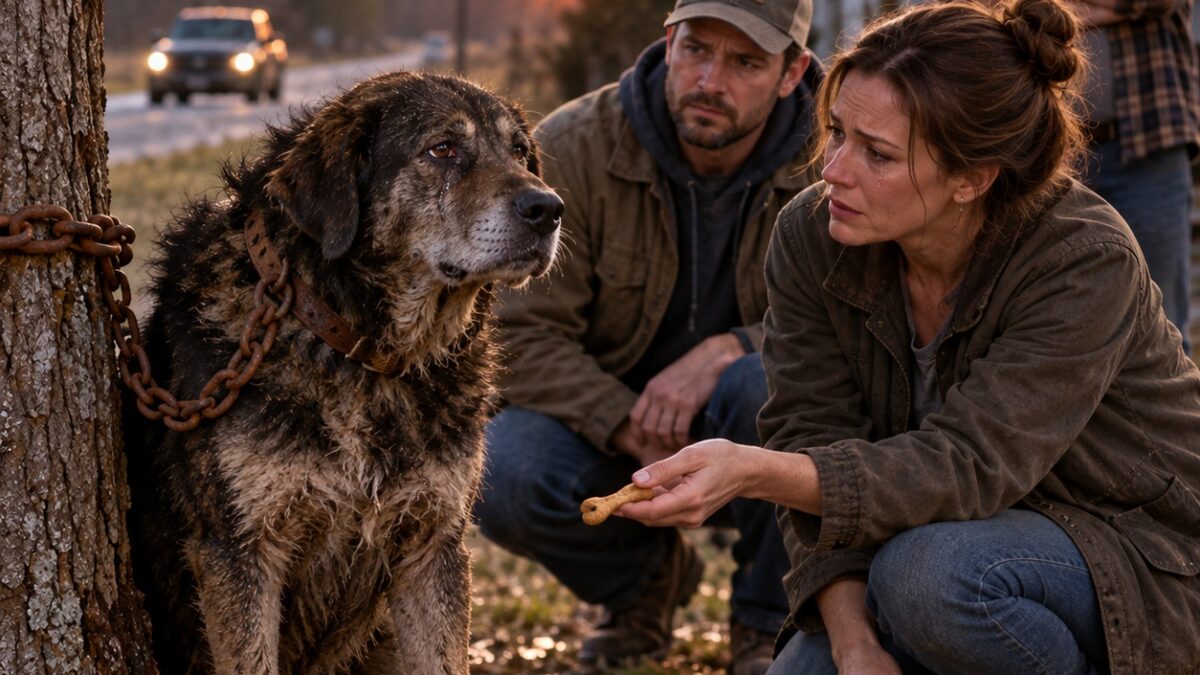
I stayed on my knees.
The dirt was damp beneath my jeans.
The treat remained untouched beside his paw.
I had worked with frightened dogs before.
Dogs who lunged because they were terrified.
Dogs who pressed themselves against kennel walls.
Dogs who tried to climb fences.
Dogs who urinated when a hand moved too quickly.
Those animals were painful to see.
But somewhere inside all that fear was still an expectation.
Something mattered.
A person could hurt them.
A person might help them.
Either way, the human being in front of them still meant something.
Rufus looked at me as if I had already happened.
As if I were another car passing the road.
Another voice from a window.
Another person who might look, feel bad for thirty seconds, and leave.
“How do you give that back?” I asked Marcus.
“What?”
“Trust.”
He sat on his heels.
“You don’t give it back.”
“What do you do?”
“Stay long enough that he notices something changed.”
I looked at the chain.
That was when I knew he was leaving with us.
Not tomorrow.
Not after another call.
That day.
I also knew removing him from that yard would not be the rescue.
It would only be transportation.
The real rescue would begin after the metal was gone.
Because Rufus was already chained somewhere deeper.
The chain had been outside too long.
Rust packed around the links.
The hardware resisted.
I worked carefully.
Rufus never moved.
Metal scraped.
Tools clicked.
My hands slipped once.
Still nothing.
I kept waiting for him to react when pressure changed around his neck.
Nothing.
Finally, with one dull metallic sound, the chain dropped to the dirt.
I sat back.
Marcus did too.
We waited.
A dog who has been physically restrained for a long time often notices immediately when pressure disappears.
A head lifts.
Body shifts.
A step.
Something.
Rufus remained seated.
The chain lay beside him.
He stared toward the road.
“Come on,” I whispered.
“You’re free.”
The word sounded ridiculous the second I said it.
Free.
He had no reason to understand what I meant.
Marcus sat on the ground several feet away.
Did not reach.
Did not call.
Did not pat his leg.
He simply sat.
I looked at him.
“We could be here a while.”
“I know.”
“You okay with that?”
Marcus shrugged.
“We came because he stopped barking.”
“I’m not leaving because he won’t walk on schedule.”
So we waited.
Ten minutes.
Twenty.
Mrs. Harper stood behind her fence for a while.
Then went inside.
The owner disappeared too.
Forty minutes.
A car passed.
For the first time, one of Rufus’s ears twitched.
Tiny movement.
But I saw it.
Marcus saw it.
Neither of us reacted.
A few minutes later, Rufus turned his head.
Not toward the road.
Toward Marcus.
He studied him.
Then me.
The expression in his eyes had changed.
Not trust.
Not yet.
Something smaller.
Curiosity.
A question.
Why are you still here?
I spoke softly.
“We’re not leaving you.”
Rufus tilted his head.
Marcus smiled without showing teeth.
“There you are.”
The dog slowly shifted his weight forward.
His back legs trembled.
He stood.
One step.
Stopped.
Looked down.
For the first time, he seemed to notice the chain on the ground.
He smelled the air.
Then walked toward me.
Straight toward me.
I did not move.
He came close enough that I could feel his breath.
Then he pressed his muzzle against my shoulder.
Barely.
The lightest contact.
If I had moved too quickly, I think he would have vanished inside himself again.
So I did nothing.
No hug.
No hand over his head.
No excited voice.
I let Rufus choose the distance.
He stayed.
His muzzle against my shoulder.
Breathing unevenly.
Body shaking.
And I remember thinking:
This dog has been begging for help for years.
Now that help is finally touching him, he still does not know whether he is allowed to believe it.
I whispered:
“You don’t have to do anything.”
“You already did enough.”
Getting him into the truck took time.
Not because he fought.
Because movement itself seemed unfamiliar.
We let him stop.
Look.
Take another step.
Stop again.
Marcus opened the rear door and sat sideways on the seat.
Rufus looked inside.
Then at me.
Back at the road.
For a moment, I wondered whether he would turn around and return to the tree.
Not because he wanted to.
Because familiarity can look like safety even when familiarity is suffering.
I touched the seat.
“You can come.”
He placed one front paw on the step.
Stopped.
Second paw.
Then climbed.
No dramatic leap.
No burst of joy.
He simply folded himself onto the back seat.
I climbed in beside Marcus.
For the first part of the drive, Rufus stared through the window.
Every passing car.
Every fence.
Every driveway.
His eyes kept searching.
Eventually his eyelids lowered.
Not fully asleep.
Just tired enough to stop watching for a few seconds.
That was the first time I saw what he looked like when he was not waiting for something bad or useless to happen.
Marcus glanced back.
“He needs a name.”
“He probably has one.”
“Maybe.”
“Owner didn’t give us anything useful.”
I looked at him.
Dark coat.
Heavy head.
Something old-fashioned about him.
“Rufus.”
Marcus smiled.
“Rufus?”
“Sounds solid.”
“You’re naming a dog based on vibes now?”
“I’ve done worse.”
Rufus opened one eye.
I laughed quietly.
“See?”
“He approves.”
Marcus shook his head.
But the name stayed.
The shelter was not magic.
People sometimes imagine rescue like this:
Chain cut.
Dog placed in clean kennel.
Food.
Warm blanket.
Happy ending begins.
No.
The first days were worse in a different way.
At the tree, Rufus had at least understood the rules.
Sit.
Wait.
Road.
Chain.
At the shelter, everything changed.
New smells.
New people.
Dogs barking.
Metal doors.
Bowls.
Leashes.
Hands.
Choice.
Choice can be frightening when an animal has spent years without it.
Rufus did not eat much.
Sometimes not at all.
He barely drank.
He lay in the back of his kennel facing the wall.
If someone entered, he did not growl.
Did not bark.
Did not retreat.
He simply made himself absent.
One volunteer told me:
“I don’t think he likes me.”
I said:
“It’s not about you.”
That was important.
Rufus was not rejecting people individually.
He had stopped expecting people collectively.
There is a difference.
Several staff members worried.
Not because they disliked him.
Because shelter work is already full.
Full kennels.
Medical cases.
Dogs with obvious needs.
A dog who lies still can become invisible even inside a rescue building.
That scared me.
So I went every day.
I did not have a therapy plan.
I did not pretend I knew some secret technique.
I sat beside his kennel.
Sometimes on the floor.
Sometimes against the wall.
And I talked.
About nothing useful.
Calls from that day.
Another dog.
Weather.
Marcus.
My grandmother.
I told him stories about her village.
How she believed animals remembered things people forgot.
I told him about Marcus once spending days with an abandoned horse until the horse finally stopped moving away whenever he entered the field.
I told Rufus about my lunch.
About traffic.
About a stupid argument I had with a vending machine.
Whatever came to mind.
He rarely looked at me.
That was fine.
The point was not response.
The point was consistency.
I arrived.
I sat.
I left.
Then returned.
Again.
Again.
Again.
No demand attached.
No one had done that for him.
At least not enough.
The hardest part of those first weeks was resisting the urge to measure progress too aggressively.
Humans love milestones.
First meal.
First tail wag.
First walk.
First kiss.
We take recovery and turn it into a checklist because checklists make us feel useful.
Rufus did not care about my checklist.
Some days he seemed slightly better.
Next day he faced the wall again.
One afternoon he ate while I sat nearby.
The following morning he would not touch breakfast.
I learned to stop treating every bad day as reversal.
Trauma does not travel in a straight line.
Neither does trust.
Marcus reminded me of that whenever I became impatient with myself.
“He’s not behind.”
Marcus said once.
“Behind what?”
“Your imaginary schedule.”
I glared at him.
He was right.
Annoying man.
About two weeks after we brought Rufus in, I arrived in the morning and stopped outside his kennel.
He was sitting at the front.
Not the back wall.
Front.
That was all.
A difference of perhaps six feet.
It felt enormous.
I entered.
Sat in my usual spot.
“Morning.”
Rufus looked away.
I started talking.
I do not remember what story.
Probably something boring.
Then I felt it.
His eyes on me.
I looked.
He was not staring through me.
He was looking at me.
Not past my shoulder.
Not toward the hallway.
Me.
Only seconds.
Then he looked away.
My throat tightened.
I did not clap.
Did not move.
Just said:
“I see you.”
Pause.
“And you see me.”
“That’s a start.”
His ears shifted.
That was enough.
Food improved slowly.
He began eating more regularly.
Then drinking normally.
He started standing when I arrived.
Eventually, he began walking toward the kennel door.
At first, he would stop before crossing it.
So we waited.
No pulling.
No dragging.
No forcing him into the corridor because “he has to learn.”
One day, he stepped out.
Then another.
The shelter hallway seemed enormous to him.
Every doorway required examination.
Every new sound brought a freeze.
We let him stop.
A dog who has been forced for years does not need freedom introduced as another kind of force.
That became my rule.
Let him choose whenever safety allowed it.
The first tail wag almost broke me.
I came in one morning.
Rufus lifted his head.
Looked at me.
Then his tail moved.
Once.
Twice.
Slow.
That was it.
Two movements.
I stood in the doorway with my hand over my mouth because I suddenly felt ridiculous tears coming.
“Rufus.”
He stopped wagging.
I laughed through tears.
“Okay.”
“Too much.”
“I’m sorry.”
I sat.
A few minutes later, Marcus arrived.
He watched Rufus.
Then me.
Then Rufus again.
“You know he chose you.”
“What does that mean?”
“He waits for you.”
“He doesn’t let most people get close.”
“He settles when you’re here.”
“That doesn’t mean—”
Marcus gave me a look.
“You rescue animals all day and somehow still think you’re not allowed to be chosen back.”
I looked at Rufus.
He had put his chin on his front paws.
Eyes still on me.
“I didn’t come here looking for a dog.”
Marcus laughed.
“No one ever does when it matters.”
Adoption was not dramatic.
Friday afternoon.
Paperwork.
Signatures.
Routine forms.
I wrote my name.
Rufus’s.
Address.
Emergency contact.
Initialed boxes.
Then I sat in my vehicle afterward with Rufus beside me.
Neither of us moved.
It felt strange.
We had crossed some invisible line.
The shelter had become temporary.
My house had become next.
Rufus stared through windshield.
I looked at him.
“Well.”
Nothing.
“Let’s go home.”
His eyes moved toward me.
Then forward.
I started the engine.
The first night, Rufus inspected every room.
Slowly.
Living room.
Kitchen.
Hallway.
Bedroom.
He sniffed furniture.
Corners.
Doorways.
Then stopped at front window.
Stared toward road.
That hurt.
Because I knew the posture.
Head slightly lifted.
Eyes following traffic.
Body still.
For a moment, the old tree was inside my house.
Invisible chain.
I sat on the floor.
Not beside him exactly.
Near enough.
I waited.
Rufus watched three cars pass.
A man walking a dog.
A cyclist.
Then he left the window.
Walked toward me.
Turned once.
Lowered himself beside my leg.
Pressed his back against me.
Then sighed.
Deep.
Long.
The kind of sigh that seems to empty an entire body.
I placed my hand on the floor near him.
Not on him.
He moved closer until his side touched my fingers.
I whispered:
“You don’t have to watch the road anymore.”
He closed his eyes.
The next months were not a montage.
No sudden transformation.
No perfect dog by week three.
We learned each other slowly.
Leash walking was especially strange for him.
At first he stopped every few steps.
Not because he wanted to return home.
Because he seemed unable to understand that the path kept going.
At the tree, movement had ended where the chain ended.
A certain number of feet.
Turn around.
Walk back.
Now there was no end.
That freedom confused him.
I would walk five steps.
Rufus stopped.
I stopped too.
He looked behind.
Forward.
At me.
Then walked three more.
The first time we went around the entire block, it took a ridiculous amount of time.
I did not care.
He had spent years in one circle.
We had time.
He began learning sounds.
Mail truck.
Garbage pickup.
Children running.
Doorbell.
At first every car made him freeze.
Especially when he could see it moving away.
He watched until it disappeared.
I wondered whether he expected one of them to turn back.
Maybe he remembered years of seeing vehicles pass his tree.
Perhaps every one represented possibility.
Perhaps none.
I could not know.
So I stopped narrating his thoughts for him.
That was another lesson.
Humans are quick to give rescued animals poetic inner monologues.
Sometimes that helps us empathize.
But Rufus deserved to be Rufus, not a symbol I invented.
I could observe.
He froze at cars.
Then gradually froze less.
That was enough.
One morning, months after adoption, a car passed close beside us on a quiet street.
Rufus stopped.
I stopped.
He tracked it until it disappeared.
Then turned.
Looked directly into my eyes.
And started walking.
No shaking.
No backward pull.
No hesitation.
Just forward.
I stood there one second longer than necessary.
Then caught up.
That moment mattered because it was ordinary.
He had looked backward.
Then chosen forward.
Not because the road behind him vanished.
Because it no longer controlled where his feet went next.
He became more affectionate slowly.
Not clingy.
Rufus did not suddenly turn into a dog who wanted constant touching.
He preferred contact with control.
He might lean against my leg.
Rest muzzle near my hand.
Sit close enough that our shoulders touched.
At night, sometimes he slept near my bed.
Other nights, farther away.
I stopped measuring love by proximity.
If he chose another room, that was not rejection.
Choice was success.
A dog who had once been unable to move beyond a chain now chose where to sleep.
That is freedom too.
Marcus visited often.
Rufus tolerated him first.
Then accepted him.
Eventually Marcus became one of the few people Rufus approached willingly.
One afternoon Marcus sat on my porch.
Rufus lay nearby.
I brought coffee.
Marcus looked at him.
“He’s different.”
“Better?”
“Different.”
“What’s the distinction?”
Marcus shrugged.
“Better makes it sound like the old dog was broken.”
I sat.
He continued.
“He adapted to survive.”
“Now he doesn’t need all the same adaptations.”
I looked at Rufus.
Sleeping.
One paw stretched forward.
“He really stopped barking because nobody came.”
“We don’t know exactly why.”
Marcus said.
Then:
“But I think silence was the first thing anybody noticed.”
I nodded.
Mrs. Harper had called because silence scared her.
For years, the barking was irritating.
Then it stopped.
That was when someone finally understood the noise had meant something.
That thought stayed with me.
How many animals—and people—are labeled difficult while still actively asking for help?
And how often do we become alarmed only when they stop?
I visited Mrs. Harper once.
Not immediately.
Months later.
She asked about Rufus.
I showed her a picture.
Rufus asleep on his back.
One leg crooked.
Completely undignified.
Mrs. Harper covered her mouth.
“That’s him?”
“That’s him.”
“He looks…”
She stopped.
Then smiled.
“Safe.”
I liked that word.
Not happy.
Not healed.
Not transformed.
Safe.
A much more useful beginning.
She asked:
“Does he bark?”
“Sometimes.”
“At what?”
“Squirrels.”
Mrs. Harper laughed.
Actually laughed.
Then started crying.
“I used to hate that barking.”
“I know.”
“I would lie awake thinking I’d lose my mind.”
“I know.”
“Then when it stopped…”
Her eyes went toward the old yard.
“I would have given anything to hear it again.”
I touched her arm.
“You called.”
“Four days late.”
“You called.”
That mattered.
Not everyone who fails to act immediately is indifferent.
Sometimes people need time to understand what they are seeing.
Mrs. Harper understood eventually.
Then did something.
Rufus’s life changed because of that phone call.
The former owner did not become part of Rufus’s new life.
The source of the story gives me no dramatic punishment to offer.
No arrest.
No courtroom.
No public confession.
He had been indifferent.
He believed a dog belonged beside a tree because that was where he put him.
That was enough for me to remember.
I did not need revenge to make Rufus’s recovery meaningful.
The most important thing was simple.
Rufus did not live there anymore.
Months passed.
His coat improved.
His posture changed.
His walk became more confident.
But some habits remained.
He still liked windows.
He still watched roads.
I stopped treating that as pathology.
Maybe he just liked watching.
Not everything a rescued animal does needs to be turned into trauma.
That is another trap.
Once you know an animal has suffered, you can start reading suffering into every behavior.
Sometimes a dog sits at a window because dogs like windows.
So I let Rufus tell me through patterns.
Was he tense?
Could he disengage?
Did he choose to move away?
Over time, yes.
Then the window became just a window.
I thought often about taking him back to the road.
At first, I rejected the idea.
Why would I?
He escaped.
The past did not deserve another visit.
Then the thought returned.
Not for closure in some cinematic sense.
I do not believe animals need us to stage emotional ceremonies.
But I wondered what he would do.
More importantly, I wondered whether I needed to see that place again without him chained there.
Eventually, one day, I decided to go.
No audience.
Just Rufus and me.
We drove the same road.
I recognized turns.
Fence.
House.
Tree.
The chain was gone.
Only an empty patch of ground remained.
I parked along the shoulder.
Rufus looked out.
I opened the door.
He stepped down.
No trembling.
No freeze.
We stood together.
He looked at the tree.
Long time.
Then at the patch of earth.
I said nothing.
There was nothing I could say that would improve the moment.
Then Rufus turned.
Walked back toward me.
Placed one paw on my knee.
Looked up.
That was all.
People might assign words to it.
I’m not there anymore.
Maybe.
That is certainly what I felt.
But what I actually know is simpler.
He looked at the tree.
Then came to me.
That was enough.
I put my hand against his chest.
“Yeah.”
“We’re here.”
On the drive home, sunset spread orange and pink across sky.
Rufus sat in passenger seat.
Head near open window.
Wind moving through his coat.
Months earlier, that same dog had sat beside a road watching every car disappear.
Now he was inside one.
Moving away.
That image hit me hard.
I thought about the first day.
The untouched treat.
The chain on dirt.
Marcus sitting quietly.
Mrs. Harper saying the barking stopped.
The owner saying:
“He learned where he belongs.”
He had been wrong.
Rufus did learn where he belonged.
Just not there.
That evening, Rufus slept beside me.
Breathing deep and even.
Crickets outside.
Occasionally a paw twitched in sleep.
Once, it touched my hand.
I left it there.
I thought about all the dogs still waiting.
Some barking.
Some lunging.
Some hiding.
And some silent.
The silent ones worry me most now.
Not because silence always means despair.
But because silence can be mistaken for contentment.
A dog stops making trouble.
People say:
“He finally settled down.”
Maybe.
Sometimes he has simply stopped believing trouble changes anything.
That difference matters.
Rufus taught me patience I thought I already possessed.
I worked in rescue.
I thought patience meant giving a scared dog ten minutes.
Twenty.
Maybe an afternoon.
Rufus taught me patience can mean weeks of sitting beside a kennel without requiring eye contact.
Months of stopping every few steps on a leash.
Letting progress be two tail movements.
Letting setback be part of progress without naming it failure.
He taught me that freedom is not the moment metal hits dirt.
The chain fell in seconds.
His mind took much longer.
That did not mean the rescue failed.
It meant bodies and minds do not keep the same calendar.
He taught me something about trust too.
People say:
“Earn trust.”
Usually as though trust is a point system.
Treats.
Walks.
Gentle hands.
Enough points and suddenly the dog trusts you.
Rufus showed me trust can be more fragile.
You do not earn it once.
You demonstrate reliability repeatedly.
I come back.
I do not force.
I keep food available.
I let you move away.
I open doors.
I do not close them behind you as punishment.
Again.
Again.
Again.
Eventually the pattern becomes believable.
That is trust.
Not emotion first.
Evidence first.
Rufus needed evidence.
So did I.
The funny part is Marcus had understood that almost immediately.
“Stay long enough that he notices something changed.”
That was the entire rescue.
We stayed.
Mrs. Harper stayed aware enough to call.
Marcus stayed on dirt.
I stayed beside kennel.
Rufus stayed long enough inside his own uncertainty to test us.
The story is not about one heroic act.
Cutting chain looked heroic.
It was the easiest part.
Bolt cutters.
Rust.
Metal.
Done.
Staying was harder.
Staying when there was no visible reward.
Staying when he did not eat.
Staying when he did not look at me.
Staying without turning his suffering into proof of my goodness.
That is the work.
Sometimes visitors ask:
“Is this the dog who didn’t bark?”
Rufus will usually ignore them.
Good.
He does not owe strangers a reenactment.
I say:
“Yeah.”
Then change subject.
His past is part of him.
It is not his job.
He does bark now.
Not constantly.
A squirrel crosses yard.
Mail carrier.
Occasionally a dog across street.
The first time he barked inside my house, I nearly fell out of a chair.
One sharp:
“Woof.”
Then silence.
I looked at him.
He looked at me.
“What?”
I asked.
Another bark.
A squirrel on fence.
I laughed.
Hard.
Rufus looked offended.
“Sorry.”
I said.
“Very serious security matter.”
He barked again.
That sound was not a plea.
Not panic.
Just a dog having an opinion.
Beautiful.
I did not celebrate loudly.
I learned.
No making it a moment.
That lesson belongs to more than children.
Let ordinary things become ordinary.
Rufus did not need every bark interpreted as recovery.
He needed to bark because there was a squirrel and squirrels are suspicious.
That is enough.
I have people ask whether rescuing Rufus changed me.
Yes.
But not in the sentimental way people usually expect.
He did not teach me that love fixes everything.
Love did not untangle his coat by itself.
Love did not create appetite overnight.
Love did not make every fear disappear.
Love without patience can become pressure.
Love without observation can become projection.
Love without respect for choice can look surprisingly similar to control.
Rufus taught me to make love quieter.
More consistent.
Less interested in being recognized.
That changed me.
He also made me rethink what rescue means.
Before Rufus, I might have said rescue is removing an animal from danger.
Now I would say that is removal.
Necessary.
Urgent.
Vital.
But rescue continues after.
Can the animal rest?
Eat?
Choose distance?
Look away without being followed?
Explore?
Return?
Trust an open door?
Sleep without monitoring the road?
Those are different questions.
Rufus answered slowly.
That was okay.
There were days I wondered whether adopting him had been selfish.
Marcus had said he chose me.
Maybe.
But what if I needed to believe that?
I had spent so much time near his kennel.
What if another home could have been equally good?
Possibly.
I do not need to make our bond destiny.
He trusted me.
I was able to provide what he needed.
I wanted him.
He came home with me.
That is enough truth.
Not everything needs fate.
At night, sometimes Rufus dreams.
Legs twitch.
Breath changes.
I never know what dream contains.
I do not wake him unless he seems distressed.
If his paw touches my hand, I leave mine where it is.
He wakes.
Looks around.
Sees room.
Me.
His bed.
Window.
No chain.
Then settles.
Those small moments move me more than the dramatic ones.
Because safety is not usually one revelation.
It is recognizing the same safe room again and again after waking.
I keep thinking about the treat beside his paw the first day.
He never ate it.
I used to see that as heartbreaking.
Now I see something else.
Rufus was not refusing food.
He was refusing a bargain he no longer believed.
Come closer.
Trust.
Maybe something good happens.
He had learned those bargains did not pay.
So why participate?
Later, when food became reliable and not conditional on performance, eating returned.
It reminds me that trust often returns when goodness stops being bait.
That applies beyond dogs.
Mrs. Harper calls occasionally.
“How’s Rufus?”
“Sleeping.”
“Eating.”
“Judging my cooking.”
Normal updates.
One day she asked whether I thought he remembered her voice through the window.
“I don’t know.”
I said.
She became quiet.
“I hope he knows somebody cared.”
I thought.
Then:
“You cared enough to call.”
“He may not understand the history.”
“But his life changed because you cared.”
She cried.
I let her.
Marcus remains exactly Marcus.
Still rotates wedding ring when worried.
Still says painful truths quietly.
One afternoon he sat beside Rufus on porch.
Rufus leaned against his shin.
Marcus looked pleased.
“He likes me now.”
“Don’t get arrogant.”
“He definitely prefers me.”
“He lives with me.”
“Because I have standards.”
Rufus sighed.
I told Marcus the dog had voted.
Against him.
Marcus disagreed.
That is friendship.
People sometimes ask why I called him Rufus.
The literal meaning did not fit perfectly.
His coat was dark.
But names do not have to be academically precise.
It sounded solid.
Reliable.
A name that did not ask him to be tragic.
I did not call him Hope.
Freedom.
Chance.
Survivor.
He had already carried enough symbolism.
Rufus could just be a dog.
That mattered to me.
He likes one corner of my couch.
He steals blankets but only after I get up.
He distrusts vacuum cleaner.
He prefers chicken to beef.
He becomes deeply offended if rain interrupts a walk he did not want to take five minutes earlier.
He snores.
Loudly.
None of those things are inspirational.
Thank God.
A rescued dog deserves enough life after trauma to become annoying.
There is a tendency to end rescue stories at the biggest emotional image.
Chain cut.
Muzzle on shoulder.
Adoption papers.
Return to old tree.
I understand why.
Those images are clean.
But Rufus’s real ending is messier.
He keeps living.
Some mornings confident.
Some mornings cautious.
He may always carry pieces of what happened.
That does not mean he failed to heal.
Healing is not erasure.
It is having enough safety that the past is no longer the only thing determining the next step.
Rufus has that.
The day we returned to the old road, he did not bark.
Interesting.
He looked.
Came to me.
Then left.
The silence there was different from the silence that first brought us.
First silence had felt empty.
Defeated.
That final silence felt complete.
He did not need to call anyone.
Someone had already stopped.
When we got home, Rufus walked straight inside.
No pause at door.
No checking road.
Drank water.
Turned twice on rug.
Lay down.
I stood in kitchen watching.
It occurred to me that the greatest evidence of change was not the paw on my knee.
It was this.
Coming home and acting like home belonged to him.
I sat beside him.
He opened one eye.
Closed it.
No ceremony.
Perfect.
Tonight, as I write this, Rufus is asleep beside my chair.
His breathing is deep.
Crickets outside.
The road beyond my house is quiet.
Every once in a while, a car passes.
He does not get up for most of them.
Sometimes his ears move.
That is all.
There are still animals beside roads.
Still chains.
Still people who believe food and a patch of dirt are enough.
Still neighbors who hear barking and assume nuisance.
Still dogs who eventually stop making noise.
I cannot reach all of them.
None of us can.
But I understand something now I did not understand before Rufus.
When the noise stops, do not automatically assume the problem ended.
Sometimes that is the moment to look closer.
The owner said Rufus had learned his place.
He was right in the worst possible way.
Rufus had learned that the tree was where life happened to him.
That the road carried people away.
That barking did not change outcomes.
That chains stayed.
Then we gave him different evidence.
Not speeches.
Evidence.
The chain came off.
Marcus stayed sitting.
I came back tomorrow.
And tomorrow.
And tomorrow.
Food remained.
Doors opened.
Walks continued past the old invisible boundary.
Cars left and nothing terrible followed.
Home remained when he woke.
Eventually Rufus learned another place.
Not a geographic one.
A place inside the world where his choices mattered.
That is what I think freedom became for him.
Not simply:
No chain.
But:
I can move and safety moves with me.
I often remember the first hour beside the tree.
The owner had gone inside.
Mrs. Harper watching.
Marcus on dirt.
Me feeling impatient because the chain was gone and Rufus was still sitting there.
I had thought:
Why doesn’t he move?
Now I understand how unfair that thought was.
The metal had been removed seconds earlier.
His life had taught him the opposite lesson for years.
Why would one sound of falling chain outweigh years of repetition?
Trust takes evidence.
Evidence takes time.
We gave him time.
He did the rest.
That is why I resist saying:
“I saved Rufus.”
I helped.
Marcus helped.
Mrs. Harper helped.
Shelter staff helped.
But Rufus made every difficult move.
He stood.
He took first step.
He touched my shoulder.
He ate again.
Walked out kennel.
Wagged tail.
Entered my house.
Walked past moving cars.
Returned to old tree.
Turned away.
He came back.
That was his work.
Maybe that is what Marcus meant when he said Rufus chose me.
Not that I was special.
That Rufus still had enough inside him to choose anything.
We had mistaken stillness for emptiness.
It was not empty.
There was a question waiting.
Are you really staying?
We answered with time.
If I had to name the moment the story changed, I would not choose adoption.
Or tail wag.
Or old road.
I would choose the moment Rufus turned his head after almost an hour beside the tree.
Looked at Marcus.
Then me.
A question in his eyes.
That was the crack.
Not trust yet.
Possibility.
All recovery needs somewhere to start.
For Rufus, it began with a question.
Why are these people still here?
Our answer was simple.
Because this time, somebody stops.
My name is Arvis Dodson.
Years ago, I thought rescue meant arriving at the worst moment.
Cutting chains.
Opening gates.
Driving animals away from people who failed them.
Rufus taught me rescue is what happens after everybody who applauds the chain-cutting goes home.
It is sitting on concrete.
Returning the next morning.
Waiting beside a kennel.
Learning not to force a leash.
Letting two tail movements be enough.
Watching a dog discover that the road goes farther than the old chain ever allowed.
It is being present long enough for freedom to stop feeling temporary.
Rufus still sleeps beside me.
Sometimes his paw touches my hand.
Not because he is asking to be saved.
Because he knows where I am.
There is a difference.
Outside, cars pass.
He no longer counts them.
I do not either.
The tree is behind us.
The chain is gone.
And the dog who once barked at every person passing until he finally gave up asking now has something much quieter than rescue.
He has a life ordinary enough that tomorrow morning he will wake up, stretch, steal my place on the couch, complain about breakfast being three minutes late, and walk out the front door without once wondering how far the chain will let him go.
That is the ending.
Not that Rufus stopped barking.
Not that I cut him free.
Not even that I brought him home.
It is that one day, after years of watching the road for someone who might stop, Rufus finally stopped waiting for rescue—because he had learned that he was already home.

