PART2:For Three Days, Crows Pecked at a 4-Pound Puppy in the Rain—Then One Woman Refused to Stop Coming Back
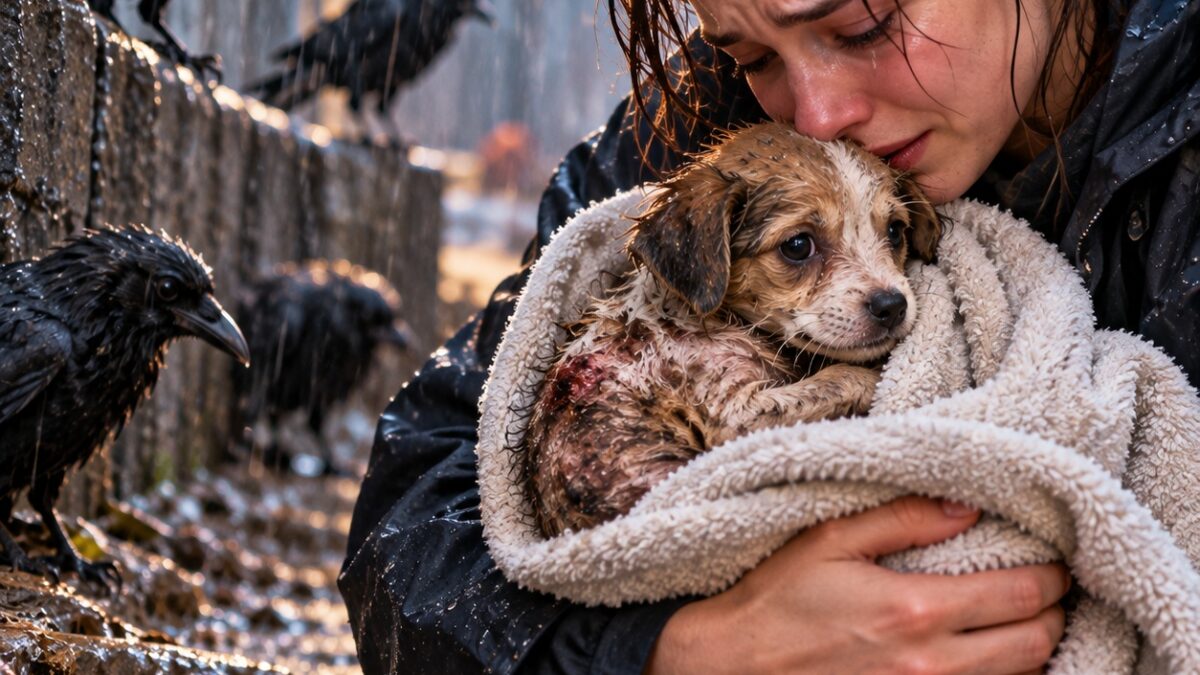
PART2
Warmth was not enough.
That was the first thing the veterinarian made clear.
Grace looked so fragile that anyone seeing her for the first time might have thought the greatest emergency was simply getting her dry.
The truth was more complicated.
Her skin was damaged.
Several wounds were infected.
Her body condition was poor.
She was dehydrated.
And beneath everything visible, something worse was already happening.
The veterinary staff took her temperature.
Checked her gums.
Examined the wounds.
Ran tests.
The rescuer waited with Grace wrapped inside a clean towel.
Every few minutes, the puppy opened her eyes and looked toward the woman’s voice.
That tiny response became important later.
At that moment, it was simply heartbreaking.
The rescuer rubbed the side of Grace’s head with one finger.
“You made it here.”
Grace blinked.
“You only have to do the next part.”
The rescuer did not know what the next part would be.
Then the veterinarian returned.
His face had changed.
People who spend their lives around sick animals learn to soften bad news without hiding it.
The rescuer recognized the expression immediately.
“What?”
“She tested positive for parvovirus.”
The room seemed to shrink.
“And?”
The veterinarian hesitated.
“Canine coronavirus as well.”
The rescuer looked down at Grace.
The puppy was barely awake.
Parvo.
She knew enough to understand the danger.
Especially in a puppy this small.
Especially one already weakened by exposure, hunger, dehydration, and infected wounds.
“How bad?”
“We’re going to support her as aggressively as we can.”
That was not the answer.
“How bad?”
The veterinarian looked at Grace.
“Critical is possible.”
The rescuer closed her eyes.
They had just pulled her out of the rain.
Just.
Grace had survived crows.
Cold.
Hunger.
Three days alone.
And now a virus that kills puppies was inside her.
The rescuer touched Grace’s ear.
The puppy barely moved.
“What does she need?”
Fluids.
Medication to help control vomiting.
Supportive treatment.
Monitoring.
Wound care.
Nutrition when she could tolerate it.
Isolation because parvo spreads easily.
And time.
Time was always the part nobody could prescribe.
The rescuer agreed to everything.
There was no dramatic decision.
No question of whether Grace was worth the effort.
She had already answered that when she drove into the rain.
The first day brought a little hope.
Grace responded to fluids.
Her eyes seemed brighter.
She lifted her head.
For several hours, she appeared more aware of the room.
The rescuer allowed herself to imagine that maybe the worst had been the exposure.
Maybe Grace had been found just in time.
Maybe the tests sounded scarier than the reality would become.
That hope lasted less than a day.
Grace stopped eating.
Not picky.
Not hesitant.
Stopped.
The rescuer offered soft food.
Grace turned her head.
A little broth.
Nothing.
A tiny amount on a finger.
Grace sniffed.
Turned away.
Then came the vomiting.
The first time, the rescuer cleaned it and told herself this was expected.
The second time, she became afraid.
By the third, the fear changed shape.
Grace had almost nothing inside her to lose.
Still her body tried to empty itself.
Then diarrhea began.
Watery.
Then bloody.
The rescuer stared at the red on the pad beneath Grace and felt something cold move through her chest.
“Come on, baby.”
Grace lay on her side.
Her eyes opened at the voice.
That mattered.
The rescuer kept telling herself that mattered.
The veterinarian increased the intensity of supportive care.
The goal became brutally simple.
Keep Grace hydrated.
Keep her glucose and electrolytes supported.
Control symptoms as much as possible.
Treat secondary infection risk.
Clean the wounds.
Keep her warm.
Give her body time to fight.
There was no pill that made the virus disappear by morning.
There was only support.
Hour after hour.
Day after day.
The rescuer reorganized her entire life.
Meetings canceled.
Plans abandoned.
Phone calls unanswered.
Meals eaten standing up.
Sleep reduced to pieces.
Every trip outside the house became about Grace.
Veterinarian in the morning.
Treatment.
Back home when safe.
Monitoring.
Cleaning.
Then back again.
Friends sent messages.
How is she?
The rescuer stopped knowing how to answer.
Better?
Worse?
The same?
Grace could look brighter at noon and terrifying by midnight.
One hour she lifted her head.
The next she vomited until nothing came out.
Hope became dangerous because every good sign made the next decline hurt more.
Still, the rescuer kept searching for them.
A tail movement.
Eyes following sound.
One attempt to shift position.
Anything.
At night, Grace slept in a warm space close enough that the rescuer could hear her breathing.
Sometimes the woman woke without knowing why.
No alarm.
No sound.
Just fear.
She would sit up.
Listen.
Then place one hand near Grace.
Breathing.
Still.
One night, shortly before five in the morning, the alarm on her phone began vibrating.
4:58 a.m.
The number burned itself into memory.
The rescuer opened her eyes and for half a second forgot why she had set it.
Then she saw Grace.
Tiny.
Wrapped in blankets.
Treatment supplies ready nearby.
Another infusion.
Another attempt to keep a puppy alive while almost everyone else in the city slept.
The rescuer sat beside her.
Outside, the world was dark.
No traffic.
No voices.
Only rainwater still dripping from somewhere beyond the window.
Grace opened her eyes.
“Hey.”
Her tail moved.
Once.
A weak little tap beneath the blanket.
The rescuer covered her mouth.
That tail.
Everything else could be failing.
Grace’s stomach.
Her intestines.
Her appetite.
Her strength.
But when she heard the voice of the woman who had carried her out of the rain, something inside the puppy still answered.
“You know me?”
Another small movement.
The rescuer laughed and cried at the same time.
“Yeah.”
She stroked Grace’s head.
“I know you too.”
The infusion took time.
The rescuer watched every drop.
Not because staring made it work faster.
Because doing nothing felt impossible.
Grace’s breathing was shallow.
Her wounds needed attention too.
That was the cruelty of her condition.
The virus did not pause because the skin was infected.
The wounds did not stop hurting because parvo was worse.
Everything demanded care at once.
After treatment, the rescuer cleaned Grace’s back.
Warm water.
Gentle pressure.
No unnecessary handling.
Grace trembled.
The woman apologized with every touch.
“I know.”
Clean.
Dry.
Medication according to the veterinary plan.
Fresh bedding.
Then the blood again.
More than before.
The rescuer stared.
“Grace.”
The puppy’s head lowered.
Panic arrived suddenly.
Not the controlled fear she had been carrying.
Real panic.
She lifted Grace carefully.
Too light.
Lighter than before.
That was impossible.
Grace had already been four pounds.
But the scale later confirmed what the rescuer feared.
She had lost an enormous proportion of her tiny body weight.
Nearly half.
There is something frightening about holding a puppy who can almost fit inside two hands and knowing disease has taken even more from her.
The rescuer drove back to the veterinary clinic before sunrise.
She talked to Grace the entire way.
Not inspirational speeches.
Anything.
Traffic lights.
Weather.
The fact that the car heater was too warm.
A dog she once had as a child.
The words did not matter.
Her voice did.
At the clinic, the veterinarian examined Grace again.
The rescuer watched his face.
“Tell me.”
“She’s very sick.”
“I know.”
“We’re still fighting.”
“Is she?”
That question slipped out.
The veterinarian looked at Grace.
“Yes.”
The rescuer’s eyes filled.
“How do you know?”
“She still responds.”
As if summoned by the word, Grace’s tail moved when the rescuer spoke.
Tiny.
But there.
The veterinarian smiled sadly.
“That.”
The rescuer sat down because her legs had stopped feeling reliable.
For the next several days, life became an exhausting loop.
Fluid support.
Medication.
Vomiting.
Cleaning.
Blood.
Sleep.
Wake.
Veterinarian.
Repeat.
The rescuer began counting time by what Grace had not done.
She had not eaten for another day.
She had not kept food down.
She had not stood long enough.
She had not gained weight.
Then she realized that was destroying her.
So she changed the measurements.
Grace opened her eyes faster today.
Grace moved her head toward the sound of a door.
Grace shifted her front paws.
Grace’s tail moved three times.
Grace drank a tiny amount.
Small things.
Very small.
But when life has narrowed to survival, small becomes enormous.
Grace did not know people were measuring her progress.
She did not know the internet had begun following her story.
She did not know strangers were asking whether the little puppy from the rain was still alive.
She only knew that every time she felt awful, the same woman appeared.
Voice.
Hands.
Blanket.
Warmth.
Again.
Again.
Again.
Animals do not understand promises the way humans do.
They understand patterns.
The rescuer became a pattern.
When pain came, she was there.
When Grace vomited, she cleaned it.
When blood appeared, she did not recoil.
When the puppy smelled terrible from sickness and infected wounds, the woman still held her.
When Grace was too weak to eat, she kept offering without forcing.
That may have been the first dependable thing Grace had ever known.
One afternoon, the rescuer sat on the floor beside her.
She had not showered.
Had barely eaten.
Her phone showed thirty-two unread messages.
Grace lay on a towel.
The woman placed a little food nearby.
Nothing.
She touched a small amount to her finger.
“Please.”
Grace turned away.
The rescuer’s composure cracked.
“Please eat.”
Nothing.
“I don’t know what else to do.”
Grace closed her eyes.
The woman immediately regretted the desperation in her voice.
Animals should not have to carry human fear.
She sat back.
Tears fell.
“I’m sorry.”
Silence.
“I know you’re tired.”
More tears.
“I’m tired too.”
She laughed weakly.
“That seems unfair to say.”
Grace opened her eyes.
The rescuer wiped her face.
“You’re doing the hard part.”
She left the food.
No pressure.
Minutes passed.
Then Grace moved.
Barely.
Her nose shifted toward the plate.
The rescuer stopped breathing.
Grace sniffed.
Nothing.
Then her tongue touched the food.
Once.
The woman stared.
Grace licked again.
A tiny amount.
The rescuer’s hand flew over her mouth.
“No way.”
Grace paused.
Another lick.
The rescuer began crying so hard she had to turn away because she did not want to frighten her.
It was not a meal.
Not even close.
A few licks.
That was all.
But after days of refusal, it felt enormous.
The rescuer took a picture.
Then deleted it because she did not want to think about documenting.
She wanted to watch.
“Good girl.”
Grace licked again.
The woman whispered:
“Good girl.”
Not loudly.
No clapping.
Grace did not need celebration.
She needed food to stay inside.
That became the next fear.
The rescuer waited.
Ten minutes.
Twenty.
Thirty.
No vomiting.
She called the veterinarian.
“She licked food.”
The veterinarian paused.
“How much?”
“Almost nothing.”
“That counts.”
The rescuer laughed through tears.
“I know.”
It was the first time in days the future felt larger than the next hour.
Not safe.
Not guaranteed.
Larger.
Grace ate slightly more later.
Then less.
Then more again.
Progress refused to move cleanly.
One morning she appeared bright enough that the rescuer allowed herself hope.
That afternoon she vomited.
The woman sat on the floor and cried again.
Then cleaned it.
There was no single heroic breakthrough.
There were many tiny negotiations with the body.
One lick.
One sip.
One hour without vomiting.
One stool with less blood.
One night where the alarm sounded and Grace looked up before the rescuer touched her.
One morning where she stood without immediately collapsing.
The wounds on her back began changing too.
The angry swollen edges softened.
Clean tissue appeared.
The smell of infection decreased.
Fur would take much longer.
Healing skin was enough.
The crows had left marks.
Some would become scars.
That did not matter.
Grace was no longer where they could reach her.
The rescuer sometimes looked at those wounds and felt rage.
Not at the birds.
The birds were birds.
They had seen vulnerability and behaved according to instinct.
Her anger belonged elsewhere.
To whoever had left the puppy.
To whoever had seen her first and walked away.
To every human decision that placed four pounds of living animal in a corner and made survival depend on chance.
But anger did not help Grace eat.
So the woman put it down when she entered the room.
Grace did not need rage.
She needed steadiness.
By the second week, the puppy’s eyes looked different.
That was the change people noticed first.
Not weight.
She was still painfully thin.
Not fur.
Still patchy.
Eyes.
The dull exhausted stare had begun to sharpen.
She noticed movement.
Watched doors.
Followed the rescuer.
Sometimes, when the woman stood, Grace tried to rise too.
The first time, her legs folded.
The rescuer caught her.
“No rush.”
Grace tried again twenty minutes later.
Stubborn.
The woman smiled.
“There you are.”
Personality.
That was what was returning.
Illness had reduced Grace to symptoms.
Weight.
Temperature.
Vomiting.
Stool.
Fluids.
Wounds.
Now Grace was beginning to become a puppy again.
She objected to cleaning.
Good.
She tried to climb over a folded towel.
Failed.
Tried again.
Good.
She barked once when the rescuer left the room.
The woman came running, terrified something was wrong.
Grace stared at her.
The rescuer laughed.
“You called me?”
Tail.
There.
Good.
The veterinarian remained cautious.
Parvo did not care that everyone was emotionally invested.
Treatment continued.
Monitoring continued.
Isolation continued.
Grace was not declared safe because she looked better for an afternoon.
The rescuer understood.
Still, she began imagining things.
A collar.
Grass.
A toy.
A normal meal.
A home.
Then immediately stopped herself.
One day at a time.
One meal.
One treatment.
One morning.
Grace began eating small amounts more reliably.
The rescuer sat beside her during every meal.
Not because Grace required an audience.
Because the woman still could not believe it.
There had been nights when she thought she would never hear the sound of that tiny mouth eating.
Now the soft licking and chewing felt almost musical.
Late one evening, Grace had company.
A kitten named Felix.
Felix was small, curious, and completely unaware that Grace’s survival had become emotionally important to hundreds of people.
He cared about the food.
That was all.
The two sat near each other.
Grace eating slowly.
Felix doing what kittens do—behaving as if every meal were an emergency requiring personal management.
The rescuer watched them.
The sight broke something open inside her.
A few weeks earlier, Grace had been alone in rain.
Birds around her.
Nobody beside her.
Now another animal was sitting close enough to bump bowls.
A late dinner.
Warm room.
Company.
Normal.
The rescuer took the picture this time.
She kept it.
Grace did not look heroic.
That made it beautiful.
She looked like a puppy having dinner.
That was the goal.
Not to become an inspirational symbol.
To become ordinary enough that suffering was no longer the main thing people saw.
The days continued.
Grace gained a little strength.
Then more.
She still needed care.
Her body was still recovering from enormous strain.
The rescuer remained afraid to trust good news.
Every time the veterinarian called, her stomach tightened.
Then came day twenty.
The rescuer knew the number because she had counted every one.
Twenty days since Grace came out of the rain.
Twenty days of fear.
Treatments.
Blood.
Vomiting.
Wounds.
Alarms.
Driving.
Watching.
Waiting.
The veterinarian reviewed Grace’s progress.
Her symptoms had resolved enough.
Her condition had stabilized.
She had survived the worst of parvovirus.
Grace had beaten parvo.
The rescuer stared.
“Say it again.”
The veterinarian smiled.
“She beat it.”
The woman looked at Grace.
The puppy was busy sniffing something near the edge of the examination table.
Completely unimpressed.
“You hear that?”
Grace’s tail moved.
The rescuer started crying.
Again.
The veterinarian laughed softly.
“You cry a lot.”
“Apparently.”
Grace licked her hand.
That made it worse.
The rescuer bent forward and pressed her face gently against Grace’s head.
“You did it.”
Not entirely true.
Grace had done much of it.
Veterinary staff had done enormous work.
Medicine had mattered.
Fluids had mattered.
Timing had mattered.
Chance had mattered.
But the rescuer had been there for every terrible hour she could be.
Together, enough things had gone right.
Grace lived.
The news spread quickly.
People who had seen the original photograph shared new ones.
Not the rain.
Not the wounds.
Grace awake.
Grace eating.
Grace standing.
Grace looking at the camera with the cautious curiosity of a puppy discovering that the world might contain something other than pain.
Messages poured in.
Some from people who had followed since day one.
Some from strangers who only saw the recovery.
The rescuer read a few.
Then stopped.
Grace did not need the internet.
She needed the next part.
A foster home.
The rescuer had carried Grace through crisis, but long-term foster care would give her something different.
Routine.
Household sounds.
More space.
A chance to learn what home felt like.
The idea hurt.
That surprised the rescuer.
She had always known Grace would move on if she survived.
That was rescue.
You did not save animals so they would belong to you automatically.
You saved them so they could have choices.
Still, the night before Grace moved to foster care, the rescuer sat beside her for a long time.
Grace had gained weight but remained tiny.
She curled into the blanket.
The woman touched one of the healed places on her back.
“Tomorrow you’re going somewhere good.”
Grace blinked.
“A woman who already loves you.”
Tail.
“And I’m going to pretend I’m not going to cry.”
The rescuer laughed.
Grace crawled closer.
That hurt.
“You can’t do that.”
Grace pressed against her leg.
The woman closed her eyes.
Three days in the rain.
Twenty days fighting.
4:58 a.m.
Blood.
Vomiting.
One tiny lick of food.
All of it existed between them.
“Okay.”
She lifted Grace carefully.
“One more night.”
Grace slept against her.
Not because she was critically ill anymore.
Because she could.
The foster mother adored her immediately.
That word—adored—was not exaggeration.
Grace entered the foster home cautiously.
Her paws moved slowly across the floor.
New smells.
Furniture.
Voices.
The rescuer stayed near the door.
Grace looked back several times.
Each time, the woman smiled.
“You’re okay.”
The foster mother sat on the floor.
Did not reach.
Good.
Grace watched.
Then moved closer.
One step.
Another.
Sniff.
The foster mother whispered:
“Hi, sweetheart.”
Grace’s tail moved.
The rescuer looked away.
She knew that tail.
It had moved at 4:58 a.m. when the puppy barely had strength to live.
Now it moved for someone new.
That was good.
It hurt.
Both.
The rescuer left before she changed her mind.
She cried in the car.
Not grief exactly.
Release.
For weeks, everything in her life had revolved around whether Grace survived another hour.
Now someone else was feeding her.
Watching her.
Loving her.
The rescuer drove home.
Saw the empty treatment area.
The folded blankets.
One towel still carrying a little puppy smell.
She sat down.
Then slept for nearly twelve hours.
Grace settled into foster life.
Slowly at first.
She learned bowls appeared again.
And again.
She did not need to eat as if food would vanish forever.
She learned beds were allowed.
That hands could reach toward her without causing pain.
That footsteps in a hallway did not necessarily mean danger.
The foster mother sent updates.
She ate everything.
She slept through the night.
She barked at the vacuum.
The rescuer loved that one.
A puppy offended by household appliances.
Perfect.
Another:
She stole a sock.
The rescuer replied:
Finally. Criminal behavior.
Normal puppy crimes.
Every one felt like victory.
Grace’s scars remained visible as fur slowly returned.
Some areas filled in.
Some stayed thin.
Her body began to look more like it belonged to a growing puppy rather than a medical emergency.
Weight came back.
Muscle.
Energy.
The foster mother sent a video of Grace running three awkward circles around a chair.
The rescuer watched it six times.
On the seventh, she cried.
Of course.
There was another development.
A family in the United Kingdom had heard about Grace.
They had followed her recovery.
They wanted to adopt her.
Not because she had been famous online.
At least, that was what the rescue team worked to determine.
Adoption after a story like Grace’s required caution.
People can fall in love with tragedy.
They can want the symbol more than the animal.
Grace needed people who would still love her when she was no longer “the parvo puppy.”
When she chewed furniture.
When she needed patience.
When the scars were simply scars.
When the story stopped receiving attention.
So the family was assessed.
Questions.
Home.
Experience.
Expectations.
Plans.
They waited.
And waited.
They did not demand.
That mattered.
They wanted Grace.
Not her viral suffering.
The rescuer began allowing herself to imagine it.
A permanent home.
Not temporary rescue.
Not clinic.
Not foster.
Home.
The word felt dangerous.
Grace had probably had something like a home before.
Somewhere.
No one knew the full beginning of her story.
How she ended up in that corner.
Whether someone dumped her.
Whether she wandered.
Whether she had littermates.
A mother.
Nobody knew.
Rescue often begins in the middle of an animal’s life.
You inherit questions they cannot answer.
The rescuer eventually stopped needing them.
The important fact was not why Grace had been left.
The important fact was that she would not be left again.
Two and a half months after she came out of the rain, Grace was ready.
Healthy enough.
Strong enough.
Cleared.
Adoption final.
The family in the U.K. was waiting.
The foster mother cried first.
That seemed fair.
She had taken Grace from survivor to puppy.
The rescuer came to say goodbye.
Grace recognized her immediately.
That tail.
The rescuer knelt.
Grace ran.
Not weak.
Not careful.
Ran.
Straight into her.
The woman laughed as Grace climbed against her chest.
“You remember me?”
Of course she did.
Smell.
Voice.
Pattern.
Grace licked her chin.
The rescuer closed her eyes.
For a moment, she saw two versions of the puppy at once.
The one in the rain.
And this one.
Heavier.
Warm.
Bright-eyed.
Impatient.
Alive.
“You were so little.”
Grace tried to chew the edge of her sleeve.
“Still rude.”
The foster mother laughed through tears.
The permanent family had sent a new collar.
Grace wore it.
Simple.
Clean.
Not symbolic to her.
Everything to the humans.
The rescuer looked at the little tag.
Grace.
Her name had followed her through every stage.
Rain.
Hospital.
Parvo.
Recovery.
Foster.
Home.
Grace.
People sometimes choose names because they sound pretty.
Sometimes a name becomes a description only later.
The rescuer did not say goodbye dramatically.
No speech about destiny.
No promise to see Grace again.
International adoption meant distance.
The woman had learned something during those early nights.
Promises should belong to what you can control.
So she told Grace:
“You are loved.”
True.
“You’re going somewhere safe.”
True.
“And you never have to prove how strong you are again.”
The puppy looked up.
The rescuer touched her forehead.
“If you want to be weak someday, be weak.”
Her voice broke.
“If you want to be scared, be scared.”
Grace licked her thumb.
“You don’t have to survive everything.”
That was the wish.
A life where survival was no longer Grace’s main job.
The adoption completed.
Grace went home.
Not the temporary home.
Her home.
Photographs arrived afterward.
Grace on a sofa.
Grace wrapped in a blanket.
Grace outdoors on green grass.
Grace asleep with her belly exposed.
That last one mattered to the rescuer.
Animals sleep differently when they feel safe.
Bodies loosen.
Bellies show.
Legs stretch.
The puppy who once curled herself tightly in a corner against rain now slept open.
Unprotected.
Because protection existed around her.
There was a photograph of Grace beside a window.
Rain outside.
She was watching it.
Not trembling.
Not hiding.
Just watching weather.
The rescuer stared at that picture for a long time.
Three days.
Rain had once meant cold.
Exposure.
Birds.
No one coming.
Now Grace watched it from the warm side of glass.
A blanket beneath her.
A family somewhere behind the camera.
That was the picture the rescuer saved.
Not the original.
People kept the original too, of course.
The world likes before-and-after images.
Pain beside recovery.
Proof.
But the rescuer stopped opening it.
She did not need to remember Grace by the worst moment somebody else had documented.
Grace had earned new photographs.
Months passed.
Her coat improved.
Weight normalized.
Her personality became more obvious.
Apparently Grace was stubborn.
Demanding.
Affectionate.
Capable of producing a surprisingly loud bark for such a small dog.
She liked blankets.
Food.
People.
She disliked certain birds.
Nobody blamed her.
One update showed Grace staring suspiciously at a crow through a window.
The rescuer laughed.
“Good.”
Not fear.
Judgment.
Better.
Grace became part of a family.
That sentence sounds ordinary.
It is not.
Not when you know where she began.
Family meant someone noticed when she did not eat.
Someone knew which blanket she liked.
Someone scheduled veterinary checks.
Someone bought toys.
Someone complained when she stole things.
Someone came home and said her name.
Grace.
Again.
Again.
Pattern.
The rescuer’s life moved forward too.
Other animals came.
Different emergencies.
Different eyes.
A kitten hit by a car.
An older dog abandoned after illness.
Another puppy.
There was always another.
People sometimes asked:
“How do you do it?”
The rescuer disliked the question.
She did not feel unusually strong.
There had been nights with Grace when she sat on the floor convinced she could not survive losing another animal.
There were rescues that did not end like Grace.
Those stayed too.
Success did not erase grief.
What Grace changed was not the rescuer’s belief that every animal could be saved.
That would have been dishonest.
Grace taught something smaller.
You do the next necessary thing even when the ending is unknown.
Pick up the puppy.
Drive.
Go to the veterinarian.
Set the alarm.
Wake at 4:58.
Clean the wound.
Offer food.
Try again.
You cannot guarantee survival.
You can guarantee presence.
That distinction became important.
One year after Grace’s rescue, the photograph surfaced again online.
Someone shared it with an updated caption.
The rescuer opened the post.
There was Grace in the corner.
Tiny.
Wet.
Crows near her.
The sight hit just as hard.
Maybe harder now that the woman knew exactly what the puppy felt like in her arms.
Comments filled the page.
How could anyone leave her?
Did she survive?
Please tell me she made it.
The rescuer scrolled.
Then posted one new photograph.
Grace in the U.K.
Healthy.
Sitting on a couch.
Head tilted.
Eyes bright.
No dramatic caption.
Just:
Yes.
That was enough.
Because sometimes the answer people need is simple.
Yes.
She survived.
Yes.
She ate again.
Yes.
The blood stopped.
Yes.
The wounds healed.
Yes.
Someone wanted her.
Yes.
She has a home.
But survival stories can accidentally hide the cost.
The rescuer never wanted people to believe Grace simply “fought” hard enough and therefore lived.
Puppies who die from parvo are not weaker in character.
Animals do not fail because medicine cannot save them.
Grace survived because many things aligned.
She was found.
Someone acted.
Veterinary care was available.
Treatment continued.
Her body responded.
She endured.
Luck mattered.
Money mattered.
Timing mattered.
People mattered.
Turning survival into moral victory insults the ones who do not make it.
So the rescuer told Grace’s story carefully whenever asked.
Grace was brave.
Yes.
But she also needed help.
That was not weakness.
The world often celebrates independence too much.
Four pounds of puppy did not save herself.
She survived because one person saw a photograph and decided observation was not enough.
Then veterinarians did their work.
Then a foster mother opened her home.
Then a family across an ocean said:
We will take her from here.
That is what rescue is.
A chain of people refusing to be the person who walks away next.
Grace did not understand any of that.
Good.
She did not need to.
Her job was finally simple.
Wake.
Stretch.
Eat.
Play.
Sleep.
Bark at something unnecessary.
Repeat.
The foster mother occasionally received updates too.
She and the rescuer would exchange messages.
Look at her now.
A photograph.
Grace wearing a ridiculous sweater.
Another.
Grace asleep upside down.
Another.
Grace sitting beside a food bowl with the expression of someone claiming starvation despite clearly being well fed.
The rescuer loved that most.
Hunger had once been real.
Now Grace could be dramatic about dinner.
That was luxury.
Grace grew older.
Not old.
Just beyond puppyhood.
The scars became harder to see beneath fur.
People meeting her without knowing the story would never guess.
That was satisfying.
The rescuer hoped most strangers did not guess.
There is dignity in not being permanently recognizable by your suffering.
One day, Grace’s family sent a video.
Rain.
Again.
The back door opened.
Grace ran into the garden.
Straight into it.
The rescuer stopped the video.
Replayed.
Grace charged across wet grass.
Rain soaking her fur.
Tail high.
No corner.
No trembling.
No crows close enough to touch.
She ran in circles.
Then back toward the door.
Then out again.
The rescuer cried.
Of course.
But this time she laughed too.
The thing that once surrounded Grace while she was helpless had become weather.
Just weather.
That is how healing sometimes looks.
Not forgetting what happened.
Changing the meaning of what happens now.
The rescuer watched the video until the screen dimmed.
She remembered the first time she lifted Grace.
How little she weighed.
How the puppy’s body seemed to disappear inside the towel.
The sound of that weak cry.
The fear that she would die before reaching the car.
Then:
4:58 a.m.
Tail.
Blood.
Vomiting.
Tiny tongue touching food.
Felix beside her.
Day twenty.
Foster home.
Airport.
New collar.
Home.
All of it.
A life restored not in one dramatic moment but in dozens of ordinary acts.
That was the part people often skipped.
Rescue photographs make transformation look immediate.
Before.
After.
There is no picture for the hours between.
No photograph of the rescuer sitting awake at three seventeen listening for breathing.
No glamour in cleaning bloody diarrhea.
No cinematic angle for changing towels.
No applause when a puppy keeps down a teaspoon of food.
No orchestra when a veterinarian says:
“Still critical.”
Then again tomorrow.
Still.
Still.
Still.
Love often looks boring while it is saving something.
The rescuer learned that with Grace.
Love was an alarm.
A towel.
A drive.
A voice saying:
“I’m here.”
Again.
Years later, people still remembered Grace.
Some called her the crow puppy.
The rescuer disliked that.
Grace was more than the worst thing that happened to her.
So whenever possible, she simply called her Grace.
The name did enough.
A young volunteer once asked:
“Was she your hardest rescue?”
The rescuer thought.
“No.”
The volunteer looked surprised.
“But she almost died.”
“Yes.”
“Then?”
“Hardest isn’t always the sickest.”
Some animals never trusted again.
Some died.
Some disappeared before help reached them.
Grace had been terrible.
Terrifying.
But Grace eventually gave something back.
A tail.
A lick.
A meal.
Recovery.
A home.
The rescuer had been allowed to watch the story turn.
Not everyone gets that.
The volunteer asked:
“What did you learn?”
The rescuer smiled sadly.
“Don’t wait.”
“What?”
“If an animal is suffering and you can act safely, don’t assume somebody else will.”
She thought of the photograph.
Someone took it.
Someone left.
Then another person saw it.
Went.
That difference was Grace’s life.
“Pictures matter,” the rescuer said.
“But action matters more.”
The volunteer nodded.
Grace’s family in the U.K. eventually sent a birthday picture.
Nobody knew Grace’s actual birth date.
So they celebrated the day she arrived home.
A rescue birthday.
Cake made for dogs.
Tiny hat Grace clearly hated.
The rescuer zoomed in.
Grace’s eyes held the same stubbornness she had shown when she first began eating.
Different body.
Same spirit.
The message beneath:
She is spoiled beyond reason.
The rescuer typed:
Correct treatment.
Then deleted it.
Typed:
Good.
Simple.
Grace had spent enough time surviving things she did not deserve.
Spoiling could be tolerated.
Sometimes the rescuer imagined the three days before the photograph differently.
Not because she believed this happened.
Because the mind hates empty suffering.
She imagined Grace waiting.
Hearing footsteps.
Lifting her head.
Then watching people pass.
Again.
Again.
Maybe that was true.
Maybe not.
She eventually stopped trying to fill those hours.
They belonged to Grace in a way no human could fully recover.
What mattered was the fourth day.
Someone came.
That became the line dividing the story.
Before:
Exposure.
After:
Care.
Not instant safety.
Not instant health.
Care.
Care did not mean Grace stopped suffering immediately.
It meant she stopped suffering alone.
That distinction might have been the most important one.
Parvo still hurt.
Wounds still hurt.
Needles.
Fluids.
Vomiting.
Weakness.
Nothing about rescue made those disappear.
But loneliness did.
Someone knew.
Someone watched.
Someone responded.
Animals cannot explain whether that changes pain.
The rescuer believed it does.
Perhaps not physically.
But fear is different when a familiar voice exists inside it.
She had seen Grace’s tail.
Almost no strength.
Still:
voice.
Tail.
Connection.
One winter, years after Grace left, the rescuer woke at 4:58 a.m.
No alarm.
Her body remembered.
She stared at the clock.
4:58.
The exact time.
For a moment, she was back beside the sick puppy.
The dark room.
Treatment.
Fear.
She got out of bed.
Made tea.
Opened her phone.
Scrolled to the most recent photograph of Grace.
Healthy.
Older.
Sleeping beneath a blanket.
The rescuer smiled.
“You’re not here.”
That was a good thing.
Grace did not need her anymore.
Rescuers sometimes struggle with that.
Being needed can feel like love.
But the best outcome is becoming unnecessary.
The foster mother became unnecessary too.
Veterinarians became routine rather than emergency.
Even Grace’s terrible history became unnecessary for understanding her.
She was simply somebody’s dog.
That was the final victory.
Not fame.
Not inspiration.
Belonging.
The rescuer finished her tea.
Went back to bed.
At 4:58 a.m. somewhere in the U.K., Grace was probably asleep.
Warm.
Safe.
Perhaps snoring.
The thought was enough.
If Grace’s life had ended in the corner, the photograph would have become evidence of cruelty.
Instead, it became the first frame of a much longer story.
A story with blood in it.
And fear.
And exhaustion.
But also food.
Felix.
A foster mother.
A family.
Rain seen through glass.
Grass beneath running paws.
The rescuer sometimes wondered whether Grace remembered the crows.
There was no way to know.
Dogs remember fear differently from people.
Associations.
Sounds.
Shapes.
Maybe a black bird still made her muscles tighten.
Maybe not.
What mattered was that fear no longer decided the structure of her day.
Her family did not remove every possible reminder.
They simply gave her enough safe days that terrible days became outnumbered.
One safe meal.
Then another.
One peaceful night.
Then hundreds.
One person returning.
Then a family returning every day.
That is how trust changes.
Not through explanation.
Evidence.
Presence repeated until the body believes it.
Grace had taught that too.
The rescuer could still feel her weight from the first day.
Four pounds.
Almost nothing.
Years later, that memory remained more vivid than many larger moments.
The strangest thing about carrying something so light is how heavy responsibility can feel.
The rescuer knew, walking toward the car, that Grace might die despite everything.
She had no guarantee.
She carried her anyway.
That is rescue.
Not knowing.
Moving anyway.
People prefer stories where courage looks confident.
It rarely does.
The rescuer was terrified.
She drove too carefully because every bump made her look toward the carrier.
At stoplights she whispered:
“Stay.”
She did not feel heroic.
She felt late.
That was why she kept going.
Grace had already waited too long.
The day she was adopted, that lateness finally loosened its grip.
Not erased.
Nothing erases three days.
But the ending became larger.
Two and a half months after a photograph showed a tiny puppy alone in rain, another photograph showed Grace inside her new home.
No wound as the focus.
No blood.
No dramatic rescue hands.
Just Grace.
Standing on a rug.
Looking toward the camera.
Behind her:
A couch.
A toy.
A water bowl.
Ordinary things.
The rescuer loved the ordinariness.
No one who had seen Grace at the beginning would have called that rug miraculous.
But it was.
A place where her feet were supposed to be.
A bowl that belonged to her.
A couch she would eventually treat as property.
A family whose daily schedule now included her.
Home is mostly ordinary objects made meaningful by repetition.
Grace finally had enough repetition to call somewhere hers.
Her family reported that she had become affectionate but independent.
She liked being close.
Not constantly held.
Good.
She chose.
That mattered.
The puppy once too weak to move away from birds could now decide when she wanted contact.
When she wanted space.
When she wanted food.
When she wanted the garden.
Choice is one of safety’s quietest signs.
Grace had choices.
One evening, the family sent a photograph of her asleep beside a child.
The rescuer studied it.
Grace’s head rested against the child’s leg.
No tension.
No guarding.
The child’s hand lay gently on her back, near the old scarred area.
The rescuer remembered cleaning those wounds.
Grace once trembled when that skin was touched.
Now she slept through it.
The woman cried.
Not because the picture was sad.
Because it was not.
That may have been the most satisfying part of all.
One day the story stopped being sad in every direction.
The past remained sad.
The present did not.
Grace did not become an animal people needed to rescue forever.
She became loved.
There is a difference.
The original photograph continued to circulate sometimes.
The rescuer no longer tried to stop it.
Stories can help other animals.
People who saw Grace might choose to act sooner next time.
Donate.
Foster.
Call a veterinarian.
Pick up the phone.
Go.
But whenever possible, she attached the final photograph too.
Not because suffering requires happy endings to be worth caring about.
Because Grace earned the right to be seen alive.
The caption was always simple.
Grace survived.
Sometimes:
Grace is home.
Nothing more needed.
Years after the rescue, rain began outside the rescuer’s window one afternoon.
Heavy.
Cold.
The kind that made gutters overflow.
She stood watching.
For a second, she saw Grace again.
Tiny body in the corner.
Then her phone buzzed.
A message.
From the family in the U.K.
Video.
Grace, older now, trotting through a garden wearing a ridiculous yellow raincoat.
The rescuer laughed out loud.
The hood kept falling over Grace’s eyes.
She shook it off.
Ran.
The family member behind the camera called her name.
Grace turned immediately.
Tail moving.
Then ran toward the voice.
The rescuer replayed that part.
Name.
Turn.
Run toward.
Not away.
Toward.
She remembered the first day she called:
“Baby.”
Grace had barely lifted her head.
Now someone called her from across a garden and she ran because she expected good things at the other end.
That is what love had taught her.
The rescuer put down the phone.
Outside, rain continued.
For once, it did not feel like the beginning of Grace’s story.
It was only rain.
Grace had outlived its meaning.
And perhaps that was the clearest ending anyone could have asked for.
The four-pound puppy who could not protect herself had survived the birds.
She survived infection.
She survived parvo.
She survived the nights when blood covered the bedding and food seemed impossible.
She survived 4:58 a.m.
She survived long enough for her tail to move.
Long enough to lick food.
Long enough to eat beside Felix.
Long enough to reach day twenty.
Long enough to leave emergency care.
Long enough to become someone’s foster puppy instead of someone’s patient.
Long enough for a family across an ocean to say:
We want her.
And then she did something even better than survive.
She stopped needing to.
She got to live.
Not as the puppy from the photograph.
Not as the dog crows attacked.
Not as the parvo case everyone feared losing.
Grace.
Just Grace.
A dog with a home.
A family.
Meals that arrived every day.
Hands that knew how gently to touch her.
A bed waiting at night.
And when rain fell outside, she was finally on the side of the window where someone loved her enough to notice she was there.

