PART2:Doctors Said the Tumor on His Jaw Was Too Dangerous to Remove—But Every Night, Sam Climbed Onto My Chest and Asked Me Not to Give Up
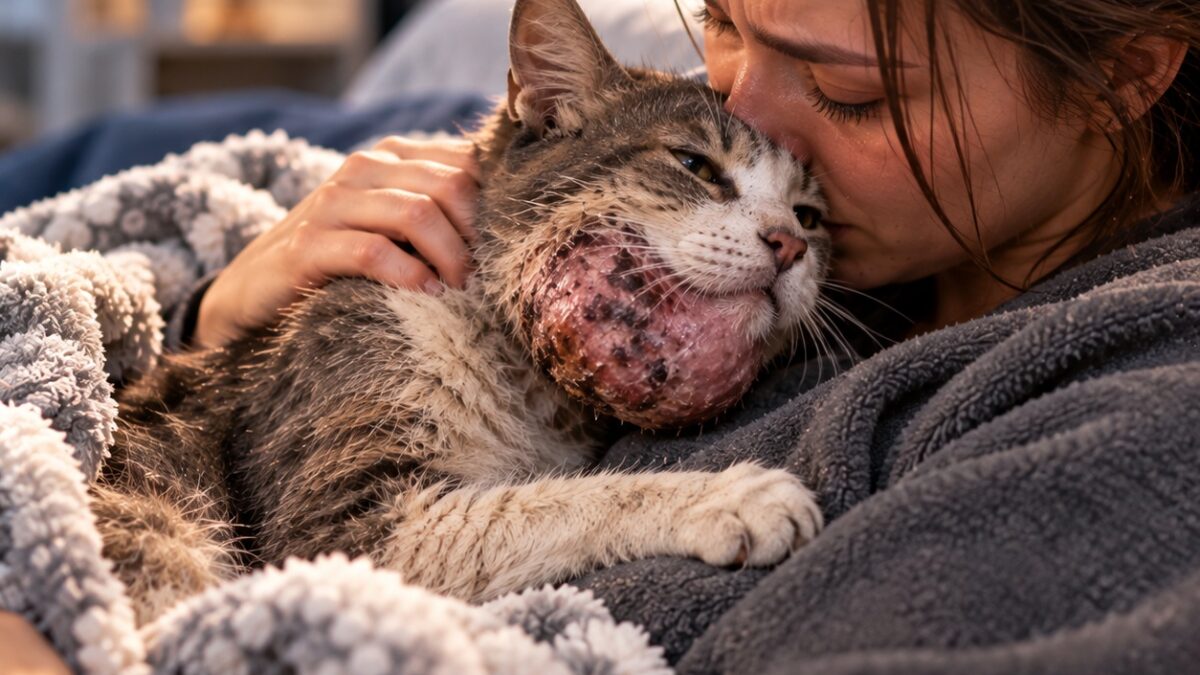
PART2
The first time Sam tried to eat in my home, I had to leave the room afterward so he would not see me cry.
I gave him soft food.
Very soft.
I mashed it until almost nothing remained that required chewing.
He approached the bowl eagerly.
That was the cruel part.
Sam was hungry.
He wanted food.
His body knew exactly what the smell meant.
He lowered his face.
Tried to take a bite.
Stopped.
Adjusted.
Tried from another angle.
The tumor struck the edge of the bowl.
He flinched.
Then went back.
Again.
Food entered his mouth.
Some fell out.
He licked what he could.
Blood appeared near the growth.
I froze.
“Sam.”
He kept eating.
Not because it did not hurt.
Because hunger was stronger.
That night, I understood what his life on the street must have required.
Every meal had been negotiation.
Pain versus starvation.
He had chosen pain.
Again and again.
I moved the food onto a flatter plate.
That helped slightly.
I held it at an angle.
Better.
Sam ate.
Slowly.
Messily.
Determined.
When he finished, he looked at me as if nothing extraordinary had happened.
Then walked toward the couch.
Jumped up.
Climbed onto my chest.
Purr.
The contradiction became unbearable.
A cat with a face that made strangers recoil still wanted ordinary things.
Dinner.
Warmth.
A lap.
A person.
He did not know that doctors were discussing whether intervention would be too much.
He did not know words like prognosis.
Operability.
Palliative.
He knew that food hurt.
He knew my chest was warm.
He knew my hand scratched behind his ears.
That was his world.
Mine became paperwork.
Phone calls.
Images.
Opinions.
I sent records to another clinic.
Then another.
Some responses were cautious.
Some discouraging.
One veterinarian told me:
“If he is comfortable enough, perhaps the kindest choice is not to put him through a major operation.”
I understood.
I really did.
There is a terrible temptation in rescue to believe doing more is always love.
It is not.
Sometimes more treatment only adds pain.
Sometimes letting an old animal rest is kinder than forcing the body through procedures because the human cannot accept loss.
I did not want to become that person.
So I asked questions.
“What happens if we do nothing?”
“We manage pain.”
“And the tumor?”
“It may continue growing.”
“Bleeding?”
“Possible.”
“Eating?”
“Likely more difficult.”
“How long?”
Nobody knew.
Medicine cannot always give a clock.
I went home.
Sam was waiting near the door.
Not dramatically.
He simply sat there.
His tail curled around his paws.
When I entered, he made a soft sound.
I sat on the floor.
He came immediately.
Climbed into my lap.
Then up.
Front paws on my chest.
He lowered himself carefully because of the jaw.
Purr.
I touched his head.
“Are you tired?”
Purr.
“Do you want me to stop?”
His eyes closed.
Purr.
Of course he could not answer.
That was the burden.
Humans had to make decisions for a cat who could only show us how he felt today.
And today, Sam still wanted things.
He watched birds through the window.
He followed me into the kitchen.
He investigated bags.
He found a favorite blanket.
He sat near the radiator.
He learned the sound of the refrigerator.
He came when I opened food.
He complained if I was late.
He groomed himself where he could.
He wanted affection.
He was not lying in a corner waiting to die.
That mattered.
It did not automatically mean surgery was right.
But it meant I needed certainty before giving up the search.
So I kept calling.
Someone mentioned a surgeon in Sofia.
Dr. Voichev.
I gathered everything.
Scans.
X-rays.
Blood results.
Photographs.
Previous opinions.
We traveled to Sofia.
Sam hated the car.
That was probably the most normal thing about him.
He complained in the carrier for part of the journey.
I apologized.
“You can hate me today.”
He stared.
“I’ll accept it.”
At the clinic, he became quiet again.
The surgeon examined him.
Carefully.
Methodically.
No dramatic promises.
More imaging.
More waiting.
The waiting was worse because by then I understood the alternatives.
If the scans showed widespread disease, there might be nothing reasonable to remove.
If the tumor involved too much surrounding tissue, surgery could cause more harm than relief.
If Sam’s body could not tolerate anesthesia, good intentions would not matter.
I sat beside the carrier.
He pressed his face against the opening.
I put two fingers through the bars.
He leaned.
Of course.
“Whatever they say.”
I whispered.
“I won’t let you hurt forever.”
That was the only promise I knew I could keep.
Eventually Dr. Voichev returned.
He had the scans.
I looked at his face.
For months, I had become an expert at reading pauses.
This pause was different.
“The tumor does not appear to have spread.”
I stared.
“What?”
He showed me.
Explained what he could see.
What remained uncertain.
The growth was serious.
The surgery would be complex.
The affected section of Sam’s lower jaw would need to be removed.
There were risks.
Bleeding.
Anesthesia.
Recovery.
Feeding.
Adaptation.
No guarantee.
But unlike the conversations before, this one contained a door.
Not wide.
Not safe.
Open.
“You think he can survive it?”
“I believe surgery is possible.”
Possible.
That word.
I had hated it before.
Now it felt enormous.
“What would it give him?”
“If successful?”
“Yes.”
“Less pain.”
The answer came first.
Not beauty.
Not a normal-looking face.
Pain.
“Eating may become easier once he heals.”
My eyes filled.
“And the bleeding?”
“We hope to stop the source.”
I looked at Sam.
He was watching us.
Not understanding.
Perhaps bored.
I asked the question I feared most.
“Would you do it if he were yours?”
Dr. Voichev did not answer quickly.
Good.
I distrusted quick certainty by then.
Finally:
“If his current assessment remains acceptable for anesthesia and you understand the risks, yes.”
I started crying.
Not because Sam was saved.
He was not.
Not yet.
Because someone had finally said there might be a way to help him beyond making his pain more comfortable while we waited for worse.
That night, Sam climbed onto my chest.
We were staying temporarily in Sofia.
Different room.
Different smells.
He circled twice.
Settled.
His tumor rested awkwardly against me.
I looked down.
“Tomorrow.”
He purred.
“You don’t know what that means.”
Purr.
“I wish I could explain.”
I ran my fingers along the top of his head.
“You’re going to wake up different.”
Sam opened one eye.
“Hopefully.”
I corrected.
“If you wake up.”
The sentence escaped before I could stop it.
My throat closed.
I pressed my face into his fur.
“I’m sorry.”
Sam continued purring.
He had no fear of tomorrow because animals rarely suffer tomorrow in advance the way humans do.
That night I suffered enough for both of us.
What if surgery killed him?
What if I had taken a cat who was still purring, still eating something, still interested in life, and pushed him into a procedure he could not survive?
What if doing nothing would have given him more time?
What if waiting would only have increased pain?
There was no perfect answer.
Only informed choice.
Risk weighed against suffering.
I barely slept.
Sam did.
On my chest.
At dawn, he woke hungry.
The fasting instructions meant no breakfast.
He was furious.
That almost made me laugh.
“I know.”
He followed me toward the food area.
“No.”
His face seemed personally offended.
“I promise this is for a reason.”
He meowed.
“You have terrible timing.”
Another meow.
Normal complaints.
I wanted to remember them.
At the clinic, paperwork came first.
Consent.
Risks.
Complications.
Words that force humans to acknowledge all the ways hope can fail before anyone is allowed to proceed.
I signed.
Sam was weighed.
Examined.
Prepared.
Then someone came to take him.
He turned in the technician’s arms.
Looked at me.
I touched his head.
“I’ll be here.”
That promise I could make.
He leaned one last time.
Then disappeared through the treatment doors.
The waiting began.
I had waited for test results.
Consultations.
Scans.
Nothing felt like this.
Because for the first time, there was no Sam in my arms while I waited.
No purr.
No weight on my chest.
Just a phone.
A chair.
A hallway.
I tried reading.
Could not.
Opened messages.
Closed them.
Walked.
Sat.
Stood.
Someone offered coffee.
I accepted.
Forgot to drink it.
Every door made me look up.
Every staff member walking toward me made my stomach drop.
Time became hostile.
Twenty minutes felt like an hour.
An hour felt like something worse.
The operation required removal of the diseased portion of Sam’s lower jaw.
Even knowing this was the plan, I could not stop imagining it.
The precision.
The bleeding risk.
The fragile body.
The cat who had survived the street now unconscious beneath surgical lights because I had said yes.
I kept asking myself the same question.
Was this love?
Or desperation?
Then I remembered the meals.
Sam trying to fit food around the mass.
Blood.
Pain.
The way he refused to stop eating because he was starving.
I remembered the surgeon’s words.
Less pain.
That was the goal.
Not preserving his appearance.
Not creating a dramatic recovery.
Give him days where a bowl of food was just a bowl of food.
Give him mornings where the first sensation in his face was not pressure from a tumor.
That was enough reason.
Hours passed.
Then my phone rang.
Clinic.
My hand shook so badly I nearly dropped it.
“Hello?”
A voice.
Calm.
“Sam is out of surgery.”
Silence.
I forgot to breathe.
“He’s awake.”
My knees weakened.
“He’s stable.”
I sat down.
The hallway blurred.
“Say that again.”
“He is stable.”
I covered my mouth.
All the tears I had refused during the waiting arrived at once.
“Did it work?”
“The operation went as planned.”
Not miracle.
Not guarantee.
Planned.
At that moment, it was the most beautiful word I had ever heard.
“Can I see him?”
“Soon.”
Soon was another kind of torture.
But now Sam was alive inside it.
When they finally let me see him, I had prepared myself for the appearance.
Or thought I had.
His face looked different.
Of course.
The mass was gone.
Part of the lower jaw too.
Swelling.
Surgical changes.
Medication.
He looked fragile.
But the grotesque weight that had pulled at his face was no longer there.
I stood near him.
“Sam.”
His eyes opened.
Slow.
Medication-heavy.
He looked toward my voice.
My chest hurt.
I put my fingers near his head.
Not touching the surgical area.
Sam moved.
Barely.
Toward me.
Lean.
I laughed through tears.
“You’re unbelievable.”
He closed his eyes again.
That first night after surgery was not the happy ending.
It was another beginning.
Pain management.
Monitoring.
Nutrition.
Healing.
Risk of complications.
The surgeon had done what he could.
Now Sam’s body had to do the rest.
And Sam’s body had already been through years of scarcity.
We watched.
At first, he slept.
A lot.
Good.
Rest.
His body needed it.
I sat close.
Sometimes he opened his eyes.
Checked.
Closed them.
I began to recognize that behavior.
Are you there?
Yes.
Sleep.
Again.
Are you there?
Yes.
No need to stay awake.
Recovery came in increments so small that people who saw him every few days noticed more than I did.
“You know his eyes are brighter?”
Someone said.
I looked.
Maybe.
“You’re too close to see it.”
True.
When you measure a life by the hour, improvement becomes invisible.
Then came food.
The question that had carried us all the way to Sofia.
Would eating become easier?
Not immediately.
His mouth had to heal.
He needed appropriate support during recovery.
Everything had changed mechanically.
The absence of the tumor did not mean Sam instantly knew how to use his altered jaw.
He approached food cautiously.
Sniffed.
Tried.
I held my breath.
He took some.
Paused.
No tumor crashing against the plate.
No enormous mass blocking the angle.
He tried again.
The motion was different.
Messy.
But Sam ate.
I started crying.
Again.
At this point he must have assumed humans leaked constantly.
“Keep going.”
He did.
Not because I asked.
Because he was hungry.
For once, that hunger had a better path.
He finished more than I expected.
Then sat back.
Licked awkwardly at his mouth.
Looked at me.
I laughed.
“That’s it?”
He stared.
Apparently.
Later, the surgeon reminded me not to rush interpretation.
One meal did not mean complete adaptation.
There could be good days.
Hard days.
Healing days.
I nodded.
By then I had learned.
Progress is not a straight line.
Sam taught it again.
Some meals were easier.
Others frustrating.
He needed time.
But the terrible barrier was gone.
The bleeding reduced.
Comfort improved.
He rested differently.
That became one of the first changes I trusted.
Before surgery, Sam often slept with his head positioned carefully, as though every angle had consequences.
Afterward, once the initial surgical discomfort began settling, his body loosened.
He stretched.
Chin down.
Side sleeping.
Then one afternoon:
He rolled partly onto his back.
I stared.
“Who are you?”
Sam looked at me upside down.
His fur was still rough in places.
Body too thin.
Face altered forever.
But his stomach was exposed.
Paws loose.
Safe.
I scratched his chest.
Purr.
The same purr.
The operation had changed his jaw.
Not him.
That mattered.
There is a tendency in rescue stories to divide an animal into two versions.
Before.
After.
The suffering animal.
The healed animal.
But Sam had always been Sam.
The cat who leaned toward my hand on the street was the same cat now asleep on clean blankets.
Pain had not created his gentleness.
Surgery did not create his personality.
It simply gave him space to express more of what had always been there.
He became curious.
That surprised me.
On the street, curiosity is dangerous when your body is weak.
In a home, curiosity becomes a hobby.
Sam explored.
One room first.
Then hallway.
He sniffed doors.
Sat beside windows.
Watched neighbors.
Discovered that cabinets sometimes contained food.
A major development.
He became fascinated by a chair near the window.
Not the softest place.
Not the warmest.
His place anyway.
Cats have no interest in human logic.
I bought him a beautiful bed.
He slept beside it.
Correct.
He started grooming more consistently as his strength improved.
His coat changed.
The dull matted look slowly disappeared.
Fur softened.
Areas that had been neglected became clean.
I brushed him gently.
At first, short sessions.
Sam tolerated them.
Then demanded them.
He learned that the brush came from a drawer.
If I opened that drawer for anything else, he appeared.
Old cat.
New expectations.
Good.
Weight gain came slowly.
That was important.
He had arrived painfully thin.
Healing requires resources.
Food was no longer merely calories.
Every meal became reconstruction.
Muscle.
Strength.
Coat.
Immune support.
Days.
The first time the scale moved clearly upward, I smiled for the rest of the afternoon.
Sam did not care.
He cared about dinner.
That became one of my favorite things about him.
Humans wanted meaning from everything.
Sam wanted food on time.
Perfect.
Weeks passed.
Follow-up visits.
Checks.
Healing.
Every trip to the clinic made me nervous.
I had spent so long receiving cautious answers that even good recovery could not immediately remove fear.
“What if it grows back?”
I asked.
“What if the scans missed something?”
“What if—”
The veterinarian stopped me gently.
“We monitor.”
That was it.
Not certainty.
Monitor.
I learned to live there.
Sam was living there already.
Cats do not schedule anxiety for six months from Tuesday.
He took the afternoon sun that existed now.
I began doing the same.
One afternoon, Sam stood near the balcony door.
Indoor safe space.
He watched a bird land outside.
His entire body changed.
Eyes wide.
Tail twitch.
Predator.
I laughed.
“You remember being a cat?”
He chattered at the bird.
The tumor had made his mouth abnormal.
The surgery had changed it further.
The sound was not exactly like other cats.
It was Sam.
The bird left.
Sam looked offended.
Good.
Offended is alive.
He began following me through the house.
Not constantly.
Sam retained dignity.
But if I sat for too long without acknowledging him, he appeared.
Front paws.
Chest.
Careful climb.
Purr.
That ritual survived everything.
Before surgery, he had climbed onto me while the tumor hung heavily beneath his face.
After surgery, he climbed differently.
More comfortably.
His body fitted closer.
Head resting higher.
I could feel the purr through my sternum.
Sometimes I thought about the evenings when doctors had told me comfort care might be the kindest choice.
I did not resent them.
That is important.
They had not abandoned Sam.
They had judged risk differently based on what they knew and what they believed they could safely offer.
Medicine is not a competition where the last doctor becomes hero and everyone else becomes villain.
Dr. Voichev had skills and information that allowed another possibility.
We found him.
That was fortunate.
If the scans had shown spread, our story could have ended differently.
If Sam’s condition had been worse, surgery might truly have been wrong.
I never wanted his survival to become evidence that people should always ignore cautious veterinary advice and keep pursuing procedures indefinitely.
The lesson was narrower.
Ask questions.
Understand goals.
Understand risk.
If there is a reasonable specialist option and the animal still has quality of life worth protecting, sometimes another consultation matters.
For Sam, it changed everything.
The purpose of surgery had never been to make him beautiful.
Yet as he healed, people began telling me how handsome he looked.
I agreed.
Not because his face became symmetrical.
It did not.
His jaw would always look different.
His mouth sat differently.
That was part of him.
But his eyes had changed.
Pain changes eyes.
Relief does too.
Before, Sam often looked inward.
Conserving.
Enduring.
Afterward, he began looking outward.
At windows.
At doors.
At me.
At food.
At life.
That was beauty.
A friend visited and met him for the first time after surgery.
She sat on the floor.
“Does he like strangers?”
“Sometimes.”
Sam approached.
Sniffed.
She did not reach immediately.
Good.
He stepped closer.
She offered fingers.
Sam leaned.
Of course.
My friend laughed.
“Oh.”
“What?”
“He’s sweet.”
I looked at him.
“Yes.”
That had been true from the first day.
His greatest mystery was not how he survived the tumor.
It was how living outside, thin and hurting, had not convinced him to stop seeking tenderness.
Perhaps someone had loved him once.
Maybe Sam had had a home years before.
An older person.
A family.
Nobody knew.
His social behavior suggested humans were not entirely new to him.
But explanations remained speculation.
I stopped needing them.
The history I could change started the day I touched him.
Everything before deserved compassion.
Not invention.
Sam’s adoption story turned out differently than many rescues.
By then, he had become woven into my routine.
The person whose chest he slept on was still the person he sought every night.
People asked:
“Are you finding him a home?”
At first, I said:
“When he’s ready.”
Then:
“We’ll see.”
Then one evening, Sam finished dinner, walked into the living room and climbed onto me.
He circled once.
Settled.
Purr.
I looked down.
“You know something, don’t you?”
Sam closed his eyes.
I had spent months searching for someone willing to help him.
A surgeon.
A clinic.
An answer.
Maybe I had been slower to recognize that another search was already over.
He was home.
Not because rescue requires rescuers to keep every animal.
It does not.
That would destroy rescue.
But Sam was older.
Medically complicated.
Deeply bonded.
And I had the ability to care for him.
The practical question eventually became embarrassingly obvious.
Why move him if neither of us needed that change?
So Sam stayed.
No dramatic adoption photograph.
No family traveling across an ocean.
No stranger appearing at the end.
His final home was the place where he had spent his uncertain nights before surgery.
The same chest.
The same hands.
Different future.
I filled out the paperwork anyway.
Official.
Permanent.
Sam became mine.
Or, as anyone who lives with cats understands, I became his.
The first official night changed nothing.
He ate.
Sat by the window.
Ignored the expensive bed.
Climbed onto me.
Purred.
I whispered:
“You’re not leaving.”
His ear twitched.
“You were never worried, were you?”
Probably not in the human way.
But I was.
I had brought him into my home believing I might only be giving him somewhere safe to die.
Now I was promising him tomorrow’s breakfast.
That felt enormous.
The months after surgery became less medically dramatic.
That is exactly what I wanted.
Ordinary days.
Some people expect the satisfying ending of a rescue story to be one perfect scene.
Sam taught me it was repetition.
Breakfast.
Nap.
Window.
Brush.
Dinner.
Chest.
Purr.
Again.
A good life is often boring from the outside.
There were follow-up appointments.
Of course.
Sam complained during transport.
Of course.
He began associating the carrier with clinics and became dramatically uncooperative.
Healthy cat problem.
I celebrated.
“You used to walk into this voluntarily.”
Sam planted all four paws.
“Apparently you have developed standards.”
Eventually I learned to leave the carrier out permanently.
Blanket inside.
No sudden appearance signaling danger.
Sam occasionally slept in it simply to prove he controlled the situation.
Cats.
His body filled out.
Not fat.
Healthy enough that bones stopped being the first thing my hands found beneath fur.
The first time I realized I could not clearly feel each vertebra, I ran my hand along his back twice.
Sam looked offended.
“What?”
I said.
“You’re getting substantial.”
He left.
Insulted.
Another good problem.
Eating changed most dramatically.
Before surgery, a meal took patience.
Positioning.
Adjustment.
Pain.
After healing and adaptation, Sam developed methods that worked for his new anatomy.
He was not identical to a cat with an intact lower jaw.
That was never the goal.
He ate.
That was.
He ate without the huge tumor obstructing every attempt.
He ate without recurrent bleeding from that mass.
He approached his bowl eagerly.
He sometimes asked for more.
The first time he yelled at me because dinner was late, I almost applauded.
Did not.
Remembered Emily from another life? No—there was no Emily here, no borrowed scene, no other story. There was only Sam, standing in my kitchen and demanding food with the authority of a cat who had finally decided survival was no longer enough.
I opened the food.
“Your Majesty.”
He ate.
Good.
I kept photographs.
Too many.
The first street picture remained difficult.
Sam beside the wall.
Thin.
Tumor dominating his face.
I rarely looked.
Not because I wanted to erase it.
Because he deserved to exist in my phone as more than evidence.
So I took new photographs.
Sam asleep with one paw over his eyes.
Sam watching snow.
Sam sitting beside a grocery bag.
Sam on my chest.
Sam beside his empty bowl looking like a victim of starvation forty seconds after dinner.
Sam in sunlight.
Sam being brushed.
Sam sleeping completely stretched out.
That last one mattered.
An animal who sleeps extended across open space trusts the room.
Sam trusted the room.
There were occasional difficult days.
He was older.
Age estimate broad.
Seven to twelve at rescue meant every year came with uncertainty.
Kidneys checked.
Teeth monitored.
Blood work.
Weight.
No one gets to keep a rescued animal young because the beginning was unfair.
Time still moves.
That became another kind of gratitude.
Sam was allowed to age.
Animals who die outside do not get gray hairs in warm homes.
Sam did.
Fur around his face changed.
Movement slightly slower.
He preferred warmer spots.
He slept more.
Still climbed onto my chest.
Sometimes he needed a small step to make the jump easier.
I bought one.
He ignored it for a week.
Then used it as if it had always been his idea.
One winter evening, I lay on the couch while snow fell outside.
Sam climbed up.
Settled.
His altered jaw rested against my shirt.
Purr.
I thought about the first night.
Before Sofia.
Before the scan.
Before anyone said surgery was possible.
How many evenings had I stared at that tumor while he slept here and tried to decide whether hope was selfish?
Now the tumor was gone.
Not Sam.
That distinction mattered.
I touched his head.
“You were worth the trouble.”
His purr continued.
Trouble.
Such a small word for all of it.
Consultations.
Travel.
Fear.
Surgery.
Recovery.
But animals do not measure worth by cost.
Humans do.
Sometimes badly.
Sam did not owe me gratitude because I paid for treatment.
Did not owe affection because I rescued him.
The purr was not repayment.
It was simply Sam.
Freely given.
That made it better.
His story spread online more than I expected.
People saw before-and-after images.
Messages arrived.
Some beautiful.
Some painful.
One person wrote:
Why would anyone spend so much on an old stray when there are healthy kittens needing homes?
I stared at that comment for a long time.
Not because I had no answer.
Because the question revealed a common cruelty disguised as efficiency.
Sam was already here.
Alive.
Feeling pain.
Wanting food.
Wanting touch.
His age did not make his suffering less urgent.
His lack of pedigree did not reduce his right to comfort.
We do not have to choose compassion only when it offers maximum years of return.
Older animals are not failed investments.
Sam did not need to justify surgery by living ten more years.
He needed the chance at one comfortable day.
Then another.
Every day after was extra.
I did not reply angrily.
I wrote:
Because he was alive, hurting, and there was a reasonable way to help him.
Enough.
Other people messaged about cats with jaw tumors.
I became careful.
“I’m not a veterinarian.”
Always first.
Sam’s case was Sam’s case.
Another tumor could behave differently.
Another cat might not be a surgical candidate.
Another owner might face a different decision.
I shared the lesson that mattered:
Seek qualified veterinary advice.
If uncertain and resources allow, ask whether specialist evaluation could change the options.
But do not turn one successful surgery into a promise.
Sam’s good outcome belonged to a particular body, particular disease, particular surgeon, particular moment.
That honesty honored him more than miracle language.
Sam did not need a miracle.
He needed someone to keep asking.
The first anniversary of his surgery arrived.
I remembered the date.
Sam did not.
I bought him a new blanket.
Ridiculous.
He preferred the old one.
Of course.
I offered special food.
That he appreciated.
I sat beside him.
“One year.”
Sam washed one paw.
“Do you care?”
No.
Good.
I cared enough.
A year earlier, I had sat in a clinic hallway wondering whether I would ever touch him alive again.
Now he was annoyed because I had interrupted grooming.
That was the celebration.
Later, he climbed onto me.
I took a photograph from above.
Sam looked smaller than he felt.
Older face.
Uneven jaw.
Eyes half closed.
Happy?
Humans are cautious with that word.
Comfortable.
Safe.
Attached.
Those I could see.
I sent the picture to Dr. Voichev.
One year. Still eating. Still bossy.
The response came later.
That is exactly what we wanted.
Yes.
Not perfection.
Quality.
Time.
The following years were defined by ordinary aging rather than the tumor.
That was an extraordinary privilege.
Sam developed preferences.
He liked one room in the afternoon because the sun moved across the floor.
He disliked a certain brand of food after loving it for months.
Naturally.
He became fascinated by one neighbor’s dog from the safety of the window, despite having no intention of meeting him.
He learned which drawer held treats.
He learned I was weaker against persistence at night.
I learned never to mistake an old cat for an animal without mischief.
Once, he stole food from my plate.
I stared.
“After everything I did for you?”
Sam chewed.
No remorse.
Perfect.
The scars from surgery were simply part of his face.
People who met him later sometimes asked:
“What happened?”
I shortened the story.
“He had a large tumor. He had surgery.”
“Was it cancer?”
“We never reduce the whole story to one label.”
What mattered was that it had not shown evidence of spread on the scans that allowed the surgical plan.
It had caused terrible local damage.
Removal gave relief.
People often wanted a clean category.
Benign.
Malignant.
Good.
Bad.
Life is rarely that clean.
Sam’s body had suffered either way.
His surgery mattered either way.
One little girl met him during a visit.
She stared.
Children stare honestly.
“What happened to his mouth?”
“He had surgery.”
“Does it hurt?”
“Not like before.”
She nodded.
Then:
“Can I pet him?”
I showed her where.
Sam sniffed her fingers.
Then leaned.
The girl smiled.
“He likes me.”
“Yes.”
That was all.
No pity.
No horror.
Contact.
Sam preferred that too.
As he became more secure, he sometimes refused affection.
Also good.
The cat who once leaned toward every gentle hand because comfort may have been scarce could now decide:
Not now.
He would walk away.
Tail up.
Choice.
People think trust always means accepting touch.
Sometimes the deepest safety is knowing you can reject it and nothing bad happens.
Sam learned that.
If he left my lap, I did not pull him back.
If he hid during visitors, fine.
If he wanted contact two minutes later, fine.
Home means control over small things.
Where to sleep.
When to eat within reason.
Whose lap.
Which window.
Sam had choices.
The street had given him few.
Sometimes at night, I imagined his life before me.
I tried not to.
Speculation can become a form of taking ownership over an animal’s history.
Maybe he had once belonged to someone.
Maybe he had been abandoned.
Maybe he had simply lived outside for years.
Maybe the tumor grew slowly while people fed him but nobody could manage treatment.
Maybe someone tried.
Maybe nobody did.
I did not know.
I stopped inventing villains.
The truth was enough.
By the time I met him, he needed help.
He got it.
That was the part I could speak about honestly.
Years later, during another veterinary check, the doctor said something I once could not have imagined hearing.
“For his age, he’s doing well.”
I laughed.
“What age?”
The veterinarian laughed too.
“Exactly.”
Sam’s official age remained a guess.
We picked a birthday.
Not because it was accurate.
Because every cat deserves an excuse for treats.
I chose the day he came inside.
His rescue day.
The first birthday, he ignored the toy.
Second, he ate too much special food.
Third, he slept through most of the celebration.
Excellent aging.
There was a temptation to call every year a gift.
It was.
But not because Sam owed us inspiration.
Living is enough.
He did not need to make his survival meaningful for strangers.
His purpose was not to teach humanity a lesson.
Still, humans learn anyway.
Sam taught me that compassion and certainty are not the same thing.
I did not know surgery would work.
I searched anyway.
Dr. Voichev could not guarantee the outcome.
He operated because the risk was judged reasonable.
Sam could not promise recovery.
His body tried.
We did not know how many years remained.
We made the days comfortable.
The lesson was not:
Never accept bad news.
Sometimes bad news is true.
The lesson was:
Understand the news before you make the final decision.
Ask what “too risky” means.
Ask what happens without intervention.
Ask whether expertise elsewhere might change the calculation.
Then choose for the animal, not for the human need to feel heroic.
For Sam, one more opinion opened a path.
Thank God.
As he aged, climbing onto my chest became slower.
First, jump.
Then step.
Then a pause at the edge of the couch.
Eventually I lifted him occasionally.
That reversal affected me.
The first time I had carried him, his body was thin from painful eating.
Now I lifted an old cat whose body had softened with years of meals.
He objected.
“I know.”
I settled him onto me.
Purr.
Always.
There are sounds you begin fearing you will miss before they disappear.
His purr became one.
I recorded it once.
Then felt foolish.
Kept the recording anyway.
One night the power went out during a winter storm.
Apartment dark.
Cold slowly creeping.
I wrapped Sam in a blanket.
He hated it.
Crawled out.
Climbed onto my chest instead.
Warmest place.
Practical cat.
I held him.
Outside, wind.
Inside:
Purr.
I thought about his first winter on the street.
Did he have shelter?
No idea.
Did someone let him inside sometimes?
No idea.
This winter, no uncertainty.
He was home.
That satisfied something in me deeper than any dramatic adoption finale could have.
Sam’s final years were not free of medical issues.
No elderly animal gets that promise.
There were days of reduced appetite.
Blood tests.
Medication.
A kidney value that required watching.
Joint stiffness.
Nothing dramatic enough to erase the years he had gained.
We adjusted.
Raised bowls.
Softer places.
Easier steps.
More frequent checkups.
The veterinarian once asked:
“What is your goal for him now?”
I knew the answer immediately.
“Comfort.”
Interesting.
Years earlier, the same word had frightened me because comfort care sounded like surrender.
Now comfort had become the entire point.
The difference was context.
Back then, Sam still had a surgically addressable source of major pain.
We pursued it.
Now he was an old cat experiencing ordinary aging.
There was no enemy to defeat.
Only a friend to care for.
Medicine changes goals because bodies change.
Love should too.
I no longer wanted maximum days at any cost.
I wanted good days.
Sam mostly had them.
A good day meant eating.
Sun.
Brush.
Window.
Purr.
Maybe a complaint.
Excellent.
One spring morning, Sam did not come when I opened breakfast.
That frightened me instantly.
I found him in his favorite sunny room.
Awake.
Watching me.
He rose slowly.
Walked toward food.
Ate less.
Not zero.
We went to the veterinarian.
Tests.
Adjustment.
Monitoring.
He improved.
Another year.
That year felt borrowed.
Not in a tragic way.
Grateful.
We stopped counting time only by medical threats.
Summer came.
Sam slept near the open screened window.
Autumn.
Leaves.
Winter.
Blanket.
Another spring.
The ordinary calendar became a miracle only because once there had almost been no calendar left.
On one of his later birthdays, I found the original photograph again.
The one beside the wall.
Tumor enormous.
Body thin.
I placed the phone beside sleeping Sam.
Looked from one to the other.
The difference was not dramatic in the way people often expect.
His face still looked unusual now.
Older.
Scarred.
But his body filled the blanket.
That was the difference.
He occupied space.
Comfortably.
The street Sam looked as if the world was pressing him smaller.
Home Sam spread out.
I deleted neither image.
History should not be erased.
But I moved the old one out of favorites.
The new photograph took its place.
Sam asleep with his paw across my wrist.
That was who I wanted to see first.
Eventually, age began winning more often.
Sam slept longer.
Ate smaller meals.
Needed encouragement.
The veterinarian and I talked openly.
Not yet.
But eventually.
Quality of life.
Pain.
Hydration.
Interest.
Mobility.
The conversation I had feared when the tumor first appeared in my life returned years later in a different form.
This time I was ready to listen.
Because searching for surgery had never been about refusing death forever.
It had been about refusing unnecessary pain while meaningful life remained possible.
Those years had happened.
Real.
Full.
Sam had gotten them.
Now my responsibility would eventually change.
One evening he climbed onto my chest.
Slow.
I helped.
He settled.
Purr weaker.
Still there.
I whispered:
“You know I’m going to keep my promise.”
He opened one eye.
“No hurting forever.”
I touched his head.
“When it becomes too much, I’ll know.”
I hoped.
That is the most frightening promise a guardian makes.
Not keep you alive.
Do not let love become selfish.
For a while longer, Sam remained comfortable enough.
Good mornings outnumbered difficult ones.
We stayed there.
Then one week, the balance changed.
He stopped finishing meals.
Not because a tumor blocked his mouth this time.
Age.
Body.
He still drank.
Still sought me.
Then less.
The veterinarian examined him.
We discussed findings.
Options.
Support.
I tried what was reasonable.
Not everything possible.
There is a difference.
One night, Sam did not climb onto my chest.
I sat beside him on the floor instead.
He leaned his head into my hand.
Same movement.
Years collapsed.
Street.
First touch.
Lean.
I cried.
“You really never changed.”
He purred faintly.
The next morning, he still came for affection.
Barely ate.
The veterinarian said what I already knew.
We could continue supportive measures.
Maybe gain a little time.
But Sam was tired.
This was not one dramatic disease to remove.
This was the body reaching its end.
I went home with him for one more afternoon.
No hospital cage.
No panic.
Sunlight.
Favorite blanket.
I opened the window enough for smells.
Sam lay there.
I sat.
He watched birds.
Even then.
Small interest.
I almost used it as an excuse.
See?
He still wants life.
Then he lowered his head.
Did not lift it again for several minutes.
Love can turn one flicker into denial if we are not careful.
I touched him.
“I know.”
Sam leaned.
We returned to the clinic.
The same kind of place where years earlier I had waited to learn whether surgery had succeeded.
This time, no surgery.
No rescue from death.
Rescue from suffering.
I held Sam.
On my chest.
Exactly where he had spent so many evenings.
The veterinarian explained.
I already understood.
I cried into his fur.
“You were supposed to make this easier.”
He purred.
Of course.
The sedative relaxed him.
His body grew heavier against me.
No fear.
No struggle.
I kept one hand on his head.
“You’re home.”
Not literally.
Clinic room.
But home is sometimes a person.
“You’re safe.”
That was true.
“No more pain.”
That was about to become true.
His purr faded gradually.
I do not know the exact second it stopped.
Maybe that was merciful.
The veterinarian listened.
Then looked at me.
Sam was gone.
Not from the street.
Not hungry.
Not bleeding from a tumor.
Not alone.
Old.
Loved.
Against my chest.
I cried until I had nothing graceful left.
That was fine.
Grace is overrated during grief.
I took him home one last time only in memory.
The rooms changed immediately.
Empty chair.
Untouched bowl.
The expensive bed he had barely used.
Brush drawer.
Window.
My chest felt physically wrong without weight.
For weeks, I woke expecting the evening ritual.
Sometimes I touched my shirt absentmindedly where his face had rested.
Grief is muscle memory.
People wrote kind things.
“He was lucky to have you.”
Maybe.
I was lucky too.
But I never liked framing rescue as an exchange of luck.
Sam had deserved help regardless of whether he gave me anything emotionally.
He did give.
Enormously.
Still.
His right to care existed before gratitude.
That mattered.
I kept his brush.
The blanket.
The recording of his purr.
Not everything.
I donated some supplies.
Another cat needed them.
That hurt.
Then helped.
Months later, I visited Sofia again.
Different reason.
I thought about Dr. Voichev.
I sent a message.
A photograph of Sam in his final year.
Healthy enough.
Old.
Comfortable.
Then:
Thank you for giving him these years.
The response:
Sam gave himself those years too. We only opened the door.
I liked that.
Because surgery had not created Sam’s desire to live.
The old cat had already been trying.
Street food.
Pain.
Lean.
Purr.
We opened a door.
He walked through.
Years later, when people ask me about Sam, they usually begin with the tumor.
Understandable.
The photographs are unforgettable.
But if you ask what I remember first now, it is not the mass.
It is weight.
A cat on my chest.
Warm.
Purring.
The tumor dominated his face.
It never dominated his identity.
That is the mistake suffering invites.
A visibly injured animal becomes “the tumor cat.”
“The burned dog.”
“The three-legged puppy.”
“The sick stray.”
People reduce them to the thing that makes us feel most.
Sam was never a tumor.
He was impatient at dinner.
Selective about blankets.
Suspicious of carriers.
Obsessed with one sunny chair.
Affectionate on his terms.
A terrible respecter of personal space after eight in the evening.
Old.
Funny.
Stubborn.
Gentle.
Sam.
That is why I tell the story past the surgery.
If the ending were only:
He survived the operation.
It would be incomplete.
The purpose of saving a life is not the dramatic moment where death loses.
It is everything that becomes possible afterward.
Breakfast.
Sunlight.
Annoying habits.
Visitors.
Vet complaints.
Years.
Aging.
Even grief.
Sam got enough life afterward that eventually I had to lose him for an entirely different reason.
That hurt.
It was also the evidence we had won the thing worth winning.
The tumor did not take him then.
It did not make every remaining meal a fight.
It did not decide the end of his life.
For years, Sam got to be something else.
A house cat.
My cat.
That is the ending I wanted for him when I kept calling clinics without knowing exactly what I was searching for.
Not immortality.
Time without that terrible burden hanging from his jaw.
He got it.
If I could return to the evening after the first doctor told me surgery might be too much, I would sit beside my younger self.
Sam would climb onto us, probably annoyed there was another person occupying his space.
I would say:
Listen carefully to the doctors.
Do not dismiss risk because you are scared of loss.
But do not confuse one limit with every limit.
Gather information.
Ask.
Travel if it is reasonable.
Find someone qualified to look again.
Then, if the answer is still no, love him enough to accept it.
But you are not at no yet.
There is a surgeon in Sofia.
The scans will show no spread.
There will be an operation.
You will be terrified.
Sam will wake.
He will eat.
He will gain weight.
He will complain about dinner.
He will sleep in sunlight.
He will grow old enough that his body fails for ordinary reasons.
And when that day comes, you will wish desperately for one more year.
But you will also understand exactly what those extra years were worth.
I would tell myself:
Keep searching.
Not forever.
Just until you have the answer Sam deserves.
Then I would stop talking.
Because Sam would probably be purring.
And that sound always said more.
The first time I touched him on the street, I thought I was meeting an animal at the end of his story.
Thin.
Matted.
Jaw destroyed by a massive growth.
Food painful.
Future uncertain.
I was wrong.
I was standing at the middle.
The next chapters were hidden inside scans, highways to Sofia, a surgeon’s hands, an operating room, frightened waiting, healing tissue, soft meals and a cat who refused to stop leaning toward affection.
Sam never became the cat he might have been without the tumor.
There is no way to recover an imaginary life.
He became the cat he was allowed to become afterward.
That was enough.
More than enough.
He came to me from the street carrying a body that hurt every time he tried to do something as simple as eat.
He left this world years later with his head against the same person who had first reached toward him.
Between those two moments, Sam had thousands of meals that hurt less.
Thousands of naps in warmth.
Thousands of purrs.
Windows.
Birds.
Brushes.
Blankets.
Sunlight.
A home.
And in the end, that was why I had kept searching for another answer when giving up would have been easier.
I was never trying to save Sam from death forever.
I was trying to give him life before it came.
And he got it.

