PART2:Bruno Spent Seven Years Saving Strangers—Then His Department Retired Him Into a Concrete Cage
PART2
The first weeks were harder than I expected.
Bruno did not know how to play.
I bought him a soft bed.
He slept beside it on the floor.
I bought him toys.
He inspected them like evidence.
A ball rolled past his paw once.
He watched it.
Then looked at me as though he expected an explanation.
“What?”
I asked.
He looked at the ball.
Then back at me.
“It’s a toy.”
Nothing.
“You chase it.”
Still nothing.
I picked it up.
Tossed it gently.
Bruno remained seated.
I laughed.
“Very convincing demonstration, Elisabeth.”
He looked unimpressed.
The next morning, before sunrise, I woke to the sound of nails on the floor.
I found Bruno sitting beside the front door.
Perfect posture.
Alert.
Waiting.
At first, I thought he needed outside.
I opened the door.
He looked down the road.
Not toward the yard.
The road.
He waited.
Five minutes.
Ten.
Cold air entered the house.
“Bruno?”
His ears moved.
He did not look at me.
Then I understood.
He was waiting to be picked up for work.
That realization hurt in a way I was not prepared for.
Somewhere inside him, morning still meant duty.
Vehicle.
Handler.
Assignment.
Purpose.
I closed the door eventually.
Bruno lay beside it.
The next morning, he was there again.
The next.
And the next.
Every day before dawn, the same thing.
Ready.
Waiting for somebody who was not coming.
I tried moving his bed closer to the fireplace.
He ignored it.
I placed treats on it.
He took the treats and returned to the floor.
I tried sitting on the couch and inviting him.
Bruno stayed several feet away.
He was polite.
Obedient.
Distant.
He ate only if I remained in the room.
If I walked into the kitchen, he stopped.
If I returned, he continued.
That concerned me.
Not because he was starving himself.
Because he did not seem to believe food was something he could simply have.
Everything about him felt conditional.
As though at any moment I might say:
Enough. Back to work.
I began leaving the room for only a few seconds.
Then returning.
I would sit with a book.
Read aloud.
At first, Bruno stared.
I read anyway.
History.
Novels.
Anything.
His ears sometimes moved when my voice changed.
One evening, I decided talking at him was not enough.
So I told him the truth about myself.
I sat on the floor opposite him.
The fireplace was low.
Rain tapped the windows.
Bruno lay near the wall.
“I think I understand you more than I want to.”
His eyes opened.
I laughed softly.
“That sounded dramatic.”
He watched.
“I spend all day telling other people what frightened animals need.”
“Space.”
“Routine.”
“Patience.”
“Purpose.”
“I am very good at giving advice.”
His ear moved.
“But I go home alone.”
I looked at the fire.
“I’ve done that for years.”
Bruno stayed still.
“I have work.”
“I have people who need me there.”
“And sometimes I think if I stopped being useful for five minutes, I wouldn’t know what was underneath either.”
That was harder to admit aloud.
“I know what it is to build a life around a role.”
Bruno’s eyes stayed on me.
“I know what it is to wait for something to tell you who you are.”
My voice became quiet.
“So maybe we can learn together.”
I stopped.
The room settled.
Bruno stood.
Slowly.
Walked toward me.
I did not move.
He stopped close enough that his front paws almost touched my knee.
Then he lowered his head onto my lap.
I forgot how to breathe.
There was no command.
No food.
No leash.
He did not want anything.
He simply placed his head there.
I put one hand on him.
Slowly.
“Okay.”
I whispered.
His eyes closed.
That was the first time Bruno touched me because he wanted to.
Not because I directed him.
Not because he was waiting for instruction.
As a friend.
That night, I stayed on the floor until my back hurt.
I did not care.
Progress after that was not dramatic.
There was no morning where Bruno woke suddenly transformed into an ordinary pet.
His habits had been built over years.
He still woke early.
Still checked the door.
Still slept on the floor more often than the bed.
But gradually, the edges softened.
He began eating even when I stepped briefly into the kitchen.
He stopped following every movement of my hands as though waiting for a signal.
He learned the sound of the refrigerator.
That was important.
Apparently retirement became more understandable when cheese was involved.
I would open the door.
Bruno’s ears lifted.
“You know that sound already?”
He appeared in the kitchen.
“Interesting.”
I handed him a tiny piece.
“You ignore every toy I bought, but refrigeration makes perfect sense.”
His tail moved once.
I froze.
Bruno looked at me.
“Was that a wag?”
No response.
“Do it again.”
Nothing.
“Fine.”
I smiled.
“You win.”
I took him on slow walks.
His body showed his age.
Eleven years.
Seven in service.
His gait was steady but no longer explosive.
He did not pull.
He scanned.
Constantly.
Cars.
People.
Alleys.
Doorways.
He watched everything with the professional attention of a dog who had spent his life turning environments into information.
At first, I tried distracting him.
Then stopped.
I could not ask Bruno to forget who he had been.
That was not healing.
Retirement did not have to mean erasure.
He could keep the instincts.
I simply wanted him to learn that not every walk needed a successful outcome.
Sometimes we went around the block and found nobody.
No missing child.
No threat.
No emergency.
We came home anyway.
That was enough.
A month passed.
Then another.
Winter came.
Bruno finally started using the soft bed.
Not every night.
But sometimes.
The first evening I found him curled in it, I stopped in the doorway.
Did not take a picture.
Did not praise him.
I was afraid enthusiasm would turn rest into another performance.
I simply dimmed the lights.
Bruno watched me.
Then put his head down.
A dog who had spent years waiting for commands was learning that nothing happening could be safe.
That mattered.
The fireplace became his favorite place.
At first, he stayed several feet away.
Eventually, he discovered warmth.
He would lie with his back toward the flames.
Head on the floor.
Deep sigh.
I loved that sigh.
It was not exhaustion after work.
Not tension releasing after an assignment.
Just comfort.
I began measuring Bruno’s recovery by sighs rather than commands.
The deeper, the better.
January came hard.
The cold arrived suddenly.
One particular evening, temperatures dropped so low that frost formed intricate white shapes across the windows.
The road outside looked silver.
The trees were black against the snow.
I built the fire higher.
Bruno was lying in front of it.
Actually sleeping.
His body turned toward warmth.
No door watching.
No waiting.
I remember looking at him and thinking:
He finally understands.
Not everything.
But rest.
He understood rest.
Then someone knocked.
Three quick sounds.
Bruno’s head lifted immediately.
Old training.
One second asleep.
Next second alert.
I opened the door.
Mrs. Harper stood outside.
She lived down the road.
Older woman.
Usually neatly dressed.
That evening, her coat was buttoned incorrectly.
No gloves.
Hair damp from snow.
Her face frightened and confused.
“Elisabeth.”
“Mrs. Harper?”
“Have you seen George?”
My stomach tightened.
George had been her husband.
He had died years earlier.
But Mrs. Harper’s memory had been becoming unreliable.
There were days she spoke about him as though he were still in the next room.
I lowered my voice.
“Come inside.”
“But George—”
“Come warm up first.”
She hesitated.
I took her hand.
It was freezing.
Bruno watched from the fire.
I led Mrs. Harper into the living room.
Wrapped a blanket around her.
Made tea.
She held the cup with shaking hands.
“He went into the woods.”
she said.
“George?”
“Yes.”
“He said he needed wood.”
“He should have come home.”
Outside, wind pushed snow against the windows.
“Mrs. Harper.”
I sat opposite her.
“Are you sure George went out today?”
Her expression tightened.
“Yes.”
Then uncertainty.
“I think.”
She looked toward the fire.
“He always gets turned around.”
I had heard stories about George.
From before his death.
He had apparently loved the woods.
The memories were real.
The timeline was not.
I tried calming her.
“Let’s call David.”
Her son lived two towns away.
I dialed.
He answered after several rings.
“Elisabeth?”
“It’s your mother.”
His voice changed immediately.
“What happened?”
“She’s here.”
Relief.
“Oh, thank God.”
“She’s talking about George.”
Silence.
Then a tired exhale.
“That’s been happening more.”
“She thinks he went into the woods.”
“George has been gone for years.”
“I know.”
Mrs. Harper sat near the fire, staring into it.
I lowered my voice.
“David, she came here from outside.”
“Yes?”
“She’s very cold.”
Another silence.
Then he said:
“Elisabeth…”
Something in his tone made my body tighten.
“What?”
“She called me yesterday.”
I waited.
“She said she was going to look for George.”
My eyes went to Mrs. Harper.
“She told you that?”
“Yes.”
“I told her not to go.”
“She said he was lost in the woods.”
I looked down.
That was when I noticed her shoes.
Wet.
Mud along one side.
Snow melting on the soles.
Then her coat sleeve.
Small frozen crystals.
She had been outside longer than the walk from her house.
“David, I’ll call you back.”
“What?”
“I need to ask her something.”
I ended the call.
Crouched beside Mrs. Harper.
“Did you go into the woods today?”
She looked at me.
For several seconds, nothing.
Then something cleared in her eyes.
A brief moment of lucidity.
“I…”
She swallowed.
“I think I did.”
My heart began beating harder.
“What happened?”
“I went to find him.”
“George?”
“Yes.”
She looked confused again.
“I walked.”
“The trees all looked the same.”
“I couldn’t…”
Her voice broke.
“I got lost.”
I held her hands.
“How did you get back?”
“I saw a light.”
“What light?”
“Your window.”
She looked toward the glass.
“I followed it.”
I closed my eyes briefly.
Mrs. Harper had gone into the winter woods alone and somehow found her way back.
That should have been the end of the emergency.
But something in her story bothered me.
Maybe because her confusion mixed past and present.
Maybe because she had been out there.
Maybe because she kept saying:
“I couldn’t find him.”
I called the police.
Explained.
An elderly woman with memory problems.
Possible wandering.
She was safe now.
But I told them where she had gone.
They said officers would come.
Roads were icy.
Response might take time.
I understood.
Then I looked outside.
Snow was falling harder.
And something in my chest tightened.
What if Mrs. Harper had not been completely wrong?
Not about George.
He was gone.
But what if she had seen someone?
Heard someone?
Passed something in the woods her confused mind had transformed into her husband?
It was only a possibility.
Probably nothing.
Still.
I could not shake it.
Bruno stood near the fireplace.
Ears forward.
Watching me.
He had felt my anxiety before I acknowledged it.
That was when I remembered the file.
Missing children.
Lost elderly people.
Search operations.
Seven years.
I stared at him.
Then toward the attic stairs.
“No.”
I whispered to myself.
Bruno watched.
He was eleven.
Retired.
His body slower.
I had spent months teaching him he no longer had to work.
Was I really considering asking him to do the exact thing I had been trying to free him from?
Outside, snow thickened.
Mrs. Harper’s shoes remained wet beside the fire.
Bruno stepped closer.
I saw his posture.
Alert.
Ready.
Not commanded.
Aware.
I made a decision.
Not because I wanted to give Bruno his purpose back.
Because somewhere in those woods, there might be a human being running out of time.
I went upstairs.
Opened the attic.
Found the box from the shelter.
Bruno’s old belongings.
I had not opened it since bringing him home.
His service collar.
Equipment.
A small light.
Then the vest.
Dark blue-black.
Reflective strips.
I lifted it.
For a moment, I almost put it back.
Then carried it downstairs.
Bruno saw it.
And the dog in front of me changed.
Not emotionally.
Physically.
His spine straightened.
His ears came forward.
His head lifted.
The soft, retired dog who had learned to lie beside my fireplace disappeared beneath something older.
Sharper.
His eyes locked onto the vest.
Then me.
I felt tears sting unexpectedly.
“Oh, Bruno.”
He took one step forward.
His tail did not wag.
This was not excitement.
It was focus.
He remembered.
Of course he remembered.
Seven years does not disappear because a file says retired.
I knelt.
Held the vest.
“Listen to me.”
Bruno stared.
“I don’t know if anyone is out there.”
His ears remained forward.
“And you don’t owe anybody anything.”
I swallowed.
“But I need your help.”
The sentence seemed to pass through him.
His body tightened.
I continued.
“We may have someone lost.”
Bruno stepped closer.
I put the vest over him.
The fit was almost perfect.
He had aged.
But the harness settled around his body as though no time had passed.
I clipped the small light.
My hands were shaking.
Bruno stood.
Strong.
Ready.
Not young again.
Not magically restored.
Eleven years old.
Retired.
Slower.
But absolutely, unmistakably himself.
I whispered:
“Find.”
One word.
Bruno turned toward the door.
I made sure Mrs. Harper was safe inside.
Help was on the way.
I took a flashlight.
Phone.
Coat.
Gloves.
Then opened the door.
Cold hit my face.
Bruno stepped into the snow.
The transformation continued.
At home, his pace was deliberate.
Outside in the vest, he moved with purpose.
Not reckless speed.
Method.
Nose low.
Then air scent.
Then ground.
I guided him toward the path Mrs. Harper had described.
Her scent was already there.
That complicated things.
She had walked out.
Then back.
Bruno worked.
Stopped.
Turned.
Tested another direction.
I followed.
Branches scratched my coat.
Snow came harder.
My flashlight beam moved across trunks.
Nothing.
Only white.
Black.
White.
Bruno advanced.
I had never seen him work.
Not truly.
I knew his records.
Had read reports.
But paper cannot capture concentration.
The way his entire body became a sensory instrument.
Every movement had purpose.
Nose.
Ears.
Turn.
Pause.
Continue.
He did not look old.
I do not mean his body changed.
His age remained visible.
But purpose organized him.
For twenty minutes, I followed.
My lungs burned in the cold.
Bruno barely acknowledged me.
He was following something.
I began to believe it.
“Bruno?”
No response.
He moved toward thicker trees.
Spruce.
Dense branches.
My fear increased.
What were we doing?
What if there was nobody?
What if I had taken an elderly retired dog into dangerous cold for nothing?
Then Bruno stopped.
Completely.
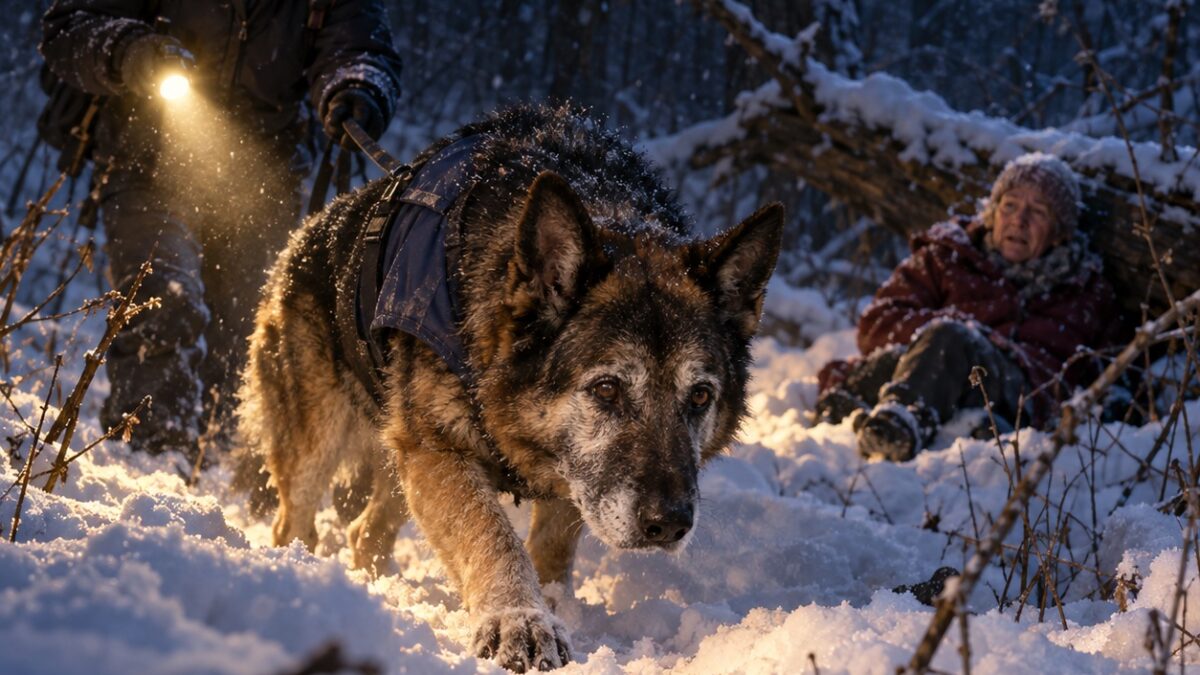
His body went rigid.
He lifted his head.
Ears forward.
Looked toward a cluster of trees.
Then he barked.
The sound exploded through the forest.
Deep.
Powerful.
I had never heard Bruno bark.
Not once.
Not at the shelter.
Not at home.
Not at visitors.
Now his voice tore through the snow.
One bark.
Then another.
I ran.
Branches struck my face.
“Bruno!”
He moved ahead.
Then stopped near the spruce.
I pushed through.
And saw a man.
Elderly.
Curled in the snow.
Light jacket.
No gloves.
His skin looked pale.
His lips blue.
But his eyes were open.
He was breathing.
“Oh my God.”
I dropped beside him.
“Sir?”
He looked at me.
Confusion.
“I…”
His teeth chattered.
“I don’t know where I am.”
I recognized him.
Mr. Whitfield.
He lived on the next street.
Another older neighbor.
He too had memory problems.
Not George.
Not Mrs. Harper’s dead husband.
A living man.
A person who had wandered into the same woods on the same freezing night.
For one second, the coincidence was so strange that I simply stared.
Then training of a different kind took over.
Keep him warm.
Call help.
I removed my outer layer.
Wrapped it around him.
Bruno moved close.
Sat directly against Mr. Whitfield’s side.
The old man looked down.
“Dog.”
“Yes.”
I said.
“He found you.”
Bruno pressed nearer.
His body offered warmth.
Mr. Whitfield’s hand moved weakly toward Bruno’s head.
“He’s a good boy.”
My throat closed.
“Yes.”
“The best.”
I called emergency services.
Gave what location information I could.
The dispatcher kept me talking.
Help was coming.
Roads were difficult.
We needed to stay put.
So we waited.
Bruno never moved from Mr. Whitfield.
Not once.
Wind pushed snow against his vest.
The small light glowed.
His ears remained alert.
Sentinel.
Exactly as he had been trained.
But something felt different.
There was no handler beside him from his old life.
No department.
No official assignment.
No requirement.
Just Bruno.
An old man freezing.
And the instinct to remain.
I watched him and felt something inside me tear open.
For months, I had been angry at the idea that Bruno needed work to feel valuable.
Now I understood something more subtle.
His service had been part of him.
I did not need to remove it.
I needed to make sure it was no longer the price of being loved.
Bruno could search.
Or not search.
Save someone.
Or sleep beside a fireplace.
His worth could remain identical.
That was freedom.
The emergency responders eventually appeared through the trees.
Lights.
Voices.
Equipment.
Mr. Whitfield was moved carefully.
One responder knelt briefly near Bruno.
“Police K9?”
“Retired.”
“He yours?”
I looked at Bruno.
Snow on his coat.
Vest glowing under the light.
Eleven years old.
Still beside the place where he had found a life.
“No.”
I said.
The responder looked confused.
I smiled.
“He belongs to himself.”
Then I touched Bruno’s shoulder.
“But he’s my friend.”
Mr. Whitfield was taken away.
Safe.
Alive.
I stood in the snow after everyone started moving back toward the road.
Bruno looked at me.
For the first time since putting on the vest, his body relaxed.
His tail moved.
One slow wag.
I crouched.
“You did it.”
His eyes stayed on mine.
“You found him.”
Another wag.
I wanted to praise him the way a handler would.
Big voice.
Reward.
Celebration.
Instead, I put both arms around his neck.
Bruno stood still.
Then leaned into me.
“I am so sorry.”
I whispered.
I did not know exactly what I was apologizing for.
For the people who had surrendered him?
For asking him to work again?
For believing retirement meant deleting half of who he was?
Maybe all of it.
“You were always enough.”
My voice broke.
“Before tonight.”
“After tonight.”
“Always.”
Snow collected in his fur.
I cried into his shoulder.
Bruno waited patiently.
Dogs are generous with human embarrassment.
We returned home close to midnight.
Mrs. Harper had been collected by her son.
She was safe.
David had thanked me repeatedly.
I had not yet told him about Mr. Whitfield.
That could wait.
Bruno walked inside.
I removed the vest.
For a terrible second, I wondered what would happen.
Would he sit by the door tomorrow again?
Would one mission reopen the waiting?
Had I undone months of healing?
I placed the vest on the table.
Bruno sniffed it.
Then walked toward the fireplace.
He turned twice.
Lay down.
Exhaled.
Deep.
I sat on the floor.
Stared.
“Bruno?”
He opened one eye.
Then closed it.
I began laughing.
Not because anything was funny.
Because I had been terrified the mission would take him away from the life we had built.
Instead, Bruno seemed to understand something I had not.
The job had ended.
This one night did not mean it had restarted.
He had searched.
Found.
Protected.
Done.
Now fire.
Rest.
Home.
Perhaps he had always been better at transitions than I gave him credit for.
Maybe he simply needed one final ending that felt complete.
The next morning, I woke late.
Sunlight entered the room.
My first thought was Bruno.
I got up.
Walked into the living room.
The front door was empty.
I stopped.
No Bruno.
For one frightened second, I thought something was wrong.
Then I saw him.
On the couch.
The couch.
Bruno had never willingly climbed onto it.
Not once.
He lay stretched across one cushion.
Head on a pillow.
Eyes half closed.
I stood there.
He looked at me.
Tail moved slowly against the fabric.
I covered my mouth.
“You’re on my couch.”
Tail.
“That is extremely inappropriate.”
Another wag.
I walked over.
Sat beside him.
Bruno did not move.
I put one hand on his chest.
He sighed.
There it was.
I started crying.
Again.
The couch meant nothing to anyone else.
To me, it meant Bruno had finally chosen comfort without permission.
No command.
No waiting.
No need to remain ready on the floor.
He had climbed onto softness because softness was available.
That was enormous.
Later that morning, I went upstairs.
Put the service vest back in the box.
For a moment, I considered placing it somewhere special.
Displaying it.
A symbol.
Then I changed my mind.
The vest belonged to Bruno’s history.
Not his daily identity.
I folded it carefully.
Closed the box.
Put it away.
If we ever truly needed it again, it existed.
But Bruno did not need to see it to know who he was.
Neither did I.
News about Mr. Whitfield spread quietly through the neighborhood.
His family was horrified.
Grateful.
He had wandered out unnoticed.
In that cold, more time would have mattered.
People thanked me.
I corrected them.
“Bruno found him.”
Then they praised Bruno.
That felt right until people started saying:
“See? He still had value.”
I hated that phrase.
Still had value.
As though the rescue proved something.
As though sleeping beside my fireplace had not already been enough.
I started answering:
“He had value before he found Mr. Whitfield.”
Some people understood.
Some looked confused.
I did not care.
Bruno did not need one last heroic mission to justify a peaceful retirement.
The mission mattered because a man lived.
Not because Bruno needed to earn his home.
That distinction became sacred to me.
Something did change after that night.
But not what I feared.
Bruno stopped waking before dawn to sit at the front door.
Completely.
The first few days, I thought it was coincidence.
Then a week.
Two.
He slept.
Sometimes in his bed.
Sometimes on the floor near the fire.
Increasingly on my couch.
The door became simply a door.
I wondered whether the search had given him a feeling of completion.
Maybe.
I cannot know what a dog thinks in those terms.
Perhaps months of safety had finally accumulated at the same time.
Perhaps the timing was coincidence.
I resisted creating a neat psychological explanation Bruno could not confirm.
The fact was enough.
He stopped waiting.
That made me happy.
He also started touching toys.
At first, only sniffing.
Then one afternoon, months after the rescue, I was reading on the couch.
Something bumped my shoe.
I looked down.
A toy.
Bruno stood in front of me.
I stared.
He stared.
“Did you bring me this?”
No reaction.
I picked it up.
A simple toy I had bought months earlier and nearly thrown away because he ignored it.
“You want it?”
Bruno’s tail moved.
I threw it.
Not far.
Across the living room.
Bruno turned.
For a second, he stood still.
Then he ran.
Not police-dog speed.
Not young-dog speed.
Eleven-year-old Bruno speed.
He grabbed the toy.
Stopped.
Looked at me.
I was crying before he returned.
“Oh, come on.”
I wiped my face.
“Can we do one normal thing without me turning it into a life event?”
Bruno carried the toy back.
Dropped it at my feet.
Apparently not.
I threw it again.
He ran.
And that was the first time I saw Bruno run without danger waiting at the end.
No missing person.
No command.
No reward for performance.
He ran because a toy was moving.
Because it was fun.
Because he wanted to.
The uselessness of it made it beautiful.
We played for maybe five minutes.
Then Bruno tired.
He lay down.
I sat beside him.
The toy near his paws.
I kept looking at it.
For years, Bruno’s movement had been connected to work.
That afternoon, he spent energy on absolutely nothing important.
I think that was one of the greatest achievements of his life.
Not because play was better than service.
Because he finally had the choice.
He learned the sun next.
There was a patch near the window in late morning.
Bruno began lying there.
No scanning.
No alert posture.
Eyes closed.
Warm fur.
Sometimes I joined him on the floor.
We said nothing.
That became our routine.
Coffee for me.
Sunlight for him.
People underestimate how healing it can be to spend time with a living creature when neither of you needs to accomplish anything.
I had spent years at the shelter turning behavior into assessment.
Ready for adoption?
Reactive?
Fearful?
Progressing?
Bruno made me stop measuring.
Some mornings, he was simply warm.
That was enough.
He started sleeping in my bed too.
The first time happened during a storm.
I heard him moving in the hallway.
Then he appeared beside the bed.
I lifted the blanket.
“Really?”
Bruno waited.
“Come on.”
He climbed carefully.
His body heavier with age.
He turned.
Lay beside me.
Back against my legs.
I smiled in the dark.
For months, Bruno had slept like a dog ready to stand at the first sound.
That night, he snored.
Loudly.
I laughed.
“You were a police dog?”
More snoring.
“Terrifying.”
I slept better than I had in years.
My own life changed with him.
I had thought I was helping Bruno leave a role behind.
He made me examine mine.
For six years, I had been the therapist.
The evaluator.
The calm person.
People came to me with frightened animals and expected answers.
I liked being needed.
Maybe too much.
At home, I had no one.
No spouse.
No children.
No dramatic tragedy.
Just an apartment-like little house filled with the quiet of a person who had put most of herself into work.
Bruno interrupted that.
Suddenly someone cared when I came home.
Not because I was competent.
Not because I knew behavior.
Because I was me.
That was unfamiliar.
I had told Bruno he did not need to earn dinner.
Slowly, I realized I had been trying to earn my own sense of worth through work for years.
He taught me the same lesson I was trying to teach him.
You are allowed to matter while resting.
That was difficult.
Still is.
Mrs. Harper remembered very little about the night.
Sometimes she thought George had been found.
Sometimes she remembered visiting my house.
David arranged more help for her after the wandering incident.
That gave me peace.
I did not correct her harshly when she talked about George.
Memory is complicated.
Love even more so.
But every time I saw her afterward, I thought about wet shoes and frozen snow on her sleeve.
If she had not wandered into my house that night, Mr. Whitfield might never have been found.
One confused search accidentally revealed another person who truly needed rescuing.
Life is strange.
I stopped trying to make it neat.
Mr. Whitfield recovered.
His family came to thank me and Bruno.
I kept the visit short.
Not because I was ungrateful.
Because I did not want Bruno turned into a public attraction.
Mr. Whitfield sat near him.
Older.
Safer.
He placed a hand on Bruno’s head.
“I remember the dog.”
he said.
His daughter looked surprised.
“You do?”
He nodded.
“Warm.”
That word broke me.
Warm.
Not hero.
Not police dog.
Not rescue animal.
Warm.
In the snow, Bruno’s body beside him had become warmth.
Maybe that was the purest description of Bruno’s service I ever heard.
He spent years running toward danger.
In the end, what mattered most was that he could sit beside someone cold.
After they left, Bruno slept for hours.
No ceremony.
That was good.
Time moved.
Eleven became older.
His body slowed more.
Stairs became difficult.
I adapted.
Rugs.
Shorter walks.
More rest.
The shelter veterinarian checked him regularly.
Nothing dramatic.
Age.
The ordinary wear of a body that had worked hard.
I became protective of his comfort.
Not because I feared death every second.
Because I had learned what his retirement was for.
Rest.
If walking three blocks became enough, three blocks.
If he wanted to lie in the sun, sun.
If a toy stayed untouched for days, fine.
Bruno no longer had performance requirements.
He still sometimes became alert at certain sounds.
Sirens.
A sharp knock.
Someone calling loudly outside.
His ears would rise.
Body shift.
The old dog present inside the retired one.
I stopped seeing that as sadness.
Identity is not something we have to amputate to move forward.
Bruno could remember work without belonging to it.
I could remember my loneliness without returning to it.
Both could coexist.
The service vest stayed in the attic.
I opened the box only once after that night.
Years of wear visible.
Reflective strips.
Old scent probably gone.
I touched it.
Then closed the box again.
Bruno was downstairs asleep on my couch.
That image mattered more.
I sometimes wondered about his former department.
Did individual officers miss him?
Probably.
Had someone been forced to make a difficult administrative decision?
Maybe.
The file said surrendered by service.
It did not tell me every human feeling behind that line.
I resisted turning an entire department into cartoon villains.
Still, Bruno had ended up in a concrete kennel at eleven after seven years of service.
That fact remained painful.
Whatever the bureaucracy or circumstances, retirement had failed him.
I did not need hatred to say that.
Working animals deserve plans for what happens after work.
They deserve more than gratitude while useful.
They deserve care when usefulness changes.
Bruno taught me that with his entire body.
People love heroes while the hero is doing heroic things.
That is easy.
Applause follows action.
Search completed.
Child found.
Danger prevented.
Lives saved.
But what about afterward?
What happens when the hero has arthritis?
When the run is slower?
When the jump is impossible?
When there is no next mission?
That is where our values become visible.
A society that praises service should know how to honor rest.
Bruno deserved that from the beginning.
I was simply fortunate enough to give him some of it at the end.
I stopped calling his life with me “retirement.”
The word still sounded like work was the main story and everything afterward was an epilogue.
It was not.
Bruno had a second life.
Not less important.
Different.
Fireplaces.
Toys.
Sun.
My bed.
A neighborhood.
Mr. Whitfield.
Slow walks.
Cheese.
Very strong opinions about cheese.
That life mattered independently.
He was not simply waiting to die after service.
He was living.
The first year with him changed my work at the shelter.
When older working dogs arrived, I looked differently.
When people surrendered senior dogs because they “weren’t active anymore,” I became more careful with my own anger and more determined about the placement.
I started asking adopters different questions.
Can you love an animal who may never entertain you?
Who may sleep most of the day?
Who has a past you cannot recreate?
Who needs patience more than adventure?
Some people said no.
Good.
Honesty protects animals.
Others said yes.
Those yeses became precious.
Bruno made me a better therapist because he made me stop treating every dog’s future as a problem to solve.
Sometimes the goal is simply the right place to rest.
He continued playing occasionally.
Never obsessed with toys.
He had spent too many years with meaningful objects to become enthusiastic about squeakers.
But every now and then, he would bring one.
Drop.
Wait.
I threw.
He followed.
Slower each year.
Still joyful.
I learned to stop before he was exhausted.
That was another act of love.
Working dogs are trained to push.
Retired dogs sometimes need humans willing to say:
Enough.
You already did enough.
One afternoon, Bruno brought the toy and I was busy.
Laptop.
Shelter notes.
Behavior reports.
“I can’t right now.”
He stood there.
Toy in mouth.
“Bruno.”
Nothing.
“I have work.”
He dropped the toy directly on my keyboard.
I stared.
He stared.
Then I laughed so hard I had to close the computer.
“Fine.”
We went outside.
I threw the toy.
Bruno trotted after it.
The report waited.
Nothing terrible happened.
That sounds trivial.
For me, it was not.
I had spent years believing responsibility meant always choosing work first.
Bruno taught me some things can wait.
A dog asking you to throw a toy may not ask forever.
The report will.
As Bruno became older, I began thinking about loss.
I tried not to.
Impossible.
Working in a shelter means you understand animal lifespans too well.
You know what twelve means.
Thirteen.
You know the changes.
The longer naps.
Stiffer mornings.
I caught myself watching him breathe.
Then stopped.
I had watched enough animals through endings to know anticipatory grief can steal enormous amounts of living time.
Bruno had already spent too much of life waiting.
I would not spend our remaining time waiting for death.
So we kept the routine.
Morning.
Food.
Walk.
Sun.
Maybe toy.
Fireplace.
Bed.
Ordinary.
Perfect.
There were days when he no longer wanted the full walk.
He would reach the end of the street.
Stop.
Look at me.
“Home?”
Bruno turned.
Clear answer.
We went home.
No pushing.
No “come on, you can do it.”
He had spent enough years being asked for more.
His body could set the terms now.
That was the privilege of retirement.
His favorite place remained the couch.
The same couch he had refused to climb onto at first.
Eventually, one cushion became his.
I pretended otherwise.
Nobody believed me.
Especially Bruno.
Visitors learned.
“That’s Bruno’s spot.”
“Yes.”
“What happens if I sit there?”
“He will stare at you until guilt moves you.”
They thought I was joking.
I was not.
Bruno had mastered civilian psychological warfare.
The fireplace was second.
Sunlight third.
My bed probably first, though he would never admit it.
One winter evening, years after the search, snow began outside.
Not as severe.
Still enough to whiten the yard.
Bruno stood at the window.
For a moment, I remembered the vest.
The forest.
His bark.
Mr. Whitfield.
I put my hand on his back.
“Retired.”
I said.
Bruno looked at me.
“Absolutely retired.”
He moved toward the fireplace.
I smiled.
“Good decision.”
No emergency came.
We spent the night inside.
That felt like victory too.
Not every storm needs a rescue.
Sometimes snow can just be snow.
Mr. Whitfield’s family sent a card one Christmas.
A photograph.
He was older.
Smiling.
Inside, one sentence:
We still remember Bruno.
I put the card near the fireplace for a few days.
Bruno did not care.
That was fine.
The life he saved belonged to Mr. Whitfield now.
That is what rescue should do.
Return people to their own lives.
Bruno did not need ownership of the result.
I thought of the children in his old records.
Names I did not know.
Families.
Searches.
People alive because of work Bruno had done.
His body carried none of their gratitude visibly.
No medals mattered to him.
No ceremony.
Dogs do not build identity from awards.
They build it from patterns.
Handler.
Vest.
Command.
Work.
Then later:
Elisabeth.
Home.
Food.
Fire.
Bed.
Sun.
Toy.
I liked the second list better.
Not because the first was wrong.
Because the second was finally for him.
The last months of Bruno’s life were quiet.
I want to say that carefully.
Quiet does not mean sad.
They were some of the most peaceful months we had.
He slept more.
Walked less.
Played only occasionally.
But his eyes remained warm.
He knew the house.
Every corner.
Every sound.
He no longer looked toward the front door at dawn.
That habit had disappeared so completely I almost forgot it.
Almost.
Sometimes I remembered the shelter Bruno.
Concrete.
Blank stare.
Waiting for an order.
Then I looked at the old dog sleeping in sunlight.
Two completely different kinds of stillness.
One was emptiness.
The other was peace.
That difference became the whole story for me.
I moved his bed to follow the sun when necessary.
He had trained me well.
Morning one side.
Afternoon another.
Sometimes he chose the couch instead.
His favorite toy often lay nearby.
Not because he played with it constantly.
Because I kept it where he could reach.
One day, he placed his head beside it and slept.
I took a photograph.
Not for social media.
For me.
Bruno in sunlight.
Toy near his muzzle.
No vest.
That became my favorite photograph.
Not the search night.
Not hero Bruno.
Resting Bruno.
That was the dog I wanted remembered.
His appetite became smaller eventually.
We adjusted.
Softer food.
Things he liked.
Veterinary checks.
Comfort.
No dramatic intervention beyond what made sense for his age and wellbeing.
I had spent years evaluating quality of life for animals.
Doing it for Bruno was different.
Emotion makes every professional skill unstable.
I asked colleagues.
Trusted them.
Listened.
I refused to keep him for myself if he was suffering.
But for a while, he still had good mornings.
Sun.
Food.
My hand.
A slow tail wag.
Those mattered.
The final day was not a search.
No siren.
No snowstorm.
No danger.
It was sunlight.
That feels important.
Bruno was on the couch.
His couch.
Light through the window.
His favorite toy near his muzzle.
I sat beside him.
His breathing had become slower.
He was tired.
Very tired.
I put my hand on his head.
The same place I had touched him the first evening at home.
“Bruno.”
His eyes opened slightly.
I smiled even though tears were already coming.
“There are no orders.”
That was the first lesson I had tried to teach him.
Now it became the last thing I wanted him to know.
“You don’t have to do anything.”
His eyes stayed on me.
“You don’t have to get up.”
My voice broke.
“You don’t have to find anyone.”
A tear fell onto my hand.
“You don’t have to save anybody.”
Bruno breathed.
Slow.
His body warm under sunlight.
“You did enough.”
I leaned closer.
“You did more than enough.”
His tail did not move.
That was okay.
I had finally learned not to ask his body to comfort me.
I kept my hand on him.
“You can rest.”
Bruno closed his eyes.
I stayed.
Of course I stayed.
For years, Bruno had run toward people who needed him.
He had gone into danger so strangers could go home.
On his final day, he was already home.
There was nowhere else he needed to go.
Nothing else he needed to earn.
No service left unfinished.
He died on my couch in the sunlight with his favorite toy near his face and my hand resting on him.
Peacefully.
No concrete kennel.
No waiting.
No command.
Just rest.
For a long time afterward, I could not move the toy.
It remained on the couch.
The house sounded wrong.
People talk about silence after loss as though silence is simply the absence of sound.
It is not.
It is the absence of expected sound.
Bruno’s nails.
His sigh.
His body shifting.
The soft thump when he jumped from the couch.
The breathing beside me at night.
All of those had occupied places in the house.
Then suddenly they did not.
I would wake before dawn sometimes.
Look toward the door.
Empty.
And remember the first weeks.
Bruno sitting there.
Waiting.
It struck me that I was doing the same thing now.
Waiting for a routine that had ended.
I finally understood him in a way I wished I did not.
The service vest remained in the attic.
The toy remained downstairs.
For weeks, I could not decide which object hurt more.
One represented the life he had been trained for.
One represented the life he learned afterward.
Eventually, I stopped treating them like opposing symbols.
Both were Bruno.
Search dog.
Retired dog.
Hero.
Couch thief.
Protector.
Friend.
No single role owned him.
That was the final lesson.
People from the neighborhood came.
Mrs. Harper, with David.
She did not always remember Bruno’s name.
That did not matter.
Mr. Whitfield’s daughter came too.
She hugged me.
“He gave us more time with Dad.”
I nodded.
Could not speak.
Later, alone, I thought about that sentence.
More time.
That was what everyone wanted.
More time.
The families Bruno helped.
Me.
Bruno himself, perhaps.
Nobody gets enough.
But some time is still different from none.
I returned to the shelter after a few days.
Work does not stop because your heart does.
The final kennel was occupied by another dog.
Different story.
Different silence.
I stood outside.
For one second, I saw Bruno.
Then I corrected myself.
No.
This dog deserved to be itself.
I opened the kennel.
Sat on the floor.
Waited.
Exactly as I had with Bruno.
Ten minutes.
Fifteen.
Eventually, the dog looked at me.
I smiled through tears.
No command.
Just presence.
Bruno had taught me well.
People sometimes asked me whether Bruno’s final search was worth bringing the vest out again.
I understand the question.
I have asked it myself.
Did I risk pulling him back into a role he had spent months leaving behind?
Maybe.
But the night ended with Mr. Whitfield alive.
Bruno returned home and rested.
And afterward, something in his waiting seemed to disappear.
I cannot scientifically prove the mission gave him closure.
I would not try.
But I know the facts.
Before that night, Bruno often waited by the door.
Afterward, he stopped.
Before that night, he had never played.
Later, he learned.
Before that night, comfort still seemed like something he needed permission to accept.
The next morning, he claimed my couch.
Whatever happened inside him, I am grateful.
But I need to say this clearly.
Bruno did not become valuable again when he found Mr. Whitfield.
He had never stopped being valuable.
The rescue did not restore his worth.
It revealed his skill one more time.
Those are different things.
If nobody had been lost that night, Bruno would still have deserved the couch.
The fire.
The toy.
The bed.
The sun.
My friendship.
That is the point I want people to remember.
We are very good at celebrating service.
Police dogs.
Military dogs.
Search dogs.
Therapy animals.
Working horses.
Humans too.
We praise usefulness.
Strength.
Sacrifice.
Performance.
Then bodies age.
Careers end.
Roles disappear.
And some people—or animals—are left staring at a wall, wondering what remains when nobody asks for the thing they were trained to give.
Bruno taught me the answer.
Everything remains.
The heart.
The memories.
Preferences.
Need for warmth.
Need for companionship.
Capacity for joy.
The right to rest.
The right to be loved without producing a result.
Those things are not retirement benefits.
They are basic worth.
Bruno had spent seven years earning praise by finding other people.
His last chapter began when he stopped needing to find anybody at all.
Except maybe himself.
I know that sounds sentimental.
Perhaps it is.
But I watched it happen.
The dog who did not understand toys learned to chase one.
The dog who slept beside a bed learned to sleep on it.
The dog who waited at a door learned to ignore it.
The dog who stared at walls learned to lie in sunlight with his eyes closed.
If that is not a form of finding yourself, I do not know what is.
I learned alongside him.
I had spent six years being Elisabeth the shelter therapist.
Useful.
Competent.
Needed.
Bruno forced me to become Elisabeth sitting on the floor.
Elisabeth throwing a toy.
Elisabeth changing plans because an old dog wanted a walk.
Elisabeth doing nothing beside a fireplace.
I still worked.
Still cared.
But I stopped treating productivity as proof I deserved to occupy my own life.
Bruno’s retirement became mine in small ways.
Not retirement from work.
Retirement from the belief that work was everything.
That is what I mean when I say Bruno saved me too.
Not dramatically.
He did not pull me from a burning building.
He changed the way I understood stillness.
Before him, stillness often felt empty.
After him, it could feel complete.
A room.
A dog.
A fire.
No task.
Enough.
Even now, I sometimes imagine the night in the woods.
Bruno’s bark.
Snow in the flashlight beam.
Mr. Whitfield beneath the spruce.
Bruno beside him.
Old.
Retired.
Still knowing exactly what to do.
People would call that the heroic part.
Maybe it was.
But I remember another night more.
Bruno asleep on my bed.
Snoring.
No danger.
No need.
I think that was harder for him.
Learning he could let his guard down.
Heroism had been trained.
Rest had to be learned.
On his final day, he mastered it completely.
He did not wait by the door.
Did not lift his head at every sound.
Did not look for a command.
Sunlight.
Toy.
My hand.
Then sleep.
That is how I choose to remember him.
Sometimes I open the attic box.
Not often.
The vest is still there.
The reflective strips have dulled.
I run my fingers over it.
I think about all the lives connected to that fabric.
Children.
Strangers.
Mr. Whitfield.
Bruno.
Then I close the box.
I do not need to keep it open.
Heroes deserve privacy after the story is over.
His toy remained with me longer.
Eventually, I moved it from the couch.
Not because I was ready to forget.
Because memory does not live in an object.
I keep the photograph.
Bruno in sunlight.
Head down.
Toy near his muzzle.
The entire final chapter visible in one image.
A dog who once believed every day required an assignment finally sleeping without one.
I tell Bruno’s story because there are animals like him everywhere.
Older.
Retired.
Slower.
No longer useful for the job someone once praised them for doing.
Some are fortunate.
They go home with handlers.
Families.
People prepared for old age.
Others do not.
I want people to understand that a working dog’s obligation has an ending.
Our obligation to that dog should not.
Service deserves aftercare.
Not just medals.
Not words.
A bed.
Medical attention.
Patience.
Home.
That is gratitude made real.
And I tell his story because humans do the same cruel thing to themselves.
We retire.
Lose jobs.
Children grow up.
Bodies change.
Roles disappear.
We ask:
What good am I now?
Bruno had no words for that question, but I saw it in the shelter.
Waiting for an order.
He taught me an answer.
You do not need a mission to deserve a morning.
You do not need an emergency to deserve someone beside you.
You do not need to save anyone today.
Sometimes the purpose is breakfast.
Sunlight.
A walk.
A friend.
A toy dropped at someone’s feet.
Life does not become meaningless when it becomes ordinary.
Sometimes ordinary is the reward.
Bruno earned ordinary.
That is what makes me cry when I think about him.
Not the searches.
Not even Mr. Whitfield.
The couch.
The fact that he eventually climbed onto it without asking.
For years, humans had trained him to wait for permission.
Then one morning, after one last night of service, Bruno chose comfort for himself.
That was freedom.
I remember standing there and saying:
“You’re on my couch.”
He looked at me.
Tail moving.
As if to say:
Yes. I am.
I wish I had known then how precious that image would become.
Maybe I did.
I think part of me knew.
That is why I did not make him get down.
By the end, Bruno owned that couch more completely than I did.
Good.
He had earned nothing.
He needed to earn nothing.
But he deserved it.
There is a difference.
His final months were not sad because they were final.
They were peaceful because he had stopped preparing for the next task.
I want that distinction remembered.
Old age is not automatically tragedy.
Decline is not humiliation.
A slower life can still be good.
Bruno ate.
Rested.
Watched me.
Sometimes played.
Sometimes did absolutely nothing.
He remained himself.
That was enough.
When his body finally reached the point where it could not continue, he did not leave in a kennel.
He did not leave under fluorescent lights alone.
He did not leave waiting for the department door to open.
He left where he had learned to live.
On the couch.
Sunlight.
Toy.
Friend.
I could not have written a kinder ending for him.
I wish I could have given him more years.
Of course.
But more years would never have felt like enough.
So I am grateful for the ones we had.
Especially the useless ones.
The days when Bruno saved nobody.
Found nobody.
Protected nobody.
The days when his only accomplishment was taking my pillow.
Those days are the ones I miss most.
My name is Elisabeth.
I worked at that shelter for six years before Bruno taught me what my job actually was.
I thought my job was to assess animals.
Understand behavior.
Decide who was ready for a home.
Bruno taught me that sometimes my job was simpler.
Sit down.
Wait.
Do not demand.
See the animal underneath the role.
Then make room.
Bruno had spent seven years running toward danger so other people could return home safely.
When his body slowed, his service ended.
Someone placed him in a concrete kennel.
He lay there waiting for another command because nobody had taught him what came after heroism.
I was fortunate enough to show him.
A fireplace.
A couch.
A toy.
Sunlight.
A bed.
A friend.
And, once, one final search through the snow when another life truly needed him.
He found Mr. Whitfield.
Of course he did.
Bruno knew how to bring lost people home.
What took him longer was learning that he had a home too.
He learned.
Eventually.
Not because of the service vest.
Not because of praise.
Because morning after morning, the same house remained.
The same person.
The same food.
The same fire.
Nobody asked him to prove anything.
Safety became repetitive enough to believe.
That is how healing happens more often than we admit.
Not revelation.
Evidence.
Again.
Again.
Again.
By the time Bruno died, he no longer waited for instructions.
That fact matters to me more than almost anything.
His last breath did not come while he was ready for duty.
It came while he was resting.
For a dog who had spent most of his life on alert, that was a victory nobody could put on a service record.
I hope that when people remember Bruno, they do not only picture the retired police dog standing in the snow.
I hope they picture the old dog on my couch.
Eyes half closed.
Tail moving lazily.
Completely unconcerned about whether anyone needed saving.
Because the first image proves Bruno was brave.
The second proves he was finally free.
There is a difference.
And freedom was the gift he deserved most.
Sometimes, after difficult days at the shelter, I still go home and sit on the floor near the fireplace.
There is no Bruno there now.
That emptiness remains.
But I do not turn on the television simply to fill it.
I let the quiet exist.
Bruno taught me quiet does not always mean absence.
Sometimes it means nothing is wrong.
No one is lost.
No one is calling.
No emergency.
No order.
That kind of silence is a blessing.
It took an old police dog to teach me.
When the fire settles low, I sometimes hear his sigh in my memory.
Deep.
Peaceful.
The sound of a body finally understanding it does not have to get up.
I close my eyes.
And for a second, I can almost feel his head on my knee.
Not waiting.
Not asking.
Just there.
That is how I remember my friend.
Not abandoned.
Not retired.
Not surrendered.
Not heroic.
Bruno.
Simply Bruno.
And after everything he had done for strangers, after every dark place he entered, every frightened person he helped bring home, every year he gave because humans asked him to serve, that simple identity was the one thing he should have been allowed from the beginning.
A dog.
Loved.
Home.
Free to rest.
No creature loses value when its service ends.
No heart becomes disposable because the body slows.
And no hero should have to spend the final chapter of life waiting in a cage for an order that will never come.
Bruno taught me that courage is not only running toward danger.
Sometimes courage is putting down the uniform.
Climbing onto the couch.
Closing your eyes in sunlight.
And trusting, finally, that the person beside you will still love you when there is nothing left to do.
He learned that before he left me.
I know because on his final day, when I whispered, “You don’t have to save anybody anymore,” Bruno did not try to rise.
He simply rested beneath my hand.
For once, the world asked nothing from him.
And for once, that was exactly enough.

