PART2:A Wealthy Investor Forced an Elderly Cleaner to His Knees—Then Security Read the Woman’s Card
PART2
Some people carry themselves as though every room has been waiting for them.
Richard was one of them.
Two assistants followed close behind.
One had a phone pressed to her ear.
The other carried a leather portfolio, tablet, and what looked like Richard’s coat despite the fact that the afternoon was warm.
Richard wore a charcoal suit so precisely cut it looked aggressive.
Gold watch.
Heavy cuff links.
Sharp cologne.
He had invested substantial capital through various property and advisory relationships connected to the hospitality group.
He sat on committees.
He knew board members.
He donated.
He expected people to know his name.
And most did.
The valet manager hurried toward him before he had taken six steps.
Richard did not say hello.
“Seven minutes.”
The manager stopped.
“Excuse me, sir?”
“Seven minutes for valet.”
“I’m sorry, Mr. Halbrook. We had—”
“Unacceptable.”
His voice was loud enough that nearby guests could hear.
Not shouting.
Performing.
“I have significant capital in this property.”
The manager nodded.
“Yes, sir.”
Richard kept walking.
“You should know what kind of service investors expect.”
He said investor the way other people say owner.
That distinction mattered.
I watched from near a seating area.
Nobody introduced us.
Good.
One assistant spotted me briefly.
Her eyes passed over my suit.
No recognition.
Better.
I followed at a distance as Richard crossed the marble.
Mr. Dio was completing another pass near the entrance.
A faint mark appeared near the wet area.
Small.
Barely visible.
Perhaps from a suitcase wheel.
Perhaps from a shoe.
Perhaps from nothing Mr. Dio had done at all.
Richard stopped.
“What is that?”
Mr. Dio followed his gaze.
“Sir?”
Richard pointed.
“That.”
Mr. Dio bent slightly.
“It is small mark, sir. I clean.”
Richard stared at him.
“Small?”
“Yes, sir. I fix.”
“That is imported Italian tile.”
People began slowing.
I saw it happen in widening circles.
A couple near the concierge desk.
A woman waiting for the elevator.
Two men with conference badges.
They were not stopping to help.
They were stopping because conflict is entertainment when you believe it belongs to someone else.
Richard moved closer.
“Do you have any idea what that costs?”
Mr. Dio tightened both hands around the mop.
“I clean again, sir.”
His accent was noticeable.
That was all.
A human accent.
Evidence that his life contained a history different from Richard’s.
Richard mimicked two syllables under his breath.
Not loudly.
Loud enough.
The couple by the concierge desk looked at each other.
Neither moved.
My stomach tightened.
I had spent enough years inside leadership teams to recognize the moment where a situation can still be corrected cheaply.
One sentence.
“Richard, that’s enough.”
A manager could have said it.
One of his assistants.
The concierge.
A guest.
Nobody did.
I did not yet either.
That truth matters.
I was watching.
Assessing.
And for several seconds, that made me part of the silence.
Richard’s voice rose.
“Do you even understand English?”
Mr. Dio nodded too quickly.
“Yes, sir. I am—I clean again.”
His hands began moving faster.
The mop trembled.
Richard looked around.
He had an audience now.
That made him worse.
“Then why am I explaining basic property care to you?”
Mr. Dio lowered his head.
“I am sorry, sir.”
Richard exhaled.
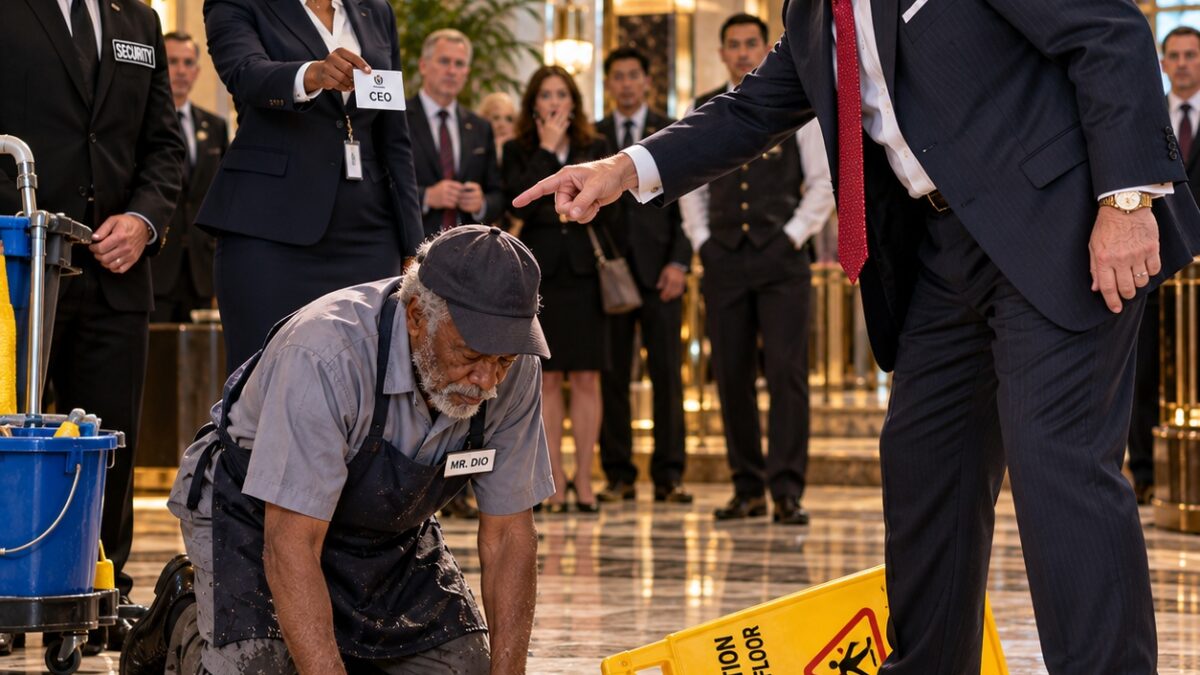
Then he used the tip of his polished shoe to push the yellow caution sign aside.
He did not kick it violently.
That is almost worse.
He nudged it with contempt.
The sign tipped.
Hit the marble.
The sound cracked through the lobby.
Mr. Dio startled.
The mop handle struck the bucket.
Water sloshed over the rim.
A thin sheet spread across the polished floor.
Richard looked down.
Then laughed once.
“Now look what you’ve done.”
I felt something inside me go cold.
Mr. Dio bent toward the bucket.
“I fix, sir.”
His hand went to his trouser pocket.
Maybe looking for a cloth.
Maybe adjusting himself.
A few coins slipped out.
One quarter.
Another.
A dime.
A nickel.
They hit the marble separately.
Bright metallic sounds.
Then rolled.
One quarter spun in a widening circle near a woman’s expensive shoe.
She looked down.
Then at her phone.
The nickel rolled toward a bellhop.
He could have stopped it with one shoe.
He did not.
His hands were clenched behind his back.
The dime traveled farther than it should have across that huge polished space.
Mr. Dio looked at the coins.
Then at the water.
Then at Richard.
He did not know what to fix first.
That was the moment that hurt me most.
Not later.
Not even the racist sentence.
The coins.
An elderly man trying to decide whether protecting the floor mattered more than retrieving the small pieces of money that had fallen from his pocket.
And a lobby full of people quietly agreeing that his humiliation was not their assignment.
Richard leaned closer.
“I could call management right now.”
Mr. Dio swallowed.
Richard lowered his voice.
That made everyone strain harder to hear.
“You might not even be working here tomorrow.”
Silence.
“Maybe not even in this country.”
My body moved before my mind finished the sentence.
But Richard was not done.
Mr. Dio bent.
Richard snapped:
“Get on your knees.”
The old man froze.
“Sir?”
“If you’re going to fix it, fix it properly.”
A manager appeared at the edge of the crowd.
He did not intervene.
I saw fear in his face.
Richard knew board members.
Everybody knew that.
Richard donated.
Richard had influence.
The manager calculated.
That calculation cost Mr. Dio something.
Slowly, Mr. Dio lowered himself.
His right knee touched the wet marble first.
Then his left.
Water immediately darkened his trousers.
His fingers shook as he gathered the coins.
One by one.
I have attended hundreds of executive meetings.
I have heard speeches about inclusion.
Values.
Human capital.
Dignity.
Culture.
I have watched leaders stand on stages beneath enormous corporate logos and say:
Our people are our greatest asset.
Those words are easy when the ballroom lights are on.
Culture is not what you print.
Culture is what happens when someone powerful humiliates someone with less visible power and everybody else decides whether it is safer to see.
I stepped forward.
“You will not speak to him like that.”
My voice was not loud.
It carried anyway.
Richard turned.
For a second, he looked annoyed that the scene had developed an unscripted participant.
Then he looked me over.
Navy suit.
No badge.
No entourage.
No person beside me whispering who I was.
He laughed.
Short.
Sharp.
“And who exactly are you?”
I did not answer immediately.
Instead, I walked closer to Mr. Dio.
I did not touch him.
People sometimes touch embarrassed people without permission because they want to perform compassion.
I simply stood close enough that he was no longer alone.
Richard’s smile widened.
“His lawyer?”
I met his eyes.
“No.”
He waited.
I said:
“Just someone who understands consequences.”
Something shifted in the lobby.
Not recognition.
Attention.
Richard straightened his jacket.
Then looked toward security.
“Security.”
Two guards stood near the entrance.
Both looked at their supervisor.
Nobody moved.
Richard’s irritation sharpened.
“I sit on advisory committees connected to this property.”
He turned so more people could hear.
“There is an executive vote next week that affects every employee in this building.”
The words were deliberate.
Not information.
Threat architecture.
The manager’s face changed.
Richard saw it.
Enjoyed it.
“I can replace staff.”
I looked at him.
“Is that how you believe leadership works?”
He smirked.
“Leadership?”
He gestured toward the lobby.
“It works by ownership.”
Then toward himself.
“Investment.”
Then toward Mr. Dio.
Still kneeling.
“People like him are here because people like me allow it.”
There are sentences that reveal more about a person than years of professional biography.
That was one.
He believed money did not merely purchase influence.
He believed it purchased hierarchy between human beings.
That other people’s ability to earn a living existed because men like him permitted it.
Mr. Dio reached for another coin.
I bent.
Picked up the quarter that had rolled near my shoe.
Then another.
That simple movement created more reaction than I expected.
Maybe because someone finally broke the invisible rule of the scene.
A young woman near the elevators bent too.
She picked up the dime.
The bellhop moved quickly and retrieved the nickel.
Suddenly three people were helping.
Too late.
But helping.
Mr. Dio looked at me.
His eyes were wet.
Not crying.
Humiliation.
He whispered:
“Thank you, ma’am.”
I placed the coins in his palm.
“You’re welcome, Mr. Dio.”
Richard scoffed.
“Oh, please.”
I stood.
He continued.
“Let’s not make this into something it isn’t.”
“What is it?”
“Property protection.”
“You questioned whether he belongs in this country.”
“He damaged expensive materials.”
“Did he?”
Richard frowned.
“What?”
“Did he cause the mark?”
Silence.
“You watched him?”
Richard’s face tightened.
“That’s irrelevant.”
“No.”
I looked toward the general manager.
“Do you know?”
The manager swallowed.
“No, ma’am.”
“Was damage confirmed?”
“No.”
“Was anyone asked to inspect it?”
“No.”
I looked back at Richard.
“Then you humiliated an employee over a mark nobody has determined he caused.”
Richard laughed again.
But the crowd no longer supported him.
“So what exactly do you want?”
That was the moment.
I could have told him.
My name.
My title.
The board decision scheduled next week.
I could have watched his face change immediately.
Instead, I thought about his sentence.
People like him are here because people like me allow it.
And I understood that this was no longer about stopping one ugly exchange.
I needed the room to see the difference between power and authority.
So I reached into my bag.
Richard stopped smiling.
Slowly, I removed a slim leather folder.
Opened it.
Inside was a single card.
I held it toward the head of security.
Not Richard.
The guard hesitated.
Then accepted it.
He glanced down.
His eyes moved across the name.
He looked at me.
Then back at the card.
Read again.
His posture changed.
Shoulders back.
Chin lifted.
Not because I suddenly deserved posture.
Because he understood his professional responsibility had just changed.
He swallowed.
“Ma’am…”
The whole lobby waited.
He said:
“Welcome.”
Richard’s smile faltered.
“Welcome?”
The guard looked at him.
Then back at me.
“Chief Executive Officer.”
The title moved through the lobby like electricity.
Not shouted.
Whispered.
CEO.
New CEO.
That’s her.
Amara Okoye.
The incoming CEO.
Richard stared.
His face emptied in stages.
First amusement.
Then confusion.
Then calculation.
Then fear.
“You’re…”
He stopped.
I nodded.
“Yes.”
The manager looked as though somebody had removed gravity.
One assistant behind Richard took half a step away from him.
Then the other.
Mr. Dio slowly rose.
Water had soaked both knees.
His hands were still shaking.
But he was standing.
I looked at him first.
Not Richard.
“Are you all right, sir?”
He nodded.
“Yes, ma’am.”
His voice broke slightly.
That nearly broke me too.
Because now the room knew my title and suddenly everybody seemed interested in his dignity.
Where had that concern been five minutes earlier?
I turned toward the general manager.
“Document everything.”
“Yes, ma’am.”
“Security footage.”
“Yes.”
“Witness statements.”
“Yes.”
“Every camera angle covering this lobby.”
“Yes.”
Then:
“No one edits anything.”
His face tightened.
“Understood.”
Richard cleared his throat.
The sound was strangely small.
“Well.”
He forced a laugh.
No one joined.
“I didn’t realize.”
There it was.
The sentence I had expected.
I looked at him.
“What didn’t you realize?”
He hesitated.
“Who you were.”
“That isn’t the problem.”
“I mean—”
“You didn’t realize I was CEO.”
He nodded.
“Correct.”
I gestured toward Mr. Dio.
“You knew exactly who you thought he was.”
Silence.
Richard’s jaw tightened.
“I was protecting the property.”
“You told a seventy-something employee to get on his knees.”
“I did not know his age.”
“You questioned whether he belonged in the country.”
“That was said in frustration.”
“You mimicked his speech.”
His assistants were staring at the floor.
Richard’s face hardened.
“Let’s not overreact.”
I felt the room change again.
Overreact.
Another favorite word of powerful people when consequences begin arriving.
“I have substantial leverage with this board.”
He wanted everyone to remember.
His investment.
His committees.
His network.
The invisible architecture that had kept managers quiet.
I looked at him.
“We’ll discuss your position with the board.”
No heat.
No threat.
Process.
That frightened him more.
He tried again.
“Amara—”
“Dr. Okoye.”
He stopped.
Not because I needed the honorific.
Because familiarity was another thing he had not earned.
The lobby remained silent as he left.
No dramatic security escort.
No arrest.
No spectacle.
His assistants followed.
The revolving doors turned.
Then he was gone.
Only after he left did people begin talking.
That irritated me.
The woman by the elevator approached Mr. Dio.
“I’m sorry.”
He nodded.
The bellhop handed him the remaining coin.
The manager kept saying:
“I should have stepped in.”
Mr. Dio looked exhausted.
I asked:
“How long have you worked here?”
He looked surprised.
“Here?”
“Yes.”
“Twenty-three years.”
I repeated it.
“Twenty-three?”
“Yes, ma’am.”
Around us, employees heard.
Some looked stunned.
That told me something else.
A man could work in the flagship property for twenty-three years and still remain unknown enough that senior people did not know his tenure.
“What time did you start today?”
“Five.”
It was nearly three.
“Have you eaten?”
He smiled apologetically.
“Little.”
That answer was unacceptable too.
Not because somebody had necessarily denied him food.
Because I realized I knew nothing yet about break practices, staffing, workload, or whether older employees were being managed humanely.
The incident had opened one door.
Behind it were others.
I asked the general manager to cover his shift.
Mr. Dio protested immediately.
“No, ma’am. I work.”
“You’ve worked.”
“I finish.”
“You’ll finish tomorrow.”
He looked frightened.
“Am I in trouble?”
That question destroyed me.
After everything Richard had done, the old man’s first fear was that being sent home meant punishment.
“No.”
I lowered my voice.
“You are not in trouble.”
His eyes filled.
I wanted to say more.
Could not safely.
So I said:
“Please go change out of those wet clothes.”
He nodded.
“Thank you.”
Then he looked at the marble.
At the remaining water.
“I clean first.”
“No.”
I almost laughed through the pain.
“Someone else can clean the floor.”
He looked uncertain.
I smiled.
“That is not a demotion.”
A tiny smile appeared.
He left.
The lobby slowly returned to motion.
But not normal.
Not yet.
People moved differently after witnessing something shameful.
Some became overly polite.
Some avoided my eyes.
Some suddenly wanted introductions.
I declined all of it.
I went upstairs.
Closed the door to an empty conference room.
And sat.
My hands began shaking.
That surprised me.
I had negotiated acquisitions worth hundreds of millions.
Closed properties during market crises.
Faced boards full of people who did not want me at the table.
I knew pressure.
But humiliation by proxy is strange.
I had not been the person ordered to his knees.
Still, I could feel those wet trousers.
Those coins rolling.
The way nobody moved.
I kept seeing his hands.
Old.
Trembling.
Trying to gather money from the floor while a wealthy man stood over him.
I thought about my parents.
Immigration.
Accent.
Belonging.
The exhausting American question:
Where are you really from?
I thought about all the ways people can be asked to prove they belong in a country they work in, pay taxes in, raise children in, pray in, struggle in, age in.
Then one wealthy man gets angry about marble and suddenly believes he can revoke belonging verbally.
I cried.
Quietly.
Not because I was weak.
Because I was furious enough that tears were the safest place for the emotion to go.
My phone buzzed.
The board member who knew I was visiting.
I answered.
“What happened?”
I told him.
He was silent for a long time.
Then:
“Are you sure about the language?”
The question irritated me.
Not because verification was wrong.
Because I had heard it directly.
“Yes.”
“Security?”
“Three cameras minimum.”
“Audio?”
“Likely.”
“Witnesses?”
“Dozens.”
Another pause.
“We convene tonight.”
“No.”
He sounded surprised.
“No?”
“We do this correctly.”
“Amara—”
“No panic meeting because the new CEO is angry.”
I wiped my face.
“Preserve evidence. Notify counsel. Formal ethics session Friday.”
“That’s three days.”
“Good.”
“Halbrook will use those three days.”
“Let him.”
I had learned early that powerful people are often most revealing when they believe they still have room to maneuver.
Sure enough, Richard called.
I did not answer.
Then emailed.
Subject:
Today’s Misunderstanding
I opened it.
The word misunderstanding appeared six times.
He described the incident as a “maintenance concern.”
He said Mr. Dio had “reacted emotionally.”
He claimed I had encountered the interaction “midstream” without context.
He wrote that cultural sensitivities may have led to “unfortunate interpretations.”
I read it twice.
Then forwarded it to legal.
No response.
At 6:14 that evening, Richard called a board member.
At 6:32, another.
At 7:05, he called a third.
He was building his version.
Fine.
The cameras had one too.
By Wednesday morning, we had footage from three angles.
I watched it once.
That was enough.
The sound of the caution sign hitting marble.
Coins.
Richard’s voice.
Do you even belong in this country?
Then:
Get on your knees.
Hearing it recorded was worse.
Because memory leaves space for doubt.
Video does not.
The bellhop was interviewed first.
Young man.
Maybe twenty.
He sat with HR and outside counsel.
“I wanted to help.”
“Why didn’t you?”
He looked down.
“Mr. Halbrook gets people fired.”
“Has he gotten someone fired before?”
“I don’t know.”
“Then why did you believe that?”
“Everybody says it.”
There it was.
Culture again.
Not policy.
Belief.
Rumor can become management infrastructure when leaders never correct it.
The woman near the elevator admitted she had looked at her phone deliberately.
“I didn’t want him to think I was watching.”
“Why?”
“I was embarrassed.”
“For him?”
She began crying.
“For myself.”
The general manager’s interview hurt me most.
He had worked for the corporation nineteen years.
Strong evaluations.
Good financial performance.
He knew our standards.
Why did he freeze?
“Because Halbrook has influence.”
“How much?”
“I don’t know.”
“Then why did you let influence become more important than an employee?”
Silence.
He pressed both hands together.
“I failed him.”
I respected that answer.
No excuse.
No:
The situation moved fast.
No:
I was waiting for security.
“I failed him.”
Good.
Painful.
Useful.
Mr. Dio’s interview lasted twenty-three minutes.
He did not want to complain.
That made everything harder.
“Mr. Halbrook was upset.”
“Were you afraid?”
“No.”
Pause.
Then:
“Little.”
“Why?”
“I need work.”
There it was.
The sentence every executive should hear at least once in life.
I need work.
Power does not feel theoretical when losing a paycheck means rent, medicine, food, family.
I asked through counsel whether Richard had ever spoken to him before.
“Many times.”
“Like this?”
Mr. Dio hesitated.
“Sometimes he is… not happy.”
“How?”
Another hesitation.
“He says things.”
“What things?”
“I don’t want trouble.”
“You are not creating trouble.”
He looked at the attorney.
Then:
“He asks why cleaners don’t understand American standards.”
I felt cold.
“Anything else?”
“He calls me professor when I speak wrong.”
That was not in the source footage.
It was worse.
The lobby incident was not a sudden aberration.
It was escalation.
Behavior repeated because nobody had stopped it early.
By Friday, the board assembled.
Emergency ethics session.
Not because I demanded punishment.
Because written policy demanded review.
Outside counsel presented the footage.
No commentary first.
Just video.
When Richard’s recorded voice said:
People like him are here because people like me allow it,
one director closed her eyes.
Another removed his glasses.
A third stared at Richard.
The video ended.
Nobody spoke for several seconds.
Richard leaned forward.
“I admit the optics are terrible.”
That phrase almost ended my patience.
“Optics?”
He looked at me.
“I behaved poorly.”
“Poorly?”
“Amara, I am trying to acknowledge—”
“Then acknowledge.”
Silence.
“You humiliated an employee.”
He tightened his jaw.
“Yes.”
“You used immigration status as a threat.”
“I did not know his status.”
“That makes it worse.”
No answer.
“You told him to kneel.”
“I told him to clean the floor.”
The board chair spoke.
“No.”
She had watched the tape twice.
“You told him to get on his knees.”
Richard looked around.
The room that had usually rewarded his confidence no longer did.
He shifted.
“I was angry.”
Outside counsel opened the policy binder.
Anti-harassment.
Investor conduct.
Diversity and inclusion commitments.
Workplace dignity.
Stakeholder obligations.
Richard had signed several of the certifications personally.
The board chair asked:
“Do these standards apply only when investors are calm?”
No answer.
“Only to employees?”
No answer.
“Only when nobody important is watching?”
Richard looked at me.
That was the old mistake again.
He still thought this was about me.
I said nothing.
I wanted the board to own its responsibility.
Not outsource ethics to the incoming CEO.
After three hours, the vote happened.
Richard was removed from his advisory committee role.
Immediately.
His voting privileges connected to the affected governance structure were frozen pending formal review and structured divestment.
No handcuffs.
No screaming.
No dramatic eviction from the boardroom.
Paper.
Votes.
Minutes.
Authority operating correctly.
Richard’s face did not collapse.
People imagine powerful men break visibly.
Most do not.
He became still.
Very still.
Then he asked:
“You’re really doing this?”
The board chair answered.
“Yes.”
He looked toward me.
I held his gaze.
No smile.
No satisfaction.
Because consequences should not require cruelty to feel complete.
He stood.
Buttoned his jacket.
Gathered his papers.
At the door, he stopped.
“Amara.”
I waited.
“This company needs people like me.”
The sentence might once have sounded true.
I answered:
“This company needs standards that apply to people like you.”
He left.
That was the last time I saw him in a boardroom.
The business press learned of the review Monday.
The notice was restrained.
Investor Under Review Following Incident at Flagship Property
No leaked insults.
No sensational language.
The board did not need drama.
The facts were enough.
Internally, change moved faster.
Bystander intervention training was mandatory across every property.
Some executives complained.
“Are we seriously training adults to say something when another adult is being humiliated?”
Yes.
Because apparently adulthood had not been enough.
Cultural competency programs expanded.
Not generic videos people clicked through while answering email.
Live sessions.
Scenario review.
Escalation procedures.
Whistleblower protections strengthened.
Direct reporting paths to executive leadership and board committees.
Most importantly:
No employee would ever again be expected to route complaints about influential investors through managers dependent on those same investors.
Structure.
Not slogans.
Mr. Dio received a formal written apology from the board.
I asked to read it before it went.
The first draft said:
“We regret the distress caused.”
I sent it back.
No.
That is the language organizations use when they want discomfort to sound atmospheric.
The second draft said:
“You were subjected to humiliating, discriminatory treatment while performing your job, and members of our leadership failed to intervene promptly. That was wrong.”
Better.
It named the failure.
Mr. Dio’s salary was reviewed.
Twenty-three years.
Steady attendance.
Long service.
Compensation had not kept pace with tenure.
We corrected it.
Not as hush money.
Not as reward for suffering.
Because the salary review should have happened long before.
At the next staff assembly, I stood backstage while the general manager introduced him.
Mr. Dio looked terrified.
“Twenty-three years of service.”
Applause.
Real applause.
Not pity.
Housekeeping staff stood first.
Then engineering.
Front desk.
Bell staff.
Kitchen workers.
Managers.
Mr. Dio walked toward the stage slowly.
He wore a dark suit.
Not expensive.
Pressed beautifully.
His shoulders were still curved.
His hands still trembled.
I watched him reach the microphone.
He looked at the crowd.
Then at me.
“I clean here long time.”
People laughed gently.
He smiled.
“I know this floor better than some people know family.”
More laughter.
Then he became serious.
“I do not need people to clap because bad thing happen.”
Silence.
“I want people see each other before bad thing.”
My eyes filled.
He continued.
“Many people help me after.”
Pause.
“One person help before.”
He looked toward me.
I shook my head slightly.
Please do not turn me into the hero.
He understood.
He looked back at the staff.
“But next time maybe many people help before.”
That was better.
That was the point.
The room rose.
Not because I told them.
Not because he had become important.
Because they finally saw him.
After the assembly, I found him near the service corridor.
“Mr. Dio.”
He smiled.
“CEO.”
I laughed.
“Amara.”
“CEO.”
He enjoyed annoying me.
Good.
I asked whether the attention bothered him.
“Yes.”
“Would you like us to stop?”
“Yes.”
“Done.”
Then he paused.
“Not all.”
I smiled.
“Explain.”
“My grandchildren see video.”
My heart sank.
“I’m sorry.”
He raised one hand.
“No.”
He smiled faintly.
“They see me stand.”
I had not thought about that.
Not kneeling.
Standing.
The clip had spread by then.
Somebody in the lobby had recorded part of the incident.
Not a polished viral video.
Fragments.
Enough.
People online were furious.
As usual, the internet simplified everyone.
Richard became pure evil.
I became a secret super-CEO hero.
Mr. Dio became a symbol.
None of us were symbols in real life.
Mr. Dio was a man with sore knees who liked strong coffee and had worked twenty-three years.
I was a woman trying not to let my first week as CEO become consumed by one incident.
Richard was a wealthy investor who had done something ugly enough to reveal a pattern.
The company was thousands of employees who had not participated.
I did not want reform to become spectacle.
At my formal unveiling as CEO one week later, every journalist expected me to discuss Richard.
I did not mention his name.
Instead, I announced the Worker Dignity Initiative.
Clear standards.
Clear consequences.
Clear reporting.
And one sentence I had written myself:
“No person in this organization will be required to prove social status before receiving basic human respect.”
The room went quiet.
I continued.
“Not employees.”
“Not contractors.”
“Not guests.”
“Not vendors.”
“Not anyone.”
Then:
“If our values become stronger only after we learn someone’s title, they were never values.”
That became the line reporters used.
Fine.
At least it was the right line.
Richard’s shares moved through structured divestment over the following months.
Not overnight.
Corporate consequences are rarely cinematic.
His voting influence shrank.
Invitations thinned.
Committee access disappeared.
People who had once laughed before he finished speaking became slower to return calls.
I did not celebrate that.
I understood it.
Power attracts loyalty that sometimes turns out to be rental.
When the rent stops, so does the loyalty.
That was Richard’s problem now.
My problem was the hotel.
Six weeks after the incident, I visited the Grand Meridian again.
Unannounced.
Same navy suit.
Different day.
The revolving doors turned.
A front-desk employee smiled.
Not because she recognized me.
Then recognition came.
Her smile changed slightly.
I noticed.
That bothered me.
“Good afternoon, Dr. Okoye.”
“Good afternoon.”
I walked the lobby.
Chandeliers.
Marble.
Concierge.
Bell staff.
Normal.
Then I saw Mr. Dio.
He was mopping near the entrance.
Still working.
Some people had argued he should be promoted immediately.
To what?
He was a cleaner.
He was good at his job.
There is nothing undignified about cleaning.
Promotion should not be used as an apology for treating a job as low-status.
We adjusted compensation and opportunity.
If he wanted another role, training was available.
But we would not pretend the proper correction for humiliating a cleaner was to make him stop being one.
That would reinforce the same hierarchy.
Mr. Dio looked up.
Saw me.
Nodded.
“Morning.”
“Morning.”
A guest walked past.
“Good morning, Mr. Dio.”
He answered.
Another employee stopped.
Asked about his weekend.
Nothing dramatic.
Small things.
His shoulders seemed less curved.
Maybe I imagined it.
Maybe not.
I walked toward the exact spot where his coins had rolled.
The marble looked perfect.
Of course.
No stain.
No memorial.
No plaque saying:
An old man was humiliated here and many people did nothing.
Buildings do not hold moral memory automatically.
People have to.
I stood there.
He approached slowly.
“Floor okay?” he asked.
I looked down.
“Looks expensive.”
He laughed.
That laugh made something inside me release.
“Very expensive.”
He leaned on the mop slightly.
Then:
“Still floor.”
I smiled.
“Still floor.”
That was wisdom too.
Richard had confused marble with value.
Mr. Dio understood better.
Marble is material.
People are people.
Simple.
Months passed.
The Grand Meridian settled into a different rhythm.
Not perfect.
That matters.
Culture does not become good because the CEO gives one speech.
Complaints still happened.
Managers still made mistakes.
Employees disagreed.
Guests behaved badly.
But the response changed.
A famous guest once shouted at a desk clerk over a room upgrade.
A junior supervisor intervened immediately.
Politely.
Firmly.
The guest complained that he knew corporate leadership.
The supervisor answered:
“You’re welcome to contact them.”
I read that incident report and smiled.
Not because a guest was embarrassed.
Because fear had shifted.
Employees were learning that policies would protect them even when the difficult person had influence.
That is culture.
Not posters.
Expectation.
Another incident involved a vendor mocking a kitchen worker’s accent.
A sous-chef stopped it.
Documented.
Vendor apologized.
No viral video.
No executive appearance.
Perfect.
That is what reform looks like when it begins working.
The system no longer needed me standing nearby in a navy suit.
At quarterly board review, we tracked reports.
Initially, complaints increased.
One director panicked.
“Is the culture getting worse?”
“No.”
“Numbers doubled.”
“Reporting increased.”
Important distinction.
When people begin trusting a system, ugly numbers sometimes rise because silence falls.
Do not punish visibility.
Use it.
We reviewed trends.
Departments.
Response time.
Retaliation concerns.
Promotions.
Turnover.
Mr. Dio’s incident became less a story and more a design failure we could study.
Not coldly.
Carefully.
What had failed?
Investor behavior.
Manager intervention.
Bystander confidence.
Escalation authority.
Power imbalance.
Fear of retaliation.
All of it.
If we had punished Richard and fixed none of those, we would have wasted the pain.
That was unacceptable.
The general manager who had frozen in the lobby asked for a meeting.
I expected resignation.
Instead:
“I want to stay.”
I waited.
“I understand if you remove me.”
“Do you think you should be removed?”
He looked down.
“I don’t know.”
“Then tell me what you learned.”
He breathed.
“I believed protecting the property included protecting relationships with investors.”
“Reasonable in part.”
“Yes.”
He looked at me.
“But I let that become protecting an investor from consequences.”
There.
“And?”
“I thought intervention had to come from someone above me.”
“Why?”
“Habit.”
“Fix it.”
He nodded.
I kept him.
Some people criticized that decision.
They wanted everyone who failed to intervene gone.
I understood the anger.
But accountability is not automatic disposal.
He admitted failure.
Participated in reform.
Became one of the strongest advocates for bystander intervention.
A year later, his staff trust scores were among the best in the group.
Growth should matter.
Otherwise we are not reforming culture.
We are only rotating fear.
The bellhop who froze remained too.
He later became a front-office supervisor.
During his promotion interview, somebody asked about the lobby incident.
He said:
“I learned silence is a decision.”
That answer reached me.
Because that was the deepest truth.
People describe silence as doing nothing.
Wrong.
Silence does something.
It communicates permission.
To the powerful person:
Continue.
To the targeted person:
You are alone.
To everyone watching:
This is what we tolerate.
That is why Mr. Dio’s kneeling image hurt so much.
Richard’s cruelty was obvious.
The lobby’s silence gave it room.
I had been part of that silence for too long too.
I never hid from that.
I waited.
Observed.
Calculated.
I had reasons.
But Mr. Dio was on his knees while I still had reasons.
That realization changed how I led.
You can gather information without letting a human being pay indefinitely for your observation.
I told leadership teams that.
Including myself.
My first instinct as incoming CEO had been to study culture before revealing authority.
Good.
But there is a line.
When harm becomes clear, observation must become intervention.
I crossed it eventually.
Next time, I hoped I would cross sooner.
Richard contacted the board repeatedly during the divestment.
He insisted the response was excessive.
That he had been provoked by property damage.
That the media had distorted everything.
Then, months later, he requested to meet me privately.
I almost declined.
Eventually accepted.
Neutral office.
No cameras.
He arrived without assistants.
No gold cuff links.
Still expensive suit.
Less armor.
He sat.
For a while, neither of us spoke.
Then:
“I lost most of my influence because of five minutes.”
I looked at him.
“No.”
He frowned.
“Yes.”
“You lost it because those five minutes revealed a pattern the board could no longer ignore.”
He tightened his jaw.
“I said things I shouldn’t have.”
“You told a man to kneel.”
“I know.”
“You questioned whether he belonged in the country.”
“I know.”
“Did you apologize to him?”
Pause.
“I sent a letter.”
“That wasn’t my question.”
He looked at the table.
“No.”
“Why not?”
“I assumed the board apology—”
“Why should the board apologize for words from your mouth?”
He had no answer.
I waited.
Eventually:
“Would he even want to see me?”
“I don’t know.”
“Can you ask?”
“No.”
He looked surprised.
“If you want to apologize, the burden of deciding how belongs to you. The burden of making it comfortable does not belong to him.”
He nodded slowly.
“I understand.”
Maybe.
He looked tired.
Then said:
“I was angry about the floor.”
I almost laughed.
Instead:
“Richard, if an imported floor can make you forget someone’s humanity, the problem was never the floor.”
Silence.
He looked at me.
“I never thought I was racist.”
There it was.
A sentence many people believe should matter.
“Most people who hurt others don’t wake up planning to be the villain.”
He looked away.
“That does not reduce the harm.”
“I know.”
I did not absolve him.
Not my job.
I did not destroy him either.
He had consequences.
What he did with them afterward belonged to him.
Weeks later, Mr. Dio told me a letter had arrived.
Handwritten.
From Richard.
He did not show it to me.
I did not ask.
“Do you accept?”
Mr. Dio shrugged.
“I read.”
“That’s enough.”
He nodded.
“He say sorry.”
“What did you say?”
“Nothing.”
Fair.
Forgiveness is not an employee obligation.
Mr. Dio was allowed to keep whatever boundaries made sense.
The corporation did not ask him to participate in Richard’s redemption.
That would have been another form of exploitation.
Time passed.
My first year as CEO ended.
Then second.
The Worker Dignity Initiative spread across properties.
We tracked wage compression.
Tenure recognition.
Reporting.
Training.
Contractor conduct.
Guest harassment procedures.
Because another uncomfortable truth emerged:
Employees are often expected to tolerate abuse from guests because hospitality culture teaches them the guest is always right.
No.
Guests can be wrong.
Guests can be abusive.
Employees should not have to surrender dignity for occupancy revenue.
We rewrote guidelines.
Managers received authority to remove guests in defined cases.
That policy cost us some money.
Good.
Values that cost nothing are often branding.
One wealthy guest threatened to move an annual conference after we defended a front-desk employee.
The board asked whether I wanted to negotiate personally.
“No.”
We lost the conference.
Three months later, another organization booked the dates.
The world continued.
Companies overestimate how often doing the right thing will destroy them because fear is louder than data.
Sometimes there is cost.
Accept it.
If dignity disappears the moment revenue is threatened, dignity was never inside the business model.
Mr. Dio eventually reduced his hours.
Age.
Knees.
He did not retire immediately.
He liked routine.
Liked mornings.
Liked the hotel more than the hotel deserved sometimes.
At his twenty-fifth service anniversary, he refused a large ceremony.
“No stage.”
I respected that.
We arranged breakfast with his team.
Small.
He arrived and looked suspicious.
“There is cake.”
“Breakfast cake.”
“That is not thing.”
“It is now.”
He laughed.
His coworkers gave him a framed photograph of the lobby from years earlier.
Not the humiliation.
A beautiful early-morning photo of the entrance when nobody was there.
He touched the frame.
“This place change.”
“Yes.”
He looked at me.
“You change too.”
“I’m older.”
He shook his head.
“Less watching.”
That landed harder than he knew.
He remembered.
Of course he did.
“You noticed?”
“You stand far away first.”
I swallowed.
“Yes.”
He smiled gently.
“But you come.”
Not absolution.
Not accusation.
Truth.
I nodded.
“I should have come sooner.”
He thought.
Then:
“Next time.”
I laughed softly.
“Next time.”
That was leadership.
Not pretending I had been perfect.
Learning before next time.
At the end of my second year, I stood again in the Grand Meridian lobby.
Late afternoon.
Same kind of light.
Same marble.
Chandeliers glowing overhead.
Guests passing.
Suitcases rolling.
Mr. Dio was near the entrance.
He no longer moved as quickly.
He had a lighter mop setup now after ergonomics review.
Something that should have been addressed years earlier.
He looked up.
“CEO.”
“Mr. Dio.”
A young employee walking past smiled.
“Good afternoon, Mr. Dio.”
A guest asked him directions.
Waited for the full answer.
Said thank you.
Small.
Almost painfully ordinary.
That was what satisfaction looked like to me now.
Not Richard losing his committee role.
Not frozen voting privileges.
Not divestment.
Those were consequences.
Necessary.
The satisfying part was that Mr. Dio could cross the lobby without curling inward as though he needed to apologize for occupying it.
That employees knew his name.
That managers did not treat investor influence as immunity.
That junior workers had channels they trusted.
That people understood silence could cost something too.
I walked toward the spot where his coins had fallen.
I still remembered each sound.
Quarter.
Dime.
Nickel.
Metal against marble.
I had once thought about installing some kind of plaque there.
Then rejected the idea.
Mr. Dio did not need the worst day of his career turned into lobby decor.
Dignity is not restored by memorializing humiliation forever.
It is restored by changing what happens next.
So the marble remained marble.
No inscription.
No symbol.
Just a floor.
Mr. Dio approached.
Stopped beside me.
“You look at floor again.”
“I do that.”
“Why?”
I smiled.
“Expensive.”
He laughed.
Then leaned slightly on his mop.
“You know what cost more?”
I looked at him.
He tapped his chest.
“People.”
I nearly cried right there.
“Yeah.”
He smiled.
“CEO learn.”
“Yes.”
“Slow.”
I laughed.
“Very slow.”
He nodded, satisfied.
Then moved away.
Back to work.
No orchestra.
No cameras.
No speech.
That should be the ending.
But there is one more thing.
For years, people who heard the story focused on the reveal.
The card.
The security guard straightening.
The words:
Chief Executive Officer.
They loved the idea that Richard had unknowingly humiliated the one woman powerful enough to punish him.
I understand why.
Power reversals feel satisfying.
A bully chooses the wrong target.
The invisible person turns out to be important.
The room gasps.
Consequences arrive.
But if that is the lesson, then we learned almost nothing.
I was not the person Richard hurt most.
Mr. Dio was.
And Mr. Dio did not secretly own the hotel.
He did not have a billion-dollar company.
He did not sit on the board.
He did not have a card in a leather folder capable of changing everyone’s posture.
He had a mop.
A paycheck he needed.
Twenty-three years of service.
A trembling hand.
A handful of loose coins.
That should have been enough.
He should not have needed me.
He should not have needed a secret CEO standing in the lobby.
He should not have needed security footage to prove that being ordered onto his knees was wrong.
His dignity existed before the board meeting.
Before the apology.
Before the salary adjustment.
Before employees learned his name.
That is what I want people to understand.
The reveal mattered because it changed the balance of power.
It did not create the moral truth.
Richard was wrong before he knew who I was.
The manager was wrong to remain silent before he knew who I was.
The guests were wrong to stare before they knew who I was.
And I waited too long before speaking even though I knew exactly who I was.
That belongs in the story too.
Real leadership does not edit out its own hesitation.
It learns from it.
People sometimes ask what I would do differently.
I answer immediately.
Step forward sooner.
Not dramatically.
Not with the card.
Just sooner.
One sentence:
“That is enough.”
Maybe the coins never hit the floor.
Maybe Mr. Dio never kneels.
Maybe Richard still gets angry.
Fine.
Let him.
The goal of intervention is not to produce a better story later.
It is to reduce harm now.
That is the standard I carried through every property after.
Do not wait until the situation becomes undeniable enough to feel safe.
Somebody being humiliated may not have the luxury of your certainty.
Speak.
I also tell people something else.
Do not become addicted to punishing the Richard Halbrooks of the world.
Accountability matters.
Yes.
Remove authority when necessary.
Freeze privileges when policy requires.
Investigate.
Divest.
Correct.
But if your entire moral energy becomes watching a cruel person fall, you will miss the people they hurt trying to stand again.
Mr. Dio mattered more than Richard.
Always.
That is why our reforms focused on workers.
Why his twenty-three years mattered.
Why we adjusted systems rather than throwing a public revenge party.
Richard’s invitations faded.
Influence narrowed.
Shares moved.
That was enough.
Mr. Dio’s shoulders rising was better.
One afternoon near the end of his career, I passed him outside the hotel rather than inside.
He was waiting for a bus.
I offered a ride.
He looked at the black company sedan.
Then at me.
“No.”
“Why?”
He grinned.
“CEO car too fancy.”
“It has seats.”
“Bus have seats.”
“Debatable.”
He laughed.
Then became serious.
“I like bus.”
“Okay.”
I stood beside him.
We waited.
He asked about my family.
I asked about his grandchildren.
Normal conversation.
No policy.
No board.
No Richard.
The bus arrived.
Door opened.
Mr. Dio stepped up.
Then turned.
“Amara.”
First time he used my name without CEO attached.
“Yes?”
“You do good.”
My throat tightened.
“I’m trying.”
He nodded.
“Keep trying.”
Then he boarded.
The door closed.
The bus pulled away.
I stood there longer than necessary.
Of every endorsement I received as CEO, that one mattered most.
Not because Mr. Dio had become symbolic.
Because he had seen me at the beginning.
Watching.
Hesitating.
Then acting.
He knew the part of the story other people edited out.
And he still told me to keep trying.
That is grace.
Not absolution.
Permission to continue improving.
Years later, when people ask about the Grand Meridian incident, I still remember Richard.
Of course.
His cuff links.
Gold watch.
The way he said investment as if money made him morally taller.
But he is not the image that stays longest.
The image is Mr. Dio’s coins.
Rolling.
And then the moment people began bending down.
One person.
Then another.
Late.
But not never.
Maybe that is the most hopeful truth I can offer.
Rooms can change.
Cultures can change.
People who froze once can move next time.
Managers can learn.
Boards can choose standards over influence.
Companies can lose money and still survive.
Employees can begin believing their dignity is not conditional.
An elderly cleaner can spend twenty-three years being barely noticed and then, finally, be seen without having to become someone else first.
That is the ending I wanted.
Not Richard destroyed.
Mr. Dio restored.
Not authority shouting louder.
Authority doing its job.
Not marble protected.
People protected.
Months after the incident, I stood in the lobby at the exact place where the water had spread.
The chandeliers reflected in the floor.
Guests moved around me.
A child laughed near the revolving doors.
Someone rolled a suitcase through the section Mr. Dio had just cleaned.
He waited.
Then smiled.
The guest noticed.
“Sorry, Mr. Dio.”
Mr. Dio waved him through.
“No problem.”
That guest knew his name.
Such a small thing.
It nearly broke my heart.
Because once, a man with money had stood over him and asked whether he belonged in the country.
Now he belonged so fully to that hotel that people spoke his name like the place would be incomplete without him.
Maybe it always had been.
We simply failed to notice.
Richard believed he could decide who belonged because he had capital.
I learned something different.
Belonging is not granted downward by the person with the biggest check.
Dignity is not a corporate benefit.
Human worth is not part of an investor agreement.
Nobody earns the right to be treated like a person by speaking perfect English.
Nobody loses it because their hands shake.
Nobody should have to reveal a title before a room decides humiliation has gone too far.
That is the final truth.
The business card did not make me worthy of respect.
The mop did not make Mr. Dio less worthy.
The only thing the card changed was who the room was afraid of disappointing.
And that realization has stayed with me ever since.
If your respect changes after you learn someone has power, then what you were offering before was never respect.
It was calculation.
I wanted something better inside the company I was asked to lead.
So we built it.
Imperfectly.
Slowly.
Through policy.
Training.
Consequences.
Apologies.
Reporting lines.
Pay corrections.
Awkward meetings.
Managers admitting failure.
Employees learning to speak.
Investors learning that money did not purchase immunity.
One ordinary decision after another.
And eventually the Grand Meridian became a place where one old man could mop imported Italian marble without fearing that the next powerful person who disliked a scuff might decide his job, dignity, or right to belong were all theirs to take.
That is what satisfied me.
Not watching Richard lose influence.
Watching Mr. Dio stop lowering his eyes.
Not seeing a rich man’s power shrink.
Seeing an old worker’s shoulders rise.
Not revenge.
Repair.
And every time I walk across that marble now, I remember the coins.
I remember how long they rolled.
I remember how many people watched.
And I remember the first moment someone finally bent down.
Because sometimes the difference between a cruel room and a human one begins with something that small:
one person deciding that another person should not have to kneel alone.

